JAUNDICE: (continued 2)
Reading edition
It may be here mentioned, that in cases of jaundice from suppression we seldom or never meet with those extreme symptoms of cerebral disturbance which are so common in cases of jaundice from obstruction. I believe the reason of this difference in the two forms of jaundice arises from the circumstance that the really poisonous parts of the bile are the biliary acids, and that they, like urea, are powerful narcotic poisons. The results of the experiments on artificial jaundice (page 95) led me to this conclusion.
As neither the symptoms nor physical signs threw any additional light on this interesting case, it was determined once more to bring chemistry and the microscope to bear upon it, with the view of, if possible, extending the information these methods of investigation had already yielded. Accordingly, a specimen of the urine was again obtained for analysis, and it yielded the following results:—
24 HOURS' URINE.
Quantity, (43 oz.) 1333 c.c.
Specific gravity 1016.
Reaction Acid.
Urea 23·994 grammes.
Uric acid 0·266 "
Bile pigment Abundant.
Bile acids Small quantity.
Sugar A little.
Solids (total) 41·989
Organic matter 31·992
Inorganic 9·997
A marked change is here seen to have occurred in the constitution of the renal secretion. First—the quantity of urea has notably diminished (from 27·28 to 23·99 grammes, or in other words, from 423·84 to 370 grains.) The amount of uric acid has also fallen (from 0·511 to 0·266 grammes, or in other words, from 8 to 4 grains); while at the same time the biliary acids have considerably decreased. These changes are also seen to be accompanied by another, which I at once regarded as a most unfavourable sign,—namely, the appearance of sugar in the urine. Although the quantity of sugar was as yet small, and it was associated with a diminution in the bile acids, it nevertheless made me look forward with gloomy forebodings, for as far as my experience goes, when the urine becomes saccharine in the course of a chronic, and exhausting disease, it has generally been the forerunner of a fatal termination. This case, I am sorry to say, proved no exception to the rule. There was, indeed, but one consolatory fact in the analysis, and that was the diminution of the uric acid, which, as I before remarked, tended to negative the idea of malignant disease of the liver, and this was a great source of satisfaction to the patient.
Eight days later, 12th November, a qualitative, and quantative analysis of the urine was again made, with the following result:—
24 HOURS' URINE.
Quantity (33 oz.) 1023. c.c.
Reaction Acid.
Specific gravity 1017.
Urea 15·345 grammes.
Uric acid ?
Bile acids None.
Bile pigment Abundant.
Sugar Increased.
Tyrosine, and leucine25 In small quantity.
Solids (total) 23·426
Organic matter 17·698
Inorganic 5·728
25 On precipitating the urine with the acetate of lead, filtering, and freeing the clear liquid from the excess of that reagent by means of sulphuretted hydrogen, and again filtering, the liquid, on evaporation, was found to deposit small crystals of tyrosine, and to have floating in it, and on its surface, round balls of leucine.
Here, is now to be observed, the rapid downward progress of the case. Stomachal digestion, as indicated by the amount of urea, is much impaired. The general health, as indicated by the sugar, is sadly affected, and, to crown all, tyrosine, and leucine, the indicators of atrophy of the liver, have made their appearance. So unfavourable was the result of this analysis considered, that Dr. Prance felt himself bound to fulfil a promise he had made to the family some time previously, of warning them of approaching danger, when we had no longer any hope of the patient's recovery.
Some time afterwards, in the beginning of December, we again saw the patient together, and made a physical examination of the hepatic organ, the result of which only confirmed our suspicions. The liver was decidedly smaller. The epigastric tenderness was increased. The jaundiced tint deeper. Petechial spots had now appeared on the trunk, and arms. The lower extremities were oedematous, and the abdomen two-thirds filled with fluid.
On the 31st December, I received a sample of urine, and a note saying that the patient had slightly rallied. But on examining the urine, it was found to have a neutral reaction—it had previously always been acid—to be of a specific gravity of 1019, and on standing, to deposit a copious sediment of lithates, coloured intensely yellow with the bile pigment. Curiously enough, the bile-acids had reappeared; but only in quantity sufficient to admit of their being detected. In spite of these trifling changes for the better, the ominous one of an increased amount of sugar was still there.
A few days later, and just before his death, the patient had the benefit of another physician's opinion, which, although it differed somewhat from the foregoing, was, nevertheless, equally unfavourable, for he considered it a case of malignant disease.
The gentleman having noticed that his case excited considerable interest, and some difference of opinion among his medical attendants, directed that his body should be examined after death; and as this wish was seconded by his wife, a lady of superior mind and accomplishments, a post-mortem examination was accordingly made, with the following results:—
Firstly,—The pancreatic duct, as had been suspected, was found completely occluded at its outlet, and so distended by the accumulated secretion, that it readily admitted the point of the little finger. (Vide Plate I., g.)
Secondly,—The orifice of the common bile-duct was in like manner completely obliterated, and the duct itself immensely distended with dark thick tarry bile, which on microscopic examination, was found loaded with beautiful crystals of cholesterine. (Fig. 7.)
FIG. 7.
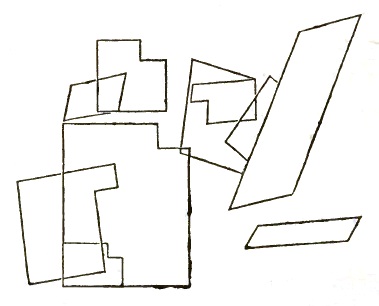
The gall-bladder was enlarged to the size of a swan's egg, and contained thick tarry fluid; but no gall-stones, or masses of inspissated bile. The hepatic duct was greatly enlarged, easily admitting the point of the finger. The cystic duct was also dilated, though in a much less degree. (Vide Plate I., c. d. e.)
Thirdly,—The gall-bladder, duodenum, abdominal parietes, and in fact all the abdominal viscera, were intensely stained, almost blackened, by the osmosed bile.
Fourthly,—The bile, on analysis, was found to contain in one thousand parts:—
Water 694·45
Solids 305·55
1000·00
======
Pigment Bile-acids Cholesterine Organic matter 288·99
Soda Potash Iron Inorganic salts 16·56
Whereas a specimen of normal bile taken from the gall-bladder of a woman aged sixty-one, was of a specific gravity of 1020, and contained in 1000 parts:—
Water 933·27
Solids 66·73
1000·00
======
Pigment Bile-acids Cholesterine Organic matter 56·73
Soda Potash Iron Inorganic salts 10·00
The difference in composition of these two biles is very striking. The one contains more than four times as much solid matter as the other; and if the relative amount of organic, and inorganic substances be compared, the curious fact is observed, that the difference in the amount of solids in the two cases, is almost entirely due to the change in quantity of organic matter. The inorganic salts have not even so much as doubled themselves in the abnormal bile. Whence is this? Soda is the chief inorganic substance found in bile, and we have seen that it occurs in the form of glycocholate, and taurocholate of soda, substances which, as before remarked, are re-absorbed from the distended ducts, and gall-bladder into the circulation, from whence they are constantly being eliminated with the urine; and this, no doubt, is one of the causes why the inorganic salts are proportionally in such small quantity in the abnormal bile of jaundice from obstruction.
Fifthly,—In the abdomen was a considerable quantity of dark straw-coloured serum, which on the addition of strong sulphuric acid became of a fine emerald-green colour, in consequence of the presence of bile. Traces of sugar were also present in the effused liquid. The serum had only collected in the latter weeks of the patient's life, and after the shrinking of the liver was observed to have begun.
Sixthly,—The liver was small in size, excessively dense, and very heavy. Externally, it had a dark olive hue, and on section presented a most curious appearance. The section was of an almost uniform yellowish-green colour, and studded over with excavations (Plate I., b), from which thick bile streamed in all directions. The apparent excavations were nothing more or less than immensely distended ducts. On looking into the ducts, it was observed that they presented the appearance of possessing valves. On microscopical examination, the hepatic cells were found smaller than normal, as if partially atrophied. The nuclei were unusually well marked, in consequence of the fat granules being almost entirely absent. (Fig. 8, b.) In the field of the microscope were a number of caudate or spindle-shaped cells (Fig. 8, c.), from the epithelial lining of the ducts. In the hepatic tissue were found some beautiful stellate crystals, as well as a number of separate needles of tyrosine. A few small crystals of cystine were also found. (Fig. 8, a.)
FIG. 8.
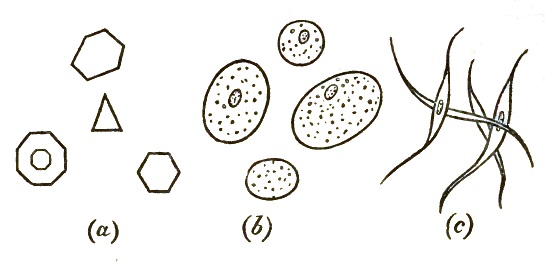
Seventhly,—The kidneys were enlarged, pale, and fatty-looking; and all over the surface of the section, as well as immediately under the capsules, which were very loosely attached, were small abscesses. The surface was also studded with numerous minute dark bile-pigment points, and it is possible that the abscesses were the result of the blocking up of the capillary vessels by the pigment deposit, as previously alluded to, page 57.
Eighthly,—The head of the pancreas was considerably enlarged, and on cutting into it, a quantity of pus oozed out from an abscess in its interior. The abscess was found to communicate with a large ulcerated spot in the duodenum. (Plate I., f.) On microscopical examination, the tumour of the pancreas was found to consist of an hypertrophy of the normal gland tissue, being, in fact, a chronic inflammatory tumour of the gland substance.
In no portion of the body was a trace of cancer detected, nor any enlargement of the mesenteric or other glands, to justify even a suspicion of malignant disease. So the opinion arrived at regarding the pathology of this case is, that the disease originated in an inflammatory affection of the pancreas, during the progress of which, the openings of the bile, and pancreatic ducts became blocked up; the interruption to the excretion of the bile giving rise to the jaundice, and at the same time inducing engorgement, and enlargement of the liver. The inflammatory affection of the pancreas had probably ended in the formation of an abscess, which, pushing the enlarged liver forwards, admitted of the distended gall-bladder being seen, and felt through the abdominal parietes. At length the abscess burst, and suddenly emptied itself into the duodenum; the yellow fluid discharged from the intestines being not bile, as the patient had supposed, but pus. No sooner had the abscess emptied itself, than the liver returned to its natural position, and thus accounted for the distended gall-bladder so suddenly ceasing to be seen or felt. The ulcer in the duodenum appears to be the mouth of the abscess, which has probably been prevented closing, partly on account of the occasional draining away of pus, which, being in small quantity, and mixed with the stools, escaped detection; and partly to the constant irritation of the passage of the food, there being no bile or pancreatic fluid to neutralize the acidity of the chyme. This might even be sufficient of itself to delay the healing process. The ultimate gradual atrophy of the liver would arise from the continued pressure of the distended bile-ducts interrupting the hepatic circulation, as formerly pointed out at page 48. Lastly, there being no bile or pancreatic juice admitted into the intestines, the greater part of the food taken passed out of the body unabsorbed, and the patient, though possessing an excellent appetite, and taking plenty of food, actually died of slow starvation.
My object in giving such prominence to this interesting case, is to show how valuable an adjunct physiological chemistry is to the other methods of diagnosis in obscure diseases of the abdominal organs, and to encourage others to follow in the same path; for it must be remembered that the foregoing was no dead-house diagnosis, but that every fact here stated was discovered and recorded before death.
Having now explained the mechanism of the two forms of jaundice—that arising from suppression, and that induced by obstruction—it only remains for me to remind my readers, that there is frequently a combination of the two conditions. Jaundice from obstruction, for example, cannot long exist without becoming complicated with jaundice from suppression. The continued backward pressure exerted on the hepatic parenchyma by the over-distended bile-tubes, sooner or later impedes the circulation in the organ to an extent sufficient to induce an impairment, if not an almost total arrest of the biliary secretion. Hence it is, that in the last stage of jaundice from obstruction, the biliary acids gradually diminish, and at last finally disappear from the urine. We have it, nevertheless, in our power to distinguish between the two forms of disease—for whereas, in jaundice arising from simple suppression, there is only an absence of the bile-acids; in jaundice from obstruction, complicated with suppression, the absence of the bile-acids is usually associated with the presence of tyrosine, and leucine. For before complete suppression occurs as a result of obstruction, the hepatic tissue has already had its nutrition so impaired, as to admit of the formation of these foreign substances. Lastly, the history of the case will of itself be an important guide.
EPIDEMIC JAUNDICE.
It is seldom that jaundice attacks persons in an epidemic form; as it does so occasionally, however, and that too in almost all countries, it is necessary that I should say a few words on its pathology. In a quotation, in the "Medical Times and Gazette," from the "Recueil de Mémoires de Médecine Militaire," vol. iii. p. 374, it is stated that, "M. Martin gave an account of an epidemic of jaundice which he had the opportunity of observing among the artillery and engineers of the French army stationed at Pavia during the Italian war. It commenced during the great heats of August, and terminated by the end of October. There occurred 71 cases in an effective of 1022 men. The causes he considers to have been the unusual heat, which gave rise to great congestion of the liver, the fatigue of long marches (the mounted men suffering oftener in proportion than the unmounted), indulgence in alcoholic drinks, and marsh miasmata. Great increase in the size of the liver in most of the cases, and of the spleen in many, was observed, and all complained of pain in the epigastrium and in the hypochondria. In fact, this last was the first symptom of the approaching jaundice. None of the cases proved fatal. Professor San-Galli informed M. Martin that a similar epidemic prevailed in the town of Pavia at the same time."
That jaundice may also occur in an epidemic form among pregnant women, has been shown by Dr. Saint-Vel, who relates that, "In 1858 the island of Martinique was, without appreciable cause, visited by an epidemic of jaundice, remarkable for its severity in pregnant women. It broke out at St. Pierre towards the middle of April, attained its maximum height in June and July, and terminated towards the end of the year. All races were attacked; the patients were mostly adults; no liver-complication could be detected; nor could any resemblance be traced between the disease and yellow fever. It was fatal to females only, especially during pregnancy. Of thirty pregnant women who were attacked at St. Pierre, ten only arrived at the full period of pregnancy without presenting any other symptoms than those of ordinary jaundice. The other twenty all had abortion or premature labour a fortnight or three weeks after the commencement of the attack, and died in a state of coma, which appeared a few hours before or after the expulsion of the foetus. The females who died were from the fourth to the eighth month advanced in pregnancy. In some cases, slight delirium preceded the coma, which was never interrupted, but became more and more profound up to the time of death. Its longest duration, in two cases, was twenty-four and thirty-six hours. It was not preceded by any notable modification of the general sensibility, nor of the respiration or circulation. Hæmorrhage was absent, except in one case, where a female had it before delivery. When death was delayed till three or four days after delivery, the lochia were healthy. Almost all the children were still-born; some lived a few hours; one alone survived. None of the infants had the icteric colour; nor was there any sign of jaundice in the ten children born at the full term."
The foregoing translation from the "Gazette des Hôpitaux," 20th November 1862, appeared in the "British Medical Journal" of the 7th of February, 1863, p. 141.
We have it further stated in the "Lancet" of the 21st February 1863, under the head of the "Health of Rotherham," that, "scarcely had the late fatal epidemic of fever subsided ere another, less fatal, but as widely spread, took its place. In last November several persons were attacked with jaundice, and now not less than 150 persons are suffering from it. None of those who were attacked by the late fever are suffering from the present epidemic."
When we reflect on the facts here related, we can have little difficulty in forming an opinion of the pathology of jaundice occurring in an epidemic form. Its mechanism seems to be precisely similar to that of the isolated cases of the disease which are every now and then met with as the result of blood-poisoning. I have recently seen a case of well-marked jaundice supervene on an attack of scarlet fever, and as it affords a tolerably good illustration of the pathology of such cases, it may, perhaps, be briefly given with advantage.
A London cabman, aged 23, was admitted under my care into University College Hospital, on the 2nd March of the present year. He stated that he had always enjoyed good health, but that lately he had been much out of spirits, in consequence of the death of one of his relatives. On the 25th February, after three days' illness, a scarlatinal rash appeared all over his chest, and extremities, and four days later (the day before his admission), he became jaundiced. March 3rd. His skin is now of a bright yellow colour, and when the finger is rapidly drawn across it, a pink line immediately takes the place of the yellowness, showing that there is still great subcutaneous vascularity. The throat is sore, and there is considerable difficulty in swallowing. The conjunctivæ are intensely yellow—proportionally more so than the skin, in consequence of the scarlatinal hue being still blended with the tint of the latter. The urine is high coloured, has a slight deposit of urates; contains a large amount of bile pigment, but no bile-acids. The stools have not been observed to be clay-coloured. The liver is enlarged (dulness extends 5½ inches in a perpendicular direction), and tender on pressure. He complains of pain in the hepatic region on taking a deep inspiration, and of a general uneasiness at other times. Has no sickness or vomiting. The mucous membrane of the tongue is red and raw-looking; flakes of epithelial fur are readily detached from it.
The case was at once diagnosed as one of jaundice from suppression. Its mechanism being supposed to be identical to that of the cases discussed at pages 25-9 under the head of jaundice arising from active congestion of the liver induced by blood-poisoning, a dose of calomel and jalap was accordingly administered, with the view of removing the portal congestion, and with the most satisfactory result; for, notwithstanding the jaundice being complicated with scarlatina, a very decided improvement in the colour of the skin took place within twenty-four hours, the other symptoms remaining as before. March 10th. The calomel and jalap was repeated on the 4th, and since then the skin has gradually become paler. It is now scarcely tinged.
To return to the cases of epidemic jaundice; they, as I have just hinted, are due to a precisely similar cause—blood-poisoning—either the direct result of miasmata, or of contagion.
A further explanation of the reason why jaundice occurs in an epidemic form, may be found in the circumstance that in all febrile states of the general system some one or other of the internal organs is liable to become congested. For example, typhus is, as a rule, complicated with cerebral congestion, typhoid with mesenteric, ague with splenic, scarlatina with renal, and so on. It is not, however, necessary that the organs should be affected in the same relation to the disease as is here given. On the contrary, in one epidemic of typhus, the brain may be congested, in another the lungs, and in a third the liver; and so also with other fevers. Hence we can have little difficulty in understanding why epidemics of jaundice every now and then occur, seeing that they are but the secondary results of other epidemic affections, although, as occasionally happens, the jaundice is the chief, if not the only well-marked symptom.
ARTIFICIAL JAUNDICE.
What is the source of the tyrosine, and leucine found in the urine, in cases like those previously described? Being well aware that the physiologist has it in his power to produce almost any pathological state or artificial disease at pleasure, I set about imitating on an animal the effects produced in the human subject by obstruction of the bile-ducts. Hitherto, artificial jaundice has been usually induced either by ligaturing the gall-ducts or injecting bile into the circulation; but as both of these methods were in the present instance objectionable—the first on account of the constitutional disturbance liable to be induced by the severity of the operation; the second from the bile being all at once thrown into the circulation, and thereby producing toxic effects, besides the danger of its too rapid elimination by the urine—I adopted another plan, which came much nearer to the state induced by disease in man—I took the bile of three healthy dogs, and injected it under the skin of a fourth. In this case the effects of the operation were almost nil, and the bile was at the same time placed in a position favourable for its slow absorption, just as in the human subject. During the first two days the animal remained comparatively well, the urine was normal in appearance, and contained neither bile-pigment, nor bile-acids. But on the third day the animal became ill, and on the fourth jaundice set in. He died on the fifth. After death the urine was found to contain not only bile-pigment, and bile-acids, but also the diseased products, leucine, and tyrosine; and what was more interesting still, the urine was loaded with sugar, just as occurred in the case imitated.
It will be remembered that in speaking of the bile-acids, I mentioned that while glycocholic acid is a crystalline, taurocholic is a non-crystalline substance. Tyrosine, and leucine stand in a similar relation to each other; tyrosine being crystallizable, leucine non-crystallizable. Now, taking this fact into account, together with the fact, that when the bile-acids are allowed slowly to enter the circulation, they reappear in the urine, accompanied with tyrosine, and leucine; and also with the third fact of these latter substances being found in the liver when the biliary function is interfered with, I am inclined to look upon tyrosine, and leucine as the products either of the arrested, or of the retrograde metamorphosis of glycocholic, and taurocholic acids. Moreover, I have found in one case, after injecting bile in the way before mentioned, into the cellular tissue, crystals of tyrosine spontaneously form in the bile taken from the animal's gall-bladder after death, and merely allowed slowly to evaporate. This result strengthens the foregoing opinion.
Frerichs states that he has never detected the biliary acids in the blood, even after bile had been injected into the circulation. In a remarkable case where 1 oz. of ox-bile killed a dog in less than five minutes from the time it began to be slowly injected into the jugular vein, I detected the bile-acids in a clear extract of the blood, with facility. This leads me to mention that, contrary to the statement of Frerichs, and in accordance with that of Kühne, the injection of the pure bile-acids into the blood is very dangerous, and that even the injection of pure bile into the cellular tissue, often proves fatal in the course of twenty-four hours, thereby showing that the constituents of the bile are highly poisonous.
In illustration of these facts I may cite the following experiments:—
Into the cellular tissue of the back of a full-grown, and healthy-looking terrier dog, I injected the bile taken from the gall-bladders of three healthy dogs, two of which had just been killed, the other had been dead a few hours. The bile was in the first two cases neutral, in the third faintly alkaline. All the biles seemed perfectly normal. They contained no crystals of any kind. Eighteen hours after the operation the animal appeared quite well, and took his food heartily. Four hours later a remarkable change took place. The dog looked dull and drowsy, and could not sustain himself on his legs; when left to himself, he lay on his side, and made not the slightest movement. He was not only paralyzed, but even the nerves of sensation had ceased to act, for when his tail, and feet were pinched, he was quite insensible to pain. The pupils were dilated, and the body felt cold. Death occurred twenty-three hours after the operation. Urine, and fæces were passed in small quantity immediately before death. The urine was strongly alkaline, and effervesced on the addition of sulphuric acid, thereby showing that it contained alkaline carbonates. Prismatic phosphatic crystals were present in the still fresh urine.
When tested for bile-acids, only the faintest trace was obtained, after the urine had been cleared with the acetate of lead and sulphuretted hydrogen.
The tissues of the abdomen and thorax were oedematous, but, within an hour after death, had not the disagreeable odour found in animals killed by injecting pure bile-acid. (See foot-note at p. 39.)
This experiment was again repeated with alkaline bile. Two ounces of ox-bile of a specific gravity of 1025 were injected under the skin of a large pointer dog. In twenty-four hours the animal was dead; the sub-cutaneous tissue all round the seat of the injection, red, inflamed, and infiltrated with blood. The urinary bladder was empty. The gall-bladder contained 1½ ounces of dark bile of a specific gravity of 1040. When examined with the microscope, the blood was found to contain a large excess of white corpuscles.26
26 It has just been said that the blood contained a large amount of white blood corpuscles. This reminds me of a fact that I have omitted to mention—namely, that in a case of severe jaundice from suppression, in consequence of cirrhosis of the liver, I found that the blood possessed a very treacle-like aspect. The serum was of a dingy yellow hue, and felt somewhat sticky to the fingers. Under the microscope the blood corpuscles were found to be large, and flabby, had a great tendency to adhere together by the edges, and become flattened on the sides whenever they came in contact. Moreover, the corpuscles looked as if they had no distinct cell-wall; some, and that too, in the freshly drawn blood, gave off buds, others split into two, each half when separate looking like a distinct blood corpuscle. In fact, the blood looked more as if it had been acted upon by some powerful chemical agent than anything else. I again examined it after the death of the patient, and found it presented all the above characters in a still more marked degree. To the naked eye it had a viscid, tarry appearance.
These results rather militate against the theory of the bile being re-absorbed, in an unchanged state, into the circulation, after the completion of the digestive process.
TREATMENT OF JAUNDICE.
After what has been said regarding the pathology of jaundice, I need scarcely remark that the treatment must vary according to the kind of disorder we have to deal with. A line of treatment found to be beneficial in one case of jaundice, might prove very hurtful in another. For, as has been shown in the foregoing pages, jaundice from suppression, and jaundice from obstruction, are, it might be said, two entirely different diseases, with only the symptoms of yellow skin, high-coloured urine, and pipe-clay stools in common. The success of our treatment will therefore depend on our powers of diagnosis.
The general principles upon which the treatment of jaundice must be founded are as follows:—
The first and great object is, of course, as in the case of every other disease, to remove, if possible, the exciting cause. When that is accomplished, we can with safety turn our attention to the removal of its effects. I need not here detail the different exciting causes which it is our duty to remove. I have indicated them elsewhere, and the mere mention of some of their names is sufficient to denote the line of treatment which ought to be adopted. Thus, for example, if it be ascertained from there being symptoms of tenderness, &c., in the hepatic region, that the jaundice arises from active congestion of the liver, the first object would of course be to subdue the congestion of that organ by means of leeches, hot fomentations, saline purgatives, &c., according to the age, sex, and constitution of the patient. On the other hand, if the jaundice be the result of passive congestion of the liver, we know well that so long as the exciting cause exists elsewhere, it will be worse than futile to attempt the removal of the hepatic congestion by direct means. In such a case, therefore, if to remedy the cause is beyond our power, our object will be to concentrate our efforts on the mitigation of its effects. Thus I might go through the whole list of causes of jaundice, and point out what appears to be the most appropriate treatment of each; but I think the time of my readers and my space, will be more profitably employed, if, instead of doing so, I turn my remarks chiefly to the therapeutical action of those remedies which we are constantly employing in the treatment of jaundice. The first remedy that merits special notice is mercury.
The benefit of mercury in cases of liver disease cannot be denied; but the injudicious employment of this drug in cases of jaundice, has frequently been followed by the most disastrous results. There was a time when mercury was administered in all cases of jaundice, irrespective of their cause; now, however, men are fortunately becoming more careful in the employment of this drug. But there is still a mistaken notion regarding the therapeutical action of mercurial preparations. It was at one time thought that they stimulated the liver to secrete bile, and now since physiology has shown that they possess no such action, many have gone to the opposite extreme, and declared, that if mercurials do not stimulate the liver to secrete bile, their benefit in hepatic disease has been a delusion; and the dark stools following upon their employment but the result of the sulphuret of mercury formed in the intestines. I take a very different view of the matter; for though believing that mercury does not directly stimulate the liver to secrete bile, I nevertheless opine that it has an important indirect effect in reinducing the biliary secretion, and thereby curing certain cases of jaundice.
The action of mercurials seems to me, to be this—mercury is a powerful antiphlogistic—it reduces the volume of the blood by its purgative properties, and it impoverishes the blood by its direct action on the red corpuscles. It has been poetically said by Dr. Watson, that mercury can blanch the rosy cheek to the white of the lily; and nothing is more true, for in experiments on animals, I have found the prolonged use of mercury reduce the red blood corpuscles to a minimum. From this it is easy to understand how mercury acts in inflammatory affections; and as in the majority of cases of jaundice from suppression, the stoppage of the biliary secretion is due to active congestion of the liver, mercury proves beneficial in such cases, not by stimulating the biliary secretion, but simply by removing the obstacle to its re-establishment, namely, the hepatic congestion.
As a good illustration of the correctness of this theory regarding the action of mercurials in cases of jaundice arising from congestion, I may be allowed to quote the following case, which appeared among the Hospital Reports of the "Lancet" of the 7th December, 1861. The case is headed, "Intense Congestion of the Liver, simulating an Abdominal Tumour:"—
Alex. E——, aged forty-eight, was admitted into St. Bartholomew's Hospital, under the care of Dr. Farre, on the 17th October, 1861. The patient had, it appeared, been suffering from jaundice during six weeks. He stated that the tumour in the epigastrium began about the same time as the yellowness of the skin.
On examination, a prominent swelling was noticed in the epigastric region, possessing an indistinct feeling of fluctuation, but it was found to be continuous with the liver. The motions were not bilious, but were of a clay colour, and the urine looked like pure bile. Three grains of blue pill and two of Barbadoes aloes were ordered every night. By the 25th the hepatic tumour was less, and the icterus was disappearing. On November 4th the urine was clearer and full of lithates. The conjunctivæ were the only parts observed of a yellow colour.
November 11th.—Although the pills had been continued up to this date, the mouth was not sore. The urine and stools were natural, and the patient was convalescent. A few days afterwards he left the hospital.
The result of the case clearly proved not only that the swelling was from a highly congested liver, but also that the jaundice depended on this state.
In this case it is evident that the primary beneficial action of the mercury was to reduce the congested state of the hepatic organ, and no one, I think, would venture to say that this was accomplished by the power the mercury possessed of exciting the liver to secrete bile.
If, then, the above view of the therapeutical action of mercurials be correct, it is easy to understand how, in cases of jaundice from permanent obstruction of the gall-duct, the administration of mercury or any other lowering medicine, must prove detrimental by hastening the fatal termination.
Although mercury has not, there are some substances which have, the power of exciting the flow of bile, just as there are substances which excite the flow of saliva. Among these the mineral acids, and soluble alkalies, hold the first rank. It may seem strange that acids, and alkalies, should be here placed in juxta-position; but the reason of this arrangement will immediately appear.
According to a physiological law, acid substances have the power of exciting alkaline secretions, and alkaline substances of stimulating acid secretions.
Bile being an alkaline secretion, we can therefore have no difficulty in understanding how the mineral acids act in cases of jaundice from suppression, induced, for example, by enervation. They simply stimulate the secretion of bile.
It is not so easy, however, to comprehend the action of alkalies in similar cases. My explanation of their action is as follows:—When taken after food, and when taken on an empty stomach, the action of an alkali is entirely different. After food, and during digestion, the stomach contains a quantity of acid gastric juice, and an alkali taken then, only neutralizes the acid. On the other hand, when an alkaline substance is introduced into an empty stomach, it acts according to the general law of exciting an acid secretion; consequently, an immediate flow of gastric juice takes place. And I believe it is the excess of this acid gastric juice, which, on reaching the duodenum, stimulates the secretion, and excites the flow from the gall-bladder of the alkaline bile, just as the mineral acids do under similar circumstances. One remark further is, however, necessary. The quantity of alkali employed for the purpose of stimulating the secretion, or of exciting the flow of the already secreted bile must be small, for if much be used, the greater part of the gastric juice will be rendered useless, in consequence of its being neutralized as fast as it is secreted. It may be laid down as a general rule, that when we desire to increase the flow of bile by means of a mineral acid, the acid must be given after food. When, on the other hand, an alkali is selected for that purpose, the alkali must be administered before food.
For obvious reasons, both alkalies and acids are counter-indicated in cases of jaundice resulting from active congestion of the liver; and it is equally evident that they can be of no direct service in jaundice arising from occlusion of the bile-duct, where our object would be rather to diminish than to increase the secretion of bile.
Alkalies, or at least some alkalies, possess certain other properties besides those to which allusion has just been made, which may be usefully turned to account in the treatment of hepatic diseases. For example, we have been long told that alkaline carbonates are valuable remedies in cases of gall-stones, in consequence of their possessing the power of dissolving biliary calculi. Now, although I am not sufficiently enthusiastic to believe that alkalies can have much effect in dissolving gall-stones when once formed, I nevertheless believe that they are of the utmost advantage in preventing and arresting their deposition. The alkali to which I give preference is the carbonate of soda, and the reason why I prefer it to the carbonate of potash, is in consequence of my believing that the advantages derived from administering alkalies in cases of incipient gall-stones are entirely due to our being able thereby to increase the amount of glycocholate, and taurocholate of soda present in the bile; both of which substances, separately or combined, retain cholesterine in a soluble form; and, as is well known, by far the greater number of biliary calculi are composed almost entirely of pure cholesterine.
The carbonate of soda has yet another advantage. It was long ago observed by Dr. Prout that gall-stones are very common in persons of a gouty, and rheumatic tendency of body, a fact which I have myself been able to confirm on several occasions, by making a quantitative analysis of the uric acid in the twenty-four hours' urine, as recommended at page 56. In such cases the carbonated alkali is of double service, for while increasing the solvent in the bile, it at the same time counteracts the uric acid diathesis. In a case of gall-stones, in a woman aged 36, where there was an almost daily deposit of fine crystalline uric acid in the urine, it was found necessary to continue the administration of ten grains of soda, with five of rhubarb, three times a-day during two months, before this tendency to lithic acid deposit was entirely overcome.
Recently I have prescribed lithia water to persons of the uric acid diathesis in whom I had reason to suspect the existence of a predisposition to gall-stones; and when it was necessary to combine it with stimulants, sherry has been the wine selected. For some further remarks on the treatment of gall-stones, see pages 114, 119, and 123.
There is a remedy to which I wish to call special attention, namely, benzoic acid. This substance was first recommended as a remedy in jaundice by a German physician, about six years ago. Since then, I have tried it several times, and found it of benefit in jaundice arising from suppression. In those cases of obstruction, on the other hand, in which I tried it, it appeared to be anything but beneficial. I give it in the form of pill, three times a day. Dr. Green, one of my former pupils, who has just returned from India, tells me that he acted on my suggestion, and tried it in a case of well-marked jaundice, following an attack of delirium tremens; and that by the end of eight days it would have required an experienced eye to detect the tinging of the conjunctivæ.
The following may be cited as a tolerably good example of the value of benzoic acid in cases of jaundice from enervation:—
William M——, aged eleven years, labouring under an acute attack of severe jaundice, came under my care at University College Hospital on the 2nd of February. The patient appeared to be a moderately developed, and very intelligent boy. The jaundiced condition of the skin, his mother said, was first noticed on the 30th of January, only two days before he came to the hospital. It was further ascertained that, although the boy had for some length of time been subject to monthly attacks of severe headache, and bilious vomiting, he had never before suffered from jaundice. On the present occasion he complained of headache, but it was unaccompanied either by sickness or vomiting. On examination the liver was found normal in size, and not in the least tender on pressure. The bowels were moderately open, and the stools not clay-coloured. The urine was of a deep orange tint, and the skin of a dark yellow hue. There was an abundance of bile pigment, but not a trace of bile-acids in the urine.
As the jaundice appeared to be the result of enervation, brought on by over mental exertion, the boy was ordered to be kept from school, and not allowed to read any books (his mother said he was always reading). At the same time three grains of benzoic acid were ordered to be taken thrice a-day.
9th February.—The skin was now very much paler, the yellow colour being nearly gone. The conjunctivæ were still yellow, although less so than at last visit. The urine remained unchanged in colour. He was ordered to continue the medicine.
16th February.—Skin perfectly normal in colour; if anything perhaps a shade whiter than natural. Conjunctivæ no longer yellow. Dismissed cured.
In this case no medicine whatever, except the benzoic acid, was given.
As far as my experience goes, benzoic acid appears to be most useful in jaundice arising from enervation or from active congestion, as in the case related at page 27; but in cases of the latter kind it seems to be of little service until the acute symptoms have disappeared. I am still rather doubtful regarding the mode in which it acts, although one point seems clear, namely, that it hastens the re-absorption from the tissues, and elimination from the body, of the bile-pigment. It thus appears to play the part of a whitewash; for, as one of my lady patients once graphically said, the medicine had bleached her. On one occasion I tried benzoic acid in a case of jaundice following upon an attack of ague; but it proved of no service. Indeed, quinine, combined with mercurials, seemed in that case to be the only remedy.
There is another drug which proves of service in jaundice from suppression, namely, podophyllin, or May-apple. This remedy, which was first introduced from America, is supposed to possess both the alterative and purgative properties of mercury. As an alterative, it is given in doses varying from 1/8 to ¼ of a grain, three times a-day; as a purgative, from ¼ to 1 grain, as a single dose. I have given this remedy a tolerably fair trial, and although it seems to be very useful as a purgative in hepatic disease, and to increase the flow of bile, I have found it open to two objections: firstly, its action is slow, and not always certain; and, secondly, in delicate females it gives rise to a good deal of griping. This latter objection can, however, to a certain extent, be counteracted, by combining the remedy with hyoscyamus. On the whole, I prefer mercurials to podophyllin, and only administer the latter in slight cases of jaundice, or in those where mercurials are counter-indicated.
For example, in cases of feeble liver, where there is an insufficient secretion of bile from want of nervous power, podophyllin is decidedly of service, for in such cases mercury is of course counter-indicated. Moreover, podophyllin can be advantageously combined with vegetable tonics, and, when given along with gentian or quinine, forms an admirable hepatic stimulant in some of the cases usually denominated "torpid liver."
I cannot refrain from making a few remarks on what I consider the injudicious employment of podophyllin. Like every new remedy, it has to run the risk of falling into disfavour, in consequence of its too ardent admirers blindly prescribing it in all cases of hepatic disease; in many of which it must of necessity prove unsuitable, if not even detrimental. In cases of jaundice, for example, podophyllin is at one, and the same time, the bane, and the antidote. The bane in all cases of jaundice from obstruction, the antidote in a few cases of jaundice from suppression. Having already indicated the cases in which it may be administered with advantage, I shall now call attention to one of those where it cannot be employed without injury, and one in which it is, nevertheless, frequently given. The case I allude to is that of gall-stones. When once a gall-stone has formed, and is blocking up the common bile-duct, thereby causing jaundice from obstruction, it is easy enough to understand why a substance like podophyllin, which increases the biliary secretion, is to be avoided. It is not, however, so easy to understand why the remedy is equally counter-indicated, either during the formation or sojourn of a gall-stone in the gall-bladder. This, therefore, I must explain. In speaking of the mode of formation of gall-stones in the gall-bladder (page 43), I have stated that their formation is due to the deposition of the less soluble parts of the bile, either as a consequence of these ingredients being in excess, or in consequence of the solvent, whose duty it is to retain them in solution, being in reduced quantity. It follows, then, as a natural result, that the longer bile sojourns in the gall-bladder, and the thicker it becomes, the more likely are its constituents to be deposited, and increase the size of the already existing concretion, or give origin to a new formation. It may be further added, that the greater the amount of bile secreted, the longer is it likely to remain in the gall-bladder, and the more concentrated to become; for, as is well known, there is a constant absorption of the aqueous particles of the bile going on during the whole time it is stored up in its reservoir. If, then, during the intervals of digestion, the liver secretes merely sufficient bile to meet the requirements of the succeeding meal, by the end of the digestive process the gall-bladder will be entirely emptied of its contents, and ready to receive a fresh supply. Whereas, if the liver secretes more bile during the intervals of digestion than the wants of the system require; after the completion of each succeeding meal the excess of bile will remain behind in the gall-bladder, and, while becoming stored up with that subsequently secreted, of necessity, favour the increase or excite the formation of gall-stones in persons predisposed to them. There being nothing more conducive to the deposition of biliary calculi than a well-filled gall-bladder.
As a warning against the indiscriminate use of podophyllin, I may cite the following case, which has come under my notice as these sheets are passing through the press. A few weeks ago I received a telegram requesting me to visit, as early as possible, a lady dwelling in the neighbourhood of St. John's Wood. On my arrival I found the lady suffering from a well-marked jaundice, and considerably prostrated in consequence of her having just arrived from Brighton, where she had gone for the benefit of her health, but where, instead of getting better, she got considerably worse. The history of the case was, that the lady had been seized with pain in the back (middle of dorsal region) about three weeks before I saw her. That there had been great tenderness in the region of the gall-bladder—so much so, that she could scarcely tolerate the pressure of her stays; and that she had suffered from occasional attacks of sickness after eating.
On examining the patient I found the liver enlarged, and tender on pressure. The gall-bladder much distended, and easily felt. The skin of a yellow hue. The stools of a pale tint. The urine very dark-coloured, and loaded with lithates. I had, consequently, no difficulty in diagnosing the case as one of gall-stone impacted in the common bile-duct; but on communicating my suspicions to the patient, I was informed that such could not possibly be the case, for during a considerable time past she had been carefully treated with podophyllin. Indeed, I learned to my surprise that she had taken from a quarter to half a grain of that substance nearly every day during the six previous months!
This incidental piece of information, instead of shaking my opinion, as the patient had apparently expected, only tended to strengthen my suspicions, for the reasons previously given, namely, that the podophyllin must have tended to keep the gall-bladder constantly full of bile. I accordingly prescribed for the case as one of impacted gall-stone, and left instructions that the stools should be carefully examined for its appearance.
On the following day the patient felt better; but the jaundiced tint was deeper, the stools paler, and the urine still high-coloured. The deposit of lithates had, however, slightly diminished. Still, feeling certain that the case was one of impacted gall-stone, I ordered the medicine to be repeated, and the stools to be again carefully examined.27 On my arrival at the patient's house the next day, the maid met me with an expression of satisfaction which could not be misinterpreted, and I had scarcely entered the sick chamber when, with an air of triumph, she showed me a gall-stone about the size of a large garden-pea, or small field-bean. It had been passed that morning about 11 o'clock, that is to say about fifteen hours after the second dose of medicine. On analysis the stone was found to consist almost entirely of cholesterine, and I have not the smallest doubt in my own mind that to the constant use of the podophyllin may, in a great measure, be attributed its formation. Unfortunately the stone had been accidentally broken before I saw it, and I was consequently unable to ascertain decidedly whether it was a solitary calculus, or one of many. Had it been one of several, it would of course have possessed facets. One facet would have indicated that the stone was one of two; two facets that three stones existed; three facets, that the gall-bladder had contained at least four calculi; while four or more facets would denote that the stone was one of many; whereas, if it was a solitary calculus, no such markings would be present.
27 We are sometimes told to add water to the stools, and that if gall-stones are present they will be found floating on the surface. I have never yet been able to detect a gall-stone in this way. The plan I recommend is, therefore, to mix the stool freely with water, and either decant the supernatant fluid, and then add fresh portions of water till the whole of the soluble matter is removed, or to strain the mixture through a hair-sieve. The gall-stone in either case remains behind, and can be readily detected.
I may merely add, in conclusion, that from the time the stone passed, the stools resumed their normal colour—the first two or three were much darker than natural, in consequence of the sudden escape of the pent-up bile—the urine gradually became pale, and clear, and the skin regained its wonted hue. The latter change was expedited by the administration of benzoic acid, and in a week from my first visit, a stranger would have been quite unable to detect that the patient had laboured under a recent attack of jaundice.
A few years ago a mixture of sulphuric ether, and turpentine was very extensively used, especially in France, as a solvent for gall-stones. This line of treatment was adopted on account of the well-known solubility of cholesterine in sulphuric ether, and it was thought that the remedy would act upon the cholesterine concretions in the gall-bladder in the same manner as it did out of the body. After a time, faith in the powers of the mixture became shaken, and it at length gradually ceased to be employed.
Within the last year or two, Dr. Bouchut28 has revived the same theory with another form of remedy, namely, chloroform, which he administers internally, with the view of dissolving any inspissated bile or biliary calculi that may be lodging in the gall-bladder. Dr. Bouchut states that he has treated one case of gall-stones in this manner with success. Now, although I have not the slightest desire to throw discredit on the statement of Dr. Bouchut, I must candidly admit that I am very much inclined to doubt the accuracy of his observations. In the first place, it is always extremely difficult to ascertain the existence of biliary concretions so long as they remain in the gall-bladder, and it is equally difficult to know, after gall-stones have been once passed by a patient, whether or not all have come away. If, then, we administer chloroform to a patient, either before or after a gall-stone has actually passed, we cannot, with anything approaching to certainty, attribute the cessation of his symptoms to the circumstance of the chloroform having dissolved a gall-stone. In fact, on physiological grounds, I very much doubt the efficacy of either sulphuric ether or chloroform as solvents of gall-stones in the living body. Sulphuric ether, and chloroform would no doubt dissolve a concretion of cholesterine in the gall-bladder were they admitted into that viscus in sufficient quantity, and in a pure state. But we have no proof that such is the case. On the contrary, we know, at least in as far as chloroform is concerned, that exactly the opposite is the fact; for no sooner does chloroform become absorbed, and mingled with the constituents of the blood, than it becomes decomposed, the chlorine combining with the blood, and the formic acid being set free.29 And even supposing that sulphuric ether and chloroform existed in the blood in a free state, they could not possibly do so in a sufficiently concentrated form to be able to act as solvents of biliary calculi.
28 "Edin. Med. Journ." 1861, p. 398.
29 Jackson, Comptes Rendus, February 25th, 1856.
My own experiments on animals have shown me how rapidly fatal even small quantities of chloroform are when injected into the circulation, and a similar remark is equally applicable to sulphuric ether. A few drops of these substances can very readily be injected into the circulation with impunity;30 but the quantity must not be increased beyond a certain amount, far less than could possibly dissolve a single grain of cholesterine, otherwise immediate death follows the operation, by inducing a state of body closely resembling rigor mortis, from which the animals never recover. I am, therefore, completely at a loss to understand how these remedies can be of service in dissolving gall-stones in the living body; and as I make it a rule as seldom as possible to prescribe a remedy without a knowledge of its physiological action, I have not yet ventured on an empirical trial of the effects of sulphuric ether or chloroform administered internally in cases of gall-stones. For some remarks on the passage of biliary calculi, see page 123.
30 Vide the Author's paper on a new method of producing diabetes artificially in animals, by the injection of stimulants—alcohol, ether, chloroform, ammonia, &c.—into the portal circulation. Comptes Rendus de la Societé de Biologie de Paris. 1853.
Taraxacum has been widely used in hepatic disease associated with jaundice, and is believed to be particularly well adapted to cases arising from congestion. As in such cases I generally trust to more potent drugs, my experience with this remedy has been too limited to admit of my offering an opinion of its value.
The majority of cases of jaundice from obstruction, are much less under the power of remedial agents than those arising from suppression, for we have here three distinct conditions to combat: Firstly,—The derangements originating in the absence of bile from the digestive canal. Secondly,—The morbid effects arising from its accumulation in the ducts, and consequent interruption to the hepatic functions. Thirdly,—The general poisonous action on the system, of the re-absorbed bile.
As regards the first of these effects,—namely, the derangements arising from an absence of bile from the digestive canal, it may be said that if these were the only difficulties with which we had to contend in cases of jaundice from obstruction, they could easily be overcome. For, in the first place, the absence of bile is not attended with any immediate danger, a circumstance which has led to the common belief that the presence of bile is not absolutely essential to life. Experiments on dogs with biliary fistulæ, like those before referred to, as well as cases in the human subject, have proved that life may be sustained, under certain conditions, for a very long period, without bile reaching the intestines. Indeed, the only immediate bad effects which appear to result from its absence, are costive bowels, great flatulence, and extremely offensive stools. The indirect bad results,—namely, loss of flesh, &c., as has been proved by experiments on animals, can be counteracted by giving an additional amount of food; and even the direct results of constipation, flatulence, and foetor, may be overcome by appropriate remedies.
The secondary morbid effects, namely, those arising from the accumulation of bile in the ducts, are unfortunately not so easily under control. Could we remove the cause of obstruction, these would, of course, immediately cease. This, however, is seldom in our power, except in the case of gall-stones, the expulsion of which we can aid in various ways. In general, we can very successfully aid the passage of a stone through the ducts by administering an anodyne containing a full dose of the tincture of belladonna, which apparently assists in dilating the duct. Placing the patient in a warm bath is also of service; and when the paroxysms of pain are very severe, the occasional inhalation of the vapor from a couple of drachms of sulphuric ether poured on a handkerchief, made into the form of a cup, is generally attended with great relief. Each of these modes of treatment may be followed either by a brisk emetic, or purgative, in the hope that the efforts of vomiting or purging may hasten the expulsion of the stone, either by the mouth or rectum.
It ought never to be forgotten, that the evil results of a gall-stone do not always cease when it has reached the intestinal canal. Even death itself has resulted from the impaction of a gall-stone in the duodenum. When we have any suspicion that the stone is large, our treatment must therefore be continued until its extrusion by the mouth or rectum has been accomplished.
When the occlusion of the common bile-duct is caused by an organic tumour, no treatment of ours can be expected to remove the obstacle, and sooner or later the patient is carried to an untimely grave. Our efforts of relief in such a case ought therefore to be directed to another channel; and here, in order to give the sufferer at least some chance of recovery, even although it be little better than a forlorn hope, I cannot refrain from recommending, in cases of permanent occlusion of the duct, in which there is great distension of the gall-bladder, the establishment of an artificial biliary fistula. Were this done, the patient would be placed, as nearly as possible, in the same condition as an animal in which the operation has been performed for physiological purposes, and, we might almost hope, with an equally favourable result, at least, in as far as the biliary functions are concerned. In the first place, we would have removed all the derangements resulting from the interruption to the flow of bile, and consequent upon the distension of the ducts. In the second place, we would have obviated the danger arising from the poisonous effects of the re-absorbed bile, which the experiments previously cited (page 98) show are of no trifling nature; and, lastly, we would only require to combat the evils arising from the absence of the biliary secretion in the digestive process, which, as was before said, can to a certain extent be overcome by giving an additional quantity of food, and paying attention to the bowels. In these remarks I have omitted taking into consideration the effects that might arise from the tumour, or other obstructing cause to the biliary secretion, for these would in no way be directly influenced by the establishment of the biliary fistula.
The artificial establishment of a biliary fistula in the human subject, is not such an Utopian idea as might at first be imagined. Distended gall-bladders having been several times tapped with success, both in this and other countries, and the permanent establishment of a fistula, if done in the manner I shall immediately point out, would, in my opinion, be a much less hazardous operation than simple tapping. Biliary fistula in dogs are generally made in a single operation, by cutting through the abdominal parietes, seizing the gall-bladder, stitching it to the lips of the wound, and inserting a cannula. Here there is always some danger of the wound not healing by the first intention, and of the passage of bile into the abdominal cavity. In the case of the human subject, I should, therefore, recommend the inducing of the adhesion of the gall-bladder to the abdominal parietes by means of an escharotic, before making the opening; in which case, I can scarcely imagine that the operation would prove one either of difficulty or danger. But even supposing that it were not entirely free from either, it would still surely be preferable to give the patient at least a chance of prolonging his life, rather than to permit a fatal affection to run its uninterrupted course, which we know can, at best, be calculated by months only.
In those cases of jaundice from obstruction, where it might be considered inadvisable to adopt the plan here suggested, we ought in our treatment carefully to avoid the common error of administering mercury, or other substances supposed to have the power of augmenting the biliary secretion. We must equally avoid the administration of foods likely to produce a similar effect, for the sufferings of the patient are not so much due to a deficient secretion, as to a want of biliary excretion. Our whole energies should be directed to sustaining the strength of the patient, and mitigating, if possible, the physical effects of the accumulation of the bile in the gall-bladder and biliary ducts, as well as the poisonous action of the re-absorbed secretion. This, I believe, we can best do by administering light and readily digested food, keeping the bowels open by gentle purgatives, and favouring the elimination of the biliary constituents from the blood by mild diuretics. Our object may be still further advanced by artificially supplying the place of the absent bile in the digestive process. Not, however, in the way usually adopted, of giving inspissated bile along with the food; a method of treatment which originated ere modern physiology rent the veil of therapeutical empiricism. In the first place, the bile prepared according to the method indicated in the pharmacopoeias, has its most essential properties destroyed during the process of preparation. And in the second place, we have hitherto been instructed to administer it at the very time which modern research has proved to be the most unsuitable that could possibly be devised. In administering bile immediately after food, as is usually done, we most effectually produce the contrary result to what is intended. When bile mingles with gastric juice, it destroys the digestive power of the latter, so that by giving the bile immediately or soon after a meal, we really diminish instead of increase the digestive functions. My experiments, both chemical, and physiological, have led me to propose not only a new method of preparing bile for medicinal purposes, but also to suggest an entirely new mode of administering it.
Firstly,—As regards the method of preparation. Nothing can be more simple, and at the same time more effectual. Fresh bile, taken directly from the gall-bladder of the newly killed pig, is filtered, through very porous filter-paper, to free it from mucus; it is then as rapidly as possible evaporated to dryness at a temperature not exceeding 160° Fahr. The bile, as soon as dried, is ready for use. Simple as this operation appears in theory, there are two practical difficulties connected with it—1st, Bile filters very slowly, and consequently little must be put into the filter at a time. 2nd, Bile is rather hygroscopic, and consequently, in order to get it dried quickly, it is necessary to spread it over a large surface. If the bile has been well prepared, that is to say, thoroughly freed by filtration from its ferment mucus, and well dried, it will keep in stoppered bottles for many months without losing any of its active properties.
Having stated that bile as at present employed more frequently does harm than good, by retarding instead of hastening the digestive process, I have now to point out the manner in which it may be given with advantage.
If bile be administered, as I propose, at the end of stomachal digestion, it will, as in the healthy organism, act on the chyme at the proper moment, and thereby render it fit for absorption. In order still further to ensure the action of the bile being delayed until the food is in a condition favourable to its action, that is to say, until it is ready to pass from the stomach into the duodenum, I have had the bile, as above prepared, put into capsules,31 which are not readily acted on by the gastric juice. While in the stomach, the capsules, however, swell up from the size of a pea to that of a small gooseberry, and at the same time become so soft that they will readily burst in passing the pylorus into the duodenum, and thereby allow the bile to escape, and come in contact with the food at the precise moment its action becomes requisite in the digestive process.32 The capsules not only preserve the active properties of the bile for an almost indefinite period, but they have the advantage of most effectually preventing the patient tasting the remedy.
31 The capsules were made by Savory and Moore, and I have every reason to be satisfied with the manner in which they accomplished the object in view.
32 Prepared bile, made up into an ordinary pill, dissolves in gastric juice in a quarter of an hour. When the pill is silvered it is dissolved in half an hour, and when gilded, in forty minutes. Whereas, in the same specimen of gastric juice, the capsules prepared for me by Savory and Moore, although swollen to more than three times their original size, were nevertheless intact at the end of an hour and a half. They readily broke on being gently squeezed between the finger and thumb, it is not therefore probable that they would pass the pylorus in this condition without giving way, and allowing their contents to escape.
Each capsule contains five grains of the prepared bile; and five grains is equal to one hundred grains of liquid bile fresh from the gall-bladder. Two capsules therefore represent two hundred grains of pure bile, a quantity (though less, perhaps, than the healthy organism consumes during each digestion) which in most cases would be sufficient for the wants of the system. If, however, a larger amount be considered necessary, there is no reason why three or more capsules should not be given. By the administration of prepared bile in the manner here described, the physician is enabled to imitate nature, and supply an important element to the system; which, although incapable of curing the disease, can nevertheless ward off for a time the fatal termination.33
33 It is not alone in cases of jaundice that the prepared bile may be of service, but also in the various forms of duodenal dyspepsia, so common among the literary classes, consequent upon either a deficient quantity, or an abnormal quality of bile.
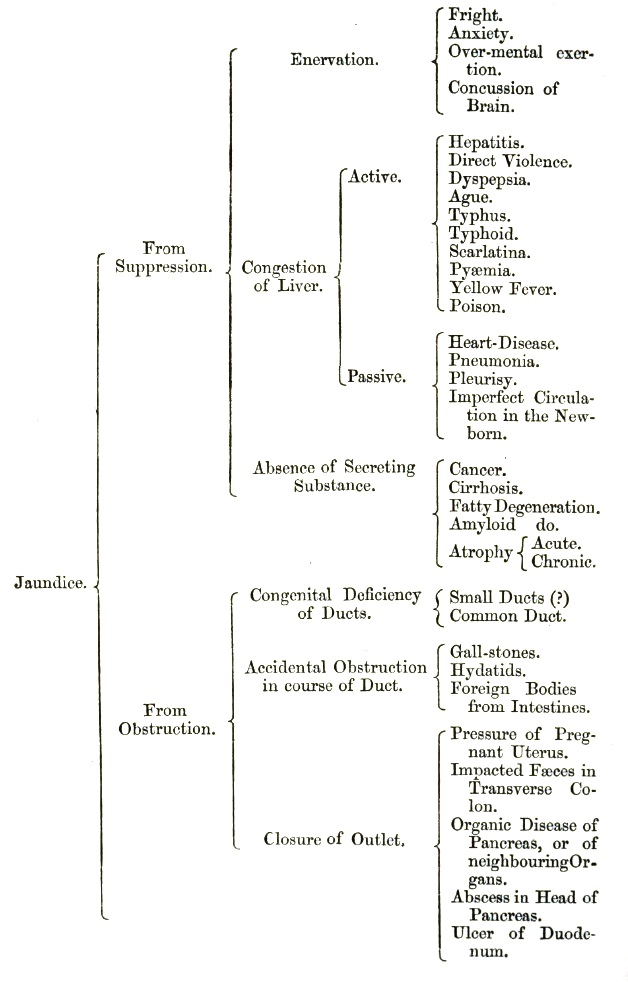
TABULAR VIEW OF THE PATHOLOGY OF JAUNDICE, ACCORDING TO THE AUTHOR'S VIEWS.
INDEX.
A.
Abscess in kidney,
58
in pancreas,
86
Acids, treatment by,
106
of bile,
8
,
36
,
58
Acute atrophy of liver,
34
Ague, jaundice in,
28
urine in,
28
Albumen in urine of ague,
28
Albuminose,
14
Alkalies, treatment by,
106
Artificial jaundice,
95
Atrophy of liver,
34
B.
Benzoic acid, treatment by,
109
Bidder's researches,
16
Bile, acids of,
8
,
36
,
58
tests for,
58
,
61
action of, on albumen,
14
action on fats,
16
analysis of,
83
colour of,
10
diseased,
83
drunk by Caffres,
19
effects of food on,
11
inorganic constituents, of,
10
pigment in kidneys,
57
,
86
mode of secretion,
11
nature of,
7
,
83
in digestive process,
15
essential to life?
13
specific gravity of,
10
treatment of jaundice by,
127
resin,
10
Biliary fistula,
124
Biliverdine,
7
,
56
Blood in jaundice,
100
Budd's (Dr.), views,
7
,
30
C.
Cancer of liver,
32
of pancreas,
46
Carbonate of soda, treatment by,
108
Cherry-stones in bile-ducts,
45
Cholesterine,
8
,
82
,
108
Colour of bile,
10
Congestion, hepatic,
24
,
104
Cystine,
86
D.
Diseases with which jaundice is associated,
3
Dyspepsia,
26
E.
Eiselt (Dr.),
68
Enervation,
22
,
110
Epidemic jaundice,
90
F.
Farre (Dr.), case,
104
Fat in fæces,
54
,
72
absorption of,
16
Flatulence,
13
Frerichs on mechanism of jaundice,
6
,
33
Fright, effect of,
23
G.
Gall-bladder, absence of in animals,
12
,
41
congenital deficiency of,
40
Gall-stones—
mode of escape from gall-bladder,
44
mode of formation,
43
in common duct,
44
in gall-bladder,
43
in intestines,
123
treatment of,
108
,
114
,
119
,
123
carbonate of soda in,
108
chloroform in,
119
podophyllin in,
115
sulphuric ether in,
119
Glycocholic acid,
8
,
97
Glycocholate of soda,
8
injected into blood,
39
H.
Heart disease, jaundice in,
30
Hepatic congestion,
24
,
104
Hoppe's method,
58
Hydatids in bile-ducts,
45
I.
Impacted fæces, effect of,
46
Inflammation of liver,
24
,
104
Inorganic constituents of bile,
10
,
83
Intestinal excretion, analysis of,
51
Introduction,
1
J.
Jaundice, artificial,
95
from acute atrophy of the liver,
34
absence of bile-duct,
40
absence of gall-bladder,
41
absence of secreting substance,
31
ague,
27
blood-poisoning,
27
,
93
blow on head,
24
cancer,
32
enervation,
22
,
110
entozoa,
45
epidemic,
90
from fright,
23
gall-stones,
42
,
116
hepatic congestion,
24
,
104
mental emotion,
22
,
110
active hepatic congestion,
25
,
104
passive hepatic congestion,
29
disease of the pancreas,
46
pregnancy,
46
obstruction,
39
,
71
scarlatina,
93
suppression,
20
typhus,
27
tubercle,
32
zymotic disease,
27
,
90
mechanism of,
19
treatment of,
101
K.
Kidneys as eliminating organs,
11
Kühne's views,
58
,
98
L.
Lenz's experiments,
16
Leucine,
63
,
80
,
95
Liver cells,
38
,
85
Liver, extirpation of,
11
M.
Marcet (Dr.),
16
Martin (Dr.),
90
Matteucci (Prof.),
17
Melanine in urine,
68
Mercurials, treatment by,
102
Milk in jaundice,
22
O.
Obstruction, of bile-duct,
71
of pancreatic duct,
71
treatment in jaundice from,
122
P.
Pancreas, abscess in,
87
Pancreatine,
73
Pancreatic juice,
18
absence of,
73
Pathology of jaundice, tabular view of,
132
Pathological conditions with which jaundice is associated,
3
,
132
Pettenkofer's test,
36
Pipe-clay stools,
52
Pneumonia, jaundice in,
30
Podophyllin, treatment by,
112
in cases of gall-stones,
114
Prance (Dr.),
71
Pregnancy, jaundice in,
91
Pregnant uterus, effect of,
46
Prepared bile, treatment by,
127
S.
Saint-Vel (Dr.),
91
Scarlatina associated with jaundice,
93
Schmidt's researches,
16
Specific gravity of bile,
10
,
83
Sputa in jaundice,
22
Stools, fat in,
54
,
72
colour of,
52
Sugar, a normal constituent of bile,
10
in urine,
70
Sulphuric ether,
119
Suppression, jaundice from,
20
Sweat in jaundice,
22
T.
Table of the pathology of jaundice,
132
Taurocholate of soda,
8
Taurocholic acid,
8
,
97
Tears in jaundice,
22
Theories regarding mechanism of jaundice,
5
Treatment of jaundice,
101
by acids,
106
by alkalies,
106
by benzoic acid,
109
by biliary fistula,
124
by carbonate of soda,
108
of gall-stones,
108
,
114
,
119
,
123
by Lithia water,
109
by mercurials,
102
of jaundice from obstruction,
122
by podophyllin,
112
by prepared bile,
127
by taraxacum,
122
Tubercle,
32
Tyrosine,
63
,
80
,
95
U.
Urea,
70
Uric acid,
56
,
70
Urine, analysis of,
55
in acute atrophy,
36
in jaundice from ague,
28
in obstruction of bile-duct,
74
,
78
,
79
bile-acids in,
36
,
58
,
74
,
97
colour of,
55
tyrosine and leucine in,
36
,
80
,
95
melanine in the,
68
uric acid,
56
,
70
sugar in,
70
Urohæmatine,
7
,
55
W.
Wilks's cases,
35
,
40
Y.
Yellow atrophy of liver,
34
WILLIAM STEVENS, PRINTER, 37, BELL YARD, TEMPLE BAR.