Harriet Ward (continued 3)
Reading edition
In many ways this stunted creature of the wilderness displayed a refinement of feeling not always met with among worldly beings, jealous of infringing on the conventionalism of society—people who meet you with “Unmeaning speech—exaggerated smile,” and measure their civilities by the length of your purse, or your position in fashionable life.
And are these less treacherous than the savage? Verily, I believe that, in spirit, they are just as deceitful.
But let us leave them, and return to our party.
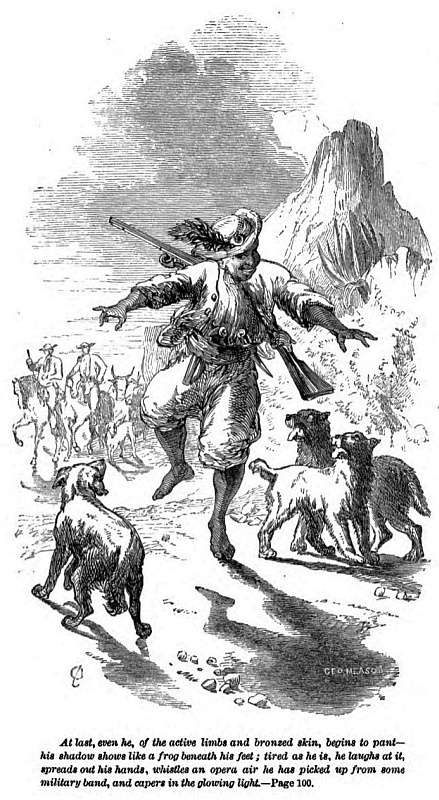
There they go up the hill—May in advance with Spry and Punch, and Floss. The sun is blazing out, and our bushman winds his bright-coloured douk round his head, and tramps round the angle of a jutting rock, staff in hand. Before he does so, he looks back to see how the cavalcade gets on, lights his pipe, and alternately smoking, and singing, and whistling to his dogs, he proceeds leisurely along. At last, even he, of the active limbs and bronzed skin, begins to pant—his shadow shows like a frog beneath his feet; tired as he is, he laughs at it, spreads out his hands, whistles an opera air he has picked up from some military band, and capers in the glowing light, till wearied, he sits down on a block of granite, beneath a stunted bush, unslings his three-string fiddle from his neck, and plays with great skill, considering the means at hand, the rattling, saucy air of “Rory O’More.”
And he was at it right merrily, when the first wagon, with its oxen smoking and breathing heavily, reached the spot he had chosen as the outspan, where a more solid breakfast was to be prepared than the one that had been hastily snatched at dawn.
The country, although only about nine miles distant from the picturesque locality on which our party had rested during the night, was now of a totally different character; great plains, only relieved here and there by low bush, or huge masses of stone, stretched out for miles before the traveller’s eye, and the noble natural parks through which they had journeyed the preceding day were hidden from their view by the undulations they had traversed. In the distance, between the arid earth and the glowing sky, at the edge of the horizon, stalked a company of ostriches, apparently the only tenants of this great solitude.
There was something very grand, and even affecting, in the contemplation of such a scene; at least, so thought Frankfort, whose heart expanded under the impression produced by Nature in her state of lonely majesty. Here she was not lovely, but sublime; the infinity of space, the shadowless land, the unclouded sky—too dazzling for mortal eye to dwell upon—the awful silence, all seemed more fully to betoken the eternal presence of God, than in green places where shelter was at hand, and where, therefore, the solitude was not so apparent, so vast. The very cries of wild beasts give life to the jungle—but here the human voice broke abruptly on the stillness of the plains, as if it had no business there, and Frankfort was thoroughly disenchanted of his sublime mood in contemplating the almost awful expanse, as May scraped his fiddle ere he laid it down to attend to Ormsby’s inquiry as to “where his cigars had been packed.”
It must be owned, that Ormsby had no taste for the sublime or the romantic; indeed, there are not many men in the world who would have found food for contemplation in the desert scene before them; and as for our young sub, I am forced to admit, that by the time he had smoked three cigars, he began to wonder what he should do with himself when breakfast was over.
Frankfort had stocked the wagon with many more luxuries on Ormsby’s account, than he would have thought of providing for himself; and the meal, spread out on the shady side of the wagon, was by no means despicable. Excellent tea, devilled biscuits, cold tongue and honey, an offering from Vanbloem, and added to these were savoury slices of porcupines, a viand from which, in its raw state, Ormsby had turned away in disgust, but to which, when cooked, he addressed himself with a keen relish.
The panting oxen had been turned loose to seek what provender they could among the tufts of grass on the sandy plain—the sun shone upon a vley (pool), about a hundred yards from the outspan; the place had been selected by May, because he knew there was no better bivouac for miles in advance. Like many other bright things, the pool shone with a delusive lustre; it offered but a muddy draught to the thirsty traveller—but drivers, foreloupers (leaders of the draught cattle), guides and oxen, plunged therein their parched lips, and drank thankfully of the slimy waters...
“There is certainly nothing like judging of things by comparison,” observed Frankfort, as, after a thorough enjoyment of his breakfast, he laid his head on his saddle under a stunted bush, and, taking out a book, prepared to indulge himself, as he called it, till it was time to assist May in re-packing and preparing for advancing.
May trudged on with the dogs, and halted again in due time, in a similar locality, where the solace Ormsby sought was another meal, combining dinner and supper. An omelette from the egg of an ostrich, whose nest had been raked out of the sand by the keen and persevering May, was not a bad wind-up to a refection of game; a cigar and coffee followed, and while the ostriches were still stalking in the light, the wearied party were glad to make ready for the night, and lay their limbs at rest.
For two succeeding days nothing occurred to distinguish the one from the other; there were the same arid tracts, the same glaring bivouacs, the chilly midnights and dewy dawns—the same porcupine breakfasts, venison dinners, and omelette remove.
On the third day they found themselves on the borders of a river, rapid and circuitous in its course, and fringed with bush, and here Ormsby, in a fit of ennui, determined that May should get up a regular porcupine hunt by moonlight—midnight was the time chosen.
Their tents were pitched on the riverside in expectation of remaining there some days, for, calm as looked the current, May, from certain indications, expected it to rise and swell beyond its bounds. Besides, here was shelter and pasturage for the tired cattle.
“So much for things by comparison again,” said Frankfort, as he sat down under a foe willow. “Those who sleep in well-curtained beds this night will hardly enjoy their rest as we shall do for the next three hours.”
Ormsby’s thoughts had been floating about in the clouds of his cigar, the fifteenth since the morning; but as he cast the remainder of it from his lips, he said, “Ah, all this may be very fine and sublime, as you call it; but, for my part, I wish I were going to take my rest in the orange-room at Ormsby Park.”
The contrast of the orange-room at Ormsby Park with the willow drapery, the starry roof and the silver moon walking demurely in the sky, at once dragged Major Frankfort from the sublime to the ridiculous, and he burst out laughing; but his mirth was checked by Ormsby whispering, “Hush, there is some one in the bush near us; I heard a branch crack—it can be none of our own people—they are all sitting together over the fire, listening to that three-stringed lute of May’s.”
“Hush, there it is again!—some restless baboon, probably,” remarked Ormsby.
“No, the bush here is not thick enough for them.”
At this instant, May came from the fireside circle. The night was so clear that he recommended attacking the porcupine in his haunt at once, and sleeping after the sport. On being told that some one was hovering about, he laid his ear to the ground, but could detect nothing. Ormsby reminded him that he had been under the impression, ever since they left the Dutchman’s valley, that some one was hovering about. Had Frankfort stated this opinion. May would have put some faith in it; but he did not like Ormsby. The latter was perpetually scolding and ridiculing the poor little bushman; and so, as the idea of the stealthy visitant originated with the young subaltern, May chose to ignore it; but he determined, nevertheless, on keeping a sharp look-out, and was as much puzzled as his masters as to who the spy could be.
They were a tolerably large party; and, knowing the character of the locality, and the tribes near it, he felt sure that the enemy, if enemy it was, mustered in no force: so they set out on the porcupine hunt.
The bushman had already tracked out his victim for the sport. The poor little creature had set the dogs at defiance on being first discovered, and kept them at bay till it managed to retreat to its hole. So there he was, poor fellow, with his ears, almost like a man’s, stretched wide open, listening for his expected besiegers; for, once disturbed, he was thoroughly uneasy, and all his quills, though lying close to his body, were ready to shoot out into a panoply for his defence when his castle should be attacked.
May tried to get a peep at him in his hole, but he could only hear him panting; so he fastened the bayonet, with which he had taken care to provide himself to the long bamboo of old Piet’s wagon whip. It was very sharp at the point; our bushman had taken care to cleanse it from the rust it had imbibed in the damp ground, in which Ormsby had occasionally planted it as a candlestick by his bedside. Armed with this weapon, and followed closely by the dogs, whom he encouraged and exhorted in the queerest jargon that can be imagined, Frankfort and Ormsby carrying sticks, he led the way along the banks of the river, and soon reached the hiding-place of the poor little beast. The dogs gave tongue at once. May, as I said, tried to get a peep at him, but he could only hear him panting.
Floss soon got pricked in the nose, and retreated—only, however, to return to the charge, and scratch and yelp in vain. Spry and Punch kept steady sentry, warily taking their opportunities of making an entrance. At last the earth gave way, and the “wee beastie” emerged from his den, with all his darts prepared for the charge. His mouth was but a mockery; he could not bite; so he turned his back again upon the foe, and as they approached, opened out the weapons that nature had given him to save himself. These Ormsby believed would be shot out like arrows; but, as May said, the schelm (rogue) was too slim (knowing) to part with his arms entirely, adding, that “English man” was “too fond of making stories, and,” with a sly smile, “too ready to believe them.”
The creature, however, made his backward charge, again and again rolled himself into a ball, with all his quills “on end,” and after gathering strength for another battle, fought his foes gallantly, till May, fearing the dogs would make a meal of him, drove his bayonet into the soft part of his body, and laid him dead upon the threshold of his home.
Ormsby was delighted with the novelty of the porcupine hunt on the edge of that winding river, its waters flashing in the moonlight, and clamouring along between the stones, or gurgling in little creeks of mossy rock. Here a bank stretched out into the stream, with a group of willows hanging their tresses over their own inverted shadows; there the grey cliffs were broadly reflected in the waters, and the frogs kept up a perpetual though most unmusical chorus from the pools in the drift. Up the stream the murmur was beginning to increase to a roar; and, in some dread of the torrent suddenly swelling, May scrambled up the bank, and shortened the way to the bivouac, where the wagons were drawn up in great precision, and where all were sound asleep save Marmion, who “bayed the moon” loudly at the approach of his master.
Ormsby, in horror of “creeping things,” had latterly taken it into his head to sleep in the wagon, instead of sharing the tent with Frankfort; and still convinced that some one was hanging about the neighbourhood, he determined to keep watch till dawn; but fatigued by his midnight sport, he was soon overcome with drowsiness, and the bright African sun was shining on his face, and May laughing quietly over him, as he woke with a start, and seizing the bushman’s hand, examined it intently, to May’s great amusement. Frankfort, too, was looking in upon him, and Marmion, with his fore paws on his master’s chest, had his great eyes fixed upon him lovingly.
“I have had the oddest dream,” said Ormsby. “I felt, as I fancied, a hand clutch mine: I grasped it tightly; and when I thought I had got it quite safe, I found the arm was gone, and only the hand, hard and cold, was left in mine.”
“And here it is, I suppose,” said Frankfort, laughing, and taking up the six-barrelled pistol, which Ormsby always placed beside him when lying down at night.
May shook his head very solemnly, and then begged the “Masters” to follow him, and he would show them who had lifted the pistol.
The bushman led them through a mass of tangled underwood, to a copse all interlaced with wreaths of starry jessamine and wild convolvulus, and softly putting aside a geranium-bush, entered the covert, followed by the others.
Bending low, and creeping after him, they found themselves soon in the centre of the thicket, surprised to see scattered about fragments of bread and meat, and some broken bottles; in short, these were the débris of a meal eaten on the spot.
Lifting up a bough, May showed them a young Kafir stretched on the grass, and wrapped in profound repose; near him were three assegais. He lay with his head supported by his dusky arm, his dark and finely-moulded limbs offering a study for the sculptor. But the frame looked worn, and his hair, long neglected, was of its natural hue, instead of a dull red, from the clay usually employed in adorning it.
Frankfort and Ormsby did not at once recognise the young Kafir servant, Zoonah, whom they had seen at the Dutchman’s farm, but May informed them who the sleeper was.
Frankfort, surprised at the bushman’s want of caution, placed his forefinger on his lips to enjoin silence.
May pointed to an empty bottle near the Kafir, and, taking it up, turned it upside down with a knowing wink, as he proved that it was empty.
“But,” said Ormsby, “when the rascal wakes he will be off; and, as he has been lurking about for no good, we had better secure him; he would soon outrun the dogs. Some fellows would shoot him, and serve him right; he would murder us if he dare.”
“No, master, no,” replied May; “a Kafir won’t kill you to get nothing by you; he would, if he could, sell your skin; but he don’t want to make a row for nothing; it’s all different when his blood is up. The dog has been hanging about our spoor (track) ready to steal all he can get, and he’s making his way to his own people to tell them, perhaps, that there ain’t red men enough in the country to keep it. Master Ormsby said this himself to Vanbloem, and I heard this fellow tell the other Kafir, who does not understand English.”
“By George!” exclaimed Ormsby, “who would have thought the rascal was ‘so wide awake;’ but will his people believe him?”
“He’s been sent into the country,” said May, “as a spy, to take service, and find out all he can by lurking about the towns, and picking up news at canteens or shop-doors; and then he has come to the farm to keep his eye upon the cattle, and listen to every word that passes between the farmers and missionaries and travellers. His people will believe him fast enough, for they’ve been making ready for war these six months. Vanbloem’s Hottentots told me they had lost cattle lately, but could not account for it. This vagabond has been at the bottom of it, depend upon it.”
And May contemplated the sleeper as he would a mischievous animal; shaking his fist and making hideous grimaces over him.
“He will be up and at you, you little fool,” whispered Frankfort, surprised at the death-like repose of the Kafir, who scarcely seemed to breathe.
“He can’t rise, master,” replied May, with a low laugh; “first of all, he’s drunk, for I left some brandy in the bottle I pretended to throw away; and next, see the snake-bite in his leg: ‘No need to tie him up,’ said I, when I saw that. Ah, the schelm! here’s the top joint of his finger chopped off—he belongs to some of old Mawani’s people. Mawani wouldn’t let the Gaika Nazelu marry his daughter, so Nazelu attacked his kraal ten years ago, and marked all the boys this way, after killing the men, or cutting off their ears and hands.”
Frankfort and Ormsby shuddered as they discovered the snake-bite in the bend of Zoonah a knee, who, all unconscious and stupified, still slept on, in spite of May’s chattering and caperings round him.
Ormsby drew back with a start as the bushman lifted the reptile, which he had discovered, with its back broken, but with some remains of life, for it reared itself up, and fixed its filmy eyes on the young officer’s face; but Frankfort stepped briskly forward, and crushed its head.
Instinct roused the Kafir from his heavy slumber as May waved his assegai over him; but stupified, and sensible only of intense pain, he sunk back with a sullen air, keeping, however, a steady gaze on May.
This page only partly readable; about an inch down the right, missing.
“Poor wretch!” said Frankfort, “he must not, if we can help him. I have the cure of snake-bites; May, fetch the medicine-chest in my wagon.”
May took the proffered key, from which a shrill whistle ere he went in search of which, however, he put less faith tha Fitje’s coctions of herbs, which she had prepare as soon as she, good-hearted little that the young Kafir had been wounded tile. Plenty of healing roots and herb the spot—for God often plants the ai snakes most abound—and very soon t and his wife were at their task of huma ing Zoonah’s wound; May, while i bestowing on his patient a variety of ep Hottentot, Dutch, English, and Kafir la.
The savage understood the reality though it was not in his nature to trac or respond to its sympathies by gratitude gloom was on his countenance at having thus, like a wild beast, in the hunters submitted to the surgery; and, the t dressed, raised himself against the tru and stared from one to the other of the him.
“May,” said Ormsby, who held a hand, “what has made the rascal follow him.”
Zoonah, who understood English, knew, cast his eyes upon the turf, and bushman’s translation of the question.
After duly considering the answer h and accepting the cigar, he answered in language—
“Zoonah is the white man’s dog, they journey in the same path.”
To which assertion May added in “lies.”
Problem ends here.
“Ask him,” said Frankfort, “why he followed stealthily.”
“Because I was alone, and thought the Hottentots would kill me,” said Zoonah.
“He lies,” added May.
“Where are you going?”
“To my people—I left my heart in the bush,”—meaning his wife.
“Why did you leave Vanbloem?”
“He sent me away.”
“Why did you try to steal arms from the master’s wagon?”
“I do not understand you.”
Zoonah’s stolid air convinced Frankfort, too, that it was of no use to question him. It was evident that May was right—he was a spy on his way to his own chief’s kraal, and, as the bushman observed, it was useless to waste words upon a liar.
“He’s born liar—he’ll die liar; he’s born blackguard, and he’ll die blackguard.”
And, with this last truly English vituperative, May left the thicket, and went to prepare his master’s breakfast.
He had tied up the dogs and kept watch himself all night, lying in the long grass between Frankfort’s tent and Ormsby’s wagon, and had seen Zoonah, just as the moon was waning, winding himself along in snake fashion, till he reached the young officer’s sleeping-place, in which he was wont to spend part of the day, reading and smoking, with “pistol, sword, and carbine,” slung above him.
Doubtless, Zoonah had long had his attention fixed on these particular objects, and allowing the cavalcade to pass the open plains, had come up with it as soon as it was fairly bivouacked in the embowered nook selected by May. Here he awaited his opportunity to plunder.
But Kafirs have a dread of what they cannot see—a house, a tent, or a wagon, may always, they believe, contain some mysterious agency of evil, and hence, on Ormsby’s instinctively clutching the pistol the Kafir dropped it in terror, which was increased by a movement of May’s. The wily bushman, though, had no mind to throw the Kafir off his guard; the roar of the river proved that it was impassable; in the rear were the inhospitable plains of sand, the Kafir must ere this have exhausted such provision as he could have carried from Vanbloem’s, and would therefore not go far; and, in a word, May resolved not to alarm the little camp until obliged to do so.
The result was, that Zoonah traced his way to the thicket where the bushman had left a decoy, in the shape of scattered bread and meat, and an apparently empty bottle.
“I watched that bush yesterday evening,” said May, when explaining his devices to Frankfort; “for though I laughed at Master Ormsby, it’s always right to be ‘primed and loaded.’ Well, I watched that bush closely, because, whenever the birds lighted on it, they flew away and would not stop a minute. Some came there to roost in their nests—but no, off they went, came back again, and then away—‘Ah!’ says May, ‘some one spenning (lurking, hiding) there, I know;’ so I was glad to see Master Ormsby tie Marmion to his wagon, while we were hunting the porcupine, and I told old Piet to lie between that and the tent, where I made a good fire. This schelm little thought we went off so far; but I gave Fitje the long pistol ready loaded, and told her to fire it, if she was frightened—but she was not,” added May quietly, “and lay down as soon as she heard the dogs coming home with us. I tied them up as soon as I had fed them, and so now, if the sir pleases, I’ll reim the prisoner.”
“Reim the prisoner?” said Ormsby; “what does he mean?”
“Tie him to the wagon wheel, master,” answered May, “and keep him there, till we can get rid of him handsomely.”
Probably, May’s ideas about getting handsomely rid of Zoonah were rather vague; at any rate, he had no idea of trusting him in the smallest degree, and he was greatly astonished when Frankfort observed, “Nay, nay, we won’t bind him; he looks half-starved.
“Poor wretch; we may make him earn his living by being useful—it is no business of ours if he chooses to leave Vanbloem, we cannot send him back—he is but a savage, and we must be kind to him.”
“Right, master,” replied May, after grave consideration; “but he’s a thief, as well as a liar, so take care.”
So saying, they left Zoonah in the leafy covert.
May put no trust in Zoonah, and such was Fitje’s dread of him, that she would not lie down to rest, unless her husband laid his gun beside him.
The sportsmen decided on crossing the river as soon as it was fordable; and Zoonah, rejoicing in contributions of tobacco, cigars, and provisions, was happy, after Kafir fashion, lying on the soft turf, and contemplating, with a longing eye, the cattle he professed to guard, but hoped to steal from the men who had saved his life, and now fed him, and treated him with kindness.
Although May heartily despised Zoonah, he was always in good humour with him; for there is nothing in nature more cheery and good-humoured, though hot-tempered and keenly alive to injury, than a bushman, caught young, and tamed and educated by real Christian people.
Three or four evenings after the incident described, as Frankfort and Ormsby sat by the river, after the last meal of the day, anxiously comparing the depth of water with a certain mark they had drawn on a jutting rock, their attention was diverted by an earnest “talk” going on between May and Zoonah.
The latter was deriding May’s idea of Umtiko (God). Zoonah, finding disguise was useless, now conversed in excellent English. May’s suppositions were right. He had been educated at Shiloh; but the care bestowed on a Kafir seldom answers the humane purpose intended. Savage he is, and savage he will he, unless, indeed, the age of miracles is not past and gone.
“You say that Umtiko is good,” said Zoonah; “how do you know it?”
May pointed out the benefits we derive from God.
“How do you know they come from him? Did you ever see him?”
“He is invisible.”
“If he is so good and so glorious, why does he not show himself? The teachers are always telling us about God; but first, a Kafir never believes what he does not see, and next, the teachers say that all men are liars; how, then, can they expect us to believe them?”
“But the teachers do not tell you this without proof.”
“Where is the proof?”
“In the beautiful world, where all things are given for our good, and where the wicked are unhappy.”
“Who do you call wicked?”
“Those who commit sin,” replied May.
“Sin!” said Zoonah, after examining the ground,—“sin means pleasing one’s self.”
Before May could answer, Zoonah went on: “You cannot believe in the existence of what you cannot see.”
“You do not see the wind,” interposed May. Zoonah went on in his own language, May translating sentence by sentence.
“You cannot take the word of one man, whom you have never seen nor heard,” answered the cunning Kafir, “against the wishes of all men. The invisible God you talk of says, ‘Obey me, and do nothing that pleases yourself.’ The visible man says, ‘Enjoy earth, and all that belongs to it, and be happy.’ On one side is a chance of another world if we punish ourselves in this; on the other is pleasure, ease, and our own will, under laws made for man by man. You English have a woman chief; even she never sees the God you speak of. You know not even whether he is black or white.”
At this point, Ormsby, who had drawn near, burst into a thoughtless and irreverent laugh, and Zoonah, at this, satisfied that he had the best of the argument, rose, and wrapping his kaross around him, ascended the bank, and followed the cattle to the outspan.
The east was faintly streaked with a crimson line next day, when May came to rouse the sleeping Ormsby, and call him to an early breakfast, which he had prepared, that the sportsmen might cross the river, which at last was fordable for men and horses, although the depth of mud in its bed rendered it impassable for wagons. It was possible to carry over such provisions as would last them till they reached the Orange River, where final arrangements would be made for treking at once into the depths of the long-desired hunting-grounds.
The idea of change pleased Ormsby, and he readily assisted in the necessary preparations. With his usual want of foresight and discretion, he had begun to make a pet of Zoonah; and, forgetting how dependent he and Frankfort were on the integrity and sagacity of May, amused himself with the idea that the latter was jealous; but the kind-hearted bushman was utterly unconscious of this, and worked away with his usual aptitude and good humour, keeping, too, a close eye on Zoonah’s movements when the cattle came in at sunset.
And now, to Frankfort’s surprise, May permitted the Kafir to assist him in making up sundry packages for the trek over the river, soon to be carried on their own heads as they swam the stream; for May was ever humane, and strove to lighten the weights on the pack-horses.
Two leather bags were soon filled. Zoonah’s dark eyes glistened at the goodly store scattered about the ground,—canisters of powder, a pocket looking-glass, bundles of cigars, and manifold articles delightful to a Kafir’s sight; he gladly helped in the task of tying up the bags, and after adjusting one on May’s head, and lifting one to his own, he proceeded with the Bushman to the edge of the stream. The rest of the cavalcade were to cross the river whenever they could do so with safety; and Frankfort, ascertaining that all was ready, took his horse well in hand, and plunged into the clear and rapid current, Ormsby following. By Frankfort’s desire, May was to attend as guide and groom, and on second thoughts, he consented to let Zoonah follow, deeming it unwise to leave him with the cattle.
Both sportsmen’s horses breasted the torrent gallantly. Ormsby, despising May’s injunctions, had nearly floundered in a sea-cow’s hole; but the opposite bank was safely reached, and both gentlemen, dismounting to rest their panting steeds, sat down to watch the transit of May, Zoonah, and the dogs.
The bushman and Kafir, side by side, were already midway between the banks, and, in thorough good-fellowship, exhibited their skill and daring in buffeting the element through which the horses had passed with less ease.
Frankfort watched the race—for such it seemed—with some anxiety, for it called forth equal strength and courage on the part of both the swimmers. Ormsby laughed heartily at the “dodges” each took to circumvent the other, when suddenly, as if caught by the current, Zoonah was whirled round and round, sunk, rose again, keeping his burden safe supported by one hand, and in another moment struck boldly out with the right arm and vanished, to the horror of Frankfort, who gave him up for lost, and the dismay of Ormsby, who had seen Zoonah pack many articles of which he stood in need.
May swam gravely on, paying little heed, beyond a grin, at Zoonah’s disappearance; and even Frankfort reproached him severely for triumphing, as he believed, in his own sagacity, at Ormsby’s expense.
“I told the sir,” said the bushman, when he recovered breath on landing, “that Zoonah was thief as well as liar, but Master Ormsby only laughed.”
“You should not have intrusted him with a package of such value to us just now,” said Frankfort.
“I obey Master Ormsby,” answered May, beginning to shiver.
“Go and get some dry clothing on you,” said Frankfort; and May rose to do as he was bid, first laying the package, untouched by wet, at Ormsby’s feet.
The latter kicked it from him with an oath.
“It is all right, sir,” said the bushman, patiently lifting it up again; “all your powder and other things quite safe. I let Zoonah pack ’em up, but changed the bags, while Fitje gave him his sopie; he’s got a lot of rubbish packed up in the other. I thought it best to let him go. I knew he would, as soon as he thought he had got something worth taking. Ah! the schelm, he’ll swim for the next hour. I should like to see him open his prize;” and Frankfort and Ormsby laughed as heartily as May himself.
On, still on. Each succeeding day drew our travellers far from the settlements of the English colonists, and Ormsby, by degrees, began to try and reconcile himself to an expedition from which there was no fair means of retreating.
Soon the broad and refreshing waters of the glorious Orange River, lying in lake-like beauty between its richly-wooded borders—the graceful shelter of the fine trees that grew luxuriantly near its banks—the murmuring sound of distant falls—the delicious lounge on the smooth turf, selected as the halting-place for at least a week, that horses and cattle, as well as men, might repose, were all enchanting to our sportsmen, to whom the scene was as new as agreeable.
The Orange River forded, our sportsmen at length looked down upon the “happy hunting-grounds.” But it was not now as in the time when Mr Trail rescued May from the dwellings in the rocks.
As the white man’s footprints had advanced, the game had retreated to the deeper solitudes of the wilderness. Herds of gnoos and bucks occasionally swept across the plains, and May pointed out a drift where lions sometimes came down to drink; but there were no companies of these kings of the desert—no sentinel giraffes—no midnight echoes from the trumpet-signal of wandering elephants.
It was a grand panorama, and as, while May off-saddled, our sportsmen cast themselves on the grass of a natural platform overhanging the scene, a fine buck started out of a bush, and passed them by with head erect, eyeballs strained, and limbs quivering with terror and dismay. The rifles of both sportsmen were brought to the shoulder at one instant, and in another, the beautiful animal was stretched upon the turf, dying the plants, which enamelled it, in blood.
The horses secured, away went May—greedy fellow—to kindle a fire; Frankfort and Ormsby took out their couteaux de chasse, and the former, ere he drew his blade across the neck of the creature, paused with some compunction at having killed his game with so little credit to himself as a sportsman, two rifle-balls having lodged in the head of the buck when only a few feet from his destroyers.
He paused, I say, and, casting his eyes upon the valley, drew Ormsby’s attention to various species of smaller game, which, roused from their coverts by the crack of the rifles, were speeding in hot haste across the plain; gnoos, zebras, and bucks of manifold kind, all at once gave life to the green valley far below the travellers’ reach; and Frankfort had scarcely had time to point them out, when a noble lion, with eyeballs of flame and mane erect, sprung at a single bound from his covert in the cliff above, and, in silent majesty, placed his huge paw upon the neck of the slaughtered deer, his gleaming orbs fixed in steady gaze on the astonished countenance of Frankfort.
He uttered no sound—the lashing of his tail against his sides was the only proof this magnificent lord of the manor gave of his displeasure at the intrusion of poachers on his territory. His frown was terrific, and said plainly, “This is my property by royal right, and here I stand to defend it.”
How long this scene lasted was never computed by the sportsmen—Frankfort always admitted that they left the lion master of the field, and declared that Ormsby was as ready as he to dive into a bush and climb a path they would not have attempted “under ordinary circumstances.”
Not long after this adventure their plans and prospects assumed a totally different aspect to what they had anticipated; a simple incident proved the straw that turned the balance, and caused them to turn their backs upon an expedition to which one, at least, had looked forward with the prospect of a year’s sport and travel.
At dawn, one roseate morning, a yell from the dogs awoke May in time to discover a poor little porcupine scuffling back to his hole. Up jumped Ormsby, who would not wait for May’s attack with a short assegai, which he had at hand; lifting his foot, he laid the quarry sprawling on the ground, but not before the animal had driven one of his natural weapons into the thoughtless young man’s foot; darting the quill, sharp as a needle, with all his force, the creature left it two inches deep in the instep, and would have returned to the attack, but that May, with a stirrup-leather, laid the enemy dead.
Ormsby sat down upon a block of granite, in great agony, and the bushman, after a deliberate survey of the jeopardised limb, remarking, with a gravity that startled even Frankfort, that “the sir must lose either his leg or his boot,” opened his clasp-knife, and skilfully and deliberately cut the boot open, then applying his fine but useful teeth to the quill, he tugged at it bravely, and drew it out with a jerk. A clear jet of blood bubbled up from the wound, and Ormsby fainted with the pain.
The inflammation which followed was so great as to preclude the possibility of riding far, and as, fortunately, the wagons were only five miles in the rear, Frankfort deemed it wisest to return to them at once, as he well knew Piet would not move in haste.
Everything was as they had left it two days previously, although the obstinate old wagoner had been told to follow as soon as the sore-footed oxen had recovered, and they were now fit for their work. There sat Fitje, stitching at her patchwork petticoat; there lay the herd-boys beside the green-bordered vley; and there sat old Piet, in the glow of sunlight, smoking his pipe.
Chapter Seven.
Light in the Wilderness.
Ormsby was thoroughly discomfited by his accident, and his impatience, and unwillingness to apply the remedies prescribed by Fitje, duly aggravated the inflammation: he would walk, he would bathe, and at last was fairly laid prostrate for two or three days.
Utterly disgusted, and intensely pained by the jolting of the wagon, he listened one morning with complacency to May’s information, that there was a Dutchman’s farm at the foot of a long, low hill in front. The sun shone down upon the settlement, which at that distance looked fair and pleasant; but May said it was but a desolate place within, for the master was heart-sore. He had lost five sons in the last war; he had but few cattle left; and whenever he began to till the land, he was told by his neighbours—there were none within twelve miles—that it was not safe to stay. The bushman had heard this two months ago from the Boer himself at Beaufort, when he came there, in his perplexity, to consult his fellow-colonists.
Frankfort immediately thought of helping this poor man in some way, and the cavalcade directed its progress towards the farm; but on reaching it, they found it abandoned—“Silent all and lone.” The house was empty, the doors and windows open, the garden desolate.
Both sportsmen agreed, that if this abandonment of the location was the result of a rumour of war, it was high time for them to think of rejoining their regiment instead of pursuing their expedition. Ormsby would fain have had the cavalcade halt here for the night; but May informing them that, if they would consent to advance three miles further, they would find a halting-place within only two hours’ distance of the settlement of Annerley, a property belonging to a retired British officer, Frankfort decided on moving on.
The party proceeded slowly forward, the character of the country changing at every step. The bush grew thinner; wide undulating plains, dotted with ant-heaps, and here and there a dump of dwarf mimosas, were spread before the traveller’s eye; and as the last rays of light gleamed in dying glory on the waste, several dark objects were descried moving in a body at speed.
Frankfort, by the aid of the telescope he carried, fancied he recognised European horsemen. A slight indentation of the ground hid them from his sight for a minute or two, and as they reached the elevation, the wide hat, ostrich feather, long roer (gun)—in short, the whole guerilla air, bespoke the Dutch border colonists of South-Eastern Africa.
At sight of the wagons, the party came galloping down the slope, and approaching Frankfort in breathless haste, announced that the new British commander of the forces, Sir John Manvers, had issued a manifesto desiring the chiefs of the Gaika and T’Slambie tribes to meet him in the neighbourhood of the garrison of Fort Beaufort, on the Kat River, on a certain day; that the chiefs had hesitated, asking for more time, to consult their councillors, which time was, of course, to be employed in making ready; that the war-cry had already faintly issued from the Gaikas, who only waited for the gathering of the tribes to shout it aloud from the Amatola mountains; and that, as soon as the warriors could be organised, an attack would be made upon the colonists.
This mounted troop of stout and determined Burghers had been despatched, by the commandant of a frontier outpost, to warn the farmers in the north eastern districts of their danger; and, being loyal to the Government, were proceeding, as far as they dared, to sound the alarm among all the landholders who were considered to be discontented, but as yet were not avowedly disaffected. These were expected to join a Burgher force, ready for action, if called upon; while the farmers near the colony were advised to put their homesteads in a state of defence; and if this was difficult, from want of hands, or faulty position, to establish lagers (bivouacs), and bring their families together, for the sake of security.
It was further stated, that the rivers were rising, and the enemy congregating along the bush-lined banks of the Fish River, ready to pounce on stray cattle or hapless travellers; the troops were mustering in the different garrisons, the new commander-in-chief was at Graham’s Town, ships with stores and reinforcements were daily expected at Algoa Bay, and the greatest cause for anxiety was the uncertain state of affairs among the Dutch beyond the Orange River. These, it was supposed, had been fully conciliated by the visit of the late governor, whose health had suffered from his fatiguing exertions in negotiating with the rebellious Boers in person. By these able negotiations peace had been established, and redress officially promised; but, strange to say, the arrival of Sir John Manvers had been the signal for another outbreak, and while Kafirland was up on one side of the Orange River, the Boers were inspanning their oxen on the other, and preparing sullenly to trek, roer in hand, and with wives, children, and all their property in a train, headed by one Vander Roy, a clever fellow, and as ambitious as he was determined and persevering. Having delivered this news, and refreshed themselves with sopies of French brandy, the young Burghers touched their hats, the officers bent over their horses’ necks, and were off at a hand-gallop.
Ormsby had laid aside his novel at the approach of the riders, and leaped out of the wagon to hear the news. At the prospect of war he sent up his hat into the air with a shout, and telling May to “up-saddle,” would have mounted his horse, and insisted on at once riding forward to Graham’s Town.
He made no allowance for difficulties; he thought not of swelling rivers, of a lurking enemy, ready to seize upon the horses of unprotected travellers; he would have taken May and one of the wagon-drivers with him, and left Frankfort on the instant; for the latter, though brave, was not rash, and had no idea of such a mad project as leaving the cavalcade behind, and starting headlong on a journey of two hundred miles, with horses quite unfit for it. Besides, he did not expect May to leave both wife and child to the tender mercies of the dogged Piet; and in short, to Ormsby’s infinite disgust, he was told that haste was out of the question: they must make what way they could to Annerley, and there act upon the intelligence with such means as circumstances afforded. If fresh horses could be procured, a couple of armed guides would be sufficient, and the cavalcade of wagons and attendants could, for the present, remain behind; besides which difficulties, Ormsby’s foot was too much inflamed to permit him to ride. On what small hinges do great doors turn!
Evening fell, heavy and gloomy; the atmosphere was loaded with an unpleasant vapour. As night drew on, the exhalations floated above the earth in thin white mist, and as this increased, the travellers could scarcely see a foot in advance. The road, or rather track, was grass-grown, the wheels sunk into the sward, and moved noiselessly along; there was no echo of the horses’ feet upon the turf, and as if the stillness or nature had effect upon the party, not a word was uttered. Altogether, the vehicles, with their white canvass coverings, the impish foreloupers, the attendant guides, and the riders, who kept close to the two foremost wagons for fear of losing their way, all gliding silently through the shroud-like vapour, might have served as an illustration of one of the scenes in that delicious romance of “Undine.” They looked as if they must vanish and melt in the snow-white cloud, wreathing itself closer and closer round them at every step.
May was wide awake; his keen eyes were riveted to the ground, watching the slight undulations made by occasional wanderers in the wilderness, and if his eye failed him, he knelt down, groped about the path, and having found it, led the way beside the foremost forelouper. Poor, patient, honest May! how Ormsby muttered his discontent at thee for being “encumbered” with thy wife and child! How unthinking was he of thy daily aid!
The dwelling for which they were bound, and to which May was so carefully guiding them through the mist, along the almost trackless waste, had been and was, for aught the bushman knew to the contrary, the residence of an Englishman, who had been an officer. If still there, they would ascertain from him, “whose word,” May said, “was true,” the real condition of the country. If war had been openly proclaimed by the English general, Frankfort admitted it would be madness to proceed, and run the risk of being detained upon the banks of those densely-wooded streams.
Ormsby, like all self-opinionated, inexperienced men, would not admit the necessity of bending to circumstances; he was for advancing “in the teeth of the enemy. They would know better than shoot down, like dogs, a couple of English officers. He should like to bag a leash of Kafirs amazingly. He should send home a skull for his old governor’s library. He hoped there would be war with all his heart. He longed to knock over some of those black tinkers.”
Frankfort listened quietly, smiling inwardly at the idea of Ormsby in the bush in the rainy season, sleeping with his head in a pool of water, and breakfasting on a hard biscuit and a cup of muddy coffee, without milk or sugar; but he kept his communings to himself, and was not sorry when he saw lights twinkling through the mist. They looked distant; he put his horse into a canter, and in a few minutes was greeted by the “deep-mouthed welcome” of the dogs of the settlement,
Presently a door opened, but the lights were withdrawn; the butt-end of a musket rang on the stone step, and a gentlemanly voice uttered the words “Who comes here?”
“Friends,” said Frankfort.
“Friends,” repeated the voice aloud; the lights re-appeared, a group of people filled the open doorway, and the owner of the mansion—for it was a substantial building of stone—descended the steps, and advancing to the gate, a Hottentot servant following with a lantern, held out both his hands, saying, “Welcome; excuse our caution, friends and countrymen, but it behaves us to be wary; for although the open plains are stretched before us, we have a suspicious kloof to our right, and a chain of hills to our left, which may contain some objectionable neighbours. The mistiness of the night prevented our discovering the character of your cavalcade, nor could we distinguish the usual crack of wagon-whips.”
And no wonder; for the driver of the foremost vehicle was sound asleep, though sitting bolt-upright upon his box, and to Frankfort’s discomfiture, and May’s terror, Piet had not come up. May had collected the whole party together at a great vley some two miles off, and then finding that Piet would not be foremost in the van, had moved to the front as guide.
As it was supposed, however, that he would arrive ere long, though poor May had certain misgivings on the subject, Frankfort and Ormsby gladly accepted Mr Daveney’s welcome, and followed him through, what appeared to them, a garden, for trees bent over the pathway, and the air was burdened with perfume.
Ascending the steps of the house, their host stood at the threshold, and welcomed them again, ushering them, as he did so, into a large sitting-room, which, though dimly lighted, was evidently furnished with some attention to taste and comfort. “We are cautious, you see, in the wilderness,” said the host, and ringing a small hand-bell, he bade an old Griqua, who answered the summons, bring more light, desiring him further to inform the ladies, that the visitors were friends, and to “send Erasmus for the gentlemen’s saddle-bags.”
Frankfort and Ormsby surveyed their host with that interest which only travellers in the desert can feel on opening communion with a countryman and brother-soldier, for Mr Daveney stood avowed “a soldier every inch of him.” The erect carriage, and the kindly, but decided, tone of voice in which he issued his simple orders, proclaimed his profession at once. Of the middle height, of strong but slender frame, his life had doubtless been one of activity and observation: the high, thoughtful brow was divested of its early curls, but the well-shaped head was still partially adorned with crisp grey locks; the eye was blue as heaven, and shone with an honest light; the teeth were perfect, and of that hue indicating a sound constitution; a grey moustache shaded the upper lip, but, smiling as he spoke, a most agreeable impression was conveyed by the contrast of these white and even teeth with the sunburnt face, marked not so much by care, as with those lines which evince a deep sense of man’s duties to himself and others. The close observer will often recognise the difference between the restless attributes of anxiety and the calm thoughtfulness of a mind sensible of its powers and intent on its responsibilities. He makes the discrimination almost imperceptibly to himself, but is not the less guided by the impulse arising from it; and thus Frankfort took the proffered hand of his host with a feeling of interest he seldom accorded to strangers, and responding to the light of the honest eye and hospitable smile, said, as he lifted his hat with the grace of a soldier and a gentleman, yet with his own frank and unaffected manner, “We are officers of the Eighty —th regiment; this is my friend Ormsby, and I am Captain Frankfort.”
A door leading to an inner apartment opened, and a lady, followed by the Griqua servant, bearing lights, entered, and admitting that she had been somewhat agitated, “not alarmed,” by the unexpected arrival of the party, added, that supper would be served up with as little delay as possible.
There followed soon a young lady—yes, a young lady in the wilderness, and the stamp of a gentlewoman was on her and on her mother. No adventitious ornaments of dress, or the absence of them, can give or take away this stamp; be it in the desert, or the court, the English gentlewoman, in humble garb or courtly robe, needs no herald to proclaim her position.
Mother and daughter, in their simple costume of sober hue, were received by our two wanderers with all the courtesy they would have paid “To high-born dames in old ancestral halls.”
Ormsby was most agreeably surprised. Miss Daveney was of a charming height, had fine hair, a gentle voice and winning manner, with a little dash of coquetry, which in girlhood, as the result of innocence, is so bewitching. She admitted, that her alarm had been great, for the news from the colony was startling; her father, as the magistrate of the district, held a situation of difficulty and responsibility; the Kafirs had long been anxious for war, and within a few days, Mr Daveney had been informed, on good authority, that the Dutch in the upper part of the colony would not respond to the manifesto calling on them to assist in the defence of the colony: “in short,” said she—clasping her pretty hands together, in an attitude of thankfulness, as she lifted her clear eyes, honest as her father’s, to Ormsby—“we really have been in some perplexity, and nothing could be more opportune than your arrival. I confess, I had some dread of remaining in the wilderness—yet, what are we to do? My father must not desert his post; never were visitors more welcome.”
And Ormsby fancied—vain Ormsby!—that though the welcome was intended for both travellers, the smile was especially bestowed on him, and a very piquant smile it was.
But, dear reader, this pretty, animated Marion Daveney is not my heroine; she is a fair, ingenuous creature, with sunny hair, and shining eyes, and fawnlike step; but methinks you will be more interested in Eleanor, who has not yet descended to meet the guests.
Seated at the window of her little bed-room, she had sat looking out upon the misty night, forgetting that she was alone, and that darkness had fallen round her. It suited the mood of her stricken heart, veiled within the shadows that had been cast upon it, and doomed to remain there, as it seemed to her, for ever. Dim visions of childhood free from care, passed bird-like among flowers and sunlight, rose at times, and, like blue specks in a stormy sky, only made the clouds look heavier and nearer for the contrast.
She rose, paced the chamber, re-seated herself strove to gain courage to join the family group—for she loved to please her father—but sunk down at the idea of encountering strange faces.
“The thraldom is over,” said she, “the chain is broken; but the mark of the fetter has burnt in its brand upon the heart. As spots upon the green hills are seared for ever by the lightning’s blast, so is the blight upon my soul. Oh, youth, youth!—in some so verdant and so fair—why has mine been scathed so ruthlessly?”
She heard a step approaching, and, hurrying to the window-sill, appeared to be looking out. The step was her father’s, and, recognising that, she opened the door.
By the light he held, he looked sorrowfully at that young pale face.
“My love,” he said, “strangers have arrived, who will probably be with us some days; do you think you can summon resolution to come among us?”
“My dear father, I will do anything you wish,” said the daughter; but, as she spoke, she burst into a passion of tears.
The father closed the door, and sat down with his arm round his weeping child.
Her youth—she was barely twenty—her sable garb, her beautiful hair bound simply round her head, in token of mourning, instead of falling on her bosom in its natural heavy ringlets—her sobs, emanating from the depths of an aching heart, presented such a picture of desolation as would have moved a stranger. Her father could only take her to his breast, and clasp her there, as though he would say, “Lie here, my stricken one, and be at peace.”
She understood him, for she loved him, she respected him, and she was anxious, as she said, to do anything he wished. The overburdened heart gained relief after this outburst of sorrow, and, rising, she said—
“Give me half an hour, father, and I will be with you. I am not selfish, as you know.”
She kissed him, lit the candle on her dressing-table, and began to make such preparations for her appearance as would prevent any remarks on her agitated face and trembling frame, except in so far as might arise from the arrival of the strangers under circumstances of excitement and alarm.
Some idea of Mrs Daveney’s character in early life may be gathered from a letter written to a friend in England some five or six years after she had settled with her husband at Annerley—so, from certain associations, she had named the residence—which, once but a mere farm, was now a capacious and picturesque dwelling.
“You will remember,” says she in this letter, “my resolution to marry for love; you ignored my principle of matrimonial life being all the happier for mutual struggles, helpfulness one towards another; you laughed at the idea of care and trouble being stronger ties between man and wife than hours linked with flowers. Do you remember quizzing my fanciful notion of the evergreen cypress-wreath and the faded rose-garland? Nay, you often said I was too anxious for distinction, for any kind of éclat, to marry only for love. You know my story, my orphaned state, my dependence—no, not dependence—my reliance for protection on my kind aunt, and my departure from England. Hither I came; I was honest in my first communication to you; I told you that the admiration of the world had charms for me, which every pretty woman must understand. You scoffed at my world, and I—how I laughed at yours!—Lighted rooms, conventional forms, worldly tactics, the same circles revolving and re-revolving—Dinner-parties, where the host and hostess sat revelling, not in the society of friends, but in the display of plate, and cookery, and servants—Morning drives through interminable streets, or between tall hedges, or monotonous parks—Evening visits among crowds, where mothers came anxious to outdo their auctioneering compeers in displaying their daughters tricked out for conquest, and where daughters vied with each other in deceiving the world, by trying to look as if they cared nothing about it; and where men sneered at women, and boasted of being too knowing to be caught even with a gilded hook. My world, I told you, should be where self was not upon the surface, as in yours; where Nature reigned supreme, and where earth was peopled with men and women in whom thought was brought into action by necessity.
“And the opening chapter of my career in Southern Africa! how you laughed at that, though in all good humour, because you were prosperous at the time. Ah, what a brilliant colouring does the rainbow of hope cast on all it falls upon!
“There was no contempt in your gratulations at my success on my first appearance at a colonial fête, got up for my especial presentation. Ah, Emily! I often think of that day. My dear, single-minded aunt, and her husband, who had begun by being soldier, and turned merchant in prosperous times; how pleased were they at introducing their niece, fresh from England, while to me, life in Southern Africa seemed delicious after the thraldom of school in murky old London. Bands of military music, young and gallant gentlemen, all struggling for the ladies’ favour, a horse to ride, the prettiest that money could buy, and Captain Daveney beside me, who would teach me. Ah, what a day that was! I remember it well, Emily—the repast spread on the green-sward beneath a spreading oak; the champagne cooling in a nook, where clear waters rippled over the stones; conversation by the river’s side; then the saddling our steeds by the careful hands of courteous cavaliers; the canter home by moonlight, Daveney keeping his place beside me all the time. We assembled at my uncle’s house, and refreshed ourselves with coffee; then we danced, resting in the verandah, all festooned with vines and roses; then we strolled under the quince hedge in the bright garden, and parted with smiles, gaily anticipating the morrow.
“To you, with the wreath of strawberry-leaves floating before you, how trifling, how shallow did all this appear! and how summarily, Emily, you closed our correspondence with that daring quotation, in reference to my contentment, and that you said I thought it ‘Better to reign in hell than serve in heaven.’
“The Court, the ball, the Opera, jewels, dress, carriages, horses, fine houses, tribes of servants bowing down for hire, hundreds of acquaintances, and no friends—these were your heaven, dear friend. Duchess in perspective though you be, you will own some day that these are but as a sounding brass and a tinkling cymbal.
“I married Daveney—then came the solitary outpost; but love triumphed.
“My English maid left me, to marry a man who now drives a pair of bays, and I was fain to help myself. After this came the bustle and excitement of an anticipated campaign, and we were encamped upon the plains of Africa. Ah, Emily! you never experienced the hearty good-will, the earnest kindness that such circumstances draw forth.
“Fear there was at times, not for myself, but for my husband; but, thank God! war was averted. Still, the idea of our common danger drew us closer to each other, and the child born in that encampment, amid the din of arms and clang of bugles, was dearer to us than others while it lived. It died, poor babe, and I have now two daughters, of whose welfare you shall hear, when you desire.”
Chapter Eight.
The War-Cry in the Mountains.
The kind uncle referred to by Mrs Daveney was imprudent enough to speculate, and lost a large sum; but, wiser or better-principled than most men who gamble, he forswore speculation for ever, and retired to England, to live on the residue of his property. It had been his intention to apportion his wife’s niece on winding up his affairs; but ready money in colonial commerce was at that time a dream, and as he had fine available land in one of the most flourishing districts of the colony, he proposed that Captain Daveney should leave the army, and take possession of the land, which was excellent. A magistracy fell vacant at this time, and, by Mr Morland’s influence, was offered to Daveney.
Thus the alternative was offered the soldier, of a plentiful estate, with an excellent house, built indeed on the ashes of a former homestead, and to be held by force of arms, but all preferable, as it appeared to Mr Morland, to life with a regiment at home. The corps was on the eve of embarkation, his wife on the eve of her confinement, and, within a month of the offer, Daveney had “made his book” in his corps, and, with a goodly stock of furniture from the kind merchant’s store, he bade adieu to his brother-officers, and trekked from the town to the wilderness.
He promised his soldier friends he would see them all again before they marched, and so he did, but from a distance. On the morning that the Forty —th were to start from Graham’s Town, he reached the hill overlooking the green parade-ground at Fort England. The men were hurrying from quarters, oxen were yoking to the baggage-wagons—men and officers were fully accoutred—they fell into the ranks—he could see some of them looking up the road—were they watching for him? The regiment formed column, the band struck up “The girl I left behind me,” and Daveney’s old comrades turned their backs upon him.
He sat motionless on his horse, watching, with a swelling heart, the long cavalcade of troops and baggage. He could see it all passing through the wide streets of the great straggling African town. People came running from their houses, waving their hands in token of farewell; Daveney heard the soldiers cheer, and then, with something more like a sob than a sigh, he turned his horse’s head homewards, led it slowly down the steep irregular pathway, let it browse upon the sweet green pasturage, and sat down to shed a flood of tears.
Still he felt he had acted, as far as he could judge, for the best. A career of trust and command was before him. He was to think for others as well as himself. He was in possession of house, land, and cattle. He was to be umpire, in a large district, between the great powers of might and right. He stood with ten talents in his hand, for which he was to be responsible.
A certain spasm shot through his wife’s heart, as well as his own, when the old uniform was laid aside for ever—the sword hung up, the number cut from the forage-cap; but within her mind lay, deeper than in his, the germ and elements of an unrecognised ambition. Had she been born to power at home, she would have exercised it with the same lofty bearing with which, on one occasion, in her husband’s absence on duty, she had set her house in array to receive a troop of savages, who had been seen stalking, brand and assegai in hand, through the passes of the district.
The letter we have quoted was but a girlish effusion. Still, the shrewd woman of the world, the embryo Duchess, read her friend and playmate aright when, on laying down this epistle from a soldier’s wife, she remarked to a friend who had heard its contents, “Africa will suit Eleanor Daveney. In England she could neither be seen nor heard above her compeers. I know her better than she knows herself. She is just one of those who profess self-abnegation in their desire to be placed in a sphere of usefulness, but whose enthusiasm would fall to the ground without the excitement of success or applause.”
“There is some good sense, though, and much good feeling,” observed the other lady, “in all Eleanor says, and, without intending it, she has placed her husband in a pleasant light. I should think he was just the man to appreciate the good sense, and turn the warmth of heart to wise account.”
“Yes, I dare say,” replied Eleanor’s friend, with an absent air, as she walked to the window, overlooking Piccadilly, and watched the restless thoroughfare through her eye-glass. Then a carriage, in most perfect taste, drove up, a portly man, with a hook nose and rubicund visage, descended, and the Duchess-elect forgot Mrs Daveney’s existence for many years, till her cousin Frankfort, by a letter, revived for a short time the old association.
But let future events develop the characters I have faintly sketched. Supper is ready in the eating-room, and Mr Daveney, as we shall for the future style him, having introduced his guests to his tiny dressing-room, where they refreshed themselves with clean water and a slight change of dress, taps at the door and waits to usher them to his hospitable board.
The sportsmen gladly acceded, and followed him to the dining-room, where Mrs Daveney and two daughters awaited them.
Frankfort’s eye rested at once upon the pale face of Eleanor, the elder of these daughters. He recognised the high thoughtful forehead of the father, but the long grey eye, with dark lashes, resembled her mother’s, so did the lip, that had narrowly escaped being scornful; and, though strongly resembling her mother, the features of the youthful face were soft. But much older than that young fair face was the expression it wore,—wore, for it was not natural to it. Was it the result of mournful experiences? Yes, surely so, thought Frankfort, as Mr Daveney took his daughter’s hand, and placing her beside himself, introduced her to his guests.
She looked up, and bending gracefully to both gentlemen, her eyes and Frankfort’s met. Oh, the mysterious charm cast on the traveller from the depths of those earnest, melancholy orbs!
Ormsby soon found that both sisters had been, in Cape Town, Marion within the last twelve months, visiting some friends of her father, who were enjoying the Cape climate after the sultry sun of India. He was fully prepared to admire his fair neighbour’s bright eyes, and at the same time enjoy the repast spread before him; it was plentiful, savoury, and far from inelegant. Before the host was that first-rate Irish dish, a cold shoulder of corned mutton, garnished with fresh, green, crisp parsley; on lifting the cover from the side-dishes, a fragrant steam arose, that warmed a hungry man’s heart as he inhaled it. In one was a fine cucumber, scooped hollow, and then stuffed with seasoned meat, and stewed in rich sauce. In another smoked a famous Dutch plat, called La partje, square inches of mutton, skewered on little sticks, dipped in sauce, made of tomatoes and capsicums and eschalots if none better offers, and toasted over a wood fire. A third contained a pile of rice, white as snow; the next a rechauffé of ox-tail curry; added to these were potatoes, baked with their jackets on in the ashes, roasted meelies (Indian corn), so delicious when young, grated biltongue, excellent butter, some delicious rolls, a household loaf on a trencher, with a knife beside it, whereof the handle was of polished horn from the head of the African gemsbok; then there was such preserved quince, and marmalade, as a Scotchman’s soul would have delighted in, to say nothing of poached eggs, brought in hot after all had sat down. It was all like magic to the travellers, and had they seen the old Malay in the kitchen, with his mysterious contrivances, which no European cook would condescend to understand, they would have been still more astonished. He was an old creature, who had lived with the Morlands, and then followed the Daveneys to the wilderness, where he had his own way, and sent forth all manner of savoury dishes from a huge fireplace, without a grate, before which he was seated all day, issuing his orders to an assistant imp, something like May.
There were no fine wines, no foaming English ale, but the Cape Madeira made good beverage, mixed with water; and there was an old-fashioned silver service before Mrs Daveney, from which she distilled coffee clear as amber, and steaming milk; the table-linen was white as an African sun can bleach it, and the light from two tall wax candles, mantled in the cherry-patterned delf. The ladies took some coffee, in compliment to their guests—what trifles place people at ease with one another. Their light supper was long since over; but Mr Daveney, who had been busy about his farm defences all day, enjoyed his meal the more for the companionship of brother-soldiers.
At the sound of Eleanor’s voice, Ormsby, who had paid no attention to her appearance beyond a bow, glanced across the table, and, with his usual air of nonchalance, put aside the light on his left hand, that he might have a better view of the speaker; and having satisfied himself that the pale cheek and braided hair of the one sister was less attractive to him than the radiant smile and sunny ringlets of the other, he helped himself to the smoking La partje, and prepared to do full justice to the good cheer he so little expected to find in the wilderness.
Frankfort, as he looked round upon this family group, entered with deep interest into Mr Daveney’s anecdotes of sport and peril—his anxieties for the present, his projects for the future. They went back together to the crowded homes of England, its pallid manufacturing children, its cities with dark buildings jammed together, its thronged populace, toiling; toiling on, with heaven’s sunlight bricked out; its gigantic schemes,—some successful, blazing up and illuminating the world; some, like rockets, aiming at the sky, and falling in smoke upon the great ocean of eternity; some lying in gloom, with hopeless projectors, whose thoughts were to be seized and worked out by men who could and would be heard. They talked too, of the struggle of the better classes to “keep up appearances,” to “get their sons on,” and their daughters “settled;” they, who had scarcely wherewithal to buy food and raiment,—while here was a fair, plentiful country lying waste—a savage hunting-ground—space for thousands—a wild and lovely country, awaiting the hand of civilisation to make it prosperous and peaceful for all.
Frankfort could see that to touch on domestic questions was tender ground. His host turned the tide of conversation to the troubles of the colony, its grand resources; and Mrs Daveney, as she listened to the conversation, at times joining in it, said earnestly to Frankfort, how she wished that such as he might stand up in the council-chambers of England, and plead the cause of the colonist of Southern Africa. But Eleanor only joined in the discussion with a smile or a sigh, as her father’s reference to past events demanded. Still, Frankfort read the heart, as he looked into those deep eyes, and pondered afterwards on trifling things, which would have escaped a man not enthralled with their expression of deep melancholy.
The meal ended, the ladies retired to a table, on which books and work had been scattered in some confusion on the arrival of the sportsmen and their wagons. The cloth was withdrawn from the polished oaken table; a little kettle, with its spirit-lamp, was glowing beside Mr Daveney, and he was about to blew some mulled Pontac, the rich red wine of the Cape, when Frankfort begged to withdraw, in order to make inquiries concerning the absent Piet.
Some unusual sounds without had already caught the ear of the master of the dwelling. The dogs were growing restless in the yards; the people were astir in the outbuildings; and at the moment that Daveney and Frankfort rose together to go out and reconnoitre, Ormsby comfortably establishing himself in a camp arm-chair, brought from his wagon, the door was thrown open, and May rushed in; terror was in his face, the passage behind him was filled with servants, and, gasping for breath, he exclaimed—“Master, good Master Frankfort, come out and see, come out and listen; the fires are lighted on the hills; but that is not all—open your ears, and hear the war-cry on the mountains. Oh! master,” cried the poor bushman, in a voice of despair, “what shall I do?—my wife! my little child!”
Mrs Daveney stood up, silent, but appalled; Marion’s cheek faded to the hue of death; Eleanor went up to her father, and put her arm through his.
“My dear,” said he, “you must summon all your presence of mind, for I must go.”
“I know it, father, but tell us what you would have us do; the house is already defensible”—the windows had been partially bricked up for some days, in consequence of intelligence from the towns—“but you must appoint us our places, if you are obliged to leave us.”
“Your mother,” said Mr Daveney, “has had my instructions these three days; she has an able coadjutor in you; but Marion is faint-hearted, I am afraid.”
Excellent arrangements had indeed been made, in preparation for defence, if besieged by the savages, which Mr Daveney could not think was probable, from various circumstances.
The enemy had got so much plunder lately, that he considered they could scarcely have disposed of it with sufficient security to enable them to go openly to war. He had many other arguments against a sudden attack; but he was an old soldier, who knew that there is nothing so likely to keep a foe away as to be always ready to receive him. Furthermore, he never disdained advice, or scoffed at information, and he had lately heard of immense stores of ammunition finding their way into Kafirland in a manner incredible to him, but perfectly intelligible to the reader.
The house, then, had been duly set in order. Arms and ammunition were stored in a large closet adjoining the dining-room; small bags, filled with sand, were ready to be placed against all apertures left to give light; a room had been prepared by Mrs Daveney for the wounded, a table spread with lint, tourniquets, and various salves and styptics; provisions had been collected together in a store-room, where also stood several barrels of water; and, in short, it would be quite possible to hold out against assailants for many days.
Unfortunately, the cattle, horses, and sheep were unprotected; the stone wall and blockhouses, begun some weeks back, were yet unfinished. The plan was admirable, but, owing to want of hands, required much time to carry it out.
But I must defer my description of these buildings till a future occasion. May disappeared in the same frantic way he had entered, and the master of the house having, with quiet decision, repeated his instructions to his principal servants, and succeeded in calming his younger daughter’s terrors, proceeded to the stoep of the house, cautioning the inmates about displaying lights, and followed by his daughter Eleanor.
On emerging from the house, a scene was presented, so brilliant, yet so terrific, as to mock the efforts of my poor pen in describing it. In a few minutes the whole household were drawn together by one impulse in the verandah; all the servants clustered in a group at the foot of the steps.
The plains which the travellers had journeyed over had to them been invisible till now, that they were fairly lit up for miles round. The mountains, stretching, as I have observed, from the left of the homestead, and extending in a south-westerly direction, were enwreathed with fire, clearly defining their shape and altitude against the glowing sky. Some rose proudly to the heavens; some formed a dark but distinct foreground; some were covered, others only dotted with burning bush, and, from the most distant peak, crowned with its diadem of basaltic rock, to the nearest acclivity, sloping seawards, these wreaths of vivid flame blazed with steady splendour, illuminating acres of trackless country. From the mountain-tops in the back-ground, great tongues of flame shot up from time to time, lit the air for a few minutes, and raided into darkness; anon, some answering light gleamed out from a distant height, and so disappeared; thus, in all directions, these luminous telegraphs sparkled and died away, while on the plains, at no great distance from the settlement, a shimmer here and there proved that the savages were astir in all directions.
Mr and Mrs Daveney stood together, and held a parley; their guests surprised at the steady reasoning of the lady, no less than at the close calculations of the host.
“These fires,” said Mrs Daveney, “are the forerunners of an open declaration of war; but I doubt their attacking the settlement, especially to-night, for the scouts ere this will have told the tale of a reinforcement at Annerley; you have been tracked hither.”
“The drought of this year has been nothing considerable,” remarked her husband, “and therefore I am inclined to attach some importance to these illuminations, which are common at this period, when the earth is parched, and the Kafirs improve the vegetation by burning the old grass out of the pasture. Still, as there has been no public proclamation of war—I, as a magistrate, must have received notice of it if there had been—I can scarcely believe these to be signals of open defiance to our authorities, however the enemy may translate them between themselves.”
“Ah! father,” interposed Eleanor Daveney, who had wound her arm round the trembling Marion’s waist, “the rivers may have risen, the post-riders may be shot, or their despatches seized.”
“Right, Eleanor—we know not what intelligence these luminous telegraphs may convey from the Fish River to the Kei, while our poor heralds lie dead in the bush. We may be thankful,” continued the host, bowing to Frankfort and Ormsby, “for our gallant reinforcement. Marion, are you a soldier’s daughter, and afraid?”
The light—for it was clear as day beyond the house, the verandah shading the group out partially—fell on the upturned face of the frightened girl.
“Not only for myself,” said his daughter; “what would become of hundreds in the district if you fell in a conflict with these savages?”
Her father put aside the ringlets from her brow and kissed her. “Let us hope for the best,” said he. “If these demonstrations be hostile, troops from the garrisons must be on the march; the colony is ill prepared for war, and the Dutch farmers, to say the least, are uncertain; but, if once the word to arm is given, thousands of brave and ready burghers will be up and stirring; for, however incredulous the authorities may have been, the settler has slept with arms in hand: and now, let us hold a council of war.”
So saying, he opened a door leading from the stoep to the eating-room, and, desiring Griqua Adam to arm the trustiest herds, and place them as sentinels in the kraals and angles of the outbuildings, he sat down with his family and guests to confer as speedily as might be on the present emergency.
What it was immediately necessary to guard against was the stealthy advance of the enemy on the right; certain duties were also assigned to the ladies; poor Marion’s white lips sadly belied the readiness with which she obeyed her father in telling off percussion-caps by dozens. To be sure, Ormsby seated himself beside her to assist her in the task, and the calmness of her mother and elder sister was her best incentive to courage.
A strange sight it would have been to English eyes to see Mrs Daveney and her elder daughter bringing the muskets from the store-room, Mr Daveney and Frankfort piling them in readiness for those whom Griqua Adam had summoned to receive them in a trellised passage at the back of the dining-room.
In a few minutes a very fair plan of operations was sketched out for the instruction especially of the two officers, each having a particular post allotted him.
Poor May, who had been patiently sitting on the stoep awaiting his master’s decision, at last tapped in despair at the door, which Mr Daveney, a little disconcerted by the interruption, opened.
“Ah! sir,” said the poor bushman, “I am heart-sore for my wife and child; they must be in danger, for these schelms are all round us. Come out, sir, once more. Oh! master,” observing Frankfort advancing, “the vrouw and the kiut will be murdered;” and thereupon poor May—merry-hearted, honest, hopeful, keen-witted May—sat down upon the ground, and cried like a child.
“Something must be done, certainly, for this poor fellow,” said Mr Daveney; “let us at once arm the people, and steal out cautiously to reconnoitre.”
Advancing to the right of the mansion, the two gentlemen looked up towards the kloof; it was in profound darkness; but, on the krantz above it, the dark figures of Kafirs, looking more like, demons than human beings, were seen flitting about, and leaping from ledge to ledge of the rocky precipices with firebrands in their hands. Below the stoep some of the Hottentots and Fingo servants of the farm, stood watching these creatures, and calculating the meaning of every movement with a coolness that gave Frankfort great confidence in their courage and sagacity.
The distant signals still shot up at intervals like sky-rockets, and, as May affirmed, were evidently questions and answers passing between the Gaika and T’Slambie tribes.
“See there,” observed Mr Daveney; “at the very farthest ridge is a gleam like a star, this is but a link in the chain which began in some far valley within the frontier line, and is passing from hill to hill to the distant bluffs overhanging the sea near the Kei.”
The servants were assembling in the trellised passage to wait their master’s orders, the ladies and Ormsby were still busied in the dining-room, and Frankfort was intent on May’s entreaties that a party might be sent under his guidance in search of Piet’s wagon, when the deep stillness of the night was broken by a cry so unearthly, so shrill, yet so strangely prolonged, that all stood still to listen.
It was the war-cry of Kafirland!
It came from the farthest mountain-tops, advanced as though a voice, trumpet-tongued, passed over the hills, descended to the plains, rose again, the echoes following it. Fainter, fainter, it dies away at last into a wailing cry, only to be repeated at the starting point, taken up, passed on as before, and sent again wailing through the great solitudes from the Amatolas to the ocean.
Silence, dread and profound, fell upon many tenants of the mansion in that appalling hour. Mr Daveney and his guest re-entered the dining-room—Eleanor had sunk upon a chair to receive her falling sister in her arms, Marion’s face was buried in her sister’s lap; Mrs Daveney, in the act of giving a musket to the Griqua, stood transfixed with awe, for she well knew what that unearthly cry portended, and Ormsby had opened the door leading to the trellised passage, and stood there with the servants drawn up awaiting the orders of their master.
We read of the heroines of old, who armed their heroes for the battle, or went forth commanding armies; but it is not to such as these our hearts yield the tribute of earnest admiration: that calm fortitude, which stands in better stead than the daring elicited by excitement—that dignified resignation, which prepares itself to meet danger—that self-abnegation, which sets aside all difference of opinion, and unites with all ranks of life in the common cause of defence, is worth all the sudden impulses of bravery which history has immortalised. The records of our colonies would furnish forth subject-matter for many a bard; but they want, so to speak, dramatic colouring, though one would think the terrific scenes of blazing homesteads and blood-stained hearths were not without what reporters would call “effect.” Verily, our English settlers’ wives, with their patient, work-a-day endurance, would need the pen of a Goldsmith or a Crabbe to set them in their proper light.
Eleanor Daveney would have made a charming foreground for such a picture as men like these have loved to draw.
Mrs Daveney issued orders in conjunction with her husband, apportioned to each man his store of ammunition, loosed to the priming of the muskets in the hands of the herd-boys, who were more accustomed to the assegai and the knob-kierrie than to our firearms; but Eleanor, while she soothed her more excitable sister’s fears, had a word of encouragement for every one; and, rousing Marion, bid her accompany her to the stoep, and comfort the women, who were there huddled together in mute terror.
Poor May, who, in the extremity of danger to the household, could not obtain a hearing, now rushed past the sisters like a madman, and, springing over the gateway, sped out into the wilderness. They could hear the terrier yelping at his heels ever so far, and Frankfort, thoroughly dismayed at the idea, at once gave his faithful bushman up for lost.
Eleanor had some comfort for him.
“These defiances from the hills,” said she, “are so decided, that there is no doubt the assegai hangs over our heads by a single hair; still the object of these creatures is plunder. When they attack the settlement, it will be in a quiet guise. If May keeps his wits about him as he used—as he used to do—he will find his way uninterrupted.”
“Ah!” said Frankfort, “you have seen my friend May before?”
Eleanor hesitated, but only for a moment, and replied—
“Yes, we remember him when quite a boy.”
Candour evidently prevailed over a seeming reluctance to refer to the past; and yet there was nothing singular in Eleanor Daveney’s remembrance of May, who had been employed from childhood about the English quarters and locations. It was simply her sudden pause, hesitation, and hurried tone in admitting the truth, which had attracted Frankfort’s notice.
Ormsby, on hearing the bushman had sped into the wilderness, grew furious with Piet, and wished Frankfort had taken his advice in forbidding Fitje’s accompanying her husband. Frankfort reproached himself for not riding in the rear of the cavalcade, and keeping the party together, but time was too precious for unavailing regret; it was deemed prudent to close and secure the front of the dwelling, Eleanor consoling Marion by reminding her that, for the present, the war-cry of Kafirland was their best personal security, since “you know,” said she, “that unlike the honest faces of civilised lands, the Kafir comes not with beating drum and flying standard; and the settler of South Africa is safest when face to face with his wicked neighbour. Yet,” added Eleanor, “why should I call the Kafir wicked?—it is not for me to judge.”
Again there arose that shrill, terrific war-cry. Marion shuddered, and wound her arms round her sister’s slender waist.
“Poor wretches!” said Eleanor, lifting her mournful eyes to heaven—“poor misguided beings!” and, clasping her hands, her lips moved in inaudible prayer.
Frankfort watched her as she implored Heaven in behalf of the unhappy savages, and could not help contrasting her mild courage with her mother’s authoritative air of resolution and her sister’s utter helplessness and terror.
All night long the little garrison of Annerley stood to its arms, the sentinels immovable at the outposts, Daveney and Frankfort going the rounds at intervals, Ormsby in command of the party guarding the rearward premises, his head-quarters being the trellised passage, from which he occasionally looked in upon the ladies. He had been particularly requested by his host to act under the directions of the old Griqua, who had been a soldier in the Cape Corps, and whose experience was invaluable; and, what was more than Frankfort had expected, Ormsby had the good sense to see this, and acknowledge it.
Daveney, albeit far from easy as to the safety of his family, would not permit his domestic troubles to interfere with his duties as master of a household.
Once, when on his rounds with Frankfort, he looked in upon the group, and asked how all went on. Marmion had made his way into the sitting-room, and stretched himself at Eleanor’s feet, with his black muzzle to the ground, and ears and eyes wide open, keeping watch and ward over the group. Marion lay on a couch, her head pillowed on her sister’s arm, and fast asleep, her ringlets hanging, all dishevelled, round her, and Mrs Daveney’s anxious gaze was riveted on a loop-hole looking eastward, watching with weary heart the long-coming of the dawn.
So wore on the night. The fires on the hills died away; the gorgeous sun, opening his gates of glory, came forth to dispel the smoke and vapours that obscured the distant mountains and floated over the plains; the night sentinels were relieved, and other watches set; the house was put in order for the morning refreshment, so much needed; the herdsmen, well armed, led the cattle to the open ground fronting the settlement, and the ladies retired to their own apartments for a while.
Frankfort then expressed his deep anxiety about the missing members of his train; but as it was considered by his host highly imprudent to reduce the force of the garrison under present circumstances, there was nothing for it but to leave May to his known sagacity, and hope that old Piet had not brought himself and others into danger through his obstinacy and imprudence; for there was no denying that the vley indicated by May as the outspan was flanked on one side by a dense bush, a notorious haunt of Kafirs.
Our two sportsmen were ushered by Mr Daveney into a tolerably-sized apartment, divided by a wooden partition running little more than half way to the roof. Everything was in the most homely style, but exquisitely neat. In each domicile was a small camp bedstead, table, chair, and chest of drawers, all manufactured by their ingenious host. Sheepskin mats were spread on the earthen floor, and the walls, originally white-washed, were gaily papered with manifold prints and engravings from some of those publications which, for the last fifteen years, have taken England and her customs through the length and breadth of the earth. The windows were, of course, partially screened by brickwork; but the sun pierced one of the loops, and shed its rays on the picture of a popular danseuse. Frankfort would have smiled at the associations called forth by such an anomaly, but his heart misgave him about his faithful servant, and though he lay down, he could not rest, and he longed to start in search of May; but that would have been absurdly imprudent.
At noon the cattle herds came running in, to say that horsemen were in sight; and Daveney, on examining the defile behind the settlement, descried, to his great satisfaction, a party of burghers, headed by an escort of Cape cavalry.
In five minutes they were at the gate, the state of their steeds indicating sharp riding. Daveney stood with open doors ready to receive them, and the officer in command dismounted, and presented an official packet.
It announced that the Commander-in-Chief, Sir John Manvers, had reached the frontier; that, deeming it prudent to await his reinforcements, he had projected a meeting with the Kafir chiefs at the base of the Amatola range; that, for the present, open hostilities were suspended; that the Eighty —th had been selected, as the weaker corps, for garrison duty. Daveney was instructed to put the district under his authority on the qui vive, and to send the General such intelligence as he could gather. It was anticipated that the meeting in Kafirland would not tend to a peaceful result, as Sir John had to propose terms most distasteful to the tribes, who had long been bent on war. “And so,” said Captain Ledyard, coolly dusting his boots on the steps, and looking round on the unfinished defences, “the sooner you throw up your outworks, Daveney, the better.” Captain Ledyard had, from his bivouac at night, witnessed the warlike demonstrations on the hills, and pronounced them as evincing the resolution of the war party in Kafirland. It was very natural to believe that the Kafir scouts had seen his fires, and carried the intelligence to the chiefs, that troops were on the march. The warriors had therefore evidently delayed offensive operations till it, was ascertained whether more were following.
“You are too well accustomed,” said Ledyard, “to guard against stealthy attacks, to require any caution on that head; but it is amazing to think how these devils have supplied themselves with ammunition. Within six or seven months, they must have completely stored their magazines afresh. I see, too”—and here the colonial soldier’s experienced eye scanned the defences of the homestead—“that your house is roofed with zinc; but I do not like the glen in the rear. It is well named the ‘Devil’s Kloof.’ However, you did not choose the site of your farm yourself, my good brother-soldier, and you will make the best of it, and give your enemy a good peppering from the loops.”