Front matter (continued 2)
Reading edition
It is certain that no one familiar with either author could mistake a page written by one of them for a page by the other. Jane Austen's people, in spite of the humour with which the atmosphere is charged, are always possible—except, some of her most intimate admirers say, for Mr. Collins—while Peacock was never to be deterred from breaking through the fence which borders the pathway of probability. Only such readers as the prelate who declined to believe some of the incidents in Gulliver's Travels could be expected to regard Melincourt or Nightmare Abbey as veracious narratives. For all that Peacock, whose first novel, Headlong Hall, appeared in the year (1816) in which Jane Austen's last (published) work was done, was her immediate successor as a satirist of the follies and foibles of English men and women, and he was succeeded in turn by the splendid Thackeray, whose most obvious difference from Jane Austen lies in his frequent indulgence in sentimental reflections.
Jane was amused by the suggestions for improving her work, or for the plots of fresh novels, given to her from time to time, and among the papers found after her death was one endorsed "Plan of a novel according to hints from various quarters," the names of some of these human "quarters" being given in the margin. There were to be a "faultless" heroine and her "faultless" father driven from place to place over Europe by the vile arts of a "totally unprincipled and heartless young man, desperately in love with the heroine, and pursuing her with unrelenting passion." Wherever she went somebody fell in love with her, and she received frequent offers of marriage, which she referred to her father, who was "exceedingly angry that he should not be the first applied to." The "anti-hero" again and again carried her off, and she was "now and then starved to death," but was always rescued either by her father or the hero! For even the mildest varieties of the plots thus burlesqued Jane had no use, unless to laugh at them.
III CONTACT WITH LIFE
Origins of characters—Matchmaking—Second marriages—Negative qualities of the novels—Close knowledge of one class—Dislike of "lionizing"—Madame de Staël—The "lower orders"—Tradesmen—Social position—Quality of Jane's letters—Balls and parties.
In her letters, as in her books, the satiric touch was on almost everything that Jane Austen wrote. Her habit of making pithy little notes on the doings of her acquaintances was, in writing to her sister, irrepressible. The pith was not bitter. It was just the comment of a highly intelligent woman to whom the gods had given the gift of humour, and who, at an age when most girls of her day were as ingenuous as Evelina or as Catherine Morland, had learnt how much insincerity and affectation coloured the conduct even of kind and well-meaning people.
In her references to the foibles of real men and women we gain many glimpses of the origins—if not the originals—of some of her character studies. At an Ashford ball in 1798 one of the Royal Dukes was present, and among those who supped in his company were Cassandra and a Mrs. Cage, with whom the Austens were well acquainted. This lady was uneasy in the presence of Royalty, and her mistakes were described in a letter from Cassandra. Jane's mention of the incident in her reply is a fair sample of the way in which, in her more serious mood, this young woman of twenty-three regarded the weakness of her less cool and reasonable friends: "I can perfectly comprehend Mrs. Cage's distress and perplexity. She has all those kind of foolish and incomprehensible feelings which would make her fancy herself uncomfortable in such a party. I love her, however, in spite of all her nonsense."
One can see a hint of Mrs. Allen and Mrs. Bennet in the silly woman who flustered herself and fidgeted her companions in her attempts to assume what she supposed to be the right behaviour on such an occasion. Jane, who had never seen a prince, so far as we know, would have had no "distress and perplexity." She would have curtsied in the prettiest way, the Duke would have been charmed by her graceful figure, her clear complexion, and her soft brown eyes, and she would next day have written to her sister "all the minute particulars, which only woman's language can make interesting."
Her reflections on the gossip of the hour are not always quite so kindly. When Charles Powlett (of whose rejected offer of a kiss we have already heard) brings home a wife, Jane tells her sister that this bride "is discovered to be everything that the neighbourhood could wish her, silly and cross as well as extravagant." Once, when a story has reached her in the way that "Russian Scandal" is played, by the muddling up of half-understood particulars in the process of transmission from mouth to ear, she has to correct a previous statement about some of the Austen circle—
"On inquiring of Mrs. Clerk, I find that Mrs. Heathcote made a great blunder in her news of the Crooks and Morleys. It is young Mr. Crook who is to marry the second Miss Morley, and it is the Miss Morleys instead of the second Miss Crook who were the beauties at the music meeting. This seems a more likely tale, a better devised imposture."
The sting is where stings usually are.
Scandal was as distasteful to her as it can have been to Madame du Châtelet, of whom Voltaire said that "tout ce qui occupe la société était de son ressort, hors la médisance." Jane gave Cassandra many little bits of news about their friends which the principals might have resented, but between sister and sister such things are not scandalous, and as for those who read them now, they may talk about the incidents referred to as freely as they like without harm to any one. Many of the "scandals" Jane mentions are "serious" only in her innocent fun. We hear, for instance, that in 1809, "Martha and Dr. Mant are as bad as ever, he runs after her in the street to apologize for having spoken to a gentleman while she was near him the day before. Poor Mrs. Mant can stand it no longer; she is retired to one of her married daughters." Jane amused herself and her sister and teased poor Martha by her jokes on this affair. "As Dr. M. is a clergyman," she writes, "this attachment, however immoral, has a decorous air." Mrs. Jennings, Sir John Middleton's mother-in-law, would have told the story quite seriously, and with immense gusto, at the Barton breakfast-table, but Dr. Mant and Martha were not transferred to a novel to the discomfort of themselves and their families and the delight of the roman à clef hunters of Southampton.
The letters do seem occasionally to bring us into the company of people whom we know quite well in the novels. Jane, replying to Cassandra at Christmas 1798, says: "I am glad to hear such a good account of Harriet Bridges; she goes on now as young ladies of seventeen ought to do, admired and admiring.... I dare say she fancies Major Elkington as agreeable as Warren, and if she can think so, it is very well." Alter the surnames, and this passage might apply as well to Harriet Smith as to Harriet Bridges. "I dare say she fancies Mr. Martin as agreeable as Mr. Churchill, and if she can think so, it is very well," might have been written by Emma to dear Anne Weston about the "little friend" from the boarding-school. Jane, as in this case of Harriet Bridges, took so much interest in the love affairs of her friends that we often think of Emma Woodhouse and her match-making propensities, about which Mr. Knightley spoke so harshly. By Emma's advice Harriet Smith, having refused Robert Martin, the young farmer, had regarded Mr. Elton as a prospective husband, and when he went elsewhere Emma had selected Frank Churchill for the vacant post. Then, through a serious mistake, Mr. Knightley was the man, until at last the "inconsiderate, irrational, unfeeling" nature of her conduct became clear to her mind, and Harriet was allowed to marry the constant Martin.
Mrs. Mitford declared that Jane Austen was husband-hunting at twelve years of age, but the old lady's memory was evidently quite untrustworthy about people and dates when she talked such nonsense. Jane was, however, on her own showing, fond of looking out for possible husbands for her pretty little nieces. Here is an instance, from a letter of 1814—"Young Wyndham accepts the invitation. He is such a nice, gentlemanlike, unaffected sort of young man, that I think he may do for Fanny." Next day she is less pleased with him—"This young Wyndham does not come after all; a very long and very civil note of excuse is arrived. It makes one moralize upon the ups and downs of this life."
That the habit was hereditary—it was a custom of Jane's time, even more than it is of our own—we may see from a report she sent to Cassandra of the pleasure with which Mr. and Mrs. Austen, with one accord, lighted upon a suitable "match" for their elder daughter. He was "a beauty of my mother's." Having no affaire of her own to trouble her rest, Jane took an active part as adviser for those in whose fate she was affectionately interested. Especially was this the case with this favourite niece, Fanny Knight, who, having fancied she was "in love" with one man, discovered that she preferred, or thought she preferred, another.
"Do not be in a hurry," wrote Aunt Jane, "the right man will come at last; you will in the course of the next two or three years meet with somebody more generally unexceptionable than anyone you have yet known, who will love you as warmly as possible, and who will so completely attract you that you will feel you never really loved before."
Fanny, who was "inimitable, irresistible," whose "queer little heart" and its flutterings were "the delight of my life," might have been fickle, but she did not, said her aunt, deserve such a punishment as to fall in love after marriage, and with the wrong man.
Jane's views on second marriages are expressed in the case of Lady Sondes, whose haste to find consolation after the death of Lord Sondes was the subject of much chatter among the Mrs. Jenningses and Mrs. Bennets of her neighbourhood. "Had her first marriage been of affection, or had there been a grown-up single daughter, I should not have forgiven her; but I consider everybody as having a right to marry once in their lives for love, if they can, and provided she will now leave off having bad headaches, and being pathetic, I can allow her, I can will her, to be happy."
In the novels no woman of consequence—excepting the callous and selfish Lady Susan Vernon—is allowed a second mate, nor is the courtship before any of the marriages much in accord with the general practice of English fiction. There is not even a description of some splendid wedding. Jane, by the way, did not regard a marriage as the proper occasion for public advertisement of the bride's qualities. "Such a parade," she writes of the conduct of a certain "alarming bride," is "one of the most immodest pieces of modesty that one can imagine. To attract notice could have been her only wish."
It might seem, indeed, that the most original characteristic of her works is the absence of almost all the qualities of plot and treatment on which fiction usually depends for success with the public. If we were asked of some modern lady writer, "What are her books like?" and we replied, "In one respect they are conventional, for they all end in the choosing of wedding-rings. But scarcely anybody in these novels feels the 'grand passion,' they have no relation to current events, nobody ever has a strange adventure, only one married woman is faithless to her vows, no adventuress appears, there are no foreigners, no one is in revolt against anything, nobody is seriously troubled about the trend of society or the decadence of morals and taste, nobody starves, or commits a murder, or engineers a swindle, there are no cruel husbands, no triple ménages and no mysterious occurrences or detectives, and as nobody dies, nobody makes death-bed revelations," the retort would probably imply, "What stupid stuff they must be." These novels do, indeed, depend for their effect on less of "plot and passion" than almost any others of consequence yet written. There are many novels of small plot. Balzac, in Eugénie Grandet, George Sand, in Tamaris, show what even "stormy" novelists can do with a modicum of events. But the lack of both plot and passion is rare in the work that lives. It is thus that the genius of Jane Austen is strongly displayed. Only genius could give a vital, an enduring fascination to a record chiefly concerned with the ordinary experiences of a few respectable country people, almost all of one class.
She had the power, because, with the gifts of expression and of humour, she combined an almost perfect knowledge of a typical section of society, all the more clearly exhibited because of her comparative ignorance of any other section. She did not care to study the very poor, the very rich were outside her circle of common experience, and she would rarely write about people or phases of life that were not as familiar to her as the squire's daughter and the manners of the hunt ball. She had none of Disraeli's audacity. "My son," said Isaac Disraeli, when some one expressed surprise at the knowledge of "exalted circles" shown in The Young Duke, "my son, sir, when he wrote that book, had never even seen a duke." Jane Austen, "never having seen a duke," or a ducal palace, never attempted to describe either. She shrank from any kind of "lionizing," whether in village society or in the "great world," and to this healthy pride is no doubt partly due the obscurity in which she lived and died. One instance of her reserve may be adduced. Soon after the appearance of Mansfield Park she was invited, "in the politest manner," to a party at the house of a nobleman who suspected her of the authorship of that book, and who, as an inducement, intimated that she would be able to converse with Madame de Staël. "Miss Austen," says her brother, "immediately declined the invitation. To her truly delicate mind such a display would have given pain instead of pleasure." The story, which has sometimes been regarded as evidence of improper pride on the part of the English novelist, is in keeping with all that is known of Jane Austen's nature.
Had the meeting of the authors of Emma and Corinne come about, one would like to have heard their conversation. The talking would have been largely on one side. Madame, who knew the "world," and enjoyed the distinction of having been called a "wicked schemer" and a "fright" by the greatest man of her time, would have tried in vain to impress the unaffected Englishwoman who cared so little for politics and Napoleon that, in those novels which Madame regarded as "vulgaire," she scarcely alluded to either. Jane would have listened attentively, and now and again, when Madame paused for breath, would have made a polite remark, the covert humour of which would have been lost on her famous companion. There is no suggestion that any hint as to Madame de Staël's reputation had reached Chawton Cottage, otherwise some might suppose that it was not only the diffident modesty Jane's brother alleges which prevented her from going to the party. It is quite likely that she who described the loves of Lydia Bennet and Maria Rushworth with such an entire absence of sermonizing would yet have felt that, though she might like to converse on a more private occasion with the author of Corinne and Delphine, she would prefer not to be matched with a lady who had put to so practical a test her theories "de l'influence des passions sur le bonheur."
Could there be a stronger contrast, physical or moral, than between the country parson's slight and good-looking daughter, whose knowledge of men and affairs was gained in the parlours of manor-houses and the assembly-rooms of watering-places, and the financier's stout and ugly daughter, whose political activities were so persistent that she had been expelled from Paris, who had travelled, mingling in the society of the governing classes, the artists, the men of letters in Italy, Germany, and other lands, and whose literary performances, historical, political, and imaginative, were read wherever educated readers existed?
If Jane had no strong desire to be brought into contact with the great, wise, and eminent of her time, neither were her tastes at all in the direction of social equality or the advocacy of the "rights of man," and while she was indifferent to the famous and influential, she was scarcely more concerned for the obscure and lowly. Admire her work as we may, and love her as many of us must, we cannot recognize that she was much in sympathy with any class but her own. It is certainly to no undue regard for social position, to no want of charitable intention, that we can attribute her general neglect of the drama, comedy and tragedy alike, of humble life. It might be said that she could, and if she would, have drawn the poor as well as she drew the "gentry." She knew her limitations, and thus such rare sketches of the "lower orders" as she gives stop short of any errors of understanding. Mrs. Reynolds, Darcy's housekeeper, whose admiration for her master and his sister is so strongly expressed, and Thomas, the servant at Barton Cottage, who comes in to describe how he has seen "Mr. and Mrs. Ferrars" in Exeter, are in no way out of drawing, though the phrase with which the author finishes off the man-servant—"Thomas and the table-cloth, now alike needless, were soon dismissed"—so aptly suggests the position accorded to the working classes in her own works that it almost seems to have a double meaning. Let any one familiar with the novels try to recall occasions when a servant is introduced even in such common cases as the answering of a bell or waiting at table, and he will find it hard to add to the examples already given any with a better part than the overworked Nanny at the Watsons', who, when Lord Osborne is paying his untimely visit, puts her head in at the door and says, "Please, ma'am, master wants to know why he be'nt to have his dinner." As for the class from which most of these servants came, it has no place at all. Emma takes Harriet to a cottage where there is a convalescent child who requires jellies or beef tea, but the incident is of no account except as leading up to the visit to Mr. Elton; and she goes to see an old servant while Harriet pays her formal call at the Abbey Mill Farm. Robert Martin is a farmer, and a letter from him is introduced, but he has no share of any consequence in the dialogue. When we remember Jane Austen's avowed partiality for Emma, and Emma's disgust at the idea of Harriet marrying a mere farmer, no matter how much her admirer Knightley might support the man's claims, we may not unreasonably suppose that Jane to some extent shared Emma's prejudice. There was, however, a notable exception to Jane's remoteness from the farming class. The joint tenant of the Manor farm at Steventon, the happily named James Digweed—who seems to have been ordained later on—was admitted to so much favour that she could not only dance and dine, and gossip with him, but could chaff her sister about his evident desire to gain Cassandra's affection.
Two or three apothecaries are admitted into the novels. One attends Jane Bennet at Netherfield, and another attends Marianne Dashwood at Cleveland. Apothecary was almost a term of contempt in those days, and one of Jane's hits at the neighbourhood of Hans Place was that there seemed to be only one person there who was "not an apothecary." She even, as we have seen, corrects her niece for supposing that a country doctor—not a mere "apothecary"—would ever be "introduced" to a peer!
The only country tradesman who figures at all prominently is Sir William Lucas, who had "risen to the honour of Knighthood by an address to the King during his mayoralty. The distinction had perhaps been felt too strongly. It had given him a disgust to his business.... By nature inoffensive, friendly, and obliging, his presentation at St. James's had made him courteous." He is not so diverting a creature as Martin Tinman of Crikswich in Mr. Meredith's delightful comedy The House on the Beach, who, when rescued from that storm-beaten home on a terrible night, was found to be wearing the Court suit in which, long before, he had presented an address to the throne! But Sir William Lucas's constant recollection of the fact that he had been received by the sovereign, while his neighbours, the "small" country-gentlemen, had not, is illustrated with admirable art. In his "emporium," with his stock-in-trade around him, his portrait would never have been drawn. Mr. Weston also made money in trade, apparently "in the wholesale line," after he had retired from the militia, and of the proud and conceited Bingley sisters we are told that "they were of a respectable family in the north of England; a circumstance more deeply impressed on their memories than that their brother's fortune and their own had been acquired by trade."
Jane has many kindly things to tell her sister about, her mother's maids, especially of a faithful and industrious "Nannie." Of the maids' relations, the agricultural class, amid whose homes she passed nearly all her life, she has, as I have said, left no account in her novels. Her letters do indeed contain many bits of news concerning the ploughmen and washerwomen of the parish, and they are significant as to the manner, proper to the age, in which she regarded her humble neighbours. Her references to the cottagers are commonly devoid of any indication of deeper feeling than the consciousness of a need to give them clothes. Of the people employed on her father's farm, she says—
"John Bond begins to find himself grow old, which John Bond ought not to do, and unequal to much hard work; a man is therefore hired to supply his place as to labour, and John himself is to have the care of the sheep. There are not more people engaged than before, I believe; only men instead of boys. I fancy so at least, but you know my stupidity as to such matters. Lizzie Bond is just apprenticed to Miss Small, so we may hope to see her able to spoil gowns in a few years."
About Christmas (1798) she writes—
"Of my charities to the poor since I came home you shall have a faithful account. I have given a pair of worsted stockings to Mary Hutchins, Dame Kew, Mary Steevens, and Dame Staples; a shift to Hannah Staples, and a shawl to Betty Dawkins, amounting in all to about half-a-guinea. But I have no reason to suppose that the Battys would accept of anything, because I have not made them the offer."
Of personal service we hear but little. There is just the old "Lady Bountiful" idea, adapted to the purse of the parson's younger daughter. Alms were what the poor chiefly wanted, and alms they received—if not in money, in warm garments. She gave them worsted stockings, and flannel to wear in the cold weather. She did not often, so far as we hear, sit and chat with Dame Staples and Dame Kew over the things that made up their life-interests, or listen to the confidences of Lizzie Bond and Hannah Staples concerning their rustic lovers.
Sometimes we do hear of talks with poor women, as when Jane writes, "I called yesterday upon Betty Londe, who inquired particularly after you, and said she seemed to miss you very much, because you used to call in upon her very often. This was an oblique reproach at me, which I am sorry to have merited, and from which I will profit." We may well believe that Jane was no pioneer in "district visiting." Her services to humanity were of another kind. Almost alone among the greater novelists who have written the fiction of drawing-rooms, she was hardly less indifferent as a writer to the concerns of the governing class of her day than of the voteless class, unless, indeed, she was a hostile witness so far as her knowledge went. Among the worst-bred persons in the novels, with John Thorpe, Mr. Collins, and the ever-delightful Mrs. Bennet, are Sir Walter Elliot and Lady Catherine de Bourgh, and the hero whose manners are most open to reproach is Lady Catherine's nephew, Darcy—before he has been refused by Elizabeth.
Jane Austen's views on the claims of social position, as distinct from individual character, were much the same as Anne Elliot's. Mr. Elliot and Anne, we learn—
"Did not always think alike. His value for rank and connection she perceived to be greater than hers. It was not merely complaisance, it must be a liking to the cause, which made him enter warmly into her father's and sister's solicitudes on a subject which she thought unworthy to excite them.... She was reduced to form a wish which she had never foreseen—a wish that they had more pride.... Had Lady Dalrymple and her daughter even been very agreeable, she would still have been ashamed of the agitation they created; but they were nothing. There was no superiority of manner, accomplishment, or understanding."
The Dalrymples and Lady Catherine de Bourgh do not lead one to suppose that Jane's acquaintance with their class was a fortunate one. Had it been, she would probably have given some happier examples of the titular aristocracy. Lord Osborne, in The Watsons, is in some ways a more amiable type, but too "sketchy" to be of much account as an antidote to such unpleasing people as the aunt of Darcy and the cousins of Anne Elliot.
If persons of artificial eminence are almost unknown in the novels, there is an even more complete dearth of men or women distinguished for their individual gifts or achievements. Sir John Middleton fills his too hospitable mansion with an endless supply of guests who keep his maid-servants hard at work in preparing spare bedrooms, that were occupied the night before, for fresh arrivals in the afternoon. He hardly allows time to speed the parting guests before he must turn to welcome their successors. But no statesman, or traveller, or professor, not so much as a rising politician or a poet, crosses those ever-open doors. They do not come, for one reason—and it seems a sufficient one—because they scarcely exist for the author, or if they do, the people who eat mutton and drink port and Madeira around the mahogany tables at Netherfield, or Barton, or Uppercross, know and care nothing whatever about them and their performances. "Each thinks his little set mankind" is as true of the characters in Jane Austen's books as in a sense it is true, one is sometimes inclined to think, of their author. The Morlands, and Musgroves, and Woodhouses, and Bennets have never travelled, unless an occasional visit to London may count as travel. They have been into some neighbouring county, they have been perchance to Bath. They have not so much as been to Paris. Emma had never seen the sea. Twenty years earlier it would have been different. Darcy at any rate would have known something of France had he been twenty years older. From the outbreak of the Revolution till the first exile of Napoleon, France was not a likely place for any but the most adventurous of squires to choose for a pleasure-trip, nor, after the rise of Napoleon's star, were the accessible parts of the Continent very attractive for any but soldiers of fortune and spies. Thus, not only are the conversations which Jane Austen offers devoid of any such elements of interest as are introduced, for example, by the appearance of Byron in Venetia, or of Shelley in Nightmare Abbey, but the opportunities of lively talk offered by reminiscences of foreign manners and scenes are not allowed to the author. On the other hand, we do not meet with any of those egotistical travellers who, as a contemporary of Jane Austen's declared, "If you introduce the name of a river or a hill, instantly deluge you with the Rhine, or make you dizzy with the height of Mont Blanc."
In any case, however much the fact may be due to want of opportunities for enlarging her knowledge, Jane, literature apart, took very little interest in anything outside the social and family life of her own class in the country. Her published correspondence has been described as "trivial" (as her novels have been, for that is what Madame de Staël meant by "vulgaire," and not "vulgar," as Sir James Mackintosh and others have supposed), and, in comparison with such contemporary letters as Byron's or Lamb's, her accounts of her dances and her bonnets are certainly weak tea for serious readers. They are, however, exactly such letters as she might have been expected to write. Her satire gives them an agreeable tartness which somehow suggests the syllabubs which were so common a feature of the supper-tables of her time. It is all, one may reasonably suppose, like the common talk of the drawing-room in a manor-house on an afternoon when the men are hunting or shooting—the choice of a winter frock, the prospects of a ball at some territorial magnate's, the errors of cooks and housemaids, the fatuity of this young man who is so rich, and the silliness of that young woman who is so pretty—enlivened by Jane's wit.
The dances, whether full-dress balls or merely "small and early hops" were among the favourite pleasures of Jane Austen. If you have read her letters you will feel that she is present when Fanny Price dances so prettily at Mansfield Park, or when Darcy declines to dance with Elizabeth because though she is "tolerable," she is "not handsome enough" to tempt him. "I danced twice with Warren last night, and once with Mr. Charles Watkins, and to my inexpressible astonishment I entirely escaped John Lyford. I was forced to fight hard for it, however. We had a very good supper, and the greenhouse was illuminated in a very elegant manner." Such bits of news are common at all periods of Jane's correspondence. For example: "The ball on Thursday was a very small one indeed, hardly so large as an Oxford smack;" and again, "Our ball on Thursday was a very poor one, only eight couple, and but twenty-three people in the room"—just as it was when they got up the scratch dance at the Bertrams, "the thought only of the afternoon, built on the late acquisition of a violin player in the servants' hall."
On another occasion, at a public hall at the county town—
"The Portsmouths, Dorchesters, Boltons, Portals, and Clerks were there, and all the meaner and more usual etc., etcs. There was a scarcity of men in general, and a still greater scarcity of any that were good for much. I danced nine dances out of ten—five with Stephen Terry, T. Chute, and James Digweed, and four with Catherine. There was commonly a couple of ladies standing up together, but not often any so amiable as ourselves."
Jane, from all we know of her, would almost as soon dance with another girl as with a man—it was the dancing she loved, and watching the behaviour of others, their flirtations, their love-making, their airs and affectations.
Emma Woodhouse, the day after a dance at Highbury, might have sent to her sister in Brunswick Square just such an account as Jane Austen to her sister at Godmersham—
"There were very few beauties, and such as there were were not very handsome." One of the girls seemed to her: "A queer animal with a white neck. Mrs. Warren, I was constrained to think a very fine young woman, which I much regret. She danced away with great activity. Her husband is ugly enough, uglier even than his cousin John; but he does not look so very old. The Miss Maitlands are both prettyish, very like Anne, with brown skins, large dark eyes, and a good deal of nose. The General has got the gout, and Mrs. Maitland the jaundice."
A ball to which Jane Austen went in 1808—her thirty-fourth year—was "rather more amusing" than she expected. "The melancholy part was to see so many dozen young women standing by without partners, and each of them with two ugly naked shoulders. It was the same room in which we danced fifteen years ago. I thought it all over, and in spite of the shame of being so much older, felt with thankfulness that I was quite as happy now as then. We paid an additional shilling for our tea." This letter is but one of many bits of evidence that no memory of a Captain Wentworth troubled Jane's own life. The "shame" such a woman could have felt in being "older" one can scarcely imagine, and the context shows it was not seriously felt.
The most pathetic dancing incident in the novels was the impromptu affair at Uppercross (in Persuasion), where Anne saw her old lover apparently losing his heart elsewhere. "The evening ended with dancing. On its being proposed, Anne offered her services, as usual; and though her eyes would sometimes fill with tears as she sat at the instrument, she was extremely glad to be employed, and desired nothing in return but to be unobserved." She did not know that Wentworth, who was making so merry with the Musgrove girls, was faithful all the time to his old love—herself. We might doubt whether the author knew it until later on in the story, were it not that the idea of ending a novel without the marriage of the principal maiden to the man she liked best would have been entirely foreign to Jane Austen's method. So Frederick Wentworth danced with the Musgroves, and Anne played for their delight.
The dance most fully described was that given by the Westons at the "Crown," when Mr. Elton behaved so abominably to Harriet Smith, and Mr. Knightley showed himself a preux chevalier and saved Emma's lovely protégée from the humiliation of being the only "wallflower." In describing how Elizabeth at Netherfield, Catherine at Bath, Harriet at Highbury, and Fanny at Mansfield Park idly watched the dancing because no man had asked them to join it, Jane, pretty girl and excellent dancer as she was, spoke from personal experience. Once at any rate, when "in the pride of youth and beauty," she was able to write, after a dance at a neighbouring house—
"I do not think I was very much in request. People were rather apt not to ask me till they could not help it; one's consequence, you know, varies so much at times without any particular reason. There was one gentleman, an officer of the Cheshire, a very good-looking young man, who, I was told, wanted very much to be introduced to me; but as he did not want it quite enough to take much trouble in effecting it, we never could bring it about."
She would not, if she could help it, dance with bad partners. "One of my gayest actions," she writes after a ball, "was sitting down two dances in preference to having Lord Bolton's eldest son for my partner, who danced too ill to be endured."
It is in connection with one of the Westons' parties that Mr. Woodhouse makes his sage observations on the eternal question of ventilation. When Frank Churchill says that the fresh air difficulty will be settled by their dancing in a large room, so that the windows need not be opened, because "it is that dreadful habit of opening the windows, letting in cold air upon heated bodies, which does the mischief," Mr. Woodhouse cries—
"'Open the windows! but surely, Mr. Churchill, nobody would think of opening the windows at Randalls. Nobody could be so imprudent! I never heard of such a thing. Dancing with open windows! I am sure neither your father nor Mrs. Weston (poor Miss Taylor that was) would suffer it.'
"'Ah! sir—but a thoughtless young person will sometimes step behind a window-curtain, and throw up a sash, without its being suspected. I have often known it done myself.'
"'Have you, indeed, sir? Bless me! I never could have supposed it. But I live out of the world, and am often astonished at what I hear.'"
The conversation of this valetudinarian quietist is always diverting. He suggests that Emma should leave the Coles' party before it is half over, as it is so bad to be up late. "But, my dear sir," cried Mr. Weston, "if Emma comes away early it will be breaking up the party."
"And no great harm if it does," said Mr. Woodhouse. "The sooner every party breaks up the better."
Advancing maturity did not do much to spoil Jane's love of dances. From Southampton, in 1809, she wrote: "Your silence on the subject of our ball makes me suppose your curiosity too great for words. We were very well entertained, and could have stayed longer but for the arrival of my list shoes to convey me home, and I did not like to keep them waiting in the cold."
A letter of Jane Austen's
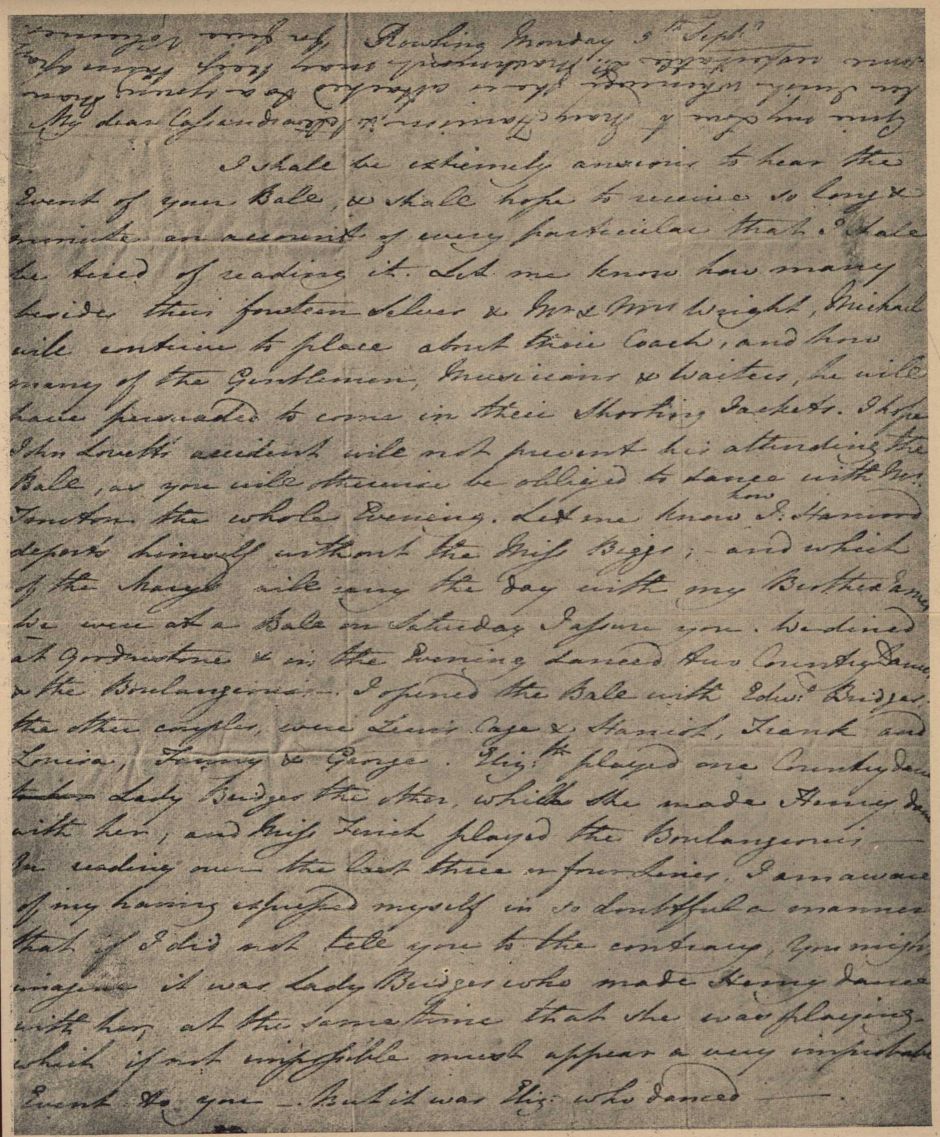
If Jane tells Cassandra about her own dances, she is ever ready in return for news of Cassandra's. "I shall be extremely anxious to hear the event of your ball, and shall hope to receive so long and minute an account of every particular that I shall be tired of reading it.... We were at a ball on Saturday I assure you. We dined at Goodnestone and in the evening danced two country dances and the Boulangeries." This French dance, by the way, was on the unwritten programme at Mr. Bingley's ball, in Pride and Prejudice. It seems to have had its birth in the Revolution, when the bakers, men and women together, kept themselves warm by joining hands and dancing up and down the streets.
After Jane Fairfax had sung herself hoarse at the Coles' party—
"The proposal of dancing—originating nobody exactly knew where—was so effectually promoted by Mr. and Mrs. Cole that everything was rapidly clearing away, to give proper space. Mrs. Weston, capital in her country dances, was seated, and beginning an irresistible waltz; and Frank Churchill, coming up with most becoming gallantry to Emma, had secured her hand, and led her up to the top, (where) she led off the dance with genuine spirit and enjoyment."
The waltz was a novelty still in those days, and seems here to be classed as a country dance. It had been imported from Germany, where Mozart had done much to forward its triumph, after Jane Austen had written her earlier novels, and I cannot remember any other reference to it in her work. It was at first considered an "improper" dance, and one need not be surprised that a generation which had danced nothing more intimate than the "boulangeries" was at first a little flustered by the new fashion. Sheridan, watching the dancers in a ball-room, repeated the following lines of his own composition, which aptly suggest the contrast between the old dancing and the new as it struck the eyes of our great-grand-aunts about the time when Emma danced at the "Crown" and Jane Austen at Goodnestone.
"With tranquil step, and timid, downcast glance, Behold the well-paired couple now advance. In such sweet posture our first parents moved, While, hand in hand, through Eden's bowers they roved, Ere yet the Devil, with promise fine and false, Turn'd their poor heads, and taught them how to waltz."
Little wonder, when a waltz was regarded as forbidden fruit, if Edmund Bertram, Fanny, and Sir Thomas were shocked at the very idea of play-acting by the family and guests at Mansfield Park. Not that there were wanting plenty of quiet souls who were in nowise personally distressed at the "impropriety" of the waltz on their own account, just as, in the other matter of amateur theatricals, and the choice of a play, when Lady Bertram asked her children not to "act anything improper," it was not because she had any personal objection to offer, but because "Sir Thomas would not like it."
The Bertrams' ill-fated theatricals, and the waltz which Mrs. Weston played, serve to emphasize the place which Jane Austen fills as an historian of the transition from the formal prudery of the sceptical eighteenth century to the broader liberties of the scientific nineteenth. "What is become of all the shyness in the world?" she asks her sister in 1807; "shyness and the sweating sickness have given way to confidence and paralytic complaints." Morals change but little as compared with moeurs. The girls who act in private theatricals every winter and dance twenty waltzes a night half the year round are no whit less virtuous than their great-grandmothers who were shocked at the waltz, and caught cold in clothes which were so thin that, as a close observer has recorded, you could "see the gleam of their garter-buckles" through the silks and kerseymeres as they danced, and altogether so suitable for a classical revival that a contemporary poet was moved to utter the quatrain—
"When dressed for the evening the girls now-a-days, Scarce an atom of dress on them leave; Nor blame them, for what is an evening dress But a dress that is suited to Eve."
Thus the mother of mankind is accused by one poet of having danced the first waltz, and held responsible by another for the airy fashions of the Récamier period.
One of the principal differences of etiquette, we may note before passing on, between the customs of the ball-room a century ago and now, was that in the days when John Lyford was eluded with so much difficulty a girl danced two successive dances with the same partner as a matter of course, so that neither an imaginary John Thorpe nor a real John Lyford could be got rid of by the promise of one dance.
The scraps from the letters, given on the last few pages, help us to realize how clearly Jane Austen's own life is at times reflected in her books.
IV ETHICS AND OPTIMISM
Dr. Whately on Jane Austen—"Moral lessons" of her novels—Charge of "Indelicacy"—Marriage as a profession—A "problem" novel—"The Nostalgia of the Infinite"—The "whitewashing" of Willoughby—Lady Susan condemned by its author—The Watsons—Change in manners—No "heroes"—Woman's love—The Prince Regent—The Quarterly Review.
"The moral lessons of this lady's novels," wrote Archbishop Whately in his Quarterly article of 1821, "though clearly and impressively conveyed, are not offensively put forward, but spring incidentally from the circumstances of the story." So inoffensively, indeed, are they offered to our notice, that Dr. Whately himself seems to have been unable to discover them at all. "On the whole," writes the Archbishop, "Miss Austin's (sic) works may safely be recommended, not only as among the most unexceptionable of their class, but as combining, in an eminent degree, instruction with amusement, though without the direct effort at the former, of which we have complained, as sometimes defeating its object."
The most obvious "moral" of Jane Austen's novels is that if you are a heroine you need not trouble yourself about your future. You are certain to marry a worthy man with an income sufficient for a comfortable existence. He may be endowed with something less than a thousand a year, like Edward Ferrars, with a couple of thousand like Captain Wentworth, or with the ten thousand a year which made Darcy appear so admirable to Mrs. Bennet. In any case you will not have to eat bread-and-scrape or go without a fire in your bedroom. The Country-house Comedy of Jane Austen is full of morals if you are in need of them, but it was not written to improve you, only to amuse you—and its maker. If you must have a clear moral for each story, after the manner of tracts, you may take them thus. Pride and Prejudice conveys the useful lesson that the person you most dislike in one month may be the one you will very sensibly give your affection to in the next; Sense and Sensibility that when the bad man falls into the pit he has dug for himself, the good man comes by his own; Emma that the man whose society is most necessary to a woman's quiet contentment is the man she ought to marry; Mansfield Park that a simple, unaffected girl who gains the second place in a man's affections may win the prize through the disqualification of her more brilliant rival; Persuasion that nothing is more likely to revive an old passion than to see its object warmly admired by some other eligible party; Northanger Abbey that a tuft-hunting father may be induced to receive a daughter-in-law of no importance by the kindly influence of a son-in-law of superior rank. As for Lady Susan, the moral of that unpleasing story is that if a worldly mater pulchra is the rival in love of an ingenuous filia pulchrior she will probably lose the battle after much suffering on either side; and from The Watsons we may see that if a girl is educated above her family she will find it hard to be happy beside the domestic hearth. All these are plain workable morals. Whether the author of the novels would have endorsed them we cannot certainly know, but it is more than probable she would not.
We need not suppose that Jane Austen was ignorant of the coarseness of conversation, the hard-drinking, the wild gambling, the moral laxity of a large section of society that are so frequently exhibited in the records of the age, in spite of the improvement in manners. But we can hardly help laughing at the objection taken to her novels even by some of her contemporaries, that they were "indelicate"! The "indelicacy" was usually found in the views of marriage held and expressed by the heroines and their families. The love-affairs of these country maidens were not often, we must admit, such as to steal away their beauty sleep or spoil their appetites for breakfast. Mrs. Jennings' kindly endeavour to cure a girl's disappointment in love by a variety of sweetmeats and olives, and a good fire, was perhaps not wholly unjustified by experience. In those days, when no profession save that of governess was open to women, when nursing the sick was regarded as an occupation specially suitable for those of a low class, when no door opened from the drawing-room on to the professional stage, and when the very idea of a "female" as secretary to a man of affairs or of business would have been condemned as "improper," marriage was undoubtedly viewed by most people as the only aim of a young woman, "the pleasantest preservative from want," as Charlotte Lucas regarded it, and, moreover, the average age of brides was much lower than it is now-a-days. To avoid being a governess by attracting the admiration of a man who could afford a wife was the hope, at least, of most poorly endowed girls, and even if matrimony is not viewed with so much sentiment and reserve by Jane Austen's heroines as by the excessively squeamish Evelina, we may be inclined to prefer the "indelicacy" of Jane Austen to the elaborate, delicacy of Fanny Burney. Scott himself, by an ingenious paradox, has been accused—as a novelist—of immorality, and Quentin Durward in particular described as "one of the most immoral novels that has even been written," because its romance expresses nothing. The interest a boy takes in its romantic passages "depends on the fact that he dreams himself to be in similar circumstances; he must treat the novel subjectively, and it is the subjective use of the imagination which does all the damage. It is in reading such books as this that a bad habit of mind is begun, and Quentin Durward is more immoral for a boy of fourteen than a translation of the most shockingly indecent French novel." Well may the anonymous writer of this unexpected criticism add: "There are paradoxes to be met everywhere, and most of all in the question of morality." This particular kind of immorality has not yet, so far as I know, been charged against Jane Austen. She cannot be justly accused of writing romance which "expresses nothing," but she certainly leaves plenty of opportunity for young readers to exercise their imaginations, and thus begin a "bad habit of mind."
The view of marriage as a profession, with or without ardent affection, is not the only thing that has shocked the delicacy of many of Jane Austen's readers. Serious objection has been taken to her introduction of episodes of an "improper" nature. How is the charge supported? Lydia Bennet, a vulgar, badly brought-up girl still in her teens, infatuated with the red coats of the militia officers, insists on going away with Wickham, and lives with him as his mistress until, by the generous aid of Darcy, and the determination of the Gardiners—her uncle and aunt—"a marriage is arranged" and does "shortly take place." This episode, say the stern critics, was (1) unnecessary to the plot, and (2) if it was necessary, it is too much insisted on and developed. That it is an essential part of the little plot, worked in to exhibit the best side of Darcy's character, which before has only been seen in its least attractive light, seems to me obvious, and I agree with Professor Saintsbury's opinion that it brings about the dénouement with complete propriety. Lydia's entire indifference to the moral aspect of her conduct is and was unusual in a girl of sixteen and of her class, but her character from first to last is consistently drawn, and the contrast between the selfishness of Wickham and Lydia, who care nothing for any one's happiness except their own, and not even for each other's, and the sympathy of heart and variety of temperament which bring Elizabeth and Darcy together is admirably drawn.
Then we are asked to be shocked at the illustration of the bad character and selfish cruelty of Willoughby given to Elinor Dashwood by the very worthy and very dull Colonel Brandon in Sense and Sensibility. It is a painful story. Willoughby, the faithless lover of Marianne Dashwood, had seduced an impressionable girl whom Brandon, out of affection for the memory of her mother, herself ruined by a scoundrel, had practically adopted, and whom such scandal-mongers as Mrs. Jennings declared to be the Colonel's own child. "Why drag in this nasty story?" ask the objectors, and above all, "why allow the Colonel to pour it into the ears of a young girl like Elinor?" That it comes unfortunately from Brandon, who is a rival—hopeless as it had seemed—of Willoughby for Marianne's affection, and that in the middle-class society of to-day a well-bred man would not tell such a tale to a girl if he could find any other means of achieving an imperative object is undeniable.
What was Brandon to do? He knew that Marianne was pining for love of a man at least as unworthy of her as, in his worst days, was Tom Jones of Sophia, and he believed, with or without reason, that the knowledge of Willoughby's character would be a bitter but efficacious medicine for her heart-sickness. Elinor, the sensible, prudent, devoted sister, seemed the only person to whom he could tell the story with any hope that it would be discreetly used. "He had spent many hours in convincing himself that he was right," and when Elinor said, "I understand you, you have something to tell me of Mr. Willoughby that will open his character farther. Your telling it will be the greatest act of friendship that can be shown to Marianne. My gratitude will be ensured immediately by any information tending to that end, and hers must be gained by it in time. Pray, pray let me hear it," there is little reason for wonder that "upon this hint he spake," and told the story of the moral ruin of the mother and the cruel desertion of the daughter which the reader of Sense and Sensibility will recall, Elinor lost little time in retailing it to her sister, with the immediate and apparently unexpected effect of increasing the girl's unhappiness. "She felt the loss of Willoughby's character yet more heavily than she had felt the loss of his heart," though we know that she soon afterwards became as fond a wife of Colonel Brandon as she ever could have been of Willoughby.
Far more remarkable, I think, than Brandon's telling Elinor the miserable story of his sister-in-law and her daughter is the manner in which Elinor herself receives Willoughby's attempt to excuse his conduct. He admits his treatment of Miss Williams, but asks how Elinor could think Colonel Brandon an impartial reporter of the affair, and proceeds to offer his own excuse in the words that follow—
"I do not mean to justify myself, but at the same time cannot leave you to suppose that I have nothing to urge,—that because she was injured, she was irreproachable,—and because I was a libertine, she must be a saint. If the violence of her passion, the weakness of her understanding—I do not mean, however, to defend myself. Her affection for me deserved better treatment, and I often, with great self-reproach, recall the tenderness which, for a very short time, had the power of creating any return. I wish—I heartily wish it had never been. But I have injured more than herself; and I have injured one whose affection for me (may I say it?) was scarcely less warm than hers, and whose mind—oh! how infinitely superior."
In other words, the inexperienced child was of weak understanding, and loved him passionately, and therefore he was not so much to blame as if she had been less warm in her affection and stronger in her intelligence. Surely the reasoning should have been reversed. Yet after this fine oration Elinor "pities" him, and, when he goes on to disparage his wife, whom he has married for her fortune, and to express his continued love for Marianne, all that Elinor says is, "You are very wrong, Mr. Willoughby, very blamable, you ought not to speak in this way, either of Mrs. Willoughby or my sister," and in saying this "her voice, in spite of herself, betrayed her compassionate emotion." When he left her, Elinor assured him that she thought better of him than she had done, "that she forgave, pitied him, wished him well—was even interested in his happiness—and added some gentle counsel as to the behaviour most likely to promote it;" counsel which he showed little disposition to take.
This tolerance by Elinor for a man who, on his own admission, had "taken advantage" of a simple young girl, ignorant in the world's ways, this readiness to allow extenuating circumstances to a mercenary breaker of reputations and hearts, is a far more serious fact than the mere introduction of a story which does fit quite easily into the plan of the novel. Elinor's reflections when Willoughby had ended his apologies sufficiently show that the point of view suggested in the duologue between the sinner and the sister was deliberately set up by the author—
"She made no answer. Her thoughts were silently fixed on the irreparable injury which too early an independence and its consequent habits of idleness, dissipation, and luxury, had made in the mind, the character, the happiness, of a man who, to every advantage of person and talents, united a disposition naturally open and honest, and a feeling, affectionate temper. The world had made him extravagant and vain; extravagance and vanity had made him cold-hearted and selfish. Vanity, while seeking its own guilty triumph at the expense of another, had involved him in a real attachment, which extravagance, or at least its offspring necessity, had required to be sacrificed. Each faulty propensity, in leading him to evil, had led him likewise to punishment. The attachment from which, against honour, against feeling, against every better interest he had outwardly torn himself, now, when no longer allowable, governed every thought; and the connection, for the sake of which he had, with little scruple, left her sister to misery, was likely to prove a source of unhappiness to himself of a far more incurable nature."
The chapter describing this interview between Willoughby and Elinor is the only one in all the novels of Jane Austen wherein a "problem," after the kind dear to the dramatist of to-day and the novelists of yesterday, is fully presented and considered, the heroines, with this exception, answering to Mr. Andrew Lang's description, being "ignorant of evil, as it seems, and unacquainted with vain yearnings and interesting doubts." Elinor only, as we find her on this occasion, is a pioneer of that school of sociology which whitewashes the individual at the expense of his early environment and education. Her defence of this wretched man is, in principle, that which an Old Bailey advocate offers when he cites the theories of Lombroso in favour of a beetle-browed criminal who has stuck his knife into the breast of some confiding woman. It was "the world" that had made him what he was, he was to be pitied, not condemned.
Though we have not to consider here whether Elinor and the advocate are right or wrong, it is hard to avoid the thought that, when she wrote this remarkable chapter, Jane Austen was influenced in a degree quite unusual in that age with people of her class by the sense of futility which, not long before her day, had been the motive of Candide. Voltaire's irony is bitter, in spite of the optimism which his book preaches, and of the essential kindness of his nature, while Jane Austen's is as sweet as irony can ever be. That she was intentionally ironical in this case of Elinor's tolerance is scarcely possible. Only a cynic would treat a pure-minded maiden's apology for a heartless seducer as a subject for covert satire, and Jane was not a cynic.
Writing of Maria Edgeworth in his Notes for a Diary, Sir M. E. Grant Duff says: "In her, as in Miss Austen, there is something wanting. Is it what has been called the nostalgie de l'Infini?" That intellectual ailment is more common now-a-days than it was in the eighteenth century, and there was little of it in the grey matter of any country brains when Jane was born. Certainly it cannot be diagnosed from her work generally. Only in the particular case of Elinor and Willoughby does that idea of the helplessness of man in the maelstrom of Infinity which has paralyzed the wills of so many unhappy victims, and induced the devastating literature of determinism, seem to have entered into her plan of work—for only thus can I account for the moral whitewashing of Willoughby, not by a "man-of-the-world," with his "after all," and his "human nature" arguments, but by a country ingénue. The more I read Jane Austen's writings the stronger grows my conviction that she was one of those fortunate beings whose optimism is differentiated from pessimism by the good offices of an excellent digestion and an even pulse.
We need not suppose that she had thought much about the philosophical sanction of conduct as opposed to the purely religious, or that she had studied the French Encyclopædia. She was born and brought up in an atmosphere wherein convention, in regard to the things that matter, was almost omnipotent, and she was not of the type whereof iconoclasts are made. She attacked no system, social or religious; but she had no fondness for "isms," and thus it is that dogmatism is quite as hard to discover in her writings as scepticism.
It has been said already that Jane Austen was not a cynic. Yet it would be easy, by making Lady Susan one's text, and ignoring the rest of her writings, to show that she was as cynical as a Swift or an Anatole France. Of course I do not mean that her apparent cynicism in this case was exercised on the kind of subjects which is ridiculed in The Tale of a Tub or in L'Ile des Pingouins. But I know nothing, in its way, more cold-blooded in the presentation of "love" than the conclusion of that novel of Jane's springtime, which she herself, her own wise critic, withheld from publication. The rivalry of mother and daughter for the affections of the same man must always be an unpleasant subject, and the story of the conflict between Lady Susan Vernon and her daughter for the matrimonial prize represented by Reginald de Courcy, as told in letters among the characters concerned, is on a low plane. The morals of the "heroine" may not be suspect, but her tone is below suspicion.
What is the dénouement of Lady Susan? The mother's schemes to marry the man of the daughter's choice have ended in her own marriage to the wealthy noodle whom she had tried to force upon the daughter. "Frederica," says the author,—dropping the "correspondence" plan in order to wind up the book more readily—"was therefore fixed in the family of her uncle and aunt till such time as Reginald de Courcy could be talked, flattered and finessed into an affection for her which, allowing leisure for the conquest of his attachment to her mother, for his abjuring all future attachments, and detesting the sex, might be reasonably looked for in the course of a twelve-month. Three months might have done it in general, but Reginald's feelings were no less lasting than lively. Whether Lady Susan was or was not happy in her second choice, I do not see how it can ever be ascertained...."
It is certain that to some considerable extent Lady Susan was a satire on several lady novelists of the period. All Jane Austen's novels are more or less satirical, from Northanger Abbey, which is full of burlesque passages, to Persuasion, in which they are so rare that it needs a hunt to discover any. Whether or not Lady Susan was intended to be taken more seriously than in jest, it is a dull performance. The whole plan and treatment of the book are artificial. It was not Jane's natural instinct or her finer art which was at work in its making. So foreign is it to herself that if the MS. had been found in some cupboard of a manor-house no occupants of which had been of known relationship to the Austens, I doubt if it would have been attributed to her by any one who had not made a meticulous comparison of its phraseology with her acknowledged works.
There is, I think, no surer evidence of Jane's fine taste, alike in character and in literature, than that, having brought this novel to completion, she deliberately suppressed it. Had she sold it to a publisher, and allowed it to run its chance of popularity like the rest of her finished novels, we should have had to revise our views on her nature and judgment to a considerable extent. As it is, the fact that having written a poor novel of disagreeable tendency she recognized the unsatisfactory thing that she had done in time to cancel it is much in her favour, and justifies the opinion that whatever defects of subject or of treatment we may find in Lady Susan were condemned by its author. It is for this reason that we need not regret the decision of her nephew and niece to publish, many years after their aunt's death, the book which she herself had withheld. Only, let us never forget as we read it that it was cancelled by the author.
The Watsons was produced, as far as can be ascertained, in that middle period of Jane's life when, after her father's resignation of the Steventon living he was spending his few remaining years at Bath with his wife and daughters. Having written three of her six novels in the nineties of the eighteenth century—the six novels by which she chose to be judged—at Steventon, she produced nothing more of her best until at Chawton, in the early years of the nineteenth century, she completed her life's work.
All her books that live by their own merits were written in the heart of the country. The book that comes nearest to the commonest fiction of her period was chiefly written in a town which, however staid and irreproachable in its tone at the present date, was in her time a centre of worldliness and frivolity.
The Rivals was first acted in the year of Jane Austen's birth, but the picture it offers of Bath society is almost as true of 1802 as of 1775. Dress had changed much in the intervening years, but in all else there seems to have been little change between the Bath of Sheridan the lover of Elizabeth Linley, and the Bath of Sheridan the friend of the Prince Regent. It was among Lydia Languishes and Captain Absolutes that Jane Austen walked in Milsom Street and danced at the Assembly-rooms in 1802-5, and it was in an atmosphere of social affectation and busy idleness that she found her powers unequal to any nobler performance than the account of the husband-hunting and silly young women who angle for Lord Osborne and his friends. The futilities of The Watsons form a remarkable interlude between Pride and Prejudice and Mansfield Park.
The rural society into which Jane Austen takes us in all her novels marks a rapid development from the manners of the preceding age. If we regard the Squire Western of Fielding as representative of a considerable class of the country gentlemen of his time, we may wonder how it is that no such rude disturber of the peace bursts in among the Woodhouses and the Dashwoods. His nearest relation in Jane's novels is Sir John Middleton, and he, with all his noise and ignorance, is a quiet, well-bred person in comparison with the rude father of the delicious Sophia. Even the less rubicund and animal squire of the Hardcastle species is here unknown, and Squire Allworthy himself would have been strange in the drawing-rooms of Mansfield Park and Pemberley, or the parlours of Longbourn and Hartfield. There is less change to be seen in the "manners and tone" of the women, especially the younger women, than of the men. Sophia and Amelia would have used a few expressions, perhaps, that might have made Emma stare and cry "Good God!" or the fine colour deepen on Elizabeth's cheeks, and Marianne Dashwood would have confided to Elinor her astonishment that such otherwise attractive girls should be so ignorant of the poets, and of the proper arrangement of natural scenery. Had the girls become confidential on further acquaintance, Sophia might have wondered why Elizabeth said so little about the appearance of her lover, and so much about his intelligence. But Tom Jones and Booth would never have got on intimate terms with Knightley, or Darcy, or Edward Ferrars, until these Austen young men had drunk more port than anybody in Jane's novels—with the exception of John Thorpe as described by himself—could carry without disaster.
There are no "heroes" among these honest gentlemen of a hundred years ago. Wentworth has indeed won credit and fortune at sea. Bertram and Knightley do nothing to entitle them to the name, beyond marrying the heroine. Edward Ferrars merely behaves properly in keeping faith with Lucy as long as she wants him. Darcy is heroic in taking Mrs. Bennet for a mother-in-law; Henry Tilney makes fun of his chosen mate in a way that would have cost him her heart in a more conventional novel. "Il y a des héros en mal comme en bien," says Rochefoucauld, but of the evil-doing kind there are none here, unless, indeed, the effrontery with which, after jilting Marianne for a rich wife, Willoughby comes to her sister Elinor and asks for her sympathy for his sad fate, or the coolness of Wickham in the presence of the people he has wronged may be regarded as evidence of heroism.
It is to the wonderfully true presentation of the hearts and minds of girls that these novels chiefly owe their immense power of attraction even for readers who miss the greater part of the humour. Fanny Price and Elinor Dashwood are themselves but poorly endowed with humour, and Catherine Morland only possesses it in the rudimentary way of a lively school-girl. With how much of understanding, how clearly and fully are the hopes and fears, the innocent little plans of Fanny and Catherine, the more mature and reasoned ways of Elinor shown to us, without the least apparent effort.
The trustful reader nurtured on the successful fiction of our own time, especially that of the last ten years, during which English novelists have been able to indulge themselves and their public by the introduction of incidents and types of character which up to about the commencement of that decade would have secured the ban of the circulating libraries, has been led to believe that sensual impulse plays as large a part in woman's life as in man's. That such women as Lady Bellaston in Tom Jones, Arabelle in Le Lys dans la Vallée, or the Bellona of Richard Feverel exist, and in great numbers, is certain, but they are not representative of woman. Balzac, who was not: much restrained by any fear of the libraries, knew that many faithless wives (so very common in French fiction and drama, whatever they might be in life) gave themselves to men their love for whom contained much less of sensuality than of other instincts. Esther, the unhappy Jewess of Splendeurs et Misèes de Courtisanes, loves Lucien with an affection far more chaste than that which many a correct heroine is made to display for the man with whom she goes to the altar in the last chapter. The mistresses of famous men, as known to us from memoirs and histories, have not generally been of a sensual nature. Aspasia, most distinguished of them all, was of the intellectual, not the sensual, type. Strangely indelicate as was Madame du Châtelet, her relations with Voltaire were based on affinity of literary taste and critical appreciation much more than on physical attraction. Even among the unintellectual women who have figured among the grandes amoureuses of history, the passion of the woman does not in most instances appear to have been of the coarser kind. Louise de la Vallière is at least more typical of womanhood than Barbara Villiers.
Emma Woodhouse, deeply distressed at the supposed intention of Knightley to marry Harriet Smith, feels that she cares not what may happen, if he will but remain single all his life. "Could she be secure of that, indeed, of his never marrying at all, she believed she should be perfectly satisfied. Let him but continue the same Mr. Knightley to her and her father, the same Mr. Knightley to all the world; let Donwell and Hartfield lose none of their precious intercourse of friendship and confidence, and her peace would be fully secured. Marriage, in fact, would not do for her." Marriage, we know, "did for her" very well, and not at all, so far as we have her story, in the idiomatic sense in which the words are commonly used. But in this healthy maiden, who could regard with equanimity a future wherein the man she liked best should never be more to her than a dear friend who dropped in for tea or supper, we have an effective illustration of the relative insignificance of passion in Jane Austen's view of life.
Emma Woodhouse has near relations in Elinor Dashwood and Edward Ferrars, who, after the marriage of Lucy Steele to Robert Ferrars had cleared away the only barrier to their own avowals of affection, "were neither of them quite enough in love to think that three hundred and fifty pounds a year would supply them with the comforts of life." Kitty and Lydia Bennet could simultaneously adore all the officers of a militia regiment, but there was nothing of the "all for love, and the world well lost" nonsense about any of the agreeable women of Jane Austen's creation. They were not to be captured by a man's attractions of mind and person in the way that Millamant was by Mirabell's, nor even by the art of others, as Beatrice was won for Benedick—and he for her. The names of Millamant and Beatrice were in the ancestral tree of Elizabeth Bennet, but her pulses beat more regularly than theirs.
In the effect of Mary Crawford's charms on Edmund Bertram we may see some pale suggestion of such an awakening as that of Robert Orange (in The School for Saints), who, on meeting with Brigit, "suddenly had found presented to him a mind and a nature in such complete harmony with his own that it had seemed as though he were the words and she the music, of one song." But it was only a "seeming" in Edmund's case, and while we read Jane Austen our thoughts are rarely allowed to flow into a "Romeo and Juliet" channel for more than a few moments at a time.
The re-awakening of Wentworth's dormant love for Anne Elliot would have afforded to most lady novelists an opportunity for some fine, romantic writing. Jane Austen allows herself no romance in the matter. The sea air at Lyme has heightened Anne's colour, and a passing visitor—her cousin, as it happens—is attracted by her appearance. Wentworth notices his glances of admiration and is reminded that she is charming!
"When they came to the steps leading upwards from the beach, a gentleman, at the same moment preparing to come down, politely drew back and stopped to give them way. They ascended and passed him; and as they passed, Anne's face caught his eye, and he looked at her with a degree of earnest admiration which she could not be insensible of. She was looking remarkably well; her very regular, very pretty features having the bloom and freshness of youth restored by the fine wind which had been blowing on her complexion, and by the animation of eye which it had also produced. It was evident that the gentleman (completely a gentleman in manner) admired her exceedingly. Captain Wentworth looked round at her instantly in a way which showed his noticing of it. He gave her a momentary glance—a glance of brightness which seemed to say, 'That man is struck with you'—and even I, at this moment, see something like Anne Elliot again."
This scene may be deficient in the sentiment that delights Catherine Morlands and Marianne Dashwoods, but it is a bit of true observation of a familiar phase of human folly. Archbishop Whately remarks that: "Authoresses ... can scarcely ever forget that they are authoresses. They seem to feel a sympathetic shudder at exposing naked a female mind. Elles se peignent en buste, and leave the mysteries of womanhood to be described by some interloping male, like Richardson or Marivaux, who is turned out before he has seen half the rites, and is forced to spin from his own conjectures the rest. Now from this fault Miss Austin is free. Her heroines are what one knows women must be, though one never can get them to acknowledge it." It is a striking proof of the little that was known of Jane Austen by her contemporaries that, even four years after her death, neither Whately himself, nor the editor of the Quarterly Review knew how to spell her name.
The criticism that the mind brought up on modern fiction would be likely to make on the girls of Jane Austen would be the reverse of Whately's. It would be that her chief defect in depicting woman's character was that she almost invariably did force the reader to spin from his own conjectures when the "mysteries of the heart" were the subject of her pages. The truth is divided, I think, between the Archbishop and the supposed modern critic. Jane's heroines are true women, admirably portrayed, but they only represent a certain proportion of their sex. It could never be suspected of Elizabeth, or Elinor, or Anne, or Fanny that there was Southern blood in her veins. There might have been a few drops—no more—in Marianne's. The feelings of the author are reflected in her most attractive characters. She might have married, again and again, of that there can be small doubt; and while for herself she shared Dorothy Osborne's opinion as to the essentials of conjugal happiness, I fancy that she would also have agreed with Dorothy's brother that "all passions have more of trouble than satisfaction in them, and therefore they are happiest that have least of them." That, indeed, as we have already seen, was very much the fault that Miss Brontë found in her as a novelist.
Anne Elliot comes nearer than any of her fellow-heroines to Dorothy Osborne's ideal of the changelessness of affection, the true union of hearts, but, save for her involuntary tears at the Musgroves', she kept her feelings under the most perfect control, and never, we may be sure, tried to beat her convictions into the heads of her silly family, or even of her faithful friend Lady Russell.
There were, we may fairly believe, not a few who would like to have been Jane's chosen mate. One such unhappy being seems, as we read, to be the actor in the little bit of serious comedy related, with lively exaggeration, in a letter written when she was twenty-five years old. "Your unfortunate sister was betrayed last Thursday into a situation of the utmost cruelty. I arrived at Ashe Park before the party from Deane, and was shut up in the drawing-room with Mr. Holder alone for ten minutes. I had some thoughts of insisting on the housekeeper or Mary Corbett being sent for, and nothing could prevail on me to move two steps from the door, on the lock of which I kept one hand constantly fixed."
Elizabeth Bennet was not more uncomfortable when her mother took Kitty up-stairs after breakfast in order that Mr. Collins might have what he called "The honour of a private audience" with the elder girl. "Dear ma'am," Elizabeth cried, "do not go. I beg you will not go. Mr. Collins must excuse me. He can have nothing to say to me that anybody need not hear. I am going away myself." But her mother's, "Lizzy, I insist upon your staying and hearing Mr. Collins," compelled her to remain, with results for which we must ever be grateful to Mrs. Bennet. It is not clear, however, that Mr. Holder was a suitor for Jane. We are left in doubt both as to his hopes and his demerits.
There is a little matter connected with the Quarterly's two articles in praise of Jane which is perhaps worth noting here. Gifford, who was editor when both appeared, was so warm a supporter of the Prince Regent that Hazlitt—one of Gifford's "beasts"—wrote in an open letter to him: "When you damn an author, one knows that he is not a favourite at Carlton House." Now the Prince is said to have been so fond of Jane Austen's novels that he kept a set in each of his residences, and it is unquestionable that, in consequence of a suggestion that was "equivalent to a command," she dedicated Emma to him. "You will be pleased to hear," she wrote on April 1, 1816, to John Murray the First, who published the book, "that I have received the Prince's thanks for the handsome copy I sent him of 'Emma.' Whatever he may think of my share of the work, yours seems to have been quite right."
In the same letter she expresses her disappointment at the "total omission of 'Mansfield Park'" in the Quarterly's review of her work in the preceding autumn. As to that review, it is a curious fact that until Lockhart's "Life of Scott" appeared, Whately, who wrote the 1821 article, was credited with the authorship of the earlier review, and it is still to be found against his name in the British Museum catalogue, not from the ignorance of the cataloguers, but because he appears as author on the title-page of a reprint of the article issued at Ahmedabad in 1889.
V THE IMPARTIAL SATIRIST
What has woman done?—"Nature's Salic law"—Women deficient in satire—Some types in the novels—The female snob—The valetudinarian—The fop—The too agreeable man—"Personal size and mental sorrow"—Knightley's opinion of Emma—Ashamed of relations—Mrs. Bennet—The clergy and their opinions—Worldly life—Absence of dogma—Authors confused with their creations.
It is a commonplace of those who refuse to recognize the claims of woman to equal treatment in spheres of activity where man has long held a monopoly, to ask what great thing has woman done in any walk of life? One may talk in reply of Sappho, of Joan of Arc, of George Sand, of George Eliot, of Florence Nightingale, and two or three others, and the retort, if the greatness of these be admitted, is that they are the exceptions that "prove" the rule. It is difficult, impossible perhaps, to upset the man who denies that anything of "the greatest" in art, or literature, or science has been achieved by a woman. The list of women who have left an abiding fame as poets, or novelists, or painters is soon exhausted, and there is not a name that can, without reserve, be placed among the Rembrandts and Turners, the Goethes and Miltons, the Newtons and Darwins of mankind. Maybe this deficiency is largely due to lack of opportunity. Since the gates were partly opened to woman, within the lifetime of those who are still not old, she has done enough to change the opinions of many who held that rocking the cradle was a sufficiently active share in the ruling of the world for the sex that produced the Maid of Orleans and the Lady with the Lamp. Such justly conspicuous success as Madame Curie has attained in chemistry, or Mrs. Garrett Anderson in medicine, or Mrs. Scharlieb in surgery, has compelled the admission that even if woman were by nature unfitted to reach the highest levels of intellectual achievement, she at least could not be excluded from the learned professions on the ground of inadequate mental equipment.
"Nature's old Salic law," said Huxley, "will not be repealed, and no change of dynasty will be effected." Jane Austen, at any rate, did not desire to repeal it. She was among the most feminine of the women writers who have left an enduring reputation. It is something of a paradox, therefore, that the quality on which her fame chiefly rests is one which is rare among women, and in which most of those women who have attained success in literature have been conspicuously lacking—satirical humour. Apart from physical disabilities, want of humour is woman's heaviest handicap in the conflict of life. Humour is the principal ingredient of the philosophic temperament. Woman has courage in adversity, she can suffer intensely without complaint, but she rarely possesses the power of laughing at her own misfortunes.
It has been said, and the saying might not easily be gainsaid, that none of the great jokes of the world was made by a woman. There are perhaps fifty great jokes—spoken jokes, of course, are meant, not those generally humourless things known as "practical jokes"—and the good stories that are told and received as novelties are, save in the rarest instances, merely new editions of some wheeze which was already ancient when it was told to a circle of mead-drinkers round a fire the smoke whereof—or some of it—escaped through the roof. It is, there is reason to believe, no mere figure of speech that originally most of the basic jokes were told round the galley fire of the Ark during the long dark evenings after the animals had been fed, the decks swept down, and the women had retired to their quarters. Thus may we account for the otherwise inexplicably large proportion of sea-faring and animal tales among the mirth-provoking yarns of man. A woman might never make a joke, and yet have a keen sense of humour, while, on the other hand, she might make many jokes, and have no sense of humour at all. Most of the jokes that have any element of freshness are alive with fun, and not with humour. Who is more humourless than the notoriously funny man?
Jane Austen is not often funny and seldom makes jokes in her novels. Her humour is of the essential kind, which is so nearly akin to wit that it is often almost identical with it. Wit and humour, after all definitions, are brothers who might be taken for one another by those who do not notice that the one has colder hands than the other.
If you want to laugh heartily you must not trust to Jane's novels for a stimulant. Her characters laugh but little among themselves, and are the cause of intellectual joy rather than of physical contractions in those who read about them.
When, after a re-reading of the novels, we sit and think over their delights, many are the admirable bits of character-drawing that come to mind. After we have thought of the heroines, the "good" people, in the common meaning of the word, do not come back to us so readily as those who, if not "bad," are decidedly faulty. The Westons, the Gardiners, the Harvilles, the Crofts, Lady Russell, the John Knightleys, we recall when we jog our memories. After Elizabeth, and Emma, and Anne, it is the appallingly tactless Mrs. Bennet, the odiously snobbish Mrs. Elton, the race-proud Lady Catherine, the entirely selfish Mr. Collins, the lazy and thoughtless Lady Bertram, the mean and tyrannical Mrs. Norris, the fatuous Sir Walter Elliot, these and their like, who throng into view. No writer—not even Thackeray—has realized the female snob more knowingly than Jane Austen in Mrs. Elton, whose constant reference of all matters of taste to the standard presented by "Maple Grove" and the "barouche-landau" renders her as diverting to us as she was insufferable to Emma Woodhouse. A woman like this, who is never betrayed into an unselfish action or a noble aspiration, is happily not a common object in real life, but there are enough of Mrs. Elton's great-granddaughters about the world to exculpate Jane from the charge of undue exaggeration. Emma herself has been called a snob, and only the other day was described as "perpetually acting with bad taste." But Emma's disdain for Robert Martin, and her opinion of the degradation of marrying a governess, were due to prejudices of convention, which thought—under Knightley's influence—dispelled. Mrs. Elton was a snob at heart, who revelled in her own vulgarity of instinct.
If the snob is portrayed to perfection in Mrs. Elton, the valetudinarian is no less happily presented in Mr. Woodhouse—"My dear Emma, suppose we all have a little gruel"—and for a picture of an empty-headed, frivolous wife married to a rational and bearish husband, the Palmers, in Sense and Sensibility, have few equals. As for Miss Bates, she is without a serious rival as an inconsequential babbler, and though we may be, and ought to be, as angry with Emma for her rudeness at the Box Hill picnic as was Mr. Knightley himself, we must admit that years of Miss Bates's disjoined garrulity were some set-off against that gross breach of charity and good manners. Lady Catherine de Bourgh has been placed by some critical readers among Jane Austen's obvious caricatures. Is she not an entirely credible, if happily rare, type? She is seen in a strong light in her attempt to bully Elizabeth into a promise not to marry Darcy—
"'With regard to the resentment of his family,' says Elizabeth at last, 'or the indignation of the world, if the former were excited by his marrying me, it would not give me one moment's concern—and the world in general would have too much sense to join in the scorn.'
"'And this is your real opinion!' replies Lady Catherine. 'This is your final resolve! Very well. I shall now know how to act. Do not imagine, Miss Bennet, that your ambition will ever be gratified. I came to try you. I hoped to find you reasonable; but, depend upon it, I will carry my point.'
"In this manner Lady Catherine talked on till they were at the door of the carriage, when, turning hastily round, she added—
"'I take no leave of you, Miss Bennet. I send no compliments to your mother. You deserve no such attention. I am most seriously displeased.'
"Elizabeth made no answer, and without attempting to persuade her ladyship to return into the house, walked quietly into it herself."
Thus ends one of the great scenes of Jane Austen, a bit of duologue which gives us the natures and capacities of two remarkable people, a charming, clear-headed, self-reliant girl, and a blustering, stupidly proud old woman.
Sir Walter Elliot is the companion figure, more highly-coloured, of Lady Catherine. This man, a vain fop who has not sense enough to govern his own affairs, regards professional men as contemptible, if necessary, adjuncts of society, and, at a time when only the splendid services of our sailors had saved England from disaster he thus babbles about the navy—
"Yes; it is in two points offensive to me, I have two strong grounds of objection to it. First, as being the means of bringing persons of obscure birth into undue distinction, and raising men to honours which their fathers and grandfathers never dreamt of; and, secondly, as it cuts up a man's youth and vigour most horribly; a sailor grows old sooner than any other man. I have observed it all my life. A man is in greater danger in the navy of being insulted by the rise of one whose father his father might have disdained to speak to, and of becoming prematurely an object of disgust himself, than in any other line. One day last spring, in town, I was in company with two men, striking instances of what I am talking of,—Lord St. Ives, whose father we all know to have been a country curate, without bread to eat: I was to give place to Lord St. Ives,—and a certain Admiral Baldwin, the most deplorable-looking personage you can imagine; his face the colour of mahogany, rough and rugged to the last degree; all lines and wrinkles, nine grey hairs of a side, and nothing but a dab of powder at top. 'In the name of heaven, who is that old fellow?' said I to a friend of mine who was standing near (Sir Basil Morley). 'Old fellow!' cried Sir Basil, 'it is Admiral Baldwin. What do you take his age to be?' 'Sixty,' said I, 'or perhaps sixty-two.' 'Forty,' replied Sir Basil, 'forty, and no more.' Picture to yourselves my amazement: I shall not easily forget Admiral Baldwin. I never saw quite so wretched an example of what a sea-faring life can do; but to a degree, I know it is the same with them all: they are all knocked about, and exposed to every climate, and every weather, till they are not fit to be seen. It is a pity they are not knocked on the head at once, before they reach Admiral Baldwin's age."
There have been such fools as Sir Walter Elliot, but as a type he is overdrawn. Jane loved the navy so much that her anger with those who disparaged it gave her pen speed and added colour to the ink.
Anne's cousin William Elliot, whose attentions to her help to revive Wentworth's affection, is more closely studied by the author than any of her "heroes."
"Everything united in him; good understanding, correct opinions, knowledge of the world, and a warm heart. He had strong feelings of family attachment and family honour, without pride or weakness; he lived with the liberality of a man of fortune, without display; he judged for himself in everything essential, without defying public opinion in any point of worldly decorum. He was steady, observant, moderate, candid; never run away with by spirits or by selfishness, which fancied itself strong feeling; and yet, with a sensibility to what was amiable and lovely, and a value for all the felicities of domestic life, which characters of fancied enthusiasm and violent agitation seldom really possess."
Anne, however, was not long in discovering grave defects in this outwardly model person. She saw that while he was
"rational, discreet, polished, he was not open. There never was any burst of feeling, any warmth of indignation or delight, at the evil or good of others. This, to Anne, was a decided imperfection. Her early impressions were incurable. She prized the frank, the open-hearted, the eager character beyond all others. Warmth and enthusiasm did captivate her still. She felt that she could so much more depend upon the sincerity of those who sometimes looked or said a careless or a hasty thing, than of those whose presence of mind never varied, whose tongue never slipped.
"Mr. Elliot was too generally agreeable. Various as were the tempers in her father's house, he pleased them all. He endured too well, stood too well with everybody."
Those who accuse Jane Austen of hardness have sometimes relied on her treatment of Mrs. Musgrove's sorrow over her ne'er-do-well son, long after his death, to support this charge. Anne and Wentworth, whose mutual liking was just beginning to bloom again, were "actually on the same sofa, for Mrs. Musgrove had most readily made room for him; they were divided only by Mrs. Musgrove. It was no insignificant barrier, indeed. Mrs. Musgrove was of a comfortable, substantial size, infinitely more fitted by nature to express good cheer and good humour than tenderness and sentiment; and while the agitations of Anne's slender form, and pensive face, may be considered as very completely screened, Captain Wentworth should be allowed some credit for the self-command with which he attended to her large fat sighings over the destiny of a son, whom alive nobody had cared for." And then the author stops in her narrative to observe that "Personal size and mental sorrow have certainly no necessary proportions. A large, bulky figure has as good a right to be in deep affliction as the most graceful set of limbs in the world. But, fair or not fair, there are unbecoming conjunctions, which reason will patronize in vain—which taste cannot tolerate—which ridicule will seize."