JAMES LUSK (continued 2)
Reading edition
SABBATH EVENING, AUGUST 1, 1915.
On Wednesday night we moved away from our nice Château at 10.30 p.m., and at 1.30 a.m. reached the village where we were to stay the night. The moon was good, and the march was a good one of about seven miles or so. At 2.15 that morning I lay down on the top of a bed with just my boots and jacket off, and slept till 6 a.m. Then I got up and shaved, and drank a cup of cocoa that my servant made, and was in the saddle again by 7 a.m., and rode about five miles to the headquarters of a French General in a Château. Officers Commanding Battalions were ordered to go there at 8 a.m., and we were provided with French guides who could speak English, and went over the trenches that our Battalions were to take over on Saturday night. This we did, and were much pleased with the construction of them and the general conditions of everything; so last night we marched off from our Billets in the village to the trenches, and we are here now. Our Battalion is not actually in the front line just now, but is in 'dug-outs' just behind the first line. It is in a wood, and is so picturesque in places that one would never connect it with war, were it not for occasional shells that come over our heads.
MONDAY, AUGUST 2, 1915.
I am well, and busy all day with many varied things. I am acting just now both as Commanding Officer and Adjutant, but we are getting on nicely. We are a few hundreds of yards behind the front line just now, and, beyond a little shelling now and again, we are very quiet.
We are living in a wood with high trees and undulating ground, and the French Army, who have just vacated the place have constructed most elaborate shelters from shell-fire. They are much more palatial places than any 'dug-outs' we have seen or made elsewhere. They go so deep down into the ground, or are built up with such thick sides and roofs, that they are considered quite safe things to be in, even if they do get a direct hit upon them with a big shell. We are going to make application for leave for other two Officers.... Then perhaps it will be my turn to come. Yes, I am waiting till all the others have had leave, as I would rather be the last to go.
SABBATH NIGHT, SEPT. 19, 1915.
To-day has been my birthday and I am getting very old, but I don't feel it, so it doesn't matter, and the best thought is that we grow old all together. And I have more to be thankful for than most. Our mails have been delayed one day, and that has had this result, that to-day's mail brought me no fewer than eight letters, and six of these were partly written for my birthday, and if the mails had not been delayed I would likely have had all these birthday letters one day too soon! So that I am quite content to see a purpose in all that concerns me, and I am especially rich in real friends.
SAME DATE.
I am thirty-seven to-day.... but I don't feel old, and pray that I may be given more strength to give more and do more, and to keep nothing back that should be given.
There is an inspiration in giving, and in being spent for the greatest things, that knows no limits and never knows what it is to give too much.
He was disappointed several times of the leave which he was looking forward to, but he never grumbled. When it came at last in October it was spent chiefly in seeing his many friends and especially the relatives of his comrades in the Battalion. One friend has seen in this a new instance of the fact that he 'always thought first of others.'
It was in November that the unlooked for honour came to Captain Lusk:—
SATURDAY, NOVEMBER 6, 1915.
I have got a little piece of news for you to-night that will cheer you. Intimation came to us this morning that a French decoration was to be given to your first-born son. It is called 'Chevalier, 5th Class, Legion of Honour.' I don't know what it is for, but someone—I don't know who—has been so kind as to recommend me for it, and it is to be given to-morrow, Sabbath, by the Commander of the Third Army at a little village behind the lines.
I don't know what there has been in the work of each day that has seemed to those in authority to be worthy of some mark of approval.... It has come as a complete surprise to us all, and I try to say that it is an honour more to the Battalion than to me.... It is exactly one year to-day since I took up my duties as Staff Captain of the Scottish Rifle Brigade at Falkirk.
NOVEMBER 9, 1915.
Saturday night was a busy one; I think I only got a few hours' sleep altogether. We were to be relieved in trenches on Sabbath morning. It was a day sooner than we had expected, and there were many arrangements to make, besides the ordinary routine-work of messages and telephones and counter-messages. I got up before 6 to lead a working party up to the front trench, and when I had done that I lay down again for less than an hour; then got up and washed and shaved, for this was a great day for my Mother and my Sister, and through them for me! The orders for the relief reached us at 8 a.m., and I had much arranging to do in the hour that followed before I had to be off on my errand. I got something to eat, put on a pair of cleaner boots, and tried to take at least some of the mud from my clothes. My grey mare was waiting for me in the wood, and I rode about three miles back to Hamilton's billet in his little village. I met him in the middle of the street. He had just heard about it the night before, and was very kind about it and extremely pleased. He is such a keen soldier. I took off my web equipment, and borrowed his leather cross-belts, which he always keeps polished to the last degree, and dug out my new glengarry from my valise that was in his keeping what time we were in the trenches.
A motor-bus had been arranged for the rest of the journey; it was one of the old London Omnibus Company's ones, painted khaki and with its side windows boarded up. There are lots of them used here for taking troops about hurriedly. This took me back another five or six miles, and by 11 a.m. we had reached a little village where there was a charming old French Château, that was being used as the Headquarters of a certain 'Division'—a Regular Division. In front of the Château was a beautiful park with trees covered with autumn leaves. It was a perfect winter day. The sun shone, and opposite the centre of the Château at the other side of the park stood a great gateway with high pillars and a great gate. A parade ground was marked off in this park, and a certain Regiment of Regulars was drawn up to form three sides of a square. When every one was in his place the order was given 'Fix Bayonets,' and like one man they flashed in the sun-light. There was a little table at the fourth side of the square with a coloured rug laid over it. In the centre of the square nine Officers and about thirty Non-Commissioned Officers and men stood to attention in line.
General Sir E. H. H. Allenby, K.C.B., Commanding the Third Army, accompanied by his Staff and several French Officers in blue and gold, came to the little table. The Commander of the Troops gave the command 'GENERAL SALUTE, PRESENT ARMS,' and they did it well, while the Army Commander stood at the salute. One by one names were called by the Chief of his Staff, and each one in the centre row came forward and saluted. No word was spoken save this,—'Legion d'Honneur, Chevalier,—I congratulate you.' Each again saluted in silence and withdrew to the centre line, with something in his hand. Then to the other ranks was handed either 'Medaille Militaire' or 'Croix de Guerre.' Again the band in rear of the troops played 'The Marseillaise,' while all stood at the salute. That was all. The troops marched off the ground, the centre row fell out, and it was over. No speech. The Army is not given to making speeches; and in the circumstances that made the setting, it seemed entirely fitting that it should be so, for we could still hear the guns in the distance. I went back to the trenches, but why I was one of those nine I do not know or understand.
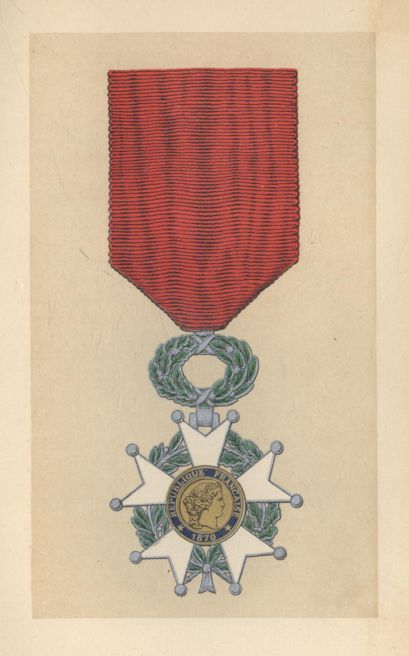
Chevalier de la Légion d'Honneur
SAME DATE.
Everyone here has been so kind about my French decoration. I feel quite ashamed that such a thing should have come to me, when so many others round me have done so well. I don't understand it.
The star is of white and green enamel and the ribbon is scarlet silk.
It is exactly seven years yesterday since I joined this Battalion.
In two letters to friends, written some weeks later, the following passages occur:—
There are many in the Battalion who have deserved marks of approval for service much more than I, and in particular those who have made the supreme sacrifice. But their Honour is greater than anything that man can give.
I went back to the trenches, and the Château with its park, its gates, its trees with autumn leaves, its well-dressed regiment with fixed and shining bayonets, its Generals in red and blue and gold, disappeared like a happy dream, and it was back to mud and duty.
But there is a deep down satisfaction in being in the front line that a man would not give up for much that the world holds dear.
I am proud of that Cross, and proud to wear its scarlet ribbon on my jacket, but there are honours greater far than that, and to these I have not attained. I have not made the great sacrifice, nor have I even suffered wounds in this fight, and these need no marks of man's approval.
Colonel Kay wrote to Mrs. Lusk under date November 6th as follows:—
'I am asking James to enclose this with his to-day's letter to you just to say how charmed and delighted we all are that he has been selected to have the Légion d'Honneur conferred upon him. The award brings great honour on him and on the Regiment, and the fact that he has been chosen as, I believe, the only Officer in the Brigade[6] to receive the Cross, shows that those in high places know and recognize what splendid service he has done not only at Festubert, but before and since. In his own good modest way he insists that it is a recognition to the Regiment, but I want specially to say that that is nonsense. It is an absolutely personal award for gallant and strenuous service.... I can never thank him sufficiently for all he has done and is doing, and my earnest prayer is that God may restore him to you and all who love him in due time, and that he may be long spared to enjoy the honours he is so worthily earning.'
IV
THE LAST WEEKS
November & December, 1915
IV THE LAST WEEKS November and December, 1915
One of the last weeks of Captain Lusk's life was a specially busy one. He was summoned to take the place of the Brigade Major, while the latter was absent on leave. Before the letters which describe this work there are two or three others which are of special interest:—
SABBATH NIGHT, NOV. 14, 1915.
We had Service to-day in a sort of Hall in one of the wings of the Château of this village. Mr. Coutts officiated and did very well indeed, and we all like him.
Fortunately a piano was available and I played it. We sang 'God is our Refuge' to Stroudwater, 'The Lord is my Shepherd' to Wiltshire, and 'Fight the good Fight' to the tune that is not in the Hymnary.
In the evening again we had another more informal Service, at which I again played; everyone enjoyed both Services. Two biscuit boxes served as a piano stool!
SAME DATE (to his Sister).
There is a phrase of John Kelman's about this war that I specially like to think of. It speaks of one who strives to 'carry a sword across the barriers of death clean and bright.' Many and many a one has done it and done it to the uttermost in this fight, and the rest of us, halting and stumbling, try to follow in their train.
And what helps me most is just your love. It keeps high the ideals of service and sacrifice, and makes the counting of all cost as a forgotten thing.
SATURDAY NIGHT, NOV. 20, 1915.
You say the ground is white with snow. We have had snow too. The night we marched off from billets to trenches (about 7½ miles), the snow was thick on the ground, and a mist came down, and it was very cold. Did I tell you that I thought it would have made a good picture for an artist to paint? At a bend in the road you could see a long column of troops—only half its former length—trudging slowly along, every man laden like a pack animal, with fur coat, waterproof sheet, blanket, pack, equipment, &c., and of course his rifle and bayonet and 120 rounds of ammunition. The Colonel and I rode at the head of the column, and Major Graham and the Medical Officer at the rear.
SATURDAY MORNING, DEC. 4, 1915.
They called for me this afternoon to come to Brigade Headquarters to take the place of the Brigade Major, who has gone on leave for a week—and so I find myself once more in a Brigade Office with plenty of work to do. But it is responsible work, and the Brigade takes over trenches on Sabbath, so I have to make all arrangements for the move of the different Battalions.
SAME DATE.
I am in a post of much increased responsibility just now for about a week, and I need great help, but I am getting this help. I feel it in no uncertain way.
WEDNESDAY MORNING, DEC. 8, 1915.
To-day has not been quite such a hustle as yesterday was, but it has been very full since 8 a.m. this morning—or rather yesterday morning! I am very well and getting through it wonderfully; the Brigade Major will probably return on Thursday or Friday. A Brigade Headquarters is a busy place on Service, and fifty different things seem to call for attention at once sometimes. There are telephones to the different Battalions in the trenches, and a telephone to the Divisional Headquarters and to Artillery Batteries and Royal Engineers. Then besides that, Officers come in to ask for instructions for this, that and the other thing. But I have been wonderfully helped from day to day. The trenches are pretty bad with mud and water, and to-day and to-night it has been raining, and they will be worse to-morrow.
SABBATH NIGHT, DEC. 12, 1915.
I am once more at the Headquarters billet of the 6th Scottish Rifles after a most strenuous ten days as Acting Brigade Major. It has been a busy time. Each day has been as full as days can be from 8 a.m. till after midnight—then six hours sleep and at it again; but I am perfectly well, and with a good sleep I shall be all right again. I am so glad I have been able to do it, though it has been a good handful for me. Still the General seemed pleased with the manner in which the work had been done, and I was thankful for that.... I now feel as if I would have an easier time. One of the best ways to find how light a burden is—is to carry a heavier one for some time!
Captain Lusk's impression that 'the General seemed pleased' with his work is confirmed by a letter, written after his death to his Mother, by Brigadier-General G. L. G. Edwards, 154th Infantry Brigade:—
'I am writing a few lines to tell you how deeply I condole with you and your family in the irreparable loss you have sustained. A short time ago when the Brigade Major was on leave, your son took over his duties, and I was then able to personally appreciate his many good qualities and devotion to duty. He is a very great loss to his Regiment and to the Service, and his sad end is deeply felt by all in the Brigade who knew him.'
An Illuminated Address of congratulation upon his honour was drawn up by the Directors, Members of the Staff and representative Foremen at the Dalzell Iron and Steel Works, and sent to his Mother for safe keeping. Previously one of his colleagues there had written to Mrs. Lusk,—'It would do your heart good to hear the remarks made by everyone at the Works, and everyone seems anxious that you should know how glad they are.' The Address pleased Captain Lusk very much, as the following letter will show:—
SABBATH NIGHT, DEC. 19, 1915.
Thank you very much for your letter to-day telling me of this magnificent Illuminated Address that has come to you from the Works. It is just exceedingly kind of them, and is a great deal more than I deserve. You have described it most fully even to the measurements of the frame both inside and outside, as well as all that is inscribed upon it. It is a great work of art, and I think I can guess the name of the man who did the drawing part of it. He is on the Staff of the Drawing Office and draws very well indeed, and so when I write to the Works about it I must write a special note to him. It is just exceedingly kind of everyone there to think of the idea, and I do greatly appreciate their kindness. It shows a great feeling of friendliness that I am very proud of. The signatures will be most interesting. I wonder whose idea it was to do it? ...
Christmas will soon be here. We go into trenches again on Tuesday, so shall likely be there on that day.
We had Service to-day. Our own Chaplain is on leave, and the Service was taken for us by a Church of England Chaplain, who took our Form of Service very well indeed. It was good of him to do it. We sang 'Lord, bless and pity us,' and 'I'm not ashamed,' and 'Fight the good Fight.'
There is not a little pathos about the letters of the last days of all:—
(To the Rev. James MacGibbon, C.F.)
I fear your thoughts of me must be hard ones, and there is ample reason. I have been waiting, and still waiting, for a quiet hour in which to answer your letter to me. It has not been by any means a question of forgetting—for I could not forget that—but merely a question of putting off the time of writing, till I could find a time of comparative quiet to answer you as your letter demands to be answered.
I thank you for it very warmly indeed—more warmly than I can say on paper....
The Honour that has come to me was wholly unexpected, and I take it as being meant for the Battalion, more than for me personally. The mere accident of seniority among those who were left at the end of the fight, does not in itself carry any claim to notice. My poor part in that night's happenings was a very small one. I have not made the great sacrifice, nor have I even suffered wounds in this great cause. To those who have given all there was to give—even life itself—belongs that Honour. Theirs is the Honour that no man can give. It is alone in its greatness, and of man's approval it needs no mark or sign. God marks their resting place, for He alone can.
Our thoughts go out towards those at home whose patience and self-sacrifice is past telling in its greatness. They have given of their dearest and their best, and to that Legion of those whom we Honour do they most assuredly belong.
God knows how little I deserve of this.
I have a book wrapped in my haversack that I never tire of reading, though I have but seldom opened it here—to my loss. It is F. W. H. Myers' St. Paul. No doubt you know it. It has given strength many a time.
'Nay but Thou knowest us, Lord Christ, Thou knowest, Well Thou rememberest our feeble frame, Thou canst conceive our highest and our lowest, Pulses of nobleness and aches of shame.
'Therefore have pity!—not that we accuse Thee, Curse Thee and die, and charge Thee with our woe: Not through Thy fault, O Holy One, we lose Thee, Nay, but our own,—yet hast Thou made us so!
'Then, though our foul and limitless transgression Grows with our growing, with our breath began, Raise Thou the arms of endless intercession, Jesus, divinest when Thou most art man!'
... I have always looked forward to the days when you would be able to take our services for us, and missed them when they were impossible. The passion of self-sacrifice, the passion of St. Paul as of his Christ, makes strong appeal, and I always found that note in your words to us, and I loved it. It has no limits; it counts no cost.
I miss you now—we all do. God grant we may meet again.
One wonders how long it still must last. There is something written by George Dawson that I like for these days. It is this:—
'Grant unto us, Almighty God, that when our vision fails and our understanding is darkened, when the ways of life seem hard and the brightness of life is gone—to us grant the wisdom that deepens faith when the sight is dim, and enlarges trust when the understanding is not clear. And whensoever Thy ways in nature or in the soul are hard to be understood, then may our quiet confidence, our patient trust, our loving faith in Thee be great; and as children, knowing that we are loved, cared for, guarded, kept, may we with a quiet mind at all times put our trust in the unseen God. So may we face life without fear and death without fainting.'
You will, I hope, forgive this much quotation. They are taken out of my treasures, and I like to share them with those I care for.
We have been out of the trenches for four days and are going in again to-morrow, so that it appears as if Christmas Day may find us there.
'Peace on earth, Goodwill among men' seems far away. But no doubt the strife of to-day will make the peace of to-morrow more lasting when it comes, as come it will.
TUESDAY NIGHT, DEC. 21, 1915.
I must send you a Christmas message of love to-night, as this may reach you on Christmas Day, or even later.
We came into trenches to-day, and shall likely be in for Christmas. Everyone is very cheerful. Friends at home have been specially kind in sending parcels out. The men seem to have loads of good things to eat, and are really very well provided for in that respect. Of course the mud and water that is everywhere does not form the most pleasant surroundings for enjoying these good things, but against all that there is the deep satisfaction in knowing that they are in the place where they can best do their duty, and that makes up for a great deal of discomfort.
SAME DATE.
We are all very cheerful, and Christmas Day will find us in the same frame of mind, I hope. Perhaps by next Christmas-time there will be lasting Peace and Goodwill. But that time is not yet.
SAME DATE.
We took over trenches again this evening—a day sooner than we expected. It has rained most of the day. The Colonel and Boyd and our Medical Officer and I, all rode over here from our rest billets this afternoon. It rained and the roads are very muddy. Headquarters are occupying the same cottage as we had last time—the one that had its chimney carried away one day by a shell. But it will be safer this time! I suppose we shall be in for Christmas Day, but we are quite cheerful about it, and hope that the next Christmas will be spent under different circumstances, where Peace and Goodwill will be more in evidence than they are to-day. Peace will be more lasting when it comes, because of all the strife that has gone before it. I must send you Christmas messages by this letter, for the day will have come and perhaps gone when it reaches you. They are just the same old messages, but they go very deep down indeed.... And after Christmas and New Year's Day are over, and a few more weeks are past, I shall hope to come home again and actually see you.
CHRISTMAS EVE, 1915.
It is Christmas Eve once more, and we are still fighting mud and water and Germans. I hope that by next Christmas we shall be doing so no longer. We hope to come out of the front line on Tuesday next, and have four days in Brigade Reserve, and then go back a good long way for a rest. So about New Year's Day we shall probably be on the move somewhere, and we hope that our long-looked-for rest of several weeks' duration may actually come to pass at last. But we shall see. I have just been wading through the mud and water of the trenches, and they are pretty bad, but we are all very cheerful, and try to make the best of our Christmas-time.
CHRISTMAS EVE (to his Sister).
It is Christmas Eve once more, and I have just come back from wading through the mud and water of front line trenches. I am tired and wet and dirty, and would that the men of strife would cease their noise and hear the Angels sing. But we must keep up our hearts. One gets sick to death sometimes of it all, but still it goes on and on, and we somehow live or dream through it. The night is clear with a bright moon, and it is dry at the moment. Pumps and mud and water and sandbags and chalk and bullets and more mud and bayonets and gum-boots and shells and signal messages and artillery retaliation, seem sometimes to be all jumbled up, and dance before your eyes, and haunt you night and day. But at other times things are not so bad, and everybody is really very cheerful.... I've got nothing to give you this Christmas except my LOVE, from the midst of all the dancing muddle of mud and rain and other things.
EPILOGUE
EPILOGUE
We are grateful to those who were beside James during his last days, for telling us about them, as well as for the loving care which they bestowed upon him, and the kind words of appreciation which they wrote.
Captain Campbell was one of the last to be with him. He writes:—
'Poor Lusk was hit shortly after noon on Christmas Day. He had come up to the trenches[1] for his usual morning tour along with Major Graham. He had looked into Keith's and my 'dug-out,' and then gone along into 'A' Company's lines himself, the C.O. (Major Graham) having preceded him by a few minutes, when the trench-mortar came that laid him out.
'He apparently did not hear or see the mortar coming. It was one of these infernal 'oil cans' (a cylindrical shaped object about two feet long and nine inches in diameter, filled with explosive); it landed on the parapet, and blew him against the corner of a communication trench which he was just passing. His ear was badly lacerated, and he was buried up to the shoulders in the falling debris (sand-bags, mud, &c.). It was only a matter of seconds before there was somebody there digging him out, which was done in five or ten minutes. The M.O., who was in the trenches at the time, bandaged him up, and he was carried out. I believe he was more or less conscious all the time, though he didn't appear to hear properly. Either the shock of the explosion, or his fall against the trench, broke the vertebrae of his neck. He passed away in Hospital at Amiens on the evening of the 28th December.
'Major Graham, the Padre and our M.O., myself and twenty men were present at his funeral which took place at 3.30 p.m. on the 30th. He is buried a mile and a half or so out of Amiens.
'I can appreciate how great must be the loss to you all. He was out here for one thing, and that was to give his best for the job he was on, and he gave it all the time. He seemed to be everything the average fellow would like to be, but never is. He was the best of all.'
The Rev. Alfred Coutts, the Chaplain of the Battalion, wrote on the evening of Christmas Day:—
'Colonel Kay is home on leave this week, or I feel sure he would have wished to write to you himself, and express the profound sorrow of every Officer and man in the Battalion, that your son Captain Lusk was unfortunately wounded in the trenches this morning. He had not been long there before a German trench-mortar fired the 'oil can' as the soldiers call it, which exploded near the trench along which he was passing at the time. Happily the Medical Officer, Dr. Rawlins, was visiting the trenches, and was at your son's side within two minutes. He was very quickly got down to headquarters in the village, where he was further attended to, and the Doctor afterwards went to the Field Ambulance with him. There it was decided to send the patient to the Hospital at Amiens without delay. He is wounded in the head—about the left ear—but he spoke to the Medical Officer quite calmly and rationally, and asked about the nature of his wound. As you can readily understand, he is suffering considerably from shock, but the Regimental Doctor and the Doctors of the Field Ambulance were unable to say more. A further medical examination would take place at Amiens, where they have X-ray apparatus. He bore the journey by motor to the Field Ambulance well, and we are all hoping to hear good news about him in a day or two. It has been a sad Christmas for his comrades here, for Captain Lusk was the honoured and beloved friend and brother of us all. Absolutely fearless at all times, he has greatly impressed us by his goodness. I shall miss very much his kindly presence—for he has been most helpful to me in my work.'
Captain Lusk's orderly, Private Isaac Devon, has told us that when he was hit, he was in the act of distributing cigarettes to the men in the trenches, and wishing them a Happy Christmas. The following is from a letter which Private Devon wrote to his wife on the night of Christmas Day:—
'It is with a very sore heart I write to you to-night. My dear Captain was wounded to-day very seriously, and I can't tell how much yet. I am in Hospital just now with him; the doctors are operating on him with X-rays.... He is very done. I am so sorry for his poor Mother. This has been a bad Christmas for us. Oh, my poor Captain ... he knew me, and knows I am near him. His wounds are mostly about the head. It was a trench mortar. He was buried and we had to dig him out. But I hope he pulls through; the doctor that dressed him at the trenches told me the shock is the worst; but I am afraid he is disfigured for life. I am waiting to hear how the operation goes on. I can't tell you any more to-night, but I will be with him till he is sent to England if he is spared. I will give you full news to-morrow.... you know how I am upset about him.'
Kind letters came also from the Chaplains, the Doctor and the Sister in the South Midland Casualty Clearing Station at Amiens; and he was at the last laid to rest by the Chaplain and some of his comrades in the Battalion which he had loved so well:—
'JANUARY 10, 1916.
'I shall never forget Christmas Day here, and your brother will always be linked in my memory with it. Sorrow and joy were intermingled during that day in a strange and wonderful way. I dressed as Father Christmas, and went round all the Wards with a present for each man... Then at the close of the day came the summons to see your brother. He had been put to bed and everything possible had been done to restore his circulation. He was very glad I had come. He was too weak to bear much, but I sat by his side for about three-quarters of an hour. The lights had been turned low, but I prayed quietly by his bedside, as is my custom when quietness is an absolute necessity. It was a sad close to Christmas Day, seated by the bedside of one who had been so badly hurt.
'Next morning he had brightened up considerably, and was very grateful that I had seen him the previous night. He gave me his Mother's address, and was most anxious that I should not say too much about his injuries. There seemed a possibility of his recovery; my judgment was in suspense about that, but I was not without hope. Next day I brought a pot of white primulas. He wanted them put where he could see them. So I arranged them high enough where his eyes could always rest upon their white beauty. "These mean that Spring is coming," I said to him, but I did not know then how near Eternal Spring was to him....
'He was most gracious and gentle in his ways, and so thankful for all that was done.'
EDWARD SKILTON, C.F.
'DECEMBER 29, 1915.
'I grieve very much to tell you that your son, Captain Lusk, took a turn for the worse last night. Captain Skilton, the Presbyterian Chaplain who has written to you informing you of the serious wounds your brave son received, would naturally have written to you now, but he is away at the present time. However, he asked me to write and keep you informed about your son's condition in his absence. The turn for the worse which came last night was somewhat unexpected, in spite of the fact that we knew the serious nature of your son's condition.
'We hoped, however, that, please God, his life might be spared. But I grieve to have to tell you that He has ordered otherwise. After your son's collapse the end came very rapidly last night and he passed away....
'If it is of the slightest comfort to you to know it, I should like you to feel that your son, after what he has undergone for his country's sake, spent his last days among friends, for his doctor and his nurse, Miss Bulman, quickly formed a great regard for him. Miss Bulman, I know, is writing to you herself, and I know how she has nursed your son with the greatest tenderness and care.'
BASIL ASTON (Chaplain).
'DECEMBER 29, 1915.
'My heart is very sad as I sit down to write to you again. You will have heard ere this that Captain Lusk passed away last evening,—so quietly he went, it was hard to realize that he had really left us, and there had been such great hopes of his recovery. After his first night with us the improvement seemed to be so steady, and yesterday he spoke so brightly and seemed so much more himself in every way. Several times he spoke of you, and his keen desire that you should not be told that he was seriously injured. He asked not to be moved from here till he was stronger, and remarked how he enjoyed the sounds of the children's voices playing in the Convent garden. Our Hospital is the other half of the Convent. He also asked to see his tunic, which I had brought up, and in examining it we admired the little "piece of ribbon." Then in his gallant way he remarked "Yes, they were very good to give me that; we had a rough time, but they certainly have been good to me." I could only feel how very much more we would do if we could, to save the lives of men like that.'
K. BULMAN (Sister-in-Charge).
'JANUARY 5, 1916.
'He was quite conscious until breathing ceased. He never complained of any pain and I believe his suffering at the end was of very short duration....
'In the short time I looked after him I appreciated his noble character, his patience and bravery, and was particularly struck by the gratitude he showed both to myself and the Sisters who looked after him. I attended his funeral and realized what a loss his brother Officers had sustained by his death.'
C. B. BAXTER (Captain R.A.M.C.T.)
'DECEMBER 30, 1915.
'I have just returned from Amiens (which is about fourteen miles from here), where I had the sad duty of committing to its resting place the body of your departed son, our highly honoured and greatly loved Adjutant. From enquiries which I made, I learned that he passed away on the evening of the 28th inst. at 8.30. He is interred in the Cimetière de St. Pierre, Amiens, and his grave is No. 4, Officers' Section. A burial party went down from the trenches with Major Graham, Captain Campbell, Dr. Rawlins and Monsieur Viel, the Brigade Interpreter. The scene was very pathetic, and everyone present was deeply moved. The Medical Officer who had your son under his special care at Amiens attended the funeral. He told me that Captain Lusk seemed at first to be doing quite as well as could be expected, and conversed freely with the doctors and nurses. The wound in the head though serious was not considered specially dangerous. There was some injury to the spine, however, which, I understand, caused paralysis. He suffered no pain all the doctors assured me, and was perfectly conscious and very bright to the last. All who nursed him in Hospital were much impressed by the personal charm and attractiveness of your son, and they were greatly touched by his constant gratitude for the smallest services rendered to him. His was a rare and beautiful character, and we all feel enriched by the gracious memories he has left behind him. His Christian life was a testimony to the Master Whom he served, that none could fail to understand, and the men—one and all—felt that in Captain Lusk they knew a man who was a Christian "in deed and in truth."
'On the evening of the 28th December there was a sudden failure of strength. His breathing was affected. It all lasted but a few moments. "Quickly, Quickly" were the words he uttered, before he passed away.'
ALFRED COUTTS, (Chaplain, 6th Cameronians).
* * * * * *
In a special supplement to the London Gazette, issued on February 24, 1916, the official announcement appeared that the President of the French Republic, with the approval of His Majesty the King, had bestowed the Croix de Chevalier of the Legion of Honour on Captain Lusk. He was also mentioned in Despatches by the British Commander-in-Chief.
* * * * * *
The tributes with which we conclude are all from Officers of the 6th Cameronians, except the first three which are from the widow of one Officer, and the bereaved parents of two others:—
'I feel I have lost a true dear friend, one who brought comfort to my wounded heart, and whose precious letter and friendship I shall always cherish.'
R. K.
'It was only on Christmas Morning that I received a beautiful letter from your son which greatly cheered my loneliness; this I know was characteristic of his ever mindful nature, and I feel proud to have had the honour of even being in his thoughts.
'How vividly that last Sunday at Falkirk rises before me to-night, and his masterful touch on the organ that day I shall never forget.'
H. B. S.
'You don't know how he has endeared himself to me, first as Allan's friend—then in the way he has looked after and helped my younger son since he went to France.
'I have only seen Captain Lusk once, the evening you were all here, but I was never allowed to forget him, as few letters from both Allan and Vernon did not contain some reference to Captain Lusk. He seems to have been everybody's friend. In a very sad letter which I received from Vernon to-night—written before Captain Lusk's death—he says "I don't know anyone who is so universally loved as Lusk is."'
F. L.
'It was with the greatest sorrow that I heard of your son's death. He was a great friend of mine, and I always looked upon him as a man above other men. His high principles, up to which he acted to the letter, always made me describe him as "God's good man." I looked upon him as a type of ideal manhood far above those with whom he came in contact, and as a rich example of self-denial and uprightness which had a lasting influence upon his brother Officers.'
J. D.
'I liked your son immensely. He and I were always the best of friends, and I feel his loss very much indeed. He had done so well as Adjutant of the Battalion, and I know that no one will ever forget the part he played on the night of the 15th of June, when he took command of the Battalion at a critical moment and brought them out of action, and for which he was most justly rewarded.
'It seems too sad to think that now he has gone, but it may be some slight consolation to you in your sorrow to know that your son died like a gallant Scottish gentleman, fighting for his country in what is surely a righteous cause.'
F. G. W. D.
'As an old comrade of your very gallant son, I write to express my heartfelt sympathy with you in the loss of your dear boy, and our devoted Adjutant.
'Nothing happens but by the permission of our Heavenly Father, so all is well with him gone Home.... It is given to few men even in this dreadful war to accomplish so much, and to perform their appointed tasks so worthily as has Captain Lusk, and it will surely help you to know how bravely and nobly he has kept his word, and in passing carried his sword pure and spotless beyond the Veil.
'To us of the 6th S.R. he has given a grand example of devotion to duty, and his influence has permeated the whole Corps. We could ill spare him, and probably from a regimental standpoint no greater loss could have befallen us. I had a letter from my son, who is with the Battalion, saying that Captain Lusk had passed him but a few minutes before he was hit. The grief in the regiment is deep, but his example will live and inspire all.'
W. D. L.
'You probably know already what a tremendous lot James meant to the 6th—both officers and men—especially in the difficult times, and how unflinchingly courageous he was in facing their trials. He once showed written on a piece of paper the words, "I will never leave thee nor forsake thee"; and very truly He was with him always....
'I shall never forget his calm fearlessness and his constant cheerfulness at the Front.'
A. G. E. H.
'It came as a blow to me when I saw him lying wounded in the trench, and I can hardly realize that he has left us; and we all feel here that in addition to having lost an Officer whose place can never be filled, we have lost a friend, who had endeared himself to all ranks by the high Christian principles which he lived up to, and his constant unselfishness and kindness to everyone. His influence has always been for good in the Battalion.
'I regret that my duties prevent me from being present at the funeral to-morrow.'
J. B.
'I have known Captain Lusk since the time he joined the 6th Battalion, and I would find it difficult to express with what love and admiration we all regarded him. He was a gentleman amongst gentlemen, and the fine, noble, generous and selfless qualities which ever dominated him, made it a pleasure and a privilege to have known and associated with him. One can never forget the great self-sacrifice and devotion to duty which he displayed after our attack at Festubert, in going over that bullet-swept area and safely withdrawing our men, and thereafter gallantly seeking to attempt the rescue of our brave wounded on the field. Well did he deserve the Decoration bestowed on him by the French Government, and his noble and gallant conduct will ever be proudly remembered by the Battalion.'
J. C. McL.
'We of the 6th, The Cameronians, are under a cloud, a very dark and heavy cloud. We have lost a few good fellows since coming out here, but never one who was so universally loved and respected and whose loss will be so keenly felt. James Lusk was indeed a true Christian gentleman. We of inferior clay stood aghast and marvelled at his unfailing good-humour, his inexhaustible patience, his unshaken integrity and his continued self-effacement. He gave way to everybody, even the most junior of Subalterns, and yet there was not one of us but knew that he stood head and shoulders above us as a man. If ever a man followed hard in the Footsteps of Jesus Christ, that man was James Lusk. I am proud to have been counted one of his friends.
'By his death, the 6th have sustained an irreparable loss. We have lost a great friend with a great heart, and we have lost a soldier who was the backbone of the regiment and who added to its reputation.
'May I tell you, that everywhere, not only in the Battalion but in the Brigade and Division, the news of his death was the cause of universal sorrow.'
D. L. G.
'I had the honour to know your son in the regiment for a long time, but since mobilization he and I had been brought close together by our work, and I can say with pride that never did I meet a finer man. He was universally loved by us all, and by all he came in contact with. His death is a very heavy loss to you, but may I assure you that no death could have been nobler—he died, as he lived, a true hero. His memory will ever be cherished and honoured by the regiment he served so faithfully—his loss will leave a blank in the lives of his fellow Officers for many a long day.'
J. C. E. H.
'Believe me, we share in your great sorrow, and the regiment he loved so well will miss him greatly, for everyone loved and respected him—not alone for his great talents as a soldier, or for his bravery, but for his lovableness, and great striving after the Right. I personally feel as if I had lost a brother that can never be replaced, but it is some consolation to you and all of us, to know that he died, as he had lived—a very perfect Knight—for his Country and in the cause of Righteousness and Truth.'
J. H.
'The greatest privilege of my Chaplaincy, and one of the greatest privileges of my life, has been to live with your gallant son. His influence on the Battalion is incalculable.... I have never met any one who so consistently submerged all thought of self in the pursuit of duty and the consideration of others. One dare not even speak of his death in the ordinary terms as an unspeakable loss, for such lives cannot be lost, and seem to gain even greater power when they have passed "to where beyond these voices there is peace."'
* * * *
'Many instances of his quiet resolute devotion and of his invariable chivalry have come to my recollection during the past weeks....
'Nothing was a trouble to Captain Lusk if it lay in the way of what he considered duty, and I need not tell you that his ideal was very high.
'What and when he ate, and where he should sleep—very important items to most soldiers—were matters of least importance to him. We used to beseech him to have more regard for himself, and he only responded with a smile.
Yet when the comfort of others was concerned he would make a resolute fight. After a long march we arrived at our appointed billet, a small farm, to find that the Officers of another regiment had usurped our farmhouse. The Brigade Officer came upon the scene. Captain Lusk tackled him, and would not let him go, until he had turned out the intruders and given us our right.
'None was more touched than he by the death of any of our men. He made a point of being present at the burial, and on such occasions I have noticed the unconsciously upward glance of his eyes.
'To myself your brother's consideration and courtesy was unsurpassed. He must have seen my faults, yet he was always most forbearing. I used to say to him, "You are the real Padre of the regiment," as indeed he was. Still he always honoured me as the Chaplain and gave me every opportunity in my work.
'I visited the Battalion recently. Our talk was chiefly about your dear brother. Major Graham and Quartermaster Hamilton, who were more closely associated with him than I was, agreed with me that our fellowship with Captain Lusk was a privilege never to be forgotten. None of us can hope to meet with a more truly Christian gentleman.'
* * * *
'Among the many casualties which have befallen the 6th Scottish Rifles, none can be more deeply or widely felt by Officers and men than the death of Captain Lusk. We learned that he had been wounded on Christmas Day, but the message did not say that the wound was dangerous. We did not expect to hear that on the fourth day after the injury he succumbed.
'We have reason to be proud of the Battalion. Major A. J. Graham, Captain J. Lusk, Captain D. L. Gray, Captain J. C. E. Hay, Private J. R. Brown, Private J. Craig, Private W. Hannah and Private J. Williamson have been mentioned in Despatches. Of those eight, seven will admit that there was none worthier of the distinction than he who is taken from them, nor any who better deserved the additional recognition given to him only among them, the Chevalier of the Legion of Honour.
'To those who did not know him, any attempt to estimate the worth of Captain James Lusk, must seem exaggeration. His were not mere surface qualities. Indeed, a stranger on first meeting him might not discover any brilliancy. Those who lived with him learned what he was. He was a man of many accomplishments. A graduate of Cambridge, he had the culture of a great University. He was a highly skilled engineer and showed a rare capacity for business. He had also acquired the art of managing men. He was a splendid horseman; it was good to observe his firm seat and to watch his determined mastery of a refractory steed. He was an accomplished musician who could charm with the music he drew from the piano or the pipe organ. He was a soldier of the finest type, master of the details of military duty, scrupulously careful and exact, faithful and fearless to a degree. One could not find a more unselfish man than he was. Anything good which he happened to have was generously at the disposal of others. If there was any hardship or privation, Lusk would take the worst place.
'When the billet of one of our companies was shelled and burned and the Officers lost all their kit, the rest of us contributed such articles as we could spare for their supply. It was not much to give a razor or a shirt, or a pair of socks, but Lusk gave up his Wolseley valise—a fact which was revealed only by seeing his things lying in a heap in the corner of the room. He would sleep without murmur on the hard earth of an unsavoury field because he considered it his duty to be with the transport. When he had secured a fairly comfortable billet for four of us in which there were three beds, we knew that Lusk would certainly choose to be the man who should lie on the floor, unless we found a fourth bed in some adjoining house. If the way to and from Headquarters of the trenches lay, as it generally did, through an "unhealthy" field or wood, Lusk would certainly accompany one who disliked solitude in such places, deaf to any protest, or the consideration that he himself would have to return alone. His quiet strength and indomitable courage banished every sign of fear.
'In the memorable charge of Festubert, which the Battalion accomplished at such awful cost, Captain Lusk was disappointed that he could not be one of the leaders in the attack. As Transport Officer his duties kept him in the rear, but he brought his supplies to the scene of action, and even lingered there quietly writing a letter in a "dug-out," though shells were bursting about him. It was he who gathered together what was left of the Battalion when the attack was over, and brought them out of danger; he also who inspired a band of volunteers to make a long night march back to the place of slaughter, in the hope of recovering the wounded or burying the dead.
'It seemed to one afterwards as though Lusk could hardly forgive himself for being among the survivors of that night when so many were wounded and killed. And now when he has met his death, not in the glory and excitement of an advance, but in the routine of holding the trenches, one might dare to say that he had attained his wish. He not only "bore without abuse the grand old name of gentleman"; on his shield of faith was blazoned the noblest and simplest device—the Cross—with the motto "To me to live is Christ and to die is gain." I may not write for print the name by which he passed among some of the men in the ranks; it would look irreverent; yet it showed a keen unscornful appreciation of their Officer's character and of his loyalty to the Master Whom he served. Yet his piety was never a parade or an intrusion.
"He never found fault with you, never implied Your wrong by his right, only men by his side Grew purer."
'In the privilege of these months' experience among the bravest and best of men who are fighting and have fought the good fight, I know nothing which has made more grateful and lasting impression than my intercourse with Captain Lusk. Because I know that my appreciation is not singular, but must be universally shared by all who knew him, because I am sure they wish our acknowledgement of the debt we owe to him to be not only admitted but proclaimed, I have ventured to pay this tribute to the Galahad among the Knights of the Cameronians.'
J. MAC G.
PRINTED AT THE HOLYWELL PRESS OXFORD