"Jack at Sea" (continued 5)
Reading edition
“Excepting in the case of snakes,” said Jack bitterly.
“Oh, don’t you mind about that, sir. I was as scared as you were, I can tell you. I remember when I was a boy I wasn’t good at fighting, and I used to get what we used to call the coward’s blow, and that was the rum part of it.”
Jack stared.
“Ah, you don’t understand that, sir. But it was rum. You see it was like this; t’other chap as was crowing over me because I wouldn’t fight, would give me an out-and-out good whack for the coward’s blow, and then he wished he hadn’t.”
“Why?” asked Jack, after a glance at the doctor, who was still in the bows.
“Because it hurt me, and made me wild. And then I used to go at him and give him a good licking. That’s what I was when a boy, sir, and I am just the same now; I don’t feel at all like fighting, and, coward or no coward, I won’t fight if I can help it; but if any one hurts me, or begins to shoot at us, I think I shall get trying what I can do. But you see it won’t be fist-fists.”
“No,” said Jack thoughtfully; “it will not be fists.”
“Hi! look out!” shouted Ned. “You’ll be over.”
For a sudden puff of wind had caught the boat in front, and she heeled over so much with the large spread of sail that the water began to creep in over the leeward side. But at a word from the mate half-a-dozen men shifted their positions to windward, and there were two or three inches clear once more, as the boat with her three sails well-filled began to rush through the water.
“And now they’re goin’ to take us under,” said Ned, nervously seizing the side with one hand. “My word, we are beginning to go.”
“Yes; this is different to rowing,” cried the doctor, as their boat danced about and ran swiftly through the disturbed water left by their companion. “But, unfortunately, the wind will help the canoes as much as it helps us.”
“But if it does not help them more, we shall be up to the yacht first.”
“There’s another side to that, Jack,” said the doctor; “suppose they sail faster than we do. What then?”
This was unanswerable, and they sat back in the boat, running through the water with a little wave ever-widening on either side.
“I hope the painter won’t give way,” said the doctor at last, “and that they will not leave us behind.”
“They’d miss us directly,” said Jack. “Their boat would go so much faster.”
“Couldn’t go faster than she is. Why, Jack, it must be a clever canoe that can beat us.”
“Goes too fast to please me,” whispered the man at the first opportunity. “Strikes me, Mr Jack, that one of these times when they swing over to the left so they’ll drag us under, so that our boat will fill and go down; and if we do, what about that there pig?”
“What pig?” said Jack wonderingly.
“Why, you know, sir, close in there as we came along. If there’s things in this water that can pull down pigs, won’t they be likely to pull down us?”
“There’s plenty of real trouble to think about,” said Jack quietly, “without our trying to make out imaginary ones. The boat will not fill.”
“Eh? what’s that?” said the doctor; “this boat fill? Oh no; she rides over the water like a cork. Can’t see anything of the enemy, Jack; the spray along the reef makes a regular curtain, and shuts off everything. I hope it hides us well from our black friends, for I don’t want to get into a row of that kind. Well, Ned, if it comes to the worst, do you think you can manage a gun?”
“Cleaned Sir John’s guns often enough, sir.”
“Yes, but can you shoot?”
“That means holding the gun straight, sir, and pulling the trigger. Oh yes, sir; I can do that.”
“That isn’t shooting: you have to hit.”
“So I suppose, sir; but some of the governor’s friends, who come down in September and October, go shooting in his preserves and over the farms, but they don’t always hit anything.”
“But you will try if we want you, eh?”
“Yes, sir, if the governor orders me. And what about a cutlass? Can you handle that, do you think?”
“Don’t see why not, sir. I’m pretty handy with a carving-knife, both with meat and on the knifeboard.”
“Well,” said the doctor gravely, “I hope we shall not have to come to anything of that kind, for all our sakes.”
“How long will it take us to get back?” said Jack, after a silence, during which the thoughts of the danger seemed to be chased away by the beauty of the shore along which they glided.
“Hours yet,” said the doctor. “This wind will not last. If it would, we might be there before the canoes.”
Very few greetings passed between the two boats, for every one engaged in the race seemed in deadly earnest. There was the possibility of the people proving to be friendly, but as in all probability these great sea-going canoes belonged to a fighting fleet upon some raiding expedition, the hope in the direction of peace was not great.
About half of the way had been accomplished, when, as Jack sat watching the foaming waves break upon the reef, he caught sight of something misty and weird-looking apparently just on the other side, but it was too undefined for its nature to be made out.
He pointed it out to the doctor, who gave his opinion directly.
“One of the canoes,” he said. “That’s good, Jack. It shows that they have not distanced us.”
A hail from the mate told them that they too had sighted the canoe from the boat in front; but though they gazed long and watchfully, they saw no more.
Not long after the wind dropped suddenly, came again, and then fell altogether, the appearances being so marked that the mate had the sails lowered, and stowed after the oars had been going for some time, and now they made out from the boat astern that Mr Bartlett had divided his crew into two watches, one rowing hard while the other rested.
It was all plain enough to those astern that everything was admirably arranged, so that the well-drilled men shifted their places without any confusion or difference in the speed of the boat, the men changing one at a time.
And so the afternoon wore on.
“We shall be no sooner,” said Jack at last. “In an hour it will be dark.”
“Yes,” said the doctor with a sigh. “It would not matter if the blacks are not there first, but the worst of it is, as soon as it’s dusk the captain will be lighting up that firework business for a beacon, and that will show the canoes where to steer.”
It proved just as he said. The darkness came on with awful rapidity as soon as the sun disappeared beneath the waves, all searching the edge of the reef most anxiously during the last rays which flooded the sea; but in vain; and then for a full hour they rowed steadily on, guided by the gleaming of the fireflies against the black darkness ashore, but all at once a bright star shone out.
“There she is!” cried Jack excitedly. “Look how Mr Bartlett has turned the boat’s head straight for the light.”
“Yes; we shall follow the bright path straight away now,” said the doctor.
“How are you getting on there?” came from the boat in front. “Hungry, or will you wait till we get on board?”
“We’ll wait, father,” shouted Jack.
“Yes. Only half-an-hour now. Mr Bartlett thinks we’ve distanced the canoes.”
They were soon to learn for certain, as they followed the bright path of light which minute by minute grew clearer, till they could see as it were right up to the anchored yacht.
“Shall we hail the captain?” said Jack.
He had hardly spoken when he felt a jar run through the boat, and found that the towing-line had been hauled upon till the prow of the second boat touched the stern of the first.
“Hist there!” said the mate. “Perfect silence, please. We must creep alongside so as to give warning. There must be no hailing. This is the most dangerous time.”
“How far are we away?” said the doctor in a whisper.
“About five hundred yards.”
“How is it the oars go so quietly now?” whispered Jack.
“Muffled, and the men are just dipping them, so as to keep a fair way on.”
The next two or three minutes were passed in silence, Jack’s boat having once more dropped astern to the full length of the rope.
The lad had risen to stand up and watch the line of light extending from them right up to the source of the rays ahead, and from his position he could look right over the foremost boat.
“How deceptive it is!” he thought. “One can hardly tell how near we are, and—ah!—”
“What is it, boy?” whispered the doctor.
For answer Jack pointed right ahead to where something dark could be seen crossing the line of sight.
“One of the canoes,” said the doctor quickly. “We shall be right aboard her.”
He crept forward, but Jack forestalled him, and was hauling in the line till they wore close up.
“Mr Bartlett—father!”
“Yes; what is it?”
“You are rowing right into one of the canoes.”
Chapter Twenty Two.
A sharp lesson.
The men ceased rowing, and Jack sat with his heart beating painfully, his mind full of memories of accounts he had read concerning encounters with savages, and wounds inflicted by poisoned arrows and spears.
As he sat in the intense darkness, watching the brilliant star-like lamp, it all seemed to be dreamlike and impossible that he should be there—he who so short a time before was leading that quiet student life in the study or library at home.
But there was the black canoe gliding by the light, and like so many silhouettes the dark, clearly-defined figures of the savages busy paddling.
No, it could not be the canoe he had seen first, it must be another, and the next minute he had proof thereof, in this canoe passing across the disk of radiant light, leaving it for a few moments clear, and then another appeared, and he watched the little black silhouettes steadily moving as they paddled, till the long boat had gone by, when another appeared and passed.
“Give way!” came in a whisper; then the oars dipped silently, and they began to move onward.
“We must make a dash for it, or they will surprise the yacht,” whispered the mate. Then he leaned over backward, and the exciting words came—“Astern there. Guns ready and load.”
A faint whisper or two from the mate’s boat told that the men not rowing had received a similar command, and Jack, as he thrust a couple of cartridges into the breech of his gun, felt that the canoes would be paddling round the yacht, and have reached the other side by the time they were alongside.
“Are we not going to shout and alarm Captain Bradleigh?” whispered Jack to the doctor.
“No; sit still,” said that gentleman sternly. “He and your father are the leaders. We have only to obey. Don’t fire till you receive orders.”
A low deep sigh came from Ned, but it was accompanied by a faint “click—click; click—click.”
“Both barrels at full cock,” thought the lad. “But how horrible to have to fire at any one, even if he is black.”
But all the same, horrible or no, the lad cocked both locks of his own piece, and felt the flap of his cartridge satchel to try whether everything was handy if he had to reload; and just then, as they glided silently along in the full glare of the great artificial star, a feeling of angry resentment ran through him, and he said half aloud—
“Serve them right. Why can’t they leave us alone?”
“And so say all of us, Mr Jack,” whispered Ned, startling him he addressed, for he was not aware that his words were heard.
The only sounds to be heard now were the regular heavy boom of the breakers on the reef—a sound so deep and constant that it had already begun to count as nothing, and curiously enough did not seem to interfere with their hearing anything else, acting as it did like the deep bass in an orchestra or great organ, and making the lighter, higher-pitched notes more clear—and the light soft dip of the boat’s oars as the men silently pulled home.
Then, all at once, as Jack strained his ears to catch the paddling of the canoes, the deep voice of Captain Bradleigh rang out as if from the other side of the yacht.
“Ahoy! What boat’s that?”
Then in the midst of a dead silence there was a quick flash, and Jack held his breath, expecting to hear the report of a gun, but his eyes conveyed the meaning of the flash, not his ears.
The darkness was profound, for the light from the great star had been shut off in their direction, and directly after the shape of the graceful yacht stood out clearly, every spar and rope defined against a softly diffused halo as the star was made to perform the duties of a search-light, sweeping the lagoon beyond and showing plainly the long low shapes of four great canoes, each with its row of men, and about a quarter of a mile away.
Then all was black as pitch.
“Now for it, my lads,” whispered the mate. “Pull with all your might.”
The men made the water hiss as they drew hard at the long tough ash blades, and above this sound they could hear the hurry and rattle of something going on aboard the yacht. Quick short orders were issued; then Captain Bradleigh’s voice was heard again.
“Ahoy there! Sir John!”
“Right. Here we are.”
What the captain said in reply was confined to the word “Thank—” The rest was smothered by a sharp crash, and a check which took the small boat in which Jack sat sharply up against the other’s stern.
The crash was followed by a savage yelling and splashing; and as they went on again directly, the men pulling with all their might. Jack was conscious of struggling and blows, and he grasped the fact that they had rowed at full speed against the stern or bows of another canoe which had been invisible in the darkness, and that some of her occupants had seized the men’s oars on the port side. The blows, he found, were delivered by their men to shake off their adversaries, some of whom he dimly saw struggling in the water as the boat passed on; and, unable to control himself, Jack leaned over and caught at a hand just within his reach, the fingers closing upon his in a fierce grasp and nearly jerking him out of the boat, a fate from which he was saved by Ned, who seized him round the middle and dragged him back.
“Got him?” cried the doctor excitedly.
“You should have said ‘Got it,’ sir,” grumbled the man, with a drawing-in of his breath as if in pain. “But he’s all right. I wish I was.”
“What’s the manner, man?”
“Him a-holding his gun like that. Oh, my crikey! What a whack I got on the cheek!”
“What an escape, Jack!” cried the doctor.
“But the poor wretch was drowning. Hark! their canoe must be sinking—men struggling in the water.”
“Never mind: let them,” said the doctor. “They can swim like seals, and their canoe will float like a log.”
“But the sharks!” panted Jack.
“We can’t stop to think of them,” said the doctor.—“Are you all right there?”
“Yes, and alongside,” cried the mate, and there was the rattle of the oars being laid in.
“Thank heaven!” cried the captain from the deck, as both boats ground against the yacht’s side. “Quick, all aboard! Now then, hook on those falls and up with the boats.”
The boats were run up to the davits in regular man-o’-war fashion, the gangway was closed, and the men who were busy went on rigging up a stout net about six feet wide along from stanchion to stanchion, and shroud to shroud, while, after a word or two of congratulation upon their safe return, the captain went on giving his orders.
“Nearly surprised us, Sir John,” he said; “and it would have been awkward with us so weak-handed. All go to your stations; they may try to board at any time. Here, Mr Jack, you’d better go below.”
“What for?” said Jack quietly.
“To be out of danger, sir,” said the captain angrily. “Quick, sir, I have no time to be polite.”
“Are you going below, father?” said the lad.
“I? No, my boy. I shall stay.”
“So shall I,” said Jack; and a voice whispered at his ear—
“That’s it, Mr Jack. You stop; we don’t want to be out of the fun.”
Sir John was silent, and stood behind the captain, who looked out ahead at the canoes, shown up clearly by the search-light as four lay in a cluster together, their occupants watching the light as if puzzled.
The next moment the light was sent sweeping round to the other side; and there, plainly seen, was the fifth canoe, its gunwale level with the surface, and only its high stem and prow standing well above the water. And there clinging to her on either side were her crew, paddling away by striking the water, and sending the injured vessel slowly along, so as to cross the yacht’s stem, and take her to where the rest lay waiting, as if their leaders were uncertain what to do.
“There, you see, Jack,” said the doctor. “But what a crash! our speed saved us from being stove in, just as the tallow candle is said to pass through a deal board when fired from a gun.”
“Do you think they are all there?” said Jack.
“Oh yes, they would help one another; but I don’t think we should have been all here if they had had their way with us.”
They stood watching the damaged canoe till it had passed the yacht, and then the light was suddenly turned so that it lit up the four canoes, in which there might have been close upon a couple of hundred men; and to Jack’s horror he saw that they had altered their position, and were prow toward them in regular battle array, and only about forty or fifty feet apart.
“Does that mean coming on?” said Jack, and he thought of their own weakness.
“I expect so,” replied the doctor; “but I dare say a few volleys of small shot will give them such a sickening of the white man’s magic that they will turn tail. Why look at that.”
The light was now turned on to its full power, and the man who managed it kept on changing its position so that it blazed right upon each canoe in turn, with a singular result, each doing the same. For, as if startled by the light, the occupants began to paddle backward in a hurried way, till the beam was shifted, when they ceased.
“Why they’re regularly scared at the lamp, captain,” cried Doctor Instow.
“Yes, that’s so, sir,” replied the captain; “and it looks as if they knew that their deeds were evil, shunning the light in this fashion; but it can’t last. They’ll soon get used to it; and if they can only be scared until I get the steam up I don’t mind.”
“Are you getting the steam up, captain?” asked Jack eagerly.
“Yes; can’t you hear the fires going?”
Jack had been too much excited to notice any one special thing in the preparations to resist an attack, but he was now conscious of a dull humming sound which he knew was the softened roar of the furnaces.
“The yacht’s like a useless log lying here becalmed,” continued the captain; “but once I have a good head of steam on she becomes a living creature, and I can do anything with her—and with them if they don’t behave themselves. I don’t want to run down and drown any of the poor wretches; but if they attack us they must take the consequences.”
“Poor ignorant creatures!” said Sir John. “I suppose they don’t know our power.”
“That’s it,” replied Captain Bradleigh. “The more savage a man is, according to my experience, the more vain and conceited he seems. He believes in himself thoroughly, for he is generally vigorous and active as a wild beast, and looks down on an ordinary white man with a kind of scorn. You would be surprised, Mr Jack, what a number of lessons have to be given him before he will believe in our machinery and weapons of war, unless you can appeal to his brain by making him believe that they are what the Scotchman calls uncanny. If you once find him thinking that steam, or the gun which kills a man a couple of hundred yards away, is the result of fetish or the bunyip, or a diabolical spirit, he’s the greatest coward under the sun. Give them another brush over with the light, my lad.”
The man in charge of the great star sent the rays sweeping over the sea, once more making the dazzling beam play here and there at his will, upon first one and then another of the blacks in the canoes, with the result that they were all thrown into a state of confusion, each as the light dazzled his eyes ducking down right into the bottom of his vessel, or trying to bend behind his neighbour and to escape from the terrible blazing eye, which seemed to go through him.
“That’s right,” said Sir John.
“Now if we can only keep them off for an hour longer I don’t care. Give me that time and I’ll chase them all out to sea before they know where they are, or send them to the bottom if they don’t mind.”
The suppressed excitement on board the yacht was tremendous, but the men worked without a word. The thick net was strongly fixed so as to act as a barrier to the enemy who might try to climb on board. The yacht’s guns were cast loose, well shotted with small grape, and cartridges were ready for use. The men whose duty it was to repel attempts at boarding stood ready with their sword-bayonets at the ends of their rifles, and the engineer and firemen were below doing their best to get up steam, the humming noise going merrily on the while.
The captain paced the deck very calmly and quietly, night-glass in hand, with which he watched the movements of the savages, and handed it more than once to Jack to take a look through at the enemy, making remarks the while about their bows and arrows, spears and war-clubs, while the doctor and Sir John stood aft, well-armed and ready for any emergency, Sir John’s servant being close at hand.
“Don’t seem quite the thing, Jack,” said the doctor, as the lad came along the dark deck to where they stood.
“What doesn’t seem quite the right thing?” said the boy, glad to have an opportunity to talk and have some cessation of the terrible strain which kept his excited nerves at the highest pitch of tension.
“Why, the standing here with a double gun loaded with slugs, ready to pepper the niggers. I’m a curer, not a killer.”
“We must defend ourselves,” said Jack.
“You must. I ought to be below turning the cabin or the steward’s place into an operating room, getting my instruments, tourniquets, silk, and bandages ready.”
“Oh, don’t talk like that!” cried the lad with a shudder.
“Why not? Doctors must prepare for the worst.”
“Hope we shall have no worst, Doctor Instow,” said the captain, coming up. “If I could only get the signal that steam was ready! We are just swinging by the head to the buoyed cable, so that I can slip at any moment. Halloo! What’s going on now?” He ran forward, gave a word to the man in charge, and the beam of light swept round the yacht and back; but there was no fresh danger coming up, and the shouting and yelling which had taken the captain forward evidently proceeded from the two central canoes.
“Why, where’s the sunken one?” said Jack, as he shaded his eyes and peered forward.
“They’ve floated her right astern of them,” replied the captain, “half-an-hour ago, and the crew are distributed amongst the four. But I don’t quite make out what they were shouting about. Why— Steady there, my lads. You at the guns, be ready. The canoes are coming on. Oh!” he added to himself, “if there were only a capful of wind!”
But there was not a breath of air, as a loud yell from one voice was heard, and followed by a burst from the whole party. Then the paddles were plunged into the water on both sides, making it foam and sparkle in the bright light of the star, the canoes began to move very slowly, and Captain Bradleigh turned to the yacht’s owner—
“They mean mischief, sir. I’m afraid we must fire.”
“Only as a last resource,” said Sir John.
“If we wait for a last resource, sir,” said the captain sternly, “it may be too late. My lads could sink one of the canoes now, and that might check the advance. The guns are useless if we let them come to close quarters.”
“But I am dreadfully averse to what may prove wholesale slaughter,” said Sir John.
“So am I, sir,” said the captain dryly. “It is for you to decide.”
Jack stood quivering with excitement, and wondered what Sir John would say. But he said nothing, for all at once, as the canoes were coming on faster and faster in the bright light shed by the star, and the little crews of the two bright guns laid them ready for the shots they expected to hear ordered from moment to moment, the strange silence on board was broken by the clear loud ting of a hammer upon a gong close to where the principals stood.
“At last!” cried the captain; and before Jack could utter the question upon his lips as to what that stroke meant, order after order was delivered in quick succession.
At the first the cable was slipped. At the second, the star, which was vividly lighting up the approaching canoes, suddenly went out, leaving everything in darkness, for there was not another light visible on board. And at the third, a peculiar vibration made the slight yacht quiver from stem to stern, for the engine was in motion under a good head of steam, and the propeller revolved slowly in reverse, so that the yacht moved astern as fast as the canoes approached.
This went on for a few minutes, with captain and mate standing by the wheel, and the former suddenly turned to Sir John.
“I can’t keep this up in the dark, sir,” he said. “Perhaps we had better give them a shot or two.”
“Why not keep on retreating?”
“Because at any moment we may retreat on to a sharp coral rock, and be at their mercy.”
“Try everything first.”
“I will, sir,” said the captain; and suddenly changing his tactics, the order was given, the light flashed out again, and the canoes were made out four times the distance away, the men paddling with all their might, but stopping instantly in utter astonishment, for they were in perfect ignorance of the distance having been put between them, all being invisible in the darkness which followed the shutting off of the light.
There was another yell now, and plunging their paddles in again, the water once more flashed and foamed in the brilliant light.
Then there was a stroke on the engine-room gong down below, and the propeller began to revolve; two more strokes, directly after, another three, and the yacht gathered more and more way till she was rushing on full speed ahead, her light, like a brilliant star, hiding everything behind her, and apparently just above the surface of the water, bearing rapidly down for the centre of the little fleet of canoes.
On she went, and as she neared the rate at which the paddles were used increased in speed too, but it was to get out of the way, for the steersmen turned off to starboard and port, and though the slightest turn of the wheel would have sent the Silver Star crashing through either of the canoes the captain had chosen to select, she was steered straight through the little fleet till she was three or four hundred yards astern, and the canoes were invisible in the darkness. Then by a clever manoeuvre she was swung round in very little more than her own length, the light which had been shut off as soon as they passed being opened upon the enemy again, and the occupants of the deck saw the two pairs of canoes now lying waiting as if undecided.
Once more the order to go on full speed rang out, and the yacht was steered for the nearest canoe.
No movement was made at first, but the moment the enemy made out that the light was rushing silently at them again, they uttered a wild shout of horror and dismay and began to paddle as hard as they could for the opening in the reef, to escape from the fiery star that had dropped from the heavens and was now chasing them to burn them up.
Ignorance and fear went hand in hand, for there was the dazzling star but nothing more to be seen. There might have been no yacht in existence for all they could tell. It was enough that the fiery light like a great eye was fixed upon them in full pursuit, and away they went, faster probably than canoes ever travelled before, till the dark portion was reached where there were no breakers, and the leading canoe rushed out, followed by the others, and away to sea, horror-stricken at the great mystery they had seen, and in no wise lightened by the fact that the star suddenly disappeared as the last canoe dashed out from the lagoon.
“I think that has startled them,” said the captain, as he had the light shut off and gave the order for the yacht to go slowly astern, as he made, as well as the darkness would allow, for their old quarters, but did not reach them, it being more prudent to drop another anchor at once.
No lights were shown and the strictest watch was kept, when the gentlemen went below to their late dinner, and discussed over it the probabilities of a return of the enemy.
“No, you won’t receive another visit from them in the dark, gentlemen,” said Captain Bradleigh merrily. “The star they saw will be talked about among them for years. That big light must have been a scare; but I expect we shall have them again by daylight, for this yacht would be a prize worth having. But we shall see.”
“Well,” said the doctor, “I should think that the maker of that light would be surprised if he knew to what purpose it was put.”
“Yes,” said the captain, “I should say it is the first time an illuminated figure-head was used to scare a war-party of blacks.”
“What about to-night, Captain Bradleigh?” said Jack anxiously.
“Well, if I were you, sir, I should go to bed and have a good long sleep.”
“Oh, impossible,” cried the lad; “I could not close my eyes for feeling that the blacks were come back.”
“Try, sir,” said the captain; and when the others went to lie down, on the captain’s assurance that steam would be still on and the strictest watch would be kept, Jack lay down to try.
But he did not try, he had no time. Wearied out with the dangers of the day, he laid his head on his pillow, after placing a double gun and loaded revolver close to the bed’s head, and just closed his eyes.
They did not open again till Ned stood there and announced that it was “some bells,” and that it was time to rise.
“How many, Ned?” said Jack sleepily.
“Oh, I dunno, sir, only that it answers to seven o’clock.”
“And the savages?” cried Jack excitedly.
“Nowhere in sight, sir; but they’ve left the broken canoe as a present for you. It’s floating close in to the sands where we made our start the day before yesterday. Lovely morning, sir, but I wish the neighbours hadn’t been quite so friendly and wanted to come and see how we were getting on.”
Chapter Twenty Three.
The use of the lance.
Edward was right. There, a few hundred yards from the yacht, and close in shore, lay the great canoe; but not floating, for she was aground, with the water lapping over her, and only the prow and raised stern standing above the surface.
Jack had a good look at the vessel through his glass, and then turned to watch the proceedings going on, just as Captain Bradleigh came up to him.
“Well, squire!” he cried, “that was a bit of a scare for us.”
“Yes; it was horrible. But are they quite gone?”
“We can’t make out any signs of them from the mast-head; but as they know we’re here, they may set over their fright and come back.”
“Why, we’re steaming,” said Jack in surprise.
“We are, my lad. This is just the time when steam is useful; it helps me to run back gently to our old moorings; and as soon as Sir John comes up, I’m going to propose that we take a run right round the island from outside the reef, so as to make sure that the blacks have no village here.”
Directly after that the yacht hooked up the tub which buoyed the cable, and they swung in their old moorings.
“Now then,” said the captain, “I’m going to have a look at that canoe; will you come with me?”
“Of course,” cried Jack.
“Get your gun and cartridges then. It will not do to go unarmed anywhere now we have found that there is an enemy.”
Jack fetched his double gun, wondering whether he would ever have occasion to use it, and on returning to the deck he found the captain examining the stem of the cutter, now hanging from the davits.
“Look here, Squire Meadows,” he said, “this is a specimen of the value of good things. Now if this had been a common, cheaply-made boat her planks would have been started, and a lot of carpenter’s work wanted before she would have been any use. As it is, she will want a bit of varnish there, and a few taps of the hammer where the copper covers the front of the keel. You came a pretty good crash into that canoe, I suppose?”
“I was not in the boat; but they seemed to.”
“I suppose so. Well, come and jump in.”
He led the way to where Lenny was seated in the dinghy, and they stepped down, and were rowed by the man toward the submerged canoe.
“Keep a sharp look-out along the edge of the trees,” said the captain quietly. “I don’t think any one can have landed; but there is no harm in being safe.”
Jack began sweeping the green edge just beyond the golden sands, but his attention was taken off by the captain as they approached the canoe.
“Look at the brutes,” he said, pointing. “Half-a-dozen of them under her.”
Jack looked at him in horror.
“There, you can see their dusky bodies against the sand.”
“I thought they all escaped by swimming and hanging on to her,” he said a little huskily.
“Escaped by swimming?” replied the captain wonderingly. “What are you talking about?”
“The savages.”
“Oh!” cried the captain, bursting into a hearty laugh, to the boy’s great disgust, “I see. Well, I meant the savages too, but a different sort. Look down there.”
“I don’t care to!” cried Jack hoarsely. “Perhaps it is cowardly; but I don’t want to satisfy a morbid curiosity by gazing down at the dead bodies of my fellow-creatures.”
“Rather fine language, young gentleman,” said the captain, patting him on the shoulder; “but I like the sentiment all the same, and I should not have drawn your attention to them if it had been what you thought. The bodies I mean are those of half-a-dozen sharks. There they are.”
“Oh, I beg your pardon, Captain Bradleigh!” cried Jack. “How stupid of me!”
“Nothing to ask pardon for, sir,” said the captain, smiling. “See them?—Hold hard, Lenny.”
“Yes; quite plainly now. Six. How shadowy they look! Not very big though, are they?”
“Plenty big enough to tear a man to pieces. Why, that one’s a good nine feet long, and there isn’t one under six, I should say. But isn’t it strange how they seem to smell out danger? You know how they’ll follow a ship? Well, these brutes must have been following the canoes, expecting to get something, and this one being wrecked, they’re waiting by it as if they were ready for a grab at some poor wretch.”
“How horrible!”
“Ay, my lad, it is. I’m as bad as any of the sailors. Of course it’s the brutes’ nature; but I feel a thorough satisfaction when one is caught and killed; and if it was not that I don’t want to have any firing just now, I’d go back and make some kind of a dummy with a ship’s fender and some old clothes, and we’d pitch it overboard. It would tempt them to come at it, and we’d put in ball-cartridge and try a bit of shooting, and finish off this lot.”
“I wish you would,” cried Jack eagerly.
“Well, we’ll see after breakfast.”
Jack took up his gun and cocked it as he gazed down at the long, lithe creatures lying perfectly motionless beneath the injured canoe.
“No, no; don’t fire!”
“Not unless I’m obliged,” said Jack, who looked excited. “This boat is so small and slight, I thought that perhaps they might attack us.”
“Oh no; they will not do that. Scull round her bows, Lenny; I want to see where the cutter struck her.”
The man obeyed, and there about twenty feet from the prow, seen perfectly through the clear water, was a large gap where the cutter had acted up to her name, and gone right through the side, completely disabling the barbarian craft.
“Ah, shows the strength of our boats,” said the captain. “Fine canoe, too. Perhaps they’ll come after her, and tow her away to mend her. Takes them too long to make such a canoe as that to give her up easily. Humph! a good sixty feet long. That must have been a fine tree before it was cut down.”
“Was that made out of one tree?”
“Yes; all the bottom part. They cut one down, and hollow it out by burning and chopping, and then they raise the sides, and bows, and stern by pegging and lashing on planks. There, you can see the rattan cane they lash the planks on with. Look how the holes are plugged and filled up with gum. It’s rough, but good, strong work; and it’s wonderful what voyages they make from island to island in a canoe like that.”
“Look!” said Jack excitedly, “there’s one of the sharks rising.”
“Yes,” said the captain coolly. “Give me the little boat-hook, my lad.”
Lenny smiled grimly as he passed the little pole from where it lay.
“Like to have a prod at him?” said the captain.
Jack hesitated a moment, and then said, “Yes.”
The captain nodded approval, but did not hand the boat-hook.
“Better let me,” he said. “You shall have a turn with a lance, first chance. Look, here he comes. Wonderful how these things can move through the water. You can’t see him moving a fin, but he is rising slowly, and when he likes he can dart through like an arrow. One lash with the powerful tail sends the brutes a long way. I believe he is rising now from some management of the air-bladder. Swells himself out and makes himself lighter.”
Jack made no reply, for he was half fascinated, as he gazed down into the water, by the way in which, after passing under the canoe, the shark gradually and almost imperceptibly rose, with its head toward them, the sharply-rounded snout projecting over and completely hiding the savagely-armed jaws.
“Sit fast and don’t move,” said the captain, poising the little boat-hook; “he is sure to lash out, but it will be behind, and can’t touch the boat.”
Only a few moments passed, but expectation made them seem minutes, during which the shark’s head came nearer and nearer, and its shadow cast by the sun was perfectly plain on the sands a few feet below.
Then with all his force the captain drove the pole down; the aim was good, for the next instant there was a tremendous swirl in the water, the long, heterocercal tail, through which the creature’s spine was continued to the end of the upper lobe, rose above the surface, and was brought down with a tremendous blow which raised a shower, and at the same time Captain Bradleigh’s arms were dragged lower and lower, till he loosened his hold, and the pole of the boat-hook disappeared.
“I didn’t mean that, Mr Jack!” he cried, laughing, as the boat danced up and down, and the lad sat waiting to fire if the need arose. “My word, what a tug! Enough to jerk a man’s arms out of the sockets.”
“Will it attack us?” said Jack.
“Not he. Gone to get rid of that thing sticking in his head. No; got rid of it directly. Lucky for him. I dare say if it had stopped there his beloved brothers and sisters would have been at him for a cannibal feast.”
For about twenty yards away the handle of the boat-hook suddenly shot above the surface, and floated, bobbing gently up and down like a huge quill float, the metal on the end weighting it sufficiently to keep it nearly upright.
A touch or two with the oars sent the dinghy within reach, and the boat-hook was recovered, but with its gun-metal head a good deal bent.
“Got a good strong skull,” said the captain, holding the end for Jack to see. “Look under the canoe now.”
Jack glanced over the side, and there was not a shark to be seen as the agitated water grew calm again; but even as he looked, first one and then another shadowy object reappeared, until five had resumed their places, waiting for the dead that might float out of the canoe, but in this case waiting in vain.
“The horrible wretches!” said Jack.
“It’s their nature, sir. They are the scavengers of the sea in their way, just as the crocodiles are of the great rivers.—Row back, Lenny.—There is your father on the deck.”
“And Doctor Instow too,” said Jack.
“Here, I say,” cried the doctor, “play fair. Don’t have all the adventures to yourselves. Been harpooning fish? Ugh!” he continued. “Sharks. I should like a turn at them.”
Over the breakfast the position was discussed.
“Well, you saw, Sir John, we would be obliged to camp out for one, perhaps two nights, if we tried to row inside the reef, and it would be dangerous with the enemy about.”
“And the steam is up, and we could run round outside the reef, and be back here in the evening.”
“Why not try inside?” said the doctor.
“I was thinking of it,” replied the captain. “There is the risk of coming upon shallow water; but if Sir John likes we’ll try. I can have a couple of men sounding.”
“It would be much more interesting than going out to sea,” put in Jack. “It’s so much better than having to be always looking through a glass.”
“Try inside, Bradleigh,” said Sir John.
“It means coals, sir.”
“Never mind that,” said Sir John, who had just drawn a deep breath full of satisfaction to see the intense interest his son was taking in everything now.
“And what about our friends the blacks?” said the doctor.
“Well, sir, we should find out whether they are neighbours or visitors from some other island. I expect the latter,” said the captain, “but I want to know.”
“Wouldn’t there be time to try for the sharks first?” said Jack.
“Oh yes, we could give an hour to that,” said the captain; “for perhaps while we are rounding the island our friends of last night will come and fetch their boat. They are welcome to it, I suppose, Sir John. You don’t want to take it back to England as a specimen?”
“No,” said Sir John, smiling, “let them have it; and I hope we shall see no more of them while we are here.”
There was a little excitement among the men as the cutter was lowered down, and a couple of small harpoons, two lances, and a little tub containing a hundred yards of fine strong line carefully coiled in rings were handed down, along with three rifles.
Jack was looking on deeply interested after going with the doctor and Edward to fetch these and the necessary ammunition from the little museum-like place set apart for them and the magazine. He was so much occupied with the preparations and his eagerness to get back that he did not notice a peculiar cough which was uttered behind him twice.
But when it was delivered again with peculiar emphasis close by, and followed by a touch on the arm, he turned sharply round to find Edward looking at him with a most agonised expression of countenance—so bad did the man seem that Jack was startled.
“Why, Ned,” he cried, “what’s the matter? Here, doctor! doctor!”
“Hush! don’t, sir, pray,” whispered the man. “He couldn’t do me no good. Don’t call him, pray.”
“But you look horrible,” cried Jack.
“So would you look horrible, sir, if you was like me.”
“Then why don’t you speak out and tell me? Are you in pain?”
“Well, yes, sir, it is pain, and yet it ain’t, if you can understand that.”
“Well, Ned, I can’t. Let me fetch Doctor Instow.”
“No, no, sir, please don’t; he’d only laugh at me.”
“He would not be so unfeeling, I’m sure.”
“But he couldn’t do me no good, sir. Please don’t. Nobody but you could do me any good.”
“What nonsense, Ned! Just because I gave you a seidlitz powder once.”
“I don’t mean powders, sir.”
“Then what is the matter?”
“Oh, sir, you’d be just the same if you was like me. Can’t you see?”
“No; only that you look rather yellow.”
“Oh, don’t laugh at a fellow, sir. It does seem so hard. Sharks! and me left behind.”
“That’s it, is it?” cried Jack, laughing.
“Yes, sir; ain’t it bad enough? But I say, sir, it does do a fellow good to see you laugh like that.”
“Absurd! But I meant you to go, Ned.”
“Did you, sir?” cried the man joyfully.
“Of course. My father said the other night that I was to take you with me everywhere I liked, and have you as my regular attendant.”
“Did he, sir?” cried the man joyfully. “Think of that now. Well, I was going to ask him to raise my wages, and now I won’t. I say, Mr Jack, sir, ain’t it a lovely morning?”
“I thought it looked rather cloudy just now, Ned,” said Jack dryly.
“Now, my boy, are you ready?” said Sir John, coming up.
“Yes, father, but you’re not.”
“No, I’m not coming this morning. There’ll be plenty in the boat without me.”
“Oh!” ejaculated the lad, “you go, and I’ll stay behind.”
“Certainly not. You’ll have the doctor with you.”
“And Mr Bartlett,” said the captain, strolling up.
“But you’re coming,” cried Jack. “No; Bartlett’s a better hand at this sort of work than I am. He and Lenny will show you plenty of sport, and help to rid the seas of some of these dangerous brutes. Now then, over with you.”
Ned did not need the order, for he had already stepped over the side with the oarsmen.
“Make anything out, Bartlett?” shouted the captain.
“No,” came from the mast-head. “I’ve swept well round, and there’s nothing in sight.”
“Come down then, and I’ll send up one of the watch.”
The mate came down and joined the party in the boat, which pushed off in the direction of the sunken canoe.
“Stop,” cried Jack before they had gone fifty yards.
“What is it?” cried the doctor. “Captain Bradleigh said that he would have a kind of bait made to attract the sharks.”
“Here it is, Mr Jack, sir,” cried Ned from the bows. “I’m sitting on it.”
Curious to see what it was like, Jack went forward, the men laughingly making way for him to pass as they tugged against rather a swift current, for the tide was setting toward the opening in the reef; and the next minute he was examining a nondescript affair made of two ship’s fenders—the great balls of hempen network used to prevent injury to a vessel’s sides when lying in dock or going up to a wharf or pier. These were placed, one inside an old pea-jacket, the other in a pair of oilskin trousers, and all well lashed together so as to have some semblance to the body of a man.
“But a shark will never be stupid enough to bite at that,” said Jack contemptuously.
“Oh yes, he will, sir,” said the black-bearded sailor, grinning. “The cook’s put a bit of salt pork, beef, and old grease inside. They’ll smell that soon enough.”
It was soon put to the proof, for the boat was steered by the mate well beyond the sunken canoe. The men kept near there by clipping their oars, and then Jack and the doctor were each furnished with a lance, and the mate took the harpoon and attached it to the line in the tub.
“Would either of you gentlemen like to have first try?”
“No, no, I want to learn,” said the doctor. “What do you say, Jack?”
“No, thank you,” said the lad merrily; “I should be harpooning one of the men.”
“Not unlikely,” said the mate, smiling. “Don’t lift your lances till they are wanted, and then handle them carefully. I don’t say though that I shall strike a fish,” he continued, as he rose in his place and stood ready, with one foot on the side. “Now then, Lenny, overboard with the dummy, and make a good splash. Give it plenty of line, and let it sail by the canoe; then bring it back toward me; and you, my lads, try and give me a chance by backing water gently. Ready?”
“Ay, ay, sir.”
“Over she goes then.”
Splash! went the awkward-looking bundle the next moment, and began to float toward the stern of the canoe, beneath which the sharks had lain that morning, but were too far off now to be visible.
“I say, this is exciting, Jack,” cried the doctor, rubbing his hands. “I hope they’ll bite. Pike-fishing’s nothing to it.”
But there was no sign of anything stirring, as the unwieldy bait was allowed to float on between the stern and bow of the canoe; and though Jack watched, holding his breath at times in his excitement, there was not a ripple, and the dummy was dragged back alongside.
“Was it past there you saw them?” said the doctor.
“Yes, past there. Try again, Mr Bartlett.”
“Oh yes, we’ll try till we get one or two,” replied the mate. “Mustn’t go back without something to show.”
The men, who seemed as eager as so many boys, let the bait go again, and once more drew it back without result, then a third time, but were no more fortunate.
“The tide’s fallen since you were here,” said the mate, after a few moments’ thought. “Pull a few yards farther away from the shore, and let it go down to the right of the canoe, where the water’s deeper, and jerk it about like a man swimming—at least as near it as you can,” he added in a low voice to Jack and the doctor.
“Oh dear, I wish I was at that end of the boat,” muttered Ned, as the bundle floated down again from the fresh place, and it had not more than reached the canoe when a thrill ran through Jack, for the calm water was suddenly disturbed as if by something shooting through it.
“Look out!” said the mate sharply; “don’t let him have it—make him follow it up. See him, Mr Jack?”
“No! Yes, I can see that black thing sticking out of the water.”
“Back fin,” said the mate.—“Well done, my lad. Steady.—Make the poor victim swim for his life, Mr Jack, to escape the shark. Capital. Do you see he is following the dummy?”
“Yes, I see,” said Jack in a husky whisper. “Shall I get the lance?”
“No, no, not yet. That’s to kill him when he’s harpooned. This is a good big chap, judging by the size of his fin. Look at it sailing along like a tiny lateen-rigged boat. Oh, he’s coming on splendidly. Smells the meat. That’s it; coax him well up astern, Lenny.”
“Ay, ay, sir.”
And there, as the man hauled upon the line, and the dummy answered to each jerk with a splash, the black triangular back fin of the shark came on behind, cutting the water steadily, till the fish was only about ten feet from where the mate stood in the stern, giving a sharp look to see that the rings of line he had drawn out of the tub would run clear.
“Don’t move, either of you,” he said sternly, as he balanced the harpoon pole in his hand, well above his head.
Jack could hardly keep in his place as he strained his eyes to watch for the shark, and the next minute he saw its white under-part as it turned on one side to make a snap at the dummy, now close astern; but at the same moment the mate darted the keen-bladed harpoon downward with so true an aim that he buried it deeply in the shark’s sleek side. There was a tremendous swirl in the water as the dummy was dragged aboard; the rings of rope curled over the side, and others began to run out of the tub at a rapid rate, while the mate took a big leather glove out of his pocket and put it on.
“This is three times as big as the one that towed us before,” he said quietly; “but we’re better prepared this time.”
“What are you going to do when the line’s all out?” cried Jack excitedly. “Look! it will soon be gone.”
“I’ll show you,” said the mate, and taking hold of a piece of the rope secured to a couple of hooks in the outside of the tub, he cast it loose, hauled a few yards out, and secured the end of the line to a ring-bolt astern. Then, raising his foot, he pressed it on the line where it ran over the boat’s edge, slowly increasing the pressure so as to make his boot act as a brake, with the result that the boat began to follow the shark, at first slowly, then faster, and at last, when the line was all out, quite rapidly, farther and farther from the yacht.
“Not a wise shark this,” said the mate. “He is going against the tide. Make it all the better, though, for us. Does not disturb the water where the rest are.”
The shark took them for some distance, but at last began to show signs of being tired, and then made a curve round toward the sands, but, finding the water too shallow, made a tremendous leap right out, and came down with a heavy splash, to begin swimming back nearly over the same ground. “Cannot be better, eh?” said the doctor. “It’s splendid!” cried Jack.
“Haul upon him now, my lads,” said the mate. “Take the tub forward.”
This was done, the tub placed right in the bows, and as two men hauled, another laid the line back in rings, till, about a couple of hundred yards above the sunken canoe, the motion in the water, and the occasional appearance of the harpoon pole and shark’s back fin, showed that the end was getting near.
“Now, gentlemen, it’s your turn,” said the mate. “I’ll get out of your way. Hold your lances ready; wait till you get a good chance, and then thrust hard just behind the head. Into the white if you can.”
“Strikes me it only takes one to kill a shark,” said the doctor quietly. “Your lance there, Jack.”
“No, no, doctor—you,” cried Jack excitedly.
“Don’t lose the chance, Mr Jack. Be ready, sir. Haul, my lads. Put your foot on the thwart, sir. Now then! Let him have it.”
Jack stood there flushing with excitement, and with his eyes dilated, following out his instructor’s orders to the letter, till, startled at the aspect of the monster being brought close up astern, he was ready to shrink from his task.
But he did not. As the mate spoke he thrust the lance down with excellent aim, feeling the keen blade pierce into the great fish’s side, and then seeming to dart out again.
“Give it him once more. Well done, sir. Bravo! Now another.”
Jack, in his excitement, thrust twice to the mate’s orders, and each time the dangerous brute made a feeble rush, but the harpoon held firm, and the last thrusts were fatal. The water was dyed with blood, and the shark turned up, showing all white in the ruddy surface; its tail quivered a little, and its career was over.
A cheer, headed by Edward, rang out, and the beast was examined before being cast loose, a clever cut or two from Lenny’s knife setting the harpoon at liberty.
Then, as the dead fish floated away, a good ten feet in length, the tub was replaced astern, and the dummy brought into requisition for a repetition of the novel fishing.
“My turn now,” said the doctor.
“To harpoon?” said the mate.
“No, no, you do that; I’ll lance. And I flatter myself that if I have as good a chance as Jack here, I can perform that feat more artistically, and kill the monster at the first stroke.”
“Let’s see,” said Jack, laughing.
The opportunity soon came, for the blood in the water seemed to have excited the other sharks, one of which, on the same tactics being carried out, soon became fast on to the line; the harpoon held, and after it had towed them about a bit it was brought alongside.
“Now’s your time, sir,” cried the mate, and the doctor delivered a quick thrust, and, to Jack’s great delight, missed entirely.
“Well, that’s curious,” said the doctor; “I thought I had him.”
“Try again, sir.”
“Will you let me take my time, Bartlett,” said the doctor tetchily. “I want to strike in a particular place.”
The mate remained silent, watching; while, after letting two or three chances go by, the doctor struck again and wounded the shark, but with a stroke that seemed to infuse vitality instead of destroying it.
“Lesson, Jack, my lad,” he said, rubbing his ear. “Doesn’t do to be cock-sure about anything. Never mind, third time never fails. Here, you tell me when, Bartlett.”
“Very well,” said the mate; and as the shark was drawn close up, lashing about a good deal, he cried, “Now!”
The doctor thrust, and his stroke was this time so true that the creature gave a few sharp struggles and turned up dead.
“There, Jack,” cried the doctor, “what do you say to that?”
Two more were killed in the course of the next hour, and then one of the men drew the mate’s attention to different objects out toward the opening in the reef, and in turn the mate pointed them out to the doctor and Jack.
“I can count at least ten,” he said.
“What! sharks?”
“Well, their back fins, and they’re all heading up this way. Why, they must swarm on the outside of the reef. We might go on killing them all day.”
“We didn’t see any hardly before,” said Jack.
“Seems as if the more we kill, the more they come to the funeral,” cried the doctor.
“Oh, the reason is plain enough,” said the mate; “they scent the blood, which is carried out by the tide, and the more we kill, the more will come.”
“Signal from the yacht, sir,” said Lenny, pointing to a little flag being run up.
“All right. Give way, my lads.”
The boat’s head was turned, and they were rowed rapidly back, this ending the sharking.
“Strikes me the captain sights the blacks again,” said the mate, and in a few minutes they were alongside.
Chapter Twenty Four.
A circumnavigation.
But no canoes were in sight, for Sir John cried directly—
“Come, I thought you had had long enough for one day. Up with you, we are anxious to be off. Captain Bradleigh says we’re wasting steam.”
“Beg pardon, coals,” said the captain, smiling; and giving his orders, the cutter was hoisted up, the screw began to revolve slowly, and with an easy motion the yacht glided on past the opening in the reef, and then to follow the course taken by the boats.
Two men were placed forward with leads to keep on sounding, but in a short time it was found that the deep water could easily be traced by its darker colour, and the mate ascended to the foremast-head to con the ship, the navigation proving in such perfectly smooth water free from all danger, so that a fair rate of speed was kept up.
The trip was glorious, and as the various points and indentations noted on the previous day were passed, they seemed to display fresh beauties, and Jack, full of animation, kept on calling his father’s or the doctor’s attention to the manifold points of interest.
“Oh!” he cried at last, “if people only knew what they would see if they travelled they would never care to stay at home.”
“Yes,” said Sir John dryly, “if they only knew.”
They reached the beautiful glen at last, where the two springs—hot and cold—sent their waters into the shadowed pool, Jack being now forward with Edward, who, as an excuse for being well to the front in anything fresh which might arise, made a point of keeping close behind his young master with the glass, which he handed to him from time to time.
Now it was to sweep the sea beyond the glittering, misty edge of the reef, where a rainbow showed brilliantly from time to time; now to look up through a deep gash at the summit of the great volcano, which curved upward till its crater was lost in a cloud of vapour. Every now and then too a flock of birds had to be watched in some huge tree a little way back from the sands.
And still the yacht glided on in perfect safety hour after hour, with the reef nearer or more distant, but always affording an ample space of deep pellucid water full of the wonders of the tropics, and calling for a brief inspection.
“Here, look, sir,” cried Ned suddenly, as they were passing a lovely park-like stretch which ran high up amongst the dense forest growth. “Catch hold, sir. It’s just your focus.”
“Pigs,” said Jack contemptuously, “half-a-dozen.”
“I never saw pigs like them, sir. Why, hark at ’em. They’re barking.”
“Well, pigs make a short, sharp, barking noise sometimes,” said the doctor, whose attention had been taken by the man’s words. “No, they’re not pigs, Jack,” he said, as he brought his glass to bear well upon the little cluster of animals running here and there among the trees, and ending by darting down upon the sands to stare at the yacht. “Dogs, by all that’s wonderful. Here, Meadows, Bradleigh, what do you make of these?”
“Mongrel wild dogs,” said the captain, after a glance; “descendants of some that have been left by a passing ship.”
“Why, we may find cows, sheep, and goats yet,” said the doctor.
“Very likely goats,” replied the captain, “but I doubt whether we shall find the others.”
Every mile they passed spread fresh beauties before them, the rugged nature of the mountain scenery precluding all sameness; and early in the afternoon, when, by the captain’s calculation, they had arrived nearly at the opposite point to where they had lain at anchor, Jack had come to the conclusion that they need go no farther on their voyage, for they had hit upon the loveliest place in the world, where they ought to stay for good.
He said something of the kind to Sir John.
“And what about studies, books, and the realities of civilised life?” said his father.
“I feel now as if I don’t care for them a bit,” replied the lad dreamily. “I should like to stop here and do nothing.”
“Do you mean that?”
“Well, not exactly nothing,” replied the lad, “for I should want to shoot and fish and collect all the birds, insects, flowers, and shells.”
“In other words, lead a very active life, my boy. But you would weary of it in time and want a change. Better do as we are doing now, visit an island like this and return home.”
“Yes, that is perhaps the best, father; and of course there are the troubles here—the dangerous reptiles and poisonous insects.”
“And the blacks,” said the doctor, who had been leaning over the rail with his glass to his eyes, but had heard every word.
“Yes,” said Jack with a shudder, “there are the blacks.”
“I should like to know whether they are cannibals,” continued the doctor. “The worst of it is, if we killed one we should be no wiser. You see, you couldn’t tell whether he was carnivorous or herbivorous by his teeth.—Well, captain, no signs of any inhabitants.”
“Not a bit; and we’re quite half-way round. No signs either of another opening in the reef. Fine island to annex, Sir John. It’s a regular fortification, a natural stronghold with an impregnable wall round it, and a full mile-wide moat inside. A fort at the point commanding the entrance would be sufficient.”
“But we do not want it,” said Sir John.
“No, sir, it’s on the road to nowhere.”
The captain went aloft, glass in hand, to have a good look ahead, and descended pretty well convinced that there would be nothing to hinder their progress round the island, the water of the lagoon being very calm, and deeper than on the other side of the island.
The gentlemen lunched and the men dined, and the afternoon was spent in gazing at the wonders of sea and shore. Shoals of silvery and golden fish, startled by the vessel, leaped out of the water and darted in all directions; a shark showed its back fin now and then, and twice over droves of pigs started up out of the hot sand to make for cover. But still there was no sign of inhabitant or opening in the reef, while scores of tempting places were passed, all inviting to a naturalist, and above all to Jack; vistas among the trees took his attention, and valleys rising upward toward the higher parts of the mountain.
Upon one of these occasions, when he was sitting back in a deck-chair, sweeping the side of the mountain with his glass, the doctor came up behind him.
“Looking at the mountain?” he said.
“Yes; couldn’t we get up there?”
“I vote we try,” said the doctor. “Will you come?”
“Yes,” cried Jack eagerly; “but we couldn’t land and start now.”
“Hardly,” said the doctor, laughing. “We should have to start at daybreak.”
“What, to get up a little way like that?”
“Yes, to get up that little way,” said the doctor, with a queer twinkle of the eye. “Well, we don’t seem to see anything likely to hinder our landing to-morrow and having a good time at collecting. We must soon get round to our starting-place. Let’s ask the captain how far we have come.”
“Roughly speaking, nearly fifty knots,” said the captain. “It’s getting well on toward six bells now, and we’ve been coming at a fair speed, and are going a bit faster. I want to reach the anchorage before dark.”
At one time this seemed to be doubtful, but just as the captain announced his intention of dropping anchor for the night, Mr Bartlett hailed him from above.
“I can just see the opening in the reef over that low strip of sand.”
“How far off?”
“About a mile,” was the reply; and the speed being increased, they picked up the buoy they had left in the morning just as it was beginning to grow dark, having completely circumnavigated the island.
“I say, Mr Bartlett,” cried Jack suddenly, as the mate approached him, and he pointed toward the shore. “Wasn’t it just there that we killed the sharks?”
“Yes; just there. Can you see any back fins?”
“No; but where’s the wrecked canoe?”
The mate clapped his glass to his eye, and swept the shore for some minutes.
“Could it have been carried out to sea?” said Jack excitedly.
“No; hardly possible.”
“Then has it sunk?”
“No; it could not sink.”
“Then what does it mean? We left it there.”
“It means that the blacks have been and fetched it while we were away,” said the mate, drawing a deep breath. “Just as Captain Bradleigh prophesied.”
“What’s that?” said the captain sharply.
“I don’t think there is any question about it. She might have drifted a little way, but that is doubtful, for one end was well aground. We must have had visitors while we were away. I thought they would not give up that canoe without a struggle.”
“Yes,” said the captain, “they must have been. That canoe was too valuable to be lost. I said so.”
“Then they may come again at any moment?” said Sir John.
“Yes, sir,” replied the captain; “and they must find us well prepared.”
“Mr Jack, sir,” whispered Ned at the first chance, “we’re going to have some fighting after all.”
Chapter Twenty Five.
“A was an archer, who shot—”
No more was seen of the blacks, while a fortnight passed; and encouraged by the utter solitude of the place, the well-armed parties which left the yacht made longer and longer excursions, coming home with an abundance of specimens to preserve. The sailors took to the task with the greatest of gusto, and evidently thoroughly enjoyed the hunt for rare birds and butterflies, of which there proved to be an abundance. One day Jack would be helping his father collect the wonderfully painted insects which hovered or darted about in the sunny glades or in the moist shady openings over the streams, where they hung over the lovely blossoms of the orchids. At another time the doctor would claim his attention, and shouldering one gun, while Edward carried another and the cartridges, long tramps were taken over the mountain slopes and at the edge of the forest, to penetrate which, save in rare places, was impossible. Their sport was plentiful enough, for the birds were fresh to the gun, and when startled their flight was short, and they alighted again within reach. They were all new to the boy, who seemed never weary of examining the lovely plumage of the prizes, which one or other of the sailors carried afterwards, slung by their beaks from a stick, so that the feathers should not be damaged. Now it was a green paroquet, with long slender tail and head of the most delicate peach-colour or of a brilliant orange yellow. At another time, after a careful stalk, one or other of the pittas, the exquisitely-coloured ground thrushes, in their uniforms of pale fawn and blue, turquoise, sapphire, and amethyst. And perhaps the next shot would be at one of the soft feathery trogons, cuckoo-like birds in their habits, but instead of being pale slate-coloured, barred and flecked like a sparrowhawk, Jack’s specimens would display a breast of the purest carmine, and a back glistening with metallic green. Something like cuckoos, Ned declared them to be, but not in aspect.
One morning, after several times hearing their calls in a clump of gigantic trees up one of the volcanic ravines, the doctor called the lad to be his companion to try and stalk what he believed to be birds of paradise; but they had evidently chosen the wrong time, for to their disappointment not a sound was heard, and they would have gone back to the yacht empty-handed if it had not been for Ned’s sharp eyes.
“There they are!” he whispered, pointing across the ravine to where another little forest of tall trees feathered the steep sides of the slope.
“What are?” said Jack excitedly.
“The birds you are looking for, sir. Saw about a dozen, big as pheasants, fly across and settle there.”
He pointed with the gun he carried to one tree which towered above the rest.
“They went down under there, sir. I could lead you straight to the place.”
Jack took out his small glass, and after gazing through it attentively he suddenly said—
“I saw a big bird fly down. Yes, and another.”
“They can’t be those we want,” said the doctor, “but they may be good specimens of something. What do you say, Jack, will you go down and across?”
“Oh yes,” he replied.
“It’s very steep, and will mean lowering ourselves cautiously.”
“I don’t mind,” said the lad. “If it’s very bad they will help me.”
“Oh yes, sir, we’ll help,” said Lenny, turning to his companions; “won’t us, lads?”
There was a chorus of “Ay, ays,” and the steep descent from the great grove commenced, it being necessary to get to the bottom of what became low down a precipitous gully, along which one of the springs which had its source high up in the mountain dashed along. This had to be crossed, and then there was a similar climb on the other side.
The start was made, and proved difficult enough, for where the trees were not close and their roots interlaced, there were openings where masses of volcanic rock were tumbled-together in inextricable confusion, and the way over them was made more difficult by the bushy, shrubby growth and creepers which bound them together.
But the sailors were activity itself, and they slashed and trampled down and hauled and lowered till the whole party found themselves upon a broad stony shelf at the very edge of a sharply-cut rift, whose sides showed that it must have been split from the opposite side by some convulsion of Nature, so exactly was the shape repeated.
At the bottom of this crack—for it could be called little else—the water of the stream rushed foaming along some thirty feet beneath, the whole place looking black and forbidding enough to make any one hesitate before attempting to cross, though the distance to the other ledge was not above five feet, a trifling jump under ordinary circumstances. But here, with the deep black rift and the foaming water beneath, it looked startling to a lad accustomed to a quiet home life. He, however, put a bold face on the matter and stood looking on.
Jack was, however, conscious of the fact that the doctor was watching him in a side-long way, as if expecting to hear him make some objections. As, however, the boy was silent, the doctor spoke.
“Rather an ugly jump, Jack,” he said. “Think you can manage it?”
“Oh, I think so. I shall try.”
“Try? It must not be a try. It has to be done.”
“Yes, I can do it,” said the lad confidently.
“Oh yes, you can do that, Mr Jack,” said Ned in a whisper, as the doctor turned off to speak to Lenny; “think it’s only a ditch a foot deep.”
The boy could not think that with the water roaring beneath him far below, and he could not help glancing back up the steep slope they had descended. This looked so forbidding and meant so much toilsome work, that he felt as if he would rather do the leap, though all the same there was the climb on the other side. Still there was an attraction there in the shape of the strange birds, which he was as eager to secure as the doctor.
“Who’ll go first?” said the doctor. “Here, I will.”
He handed his gun and satchel to Ned, walked a little way to select the broadest and clearest path, which happened to be a couple of feet higher than the opposite side, stepped back as far as he could, took a short run, and landed easily a couple of feet clear.
“There: nothing,” he cried, “but I shouldn’t like to try it back. Throw my satchel over, Ned.”
This was done and deftly caught. Then the gun was carefully pitched across, the others followed, and the specimens shot that morning.
Then one by one the sailors leaped over, and Jack and Ned remained.
“Will you go next, Ned?”
“Me, sir, and leave you behind? ’Tisn’t likely. Don’t think about it, sir. It’s easy enough. Off you go. The thinking’s worse than the doing.”
To an ordinary school-boy it would have been nothing. His legs, hardened by exercise, would have sent him across like a deer, but Jack’s muscles only a short time before were flaccid and weak in the extreme. Still the voyage had done something; the strong will growing up within him did more, and without a moment’s hesitation, feeling as if his reputation was at stake, he went sharply to the starting-point, took the short run, and leaped, but too hurriedly. If he had gone quietly to work it would have been different; as it was, he cleared the gulf and landed on the other side, but without throwing himself forward sufficiently to recover himself, and Ned uttered a cry of horror as he saw the lad apparently about to totter backward into the depths below.
Lenny saved him by a curiously awkward-looking act. He had been on the look-out on one side, the doctor on the other, to give the lad a hand as he landed, but instead of a hand he gave him an arm, delivering a sharp blow on the back, and driving him into safety just as he was hopelessly losing his balance, and the men gave a cheer.
“Thank you, Lenny,” gasped the boy breathlessly, as he saved himself from falling forward by catching at the nearest sailor; “but don’t hit quite so hard next time; it hurts.”
A roar of laughter followed this, and the doctor took off his pith helmet to wipe his forehead.
“That’s a nice sort of an example to set a fellow,” muttered Ned as he stood on the other side, rather unnerved by what he had seen. “Makes a poor man feel as if he would rather be at home cleaning the plate.”
Then in a fit of determination he flung up his arms, and in regular boyish fashion shouted—
“Clear the way, there. Here comes my ship full sail.”
He cleared the gulf with a good foot to spare, and felt triumphant.
Each took his gun or rifle directly without a word of allusion to Jack’s narrow escape, and with the doctor leading the way they began to climb the steep ascent in silence.
“I hope that fellow’s shouting has not scared our birds,” said the doctor after a time. “Quiet as you can, below there.”
“They were so far off I don’t think the birds could have heard him,” replied Jack. “Perhaps the noise would not have gone out of the gully.”
“Perhaps not,” said the doctor. Then laconically: “Hurt?”
“Oh, not much,” said Jack, smiling. “He did hit me a good bang though.”
“Never mind, my lad; I like to see you bear it stoically. Shows me you’re recovering tone. Phew! this is warm work. How much more of it is there?”
“Not half-way up yet,” panted Jack.
“Take it coolly, men, or our hands will be all of a tremble, so that we can’t shoot straight.”
There was no need to advise an impossibility, for no one could have taken it coolly. The blocks of stone, the tangled creepers, and higher up the dense undergrowth, made it a slow, laborious task; but at last the huge trees of the upper slope were reached, and the work promised to be lighter.
The doctor made a sign, and they both sat down to rest for a few minutes, the men who came on smilingly following suit; but all at once a peculiarly hoarse cooing sound arose from not far away among the trees, and all the fatigue passed away as if by magic.
“Pigeons!” whispered the doctor excitedly. “Hark! more of them! They must be the big fruit birds, Jack, and we must have a pair or two of these. When you’re ready we’ll go on.”
“I’m ready,” whispered Jack.
“Then we’ll go abreast. Don’t you study me. Keep your eyes open, and the first moment you have a good chance you fire. Get one with each barrel if you can.”
Jack nodded, and directly after they advanced among the trees, with Ned about a couple of yards behind, carrying a second gun for whichever needed it.
These were exciting moments, more exciting than they knew of, as they crept forward among the huge trunks, and gazing upward among the branches, expecting moment by moment to catch sight of the flock of great fruit-pigeons, whose cooing kept stopping and commencing again.
It had sounded to be so close that they felt puzzled, and wondered whether they had passed them, for the doctor argued that if they had taken fright the rustle of their wings would have been heard among the branches.
All at once Jack, who walked on the doctor’s left, held his gun in his left hand only, and made a sign with his right.
His companion crept close to him, and the next moment a flock of enormous pigeons, which had been feeding on the fallen nuts of one of the biggest trees, rose with a tremendous rushing of wings, and four barrels were fired into them, with the result that three birds fell.
“Our dinner, Jack, and the men’s too,” cried the doctor; and the boy felt a chill of horror run through him, as from close behind there was a wild cry from Ned, followed by a shouting amongst the men a dozen yards below. Then shot—shot—shot followed one another quickly, and Lenny cried—
“Down, gentlemen, down!”
The doctor dropped instinctively, and began to creep to Ned, who had fallen heavily, when he heard Lenny cry—
“Down, Mr Jack—down!” and he saw the lad standing motionless, staring with horror at the ground.
The next instant something whizzed by his ear and struck quivering in the tree-trunk behind. Then he dropped into shelter, and began rapidly to reload.
“Fall back on us, my lads,” said the doctor sharply, “and don’t fire unless you have a good chance. Keep well under cover.”
“The blacks?” panted Jack.
The doctor nodded. “Is Ned—hurt much?”
“Can’t tell yet, my lad. How are you, Ned—much hurt?”
“Oh, it hurts, sir, horrid,” said the man faintly; “but I shouldn’t mind that. It’s feeling so sea-sick and swimming I mind. Let’s go back to the yacht.”
“Yes, of course; but you can’t walk.”
“But I will walk, sir; must walk. ’Tain’t my leg, it’s my arm,” cried the man, who was sick with agony, but full of spirit. “Who’s going to carry a fellow in a place like this?”
“Much hurt, mate?” said Lenny, who now crept to them on all fours.
“What’s the good o’ asking stupid questions, old ’un?” cried Ned petulantly. “Course I’m much hurt. Can’t you see it’s gone right into my arm? Why look at this—gone right through. Going to cut the arrow-head out, sir?”
“No,” replied the doctor sharply. “Kneel, and be a man. I won’t hurt you more than I can help.”
“All right, sir. No use hollering,” cried Ned cheerily.
“Look out there!” cried one of the sailors from below. “They’re going to rush us!”
“Never mind me, sir,” said Ned, letting himself sink back. “You three has to fight. Nasty cowardly beggars—shooting a man behind his back! Let ’em have it, I say.”
He had hardly spoken when the men below fired a little volley across the gully, and then there was a cheer.
“That’s scut ’em to the right-about, sir. We’ve dropped two,” cried one of the men, and they crept back under the dense cover to where Ned lay.
The doctor had seized his gun, but he laid it down again, and took out a keen-bladed knife.
“Thought you wasn’t going to cut out the head, sir?” said Ned faintly.
“I am not,” replied the doctor.
“Oh, don’t you mind me, sir. I tell you I won’t shout. You do what’s right. I know it must come out; but I’d take it kindly, Mr Jack, sir, if you’d lay hold of my hand. Cheer a fellow up a bit. Go on, doctor; I’m game.”
“That you are, my lad,” said the doctor, and kneeling behind the sufferer he took hold of the long arrow, which had completely transfixed the fleshy part of the arm, and snapped it sharply in two on the side where it had entered, then in an instant he had drawn the head portion right out of the wound in the same way in which it was driven.
“That’s the way, sir. Don’t you be afraid to cut,” said Ned sturdily, but with his eyes shut. “I’ll bear it; but I didn’t know you’d got a red-hot poker up here to dress the wound with.—What! have you got it out?”
“Yes. Take hold of these pieces, Lenny.”
“Well, you have been quick, sir. My word, it was a stinger—just like as if twenty thousand wasps was at you. Eh! going to bind it up?”
“Yes, only lightly. It will be all the better for bleeding a bit. Now then! We must retreat as fast as we can. Can you get up, Ned?”
“Can I get up, sir! I should just think I can! I’m not going to make a regular how-de-do because I’ve got a prick from a bit of wood.”
“Are the enemy coming on, men?” said the doctor sharply.
“Can’t see any more of ’em, sir,” sail one of the sailors. “I think that volley scared ’em a bit.”
“Here, take my arm, Ned. Jack, you come next. Come on, my lads.”
“All right, sir, we will,” cried Lenny.
“Who has Ned’s gun?” said Jack. “That must not be left behind.”
“I’ve got it, sir; he’s loaded too,” said one of the sailors.
“Forward then,” cried the doctor.
“I can get on without your arm, sir,” grumbled Ned now sturdily. “No, I can’t. Things turn round a bit somehow. Thank you, sir. I shall be better directly.”
At that moment there was a heavy concussion, and a rolling echo which went reverberating up the gully toward the mountain top.
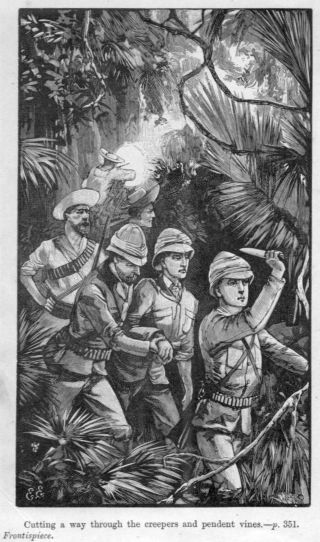
“One of the big guns,” said Lenny. “That means a signal to come back.”
“Then the black fellows are in sight there,” cried Jack excitedly. “Come on.”
The start was made, with Ned making a brave effort to keep his legs, and succeeding fairly well as they struggled on through the tangled growth, Jack springing to the front, hunting-knife in hand, to slash away at creepers and pendent vines which came in their way. But every now and then the poor fellow stopped short.
“Bit touched in the wind, gentlemen,” he said cheerily. “Go on again directly. If there is a chance to get a mouthful of water I should like it. If there ain’t, never mind.—Off we goes.”
The doctor said nothing, but supported him all he could, and they started again, with Jack leading and the sailors forming their rear-guard, retiring in regular military fashion, dividing themselves in twos, one couple halting face to the enemy till the rest had gone on a hundred yards and halted, and then trotting or rather forcing their way along the track, to pass their companions and halt again.
Moment by moment an attack was expected, but it was not made, though from time to time those in the rear caught sight of a black face peering round the trunk of a tree, showing that they were followed.
At last as they descended they came to a spot where the stream in the ravine could be reached, and the wounded man drank of the cool clear water with feverish avidity, while the doctor frowned as Jack looked at him with questioning eyes.
“Does take the conceit out of you, Mr Jack,” said Ned, as they continued their retreat. “I did think I was a better-plucked one than this. Talk about a weak ’un; I’m downright ashamed of myself.”
“Don’t talk so much, my man,” said the doctor. “Keep your breath for the exertion.”
“Cert’nly, sir. That’s right,” said the man in quick, excited tones. “Won’t say another word, only this. I should like to have just one pop at the chap who shot me, and hit him in the same place. I’m ashamed to see you working so hard, Mr Jack, sir. How far is it down to the boat?”
“About a mile, Ned; but pray do as Doctor Instow says—keep quiet.”
“Right, sir, I will,” replied the man, setting his teeth hard, his drawn face showing the agony he was in; and they went on descending, to be startled by another heavy detonation.
“Another signal,” said the doctor; but the words were hardly out of his lips when there was a fresh report running up the gully, and being multiplied in echoes which gradually died away.
“Those are not signals, Jack,” said the doctor quietly. “It means an attack upon the yacht by the canoes.”
“Oh! and we not there,” cried the lad excitedly.
“Well, the more lucky for us, eh?”
“Doctor Instow!” cried Jack indignantly; “when these men are wanted to help defend the vessel. Pray, pray try and walk faster, Ned.”
“Trying my best, sir, but I’m very shaky. Legs must be a regular pair of cowards, sir, for they won’t hurry a bit. Ah!”
The poor fellow reeled and would have fallen but for the doctor’s strong arm supporting him and letting him gently down.
Just then the regular short, sharp report of rifles reached their ears from below, announcing that there was no mistake about an attack being made upon their friends, and the anxiety of Jack and the doctor was increased as they trembled for the fate of the two men left as keepers of the boat in which they had come ashore.
“I hope they have escaped back to the yacht,” said the doctor.
“They wouldn’t do that,” cried Jack indignantly. “But what is to be done? Can’t we make a sort of stretcher with two of the guns?”
“No,” said the doctor, “it would take time; and the wood is too thick. I’ll carry him for a few hundred yards.”
“Let me have first go, sir,” cried Lenny. “You’re tired. I’ll take him. Help me get him on my back, so as not to hurt his arm.”
This was done, poor Ned remaining quite insensible; and once more they began to descend through the solemn aisles of the forest, with the sunshine coming through the leaves in showers of rays, while the firing away below them kept rolling up to where they were.
After a time Lenny was relieved, and dropped into the rear-guard, and this evolution was performed again and again, Jack still leading the way, and hacking through some growing rope from time to time.
“Soon do it now, sir,” said the man who was carrying. “Keep a good heart, sir. That’s the best o’ being mates. Chap goes down, and t’others ’ll always carry him. Hullo! what, a’ready?” he continued, as one of his companions came to relieve him. “I’ve only just begun.”
“Don’t be greedy, matey,” said the new-comer with a grin. “You allus was such a chap for wanting to have more ’n your share. Gently, let me get under the poor chap here without hauling him about so. That’s your sort. Warm work, mate?”
“Tidy,” said the man relieved with a grin. “Warmer where there’s none.”
On they went again with the relieved man taking his place ready for the defence if called upon, and the fresh bearer toiling on as if there was nothing to mind.
“Mustn’t whistle, I suppose, Mr Jack?”
There was a shake of the head.
“S’pose not. Like letting the beggars know where we are. My word, how things seem to grow here. Take some muscle to cut a good road. Say, sir; think poor Ned here’s much hurt?”
“Hurt a good deal, of course, but it can’t be a dangerous wound.”
“I dunno,” said the man thoughtfully, after a few minutes’ silence. “Is he onsensible like, sir?”
“Yes, quite,” said Jack, after a look at Ned’s face.
“Can’t hear what I say then, sir? I’m a bit afeard for him.”
“Why?”
“Chap wouldn’t go like this after a hole being made in his arm. I had a bayonet through mine once, but it didn’t turn me this way. Felt a bit sick at first, but it made me feel hot and savage after.”
“What do you mean?” said Jack, baring his head for a moment.
“Arrows, sir; poison.”
“Ah!” ejaculated Jack in horror. “Then that’s what made Doctor Instow look so serious.”
“That’s it, sir. But don’t you say anything. I dare say as soon as we get aboard the doctor ’ll put some of his acquy miracolus on it, and set it right again. My word, they’re having a good round with the niggers. I do wish we were aboard in the fun. I don’t like this running away.”
The bottom of the forest slope at last, and now an open park-like stretch lay between them and the patch of jungle which ran down to where they had left the boat. But upon this being neared they could see no sign of her.