PICTURESQUE MILAN
Reading edition
I
It is hard to say whether the stock phrase of the stock tourist—“there is so little to see in Milan”—redounds most to the derision of the speaker or to the glory of Italy. That such a judgment should be possible, even to the least instructed traveller, implies a surfeit of impressions procurable in no other land; since, to the hastiest observation, Milan could hardly seem lacking in interest when compared to any but Italian cities. From comparison with the latter, even, it suffers only on a superficial estimate, for it is rich in all that makes the indigenous beauty of Italy, as opposed to the pseudo-Gothicisms, the trans-Alpine points and pinnacles, which Ruskin taught a submissive generation of art critics to regard as the typical expression of the Italian spirit. The guide-books, long accustomed to draw their Liebig’s extract of art from the pages of this school of critics, have kept the tradition alive by dwelling only on the monuments which conform to perpendicular ideals, and by apologetic allusions to the “monotony” and “regularity” of Milan—as though endeavouring in advance to placate the traveller for its not looking like Florence or Siena!
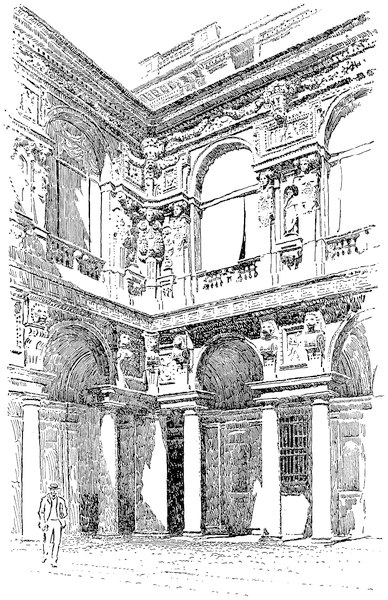
Court of the Palazzo Marino, now the Municipio
Of late, indeed, a new school of writers, among whom Mr. J. W. Anderson, and the German authors, Messrs. Ebe and Gurlitt, deserve the first mention, have broken through this conspiracy of silence, and called attention to the intrinsically Italian art of the post-Renaissance period; the period which, from Michael Angelo to Juvara, has been marked in sculpture and architecture (though more rarely in painting) by a series of memorable names. Signor Franchetti’s admirable monograph on Bernini, and the recent volume on Tiepolo in the Knackfuss series of Künstler-Monographien have done their part in this redistribution of values; and it is now possible for the traveller to survey the course of Italian art with the impartiality needful for its due enjoyment, and to admire, for instance, the tower of the Mangia without scorning the palace of the Consulta.
II
But, it may be asked, though Milan will seem more interesting to the emancipated judgment, will it appear more picturesque? Picturesqueness is, after all, what the Italian pilgrim chiefly seeks; and the current notion of the picturesque is a purely Germanic one, connoting Gothic steeples, pepper-pot turrets, and the huddled steepness of the northern burgh.
Italy offers little, and Milan least of all, to satisfy these requirements. The Latin ideal demanded space, order, and nobility of composition. But does it follow that picturesqueness is incompatible with these? Take up one of Piranesi’s etchings—those strange compositions in which he sought to seize the spirit of a city or a quarter by a mingling of its most characteristic features. Even the northern conception of the picturesque must be satisfied by the sombre wildness of these studies—here a ruined aqueduct, casting its shade across a lonely stretch of ground tufted with acanthus, there a palace colonnade through which the moonlight sweeps on a winter wind, or the recesses of some mighty Roman bath where cloaked figures are huddled in dark confabulation.
Canaletto’s black-and-white studies give, in a lesser degree, the same impression of the grotesque and the fantastic—the under-side of that barocchismo so long regarded as the smirk on the face of a conventional age.
But there is another, a more typically Italian picturesqueness, gay rather than sinister in its suggestions, made up of lights rather than of shadows, of colour rather than of outline, and this is the picturesqueness of Milan. The city abounds in vivid effects, in suggestive juxtapositions of different centuries and styles—in all those incidental contrasts and surprises which linger in the mind after the catalogued “sights” have faded. Leaving behind the wide modern streets—which have the merit of having been modernized under Eugène Beauharnais rather than under King Humbert—one enters at once upon some narrow byway overhung by the grated windows of a seventeenth-century palace, or by the delicate terra-cotta apse of a cinque-cento church. Everywhere the forms of expression are purely Italian, with the smallest possible admixture of that Gothic element which marks the old free cities of Central Italy. The rocca Sforzesca (the old Sforza castle) and the houses about the Piazza de’ Mercanti are the chief secular buildings recalling the pointed architecture of the north; and the older churches are so old that they antedate Gothic influences, and lead one back to the round-arched basilican type. But in the line of national descent what exquisite varieties the Milanese streets present! Here, for instance, is the Corinthian colonnade of San Lorenzo, the only considerable fragment of ancient Mediolanum, its last shaft abutting on a Gothic archway against which clings a flower-decked shrine. Close by, one comes on the ancient octagonal church of San Lorenzo, while a few minutes’ drive leads to where the Borromeo palace looks across a quiet grassy square at the rococo front of the old family church, flanked by a fine bronze statue of the great saint and cardinal.
The Palazzo Borromeo is itself a notable factor in the picturesqueness of Milan. The entrance leads to a court-yard enclosed in an ogive arcade surmounted by pointed windows in terra-cotta mouldings. The walls of this court are still frescoed with the Borromean crown, and the Humilitas of the haughty race; and a doorway leads into the muniment-room, where the archives of the house are still stored, and where, on the damp stone walls, Michelino da Milano has depicted the scenes of a fifteenth-century villeggiatura. Here the noble ladies of the house, in high fluted turbans and fantastic fur-trimmed gowns, may be seen treading the measures of a mediæval dance with young gallants in parti-coloured hose, or playing at various games—the jeu de tarots, and a kind of cricket played with a long wooden bat; while in the background rise the mountains about Lake Maggiore and the peaked outline of the Isola Bella, then a bare rock unadorned with gardens and architecture. These frescoes, the only existing works of a little-known Lombard artist, are suggestive in style of Pisanello’s dry and vigorous manner, and as records of the private life of the Italian nobility in the fifteenth century they are second only to the remarkable pictures of the Schifanoia at Ferrara.
Not far from the Borromean palace, another doorway leads to a different scene: the great cloister of the Ospedale Maggiore, one of the most glorious monuments that man ever erected to his fellows. The old hospitals of Italy were famous not only for their architectural beauty and great extent, but for their cleanliness and order and the enlightened care which their inmates received. Northern travellers have recorded their wondering admiration of these lazarets, which seemed as stately as palaces in comparison with the miserable pest-houses north of the Alps. What must have been the astonishment of such a traveller, whether German or English, on setting foot in the principal court of the Milanese hospital, enclosed in its vast cloister enriched with traceries and medallions of terra-cotta, and surmounted by the arches of an open loggia whence the patients could look down on a peaceful expanse of grass and flowers! Even now, one wonders whether this poetizing of philanthropy, this clothing of charity in the garb of beauty, may not have had its healing uses: whether the ugliness of the modern hospital may not make it, in another sense, as unhygienic as the more picturesque buildings it has superseded? It is at least pleasant to think of the poor sick people sunning themselves in the beautiful loggia of the Ospedale Maggiore, or sitting under the magnolia-trees in the garden, while their blue-gowned and black-veiled nurses move quietly through the cloisters at the summons of the chapel-bell.
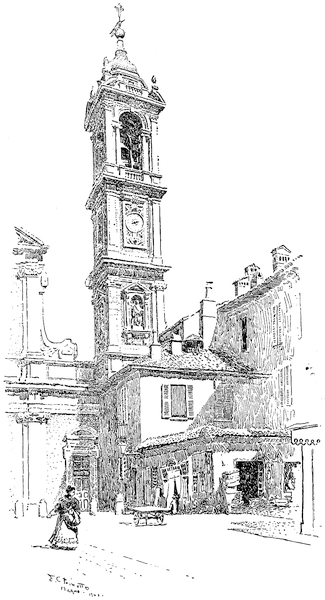
The Tower of S. Stefano E. C. Peixotto MILANO. 1901.
But one need not enter a court-yard or cross a threshold to appreciate the variety and colour of Milan. The streets themselves are full of charming detail—quattro-cento marble portals set with medallions of bushy-headed Sforzas in round caps and plaited tunics; windows framed in terra-cotta wreaths of fruit and flowers; iron balconies etching their elaborate arabesques against the stucco house-fronts; mighty doorways flanked by Atlantides, like that of Pompeo Leoni’s house (the Casa degli Omenoni) and of the Jesuit seminary; or yellow-brown rococo churches with pyramids, broken pediments, flying angels, and vases filled with wrought-iron palm-branches. It is in summer that these streets are at their best. Then the old gardens overhanging the Naviglio—the canal which intersects Milan with a layer of Venice—repeat in its waters their marble loggias hung with the vine, and their untrained profusion of roses and camellias. Then, in the more aristocratic streets, the palace doorways yield vistas of double and triple court-yards, with creeper-clad arcades enclosing spaces of shady turf, and terminating perhaps in a fountain set in some splendid architectural composition against the inner wall of the building. In summer, too, the dark archways in the humbler quarters of the town are brightened by fruit-stalls embowered in foliage, and heaped with such melons, figs and peaches as would have driven to fresh extravagance the exuberant brush of a Flemish fruit-painter. Then again, at the turn of a street, one comes across some little church just celebrating the feast of its patron saint with a brave display of garlands and red hangings; while close by a cavernous bottegha has been festooned with more garlands and with bright nosegays, amid which hang the painted candles and other votive offerings designed to attract the small coin of the faithful.
III
Yet Milan is not dependent on the seasons for this midsummer magic of light and colour. For dark days it keeps its store of warmth and brightness hidden behind palace walls and in the cold dusk of church and cloister. Summer in all its throbbing heat has been imprisoned by Tiepolo in the great ceiling of the Palazzo Clerici: that revel of gods and demi-gods, and mortals of all lands and races, who advance with linked hands out of the rosy vapours of dawn. Nor are loftier colour-harmonies wanting. On the walls of San Maurizio Maggiore, Luini’s virgin martyrs move as in the very afterglow of legend: that hesitating light in which the fantastic becomes probable, and the boundaries between reality and vision fade; while tints of another sort, but as tender, as harmonious, float through the dusk of the sacristy of Santa Maria delle Grazie, a dim room panelled with intarsia-work, with its grated windows veiled by vine-leaves.
But nothing in Milan approaches in beauty the colour-scheme of the Portinari chapel behind the choir of Sant’ Eustorgio. In Italy, even, there is nothing else exactly comparable to this masterpiece of collaboration between architect and painter. At Ravenna, the tomb of Galla Placidia and the apse of San Vitale glow with richer hues, and the lower church of Assisi is unmatched in its shifting mystery of chiar’-oscuro; but for pure light, for a clear shadowless scale of iridescent tints, what can approach the Portinari chapel? Its most striking feature is the harmony of form and colour which makes the decorative design of Michelozzo flow into and seem a part of the exquisite frescoes of Vincenzo Foppa. This harmony is not the result of any voluntary feint, any such trickery of the brush as the later decorative painters delighted in. In the Portinari chapel, architecture and painting are kept distinct in treatment, and the fusion between them is effected by unity of line and colour, and still more, perhaps, by an identity of sentiment, which keeps the whole chapel in the same mood of blitheness,—a mood which makes it difficult to remember that the chapel is the mausoleum of a martyred saint. But Saint Peter Martyr’s marble sarcophagus, rich and splendid as it is, somehow fails to distract the attention from its setting. There are so many mediæval monuments like it in Italy—and there is but one Portinari chapel. From the cupola, with its scales of pale red and blue, overlapping each other like the breast-plumage of a pigeon, and terminating in a terra-cotta frieze of dancing angels, who swing between them great bells of fruit and flowers, the eye is led by insensible gradations of tint to Foppa’s frescoes in the spandrils—iridescent saints and angels in a setting of pale classical architecture—and thence to another frieze of terra-cotta seraphs with rosy-red wings against a background of turquoise-green; this lower frieze resting in turn on pilasters of pale-green adorned with white stucco rilievi of little bell-ringing angels. It is only as a part of this colour-scheme that the central sarcophagus really affects one—the ivory tint of its old marble forming a central point for the play of light, and allying itself with the sumptuous hues of Portinari’s dress, in the fresco which represents the donator of the chapel kneeling before his patron saint.
IV
The picturesqueness of Milan has overflowed on its environs, and there are several directions in which one may prolong the enjoyment of its characteristic art. The great Certosa of Pavia can, alas, no longer be included in a category of the picturesque. Secularized, catalogued, railed off from the sight-seer, who is hurried through its endless corridors on the heels of a government custodian, it still ministers to the sense of beauty, but no longer excites those subtler sensations which dwell in the atmosphere of a work of art rather than in itself. Such sensations must be sought in the other deserted Certosa at Chiaravalle. The abbey church, with its noble colonnaded cupola, is still one of the most conspicuous objects in the flat landscape about Milan; but within all is falling to ruin, and one feels the melancholy charm of a beautiful building which has been allowed to decay as naturally as a tree. The disintegrating touch of nature is less cruel than the restoring touch of man, and the half-ruined frescoes and intarsia-work of Chiaravalle retain more of their original significance than the carefully-guarded treasures of Pavia.
Less melancholy than Chiaravalle, and as yet unspoiled by the touch of official preservation, is the pilgrimage church of the Madonna of Saronno. A long avenue of plane-trees leads from the village to the sumptuous marble façade of the church, an early Renaissance building with ornamental additions of the seventeenth century. Within, it is famous for the frescoes of Luini in the choir, and of Gaudenzio Ferrari in the cupola. The Luini frescoes are full of a serene impersonal beauty. Painted in his latest phase, when he had fallen under the influence of Raphael and the “grand manner,” they lack the intimate charm of his early works; yet the Lombard note, the Leonardesque quality, lingers here and there in the side-long glance of the women, and in the yellow-haired beauty of the adolescent heads; while it finds completer expression in the exquisite single figures of Saint Catherine and Saint Apollonia.
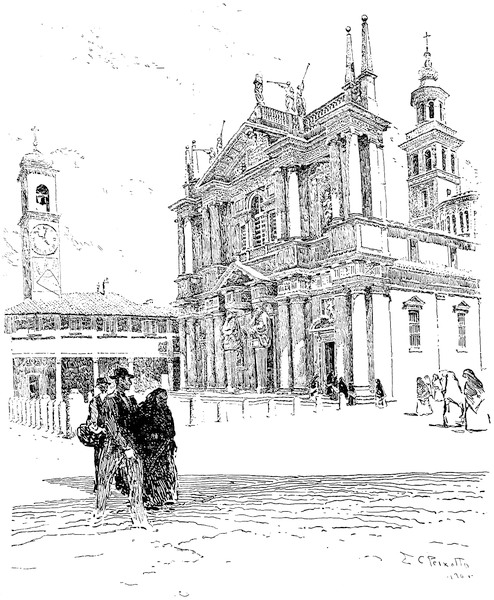
The Church at Saronno E. C. Peixotto 1901.
If these stately compositions are less typical of Luini than, for instance, the frescoes of San Maurizio Maggiore, or of the Casa Pelucca (now in the Brera), Gaudenzio’s cupola seems, on the contrary, to sum up in one glorious burst of expression all his fancy had ever evoked and his hand longed to embody. It seems to have been given to certain artists to attain, once at least, to this full moment of expression: to Titian, for instance, in the Bacchus and Ariadne, to Michael Angelo in the monuments of the Medici, to Giorgione in the Sylvan Concert of the Louvre. In other works they may reveal greater powers, more magnificent conceptions; but once only, perhaps, is it given to each to achieve the perfect equipoise of mind and hand; and in that moment even the lesser artists verge on greatness. Gaudenzio found his opportunity in the cupola of Saronno, and for once he rises above the charming anecdotic painter of Varallo to the brotherhood of the masters. It is as the expression of a mood that his power reveals itself—the mood of heavenly joyousness, so vividly embodied in his circle of choiring angels that form seems to pass into sound, and the dome to be filled with a burst of heavenly jubilation. With unfaltering hand he has sustained this note of joyousness. Nowhere does his invention fail or his brush lag behind it. The sunny crowding heads, the flying draperies, the fluttering scores of the music, are stirred as by a wind of inspiration—a breeze from the celestial pastures. The walls of the choir seem to resound with one of the angel-choruses of “Faust,” or with the last chiming lines of the “Paradiso.” Happy the artist whose full powers find voice in such a key!
V
The reader who has followed these desultory wanderings through Milan has but touched the hem of her garment. In the Brera, the Ambrosiana, the Poldi-Pezzoli gallery, and the magnificent new Archæological Museum, now fittingly housed in the old castle of the Sforzas, are treasures second only to those of Rome and Florence. But these are among the catalogued riches of the city. The guide-books point to them, they lie in the beaten track of sight-seeing, and it is rather in the intervals between such systematized study of the past, in the parentheses of travel, that one obtains those more intimate glimpses which help to compose the image of each city, to preserve its personality in the traveller’s mind.
ITALIAN BACKGROUNDS
I
In the Italian devotional pictures of the early Renaissance there are usually two quite unrelated parts: the foreground and the background.
The foreground is conventional. Its personages—saints, angels and Holy Family—are the direct descendants of a long line of similar figures. Every detail of dress and attitude has been settled beforehand by laws which the artist accepts as passively as the fact that his models have two eyes apiece, and noses in the middle of their faces. Though now and then some daring painter introduces a happy modification, such as the little violin-playing angels on the steps of the Virgin’s throne, in the pictures of the Venetian school, such changes are too rare and unimportant to affect the general truth of the statement. It is only in the background that the artist finds himself free to express his personality. Here he depicts not what some one else has long since designed for him, in another land and under different conceptions of life and faith, but what he actually sees about him, in the Lombard plains, in the delicately-modelled Tuscan hill-country, or in the fantastic serrated landscape of the Friulian Alps. One must look past and beyond the central figures, in their typical attitudes and symbolical dress, to catch a glimpse of the life amid which the painting originated. Relegated to the middle distance, and reduced to insignificant size, is the real picture, the picture which had its birth in the artist’s brain and reflects his impression of the life about him.
Here, for instance, behind a Madonna of Bellini’s, white oxen graze the pasture, and a shepherd lolls on a bank beside his flock; there, in the train of the Eastern Kings, real soldiers, clerks, pedlars, beggars, and all the miscellaneous rabble of the Italian streets wind down a hill-side crowned by a mediæval keep, and cross a bridge with a water-mill—just such a bridge and water-mill as the artist may have sketched in his native village. And in the scenes of the life of the Virgin, what opportunities for genre-painting present themselves! In Ghirlandaio’s fresco of the Birth of the Virgin, in the apse of Santa Maria Novella, fine ladies in contemporary costume are congratulating the conventionally-draped Saint Anna, while Crivelli’s Annunciation, in the National Gallery, shows an ornate Renaissance palace, with peacocks spreading their tails on the upper loggia, a sumptuous Eastern rug hanging over a marble balustrade, and the celestial messenger tripping up a flight of marble stairs to a fashionable front door.
No painter was more prodigal than Carpaccio of these intimate details, or more audacious in the abrupt juxtaposition of devotional figures with the bustling secular life of his day. His Legend of Saint Ursula, in the Accademia of Venice, is a storehouse of fifteenth-century anecdote, an encyclopædia of dress, architecture and manners; and behind his agonizing Saint Sebastian, tied to a column and riddled with arrows, the traffic of the Venetian canals goes on unregardingly, as in life the most trivial activities revolve unheeding about a great sorrow.
Even painters far less independent of tradition than Carpaccio and Crivelli succeeded in imparting the personal note, the note of direct observation, to the background of their religious pictures. If the figures are placed in a landscape, the latter is not a conventional grouping of hill, valley and river: it has the unmistakable quality of the chose vue. No one who has studied the backgrounds of old Italian pictures can imagine that realistic landscape-painting is a modern art. The technique of the early landscape-painters was not that of the modern interpreter of nature, but their purpose was the same; they sought to render with fidelity and precision what they saw about them. It is this directness of vision which gives to their backgrounds such vividness and charm. In these distances one may discover the actual foreground of the artist’s life. Here one may learn what was veritably happening in fifteenth-century Venice, Florence and Perugia; here see what horizons the old masters looked out on, and note that the general aspect of the country is still almost as unchanged as the folds of the Umbrian mountains and the curves of the Tuscan streams.
II
As with the study of Italian pictures, so it is with Italy herself. The country is divided, not in partes tres, but in two: a foreground and a background. The foreground is the property of the guide-book and of its product, the mechanical sight-seer; the background, that of the dawdler, the dreamer and the serious student of Italy. This distinction does not imply any depreciation of the foreground. It must be known thoroughly before the middle distance can be enjoyed: there is no short cut to an intimacy with Italy. Nor must the analogy of the devotional picture be pushed too far. The famous paintings, statues and buildings of Italy are obviously the embodiment of its historic and artistic growth; but they have become slightly conventionalized by being too long used as the terms in which Italy is defined. They have stiffened into symbols, and the life of which they were once the most complete expression has evaporated in the desiccating museum-atmosphere to which their fame has condemned them. To enjoy them, one must let in on them the open air of an observation detached from tradition. Since they cannot be evaded they must be deconventionalized; and to effect this they must be considered in relation to the life of which they are merely the ornamental façade.
Thus regarded, to what an enchanted region do they form the approach! Like courteous hosts they efface themselves, pointing the way, but giving their guests the freedom of their domain. It is not too fanciful to say that each of the great masterpieces of Italy holds the key to some secret garden of the imagination. One must know Titian and Giorgione to enjoy the intimacy of the Friulian Alps, Cima da Conegliano to taste the full savour of the strange Euganean landscape, Palladio and Sansovino to appreciate the frivolous villa-architecture of the Brenta, nay, the domes of Brunelleschi and Michael Angelo to feel the happy curve of some chapel cupola in a nameless village of the hills.
“Une civilisation,” says Viollet-le-Duc, “ne peut prétendre posséder un art que si cet art pénètre partout, s’il fait sentir sa présence dans les œuvres les plus vulgaires.” It is because Italian art so interpenetrated Italian life, because the humblest stonemason followed in some sort the lines of the great architects, and the modeller of village Madonnas the composition of the great sculptors, that the monumental foreground and the unregarded distances behind it so continually interpret and expound each other. Italy, to her real lovers, is like a great illuminated book, with here and there a glorious full-page picture, and between these, page after page of delicately-pencilled margins, wherein every detail of her daily life may be traced. And the pictures and the margins are by the same hand.
III
As Italy is divided into foreground and background, so each city has its perspective; its premier plan asterisked for the hasty traveller, its middle distance for the “happy few” who remain more than three days, and its boundless horizon for the idler who refuses to measure art by time. In some cases the background is the continuation, the amplification, of the central “subject”; in others, its direct antithesis. Thus in Umbria, and in some parts of Tuscany and the Marches, art, architecture, history and landscape all supplement and continue each other, and the least imaginative tourist must feel that in leaving the galleries of Siena or Florence for the streets and the surrounding country, he is still within the bounds of conventional sight-seeing.
In Rome, on the contrary, in Milan, and to some extent in Venice, as well as in many of the smaller towns throughout Italy, there is a sharp line of demarcation between the guide-book city and its background. In some cases, the latter is composed mainly of objects at which the guide-book tourist has been taught to look askance, or rather which he has been counselled to pass by without a look. Goethe has long been held up to the derision of the enlightened student of art because he went to Assisi to see the Roman temple of Minerva, and omitted to visit the mediæval church of Saint Francis; but how many modern sight-seers visit the church and omit the temple? And wherein lies their superior catholicity of taste? The fact is that, in this particular instance, foreground and background have changed places, and the modern tourist who neglects Minerva for Saint Francis is as narrowly bound by tradition as his eighteenth-century predecessor, with this difference, that whereas the latter knew nothing of mediæval art and architecture, the modern tourist knows that the temple is there and deliberately turns his back on it.
IV
Perhaps Rome is, of all Italian cities, the one in which this one-sidedness of æsthetic interest is most oddly exemplified. In the Tuscan and Umbrian cities, as has been said, the art and architecture which form the sight-seer’s accepted “curriculum,” are still the distinctive features of the streets through which he walks to his gallery or his museum. In Florence, for instance, he may go forth from the Riccardi chapel, and see the castle of Vincigliata towering on its cypress-clad hill precisely as Gozzoli depicted it in his fresco; in Siena, the crenellated palaces with their iron torch-holders and barred windows form the unchanged setting of a mediæval pageant. But in Rome for centuries it has been the fashion to look only on a city which has almost disappeared, and to close the eyes to one which is still alive and actual.
The student of ancient Rome moves among painfully-reconstructed débris; the mediævalist must traverse the city from end to end to piece together the meagre fragments of his “epoch.” Both studies are absorbing, and the very difficulty of the chase no doubt adds to its exhilaration; but is it not a curious mental attitude which compels the devotee of mediæval art to walk blindfold from the Palazzo Venezia to Santa Sabina on the Aventine, or from the Ara Cœli to Santa Maria Sopra Minerva, because the great monuments lying between these points of his pilgrimage belong to what some one has taught him to regard as a “debased period of art”?
Rome is the most undisturbed baroque city of Italy. The great revival of its spiritual and temporal power coincided with the development of that phase of art of which Michael Angelo sowed the seed in Rome itself. The germs of Bernini and Tiepolo must be sought in the Sistine ceiling and in the Moses of San Pietro in Vincoli, however much the devotees of Michael Angelo may resent the tracing of such a lineage. But it is hard at this date to be patient with any form of artistic absolutism, with any critical criteria not based on that sense of the comparative which is the nineteenth century’s most important contribution to the function of criticism. It is hard to be tolerant of that peculiar form of intolerance which refuses to recognize in art the general law of growth and transformation, or, while recognizing it, considers it a subject for futile reproach and lamentation. The art critic must acknowledge a standard of excellence, and must be allowed his personal preferences within the range of established criteria: æsthetically, the world is divided into the Gothically and the classically minded, just as intellectually it is divided into those who rise to the general idea and those who pause at the particular instance. The lover of the particular instance will almost always have a taste for the Gothic, which is the personal and anecdotic in art carried to its utmost expression, at the cost of synthetic effect; but if he be at all accessible to general ideas, he must recognize the futility of battling against the inevitable tendencies of taste and invention. Granted that, from his standpoint, the art which evolved from Michael Angelo is an art of decadence: is that a reason for raging at it or ignoring it? The autumn is a season of decadence; but even by those who prefer the spring, it has not hitherto been an object of invective and reprobation. Only when the art critic begins to survey the modifications of art as objectively as he would study the alternations of the seasons, will he begin to understand and to sympathize with the different modes in which man has sought to formulate his gropings after beauty. If it be true in the world of sentiment that il faut aimer pour comprendre, the converse is true in the world of art. To enjoy any form of artistic expression one must not only understand what it tries to express, but know
The hills where its life rose, And the sea where it goes.
Thus philosophically viewed, the baroque Rome—the Rome of Bernini, Borromini and Maderna, of Guercino, the Caracci and Claude Lorrain—becomes of great interest even to those who are not in sympathy with the exuberances of seventeenth-century art. In the first place, the great number of baroque buildings, churches, palaces and villas, the grandeur of their scale, and the happy incidents of their grouping, give a better idea than can elsewhere be obtained of the collective effects of which the style is capable. Thus viewed, it will be seen to be essentially a style de parade, the setting of the spectacular and external life which had developed from the more secluded civilization of the Renaissance as some blossom of immense size and dazzling colour may develop in the atmosphere of the forcing-house from a smaller and more delicate flower. The process was inevitable, and the result exemplifies the way in which new conditions will generate new forms of talent.
It is in moments of social and artistic transformation that original genius shows itself, and Bernini was the genius of the baroque movement. To those who study his work in the light of the conditions which produced it, he will appear as the natural interpreter of that sumptuous bravura period when the pomp of a revived ecclesiasticism and the elaborate etiquette of Spain were blent with a growing taste for country life, for the solemnities and amplitudes of nature. The mingling of these antagonistic interests has produced an art distinctive enough to take rank among the recognized “styles”: an art in which excessive formality and ostentation are tempered by a free play of line, as though the winds of heaven swept unhindered through the heavy draperies of a palace. It need not be denied that delicacy of detail, sobriety of means and the effect of repose were often sacrificed to these new requirements; but it is more fruitful to observe how skilfully Bernini and his best pupils managed to preserve the balance and rhythm of their bold compositions, and how seldom profusion led to incoherence. How successfully the Italian sense of form ruled over this semi-Spanish chaos of material, and drew forth from it the classic line, may be judged from the way in which the seventeenth-century churches about the Forum harmonize with the ruins of ancient Rome. Surely none but the most bigoted archæologist would wish away from that magic scene the façades of San Lorenzo in Miranda and of Santa Francesca Romana!
In this connection it might be well for the purist to consider what would be lost if the seventeenth-century Rome which he affects to ignore were actually blotted out. The Spanish Steps would of course disappear, with the palace of the Propaganda; so would the glorious Barberini palace, and Bernini’s neighbouring fountain of the Triton; the via delle Quattro Fontane, with its dripping river-gods emerging from their grottoes, and Borromini’s fantastic church of San Carlo at the head of the street, a kaleidoscope of whirling line and ornament, offset by the delicately classical circular cortile of the adjoining monastery. On the Quirinal hill, the palace of the Consulta would go, and the central portal of the Quirinal (a work of Bernini’s), as well as the splendid gateway of the Colonna gardens. The Colonna palace itself, dull and monotonous without, but within the very model of a magnificent pleasure-house, would likewise be effaced; so would many of the most characteristic buildings of the Corso—San Marcello, the Gesù, the Sciarra and Doria palaces, and the great Roman College. Gone, too, would be the Fountain of Trevi, and Lunghi’s gay little church of San Vincenzo ed Anastasio, which faces it so charmingly across the square; gone the pillared court-yard and great painted galleries of the Borghese palace, and the Fontana dei Termini with its beautiful group of adjoining churches; the great fountain of the piazza Navona, Lunghi’s stately façade of the Chiesa Nuova, and Borromini’s Oratory of San Filippo Neri; the monumental Fountain of the Acqua Paola on the Janiculan, the familiar “Angels of the Passion” on the bridge of Sant’ Angelo, and, in the heart of the Leonine City itself, the mighty sweep of Bernini’s marble colonnades and the flying spray of his Vatican fountains.
This enumeration includes but a small number of the baroque buildings of Rome, and the villas encircling the city have not been named, though nearly all, with their unmatched gardens, are due to the art of this “debased” period. But let the candid sight-seer—even he who has no tolerance of the seventeenth century, and to whom each of the above-named buildings may be, individually, an object of reprobation—let even this sectary of art ask himself how much of “mighty splendent Rome” would be left, were it possible to obliterate the buildings erected during the fever of architectural renovation which raged from the accession of Sixtus V to the last years of the seventeenth century. Whether or no he would deplore the loss of any one of these buildings, he would be constrained to own that collectively they go far toward composing the physiognomy of the Rome he loves. So far-spreading was the architectural renascence of the seventeenth century, and so vast were the opportunities afforded to its chief exponents, that every quarter of the ancient city is saturated with the bravura spirit of Bernini and Borromini. Some may think that Rome itself is the best defence of the baroque: that an art which could so envelop without eclipsing the mighty monuments amid which it was called to work, which could give expression to a brilliant present without jarring on a warlike or ascetic past, which could, in short, fuse Imperial and early Christian Rome with the city of Spanish ceremonial and post-Tridentine piety, needs no better justification than the Circumspice of Wren. But even those who remain unconverted, who cannot effect the transference of artistic and historic sympathy necessary to a real understanding of seventeenth-century architecture, should at least realize that the Rome which excites a passion of devotion such as no other city can inspire, the Rome for which travellers pine in absence, and to which they return again and again with the fresh ardour of discovery, is, externally at least, in great part the creation of the seventeenth century.
V
In Venice the foreground is Byzantine-Gothic, with an admixture of early Renaissance. It extends from the church of Torcello to the canvases of Tintoretto. This foreground has been celebrated in literature with a vehemence and profusion which have projected it still farther into the public consciousness, and more completely obscured the fact that there is another Venice, a background Venice, the Venice of the eighteenth century.
Eighteenth-century Venice was not always thus relegated to the background. It had its day, when tourists pronounced Saint Mark’s an example of “the barbarous Gothick,” and were better acquainted with the ridotto of San Moisè than with the monuments of the Frari. It is instructive to note that the Venice of that day had no galleries and no museums. Travellers did not go there to be edified, but to be amused; and one may fancy with what relief the young nobleman on the grand tour, sated with the marbles of Rome and the canvases of Parma and Bologna, turned aside for a moment to a city where enjoyment was the only art and life the only object of study. But while travellers were flocking to Venice to see its carnival and gaming-rooms, its public festivals and private casini, a generation of artists were at work brushing in the gay background of the scene, and quiet hands were recording, in a series of memorable little pictures, every phase of that last brilliant ebullition of the joie de vivre before “the kissing had to stop.”
Longhena and his pupils were the architects of this bright mise en scène, Tiepolo was its great scene-painter, and Canaletto, Guardi and Longhi were the historians who captured every phrase and gesture with such delicacy and precision that under their hands the glittering Venice of the “Toccata of Galuppi” lies outspread like a butterfly with the bloom on its wings.
Externally, Venice did not undergo the same renovation as Rome. As she was at the close of the Renaissance, with the impress of Palladio and Sansovino on her religious and secular architecture, so she remains to this day. One original architect, Baldassare Longhena, struck the note of a brilliant barocchismo in the churches of Santa Maria della Salute and the Scalzi, and in the Pesaro and Rezzonico palaces on the Grand Canal; and his pupils, developing his manner with infinitely less talent, gave to Venice the long squat Dogana with its flying Fortune fronting the Lagoon, the churches of Santa Maria Zobenigo, San Moisè and the Gesuiti, the Monte di Pietà, and a score of imposing palaces. The main effect of the city was, however, little modified by this brief flowering of the baroque. Venice has always stamped every new fashion with her own personality, and Longhena’s architecture seems merely the hot-house efflorescence of the style of Sansovino and Scamozzi. Being, moreover, less under the sway of the Church than any other Italian state, she was able to resist the architectural livery with which the great Jesuit subjugation clad the rest of Italy. The spirit of the eighteenth century therefore expressed itself rather in her expanding social life, and in the decorative arts which attend on such drawing-room revivals. Skilful stuccatori adorned the old saloons and galleries with fresh gilding and mirrors, slender furniture replaced the monumental cabinets which Venice had borrowed from Spain, and little genre-pictures by Longhi and landscapes by Canaletto and Battaglia were hung on the large-patterned damask of the boudoir walls. Religion followed the same lines, adapting itself to the elegancies of the drawing-room, and six noble families recognized their social obligations to heaven by erecting the sumptuous church of Santa Maria degli Scalzi, with its palatial interior, in which one may well imagine the heavenly hostess saying to her noble donators: “Couvrez-vous, mes cousins.”
Though begun by Longhena about 1650, the church of the Scalzi is so identified with the genius of Tiepolo that it may be regarded as an epitome of eighteenth-century Venetian art. Herr Cornelius Gurlitt, the most penetrating critic of the Venetian baroque, has indeed justly pointed out that Longhena was the forerunner and Geistesgenossen of the great master of eighteenth-century decorative painting, and that the architect’s bold and sumptuous structural effects might have been designed as a setting for those unsurpassed audacities of the brush which, a hundred years later, were to continue and complete them.
On the soaring vault of the Scalzi, above an interior of almost Palladian elegance and severity, the great painter of atmosphere, the first of the pleinairistes, was required to depict the transportation of the Holy House from Palestine to Loreto. That Tiepolo, with his love of ethereal distances, and of cloud-like hues melting into thin air, should have accepted the task of representing a stone house borne through the sky by angels, shows a rare sense of mastery; that he achieved the feat without disaster justifies the audacity of the attempt.
Tiepolo was above all a lover of open spaces. He liked to suspend his fluttering groups in great pellucid reaches of sky, and the vast ceiling of the Scalzi gave him an exceptional opportunity for the development of this effect. The result is that the angels, whirling along the Virgin’s house with a vehemence which makes it seem a mere feather in the rush of their flight, appear to be sweeping through measureless heights of air above an unroofed building. The architectural propriety of such a trompe l’œil is not only open to criticism but perhaps quite indefensible; yet, given the demand for this particular illusion, who but Tiepolo could have produced it?
The same ethereal effect, but raised to a higher heaven of translucency, is to be found in the ceiling of the Gesuati (not to be confounded with the Gesuiti), on the quay of the Zattere. This charming structure, built in the early eighteenth century by Massari, one of the pupils of Longhena, but obviously inspired by the great churches of Palladio, is dedicated to Saint Mary of the Rosary; and Tiepolo, in three incomparable frescoes, has represented on its ceiling the legend of Saint Dominick receiving the chaplet from the Virgin in glory.
The guide-books, always on the alert to warn the traveller against an undue admiration of Tiepolo, are careful to point out that the Mother of God, bending from her starry throne above the ecstatic saint, looks like a noble Venetian lady of the painter’s day. No doubt she does. It is impossible to form an intelligent estimate of Tiepolo’s genius without remembering that the Catholicism of his time was a religion of bon ton, which aimed to make its noble devotees as much at home in church as in the drawing-room. He took his models from real life and composed his celestial scenes without much thought of their inner significance; yet by sheer force of technique he contrived to impart to his great religious pictures a glow of supernatural splendour which makes it not inapt to apply to them the lines of the “Paradiso”:
Che la luce divina è penetrante Per l’universo, secondo ch’è degno, Sichè nulla le puote essere ostante.
VI
It is quite true, however, that Tiepolo was not primarily a devotional painter. He was first of all a great decorative artist, a master of emotion in motion, and it probably mattered little to him whether he was called on to express the passion of Saint Theresa or of Cleopatra. This does not imply that he executed his task indifferently. Whatever it was, he threw into it the whole force of his vehement imagination and incomparable maestria; but what he saw in it, whether it was religious or worldly, was chiefly, no doubt, the opportunity to obtain new effects of light and line.
If he had a special bent, it was perhaps toward the depicting of worldly pageants. In the Labia palace on the Canareggio, a building in which Cominelli, the ablest Venetian architect of the eighteenth century, nobly continued the “grand manner” of Sansovino and Scamozzi, Tiepolo found an unequalled opportunity for the exercise of this side of his talent. Here, in the lofty saloon of the piano nobile, he painted the loves of Antony and Cleopatra transposed to the key of modern patrician life. He first covered the walls with an architectural improvisation of porticoes, loggias and colonnades, which might have been erected to celebrate the “triumph” of some magnificent Este or Gonzaga. In this splendid setting he placed two great scenes: Cleopatra melting the pearl, and Antony and Cleopatra landing from their barge; while every gallery, balcony and flight of steps is filled with courtiers, pages and soldiers, with dwarfs and blackamoors holding hounds in leash, and waiting-maids and lacqueys leaning down to see the pageant.
From this throng of figures the principal characters detach themselves with a kind of delicate splendour. Royal Egypt,
On her neck the small face buoyant, like a bell-flower on its bed,
in her brocaded gown of white and gold, with a pearl collar about her throat, and a little toy spaniel playing at her feet, is an eighteenth-century Dogaressa; Antony is a young Procurator travestied as a Roman hero; while the turbaned black boy, the maid-servants, the courtiers, the pages, are all taken sur le vif from some brilliant rout in a Pisano or Mocenigo palace. And yet—here comes the wonder—into these “water-flies” and triflers of his day, the ladies engrossed in cards and scandal, the abatini preoccupied with their acrostics, the young nobles intriguing with the prima amorosa of San Moisè or engaged in a sentimental correspondence with a nun of Santa Chiara—into this throng of shallow pleasure-seekers Tiepolo has managed to infuse something of the old Roman state. As one may think of Dante beneath the vault of the Gesuati, one may recall Shakespeare in the presence of these rouged and powdered Venetians. The scene of the landing suggests with curious vividness the opening scene of “Antony and Cleopatra”—
Look where they come! The triple pillar of the world transformed Into a strumpet’s fool—
and one can almost hear the golden Antony, as he brushes aside the importunate Roman messengers, whispering to his Queen: “What sport to-night?”
Still more Shakespearian is the scene of the pearl. Cleopatra, enthroned in state at the banqueting-table, lifts one hand to drop the jewel into her goblet, and in her gesture and her smile are summed up all the cruel grace of the “false soul of Egypt.” It is Tiepolo’s best praise that such phrases and associations as these are evoked by his art, and that, judged from the painter’s standpoint, it recalls the glory of another great tradition. Studied in the light of Venetian painting, Tiepolo is seen to be the direct descendant of Titian and Veronese. If the intervening century has taken something from the warmth of his colour, leaving it too often chalky where that of the Renaissance was golden, he has recovered the lines, the types and the radiant majesty of the Venetian cinque cento, and Veronese’s Venice Enthroned, in the Ducal Palace, is the direct forbear of his Virgins and Cleopatras.
VII
It is perhaps no longer accurate to describe Tiepolo as forming a part of the Venetian background. Recent criticism has advanced him to the middle distance, and if there are still comparatively few who know his work, his name is familiar to the cultivated minority of travellers.
Far behind him, however, still on the vanishing-point of the tourist’s horizon, are the other figures of the Venetian background: Longhi, Guardi, Canaletto, and their humbler understudies. Of these, Canaletto alone emerges into relative prominence. His views of Venice are to be found in so many European galleries, and his name so facilitates the association of ideas, that, if few appreciate his work, many are superficially acquainted with it; whereas Guardi, a painter of greater though more unequal talent, is still known only to the dilettante.
The work of both is invaluable as a “document” for the study of eighteenth-century Venice; but while Canaletto in his charming canvases represented only the superficial and obvious aspect of the city, as it might appear to any appreciative stranger, Guardi, one of the earliest impressionists, gives the real life of the streets, the grouillement of the crowd in Saint Mark’s square, the many-coloured splash of a church procession surging up the steps of the Redentore, the flutter of awnings over market-stalls on a fair-day, or the wide black trail of a boat-race across the ruffled green waters of the Canalazzo.
Far beneath these two men in talent, but invaluable as a chronicler of Venetian life, is Canaletto’s son-in-law, Bellotti, who, in a stiff topographical manner, has faithfully and minutely recorded every detail of eighteenth-century life on the canals. Being of interest only to the student of manners, he is seldom represented in the public galleries; but many private collections in the north of Italy contain a series of his pictures, giving all the Venetian festivals, from the Marriage of the Adriatic to the great feat of the Vola, which took place in the Piazzetta on the last Thursday before Lent.
As unknown to the general public as Bellotti, but more sought after by connoisseurs than any other Italian artist of the eighteenth century save Tiepolo, is Pietro Longhi, the genre-painter, whose exquisite little transcripts of Venetian domestic life now fetch their weight in gold at Christie’s or the Hôtel Drouot. Longhi’s talent is a peculiar one. To “taste” him, as the French say, one must understand the fundamental naïveté of that brilliant and corrupt Venetian society, as it is revealed in the comedies of Goldoni and in the memoirs of contemporary writers. The Venetians were, in fact, amoral rather than immoral. There was nothing complex or morbid in their vice; it was hardly vice at all, in the sense which implies the deliberate saying of “Evil, be thou my good.” Venetian immorality was a mere yielding to natural instincts, to the joie de vivre of a gay and sensuous temperament. There was no intellectual depravity in Venice because there was hardly any intellect: there was no thought of evil because there was no thought. The fashionable sinners whom posterity has pictured as revelling in the complexities of vice sat enchanted before the simple scenes of Goldoni’s drama, and the equally simple pictures of their favourite genre-painter. Nor must it be thought that this taste for simplicity and innocence was evidence of a subtler perversion. The French profligate sought in imagination the contrast of an ideal world, the milk and rose-water world of Gessner’s Idylls and the bergerie de Florian. But Goldoni and Longhi are not idealists, or even sentimentalists. They draw with a frank hand the life of their day, from the fisherman’s hut to the patrician’s palace. Nothing can be more unmistakable than the realism of Goldoni’s dialect plays, and a people who could enjoy such simple pictures of the life about them must, in a sense, have led simple lives themselves.
Longhi’s easel-pictures record every phase of Venetian middle-class and aristocratic existence. To some, indeed, it is difficult to find a clue, and it has been conjectured that these represent scenes from the popular comedies of the day. The others depict such well-known incidents as the visit to the convent parlour, where the nuns are entertaining their gallants with a marionette-show; the masked nobil donna consulting the fortune-teller, or walking with her cicisbeo in Saint Mark’s square; the same lady’s lever, where she is seen at her toilet-table surrounded by admirers; the family party at breakfast, with the nurse bringing in a swaddled baby; the little son and heir riding out attended by his governor; the actress rehearsing her aria with the maestro di cappella; the visit to the famous hippopotamus in his tent in the Piazzetta; the dancing-lesson, the music-lesson, the portrait-painting, and a hundred other episodes of social and domestic life. The personages who take part in these scenes are always of one type: the young women with small oval faces, powdered but unrouged, with red lips and sloping foreheads; the men in cloaks and masks, or gay embroidered coats, with square brows and rather snub features, gallant, flourishing, empressés, but never in the least idealized or sentimentalized. The scenes of “high life” take place for the most part in tall bare rooms, with stone window-frames, a family portrait of a doge or an admiral above the chimney-piece, and a few stiff arm-chairs of the heavy Venetian baroque. There is nothing sumptuous in the furnishing of the apartments or in the dress of their inmates. The ladies, if they are going abroad or paying a visit, wear a three-cornered hat above the black lace zendaletto which hides their hair and the lower part of the face, while their dresses are covered by the black silk bauto or domino. Indoors, they are attired in simple short gowns of silk or brocade, with a kerchief on the shoulders, and a rose or a clove-pink in the unpowdered hair. That pleasure in the painting of gorgeous stuffs, and in all the material splendours of life, derived by Tiepolo from his great predecessors of the Renaissance, was not shared by Longhi. His charm lies in a less definable quality, a quality of unstudied simplicity and naturalness, which gives to his easel-pictures the value of actual transcripts from life. One feels that he did not “arrange” his scenes, any more than Goldoni constructed his comedies. Both were content to reflect, in the mirror of a quietly humorous observation, the every-day incidents of the piazza, the convent and the palace.
The fact that Longhi, in his genre-pictures, sought so little variety of grouping, and was content to limit his figures to so small a range of gestures, has given rise to the idea that he was incapable of versatility and breadth of composition. To be undeceived on this point, however, one has only to see his frescoes in the Palazzo Grassi (now Sina) on the Grand Canal. This fine palace, built about 1740 by Massari, the architect of the Gesuati, has a magnificent double stairway leading from the colonnaded court to the state apartments above; and on the walls of this stairway Longhi, for once laying aside his small canvases and simple methods, has depicted, in a series of charmingly-animated groups, the members of the Grassi family leaning over a marble balustrade to see their guests ascending the stairs. The variety of these groups, the expressiveness of the faces, and the general breadth of treatment, prove that Longhi had far more technical and imaginative power than he chose to put into his little pictures, and that his naïveté was a matter of choice. Probably no one who knows his work regrets this self-imposed limitation. Additional movement and complexity of grouping would destroy the sense of leisure, of spacious rooms and ample time, of that absence of hurry and confusion so typical of a society untroubled by moral responsibilities or social rivalries, and pursuing pleasure with the well-bred calmness which was one of the most charming traits obliterated by the French Revolution.
VIII
On a quiet canal not far from the church of the Frari there stands an old palace where, in a series of undisturbed rooms, may be seen the very setting in which the personages of Goldoni and Longhi played out their social comedy.
The Palazzo Querini-Stampaglia was bequeathed to the city of Venice some fifty years since by the last Count Querini, and with its gallery, its library and its private apartments has since then stood open to a public which never visits it. Yet here the student of Venetian backgrounds may find the unchanged atmosphere of the eighteenth century. The gallery, besides some good paintings of earlier schools, contains a large collection of Bellotti’s pictures, representing all the great religious and popular festivals of Venice, as well as a half-dozen Longhis and a charming series of genre-pictures by unknown artists of his school.
Of far greater interest, however, are the private apartments, with their seventeenth and eighteenth century decorations still intact, and the walls lined with the heavy baroque consoles and arm-chairs so familiar to students of Longhi’s interiors, and of the charming prints in the first edition of Goldoni. Here is the typical chambre de parade, with its pale-green damask curtains and bed-hangings, and its furniture painted with flowers on a ground of pale-green laque; here the tapestried saloon with its Murano chandeliers, the boudoir with looking-glass panels set in delicately carved and painted wreaths of flowers and foliage, and the portrait-room hung with pictures of the three great Querini: the Doge, the Cardinal and the Admiral. Here, too, is the long gallery, with a bust of the Cardinal (a seventeenth-century prince of the Church) surrounded by marble effigies of his seven bravi: a series of Berniniesque heads of remarkable vigour and individuality, from that of the hoary hang-dog scoundrel with elf-locks drooping over an evil scowl, to the smooth young villain with bare throat and insolent stare, who seems to glory in his own sinister beauty.
These busts give an insight into a different phase of Italian life: the life of the violent and tragical seventeenth century, when every great personage, in the Church no less than in the world, had his bodyguard of hardened criminals, outlaws and galley-slaves, who received sanctuary in their patron’s palace, and performed in return such acts of villany and violence as the Illustrissimo required. It seems a far cry from the peaceable world of Goldoni and Longhi to this prelate surrounded by the effigies of his hired assassins; yet bravi, though no longer openly acknowledged or immortalized in marble, lurked in the background of Italian life as late as the end of the eighteenth century, and Stendhal, who knew Italy as few foreigners have known it, declares that in his day the great Lombard nobles still had their retinue of bauli, as the knights of the stiletto were called in the Milanese.
It is not in art only that the bravi have been commemorated. Lovers of “I Promessi Sposi,” the one great Italian novel, will not soon forget the followers of Don Rodrigo; and an idea of the part they played at the end of the eighteenth century may be obtained from the pages of Ippolito Nievo’s “Confessioni di un Ottuagenario,” that delightful book, half romance, half autobiography, which, after many years of incredible neglect, has just been republished in Italy. Ippolito Nievo, one of Garibaldi’s young soldiers, was among those who perished in the wreck of the Ercole, on the return from Palermo in 1860. He was but twenty-nine at the time of his death, and it is said that his impatience to see a lady to whom he was attached caused him, despite the entreaties of his friends, to take passage in the notoriously unseaworthy Ercole. Four years earlier he had written the “Confessioni,” a volume which, for desultory charm and simple rendering of domestic incidents, is not unworthy to take rank with “Dichtung und Wahrheit,” while its capricious heroine, La Pisana, is as vivid a creation as Goethe’s Philina or (one had almost said) as the Beatrix of Thackeray.
Ippolito Nievo was himself a native of the Veneto, and intimately acquainted, through family tradition, with the life of the small towns and villa-castles of the Venetian mainland at the close of the eighteenth century. The “Confessioni” picture the life of a young lad in a nobleman’s castle near the town of Portogruaro, and later in Venice; and not the least remarkable thing about the book is the fact that, at a period when other Italian novelists were depicting the high-flown adventures of mediæval knights and ladies, its young author, discarding the old stage-properties of romanticism, should have set himself to recording, with the wealth of detail and quiet humour of a Dutch genre-painter, the manners and customs of his own little corner of Italy, as his parents had described it to him. Nievo’s account of the provincial nobles in the Veneto shows that to the very end of the eighteenth century, mediæval customs, with all their violence and treachery, prevailed within a day’s journey of polished and peaceful Venice. His nobles in their fortified castles, of which the drawbridges are still raised at night, have their little trains of men-at-arms, composed in general of the tattered peasantry on their estates, but sometimes of professional fighters, smugglers or outlaws, who have been taken into the service of some truculent lord of the manor; and Nievo describes with much humour the conflicts between these little armies, and the ruses, plots and negotiations of their quarrelsome masters.
In another novel, published at about the same time, Pietro Scudo, a Venetian who wrote in French, has drawn, with far less talent, a picture of another side of Venetian life: the life of the musical schools and the Opera, which George Sand had attempted to represent in “Consuelo.” Scudo’s book, “Le Chevalier Sarti,” has fallen into not unmerited oblivion. It is written in the insipid style of the romantic period—that style which Flaubert, in a moment of exasperation, described as “les embêtements bleuâtres du lyrisme poitrinaire”; and its heroine, like Châteaubriand’s unhappy Madame de Beaumont, dies of the fashionable ailment of the day, une maladie de langueur. The book, moreover, is badly constructed to the verge of incoherence, and the characters are the stock mannikins of romantic fiction; yet in spite of these defects, Scudo has succeeded (where George Sand failed) in reproducing the atmosphere of eighteenth-century Venice. He has done this not by force of talent but by the patient accumulation of detail. Though not the most important feature in the construction of a good historical novel, this is an essential part of the process. George Sand, however, was above such humble methods. Totally lacking in artistic sensibility and in its accompanying faculty, the historic imagination, she was obliged to confine herself to the vaguest generalities in describing scenes and manners so alien to the “romantic” conception of life. Nature and passion were the only things which interested her, and in the Venice of the eighteenth century there was no nature and little passion. Hence the Venetian scenes of “Consuelo” give the impression of having been done de chic, while Scudo’s bear the impress of an unimaginative accuracy. In “Le Chevalier Sarti” the lover of “decadent” Venice will find innumerable curious details, descriptions of life in the villas of the Brenta, of concerts in the famous Scuole, carnival scenes at the ridotto, and parties fines at the Orto di San Stefano, the favourite resort of the world of gallantry; while the minor characters of the book, who have escaped the obligatory romanticism of the hero and heroine, help to make up the crowded picture of a world as bright and brittle as a sun-shot Murano glass.
IX
But it is, after all, not in Nievo or Scudo, nor even in Longhi and Goldoni, that one comes closest to the vanished Venice of the eighteenth century.
In the Museo Correr, on the Grand Canal, there has recently been opened a room containing an assemblage of life-sized mannikins dressed in the various costumes of the sette cento.
Here are the red-robed Senator, the proud Procuratessa in brocade and Murano lace, the Abatino in his plum coloured taffeta coat and black small-clothes, the fashionable reveller in bauto and mask, the lacquey in livery of pale-blue silk, the lawyer, the gondolier, the groom, and the noble Marquess in his hunting-dress of white buckskin. Surely nowhere else does one come into such actual contact with that little world which was so essentially a world of appearances—of fine clothes, gay colours and graceful courtly attitudes. The mannikins indeed are not graceful. The Cavaliere Leandro can no longer execute a sweeping bow at the approach of the Procuratessa, or slip a love-letter into the muff of the charming Angelica; the Senator may stare as haughtily as he pleases at the Abate and the lawyer, without compelling those humble clients to stir an inch from his path; and the noble Marquess, in his spotless buckskin leggings and gauntlets, will never again be off to shoot thrushes from a “bird-tower” in the Euganeans. But the very rigidity of their once supple joints seems an allegory of their latter state. There they stand, poor dolls of destiny, discarded playthings of the gods, in attitudes of puzzled wonder, as if arrested in their revels by the stroke of the dread Corsican magician—for it was not Death but Napoleon who “stepped tacitly and took them” from the plots and pleasures, the sunshine and music of the canals, to that pale world of oblivion where only now and then some dreamer curious of the day of little things revisits their melancholy ghosts.