APPENDIX.
Reading edition
—Phillips in Theatrum Poetarum, p. 24, Ed. 1680.
2 “Collier considers that Marlowe would in this case (i. e. had he lived) have become a formidable rival to Shakespere.”
—Gervinus’ Shakespere Commentaries, p. 78.
3 “But the department of tragedy was dominated by a writer of superb genius, Christopher Marlowe. Shakespere, whose powers ripened slowly, may at the time when he wrote the ‘Comedy of Errors’ and ‘Love’s Labor Lost,’ have well hesitated to dispute with Marlowe his special province. Imitators and disciples had crowded around the master.”
—Edward Dowden.
4 “If Marlowe had lived to finish his ‘Hero and Leander’ he might perhaps have contested the palm with Shakespere in his ‘Venus and Adonis’ and ‘Rape of Lucrece.’”
—Malone.
5 “In his first stage Shakespere had dropped his plummet no deeper into the sea of the spirit of man than Marlowe had sounded before him, and in the channel of simple emotion no poet could cast surer line with steadier hand than he.”
—Swinburne’s “A Study of Shakespere,” p. 77.
“It [Richard III] is doubtless a better piece of work than Marlowe ever did; I dare not say than Marlowe ever could have done. It is not for any man to measure * * * what it is that Christopher Marlowe could not have done; but dying as he did and when he did, etc.”
—“A Study of Shakespere,” Swinburne 43.
6 “For my own part, I feel a strong persuasion, that with added years and well directed efforts, he would have made a much nearer approach to Shakespere than has yet been made by any of his countrymen.”
—Dyce’s Marlowe, p. 55.
“Now pile your dust upon the quick and dead, Till of this flat a mountain you have made, To o’ertop old Pelion, or the skyish head Of blue Olympus.” —Hamlet III, 3.
“Streams of blood As vast and deep as Euphrates or Nile.” —Tamburlaine V, 2.
“Not tomb enough and continent To hide the slain.” —Hamlet IV, 4.
The graund disease disdained his Toade Conceit And smiling at his Tamburlaine contempt Sternly struck home the peremptory stroke.” —Harvey’s New Letter, September, 1593.
—Thomas Beard’s “Theater of God’s Judgments,” Edition First, 1597.
—Meres “Palladis Tamia,” etc., 1598.
—Vaughan’s Golden Grove, etc., 1600.
—Aubrey’s “Lives of Eminent Men,” citing Sr. Ed. Sherburne, p. 415.
—The Author.
—Nash’s Introduction to Greene’s Menaphon, 1587 (Grosart’s Nashe I, XX).
“And he that cannot write true English without the help of clerks of parish churches, will needs make himself the father of interludes. O, ’tis a jolly matter when a man hath a familiar style, and can endite a whole year, and not be beholden to art.”
—Greene’s Farewell to Folly (1587).
“It’s a common practice now-a-days, amongst a sort of shifting companions, that run through every art and thrive at none, to leave the trade of noverint whereto they were born and busy themselves with the endeavors of art, that could scarcely Latinize their neck-verse, if they should have need. Yet English Seneca, read by candle light, yields many good sentences, etc.”
—Nash (1587).
—Article on Marlowe, Ency. Britannica, vol. XV, p. 556.
“That fiery reformer who wrought on the old English stage no less a miracle than Hernani on the French stage in the days of our fathers.”
—Swinburne’s “Study of Shakespere,” p. 31.
19 “Now (as swift as Time Doth follow Motion) find th’ eternal clime Of his free soul, whose living subject stood Up to the chin in the Pierian flood, And drunk to me half this Musean story Inscribing it to deathless memory.” —Chapman’s Third Sestiad to Marlowe’s Hero and Leander.
20 “Unhappy in thine end, Marley, the Muses’ darling for thy verse, Fit to write passions for the souls below, If any wretched souls in passion speak.” —George Peele “Prologue to the Honour of the Garter.”
21 “The impression of the man that hath been dear unto us, living an after life in our memory, etc.”
—Blunt’s Dedication of Hero and Leander, 1598.
22 “Is it a dream? or is the Highest minde That ever haunted Pauls, or haunted winde Bereft of that same sky-surmounting breath, That breath that taught the Timpany to swell?” —“Sonet Gorgon,” Gabriel Harvey, 1593. 23 “Dead Musæus’ gracious song.” —Henry Chettle. 24 “Next Marlow, bathed in the Thespian springs, Had in him those brave translunary things That the first poets had; his raptures were All air and fire which made his verses clear.” —Michael Drayton’s Epistle, etc.
Quarto editions of what are now termed the genuine, and also of what are now termed the spurious plays, had been appearing for an interval of twenty-five years, with the announcement on their title pages of being “newly arranged by,” or “written by” William Shakespere. The claims announced on these title pages appear never to have been disputed by Shakespere. “A Yorkshire Tragedy,” “The London Prodigal,” and “The First Part of the Life of Sir John Oldcastle” were so published as his work. Then followed the collection of dramas in the edition of 1623. Jonson may, or may not, have known the real facts of the authorship. If he knew that some persons, other than Shakespere, were the authors, he went only a step further than he did in his address in “Sejanus,” where he fails to mention the name of the “happy genius” who wrote that tragedy with him; but his own molding of the play has not destroyed the trace of Marlowe’s elemental wit therein. We would rather attribute to Jonson ignorance of the authorship of the plays, and in this ignorance assigning them to the Manager of the Globe, than to place him on the level of the Archbishop who ordered Marlowe’s translation of the “Amores” burnt, or of Richard Bame, who wrote the accusation of blasphemy, or of those unknown and more powerful persons, either of Church or State, who labored to blot out of memory the daring and impious Marlowe.
The copy of the second folio edition (1632), containing emendations of the original text, as given to the world by Mr. Collier, if genuine, contains evidence of my theory of Ben Jonson’s editing the earliest edition of the plays. This copy contained interlineations and corrections of text which could have been made only by an editor with the manuscript before him, or by a student deeply versed. The handwriting displayed in these emendations is a facsimile of Ben Jonson’s.
—The Author.
For comparison, a portion of a facsimile page of emendations in Collier’s volume, and some of the writing of Jonson, are here printed:
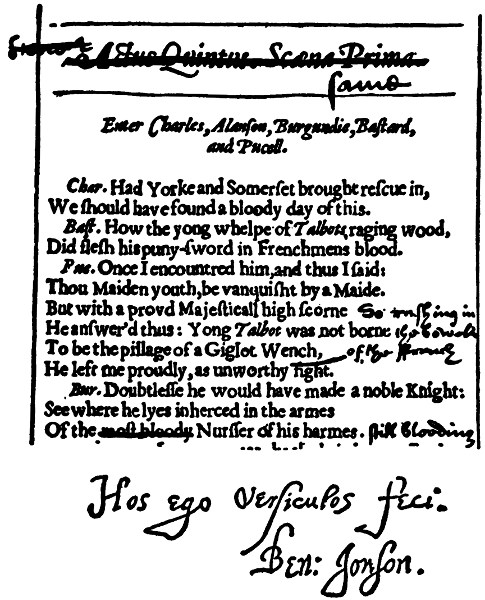
Enter Charles, Alanson, Burgundie, Bastard, and Pucell
Char. Had Yorke and Somerset brought rescue in, We should have found a bloody day of this.
Bast. How the yong welpe of Talbots raging wood, Did flesh his punie-sword in Frenchmens blood.
Puc. Once I encountred him, and thus I said: Thou Maiden youth, be vanquisht by a Maide. But with a proud Majesticall high scorne He answer’d thus: Yong Talbot was not borne To be the pillage of a Giglot Wench, He left me proudly, as unworthy fight.
Bur. Doubtlesse he would have made a noble Knight: See where he lyes inherced in armes Of the most bloody Nursser of his harmes.
Hos ego versiculos feci. Ben: Jonson.
—Gervinus, 480.
—Bullen’s Marlowe.
—Fleay’s Life and Character of Shakespere. Halliwell-Phillipps Outlines chap. “Life Time Editions.”
—Fleay’s Life and Character of Shakespere.—Outlines, chapter “Life Time Editions.”
—Article “Marlowe,” Encyclopedia Britannica.
—Dyce’s Marlowe. —Bullen’s Marlowe.
32 There are only five known signatures of Wm. Shakespere, and no other written words or manuscript known to be by his hand. The scrawls are scarcely decipherable and strongly at variance with the statement made by Heminge and Condell in the First Folio Edition of the Plays: “His mind and hand went together, and what he thought he wrote with that easiness, that we have scarce received from him a blot in his papers.”
“His mountain belly and his rocky face.”
He was “wont to wear a coat with slits under the armpits.”
—Knight’s London, vol. I, 367.
—Hallam’s Constitutional History, vol. I, 215. 35 Elizabeth, c. 1.
—The Author.
—Halliwell-Phillipps Outlines, p. 88. See also Id. p. 1 and 2.
—Dyce’s Marlowe, p. 36.
“But Chapman had also been busy with a continuation of Marlowe’s ‘half-told tale.’”
—Dyce’s Marlowe, p. 42.
—Bullen’s Marlowe, p. 69.
“The gaudy, babbling and remorseful day Is crept into the bosom of the sea, And now long howling wolves arouse the jades That drag the tragic melancholy night; Who with their drowsy slow and flagging wings Clip dead men’s graves, and from their misty jaws Breathe foul contagious darkness in the air.” —Second Part Henry VI.
Aut Christopherus Marlowe, aut diabolus, “A study of Shakespere,” by Swinburne, p. 52.
—Morgan’s “Shakespere In Fact and In Criticism,” p. 18.
—Dyce’s Shakespere, p. 41.
—Rowe’s Life of Shakespere.
—Note in Furness’ Variorum, vol. 3, p. 17 (Hunter II, 214).
—Bullen’s Marlowe, vol. 3, p. 250.
—Fleay, Macmillan’s Magazine, Dec., 1874.