Chapter XIII · (continued 2)
Reading edition
Returning now to levitations of human bodies and inanimate bodies, in modern circle-rooms, we must refer the reader to the Introductory chapter of this work. (See “Æthrobasy.”) In connection with the story of Simon the Magician, we have shown the explanation of the ancients as to how the levitation and transport of heavy bodies could be produced. We will now try and suggest a hypothesis for the same in relation to mediums, i. e., persons supposed to be unconscious at the moment of the phenomena, which the believers claim to be produced by disembodied “spirits.” We need not repeat that which has been sufficiently explained before. Conscious æthrobasy under magneto-electrical conditions is possible only to adepts who can never be overpowered by an influence foreign to themselves, but remain sole masters of their WILL.
Thus levitation, we will say, must always occur in obedience to law—a law as inexorable as that which makes a body unaffected by it remain upon the ground. And where should we seek for that law outside of the theory of molecular attraction? It is a scientific hypothesis that the form of force which first brings nebulous or star matter together into a whirling vortex is electricity; and modern chemistry is being totally reconstructed upon the theory of electric polarities of atoms. The waterspout, the tornado, the whirlwind, the cyclone, and the hurricane, are all doubtless the result of electrical action. This phenomenon has been studied from above as well as from below, observations having been made both upon the ground and from a balloon floating above the vortex of a thunder-storm.
Observe now, that this force, under the conditions of a dry and warm atmosphere at the earth’s surface, can accumulate a dynamic energy capable of lifting enormous bodies of water, of compressing the particles of atmosphere, and of sweeping across a country, tearing up forests, lifting rocks, and scattering buildings in fragments over the ground. Wild’s electric machine causes induced currents of magneto-electricity so enormously powerful as to produce light by which small print may be read, on a dark night, at a distance of two miles from the place where it is operating.
As long ago as the year 1600, Gilbert, in his De Magnete, enunciated the principle that the globe itself is one vast magnet, and some of our advanced electricians are now beginning to realize that man, too, possesses this property, and that the mutual attractions and repulsions of individuals toward each other may at least in part find their explanation in this fact. The experience of attendants upon spiritualistic circles corroborates this opinion. Says Professor Nicholas Wagner, of the University of St. Petersburg: “Heat, or perhaps the electricity of the investigators sitting in the circle, must concentrate itself in the table and gradually develop into motions. At the same time, or a little afterward, the psychical force unites to assist the two other powers. By psychical force, I mean that which evolves itself out of all the other forces of our organism. The combination into one general something of several separate forces, and capable, when combined, of manifesting itself in degree, according to the individuality.” The progress of the phenomena he considers to be affected by the cold or the dryness of the atmosphere. Now, remembering what has been said as to the subtler forms of energy which the Hermetists have proved to exist in nature, and accepting the hypothesis enunciated by Mr. Wagner that “the power which calls out these manifestations is centred in the mediums,” may not the medium, by furnishing in himself a nucleus as perfect in its way as the system of permanent steel magnets in Wild’s battery, produce astral currents sufficiently strong to lift in their vortex a body even as ponderable as a human form? It is not necessary that the object lifted should assume a gyratory motion, for the phenomenon we are observing, unlike the whirlwind, is directed by an intelligence, which is capable of keeping the body to be raised within the ascending current and preventing its rotation.
Levitation in this case would be a purely mechanical phenomenon. The inert body of the passive medium is lifted by a vortex created either by the elemental spirits—possibly, in some cases, by human ones, and sometimes through purely morbific causes, as in the cases of Professor Perty’s sick somnambules. The levitation of the adept is, on the contrary, a magneto-electric effect, as we have just stated. He has made the polarity of his body opposite to that of the atmosphere, and identical with that of the earth; hence, attractable by the former, retaining his consciousness the while. A like phenomenal levitation is possible, also, when disease has changed the corporeal polarity of a patient, as disease always does in a greater or lesser degree. But, in such case, the lifted person would not be likely to remain conscious.
In one series of observations upon whirlwinds, made in 1859, in the basin of the Rocky Mountains, “a newspaper was caught up ... to a height of some two hundred feet; and there it oscillated to and fro across the track for some considerable time, whilst accompanying the onward motion.”[748] Of course scientists will say that a parallel cannot be instituted between this case and that of human levitation; that no vortex can be formed in a room by which a medium could be raised; but this is a question of astral light and spirit, which have their own peculiar dynamical laws. Those who understand the latter, affirm that a concourse of people laboring under mental excitement, which reäcts upon the physical system, throw off electro-magnetic emanations, which, when sufficiently intense, can throw the whole circumambient atmosphere into perturbation. Force enough may actually be generated to create an electrical vortex, sufficiently powerful to produce many a strange phenomenon. With this hint, the whirling of the dervishes, and the wild dances, swayings, gesticulations, music, and shouts of devotees will be understood as all having a common object in view—namely, the creation of such astral conditions as favor psychological and physical phenomena. The rationale of religious revivals will also be better understood if this principle is borne in mind.
But there is still another point to be considered. If the medium is a nucleus of magnetism and a conductor of that force, he would be subject to the same laws as a metallic conductor, and be attracted to his magnet. If, therefore, a magnetic centre of the requisite power was formed directly over him by the unseen powers presiding over the manifestations, why should not his body be lifted toward it, despite terrestrial gravity? We know that, in the case of a medium who is unconscious of the progress of the operation, it is necessary to first admit the fact of such an intelligence, and next, the possibility of the experiment being conducted as described; but, in view of the multifarious evidences offered, not only in our own researches, which claim no authority, but also in those of Mr. Crookes, and a great number of others, in many lands and at different epochs, we shall not turn aside from the main object of offering this hypothesis in the profitless endeavor to strengthen a case which scientific men will not consider with patience, even when sanctioned by the most distinguished of their own body.
As early as 1836, the public was apprised of certain phenomena which were as extraordinary, if not more so than all the manifestations which are produced in our days. The famous correspondence between two well-known mesmerizers, Deleuze and Billot, was published in France, and the wonders discussed for a time in every society. Billot firmly believed in the apparition of spirits, for, as he says, he has both seen, heard, and felt them. Deleuze was as much convinced of this truth as Billot, and declared that man’s immortality and the return of the dead, or rather of their shadows, was the best demonstrated fact in his opinion. Material objects were brought to him from distant places by invisible hands, and he communicated on most important subjects with the invisible intelligences. “In regard to this,” he remarks, “I cannot conceive how spiritual beings are able to carry material objects.” More skeptical, less intuitional than Billot, nevertheless, he agreed with the latter that “the question of spiritualism is not one of opinions, but of facts.”
Such is precisely the conclusion to which Professor Wagner, of St. Petersburg, was finally driven. In the second pamphlet on Mediumistic Phenomena, issued by him in December, 1875, he administers the following rebuke to Mr. Shkliarevsky, one of his materialistic critics: “So long as the spiritual manifestations were weak and sporadic, we men of science could afford to deceive ourselves with theories of unconscious muscular action, or unconscious cerebrations of our brains, and tumble the rest into one heap as juggleries.... But now these wonders have grown too striking; the spirits show themselves in the shape of tangible, materialized forms, which can be touched and handled at will by any learned skeptic like yourself, and even be weighed and measured. We can struggle no longer, for every resistance becomes absurd—it threatens lunacy. Try then to realize this, and to humble yourself before the possibility of impossible facts.”
Iron is only magnetized temporarily, but steel permanently, by contact with the lodestone. Now steel is but iron which has passed through a carbonizing process, and yet that process has quite changed the nature of the metal, so far as its relations to the lodestone are concerned. In like manner, it may be said that the medium is but an ordinary person who is magnetized by influx from the astral light; and as the permanence of the magnetic property in the metal is measured by its more or less steel-like character, so may we not say that the intensity and permanency of mediumistic power is in proportion to the saturation of the medium with the magnetic or astral force?
This condition of saturation may be congenital, or brought about in any one of these ways:—by the mesmeric process; by spirit-agency; or by self-will. Moreover, the condition seems hereditable, like any other physical or mental peculiarity; many, and we may even say most great mediums having had mediumship exhibited in some form by one or more progenitors. Mesmeric subjects easily pass into the higher forms of clairvoyance and mediumship (now so called), as Gregory, Deleuze, Puysegur, Du Potet, and other authorities inform us. As to the process of self-saturation, we have only to turn to the account of the priestly devotees of Japan, Siam, China, India, Thibet, and Egypt, as well as of European countries, to be satisfied of its reality. Long persistence in a fixed determination to subjugate matter, brings about a condition in which not only is one insensible to external impressions, but even death itself may be simulated, as we have already seen. The ecstatic so enormously reïnforces his will-power, as to draw into himself, as into a vortex, the potencies resident in the astral light to supplement his own natural store.
The phenomena of mesmerism are explicable upon no other hypothesis than the projection of a current of force from the operator into the subject. If a man can project this force by an exercise of the will, what prevents his attracting it toward himself by reversing the current? Unless, indeed, it be urged that the force is generated within his body and cannot be attracted from any supply without. But even under such an hypothesis, if he can generate a superabundant supply to saturate another person, or even an inanimate object by his will, why cannot he generate it in excess for self-saturation?
In his work on Anthropology, Professor J. R. Buchanan notes the tendency of the natural gestures to follow the direction of the phrenological organs; the attitude of combativeness being downward and backward; that of hope and spirituality upward and forward; that of firmness upward and backward; and so on. The adepts of Hermetic science know this principle so well that they explain the levitation of their own bodies, whenever it happens unawares, by saying that the thought is so intently fixed upon a point above them, that when the body is thoroughly imbued with the astral influence, it follows the mental aspiration and rises into the air as easily as a cork held beneath the water rises to the surface when its buoyancy is allowed to assert itself. The giddiness felt by certain persons when standing upon the brink of a chasm is explained upon the same principle. Young children, who have little or no active imagination, and in whom experience has not had sufficient time to develop fear, are seldom, if ever, giddy; but the adult of a certain mental temperament, seeing the chasm and picturing in his imaginative fancy the consequences of a fall, allows himself to be drawn by the attraction of the earth, and unless the spell of fascination be broken, his body will follow his thought to the foot of the precipice.
That this giddiness is purely a temperamental affair, is shown in the fact that some persons never experience the sensation, and inquiry will probably reveal the fact that such are deficient in the imaginative faculty. We have a case in view—a gentleman who, in 1858, had so firm a nerve that he horrified the witnesses by standing upon the coping of the Arc de Triomphe, in Paris, with folded arms, and his feet half over the edge; but, having since become short-sighted, was taken with a panic upon attempting to cross a plank-walk over the courtyard of a hotel, where the footway was more than two feet and a half wide, and there was no danger. He looked at the flagging below, gave his fancy free play, and would have fallen had he not quickly sat down.
It is a dogma of science that perpetual motion is impossible; it is another dogma, that the allegation that the Hermetists discovered the elixir of life, and that certain of them, by partaking of it, prolonged their existence far beyond the usual term, is a superstitious absurdity. And the claim that the baser metals have been transmuted into gold, and that the universal solvent was discovered, excites only contemptuous derision in a century which has crowned the edifice of philosophy with a copestone of protoplasm. The first is declared a physical impossibility; as much so, according to Babinet, the astronomer, as the “levitation of an object without contact;”[749] the second, a physiological vagary begotten of a disordered mind; the third, a chemical absurdity.
Balfour Stewart says that while the man of science cannot assert that “he is intimately acquainted with all the forces of nature, and cannot prove that perpetual motion is impossible; for, in truth, he knows very little of these forces ... he does think that he has entered into the spirit and design of nature, and therefore he denies at once the possibility of such a machine.”[750] If he has discovered the design of nature, he certainly has not the spirit, for he denies its existence in one sense; and denying spirit he prevents that perfect understanding of universal law which would redeem modern philosophy from its thousand mortifying dilemmas and mistakes. If Professor B. Stewart’s negation is founded upon no better analogy than that of his French contemporary, Babinet, he is in danger of a like humiliating catastrophe. The universe itself illustrates the actuality of perpetual motion; and the atomic theory, which has proved such a balm to the exhausted minds of our cosmic explorers, is based upon it. The telescope searching through space, and the microscope probing the mysteries of the little world in a drop of water, reveal the same law in operation; and, as everything below is like everything above, who would presume to say that when the conservation of energy is better understood, and the two additional forces of the kabalists are added to the catalogue of orthodox science, it may not be discovered how to construct a machine which shall run without friction and supply itself with energy in proportion to its wastes? “Fifty years ago,” says the venerable Mr. de Lara, “a Hamburg paper, quoting from an English one an account of the opening of the Manchester and Liverpool Railway, pronounced it a gross fabrication; capping the climax by saying, ‘even so far extends the credulity of the English;’” the moral is apparent. The recent discovery of the compound called METALLINE, by an American chemist, makes it appear probable that friction can, in a large degree, be overcome. One thing is certain, when a man shall have discovered the perpetual motion he will be able to understand by analogy all the secrets of nature; progress in direct ratio with resistance.
We may say the same of the elixir of life, by which is understood physical life, the soul being of course deathless only by reason of its divine immortal union with spirit. But continual or perpetual does not mean endless. The kabalists have never claimed that either an endless physical life or unending motion is possible. The Hermetic axiom maintains that only the First Cause and its direct emanations, our spirits (scintillas from the eternal central sun which will be reäbsorbed by it at the end of time) are incorruptible and eternal. But, in possession of a knowledge of occult natural forces, yet undiscovered by the materialists, they asserted that both physical life and mechanical motion could be prolonged indefinitely. The philosophers’ stone had more than one meaning attached to its mysterious origin. Says Professor Wilder: “The study of alchemy was even more universal than the several writers upon it appear to have known, and was always the auxiliary, if not identical with, the occult sciences of magic, necromancy, and astrology; probably from the same fact that they were originally but forms of a spiritualism which was generally extant in all ages of human history.”
Our greatest wonder is, that the very men who view the human body simply as a “digesting machine,” should object to the idea that if some equivalent for metalline could be applied between its molecules, it should run without friction. Man’s body is taken from the earth, or dust, according to Genesis; which allegory bars the claims of modern analysts to original discovery of the nature of the inorganic constituents of human body. If the author of Genesis knew this, and Aristotle taught the identity between the life-principle of plants, animals, and men, our affiliation with mother earth seems to have been settled long ago.
Elie de Beaumont has recently reasserted the old doctrine of Hermes that there is a terrestrial circulation comparable to that of the blood of man. Now, since it is a doctrine as old as time, that nature is continually renewing her wasted energies by absorption from the source of energy, why should the child differ from the parent? Why may not man, by discovering the source and nature of this recuperative energy, extract from the earth herself the juice or quintessence with which to replenish his own forces? This may have been the great secret of the alchemists. Stop the circulation of the terrestrial fluids and we have stagnation, putrefaction, death; stop the circulation of the fluids in man, and stagnation, absorption, calcification from old age, and death ensue. If the alchemists had simply discovered some chemical compound capable of keeping the channels of our circulation unclogged, would not all the rest easily follow? And why, we ask, if the surface-waters of certain mineral springs have such virtue in the cure of disease and the restoration of physical vigor, is it illogical to say that if we could get the first runnings from the alembic of nature in the bowels of the earth, we might, perhaps, find that the fountain of youth was no myth after all. Jennings asserts that the elixir was produced out of the secret chemical laboratories of nature by some adepts; and Robert Boyle, the chemist, mentions a medicated wine or cordial which Dr. Lefevre tried with wonderful effect upon an old woman.
Alchemy is as old as tradition itself. “The first authentic record on this subject,” says William Godwin, “is an edict of Diocletian, about 300 years after Christ, ordering a diligent search to be made in Egypt for all the ancient books which treated of the art of making gold and silver, that they might be consigned to the flames. This edict necessarily presumes a certain antiquity to the pursuit; and fabulous history has recorded Solomon, Pythagoras, and Hermes among its distinguished votaries.”
And this question of transmutation—this alkahest or universal solvent, which comes next after the elixir vitæ in the order of the three alchemical agents? Is the idea so absurd as to be totally unworthy of consideration in this age of chemical discovery? How shall we dispose of the historical anecdotes of men who actually made gold and gave it away, and of those who testify to having seen them do it? Libavius, Geberus, Arnoldus, Thomas Aquinas, Bernardus Comes, Joannes Penotus, Quercetanus Geber, the Arabian father of European alchemy, Eugenius Philalethes, Baptista Porta, Rubeus, Dornesius, Vogelius, Irenæus Philaletha Cosmopolita, and many mediæval alchemists and Hermetic philosophers assert the fact. Must we believe them all visionaries and lunatics, these otherwise great and learned scholars? Francesco Picus, in his work De Auro, gives eighteen instances of gold being produced in his presence by artificial means; and Thomas Vaughan,[751] going to a goldsmith to sell 1,200 marks worth of gold, when the man suspiciously remarked that the gold was too pure to have ever come out of a mine, ran away, leaving the money behind him. In a preceding chapter we have brought forward the testimony of a number of authors to this effect.
Marco Polo tells us that in some mountains of Thibet, which he calls Chingintalas, there are veins of the substance from which Salamander is made: “For the real truth is, that the salamander is no beast, as they allege in our parts of the world, but is a substance found in the earth.”[752] Then he adds that a Turk of the name of Zurficar, told him that he had been procuring salamanders for the Great Khan, in those regions, for the space of three years. “He said that the way they got them was by digging in that mountain till they found a certain vein. The substance of this vein was then taken and crushed, and, when so treated, it divides, as it were, into fibres of wool, which they set forth to dry. When dry, these fibres were pounded and washed, so as to leave only the fibres, like fibres of wool. These were then spun.... When first made, these napkins are not very white, but, by putting them into the fire for a while, they come out as white as snow.”
Therefore, as several authorities testify, this mineral substance is the famous Asbestos,[753] which the Rev. A. Williamson says is found in Shantung. But, it is not only incombustible thread which is made from it. An oil, having several most extraordinary properties, is extracted from it, and the secret of its virtues remains with certain lamas and Hindu adepts. When rubbed into the body, it leaves no external stain or mark, but, nevertheless, after having been so rubbed, the part can be scrubbed with soap and hot or cold water, without the virtue of the ointment being affected in the least. The person so rubbed may boldly step into the hottest fire; unless suffocated, he will remain uninjured. Another property of the oil is that, when combined with another substance, that we are not at liberty to name, and left stagnant under the rays of the moon, on certain nights indicated by native astrologers, it will breed strange creatures. Infusoria we may call them in one sense, but then these grow and develop. Speaking of Kashmere, Marco Polo observes that they have an astonishing acquaintance with the devilries of enchantment, insomuch that they make their idols to speak.
To this day, the greatest magian mystics of these regions may be found in Kashmere. The various religious sects of this country were always credited with preternatural powers, and were the resort of adepts and sages. As Colonel Yule remarks, “Vambery tells us that even in our day, the Kasmiri dervishes are preëminent among their Mahometan brethren for cunning, secret arts, skill in exorcisms and magic.”[754]
But, all modern chemists are not equally dogmatic in their negation of the possibility of such a transmutation. Dr. Peisse, Desprez, and even the all-denying Louis Figuier, of Paris, seem to be far from rejecting the idea. Dr. Wilder says: “The possibility of reducing the elements to their primal form, as they are supposed to have existed in the igneous mass from which the earth-crust is believed to have been formed, is not considered by physicists to be so absurd an idea as has been intimated. There is a relationship between metals, often so close as to indicate an original identity. Persons called alchemists may, therefore, have devoted their energies to investigations into these matters, as Lavoisier, Davy, Faraday, and others of our day have explained the mysteries of chemistry.”[755] A learned Theosophist, a practicing physician of this country, one who has studied the occult sciences and alchemy for over thirty years, has succeeded in reducing the elements to their primal form, and made what is termed “the pre-Adamite earth.” It appears in the form of an earthy precipitate from pure water, which, on being disturbed, presents the most opalescent and vivid colors.
“The secret,” say the alchemists, as if enjoying the ignorance of the uninitiated, “is an amalgamation of the salt, sulphur, and mercury combined three times in Azoth, by a triple sublimation and a triple fixation.”
“How ridiculously absurd!” will exclaim a learned modern chemist. Well, the disciples of the great Hermes understand the above as well as a graduate of Harvard University comprehends the meaning of his Professor of Chemistry, when the latter says: “With one hydroxyl group we can only produce monatomic compounds; use two hydroxyl groups, and we can form around the same skeleton a number of diatomic compounds. ... Attach to the nucleus three hydroxyl groups, and there result triatomic compounds, among which is a very familiar substance—
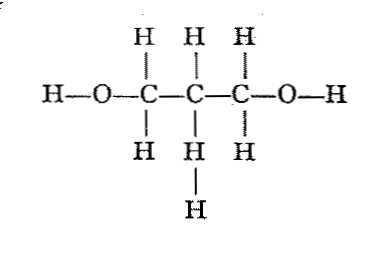
Glycerine
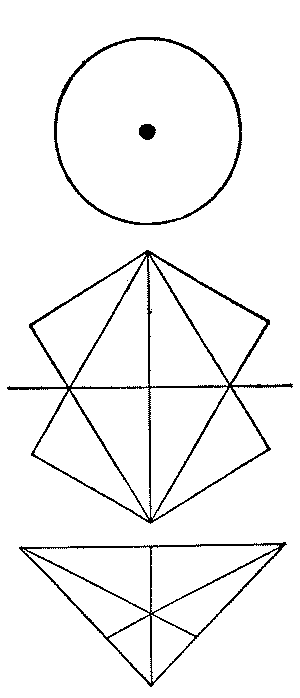
“Attach thyself,” says the alchemist, “to the four letters of the tetragram disposed in the following manner: The letters of the ineffable name are there, although thou mayest not discern them at first. The incommunicable axiom is kabalistically contained therein, and this is what is called the magic arcanum by the masters.” The arcanum—the fourth emanation of the Akâsa, the principle of Life, which is represented in its third transmutation by the fiery sun, the eye of the world, or of Osiris, as the Egyptians termed it. An eye tenderly watching its youngest daughter, wife, and sister—Isis, our mother earth. See what Hermes, the thrice-great master, says of her: “Her father is the sun, her mother is the moon.” It attracts and caresses, and then repulses her by a projectile power. It is for the Hermetic student to watch its motions, to catch its subtile currents, to guide and direct them with the help of the athanor, the Archimedean lever of the alchemist. What is this mysterious athanor? Can the physicist tell us—he who sees and examines it daily? Aye, he sees; but does he comprehend the secret-ciphered characters traced by the divine finger on every sea-shell in the ocean’s deep; on every leaf that trembles in the breeze; in the bright star, whose stellar lines are in his sight but so many more or less luminous lines of hydrogen?
“God geometrizes,” said Plato.[756] “The laws of nature are the thoughts of God;” exclaimed Oërsted, 2,000 years later. “His thoughts are immutable,” repeated the solitary student of Hermetic lore, “therefore it is in the perfect harmony and equilibrium of all things that we must seek the truth.” And thus, proceeding from the indivisible unity, he found emanating from it two contrary forces, each acting through the other and producing equilibrium, and the three were but one, the Pythagorean Eternal Monad. The primordial point is a circle; the circle squaring itself from the four cardinal points becomes a quaternary, the perfect square, having at each of its four angles a letter of the mirific name, the sacred TETRAGRAM. It is the four Buddhas who came and have passed away; the Pythagorean tetractys—absorbed and resolved by the one eternal NO-BEING.
Tradition declares that on the dead body of Hermes, at Hebron, was found by an Isarim, an initiate, the tablet known as the Smaragdine. It contains, in a few sentences, the essence of the Hermetic wisdom. To those who read but with their bodily eyes, the precepts will suggest nothing new or extraordinary, for it merely begins by saying that it speaks not fictitious things, but that which is true and most certain.
“What is below is like that which is above, and what is above is similar to that which is below to accomplish the wonders of one thing.
“As all things were produced by the mediation of one being, so all things were produced from this one by adaptation.
“Its father is the sun, its mother is the moon.
“It is the cause of all perfection throughout the whole earth.
“Its power is perfect if it is changed into earth.
“Separate the earth from the fire, the subtile from the gross, acting prudently and with judgment.
“Ascend with the greatest sagacity from the earth to heaven, and then descend again to earth, and unite together the power of things inferior and superior; thus you will possess the light of the whole world, and all obscurity will fly away from you.
“This thing has more fortitude than fortitude itself, because it will overcome every subtile thing and penetrate every solid thing.
“By it the world was formed.”
This mysterious thing is the universal, magical agent, the astral light, which in the correlations of its forces furnishes the alkahest, the philosopher’s stone, and the elixir of life. Hermetic philosophy names it Azoth, the soul of the world, the celestial virgin, the great Magnes, etc., etc. Physical science knows it as “heat, light, electricity, and magnetism;” but ignoring its spiritual properties and the occult potency contained in ether, rejects everything it ignores. It explains and depicts the crystalline forms of the snow-flakes, their modifications of an hexagonal prism which shoot out an infinity of delicate needles. It has studied them so perfectly that it has even calculated, with the most wondrous mathematical precision, that all these needles diverge from each other at an angle of 60°. Can it tell us as well the cause of this “endless variety of the most exquisite forms,”[757] each of which is a most perfect geometrical figure in itself? These frozen, star-like and flower-like blossoms, may be, for all materialistic science knows, a shower of messages snowed by spiritual hands from the worlds above for spiritual eyes below to read.
The philosophical cross, the two lines running in opposite directions, the horizontal and the perpendicular, the height and breadth, which the geometrizing Deity divides at the intersecting point, and which forms the magical as well as the scientific quaternary, when it is inscribed within the perfect square, is the basis of the occultist. Within its mystical precinct lies the master-key which opens the door of every science, physical as well as spiritual. It symbolizes our human existence, for the circle of life circumscribes the four points of the cross, which represent in succession birth, life, death, and IMMORTALITY. Everything in this world is a trinity completed by the quaternary,[758] and every element is divisible on this same principle. Physiology can divide man ad infinitum, as physical science has divided the four primal and principal elements in several dozens of others; she will not succeed in changing either. Birth, life, and death will ever be a trinity completed only at the cyclic end. Even were science to change the longed-for immortality into annihilation, it still will ever be a quaternary; for God “geometrizes!”
Therefore, perhaps alchemy will one day be allowed to talk of her salt, mercury, sulphur, and azoth, her symbols and mirific letters, and repeat, with the exponent of the Synthesis of Organic Compounds, that “it must be remembered that the grouping is no play of fancy, and that a good reason can be given for the position of every letter.”[759]
Dr. Peisse, of Paris, wrote in 1863, the following:
“One word, a propos, of alchemy. What must we think of the Hermetic art? Is it lawful to believe that we can transmute metals, make gold? Well, positive men, esprits forts of the nineteenth century, know that Mr. Figuier, doctor of science and medicine, chemical analyst in the School of Pharmacy, of Paris, does not wish to express himself upon the subject. He doubts, he hesitates. He knows several alchemists (for there are such) who, basing themselves upon modern chemical discoveries, and especially on the singular circumstance of the equivalents demonstrated by M. Dumas, pretend that metals are not simple bodies, true elements in the absolute sense, and that in consequence they may be produced by the process of decomposition.... This encourages me to take a step further, and candidly avow that I would be only moderately surprised to see some one make gold. I have only one reason to give, but sufficient it seems; which is, that gold has not always existed; it has been made by some chemical travail or other in the bosom of the fused matter of our globe;[760] perhaps some of it may be even now in process of formation. The pretended simple bodies of our chemistry are very probably secondary products, in the formation of the terrestrial mass. It has been proved so with water, one of the most respectable elements of ancient physics. To-day, we create water. Why should we not make gold? An eminent experimentalist, Mr. Desprez, has made the diamond. True, this diamond is only a scientific diamond, a philosophical diamond, which would be worth nothing; but, no matter, my position holds good. Besides, we are not left to simple conjectures. There is a man living, who, in a paper addressed to the scientific bodies, in 1853, has underscored these words—I have discovered the method of producing artificial gold, I have made gold. This adept is Mr. Theodore Tiffereau, ex-preparator of chemistry in the École Professionelle et Supérieure of Nantes.”[761] Cardinal de Rohan, the famous victim of the diamond necklace conspiracy, testified that he had seen the Count Cagliostro make both gold and diamonds. We presume that those who agree with Professor T. Sterry Hunt, F.R.S., will have no patience with the theory of Dr. Peisse, for they believe that all of our metalliferous deposits are due to the action of organic life. And so, until they do come to some composition of their differences, so as to let us know for a certainty the nature of gold, and whether it is the product of interior volcanic alchemy or surface segregation and filtration; we will leave them to settle their quarrel between themselves, and give credit meanwhile to the old philosophers.
Professor Balfour Stewart, whom no one would think of classing among illiberal minds; who, with far more fairness and more frequently than any of his colleagues admits the failings of modern science, shows himself, nevertheless, as biassed as other scientists on this question. Perpetual light being only another name for perpetual motion, he tells us, and the latter being impossible because we have no means of equilibrating the waste of combustible material, a Hermetic light is, therefore, an impossibility.[762] Noting the fact that a “perpetual light was supposed to result from magical powers,” and remarking further that such a light is “certainly not of this earth, where light and all other forms of superior energy are essentially evanescent,” this gentleman argues as though the Hermetic philosophers had always claimed that the flame under discussion was an ordinary earthly flame, resulting from the combustion of luminiferous material. In this the philosophers have been constantly misunderstood and misrepresented.
How many great minds—unbelievers from the start—after having studied the “secret doctrine,” have changed their opinions and found out how mistaken they were. And how contradictory it seems to find one moment Balfour Stewart quoting some philosophical morals of Bacon—whom he terms the father of experimental science—and saying “ ... surely we ought to learn a lesson from these remarks ... and be very cautious before we dismiss any branch of knowledge or train of thought as essentially unprofitable,” and then dismissing the next moment, as utterly impossible, the claims of the alchemists! He shows Aristotle as “entertaining the idea that light is not any body, or the emanation of any body, and that therefore light is an energy or act;” and yet, although the ancients were the first to show, through Demokritus, to John Dalton the doctrine of atoms, and through Pythagoras and even the oldest of the Chaldean oracles, that of ether as a universal agent, their ideas, says Stewart, “were not prolific.” He admits that they “possessed great genius and intellectual power,” but adds that “they were deficient in physical conceptions, and, in consequence, their ideas were not prolific.”[763]
The whole of the present work is a protest against such a loose way of judging the ancients. To be thoroughly competent to criticise their ideas, and assure one’s self whether their ideas were distinct and “appropriate to the facts,” one must have sifted these ideas to the very bottom. It is idle to repeat that which we have frequently said, and that which every scholar ought to know; namely, that the quintessence of their knowledge was in the hands of the priests, who never wrote them, and in those of the “initiates” who, like Plato, did not dare write them. Therefore, those few speculations on the material and spiritual universes, which they did put in writing, could not enable posterity to judge them rightly, even had not the early Christian Vandals, the later crusaders, and the fanatics of the middle ages destroyed three parts of that which remained of the Alexandrian library and its later schools. Professor Draper shows that the Cardinal Ximenes alone “delivered to the flames in the squares of Granada, 80,000 Arabic manuscripts, many of them translations of classical authors.” In the Vatican libraries, whole passages in the most rare and precious treatises of the ancients were found erased and blotted out, for the sake of interlining them with absurd psalmodies!
Who then, of those who turn away from the “secret doctrine” as being “unphilosophical” and, therefore, unworthy of a scientific thought, has a right to say that he studied the ancients; that he is aware of all that they knew, and knowing now far more, knows also that they knew little, if anything. This “secret doctrine” contains the alpha and the omega of universal science; therein lies the corner and the keystone of all the ancient and modern knowledge; and alone in this “unphilosophical” doctrine remains buried the absolute in the philosophy of the dark problems of life and death.
“The great energies of Nature are known to us only by their effects,” said Paley. Paraphrasing the sentence, we will say that the great achievements of the days of old are known to posterity only by their effects. If one takes a book on alchemy, and sees in it the speculations on gold and light by the brothers of the Rosie Cross, he will find himself certainly startled, for the simple reason that he will not understand them at all. “The Hermetic gold,” he may read, “is the outflow of the sunbeam, or of light suffused invisibly and magically into the body of the world. Light is sublimated gold, rescued magically by invisible stellar attraction, out of material depths. Gold is thus the deposit of light, which of itself generates. Light in the celestial world is subtile, vaporous, magically exalted gold, or ‘spirit of flame.’ Gold draws inferior natures in the metals, and intensifying and multiplying, converts into itself.”[764]
Nevertheless, facts are facts; and, as Billot says of spiritualism, we will remark of occultism generally and of alchemy in particular—it is not a matter of opinion but of facts, men of science call an inextinguishable lamp an impossibility, but nevertheless persons in our own age as well as in the days of ignorance and superstition have found them burning bright in old vaults shut up for centuries; and other persons there are who possess the secret of keeping such fires for several ages. Men of science say that ancient and modern spiritualism, magic, and mesmerism, are charlatanry or delusion; but there are 800 millions on the face of the globe, of perfectly sane men and women, who believe in all these. Whom are we to credit?
“Demokritus,” says Lucian,[765] “believed in no (miracles) ... he applied himself to discover the method by which the theurgists could produce them; in a word, his philosophy brought him to the conclusion that magic was entirely confined to the application and the imitation of the laws and the works of nature.”
Now, the opinion of the “laughing philosopher” is of the greatest importance to us, since the Magi left by Xerxes, at Abdera, were his instructors, and he had studied magic, moreover, for a considerably long time with the Egyptian priests.[766] For nearly ninety years of the one hundred and nine of his life, this great philosopher had made experiments, and noted them down in a book, which, according to Petronius,[767] treated of nature—facts that he had verified himself. And we find him not only disbelieving in and utterly rejecting miracles, but asserting that every one of those that were authenticated by eye-witnesses, had, and could have taken place; for all, even the most incredible, was produced according to the “hidden laws of nature.”[768]
“The day will never come, when any one of the propositions of Euclid will be denied,”[769] says Professor Draper, exalting the Aristoteleans at the expense of the Pythagoreans and Platonists. Shall we, in such a case, disbelieve a number of well-informed authorities (Lemprière among others), who assert that the fifteen books of the Elements are not to be wholly attributed to Euclid; and that many of the most valuable truths and demonstrations contained in them owe their existence to Pythagoras, Thales, and Eudoxus? That Euclid, notwithstanding his genius, was the first who reduced them to order, and only interwove theories of his own to render the whole a complete and connected system of geometry? And if these authorities are right, then it is again to that central sun of metaphysical science—Pythagoras and his school, that the moderns are indebted directly for such men as Eratosthenes, the world-famous geometer and cosmographer, Archimedes, and even Ptolemy, notwithstanding his obstinate errors. Were it not for the exact science of such men, and for fragments of their works that they left us to base Galilean speculations upon, the great priests of the nineteenth century might find themselves, perhaps, still in the bondage of the Church; and philosophizing, in 1876, on the Augustine and Bedean cosmogony, the rotation of the canopy of heaven round the earth, and the majestic flatness of the latter.
The nineteenth century seems positively doomed to humiliating confessions. Feltre (Italy) erects a public statue “to Panfilo Castaldi, the illustrious inventor of movable printing types,” and adds in its inscription the generous confession that Italy renders to him “this tribute of honor too long deferred.” But no sooner is the statue placed, than the Feltreians are advised by Colonel Yule to “burn it in honest lime.” He proves that many a traveller beside Marco Polo had brought home from China movable wooden types and specimens of Chinese books, the entire text of which was printed with such wooden blocks.[770] We have seen in several Thibetan lamaseries, where they have printing-offices, such blocks preserved as curiosities. They are known to be of the greatest antiquity, inasmuch as types were perfected, and the old ones abandoned contemporaneously with the earliest records of Buddhistic lamaism. Therefore, they must have existed in China before the Christian era.
Let every one ponder over the wise words of Professor Roscoe, in his lecture on Spectrum Analysis. “The infant truths must be made useful. Neither you nor I, perhaps, can see the how or the when, but that the time may come at any moment, when the most obscure of nature’s secrets shall at once be employed for the benefit of mankind, no one who knows anything of science, can for one instant doubt. Who could have foretold that the discovery that a dead frog’s legs jump when they are touched by two different metals, should have led in a few short years to the discovery of the electric telegraph?”
Professor Roscoe, visiting Kirchhoff and Bunsen when they were making their great discoveries of the nature of the Fraunhoffer lines, says that it flashed upon his mind at once that there is iron in the sun; therein presenting one more evidence to add to a million predecessors, that great discoveries usually come with a flash, and not by induction. There are many more flashes in store for us. It may be found, perhaps, that one of the last sparkles of modern science—the beautiful green spectrum of silver—is nothing new, but was, notwithstanding the paucity “and great inferiority of their optical instruments,” well known to the ancient chemists and physicists. Silver and green were associated together as far back as the days of Hermes. Luna, or Astartè (the Hermetic silver), is one of the two chief symbols of the Rosicrucians. It is a Hermetic axiom, that “the cause of the splendor and variety of colors lies deep in the affinities of nature; and that there is a singular and mysterious alliance between color and sound.” The kabalists place their “middle nature” in direct relation with the moon; and the green ray occupies the centre point between the others, being placed in the middle of the spectrum. The Egyptian priests chanted the seven vowels as a hymn addressed to Serapis;[771] and at the sound of the seventh vowel, as at the “seventh ray” of the rising sun, the statue of Memnon responded. Recent discoveries have proved the wonderful properties of the blue-violet light—the seventh ray of the prismatic spectrum, the most powerfully chemical of all, which corresponds with the highest note in the musical scale. The Rosicrucian theory, that the whole universe is a musical instrument, is the Pythagorean doctrine of the music of the spheres. Sounds and colors are all spiritual numerals; as the seven prismatic rays proceed from one spot in heaven, so the seven powers of nature, each of them a number, are the seven radiations of the Unity, the central, spiritual Sun.
“Happy is he who comprehends the spiritual numerals, and perceives their mighty influence!” exclaims Plato. And happy, we may add, is he who, treading the maze of force-correlations, does not neglect to trace them to this invisible Sun!
Future experimenters will reap the honor of demonstrating that musical tones have a wonderful effect upon the growth of vegetation. And with the enunciation of this unscientific fallacy, we will close the chapter, and proceed to remind the patient reader of certain things that the ancients knew, and the moderns think they know.