Chapter XVI · Summary and Estimate of Prose Writings. (continued 2)
Reading edition
There are two other pieces well worth a study—his remarks on Mr. Locke’s “Essay on the Human Understanding,” and a “Brief Scheme of Ontology.” The essay on ontology, like that on logic, is a most interesting handbook and guide to thought. Watts thought so clearly that it often seems as if he were only putting things neatly. Sometimes, as in his “Philosophic Essays,” and in his pieces on the Trinity, he is eminently translucent; you see that there is light behind. This is the impression conveyed by his dissertation on “Space,” “Substance,” and “Concerning Spirits, their Place and Motion;” but in his Ontology and Logic he is transparent, the objects are brought distinctly into view. When he presents before you his greater thoughts his style is indeed clear, but you feel that it is as when “morning is spread upon the mountains” before sunrise, or as when evening lingers in the soft and rosy light after sunset, there is something somewhere behind, some orb of light which spreads out all that roseate glow; in his Ontology and Logic he is concise and distinct, as we have said; you may almost call him a neat writer. He has a wonderful power of accumulating particulars, a singular felicity in discriminating ideas. This gives to him a very nice sense of words, as he says, “We must search the sense of words. It is for want of this that men quarrel in the dark, and that there are so many contentions in the several sciences, and especially in divinity.” His power of discrimination is so nice that it often becomes as amusing as it is instructive; regarded thus, his Logic is a most interesting book, we suppose quite the most delightful to read of any treatise on logic in our language. Of this amusing cumulative power let the reader take the following:
NAMES AND NAMING THINGS.
“Do not suppose that the natures or essences of things always differ from one another as much as their names do. There are various purposes in human life for which we put very different names on the same thing, or on things whose natures are near akin; and thereby oftentimes, by making a new nominal species, we are ready to deceive ourselves with the idea of another real species of beings, and those whose understandings are led away by the mere sound of words fancy the nature of those things to be very different whose names are so, and judge of them accordingly. I may borrow a remarkable instance for my purpose out of every garden which contains a variety of plants in it. Most of all plants agree in this, that they have a root, a stalk, leaves, buds, blossoms, and seeds: but the gardener ranges them under very different names, as though they were really different kinds of beings, merely because of the different use and service to which they are applied by men, as for instance those plants whose roots are eaten shall appropriate the name of roots to themselves, such as carrots, turnips, radishes, etc. If the leaves are of chief use to us then we call them herbs, as sage, mint, thyme; if the leaves are eaten raw they are termed salad, as lettuce, purslane; if boiled they become pot-herbs, as spinage, coleworts; and some of those same plants which are pot-herbs in one family are salads in another. If the buds are made our food they are called heads or tops; so cabbage heads, heads of asparagus, and artichokes. If the blossom be of most importance we call it a flower, such as daisies, tulips, and carnations, which are the mere blossoms of those plants. If the husks or seeds are eaten they are called the fruits of the ground, as peas, beans, strawberries, etc. If any part of the plant be of known or common use to us in medicine we call it a physical herb, as cardamus, scurvy-grass; but if we count no part useful we call it a weed, and throw it out of the garden; and yet perhaps our next neighbour knows some valuable property and use of it, he plants it in his garden and gives it a title of an herb or a flower. You see here how small is the real distinction of these several plants considered in their general nature as the lesser vegetables, yet what very different ideas we vulgarly form concerning them, and make different species of them, chiefly because of the different names given to them.”
Exactly the same characteristics meet us in his Ontology, but here there is yet more of this kind of amusement; its pages are crowded with illustrations. It was perhaps in the nature of the subject that he scarcely mentions a particular for which he does not furnish one or twenty illustrative examples: take his curious discrimination of causes into the deficient, the permissive, and the conditional:
CLASSIFICATION OF CAUSES.
“A deficient cause is when the effect owes its existence in a great measure to the absence of something which would have prevented it, so that this may be reckoned a negative rather than a positive cause: the negligence of a gardener, or the want of rain, are the deficient causes of the withering of plants; and the carelessness of the pilot, or the sinking of the tide, is the cause of a ship’s splitting on a rock; the forgetfulness of a message is the cause of a quarrel among friends, or of the punishment of servants; the not bringing a reprieve in time is the cause of a criminal’s being executed; and the want of education is the cause why many a child runs headlong into vice and mischief; the blindness of a man, or the darkness of the night, are the causes of stumbling; a leak in a boat is a deficient cause why the water runs in and the boat sinks; and a hole in a vessel is called a deficient cause why the liquor runs out and is lost. Man is the deficient cause of all his sins of omission, and many of these carry great guilt in them.
“A permissive cause is that which actually removes impediments, and thus it lets the proper causes operate. Now this sort of cause is either natural or moral. A natural permissive cause removes natural impediments or obstructions, and this may be called a deobstruent cause. So opening the window shutters is the cause of the light entering the room; cleaning the ear may be the cause of a man’s hearing music who was deaf before; breaking down a dam is the cause of the overflowing of water and drowning a town; letting loose a rope is the cause of a ship’s running adrift; leaving off a garment is the cause of a cold and a cough; and cutting the bridle of the tongue may be the cause of speech to the dumb.
“Note.—The cause which removes natural impediments may be a proper efficient cause with regard to that removal, yet it is not properly efficient, but merely permissive with regard to the consequences of that removal.
“A moral permissive cause removes moral impediments, or takes away prohibitions, and gives leave to act: so a master is a permissive cause of his scholars going to play; a general is the same cause of his soldiers plundering a city; and a repeal of a law against foreign silks is the permissive cause why they are worn.
“Query.—Was not God’s permission of Satan to afflict Job rather natural than moral, since his mischievous actions did not become lawful thereby, and since it is now become his nature to do mischief where he has no natural restraint?
“A condition has been usually caused causa sine quâ non, or a cause without which the effect is not produced. It is generally applied to something which is requisite in order to the effect, though it hath not a proper actual influence in producing that effect. Daylight is a condition of ploughing, sowing, and reaping; darkness is a condition of our seeing stars and glowworms; clearness of the stream is the condition of our spying sand and pebbles at the bottom of it; being well dressed with a head uncovered is a condition of a man’s coming into the presence of a king; and paying a peppercorn yearly is the condition of enjoying an estate. How far the perfect idea of the word condition, in the civil law, may differ from this representation is not my present work to determine.
“Note.—These three last causes may possibly be all ranked under the general name of conditions, but I think it more proper to distinguish them into their different kinds of causality.”
We perhaps repeat ourselves in these last remarks, for all is an illustration of that perspicuity which we mentioned as Watts’ first characteristic; but in him perspicuity was not the attribute of a small mind, or a limited range of vision; perspicuous speech is the natural instrument of perspicuous thought: how can that man express himself clearly who does not see clearly? Hence dark language must be the companion of dark vision; but the perspicuity of a child amongst its playthings, in its playground or its garden is one thing, and the perspicuity of the pilot of a vessel, or a gifted astronomer, is quite another. However wide or vast the subjects upon which Watts wrote, it seemed he had cleared thought in his own mind, by the clearness with which speech served him in making the things in his own mind the property of others; and upon whatsoever he wrote there was always the same suffusing light of the devoutness of the spiritual mind. Here is no flippancy; here are no impertinent epigrams, no hard words even for opponents; we have to search a long way through his works before we find an expression of severity, we will not say of contempt—perhaps there are such—but we are sure they will only be used of those who, by some abandonment of sentiment, had separated themselves from the common feeling of mankind. Yet there was considerable nervousness in his speech, he was a great preacher, he commanded attention; judging from the testimony of Johnson, he must have been, to cultivated minds, one of the most distinguished preachers of his day: his enunciation was clear, forcible, and distinct, and what was wanting to an imposing presence was made up from the earnestness of the manner, the calm luminousness, elevation, and we would even say, the sustained but subdued vehemence of his diction. His sermon on the “Reformation of Manners,” to which Southey has referred, not in his life of Watts but in one of the volumes of his “Common-place Book,” as “an extraordinary piece,” is an illustration of this. It was preached at the time when we were in conflict with Louis XIV. He gives the following side-glance to the wars in Flanders, and on the borders of the Rhine, and he refers to the importance, not only of fighting the enemy abroad, but resisting vice at home. He exclaims, in a remarkable passage:
“But was there ever any war without danger, or victory without courage? Besides, the perils you run here are almost infinitely less than those which attend the wars of nations, where the cause is not half so Divine. The fields of battle in Flanders, and almost all over Europe, have drunk up the blood of millions, and have furnished graves for large armies; but it can hardly be said that you have hitherto ‘resisted unto blood striving against sin.’ In a war of more than twelve years’ continuance (i.e., against vice at home) there has but one man fallen. The providence of God has put helmets of salvation upon your heads. Some of you can relate wonders of deliverance to safety when you have been beset by numbers, and their rage has kindled into resolutions of revenge; the Lord has taken away their courage in a moment, the ‘men of might have not found their hands;’ thus He has caused ‘the wrath of man to praise Him, and the remainder of wrath He hath restrained.’[55] Read over this psalm, and with Divine valour pursue the fight. But if your life should be lost in such a cause as this, it will be esteemed martyrdom in the sight of God, and shall be thus written down in the book of the wars of the Lord. Believe me, these red lines will look well in the records of heaven, when the judgment shall be set, and the books opened in the face of men and angels.”
Watts in the pulpit ought to furnish the subject for a distinct chapter—it must fall into this feeble attempt to realize the man’s mind in his works. His sermons were evidently carefully prepared and admirably arranged; it was not possible for him to speak without thought, but he used very few notes in the pulpit, preparing carefully so that the mind and memory were fully charged, giving to such a mind as his freedom, instantaneous propriety, and fulness of expression; many men who exhibit fulness of wisdom, both in thought and language, in the study, find all fail them when they come to speak in public. On every hand we hear that this was not the case with Watts, and that his deliverances in public corresponded to his great powers in the study; and his sermons are of that nature that they assure us if the delivery corresponded to the strength of the matter and the felicity and harmony of the composition, they must have been very impressive. As some of the great sermons of Jeremy Taylor appear to have been prepared to preach when he was in exile at the Golden Grove in Wales, in the drawing-room of Lord Vaughan, so some of Watts’ sermons were prepared for delivery at the evening worship at Theobalds; one of the noblest of these is a commanding piece on the Scale of Blessedness, or Blessed Saints, Blessed Saviour, Blessed Trinity. In this subduing sermon occurs one of the passages which excited the wrath of Thomas Bradbury, and to which we have referred. Here it is; the note is evidently intended to justify himself from his coarse assailant, although he does not say so.
A SCALE OF BLESSEDNESS.
“Can we ever imagine that Moses the meek, the friend of God, who was, as it were, His confidant on earth, His faithful prophet to institute a new religion, and establish a new Church in the world, who, for God’s sake, endured forty years of banishment, and had forty years’ fatigue in a wilderness; who saw God on earth face to face, and the shine was left upon his countenance: can we suppose that this man has taken his seat no nearer to God in Paradise than Samson and Jephthah, those rash champions, those rude and bloody ministers of Providence?[56] Or can we think that St. Paul, the greatest of the apostles, ‘who laboured more than they all,’ and ‘was in sufferings’ more abundant than the rest; who spent a long life in daily services and deaths for the sake of Christ, is not fitted for, and advanced to a rank of blessedness superior to that of the crucified thief, who became a Christian but a few moments at the end of a life of impiety and plunder? Can I persuade myself that a holy man, who has known much of God in this world, and spent his age on earth in contemplation of the Divine excellences, who has acquired a great degree of nearness to God in devotion, and has served Him, and suffered for Him, even to old age and martyrdom, with a sprightly and faithful zeal: can I believe that this man, who has been trained up all his life to converse with God, and is fitted to receive Divine communications above his fellows, shall dwell no nearer to God hereafter, and share no larger a degree of blessedness, than the little babe who has just entered into this world to die out of it, and who is saved, so far as we know, merely by spreading the veil of the covenant grace, drawn over it by the hand of the parent’s faith? Can it be that the Great Judge who ‘cometh and His reward is with Him, to render to every one according to his works,’ will make no distinction between Moses and Samson, between the apostle and the thief, between the aged martyr and the infant, in the world to come? And yet, after all, it may be matter of inquiry, whether the meanest saint among the sons of Adam has not some sort of privilege above any rank of angels by being of a kindred nature to our Emmanuel, to Jesus the Son of God.”
And the following is a fine passage on the Trinity, which may be read with pleasure, although some years after he says that “it is a warmer effort of the imagination than riper years would indulge. What distinctions there may be in this one Spirit I know not; I am fully established in the belief of the Deity of the Blessed Three, though I know not the manner of the explication.”
THE TRINITY.
“The Father is so intimately near the Son and Spirit, that no finite or created natures or unions can give a just resemblance of it. We talk of the union of the sun and his beams, of a tree and its branches: but these are but poor images and faint shadows of this mystery, though they are some of the best that I know. The union of the soul and the body is, in my esteem, still farther from the point, because their natures are so widely different. In vain we search through all the creation to find a complete similitude of the Creator.
“And in vain may we run through all parts and powers of nature and art, to seek a full resemblance of the mutual propensity and love of the Blessed Three towards each other. Mathematicians, indeed, talk of the perpetual tendencies and infinite approximations of two or more lines on the same surface, which yet never can entirely concur in one line: and if we should say that the Three Persons of the Trinity, by mutual indwelling and love, approach each other infinitely in one Divine nature, and yet lose not their distinct personality, it would be but an obscure account of this sublime mystery. But this we are sure of, that for three Divine Persons to be so inconceivably near one another in the original and eternal spring of love, goodness, and pleasure, must produce infinite delight. In order to illustrate the happiness of the Sacred Three, may we not suppose something of society necessary to the perfection of happiness in all intellectual nature? To know and be known, to love and to be beloved, are, perhaps, such essential ingredients of complete felicity that it cannot subsist without them. And it may be doubted whether such mutual knowledge and love, as seems requisite for this end, can be found in a nature absolutely simple in all respects. May we not then suppose that some distinctions in the Divine Being are of eternal necessity, in order to complete the blessedness of Godhead? Such a distinction as may admit, as a great man expresses it, of delicious society. ‘We, for our parts, cannot but hereby have in our minds a more gustful idea of a blessed state, than we can conceive in mere eternal solitude.’
“And if this be true, then the three differences, which we call personal distinctions, in the nature of God, are as absolutely necessary as His blessedness, as His being, or any of His perfections. And then we may return to the words of my text, and boldly infer, that if the man is blessed who is chosen by the free and sovereign grace of God, and caused to approach, or draw near Him, what immense and unknown blessedness belongs to each Divine Person, to all the Sacred Three, who are by nature and unchangeable necessity so near, so united, so much one, that the least moment’s separation seems to be infinitely impossible, and, then we may venture to say, it is not to be conceived: and the blessedness is conceivable by none but God!
“This is a nobler union and a more intense pleasure than the Man Jesus Christ knows or feels, or can conceive, for He is a creature. These are glories too Divine and dazzling for the weak eye of our understanding, too bright for the eye of angels, those morning stars; and they, and we, must fall down together, alike overwhelmed with them, and alike confounded. These are flights that tire souls of the strongest wing, and finite minds faint in the infinite pursuit; these are depths where our tallest thoughts sink and drown; we are lost in this ocean of being and blessedness that has no limit on either side, no surface, no bottom, no shore. The nearness of the Divine Persons to each other, and the unspeakable relish of their unbounded pleasures, are too vast ideas for our bounded minds to entertain. It is one infinite transport that runs through the Father, Son, and Spirit, without beginning, and without end, with boundless variety, yet ever perfect and ever present without change, and without degree; and all this because they are so near to one another, and so much one with God.
“But when we have fatigued our spirits and put them to the utmost stretch, we must lie down and rest, and confess the great incomprehensible. How far this sublime transport of joy is varied in each subsistence; how far their mutual knowledge of each other’s properties, or their mutual delight in each other’s love, is distinct in each Person, is a secret too high for the present determination of our language and our thoughts: it commands our judgment in silence, and our whole souls into wonder and adoration.”
He frequently indulged in a warmth of expression; he did not disdain ornament, although all was held in a wise check, and indeed with a severe rein, and his sermons were not less practical than beautiful. They abound in such passages as the following, in which he so sweetly and mildly expostulates with
CENSORIOUS CHRISTIANS.
“Be not too severe in your censures, you who have been kept from temptation, but pity others who are fallen, and mourn over their fall. Do not think or say the worst things you can of those who have been taken in the snare of Satan, and been betrayed into some grosser iniquities. When you see them grieved and ashamed of their own follies, and bowed down under much heaviness, take occasion then to speak a softening and a healing word. Speak for them kindly, and speak to them tenderly. ‘Have compassion of them, lest they be swallowed up of over much sorrow.’ And remember, too, O censorious Christian, that thou art also in the body. It is rich grace that has kept thee hitherto, and the same God, who for wise ends has suffered thy brother to fall, may punish thy severity and reproachful language by withholding His grace from thee in the next hour of temptation, and then thy own fall and guilt shall upbraid thee with inward and bitter reflections, for thy sharp censures of thy weak and tempted brother. This life is the only time wherein we can pity the infirmities of our brethren, and bear their burdens. This law of Christ must be fulfilled in this world, for there is no room for it in the next: ‘Wherefore bear ye one another’s burdens, and so fulfil ye the law of Christ.’ This world is the only place where different opinions and doctrines are found amongst the saints; disagreeing forms of devotion, and sects, and parties, have no place on high: none of these things can interrupt the worship or the peace of heaven. See to it then, that you practise this grace of charity here, and love thy brother, and receive him into thy heart in holy fellowship, though he may be weak in faith, and though he may observe days and times, and may feed upon herbs, and indulge some superstitious follies while thou art strong in faith, and well acquainted with the liberty of the Gospel. Let not little things provoke you to divide communions on earth: but by this sort of charity, and a Catholic spirit, honour the Saviour and His Church here in this world; for since there are no parties, nor sects, nor contrary sentiments among the Church in heaven, this Christian virtue can never find any room for exercise there. This kind of charity ends with death.”
But such delineations as these might be pursued to a great length, and we have scarcely dwelt at all upon that aspect of his public teaching which the last quotation instantly suggests, its eminent practical character; his discourses on “Christian Morality,” his beautiful discourse on “Humility,” for which he received the hearty thanks of the Bishop of London; his “Caveat against Infidelity,” his “Guide to Prayer;” summarily, it may be said, he touched everything with an exquisite delicacy of conscience, and with the elevation of a saint. His mind cannot be summed in one attribute, neither his piety, nor his genius can be said to find an adequate illustration in one work; he was one of a race of men of whom, indeed, the history of the literature of those times furnishes many illustrations, whose learning and labours were alike vast; they must have caught the earliest daybeam, and trimmed the lamp far beyond the hours of midnight, pursuing their industrious toil, devouring libraries. Their works formed a library; they had not the necessities of our times to call them away, nor was it the age of magazines and reviews, and the lighter shallops of literature. The age immediately preceding that of Watts, and his own age, present to us the forms of many men, who in some sheltered nook passed a life unprofitable—ought we to say inglorious?—satisfied with the spoils of learning, they lived a life of barrenness; they sought wisdom for her own sake, neither for the use it enabled them to confer on others, or the fame it conferred on themselves; or, if they published, it was not so much from the benevolent idea of the transfusion of knowledge, but really from their interest only in their own idea. These were the men and those the times which may be best described in the words of Milton:
Whose lamp at midnight hour Is seen in some high lonely tower, Where he may oft outwatch the Bear With thrice great Hermes, or unsphere The spirit of Plato, to unfold What worlds or what vast regions hold The immortal mind that hath forsook Her mansion in this fleshly nook.
But to this order of mind Watts added that which altogether changed it; he possessed in an eminent degree the love of books and thought, lofty imaginations, and excursions through the far-off continents of knowledge; but he added to the volitions of genius, and the accumulations of the scholar, the doing “all for the glory of God;” few lives so useful and even so obvious seem to have been so sanctified from every human passion and selfish isolation; and hence with powers which might have found their gratification had he chosen to move like some remote and solitary planet in an unilluminating orb, he preferred rather to be a satellite, shedding a useful lustre on his serene way, and in the language of a well-known writer, “singing while he shone.” The amiable critic to whom we have already referred says that the whole lesson of Watts’ life might be condensed into the apostolic injunction, “Study to be quiet and mind your own business;” and the estimate is greatly true. He was a firm Nonconformist, but he was no agitator; he lived and wrought laboriously in his vocation, and that vocation was to bring about “the union of mental culture and vital piety.” As he did not write pamphlets to expose the evils of the hierarchy, or the defects of his own ecclesiastical system, so neither did he attempt to rebuke in print such assailants as Bradbury. He was the first in England who set the Gospel to music; and many who knew not the meaning of the words yet found their hearts melted by the melody of genius. There is a saintly dignity and peaceful purity about his life which it is not invidious to say gives to him, even in writers of his own order, a high pre-eminence. He seems to have been one whom “the peace of God which passeth all understanding” kept. And surely he has won a place in the universal Church—no Church repudiates him; his eulogy has been pronounced, and his life recorded, by Samuel Johnson, and Robert Southey, and Josiah Conder. If his hymns crowd the “Congregational Hymn Book,” they are to be found in the “Hymns Ancient and Modern;” and, as we have seen, his monument adorns not only the “conventicle” but the cathedral.
Ages differ, and men differ with their age. This is the place neither to compare nor to contrast; but in an eminent sense Watts appears to have fulfilled himself. He drank deep from every kind of learning: we have seen that he wrote upon every kind of subject; and although it is the fashion now to pass him by, and even to underrate many of those pieces in prose and verse which were long held as the most cherished heirlooms of the Church, we shall have to search long and far to discover a more ample and consecrated intelligence, a more conscientious and laborious worker, than the mild, the modest, yet majestic hermit, philosopher, and sweet singer of Theobalds and Stoke Newington.
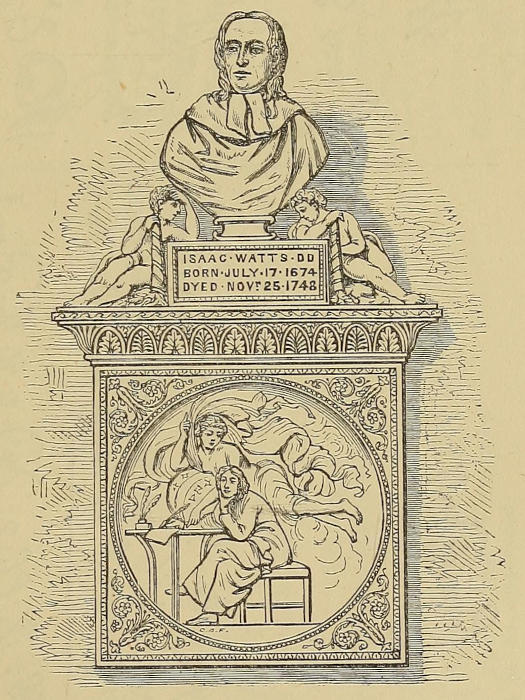
MONUMENT OF DR. WATTS IN WESTMINSTER ABBEY.