HYPNOSIS
Reading edition
As to science
Since man began assembling, some few have spent their lives in trying to comprehend the most incomprehensible of all beings,—man. The net result of all their work and discoveries has resulted in nothing but theory, and that not worth the candle. With all of our alleged knowledge the few truths we have are of but little value. The myriads of theories are so impracticable that I often wonder why and how the “authorities” obtain their titles. The authorities of a hundred years ago are the laughing stock of to-day.
Up to fifty years ago man was bled as a cure for every disease; to-day they claim he is full of bugs that require slaughtering and try to make of him a bacilli abattoir. They write tomes of books on “mind,” yet nowhere can I find it comprehensively defined. Everyone prides himself on his will power, yet I must own that such a thing which is so ambiguously defined is incomprehensible to me. Volumes are written as to hearing, seeing, smelling, feeling and tasting, and yet no one seems to be able to grasp the true significance of these terms.
Crime is punished, yet more penitentiaries are yearly required. Our alienists, truly foreigners to their subjects, know all (?) about the brain and with the greatest assurance pronounce upon man’s sanity, yet offer us no cure, and our institutions for the insane are too small for the ever increasing demands upon them. We know the effect, need no experts, why does not some one demonstrate the cause.
As to expert testimony
In all sensational murder trials our most learned(?) and wise doctors(?) go on the stand as experts(?)—whatever that may mean—swearing directly opposite to one another, and still maintain their standing in their profession and the community. If they know anything, how is it possible for the truth to be in both of two contradictory assertions. They study in the same schools, from the same books and from the same “authorities,” yet one says “yes,” the other “no.” Verily, gentlemen, you must lack a true premise.
Effect, man comprehends fairly well, but as to cause our most learned scientists seem to have no conception. Now, dear reader, if you would know a bit of truth follow me. I am a graduate of no great college; am professor in no great institution; have been exposed(?) many times, yet truth is, was, and always will be, and year after year my following increases. If you will follow through the ensuing pages, unsophisticated as I am, I will try to teach you something about man—a mere machine; his every thought and action forced, possessing no will power, and in no way responsible for his actions. For twelve years I have studied nightly from ten to twenty-five hypnotized subjects and have found that they are ruled by the same general law as the non-hypnotized man. In other words, a hypnotized subject is a slowed-down machine which one knowing how, can watch each and every movement of, and thereby comprehend cause and effect. Through a hypnotized subject we can learn how “normal” man is forced to act. Consequently, we can thoroughly analyze the whys and wherefores of every act performed by a subject while in hypnosis, during which time I believe the cerebrum to be entirely inactive.
All action automatic
The cerebrum is like the receiving or correlating mechanism of the phonograph; after the thought is registered in the ganglion of the Abdominal Brain it is then purely automatic and free from the cerebrum, which is the realizing brain. Everything we do and say is purely automatic—an effect. The babe at birth fails to withdraw its foot when tickled. After that action is associated with the peculiar sensation, the action always takes place when the sensation is produced, it being purely automatic, otherwise, a result or transformation of the cause. After the babe has learned to speak the word “papa,” whenever the environment forces the desire for father, automatically the word is said without any predetermination.
One thing an impossibility
Everything in life is a combination of attributes; i. e., one thing an impossibility.
The attributes of which any object is composed are of interest to us only as they affect our senses. The word “tree,” if disassociated with our sense-impressions, would mean nothing, but when its form (sight) and use (feeling) are associated with its name (sound), we for the first time have a comprehension of what in the English language is known as a tree. A foreigner, unable to understand our language, coming to this country and being asked for a match would have no conception of what we were talking about; after we have associated in his “mind” its form (sight), its use (feeling) and its name (sound), he would for the first time understand what was meant by the word match.
Matter
Definition of thought and idea
All matter to be conceived must affect two senses; to be comprehended it must affect three or more. A cigar cannot be thoroughly comprehended with less than five. It has form, equaling sight; use, equaling feeling; a name, equaling sound; taste and smell. It is not necessary for man to comprehend the material of which it is made, or the skill that made it. The last two are inconsequential to him, other than in producing the desired effect on the senses. Therefore, all matter equals in comprehension the degree to which it affects man’s different senses, and if man can only comprehend through the effect on his senses, that comprehension which is called a thought, must likewise be a combination; hence, I will define a thought to be two or more associated ideas, an idea being a percept through any of the senses. The more ideas associated the more comprehensive the alleged thought.
Matter and form
Matter is comprehensible only in the degree to which it affects the senses; to be conceived it must affect two, to be comprehended, three. Form is comprehensible (when acquired) only when it affects sight and feeling, and a child must not only hear the word “round” but also feel of the object. The same with “straight,” “square,” et cetera. The round object through sight must transform itself into a feeling memory. Form is the outline of matter, and as nothing but matter is appreciable by man, the form of it conveys no impression except of the matter (feeling) within its boundary.
Nothing but matter is comprehensible to man.
Conception and thinking
The five senses to be impressed must be stimulated, and nothing but matter will produce the excitation necessary. Energy can move only through matter by disturbing matter; or, in other words, “nothing” is impossible and incomprehensible. Therefore, there is nothing appreciable but matter. Man can conceive of nothing that he has not experienced, and as all so-called thinking is but the correlation or passing through one’s mind the experiences associated, and as they have necessarily been the product of matter, nothing else is comprehensible. Consequently, man can conceive of nothing greater nor less than his individual experiences. It is impossible to lift him to your comprehension, you must drop to his.
Law of Nature (?)
If I speak to you of the “Law of Nature,” what sense-experience have you a memory of to be aroused by the utterance of the phrase “Law of Nature”? None. But if I tell you that the farmer ploughed the ground, sowed the seed, the Heavens gave forth rain; he then hoed around the seed, a sprout came up, and by more cultivation the sprout matured into a stalk of corn, the corn was then harvested; you would say “Ah, well, the farmer did all that. I fail to see what the ‘Law of Nature’ did,” because you can comprehend nothing that does not affect your senses.
Proper sense-memories
While lecturing in New York City two years ago, a very estimable lady, whose children were reared in a nursery and lacked many of the usual experiences of children of middle-class families, came to me and said:
“Mr. Santanelli, can you cure my boy of a very vicious habit?”
“Madam, what is the habit?”
“He enjoys putting the cat on the hot stove to see it dance.”
“Yes, madam.”
“How long will it take you?”
“One-quarter of a minute.”
Lacked a memory
My good reader, can you tell me what was done; if so, why? What ideas were associated in this lad’s mind as to the stove and cat? The different actions of the cat and nothing else. The stove being the force (suggestion) and the dancing of the cat the result, thereby arousing only a sight memory. The lad lacked a memory. The moment there was given him a feeling memory, he no longer cared to see the cat dance on the stove. His finger was held on the stove until it was blistered, which associated in his “mind” through the proper sense that heat produced pain, and substituted a memory of pain for the memory of the pleasure of seeing the cat dance.
The spiritual impossible
While in New York City, on Sunday mornings I attended an independent church, whose minister or lecturer is beyond all question one of the cleverest logicians of the day. On one Sunday in particular he preached a sermon claiming that the right religion has yet to be offered man; that the foundation of all doctrines so far offered us has been based upon a material premise; that the right founder will offer us one built entirely upon a spiritual basis. Such a thing is an impossibility, inasmuch as the spiritual is incomprehensible. The moment that one begins speaking of the spiritual he is using mere idle words, inasmuch as the spiritual has never affected any of his senses, hence he has no memory of its action; therefore, no ideas are properly associated, and the word possesses no meaning—his utterances are purely conjectural.
Building a thought
Thoughts forced
I speak to you of a “thingamagig,” which is mere sound, arousing no thought in your “mind.” I show it to you and thereby associate sound—thingamagig—with sight—its form. I then teach you its use—feeling—and you comprehend it. The two ideas will give you a conception, but it requires the third to get a comprehension. I touch you. Can you help thinking of it? I show you my watch, and you think of it. You hear a sound, you think of it; you smell or taste something, and think of it; you have no control nor in any manner can you prevent the consciousness or the realization of the senses so affected.
Thinking
Man does not “think,” he realizes. Thinking is the transforming of energy (suggestion). I pinch you; it has happened and is registered irrespective of your “will power,” and when registered, you realize it. You see my hand move towards you; you see on my face an expression which arouses the thought (associated ideas) of being pinched, the alleged pain and the avoidance of it through the action of withdrawing your limb, which is but the transforming of the energy (suggestion) taken in through the eye and voiced in your action, all being done before you realize it, the transforming being instantaneous and must be registered before you are conscious of (realize) it. The “mind” is the realizing intelligence, and the actual mind is like the transformer of electricity in the main power station that receives one kind of electric current and sends out another. Into what action the received current will be transformed, depends on the ideas (currents) previously associated. The degree of action and its rapidity depends on the number of senses affected and the degree of force. Therefore, your thoughts are forced on you by your environment, and are the transformation of the suggestion; hence, man is a creature of his environment. Now, as I have defined a suggestion to be anything that arouses an action, anything that affects any of your five senses must be a suggestion; therefore, man is ruled by suggestion.
Man is like a phonograph
Man is like a phonograph; each thought a wax cylinder; the ideas associated the indentations thereon (memory). One sense puts the cylinder in position, the second sense drops the pin into place on the cylinder where the tune is begun. No thought can be put into action unless two senses are affected. When a series of ideas are associated into a thought, and the thought is forced into action, each idea in its proper place is certain to appear and it is beyond the power of man to resist it.
I speak to you of a horse, immediately its form (sight), use (feeling), et cetera, appear to you, unconsciously.
Words
A word of itself arouses no action. In conversation, the environment, the expression on the speaker’s face, and the tone are the attributes that force the thought into action.
Words mean nothing
If one should go into the kitchen and tell Bridget, who is not afraid of losing her position, to remove the teakettle, she would ask, “Why?” Were it boiling over she would remove it, not because you told her, for you simply forced her to look at it; when she did so, seeing it boiling over, the removal of it was due to the conditions forcing themselves upon her through the eye. Had she no ideas associated as to a kettle boiling over, that its removal would stop it, there would have been no action.
Tone
I say to you, “Jump out of your chair,” and you remain seated. I ask you what was said, and you will reply that I said, “Jump out of your chair.” I deny saying any such thing. I said just what you did, because a thought is simply the transforming of energy. Thus an energetic wave affects the eye which is immediately transformed into the action associated with the expression perceived, or in this case, sound. If you had thought to jump out of your chair, the action would have taken place and you could not have avoided it. When I spoke the words, “Jump out of your chair,” the tone conveyed the opposite action; the expression on my face conveyed the opposite action, and the two senses affected put into action the thought of remaining in your seat. But, if with an expression of fear on my face and a tone of fear in my voice, I called to you “Jump!” you would have been out of the chair instantly, then looking at the chair and seeing no reason for jumping, you would have asked why I told you to jump.
Everything positive
Everything in life is positive. Your hand is not “not up,” but is down. A man who is seated is not “not standing up.” If I say to you, “You cannot take your hand from your face,” I am really making the affirmation that you will keep it there. I start a party of hypnotized subjects at spinning their hands, and then tell them that they cannot stop. What do they do? They spin the faster, because if they cannot stop they must go faster. There is where I learned it. Every statement must necessarily convey and can only convey an affirmation.
Sleep
Attributes of sleep
If everything in life is a combination of attributes, sleep also must be a combination, but can man artificially induce sleep? No. Man never went to sleep, but sleep gathers round him. No two things in the world are the same, many things are similar. There are two matches on the table. Are these matches the same? They have the same form(?), the same name, the same use, but the material of which they are made is not the same. If it was, they would be one match. Therefore, real sleep can only be produced in one way, that way I do not know. What is called sleep I can pick apart, and find: First, that under ordinary circumstances, a person to be asleep must be in what is to them an easy position. Next, I find that in sleep “mind” is inactive. Next, the eye is either rolled up or converged, and then the eye is closed. The bringing together of these four attributes will result in what? If a thing is made up of four parts, and we bring the four proper parts together, we will have the whole. If we bring but three together we will accomplish but three-fourths. An inactive “mind” I want; therefore, I must have a very “small” thought, and as thought is all action, if I can pre-supply the action of the thought and have the subject maintain it, I then will have an inactive thought. As all of the attributes of a thought are certain to take place, and I am trying to induce a condition similar to sleep, the thought of sleep is the thought required. Consequently, if I could lock in the “mind” the thought of sleep, I would be able to accomplish my purpose.
Note.—I call the thought of sleep and the thought that pain has ceased, blank thoughts, as they give forth no perceptible action.
Thought is action
If I tell you to sit up, the thought of sitting up is active to the extent of “sitting up,” after which the only action is that of holding or retaining the muscles in their present tension, which action is imperceptible.
As to inducing hypnosis
The dimmer a sound grows to the ear, the dimmer will be the thought of it. The dimmer an object grows to the sight, the dimmer will be the thought of it. Therefore, if I place my subject in an easy position and hold an object for him to look at in such a location that his eyes are either turned up or take the proper converged position, I will have two attributes of sleep. If I hold the object in such a way as to tire the nerves of accommodation, and not the eye (because I would then be losing the easy position), the thought of his environment would pass out of his “mind” through his eye as the nerves of accommodation failed to perceive the object gazed at. While that thought is fading away through the eye, if I would supplant it through the ear with the thought of sleep, the moment that I have succeeded in doing so, and have brought together an easy position, upturned eye, closed eye, the thought of sleep, we will have a simulated sleep, differing from real sleep only in this: In real sleep there is no thought; in hypnosis there is the thought of sleep, which nothing but the operator’s voice can change.
Difference between sleep and hypnosis
As to motion
To show the mental difference between hypnosis and sleep, I have drawn a wheel (See Fig. 1) to represent the “mind,” each spoke representing a thought, which is made up of ideas (actions associated). When you are doing one thing you cannot do the second until you stop the first, otherwise you would continue doing the first all your life. The moment you stop the first, just before beginning the second, your muscles are positively inactive. This point in mechanics is known as the “dead center.” The eye can distinguish (comprehend) no object in motion. There must be a point of rest, or the eye must move with the object which relatively produces a point of rest. This is demonstrated by the moving picture machine.
Our scientists tell us that a wheel never stops in making a revolution. I always have and do still maintain that one-half of the wheel must stop going down before it can go up, and vice versa. If we will take a sixteen foot fly-wheel and lay off on it a square, we can see it stop. The piston of the engine that moves it stops, and I maintain that when we can see the spokes of a bicycle wheel as it revolves slowly, is when the eye can measure the stoppage, but when the stoppage is so brief that the eye fails to perceive it, we fail to see the spokes. When you are thinking of one thing you must stop thinking of that before you can think of the second, for no man can do or think of two things at the same time.
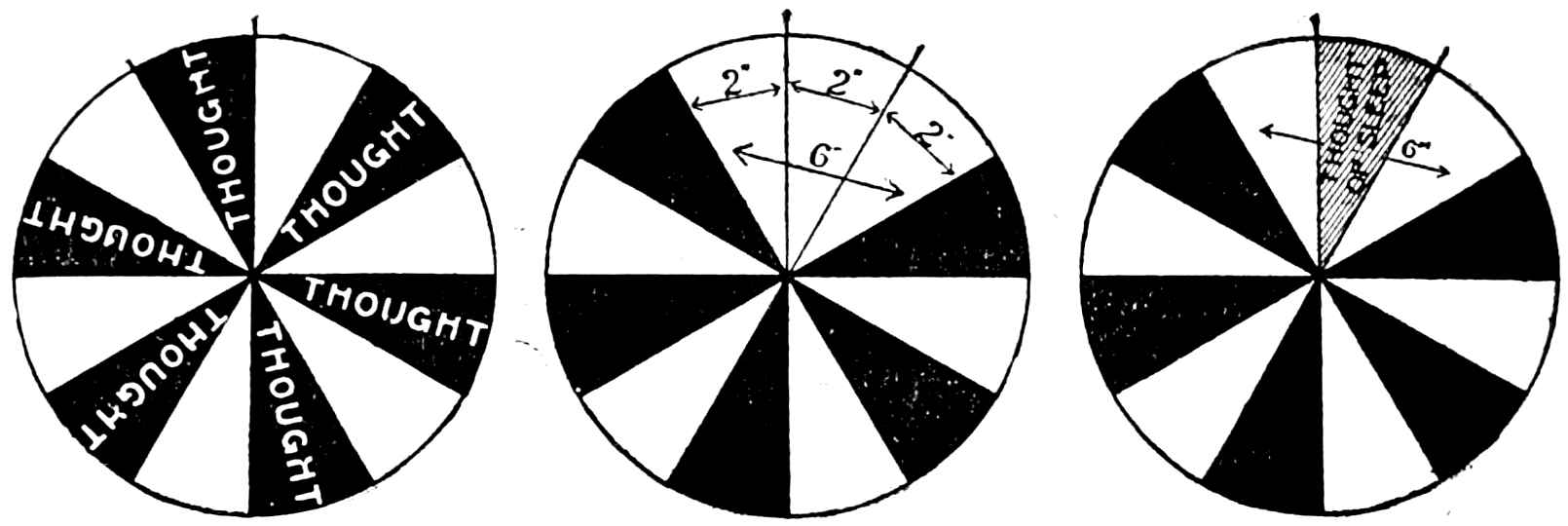
Awake
Asleep
Hypnosis
Fig. 1
Difference between hypnosis and sleep
Mental condition of hypnotized person
By referring to the wheels you can see there is a blank on either side of every thought. When a person is asleep the “mind” is empty, the thought having faded away and the two blank spaces having merged into one, and the “mind” is free of thought. Assuming that in sleep the two merged blanks on either side of the thought will occupy a space of six inches, in hypnosis we have a blank space on either side of the thought, occupying two inches each, and an inactive thought occupying two inches, making up the six inches required; but in three parts—a blank, an inactive thought, and a blank. The subject is in this mental condition: First, the inactive condition of being awake—he has a thought; second, this thought being inactive (but of sleep), he has seemingly all of the attributes making up the condition of sleep, with the exception that the “mind” holds the thought; hence we can readily see that all action must necessarily be part of a thought, and will define hypnosis to be a simulated sleep, yet the subject has the most important attribute of being awake, he can accept and hold a thought. His condition is actually this: He cannot receive impressions but can respond with those already possessed. Thought will not respond to its environment and by my method thoughts can only be made responsive through the operator’s voice. If he were actually asleep and we attempted to arouse a thought, he would awaken. In hypnosis we can force the thought to remain at pleasure, therefore are enabled to deliberately study it and to find what attributes are necessary to force an action.
Recapitulation
To recapitulate: In hypnosis there is the dummy thought of sleep, holding the space of an active thought; the key—the operator’s voice. The subject is free from his environment, therefore no shifting of thought, thus illustrating my previous statement that man does not choose his thoughts (action), but has them forced on him by environment (suggestion).
Dreams
Magnetic passes
Law of suggestion
Two positives
One is not asleep when dreaming, there being a thought in the mind; one is rarely over half asleep. A dream is the passing through the conscious mind (cerebrum) of a thought usually without the action taking place in the Sympathetic System—the cylinder of a phonograph going “zip” instead of running at the usual speed. I might state here to the amateurs that if the subjects take on hypnosis through the suggestion of so-called magnetic passes, the operator’s touch will force into play certain actions if previously comprehended (associated) by the subject. Suggestion means anything that arouses an action. This is the law: Surround a man with every suggestion or attribute of sleep and he will be asleep; surround him with every suggestion of virtue and he cannot help being pure, and no credit is due him. Surround him with every suggestion of vice and crime and he will be a criminal, and in no manner should he be held responsible. Remember, though, that every suggestion has two positives, one for and one against, and the body is the closest environment (suggestion).
Relaxation
The subject holding the thought of sleep, and that thought being made up of a series of attributes, all of which I do not know, has every appearance of being asleep. First, he is relaxed. Why relaxed? Is the contraction of the muscles a voluntary unconscious or an involuntary unconscious act? The babe must learn to draw up its limbs, to sit, to crawl, to stand, to walk. Therefore, it must be acquired, and is the result of a feeling suggestion. Is man conscious of it? You suddenly pull a chair from under him, he seems to be very conscious that the chair is going. Therefore it is an enforced, acquired action, unconsciously done in response to the suggestion of the environment.
Is the waking state hypnosis?
Inspiration
The subject always normal.
But a sleeping man is of little value to us. So we tell him that when he opens his eyes he will see a fly on the end of his nose, he will feel it biting, cannot brush it away, and to open his eyes. Is the man now in hypnosis? If hypnosis consists of an easy position, the thought of sleep, an upturned eye, a closed eye, he is not. As the subject has none of these attributes now, he cannot possibly be in hypnosis. He is now in a condition that I call “inspired,” meaning that the condition he is in was forced on him through the operator’s voice, instead of the natural suggestion of his environment. The man believes there is a fly on his nose; he sees it and is trying to brush it away. Perfectly rational, perfectly consistent. In fact, does he differ from the so-called normal—a word I cannot understand? If there was a fly on his nose and he felt it biting, he surely would think of it and try to brush it away. That is what he is doing now. Wherein does the subject differ from the ordinary? If the fly really alighted on his nose, the sense of feeling and sight would arouse the thought. Through hypnosis, that old thought is aroused through my voice; and, as his senses fail to arouse a thought, there is nothing to contradict my affirmation. The result thoroughly consistent, the man being in identically the same condition as when he held that thought, aroused and put into action through the proper senses. Therefore, it can be readily seen that the hypnotized subject is in a perfectly “normal” condition; save that he has had a thought aroused through hearing and emphasized through hearing which his environment would have aroused and put into action through sight and feeling.
Memory
Impossible to implant a new thought
As to sense-impressions
As to sight
As to pictures
Memory is the registration of ideas. A hypnotized subject retains no memory of what has taken place in hypnosis; we have only turned off from the cylinder what was already there, and that conditionally. Why is it impossible to put any thought in the “mind” of a hypnotized subject? Because it is impossible to register through one sense that which the economy of man is made to receive through another. It is impossible to describe color to a man born blind; or sound to one born deaf. The comprehension of the girl, Helen Keller, in Boston, to me is quite an interesting problem. I unhesitatingly state that the girl is a mere automaton; she has no ideas, no thoughts in any manner, shape or form similar to those of her teachers. We associate color with a stimulation of the nerve-ends of the eye and sound with a stimulation of the nerve-ends of the ear. Therefore, anyone lacking the ability to receive these two sensations can have no conception similar to the one who does. Sight is the least trained of all our senses. A child or even an adult has to learn to read a picture. To one never having seen a picture, it is simply a blur of colors. A missionary in South Africa, showed the photograph of a cow to one of the native chiefs, who was the owner of vast herds; he looked at it and saw nothing. It took the missionary three days to make him comprehend. When he did, a smile illumined the chief’s face and he sent for other chiefs, showed it to them, and because they could not comprehend at once what he failed to, he wanted to behead them, a proof positive that he was becoming civilized.
A man born blind and suddenly given his sight has no perspective. Perspective must be learned. The use (correlating) of the senses is acquired—must be learned.
Force (suggestion)
No man does anything because he is told to. He must always have a reason, which I call a force. Nothing that we tell him to do can mean anything to him unless there are two ideas associated to give him conception, three to give him comprehension. The soldier whose officer commands to “shoulder” or “present arms” does so not because he is told, but because he knows that if he refuses or fails to do so, he will be punished; or he hopes for a reward. These are the incentives that force the action, the mere telling him to do a thing would not cause him to act.
The general public believes that all that is necessary to get a hypnotized subject to do something is to say to him, “Jump out of your chair,” and he will do so; but he will not. If his cerebrum was active, he would ask you why he should jump. But if we put the force there he will respond instantly. Therefore, if we say to him, “When you open your eyes, you will find the chair you are sitting on is red hot,” believing it to be hot, the action of getting away will take place at once, and he will jump out of the chair, not because we told him to, but because of the natural action to do so, forced by the suggested environment. In hypnosis the senses fail to convey ideas, therefore they do not contradict the statement that the chair is hot.
Mental condition of hypnotized subject
Always normal
Let us now look at the mental condition of the subject: First, in his so-called normal condition he sits on a hot chair; through the sense of feeling he has the thought forced on him, and he jumps because of his first associated action. The thought of heat is transformed into the action of getting away from it. If he had no previous experience with heat, the action would not have been there to be forced into play. I now hypnotize him, and tell him that when he opens his eyes he will discover that he is sitting on a hot chair; to open his eyes, he does so, he jumps and repeats everything he did when he actually sat on the hot chair. In what way does the man differ from the so-called normal? Normally, there was a chair, heat, the man, a thought and its action. In hypnosis we have the chair, the man, the thought of the coming into contact with the heat, and its action. What is wrong? The man or the environment? It is the environment. The difference is this: There is no hot chair. Therefore, nothing to force the thought of such and accentuate the action of jumping. As I have forced such a thought through the ear and that not being the proper channel, it makes no registration and consequently can only be a thought re-used, and hence no memory. I maintain a man is perfectly normal in body and mind, and will only do what he would have been forced to do had he received the thought through feeling, the result being identical with “normal.”
Like a camera
As a stereopticon
The automatic action of man is registered on the cylinder of the phonograph regulated by the picture taken. Man is also like a camera taking a photograph of his surroundings, which forces the cylinder of the phonograph into operation. In hypnosis the process is reversed and he becomes like a stereopticon, throwing out registered pictures. As it is impossible to light up a plate which is not there, we have another proof that nothing new can be introduced into the mind of a hypnotized subject. I can light up any plate upon which an impression has been recorded, but in no way can I change the detail. (Plate I.)
Environment
I shall next endeavor to show how one is ruled by environment (suggestion).
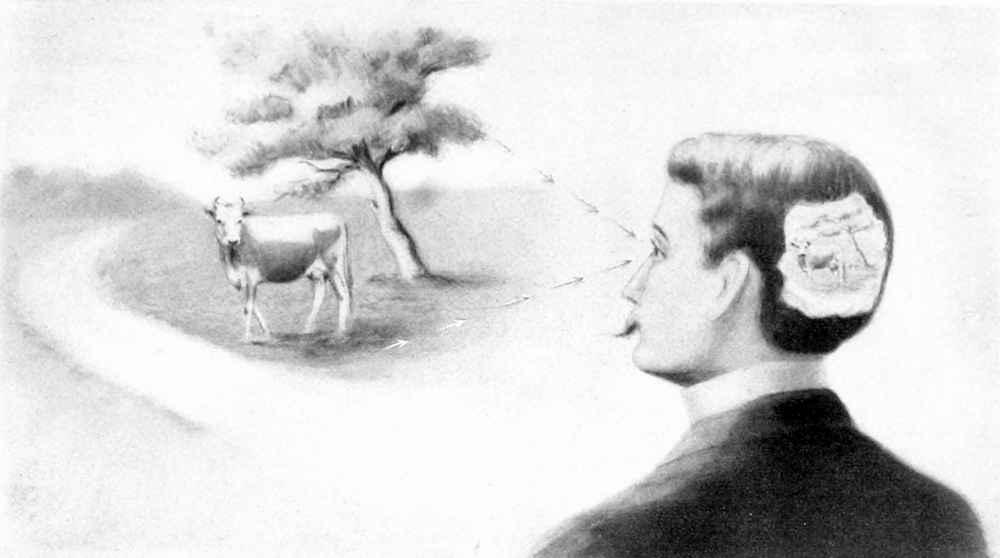
Non-hypnotized Man as a Camera, receiving and registering a picture of his environment.
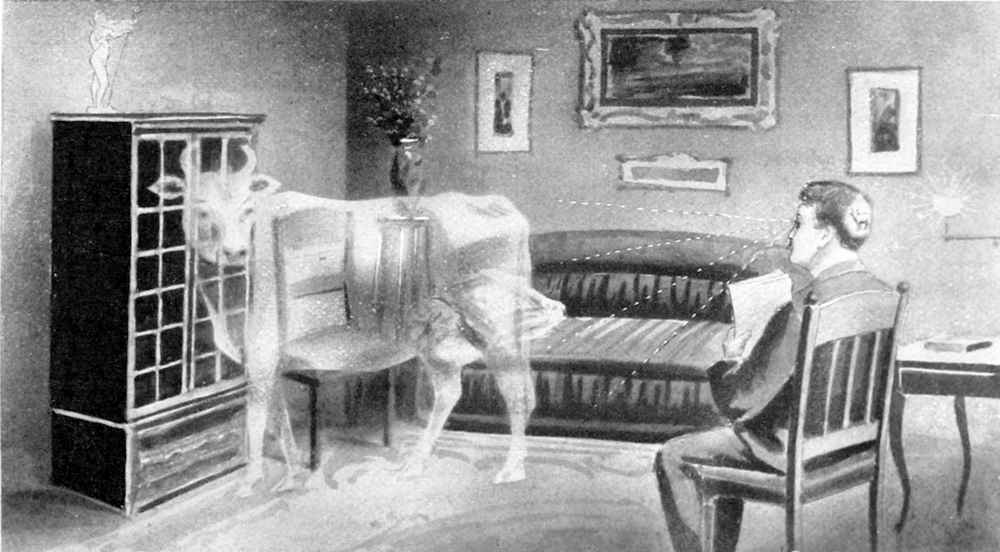
Hypnotized Man as a Stereopticon, throwing out an inspired environment.
PLATE I
Suggestion
We will assume that there are present three ladies of the following turn of mind: one who never overlooks an opportunity to dance, to attend a ball, a party; number two, who was of the same disposition at a former time, but who now has the thought that it is a sin, and number three who has no conception of what a ball or party is like. We ask number one, while normal, to please get up and dance; she refuses(?). No, we have failed to force her. Being ruled by her surroundings she says, “This is no place for dancing.” She is here to listen to a lecture and she refuses(?). We hypnotize her and tell her that when she opens her eyes she will get up and dance. Will she? No, she will repeat the first answer, she refuses because, as yet, she has the same surroundings. She does not refuse, but responds to her environment which has all the suggestions positive against dancing. We can make her dance. How? By taking her to a ballroom.
Normal subservient to picture
All action is “reflex”
When she is in hypnosis, the process can be reversed, bringing a ballroom to her. Normally the thought should be aroused through the eye and accentuated through the other senses. We will revive the thought through the ear by telling her “when she opens her eyes she will find herself in a ballroom, will see her friends dancing, will hear the music and will see her partner standing beside her.” When she opens her eyes, she throws out a picture of a ballroom on her present surroundings and is perfectly normal, subservient to the picture thrown out. She seemingly sees, hears, smells, feels and tastes normally as to all things that pertain to the ballroom she has pictured. She has a ballroom thought placed there through her ear in lieu of through the eye, no other could she have were she in a ballroom. Seeing a partner by her side she accepts his arm and dances. If she should dance against a chair she would not see it, as it is not part of the picture, but through the sense of feeling she would respond to the suggestion which would force an action of apology as though she had bumped into another couple. (This completely exemplifies the action of man.) She is perfectly capable of carrying on a conversation and no one could tell she were not normal as to her inspired environment. She will do or say only what she would, were she in an actual ballroom. Every idea that is engraven on the cylinder will respond if forced. When no action is recorded there is no reflex(?) to respond and the action is omitted.
As to detailed suggestion
To make a thought active
We will assume that this young lady is dancing in a certain ballroom where a young man stepped on the train of her dress; she turned and slapped him. If we call to her, “Your dress has been stepped on and torn,” will she turn and slap an imaginary man behind her? No. We will get no more action than a frown on her face, as we have failed to put the thought in action; the thought of her dress being torn was made up of the feeling of the pull, the hearing it tear, and perhaps the seeing of it (perhaps it was torn); three senses being affected. As we can deceive only the sight of a hypnotized subject, we can cause her to throw out a picture of a torn place in her dress, but as we failed to make her feel it tear, or to hear it tear, we have failed to put the thought in action by failing to affect two senses.
Cannot deceive sense-memories
Subjective mind
To further illustrate that a subject is “normal,” subservient to his picture and that the operator causes only the eye to be deceived, we will assume that there are on the stage a barber and a very fastidious young man, who takes a great interest in his shaving. We desire to put on a shaving act, that is, one man to sit in a chair, the other to put on him a barber’s apron, using a one pound paint brush and a large soup bowl full of lather to lather the customer’s face, and then to shave him with a wooden razor that weighs at least a pound and a half. Now, dear reader, which would you choose for the barber and which for the customer? No doubt, you would say, “Make the barber the barber and the fastidious young man the customer.” That would never do, for if you were giving an exhibition before a public audience, within two minutes many of the spectators would swear that the barber was “faking.” The sense highest cultivated in a barber is that of feeling. He sees the picture, well and good, but when he tries to tip back the chair it fails to tip, therefore feeling contradicts his sight; when he picks up the paint brush, feeling again contradicts sight; in fact, everything he does, every feeling memory that is actually associated and pronounced in him, is being contradicted (Hudson’s subjective(?) mind), and a smile will appear on the face of the actual barber. But if we reverse them and cause the fastidious young man who knows all the detail through his eye, and not through the sense of feeling, he will, seemingly, most perfectly go through the entire process of shaving, as there is no memory of feeling to be contradicted by the actual contact with the tools furnished.
Expression is thought
Again referring to the young ladies and the ballroom. Number two, although given the same inspiration, will wonder how she happened to attend, and is likely to ask for her wraps and desire to be taken home. What will be the appearance of number three when she opens her eyes? Her face will be a blank and her eye without expression, as we have failed to inspire her with a thought. Hence, we learn that all expression is the result (part) of thought. Having a thought of mirth, it is impossible to look sad, to speak firmly, or to give any action seriously.
Simulation impossible
“Faking”
Another point here; simulation is impossible. No person can simulate closely enough to force conviction, as it is impossible to furnish all the attributes without having the actual thought. Tune a dozen violins to G, draw the bow over one and the others will respond; if one is not tuned to the note, there will be no response. Normal man, far more sensitive than the finest tuned instrument, cannot be deceived (made to respond). Let twenty subjects be inspired with laughter and among them one attempting to simulate, the audience will not laugh, that one discord will prevent a response. The indescribable tone must be there to force a result and this can only be when it is the result of a mirthful thought. Without the thought there can be no expression, therefore no person can simulate the inspiration. You read much about subjects who claim that they have deceived the public and the operator by pretending, or to use a common expression, they “faked.” Let me assure you that those persons deliberately lie. The man does not live who can so overcome and defy such a positive law. I have led into hypnosis over one hundred thousand persons and have yet to meet the one who could deceive a ten year old lad. The subject, to make you think he believes a fly on his nose through the particular contraction of the muscles of his face, the look in his eyes, and the gesture of brushing it away, must have that thought in his “mind.” The method of putting it there is what I call hypnosis. Call it whatever you wish, we hypnotists are the only ones who do this; and, furthermore, the only ones able to find these fellows who claim they are able to “fake.” The ordinary layman does not find them; we find them. We call it hypnotism.
Fallacy of a dual “mind”
Avoid positives against
Producing day-dreams
See comprehension
To illustrate that a subject is normal, subservient to his picture, and that the claim made by Hudson that we have two minds, objective and subjective, which discriminate (an impossibility), is incorrect: In the ridiculous side of this art, the operator strives to emphasize and make use of day-dreams. We will assume that there are twenty subjects on the platform, all strangers to me. I desire to have some of them play on brooms for banjos. I carefully look them over and choose those whose appearance would suggest that they were accustomed to attending parties, dances, et cetera, who have full foreheads and other signs of being musically inclined. I am not looking for those who play, as you will comprehend later, but for those who have envied some player, for those who have mentally taken the place of a player. If I should say to them, “When you open your eyes, you will find a banjo in your lap, and you will play for us,” and they open their eyes they would refuse, saying, “We do not know how to play.” Yet, if I build around them a positive picture, being careful to avoid any positive against their playing, I can force them to respond, if at any time they have had a desire to be a player. So I tell them that “When you open your eyes you will find yourself on the stage, there is a banjo in your lap, you are a member of a banjo quartette; the curtain is up and it is your turn to move your chairs down the stage, to tune up and in turn play and sing your best song to entertain the ladies and children.” There being no positive against their playing, the day-dream will be reproduced. Of course, the result will be ridiculous, but that is what we desire. As to the mental condition of the players, each is his own thought of a banjo player; they respond to the audience, the applause. They could be allowed to go home as they are, yet if some one on the way should ask them to play they would be likely to do so. When they arrived home, they would carefully put away the supposed banjo, and the next morning would ask how that broom happened to be where it was. The subject is perfectly “normal,” subservient to his picture, it being, if he could tell it, “I am a banjo player. I am wide-awake; my conduct must be consistent with what I believe a banjo player to be.” Right here I will state that I lack the ability to properly describe the state of a subject; his cerebrum is not active, he simply responds, yet the explanation is not correct, but would be if the subject was using his cerebrum. For the ordinary reader the present explanation is the more comprehensible. In other words, a banjo player is a normal being, and although his clothes may not fit the subject, yet the subject will try his best to adapt himself to them. If one of the subjects should be a banjo player, a puzzled look will appear on his face the moment he tries to tune the instrument, and he will hand me the broom saying “I cannot play it; it has no strings.” The others would not attempt to play it if it had strings. Why? The moment the subject opens his eyes he is normal, subservient to his picture, and the first associated action of the player is to tune the instrument. The capable player has a very decided memory of the feeling of the strings, his touch is normal; he can find no strings with his fingers although he can see them, but as he plays with his fingers they cannot be deceived, the force (cause, suggestion) is lacking, and his touch not being affected, no action is forced.
Cannot furnish emphasizing attributes
Those who do not know how to play have no feeling memory; they see the strings and indiscriminately finger them; and, as there is no suggestion to inform them that they are not players, they continue. If there were strings on the broom, the moment they touched them the idea that they could not play would be forced into action and they would refuse. Thus we can see that although the operator may be able to bring up the mental picture, he lacks the ability to furnish or make good the emphasizing attributes of the other senses that are necessary to force the completion of any act that is not extremely congenial to the subject, and no “abnormal” act is congenial.
Words without tone
I place a hypnotized subject at a table, a non-hypnotized man opposite to him, giving them a pack of cards, and they begin playing. The man opposite the subject undertakes to abuse him very severely. I stand behind the hypnotized subject and urge him on, till we get a quarrel. I hand him a pasteboard dagger and he stabs the man he is playing with. If he is given a steel dagger, he fails to close his hand on it. Why? First, there is no quarrel. His opponent lacks the tone; words without tone are ineffectual and put no thought in action. Therefore, the picture we have is one of a simulated quarrel; and the pasteboard dagger, as it carries with it no ideas contrary to the picture, is readily used; but the moment we introduce the steel dagger, we introduce an attribute foreign to the picture, therefore inactive, there being no action for the transforming, through touch, of the suggestion of the dagger.
Place the subject
Furnish attributes
One more illustration: We desire to have the subjects go through the act of fishing. If I simply say to them “that when they open their eyes they will go fishing,” then tell them to open their eyes, they will not respond, as they are still on the stage, and there is no place thereon to fish. If I tell them that when they open their eyes they will find themselves alongside of a fishing stream, they will not respond even then; for, though man be alongside of a stream, he cannot fish without the proper attributes. Consequently, I must furnish each one with bait, hooks, lines and rods. These attributes, although ghosts, will force him to fish, provided he knows how. The subject sees no audience, neither can he hear one, for it is foreign to his picture. If a person from the audience should step up and take hold of the pole that is held by the inspired fisherman, he would not be seen; but, through feeling, the fisherman would have the idea that a big fish or a tree or a log had caught his hook and conduct himself accordingly. He sees the other fishermen, and will talk to them. I am only another fisherman, nothing more to him. If I were, the ideas associated would carry a picture of the stage. I can allow him to go home; he may show a string of fish that he does not possess, and might scold if they were not cooked as ordered. Otherwise, he is perfectly rational, such as any fisherman; he is his thought of a fisherman, which is that of a rational being.
Picture of ghosts
In all these scenes the subject is working in a picture (environment) of ghosts, furnished by himself and aroused in his mind through the voice of the operator. The thought cannot be changed by other than the operator; the senses are free only in relation to the thought, which, in most cases, makes the subject seemingly super-sensitive.
Man is a piano keyboard
Man is as a piano keyboard, played on by his environment. When we touch “a”, “g” does not refuse to respond, but we fail to force it. To the degree that we strike a note, is to the degree that there is a response. Man responds according to the degree of the force (suggestion) on two or more senses.
A guide
Cannot be hypnotized
Self-induced
As to hypnotizing at a distance
A hypnotist is merely a guide—a leader—who teaches a subject how to hypnotize himself, and all sane persons can be taught to take on this condition. An operator stands in about this position: If I should go to a city a stranger, and, standing on the street corner, meet the brightest citizen and ask him to show me the way to the postoffice, he naturally would reply, “Certainly, follow me.” I reply, “I will not walk, neither will I ride.” Why, the man would look at me in disgust and ask how I expected to reach the postoffice. So it is with many who sit down to be hypnotized. They will not give the operator their attention, yet expect the operator to lead them where they will not follow. Still standing on the street corner, I meet a half-witted lad, whom it has taken ten years to teach the way to the postoffice. I ask him to show me the way. He replies, “Certainly; follow me.” If I were insane, drunken, or half-witted, I would not be able to do so. I follow him and reach the postoffice, not because the half-witted lad has a stronger mind than the brightest citizen or myself, but he knows the way, is willing to lead me, and I, being capable of following do so, and consequently reach the postoffice. On the way, I noted the surroundings; the next time I can go there slowly without a guide, and after half a dozen trips can go as quickly as anyone in the town. So it is with the subject. I teach him how to take on hypnosis, and in a very short time he will require no prompting from the operator. It matters not whether you place the thought of sleep with your voice or by making passes over the subject, for the passes are feeling suggestion and will induce the same condition. You read of this wonderful “power” being exerted over the telephone. It is very simple. You have an office boy to whom you have taught the way to the postoffice. Being down town, it occurs to you that there may be some mail for you at the postoffice. You go to the telephone and ring up your office, tell the boy to go and get your mail. If the lad is so disposed, he will; otherwise, he will not, and you cannot force him. The same condition may be induced by writing to a subject, that when he “finishes reading this letter, he will go to sleep.” As hypnosis is self-induced, he can do so if so disposed.
Attributes necessary to a hypnotist
If you lack a firm voice and assurance, you lack the two most important attributes necessary to a hypnotist, and you should refrain from attempting to hypnotize. Your tone will fail to carry any suggestion other than a positive against you and will contradict the words you utter. If you have assurance and a firm voice, know what hypnosis is, that words of themselves put no thought in action, that it is impossible to bring out of the mind of a person what is not there, or to arouse any thought unless two senses are affected, you are prepared to learn how to teach a subject to take on what is known as “Hypnosis.”
The first thing necessary is that the following formula be learned word for word:
Oral formula to induce hypnosis
“Take an easy position. Put your hands together thus. I am going to ask you to look at the end of this pencil. If you will do so and think of it, your eyelids will get heavy and close, or, if I close them for you, allow them to remain closed; then your head will fall to the front, your hands will drop to your sides and you will forget where you are. When I want you to awaken I will (tell you) say ALL RIGHT and clap my hands. Do you understand me?
“At no time will you feel sleepy, but by giving me your undivided attention you will slowly forget where you are.
“Drowsy, sleepy, drowsy, sleepy, drowsy, sleepy; as you go deeper asleep your eyelids get heavy and close.” (Repeat until accomplished.)
“Drowsy, sleepy, drowsy, sleepy, drowsy, sleepy; as you go deeper asleep your head falls to the front.” (Repeat until accomplished.)
“Drowsy, sleepy, drowsy, sleepy, drowsy, sleepy; as you go deeper asleep your hands get heavy and fall to your sides.” (Repeat until accomplished.)
“This ear smarts, burns, stings and itches, and will stop only when you rub it a long time with your right hand. UGH! UGH! UGH!
“You open your eyes only when I tell you. You awaken only when I say ALL RIGHT and clap my hands (I tell you). Now mind!” (Repeat this.)
“You have an awful pain in this knee (thumb, when a lady), and it will stop only when you rub it a long time with both hands (right hand), UGH! UGH!” While he is rubbing it say, “When you look at it it will be a thousand times worse, now open your eyes.”
Attributes of hypnosis
Knowing that Hypnosis consists of:
First, An easy position;
Second, Upturned or converged eyes;
Third, Concentration;
Fourth, Closed eyes;
Easiest to hypnotize
Fifth, The substitution for the concentration of the “locked in” thought of sleep;[1] who are the easiest to hypnotize? Those possessing the greatest concentration.
Can the insane or half-witted be hypnotized? No; they cannot concentrate.
Who to choose
Therefore, choose for your first subjects, those with pronounced concentration, who are distinguishable by the fulness of their heads at the temples, and avoid those with big perceptives (shown by the large protuberance over the eyes).
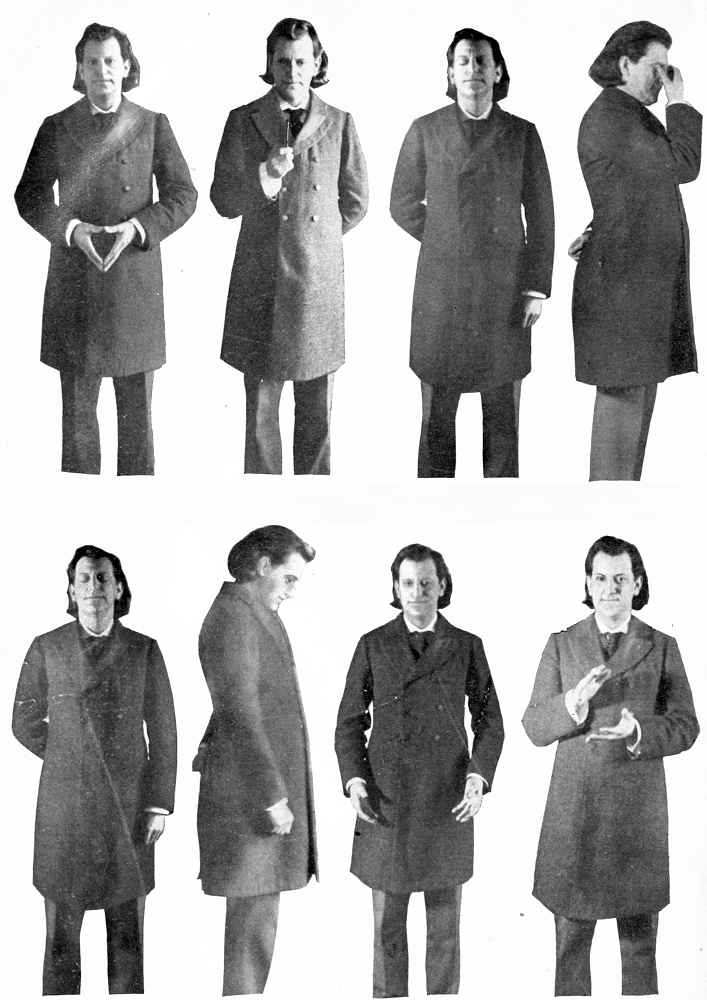
Put your hand together thus.
To look at the end of this pencil.
Will get heavy and close.
Or if I close them for you.
Allow them to remain closed.
Your head will fall to the front.
Your hands will drop to your sides.
Will say “all right” and clap my hands.
PLATE II
Experience has taught me that the professional musician in a regular orchestra, the player of classic music; a telegrapher, a first-class stenographer, or those whose business requires concentration; and naturally slow correlators, are more readily lead into hypnosis.
Seat your subject in a chair and stand directly in front of him and repeat the following paragraph:
How to hypnotize
“Take an easy position. Put your hands together thus. (Plate II.) I am going to ask you to look at the end of this pencil. If you will do so and think of it, your eyelids will get heavy and close; or, if I close them for you, allow them to remain closed; then your head will fall to the front, your hands will drop to your sides and you will forget where you are. When I want you to awaken I will (tell you) say ALL RIGHT and clap my hands. (Suit the action to the word.) Do you understand me? At no time will you feel sleepy, but by giving me your undivided attention you will slowly forget where you are.”
If you desire to send a person to a place of which he knows nothing, as to the manner of going you must necessarily give him full directions, so nothing that is certain to occur can divert him. So it is with a subject; he must know what to expect and thus be freed of all fear that might be aroused when the attributes occur, which otherwise would cause an active mind. The falling of the eyelids, of the head and the hands should arouse no thought other than the one you are suggesting to him through his ear, i. e., the thought of sleep.
As two senses must be affected to impress a thought, great care is necessary that whatever you say you actually do, so the prospective subject can see as well as hear it.
As to affecting two senses
Special attention is drawn to the sentence, “If you will do so your eyelids will get heavy and close; or, if I close them for you, allow them to remain closed.” Only three in ten will close their eyelids; the other seven after giving you the stare for some five minutes, must have their eyelids closed for them. If you will note in the foregoing sentence, I have said nothing about the eyelids “not closing,” but have made affirmations and provided for the “not closing.” When you say to him, “Your eyelids will get heavy,” you must then close your eyelids. When you say, “remain closed,” your eyelids must be closed while saying the words. When you say, “or if I close,” while uttering the words “I close,” you must with your fingers close your own eyes, taking care to immediately remove the fingers; otherwise you would convey through his eye the idea that you will hold his eyes closed (suggested to him by seeing you hold your own eyelids closed). Hence, if you close them for him, when you remove your fingers, the subject will open his eyes. When you use the words, “head falls to the front,” your head must move forward; and when you say, “hands fall to your sides,” your hands must fall.
As to awakening
If you will notice, there are two ways of awakening mentioned here; one is “When I tell you;” the other, “When I say ALL RIGHT and clap my hands.” (Which must be said with one breath.) You use “ALL RIGHT and clap my hands;” the doctor should use the other. The physician, desiring his patient to go away with some inspiration given him, simply says, “When you open your eyes you are awake,” and so and so is the case; for an inspiration given in hypnosis can only be responded to in hypnosis. The operator in the parlor entertainment, when he has finished the performance says, “All right,” and claps his hands.
As to signs
Expression of thought
Why do I desire the subject to put his hands together? To see them fall. The hands will unconsciously drift apart—the action will be entirely involuntary, and after a pupil has watched a dozen pairs of hands he will see that no one on earth can deceive him, as it is utterly impossible to simulate (consciously) an involuntary action. It is for the same reason that I desire the head to fall to the front—I wish to see it fall—knowing that when an action is part of a thought, to the degree that action takes place is to the extent that the thought is aroused in the “mind.” When the hands drop relaxed to the sides, I know that the subject has forgotten or lost his environment, and therefore is in hypnosis.
Now, I have told the subject exactly what would happen. If my pupil will carefully analyze the paragraph he will find that telling him to “Take an easy position” is the first attribute I desire. That to “look at the pencil,” if the operator holds it in the proper position, will force the eyes upturned, or converged; that if he thinks of the pencil he will furnish concentration. I then tell him as to the closing of the eyes; and then, if I slip into his “mind” the thought of sleep, I will have accomplished my purpose and have induced hypnosis.
Now stand to the left of your subject, holding a lead pencil or your finger as in Plate III, and repeat verbatim in a firm voice:
“Drowsy, sleepy, drowsy, sleepy, drowsy, sleepy; as you go deeper asleep your eyelids get heavy and close.” (Repeat until accomplished.)
“Drowsy, sleepy, drowsy, sleepy, drowsy, sleepy; as you go deeper asleep your head falls to the front.” (Repeat until accomplished.)
“Drowsy, sleepy, drowsy, sleepy, drowsy, sleepy; as you go deeper asleep your hands get heavy and fall to your sides.” (Repeat until accomplished.)
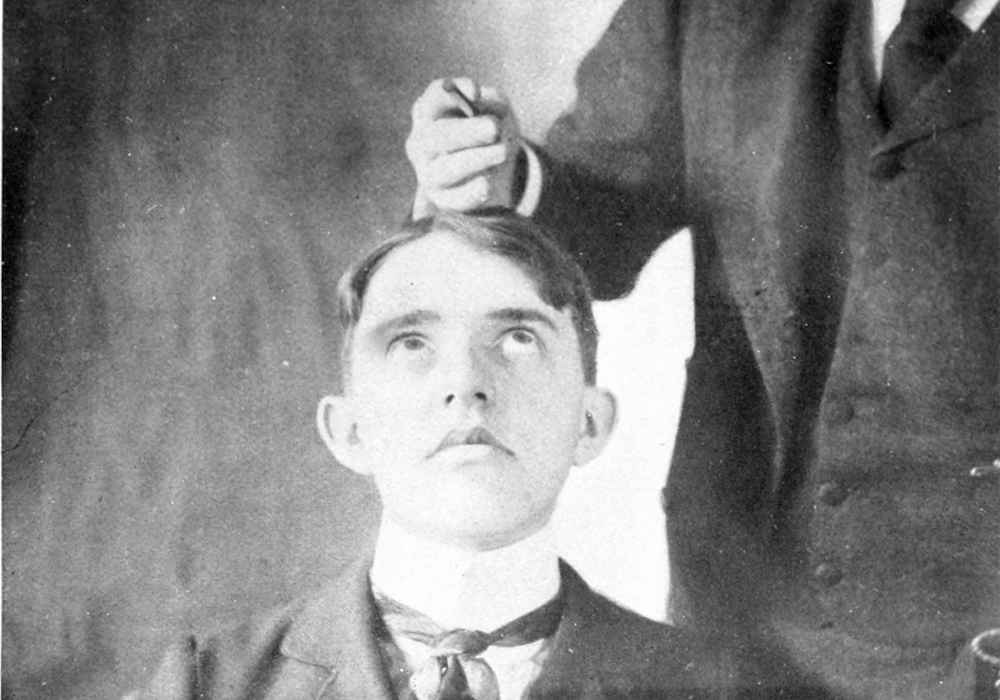
Upturned Eyes.
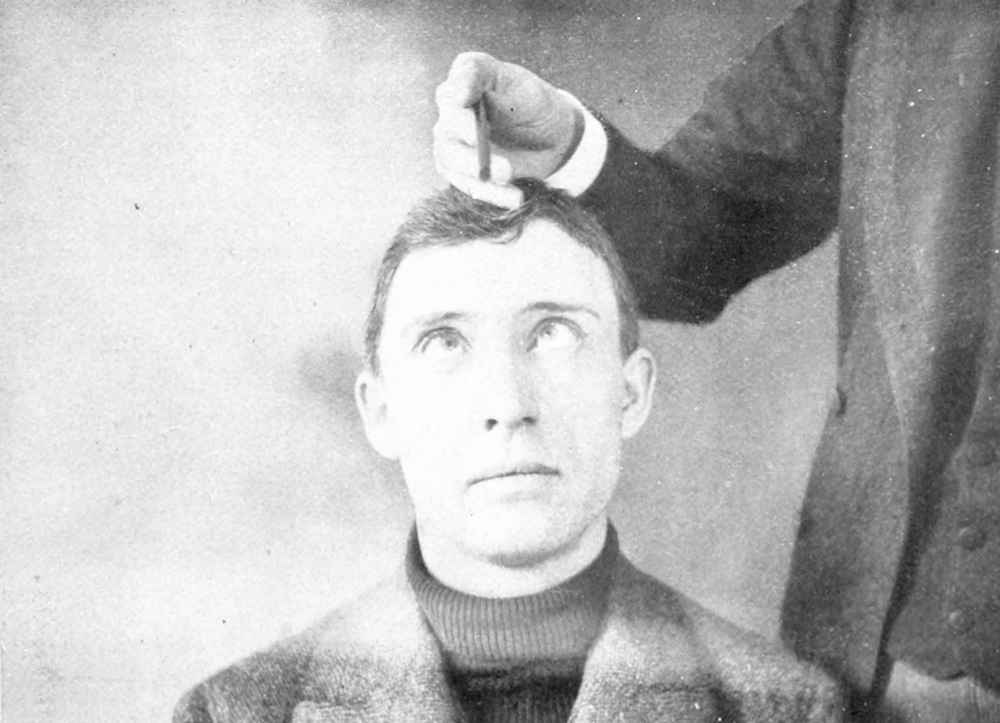
Converged Eyes.
PLATE III
Multiplying a thought
Only one thought at a time
The sentence of “Drowsy, sleepy, drowsy, sleepy, et cetera, as you go deeper asleep your eyelids get heavy and close,” seems a long one. Why not make it shorter? Why not “Drowsy, sleepy, your eyes shut”? Is not that the same thing? No! “Drowsy, sleepy, et cetera, as you go deeper asleep the eyelids get heavy and close,” makes the closing of the eyelids one of the attributes of the thought of sleep; but when you say, “Drowsy, sleepy, your eyes shut,” you are trying to force into the “mind” of the subject two separate and distinct thoughts; i. e., to sleep—to shut his eyes—which is utterly impossible. Any operator who, in giving inspirations to the subject, leaves out his “and’s,” “as’s” and “but’s,” will fail, inasmuch as the ideas must be thoroughly correlated and be one thought, because thoughts may of themselves become ideas, or ideas become thoughts.
As to failure
We will assume that you held the pencil over the subject’s head for some half an hour and he failed to take on hypnosis. What is wrong? If he is not in an easy position (No. 1), that is your fault. Is his collar too high, is his head too far back, is his back too close to a radiator or fireplace, et cetera? Or, if a woman, is she laced too tight, do her shoes pinch, et cetera? Why is any easy position the first attribute of sleep? I mean by an “easy position” one in which the sense of feeling is not making discomfort a dominant idea; for if so, it is impossible to fade away the thought of the environment; therefore, before sleep can be induced, comfort through feeling must form itself into a natural attribute of sleep. The upturned eye (No. 2) is also for you to furnish. Are you holding the pencil in the proper place? If you strain the eye, you lose No. 1. Has the time come to close the eye (No. 4)? Is the subject concentrated? If not, you cannot accomplish No. 5.
As to concentration
It is a poor art or science if we must wait half an hour to discover whether the subject is concentrating or not.
Having fifteen to twenty-five subjects on the stage and a restless audience waiting for an entertainment, what could be accomplished if I had to wait half an hour for each subject, to discover if he was concentrating?
Every time one gets a new thought the eye blinks, although the eye may blink without a change of thought; but never a change of thought without the blink.
Note.—Now, dear reader, when you stand before a mirror to experiment, remember that the making of another idea dominant is not changing the thought. You may think you can change without blinking, but it is like people believing that a person can go on the stage and “fake” for a hypnotist, both of which are directly against a set law and impossible. If the world could learn that those attempting to deceive, deceive only themselves, there would be fewer failures in life.
The moving of the eyeball shows the reviewing of the associated ideas and always occurs in those who have large perceptives (heavy projection over the eyes). They will think of the pencil but will divide and study its attributes, i. e., cost, color, form, et cetera, and are the subjects who require several drills. Their hands will fall stiffly to their sides (having taken on hypnosis about ninety-seven per cent). For complete hypnosis, the hands must fall limply.
If the subject gives you the “baby stare,” and you fail to hypnotize him you had better—well, I advise my pupils under such conditions to jump into the river and say, “Here goes nothing.”
Proof of hypnosis
The subject being in a collapsed state or relaxed condition of the muscles, we know he is in hypnosis, but as a great many will not accept any thought of sleep without being stretched out, it is policy to lay them on the floor, which nearly always consummates the required attribute. The proof that he is in hypnosis is that he is relaxed. Perhaps he can simulate it; I can hold my arm relaxed? All right. Man can think of but one thing at a time; the subject’s eyes are closed. I take hold of his arm (he relaxes it); with my other hand I quickly lift his leg, and, if he knew how to simulate, he could not shift the action in time to deceive anyone.
To undo the hypnosis
No action from direct command
A subject being in all the conditions of sleep is of no value to me,—the operator. I want one seemingly awake. Consequently, I want now to partially unbuild what I built. First, I give him what I call the “Ear Test,” the object of which is to find if I can replace the thought (cylinder) of sleep with another thought (cylinder) having a perceptible action to it. Therefore, I say to him, “Your right ear (touching it) smarts, burns, stings, itches, and will stop only when you rub it a long time with your right hand,” making with my mouth expressions of pain. If the subject rubs his ear, I have a demonstration that I have changed the thought. If I say to him, “Your ear smarts, burns, stings, rub it,” would I get any action? No, he would simply ask me which ear, if his cerebrum was active. Therefore, it is necessary for me to designate the ear, or properly, to state which ear, and touch it. I now tell him, “Your right ear, or this ear (touching it), smarts, burns, stings and itches, rub it.” Will he rub it? He will not, but will ask me why he should rub it, if his cerebrum was active, but if I said to him as above mentioned, “it will stop only when you rub it” he rubs it to cause it to stop, not because I told him to rub his ear, which I failed to do. Man does nothing because he is told to. While he is rubbing the ear I call to him, “The pain has stopped.” Instantly he ceases to rub it. Is the subject now in hypnosis? No, because he has the thought that the “pain has ceased” instead of the thought of sleep. His muscles are contracted into the position he happens to be in, the eye can be turned down; the inexperienced would say he was in hypnosis, the same as when lying limp on the floor. My experience proves to me that he is not in hypnosis; he has the thought of “no pain” which is a blank thought similar to the thought of sleep, but you will find that the muscles are in a different condition.
Voice rules
The subject can only respond to my voice, he being free of his actual environment. My voice now being his environment, I must pull apart nearly all that has just been brought together. To open his closed eyes is the most powerful suggestion of being awake. If I could only teach the subject now to open his eyes, to turn them down and still respond to my voice only, he would be in the condition I desire. So I say to him in a firm voice:
Unbuilding
“You open your eyes only when I tell you; you awaken only when I say ALL RIGHT and clap my hands (I tell you). Now mind!” (Repeat this.)
Disassociating ideas
Always one thought
I then cause him to rub his knee in the same manner as I cause him to rub his ear, by designating the knee as follows: “You have an awful pain in this (touching it), the right knee, and it will stop only when you rub it a long time with both hands.” While the subject is rubbing, I say, “When you look at it, it will be a thousand times worse. Now open your eyes.” If he opens his eyes and continues to rub it, he is practically my subject for the first time. In this way we play on him a psychological trick; first bringing up in his “mind” the thought of pain; then disassociating the opening of the eyes with the idea of awakening, and substituting for it the idea of more pain. We do not tell him that “When you look at it, it will be a thousand times worse; now look at it.” Because, if his cerebrum was active, he would refuse to look at it. We tell him to open his eyes, and if he opens them, he certainly will look at it. We now say to the subject, “Close your eyes, the pain has ceased;” then saying, “When you open your eyes you will find yourself on the floor. Naturally you will get up and sit on the chair. The moment you sit down you will discover that you have a very severe nose bleed; now open your eyes,” the “now” being necessary as a conjunction to connect it with the previous statement. Otherwise, the subject would be likely to take the sentence, “Open your eyes,” as a separate thought, do so and lie there on the floor with his eyes open. The subject opens his eyes, gets up, sits on the chair, and discovers his nose to be bleeding. Is this subject now in hypnosis? Decidedly not. His muscles are contracted, in response to his feeling (environment); his eyes are open and in the “normal” position; he is not necessarily in a comfortable position. Other than that his cerebrum is inactive, or that the thought of a nose bleed has been put into an automatic action through his ear, no sense will respond to his environment unless it has a relationship to his present thought; he will continue to give action to all the variations of that thought until the operator’s voice changes it.
Words are of little value to explain the condition of a “hypnotized” subject or “normal” man.
As a typewriter
Man is like a typewriter
I shall try to draw a sight picture to make you comprehend. You have seen a typewriter. On the keyboard is a pin marked “G”; fastened (associated) to that is a lever, to that, two more. On the end of the last is the type “G.” When the pin with the letter “G” marked on it is touched, three actions take place, and “G” is reproduced on the paper on the cylinder of the machine. (Analyze the action of lifting or taking hold of an object.) Until those three levers are properly fitted (associated), it will be impossible to get an impression on the paper by striking “G,” but the moment that they are properly associated, every time you strike “G,” “G” is reproduced on the paper and nothing else can be. “G” equals the energy exerted (suggestion) on the pin “G.” If we hit a space on the keyboard that has no lettercap, there is no response on the paper. Man is like a typewriter; when we hit the cap of a letter that has the proper actions associated, there is a response on the paper; when we offer him and he receives (he don’t receive), a suggestion of which he has no associated ideas, there is no response because there is no action to respond.
Abdominal brain
A hypnotized subject does not hear me, cerebrally. He only responds to me. A “normal” man both hears and responds. The consciousness of realization of seeing, hearing, et cetera, is only in the cerebrum. The brain that retains the impressions and responds, is the Abdominal Brain—the Sympathetic System.
Environment rules
As a hypnotized subject is but as the keyboard of a typewriter, played on by and through his aroused memory of environment, so also must man be played on by and respond to his actual environment. In inspiring subjects with any condition, if we fail to emphasize or draw particular attention to less than two senses, the effect will be unsatisfactory.
“Dopy” expression
As to inspiring
Improper inspiring
Among the masses there has been a great objection offered to my work, inasmuch as the people remark that they could not tell if Santanelli’s subjects were hypnotized except by seeing them doing things that they knew would not have been done were they not hypnotized. Whereas, with all other operators they could see that the subjects were hypnotized because their faces and eyes showed it. Why? A comprehensive thought must express itself in the face and eye—a comprehensive and intelligent expression; but where the subject lacks a comprehensive thought he has that “dopy,” hypnotized (?) expression. Being a master of suggestion and thoroughly understanding how to build, I make my subjects thoroughly “normal,” subservient to their pictures. When they had the thought of “fly” it was so definite, all sense-pictures having been emphasized (aroused), that the man or the subject was in identically the same position or condition of “mind” that he was when an actual fly was on his nose. The secret is this: The other operators tell the subject that when he wakes up, equaling my “When you open your eyes,” he would find a fly on his nose; something very indefinite. “Normally,” how would you know there was a fly on your nose? You would feel it. Is that enough? No. It might be a mosquito, it might be an ant, it might be a wasp. You look at it and then you know that it is a fly, and by-the-by, let me state here that man knows nothing, but believes much; for if the senses are imperfect, what he knows, he doesn’t know. I say to a subject, “When you open your eyes you will see a fly on the end of your nose,” covering two senses, the object itself (sight) and the place (feeling) which is irritated; “you will feel it bite and cannot brush it away.” Now, I have covered three (?) senses: The subject first feels the fly on the end of his nose, he sees it to be a fly, and he feels very comprehensively its irritation. Hence, he has no doubt. Could his “mind” be more active, could he be more positive if he were “normal?” No. “Dopy” subjects are the result of improper inspiration. If you say to a subject, “When you open your eyes you will find the chair is hot,” that is very indefinite. But if you say to the subject, “When you open your eyes you will feel the chair you are seated on is red hot,” he will get out quick. In the lesson I told you that if you left out your “and’s,” “as’s” and “but’s,” you would fail to get a good inspiration.
There are some ideas or thoughts which cannot be correlated or associated. If you tell a subject he cannot let go a cane, it necessarily follows he must hold on to it; hence, cannot drop it. If you tell him it is red hot he will drop it, because it is against nature (?); i. e., experience, to grasp a red hot object, and not be able to drop it. If you tell him that he cannot let go the cane and it is getting warmer, hotter, you can produce an effect up to a certain degree; there will be a certain contraction of the muscles and a certain expression of pain in the face, but the moment that you make the heat dominant he will drop the cane every time if he is a man of ordinarily good correlation. If you have a thick-headed subject, there is no telling what the result will be. Man is wonderfully compounded and you will meet combinations some days that no man could build a philosophy on. The exceptions to the foregoing are the isolated cases where the subject has never experienced being severely burned. Perhaps dulled nerve-ends. (See Degenerates, pages 15 and 159.)
Actually awake
Post-hypnosis impossible
I unhesitatingly assert that I (which also includes my pupils) am the only operator who ever dismissed his subjects actually awake. If hypnosis is the thought of sleep, the antithesis to that must be the thought of being awake, and when we tell the subject he is awake he has the thought of being awake, just the same as we tell him there is a fly on his nose. The snapping of the fingers is of no value. To awaken, we must startle him, and if he is awakened properly, a post-hypnotic (?) suggestion is an impossibility. So I reiterate that any inspiration given in “hypnosis” can only take place in “hypnosis,” never minding what the quasi “authorities” tell us.
Hypnosis and pain
Waking state
A subject suffering with headache comes to me to be cured. If the subject has never been led into hypnosis it is impossible to hypnotize him the first time if he is suffering from the headache, inasmuch as No. 1, “Easy position,” cannot be acquired; the suggestion of pain forces a thought which cannot be faded away through the eye, and no thought offered in substitution is forceful enough to overcome it. But if he has learned how to take on hypnosis, it can be done so quickly that if the thought of pain is not too severe, it can be readily overcome. If the pain be extremely severe, hypnosis cannot be induced. I tell the subject that when he opens his eyes he will have no headache and be wide-awake, and he is now in the condition of believing himself to be awake with an idea of “no headache”—awake as in a looking-glass—but if he were actually awake, the cause that produced the headache, being still present, would get its natural response and he would feel the headache. Therefore, it can be readily seen that the subject is not himself truly. Yet, having the thought of being awake, he necessarily has all the attributes of the thought, and as far as one can perceive, is awake. Stand in front of a mirror. You see yourself? No, a reflection—a thought of yourself.
If I said “All right” and clapped my hands, the subject would be in the identical condition as when he came to me; i. e., feeling the headache.
Two awakenings
I teach you to awaken the subject two ways; one by giving the inspiration that he is awake, and the other by saying, “All right” and clapping my hands. Now, my dear pupil, if I should clap my hands first, then say, “All right,” would the subject awaken? No. Why not? Because that is not the way you told it to him (?). If I was personally giving you the lesson, I would say “rats.” What rules the subject? Your voice. If I clap my hands, could he hear it? Yes (?). If that be true, he could hear every sound; that constitutes being wide-awake. You mean “No.” He could not and cannot hear the clapping of my hands, but when I say, “All right,” as my voice rules and is his environment, the associated action is to listen for the clapping. But must I personally clap my hands? Yes (?). How can he distinguish the clapping of my hands from those of some one who is standing beside me? He cannot; anyone beside me could clap his hands, or a pair of clapsticks would be just as effective. He must be startled; and cannot be startled until I have used the words, “All right.”
A hypnotist (?)
Now, as you know how to induce hypnosis, know how to handle the subject by building an environment around him, taking care to name all of the senses necessary to enforce a response to the environment, you are a hypnotist (?). No. I have taught too many, and feel that you still fail to comprehend me.
Importance of sense-impressions
Name every sight suggestion
You have a hypnotized subject in your room. We will assume it is up one flight of stairs. What will you say to him when you desire him to go to the postoffice? Now, mind, he doesn’t know the way to the postoffice, he is a stranger. Why, you would say to him, “When you open your eyes, you will go to the postoffice and get me a letter,” and the subject will fail to move; because, remember this, a hypnotized subject is a blind man. He doesn’t take in impressions, he throws out pictures; but the other senses are of such greater importance, forcing through actions already acquired, that man, failing to comprehend the value of this law of attributes, overlooks the importance of the other senses. Treat a hypnotized subject as a blind man. He is now sitting in the center of my room up one flight of stairs, and I say to him, “When you open your eyes you will find yourself in my room. There is an important letter for me at the postoffice which I am desirous that you, as a good fellow, will go and get for me. The moment you stand up you will walk five feet to your left and you will come to the door, on the left side of that door is the knob; the door opens towards you. Passing out of the door for two feet you will find the head of the stairs; by putting your hands on the banister at your left, you can follow down the stairs. To your right is a door with the knob on the right, which opens towards you. You pass into that room four feet, then turn to the right, go three feet and you will find another door with a knob on the right, which opens towards you; go through the doorway and you will turn to your left; you walk two feet, then turn to the right and walk eight feet, when you will come to another door with the knob to your right. You will open that door and step on to the porch. After walking four feet you will come to three steps. By walking straight ahead eight feet, you will come to two more steps. You will then be on the sidewalk. You will walk twenty feet to reach the corner of the street, turn to your right and cross the street, et cetera.”
Name all sense attributes
Again, my pupil, you have a subject sitting in the center of the room, and wish him to go to the radiator on the opposite side of the room to comb his hair at an imaginary looking-glass. What will you say to him? Why, you will say to him, “When you open your eyes, you will go to the looking-glass just across the room from you and brush your hair (?).” The subject opens his eyes, but will not move. Why? Why do people brush their hair? Because it is disarranged. Therefore the first thing the subject must know is that his hair is tousled; then he must be told exactly where the looking-glass is and that on this affair is a comb and brush; or, in other words, you must name the sight for him, because through hearing and sight, in many cases we reach the identical result. You, reading this book, are really receiving sound impressions; I am giving you words through your eye. With a hypnotized subject, we are giving him sight through his ear. The more sense-pictures we specifically arouse, the more comprehensive the action of the subject; provided, the things he comes in contact with do not give him directly opposite suggestions.
Parlor exhibit
May fall over
“Dopy” subjects
We will assume that you are giving a parlor entertainment. You have led your subject into hypnosis, and have him back into his chair. He has the nosebleed. Now, pupil, what are you going to do? Hypnosis is the spoon with which you give your medicine. When you are tired of any action, conditionally awakened in said subject, induce hypnosis again. Say to him, “Close your eyes, go deep asleep,” and now we are where we started from. We again have hypnosis; then tell him, “When you open your eyes, so and so will happen, or is the case.” If the man is standing up and you say to him, “Close your eyes, go to sleep,” or, “You are asleep,” he will fall over, because one of the attributes of sleep is the relaxed muscles. Therefore, when he is doing any action, associate with that action that it will be more congenial or comfortable for him to take his seat, then tell him to close his eyes, he is deep asleep, or you must step up beside him and catch him in your arms. Now, the necessity for this may not always be apparent. Many amateurs will say, “Not necessary;” but I am writing of a man or operator who is working clean-cut and is not allowing the subject to be “dopy,” half conscious (?) of his environment, half conscious of the inspiration given him. If the subject is completely lost to his environment, as he should be if the operator understands his business, he will drop over every time. Now, I know that many of these statements amateurs will deny, but I unhesitatingly answer that if they know their business and work correctly they can demonstrate every affirmation made here; that they all work with “dopy” subjects; that they do not and have not ever comprehended the Law of Suggestion; they do not get perfect or correct work from their subjects.
On the stage when I wish to conclude an action, I thoroughly awaken my subjects, allowing them to take their seats and enjoy laughing at the others. As hypnosis is entirely a self-induced condition; that is, a man with ordinary intelligence can learn to take it on at once after the first time, I consequently awaken him. When I want to use them again, I tell them to put their hands together, close their eyes and go to sleep; they readily take on the attributes necessary; I repeat to them, “Drowsy, sleepy,” et cetera, a couple of times and they are in hypnosis, after which I inspire them with any thought I see fit.
Pre-inspiration
As it is apropos, I shall here tell of two occurrences which will demonstrate the self-induced (pre-inspired, “auto-suggested”) condition as to hypnosis. While lecturing through Michigan in 1895, I preceded every exhibition with an hour’s talk on hypnosis, et cetera, carrying the story from night to night for the six nights. A majority of the drummers traveling through the country made it their special duty to hear and comprehend the entire six lectures. One of these drummers had a son fifteen years of age; his residence, a town in Ohio. One day he received a telegram from his wife saying that their son had been a subject for some hypnotist, who a week prior had exhibited in the town, and that the son now was in such a condition that every time she told him to go to school he fell asleep and could not be aroused, and nothing could be done with him. The father, having thoroughly comprehended my lectures, wired the mother not to worry, that he would go home. He did so. After getting off the train, he went to a harness shop and bought a buggy whip, arrived home and asked John why he didn’t go to school, and John told him that the professor had left him in such a condition that he could not go to school. The father said, “Well and good; I will remove the effect of the professor,” and gave the boy a good horsewhipping; ever since he has attended school without the least sign of hypnosis.
Another: In L——, New York, a very bright lad of thirteen or fourteen years of age was on the stage with me three or four nights. On Saturday night his mother and sister came to me in the dressing-room and said they could do nothing with the boy, that every time they told him to chop the wood or draw water, he would fall over asleep, and they said they were going to have me arrested. I asked her if she would do exactly as I told her, informing her if she would she would have no more trouble with the boy. The mother, being a good, sensible woman, said she would. I told her to take the boy’s pants down, lay him across her lap face downward, and warm him with her hand, which she did. Some three weeks afterward I met her and she told me she had no further trouble.
Doctors trying to awaken subjects
Awakening
A few years ago professors (?) in the dime museums of the large cities used to put subjects to sleep and, failing to awaken them, would send for physicians. The learned (?) doctors, after applying electricity, cautery, et cetera, in the course of eight or ten hours awakened (?) them, only they didn’t; the hypnosis passed off. Why is it that every operator excepting myself, and I state this unreservedly, has had trouble many a time in awakening his subjects. In a town in Illinois I arrived late. I was carrying one subject, and was anxious to get as many local subjects as possible for my first night’s performance, as it is often very hard to get volunteers on the first night. Some amateur hypnotists came around and said they could get me some. At last they produced a most horrible specimen of humanity and asked me to hypnotize him. I remarked that I would not allow him on the stage; then they said. “As a favor to us, please hypnotize him.” I looked at the fellow and said, “Go to sleep.” He replied, “Magnetize me.” I said, “You fool, you know how to go to sleep; go!” He failed to do so. I made some passes over his face and he took on hypnosis, but he worked “dopy.” In about five minutes I got him to work with a clear eye. I said, “All right,” clapped my hands and he failed to awaken. Smiles appeared on the faces of the five amateurs standing around. Again I said to him, “All right,” and clapped my hands. He again failed to awaken. The amateurs continued to smile, some tittered. I readily perceived what I was “up against,” and I said to the subject, “—— you, when I say ‘All right’ and clap my hands, if you do not awaken, I will throw you out in the snowbank and leave you rot, you ——.” I said, “All right,” and clapped my hands and he nearly went through the ceiling. The amateurs stood around with their mouths open and said to me, “Mr. Santanelli, do you teach?”
“Yes, at twenty-five dollars a lesson.”
“Will you teach five of us for less?”
“Yes, one hundred dollars.”
And these clever amateurs paid me the one hundred dollars. The subject they brought me was one that, after experimenting upon, was always left to lie on the floor from six to ten hours, as they could not awaken him and he had to “sleep it off.”
Never fail to awaken
Have confidence
Voice
Now, to answer the question previously asked, “Why is it that I have never failed and all others do fail?” The reason is simply this: That when we put the thought of sleep into a subject’s “mind,” it must be done with a firm voice. That is the key. The moment we become doubtful or frightened, we have lost the firm voice; inasmuch as the voice is the utterance of the “mind,” and what we think, we say in tone and in action; if we are frightened and say, “All right,” to the subject and clap our hands, he doesn’t respond to it because we have lost the key; but if we never get rattled, there is no possibility of failing to awaken the subject. It may be that we will be obliged to use language expressed by dashes—such a case happened in a city in Arkansas. A young lady had been reading about the woman who had been asleep in St. Louis for thirty days, and whom none had been able to awaken. Of course, she was a neurotic. When I said, “All right,” and clapped my hands, she failed to awaken. Her friends in the parlor became greatly frightened, so I asked them to retire; then quietly informed the lady that if when I said, “All right,” and clapped my hands, she failed to awaken I would have to do things that would be very inelegant, seemingly ungentlemanly, and above all things I was not there to be made a —— fool of. I then said, “All right,” clapped my hands, and she was wide-awake. Keep your nerve, always treat a hypnotized subject as a rational being, and there will be no trouble. If you are possessed of a doubt as to the subject awakening, you are lost; he may be awakened to the degree of “lack of doubt,” but not thoroughly. The operator’s voice is the thought (in action).
Man is like a piano keyboard, played upon by his environment; as we touch the keys, so is the response. Hit vigorously and there will be a corresponding result. When we strike key “A,” do the other notes refuse to respond, or have we failed to force (suggest) them?
Treat all subjects as rational beings
My audiences have wondered why it is that when I get a subject whom some one else has operated on (as I call it “handled”), and he goes through many gyrations while going into hypnosis, that I say to him, “Now, my dear fellow, there is no need of this ‘monkey-shine.’ You go quietly to sleep; otherwise, you and I will have trouble,” after which I have but little trouble with the subject, and the people say, “That’s funny; I wonder if he was ‘faking?’ How can he talk to them as he does?” A hypnotized subject must comprehend; that is, his Abdominal Brain must respond and words when given him must arouse thoughts. The operator should know how to use words with the proper emphasis and construction.
Place the subject
The first attribute of all consciousness is “place,” and the subject, when he opens his eyes, is always in the place where he went to sleep unless that place has been changed by the operator. Therefore, first place the subject, then give him the attributes, naming each sense, thus: “When you open your eyes, you will find yourself in a certain place, and you will see so and so, and you will hear so and so, and you will feel so and so,” covering feeling, seeing, hearing, and feeling as to minor attributes.