I. S. C.
Reading edition
I hate like the devil to drop into verse Because hardly a chap can do it much worse: Still prose sounds so dull when your mind lights on Cobb And the writer of verse has some chance with the job; For if ever a chap breathed forth sunlight and wit And could write and then talk as if they were nit And wooed you, and held you and made you first gulp And tighten the throat and made you like pulp Just to turn you to laughter until your sides ache,— It’s Cobb: bless his heart and his wit: and I ask him to take This rotten attempt to bid him God-speed In taking the world and his wife in those paths Where laughter and smiles still hang on the trees And fun goes with sunshine, like the heart of a child! Who wrote this? Oh, Lord: here’s the key to the lock, Just read Cobb’s name backward, and you can’t miss the dock.[A]
Cobb’s ability as a football player should entitle him to speak at every Gridiron dinner. Cobb may require a sofa to sit down on, but, as an all-around star he stands alone.
—Walter Trumbull
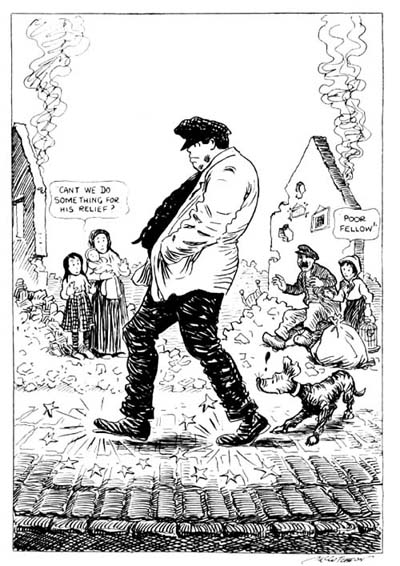
BY JOHN T. McCUTCHEON
To-night, as I look at Mr. Cobb, aglow with all that tailor, laundry, barber and friendship can do for man, I find it hard to realize that this is the same Mr. Cobb I saw one day last August in Belgium.
Time had not dealt gently with him that day. The sun of his smile had set early in the forenoon. His beard was several days gone. His raiment was an affront to at least three of the five senses and all that was left of his spirit was the droop.
He had eaten nothing for a long time, his feet were sore, and he was so chafed that he emanated sparks at every step.
Even in a land as rich in ruins as Belgium, he stood out a conspicuous masterpiece of wreckage.
The homeless Belgians pitied him!
Late in the evening, after several hours of brooding silence, he gave utterance to the following statement:
“I wish I was back in New York, just sitting down to a good square meal with some friends.”
And so to-night it is pleasant to realize that virtue is at least triumphant and that his wish has come true.
—John T. McCutcheon
My admiration for him and what he has done is really beyond words.
—J. A. Mitchell
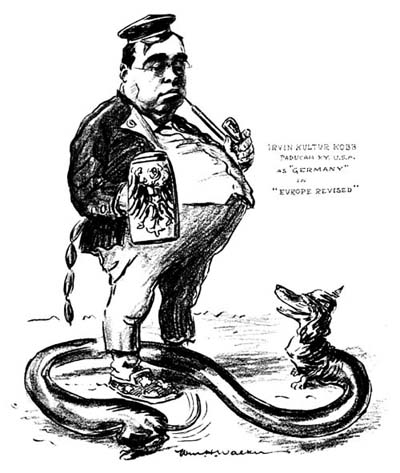
IRVIN KULTUR KOBB PADUCAH KY. U.S.A. AS “GERMANY” IN “EUROPE REVISED”
BY WILLIAM H. WALKER
(BY CABLE)
Monumental on a boot cleaning stand, he is equally interested in cigars and in assassinations, and he likes to wear his thinnest clothes in winter. His stories are always reliable, even when they deal with the British War Office. After annexing Broadway he took Belgium and his book thereon is history. He sees straight and writes straight, and I am his friend and his fan.
—Arnold Bennett
Cobb’s “Paths of Glory” is acclaimed throughout Britain to be the most vivid, most moving, most convincing of all books on the Great War; which means the British public recognizes in the printed page the compelling personality of its author. I am proud to be his publisher.
—J. E. Hodder Williams
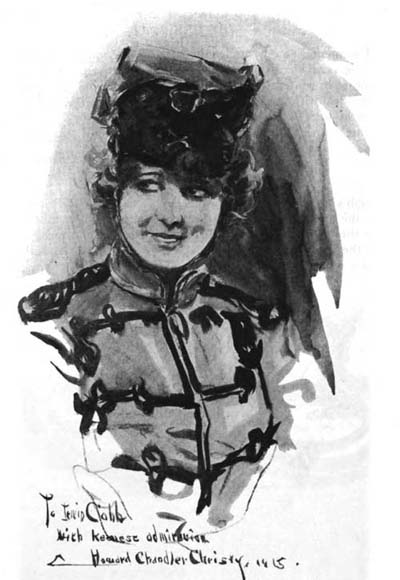
BY HOWARD CHANDLER CHRISTY
Irvin Cobb leads his league in everything but base running. He went to the Belgian battle-fields equipped as a war correspondent with a facile pen, a sense of humor, and a wonderful repertoire of darkey stories. He came back with a neutral dialect, a reputation enhanced by the depth and sincerity of his writing, and the mantles of Archibald Forbes and Bennett Burleigh combining to cover—at least—portions of him.
—Walter Hale
We have long appreciated the corn of the South whose bright kernels, properly distilled, make brighter Colonels still. Yet when before have we worshipped the Cobb of the South? Here, surely, is all the brightness and all the stimulation—and all the nourishment which a fat land can give to a lean and hungry world. More joy comes from one Cobb than from 1,000,000,000 bushels of corn—and although he is rare, in one sense, in another he may be ranked as the South’s largest output.
—Wallace Irwin
I see no reason why I should not say that I like Irvin Cobb—because I do, very much. He does not irritate the throat; and, if you are a magazine editor, his is the stuff you will eventually buy.
—F. P. A.
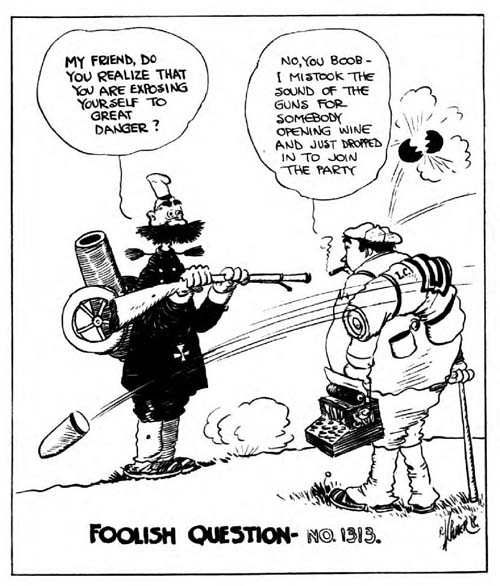
MY FRIEND, DO YOU REALIZE THAT YOU ARE EXPOSING YOURSELF TO GREAT DANGER? NO, YOU BOOB—I MISTOOK THE SOUND OF THE GUNS FOR SOMEBODY OPENING WINE AND JUST DROPPED IN TO JOIN THE PARTY FOOLISH QUESTION—NO. 1313.
BY R. L. GOLDBERG
The surest and simplest way to appreciate Irvin Cobb is to start in to read him when you are too busy or too tired to read anything at all.
—George Barr McCutcheon
Irvin Cobb! Gentle, keen, loyal and truth-telling—the best ever.
—Wm. Travers Jerome
Certainly I appreciate Cobb! I appreciated him long before the mob got on to him. But the thing that galls me is—why the wrist watch? He came among us out west here, wearing a 27-jewelled, steam-heated, forty-dollar wrist watch and I assure you it is not being done here at all—at least not in our set. Shall we blame the Germans for this, or is Old Irv slipping? From my heart, I ask you to reason with him.
—C. E. Van Loan
This is the first time in five years I’ve regretted not being in New York.
—Harry Leon Wilson
Monterey, California, April First, Nineteen-fifteen.
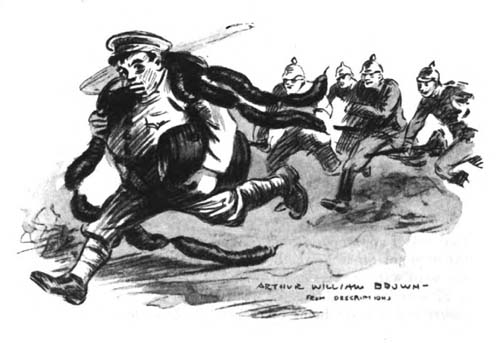
BY ARTHUR WILLIAM BROWN
Irvin is a true humorist in that he knows when not to be funny. In addition to numberless works of irresistible joviality, he has contributed to American literature some of its most serious notes, including stories of pathos and also of gruesome power, almost unrivalled. He has written important essays on food, too, one on Southern cooking, in particular, that is as savory as Charles Lamb’s “Dissertation on Roast Pig.” We are safe in hailing Cobb as already a classic.
Everybody reads and rejoices in Cobb’s printed self. Those who know the man love him and rejoice in his society. “Cobb’s Anatomy” is for the general public. His heart is the biggest part of him, and if that were not true, this unusual dinner would not be given. It takes more than a great writer to earn great affection.
—Rupert Hughes
A big brain needs a big belly to balance it.
Irvin Cobb has a well-balanced brain.
He’s never top-heavy and never will be.
In all the years he wrote for the Sunday World he never was late turning in his copy, reaching the pay-window, going to luncheon, buying a drink, laughing at his own jokes or demanding a raise in salary.
In his New York career he has made only three mistakes in judgment: his house in Park Hill, the play he wrote, and leaving the World. The first he may sell, the second he can live down, but the third is irreparable,—if not to him, assuredly to us.
—William Johnston
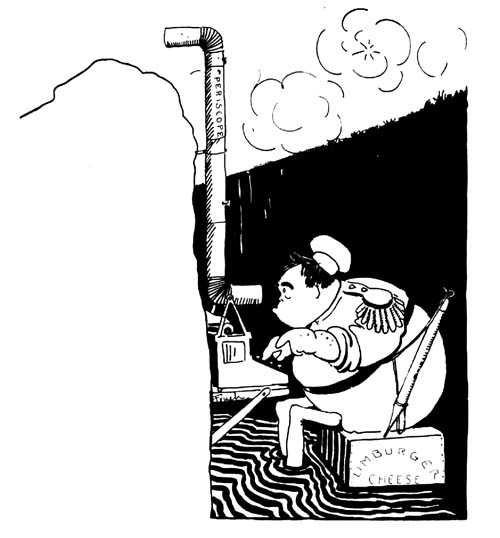
BY ALFRED FRUEH