Front matter (continued 2)
Reading edition
Two passengers left at Twenty-third Street, three at Thirty-fourth Street, and seven at Forty-second Street.
Preoccupied, she glanced up at the only passenger remaining, caught the fleeting shadow of interest on his face, regarded him with natural indifference, and looked out of the window, forgetting him. A few moments later, accidentally aware of him again, she carelessly noted his superficially attractive qualities, and, approving, resumed her idle inspection of the passing throng. But the next time her pretty head swung round she found him looking rather fixedly at her, and involuntarily she returned the gaze with a childlike directness—a gaze which he sustained to the limit of good breeding, then evaded so amiably that it left an impression rather agreeable than otherwise.
“I don’t see,” thought Aphrodite, “why I never meet that sort of man. He hasn’t art
The lovely mouth grew sullen again: “I don’t wish to wait two years and be what dreadful newspapers call a ‘bud’! I wish to go to dinners and dances now!... Where I’ll meet that sort of man.... The sort one feels almost at liberty to talk to without anybody presenting anybody.... I’ve a mind to look amiable the next time he——”
He raised his eyes at that instant; but she did not smile.
“I—I suppose that is the effect of civilization on me,” she reflected—“metropolitan civilization. I felt like saying, ‘For goodness’ sake, let’s say something’—even in spite of all my sisters have told me. I can’t see why it would be dangerous for me to look amiable. If he glances at me again—so agreeably——”
He did; but she didn’t smile.
“You see!” she said, accusing herself discontentedly; “you don’t dare look human. Why? Because you’ve had it so drummed ——”
He did.
The faintest glimmer of a smile troubled her lips. She thought: “I do wish he’d speak!”
There was a very becoming color in his face, partly because he was experienced enough not to mistake her; partly from a sudden and complete realization of her beauty.
“It’s so odd,” thought Aphrodite, “that attractive people consider it dangerous to speak to one another. I don’t see any danger.... I wonder what he has in that square box beside him? It can’t be a camera.... It can’t be a folding easel! It simply can’t be that he is an artist! a man like that——”
“Are you?” she asked quite involuntarily.
“What?” he replied, astonished, wheeling around.
“An—an artist. I can’t believe it, and I don’t wish to! You don’t look it, you know!”
For a moment he could scarcely realize that she had spoken; his keen gaze dissected the face before him, the unembarrassed eyes, the oval contour, the smooth, flawless loveliness of a child.
“Yes, I am an artist,” he said, considering her curiously.
“I am sorry,” she said, “no, not sorry—only unpleasantly surprised. You see I am so tired of art—and I thought you looked so—so wholesome——”
He began to laugh—a modulated laugh—rather infectious, too, for Aphrodite bit her lip, then smiled, not exactly understanding it all.
“Why do you laugh?” she asked, still smiling. “Have I said something I should not have said?”
But he replied with a question: “Have you found art unwholesome?”
“I—I don’t know,” she answered with a little sigh; “I am so tired of it all. Don’t let us talk about it—will you?”
“It isn’t often I talk about it,” he said, laughing again.
“Oh! That is unusual. Why don’t you talk about art?”
“I’m much too busy.”
“D—doing what? If that is not very impertinent.”
“Oh, making pictures of things,” he said, intensely amused.
“Pictures? You don’t talk about art, and you paint pictures!”
“Yes.”
“W—what kind? Do you mind my asking? You are so—so very unusual.”
“Well, to earn my living, I make full-page pictures for magazines; to satisfy an absurd desire, I paint people—things—anything that might satisfy my color senses.” He shrugged his shoulders gaily. “You see, I’m the sort you are so tired of——”
“But you paint! The artists I know don’t paint—except that way—” She raised her pretty gloved thumb and made a gesture in the air; and, before she had achieved it, they were both convulsed with laughter.
“You never do that, do you?” she asked at length.
“No, I never do. I can’t afford to decorate the atmosphere for nothing!”
“Then—then you are not interested in art nouveau?”
“No; and I never could see that beautiful music resembled frozen architecture.”
They were laughing again, looking with confidence and delight upon one another as though they had started life’s journey together in that ancient omnibus.
“What is a ‘necklace of precious tones’?” she asked.
“Precious stones?”
“No, tones!”
“Let me cite, as an example, those beautiful verses of Henry Haynes,” he replied gravely.
TO BE OR NOT TO BE
I’d rather be a Could Be, If I can not be an Are; For a Could Be is a May Be, With a chance of touching par. I had rather be a Has Been Than a Might Have Been, by far; For a Might Be is a Hasn’t Been But a Has was once an Are! Also an Are is Is and Am; A Was was all of these; So I’d rather be a Has Been Than a Hasn’t, if you please.
And they fell a-laughing so shamelessly that the ’bus driver turned and squinted through his shutter at them, and the scandalized horses stopped of their own accord.
“Are you going to leave?” he asked as she rose.
“Yes; this is the Park,” she said. “Thank you, and good-by.”
He held the door for her; she nodded her thanks and descended, turning frankly to smile again in acknowledgment of his quickly lifted hat.
“He was nice,” she reflected a trifle guiltily, “and I had a good time, and I really don’t see any danger in it.”
XV
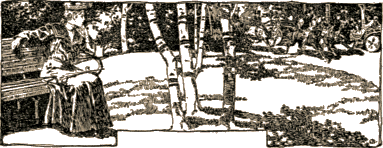
he drew a deep, sweet breath as she entered the leafy shade and looked up into the bluest of cloudless skies. Odors of syringa and lilac freshened her, cleansing her of the last lingering taint of joss-sticks. The cardinal birds were very busy in the scarlet masses of Japanese quince; orioles fluttered among golden Forsythia; here and there an exotic starling preened and peered at the burnished purple grackle, stalking solemnly through the tender grass.
For an hour she walked vigorously, enchanted with the sun and sky and living green, through arbors heavy with wistaria, iris hued
“More danger, I suppose,” she thought impatiently.... “Well, what is this danger that seems to travel like one’s shadow, dogging a girl through the world? It seems to me that if all the pleasant things of life are so full of danger I’d better find out what it is.... I might as well look for it so that I’ll recognize it when I encounter it.... And learn to keep away.”
She scanned the flowery thickets attentively, looked behind her, then walked on.
“If it’s robbers they mean,” she reflected, “I’m a good wrestler, and I can make any one of my four brothers-in-law look foolish.... Besides, the Park is full of fat policemen.... And if they mean I’m likely to get lost, or run over, or arrested, or poisoned with soda-water and bonbons—” She
“So I’ll just look about for this danger they are all afraid of, and when I see it, I’ll know what to do,” she concluded, paying not the slightest heed to the man on the bench until he rose, as she passed him, and took off his hat.
“You!” she exclaimed.
She had stopped short, confronting him with the fearless and charming directness natural to her. “What an amusing accident,” she said frankly.
“The truth is,” he began, “it is not exactly an accident.”
“Isn’t it?”
“N—no.... Are you offended?”
“Offended? No. Should I be? Why?... Besides, I suppose when we have finished this conversation you are going the other way.”
“I—no, I wasn’t.”
“Oh! Then you are going to sit here?”
“Y—yes—I suppose so.... But I don’t want to.”
“Then why do you?”
“Well, if I’m not going the other way, and if I’m not going to remain here—” He looked at her, half laughing. She laughed, too, not exactly knowing why.
“Don’t you really mind my walking a little way with you?” he asked.
“No, I don’t. Why should I? Is there any reason? Am I not old enough to know why we should not walk together? Is it because the sun is going down? Is there what people call ‘danger’?”
He was so plainly taken aback that her fair young face became seriously curious.
“Is there any reason why you should not walk with me?” she persisted.
The clear, direct gaze challenged him. He hesitated.
“Yes, there is,” he said.
“A—a reason why you should not walk with me?”
“Yes.”
“What is it?”
And, as he did not find words to answer, she studied him for a moment, glanced up and down the woodland walk, then impulsively seated herself and motioned him to a place beside her on the bench.
“Now,” she said, “I’m in a position to find out just what this danger is that they all warn me about. You know, don’t you?”
“Know what?” he answered.
“About the danger that I seem to run every time I manage to enjoy myself.... And you do know; I see it by the way you look at me—and your expression is just like their expression when they tell me not to do things I find most natural.”
“But—I—you——”
“You must tell me! I shall be thoroughly vexed with you if you don’t.”
Then he began to laugh, and she let him, leaning back to watch him with uncertain and speculative blue eyes. After a moment he said:
“You are absolutely unlike any girl I ever heard of. I am trying to get used to it—to adjust things. Will you help me?”
“How?” she asked innocently.
“Well, by telling me”—he looked at her a moment—“your age. You look about nineteen.”
“I am sixteen and a half. I and all my sisters have developed our bodies so perfectly because, until we came to New York last autumn,
“Intensely.”
“Well, there are eight of us: Chlorippe, thirteen; Philodice, fourteen; Dione, fifteen; Aphrodite, sixteen—I am Aphrodite; Cybele, seventeen, married; Lissa, eighteen, married; Iole, nineteen, married, and Vanessa, twenty, married.” She raised one small, gloved finger to emphasize the narrative. “All our lives we were brought up to be perfectly natural, to live, act, eat, sleep, play like primitive people. Our father dressed us like youths—boys, you know. Why,” she said earnestly, “until we came to New York we had no idea that girls wore such lovely, fluffy underwear—but I believe I am not to mention such things; at least they have told me not to—but my straight front is still a novelty to me, and so are my stockings, so you won’t mind if I’ve said something I shouldn’t, will you?”
“No,” he said; his face was expressionless.
“Then that’s all right. So you see how it is; we don’t quite know what we may do in this city. At first we were delighted to see so many attractive men, and we wanted to speak
“Very.” There was not an atom of intelligence left in his face.
“So that’s all right, then. Let me see, what was I saying? Oh, yes, I know! So four of my sisters were married, and we four remaining are being civilized.... But, oh—I wish I could be in the country for a little while! I’m so homesick for the meadows and brooks and my pajamas and my bare feet in sandals again.... And people seem to know so little in New York, and nobody understands us when we make little jests in Greek, or Latin, or Arabic, and nobody seems to have been very well educated and accomplished, so we feel strange at times.”
“D—d—do you do all those things?”
“What things?”
“M—make jests in Arabic?”
“Why, yes. Don’t you?”
“No. What else do you do?”
“Why, not many things.”
“Music?”
“Oh, of course.”
“Piano?”
“Yes, piano, violin, harp, guitar, zither—all that sort of thing.... Don’t you?”
“No. What else?”
“Why—just various things, ride, swim, fence, box—I box pretty well—all those things——”
“Science, too?”
“Rudiments. Of course I couldn’t, for example, discourse with authority upon the heteropterous mictidæ or tell you in what genus or genera the prothorax and femora are digitate; or whether climatic and polymorphic forms of certain diurnal lepidoptera occur within certain boreal limits. I have only a vague and superficial knowledge of any science, you see.”
“I see,” he said gravely.
She leaned forward thoughtfully, her pretty hands loosely interlaced upon her knee.
“Now,” she said, “tell me about this danger that such a girl as I must guard against.”
“There is no danger,” he said slowly.
“But they told me——”
“Let them tell you what it is, then.”
“No; you tell me?”
“I can’t.”
“Why?”
“Because—I simply can’t.”
“Are you ashamed to?”
“Perhaps—” He lifted his boxed sketching-kit by the strap, swung it, then set it carefully upon the ground: “Perhaps it is because I am ashamed to admit that there could be any danger to any woman in this world of men.”
She looked at him so seriously that he straightened up and began to laugh. But she did not forget anything he had said, and she began her questions at once:
“Why should you not walk with me?”
“I’ll take that back,” he said, still laughing; “there is every reason why I should walk with you.”
“Oh!... But you said——”
“All I meant was not for you, but for the ordinary sort of girl. Now, the ordinary, every-day, garden girl does not concern you——”
“Yes, she does! Why am I not like her?”
“Don’t attempt to be——”
“Am I different—very different?”
“Superbly different!” The flush came to his face with the impulsive words.
She considered him in silence, then:
“So interesting,” he said, “that I don’t know what I shall do when you go away.”
Another pause; she was deeply absorbed with her own thoughts. He watched her, the color still in his face, and in his eyes a growing fascination.
“I’m not out,” she said, resting her chin on one gloved hand, “so we’re not likely to meet at any of those jolly things you go to. What do you think we’d better do?—because they’ve all warned me against doing just what you and I have done.”
“Speaking without knowing each other?” he asked guiltily.
“Yes.... But I did it first to you. Still, when I tell them about it, they won’t let you come to visit me. I tried it once. I was in a car, and such an attractive man looked at me as though he wanted to speak, and so when I got out of the car he got out, and I thought he seemed rather timid, so I asked him where Tiffany’s was. I really didn’t know, either. So we had such a jolly walk together up Fifth Avenue, and when I
“Then you intend to tell them all about—us?”
“Of course. I’ve disobeyed them.”
“And—and I am never to see you again?”
“Oh, I’m very disobedient,” she said innocently. “If I wanted to see you I’d do it.”
“But do you?”
“I—I am not sure. Do you want to see me?”
His answer was stammered and almost incoherent. That, and the color in his face and the something in his eyes, interested her.
“Do you really find me so attractive?” she asked, looking him directly in the eyes. “You must answer me quickly; see how dark it is growing! I must go. Tell me, do you like me?”
“I never cared so much for—for any woman——.”
She dimpled with delight and lay back regarding him under level, unembarrassed brows.
“That is very pleasant,” she said. “I’ve often wished that a man—of your kind—would say that to me. I do wish we could be together a great deal, because you like me so much already and I truly do find you agreeable.... Say it to me again—about how much you like me.”
“I—I—there is no woman—none I ever saw so—so interesting.... I mean more than that.”
“Say it then.”
“Say what I mean?”
“Yes.”
“I am afraid——”
“Afraid? Of what?”
“Of offending you——”
“Is it an offense to me to tell me how much you like me? How can it offend me?”
“But—it is incredible! You won’t believe——”
“Believe what?”
“That in so short a time I—I could care for you so much——”
“But I shall believe you. I know how I feel toward you. And every time you speak to me I feel more so.”
“Feel more so?” he stammered.
“Yes, I experience more delight in what you say. Do you think I am insensible to the way you look at me?”
“You—you mean—” He simply could not find words.
She leaned back, watching him with sweet composure; then laughed a little and said: “Do you suppose that you and I are going to fall in love with one another?”
In the purpling dusk the perfume of wistaria grew sweeter and sweeter.
“I’ve done it already—” His voice shook and failed; a thrush, invisible in shadowy depths, made soft, low sounds.
“You love me—already?” she exclaimed under her breath.
“Love you! I—I—there are no words—” The thrush stirred the sprayed foliage and called once, then again, restless for the moon.
Her eyes wandered over him thoughtfully: “So that is love.... I didn’t know.... I supposed it could be nothing pleasanter than friendship, although they say it is.... But how could it be? There is nothing pleasanter than friendship.... I am perfectly delighted that you love me. Shall we marry some day, do you think?”
He strove to speak, but her frankness stunned him.
“I meant to tell you that I am engaged,” she observed. “Does that matter?”
“Engaged!” He found his tongue quickly enough then; and she, surprised, interested, and in nowise dissenting, listened to his eloquent views upon the matter of Mr. Frawley, whom she, during the lucid intervals of his silence, curtly described.
“Do you know,” she said with great relief, “that I always felt that way about love, because I never knew anything about it except from the symptoms of Mr. Frawley? So when they told me that love and friendship were different, I supposed it must be so, and I had no high opinion of love ... until you made it so agreeable. Now I—I prefer it to anything else.... I could sit here with you all day, listening to you. Tell me some more.”
XVI
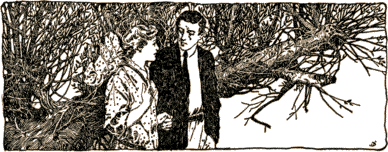
e did. She listened, sometimes intently interested, absorbed, sometimes leaning back dreamily, her eyes partly veiled under silken lashes, her mouth curved with the vaguest of smiles.

He spoke as a man who awakes with a start—not very clearly at first, then with feverish coherence, at times with recklessness almost eloquent. Still only half awakened himself, still scarcely convinced, scarcely credulous that this miracle of an hour had been wrought in him, here under the sky and setting sun and new-born leaves, he spoke not only to her
He spoke, striving to teach himself that the incredible was credible, the impossible possible—that it was done! done! done! and that he loved a woman in an hour because, in an hour, he had read her innocence as one reads through crystal, and his eyes were opened for the first time upon loveliness unspoiled, sweetness untainted, truth uncompromised.
“Do you know,” she said, “that, as you speak, you make me care for you so much more than I supposed a girl could care for a man?”
“Can you love me?”
“Oh, I do already! I don’t mean mere love. It is something—something that I never knew about before. Everything about you is so—so exactly what I care for—your voice, your head, the way you think, the way you look at me. I never thought of men as I am must! There is nobody else, is there? If you do truly love me?”
“Nobody but you.”
“That is what I desire.... I want to live with you—I promise I won’t talk about art—even your art, which I might learn to care for. All I want is to really live and have your troubles to meet and overcome them because I will not permit anything to harm you.... I will love you enough for that.... I—do you love other women?”
“Good God, no!”
“And you shall not!” She leaned closer, looking him through and through. “I will be what you love! I will be what you desire most in all the world. I will be to you everything you wish, in every way, always, ever, and forever and ever.... Will you marry me?”
“Will you?”
“Yes.”
She suddenly stripped off her glove,
She was laughing, a trifle excited, as she turned to face him where he had risen. But, at the touch of his hand on hers, the laughter died at a breath, and she stood, her limp hand clasped in his, silent, expressionless, save for the tremor of her mouth.
“I—I must go,” she said, shrinking from him.
He did not understand, thrilled as he was by the contact, but he let her soft hand fall away from his.
Then with a half sob she caught her own fingers to her lips and kissed them where the pressure of his hand burned her white flesh—kissed them, looking at him.
“You—you find a child—you leave a woman,” she said unsteadily. “Do you understand how I love you—for that?”
He caught her in his arms.
“No—not yet—not my mouth!” she pleaded, holding him back; “I love you too much—already too much. Wait! Oh, will you wait?... And let me wait—make me wait?... I—I begin to understand some things I did not know an hour ago.”
In the dusk he could scarcely see her as she swayed, yielding, her arms tightening about his neck in the first kiss she had ever given or forgiven in all her life.
And through the swimming tumult of their senses the thrush’s song rang like a cry. The moon had risen.
XVII
ounting the deadened stairway noiselessly to her sister’s room, groping for the door in the dark of the landing, she called: “Iole!” And again: “Iole! Come to me! It is I!”

The door swung noiselessly; a dim form stole forward, wide-eyed and white in the electric light.
Then down at her sister’s feet dropped Aphrodite, and laid a burning face against her silken knees. And, “Oh, Iole, Iole,” she whispered, “Iole, Iole, Iole! There is danger, as you say—there is, and I understand it ... now.... But I love him so—I—I have been so happy—so happy! Tell me what I
“Done, child! What in the name of all the gods have you done?”
“Loved him—in the names of all the gods! Oh, Iole! Iole! Iole!”
“——The thrush singing in darkness; the voice of spring calling, calling me to his arms! Oh, Iole, Iole!—these, and my soul and his, alone under the pagan moon! alone, save for the old gods whispering in the dusk——”
“——And listening, I heard the feathery tattoo of wings close by—the wings of Eros all aquiver like a soft moth trembling ere it flies! Peril divine! I understood it then. And, stirring in darkness, sweet as the melody of unseen streams, I heard the old gods laughing.... Then I knew.”
“Is that all, little sister?”
“Almost all.”
“What more?”
And when, at length, the trembling tale was told, Iole caught her in her white arms, looked
“If he is all you say—this miracle—I—I think I can make them understand,” she whispered. “Where is he?”
“D-down-stairs—at b-bay! Hark! You can hear George swearing! Oh, Iole, don’t let him!”
In the silence from the drawing-room below came the solid sobs of the poet:
“P-pup! P-p-penniless pup!”
“He must not say that!” cried Aphrodite fiercely. “Can’t you make father and George understand that he has nearly six hundred dollars in the bank?”
“I will try,” said Iole tenderly. “Come!”
And with one arm around Aphrodite she descended the great stairway, where, on the lower landing, immensely interested, sat Chlorippe, Philodice and Dione, observant, fairly aquiver with intelligence.
“Oh, that young man is catching it!” remarked Dione, looking up as Iole passed, her arm close around her sister’s waist. “George has said ‘dammit’ seven times and father is rocking—not in a rocking-chair—just rocking and expressing his inmost thoughts. And Mr. ——”
But Iole brushed by her younger sisters, Aphrodite close beside her, and, entering the great receiving-hall, stood still, her clear eyes focused upon her husband’s back.
“George!”
Mr. Wayne stiffened and wheeled; Mr. Briggs sidled hastily toward the doorway, crabwise; the poet choked back the word, “Phup!” and gazed at his tall daughter with apprehension and protruding lips.
“Iole,” began Wayne, “this is no place for you! Aphrodite! let that fellow alone, I say!”
Iole turned, following with calm eyes the progress of her sister toward a tall young man who stood by the window, a red flush staining his strained face.
The tense muscles in jaw and cheek relaxed as Aphrodite laid one hand on his arm; the poet, whose pursed lips were overloaded, expelled a passionate “Phupp!” and the young man’s eyes narrowed again at the shot.
Then silence lengthened to a waiting menace, and even the three sisters on the stairs succumbed to the oppressive stillness. And all the while Iole stood like a white Greek goddess under the glory of her hair, looking full into the eyes of the tall stranger.
A minute passed; a glimmer dawned to a smile and trembled in the azure of Iole’s eyes; she slowly lifted her arms, white hands outstretched, looking steadily at the stranger.
He came, tense, erect; Iole’s cool hands dropped in his. And, turning to the others with a light on her face that almost blinded him, she said, laughing: “Do you not understand? Aphrodite brings us the rarest gift in the world in this tall young brother! Look! Touch him! We have never seen his like before for all the wisdom of wise years. For he is one of few—and men are many, and artists legion—this honorable miracle, this sane and wholesome wonder! this trinity, Lover, Artist, and Man!”
And, turning again, she looked him wistfully, wonderingly, in the eyes.