Part 1 — FRIDAY, MARCH 18, 1955 (continued 2)
Reading edition
Mr. Carlson. Maybe I misunderstand you or you misunderstand me, Mr. Chairman. I don’t believe in the principle that is commonly accorded to the Communist Party, that they are subversive. I don’t want anything to do with that. That they are ready to overthrow the Government, I don’t believe in that. Certainly not.
(The witness confers with his counsel.)
Mr. Carlson. Mr. Chairman, further, if I thought that they did believe in that, or ever believed in that, I certainly never would have had anything to do with them, and I would be most bitterly in opposition.
Mr. Moulder. Mr. Tavenner, proceed with the interrogation of the witness.
Mr. Tavenner. Mr. Carlson, I understood you to say that in 1950 you were not a member of the Communist Party. Is that correct?
(The witness confers with his counsel.)
Mr. Carlson. To the best of my knowledge, that is right.
Mr. Tavenner. But in 1949 you withdrew from the Communist Party? Is that correct?
(The witness confers with his counsel.)
Mr. Carlson. There was no formal act of withdrawal.
Mr. Tavenner. You did not hand in a written resignation?
Mr. Carlson. That is right.
Mr. Tavenner. Did you notify any functionary in the Communist Party that you were withdrawing from the Communist Party?
(The witness confers with his counsel.)
Mr. Carlson. I failed to reregister.
(The witness confers with his counsel.)
Mr. Tavenner. Did any member of the Communist Party ask you to reregister, and you refused to do it?
Mr. Carlson. That I believe, is correct. I did not reregister purposely; I did not intend to reregister.
But just exactly if that is what happened I am not quite so sure about that. I mean whether somebody came and asked me to reregister; I don’t remember. I am not sure about that.
Mr. Tavenner. Was that in 1949?
Mr. Carlson. That was about that time. It was at the time of the——
(The witness confers with his counsel.)
Mr. Carlson. It was right in there, yes.
Mr. Tavenner. What was the date of the last meeting of the Communist Party you attended?
(The witness confers with his counsel.)
Mr. Carlson. I have to invoke the fifth amendment on that.
Mr. Tavenner. Mr. Chairman, I am inclined to think that the witness, by the answers he has given, has opened the door for examination of what he knows about Communist Party activities during the period when he was a member. Therefore, I request that the chairman direct the witness to answer.
Mr. Moulder. The Chair directs the witness to answer the question.
(The witness confers with his counsel.)
Mr. Carlson. Will you restate the question?
Mr. Tavenner. Will you read the question, please?
(The pending question was read by the reporter.)
(The witness confers with his counsel.)
Mr. Carlson. I invoke the fifth amendment, Mr. Chairman.
Mr. Tavenner. How many people composed the group or branch of the Communist Party to which you belonged?
(The witness confers with his counsel.)
Mr. Carlson. The answer is the same, Mr. Chairman, the fifth amendment.
Mr. Moulder. The Chair directs the witness to answer the question.
(There was no response.)
Mr. Tavenner. What was the name of the unit or group of the Communist Party of which you were a member?
Mr. Carlson. I again invoke my rights under the fifth amendment, Mr. Chairman.
Mr. Moulder. The Chair directs the witness to answer the question.
(There was no response.)
Mr. Tavenner. Will you tell the committee, please, what the Communist Party was endeavoring to accomplish in the group of the Communist Party with which you were affiliated?
(The witness confers with his counsel.)
Mr. Carlson. I again invoke the fifth amendment, Mr. Chairman.
Mr. Moulder. The Chair directs the witness to answer the question.
(There was no response.)
Mr. Velde. Just a minute. I don’t think the record shows any answer to that. Do you want the record to show that you do not answer, that you remain silent?
Mr. Carlson. I wish to invoke the fifth amendment.
Mr. Tavenner. Will you tell the committee, in what activities did the group of the Communist Party of which you were a member engage?
Mr. Carlson. I again invoke the fifth amendment.
Mr. Moulder. The Chair directs the witness to answer the question.
(There was no response.)
Mr. Tavenner. Will you tell the committee, please, whether the Communist Party group with which you were affiliated was organized within any industry, within any labor union, or whether it was a street group of the Communist Party, or, sometimes referred to as, a neighborhood group of the Communist Party?
Mr. Carlson. Again, on the grounds of possible self-incrimination I refuse to answer.
Mr. Moulder. You are directed to answer the question propounded to you by Mr. Tavenner, counsel for the committee.
Mr. Carlson. On the grounds of the fifth amendment, I refuse to answer.
Mr. Tavenner. Over how long a period of time does your knowledge of Communist Party activities exist?
Mr. Carlson. I again invoke the fifth amendment.
Mr. Moulder. You are advised and directed to answer the question.
(There was no response.)
Mr. Tavenner. When did you become a member of the Communist Party?
Mr. Carlson. The answer is the same as the one previous.
Mr. Moulder. Again the Chair advises and directs you to answer the question.
(There was no response.)
Mr. Tavenner. What methods were used by the Communist Party in order to induce you to become a member?
Mr. Carlson. I again invoke the fifth amendment.
Mr. Moulder. You are advised and directed to answer the question.
(There was no response.)
Mr. Tavenner. You have told the committee that you withdrew from the Communist Party in 1949. What were the circumstances which led you to the decision to withdraw from the Communist Party?
(The witness confers with his counsel.)
Mr. Carlson. I believe, Mr. Chairman, the immediate thing was the outbreak of the Korean war.
(The witness confers with his counsel.)
Mr. Tavenner. Will you tell the committee, please, just how the outbreak of the Korean war affected you in your decision?
Mr. Carlson. My opinion, Mr. Chairman, was that that war was uncalled for. I didn’t agree with it, no more than I agreed with our participation in it.
Mr. Tavenner. Do you mean to say that the Communist Party was in favor of the war, and, therefore, inasmuch as you disagreed with it, you got out of the Communist Party?
(The witness confers with his counsel.)
Mr. Carlson. I was against the invasion by the North Koreans of South Korea. That is my position. I didn’t approve of that at all. In fact, I don’t approve of war really of any kind.
Mr. Tavenner. I misunderstood your answer entirely.
You believed that the North Koreans invaded South Korea?
Are you assigning the Korean war as your reason for getting out of the Communist Party? What I am getting at is: What was the Communist Party doing about the Korean war with which you disagreed? That is the point I am trying to develop. (The witness confers with his counsel.)
Mr. Carlson. I am not really in a position, I don’t think, to say what the Communist Party did about that. Officially. There was a period of time when I suppose I was—Well, I don’t know what word to use—probably losing faith, or disagreeing, or something with the activities. And that was the real change in my mind. That was the thing, the straw that broke the camel’s back, you might say.
Mr. Tavenner. Do you mean the Korean war?
Mr. Carlson. Yes.
Mr. Tavenner. What was the Communist Party doing about the Korean war that made this matter so important it affected your decision about breaking your connection with the party?
(The witness confers with his counsel.)
Mr. Carlson. My decision was made right then in my own mind when that war broke out.
Mr. Tavenner. I am not talking about the time; I am talking about what the Communist Party did to create such a situation which prevented you from continuing as a member of the Communist Party.
(The witness confers with his counsel.)
Mr. Carlson. My impression was that they favored the North Koreans, and I didn’t.
Mr. Tavenner. How did the Communist Party handle that question in its meetings?
(The witness confers with his counsel.)
Mr. Tavenner. Now actually the Korean war began in June 1950, didn’t it?
Mr. Carlson. As near as my recollection, I was thinking it was 1949.
Mr. Tavenner. And you say you withdrew from the Communist Party in 1949?
(The witness confers with his counsel.)
Mr. Carlson. I am sure in my mind that it was in the fall of 1949 that I failed to reregister in the Communist Party.
Mr. Tavenner. But the only reason you have assigned for your withdrawal from the Communist Party in 1949 is the Korean war, which did not begin until nearly a year later.
Now it is rather difficult for the committee, I am sure, to understand whether or not your reasons for withdrawing from the Communist Party are being given in good faith.
Mr. Carlson. Mr. Chairman, I was quite active in my union and in my shop as a good trade union member, and, to tie one thing with another, I don’t have anything to go by except that Korean war. I remember that was about the time.
Mr. Tavenner. Then you must have been mistaken as to the year in which you withdrew from the Communist Party.
(The witness confers with his counsel.)
Mr. Carlson. That is possible.
Mr. Tavenner. I would much rather believe that you were mistaken than believe you are trying to deceive the committee.
Mr. Carlson. No. That is not the case.
Mr. Tavenner. The committee has been interested for quite a period of time in learning all it can about the method used by the Communist Party to oppose the Korean war. By opposing the Korean war I mean opposing the foreign policy of the United States in connection with that war. What position did the Communist Party take with which you disagreed?
(The witness confers with his counsel.)
Mr. Carlson. I think it is quite common knowledge that, even from our daily papers, the Communists did support the North Koreans.
Mr. Tavenner. Yes; but the daily papers do not tell us what was done in your particular cell or group of the Communist Party, and that is what we want to know.
Mr. Carlson. Well, after that war broke out, Mr. Chairman, I did not participate. I can’t tell what they done because I don’t know.
Mr. Tavenner. Then why did you disagree with them if you didn’t know what they were doing?
Mr. Carlson. Well, you remember, as history shows—according to the papers, anyway—that in the time before the First World War broke out, I remember—it just comes to my mind—the papers printed that the Communist Party members of France tore up their Communist cards immediately when Russia signed some sort of a pact with Germany. You probably recall that in your own mind. I think that is a historical fact. At least the paper files will show that. I recall it that way. Now the same situation was mine, although I might add, as I have said before, that was the straw that broke the camel’s back as far as I am concerned.
Mr. Tavenner. Did you attend any meeting of the Communist Party after you wrote the letter on June 19, 1954, to this committee?
(The witness confers with his counsel).
Mr. Tavenner. Did you attend any meeting of the Communist Party after the outbreak of the Korean War?
Mr. Carlson. Not to the best of my recollection; I don’t believe so.
Mr. Tavenner. I understand you will not tell this committee anything about the activities of the Communist Party during the period when you were a member. Is that correct?
Mr. Carlson. Because the answer to those questions might tend to incriminate me, and, on advise of my counsel, I refuse to answer those questions.
Mr. Tavenner. I have no further questions.
Mr. Moulder. Any questions?
Mr. Velde. Yes, Mr. Chairman. Since the witness is unwilling to give us any of the information which we are certain he has regarding his activities in the Communist Party while he was a member, possibly he would tell us what motivated him to get into the Communist Party, to join the Communist Party in the first place.
(The witness confers with his counsel.)
Mr. Carlson. Could I answer that question, Mr. Congressman, and not go into other questions regarding it?
Mr. Velde. Yes, certainly. I would like to have you answer.
(The witness confers with his counsel.)
Mr. Carlson. I was looking for an answer to the problems that beset many, many workers besides myself. And I really had a rough time during the depression.
Mr. Velde. Did you join the party, then, during the depression?
(The witness confers with his counsel.)
Mr. Carlson. My understanding was that if I answered the previous question there would not be any more regarding that.
Mr. Velde. I did not understand it that way at all. I am sorry if you misinterpreted my question. And I don’t mean to treat you unfairly in any way or try to trap you. It seems to me that if anybody is being trapped you are being trapped by your own unwillingness to answer questions that are put to you about your activities in the Communist Party. I think, Mr. Chairman, the record should show during the course of the examination by Mr. Tavenner and by you that the witness has been conferring with his counsel regarding the answers to the questions.
Mr. Moulder. The record will reflect conferences with counsel in that regard.
Mr. Tavenner. I have no further questions.
Mr. Moulder. The witness is excused.
At this time the committee will read a letter which was just received, addressed to myself as chairman. The letter is from the Musicians’ Association of Seattle, Local 76, A. F. of M.
Dear Sir: I am distressed to learn that our member, Mrs. Helen Taverniti, has not made herself available for service of the subpena from the House Un-American Activities Committee.
I wish to point out that since 1940 the American Federation of Musicians has persistently carried on a sustained effort to remove from our membership persons proven to be affiliated with organizations of a subversive nature. In fact, our bylaws specifically provide that membership in the Communist Party or any Communist “front” organization is cause for immediate expulsion from membership.
The executive board of local 76 has deemed it necessary to send a registered letter to Mrs. Helen Taverniti at her last known address, citing her to appear before the board for interrogation relative to this matter.
Very truly yours,
Leslie R. Martin, President.
Mr. Tavenner. Mrs. Margaret Elizabeth Gustafson.
Will you come forward, please.
Mr. Moulder. Hold up your right hand and be sworn, please.
Do you solemnly swear that the testimony which you are about to give before this committee will be the truth, the whole truth and nothing but the truth, so help you God?
Mrs. Gustafson. I do.
Mr. Moulder. Be seated.
TESTIMONY OF MARGARET ELIZABETH GUSTAFSON, ACCOMPANIED BY HER COUNSEL, KENNETH A. MacDONALD
Mr. Tavenner. Will you state your name please?
Mrs. Gustafson. Margaret Elizabeth Gustafson.
Mr. Tavenner. It is noted that you are accompanied by counsel.
Will counsel please identify himself for the record?
Mr. MacDonald. Kenneth A. MacDonald, a lawyer of the city of Seattle.
Mr. Tavenner. When and where were you born, Mrs. Gustafson?
Mrs. Gustafson. I was born February 9, 1912, in the city of Seattle.
Mr. Tavenner. Will you spell your last name, please?
Mrs. Gustafson. G-u-s-t-a-f-s-o-n.
Mr. Tavenner. Where do you now reside?
Mrs. Gustafson. In Bremerton, Wash.
Mr. Tavenner. How are you employed?
Mrs. Gustafson. As a schoolteacher.
Mr. Tavenner. Will you tell the committee, please, what your formal educational training has been?
Mrs. Gustafson. I graduated from San Diego State College in 1933, attended Mills for graduate work the following year. I have had summer school at the Western Washington College of Education, at the University of Washington, extension courses——
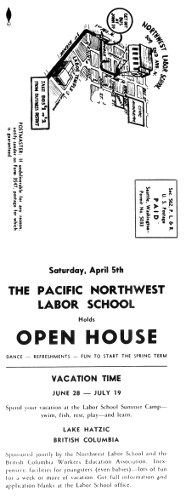
NORTHWEST LABOR SCHOOL 309 2nd Avenue No. POSTMASTER: If undeliverable for any reason, notify sender on Form 3547, postage for which is guaranteed. Saturday, April 5th THE PACIFIC NORTHWEST LABOR SCHOOL Holds OPEN HOUSE DANCE—REFRESHMENTS—FUN TO START THE SPRING TERM VACATION TIME JUNE 28-JULY 19 Spend your vacation at the Labor School Summer Camp—swim, fish, rest, play—and learn. LAKE HATZIC BRITISH COLUMBIA Sponsored jointly by the Northwest Labor School and the British Columbia Workers Education Association. Inexpensive facilities for youngsters (even babies)—lots of fun for a week or more of vacation. Get full information and application blanks at the Labor School office.
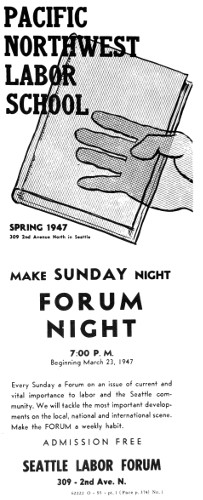
PACIFIC NORTHWEST LABOR SCHOOL SPRING 1947 309 2nd Avenue North in Seattle MAKE SUNDAY NIGHT FORUM NIGHT 7:00 P. M. Beginning March 23, 1947 Every Sunday a Forum on an issue of current and vital importance to labor and the Seattle community. We will tackle the most important developments on the local, national and international scene. Make the FORUM a weekly habit. ADMISSION FREE SEATTLE LABOR FORUM 309-2nd Ave. N.
YOUTH CANTEEN—Cyril Gius—Once month—(April 11, May 9 and June 6)—with music, entertainment, and food arranged under mature supervision, by and for youth.
JUNIOR TOWN HALL—Cyril Gius—A monthly lively and stimulating discussion on questions of the day of particular interest to youth. Fridays—April 25, May 23, and June 20.
$1.50 for the six sessions or 35c a session.
CHILDREN’S WORKSHOP—Ruth Bitterman—assisted by Celeste Brooks and Martha Smyser. Saturday, 10 a. m.-12 noon. Ages 6-12.
A workshop for children 6-12, encouraging their natural desire to create, to help them find and express the beauty and color in their everyday life, using simple art skills, and to help them to be cooperative individuals in their group.
Fee: $3.00
WHO RUNS YOUR SCHOOL?
BOARD OF DIRECTORS: This is the governing body of the School and its decisions are binding upon the school in matters of organization and policy. It is comprised of trade union members and representatives of the city at large, elected on the following basis: Trade unions affiliating to the school through payment of an affiliation fee elect one member to the Board. Trade union councils endorsing the school also elect one member to the Board. These elect additional members from the city at large up to one third of their number. Thus, the Board of Directors, always representative of labor, also includes people who can bring broad educational experience to the school.

Our aim to do what YOU want done. In addition to classes and activities in the center, we will come to you. Does your union need a special course to help in building the union, in developing new forces? Are there fifteen people in your neighborhood who want some special class? Do you need help in planning parties, song-fests, shows, meetings—the Public Affairs Dept. is organized to help you. Give us a call and we’ll work out what you need.
PACIFIC NORTHWEST LABOR SCHOOL 309-2nd Avenue North GArfield 5404
SPRING TERM opens Week of April 7, 1947 Register Now! Pacific Northwest Labor School 309 2nd Ave. North GA. 5404
I want to enroll in the NORTHWEST LABOR SCHOOL in (please print plainly)
CLASS______________________ No______ Day______
CLASS______________________ No______ Day______
Enclosed find $________ for my registration fee.
NAME____________________________________________
ADDRESS_________________________________________
UNION____________________________________________
AFFILIATED ORGANIZATIONS
(Members of the following organizations and their Auxiliaries may attend at the reduced fee.)
Aeronautical Industrial District Lodge No. 751 American Communications Association, Local 130 American Communications Association—Regional Office American Veterans Committee—Queen Anne Chapter Building Service Employees International Union No. 6 Cannery Workers and Farm laborers Union—F.T.A. No. 7 International Association of Machinists No. 79 International Ladies’ Garment Workers Union No. 184 International Longshoremen’s and Warehousemen’s Union Nos 1-9 International Molders & Foundry Workers No. 158 Luggage Workers Union No. 51 Marine Cooks and Stewards Association National Maritime Union of America National Negro Congress Painters Local Union, No. 300 Shipscalers, Drydock and Boatyard Workers, No. 589 The New World United Office and Professional Workers of America, No. 35 United Public Workers of America Washington Pension Union Window Cleaners Union, No. 23
FRATERNAL AFFILIATES
Northern Washington District Council, I.W.A. Painters District Council No. 5 Seattle CIO Council Washington State CIO Council
REGISTER NOW
Spring is already with us, so sign up for the course that meets your needs NOW! The tuition fee for a single course is $6.00 for 10 weeks. If your trade union or community organization is affiliated with the Northwest Labor School the fee is $3.00. It’s an investment that will pay off in new satisfactions and practical understanding. This is education to make democracy work.
SPRING TERM OPENS WEEK OF APRIL 7, 1947
TRADE UNIONISM
104—Union Meeting Procedure
Monday, 8:30-10:00 P.M. Herman Ott
How to organize and run a union meeting. Discuss and practice rules of order; learn to exercise your rights in a union meeting.
106—History of American Labor
Friday, 1:00-3:00 P.M. Friday, 8:30-10:00 P.M. John Deschbach
A background for understanding the labor problems of the present. Deals with major developments in the labor movement, special emphasis on events from World War I and on.
108—Trade Union Organizational Problems
Wednesday, 6:45-8:15 P.M. Harvey Jackins
Continuation of last term’s course, but open to new registrants. Covering problems of organizing and operating a local union.
109—Psychology for Unionists
Wednesday, 8:30-10:00 P.M. Dr. Ralph Gundlach
Problem of making a dues-payer into a union man. Psychological approach to such topics as handling grievances, discrimination, job evaluation and personnel management.
110—Labor’s Experience in Political Action
Friday, 6:45-8:15 P.M. H. Richard Seller Thomas C. Rabbitt
Analysis of labor, success and failures in political action. Includes practical information on government and how labor can use its strength to safeguard democracy.
115—Labor as Consumer
Monday, 1:00-3:00 P.M. Mary Salvus
How to buy, what to buy, and what not to buy. Provides “shopping to save” techniques. Class members will cooperate in field work to determine good and bad buys in the Seattle area.
118—The Truth About Unions
Thursday, 6:45-8:15 P.M. Richard Berner
This course is for everyone—but especially for rank and filers who want correct answers on the structure and role of the unions. Here is an opportunity for those outside of organized labor to deal with the facts—rather than the fictions which circulate about unions.
120—Labor News Reporting
Monday, 6:45-8:15 P.M. Terry Pettus H. Richard Seller
A course for beginners as well as those with some experience in the technique of news reporting for the labor press, with special emphasis on learning-by-doing. It will deal with techniques of journalism and the reporting of news, not views.
SOCIAL SCIENCES
204—Facts Behind the News
Thursday. 8:30-10:00 P.M. Albert M. Ottenheimer
A critical discussion of the news behind the headlines. Analysis of fast moving events in national and international affairs.
205—Science and the Problems of Race
Tuesday, 6:45-8:15 P.M. Dorothy Anderson
Will help supply scientific understanding of backgrounds and contributions of various peoples. Deals with the origin of racial and religious prejudices, and gives facts to combat them.
209—Child Psychology
Tuesday, 8:30-10:00 P.M. Dr. Sylvia Mac Coll
The job of being a mother—with practical application to everyday problems in rearing healthy, normal children and to the establishment of healthy parent-child relationships.
210—Science of Society
Monday, 1:00-3:00 P.M. Monday, 6:45-8:15 P.M. Bert MacLeech
A scientific analysis of the basic forces at work in the world today. Covers a study of the origin and development of capitalism, the rise of modern imperialism and theory and practice of socialism.
214—World Politics
Friday, 6:45-8:15 P.M. John Deschbach
This course deals with the major trends in international relations, with special attention to relations between Britain, the Soviet Union, and the United States.
215—Development of Socialist Thought II
Wednesday, 8:30-10:00 P.M. Bert MacLeech
Course continues the winter’s study, but is open to new registrants. Covers major developments of Socialist thought since the turn of the 20th Century.
216—Political Economy I
Monday, 8:30-10:00 P.M. Harry Fugl
Course deals with basic laws of capitalistic economy. Analyzes relationships of value and price, wages and profits; special emphasis on the role of organized labor’s effect on these relationships.
217—Political Economy II
Monday, 6:45-8:15 P.M. Harry Fugl
Continuation of Political Economy I; a study of the basic laws of capitalist economy.
219—Problems Facing the Negro People
Tuesday, 8:30-10:00 P.M. Carl Brooks
Concerns present growing crisis in unemployment, housing, and discrimination of the Negro peoples; and how to combat policies which divide and weaken the community and country.
220—What is Philosophy
Thursday, 6:45-8:15 P.M. Prof. H. J. Phillips
Treats philosophy in terms of its relation to the principal needs and interests of men today. Get acquainted with some of the major thinkers of the past and present.
SCHEDULE OF CLASSES—PACIFIC NORTHWEST LABOR SCHOOL
Monday DAY CLASSES 1:00-3:00 P.M. 115—Labor as Consumer 120—Science of Society Tuesday DAY CLASSES 10:00 A.M.-4:00 P.M. Maritime Leadership Training School Wednesday DAY CLASSES 1:00-3:00 P.M. 320 Recreation as Leadership Thursday DAY CLASSES 12 Noon—Meet and Eat 10:00-12:00 P.M. 322—Crafts Workshop Friday DAY CLASSES 1:00-3:00 P.M. 106—History of American Labor
6:45-8:15 P.M. 120—Labors News Reporting 210—Science of Society 217—Political Economy II 6:45-8:15 P.M. 205—Science and Problems of Race 312—Everyone Can Draw 6:45-8:15 P.M. 108—Trade Union Organization Problems 323—Recreation as Union Leadership 6:45-8:15 P.M. 118—Truth About Unions 220—What is Philosophy 6:45-8:15 P.M 110—Labor and Political Action 214—World Politics 315—Labor Sings
8:30-10:00 P.M. 104—Union Meeting Procedure 216—Political Economy I 8:30-10:00 P.M. 209—Child Psychology 219—Problems of Negro People 8:30-10:00 P.M. 109—Psychology for Unionists 215—Development of Socialist Thought II 304—Swing Your Pardner 8:30-10:00 P.M. 204—Facts Behind the News 8:30-10:00 P.M. 106—History of American Labor Junior Town Hall and Youth Canteen (Alternate weeks beginning April 11)
SATURDAY, 10-12—CHILDREN’S WORKSHOP SUNDAY NIGHT: FORUM NIGHT, 1:00-3:00 P.M.
WORKSHOPS
304—Swing Your Pardner
Wednesday, 8:30-10:00 P.M. Ruth MacLeech
The rollicking calls of folk and country dances—some with real labor flavor—will mean real fun for you. So get your pardner—or you’ll find one there—and join in. Individual sessions will be open to all comers.
312—Everyone Can Draw
Tuesday, 6:45-8:15 P.M. John Davis
A class for everyone who wants to learn to draw or paint and enjoy it. The course will cover the fundamentals of freehand drawing, cartoons, designs, etc.
315—Labor Sings
Friday, 6:45-8:15 P.M. Hazel Johnson Helen Taverniti
If you can carry a tune, come and sing peoples songs—old and new. You do not need to read music or have choral training. Learn songs to use at union, club meetings.
320—Recreation as Leadership
Wednesday, 1:00-3:00 P.M. Ruth MacLeech
How to plan and arrange recreation for children’s groups. A workshop in simple uses of music, puppetry, crafts. Source material available for planning programs around these skills.
321—Recreation as Union Leadership
Wednesday, 6:45-8:15 P.M. Ruth MacLeech
How recreation can be used to activate the union membership. Deals especially with simple uses of music, crafts and other recreational techniques. Source material available for unionists planning activities in these fields.
322—Craft Workshop
Thursday, 10:00 A.M.-12:00 P.M. Trudi Hirshman
Simple projects for the home and trade union hall, using inexpensive and salvage materials. A chance to learn new skills and satisfactions while producing what interests you.
Meet and Eat Club (No Fee Charged)
Thursday, Noon to 2:00 P.M. Edith Coley
Bring a bag lunch and enjoy two hours gaining latest information on Child Development, Home Management, Health and Family Relations. Speakers, specialists in their fields, and films featured. Coffee will be furnished. Child care will be provided. No fee charged.
See Other Side for Announcements on Children and Youth Work.
NOTE: REGISTRATION IS OPEN NOW FOR CLASSES BEGINNING APRIL 7, 1947
Mr. Tavenner. When were you at the University of Washington?
Mrs. Gustafson. 1940, the summer session.
Mr. Tavenner. I interrupted you. You were in the course of giving some further extension work.
Mrs. Gustafson. I have had extension courses; I just finished one a few weeks ago.
Mr. Tavenner. How have you been employed since 1940?
(The witness confers with her counsel.)
Mrs. Gustafson. In 1941 I taught kindergarten. Right after Pearl Harbor I went into the Puget Sound Naval Shipyard. And when I left there I organized and supervised the war emergency nursery schools in Bremerton, the after-school-care program for the children of working mothers. Then I worked for the Kitsap County Welfare Department.
Mr. Tavenner. When was that, please? Approximately.
Mrs. Gustafson. My first child was born in 1945. So it was the year of 1945, maybe the latter part of 1944. I don’t recall exactly.
Then in the fall of 1947 I went back to teaching in the Bremerton public schools, and have been there ever since.
Mr. Tavenner. Mrs. Gustafson, do you have any knowledge of the operation of the Northwest Labor School in Seattle?
(The witness confers with her counsel.)
Mrs. Gustafson. I shall have to avail myself of the privilege granted me by the fifth amendment of the Constitution of the United States, which protects me from giving testimony which might incriminate me.
Mr. Moulder. The question asked was: Do you possess any information or knowledge concerning the school referred to by counsel?
(The witness confers with her counsel.)
Mr. Moulder. He did not ask you for any specific information. He just asked you if you had such information, if you knew about the school. Do you refuse or decline to answer?
(The witness confers with her counsel.)
Mrs. Gustafson. I shall have to avail myself of the privilege of invoking the fifth amendment for the reasons given before.
Mr. Tavenner. Did you attend the Pacific Northwest Labor School at any time?
(The witness confers with her counsel.)
Mrs. Gustafson. I refuse to answer on the grounds previously given.
Mr. Tavenner. Quite apparently, Mr. Chairman, it would be a useless waste of time to ask any further questions regarding the operation of the school.
(The Spring 1947 Catalogue of the Pacific Northwest Labor School is hereby made a part of the transcript, and appears herewith.)
Mr. Tavenner. During the period of time that you have been engaged in teaching have you been a member of the American Federation of Teachers unions?
(The witness confers with her counsel.)
Mr. Tavenner. And I should add, for your information, that the American Federation of Teachers unions has never been cited as a communist front organization.
(The witness confers with her counsel.)
Mrs. Gustafson. Yes; I have been.
Mr. Tavenner. Over what period of time have you been a member?
(The witness confers with her counsel.)
Mrs. Gustafson. Off and on since I became eligible in 1937, whenever I was in the public schools.
Mr. Tavenner. The investigation which this committee has conducted within the past few years has developed information in several different parts of the country, and I refer particularly to New York, to Harvard University, to the general area of Los Angeles, and, I believe, also in Michigan, that the Communist Party made a very strong effort to get in a position to control the activities of the teachers unions affiliated with the American Federation of Teachers. Do you have any knowledge as to whether or not the Communist Party made an effort to infiltrate the American Federation of Teachers union here?
(The witness confers with her counsel.)
Mr. Tavenner. I think I should say, and it may be of some help to you in answering the question, that I have no information of any Communist Party activities within the American Federation of Teachers union here. But I want to know whether there were.
(The witness confers with her counsel.)
Mrs. Gustafson. My counsel advises me that I must say “No.” I am sorry but I have to answer.
Mr. Tavenner. And what is your answer?
Mrs. Gustafson. My answer is “No.”
Mr. Tavenner. That you do not have any such knowledge?
Mrs. Gustafson. Absolutely not.
Mr. Tavenner. Have you held any office or position in the American Federation of Teachers unions?
(The witness confers with her counsel.)
Mrs. Gustafson. Yes. I held the office of treasurer.
Mr. Tavenner. Over what period of time?
(The witness confers with her counsel.)
Mrs. Gustafson. I think it was a portion of 1948 and a good share of 1949.
Mr. Tavenner. Were you a member of the Communist Party at any time during the years 1948 and 1949?
(The witness confers with her counsel.)
Mrs. Gustafson. No; I was not.
Mr. Tavenner. Were you a member of the Communist Party at any time while you were a member of the American Federation of Teachers unions?
(The witness confers with her counsel.)
Mrs. Gustafson. I shall have to invoke the fifth amendment, for the reasons previously given.
Mr. Tavenner. Are you a member of the Communist Party now?
(The witness confers with her counsel.)
Mrs. Gustafson. No.
Mr. Tavenner. Were you a member of the Communist Party in 1947?
(The witness confers with her counsel.)
Mrs. Gustafson. I shall have to invoke the fifth amendment to the Constitution, for the reasons previously given.
Mr. Tavenner. According to your testimony, you were at the University of Washington for 1 year in 1940.
Mrs. Gustafson. I beg your pardon. That was the summer session.
Mr. Tavenner. Were you a member of the Communist Party at that time?
(The witness confers with her counsel.)
Mrs. Gustafson. I shall have to invoke the fifth amendment for the reasons previously given.
Mr. Tavenner. Were Communist Party meetings held at any time in your home during the year 1947?
(The witness confers with her counsel.)
Mrs. Gustafson. I shall have to invoke the fifth amendment, for the reasons previously given.
Mr. Tavenner. Were you at any time a member of the Victory Club of the Communist Party in Bremerton?
(The witness confers with her counsel.)
Mrs. Gustafson. I shall have to invoke, for the reasons previously given.
Mr. Tavenner. Mr. Chairman, inasmuch as the witness refuses to answer as to the period 1940-47, it is hardly necessary to ask any further questions. So that is all I have.
Mr. Moulder. Mr. Velde?
Mr. Velde. Do you intend to invoke the fifth amendment on any question we might ask you touching upon your activities as a member of the Communist Party?
(The witness confers with her counsel.)
Mrs. Gustafson. I refuse to answer the question on the grounds previously given.
Mr. Velde. It is obvious to me that we cannot get any information whatsoever from this witness. So I have nothing further to ask.
Mr. Moulder. Would you answer a question concerning any information or knowledge you may have of Communist Party or subversive activities in which you yourself were in no way whatsoever personally connected? If you had such knowledge and information, would you answer the question concerning such information or knowledge?
(The witness confers with her counsel.)
Mrs. Gustafson. I am sorry, Mr. Chairman, but I have to invoke the fifth amendment, for the reasons previously given.
Mr. Moulder. I want to make myself clear, that I am not proposing to ask you questions concerning any matter or any fact which would tend to incriminate you personally.
I say would you answer any question concerning any fact or information you may have concerning subversive, communistic, or un-American activities which you yourself were not related to, but which you have knowledge of concerning someone else. Would you answer such a question?
(The witness confers with her counsel.)
Mrs. Gustafson. I am sorry, sir, but I shall have to invoke the fifth amendment.
Mr. Moulder. You are excused as a witness.
The committee will stand in recess until 1:30.
(Whereupon, at 12:03 p. m., the subcommittee was recessed, to be reconvened at 1:30 p. m., this same day. Remainder of this hearing is printed in pt. 2 of this series.)