APPENDICES
Reading edition
APPENDIX A SOME USEFUL MATHEMATICAL FORMULAS
π = 3.14159 (π is a Greek letter pronounced Pi)
d = diameter of a circle
r = radius of a circle
p = periphery, or circumference of a circle
The area of a circle = πr²
The circumference of a circle = πd
The diameter of a circle = p = p
π 3.14
The radius of a circle = p = p
2π 6.28
The surface of a sphere = 4πr² = πd²
The volume of a sphere = 4 πr³ = 1 πd³
3 6
APPENDIX B THE METRIC OR DECIMAL SYSTEM
The metric system is a French system of weights and measures much used in the arts and sciences in every civilized country and as each unit is multiplied or divided by 10 to obtain ascending or descending values it is much more convenient to use than the older English system of arbitrary measures.
The metric system is based on the meter, which is one-ten millionth of the distance from the Earth’s equator to the North Pole. There are five units, the four latter being derived from the meter and these are:
1. The meter which is the unit of length and is about 3.280 feet in length.
2. The are which is the unit of surface and is 100 square meters in area.
3. The liter which is the unit of capacity and is 1 cubic decimeter, which is equal to 1.0567 United States quarts.
4. The stere which is the unit of solidity and is equal to 1 cubic meter.
5. The gram is the unit of weight and is the weight of 1 cubic centimeter of distilled water at its maxim density.
APPENDIX C METRIC MEASURES OF LENGTH AND VALUES IN INCHES
Divisions Millimeter (mm) = 0.001 m. = 0.03937 inch
Centimeter (cm) = 0.01 m. = 0.3937 inch
Decimeter (dm) = 0.1 m. = 3.937 inches
Unit Meter (m) = 1. m. = 39.37 inches
Multiples Dekameter (Dm) = 10. m. = 393.7 inches
Hektometer (Hm) = 100. m. = 328. feet and 1 inch
Kilometer (Km) = 1,000. m. = 0.62326 mile
Myriameter (Mm) = 10,000. m. = 6.2326 miles
APPENDIX D METRIC MEASURES OF WEIGHT AND VALUES IN ENGLISH WEIGHT
Divisions Milligram (mg) = 0.001 g = 0.0154 grain avoirdupois
Centigram (cg) = 0.01 g = 0.1543 grain “
Decigram (dg) = 0.1 g = 1.5432 grain “
Unit Gram (g) = 1 g = 15.432 grains “
Multiples Dekagram (Dg) = 10 g = 0.3527 ounce “
Hektogram (Hg) = 100 g = 3.5274 ounces “
Kilogram (Kg) = 1,000 g = 2.2046 pounds “
Myriagram (Mg) = 10,000 g = 22.046 pounds “
APPENDIX E TO CHANGE METRIC TO ENGLISH MEASURE AND VICE VERSA
To Change To Multiply by
Inches Centimeters 2.54
Feet Meters 0.3048
Miles Kilometers 1.6093
Square Inches Square Centimeters 6.4516
Square Feet Square Meters 0.0929
Square Yards Square Meters 0.8361
Cubic Inches Cubic Centimeters 16.3872
Cubic yards Cubic Meters 0.7646
Fluid ounces Cubic Centimeters 29.574
Quarts Liters 0.9464
Ounces (avoirdupois) Grams 28.3495
Grains Milligrams 64.789
Pounds (avoirdupois) Kilograms 0.4536
Meters Inches 39.37
Meters Feet 3.2808
Kilometers Miles 0.6213
Square Centimeters Square Inches 0.155
Square Meters Square Yards 1.196
Cubic Centimeters Cubic Inches 0.0610
Cubic Meters Cubic Yards 1.308
Cubic Centimeters Fluid Ounces 0.0344
Liters Quarts 1.0567
Grams Grains 15.4324
Kilograms Pounds 2.204
APPENDIX F SIZES OF TWIST DRILLS FOR TAPS OR SCREWS
No. of Drill No. of Tap or Screw No. of Threads to the Inch
Use 38 for 4 — 36
“ 32 “ 6 — 32
“ 28 “ 8 — 32
“ 22 “ 10 — 24
“ 13 “ 12 — 24
APPENDIX G SIZES OF TAPS AND DIES
No. of Tap or Die Threads to Inch
4 36
6 32
8 32
10 24
12 24
APPENDIX H SIZES OF MACHINE SCREWS AND NUTS
Machine screws and nuts are numbered the same as dies and taps.
APPENDIX I REDUCING FRICTION
When two bodies are rubbed together the motion is opposed by a force called friction. When two surfaces slide against each other the friction between them is proportional to the force pressing them together. The amount of friction depends upon the pressure of the bodies, the roughness of their surfaces and also slightly on their adhesion. The friction is the same regardless of the speed with which the surfaces slide over each other.
The co-efficient of friction is the measure of friction and this is found by dividing the force of friction by the force pressing the surfaces together. Here are a few co-efficients of sliding friction:
Per cent.
Oak on Oak with Fibers parallel without lubricant 0.42
Oak on Oak with Fibers parallel rubbed with soap 0.16
Cast Iron on Oak 0.42
Cast Iron on Cast Iron, not lubricated 0.15
Cast Iron on Cast Iron, lubricated 0.10
Iron on Brass 0.16
Brass on Brass 0.20
Iron on Bronze, without lubricant 0.25
Iron on Bronze, thoroughly lubricated 0.06
Cast Iron Wheels on Rails (Rolling Friction) 0.004
Ball Bearings (Rolling Friction) 0.001
APPENDIX J WEIGHT OF CASTINGS COMPARED WITH WOOD PATTERNS
The following table shows what the weight of a casting will be compared with the weight of the wood pattern from which it was made, less the weight of the core point, or piece projecting from the pattern to support it.
A Wood Pattern Weighing One Pound Will Make a Casting Weighing
Pattern of Cast Iron Pounds Brass Pounds Copper Pounds Bronze Pounds Zinc Pounds
Pine 14 15.8 16.7 16.3 13.5
Beech 9.7 10.9 11.4 11.3 9.1
Oak 9 10.1 10.4 10.3 12.9
Birch 10.6 11.9 12.3 12.2 10.2
Mahogany 11.7 13.2 13.7 13.5 11.2
Brass 0.84 0.95 0.99 0.98 0.81
APPENDIX K GEARS AND GEARINGS
A spur-gear is a gear with teeth cut on its periphery, that is an ordinary cog-wheel. Miter gears are two bevel gears of the same diameter which run together. A large miter gear will not mesh with a small miter gear nor with another bevel gear in the proper manner. Miter and bevel gears cannot be interchanged with other sets like spur gears.
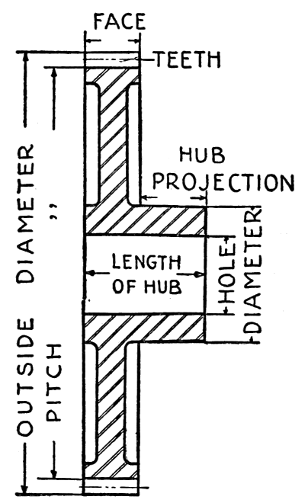
Fig. 129. CROSS SECTION OF GEAR
All miter gears that you buy ready cut are made so that their shafts run at right angles to each other as shown in Fig. 129, but you can have them cut to order to run at any angle you want.
To find the pitch, pitch diameter, circular pitch, etc., of both spur and bevel gears use these rules:
π = 3.14159
p = pitch
n = number of teeth
pd = pitch diameter
od = outside diameter
cp = circular pitch
To Find the Pitch:
p = n
pd
To Find the Number of Teeth:
n = p × pd
To Find the Pitch Diameter:
pd = n
p
To Find the Outside Diameter of Spur Wheels:
od = (2 + n)
p
To Find the Circular Pitch:
cp = π
pd
To Find the Distance Between the Centers of Two Spur Gears:
(n¹ + n²)
2
p
Where n¹ + n² = the sum of the teeth of both gears.
APPENDIX L SOME USEFUL ALLOYS
Name of Alloy Parts of Copper Parts of Tin Parts of Zinc Parts of Lead Parts of Other Metals
Gun Metal 91 9
Bell Metal 75 25
Phosphor Bronze 92½ 7 ½ phosphorus
Aluminum Bronze 90 10 aluminum
Common Brass 66⅔ 33⅓
Brazing Metal (soft) 50 12½ 37½
German Silver 60 20 20 nickel
Common Solder 50 50
Fine Solder 66⅔ 33⅓
Babbitt Metal 3 89 8 antimony
Pewter 80 20
Type Metal 80 20 antimony
Aluminum Solder 95 5 bismuth
Magnetic Alloy.—An alloy that has strong magnetic properties is made of 25 parts of manganese, 14 parts of aluminum and 61 parts of copper, yet none of these metals are even slightly magnetic.
APPENDIX M SOME HARD SOLDERS
Hard solders melt only at red heat and are used for soldering gold, silver, brass and other metals where a good strong joint is needed.
Metal to be Soldered Parts of Gold Parts of Brass Parts of Silver Parts of Zinc Parts of Other Metals
Gold 66.67 22.22 11.11 copper
Silver 43.75 50 6.25
Brass 87.5 12.5
APPENDIX N HIGH SPEED STEEL
A special steel alloy which is largely used for turning tools in engine lathes and which will cut ordinary steel when the latter is revolved at a high surface velocity is called high speed steel. A tool made of high speed steel will not lose its temper and will keep its cutting edge hour after hour if they are kept cool by a stream of water running on them. A good high speed steel for machine tools is known by the trade name of blue-chip and is manufactured by the Firth-Sterling Steel Company of Pittsburg, Pa.
APPENDIX O
SOME ELECTRICAL SYMBOLS, TERMS AND FORMULAS
Symbols Terms
E or EMF = Electromotive Force
I = Intensity of Current
R = Resistance
C = Capacity
Q = Quantity of Current
= Magneto-Motive Force

= Reluctance (magnetic resistance)

µ = Magnetic Permeability
W = Electric Energy
P = Electric Power
SOME DEFINITIONS
E or EMF, or electromotive force, is the force that moves a current through a conductor.
I, or intensity of current, or current as it is called for short, is the flow of electricity through a conductor.
R, or resistance is that property of a conductor which opposes the flow of the current.
SOME ELECTRICAL UNITS
Practical Units. Electrical Quantity
Volt is the practical unit of EMF
Ampere is the practical unit of I
Ohm is the practical unit of R
Watt is the practical unit of P
OHM’S LAW
Since the intensity of an electric current varies directly as the electromotive force and inversely as the resistance, if you know the value of any two of the above units you can easily find the third.
Amperes = Volts , or I = E
Ohms R
Electromotive Force = Current , or E = I
Resistance R
Resistance = Electromotive Force , or R = E
Current I
To Find Power of an Electric Current in Terms of Horse Power
One Watt = 1 volt × 1 ampere
746 Watts = 1 horse power.
To find the power of an electric current in terms of horse-power, find the number of watts by multiplying the volts by the amperes and divide the watts by 746 and the result will give you the horse-power of the current.
APPENDIX P NUMBER, DIAMETER, CAPACITY, WEIGHT, AND RESISTANCE OF PURE COPPER WIRE
Gage, B. & S. No. Diameter in 1000ths. Sectional Area in Circular Mils. Capacity in Amperes OHMS FEET POUNDS
Per 1,000 feet Per Mile Per Pound Per Pound Per Ohm Per 1,000 feet Per Ohm
0000 .460 211600. 312. .0490 .2590 .00007 1.5612 20497.7 640.59 12987.
000 .40964 167805. 262. .0618 .3266 .00012 1.9687 16255.27 507.85 8333.
00 .3648 133079. 220. .0780 .4118 .00019 2.4824 12891.37 402.83 5263.
0 .32486 105534. 185. .0983 .5190 .00031 3.1303 10223.08 319.45 3225.
1 .2893 83694. 156. .1240 .6549 .00049 3.9471 8107.49 253.34 2041.
2 .25763 66373. 131. .1564 .8258 .00078 4.9772 6429.58 200.91 1228.
3 .22942 52634. 110. .1972 1.0414 .00125 6.2765 5098.61 159.32 800.
4 .20431 41473. 92.3 .2486 1.313 .00198 7.9141 4043.6 126.35 505.
5 .18194 33102. 77.6 .3136 1.655 .00314 9.9798 3206.61 100.20 318.
6 .16202 26251. 65.2 .3954 2.088 .00499 12.5847 2542.89 79.462 200.
7 .14428 20817. 54.8 .4987 2.633 .00792 15.8696 2015.51 63.013 126.
8 .12849 16510. 46.1 .6529 3.3 .0125 20.0097 1599.3 49.976 80.
9 .11443 13094. 38.7 .7892 4.1 .0197 25.229 1268.44 39.636 50.
10 .10189 10382. 32.5 .8441 4.4 .0270 31.8212 1055.66 31.426 37.
11 .09074 8234. 27.3 1.254 6.4 .0501 40.1202 797.649 24.924 20.
12 .08080 6530. 23. 1.580 8.3 .079 50.5906 632.555 19.766 12.65
13 .07196 5178. 19.3 1.995 10.4 .127 63.7948 501.63 15.674 7.87
14 .06408 4107. 16.2 2.504 13.2 .200 80.4415 397.822 12.435 5.00
15 .05706 3257. 13.6 3.172 16.7 .320 101.4365 315.482 9.859 3.12
16 .05082 2583. 11.5 4.001 23. .512 127.12 250.184 7.819 1.95
17 .04525 2048. 9.6 5.04 26. .811 161.29 198.409 6.199 1.23
18 .04030 1624. 8.1 6.36 33. 1.29 203.374 157.35 4.916 .775
19 .03589 1288. 8.25 43. 2.11 256.468 124.777 3.899 .473
20 .03196 1021. 10.12 53. 3.27 323.399 98.9533 3.094 .305
21 .02846 810. 12.76 68. 5.20 407.815 78.473 2.452 .192
22 .02534 642. 16.25 85. 8.35 514.193 62.236 1.945 .119
23 .02257 509. 20.30 108. 13.3 648.452 49.3504 1.542 .075
24 .0201 404. 25.60 135. 20.9 817.688 39.1365 1.223 .047
25 .0179 320. 32.2 170. 32.2 1031.038 31.0381 .9699 .030
26 .01594 254. 40.7 214. 52.9 1300.180 24.6131 .7692 .0187
27 .01419 201. 51.3 270. 84.2 1639.49 19.5191 .6099 .0118
28 .01264 159.8 64.8 343. 134. 2067.364 15.4793 .4807 .0074
29 .01125 126.7 81.6 432. 213. 2606.959 12.2854 .3835 .0047
30 .01002 100.5 103. 538. 338. 3287.084 9.7355 .3002 .0029
31 .00892 79.7 130. 685. 539. 4414.49 7.7214 .2413 .0018
32 .00795 63. 164. 865. 856. 5226.915 6.1224 .1913 .0011
33 .00708 50.1 206. 1033. 1357. 6590.41 4.8557 .1517 .00076
34 .00630 39.74 260. 1389. 2166. 8312.8 3.8496 .1204 .00046
35 .00561 31.5 328. 1820. 3521. 10481.77 3.0530 .0956 .00028
36 .005 25. 414. 2200. 5469. 13214.16 2.4217 .0757 .00018
37 .00445 19.8 523. 2765. 8742. 16659.97 1.9208 .0600 .00011
38 .00396 15.72 660. 3486. 13722. 21013.25 1.5229 .0475 .00007
39 .00353 12.47 832. 4395. 21896. 26496.237 1.2077 .0375 .00004
40 .00314 9.88 1049. 5542. 34823. 33420.63 0.9798 .0299 .00002
APPENDIX Q NUMBER OF TURNS OF WIRE THAT CAN BE WOUND IN A GIVEN SPACE
No. B. & S. or American Gage COTTON SILK
SINGLE DOUBLE SINGLE DOUBLE
Per Square Inch. Per Square Qu. Inch Per Square Inch. Per Square Qu. Inch Per Square Inch. Per Square Qu. Inch Per Square Inch. Per Square Qu. Inch
20 676 42 576 36 841 52 676 42
21 842 53 625 39 961 60 842 53
22 1.024 64 729 45 1.225 76 1.024 64
23 1.024 81 900 56 1.521 95 1.296 81
24 1.600 100 1.089 68 1.936 121 1.600 100
25 1.849 115 1.296 81 2.304 144 1.849 115
26 2.209 138 1.440 90 2.916 182 2.209 138
27 2.500 156 1.600 100 3.249 206 2.500 156
28 3.025 189 1.849 115 4.096 254 3.025 189
29 3.481 218 2.025 126 4.761 297 3.481 218
30 4.356 272 2.500 156 6.400 400 4.356 272
31 5.001 315 2.704 169 7.769 485 5.041 315
32 5.929 370 3.025 189 9.025 564 5.929 370
33 7.089 443 3.481 218 11.025 689 7.089 443
34 7.769 485 3.600 225 12.321 770 7.769 485
35 8.100 506 3.844 240 13.689 855 8.100 506
36 10.000 625 4.356 272 17.689 1.105 10.000 625
37 11.025 689 4.761 297 20.164 1.240 11.025 689
38 12.321 770 5.041 315 23.716 1.482 12.321 770
39 13.689 855 5.476 342 27.556 1.722 13.689 855
40 15.625 976 5.929 370 32.761 2.047 15.625 976
(W. J. Clarke.)
APPENDIX R PRICES OF SINGLE AND DOUBLE SILK AND COTTON COVERED MAGNET WIRE
PRICE PER POUND
Size by B. & S. Gage Single Covered. Double Covered.
Cotton Silk Cotton Silk
16 $0.80 $1.02
17 .82 1.04
18 .84 1.06
19 .86 1.08
20 $0.58 .88 $0.64 1.12
21 .60 .90 .70 1.15
22 .62 .92 .74 1.22
23 .65 .96 .78 1.28
24 .68 1.02 .84 1.38
25 .73 1.10 .92 1.48
26 .80 1.20 1.00 1.65
27 .86 1.30 1.10 1.85
28 .92 1.40 1.20 2.00
29 .98 1.53 1.30 2.22
30 1.08 1.70 1.42 2.56
31 1.19 1.92 1.54 3.08
32 1.27 2.16 1.64 3.40
33 1.44 2.46 1.88 4.00
34 1.73 2.90 2.20 4.60
35 1.86 3.38 2.67 5.28
36 2.12 3.93 3.00 5.98
37 2.70 4.66 4.30 7.37
38 3.60 5.58 5.70 8.43
39 4.70 6.76 7.20 9.75
40 6.00 8.14 9.00 11.53
There is a discount of about 50 per cent. on the above prices though this is subject to change.
APPENDIX S A LIST OF SOME CHEMICAL ELEMENTS AND THEIR SYMBOLS
Element Symbol
Aluminum Al
Antimony Sb
Argon A
Arsenic As
Barium Bi
Boron B
Bromine Br
Cadmium Cd
Calcium Ca
Carbon C
Chlorine Cl
Chromium Cr
Cobalt Co
Copper Cu
Fluorine F
Gold Au
Helium He
Hydrogen H
Iodine I
Iron Fe
Lead Pb
Lithium Li
Magnesium Mg
Manganese Mn
Mercury Hg
Nickel Ni
Nitrogen N
Oxygen O
Phosphorus P
Potassium K
Platinum Pt
Silicon Si
Silver Ag
Sodium Na
Strontium Sr
Sulphur S
Tin Sn
Zinc Zn
APPENDIX T THE COMMON NAMES OF SOME CHEMICALS
Common Name Chemical Name
Alum Sulphate of ammonium, or potassium, etc.
Aqua fortis Nitric acid
Aqua regia Concentrated nitric and hydrochloric acid mixed.
Baking soda Sodium carbonate
Calomel Mercurious chloride
Carbolic acid Phenol
Caustic potash Potassium hydroxide
Caustic soda Sodium hydroxide
Chalk Calcium carbonate
Copperas Ferrous sulphate
Corrosive sublimate Mercuric chloride
Cream of tartar Potassium bitartrate
Epsom salts Magnesium sulphate
Fire damp Methane
Fool’s gold Iron pyrites
Glauber’s salt Sodium sulphate
Grape sugar Glucose; a carbohydrate
Hartshorn Aqueous solution of ammonia
Jeweler’s putty Tin oxide
Laughing gas Nitrous oxide
Lime Calcium oxide
Lunar caustic Silver nitrate
Mosaic gold Tin bisulphide
Muriatic acid Hydrochloric acid
Monsel’s salts Basic ferric sulphate
Plaster of Paris Calcium sulphate
Realgar Red arsenic sulphide
Red lead Lead oxide
Rochelle salt Sodium potassium tartrate
Royal water See Aqua regia
Sal ammoniac Ammonium chloride
Salt (common) Sodium chloride
Sal soda Sodium carbonate
Salt of tartar Potassium carbonate
Saltpeter Potassium nitrate
Salts of lemon Oxalic acid
Slacked lime Calcium hydrate
Soda Sodium carbonate
Spirits of salt Hydrochloric acid
Sugar of lead Lead acetate
Sugar of milk Lactose
Tartar emetic Potassium antimonious tartrate
Verdigris Copper acetate
Vermilion Mercuric sulphide
Vinegar Dilute acetic acid
Vitriol, blue Copper sulphate
Vitriol, green Ferrous sulphate
Vitriol, oil of Sulphuric acid
Vitriol, white Zinc sulphate
Volatile alkali Ammonia
Washing soda Sodium carbonate
White lead Lead carbonate
Zinc white Zinc sulfid
APPENDIX U THE FOUR CHIEF THERMOMETRIC SCALES
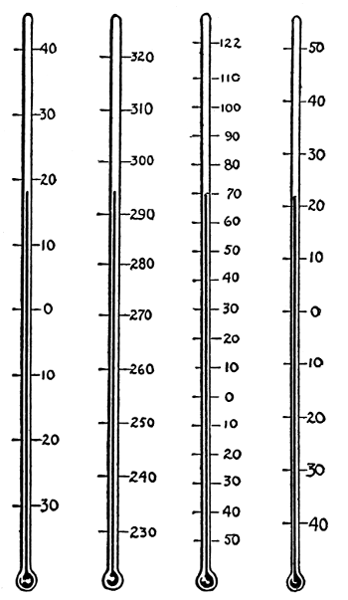
Fig. 130. The four chief thermometric scales: réaumur, absolute, fahrenheit and centigrade
There are four different thermometer scales used for measuring temperature and these are (1) the Fahrenheit scale which is widely used for all ordinary purposes; (2) the Centigrade which is the standard scale used for scientific work since it is based on the decimal system; (3) the Réaumur scale which is largely used in Germany, and (4) the absolute scale which is reckoned from absolute zero, that is the point at which there is absolutely no heat. It is about 461 degrees Fahr., 274 degrees centigrade, and 219 degrees Réaumur below the zero of these scales.
SOME WORDS AND TERMS USED IN THIS BOOK
Accelerate.—To hurry or speed up the usual slow state of events.
Actuate.—(1) To put into action. (2) Means by which anything is started to move. (See Operate).
Adhesion.—A force which makes certain bodies stick together.
Aërial Wire.—An elevated wire used to send out and to receive electric waves for wireless telegraphy and wireless telephony.
Affidavit.—A sworn statement made before a notary public or other legal authority.
Agent.—(1) A canvasser. (2) One who acts as a salesman or in any capacity for another.
Amend.—To change or correct, as to amend a claim in a patent.
Analysis.—See Chemical decomposition.
Arbor.—An axle, spindle, shaft or mandrel.
Archives.—A place in which official papers are kept and held secret.
Arlington wireless station.—A high powered wireless station at Arlington, Va., across the river from Washington, D. C.
Assignment.—To transfer to another a right or interest.
Attest.—To witness or to sign an oath that a thing is true.
Automatic.—A machine which performs certain operations of its own accord.
Aviation.—The art of flying.
Axis.—An imaginary line on or around which a body turns. (Plural Axes.)
Basic principle.—The first source or cause of a thing.
Biologist.—One who knows something about the science of life and living things.
Broker.—One who acts as an agent to negotiate purchases and make sales on a commission, as a stock-broker, coffee-broker, etc.
Capital.—Wealth that is used in or can be had for business.
Capital Stock.—The shares of a company that are sold to furnish funds with which to transact business.
Capitalize.—To fix a value on the stock of a company.
Case.—An application pending in the patent office.
Cause.—A suit or action over patent rights which is conducted in a court.
Certified copy.—A paper or a copy of a paper that has been sworn to before a notary to prove it to be the original or an exact copy of the original.
Chemical Combination.—(1) The atomic union of chemicals. (2) A compound of chemical elements.
Chemical Decomposition.—The separation of a compound with its original elements.
Circularize.—To send out circulars to a list of names.
Cite.—To quote a reference to an authority.
Citation.—An article or patent quoted by a patent examiner as a basis for the rejection of a patent application or of a claim.
Claim.—The last part of a patent specification in which the inventor clearly and specifically sets forth what his invention consists of and what he demands to have protected by a patent.
Claim, Broad.—(1) A broad claim is one in which the inventor claims everything in sight and usually more than he is entitled to. (2) It is easy to write a broad claim but hard to get it allowed.
Claim, Narrow.—(1) A narrow, or limited claim is one in which a patent attorney puts in so many elements or parts that the combination is bound to be patentable. (2) Such a claim has no value because it is easy for another to change an element or a part when the combination no longer infringes. (3) The hardest thing that an inventor has to contend with is to get a claim written so that it will stand in court.
Coincide.—Exactly corresponding to or meeting.
Conceive.—To get an idea.
Commission Merchant.—A man who stands between the manufacturer and the wholesaler and who gets a percentage on the amount of goods that change hands.
Commissioner of Patents.—The head, front and center of the patent office.
Concentric Circles.—Circles drawn within circles and all of them having the same center.
Corporation.—(1) A company. (2) An imaginary person invented by law and formed of one or more real persons banded together to transact business.
Correspondent.—(1) An associate. (2) A lawyer that carries on his business with another lawyer at a distance.
Consumer.—The last buyer and the user of an article or a device.
Cross-section.—See Drawing, Cross-section.
Counsel.—A patent attorney who is qualified to prosecute patent cases in court.
Data.—Information that is known or may be had.
Deductive Proof.—That form of thought by which an idea used as a starting point is brought to a conclusion by known principles and facts. (See Inductive Discovery.) Inductive discovery is the raw idea and does not lead up to certainty, whereas deductive proof does.
Degree.—(1) One three hundred and sixtieth part of a circle. (2) The unit of angular measurement.
Detailed Drawing.—See Drawing, Detailed.
Device.—(1) An apparatus or an instrument, or a machine or any part of any of them. (2) Any scheme for producing a desired result.
Die.—A steel tool having a sharp edge for cutting out special designs in paper, metals, etc.
Directors.—Members of a company chosen to direct its business.
Disclose.—(1) To make known. (2) To give up the secret of your invention.
Display ad.—An advertisement in which larger type is used than for the reading matter of the paper.
Dividends.—Money resulting from profits and which are distributed among the shareholders.
Drawing, Free Hand.—Pictures drawn without measurements or the aid of instruments.
Drawing, Working.—A drawing of a part, device or machine made to scale so that a mechanic can work from it.
Drawing, Cross Section.—A drawing of an object as though it had been cut in two in order to show its inside construction.
Drawing, Detail.—A drawing of any part of a device or a machine made large enough to show everything no matter how small.
Drawing, Perspective.—A drawing of a solid object on a flat surface so that it seems to stand out in space like the object itself.
Drawing, Isometric perspective.—See Isometric Perspective.
Du Ponts.—A firm at Wilmington, Delaware, who manufactures gun-powder and other explosives.
Efficient.—That which works the best with the greatest economy.
Element.—(1) A chemical element is a form of matter which cannot be decomposed. (2) A mechanical element is a single part of a device or a machine.
Electrolytic.—The decomposition of a chemical compound by an electric current.
Electroplating.—Depositing one metal on another metal by an electric current.
Electrotype.—A duplicate of type or cuts for printing, the body of which is of type-metal and the face of copper which has been deposited by an electric current.
Electrolytic.—Decomposition of a substance, or a solution by means of an electric current.
Electrolysis.—About the same as electrolytic.
Elementary.—Simple; primary.
Electro-Chemistry.—Chemistry in which electricity is used.
Engine lathe.—A large and accurate screw cutting lathe fitted with all known attachments.
Entering Edge.—The front edge of the main plane of an aeroplane.
Ether.—A substance filling all space and in, by and through which light, electricity and magnetism acts and travels.
Evidence of conception.—A signed and sealed statement made at the time or shortly after you get the big idea which will serve as proof of the earliest time you thought of it.
Excerpt.—A part, or an extract of an article.
Expert.—One who is trained or is skilful, due to learning and practice.
Experiment.—(1) To find out an effect, or the cause of it by trials and tests. (2) To work out a process for the purpose of developing an idea. (3) To show the effect of some previous discovery or invention.
Files.—Patents that are arranged systematically for easy reference.
Fixture.—See Jig.
Free-hand Drawing.—See Drawing, Free-hand.
Full paid.—Stock that has been paid for either in cash or by a patented invention.
High Frequency Oscillations.—(1) Electric oscillations. (2) Electric currents which alternate in direction 100,000 or more a second.
Idea, Raw.—The first idea that comes into the mind as a basis for an invention.
Improvement.—(1) Adding a new element or part to a composition, device or a machine. (2) An improvement constitutes an invention and can be patented.
Impulse.—A turbine wheel turned by steam forced against its blades.
Initiative.—The first step or action.
Indicate.—To point out. To show how a thing is done.
Inductive Discovery.—(1) The raw, or original idea that results from the mind process. It precedes deductive proof.
Inherent stability.—A natural tendency of a body to remain balanced, or when upset to right itself.
Isometric.—Of equal measure or scale.
Isometric Perspective.—Three sets of lines of equal measure, that is 120 degrees apart which represent the three dimensions of space.
Isometric Cross-section paper.—Paper ruled with lines of equal measure for making isometric perspective drawings.
Jig.—A tool, or fixture used as a guide for cutting tools where duplicate parts are made by a machine.
Jobber.—A man who buys in large quantities for the manufacturer and sells them to wholesalers or retailers.
Key.—A tapering wedge for fastening the collar of a wheel on a part of a shaft.
Litigation.—Law suits.
Low Voltage Currents.—(1) Currents having a pressure up to 500 volts. (2) Ordinary battery and lighting currents are low voltage.
Machine Design.—The scientific designing of machines.
Math.—Abbreviation for mathematics.
Maxims, Hiram and Hudson.—Inventors of high explosives, machine guns and other things that make for peace in times of war, and make for war in times of peace.
Mechanical Movement.—(1) The simplest form of a machine. (2) A combination of two or more of the mechanical powers.
Memorandum.—A written outline of an agreement, or a contract.
Micawber.—A character in Dickens’ David Copperfield. He was never able to get down to anything but was always waiting for something to turn up.
Model.—(1) An object or a device made to represent an apparatus or a machine. (2) A device made to show how an apparatus or a machine works. (3) Scale models are smaller than the machines they represent and may be built either to show how the finished apparatus will appear or they may be actual working models.
Monopoly.—The sole right to make, use and sell an invention or the product of an invention.
Notary Public.—A commissioned official who holds a seal of his office and who certifies papers, etc.
Oath.—A sworn statement of the truth.
Operate.—(1) To put into motion. (2) To do mechanical work. (See Actuate.)
Ozone.—A colorless gas formed by discharging electricity through the air or oxygen.
Paper patent.—A patent granted by the patent office for an idea that has never been worked out in practice.
Part.—A small portion of a device or a machine.
Par value.—The full, or face value.
Patent attorney.—A lawyer who makes patent law his business or ought to.
Patent Expert.—One who is specially trained in an art or a science which enables him to give expert testimony in patent causes.
Patent Office.—(1) The building in which the patent business of the government is transacted. (2) The office conducted by the government for handling of its patent business. (3) The patent office of the U. S. is one of the bureaus of the Department of the Interior and it is under the direction of a commissioner of patents.
Patent Examiner.—One who examines and passes on patents in the patent office.
Patentee.—The one to whom a patent is granted.
Periphery.—(1) The circumference of a circle. (2) The outer surface of a wheel.
Perspective Drawing.—See Drawing, Perspective.
Perspective, Isometric.—See Isometric Perspective.
Philosophy.—(1) The science of all natural laws. (2) The laws, causes and principles on which facts can be explained. (See Psychology.)
Precision.—(1) The state of being very accurate. (2) Said of any instrument or machine which works with exactness.
Principle.—A truth or cause.
Priority.—Being first.
Protractor.—An instrument for laying off and measuring angles by degrees.
Prosecute.—To follow up until a conclusion is reached.
Pro Rata.—In proportion.
Psychological moment.—The exact time to impress the mind in the best way.
Psychology.—(1) A branch of philosophy. (2) The science of the mind and its operations.
Ramifications.—Subdivisions of a subject or branches of a thing.
Reaction.—A turbine wheel turned by steam forced from it against the air.
Rectify.—(1) To make right whatever is wrong. (2) To make a direct current of an alternating current.
Rectangle.—A four sided plane with right angle corners.
Reject.—To refuse to accept, as to reject a claim in a patent.
Retainer.—The advance fee paid to an attorney.
Retailer.—A man who buys in small quantities and sells piecemeal to consumers.
Royalty.—A share of the profits paid to the owner of a patented article or a device by those whom he allows to make or use it.
Scale.—A piece of wood, metal or other material with graduated lines on it and used for measuring.
Securities.—Property of any kind which has enough value to keep the credit good.
Semi-circle.—(1) Half of a circle. (2) A segment of a circle equal to 180 degrees.
Shares.—(1) The equal parts of the capital stock of a company. (2) The shares are represented by certificates.
Shareholder.—An owner of the shares of stock of a company.
Shop-right license.—A legal permit given to the owner of a shop to make and sell a patented article or device.
Sketch.—A crude picture.
Standardize.—To make a device or a machine to conform to a certain type.
Stockholder.—An owner of the shares of the stock in a company.
Stock.—(1) The shares of a company which represent its capital. (2) Goods traded in for a profit. (3) The raw materials used for manufacturing purposes. (4) The manufactured goods that are held in reserve.
St. Elmo’s Fire.—An electric glow which is often seen at the end of a spar of a ship at night.
Synthesis.—To combine chemical elements to form a compound.
Synthetic.—A chemically prepared substance which is exactly like that found in nature, as synthetic camphor, synthetic sapphires, etc.
Technical Expert.—See Patent expert.
Transfer of Energy.—Changing the energy of one body to another body.
Transformation of Energy.—Changing the form of energy, as from electricity to magnetism, or from heat to light.
Transactions, or Proceedings.—The published reports of scientific and other societies.
Treasury stock.—The shares that belong to the company and which are used to provide it with working capital.
Trustees.—About the same thing as directors.
Tungsten.—A steel gray metallic element.
Tyro.—A beginner.
Useful art.—Anything which requires ingenuity to fashion, and which can be used for some good purpose.
Valid.—(1) That which holds good. (2) A patent that is founded on fact and in law.
Who’s Who.—A red book of noted men and women living in the United States.
Wholesaler.—One who buys and sells in large quantities.
Wing.—The main or supporting plane of an aeroplane.
Working Drawing.—See Drawing, Working.