Chapter XXXIV
Reading edition
HISTORY OF PHYSICAL AND OTHER LITERATURE FROM 1650 TO 1700.
Sect. I.
ON EXPERIMENTAL PHILOSOPHY.
Institutions for Science at Florence—London—Paris—Chemistry—Boyle and others.
Reasons for omitting mathematics. 1. We have now arrived, according to the method pursued in corresponding periods, at the history of mathematical and physical science in the latter part of the seventeenth century. But I must here entreat my readers to excuse the omission of that which ought to occupy a prominent situation in any work that pretends to trace the general progress of human knowledge. The length to which I have found myself already compelled to extend these volumes, might be an adequate apology; but I have one more insuperable in the slightness of my own acquaintance with subjects so momentous and difficult, and upon which I could not write without presumptuousness and much peril of betraying ignorance. The names, therefore, of Wallis and Huygens, Newton and Leibnitz, must be passed with distant reverence.
Academy del Cimento. 2. This was the age, when the experimental philosophy, to which Bacon had held the torch, and which had already made considerable progress, especially in Italy, was finally established on the ruins of arbitrary figments and partial inductions. This philosophy was signally indebted to three associations, the eldest of which did not endure long; but the others have remained to this day, the perennial fountains of science; the Academy del Cimento at Florence, the Royal Society of London, the Academy of Sciences at Paris. The first of these was established in 1657, with the patronage of the Grand Duke Ferdinand II., but under the peculiar care of his brother Leopold. Both were, in a manner at that time remarkable, attached to natural philosophy; and Leopold, less engaged in public affairs, had long carried on a correspondence with the learned of Europe. It is said that the advice of Viviani, one of the greatest geometers that Europe has produced, led to this institution. The name this Academy assumed, gave promise of their fundamental rule, the investigation of truth by experiment alone. The number of Academicians was unlimited, and all that was required as an article of faith was the abjuration of all faith, a resolution to inquire into truth without regard to any previous sect of philosophy. This Academy lasted, unfortunately, but ten years in vigour; it is a great misfortune for any literary institution to depend on one man, and especially on a prince, who, shedding a factitious, as well as sometimes a genuine lustre round it, is not easily replaced without a diminution of the world’s regard. Leopold, in 1667, became a cardinal, and was thus withdrawn from Florence; others of the Academy del Cimento died or went away, and it rapidly sunk into insignificance. But a volume containing reports of the yearly experiments it made, among others, the celebrated one showing the incompressibility of water, is generally esteemed.[1060]
Royal Society. 3. The germ of our Royal Society may be traced to the year 1645, when Wallis, Wilkins, Glisson, and others less known, agreed to meet weekly at a private house in London, in order to converse on subjects connected with natural, and especially experimental philosophy. Part of these soon afterwards settled in Oxford; and thus arose two little societies in connection with each other, those at Oxford being recruited by Ward, Petty, Willis, and Bathurst. They met at Petty’s lodgings till he removed to Ireland in 1652; afterwards at those of Wilkins, in Wadham College, till he became Master of Trinity College, Cambridge, in 1659; about which time most of the Oxford philosophers came to London, and held their meetings in Gresham College. They became more numerous after the Restoration, which gave better hope of a tranquillity indispensable for science; and, on the 28th of November, 1660, agreed to form a regular society which should meet weekly for the promotion of natural philosophy; their registers are kept, from this time.[1061] The king, rather fond himself of their subjects, from the beginning afforded them his patronage; their first charter is dated 15th July, 1662, incorporating them by the style of the Royal Society, and appointing Lord Brouncker the first president, assisted by a council of twenty, the conspicuous names among which are Boyle, Kenelm Digby, Wilkins, Wren, Evelyn, and Oldenburg.[1062] The last of these was secretary, and editor of the Philosophical Transactions, the first number of which appeared March 1, 1665, containing sixteen pages in quarto. These were continued monthly, or less frequently, according to the materials he possessed. Oldenburg ceased to be the editor in 1677, and was succeeded by Grew, as he was by Hooke. These early transactions are chiefly notes of conversations and remarks made at the meetings, as well as of experiments either then made or reported to the Society.[1063]
Academy of Sciences at Paris. 4. The Academy of Sciences at Paris was established in 1666, under the auspices of Colbert. The king assigned to them a room in the royal library for their meetings. Those first selected were all mathematicians; but other departments of science, especially chemistry and anatomy, afterwards furnished associates of considerable name. It seems, nevertheless, that this Academy did not cultivate experimental philosophy with such unremitting zeal as the Royal Society, and that abstract mathematics have always borne a larger proportion to the rest of their inquiries. They published in this century ten volumes, known as Anciens Mémoires de l’Académie. But near its close, in 1697, they received a regular institution from the king, organising them in a manner analogous to the two other great literary foundations, the French Academy, and that of Inscriptions and Belles Lettres.[1064]
State of Chemistry. 5. In several branches of physics, the experimental philosopher is both guided and corrected by the eternal laws of geometry. In others he wants this aid, and, in the words of his master, knows and understands no more concerning the order of nature, than, as her servant and interpreter, he has been taught by observation and tentative processes. All that concerns the peculiar actions of bodies on each other was of this description; though, in our own times, even this has been, in some degree, brought under the omnipotent control of the modern analysis. Chemistry, or the science of the molecular constituents of bodies, manifested in such peculiar and reciprocal operations, had never been rescued from empirical hands till this period. The transmutation of metals, the universal medicine, and other inquiries utterly unphilosophical in themselves, because they assumed the existence of that which they sought to discover, had occupied the chemists so much that none of them had made any further progress than occasionally by some happy combination or analysis, to contribute an useful preparation to pharmacy, or to detect an unknown substance. Glauber and Van Helmont were the most active and ingenious of these elder chemists; but the former has only been remembered by having long given his name to sulphate of soda, while the latter wasted his time on experiments from which he knew not how to draw right inferences, and his powers on hypotheses which a sounder spirit of the inductive philosophy would have taught him to reject.[1065]
Becker. 6. Chemistry, as a science of principles, hypothetical, no doubt, and in a great measure unfounded, but cohering in a plausible system, and better than the reveries of the Paracelsists and Behmenists, was founded by Becker, in Germany, by Boyle and his contemporaries of the Royal Society in England. Becker, a native of Spire, who, after wandering from one city of Germany to another, died in London in 1685, by his Physica Subterranea, published in 1669, laid the foundation of a theory, which having in the next century been perfected by Stahl, became the creed of philosophy till nearly the end of the last century. “Becker’s theory,” says an English writer, “stripped of everything but the naked statement, may be expressed in the following sentence: besides water and air there are three other substances, called earths, which enter into the composition of bodies; namely the fusible or vitrifiable earth, the inflammable or sulphureous, and the mercurial. By the intimate combination of earths with water is formed an universal acid, from which proceed all other acid bodies; stones are produced by the combination of certain earths, metals by the combination of all the three earths in proportions which vary according to the metal.”[1066]
Boyle. 7. No one Englishman of the seventeenth century, after Lord Bacon, raised to himself so high a reputation in experimental philosophy as Robert Boyle; it has even been remarked, that he was born in the year of Bacon’s death, as the person destined by nature to succeed him. An eulogy which would be extravagant, if it implied any parallel between the genius of the two; but hardly so, if we look on Boyle as the most faithful, the most patient, the most successful disciple who carried forward the experimental philosophy of Bacon. His works occupy six large volumes in quarto. They may be divided into theological or metaphysical, and physical or experimental. Of the former, we may mention, as the most philosophical, his Disquisition into the Final Causes of Natural Things, his Free Inquiry into the Received Notion of Nature, his Discourse of Things above Reason, his Considerations about the Reconcilableness of Reason and Religion, his Excellency of Theology, and his Considerations on the Style of the Scriptures; but the latter, his chemical and experimental writings, form more than two thirds of his prolix works.
His metaphysical works. 8. The metaphysical treatises, to use that word in a large sense, of Boyle, or rather those concerning Natural Theology, are very perspicuous, very free from system, and such as bespeak an independent lover of truth. His Disquisition on Final Causes, was a well-timed vindication of that palmary argument against the paradox of the Cartesians, who had denied the validity of an inference from the manifest adaptation of means to ends in the universe to an intelligent Providence. Boyle takes a more philosophical view of the principle of final causes than had been found in many theologians, who weakened the argument itself by the presumptuous hypothesis, that man was the sole object of Providence in the Creation.[1067] His greater knowledge of physiology led him to perceive that there are both animal, and what he calls cosmical ends, in which man has no concern.
Extract from one of them. 9. The following passage is so favourable a specimen of the philosophical spirit of Boyle, and so good an illustration of the theory of idols in the Novum Organum, that, although it might better, perhaps, have deserved a place in a former chapter, I will not refrain from inserting it. “I know not,” he says, in his Free Inquiry into the received Notion of Nature, “whether it be a prerogative in the human mind, that, as it is itself a true and positive being, so is it apt to conceive all other things as true and positive beings also; but whether or no this propensity to frame such kind of ideas supposes an excellency, I fear it occasions mistakes, and makes us think and speak after the manner of true and positive beings, of such things as are but chimerical, and some of them negations or privations themselves; as death, ignorance, blindness, and the like. It concerns us, therefore, to stand very carefully upon our guard, that we be not insensibly misled by such an innate and unheeded temptation to error, as we bring into the world with us.”[1068]
His merits in physics and chemistry. 10. Boyle improved the air-pump and the thermometer, though the latter was first made an accurate instrument of investigation by Newton. He also discovered the law of the air’s elasticity, namely, that its bulk is inversely as the pressure. For some of the principles of hydrostatics we are indebted to him, though he did not possess much mathematical knowledge. The Philosophical Transactions contain several valuable papers by him on this science.[1069] By his “Sceptical Chemist,” published in 1661, he did much to overturn the theories of Van Helmont’s school, that commonly called of the iatro-chemists, which was in its highest reputation; raising doubts as to the existence, not only of the four elements of the peripatetics, but of those which these chemists had substituted. Boyle holds the elements of bodies to be atoms of different shapes and sizes, the union of which gives origin to what are vulgarly called elements.[1070] It is unnecessary to remark that this is the prevailing theory of the present age.
General character of Boyle. 11. I shall borrow the general character of Boyle and of his contemporaries in English chemistry from a modern author of credit. “Perhaps Mr. Boyle may be considered as the first person neither connected with pharmacy nor mining, who devoted a considerable degree of attention to chemical pursuits. Mr. Boyle, though in common with the literary men of his age he may be accused of credulity, was both very laborious and intelligent; and his chemical pursuits, which were various and extensive, and intended solely to develop the truth without any regard to previously conceived opinions, contributed essentially to set chemistry free from the trammels of absurdity and superstition, in which it had been hitherto enveloped, and to recommend it to philosophers as a science deserving to be studied on account of the important information which it was qualified to convey. His refutation of the alchemistical opinions respecting the constituents of bodies, his observations on cold, on the air, on phosphorus, and on ether, deserve particularly to be mentioned as doing him much honour. We have no regular account of any one substance or of any class of bodies in Mr. Boyle, similar to those which at present are considered as belonging exclusively to the science of chemistry. Neither did he attempt to systematize the phenomena, or to subject them to any hypothetical explanation.
Of Hooke and others. 12. But his contemporary, Dr. Hooke, who had a particular predilection for hypothesis, sketched in his Micrographia a very beautiful theoretical explanation of combustion, and promised to develop his doctrine more fully in a subsequent book; a promise which he never fulfilled; though in his Lampas, published about twenty years afterwards, he has given a very beautiful explanation of the way in which a candle burns. Mayow, in his Essays, published at Oxford about ten years after the Micrographia, embraced the hypothesis of Dr. Hooke without acknowledgment; but clogged it with so many absurd additions of his own as greatly to obscure its lustre and diminish its beauty. Mayow’s first and principal Essay contains some happy experiments on respiration and air, and some fortunate conjectures respecting the combustion of the metals; but the most valuable part of the whole is the chapter on affinities; in which he appears to have gone much farther than any other chemist of his day, and to have anticipated some of the best established doctrines of his successors. Sir Isaac Newton, to whom all the sciences lie under such great obligations, made two most important contributions to chemistry, which constitute, as it were, the foundation stones of its two great divisions. The first was pointing out a method of graduating thermometers, so as to be comparable with each other in whatever part of the world observations with them are made. The second was by pointing out the nature of chemical affinity, and showing that it consisted in an attraction by which the constituents of bodies were drawn towards each other and united; thus destroying the previous hypothesis of the hooks, and points, and rings, and wedges, by means of which the different constituents of bodies were conceived to be kept together.”[1071]
Lemery. 13. Lemery, a druggist at Paris, by his Cours de Chymie in 1675, is said to have changed the face of the science; the change, nevertheless, seems to have gone no deeper. “Lemery,” says Fontenelle, “was the first who dispersed the real or pretended obscurities of chemistry, who brought it to clearer and more simple notions, who abolished the gross barbarisms of its language, who promised nothing but what he knew the art could perform; and to this he owed the success of his book. It shows not only a sound understanding, but some greatness of soul, to strip one’s own science of a false pomp.”[1072] But we do not find that Lemery had any novel views in chemistry, or that he claims with any irresistible pretension the title of a philosopher. In fact, his chemistry seems to have been little more than pharmacy.
Sect. II.
ON NATURAL HISTORY.
Zoology—Ray—Botanical Classifications—Grew—Geological Theories.
Slow Progress of Zoology. 14. The accumulation of particular knowledge in Natural History must always be progressive, where any regard is paid to the subject; every traveller in remote countries, every mariner may contribute some observation, correct some error, or bring home some new species. Thus zoology had made a regular advance from the days of Conrad Gesner; yet, with so tardy a step, that, reflecting on the extensive intercourse of Europe with the Eastern and Western world, we may be surprised to find how little Jonston in the middle of the seventeenth century, had added, even in the most obvious class, that of quadrupeds, to the knowledge collected one hundred years before. But hitherto zoology, confined to mere description, and that often careless or indefinite, unenlightened by anatomy, unregulated by method, had not merited the name of a science. That name it owes to John Ray.
Before Ray. 15. Ray first appeared in Natural History as the editor of the Ornithology of his highly accomplished friend Francis Willoughby, with whom he had travelled over the continent. This was published in 1676; and the History of Fishes followed in 1686. The descriptions are ascribed to Willoughby, the arrangement to Ray, who might have considered the two works as in great part his own, though he has not interfered with the glory of his deceased friend. Cuvier observes, that the History of Fishes is the more perfect work of the two, that many species are described which will not be found in earlier ichthyologists, and that those of the Mediterranean especially are given with great precision.[1073]
His Synopsis of Quadrupeds. 16. Among the original works of Ray we may select the Synopsis Methodica Animalium Quadrupedum et Serpentini Generis, published in 1693. This book makes an epoch in zoology, not for the additions of new species it contains, since there are few wholly such, but as the first classification of animals that can be reckoned both general and grounded in nature. He divides them into those with blood and without blood. The former are such as breathe through lungs, and such as breathe through gills. Of the former of these again some have a heart with two ventricles, some with one only. And among the former class of these some are viviparous, some oviparous. We thus come to the proper distinction of Mammalia. But in compliance with vulgar prejudice, Ray did not include the cetacea in the same class with quadrupeds, though well aware that they properly belonged to it, and left them as an order of fishes.[1074] Quadrupeds he was the first to divide into ungulate and unguiculate, hoofed and clawed, having himself invented the Latin words.[1075] The former are solidipeda, bisulca, or quadrisulca; the latter are bifida or multifida; and these latter with undivided, or with partially divided toes; which latter again may have broad claws, as monkeys, or narrow claws; and these with narrow claws he arranges according to their teeth, as either carnivora, or leporina, now generally called rodentia. Besides all these quadrupeds which he calls analoga, he has a general division called anomala, for those without teeth, or with such peculiar arrangements of teeth as we find in the insectivorous genera, the hedgehog and mole.[1076]
Merits of this work. 17. Ray was the first zoologist who made use of comparative anatomy; he inserts at length every account of dissections that he could find; several had been made at Paris. He does not appear to be very anxious about describing every species; thus in the simian family he omits several well known.[1077] I cannot exactly determine what quadrupeds he has inserted that do not appear in the earlier zoologists; according to Linnæus, in the twelfth-edition of the Systema Naturæ, if I have counted rightly, they amount to thirty-two; but I have found him very careless in specifying the synonyms of his predecessors, and many for which he only quotes Ray, are in Gesner or Jonston. Ray has however much the advantage over these in the brevity and closeness of his specific characters. The particular distinction of his labours, says Cuvier, consists in an arrangement more clear, more determinate than those of any of his predecessors, and applied with more consistency and precision. His distribution of the classes of quadrupeds and birds have been followed by the English naturalists almost to our own days; and we find manifest traces of that he has adopted as to the latter class in Linnæus, in Brisson, in Buffon, and in all other ornithologists.[1078]
Redi. 18. The bloodless animals, and even those of cold blood, with the exception of fishes, had occupied but little attention of any good zoologists till after the middle of the century. They were now studied with considerable success. Redi, established as a physician at Florence, had yet time for that various literature which has immortalized his name. He opposed, and in a great degree disproved by experiment, the prevailing doctrine of the equivocal generation of insects, or that from corruption; though where he was unable to show the means of reproduction, he had recourse to a paradoxical hypothesis of his own. Redi also enlarged our knowledge of intestinal animals, and made some good experiments on the poison of vipers.[1079] Malpighi, who combated like Redi, the theory of the reproduction of organised bodies from mere corruption, has given one of the most complete treatises on the silkworm that we possess.[1080] |Swammerdam.| Swammerdam, a Dutch naturalist, abandoned his pursuits in human anatomy to follow up that of insects, and by his skill and patience in dissection made numerous discoveries in their structure. His General History of Insects 1669, contains a distribution into four classes, founded on their bodily forms and the metamorphoses they undergo. A posthumous work, Biblia Naturæ, not published till 1738, contains, says the Biographie Universelle, “a multitude of facts wholly unknown before Swammerdam; it is impossible to carry farther the anatomy of these little animals, or to be more exact in the description of the organs.”
Lister. 19. Lister, an English physician, may be reckoned one of those who have done most to found the science of conchology by his Historia sive Synopsis Conchyliorum, in 1685; a work very copious and full of accurate delineations: and also by his three treatises on English animals, two of which relate to fluviatile and marine shells. The third, which is on spiders, is not less esteemed in entomology. Lister was also perhaps the first to distinguish the specific characters, such at least as are now reckoned specific, though probably not in his time, of the Asiatic and African elephant. “His works in natural history and comparative anatomy are justly esteemed, because he has shown himself an exact and sagacious observer, and has pointed out with correctness the natural relations of the animals that he describes.”[1081]
Comparative anatomy. 20. The beautiful science which bears the nonsensical name of comparative anatomy had but casually occupied the attention of the medical profession.[1082] It was to them, rather than to mere zoologists, that it owed, and indeed strictly must always owe, its discoveries, which had hitherto been very few. It was now more cultivated; and the relations of structure to the capacities of animal life became more striking, as their varieties were more fully understood; the grand theories of final causes found their most convincing arguments. In this period, I believe, comparative anatomy made an important progress, which in the earlier part of the eighteenth century was by no means equally rapid. France took the lead in these researches. “The number of papers on comparative anatomy,” says Dr. Thomson, “is greater in the memoirs of the French Academy than in our national publication. This was owing to the pains taken during the reign of Louis XIV. to furnish the Academy with proper animals, and the number of anatomists who received a salary, and of course devoted themselves to anatomical subjects.” There are however about twenty papers in the Philosophical Transactions before 1700 on this subject.[1083]
Botany. 21. Botany, notwithstanding the gleams of philosophical light which occasionally illustrate the writings of Cæsalpin and Columna, had seldom gone farther than to name, to describe, and to delineate plants with a greater or less accuracy and copiousness. Yet it long had the advantage over zoology, and now when the latter made a considerable step in advance, it still continued to keep a-head. This is a period of great importance in botanical science. |Jungius.| Jungius of Hamburgh, whose posthumous Isagoge Phytoscopica was published in 1679, is said to have been the first in the seventeenth century who led the way to a better classification than that of Lobel; and Sprengel thinks that the English botanists were not unacquainted with his writings; Ray indeed owns his obligations to them.[1084]
Morison. 22. But the founder of classification, in the eyes of the world, was Robert Morison, of Aberdeen, professor of botany at Oxford; who, by his Hortus Blesensis, in 1669; by his Plantarum Umbelliferarum Distributio Nova, in 1672; and chiefly by his great work Historia Plantarum Universalis, in 1678, laid the bases of a systematic classification, which he partly founded, not on trivial distinctions of appearance, as the older botanists, but, as Cæsalpin had first done, on the fructifying organs. He has been frequently charged with plagiarism from that great Italian, who seems to have suffered, as others have done, by failing to carry forward his own luminous conceptions into such details of proof as the world justly demands; another instance of which has been seen in his very striking passages on the circulation of the blood. Sprengel, however, who praises Morison highly, does not impute to him this injustice towards Cæsalpin, whose writings might possibly be unknown in Britain.[1085] And it might be observed also, that Morison did not as has sometimes been alledged, establish the fruit as the sole basis of his arrangement. Out of fifteen classes, into which he distributes all herbaceous plants, but seven are characterised by this distinction.[1086] “The examination of Morison’s works,” says a late biographer, “will enable us to judge of the service he rendered in the reformation of botany. The great botanists, from Gesner to the Bauhins, had published works, more or less useful by their discoveries, their observations, their descriptions, or their figures. Gesner had made a great step in considering the fruit as the principal distinction of genera. Fabius Columna adopted this view; Cæsalpin applied it to a classification which should be regarded as better than any that preceded the epoch of which we speak. Morison had made a particular study of fruits, having collected 1,500 different species of them, though he did not neglect the importance of the natural affinities of other parts. He dwells on this leading idea, insists on the necessity of establishing generic characters, and has founded his chief works on this basis. He has therefore done real service to the science; nor should the vanity which has made him conceal his obligations to Cæsalpin induce us to refuse him justice.”[1087] Morison speaks of his own theory with excessive vanity, and deprecates all earlier botanists as full of confusion. Several English writers have been unfavourable to Morison, out of partiality to Ray, with whom he was on bad terms; but Tournefort declares that if he had not enlightened botany it would still have been in darkness.
Ray. 23. Ray, in his Methodus Plantarum Nova, 1682, and in his Historia Plantarum Universalis, in three volumes, the first published in 1686, the second in 1688, and the third, which is supplemental, in 1704, trod in the steps of Morison, but with more acknowledgment of what was due to others, and with some improvements of his own. He described 6,900 plants, many of which are now considered as varieties.[1088] In the botanical works of Ray we find the natural families of plants better defined, the difference of complete and incomplete flowers more precise, and the grand division of monocotyledons and bicotyledons fully established. He gave much precision to the characteristics of many classes, and introduced several technical terms, very useful for the perspicuity of botanical language; finally, he established many general principles of arrangement which have since been adopted.[1089] Ray’s method of classification was principally by the fruit, though he admits its imperfections. “In fact, his method,” says Pulteney, “though he assumes the fruit as the foundation, is an elaborate attempt, for that time, to fix natural classes.”[1090]
Rivinus. 24. Rivinus, in his Introductio in Rem Herbariam, Leipsic, 1690, a very short performance, struck into a new path, which has modified to a great degree the systems of later botanists. Cæsalpin and Morison had looked mainly to the fruit as the basis of classification; Rivinus added the flower, and laid down as a fundamental rule that all plants which resemble each other both in the flower and in the fruit ought to bear the same generic name.[1091] In some pages of this Introduction, we certainly find the basis of the Critica Botanica of Linnæus.[1092] Rivinus thinks the arrangement of Cæsalpin the best, and that Morison has only spoiled what he took; of Ray he speaks in terms of eulogy, but blames some part of his method. His own is primarily founded on the flower, and thus he forms eighteen classes, which, by considering the differences of the fruits, he subdivides into ninety-one genera. The specific distinctions he founded on the general habit and appearance of the plant. His method is more thoroughly artificial, as opposed to natural; that is, more established on a single principle, which often brings heterogeneous plants and families together, than that of any of his predecessors; for even Ray had kept the distinction of trees from shrubs and herbs, conceiving it to be founded in their natural fructification. Rivinus set aside wholly this leading division. Yet he had not been able to reduce all plants to his method, and admitted several anomalous divisions.[1093]
Tournefort. 25. The merit of establishing an uniform and consistent system was reserved for Tournefort. His Elémens de la Botanique appeared in 1694; the Latin translation, Institutiones Rei Herbariæ, in 1700. Tournefort, like Rivinus, took the flower, or corolla, as the basis of his system; and the varieties in the structure, rather than number, of the petals furnish him with his classes. The genera—for, like other botanists before Linnæus, he has no intermediate division—are established by the flower and fruit conjointly, or now and then by less essential differences, for he held it better to constitute new genera than, as others had done, to have anomalous species. The accessory parts of a plant are allowed to supply specific distinctions. But Tournefort divides vegetables, according to old prejudice—which it is surprising that, after the precedent of Rivinus to the contrary, he should have regarded—into herbs and trees; and thus he has twenty-two classes. Simple flowers, monopetalous or polypetalous, form eleven of these; composite flowers, three; the apetalous, one; the cryptogamous, or those without flower or fruit, make another class; shrubs or suffrutices are placed in the seventeenth; and trees, in five more, are similarly distributed, according to their floral characters.[1094] Sprengel extols much of the system of Tournefort, though he disapproves of the selection of a part so often wanting as the corolla for the sole basis; nor can its various forms be comprised in Tournefort’s classes. His orders are well marked, according to the same author; but he multiplied both his genera and species too much, and paid too little attention to the stamina. His method was less repugnant to natural affinities, and more convenient in practice than any which had come since Lobel. Most of Tournefort’s generic distinctions were preserved by Linnæus, and some which had been abrogated without sufficient reason, have since been restored.[1095] Ray opposed the system of Tournefort, but some have thought that in his later works he came nearer to it, so as to be called magis corollista quam fructista.[1096] This, however, is not acknowledged by Pulteney, who has paid great attention to Ray’s writings.
Vegetable physiology. 26. The classification and description of plants constitute what generally is called botany. But these began now to be studied in connection with the anatomy and physiology of the vegetable world; a phrase, not merely analogical, because as strictly applicable as to animals, but which had never been employed before the middle of the seventeenth century. |Grew.| This interesting science is almost wholly due to two men, Grew and Malpighi. Grew first directed his thoughts towards the anatomy of plants in 1664, in consequence of reading several books of animal anatomy, which suggested to him that plants, being the works of the same Author, would probably show similar contrivances. Some had introduced observations of this nature, as Highmore, Sharrock, and Hooke, but only collaterally; so that the systematic treatment of the subject, following the plant from the seed, was left quite open for himself. In 1670, he presented the first book of his work to the Royal Society, who next year ordered it to be printed. It was laid before the society in print, December, 1671; and on the same day a manuscript by Malpighi on the same subject was read. They went on from this time with equal steps; Malpighi, however, having caused Grew’s book to be translated for his own use. Grew speaks very honourably of Malpighi, and without claiming more than the statement of facts permits him.[1097]
His Anatomy of Plants. 27. The first book of his Anatomy of Plants, which is the title given to three separate works, when published collectively in 1682, contains the whole of his physiological theory, which is developed at length in those that follow. The nature of vegetation and its processes seem to have been unknown when he began; save that common observation, and the more accurate experience of gardeners and others, must have collected the obvious truths of vegetable anatomy. He does not quote Cæsalpin, and may have been unacquainted with his writings. No man, perhaps, who created a science, has carried it farther than Grew; he is so close and diligent in his observations, making use of the microscope, that comparatively few discoveries of great importance have been made in the mere anatomy of plants since his time;[1098] though some of his opinions are latterly disputed by Mirbel and others of a new botanical school.
He discovers the sexual system. 28. The great discovery ascribed to Grew is of the sexual system in plants. He speaks thus of what he calls the attire, though rather, I think, in obscure terms:—“The primary and chief use of the attire is such as hath respect to the plant itself, and so appears to be very great and necessary. Because even those plants which have no flower or foliature, are yet some way or other attired, either with the seminiform or the floral attire. So that it seems to perform its service to the seeds as the foliature to the fruit. In discourse, hereof, with our learned Savilian professor, Sir Thomas Millington, he told me he conceived that the attire doth serve, as the male, for the generation of the seed. I immediately replied that I was of the same opinion, and gave him some reasons for it, and answered some objections which might oppose them. But withal, in regard every plant is αρρενοθηλυς, or male and female, that I was also of opinion that it serveth for the separation of some parts as well as the affusion of others.”[1099] He proceeds to explain his notion of vegetable impregnation. It is singular that he should suppose all plants to be hermaphrodite, and this shows he could not have recollected what had long been known, as to the palm, or the passages in Cæsalpin relative to the subject.
Camerarius confirms this. 29. Ray admitted Grew’s opinion cautiously at first: Nos ut verisimilem tantum admittimus. But in his Sylloge Stirpium, 1694, he fully accedes to it. The real establishment of the sexual theory, however, is due to Camerarius, professor of botany at Tubingen, whose letter on that subject, published 1694, in the work of another, did much to spread the theory over Europe. His experiments, indeed, were necessary to confirm what Grew had rather hazarded as a conjecture than brought to a test; and he showed that flowers deprived of their stamina do not produce seeds capable of continuing the species.[1100] Woodward, in the Philosophical Transactions, illustrated the nutrition of plants, by putting sprigs of vegetables in phials filled with water, and after some time determining the weight they had gained and the quantity they had imbibed.[1101] These experiments had been made by Van Helmont, who had inferred from them that water is convertible into solid matter.[1102]
Predecessors of Grew. 30. It is just to observe that some had preceded Grew in vegetable physiology. Aromatari, in a letter of only four pages, published at Venice in 1625, on the generation of plants from seeds, which was reprinted in the Philosophical Transactions, showed the analogy between grains and eggs, each containing a minute organised embryo, which employs the substances inclosing it for its own development. Aromatari has also understood the use of the cotyledons.[1103] Brown, in his Inquiry into Vulgar Errors, has remarks on the budding of plants, and on the quinary number they affect in their flower. Kenelm Digby, according to Sprengel, first explained the necessity in vegetation for oxygen, or vital air, which had lately been discovered by Bathurst. Hooke carried the discoveries hitherto made in vegetable anatomy much farther in his Micrographia. Sharrock and Lister contributed some knowledge, but they were rather later than Grew. |Malpighi.| None of these deserve such a place as Malpighi, who, says Sprengel, was not inferior to Grew in acuteness, though, probably, through some illusions of prejudice, he has not so well understood and explained many things. But the structure and growth of seeds he has explained better, and Grew seems to have followed him. His book is also better arranged and more concise.[1104] The Dutch did much to enlarge botanical science. The Hortus Indicus Malabaricus of Rheede, who had been a governor in India, was published at his own expense in twelve volumes, the first appearing in 1686; it contains an immense number of new plants.[1105] The Herbarium Amboinense of Rumphius was collected in the seventeenth century, though not published till 1741.[1106] Several botanical gardens were formed in different countries; among others that of Chelsea was opened in 1686.[1107]
Early notions of geology. 31. It was impossible that men of inquiring tempers should not have been led to reflect on those remarkable phenomena of the earth’s visible structure, which being in course of time accurately registered and arranged, have become the basis of that noble science, the boast of our age, geology. The first thing which must strike the eyes of the merest clown, and set the philosopher thinking, is the irregularity of the surface of our globe; the more this is observed, the more signs of violent disruption, and of a prior state of comparative uniformity appear. Some, indeed, of whom Ray seems to have been one,[1108] were so much impressed by the theory of final causes that, perceiving the fitness of the present earth for its inhabitants, they thought it might have been created in such a state of physical ruin. But the contrary inference is almost irresistible. A still more forcible argument for great revolutions in the history of the earth is drawn from a second phenomenon of very general occurrence, the marine and other fossil relics of organised beings, which are dug up in strata far remote from the places where these bodies could now exist. It was common to account for them by the Mosaic deluge. But the depth at which they are found was incompatible with this hypothesis. Others fancied them to be not really organised, but sports of nature, as they were called, the casual resemblances of shells and fishes in stone. The Italians took the lead in speculating on these problems; but they could only arrive now and then at a happier conjecture than usual, and do not seem to have planned any scheme of explaining the general structure of the earth.[1109] The Mundus Subterraneus of Athanasius Kircher, famous for the variety and originality of his erudition, contains probably the geology of his age, or at least his own. It was published in 1662. Ten out of twelve books relate to the surface or the interior of the earth, and to various terrene productions; the remaining two to alchemy and other arts connected with mineralogy. Kircher seems to have collected a great deal of geographical and geological knowledge. In England, the spirit of observation was so strong after the establishment of the Royal Society, that the Philosophical Transactions, in this period, contain a considerable number of geognostic papers, and the genius of theory was aroused, though not at first in his happiest mood.[1110]
Burnet’s Theory of Earth. 32. Thomas Burnet, master of the Charterhouse, a man fearless and somewhat rash, with more imagination than philosophy, but ingenious and eloquent, published in 1694 his Theoria Telluris Sacra, which he afterwards translated into English. The primary question for the early geologists had always been how to reconcile the phenomena with which they were acquainted to the Mosaic narratives of the creation and deluge. Every one was satisfied that his own theory was the best; but in every case it has hitherto proved, whatever may take place in future, that the proposed scheme has neither kept to the letter of Scripture, nor to the legitimate deductions of philosophy. Burnet gives the reins to his imagination more than any other writer on that which, if not argued upon by inductive reasoning, must be the dream of one man, little better in reality, though it may be more amusing, than the dream of another. He seems to be eminently ignorant of geological facts, and has hardly ever recourse to them as evidence. And accordingly, though his book drew some attention as an ingenious romance, it does not appear that he made a single disciple. |Other geologists.| Whiston opposed Burnet’s theory, but with one not less unfounded, nor with less ignorance of all that required to be known. Hooke, Lister, Ray, and Woodward came to the subject with more philosophical minds, and with a better insight into the real phenomena. Hooke seems to have displayed his usual sagacity in conjecture; he saw that the common theory of explaining marine fossils by the Mosaic deluge would not suffice, and perceived that, at some time or other, a part of the earth’s crust must have been elevated and another part depressed by some subterraneous power. Lister was aware of the continuity of certain strata over large districts, and proposed the construction of geological maps. Woodward had a still more extensive knowledge of stratified rocks; he was in a manner the founder of scientific mineralogy in England, but his geological theory was not less chimerical than those of his contemporaries.[1111] It was first published in the Philosophical Transactions for 1695.[1112]
Protogæa of Leibnitz. 33. The Protogæa of Leibnitz appears, in felicity of conjecture and minute attention to facts, far above any of these. But this short tract was only published in 1749, and on reading it, I have found an intimation that it was not written within the seventeenth century. Yet I cannot refrain from mentioning that his hypothesis supposes the gradual cooling of the earth from igneous fusion; the formation of a vast body of water to cover the surface, a part of his theory but ill established, and apparently the weakest of the whole; the subsidence of the lower parts of the earth, which he takes to have been once on the level of the highest mountains, by the breaking in of vaulted caverns within its bosom;[1113] the deposition of sedimentary strata from inundations, their induration, and the subsequent covering of these by other strata through fresh inundations; with many other notions which have been gradually matured and rectified in the process of the science.[1114] No one can read the Protogæa without perceiving that of all the early geologists, or indeed of all down to a time not very remote, Leibnitz came nearest to the theories which are most received in the English school at this day. It is evident that if the literal interpretation of Genesis, by a period of six natural days, had not restrained him, he would have gone much farther in his views of the progressive revolutions of the earth.[1115] Leibnitz had made very minute inquiries, for his age, into fossil species, and was aware of the main facts which form the basis of modern geology.[1116]
This he calls the incunabula of the world, and the basis of a new science, which might be denominated “naturalis geographia.” But wisely adds, licet conspirent vestigia veteris mundi in præsenti facie rerum, tamen rectius omnia definient posteri, ubi curiositas eo processerit, ut per rejar regiones procurrentia soli genera et strata describant. Sect. 5.
Sect. III.
ON ANATOMY AND MEDICINE.
34. Portal begins the history of this period, which occupies more than 800 pages of his voluminous work, by announcing it as the epoch most favourable to anatomy: in less than fifty years the science put on a new countenance; nature is interrogated, every part of the body is examined with an observing spirit; the mutual intercourse of nations diffuses the light on every side; a number of great men appear, whose genius and industry excite our admiration.[1117] But for this very reason I must, in these concluding pages, glide over a subject rather foreign to my own studies and to those of the generality of my readers with a very brief enumeration of names.
Circulation of blood established. 35. The Harveian theory gained ground, though obstinate prejudice gave way but slowly. It was confirmed by the experiment of transfusing blood, tried on dogs, at the instance of Sir Christopher Wren, in 1657, and repeated by Lower in 1661.[1118] Malpighi in 1661, and Leeuwenhoek in 1690, by means of their microscopes, demonstrated the circulation of the blood in the smaller vessels, and rendered visible the anastomoses of the arteries and veins, upon which the theory depended.[1119] From this time it seems to have been out of doubt. Pecquet’s discovery of the thoracic duct, or rather of its uses, as a reservoir of the chyle from which the blood is elaborated, for the canal itself had been known to Eustachius, stands next to that of Harvey, which would have thrown less light on physiology without it, and like his, was perseveringly opposed.[1120]
Willis-Vieussens. 36. Willis, a physician at Oxford, is called by Portal, who thinks all mankind inferior to anatomists, one of the greatest geniuses that ever lived; his bold systems have given him a distinguished place among physiologers.[1121] His Anatomy of the Brain, in which, however, as in his other works, he was much assisted by an intimate friend, and anatomist of the first character, Lower, is, according to the same writer, a masterpiece of imagination and labour. He made many discoveries in the structure of the brain, and has traced the nerves from it far better than his predecessors, who had in general very obscure ideas of their course. Sprengel says that Willis is the first who has assigned a peculiar mental function to each of the different parts of the brain; forgetting, as it seems, that this hypothesis, the basis of modern phrenology, had been generally received, as I understand his own account, in the sixteenth century.[1122] Vieussens of Montpelier carried on the discoveries in the anatomy of the nerves, in his Neurographia Universalis, 1684; tracing those arising from the spinal marrow which Willis had not done, and following the minute ramifications of those that are spread over the skin.[1123]
Malpighi. 37. Malpighi was the first who employed good microscopes in anatomy, and thus revealed the secrets, we may say, of an invisible world, which Leeuwenhoek afterwards, probably using still better instruments, explored with surprising success. |Other anatomists.| To Malpighi anatomists owe their knowledge of the structure of the lungs.[1124] Graaf has overthrown many errors, and suggested many truths in the economy of generation.[1125] Malpighi prosecuted this inquiry with his microscope, and first traced the progress of the egg during incubation. But the theory of evolution, as it is called, proposed by Harvey, and supported by Malpighi, received a shock by Leeuwenhoek’s or Hartsoeker’s discovery of spermatic animalcules, which apparently opened a new view of reproduction. The hypothesis they suggested became very prevalent for the rest of the seventeenth century, though it is said to have been shaken early in the next.[1126] Borelli applied mathematical principles to muscular movements in his treatise De Motu Animalium. Though he is a better mathematician than anatomist, he produces many interesting facts, the mechanical laws are rightly applied, and his method is clear and consequent.[1127] Duverney, in his Treatise on Hearing, in 1683, his only work, obtained a considerable reputation; it threw light on many parts of a delicate organ, which, by their minuteness, had long baffled the anatomist.[1128] In Mayow’s Treatise on Respiration, published in London, 1668, we find the necessity of oxygen to that function laid down; but this portion of the atmosphere had been discovered by Bathurst and Henshaw in 1654, and Hooke had shown by experiment that animals die when the air is deprived of it.[1129] Ruysch, a Dutch physician, perfected the art of injecting anatomical preparations, hardly known before, and thus conferred an inestimable benefit on the science. He possessed a celebrated cabinet of natural history.[1130]
Medical theories. 38. The chemical theory of medicine which had descended from Paracelsus through Van Helmont, was propagated chiefly by Sylvius, a physician of Holland, who is reckoned the founder of what was called the chemiatric— school. His works were printed at Amsterdam, in 1679, but he had promulgated his theory from the middle of the century. His leading principle was that a perpetual fermentation goes on in the human body, from the deranged action of which diseases proceed; most of them from excess of acidity, though a few are of alkaline origin. “He degraded the physician,” says Sprengel, “to the level of a distiller or a brewer.”[1131] This writer is very severe on the chemiatric school, one of their offences in his eyes being their recommendation of tea; “the cupidity of Dutch merchants conspiring with their medical theories.” It must be owned that when we find them prescribing also a copious use of tobacco, it looks as if the trade of the doctor went hand-in-hand with those of his patients. Willis, in England, was a partisan of the chemiatrics,[1132] and they had a great influence in Germany; though in France the attachment of most physicians to the Hippocratic and Galenic methods, which brought upon them so many imputations of pedantry, was little abated. A second school of medicine, which superseded this, is called the iatro-mathematical. This seems to have arisen in Italy. Borelli’s application of mechanical principles to the muscles has been mentioned above. These physicians sought to explain everything by statical and hydraulic laws; they were, therefore, led to study anatomy, since it was only by an accurate knowledge of all the parts that they could apply their mathematics. John Bernouilli even taught them to employ the differential calculus in explaining the bodily functions.[1133] But this school seems to have had the same leading defect as the chemiatric; it forgot the peculiarity of the laws of organisation and life which often render those of inert matter inapplicable. Pitcairn and Boerhaave were leaders of the iatro-mathematicians; and Mead was reckoned the last of its distinguished patrons.[1134] Meantime, a third school of medicine grew up, denominated the empirical; a name to be used in a good sense, as denoting their regard to observation and experience, or the Baconian principles of philosophy. Sydenham was the first of these in England; but they gradually prevailed to the exclusion of all systematic theory. The discovery of several medicines, especially the Peruvian bark, which was first used in Spain about 1640, and in England about 1654, contributed to the success of the empirical physicians, since the efficacy of some of these could not be explained on the hypotheses hitherto prevalent.[1135]
Sect. IV.
ON ORIENTAL LITERATURE.
Polyglott of Walton. 39. The famous Polyglott of Brian Walton was published in 1657; but few copies appear to have been sold before the restoration of Charles II., in 1660, since those are very scarce which contain in the preface the praise of Cromwell for having facilitated and patronised the undertaking; praise replaced in the change of times by a loyal eulogy on the king. This Polyglott is in nine languages; though no one book of the Bible is printed in so many. Walton’s Prolegomena are in sixteen chapters or dissertations. His learning, perhaps, was greater than his critical acuteness or good sense; such, at least, is the opinion of Simon and Le Long. The former, in a long examination of Walton’s Prolegomena, treats him with all the superiority of a man who possessed both. Walton was assailed by some bigots at home for acknowledging various readings in the Scriptures, and for denying the authority of the vowel punctuation. His Polyglott is not reckoned so magnificent as the Parisian edition of Le Long; but it is fuller and more convenient.[1136] Edmund Castell, the coadjutor of Walton in this work, published his Lexicon Heptaglotton in 1669, upon which he had consumed eighteen years and the whole of his substance. This is frequently sold together with the Polyglott.
Hottinger. 40. Hottinger of Zurich, by a number of works on the Eastern languages, and especially by the Bibliotheca Orientalis, in 1658, established a reputation which these books no longer retain since the whole field of Oriental literature has been more fully explored. |Spencer.| Spencer, in a treatise of great erudition, De Legibus Hebræorum, 1685, gave some offence by the suggestion that several of the Mosaic institutions were borrowed from the Egyptian, though the general scope of the Jewish law was in opposition to the idolatrous practices of the neighbouring nations. |Bochart.| The vast learning of Bochart expanded itself over Oriental antiquity, especially that of which the Hebrew nation and language is the central point; but his etymological conjectures have long since been set aside, and he has not, in other respects, escaped the fate of the older Orientalists.
Pococke. 41. The great services of Pococke to Arabic literature, which had commenced in the earlier part of the century, were extended to the present. His edition and translation of the Annals of Eutychius in 1658, that of the History of Abulfaragius in 1663, with many other works of a similar nature, bear witness to his industry; no Englishman, probably, has ever contributed so much to that province of learning.[1137] A fine edition of the Koran, and still esteemed the best, was due to Marracci, professor of Arabic in the Sapienza or university of Rome, and published at the expense of Cardinal Barbadigo, in 1698.[1138] |D’Herbelot.| But France had an Orientalist of the most extensive learning, in D’Herbelot, whose Bibliothèque Orientale must be considered as making an epoch in this literature. It was published in 1697, after his death, by Galland, who had also some share in arranging the materials. This work, it has been said, is for the seventeenth century what the History of the Huns, by De Guignes, is for the eighteenth; with this difference, that D’Herbelot opened the road, and has often been copied by his successor.[1139]
Hyde. 42. Hyde, in his Religionis Persarum Historia, published in 1700, was the first who illustrated in a systematic manner the religion of Zoroaster, which he always represents in a favourable manner. The variety and novelty of its contents gave this book a credit which, in some degree, it preserves; but Hyde was ignorant of the ancient language of Persia, and is said to have been often misled by Mohammedan authorities.[1140] The vast increase of Oriental information in modern times, as has been intimated above, renders it difficult for any work of the seventeenth century to keep its ground. In their own times, the writings of Kircher on China, and still more those of Ludolph on Abyssinia, which were founded on his own knowledge of the country, claimed a respectable place in Oriental learning. It is remarkable that very little was yet known of the Indian languages, though grammars existed of the Tamul, and perhaps some others, before the close of the seventeenth century.[1141]
Sect. V.
ON GEOGRAPHY AND HISTORY.
Maps of the Sansons. 43. The progress of geographical science long continued to be slow. If we compare the map of the world in 1651, by Nicholas Sanson, esteemed on all sides the best geographer of his age, with one by his son in 1692, the variances will not appear, perhaps, so considerable as we might have expected. Yet some improvement may be detected by the eye. Thus, the Caspian sea has assumed its longer diameter from north to south, contrary to the old map. But the sea of Aral is still wanting. The coasts of New Holland, except to the east, are tolerably laid down, and Corea is a peninsula, instead of an island. Cambalu, the imaginary capital of Tartary, has disappeared;[1142] but a vast lake is placed in the centre of that region; the Altai range is carried far too much to the north, and the name of Siberia seems unknown. Africa and America have nearly the same outline as before; in the former, the empire of Monomotopa stretches to join that of Abyssinia in about the 12th degree of south latitude; and the Nile still issues, as in all the old maps, from a lake Zayre, in nearly the same parallel. The coasts of Europe, and especially of Scandinavia, are a little more accurate. The Sanson family, of whom several were publishers of maps, did not take pains enough to improve what their father had executed, though they might have had material helps from the astronomical observations which were now continually made in different parts of the world.
De Lisle’s map of the world. 44. Such was the state of geography when, in 1699, De Lisle, the real founder of the science, at the age of twenty-four, published his map of the world. He had been guided by the observations, and worked under the directions of Cassini, whose tables of the emersion of Jupiter’s satellites, calculated for the meridian of Bologna in 1668, and, with much improvement, for that of Paris in 1693, had prepared the way for the perfection of geography. The latitudes of different regions had been tolerably ascertained by observation; but no good method of determining the longitude had been known before this application of Galileo’s great discovery. It is evident that the appearance of one of those satellites at Paris being determined by the tables to a precise instant, the means were given to find the longitudinal distance of other places by observing the difference of time; and thus a great number of observations having gradually been made, a basis was laid for an accurate delineation of the surface of the globe. The previous state of geography and the imperfect knowledge which the mere experience of navigators could furnish, may be judged by the fact that the Mediterranean sea was set with an excess of 300 leagues in length, being more than one third of the whole. De Lisle reduced it within its bounds, and cut off at the same time 500 leagues from the longitude of Eastern Asia. This was the commencement of the geographical labours of De Lisle, which reformed, in the first part of the eighteenth century, not only the general outline of the world, but the minuter relations of various countries. His maps amount to more than one hundred sheets.[1143]
Voyages and travels. 45. The books of travels, in the last fifty years of the seventeenth century, were far more numerous and more valuable than in any earlier period, but we have no space for more than a few names. Gemelli Carreri, a Neapolitan, is the first who claims to have written an account of his own travels round the world, describing Asia and America with much detail. His Giro del Mondo was published in 1699. Carreri has been strongly suspected of fabrication, and even of having never seen the countries which he describes; but his character, I know not with what justice, has been latterly vindicated.[1144] The French justly boast the excellent travels of Chardin, Bernier, Thevenot, and Tavernier in the East; the account of the Indian archipelago and of China by Nieuhoff, employed in a Dutch embassy to the latter empire, is said to have been interpolated by the editors, though he was an accurate and faithful observer.[1145] Several other relations of voyages were published in Holland, some of which can only be had in the native language. In English there were not many of high reputation: Dampier’s Voyage round the World, the first edition of which was in 1697, is better known than any which I can call to mind.
Historians. 46. The general characteristics of historians in this period are neither a luminous philosophy, nor a rigorous examination of evidence. But, as before, we mention only a few names in this extensive province of literature. |De Solis.| The History of the Conquest of Mexico by Antonio De Solis, is “the last good work,” says Sismondi, perhaps too severely, “that Spain has produced; the last where purity of taste, simplicity, and truth are preserved; the imagination, of which the author had given so many proofs, does not appear.”[1146] Bouterwek is not less favourable; but Robertson, who holds De Solis rather cheap as an historian, does not fail to censure even his style.
Memoirs of De Retz. 47. The French have some authors of history who, by their elegance and perspicuity, might deserve notice; such as St. Real, Father D’Orleans, and even Varillas, proverbially discredited as he is for want of veracity. The Memoirs of Cardinal De Retz rise above these; their animated style, their excellent portraitures of character, their acute and brilliant remarks, distinguish their pages, as much as the similar qualities did their author. “They are written,” says Voltaire, “with an air of greatness, an impetuosity and an inequality which are the image of his life; his expression, sometimes incorrect, often negligent, but almost always original, recalls continually to his readers what has been so frequently said of Cæsar’s Commentaries, that he wrote with the same spirit that he carried on his wars.”[1147] The Memoirs of Grammont, by Antony Hamilton, scarcely challenge a place as historical, but we are now looking more at the style than the intrinsic importance of books. Every one is aware of the peculiar felicity and fascinating gaiety which they display.
Bossuet on universal history. 48. The Discourse of Bossuet on Universal History is perhaps the greatest effort of his wonderful genius. Every preceding abridgment of so immense a subject had been superficial and dry. He first irradiated the entire annals of antiquity down to the age of Charlemagne with flashes of light that reveal an unity and coherence which had been lost in their magnitude and obscurity. It is not perhaps an unfair objection that, in a history calling itself that of all mankind, the Jewish people have obtained a disproportionate regard; and it might be almost as reasonable, on religious grounds, to give Palestine a larger space in the map of the world, as, on a like pretext, to make the scale of the Jewish history so much larger than that of the rest of the human race. The plan of Bossuet has at least divided his book into two rather heterogeneous portions. But his conceptions of Greek, and still more of Roman history, are generally magnificent; profound in philosophy, with an outline firm and sufficiently exact, never condescending to trivial remarks or petty details; above all, written in that close and nervous style which no one certainly in the French language has ever surpassed. It is evident that Montesquieu in all his writings, but especially in the Grandeur and Decadence des Romains, had the Discourse of Bossuet before his eyes; he is more acute, sometimes, and ingenious, and has reflected longer on particular topics of inquiry, but he wants the simple majesty, the comprehensive eagle-like glance of the illustrious prelate.
English historical works. 49. Though we fell short in England of the historical reputation which the first part of the century might entitle us to claim, this period may be reckoned that in which a critical attention to truth, sometimes rather too minute, but always praiseworthy, began to be characteristic of our researches into fact. |Burnet.| The only book that I shall mention is Burnet’s History of the Reformation, written in a better style than those who know Burnet by his later and more negligent work are apt to conceive, and which has the signal merit of having been the first, as far as I remember, which is fortified by a large appendix of documents. This, though frequent in Latin, had not been usual in the modern languages. It became gradually very frequent and almost indispensable in historical writings, where the materials had any peculiar originality.
* * * * *
General character of 17th century. 50. The change in the spirit of literature and of the public mind in general, which had with gradual and never receding steps been coming forward in the seventeenth century, but especially in the latter part of it, has been so frequently pointed out to the readers of this and the last volume, that I shall only quote an observation of Bayle. “I believe,” he says, “that the sixteenth century produced a greater number of learned men than the seventeenth; and yet the former of these ages was far from being as enlightened as the latter. During the reign of criticism and philology, we saw in all Europe many prodigies of erudition. Since the study of the new philosophy and that of living languages has introduced a different taste, we have ceased to behold this vast and deep learning. But in return there is diffused through the republic of letters a more subtle understanding and a more exquisite discernment; men are now less learned but more able.”[1148] The volumes which are now submitted to the public contain sufficient evidence of this intellectual progress both in philosophy and in polite literature.
Conclusion. 51. I here terminate a work, which, it is hardly necessary to say, has furnished the occupation of not very few years, and which, for several reasons, it is not my intention to prosecute any farther. The length of these volumes is already greater than I had anticipated; yet I do not perceive much that could have been retrenched without loss to a part, at least, of the literary world. For the approbation which the first of them has received I am grateful; for the few corrections that have been communicated to me I am not less so; the errors and deficiencies of which I am not specially aware may be numerous; yet I cannot affect to doubt that I have contributed something to the general literature of my country, something to the honourable estimation of my own name, and to the inheritance of those, if it is for me still to cherish that hope, to whom I have to bequeath it.
THE END.
S. Cowan & Co., Strathmore Printing Works, Perth.
INDEX.
Aberlard, Poetry of, 17
Academies, Italian Literary, 229
Academy del Cimento, The, 831
—— French, Established, 630
—— Neapolitan, 112
Afra Behn, Plays of, 808
Agricola, The first Mineralogist, 227
—— Works of, 103
Agrippa, Cornelius, 192
Augustine, Antonio, 201
Alamanni, 202
Alciati, Andrew, 201
Aldine Editions, The, 109
Aldus, Press of, 125
Algebra, Descartes on, 650
—— Earliest Work on, 118
Alchemy, Study of, 58
Amadis de Gaul, The, 66, 152
Aminto, Passo's, 351
Amyot, His Translations, 371
Ana, The, 820
Anatomy, Fallopius on, 397
—— Leaders in studying, 842
Andreæ, John Valentine, 532, and note
Anglo-Saxon, Change of, to English, 22
Antiquaries, Society of, founded, 405
Apianus, Cosmography of, 228
Apology, Jewell's, 272
Arabic, Rise of Study of, 399
Arcadia, Sir Philip Sydney's, 383
—— Character of, 383
—— Walpole on, 383
Aretin, Leonard, 44
—— Plays of, 211
Argensola, The Brothers, 570
Arianism in Italy, 181
Ariosto, Satires of, 203
Aristotle countenanced by Melancthon, 189
—— Veneration shown for, 189
Arithmetic of Sacro Bosco, 56
Arnauld on true and false ideas, 725
Art of Rhetoric, Cox's, 219
Ascham, His Character of Cambridge, 168
—— Writings of, 372
Astronomy in Middle Ages, 58
Augsburg, Confession of, 173
—— Diet of, 259
Averroes on the Soul, 93
Avis aux Refugiéz, 772
Ayala, Balthazar, on War, 315
Bacon, Lord, 468
—— Conception of his Philosophy, 469
—— Essays of, 293, 529
—— his fame on the Continent, 489
—— his Instauratio Magna, 469
—— —— Analysis of, 469
—— ignorant of Mathematics, 488
—— Nature of his Philosophy, 472
—— Novum Organum, 478
—— Plan of Philosophy, 469
Bacon, Roger, 57
Balbi, Catholicon of, 40
Baldi, Sonnets of, 319
Ballads, Early Spanish, 59
Balzac, Letters of, 628
Bandello, Novels of, 380
Barbarism, A relapse into, 38
Barbarus, Hermolaus, 111
Barclay, his works, 642
Barlæus, Gaspar, 589
Barrow, Sermons of, 703
Basson, Sebastian, 463
Bath, Adelard of, 56
Bayle on the Comet, 819
—— his Dictionary, 819
—— Philosophical Commentary of, 700
Beaumont, Fletcher and, 611
Bellarmin, Works of, 273
Bellenden, de Statu, 534
Bello Francesco, 113
Belon, Zoology of, 394
Belphegor, Machiavel's, 215
Bembo, Care of, 159
—— Life of, 217
—— Works of, 159, 201
Berigard, Claude, 463
Benserade, Poems of, 781
Bentley, Richard, the Critic, 682
Berchonius, 59
Beza, Works of, 27
Bible, Cranmer's, 187
—— First printed, 76
—— Latin Versions of the, 137
—— Mazarin, 77
—— The Authorised Version, 457
Bibles, Early English, 187
Block-books, 75
Blood, Circulation of the, discovered, 665
Boccalini, Trajan, 624
Bodin, compared with Aristotle and Machiavel, 310
Bodleian, Foundation of the, 674
Boehm, Jacob, 464
Boethius, his Consolation of Philosophy, 1
—— Poem on, 13
Boiardo, Works of, 112
Boileau, Works of, 780
Bookselling, Rise of, 121
—— The Universities and, 123
Books, Early, price and form of, 122
—— Number of, printed at close of the Fourteenth Century, 120
—— Price of in Middle Ages, 52
—— Sold by printers, 121
Bossu on Epic Poems, 816
Bossuet, Exposition of Faith, 688
—— other Works, 689
—— Sermons of, 702
Botany, Turner's, 395
Botero, Giovanni, 301
Boucher, Treatise of, 299
Bouhours, Works by, 813
Bourdalone, Style of, 701
Boyle, Works of, 833
Brahé, Tycho, 387
—— System of, 387
Brandt, Sebastian, 117
Browne, Thomas, 531
—— his Religio Medici, 531
—— William, 581
Bruno, characteristics of his system, 285
Buchanan, de Jure Regni, 296
—— Poetry of, 349
Buda, Royal Library at, 81
Budæus, Budé on, 115
—— his Commentaries, 161
—— Style of, 162
Bunyan, John, 828
Burnet, his Theory of Earth, 841
Burton, The Anatomy of Melancholy, 637
Bury, Richard of, 39
Butler, Hudibras of, 783
Byzantine Literature, 48
Cabbala, The Jewishp, 100
Calderon, his Comedies, 593
——- his Tragedies, 595
Calendar, Gregorian, 390
Calisto and Melibœa, Drama of, 128
Calvin, John, 177
—— Institutes of, 177
Camoenss, The Lusiad of, 330
Cancionero General, The, 61
Cardan, Jerome, 193
—— Discoveries of, 221
Carew, Poetry of, 584
Cartesian Theory, The, 655
Casa, Poems of, 318
Casaubon, Isaac, 248, 410
—— Wavering of, 428, 430, note
Cassander, Consultation of, 265
Castalio, Sebastian, 270
Castelvetro, Ludovico, 377
Castile, Rhymes in Language of, 60
—— The Language of, 21
Castillejo, 329
Casuistry, Schemes of, 523
Casuists, English, 527
—— Literature of the, 521
Cathani, Labours of, 276
Catholicon, Balbi's, 40
Cats, Father, 577
Caxton, First Works of, 79
Celio Magno, Odes of, 319
Celso Minop, 271
Cena de li Ceneri, The, 282
Century, Twelfth, Progress during, 6
Cervantes, his Don Quixote, 638
—— Minor Novels, 640
Cesalpin, System of, 280
Ceva, Poems of, 791
Chapman, his Translation of Homer, 341
Charlemagne, Few schools before, 4
—— Greeks under, 45
—— Work effected by, 4
Charron, Pierre, 529
—— on Wisdom, 529
Chaucer, Gower and, 24
Chaulieu, Poems of, 781
Cheke, Teaching of, 168
Chiabrera, Poems of, 569
—— Style of, 569
Chillingworth, his Religion of Protestants, 436
China, Jesuits in, 401
Chivalry, Effects of, on Poetry, 64
—— Romances of, 215
Christianismi Restitutio, The, 268, note
Christianity, Vindicators of, 699
Chronicle, The Saxon, 23
Chronology, Lydiat's, 420
—— Scaliger's, 258
Chrysoloras, Disciples of, 49
Chrysostom, Saville's, 412
Church, Early Learning in the, 2
—— High, Rise of in England, 427, 435
Cicero, Editions of, 160
Ciceronianus, The, 159
—— Scaliger on the, 160
Cid, The, 597
Citizens, Privileges of, 303
Clarendon, History of, 636
Classics, First Editions of, 231
Clergy, Discipline of the, 261
—— Prejudices of, against profane learning, 2
—— Use of their prejudices, 3
Codex, Chartaceus, 30
Colleges at Alcala and Louvain, 134
—— not derived from Saracens, 9
Colonna, Vittoriap, 202
Columbus, the Anatomist, 398
Columns, Double, use of, 241
Comedies of the Restoration, 807
Comedy, First English, 214
Comenius, Popularity of, 409
Commès, Philip de, 118
Commentators, English, about 1600, 453
Commonwealths, Origin of, 303
Concord, Form of, 267
Congreve, Plays of, 807, 808
Conti, Account of the East by, 72
Controversy raised by Baius, 267
Copernican Theory, The, 386
Copernicus, Labours of, 222
Corneille, Pierre, Plays of, 597
—— Style of, 598
Corneille, Thomas, 799
Cortesius, Paulus, 89
Costanzo, Poems of, 319
Cowley, Johnson's Character of, 580
Crashaw and Donne, 580
Crellius, Ruanus and, 440
Cremonini, 281
Criticism in the Sixteenth Century, 375
Critics about 1600, 414
Cruquius of Ypres, 236
Cudworth, Ralph, 707
Cumberland, Richard, 747
Daillé on the Fathers, 435
Dalgarno, George, 735
Daniel, his History of England, 635
Dante, Petrarch and, 22
De Bergerac, Novels of, 827
De Gongora, Luis, 572
—— Style of, 572
—— Works of, 572
De Leon, Luis, 328
De Lisle, Map of the World by, 845
De Retz, Memoirs of, 846
De Sevigné, Madame, 812
De Vega, Lope, 353
—— Fertility of, 353
—— Popularity of, 354
—— Style of, 354
—— Versification of, 354
De Villegas, Manuel Estevan, 571
Dead, Dialogues of the, 811
Decline of German Poetry, 20
Defensio Fidei Nicenæ, The, 695
Deistical Writers, 277
Delineation, Arts of, 93
Della Causa, The, 282
Delphin Editions, 680
Denham, Sir John, 579
Descartes, René, 491
—— Attacked by Gassendi, 497
—— Charged with Plagiarism, 505
—— Early Life, 491
—— his Meditations, 495
—— his Mental Labours, 492
—— his Paradoxes, 499
—— his Publications, 492
—— his Superiority, 497
—— Merits of his Writings, 503
—— on Free-will, 503
—— on Intuitive Truth, 501
Desportes, Poems of, 335
Deventes, College at, 54
Devotional Works in 1600, 454
Dictionary, Della Crusca, 625
Dodorus, Clusius and, 396
D'Oliva, Perez, 195
Don Quixote, 638
Don Sancho Ortiz, Analysis of, 355
Donne, Crashaw and Cowley, 580
Dramatic Mysteries, Origin of, 105
Drayton, Michael, 581
—— His Polyolbion, 591
Dryden, Early Poems, 787
—— Fables, 789
—— Odes, 790
—— Style of, 821
—— Tragedies, 805
—— Translations, 790
Ductor Dubitantium, Taylor's, 745
Dunbar, Poems of, 130
Dupin on Ancient Discipline, 686
Du Vair, Works of, 371
Earle, John, Works of, 637
Eastern Languages, Early Study of, 128
Ecclesiastical Polity, The, 289
Elizabeth, Learning under, 249
Encomium Moræ, The, 143
Encyclopædias of Middle Ages, 58
England, Reformed Tenets in, 178
England, Revival of Learning in, 3
English, Use of, 22
Equations, Cubic, Invention of, 220
Episcopius, Works of, 440
Erasmus, Adages of, 139
—— Character of, 139
—— Epistles of, 175
—— First Visit to England, 116
—— His Controversy with Luther, 174
—— Jealousy of, 139
—— Quotations from, 140
—— Testament of, 142
—— Zeal of, 114
Erastianism, Disputes on, 444
Ercilla, The Araucana of, 329
Erpenius, Works of, 671
Essays, Bacon's, 293
—— Montaigne's, 290
—— Sir W. Temple's, 824
Essex, Earl of, 633
Etherege, Plays of, 808
Euclid, Early Translations of, 56
Europe, Language in, in 1400, 25
Eustachius on Anatomy, 397
Evelyn, Works of, 821
Faber of Savoy, 313
Fabricius on the Language of Brutes, 663
Faery Queen, The, 343
—— Style of, 344
—— Superiority of First Volume, 343
Fallopius on Anatomy, 397
Fanaticism, Growth of, 172
Farces, First Real, 107
Farquhar, Plays of, 809
Fenelon on Female Education, 761
—— Works of, 696
Fermat, the Geometer, 651
Fernel, Works of, 220
Ferreira, 331
Ficinus, Works of, 98
Fiction, Popular Moral, 66
Figures in MSS. of Boethius, 55
Filacaja, Vincenzo, 777
Filli di Sciro, The, 592
Fléchier, Style of, 703
Fletcher, Beaumont and, 611
—— Phineas and Giles, 577
Fleury, Ecclesiastical History, 687
Florence, Academy of, 22 9
—— History of, 199
Fontenelle, Character of, 810, 817
—— Poems of, 782
Ford, John, 621
France, Troubadours of, 21
Francesca of Rimini, 26
Franco-Gallia, The, 295
Free-will, Molina on, 268
France, Classical Study in, 53
French, Diffusion of, 19
—— During Eleventh Century, 14
—— Early, 13
—— in England, Disuse of, 24
—— Whence it came, 13
Friars, Mendicant, The, 9
Fuchs, Leonard, 226
Fur Prædestinatus, Sancroft's, 693
Galileo, compared with, Bacon, 486
—— Discoveries of, 653
Gallantry, Effects of on Poetry, 64
—— Probable Origin of, 64
Garnier, 357
Gascoyne, George, 337
Gasparin, Style of, 43
—— Works of, 42, 43
Gassendi, Syntagma Philosophicum of, 710
—— Bernier on, 713
—— Works of, 467, 468
Gemalis Dies, The, 160
Genius, Want of, in Dark Ages, 5
Gentilis, Albenius, 316
—— De Jure Belli, 377
Geology, Rise of the Science, 840
Gerard, Herbal of, 397
German Poetry, Decline of, 20
—— of Swabian Period, 19
Germany, Schools in, 89
Gesner, Conrad, 241, 392
—— His Zoology, 392
—— Quadrupeds discovered by, 393
Gilbert, his Treatise on the Magnet, 392
Glanvil, his Scepsis Scientifica, 733
—— the Plus Ultra, 735
Glosa, Nature of the, 61
Glosses, Meaning of, 31
—— Use of, 31
Gloucester, Library of Duke of, 54
Godefroy, James, 775
Gomberville, 641
Gorboduc, Sackville's, 359
Governor, Sir T. Elyot's, 195
Gower, Chaucer and, 24
Grammars of the Sixteenth Century, 239 note.
—— Provençal, 14
Greek, better known after 1580, 251
—— Corruption of Language, 47
—— Dawn of in England, 115
—— Early Grammars and Lexicons, 112
—— Latin Translations of, 50
—— Learned by Petrarch, 48
—— Learning in Middle Ages, 45
—— Printing, Early, 84
—— Revival of Study of, 44
—— Study of at Paris, 91
—— Taught by Chrysoloras, 49
—— Taught to Boys, 167
Greeks, Emigration of, to Italy, 52
Grew, Discoveries of, 839
Grocyn, Linaire and, 135
Groot, Gerard, College of, 54
Grotius, De Imperio Circa Sacra, 444
—— De Jure Belli, 544 et seq.
—— his Arrangement, 565
—— his Defects, 565
—— Objections to, 561
—— Religious Doubts of, 428
—— Vindicated against Rousseau, 565
—— Works of, 414
Gruchius, Works of, 255
Gruter, his Collection of Inscriptions, 419
—— his Suspicions, 413
Grymæus, Geography of, 228
Guevara, Treatise of, 194
Guiciardini, History of, 402
Guidi, Poems of, 777
Gymnasium, Roman, 131
Habington, 585
Hales on Schism, 438
Hardy, Plays of, 596
Harmonia Apostolica, Bull's, 694
Harriott, Works of, 649
Harvey, his Anatomical Discoveries, 665
Havelok the Dane, 18
Hawes, Stephen, 153
Hebraists of the Fifteenth Century, 227
Hebrew, First Printed, 95
—— in the Sixteenth Century, 670
Heinsius, Daniel, 413
Herbert, Lord, of Cherbury, 456, 465
Herrera, Works of, 329
Herrick, Robert, 586
Heterodoxy, Italian, 179
Heywood, Plays of, 622
—— Thomas, 363
Hippocrates, Study of, 224
History, Natural, from 1600-1650, 662
Hobbes, Political Works of, 538
—— The Leviathan of, 506
—— Analysis of, 506 et seq.
Hooft, Peter, 577
Hooke, Works of, 834
Hooker, Ecclesiastical Polity, 289
—— his Theory of Natural Law, 290
Horace, Lambinus's, 235
Hottoman, Francis, 295
Hudibras, Butler's, 783
Huet, The Censura of, 715
Hymns, German, 206
Icon Basilice, The, 636
Immutable Morality, Cudworth's, 745
Index Expurgatorius, The, 407
Ingulfus, History of, 15
Instauratio Magna, The, 469
Irnerius, Works of, 31
Italian, Early, 22
—— Language, Origin of, 10
Italy, Printing in, 83
Jansenism, Rise of, 441
Jansenius, Tenets of, 691
Jesuits, Colleges of the, 262
—— Patronized by Popes, 263
—— Rise of the, 181
—— Rising Influence of the, 261
—— their Popularity, 181
Jewell, Apology of, 272
Joachim, Rhæticus, 388
Jodelle, Father of the French Theatre, 357
John II., Poetry under, 62
—— of Ravenna, 41
—— of Salisbury, 36
Jonson, Ben, 585
—— his Every Man in his Humour, 369
—— Plays of, 609
Journal des Sçavans, The, 817
Julian Period, Invention of the, 258
Jurisprudence, Golden Ages of, 311
—— in 1500, 200
Jurists, Decline of, after Accursius, 32
—— Early, 32
—— Scholastic, 33
Kempis, Thomas à, Works of, 68
Kepler, Discoveries of, 652
King's Quair, The, 63
Knolles, his History of the Turks, 634
Knowledge, Limited by Sense, 481
La Bruyere, Characters of, 758
La Fayette, Madame, 826
La Fontaine, Fables of, 779
La Forge, Regis and, 714
La Motte le Vayer, 632
La Noue, Works of, 301
Labbe, Philip, 411
Lacteals, Discoveries of the, 668
Land, Views of, 427
Lanfrance and his Schools, 35
Language, A New, formed from Latin, 12
Language, Early Imperfections of, 6
—— Modern, Metres of, 15
Languet, Vindicæ of, 295
Latin becomes a New Language, 12
—— Colloquial Corruption of, 11
—— in the Lower Empire, 11
—— in the Seventh Century, 12
—— Origin of Rhyme in, 16
—— Poems, Mediæval, 210
Latinists, Apology for the, 217
—— in 1600, 415
Laws, Abridgments of, 31
Layamon, Works of, 23
Leaguers, Tenets of the, 298
Learned, Persecution of the, 81
Learning, Decline of in Sixth Century, 2
—— Encouraged by a Pope, 51
—— General, Rise of, 26
—— in England, Revival of, 3
—— in England under Edward VI., 249
Lebrixa, Character of, 86
Legal Study, Importance of, 30
Leibnitz on Roman Law, 775
—— The Protogæa of, 841
Leipsic Acts, The, 819
Leo X., a Patron of Letters, 131
Letters, The Paston, 82
Lexicon, Constantin's, 237
—— Feirari's, 672
—— Scapula's, 238, note.
Libraries, New Public, 230
—— Public, Want of, 169
Library, Bodleian, Founded, 674
—— of Charles V., 39
—— Vatican, Founded, 230
Lilly, his Euphues, 373
—— Popularity of, 373
Lipsius, and other antiquaries, 256
Lister, Studies of, 836
Literature, Checks upon, 407
—— Theological, of Sixteenth Century, 183
Loci Communes, The, 275
Locke on Education, 759
—— on Government, 768
—— on Human Understanding, 736
—— on the Coin, 773
—— on Toleration, 700
Logarithms, Invention of, 645
Logic, Aconcio's, 286
—— Campanella on, 460
—— Inductive, 481 et seq.
—— Ramus's, Success of, 288
Lombard, Peter, 7
London, First Theatre in, 360
Lotichius, 347
Love songs, Abelard's, 17
—— Spanish, 61
Lucan, May's supplement to, 591
Lully, Raymond, 155
—— his method, 155
Lusiad, The, 330
—— Defects of, 330
—— Excellencies of, 330
Luther, Character of, 182
—— Dangerous tenets of, 148
—— Differences from Zwingle, 172
—— Theses of, 146
Lutrin, The, 780
Lydgate, Works of, 63
Lyndsay, Poems of, 207
Lyrics, Portuguese, early, 117
Machiavel, Nicolas, 196, 211
—— Motives of, 197
—— some of his rules not immoral, 197
—— The Prince, of, 197
—— Works of, 198
Malebranche, Theory of, 717
Malherbe, Poems of, 573
—— Style of, 573
Malpighi, Discoveries of, 840
Manana, de Rege, 299
Mantuan, Works of, 111
Manuscripts, Copying of, 36
Manutius, de Civitate, 253
—— Epistles of, 245
Maps, Early, 94
Maranta on gardening, 395
Margarita, Antoniana, The, 287
Marlowe, Plays of, 360
Marot, Poems of, 206
Marsham, Sir John, 685
Massinger, Philip, 618
Matthiola, System of, 226
Medici, Lorenzo de, 80
Medicine, Early Study of, 58
—— Revival of Greek methods of, 223
Meigret, Orthography of, 219
Melancthon, Early Studies of, 127
—— Tenets of, 266
Melville, Andrew, 253
Memoirs, Political, 301
Mendicant Friars, The, 9
Mendoza, Works of, 208, 673
Mercator, Gerard, 402
Metre, Romances in, 18
Metres of Modern Languages, 15
—— Spanish, 60
Microscope, first used in Anatomy, 842
Milton, John, 586
—— Allegro, 587
—— Compared with Dante, 784
—— Comus, 586
—— Il Penseroso, 587
—— Lycidas, 587
—— Paradise Lost, 783
—— Paradise Regained, 787
—— Samson Agonistes, 787
—— Sonnets, 588
Minot, Lawrence, 24
Mirandola, Picus of, 101
—— Credulity of, 101
—— Literary Works of, 102
Miscellanies of Politian, 95
Moliére, Plays of, 799
Montaigne, Essays of, 290
—— Characteristics of, 291
Montesquieu, Bodin compared with, 310
Moralities, Early, 107
Morals, Italian writers on, 292
More, Henry, 709
More, Utopia of, 137
Morgante Maggiore, The, 97
Morison, Robert, 837
Motion, Laws of, 658
Mun, Thomas, on Foreign Trade, 773
Muretus, Marc Antony, 233
Mysteries, Desire to explore, 99
—— Early English, 105
Naudé, Gabriel, 534
Napier, Works of, 645
Nizolius, Marius, 286
Norris, Essay of, 725
Northern Seas, Discoveries in, 401
Nosce Teipsum, The, 340
Novum Organum, The, 478
Numencia, The, of Cervantes, 356
Numerals, Arabic, 55
Numismatics, Works on, 257
Oceana, Harrington's, 766
Opinion, Religious, in Fifteenth Century, 67
Opitz, Martin, 575
—— Followers of, 576
Optics, Discoveries in, 660
Opus Magnus, Bacon's, 57
Oracles, The History of, 811
Orientalists, Celebrated, 844
Orlando Furioso, The, 150
—— a continuation of Boiardo, 150
—— its popularity, 150
—— its want of seriousness, 150
—— Style of, 151
Orlando Innamorata, The, 112
Ortelius, Works of, 401
Otway, Plays of, 806
Oxford, University of, founded, 8
Paley, Compared with Puffendorf, 707
Pallavicino, Ferrante, 625
Pantheism, Bruno and, 283
Papal Power, Decline of, 425
Papal Power, Discussion of, 274
Paper, Cotton, First use of, 28
—— Invention of, 28
—— Linen, as old as 1100, 29
—— —— First use of, 28
—— —— Known to Peter of Clugni, 29
—— of mixed materials, 29
Papias, Vocabulary of, 36
Papyrus, Use of the, 28
Paracelsus, Theophrastus, 191, 463
—— his extravagances, 192
—— his impostures, 192
Paradise Lost, Milton's, 783
Parchment, Use of, 28
Paris, University of, founded, 6
—— increase of, 8
Paruta, Paolo, 302
Pascal, Malebranche and, 724
—— Provincial letters of, 744
—— Thoughts of, 697, 725
Pastor Fido, Guarini's, 351
Pastourelles, Early, 18
Patrizzi, 281
Pearson on the Creed, 704
Peele, Greene and, 362
Pelletier, Algebra of, 385
Pellican, 227
Perkins, his Cases of Conscience, 527
Perrault, Charles, 816
Petavius, the Jesuit, 421
Peter Martyr, Epistles of, 156
Petrarch, Dante and, 22
—— Latin Poems of, 41
—— Restoration of Letters by, 40
—— Style of, 41
Philology, Stephens's Works on, 243
Philosophy, Consolation of, 1
—— Scholastic, Defeat of, 188
—— Scholastic, Origin of, 7
—— Speculative, 188
—— Stanley's History of, 707
Pibrac, 335
Pilgrim's Progress, The, 828
Pinelli, Occupations of, 404
Platonists, Aristotelians and, 74
Poem, Early, on Boethius, 13
Poetry, Early English, 62
—— German, Decline of, 20
—— German, of Swabian Period, 19
—— Provençal, 16
Poets, Early Spanish, 203
—— Elizabethan, 342
—— Minor, from 1650-1700, 790
Poggio, Bracciolini, 42
—— on the Views of Rome, 72
Politian, Works of, 95, 105
Political Philosophy in the Sixteenth Century, 294
Polyglott, Walton's, 843
Pontanus, Works of, 111
Popery, Taylor's Dissuasive from, 690
Port-Royal Writers, 679
Poynet on Politique Power, 296
Prerogative Argument, 485, note.
Press, The, of Aldus, 125
Printing, Effects of, on Reformation, 124
—— Invention of, 75
—— Progress of, 79
—— Restraint of, 124
Progress in the Tenth Century, 4
Prophesying, Taylor's Liberty of, 449
Prose-writers under Elizabeth, 373
Protestantism Extinguished in Italy, 260
—— And Spain, 261
Protestants, use of the Term, 173
—— The Religion of, 426
Provençal Grammar, 14
Psalter, Early Printed, 77
Publications, Early European, 85
Puffendorf, his Theory of Politics, 762
—— The Law of Nature, 753
Pulci, Works of, 97
Purbach, Discoveries of, 78
Quevedo, Satires of, 571
—— Visions of, 825
Rabelais, 216
Racine, Plays of, 793, 802
—— Style of, 798
Raleigh, his History of the World, 635
Ramus, Peter, mentioned by Bacon, 191
—— Peter, New Logic of, 190
Ramusio, Voyages of, 400
Rapin, René, on Gardens, 792
—— Critical Works of, 815
Ray, Works of, 835, 838
Reading and Writing, Ignorance of, 25
Réflexions sur l'Eloquence, Les, 815
Reformation, Burnet's History of the, 846
—— Origin of the, 146
Regiomontanus, 93
Regnard, Plays of, 802
Regnier, Statues of, 574
Religion, Differences of, Effects of, on Poetry, 66
Republic, Analysis of the, 302
Reuchlin,, 104
—— The Monks and, 145
Reviews, Early, 817
Rhetoric, Cox's Art of, 219
Rhetorique, Wilson's Art of, 379
Rhyme, Origin of in Latin, 16
Ribeyro, Works of, 205
Richard of Bury, 39
Richelieu, his Care for Liberty, 426
Rienzi, The Story of, 52
Rivinus, System of, 838
Rochefoucault, 757
Roger Bacon, Works of, 57
Roman Laws, never wholly unknown, 31
Romances, Metrical, 18
—— of Chivalry, The, 65
Rome, Loss of Learning on Fall of, 1
—— Conversions to, 263
—— Supremacy of, 422
Ronsard, Poems of, 333
Roscelin, Story of, 7
Rose, Bishop of Senlis, 298
Rosmunda, The, 132
Rota, Bernardino, 320
Rowley, Thomas, 83
Royal Society, Origin of the, 832
Ruanus, Crellius and, 440
Rueda, Lope de, 212
Ruel, Studies of, 226
Rymer on Tragedy, 823
Sachs, Hans, Dramas of, 213
Sackville, Works of, 336
St. Evremond, 812
Salmasius, Works of, 412, 415
Salvator, Rosa, Satires of, 778
Sanchez, Minerva of, 244
—— Sceptical Theory of, 285
Sansons, Maps of the, 844
Santeul, Latin Poems, 793
Sarpi, Fra Paolo, 423
Saville on Roman Militia, 257
Saxon Chronicle, The, 23
Scaliger, Joseph, 247
—— as a Critic, 375
Scaliger assisted by Gruter, 419
Scarron, Roman Comique of, 826
Schools, Early teaching in, 136
—— Greek Taught in, 251
Science in Sixteenth Century, 645
Sciences, Academy of, at Paris, 832
—— of Middle Ages, 55
Scioppius, Work of, 416
Scot, Reginald, 278
Scotland, Learning in about 1550, 253
Scotus, 91
—— Reasonings of, 92
Scripture, Early Translation of, 85
Sebonde, Raymond de, 69
—— Real Objects of, 70
Secchia Rapita, The, 568
Secular Variation, Law of, 176
Segrais, Novels of, 827
Seicentisti, Opinions on the, 566
Selden, De Jure Naturali, 528
Semi-Pelagian School, The, 439
Sermons, Donne's and Taylor's, 454
—— Latimer's, 184
Serra, Antonio, 537
Servetus, Labours of, 180
—— Life of, 269
Servitude, Domestic, 303
Shadwell, Plays of, 808
Shakspeare, William, 364, 602
—— As You Like it, 369
—— Comedy of Errors, 365
—— First Writings, 364
—— Historical Plays, 368
—— Love's Labours Lost, 365
—— Lear, 604
—— Lucrece, 340
—— Measure for Measure, 603
—— Merry Wives of Windsor, 603
—— Midsummer Night's Dream, 365
—— Pericles, 605
—— Poems, 340
—— Roman Tragedies, 606
—— Romeo and Juliet, 366
—— Sonnets, 582
—— Twelfth Night, 602
—— Two Gentlemen of Verona, 365
—— Venus and Adonis, 340
Shirley, Plays of, 621
Skelton, Works of, 154
Smith, Teaching of, 167
Societies, German Literary, 575
Socinianism, Rise of, 181
Sonnets, Shakspeare's, 583
Soto, Dominic, 289
South, Sermons of, 704
Southern, Plays of, 807
Spain, Pastoral Romances of, 117
Spanish Language, Origin of, 10
Spenser, his Sense of Beauty, 344
—— Resembles Ariosto, 344
—— Shepherd's Kalendar of, 337
—— Style of, 345
Spregel, the Dutch Ennius, 576
Spinosa, Ethics of, 726, 746
—— Politics of, 764
Stampa, Gaspara, 321
—— her Love for Collalto, 321
—— her Second Love, 322
—— her Style, 322
Statics, Galileo's, 657
Stephens, Thesaurus of, 163, 237
—— Works of, 236
Stevinus, Statics of, 391
Strada, his Prolusiones, 627
Sturm on German Schools, 165
Suarez, of Granada, 524
—— on Laws, 544
—— Works of, 525
Surrey, Wyatt and, 207
Surville, Clotilde de, 83
Swift, his Tale of a Tub, 831
Sydney, Algernon, on Government, 767
—— Sir Philip, his Defence of Poesie, 338
—— his Poetry, 339
Syriac, New Testament in, 399
Table Talk, Selden's, 532
Tacitus of Lipsius, The, 235
Tale of a Tub, The, 831
Talent, Deficiency of Poetical, in Tenth Century, 5
Tasso, Bernardo, The Amadigi of, 323
—— Torquato, 324
—— compared with others, 326
—— his Jerusalem, 324
—— —— Characters of, 325
—— —— Faults in, 325
—— his Styles, 324
—— Virgil and, 326
Tassoni, Alessandro, 568
Taste, Prevalence of Bad, 5
Tauler, John, 25
Taylor, Bishop Jeromy, 447
Telemaque, Fenelon's, 828
Telesio, System of, 281
Theatre, English, Revival of, 804
—— First French, 107
Theosophists, Paracelsists, and, 463
Thesauri of Grævius and Gronovius, 683
Thesaurus Criticus, Gruter's, 234
Thomas À Kempis, School of, 55
Tillotson, Sermons of, 704
Toleration, Arguments for, 446
Tournebœuf, or Turnebus, 233
Tournefort, System of, 838
Tractate, Milton's, 758
Tracts, Statistical, 775
Treatise de Imitatione Christi, 68
Trent, Council of, 182
—— —— Efforts of, 264
Trinitarian Controversy, The, 268
Turkish Spy, The, 829
Tyndale, Bible of, 187
Tyrannicide, Poynet and, 297
Universities, Rise of, 8
Usher, Chronology of, 684
Usury, Noodt on, 776
Utopia, More's, 137
Valla, Laurentius, 72
—— Defects of his Work, 73
—— Heeren's Praise of it, 73
—— Testament, Annotations on New, 73
Valors, Henry, 681
Van Helmont, 669
Vanbrugh, Plays of, 809
Vanini, Writings of, 455
Vatican Library, The, 230
Vesalius, Works of, 224
Victa, Francis, 385
Victoria, Learning of, 44
Vincent of Beauvais, 59
Vinci, Leonardo de, 108
Vocabulary of Papias, 36
Voiture, Poems of, 574
Vondel, 577
Vossius, Gerard, 417
Vulgar Errors, Browne's, 677
Vulgate, The, 187
—— Authenticity of, 278
Waller, Poetry of, 782
Walton, the Complete Angler, 824
Webster, Plays of, 622
White, Thomas, 706
Wilkins, Bishop, 736
Wit, Whetstone of, The, 385
Witchcraft, Scot on, 278
Writers, Romish, 183
Writing, Rise of Knowledge of, 27
Wyatt, Surrey and, 207
Wycherley, Plays of, 803
Ximenes, Cardinal, 134
Zerbi, Anatomy of, 130
Zwingle, Work of, 147
Warwick House, Salisbury Square, London, E.C., September, 1881.
A SELECTION FROM
WARD, LOCK & CO.’S CATALOGUE
OF
Illustrated and Fine Art Volumes,
STANDARD REFERENCE WORKS, GIFT BOOKS, &c.
Now ready, price 7s. 6d., medium 8vo., cloth gilt.
The First Volume of WARD & LOCK’S UNIVERSAL INSTRUCTOR OR Self-Culture for All.
A Complete Guide to LEARNING AND SELF-EDUCATION, Meeting the requirements of all Classes of Students, and forming a Perfect System of Intellectual Culture. WITH HUNDREDS OF ILLUSTRATIONS.
The Universal Instructor is characterised by such features as will, the Publishers confidently believe, give it a marked superiority over every similar undertaking. The comprehensiveness of its plan, the thorough execution of its details, the number of its illustrations, the convenience of its size, and the cheapness of its price, cannot fail to secure for it a prominent position.
“The work is excellent, and it is to be hoped it may meet with the popularity it deserves.”—Athenæum.
“The comprehensive excellence of the work is combined with cheapness.... An undoubted boon.”—Daily Chronicle.
London: WARD, LOCK & CO., Salisbury Square, E.C.
WARD, LOCK & CO.’S NEW PUBLICATIONS.
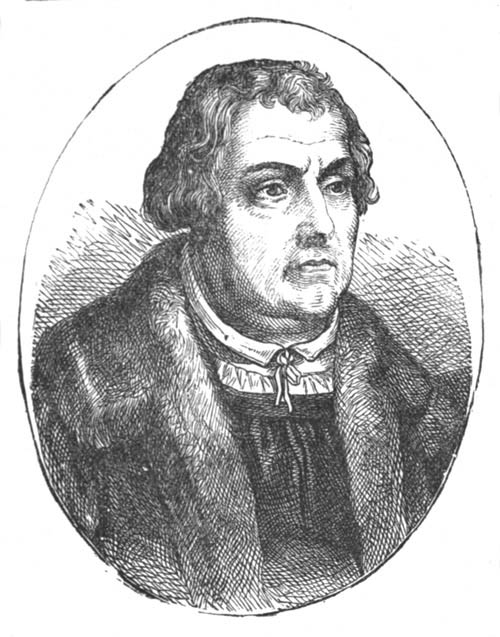
Martin Luther.
A NEW GIFT BOOK, Admirably adapted for Rewards and Presents.
In One thick Vol. 832 pp., medium 8vo. cloth gilt extra, 7s. 6d.
WARD & LOCK’S WORTHIES OF THE WORLD. CONTAINING Lives of Great Men OF All Countries and all Times. WITH PORTRAITS.
Ward and Lock’s Worthies of the World is the most interesting work ever attempted in connection with this valuable branch of study, and the Publishers recommend it with confidence to the perusal of all ages and every class of society.