NOTES TO THE INTRODUCTION
Charles Donald O'Malley translation
[1]Maurice Davidson, Medicine in Oxford, Oxford, 1953, pp. 15 ff.
[2]H. D. Rolleston, The Cambridge Medical School, Cambridge, 1932, pp. 1 ff.
[3]J. F. South, Memorials of the Craft of Surgery in England, ed. D’Arcy Power, London, 1886, pp. 14-15; Austin T. Young, The Annals of the Barber-Surgeons of London, London, 1890, p. 24.
[4]South, op. cit., pp. 15-18.
[5]Ibid., pp. 20 ff; Young, op. cit., pp. 40 ff.
[6]South, op. cit., pp. 81 ff.
[7]Ernest Wickersheimer, ‘Les premières dissections à la Faculté de Médecine de Paris’, Bulletin de la Société de l’Histoire de Paris et de l’Ile-de-France, 1910, xxxvii. 162-3.
[8]Commentaires de la Faculté de Médecine de l’Université de Paris (1395-1516), Paris, 1915, p. 286.
[9]Cronica Fratris Salimbene (Monumenta Germaniae Historica: Scriptores), Hanover, 1905-13, p. 613.
[10]Robert von Töply, in Puschmann, Handbuch der Geschichte der Medizin, Jena, 1903, ii. 199.
[11]Ibid., p. 201.
[12]Ibid., p. 209.
[13]M. Roth, Andreas Vesalius Bruxellensis, Berlin, 1892, p. 13.
[14]Töply, loc. cit., p. 212.
[15]Ibid.
[16]Montagu Burrow’s, ‘Memoir of William Grocyn’, Collectanea, Second Series (Oxford Historical Society), Oxford, 1890, pp. 332 ff.
[17]J. N. Johnson, The Life of Thomas Linacre, London, 1835, pp. 1-12.
[18]G. B. Parks, The English Traveller to Italy. The Middle Ages (to 1525), Stanford, Calif., 1955, pp. 457-60.
[19]R. J. Mitchell, ‘Thomas Linacre in Italy’, English Historical Review, 1935, l. 696.
[20]This sequence was followed in Paris where in particular Guinther of Andernach and Jacobus Sylvius were proceeding from their study of Galen’s medical writings to those of an anatomical nature.
26
[21]Thomas Fowler, The History of Corpus Christi College, Oxford, 1893, p. 381; Register of the University of Oxford, ed. Boase, Oxford, 1885, ii. 128, where he is mentioned as ‘David Edwardys, disciple of the dyalectic art’.
[22]Ibid.
[23]Fowler, op. cit., pp. 58 and n., 85 n., 369 and n.
[24]Register, p. 128.
[25]Fowler, op. cit., p. 370 n.
[26]Ibid., p. 369.
[27]Ibid., p. 372.
[28]Grace Book Β, ed. Mary Bateson, Cambridge, 1905, pt. ii, pp. 148, 150.
[29]Grace Book Γ, ed. William George Searle, Cambridge, 1908, p. 242.
[30]De Indiciis et Praecognitionibus, London, 1532, Eir.
[31]Grace Book Γ, p. 254.
[32]Ibid., p. 326.
[33]Ibid., p. 353.
[34]De Indiciis et Praecognitionibus, C₃r.
[35]There is record of the probate of his will in that year in the Vice-Chancellor’s Court in the University of Cambridge with mention of his wife Alice. The actual will, however, appears to be no longer in existence. Information kindly supplied by Miss H. E. Peek, Archivist of the University of Cambridge.
[36]J. D. Comrie, History of Scottish Medicine, London, 1932.
[37]The Paintings of Hans Holbein, ed. Ganz, London, 1956, nos. 218, 219.
[38]Young, op. cit., p. 588.
[39]Guildhall, Repertory 10, f. 186, 14 Dec. 1540.
[40]De Libris Propriis, p. 90, in The Works of John Caius, M.D., ed. Venn, Cambridge, 1912.
27
[41]William Munk, The Roll of the Royal College of Physicians of London, London, 1878, iii. 351. The statute is cited from Goodall’s MS., On College Affairs, pp. 55-56: ‘Among our elders the Anatomical Lecture was considered of such importance that according to everyone’s recollection very few Fellows sought to be excused from that duty except for very grave reasons. However, lest it happen that frequent dispensations of that sort should become usual and customary and thence, so it was feared, lest such a useful institution should gradually perish, they decided to prevent it through the statutes, by slight penalties in the beginning and afterward increased and more severe according to the danger. We desiring to follow their prudent regulation, lest hereafter we admit Fellows into the Society influenced by a like hope of always declining this duty and not giving their attention seriously to that task: We establish and Order that for those refusing the duty of the ordinary anatomical lecture and wishing to be released wholly from that duty, the penalty of paying the College twenty pounds, unless because of very serious obstacles approved by the President and a majority of the Fellows in plenary session. In cases of lesser importance in which there is not sought a continuing exemption but a deferment from lecturing for a time, we leave to the judgment of the President how far this ought to be granted to the applicants; but the deferment granted may not exceed seven months. In which case also we wish that deferment from the first lecture may not be granted in favor of the succeeding lecturer, but that he be held to observe the time ordered for him by the President, as if there were no such deferment.’
28
[42]Charles Goodall, The Royal College of Physicians of London, London, 1684, pp. 34-37: ‘Elizabeth by the grace of God, Queen of England, France & Ireland, defender of the faith &c. Greetings to all those reached by the present letter. Our father of noble memory Henry VIII, formerly King of England, among certain other decrees for the well-being and usefulness of his kingdom of England, especially watching over the health of his subjects, through his Letters Patent instituted in perpetuity a College of certain grave men of medicine who practised medicine publicly in his City of London and its suburbs within seven miles of that city. In the name of the President of the College and the Fellowship of the faculty of medicine of London, he incorporated them in the corporate and political body, and he granted to the same President and College of Fellowship aforesaid and to its successors diverse liberties and privileges. Our same father not only confirmed those Letters Patent and all things contained in them through his Senatus Consultum or Parliament held in the fourteenth and fifteenth years of his reign, but also he increased and amplified the same statute in many ways. Since our said father granted this pious design for the well-being of the commonwealth, assuredly day by day there will be manifestly great advancement if to the aforesaid President, College or Fellowship and their successors forever we grant what is especially necessary for those professing medicine, certain human bodies annually for dissection. Know that we, not only deservedly renewing the famous institution of our said father, but also considering the responsibility of our royal office to provide as much as possible for the assured health and security of our subjects, of our special grace and from our certain knowledge and genuine affection for our people, we grant presently and for our heirs and successors to the aforesaid President of the College or Fellowship of the aforesaid faculty of medicine of London, and their successors or assigns, that they may have and receive annually and forever in future times, at one time or at different times of the year, at the discretion, desire and liberty of the aforesaid President during the time of his existence and of his successors, one, two, three or four human bodies for dissection and anatomization, which have been condemned and executed according to the common law of this kingdom for theft, homicide or whatever felony, or have been condemned and executed according to the common law of this kingdom for theft, homicide or whatever felony within the County of Middlesex or within the aforesaid City of London or elsewhere within sixteen miles of the aforesaid City in whatever County.... And that it be permitted to the same President of the College and aforesaid Fellowship and their successors and whatever others of their assigns, professors or experts, to dissect and to divide the same bodies or otherwise according to their will and judgment, with that reverence which ought to be granted to human flesh, for the increment of knowledge of medicine and experiment of the same, and for the health of our liegemen without the contradiction of anyone. And this without rendering or paying any one any sum of money or any sums of money for the same. Provided always that when from time to time an anatomy of this sort has been undertaken and completed that the aforesaid bodies be given funeral and burial at the expense of the President and his successors.... Westminster, 24 February, in the seventh year of our reign’
[43]Caius was not only a confirmed Galenist, but with the passing years ever a more conservative and literal Galenist, and his anatomical lectures to the surgeons were described by Bullein in his Little Dialogue of 1579 as ‘reveiling ... the hidden jewels and precious treasures of Cl. Galenus’. It seems likely that, whatever anatomical lectures were given in the College of Physicians, they must, at least for a time, have been of like character. In the Annals of the college as written by Caius we find that as late as the year 1559 a certain Joannes Geynes was subject to disciplinary action because of his assertion that Galen had been guilty of error. He was required to state that ‘I Joannes Geynes confess that Galen did not err in those things for which I criticized him’, Annales a Collegio Condito, pp. 53-54, in The Works of John Caius, ed. Venn, Cambridge, 1912. Such conservatism carried over to the study of anatomy would certainly have been detrimental to any advancement of knowledge.
29
[44]Compendiosa totius Anatomie delineatio, aere exarata per Thomam Geminum.
[45]Selected Writings of Sir D’Arcy Power, Oxford, 1931, p. 115.
[46]H. M. Sinclair and A. H. T. Robb-Smith, A Short History of Anatomical Teaching in Oxford, Oxford, 1950, p. 10.
[47]Ibid., p. 11.
[48]Ibid.
[49]Caius, loc. cit., p. 104.
[50]This portrait shows Banister giving the Visceral lecture at Barber-Surgeon’s Hall in 1581; of small size and painted by an unknown artist on two pieces of paper joined down the middle, it is nevertheless sufficiently detailed for us to discover that Banister is using the octavo edition of Colombo’s work printed in Paris in 1572. The portrait is now laid down in an album of anatomical drawings, also painted for Banister, which was formerly owned by William Hunter and is now preserved in the Hunterian Museum, Glasgow. The drawings consist of views of the skeleton, the superficial muscles, nerves and veins drawn in colour on a dark ground with some skill. Singer, in his Evolution of Anatomy, London, 1925, p. 174, suggests that the skeletal figures are probably the earliest prepared in England which were actually drawn from the bones. This could well be true, but Banister based his drawing of the nerves on a plate of Charles Estienne, 1545, and his figures of the superficial muscles and veins are possibly based on Valverde. Other relics of Banister can be seen at Cambridge. The University Library has a book-like casket containing a small ivory skeleton and the écorché figure of a man given to the library by Banister in 1591. King’s College Library has a copy of The Historie of Man presented by the author in 1596.
[51]Books printed on the Continent were freely available in England, and it could be argued that this was one reason why so few anatomical texts were published in the Tudor period. It has already been noted that Colombo’s De Re Anatomica in the octavo edition of Paris, 1572, was used by Banister in his visceral lecture. This could well have been the text recommended to apprentices of Barber-Surgeon’s Hall. Such imported books were, of course, published in Latin and were therefore suitable to the students of the College of Physicians and those of Oxford or of Cambridge. It seems likely that the students at Barber-Surgeons’ Hall created a demand for more simple texts in the vernacular and this is surely the reason for the continued popularity of such books as Thomas Vicary’s archaic text.
31
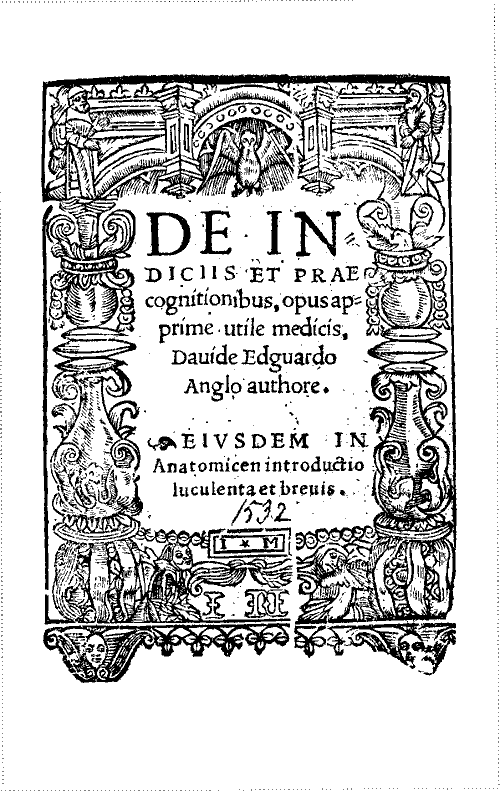
DE IN- DICIIS ET PRAE cognitionibus, opus ap- prime utile medicis, Dauide Edguardo Anglo authore.
EIVSDEM IN Anatomicen introductio luculenta et breuis.
1532
33
EXIMIO AC ILLVSTRI D. HENRICO Surrensi Comiti Da. Edguardus medicus S. D.
QVOTIES MIHI in memoriā uenit Hen- rice nobilium Comitum decus, et quanto in ho- nore fuerit tuus auus a- pud Anglos omneis, cū ob insignem illā uirtutē suam et fortunatos in rebus bel- licis succæssus, tum ob prudentiam suam minime uulgarem in administranda re publica, dum uiueret: et quam dextere eti- am his diebus quotidie gerantur res om- nes tuo patri præclarissimo, quæcunqꝫ ad nos Anglos pertinent: non possum satis admirari genus istud tuum, non horum adeo caussa, ut quod et te in hac ætate cō- stitutum, uideam, supra quam dici potest
34
in multis alijs adolescentibus, ad ea quæ te meliorem reddant tam serio animum appellere. Istud quidem ego haud scio, naturę́ ne illius beneficio ascribere debeā è qua nobis editus es, an superis, qui et tu- is bene uertunt, et Anglis nostris fauent. Vtcumqꝫ est, reipublicæ nostræ commo- do fore speramus, quod factum est, atqꝫ eo magis, quo tu diutius rebus bonis stu- dueris. Ita namqꝫ sequentem ætatem in- structior adibis, et cōsuetudo interim bo- na tuum animum stabiliet, ne ad peiora in posterum facile decidas. Quanto uero magis et consilio ualebis, et prudentia, tanto meliorem sui gubernatorem habe- bit Norfolcia tuæ stirpi credita, ubi patri succædes hæres prædiorum, tantoq́ꝫ inte- rea utilior Comes eris Surrensi populo tuo, ac tanto demum magis Anglis om- nibus expetitus, ut reipublicæ negotia suscipias, quæ omnia et honorum tibi in- cremento futura sunt et tuorum omnium
35
honestamento quæ omnia et certum est consequi posse te, si ut cœpisti iuuenileis annos transiges. Vt magnam in te spem reponimus, te et patris aui tui similem fu- turum, quòd et ingeniū tuum et morum grauitas talia nobis polliceātur. Ego tibi et maximos succæssus precor et optima- rum omnium rerum augmentum uber- rimum. Atqꝫ ut hic annus totus ab inicio fœlix tibi tuisq́ꝫ sit, iterum precor. Quo omine et hanc nostram in Anatomicen introductionem tibi dedico. Vt enim hæc artis medicæ pars omnibus comper- ta non est, sic et quod difficillima nonnul- la complectatur, facilem exigit instituti- onem, qua lectores quasi manu ducantur ad id, cui innitūtur. Istud opus exiguum quidem est, sed medicis et Chirurgis om- nibus per quam utile, quod et plurima paucis explicat. Nihilo obscuri, nihil af- fectati continet, sed omnibus eorum in- genijs expositissimum, qui nec tardi sunt,
36
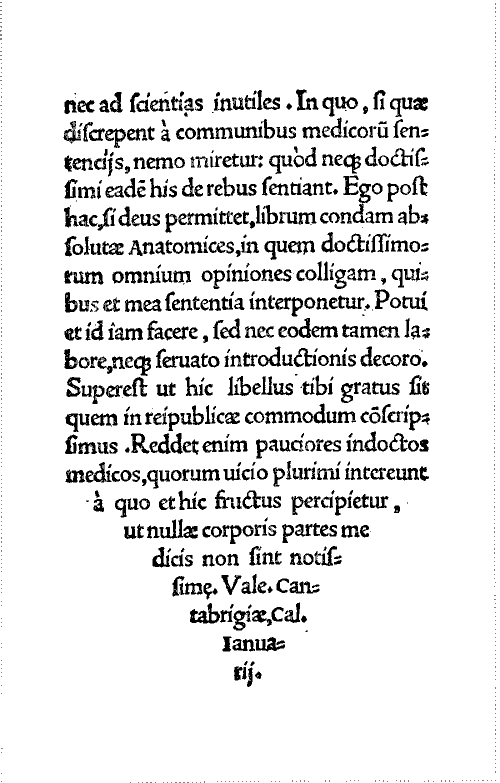
nec ad scientias inutiles. In quo, si quæ discrepent à communibus medicorū sen- tencijs, nemo miretur: quòd neqꝫ doctis- simi eadē his de rebus sentiant. Ego post hac, si deus permittet, librum condam ab- solutæ Anatomices, in quem doctissimo- rum omnium opiniones colligam, qui- bus et mea sententia interponetur. Potui et id iam facere, sed nec eodem tamen la- bore, neqꝫ seruato introductionis decoro. Superest ut hic libellus tibi gratus sit quem in reipublicæ commodum cōscrip- simus. Reddet enim pauciores indoctos medicos, quorum uicio plurimi intereunt à quo et hic fructus percipietur, ut nullæ corporis partes me dicis non sint notis- sime. Vale. Can- tabrigiæ, Cal. Ianua- rij.
37
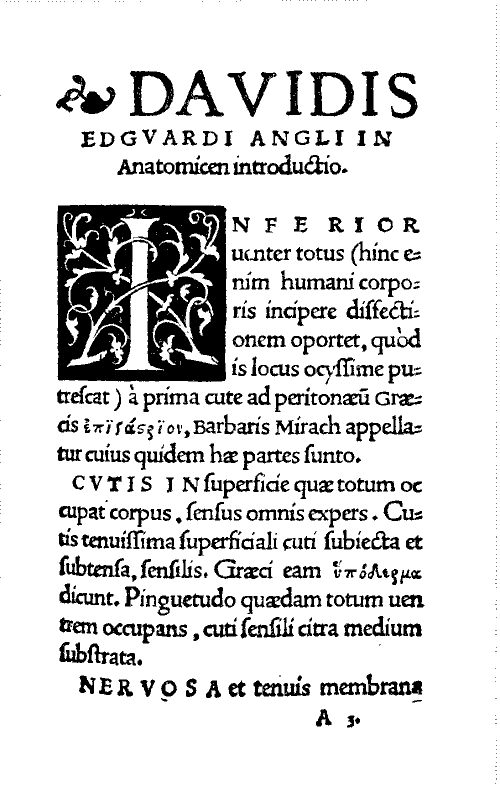
DAVIDIS EDGVARDI ANGLI IN Anatomicen introductio.
INFERIOR uenter totus (hinc e- nim humani corpo- ris incipere dissecti- onem oportet, quòd is locus ocyssime pu- trescat) à prima cute ad peritonæū Græ- cis ἐπιγάστριον, Barbaris Mirach appella- tur cuius quidem hæ partes sunto.
CVTIS IN superficie quæ totum oc- cupat corpus, sensus omnis expers. Cu- tis tenuissima superficiali cuti subiecta et subtensa, sensilis. Græci eam ὑποδερμα dicunt. Pinguetudo quædam totum uen- trem occupans, cuti sensili citra medium substrata.
NERVOSA et tenuis membrana
38
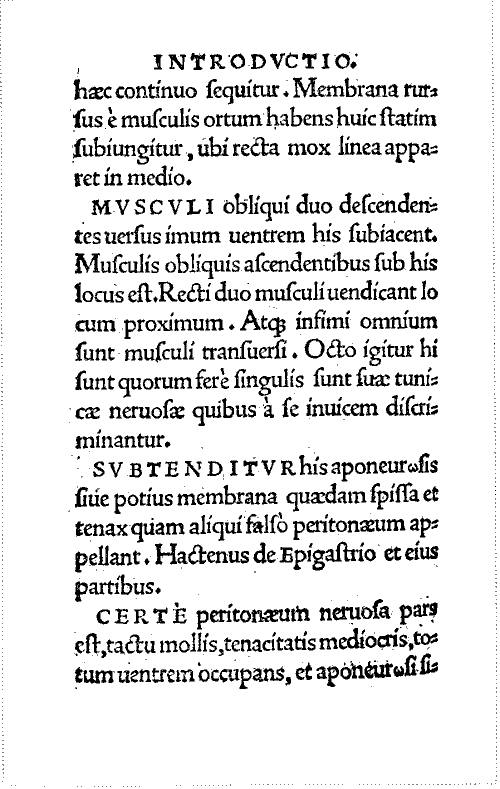
hæc continuo sequitur. Membrana rur- sus è musculis ortum habens huic statim subiungitur, ubi recta mox linea appa- ret in medio.
MVSCVLI obliqui duo descenden- tes uersus imum uentrem his subiacent. Musculis obliquis ascendentibus sub his locus est. Recti duo musculi uendicant lo- cum proximum. Atqꝫ infimi omnium sunt musculi transuersi. Octo igitur hi sunt quorum ferè singulis sunt suæ tuni- cæ neruosæ quibus à se inuicem discri- minantur.
SVBTENDITVR his aponeurωsis siue potius membrana quædam spissa et tenax quam aliqui falsò peritonæum ap- pellant. Hactenus de Epigastrio et eius partibus.
CERTÈ peritonæum neruosa pars est, tactu mollis, tenacitatis mediocris, to- tum uentrem occupans, et aponeurωsi si-
39
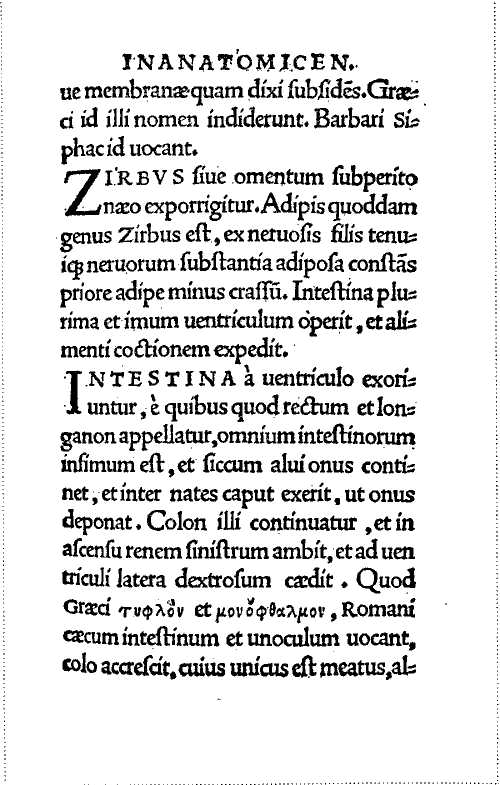
ue membranæ quam dixi subsidēs. Græ- ci id illi nomen indiderunt. Barbari Si- phacid uocant.
ZIRBVS siue omentum subperito- næo exporrigitur. Adipis quoddam genus Zirbus est, ex neruosis filis tenu- iqꝫ neruorum substantia adiposa constās priore adipe minus crassū. Intestina plu- rima et imum uentriculum operit, et ali- menti coctionem expedit.
INTESTINA à uentriculo exori- untur, è quibus quod rectum et lon- ganon appellatur, omnium intestinorum infimum est, et siccum alui onus conti- net, et inter nates caput exerit, ut onus deponat. Colon illi continuatur, et in ascensu renem sinistrum ambit, et ad uen- triculi latera dextrosum cædit. Quod Græci τυφλον et μονόφθαλμον, Romani cæcum intestinum et unoculum uocant, colo accrescit, cuius unicus est meatus, al-
40
tera enim extremitate clauditur, ut coctio- ni subseruiat cōmodius, uentriculi cuius- dam modo. Hinc igitur rei nomen. Atqꝫ intestina quidem crassiora tot sint.
ILEON excipit cæcum, intestinum in crebros intortum sinus a qua figura et Græci nomen illi fecerunt παρα του ἐιλεῖ- σθαι .i. ab inuoluendo, cuius morbus et iliacus dicitur. Illi ieiunum adheret. Hoc ieiuni nomen corporum dissectores in- testino dederunt ab euentu quòd semper inane reperiatur, et nihil continere. Iecur enim auulsit prius quicquid haberet in se ieiunum. Assurgit supra hæc intestina omnia, duodenum quod ieiuno inferne, superne Pylωro affigitur. Græcis δωδεκα δάκτῦλομ uocatur à duodecim digitorū mensura. Tria hæc substantiæ suæ ratio- ne appellentur gracilia intestina.
VENTRICVLVS sub transuerso septo locatus est, cuius os superius in
41
quod œsophagus terminatur, stoma- chus proprie appellatur, inferius per quod intestina alimentū deriuatur πυλωρος dicitur.
LIEN RARAE sustantiæ uiscus, uentriculo adiacet ad sinistrum latus et iecur ad dexterum Hypochondrium, hoc rotundum, ac quadam tenus lunare, illud oblongum, ac ueluti quadratum. Vtriusqꝫ horum gibbosa pars ad inferio- res costas pertinet. Quod in alterutro cō- cauum est, id et uentriculo est proximum. Iecur sanguinē gignit. Lien eundē repur- gat ab atrabile. Inuaugescit Lien cū reli- qui corporis dispendio. Iecoris magnitu- do totius corporis compagi utilis est, quòd sanguinē et naturalē spiritū summi- nistret ubertim. Iecur habet suas penu- las quos Græci λοβούς nominant, inter- dum treis, interdum plureis, in cuius ca- uo et uessicula fellis prominet, qua san-
42
guis à bile defecatus et purus euadit. Cuius utiqꝫ uessiculæ exhalatione et tran- spiratu inficiuntur nonnunquam duode- num et ieiunum, nonnunquam et pungi se senciunt, si transpiratus maior sit et bi- lis mordacior.
À IECORIS concauo uena portæ oritur: multis exilibus iecoris uenis con- currentibus ex quibus ea una constat. E diuerso rursus in innumeras eadem spar- gitur parteis, uenarumq́ꝫ immensam red- dit multitudinem, quæ postea passim in- testinis propè omnibus inseruntur, ad mistis unâ membranulis adiposis, ut nu- trimentalem substantiam iecori suppedi- tent in sanguinis generationem. Chilus namqꝫ cibusq́ꝫ à uentriculo statim ad in- testina demittitur concædente exitū py- lωro, ubi primum accæperit uentriculus quantum usibus suis sufficiat, et coctio- nem suam perægerit qui nisi et in sangui-
43
nis naturam transmutandus sit, parum admodum in reliqui corporis nutricio- nem contulerit. Hunc ergo usum præ- stant numerosæ hæ uenulæ, ut optimum nutrimenti succū haud satis adhuc coctū interaneis exugant, et iecoris cauo man- dent, quo illic sanguis fiat. Quas nimi- rum uenulas et Meseraicas, et Mesenteri- cas Græco uocabulo nominare licebit. Latini eas lacteis uocant. Ad harum mu- nimen ne per ramificationis frequentiam ualentiore corporis motu earum qúæuis distrahantur dilanientúr ue, quo firmius constent singulæ sibi uenulæ duodeno πανκρεασ adhæret, glandulosa scilicet ca- ro, quæ et καλλίκρεασ Græcis uocatur in- terdum.
SANGVIS meat à iecoris cōcauo, in quo paulo āte formatus est, ad gibbū iecoris, non qualis tamen omnino factus fuerit in cauo, sed syncerior et simplicior,
44
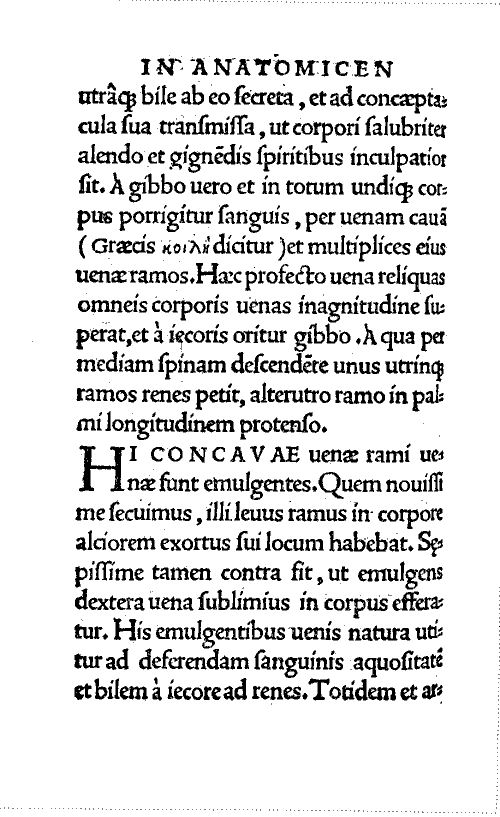
utrâqꝫ bile ab eo secreta, et ad concæpta- cula sua transmissa, ut corpori salubriter alendo et gignēdis spiritibus inculpatior sit. À gibbo uero et in totum undiqꝫ cor- pus porrigitur sanguis, per uenam cauā (Græcis κοιλη dicitur) et multiplices eius uenæ ramos. Hæc profecto uena reliquas omneis corporis uenas inagnitudine su- perat, et à iecoris oritur gibbo. À qua per mediam spinam descendēte unus utrinqꝫ ramos renes petit, alterutro ramo in pal- mi longitudinem protenso.
HI CONCAVAE uenæ rami ue- næ sunt emulgentes. Quem nouissi- me secuimus, illi leuus ramus in corpore alciorem exortus sui locum habebat. Sę- pissime tamen contra fit, ut emulgens dextera uena sublimius in corpus effera- tur. His emulgentibus uenis natura uti- tur ad deferendam sanguinis aquositatē et bilem à iecore ad renes. Totidem et ar-
45
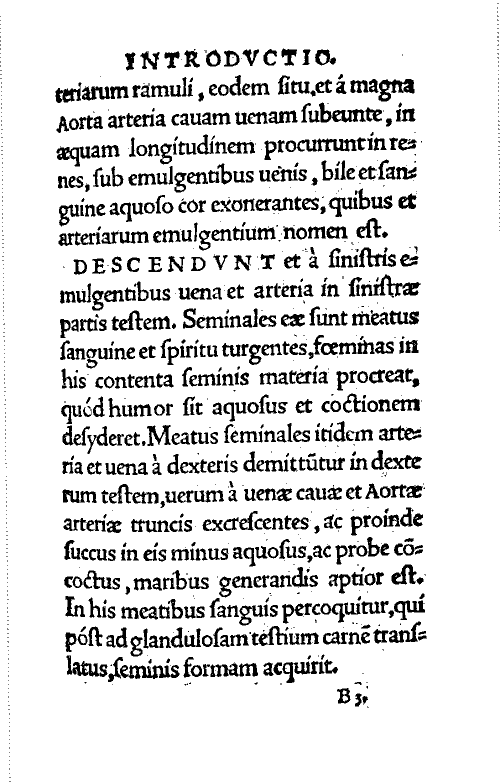
teriarum ramuli, eodem situ, et á magna Aorta arteria cauam uenam subeunte, in æquam longitudinem procurrunt in re- nes, sub emulgentibus uenis, bile et san- guine aquoso cor exonerantes, quibus et arteriarum emulgentium nomen est.
DESCENDVNT et à sinistris e- mulgentibus uena et arteria in sinistræ partis testem. Seminales eæ sunt meatus sanguine et spiritu turgentes, fœminas in his contenta seminis materia procreat, quód humor sit aquosus et coctionem desyderet. Meatus seminales itidem arte- ria et uena à dexteris demittūtur in dexte- rum testem, uerum à uenæ cauæ et Aortæ arteriæ truncis excrescentes, ac proinde succus in eis minus aquosus, ac probe cō- coctus, maribus generandis aptior est. In his meatibus sanguis percoquitur, qui póst ad glandulosam testium carnē trans- latus, seminis formam acquirit.
46
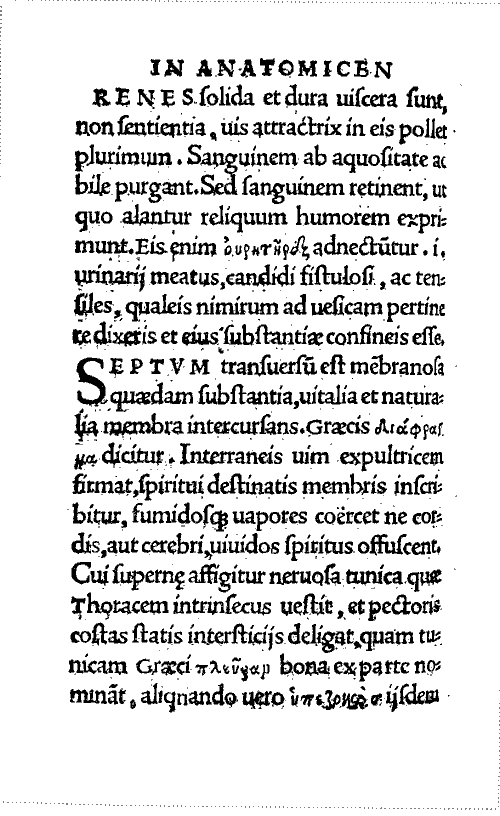
RENES solida et dura uiscera sunt, non sentientia, uis attractrix in eis pollet plurimum. Sanguinem ab aquositate ac bile purgant. Sed sanguinem retinent, ut quo alantur reliquum humorem expri- munt. Eis enim ὀυρῆτῆρες adnectūtur .i. urinarij meatus, candidi fistulosi, ac ten- siles, qualeis nimirum ad uesicam pertine- re dixeris et eius substantiæ confineis esse.
SEPTVM transuersū est mēbranosa quædam substantia, uitalia et natura- lia membra intercursans. Græcis διάφραγ- μα dicitur. Interraneis uim expultricem firmat, spiritui destinatis membris inscri- bitur, fumidosqꝫ uapores coërcet ne cor- dis, aut cerebri, uiuidos spiritus offuscent. Cui supernę affigitur neruosa tunica quæ Thoracem intrinsecus uestit, et pectoris costas statis intersticijs deligat, quam tu- nicam Græci πλεῦραν bona ex parte no- mināt, aliqnando uero ὑποζωμα ijsdem
47
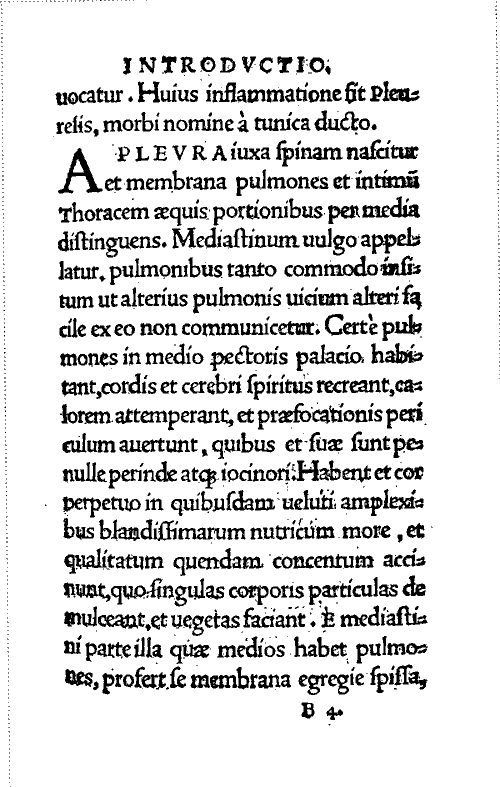
uocatur. Huius inflammatione fit Pleu- relis, morbi nomine à tunica ducto.
A PLEVRA iuxa spinam nascitur et membrana pulmones et intimū Thoracem æquis portionibus per media distinguens. Mediastinum uulgo appel- latur, pulmonibus tanto commodo infi- tum ut alterius pulmonis uicium alteri fa- cile ex eo non communicetur. Certè pul- mones in medio pectoris palacio habi- tant, cordis et cerebri spiritus recreant, ca- lorem attemperant, et præfocationis peri- culum auertunt, quibus et suæ sunt pe- nulle perinde atqꝫ iocinori. Habent et cor perpetuo in quibusdam ueluti amplexi- bus blandissimarum nutricum more, et qualitatum quendam concentum acci- nunt, quo singulas corporis particulas de mulceant, et uegetas faciant. E mediasti- ni parte illa quæ medios habet pulmo- nes, profert se membrana egregie spissa,
48
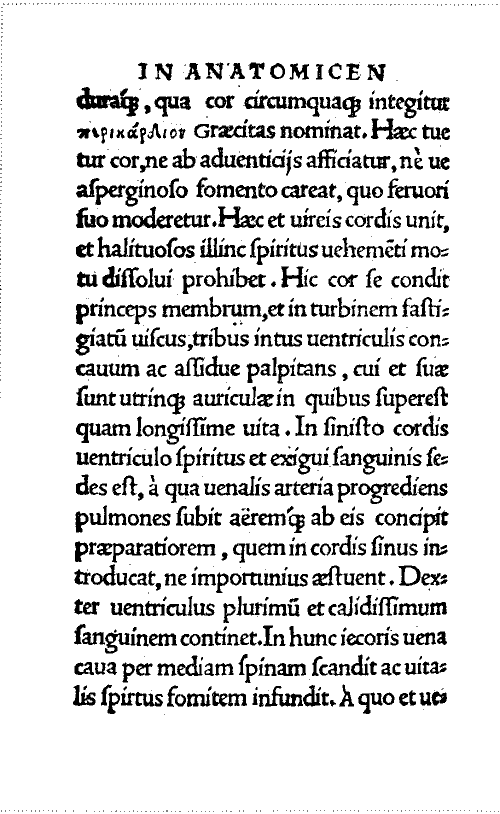
duraq́ꝫ, qua cor circumquaqꝫ integitur περικαρδιον Græcitas nominat. Hæc tue tur cor, ne ab aduenticijs afficiatur, nè ue asperginoso fomento careat, quo feruori suo moderetur. Hæc et uireis cordis unit, et halituosos illinc spiritus uehemēti mo- tu dissolui prohibet. Hic cor se condit princeps membrum, et in turbinem fasti- giatū uiscus, tribus intus uentriculis con- cauum ac assidue palpitans, cui et suæ sunt utrinqꝫ auriculæ in quibus superest quam longissime uita. In sinistro cordis uentriculo spiritus et exigui sanguinis se- des est, à qua uenalis arteria progrediens pulmones subit aëremq́ꝫ ab eis concipit præparatiorem, quem in cordis sinus in- troducat, ne importunius æstuent. Dex- ter uentriculus plurimū et calidissimum sanguinem continet. In hunc iecoris uena caua per mediam spinam scandit ac uita- lis spirtus fomitem infundit. À quo et ue-
49
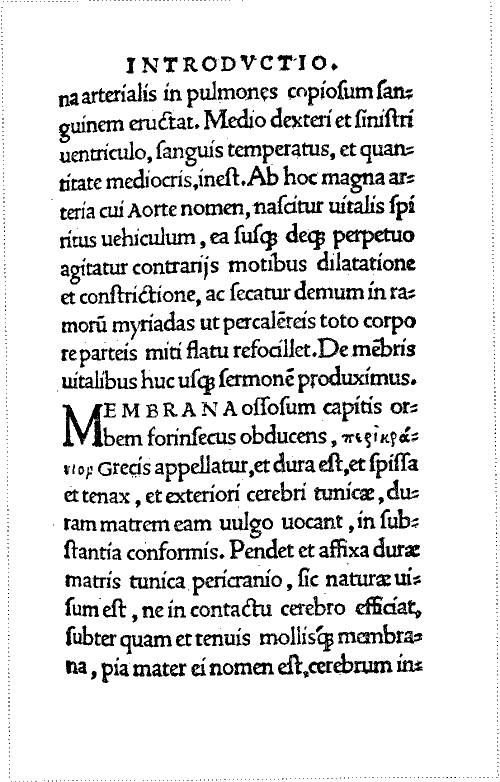
na arterialis in pulmones copiosum san- guinem eructat. Medio dexteri et sinistri uentriculo, sanguis temperatus, et quan- titate mediocris, inest. Ab hoc magna ar- teria cui Aorte nomen, nascitur uitalis spi- ritus uehiculum, ea susqꝫ deqꝫ perpetuo agitatur contrarijs motibus dilatatione et constrictione, ac secatur demum in ra- morū myriadas ut percalēteis toto corpo- re parteis miti flatu refocillet. De mēbris uitalibus huc usqꝫ sermonē produximus.
MEMBRANA ossosum capitis or- bem forinsecus obducens, περικρα- νιον Grecis appellatur, et dura est, et spissa et tenax, et exteriori cerebri tunicæ, du- ram matrem eam uulgo uocant, in sub- stantia conformis. Pendet et affixa duræ matris tunica pericranio, sic naturæ ui- sum est, ne in contactu cerebro efficiat, subter quam et tenuis mollisq̀ꝫ membra- na, pia mater ei nomen est, cerebrum in-
50
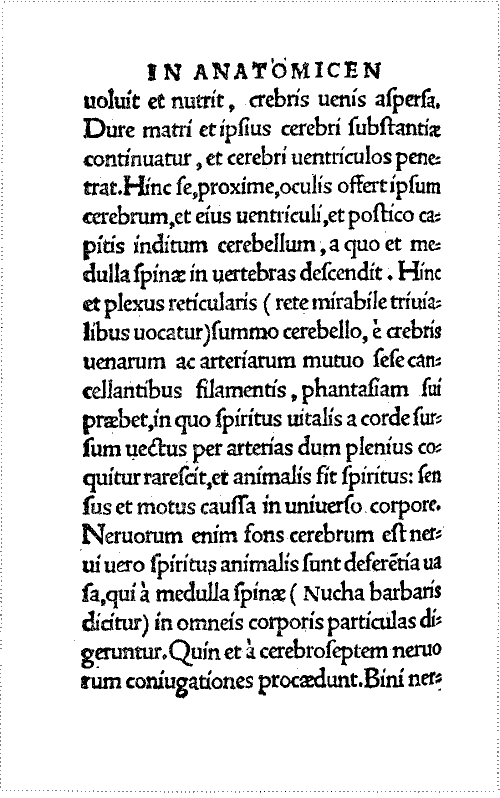
uoluit et nutrit, crebris uenis aspersa. Dure matri et ipsius cerebri substantiæ continuatur, et cerebri uentriculos pene- trat. Hinc se, proxime, oculis offert ipsum cerebrum, et eius uentriculi, et postico ca- pitis inditum cerebellum, a quo et me- dulla spinæ in uertebras descendit. Hinc et plexus reticularis (rete mirabile triuia- libus uocatur) summo cerebello, è crebris uenarum ac arteriarum mutuo sese can- cellantibus filamentis, phantasiam sui præbet, in quo spiritus uitalis a corde sur- sum uectus per arterias dum plenius co- quitur rarescit, et animalis fit spiritus: sen- sus et motus caussa in uniuerso corpore. Neruorum enim fons cerebrum est ner- ui uero spiritus animalis sunt deferētia ua- sa, qui à medulla spinæ (Nucha barbaris dicitur) in omneis corporis particulas di- geruntur. Quin et à cerebroseptem neruo- rum coniugationes procædunt. Bini ner-
51
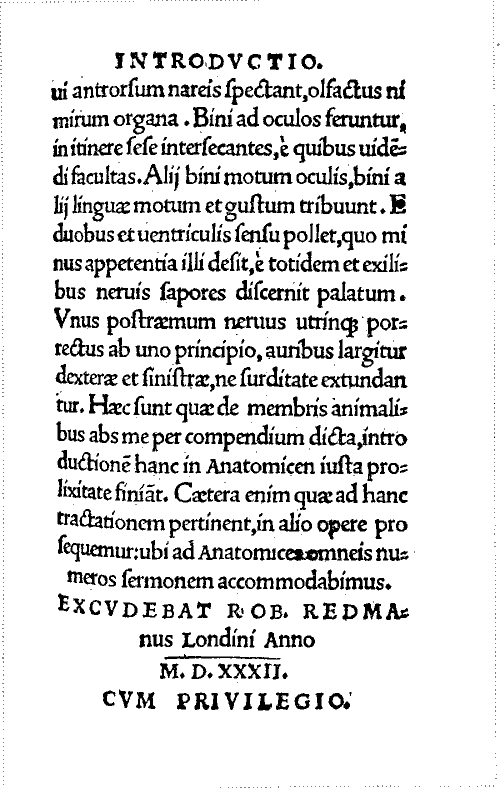
ui antrorsum nareis spectant, olfactus ni mirum organa. Bini ad oculos feruntur, in itinere sese intersecantes, è quibus uidē- di facultas. Alij bini motum oculis, bini a lij linguæ motum et gustum tribuunt. E duobus et uentriculis sensu pollet, quo mi- nus appetentia illi desit, è totidem et exili- bus neruis sapores discernit palatum. Vnus postræmum neruus utrinqꝫ por- rectus ab uno principio, auribus largitur dexteræ et sinistræ, ne surditate extundan- tur. Hæc sunt quæ de membris animali- bus abs me per compendium dicta, intro- ductionē hanc in Anatomicen iusta pro- lixitate finiāt. Cætera enim quæ ad hanc tractationem pertinent, in alio opere pro- sequemur: ubi ad Anatomices omneis nu- meros sermonem accommodabimus.
EXCVDEBAT ROB. REDMA- nus Londini Anno
M. D. XXXII. CVM PRIVILEGIO.
53
To the Distinguished and Illustrious Henry, Earl of Surrey. David Edwardes, Physician, Sends Greetings
How often, Henry, I have recalled the honourable achievements of those noble dukes, in what great honour all Englishmen held your grandfather during his lifetime for his remarkable ability and happy successes in warfare, as well as his extraordinary prudence in the administration of civil affairs; and also at present how expertly everything that pertains to us English is daily managed by your famous father. I cannot sufficiently admire your family, but not so much for those reasons as because I see you established above what can be said for many other young men in this age, and turning your mind so seriously to those things which will render it better. I am by no means certain whether I ought to ascribe this to the benefit of that stock from which you have been brought forth to us, whether to the gods who through you smile upon and favour us English. However it may be, let us hope what has occurred will be to the advantage of our commonwealth, and that the more so since you have pursued worth-while things for so long a time. Thus you will approach the next age better prepared, and good habits will meanwhile strengthen your mind so that later you will not easily fall into worse. But the more you may be strengthened by counsel and prudence, with confidence placed in your family, so much the better guidance will Norfolk have when you succeed as heir to your father’s estates. Meanwhile how 54 much more useful you will be to your people as Earl of Surrey, and finally so much the more will all Englishmen desire you to undertake the affairs of the commonwealth. There is no doubt that you can achieve all these things which will be to the increase of your honours and to the honour of your family.
As your talent and gravity of character promise, so we have great hope that you will be like your father and grandfather. I wish you both the greatest successes and the most fruitful increase of all the best things. And once more I wish that this whole year from its beginning may be happy for you and yours. With this augury I dedicate to you this our introduction to anatomy. For as this part of the art of medicine is not known to all, because it is something very difficult to comprehend, it requires an easy arrangement by which readers, as if led by the hand to it, may lean upon it. This is indeed a slight work, but wholly useful for all physicians and surgeons, because it explains many things briefly. It contains nothing obscure, nothing elaborate, very readily accessible to the talents of all those who are neither dull nor ill-adapted to matters of knowledge. In this, if anything differs from the common opinions of physicians, let no one be astonished because the learned do not believe the same in these matters.
Hereafter, if God permit, I shall compose a complete book of anatomy in which I shall further the opinions of all the learned, to which my own opinion will be added. I could have done this at present but not, however, with the same effort or with the form of an introduction preserved. It remains that this little book, which we have enlisted in the service of the commonwealth, may be pleasing to you, for it recognizes the existence of those very few unlearned physicians by whose mistakes many perish, from which this fact will be gathered, that no parts of the body should be unknown to physicians. Farewell. Cambridge. 1 January.
55