Chapter IV · (continued 3)
Reading edition
They now crossed a fairly level clover field, dark and laid with wet. The scent of the clover rose to their nostrils with almost overpowering force. There was not a breath of air. The sky was blue and the sun shining. Only a sullen roar came over the hill, sounding in the silence like the rush of a train over a far-away viaduct.
'What is that?' queried the minister, stopping to listen.
Ebie took a brisk sidelong look at him.
'I'm some dootsome that'll be the Skyreburn coming doon aff o' Cairnsmuir!'
The minister tramped unconcernedly on. Ebie Kirgan stared at him.
'He canna ken what a "Skyreburn warnin'" is—he'll be thinkin' it's some bit Machars burn that the laddies set their whurlie mills in. But he'll turn richt eneuch when he sees Skyreburn roarin' reed in a Lammas flood, I'm thinkin'!'
They took their way over the shoulder of the hill in the beautiful evening, leaning eagerly forward to get the first glimpse of the cause of that deep and resonant roar. In a moment they saw below them a narrow rock-walled gully, ten or fifteen yards across, filled to the brim with rushing water. It was not black peat water like the Camelon Lane, but it ran red as keel, flecked now and then with a revolving white blur as one of the Cauldshaws sheep spun downward to the sea, with four black feet turned pitifully up to the blue sky.
Ebie looked at the minister. 'He'll turn noo if he's mortal,' he said. But the minister held on. He looked at the water up and down the roaring stream. On a hill above, the farmer of Cauldshaws, having driven all his remaining sheep together, sat down to watch. Seeing the minister, he stood up and excitedly waved him back. But Douglas Maclellan from the Machars never gave him a look, and his shouting was of less effect than if he had been crying to an untrained collie.
The minister looked long up the stream, and at a point where the rocks came very close together, and many stunted pines were growing, he saw one which, having stood on the immediate brink, had been so much undercut that it leaned over the gully like a fishing-rod. With a keen glance along its length, the minister, jamming his dripping soft felt hat on the back of his head, was setting foot on the perilous slope of the uneven red-brown trunk, when Ebie Kirgan caught him sharply by the arm.
'It's no' for me to speak to a minister at ordinar' times,' he stammered, gathering courage in his desperation; 'but, oh, man, it's fair murder to try to gang ower that water!'
The minister wrenched himself free, and sprang along the trunk with wonderful agility.
'I'm intimated to preach at Cauldshaws this night, and my text is, "Whatsoever thy hand findeth to do, do it with thy might!"' he shouted.
He made his way up and up the slope of the fir tree, which, having little grip of the rock, dipped and swayed under his tread. Ebie Kirgan fell on his knees and prayed aloud. He had not prayed since his stepmother boxed his ears for getting into bed without saying his prayers twenty years ago. This had set him against it. But he prayed now, and to infinitely more purpose than his minister had recently done. But when the climber had reached the branchy top, and was striving to get a few feet farther, in order to clear the surging linn before he made his spring, Ebie rose to his feet, leaving his prayer unfinished. He sent forth an almost animal shriek of terror. The tree roots cracked like breaking cables and slowly gave way, an avalanche of stones plumped into the whirl, and the top of the fir crashed downwards on the rocks of the opposite bank.
'Oh, man, call on the name of the Lord,' cried Ebie Kirgan, the ragged preacher, at the top of his voice.
Then he saw something detach itself from the tree as it rebounded, and for a moment rise and fall black against the sunset. Then Ebie the Outcast fell on his face like a dead man.
In the white coverleted 'room' of the farmtown of Cauldshaws, a white-faced lad lay with his eyes closed, and a wet cloth on his brow. A large-boned, red-cheeked, motherly woman stole to and fro with a foot as light as a fairy. The sleeper stirred and tried to lift an unavailing hand to his head. The mistress of Cauldshaws stole to his bedside as he opened his eyes. She laid a restraining hand on him as he strove to rise.
'Let me up,' said the minister, 'I must away, for I'm intimated to preach at Cauldshaws, and my text is, "Whatsoever thy hand findeth to do, do it with thy might."'
'My bonny man,' said the goodwife, tenderly, 'you'll preach best on the broad o' yer back this mony a day, an' when ye rise your best text will be, "He sent from above, He took me, and drew me out of many waters!"'
AN UNDERGRADUATE'S AUNT
By F. ANSTEY
Author of "Vice Versa," etc.
Frederick Flushington belonged to a small college, and in doing so conferred upon it one of the few distinctions it could boast—namely, that of possessing the very bashfulest man in the whole university. But his college did not treat him with any excess of adulation on that account, probably from a prudent fear of rubbing the bloom off his modesty; they allowed him to blush unseen—which was the condition in which he preferred to blush.
He felt himself oppressed by a paucity of ideas and a difficulty in knowing which way to look in the presence of his fellow-men, which made him never so happy as when he had fastened his outer door and secured himself from all possibility of intrusion; though it was almost an unnecessary precaution, for nobody ever thought of coming to see Flushington.
In appearance he was a man of middle height, with a long scraggy neck and a large head, which gave him the air of being much shorter than he really was; he had little, weak eyes, a nose and mouth of no particular shape, and very smooth hair of no definite color. He had a timid, deprecating air, which seemed due to the consciousness that he was an uninteresting anomaly, and he certainly was as impervious to the ordinary influence of his surroundings as any undergraduate well could be. He lived a colorless, aimless life in his little rooms under the roof, reading every morning from nine till two with a superstitiously mechanical regularity, though very often his books completely failed to convey any ideas whatever to his brain, which was not a particularly powerful organ.
If the afternoon was fine he generally sought out his one friend, who was a few degrees less shy than himself, and they took a monosyllabic walk together; or if it was wet, he read the papers at the Union, and in the evening after hall he studied "general literature" (a graceful term for novels) or laboriously spelt out a sonata upon his piano—a habit which did not increase his popularity.
Fortunately for Flushington, he had no gyp, or his life might have been made a positive burden to him, and with his bedmaker he was rather a favorite as "a gentleman what gave no trouble"—meaning that, when he observed his sherry unaccountably sinking, like the water in a lock when the sluices are up, Flushington was too delicate to refer to the phenomenon.
He was sitting one afternoon over his modest lunch of bread and butter, potted meat and lemonade, when all at once he heard a sound of unusual voices and a strange flutter of dresses coming up the winding stone staircase outside, and was instantly seized with a cold dread.
There was no particular reason for being alarmed, although there were certainly ladies mounting the steps. Probably they were friends of the man opposite, who was always having his people up; but still Flushington had that odd presentiment which nervous people have sometimes that something unpleasant is on its way to them, and he half rose from his chair to shut his outer oak.
It was too late; the dresses were rustling now in his very passage; there was a pause, a few faint, smothered laughs and little feminine coughs—then two taps at the door.
"Come in," cried Flushington, faintly; he wished he had been reading anything but the work by M. Zola, which was propped up in front of him. It is your mild man, who frequently has a taste for seeing the less reputable side of life in this second-hand way, and Flushington would toil manfully through the voluminous pages, hunting up every third word in the dictionary; with a sense of injury when, as was often the case, it was not to be found. Still, there was a sort of intellectual orgie about it which had strong fascinations for him, while he knew enough of the language to be aware when the incidents approached the improper, though he was not always able to see quite clearly in what this impropriety consisted.
The door opened, and his heart seemed to stop, and all the blood rushed violently to his head as a large lady came sweeping in, her face rippling with a broad smile of affection.
She horrified Flushington, who knew nobody with the least claim to smile at him so expansively as that; he drank lemonade to conceal his confusion.
"You know me, my dear Fred?" she said, easily. "Of course not—how should you? I'm—for goodness sake, my dear boy, don't look so terribly frightened! I'm your aunt—your aunt Amelia, come over from Australia!"
The shock was a severe one to Flushington, who had not even known he possessed such a relative; he could only say, "Oh?" which he felt even then was scarcely a warm greeting to give an aunt from the Antipodes.
"Oh, but," she added, cheerily, "that's not all; I've another surprise for you: the dear girls would insist on coming up, too, to see their grand college cousin; they're just outside. I'll call them in—shall I?"
In another second Flushington's small room was overrun by a horde of female relatives, while he looked on gasping.
They were pretty girls, too, many of them; but that was all the more dreadful to him: he did not mind the plainer ones half so much; a combination of beauty and intellect reduced him to a condition of absolute imbecility.
He was once caught and introduced to a charming young lady from Newnham, and all he could do was to back feebly into a corner and murmur "Thank you," repeatedly.
He was very little better than that then as his aunt singled out one girl after another. "We won't have any formal nonsense between cousins," she said; "you know them all by name already, I dare say. This is Milly; that's Jane; here's Flora, and Kitty, and Margaret; and that's my little Thomasina over there by the book-case."
Poor Flushington ducked blindly in the direction of each, and then to them all collectively: he had not presence of mind to offer them chairs or cake, or anything; and besides, there was not nearly enough of anything for all of them.
Meanwhile, his aunt had spread herself comfortably out in his armchair, and was untying her bonnet-strings and beaming at him until he was ready to expire with confusion. "I do think," she observed at last, "that when an old aunt all the way from Australia takes the trouble to come and see you like this, you might spare her just one kiss!"
Flushington dared not refuse; he tottered up and kissed her somewhere about the face, after which he did not know which way to look, he was so terribly afraid that he might have to go through the same ceremony with his cousins, which he simply could not have survived.
Happily for him, they did not appear to expect it and he balanced a chair on its hind legs and, resting one knee upon it, waited patiently for them to begin a conversation; he could not have uttered a single word.
The aunt came to his rescue: "You don't ask after your Uncle Samuel, who used to send you the beetles?" she said, reprovingly.
"No," said Flushington, who had forgotten Uncle Samuel and his beetles, too; "no, how is Uncle Samuel—quite well, I hope?"
"Only tolerably so, thank you, Fred; you see, he never got over his great loss."
"No," said Flushington desperately, "of course not; it was a—a large sum of money to lose at once."
"I was not referring to money," said she, with a slight touch of stoniness in her manner; "I was alluding to the death of your Cousin John."
Flushington had felt himself getting on rather well just before that, but this awkward mistake—for he could not recollect having heard of Cousin John before—threw him off his balance again; he collapsed into silence once more, inwardly resolving to be lured into no more questions concerning relatives.
His ignorance seemed to have aroused pathetic sentiments in his aunt. "I ought to have known," she said, shaking her head, "they'd soon forget us in the old country; here's my own sister's son, and he doesn't remember his cousin's death! Well, well, now we're here, we must see if we can't know one another a little better. Fred, you must take the girls and me everywhere and show us everything, like a good nephew, you know."
Flushington had a horrible mental vision of himself careering about all Cambridge, followed by a long procession of female relatives—a fearful possibility to so shy a man. "Shall you be here long?" he asked.
"Only a week or so; we're at the 'Bull,' very near you, you see; and I'm afraid you think us very bold beggars, Fred, but we're going to ask you to give us something to eat. I've set my heart, so have the girls (haven't you, dears?), on lunching once with a college student in his own room."
"There's nothing so extraordinary in it, I assure you," protested Flushington, "and—and I'm afraid there's very little for you to eat. The kitchen and buttery are closed" (he said this at a venture, as he felt absolutely unequal to facing the college cook and ordering lunch from that tremendous personage; he would rather order it from his own tutor, even). "But, if you don't mind potted ham, there's a little at the bottom of this tin, and there's some bread and an inch of butter, and marmalade, and a few biscuits. And there was some sherry this morning."
The girls all professed themselves very hungry and contented with anything; so they sat around the table, and poor Flushington served out meagre rations of all the provisions he could find, even to his figs and French plums; but there was not nearly enough to go round, and they lunched with evident disillusionment, thinking that the college luxury of which they had heard so much had been greatly exaggerated.
During luncheon the aunt began to study Flushington's features attentively. "There's a strong look of poor, dear Simon about him when he smiles," she said, looking at him through her gold double glasses. "There, did you catch it, girls? Just his mother's profile (turn your face a leetle more towards the window, so as to get the light on your nose). Don't you see the likeness to your aunt's portrait, girls?"
And Flushington had to sit still with all the girls' charming eyes fixed critically upon his crimson countenance; he longed to be able to slide down under the table and evade them, but of course he was obliged to remain above.
"He's got dear Caroline's nose!" the aunt went on triumphantly; and the cousins agreed that he certainly had Caroline's nose, which made Flushington feel vaguely that he ought at least to offer to return it.
Presently one of the girls whispered to her mother, who laughed indulgently. "What do you think this silly child wants me to ask you now, Fred?" she said. "She says she would so like to see what you look like with your college cap and gown on. Will you put them on, just to please her?"
So Flushington had to put them on and walk slowly up and down the room in them, feeling all the time what a dismal spectacle he was making of himself, while the girls were plainly disappointed, and remarked that somehow they had thought the academical costume more becoming.
Then began a hotly-maintained catechism upon his studies, his amusements, his friends and his mode of life generally, which he met with uneasy shiftings and short, timid answers that they did not appear to think altogether satisfactory.
Indeed, the aunt, who by this time felt the potted ham beginning to disagree with her, asked him, with something of severity in her tone, whether he went to church regularly; and he said that he didn't go to church, but was always regular at chapel.
On this she observed coldly that she was sorry to hear her nephew was a Dissenter; and Flushington was much too shy to attempt to explain the misunderstanding; he sat quiet and felt miserable, while there was another uncomfortable pause.
The cousins were whispering together and laughing over little private jokes, and he, after the manner of sensitive men, of course imagined they were laughing at him—and perhaps he was not very far wrong on this occasion. So he was growing hotter and hotter every second, inwardly cursing his whole race and wishing that his father had been a foundling—when there came another tap at the door.
"Why, that must be poor old Sophy!" said his aunt. "Fred, you remember old Sophy—no, you can't; you were only a baby when she came to live with us, but she'll remember you. She begged so hard to be taken, and so we told her she might come on here slowly after us."
And then an old person in a black bonnet came feebly in, and was considerably affected when she saw Flushington. "To think," she quavered, "to think as my dim old eyes should see the child I've nursed on my lap growed out into a college gentleman!" And she hugged Flushington and wept on his shoulder till he was almost cataleptic with confusion.
But as she grew calmer she became more critical; she confessed to a certain feeling of disappointment with Flushington; he had not filled out, she said, "so fine as he'd promised to fill out." And when she asked if he recollected how he wouldn't be washed unless they put his little wooden horse on the washstand, and what a business it was to make him swallow his castor-oil, it made Flushington feel like a fool.
This was quite bad enough, but at last the girls began to go round his rooms, exclaiming at everything, admiring his pipe and umbrella racks, his buffalo horns and his quaint wooden kettle-holder, until they happened to come upon his French novel; and, being unsophisticated colonial girls with a healthy ignorance of such literature, they wanted Flushington to tell them what it was all about.
His presence of mind had gone long before, and this demand threw him into a violent perspiration; he could not invent, and he was painfully racking his brains to find some portion of the tale which would bear repetition—when there was another knock at the door.
At this Flushington was perfectly dumb with horror; he prepared himself blankly for another aunt with a fresh relay of female cousins, or more old family servants who had washed him in his infancy, and he sat there cowering.
But when the door opened a tall, fair-haired, good-looking young fellow, who from his costume had evidently just come up from the tennis-court, came bursting in impulsively.
"Oh, I say!" he began, "have you heard—have you seen? Oh, beg pardon, didn't see, you know!" he added, as he noticed the extraordinary fact that Flushington had people up.
"Oh, let me introduce you," said Flushington, with a vague idea that this was the proper thing to do. "Mr. Lushington, Mrs.—no, I don't know her name—my aunt—my cousins."
The young man, who had just been about to retire, bowed and stared with a sudden surprise. "Do you know," he said slowly to the other, "I rather think that's my aunt!"
"I—I'm afraid not," whispered Flushington; "she seems quite sure she's mine."
"Well, I've got an aunt and cousins I've never seen before coming up to-day," said the new-comer, "and yours is uncommonly like the portrait of mine."
"If they belong to you, do take them away!" said Flushington feebly; "I don't think I can keep up much longer."
"What are you whispering about, Fred?" cried the aunt. "Is it something we are not to know?"
"He says he thinks there's been a mistake, and you're not my aunt," explained Flushington.
"Oh, does he?" she said, drawing herself up indignantly. "And what does he know about it? I didn't catch his name—who is he?"
"Fred Lushington," he said; "that's my name."
"And who are you, if he's Fred Lushington?" she inquired, turning upon the unfortunate owner of the rooms.
"I'm Frederick Flushington," he stammered; "I'm sorry—but I can't help it!"
"Then you're not my nephew at all, sir!" cried the aunt.
"Thank you very much," said Flushington gratefully.
"You see," her real nephew was explaining to her, "there isn't much light on the staircase, and you must have thought his name over the door was 'F. Lushington,' so in you went, you know! The porter told me you'd been asking for me, so I looked in here to see whether you had been heard of, and here you are."
"But why didn't he tell me?" she said, for she was naturally annoyed to find that she had been pouring out all her pent-up affection over a perfect stranger, and she even had a dim idea that she had put herself in rather a ridiculous position, which of course made her feel very angry with Flushington. "Why couldn't he explain before matters had gone on so far?"
"How was I to know?" pleaded Flushington. "I dare say I have aunts in Australia, and you said you were one of them."
"But you asked after Uncle Samuel?" she said accusingly. "You must have had some object—I cannot say what—in encouraging my mistake; oh, I'm sure of it!"
"You told me to ask after him," said the unhappy Flushington; "I thought it was all right. What else was I to do?"
The cousins were whispering and laughing together all this time and regarding their new cousin with shy admiration, very different from the manner in which they had looked at poor Flushington; and the old nurse, too, was overjoyed and declared that she felt sure from the first that her Master Frederick had not turned out so undersized as him—meaning Flushington.
"Yes, yes," said Lushington hastily, "quite a mistake on both sides. Quite sure Flushington isn't the man to go and intercept any fellow's aunt."
"I wouldn't have done it for worlds, if I had known!" he protested very sincerely.
"Well," she said, a little mollified, "I am very sorry we've all disturbed you like this, Mr.—Mr. Flushington" (the unlucky man said something about not minding it now); "and now, Fred, perhaps you will show us the way to the right rooms?"
"Come along, then!" said he; "I'll run down and tell them to send up some lunch" (they did not explain that they had lunched already). "You come, too, Flushington, and then after lunch you and I will row the ladies up to Byron's Pool?"
"Yes, do come, Mr. Flushington," the ladies said kindly.
But Flushington wriggled out of it. To begin with, he did not consider he knew his neighbor sufficiently well; besides, he had had enough of female society for one day.
Indeed, long after that, he would be careful in fastening his door about luncheon-time, and if he saw any person in Cambridge who looked as if she might by any possibility turn out to be a relation, he would flee down a back street.
THE SILHOUETTES
By A. T. QUILLER-COUCH
The small round gentleman who had come all the way to Gantick village from the extreme south of France, and had blown his flageolet all day in Gantick street without exciting its population in the least, was disgusted. Toward dusk he crossed the stile which divides Sanctuary Lane from the churchyard and pausing, with a leg on each side of the bar, shook his fist back at the village, which lay below, its gray roofs and red chimneys just distinguishable here and there, between a foamy sea of apple-blossom and a haze of bluish smoke. He could not very well shake its dust off his feet, for this was hardly separable from the dust of many other places on his boots, and also it was mostly mud. But his gesture betokened extreme malevolence.
"These Cor-rnishmen," he said, "are pigs all. There is not a Cor-rnishman that is not a big pig."
He lifted the second leg wearily over the bar.
"As for Art—phit! Moreover, they shut up their churches."
This was really a serious matter for he had not a penny-piece in his pocket, the last had gone to buy a loaf—and there was no lodging to be had in the village. The month was April, a bad time to sleep in the open; and though the night drew in tranquilly upon a day of broad sunshine, the earth had by no means sucked in the late heavy rains. The church-porch, however, had a broad bench on either side and faced the south, away from the prevailing wind. He had made a mental note of this early in the day, being schooled to anticipate such straits as the present. As he passed up the narrow path between the graves, with a gait like a limping hare's, he scanned his surroundings carefully.
The churchyard was narrow and surrounded by a high gray wall, mostly hidden by an inner belt of well-grown cypresses. At one point the ranks of these trees were broken for some forty feet, and here the back of a small dwelling-house abutted on the cemetery. There was one window only in the yellow-washed wall, and this window looked straight on the church-porch. The flageolet-player regarded it with suspicion; but the casement was shut and the blind drawn down. The aspect of the cottage, too, proclaimed that its inhabitants were very poor folk—not at all the sort to tell tales upon a casual tramp if they spied him bivouacking upon holy ground.
He limped into the porch and cast off the blue bag that was strapped upon his shoulders. Out of it he drew a sheep's-wool cape, worn very thin, and then turned the bag inside out, on the chance of discovering a forgotten crust. The search disappointed him, but he took it calmly—being on the whole a sweet-tempered man and not easily angered, except by an affront to his vanity. His violent indignation against the people of Gantick arose from their indifference to his playing. Had they even run out at their doors to listen and stare, he would not have minded their stinginess.
He that cannot eat had best sleep. The little man passed the flat of his hand, in the dusky light, over the two benches, and having chosen the one with fewest asperities on its surface, tossed his bag and flageolet upon the other, pulled off his boots, folded his cape to make a pillow, and stretched himself at length. In less than ten minutes he was sleeping dreamlessly.
Over his head there hung a board containing a list or two of the parish ratepayers, and the usual notice of the spring training of the Royal Cornwall Rangers' militia. This last placard had broken from two of its fastenings, and, toward midnight was rustled by an eddy of the light wind so loudly as to wake the sleeper.
He sat upright and lowered his bare feet upon the pavement. Outside, the blue firmament was full of stars, sparkling unevenly, as though the wind was trying in sport to extinguish them. In the eaves of the porch he could hear the martins rustling in the crevices that they had come back, but a few days since, to warm again. But what drew the man to the entrance was the window in the cottage over the wall.
The lattice was pushed back and the room inside was brightly lit. But a white sheet had been stretched right across the window between him and the lamp. And on this sheet two quick hands were waving all kinds of clever shadows, shaping them, moving them and reshaping them with the speed of lightning.
It was certainly a remarkable performance. The shadows took the form of rabbits, swans, foxes, elephants, fairies, sailors with wooden legs, old women who smoked pipes, ballet-girls who pirouetted, twirling harlequins and the profiles of eminent statesmen—and all made with two hands and, at the most, the help of a tiny stick or piece of string. They danced and capered, grew large and then small, with such odd turns and changes that the flageolet-player could hardly hold his laughter. He remarked that the hands, whenever they were disentwined for a moment, appeared to be very small and plump.
After about ten minutes the display ceased and the shadow of a woman's head and neck crossed the sheet, which was presently drawn back at one corner.
"Is that any better?" asked a woman's voice, low but distinct.
The flageolet-player started and bent his eyes lower across the graves and into the shadow beneath the window. For the first time he grew aware that a figure stood there, a little way out from the wall. As well as he could see, it was a young boy.
"That was beautiful, mother. You can't think how you've improved at it this week."
"Any mistakes?"
"The harlequin and columbine seemed a little stiff; but that's the hardest of all, I know."
"Never mind; they've got to be perfect. We'll try them again."
She was about to drop the corner of the sheet when the listener sprang out toward the window, leaping with bare feet over the graves and waving his flageolet madly.
"Ah, no—no, madame!" he cried. "Wait one moment, the tiniest, and I shall inspire you!"
"Whoever is that?" cried the voice at the window, rising almost to a scream.
The youth beneath the wall faced round on the intruder. He had turned white and wanted to run, but mastered his voice to inquire gruffly:
"Who the devil are you?"
"I? I am an artist, and as such I salute madame and monsieur, her son. She is greater artist than I, but I shall help her. Her harlequin and columbine shall dance better this time. Why? Because they shall dance to my music, the music that I shall make, here, on this spot, under the stars. I shall play as if possessed—I feel that. I bet you. It is because I have found an artist—an artist in Gantick! O—my—good—Lor!"
He had pulled off his greasy hat, and stood bowing and smiling, showing his white teeth, and holding up his flageolet for the woman to see and convince herself.
"That's all very well," said the boy: "but my mother doesn't want it known yet that she practices, at these shadows."
"Ha? It is perhaps forbidden by law."
"Since you have found us out, sir," said the woman, "I will tell you why we are behaving like this, and trust you to tell nobody. I have been left a widow, in great poverty and with this one son, who must be educated as well as his father was. Six months ago, when sadly perplexed, I found out by chance that this small gift of mine might earn me a good income at a—a music hall. Richard, of course, doesn't like my performing at such places, but agrees with me that he must be educated. So we are hiding it from everybody in the village, because we have always been respected here; and, as soon as I have practiced enough, we mean to travel up to London. Of course I shall change my name, and nobody will——"
But the flageolet-player sat suddenly down upon a grave and broke into hysterical laughter.
"Oh—oh—oh! Quick, madame! dance your pretty figures while yet I laugh and before I curse. O stars and planets, look down on this mad world and help me play! And, O monsieur, pardon me if I laugh; for that either you or I are mad is a cock-sure. Dance, madame——"
He put the flageolet to his lips and blew. In a moment or two harlequin and columbine appeared on the screen and began to caper nimbly, naturally, with the wildest grace. The tune was a merry reel and soon began to inspire the performer above. Her small dancers in a twinkling turned into a gamboling elephant, then to a couple of tripping fairies. A moment after, they were flower and butterfly, then a jigging donkey; then harlequin and columbine again. With each fantastic change the tune quickened and the dance grew wilder, till, tired out, the woman spread her hands wide against the sheet, as if imploring mercy.
The player tossed his flageolet over a headstone and rolled back on the grave in a paroxysm of laughter. Above him the rooks had poured out of their nests and were calling to each other.
"Monsieur," he gasped at last, sitting up and wiping his eyes, "was it good this time?"
"It was quite different, I'll own."
"Then could you spare from the house one little crust of bread? For I am famished."
The youth returned, in a couple of minutes, with some bread and cold bacon.
"Of course," he said, "if you should meet either of us in the village to-morrow you will not recognize us."
The little man bowed. "I agree," said he, "with your mother, monsieur, that you must be educated at all costs."
MY BROTHER HENRY
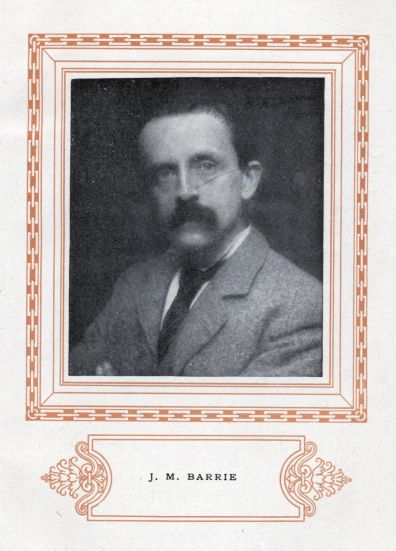
By J. M. BARRIE
Strictly speaking I never had a brother Henry, and yet I can not say that Henry was an impostor. He came into existence in a curious way, and I can think of him now without malice as a child of smoke. The first I heard of Henry was at Pettigrew's house, which is in a London suburb, so conveniently situated that I can go there and back in one day. I was testing some new Cabanas, I remember, when Pettigrew remarked that he had been lunching with a man who knew my brother Henry. Not having any brother but Alexander, I felt that Pettigrew had mistaken the name. "Oh, no," Pettigrew said; "he spoke of Alexander too." Even this did not convince me, and I asked my host for his friend's name. Scudamour was the name of the man, and he had met my brothers Alexander and Henry years before in Paris. Then I remembered Scudamour, and I probably frowned, for I myself was my own brother Henry. I distinctly recalled Scudamour meeting Alexander and me in Paris, and calling me Henry, though my name begins with a J. I explained the mistake to Pettigrew, and here, for the time being, the matter rested. However, I had by no means heard the last of Henry.
Several times afterward I heard from various persons that Scudamour wanted to meet me because he knew my brother Henry. At last we did meet, in Jimmy's chambers; and, almost as soon as he saw me, Scudamour asked where Henry was now. This was precisely what I feared. I am a man who always looks like a boy. There are few persons of my age in London who retain their boyish appearance as long as I have done; indeed, this is the curse of my life. Though I am approaching the age of thirty, I pass for twenty; and I have observed old gentlemen frown at my precocity when I said a good thing or helped myself to a second glass of wine. There was, therefore, nothing surprising in Scudamour's remark, that, when he had the pleasure of meeting Henry, Henry must have been about the age that I had now reached. All would have been well had I explained the real state of affairs to this annoying man; but, unfortunately for myself, I loathe entering upon explanations to anybody about anything. This it is to smoke the Arcadia. When I ring for a time-table and William John brings coals instead, I accept the coals as a substitute.
Much, then, did I dread a discussion with Scudamour, his surprise when he heard that I was Henry, and his comments on my youthful appearance. Besides, I was smoking the best of all mixtures. There was no likelihood of my meeting Scudamour again, so the easiest way to get rid of him seemed to be to humor him. I therefore told him that Henry was in India, married, and doing well. "Remember me to Henry when you write to him," was Scudamour's last remark to me that evening.
A few weeks later some one tapped me on the shoulder in Oxford Street. It was Scudamour. "Heard from Henry?" he asked. I said I had heard by the last mail. "Anything particular in the letter?" I felt it would not do to say that there was nothing particular in a letter which had come all the way from India, so I hinted that Henry was having trouble with his wife. By this I meant that her health was bad; but he took it up in another way, and I did not set him right. "Ah, ah!" he said, shaking his head sagaciously; "I'm sorry to hear that. Poor Henry!" "Poor old boy!" was all I could think of replying. "How about the children?" Scudamour asked. "Oh, the children," I said, with what I thought presence of mind, "are coming to England." "To stay with Alexander?" he asked. My answer was that Alexander was expecting them by the middle of next month; and eventually Scudamour went away muttering, "Poor Henry!" In a month or so we met again. "No word of Henry's getting leave of absence?" asked Scudamour. I replied shortly that Henry had gone to live in Bombay, and would not be home for years. He saw that I was brusk, so what does he do but draw me aside for a quiet explanation. "I suppose," he said, "you are annoyed because I told Pettigrew that Henry's wife had run away from him. The fact is, I did it for your good. You see, I happened to make a remark to Pettigrew about your brother Henry, and he said that there was no such person. Of course I laughed at that, and pointed out not only that I had the pleasure of Henry's acquaintance, but that you and I had talked about the old fellow every time we met. 'Well,' Pettigrew said, 'this is a most remarkable thing; for he,' meaning you, 'said to me in this very room, sitting in that very chair, that Alexander was his only brother.' I saw that Pettigrew resented your concealing the existence of your brother Henry from him, so I thought the most friendly thing I could do was to tell him that your reticence was doubtless due to the unhappy state of poor Henry's private affairs. Naturally in the circumstances you did not want to talk about Henry." I shook Scudamour by the hand, telling him that he had acted judiciously; but if I could have stabbed him in the back at that moment I dare say I would have done it.
I did not see Scudamour again for a long time, for I took care to keep out of his way; but I heard first from him and then of him. One day he wrote to me saying that his nephew was going to Bombay, and would I be so good as to give the youth an introduction to my brother Henry? He also asked me to dine with him and his nephew. I declined the dinner, but I sent the nephew the required note of introduction to Henry. The next I heard of Scudamour was from Pettigrew. "By the way," said Pettigrew, "Scudamour is in Edinburgh at present." I trembled, for Edinburgh is where Alexander lives. "What has taken him there?" I asked, with assumed carelessness. Pettigrew believed it was business; "but," he added, "Scudamour asked me to tell you that he meant to call on Alexander, as he was anxious to see Henry's children." A few days afterward I had a telegram from Alexander, who generally uses this means of communication when he corresponds with me.
"Do you know a man, Scudamour? Reply," was what Alexander said. I thought of answering that we had met a man of that name when we were in Paris; but after consideration, I replied boldly: "Know no one of name of Scudamour."
About two months ago I passed Scudamour in Regent Street, and he scowled at me. This I could have borne if there had been no more of Henry; but I knew that Scudamour was now telling everybody about Henry's wife.
By and by I got a letter from an old friend of Alexander's asking me if there was any truth in a report that Alexander was going to Bombay. Soon afterward Alexander wrote to me saying he had been told by several persons that I was going to Bombay. In short, I saw that the time had come for killing Henry. So I told Pettigrew that Henry had died of fever, deeply regretted; and asked him to be sure to tell Scudamour, who had always been interested in the deceased's welfare. Pettigrew afterward told me that he had communicated the sad intelligence to Scudamour. "How did he take it?" I asked. "Well," Pettigrew said, reluctantly, "he told me that when he was up in Edinburgh he did not get on well with Alexander. But he expressed great curiosity as to Henry's children." "Ah," I said, "the children were both drowned in the Forth; a sad affair—we can't bear to talk of it." I am not likely to see much of Scudamour again, nor is Alexander. Scudamour now goes about saying that Henry was the only one of us he really liked.
GILRAY'S FLOWER-POT
By J. M. BARRIE
I charge Gilray's unreasonableness to his ignoble passion for cigarettes; and the story of his flower-pot has therefore an obvious moral. The want of dignity he displayed about that flower-pot, on his return to London, would have made any one sorry for him. I had my own work to look after, and really could not be tending his chrysanthemum all day. After he came back, however, there was no reasoning with him, and I admit that I never did water his plant, though always intending to do so.
The great mistake was in not leaving the flower-pot in charge of William John. No doubt I readily promised to attend to it, but Gilray deceived me by speaking as if the watering of a plant was the merest pastime. He had to leave London for a short provincial tour, and, as I see now, took advantage of my good nature.
As Gilray had owned his flower-pot for several months, during which time (I take him at his word) he had watered it daily, he must have known he was misleading me. He said that you got into the way of watering a flower-pot regularly just as you wind up your watch. That certainly is not the case. I always wind up my watch, and I never watered the flower-pot. Of course, if I had been living in Gilray's rooms with the thing always before my eyes I might have done so. I proposed to take it into my chambers at the time, but he would not hear of that. Why? How Gilray came by this chrysanthemum I do not inquire, but whether, in the circumstances, he should not have made a clean breast of it to me is another matter. Undoubtedly it was an unusual thing to put a man to the trouble of watering a chrysanthemum daily without giving him its history. My own belief has always been that he got it in exchange for a pair of boots and his old dressing-gown. He hints that it was a present; but, as one who knows him well, I may say that he is the last person a lady would be likely to give a chrysanthemum to. Besides, if he was so proud of the plant he should have stayed at home and watered it himself.
He says that I never meant to water it, which is not only a mistake, but unkind. My plan was to run downstairs immediately after dinner every evening and give it a thorough watering. One thing or another, however, came in the way. I often remembered about the chrysanthemum while I was in the office; but even Gilray could hardly have expected me to ask leave of absence merely to run home and water his plant. You must draw the line somewhere, even in a government office. When I reached home I was tired, inclined to take things easily, and not at all in a proper condition for watering flower-pots. Then Arcadians would drop in. I put it to any sensible man or woman, could I have been expected to give up my friends for the sake of a chrysanthemum? Again, it was my custom of an evening, if not disturbed, to retire with my pipe into my cane chair, and there pass the hours communing with great minds, or, when the mood was on me, trifling with a novel. Often when I was in the middle of a chapter Gilray's flower-pot stood up before my eyes crying for water. He does not believe this, but it is the solemn truth. At those moments it was touch and go, whether I watered his chrysanthemum or not. Where I lost myself was in not hurrying to his rooms at once with a tumbler. I said to myself that I would go when I had finished my pipe, but by that time the flower-pot has escaped my memory. This may have been weakness; all I know is that I should have saved myself much annoyance if I had risen and watered the chrysanthemum there and then. But would it not have been rather hard on me to have had to forsake my books for the sake of Gilray's flowers and flower-pots and plants and things? What right has a man to go and make a garden of his chambers?
All the three weeks he was away, Gilray kept pestering me with letters about his chrysanthemum. He seemed to have no faith in me—a detestable thing in a man who calls himself your friend. I had promised to water his flower-pot; and between friends a promise is surely sufficient. It is not so, however, when Gilray is one of them. I soon hated the sight of my name in his handwriting. It was not as if he said outright that he wrote entirely to know whether I was watering his plant. His references to it were introduced with all the appearance of after-thoughts. Often they took the form of postscripts: "By the way, are you watering my chrysanthemum?" or, "The chrysanthemum ought to be a beauty by this time;" or, "You must be quite an adept now at watering plants." Gilray declares now that, in answer to one of these ingenious epistles, I wrote to him saying that "I had just been watering his chrysanthemum." My belief is that I did no such thing; or, if I did, I meant to water it as soon as I had finished my letter. He has never been able to bring this home to me, he says, because he burned my correspondence. As if a business man would destroy such a letter. It was yet more annoying when Gilray took to post-cards. To hear the postman's knock and then discover, when you are expecting an important communication, that it is only a post-card about a flower-pot—that is really too bad. And then I consider that some of the post-cards bordered upon insult. One of them said, "What about chrysanthemum?—reply at once." This was just like Gilray's overbearing way; but I answered politely, and so far as I knew, truthfully, "Chrysanthemum all right."
Knowing that there was no explaining things to Gilray, I redoubled my exertions to water his flower-pot as the day for his return drew near. Once, indeed, when I rang for water, I could not for the life of me remember what I wanted it for when it was brought. Had I had any forethought I should have left the tumbler stand just as it was to show it to Gilray on his return. But, unfortunately, William John had misunderstood what I wanted the water for, and put a decanter down beside it. Another time I was actually on the stair rushing to Gilray's door, when I met the housekeeper, and, stopping to talk to her, lost my opportunity again. To show how honestly anxious I was to fulfil my promise, I need only add that I was several times awakened in the watches of the night by a haunting consciousness that I had forgotten to water Gilray's flower-pot. On these occasions I spared no trouble to remember again in the morning. I reached out of bed to a chair and turned it upside down, so that the sight of it when I rose might remind me that I had something to do. With the same object I crossed the tongs and poker on the floor. Gilray maintains that instead of playing "fool's tricks" like these ("fool's tricks!") I should have got up and gone at once to his rooms with my water-bottle. What? and disturbed my neighbors? Besides, could I reasonably be expected to risk catching my death of cold for the sake of a wretched chrysanthemum? One reads of men doing such things for young ladies who seek lilies in dangerous ponds or edelweiss on overhanging cliffs. But Gilray was not my sweetheart, nor, I feel certain, any other person's.
I come now to the day prior to Gilray's return. I had just reached the office when I remembered about the chrysanthemum. It was my last chance. If I watered it once I should be in a position to state that, whatever condition it might be in, I had certainly been watering it. I jumped into a hansom, told the cabby to drive to the inn, and twenty minutes afterward had one hand on Gilray's door, while the other held the largest water-can in the house. Opening the door I rushed in. The can nearly fell from my hand. There was no flower-pot! I rang the bell. "Mr. Gilray's chrysanthemum!" I cried. What do you think William John said? He coolly told me that the plant was dead, and had been flung out days ago. I went to the theater that night to keep myself from thinking. All next day I contrived to remain out of Gilray's sight. When we met he was stiff and polite. He did not say a word about the chrysanthemum for a week, and then it all came out with a rush. I let him talk. With the servants flinging out the flower-pots faster than I could water them, what more could I have done? A coolness between us was inevitable. This I regretted, but my mind was made up on one point: I would never do Gilray a favor again.
MR. O'LEARY'S SECOND LOVE
By CHARLES LEVER
"You may easily suppose," began Mr. O'Leary, "that the unhappy termination of my first passion served as a shield to me for a long time against my unfortunate tendencies toward the fair, and such was really the case. I never spoke to a young lady for three years after, without a reeling in my head, so associated in my mind was love and sea-sickness. However, at last, what will not time do? It was about four years from the date of this adventure, when I became so oblivious of my former failure, as again to tempt my fortune. My present choice, in every way unlike the last, was a gay, lively girl, of great animal spirits, and a considerable turn for raillery, that spared no one; the members of her own family were not even sacred in her eyes; and her father, a reverend dean, as frequently figured among the ludicrous as his neighbors.
"The Evershams had been very old friends of a rich aunt of mine, who never, by the by, had condescended to notice me till I made their acquaintance; but no sooner had I done so, than she sent for me, and gave me to understand that in the event of my succeeding to the hand of Fanny Eversham, I should be her heir and the possessor of about sixty thousand pounds. She did not stop here; but by canvassing the dean in my favor, speedily put the matter on a most favorable footing, and in less than two months I was received as the accepted suitor of the fair Fanny, then one of the reigning belles of Dublin.
"They lived at this time, about three miles from town, in a very pretty country, where I used to pass all my mornings, and many of my evenings, too, in a state of happiness that I should have considered perfect, if it were not for two unhappy blots—one, the taste of my betrothed for laughing at her friends; another, the diabolical propensity of my intended father-in-law to talk politics; to the former I could submit; but with the latter submission only made bad worse; for he invariably drew up as I receded, dryly observing that with men who had no avowed opinions, it was ill-agreeing; or that, with persons who kept their politics as a school-boy does his pocket-money, never to spend, and always ready to change, it was unpleasant to dispute. Such taunts as these I submitted to, as well I might; secretly resolving, that as I now knew the meaning of Whig and Tory, I'd contrive to spend my life, after marriage, out of the worthy dean's diocese.
"Time wore on, and at length, to my most pressing solicitations it was conceded that a day for our marriage should be appointed. Not even the unlucky termination of this my second love affair can deprive me of the happy souvenir of the few weeks which were to intervene before our destined union.
"The mornings were passed in ransacking all the shops where wedding finery could be procured—laces, blondes, velvets, and satins, littered every corner of the deanery—and there was scarcely a carriage in a coach-maker's yard in the city that I had not sat and jumped in, to try the springs, by the special direction of Mrs. Eversham, who never ceased to impress me with the awful responsibility I was about to take upon me, in marrying so great a prize as her daughter—a feeling I found very general among many of my friends at the Kildare Street club.
"Among the many indispensable purchases which I was to make, and about which Fanny expressed herself more than commonly anxious, was a saddle-horse for me. She was a great horse-woman, and hated riding with only a servant; and had given me to understand as much about half-a-dozen times each day for the last five weeks. How shall I acknowledge it—equestrianism was never my forte. I had all my life considerable respect for the horse as an animal, pretty much as I dreaded a lion or a tiger; but as to any intention of mounting upon the back of one, and taking a ride, I should as soon have dreamed of taking an airing upon a giraffe; and as to the thought of buying, feeding, and maintaining such a beast at my own proper cost, I should just as soon have determined to purchase a pillory or a ducking-stool, by way of amusing my leisure hours.
"However, Fanny was obstinate—whether she suspected anything or not I cannot say—but nothing seemed to turn her from her purpose; and although I pleaded a thousand things in delay, yet she grew each day more impatient, and at last I saw there was nothing for it but to submit.
"When I arrived at this last bold resolve, I could not help feeling that to possess a horse, and not be able to mount him, was only deferring the ridicule; and as I had so often expressed the difficulty I felt in suiting myself as a cause of my delay, I could not possibly come forward with anything very objectionable, or I should be only the more laughed at. There was, then, but one course to take; a fortnight still intervened before the day which was to make me happy, and I accordingly resolved to take lessons in riding during the interval, and by every endeavor in my power become, if possible, able to pass muster on the saddle before my bride.
"Poor old Lalouette understood but little of the urgency of the case, when I requested his leave to take my lessons each morning at six o'clock, for I dared not absent myself during the day without exciting suspicion; and never, I will venture to assert, did knight-errant of old strive harder for the hand of his lady-love than did I during that weary fortnight; if a hippogriff had been the animal I bestrode, instead of being, as it was, an old wall-eyed gray, I could not have felt more misgivings at my temerity, or more proud of my achievement. In the first three days the unaccustomed exercise proved so severe, that when I reached the deanery I could hardly move, and crossed the floor pretty much as a pair of compasses might be supposed to do if performing that exploit. Nothing, however, could equal the kindness of my poor dear mother-in-law in embryo, and even the dean too. Fanny indeed, said nothing; but I rather think she was disposed to giggle a little; but my rheumatism, as it was called, was daily inquired after, and I was compelled to take some infernal stuff in my port wine, at dinner, that nearly made me sick at table.
"'I am sure you walk too much,' said Fanny, with one of her knowing looks. 'Papa, don't you think he ought to ride? it would be much better for him.'
"'I do, my dear,' said the dean. 'But then you see he is so hard to be pleased in a horse. Your old hunting days have spoiled you; but you must forget Melton and Grantham, and condescend to keep a hack.'
"I must have looked confoundedly foolish here, for Fanny never took her eyes off me, and continued to laugh in her own wicked way.
"It was now about the ninth or tenth day of my purgatorial performances; and certainly, if there be any merit in fleshly mortifications, these religious exercises of mine should stand my part hereafter. A review had been announced in the Phoenix park, which Fanny had expressed herself most desirous to witness; and as the dean would not permit her to go without a chaperon, I had no means of escape, and promised to escort her. No sooner had I made this rash pledge than I hastened to my confidential friend, Lalouette, and having imparted to him my entire secret, asked him in a solemn and imposing manner, 'Can I do it?' The old man shook his head dubiously, looked grave, and muttered at length, 'Mosch depend on de horse.' 'I know it—I know it—I feel it,' said I, eagerly—'then where are we to find an animal that will carry me peaceably through this awful day? I care not for his price.'
"'Votre affaire ne sera pas trop chère,' said he.
"'Why, how do you mean?' said I.
"He then proceeded to inform me that, by a singularly fortunate chance, there took place that day an auction of 'cast horses,' as they are termed, which had been used in the horse police force; and that from long riding and training to stand fire, nothing could be more suitable than one of these, being both easy to ride and not given to start at noise.
"I could have almost hugged the old fellow for his happy suggestion, and waited with impatience for three o'clock to come, when we repaired together to Essexbridge, at that time the place selected for these sales.
"I was at first a little shocked at the look of the animals drawn up; they were most miserably thin, most of them swelled in the legs, few without sore backs, and not one eye on an average in every three; but still they were all high-steppers, and carried a great tail. 'There's your affaire,' said the old Frenchman, as a long-legged, fiddle-headed beast was led out; turning out his forelegs so as to endanger the man who walked beside him.
"'Yes, there's blood for you,' said Charley Dycer, seeing my eye fixed on the wretched beast; 'equal to fifteen stone with any fox-hounds; safe in all his paces, and warranted sound; except,' added he, in a whisper, 'a slight spavin in both hind legs, ring-bone, and a little touch in the wind.' Here the animal gave an approving cough. 'Will any gentleman say fifty pounds to begin?' But no gentleman did. A hackney-coachman, however, said five, and the sale was opened; the beast trotting up and down nearly over the bidders at every moment, and plunging on so that it was impossible to know what was doing.
"'Five ten—fifteen—six pounds—thank you, sir—guineas'—seven pounds,' said I, bidding against myself, not perceiving that I had spoken last. 'Thank you, Mr. Moriarty,' said Dycer, turning toward an invisible purchaser supposed to be in the crowd. 'Thank you, sir, you'll not let a good one go that way.' Every one here turned to find out the very knowing gentleman; but he could nowhere be seen.
"Dycer resumed, 'Seven ten, for Mr. Moriarty. Going for seven ten—a cruel sacrifice—there's action for you—playful beast.' Here the devil had stumbled and nearly killed a basket-woman with two children.
"'Eight,' said I, with a loud voice.
"'Eight pounds, quite absurd,' said Dycer, almost rudely; 'a charger like that for eight pounds—going for eight pounds—going—nothing above eight pounds—no reserve, gentlemen, you are aware of that. They are all, as it were, his Majesty's stud—no reserve whatever—last time, eight pounds—gone.'
"Amid a very hearty cheer from the mob, God knows why, but a Dublin mob always cheer—I returned accompanied by a ragged fellow, leading my new purchase after me with a hay halter.
"'What is the meaning of those letters?' said I, pointing to a very conspicuous G. R., with sundry other enigmatical signs, burned upon the animal's hind quarter.
"'That's to show he was a po-lis," said the fellow with a grin; 'and when ye ride with ladies, ye must turn the decoy side.'
"The auspicious morning at last arrived; and, strange to say, that the first waking thought was of the unlucky day that ushered in my yachting excursion, four years before. Why this was so I cannot pretend to guess: there was but little analogy in the circumstances, at least so far as anything had then gone. 'How is Marius?' said I to my servant, as he opened my shutters. Here let me mention that a friend of the Kildare Street club had suggested this name from the remarkably classic character of my steed's countenance; his nose, he assured me, was perfectly Roman.
"'Marius is doing finely, sir, barring his cough, and the trifle that ails his hind legs.'
"'He'll carry me quietly, Simon; eh?'
"'Quietly! I'll warrant he'll carry you quietly, if that's all.'
"Here was comfort, certainly. Simon had lived forty years as pantry boy with my mother, and knew a great deal about horses. I dressed myself, therefore, in high spirits; and if my pilot jacket and oil-skin cap in former days had half persuaded me that I was born for marine achievements, certainly my cords and tops, that morning, went far to convince me that I must have once been a very keen sportsman somewhere, without knowing it. It was a delightful July day that I set out to join my friends, who, having recruited a large party, were to rendezvous at the corner of Stephen's Green; thither I proceeded in a certain rambling trot, which I have often observed is a very favorite pace with timid horsemen and gentlemen of the medical profession. I was hailed with a most hearty welcome by a large party as I turned out of Grafton Street, among whom I perceived several friends of Miss Eversham, and some young dragoon officers, not of my acquaintance, but who appeared to know Fanny intimately, and were laughing heartily with her as I rode up.
"I don't know if other men have experienced what I am about to mention or not; but certainly to me there is no more painful sensation than to find yourself among a number of well-mounted, well-equipped people, while the animal you yourself bestride seems only fit for the kennel. Every look that is cast at your unlucky steed—every whispered observation about you are so many thorns in your flesh, till at last you begin to feel that your appearance is for very little else than the amusement and mirth of the assembly; and every time you rise in your stirrups you excite a laugh.
"'Where, for mercy's sake, did you find that creature?' said Fanny, surveying Marius through her glass.
"'Oh, him, eh? Why, he is a handsome horse, if in condition—a charger, you know—that's his style.'
"'Indeed,' lisped a young lancer, 'I should be devilish sorry to charge, or be charged with him.' And here they all chuckled at this puppy's silly joke, and I drew up to repress further liberties.
"'Is he anything of a fencer?' said a young country gentleman.
"'To judge from his near eye, I should say much more of a boxer,' said another.
"Here commenced a running fire of pleasantry at the expense of my poor steed; which, not content with attacking his physical, extended to his moral qualities. An old gentleman near me observing, 'that I ought not to have mounted him at all, seeing he was so deuced groggy;' to which I replied, by insinuating, that if others present were as free from the influence of ardent spirits, society would not be a sufferer; an observation that, I flatter myself, turned the mirth against the old fellow, for they all laughed for a quarter of an hour after.
"Well, at last we set out in a brisk trot, and, placed near Fanny, I speedily forgot all my annoyances in the prospect of figuring to advantage before her. When we reached the College Green the leaders of the cortège suddenly drew up, and we soon found that the entire street opposite the Bank was filled with a dense mob of people, who appeared to be swayed hither and thither, like some mighty beast, as the individuals composing it were engaged in close conflict. It was nothing more nor less than one of those almost weekly rows which then took place between the students of the University and the town's-people, and which rarely ended without serious consequences. The numbers of people pressing on to the scene of action soon blocked up our retreat, and we found ourselves most unwilling spectators of the conflict. Political watch-words were loudly shouted by each party; and at last the students, who appeared to be yielding to superior numbers, called out for the intervention of the police. The aid was nearer than they expected; for at the same instant a body of mounted policemen, whose high helmets rendered them sufficiently conspicuous, were seen trotting at sharp pace down Dame Street. On they came with drawn sabres, led by a well-looking, gentleman-like personage in plain clothes, who dashed at once into the middle of the fray, issuing his orders, and pointing out to his followers to secure the ringleaders. Up to this moment I had been a most patient and rather amused spectator of what was doing. Now, however, my part was to commence, for at the word 'Charge,' given in a harsh, deep voice by the sergeant of the party, Marius, remembering his ancient instinct, pricked up his ears, cocked his tail, flung up both his hind legs till they nearly broke the Provost's windows, and plunged into the thickest of the fray like a devil incarnate.
"Self-preservation must be a strong instinct, for I well remember how little pain it cost me to see the people tumbling and rolling beneath me, while I continued to keep my seat. It was only a moment before, and that immense mass were a man-to-man encounter, now all the indignation of both parties seemed turned upon me; brick-bats were loudly implored and paving-stones begged to throw at my devoted head; the Wild Huntsman of the German romance never created half the terror nor one-tenth of the mischief that I did in less than fifteen minutes, for the ill-starred beast continued twining and twisting like a serpent, plunging and kicking the entire time, and occasionally biting too; all which accomplishments, I afterwards learned, however little in request in civil life, are highly prized in the horse police.
"Every new order of the sergeant was followed in his own fashion by Marius, who very soon contrived to concentrate in my unhappy person all the interest of about fifteen hundred people.
"'Secure that scoundrel," said the magistrate, pointing with his finger towards me, as I rode over a respectable-looking old lady, with a gray muff. 'Secure him. Cut him down.'
"'Ah, devil's luck to him, if ye do,' said a newsmonger with a broken shin.
"On I went, however; and now, as the Fates would have it, instead of bearing me out of further danger, the confounded brute dashed onward to where the magistrate was standing, surrounded by policemen. I thought I saw him change color as I came on. I suppose my own looks were none of the pleasantest, for the worthy man evidently liked them not. Into the midst of them we plunged, upsetting a corporal, horse and all, and appearing as if bent upon reaching the alderman.
"'Cut him down, for Heaven's sake. Will nobody shoot him?" said he, with a voice trembling with fear and anger.
"At these words a wretch lifted up his sabre, and made a cut at my head. I stooped suddenly, and throwing myself from the saddle, seized the poor alderman round the neck, and both came rolling to the ground together. So completely was he possessed with the notion that I meant to assassinate him, that while I was endeavoring to extricate myself from his grasp, he continued to beg his life in the most heart-rending manner.
"My story is now soon told. So effectually did they rescue the alderman from his danger that they left me insensible, and I only came to myself some days after by finding myself in the dock in Green Street, charged with an indictment of nineteen counts; the only word of truth is what lay in the preamble, for the 'devil inciting' me only would ever have made me the owner of that infernal beast, the cause of all my misfortunes. I was so stupefied from my beating that I know little of the course of the proceedings. My friends told me afterward that I had a narrow escape from transportation; but for the greatest influence exerted in my behalf, I should certainly have passed the autumn in the agreeable recreation of pounding oyster-shells or carding wool; and it certainly must have gone hard with me, for, stupefied as I was, I remember the sensation in court when the alderman made his appearance with a patch over his eye. The affecting admonition of the little judge—who, when passing sentence upon me, adverted to the former respectability of my life and the rank of my relatives—actually made the galleries weep.
"Four months in Newgate and a fine to the king, then, rewarded my taste for horse exercise; and it's no wonder if I prefer going on foot.
"As to Miss Eversham, the following short note from the dean concluded my hopes in that quarter:
"Deanery, Wednesday morning.
"'Sir,—After the very distressing publicity to which your late conduct has exposed you—the so open avowal of political opinions, at variance with those (I will say) of every gentleman—and the recorded sentence of a judge on the verdict of twelve of your countrymen—I should hope that you will not feel my present admonition necessary to inform you that your visits to my house shall cease.
"'The presents you made my daughter, when under our unfortunate ignorance of your real character, have been addressed to your hotel, and I am your most obedient, humble servant,
"'Oliver Eversham.'
"Here ended my second affair 'par amour;' and I freely confess to you that if I can only obtain a wife in a sea voyage, or a steeple-chase, I am likely to fulfil one great condition in modern advertising—'as having no incumbrance, nor any objection to travel.'"
THE INDIFFERENCE OF THE MILLER OF HOFBAU
By ANTHONY HOPE HAWKINS
Copyright 1895, 1896, A. H. Hawkins; 1896 Frederick A. Stokes Company; 1895, 1896, S. S. McClure, Limited.
There is a swift little river running by the village of Hofbau, and on the river is a mill, kept in the days of King Rudolf III. by a sturdy fellow who lived there all alone; the King knew him, having alighted at his house for a draught of beer as he rode hunting, and it was of him the King spoke when he said to the Queen: "There is, I believe, but one man in the country whom Osra could not move, and he is the Miller of Hofbau." But although he addressed the Queen, it was his sister at whom he aimed his speech. The Princess herself was sitting by, and when she heard the King she said:
"In truth I do not desire to move any man. What but trouble comes of it? Yet who is this miller?"
The King told her where the miller might be found, and he added: "If you convert him to the love of women you shall have the finest bracelet in Strelsau."
"There is nothing, sire, so remote from my thoughts or desires as to convert your miller," said Osra scornfully.
In this, at the moment, she spoke truthfully; but being left alone for some days at the Castle of Zenda, which is but a few miles from Hofbau, she found the time hang very heavy on her hands; indeed she did not know what to do with herself for weariness; and for this reason, and none other at all, one day she ordered her horse and rode off with a single groom into the forest. Coming, as the morning went on, to a wide road, she asked the groom where it led. "To Hofbau, madame," he answered. "It is not more than a mile further on." Osra waited a few moments, then she said: "I will ride on and see the village, for I have been told that it is pretty. Wait here till I return," and she rode on, smiling a little, and with a delicate tint of colour in her cheeks.
Before long she saw the river and the mill on the river; and, coming to the mill, she saw the miller sitting before his door, smoking a long pipe. She called out to him, asking him to sell her a glass of milk.
"You can have it for the asking," said the miller. He was a good-looking fair fellow, and wore a scarlet cap. "There is a pail of it just inside the door behind me." Yet he did not rise, but lay there, lolling luxuriously in the sun. For he did not know Osra, never having been to Strelsau in his life, and to Zenda three or four times only, and that when the Princess was not there. Moreover—though this, as must be allowed, is not to the purpose—he had sworn never again to go so far afield.
Being answered in this manner, and at the same time desiring the milk, the Princess had no choice but to dismount.
This she did, and passed by the miller, pausing a moment to look at him with bright curious eyes, that flashed from under the brim of her wide-rimmed feathered hat; but the miller blinked lazily up at the sun and took no heed of her.
Osra passed on, found the pail, poured out a cup of milk, and drank it. Then, refilling the cup, she carried it to the miller.
"Will you not have some?" said she with a smile.
"I was too lazy to get it," said the miller; and he held out his hand, but did not otherwise change his position.
Osra's brow puckered and her cheek flushed as she bent down, holding the cup of milk so that the miller could reach it. He took and drained it, gave it back to her, and put his pipe in his mouth again. Osra sat down by him and watched him. He puffed and blinked away, never so much as looking at her.
"What have you for dinner?" asked she presently.
"A piece of cold pie," said he. "There's enough for two, if you're hungry."
"Would you not like it better hot?"
"Oh, aye; but I cannot weary myself with heating it."
"I'll heat it," said the Princess; and, rising, she went into the house, and made up the fire, which was almost burnt out; then she heated the pie, and set the room in order, and laid the table, and drew a large jug of beer from the cask. Next she placed an arm-chair ready for the miller, and put the jug by it; then she filled the pipe from the bowl of tobacco and set a cushion in the chair. All this while she hummed a tune, and from time to time smiled gayly. Lastly, she arranged a chair by the elbow of the miller's chair; then she went out and told him that his dinner was ready; and he stumbled to his feet with a sigh of laziness, and walked before her into the house.
"May I come?" cried she.
"Aye, there is enough for two," said the Miller of Hofbau without looking round.
So she followed him in. He sank into the arm-chair and sat there, for a moment surveying the room which was so neat, and the table so daintily laid, and the pie so steaming hot. And he sighed, saying:
"It was like this before poor mother died." And he fell to on a great portion of pie with which Osra piled his plate.
When he had finished eating—which thing did not happen for some time—she held the jug while he took a long draught; then she brought a coal in the tongs and held it while he lit his pipe from it; then she sat down by him. For several moments he puffed, and then at last he turned his head and looked at Princess Osra; she drooped her long lashes and cast down her eyes; next she lifted her eyes and glanced for an instant at the miller; and, finally, she dropped her eyes again and murmured shyly: "What is it, sir? Why do you look at me?"
"You seem to be a handy wench," observed the miller. "The pie was steaming hot and yet not burnt, the beer was well frothed but not shaken nor thickened, and the pipe draws well. Where does your father dwell?"
"He is dead, sir," said Princess Osra very demurely.
"And your mother?" pursued the miller.
"She also is dead."
"There is small harm in that," said the miller thoughtfully; and Osra turned away her head to hide her smile.
"Are you not very lonely, living here all by yourself?" she asked a moment later.
"Indeed I have to do everything for myself," said the miller sadly.
"And there is nobody to—to care for you?"
"No, nor to look after my comfort," said the miller. "Have you any kindred?"
"I have two brothers, sir; but they are married now, and have no need of me."
The miller laid down his pipe and, setting his elbow on the table, faced Princess Osra.
"H'm!" said he. "And is it likely you will ride this way again?"
"I may chance to do so," said Osra, and now there was a glance of malicious triumph in her eyes; she was thinking already how the bracelet would look on her arm.
"Ah!" said the miller. And after a pause he added: "If you do, come half an hour before dinner, and you can lend a hand in making it ready. Where did you get those fine clothes?"
"My mistress gave them to me," answered Osra. "She has cast them off."
"And that horse you rode?"
"It is my master's; I have it to ride when I do my mistress's errands."
"Will your master and mistress do anything for you if you leave your service?"
"I have been promised a present if—" said Osra, and she paused in apparent confusion.
"Aye," said the miller, nodding sagaciously, as he rose slowly from the arm-chair. "Will you be this way again in a week or so?" he asked.
"I think it is very likely," answered the Princess Osra.
"Then look in," said the miller "About half an hour before dinner."
He nodded his head again very significantly at Osra, and, turning away, went to his work, as a man goes who would far rather sit still in the sun. But just as he reached the door he turned his head and asked: "Are you sturdy?"
"I am strong enough, I think," said she.
"A sack of flour is a heavy thing for man to lift by himself," remarked the miller, and with that he passed through the door and left her alone.
Then she cleared the table, put the pie—or what was left—in the larder, set the room in order, refilled the pipe, stood the jug handy by the cask, and, with a look of great satisfaction on her face, tripped out to where her horse was, mounted and rode away.
The next week—and the interval had seemed long to her, and no less long to the Miller of Hofbau—she came again, and so the week after; and in the week following that she came twice; and on the second of these two days, after dinner, the miller did not go off to his sacks, but he followed her out of the house, pipe in hand, when she went to mount her horse, and as she was about to mount, he said:
"Indeed you're a handy wench."
"You say much of my hands, but nothing of my face," remarked Princess Osra.
"Of your face?" repeated the miller in some surprise. "What should I say of your face?"
"Well, is it not a comely face?" said Osra, turning towards him that he might be better able to answer her question.
The miller regarded her for some minutes, then a slow smile spread on his lips.
"Oh, aye, it is well enough," said he. Then he laid a floury finger on her arm as he continued: "If you come next week—why, it is but half a mile to church! I'll have the cart ready and bid the priest be there. What's your name?" For he had not hitherto asked Osra's name.
"Rosa Schwartz," said she, and her face was all alight with triumph and amusement.
"Yes, I shall be very comfortable with you," said the miller. "We will be at the church an hour before noon, so that there may be time afterwards for the preparation of dinner."
"That will be on Thursday in next week?" asked Osra.
"Aye, on Thursday," said the miller, and he turned on his keel. But in a minute he turned again, saying: "Give me a kiss, then, since we are to be man and wife," and he came slowly towards her, holding his arms open.
"Nay, the kiss will wait till Thursday. Maybe there will be less flour on your face then." And with a laugh she dived under his outstretched arms and made her escape. The day being warm, the miller did not put himself out by pursuing her, but stood where he was, with a broad comfortable smile on his lips; and so he watched her ride away.
Now, as she rode, the Princess was much occupied in thinking of the Miller of Hofbau. Elated and triumphant as she was at having won from him a promise of marriage, she was yet somewhat vexed that he had not shown a more passionate affection, and this thought clouded her brow for full half an hour. But then her face cleared. "Still waters run deep," she said to herself. "He is not like these Court gallants, who have learnt to make love as soon as they learn to walk, and cannot talk to a woman without bowing and grimacing and sighing at every word. The miller has a deep nature, and surely I have won his heart, or he would not take me for his wife. Poor miller! I pray that he may not grieve very bitterly when I make the truth known to him!"
And then, at the thought of the grief of the miller, her face was again clouded; but it again cleared when she considered of the great triumph that she had won, and how she would enjoy a victory over the King, and would have the finest bracelet in all Strelsau as a gift from him. Thus she arrived at the Castle in the height of merriment and exultation.
It chanced that the King came to Zenda that night, to spend a week hunting the boar in the forest; and when Osra, all blushing and laughing, told him of her success with the Miller of Hofbau he was greatly amused, and swore that no such girl ever lived, and applauded her, renewing his promise of the bracelet; and he declared that he would himself ride with her to Hofbau on the wedding-day, and see how the poor miller bore his disappointment.
"Indeed I do not see how you are going to excuse yourself to him," he laughed.
"A purse of five hundred crowns must do that office for me," said she.
"What, will crowns patch a broken heart?"
"His broken heart must heal itself, as men's broken hearts do, brother!"
"In truth, sister, I have known them cure themselves. Let us hope it may be so with the Miller of Hofbau."
"At the worst I have revenged the wrongs of women on him. It is unendurable that any man should scorn us, be he king or miller."
"It is indeed very proper that he should suffer great pangs," said the King, "in spite of his plaster of crowns. I shall love to see the stolid fellow sighing and moaning like a lovesick courtier."
So they agreed to ride together to the miller's at Hofbau on the day appointed for the wedding, and both of them waited with impatience for it. But, with the bad luck that pursues mortals (even though they be princes) in this poor world, it happened that early in the morning of the Thursday a great officer came riding post-haste from Strelsau to take the King's commands on high matters of state; and, although Rudolf was sorely put out of temper by this untoward interruption, yet he had no alternative but to transact the business before he rode to the miller's at Hofbau. So he sat fretting and fuming, while long papers were read to him, and the Princess walked up and down the length of the drawbridge, fretting also; for before the King could escape from his affairs, the hour of the wedding was already come, and doubtless the Miller of Hofbau was waiting with the priest in the church. Indeed it was one o'clock or more before Osra and the King set out from Zenda, and they had then a ride of an hour and a half; and all this when Osra should have been at the miller's at eleven o'clock.
"Poor man, he will be half mad with waiting and with anxiety for me!" cried Osra. "I must give him another hundred crowns on account of it." And she added, after a pause, "I pray he may not take it too much to heart, Rudolf."
"We must try to prevent him doing himself any mischief in his despair," smiled the King.
"Indeed it is a serious matter," pouted the Princess, who thought the King's smile out of place.
"It was not so when you began it," said her brother; and Osra was silent.
Then about half-past two they came in sight of the mill. Now the King dismounted, while they were still several hundred yards away, and tied his horse to a tree in a clump by the wayside; and when they came near to the mill he made a circuit and approached from the side, and, creeping along to the house, hid himself behind a large water-butt, which stood just under the window; from that point he could hear what passed inside the house, and could see if he stood erect. But Osra rode up to the front of the mill, as she had been accustomed, and, getting down from her horse, walked up to the door. The miller's cart stood in the yard of the mill, but the horse was not in the shafts, and neither the miller nor anybody else was to be seen about; and the door of the house was shut.
"He must be waiting at the church," said she. "But I will look in and make sure. Indeed I feel half afraid to meet him." And her heart was beating rapidly and her face was rather pale as she walked up to the door; for she feared what the miller might do in the passion of his disappointment at learning who she was and that she could not be his wife. "I hope the six hundred crowns will comfort him," she said, as she laid her hand on the latch of the door; and she sighed, her heart being heavy for the miller, and, maybe a little heavy also for the guilt that lay on her conscience for having deceived him.
Now when she lifted the latch and opened the door, the sight that met her eyes was this: The table was strewn with the remains of a brave dinner; two burnt-out pipes lay beside the plates. A smaller table was in front of the fire; on it stood a very large jug, entirely empty, but bearing signs of having been full not so long ago; and on either side of it, each in an arm-chair, sat the priest of the village and the Miller of Hofbau; both of them were sleeping very contentedly, and snoring somewhat as they slept. The Princess, smitten by remorse at the spectacle, said softly:
"Poor fellow, he grew weary of waiting, and hungry, and was compelled to take his dinner; and, like the kind man he is, he has entertained the priest, and kept him here, so that no time should be lost when I arrived. Indeed I am afraid the poor man loves me very much. Well, miller, or lord, or prince—they are all the same. Heigh-ho! Why did I deceive him?" And she walked up to the miller's chair, leant over the back of it, and lightly touched his red cap with her fingers. He put up his hand and brushed with it, as though he brushed away a fly, but gave no other sign of awakening.
The King called softly from behind the water-butt under the window:
"Is he there, Osra? Is he there?"
"The poor man has fallen asleep in weariness," she answered. "But the priest is here, ready to marry us. Oh, Rudolf, I am so sorry for what I have done!"
"Girls are always mighty sorry, after it is done," remarked the King. "Wake him up, Osra."
At this moment the Miller of Hofbau sat up in his chair and gave a great sneeze; and by this sound the priest also was awakened. Osra came forward and stood between them. The miller looked at her, and tilted his red cap forward in order that he might scratch his head. Then he looked across to the priest, and said:
"It is she, Father. She has come."
The priest rubbed his hands together, and smiled uncomfortably.
"We waited two hours," said he, glancing at the clock. "See, it is three o'clock now."
"I am sorry you waited so long," said Osra, "but I could not come before. And—and now that I am come, I cannot——"
But here she paused in great distress and confusion, not knowing how to break her sad tidings to the Miller of Hofbau.
The miller drew his legs up under his chair, and regarded Osra with a grave air.
"You should have been here at eleven," said he. "I went to the church at eleven, and the priest was there, and my cousin Hans to act as my groom, and my cousin Gertrude to be your maid. There we waited hard on two hours. But you did not come."
"I am very sorry," pleaded Princess Osra. The King laughed low to himself behind the water-butt, being much amused at her distress and her humility.
"And now that you are come," pursued the miller, scratching his head again, "I do not know what we are to do." He looked again at the priest, seeking counsel.
At this the Princess Osra, thinking that an opportunity had come, took the purse of six hundred crowns from under her cloak, and laid it on the table.
"What is this?" said the miller, for the first time showing some eagerness.
"They are for you," said Osra as she watched him while he unfastened the purse. Then he poured the crowns out on the table, and counted them one by one, till he had told all the six hundred. Then he raised his hands above his head, let them fall again, sighed slightly, and looked across at the priest.
"I warned you not to be in such a hurry, friend miller," remarked the priest.
"I waited two hours," said the miller plaintively, "and you know that she is a handy wench, and very fond of me."
He began to gather up the crowns and return them to the purse.
"I trust I am a handy wench," said Osra, smiling, yet still very nervous, "and, indeed, I have a great regard for the miller, but——"
"Nay, he does not mean you," interrupted the priest.
"Six hundred," sighed the miller, "and Gertrude has but two hundred! Still she is a handy wench and very sturdy. I doubt if you could lift a sack by yourself, as she can." And he looked doubtfully at Osra's slender figure.