Amandine Lucille Aurore Dupin, Baroness Dudevant, NOW FOR THE FIRST TIME COMPLETELY TRANSLATED INTO ENGLISH INDIANA (continued 6)
George Burnham Ives translation
She waited a long while; she looked at her watch and found that the appointed time had passed. The sea was so high, and navigation about the shores of the island is so difficult in the best of weather, that she was beginning, to despair of the courage of the men who were to take her aboard, when she spied on the gleaming waves the black shadow of a pirogue, trying to make the land. But the swell was so strong and the sea so rough that the frail craft constantly disappeared, burying itself as it were in the dark folds of a shroud studded with silver stars. She rose and answered their signal several times with cries which the wind whisked away before carrying them to the ears of the oarsmen. At last, when they were near enough to hear her, they pulled toward her with much difficulty; then paused to wait for a wave. As soon as they felt it raise the skiff they redoubled their efforts, and the wave broke and threw them up on the beach.
The ground on which Saint-Paul is built is composed of sea sand and gravel from the mountains, which the Des Galets river brings from a long distance from its mouth by the strength of its current. These heaps of rounded pebbles form submarine mountains near the shore which the waves overthrow and rebuild at their pleasure. Their constant shifting makes it impossible to avoid them, and the skill of the pilot is useless among these constantly appearing and disappearing obstacles. Large vessels lying in the harbor of Saint-Denis often drag their anchors and are cast on shore by the force of the currents; they have no other resource when this off-shore wind begins to blow, and to make the turbulent receding waves perilous, than to put to sea as quickly as possible, and that is what the Eugène had done.
The skiff bore Indiana and her fortunes amid the wild waves, the howling of the storm and the oaths of the two rowers, who had no hesitation in cursing loudly the danger to which they exposed themselves for her sake. Two hours ago, they said, the ship should have been under way, and on her account the captain had obstinately refused to give the order. They added divers insulting and cruel reflections, but the unhappy fugitive consumed her shame in silence; and when one of them suggested to the other that they might be punished if they were lacking in the respect they had been ordered to pay the captain's mistress:
"Never you fear!" was the reply; "the sharks are the lads we've got to settle accounts with this night. If we ever see the captain again, I don't believe he'll be any uglier than them."
"Talking of sharks," said the first, "I don't know whether one of 'em has got scent of us already, but I can see a face in our wake that don't belong to a Christian."
"You fool! to take a dog's face for a sea-wolf's! Hold! my four-legged passenger, we forgot you and left you on shore; but, blast my eyes, if you shall eat up the ship's biscuit! Our orders only mentioned a young woman, nothing was said about a cur——"
As he spoke he raised his oar to hit the beast on the head; but Madame Delmare, casting her tearful, distraught eyes upon the sea, recognized her beautiful Ophelia, who had found her scent on the rocks and was swimming after her. As the sailor was about to strike her, the waves, against which she was struggling painfully, carried her away from the skiff, and her mistress heard her moaning with impatience and exhaustion. She begged the oarsmen to take her into the boat and they pretended to comply; but, as the faithful beast approached, they dashed out her brains with loud shouts of laughter, and Indiana saw before her the dead body of the creature who had loved her better than Raymon. At the same time a huge wave drew the skiff down as it were into the depths of an abyss, and the laughter of the sailors changed to imprecations and yells of terror. However, thanks to its buoyancy and lightness the pirogue righted itself like a duck and climbed to the summit of the wave, to plunge into another ravine and mount again to another foaming crest. As they left the shore behind, the sea became less rough, and soon the skiff flew along swiftly and without danger toward the ship. Thereupon, the oarsmen recovered their good humor and with it the power of reflection. They strove to atone for their brutal treatment of Indiana; but their cajolery was more insulting than their anger.
"Come, come, my young lady," said one of them, "take courage, you're safe now; of course the captain will give us a glass of the best wine in the locker for the pretty parcel we've fished up for him."
The other affected to sympathize with the young lady because her clothes were wet; but, he said, the captain was waiting for her and would take good care of her. Indiana listened to their remarks in deadly terror, without speaking or moving; she realized the horror of her situation, and could see no other way of escaping the outrages which awaited her than to throw herself into the sea. Two or three times she was on the point of jumping out of the boat; but she recovered courage, a sublime courage, with the thought:
"It is for him, Raymon, that I suffer all these indignities. I must live though I were crushed with shame!"
She put her hand to her oppressed heart and touched the hilt of a dagger which she had concealed there in the morning, with a sort of instinctive prevision of danger. The possession of that weapon restored all her confidence; it was a short, pointed stiletto, which her father used to carry; an old Spanish weapon which had belonged to a Medina-Sidonia, whose name was cut on the blade, with the date 1300. Doubtless it had rusted in noble blood, had washed out more than one affront, punished more than one insolent knave. With it in her possession, Indiana felt that she became a Spaniard once more, and she went aboard the ship with a resolute heart, saying to herself that a woman incurred no risk so long as she had a sure means of taking her own life before submitting to dishonor. She avenged herself for the harsh treatment of her guides only by rewarding them handsomely for their fatigue; then she went to her cabin and anxiously awaited the hour of departure.
At last the day broke, and the sea was covered with small boats bringing the passengers aboard. Indiana looked with terror through the port-hole at the faces of those who came aboard the Eugène; she dreaded lest she should see her husband, coming to claim her. At last the echoes of the last gun died away on the island which had been her prison. The ship began to cut her way through the waves, and the sun, rising from the ocean, cast its cheerful, rosy light on the white peaks of the Salazes as they sank lower and lower on the horizon.
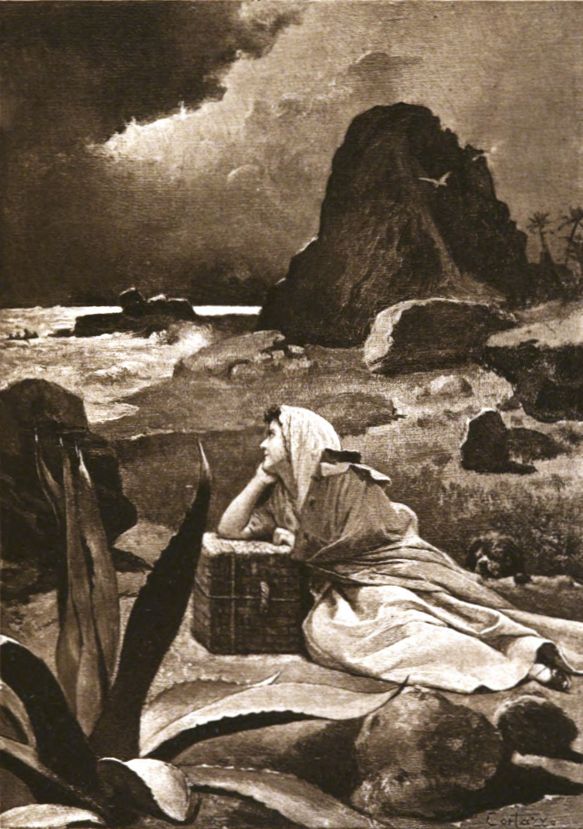
MADAME DELMARE'S FLIGHT
She waited a long while; she looked at her watch and found that the appointed time had passed. The sea was so high, and navigation about the shores of the island is so difficult in the best of weather, that she was beginning, to despair of the courage of the men who were to take her aboard, when she spied on the gleaming waves the black shadow of a pirogue, trying to make the land.
When they were a few leagues from port, a sort of comedy was played on board to avoid a confession of trickery. Captain Random pretended to discover Madame Delmare on his vessel; he feigned surprise, questioned the sailors, went through the form of losing his temper and of quieting down again, and ended by drawing up a report of the finding of a stowaway on board; that is the technical term used on such occasions.
Allow me to go no farther with the story of this voyage. It will be enough for me to tell you, for Captain Random's justification, that, despite his rough training, he had enough natural good sense to understand Madame Delmare's character very quickly; he ventured upon very few attempts to abuse her unprotected condition and eventually was touched by it and acted as her friend and protector. But that worthy man's loyal behavior and Indiana's dignity did not restrain the comments of the crew, the mocking glances, the insulting suspicions and the broad and stinging jests. These were the real torments of the unhappy woman during that journey, for I say nothing of the fatigue, the discomforts, the dangers, the tedium and the sea-sickness; she paid no heed to them.
XXVIII
Three days after the despatch of his letter to Ile Bourbon, Raymon had entirely forgotten both the letter and its purpose. He had felt decidedly better and had ventured to make a visit in the neighborhood. The estate of Lagny, which Monsieur Delmare had left to be sold for the benefit of his creditors, had been purchased by a wealthy manufacturer, Monsieur Hubert, a shrewd and estimable man, not like all wealthy manufacturers, but like a small number of the newly-rich. Raymon found the new owner comfortably settled in that house which recalled so many memories. He took pleasure in giving a free rein to his emotion as he wandered through the garden where Noun's light footprints seemed to be still visible on the gravel, and through those great rooms which seemed still to retain the echoes of Indiana's soft words; but soon the presence of a new hostess changed the current of his thoughts.
In the main salon, on the spot where Madame Delmare was accustomed to sit and work, a tall, slender young woman, with a glance that was at once pleasant and mischievous, caressing and mocking, sat before an easel, amusing herself by copying in water-colors the odd hangings on the walls. The copy was a fascinating thing, a delicate satire instinct with the bantering yet refined nature of the artist. She had amused herself by exaggerating the pretentious finicalness of the old frescoes; she had grasped the false and shifting character of the age of Louis XIV. on those stilted figures. While refreshing the colors that time had faded, she had restored their affected graces, their perfume of courtiership, their costumes of the boudoir and the shepherd's hut, so curiously identical. Beside that work of historical raillery she had written the word copy.
She raised her long eyes, instinct with merriment of a caustic, treacherous, yet attractive sort, slowly to Raymon's face. For some reason she reminded him of Shakespeare's Anne Page. There was in her manner neither timidity nor boldness, nor affectation, nor self-distrust. Their conversation turned upon the influence of fashion in the arts.
"Is it not true, monsieur, that the moral coloring of the period was in that brush?" she said, pointing to the wainscoting, covered with rustic cupids after the style of Boucher. "Isn't it true that those sheep do not walk or sleep or browse like sheep of to-day? And that pretty landscape, so false and so orderly, those clumps of many-petalled roses in the middle of the forest where naught but a bit of eglantine grows in our days, those tame birds of a species that has apparently disappeared, and those pink satin gowns which the sun never faded—is there not in all these a deal of poesy, ideas of luxury and pleasure, of a whole useless, harmless, joyous life? Doubtless these absurd fictions were quite as valuable as our gloomy political deliverances! If only I had been born in those days!" she added with a smile; "frivolous and narrow-minded creature that I am, I should have been much better fitted to paint fans and produce masterpieces of thread-work than to read the newspapers and understand the debates in the Chambers!"
Monsieur Hubert left the young people together; and their conversation drifted from one subject to another, until it fell at last upon Madame Delmare.
"You were very intimate with our predecessors in this house," said the young woman, "and it is generous on your part to come and see new faces here. Madame Delmare," she added, with a penetrating glance at him, "was a remarkable woman, so they say; she must have left memories here which place us at a disadvantage, so far as you are concerned."
"She was an excellent woman," Raymon replied, unconcernedly, "and her husband was a worthy man."
"But," rejoined the reckless girl, "she was something more than an excellent woman, I should judge. If I remember rightly there was a charm about her personality which calls for a more enthusiastic and more poetic description. I saw her two years ago, at a ball at the Spanish ambassador's. She was fascinating that night; do you remember?"
Raymon started at this reminder of the evening that he spoke to Indiana for the first time. He remembered at the same moment that he had noticed at that ball the distingué features and clever eyes of the young woman with whom he was now talking; but he did not then ask who she was.
Not until he had taken his leave of her and was congratulating Monsieur Hubert on his daughter's charms, did he learn her name.
"I have not the good fortune to be her father," said the manufacturer; "but I did the best I could by adopting her. Do you not know my story?"
"I have been ill for several months," Raymon replied, "and have heard nothing of you beyond the good you have already done in the province."
"There are people," said Monsieur Hubert with a smile, "who consider that I did a most meritorious thing in adopting Mademoiselle de Nangy; but you, monsieur, who have elevated ideas, will judge whether I did anything more than true delicacy required. Ten years ago, a widower and childless, I found myself possessed of funds to a considerable amount, the results of my labors, which I was anxious to invest. I found that the estate and château of Nangy in Bourgogne, national property, were for sale and suited me perfectly. I had been in possession some time when I learned that the former lord of the manor and his seven-year-old granddaughter were living in a hovel, in extreme destitution. The old man had received some indemnity, but he had religiously devoted it to the payment of debts incurred during the emigration. I tried to better his condition and to give him a home in my house; but he had retained in his poverty all the pride of his rank. He refused to return to the house of his ancestors as an object of charity, and died shortly after my arrival, having steadfastly refused to accept any favors at my hands. Then I took his child there. The little patrician was proud already and accepted my assistance most unwillingly; but at that age prejudices are not deeply rooted and resolutions do not last long. She soon accustomed herself to look upon me as her father and I brought her up as my own daughter. She has rewarded me handsomely by the happiness she has showered on my old age. And so, to make sure of my happiness, I have adopted Mademoiselle de Nangy, and my only hope now is to find her a husband worthy of her and able to manage prudently the property I shall leave her."
Encouraged by the interest with which Raymon listened to his confidences, the excellent man, in true bourgeois fashion, gradually confided all his business affairs to him. His attentive auditor found that he had a fine, large fortune administered with the most minute care, and which simply awaited a younger proprietor, of more fashionable tastes than the worthy Hubert, to shine forth in all its splendor. He felt that he might be the man destined to perform that agreeable task, and he gave thanks to the ingenious fate which reconciled all his interests by offering him, by favor of divers romantic incidents, a woman of his own rank possessed of a fine plebeian fortune. It was a chance not to be let slip, and he put forth all his skill in the effort to grasp it. Moreover, the heiress was charming; Raymon became more kindly disposed toward his providence.
As for Madame Delmare, he would not think of her. He drove away the fears which the thought of his letter aroused from time to time; he tried to persuade himself that poor Indiana would not grasp his meaning or would not have the courage to respond to it; and he finally succeeded in deceiving himself and believing that he was not blameworthy, for Raymon would have been horrified to find that he was selfish. He was not one of those artless villains who come on the stage to make a naïve confession of their vices to their own hearts. Vice is not reflected in its own ugliness, or it would frighten itself; and Shakespeare's Iago, who is so true to life in his acts, is false in his words, being forced by our stage conventions to lay bare himself the secret recesses of his deep and tortuous heart. Man rarely tramples his conscience under foot thus coolly. He turns it over, squeezes it, pinches it, disfigures it; and when he has distorted it and exhausted it and worn it out, he carries it about with him as an indulgent and obliging mentor which accommodates itself to his passions and his interests, but which he pretends always to consult and to fear.
He went often to Lagny, therefore, and his visits were agreeable to Monsieur Hubert; for, as you know, Raymon had the art of winning affection, and soon the rich bourgeois's one desire was to call him his son-in-law. But he wished that his adopted daughter should choose him freely and that they should be allowed every opportunity to know and judge each other.
Laure de Nangy was in no haste to assure Raymon's happiness; she kept him perfectly balanced between fear and hope. Being less generous than Madame Delmare, but more adroit, distant yet flattering, haughty yet cajoling, she was the very woman to subjugate Raymon; for she was as superior to him in cunning as he was to Indiana. She soon realized that her admirer craved her fortune much more than herself. Her placid imagination anticipated nothing better in the way of homage; she had too much sense, too much knowledge of the world to dream of love when two millions were at stake. She had chosen her course calmly and philosophically, and she was not inclined to blame Raymon; she did not hate him because he was of a calculating, unsentimental temper like the age in which he lived; but she knew him too well to love him. She made it a matter of pride not to fall below the standard of that cold and scheming epoch; her self-esteem would have suffered had she been swayed by the foolish illusions of an ignorant boarding-school miss; she would have blushed at being deceived as at being detected in a foolish act; in a word, she made her heroism consist in steering clear of love, as Madame Delmare's consisted in sacrificing everything to it.
Mademoiselle de Nangy was fully resolved, therefore, to submit to marriage as a social necessity; but she took a malicious pleasure in making use of the liberty which still belonged to her, and in imposing her authority for some time on the man who aspired to deprive her of it. No youth, no sweet dreams, no brilliant and deceptive future for that girl, who was doomed to undergo all the miseries of wealth. For her, life was a matter of stoical calculation, happiness a childish delusion against which she must defend herself as a weakness and an absurdity.
While Raymon was at work building up his fortune, Indiana was drawing near the shores of France. But imagine her surprise and alarm, when she landed, to see the tri-colored flag floating on the walls of Bordeaux! The city was in a state of violent agitation; the prefect had been almost murdered the night before; the populace were rising on all sides; the garrison seemed to be preparing for a bloody conflict, and the result of the revolution was still unknown.
"I have come too late!" was the thought that fell upon Madame Delmare like a stroke of lightning.
In her alarm she left on board the little money and the few clothes that she possessed, and ran about through the city in a state of frenzy. She tried to find a diligence for Paris, but the public conveyances were crowded with people who were either escaping or going to claim a share in the spoils of the vanquished. Not until evening did she succeed in finding a place. As she was stepping into the coach an improvised patrol of National Guards objected to the departure of the passengers and demanded to see their papers. Indiana had none. While she argued against the absurd suspicions of the triumphant party, she heard it stated all about her that the monarchy had fallen, that the king was a fugitive, and that the ministers had been massacred with all their adherents. This news, proclaimed with laughter and stamping and shouts of joy, dealt Madame Delmare a deadly blow. In the whole revolution she was personally interested in but one fact; in all France she knew but one man. She fell on the ground in a swoon, and came to herself in a hospital—several days later.
After two months she was discharged, without money or linen or effects, weak and trembling, exhausted by an inflammatory brain fever which had caused her life to be despaired of several times. When she found herself in the street, alone, hardly able to walk, without friends, resources or strength, when she made an effort to recall the particulars of her situation and realized that she was hopelessly lost in that great city, she had an indescribable thrill of terror and despair as she thought that Raymon's fate had long since been decided and that there was not a solitary person about her who could put an end to her horrible uncertainty. The horror of desertion bore down with all its might upon her crushed spirit, and the apathetic despair born of hopeless misery gradually deadened all her faculties. In the mental numbness which she felt stealing over her, she dragged herself to the harbor, and, shivering with fever, sat down on a stone to warm herself in the sunshine, gazing listlessly at the water plashing at her feet. She sat there several hours, devoid of energy, of hope, of purpose; but suddenly she remembered her clothes and her money, which she had left on the Eugène, and which she might possibly recover; but it was nightfall, and she dared not go among the sailors who were just leaving their work with much rough merriment and question them concerning the ship. Desiring, on the other hand, to avoid the attention she was beginning to attract, she left the quay and concealed herself in the ruins of a house recently demolished behind the great esplanade of Les Quinconces. There, cowering in a corner, she passed that cold October night, a night laden with bitter thoughts and alarms. At last the day broke; hunger made itself felt insistent and implacable. She decided to ask alms. Her clothes, although in wretched condition, still indicated more comfortable circumstances than a beggar is supposed to enjoy. People looked at her curiously, suspiciously, ironically, and gave her nothing. Again she dragged herself to the quays, inquired about the Eugène and learned from the first waterman she addressed that she was still in the roadstead. She hired him to put her aboard and found Random at breakfast.
"Well, well, my fair passenger," he cried, "so you have returned from Paris already! You have come in good time, for I sail to-morrow. Shall I take you back to Bourbon?"
He informed Madame Delmare that he had caused search to be made for her everywhere, that he might return what belonged to her. But Indiana had not a scrap of paper upon her from which her name could be learned when she was taken to the hospital. She had been entered on the books there and also on the police books under the designation unknown; so the captain had been unable to learn anything about her.
The next day, despite her weakness and exhaustion, Indiana started for Paris. Her anxiety should have diminished when she saw the turn political affairs had taken; but anxiety does not reason, and love is fertile in childish fears.
On the very evening of her arrival at Paris she hurried to Raymon's house and questioned the concierge in an agony of apprehension.
"Monsieur is quite well," was the reply; "he is at Lagny."
"At Lagny! you mean at Cercy, do you not?"
"No, madame, at Lagny, which he owns now."
"Dear Raymon!" thought Indiana, "he has bought that estate to afford me a refuge where public malice cannot reach me. He knew that I would come!"
Drunk with joy, she hastened, light of heart and instinct with new life, to take apartments in a furnished house, and devoted the night and part of the next day to rest. It was so long since the unfortunate creature had enjoyed a peaceful sleep! Her dreams were sweet and deceptive, and when she woke she did not regret them, for she found hope at her pillow. She dressed with care; she knew that Raymon was particular about all the minutiæ of the toilet, and she had ordered the night before a pretty new dress which was brought to her just as she rose. But, when she was ready to arrange her hair, she sought in vain the long and magnificent tresses she had once had; during her illness they had fallen under the nurse's shears. She noticed it then for the first time, her all-engrossing thoughts had diverted her mind so completely from small things.
Nevertheless, when she had curled her short black locks about her pale and melancholy brow, when she had placed upon her shapely head a little English hat, called then, by way of allusion to the recent blow to great fortunes, a three per cent.; when she had fastened at her girdle a bunch of the flowers whose perfume Raymon loved, she hoped that she would still find favor in his sight; for she was as pale and fragile as in the first days of their acquaintance, and the effect of her illness had effaced the traces of the tropical sunshine.
She hired a cab in the afternoon and arrived about nine at night at a village on the outskirts of Fontainebleau. There she ordered the driver to put up his horse and wait for her until the next day, and started off alone, on foot, by a path which led to Lagny park by a walk of less than quarter of an hour through the woods. She tried to open the small gate but found it locked on the inside. It was her wish to enter by stealth, to avoid the eyes of the servants and take Raymon by surprise. She skirted the park wall. It was quite old; she remembered that there were frequent breaches, and, by good luck, she found one and passed over without much difficulty.
When she stood upon ground which belonged to Raymon and was to be thenceforth her refuge, her sanctuary, her fortress and her home, her heart leaped for joy. With light, triumphant foot she hastened along the winding paths she knew so well. She reached the English garden, which was dark and deserted on that side. Nothing was changed in the flower-beds; but the bridge, the painful sight of which she dreaded, had disappeared, and the course of the stream had been altered; the spots which might have recalled Noun's death had been changed, and no others.
"He wished to banish that cruel memory," thought Indiana. "He was wrong, I could have endured it. Was it not for my sake that he planted the seeds of remorse in his life? Henceforth we are quits, for I too have committed a crime. I may have caused my husband's death. Raymon can open his arms to me, we will take the place of innocence and virtue to each other."
She crossed the stream on boards laid across where a bridge was to be built and passed through the flower-garden. She was forced to stop, for her heart was beating as if it would burst; she looked up at the windows of her old bedroom. O bliss! a light was shining through the blue curtains, Raymon was there. As if he could occupy any other room! The door to the secret stairway was open.
"He expects me at any time," she thought; "he will be happy but not surprised."
At the top of the staircase she paused again to take breath; she felt less strong to endure joy than sorrow. She stooped and looked through the keyhole. Raymon was alone, reading. It was really he, it was Raymon overflowing with life and vigor; his trials had not aged him, the tempests of politics had not taken a single hair from his head; there he sat, placid and handsome, his head resting on his white hand which was buried in his black hair.
Indiana impulsively tried the door, which opened without resistance.
"You expected me!" she cried, falling on her knees and resting her feeble head upon Raymon's bosom; "you counted the months and days, you knew that the time had passed, but you knew too that I could not fail to come at your call. You called me and I am here, I am here! I am dying!"
Her ideas became tangled in her brain; for some time she knelt there, silent, gasping for breath, incapable of speech or thought. Then she opened her eyes, recognized Raymon as if just waking from a dream, uttered a cry of frantic joy, and pressed her lips to his, wild, ardent and happy. He was pale, dumb, motionless, as if struck by lightning.
"Speak to me, in Heaven's name," she cried; "it is I, your Indiana, your slave whom you recalled from exile and who has travelled three thousand leagues to love you and serve you; it is your chosen companion, who has left everything, risked everything, defied everything, to bring you this moment of joy! You are happy, you are content with her, are you not? I am waiting for my reward; with a word, a kiss I shall be paid a hundred fold."
But Raymon did not reply; his admirable presence of mind had abandoned him. He was crushed with surprise, remorse and terror when he saw that woman at his feet; he hid his face in his hands and longed for death.
"My God! my God! you don't speak to me, you don't kiss me, you have nothing to say to me!" cried Madame Delmare, pressing Raymon's knees to her breast; "is it because you cannot? Joy makes people ill, it kills sometimes, I know! Ah! you are not well, you are suffocating, I surprised you too suddenly! Try to look at me; see how pale I am, how old I have grown, how I have suffered! But it was for you, and you will love me all the better for it! Say one word to me, Raymon, just one."
"I would like to weep," said Raymon in a stifled tone.
"And so would I," said she, covering his hands with kisses. "Ah! yes, that would do you good. Weep, weep on my bosom, and I will wipe your tears away with my kisses. I have come to bring you happiness, to be whatever you choose—your companion, your servant or your mistress. Formerly I was very cruel, very foolish, very selfish. I made you suffer terribly, and I refused to understand that I demanded what was beyond your strength. But since then I have reflected, and as you are not afraid to defy public opinion with me, I have no right to refuse to make any sacrifice. Dispose of me, of my blood, of my life, as you will; I am yours body and soul. I have travelled three thousand leagues to tell you this, to give myself to you. Take me, I am your property, you are my master."
I cannot say what infernal project passed rapidly through Raymon's brain. He removed his clenched hands from his face and looked at Indiana with diabolical sang-froid; then a wicked smile played about his lips and made his eyes gleam, for Indiana was still lovely.
"First of all, we must conceal you," he said, rising.
"Why conceal me here?" she said; "aren't you at liberty to take me in and protect me, who have no one but you on earth, and who, without you, shall be compelled to beg on the public highway? Why, even society can no longer call it a crime for you to love me; I have taken everything on my own shoulders! But where are you going?" she cried, as she saw him walking toward the door.
She clung to him with the terror of a child who does not wish to be left alone a single instant, and dragged herself along on her knees behind him.
His purpose was to lock the door; but he was too late. The door opened before he could reach it, and Laure de Nangy entered. She seemed less surprised than exasperated, and did not utter an exclamation, but stooped a little to look with snapping eyes at the half-fainting woman on the floor; then, with a cold, bitter, scornful smile, she said:
"Madame Delmare, you seem to enjoy placing three persons in a very strange situation; but I thank you for assigning me the least ridiculous rôle of the three, and this is how I discharge it. Be good enough to retire."
Indignation renewed Indiana's strength; she rose and drew herself up to her full height.
"Who is this woman, pray?" she said to Raymon, "and by what right does she give me orders in your house?"
"You are in my house, madame," retorted Laure.
"Speak, in heaven's name, monsieur," cried Indiana fiercely, shaking the wretched man's arm; "tell me whether she is your mistress or your wife!"
"She is my wife," Raymon replied with a dazed air.
"I forgive your uncertainty," said Madame de Ramière with a cruel smile. "If you had remained where your duty required you to remain, you would have received cards to monsieur's marriage. Come, Raymon," she added in a tone of sarcastic amiability, "I am moved to pity by your embarrassment. You are rather young; you will realize now, I trust, that more prudence is advisable. I leave it for you to put an end to this absurd scene. I would laugh at it if you didn't look so utterly wretched."
With that she withdrew, well satisfied with the dignity she had displayed, and secretly triumphant because the incident had placed her husband in a position of inferiority and dependence with regard to her.
When Indiana recovered the use of her faculties she was alone in a close carriage, being driven rapidly toward Paris.
XXIX
The carriage stopped at the barrier. A servant whom Madame Delmare recognized as a man who had formerly been in Raymon's service came to the door and asked where he should leave madame. Indiana instinctively gave the name and street number of the lodging-house at which she had slept the night before. On arriving there, she fell into a chair and remained there until morning, without a thought of going to bed, without moving, longing for death but too crushed, too inert to summon strength to kill herself. She believed that it was impossible to live after such terrible blows, and that death would of its own motion come in search of her. She remained there all the following day, taking no sustenance, making no reply to the offers of service that were made her.
I do not know that there is anything more horrible on earth than life in a furnished lodging-house in Paris, especially when it is situated, as this one was, in a dark, narrow street, and only a dull, hazy light crawls regretfully, as it were, over the smoky ceilings and soiled windows. And then there is something chilly and repellent in the sight of the furniture to which you are unaccustomed and to which your idle glance turns in vain for a memory, a touch of sympathy. All those objects which belong, so to speak, to no one, because they belong to all comers; that room where no one has left any trace of his passage save now and then a strange name, found on a card in the mirror-frame; that mercenary roof, which has sheltered so many poor travellers, so many lonely strangers, with hospitality for none; which looks with indifference upon so many human agitations and can describe none of them: the discordant, never-ending noise from the street, which does not even allow you to sleep and thus escape grief or ennui: all these are causes of disgust and irritation even to one who does not bring to the horrible place such a frame of mind as Madame Delmare's. You ill-starred provincial, who have left your fields, your blue sky, your verdure, your house and your family, to come and shut yourself up in this dungeon of the mind and the heart—see Paris, lovely Paris, which in your dreams has seemed to you such a marvel of beauty! see it stretch away yonder, black with mud and rainy, as noisy and pestilent and rapid as a torrent of slime! There is the perpetual revel, always brilliant and perfumed, which was promised you; there are the intoxicating pleasures, the wonderful surprises, the treasures of sight and taste and hearing which were to contend for the possession of your passions and faculties, which are of limited capacity and powerless to enjoy them all at once! See, yonder, the affable, winning, hospitable Parisian, as he was described to you, always in a hurry, always careworn! Tired out before you have seen the whole of this ever-moving population, this inextricable labyrinth, you take refuge, overwhelmed with dismay, in the cheerful precincts of a furnished lodging-house, where, after hastily installing you, the only servant of a house that is often of immense size leaves you to die in peace, if fatigue or sorrow deprive you of the strength to attend to the thousand necessities of life.
But to be a woman and to find oneself in such a place, spurned by everybody, three thousand leagues from all human affection; to be without money, which is much worse than being abandoned in a vast desert without water; to have in all one's past not a single happy memory that is not poisoned or withered, in the whole future not a single hope to divert one's thoughts from the emptiness of the present, is the last degree of misery and hopelessness. And so Madame Delmare, making no attempt to contend against a destiny that was fulfilled, against a broken, ruined life, submitted to the gnawings of hunger, fever and sorrow without uttering a complaint, without shedding a tear, without making an effort to die an hour earlier, to suffer an hour less.
They found her on the morning of the second day, lying on the floor, stiff with cold, with clenched teeth, blue lips and lustreless eyes; but she was not dead. The landlady examined her secretary and, seeing how poorly supplied it was, considered whether the hospital was not the proper place for this stranger, who certainly had not the means to pay the expenses of a long and costly illness. However, as she was a woman overflowing with humanity, she caused her to be put to bed and sent for a doctor to ascertain if the illness would last more than a day or two.
A doctor appeared who had not been sent for. Indiana, on opening her eyes, found him beside her bed. I need not tell you his name.
"Oh! you here! you here!" she cried, throwing herself, almost fainting, on his breast. "You are my good angel! But you come too late, and I can do nothing for you except to die blessing you."
"You will not die, my dear," replied Ralph with deep emotion; "life may still smile upon you. The laws which interfered with your happiness no longer fetter your affection. I would have preferred to destroy the invincible spell which a man whom I neither like nor esteem has cast upon you; but that is not in my power, and I am tired of seeing you suffer. Hitherto your life has been perfectly frightful; it cannot be more so. Besides, even if my gloomy forebodings are realized and the happiness of which you have dreamed is destined to be of short duration, you will at least have enjoyed it for some little time, you will not die without a taste of it. So I sacrifice all my repugnance and dislike. The destiny which casts you, all alone as you are, into my arms, imposes upon me the duties of a father and a guardian toward you. I come to tell you that you are free and that you may unite your lot to Monsieur de Ramière's. Delmare is no more."
Tears rolled slowly down Ralph's cheeks while he was speaking. Indiana suddenly sat up in bed and cried, wringing her hands in despair:
"My husband is dead! and it was I who killed him! And you talk to me of the future and happiness, as if such a thing were possible for the heart that detests and despises itself! But be sure that God is just and that I am cursed. Monsieur de Ramière is married."
She fell back, utterly exhausted, into her cousin's arms. They were unable to resume conversation until several hours later.
"Your justly disturbed conscience may be set at rest," said Ralph, in a solemn, but sad and gentle tone. "Delmare was at death's door when you deserted him: he did not wake from the sleep in which you left him, he never knew of your flight, he died without cursing you or weeping for you. Toward morning, when I woke from the heavy sleep into which I had fallen beside his bed, I found his face purple and he was burning hot and breathing stertorously in his sleep; he was already stricken with apoplexy. I ran to your room and was surprised not to find you there; but I had no time to try to discover the explanation of your absence; I was not seriously alarmed about it until after Delmare's death. Everything that skill could do was of no avail, the disease progressed with startling rapidity, and he died an hour later, in my arms, without recovering the use of his senses. At the last moment, however, his benumbed, clouded mind seemed to make an effort to come to life; he felt for my hand which he took for yours—his were already stiff and numb—he tried to press it, and died, stammering your name."
"I heard his last words," said Indiana gloomily; "at the moment that I left him forever, he spoke to me in his sleep. 'That man will ruin you,' he said. Those words are here," she added, putting one hand to her heart and the other to her head.
"When I succeeded in taking my eyes and my thoughts from that dead body," continued Ralph, "I thought of you; of you, Indiana, who were free thenceforth, and who could not weep for your master unless from kindness of heart or religious feeling. I was the only one whom his death deprived of something, for I was his friend, and, even if he was not always very sociable, at all events I had no rival in his heart. I feared the effect of breaking the news to you too suddenly, and I went to the door to wait for you, thinking that you would soon return from your morning walk. I waited a long while. I will not attempt to describe my anxiety, my search, and my alarm when I found Ophelia's body, all bleeding and bruised by the rocks; the waves had washed it upon the beach. I looked a long while, alas! expecting to discover yours; for I thought that you had taken your own life, and for three days I believed that there was nothing left on earth for me to love. It is useless to speak of my grief; you must have foreseen it when you abandoned me.
"Meanwhile, a rumor that you had fled spread swiftly through the colony. A vessel came into port that had passed the Eugène in Mozambique Channel; some of the ship's company had been aboard your ship. A passenger had recognized you, and in less than three days the whole island knew of your departure.
"I spare you the absurd and insulting reports that resulted from the coincidence of those two events on the same night, your flight and your husband's death. I was not spared in the charitable conclusions that people amused themselves by drawing; but I paid no attention to them. I had still one duty to perform on earth, to make sure of your welfare and to lend you a helping hand if necessary. I sailed soon after you; but I had a horrible voyage and have been in France only a week. My first thought was to go to Monsieur de Ramière to inquire about you; but by good luck I met his servant Carle, who had just brought you here. I asked him no questions except where you were living, and I came here with the conviction that I should not find you alone."
"Alone, alone! shamefully abandoned!" cried Madame Delmare. "But let us not speak of that man, let us never speak of him. I can never love him again, for I despise him; but you must not tell me that I once loved him, for that reminds me of my shame and my crime; it casts a terrible reproach upon my last moments. Ah! be my angel of consolation; you who never fail to come and offer me a friendly hand in all the crises of my miserable life. Fulfil with pity your last mission; say to me words of affection and forgiveness, so that I may die at peace, and hope for pardon from the Judge who awaits me on high."
She hoped to die; but grief rivets the chain of life instead of breaking it. She was not even dangerously ill; she simply had no strength, and lapsed into a state of languor and apathy which resembled imbecility.
Ralph tried to distract her; he took her away from everything that could remind her of Raymon. He took her to Touraine, he surrounded her with all the comforts of life; he devoted all his time to making a portion of hers endurable; and when he failed, when he had exhausted all the resources of his art and his affection without bringing a feeble gleam of pleasure to that gloomy, careworn face, he deplored the powerlessness of his words and blamed himself bitterly for the ineptitude of his affection.
One day he found her more crushed and hopeless than ever. He dared not speak to her, but sat down beside her with a melancholy air. Thereupon, Indiana turned to him and said, pressing his hand tenderly:
"I cause you a vast deal of pain, poor Ralph! and you must be patient beyond words to endure the spectacle of such egotistical, cowardly misery as mine! Your unpleasant task was finished long ago. The most insanely exacting woman could not ask of friendship more than you have done for me. Now leave me to the misery that is gnawing at my heart; do not spoil your pure and holy life by contact with an accursed life; try to find elsewhere the happiness which cannot exist near me."
"I do in fact give up all hope of curing you, Indiana," he replied; "but I will never abandon you even if you should tell me that I annoy you; for you still require bodily care, and if you are not willing that I should be your friend, I will at all events be your servant. But listen to me; I have an expedient to propose to you which I have kept in reserve for the last stage of the disease, but which certainly is infallible."
"I know but one remedy for sorrow," she replied, "and that is forgetting; for I have had time to convince myself that argument is unavailing. Let us hope everything from time, therefore. If my will could obey the gratitude which you inspire in me, I should be now as cheerful and calm as in the days of our childhood; believe me, my friend, I take no pleasure in nourishing my trouble and inflaming my wound; do I not know that all my sufferings rebound on your heart? Alas! I would like to forget, to be cured! but I am only a weak woman. Ralph, be patient and do not think me ungrateful."
She burst into tears. Sir Ralph took her hand.
"Listen, dear Indiana," he said; "to forget is not in our power; I do not accuse you! I can suffer patiently; but to see you suffer is beyond my strength. Indeed, why should we struggle thus, weak creatures that we are, against a destiny of iron? It is quite enough to drag this cannon-ball; the God whom you and I adore did not condemn man to undergo so much misery without giving him the instinct to escape from it; and what constitutes, in my opinion, man's most marked superiority over the brute is his ability to understand what the remedy is for all his ills. The remedy is suicide; that is what I propose, what I advise."
"I have often thought of it," Indiana replied after a short silence. "Long ago I was violently tempted to resort to it, but religious scruples arrested me. Since then my ideas have reached a higher level, in solitude. Misfortune clung to me and gradually taught me a different religion from that taught by men. When you came to my assistance I had determined to allow myself to die of hunger; but you begged me to live, and I had not the right to refuse you that sacrifice. Now, what holds me back is your existence, your future. What will you do all alone, poor Ralph, without family, without passions, without affections? Since I have received these horrible wounds in my heart I am no longer good for anything to you; but perhaps I shall recover. Yes, Ralph, I will do my utmost, I swear. Have patience a little longer; soon, perhaps, I shall be able to smile. I long to become tranquil and light-hearted once more in order to devote to you this life for which you have fought so stoutly with misfortune."
"No, my dear, no; I do not desire such a sacrifice; I will never accept it," said Ralph. "Wherein is my life more precious than yours, pray? Why must you inflict a hateful future upon yourself in order that mine may be pleasant? Do you think that it will be possible for me to enjoy it while feeling that your heart has no share in it? No, I am not so selfish as that. Let us not attempt, I beg you, an impossible heroism; it is overweening pride and presumption to hope to renounce all self-love thus. Let us view our situation calmly and dispose of our remaining days as common property which neither of us has the right to appropriate at the other's expense. For a long time, ever since my birth, I may say, life has been a bore and a burden to me; now I no longer feel the courage to endure it without bitterness of heart and impiety. Let us go together; let us return to God, who exiled us in this world of trials, in this vale of tears, but who will surely not refuse to open His arms to us when, bruised and weary, we go to Him and implore His indulgence and His mercy. I believe in God, Indiana, and it was I who first taught you to believe in Him. So have confidence in me; an upright heart cannot deceive one who questions it with sincerity. I feel that we have both suffered enough here on earth to be cleansed of our sins. The baptism of unhappiness has surely purified our souls sufficiently; let us give them back to Him who gave them."
This idea engrossed Ralph and Indiana for several days, at the end of which it was decided that they should commit suicide together. It only remained to choose what sort of death they would die.
"It is a matter of some importance," said Ralph; "but I have already considered it, and this is what I have to suggest. The act that we are about to undertake not being the result of a momentary mental aberration, but of a deliberate determination formed after calm and pious reflection, it is important that we should bring to it the meditative seriousness of a Catholic receiving the sacraments of his Church. For us the universe is the temple in which we adore God. In the bosom of majestic, virgin nature we are impressed by the consciousness of His power, pure of all human profanation. Let us go back to the desert, therefore, so that we may be able to pray. Here, in this country swarming with men and vices, in the bosom of this civilization which denies God or disfigures Him, I feel that I should be ill at ease, distraught and depressed. I would like to die cheerfully, with a serene brow and with my eyes gazing heavenward. But where can we find heaven here? I will tell you, therefore, the spot where suicide appeared to me in its noblest and most solemn aspect. It is in Ile Bourbon, on the verge of a precipice, on the summit of the cliff from which the transparent cascade, surmounted by a gorgeous rainbow, plunges into the lonely ravine of Bernica. That is where we passed the sweetest hours of our childhood; that is where I bewailed the bitterest sorrows of my life; that is where I learned to pray, to hope; that is where I would like, during one of the lovely nights of that latitude, to bury myself in those pure waters and go down into the cool, flower-decked grave formed by the depths of the verdure-lined abyss. If you have no predilection for any other spot, give me the satisfaction of offering up our twofold sacrifice on the spot which witnessed the games of our childhood and the sorrows of our youth."
"I agree," said Madame Delmare, placing her hand in Ralph's to seal the compact. "I have always been drawn to the banks of the stream by an invincible attraction, by the memory of my poor Noun. To die as she died will be sweet to me; it will be an atonement for her death, which I caused."
"Moreover," said Ralph, "another sea voyage, made under the influence of other feelings than those which have agitated us hitherto, is the best preparation we could imagine for communing with ourselves, for detaching ourselves from earthly affections, for raising ourselves in unalloyed purity to the feet of the Supreme Being. Isolated from the whole world, always ready to leave this life with glad hearts, we shall watch with enchanted eyes the tempest arouse the elements and unfold its magnificent spectacles before us. Come, Indiana, let us go; let us shake the dust of this ungrateful land from our feet. To die here, under Raymon's eyes, would be to all appearance a mere commonplace, cowardly revenge. Let us leave that man's punishment to God; and let us go and beseech Him to open the treasures of His mercy to that barren and ungrateful heart."
They left France. The schooner Nahandove, as fleet and nimble as a bird, bore them to their twice-abandoned country. Never was there so pleasant and fast a passage. It seemed as if a favorable wind had undertaken to guide safely into port those two ill-fated beings who had been tossed about so long among the reefs and shoals of life. During those three months Indiana reaped the fruit of her docile compliance with Ralph's advice. The sea air, so bracing and so penetrating, restored her impaired health; a wave of peace overflowed her wearied heart. The certainty that she would soon have done with her sufferings produced upon her the effect of a doctor's assurances upon a credulous patient. Forgetting her past life, she opened her heart to the profound emotions of religious hope. Her thoughts were all impregnated with a mysterious charm, a celestial perfume. Never had the sea and sky seemed to her so beautiful. It seemed to her that she saw them for the first time, she discovered so many new splendors and glories in them. Her brow became serene once more, and one would have said that a ray of the Divine essence had passed into her sweetly melancholy eyes.
A change no less extraordinary took place in Ralph's soul and in his outward aspect; the same causes produced almost the same results. His heart, so long hardened against sorrow, softened in the revivifying warmth of hope. Heaven descended also into that bitter, wounded heart. His words took on the stamp of his feelings and for the first time Indiana became acquainted with his real character. The reverent, filial intimacy that bound them together took from the one his painful shyness, from the other her unjust prejudices. Every day cured Ralph of some gaucherie of his nature, Indiana of some error of her judgment. At the same time the painful memory of Raymon faded away and gradually vanished in face of Ralph's unsuspected virtues, his sublime sincerity. As the one grew greater in her estimation, the other fell away. At last, by dint of comparing the two men, every vestige of her blind and fatal love was effaced from her heart.
XXX
It was last year, one evening during the never-ending summer that reigns in those latitudes, that two passengers from the schooner Nahandove journeyed into the mountains of Ile Bourbon three days after landing. These two persons had devoted the interval to repose, a precaution quite inconsistent with the plan which had brought them to the colony. But such was evidently not their opinion; for, after taking faham together on the veranda, they dressed with especial care as if they intended to pass the evening in society, and, taking the road to the mountain, they reached the ravine of Bernica after about an hour's walk.
Chance willed that it should be one of the loveliest evenings for which the moon ever furnished light in the tropics. That luminary had just risen from the dark waves and was beginning to cast a long band of quick-silver on the sea; but its rays did not shine into the gorge, and the edges of the basin reflected only the trembling gleam of a few stars. Even the lemon-trees on the higher slopes of the mountain were not covered with the pale diamonds with which the moon sprinkles their polished, brittle leaves. The ebony trees and the tamarinds murmured softly in the darkness; only the bushy tufts at the summit of the huge palm-trees, whose slender trunks rose a hundred feet from the ground, shone with a greenish tinge in the silvery beams.
The sea-birds were resting quietly in the crevices of the cliffs, and only a few blue pigeons, concealed behind the projections of the mountain, raised their melancholy, passionate note in the distance. Lovely beetles, living jewels, rustled gently in the branches of the coffee-trees, or skimmed the surface of the lake with a buzzing noise, and the regular plashing of the cascade seemed to exchange mysterious words with the echoes on its shores.
The two solitary promenaders ascended by a steep and winding path to the top of the gorge, to the spot where the torrent plunges down in a white column of vapor to the foot of the precipice. They found themselves on a small platform admirably adapted to their purpose. A number of convolvuli hanging from the trunks of trees formed a natural cradle suspended over the waterfall. Sir Ralph, with wonderful self-possession, cut away several branches which might impede their spring, then took his companion's hand and drew her to a seat beside him on a moss-covered rock from which in the daytime the beautiful view from that spot could be seen in all its wild and charming grandeur. But at that moment the darkness and the dense vapor from the cascade enveloped everything and made the height of the precipice seem immeasurable and awe-inspiring.
"Let me remind you, my dear Indiana," said Ralph, "that the success of our undertaking requires the greatest self-possession on our part. If you jump hastily in a direction where, because of the darkness, you see no obstacles, you will inevitably bruise yourself on the rocks and your death will be slow and painful; but, if you take care to throw yourself in the direction of the white line which marks the course of the waterfall you will fall into the lake with it, and the water itself will see to it that you do not miss your aim. But, if you prefer to wait an hour, the moon will rise high enough to give us light."
"I am willing," Indiana replied, "especially as we ought to devote these last moments to religious thoughts."
"You are right, my dear," said Ralph. "This last hour should be one of meditation and prayer. I do not say that we ought to make our peace with the Eternal, that would be to forget the distance that separates us from His sublime power; but we ought, I think, to make our peace with the men who have caused our suffering, and to confide to the wind which blows toward the northeast words of pity for those from whom three thousand leagues of ocean separate us."
Indiana received this suggestion without surprise or emotion. For several months past her thoughts had become more and more elevated in direct proportion to the change that had taken place in Ralph. She no longer listened to him simply as a phlegmatic adviser; she followed him in silence as a good spirit whose mission it was to take her from the earth and deliver her from her torments.
"I agree," she said; "I am overjoyed to feel that I can forgive without an effort, that I have neither hatred nor regret nor love nor resentment in my heart; indeed, at this moment, I hardly remember the sorrows of my sad life and the ingratitude of those who surrounded me. Almighty God! Thou seest the deepest recesses of my heart; Thou knowest that it is pure and calm, and that all my thoughts of love and hope have turned to Thee."
Thereupon, Ralph seated himself at Indiana's feet and began to pray in a loud voice that rose above the roar of the cascade. It was the first time perhaps since he was born that his whole thought came to his lips. The hour of his death had struck; his heart was no longer held in check by fetters or mysteries; it belonged to God alone; the chains of society no longer weighed it down. Its ardor was no longer a crime, it was free to soar upward to God who awaited it; the veil that concealed so much virtue, grandeur and power fell away, and the man's mind rose at its first leap to the level of his heart.
As a bright flame burns amid dense clouds of smoke and scatters them, so did the sacred fire that glowed in the depths of his being send forth its brilliant light. The first time that that inflexible conscience found itself delivered from its trammels and its fears, words came of themselves to the assistance of his thoughts, and the man of mediocre talents, who had never said any but commonplace things in his life, became, in his last hour, eloquent and convincing as Raymon had never been. Do not expect me to repeat to you the strange harangue that he confided to the echoes of the vast solitude; not even he himself, if he were here, could repeat it. There are moments of mental exaltation and ecstasy when our thoughts are purified, subtilized, etherealized as it were. These infrequent moments raise us so high, carry us so far out of ourselves, that when we fall back upon the earth we lose all consciousness and memory of that intellectual debauch. Who can understand the anchorite's mysterious visions? Who can tell the dreams of the poet before his exaltation cooled so that he could write them down for us? Who can say what marvellous things are revealed to the soul of the just man when Heaven opens to receive him? Ralph, a man so utterly commonplace to all outward appearance—and yet an exceptional man, for he firmly believed in God and consulted the book of his conscience day by day—Ralph at that moment was adjusting his accounts with eternity. It was the time to be himself, to lay bare his whole moral being, to lay aside, before the Judge, the disguise that men had forced upon him. Casting away the haircloth in which sorrow had enveloped his bones, he stood forth sublime and radiant as if he had already entered into the abode of divine rewards.
As she listened to him, it did not occur to Indiana to be surprised; she did not ask herself if it were really Ralph who talked like that. The Ralph she had known had ceased to exist, and he to whom she was listening now seemed to be a friend whom she had formerly seen in her dreams and who finally became incarnate for her on the brink of the grave. She felt her own pure soul soar upward in the same flight. A profound religious sympathy aroused in her the same emotions, and tears of enthusiasm fell from her eyes upon Ralph's hair.
Thereupon, the moon rose over the tops of the great palms, and its beams, shining between the branches of the convolvuli, enveloped Indiana in a pale, misty light which made her resemble, in her white dress and with her long hair falling over her shoulders, the wraith of some maiden lost in the desert.
Sir Ralph knelt before her and said:
"Now, Indiana, you must forgive me for all the injury I have done you, so that I may forgive myself for it."
"Alas!" she replied, "what can I possibly have to forgive you, my poor Ralph? Ought I not, on the contrary, to bless you to the last moment of my life, as you have forced me to do in all the days of misery that have fallen to my lot?"
"I do not know how far I have been blameworthy," rejoined Ralph; "but it is impossible that, in the course of such a long and terrible battle with my destiny, I should not have been many times without my own volition."
"Of what battle are you speaking?" queried Indiana.
"That is what I must explain to you before we die; that is the secret of my life. You asked me to tell it to you on the ship that brought us here, and I promised to do so on the shore of Bernica Lake, when the moon should rise upon us for the last time."
"That moment has come," she said, "and I am listening."
"Summon all your patience then, for I have a long story to tell you, Indiana, and that story is my own."
"I thought that I knew it, inasmuch as I have hardly ever been separated from you."
"You do not know it; you do not know it for a single day, a single hour," said Ralph sadly. "When could I have told it to you, pray? It is Heaven's will that the only suitable moment for me to do so, should be the last moment of your life and my own. But it is as innocent and proper to-day as it would formerly have been insane and criminal. It is a personal gratification for which no one has the right to blame me at this hour, which you accord to me in order to complete the task of patience and gentleness which you have taken upon yourself with regard to me. Endure to the end, therefore, the burden of my unhappiness; and if my words tire you and annoy you, listen to the waterfall as it sings the hymn of the dead over me.
"I was born to love; none of you chose to believe it, and your error in that regard had a decisive influence on my character. It is true that nature, while giving me an ardent heart, was guilty of a strange inconsistency; she placed on my face a stone mask and on my tongue a weight that it could not raise; she refused me what she grants to the most ordinary mortals, the power to express my feelings by the glance or by speech. That made me selfish. People judged the mental being by the outer envelope and, like an imperfect fruit I was compelled to dry up under the rough husk which I could not cast off. I was hardly born when I was cast out of the heart which I most needed. My mother put me away from her breast with disgust, because my baby face could not return her smile. At an age when one can hardly distinguish a thought from a desire, I was already branded with the hateful designation of egotist.
"Thereupon it was decided that no one would love me, because I was unable to put in words my affection for anyone. They made me unhappy, they declared that I did not feel my unhappiness; I was almost banished from my father's house; they sent me to live among the rocks like a lonely shore-bird. You know what my childhood was, Indiana. I passed the long days in the desert, with no anxious mother to come there in search of me, with no friendly voice amid the silence of the ravines to remind me that the approach of night called me back to the cradle. I grew up alone, I lived alone; but God would not permit me to be unhappy to the end, for I shall not die alone.
"Heaven however sent me a gift, a consolation, a hope. You came into my life as if Heaven had created you for me. Poor child! abandoned like me, like me set adrift in life without love and without protectors, you seemed to be destined for me—at least I flattered myself that it was so. Was I too presumptuous? For ten years you were mine, absolutely mine; I had no rivals, no misgivings. At that time I had had no experience of what jealousy is.
"That time, Indiana, was the least dismal period of my life. I made of you my sister, my daughter, my companion, my pupil, my whole society. Your need of me made my life something more than that of a wild beast; for your sake I threw off the gloom into which the contempt of my own family had cast me. I began to esteem myself by becoming useful to you. I must tell you everything, Indiana; after accepting the burden of life for you, my imagination suggested the hope of a reward. I accustomed myself—forgive the words I am about to use; even to-day I cannot utter them without fear and trembling—I accustomed myself to think that you would be my wife; child that you were, I looked upon you as my betrothed; my imagination arrayed you in the charms of young womanhood; I was impatient to see you in your maturity. My brother, who had usurped my share of the family affection and who took pleasure in peaceful avocations, had a garden on the hillside which we can see from here by daylight, and which subsequent owners have transformed into a rice-field. The care of his flowers occupied his pleasantest moments, and every morning he went out to watch their progress with an impatient eye, and to wonder, child that he was, because they had not grown so much as he expected in a single night. You, Indiana, were my whole vocation, my only joy, my only treasure; you were the young plant that I cultivated, the bud that I was impatient to see bloom. I, too, looked eagerly every morning for the effect of another day that had passed over your head; for I was already a young man and you were but a child. Already passions of which you did not know the name were stirring my bosom; my fifteen years played havoc with my imagination, and you were surprised to see me so often in a melancholy mood, sharing your games, but taking no pleasure in them. You could not imagine that a fruit or a bird was no longer a priceless treasure to me as it was to you, and I already seemed cold and odd to you. And yet you loved me such as I was; for, despite my melancholy, there was not a moment of my life that was not devoted to you; my sufferings made you dearer to my heart; I cherished the insane hope that it would be your mission to change them to joys some day.
"Alas! forgive me for the sacrilegious thought which kept me alive for ten years; if it were a crime in the accursed child to hope for you, lovely, simple-hearted child of the mountains, God alone is guilty of giving him, for his only sustenance, that audacious thought. Upon what could that wounded, misunderstood heart subsist, who encountered new necessities at every turn and found a refuge nowhere? from whom could he expect a glance, a smile of love, if not from you, whose lover and father he was at the same time?
"Do not be shocked to find that you grew up under the wing of a poor bird consumed by love; never did any impure homage, any blameworthy thought endanger the virginity of your soul; never did my mouth brush from your cheeks that bloom of innocence which covered them as the fruit is covered with a moist vapor in the morning. My kisses were the kisses of a father, and when your innocent and playful lips met mine they did not find there the stinging flame of virile desire. No, it was not with you, a tiny blue-eyed child, that I was in love. As I held you in my arms, with your innocent smile and your dainty caresses, you were simply my child, or at most my little sister; but I was in love with your fifteen years, when, yielding to the ardor of my own youth, I devoured the future with a greedy eye.
"When I read you the story of Paul and Virginie, you only half understood it. You wept, however; you saw only the story of a brother and sister where I had quivered with sympathy, realizing the torments of two lovers. That book made me miserable, whereas it was your joy. You enjoyed hearing me read of the attachment of a faithful dog, of the beauty of the cocoa-palms and the songs of Dominique the negro. But I, when I was alone, read over and over the conversations between Paul and his sweetheart, the impulsive suspicions of the one, the secret sufferings of the other. Oh! how well I understood those first anxieties of youth, seeking in his own heart an explanation of the mysteries of life, and seizing enthusiastically on the first object of love that presents itself to him! But do me justice, Indiana—I did not commit the crime of hastening by a single day the placid development of your childhood; I did not let a word escape me which could suggest to you that there were such things as tears and misery in life. I left you, at the age of ten, in all the ignorance, all the security that were yours when your nurse placed you in my arms, one day when I had determined to die.
"Often as I sat alone on this cliff I wrung my hands frantically as I listened to all the sounds of spring time and of love which the mountain gives forth, as I saw the creepers chase each other to and fro, the insects sleeping in a voluptuous embrace in the calyx of a flower, as I inhaled the burning dust which the palm-trees sent to one another—ethereal transports, subtle joys to which the gentle summer breeze serves as a couch. At such times I was frantic, I was mad. I appealed for love to the flowers, to the birds, to the voice of the torrent. I called wildly upon that unknown bliss, the mere thought of which made my brain whirl. But I would see you running toward me, along yonder path, merry and laughing, so tiny in the distance and so awkward about climbing the rocks that one might have taken you for a penguin, with your white dress and your brown hair. Then my blood would grow calm, my lips cease to burn. In presence of the little Indiana of seven I would forget the Indiana of fifteen of whom I had just been dreaming. I would open my arms to you with pure delight; your kisses would cool my forehead. At those times I was happy; I was a father.
"How many free, peaceful days we have passed in this ravine! How many times I have bathed your feet in the pure water of yonder basin! How many times I have watched you sleeping among the reeds, shaded by the leaf of a palm for an umbrella! It was at those times that my tortures would occasionally begin anew. It was a sore affliction to me that you were so small. I would ask myself whether, suffering as I did, I could live until the day when you could understand me and respond to my love. I would gently lift your silken locks and kiss them with passion. I would compare them with curls I had cut from your head in preceding years and which I kept in my wallet. I would joyously make sure of the darker shade that each recurring spring gave to them. Then I would examine the marks on the trunk of a date-tree nearby, that I had made to show the progressive increase in your height for four or five years. The tree still bears those scars, Indiana; I found them on it the last time I came here to suffer. Alas! in vain did you grow taller and taller; in vain did your beauty keep all its promises; in vain did your hair become black as ebony. You did not grow for me; not for me did your charms develop. The first time that your heart beat faster it was for another than me.
"Do you remember how we ran, as light of foot as two turtle-doves, among the thickets of wild rose bushes? Do you remember, too, that we sometimes went astray in the forests over our heads? Once we tried to reach the mist-enveloped peaks of the Salazes; but we had not foreseen that the higher we went the scarcer the fruit became, the less accessible the streams, the more terrible and more penetrating the cold.
"When we saw the vegetation receding behind us you would have returned; but when we had crossed the fern belt we found a quantity of wild strawberries, and you were so busy filling your basket with them that you thought no more about leaving the place. But we had to abandon the idea of going on. We were walking on volcanic rocks covered with little brown spots, and with woolly plants growing among them. Those wretched wind-beaten weeds made us think of the goodness of God, who has given them a warm garment to withstand the violence of the storm. Then the mist became so dense that we could not tell where we were going, and we had to go down again. I carried you in my arms. I crept carefully down the deep slopes of the mountain. Darkness surprised us as we entered the first woods, in the third belt of vegetation. I picked some pomegranates for you and made shift to quench my own thirst with the convolvuli, the stalks of which contain an abundant supply of cool, pure water. Thereupon we recalled the adventure of our favorite heroes, when they lost themselves in the forests of the Rivière-Rouge. But we had no loving mothers, nor zealous servants, nor faithful dog to search for us. But I was content; I was proud. I shared with no one the duty of watching over you, and I considered myself more fortunate than Paul.
"Yes, it was a profound and pure and true passion that you inspired in me even then. Noun, at ten years, was a head taller than you; a creole in the fullest acceptation of the word, she was already developed. Her melting eyes already shone with a curious expression; her bearing and character were those of a young woman. But I did not love Noun, or I loved her only because of you, with whom she always played. It never occurred to me to wonder whether she was beautiful already; whether she would be more beautiful some day. I never looked at her. In my eyes she was more of a child than you; for, you see, I loved you. I staked all my hopes upon you; you were the companion of my life, the dream of my youth.
"Those days of exile in England, that period of pain and grief, I will not describe. If I treated any one badly, it was not you; and if any one treated me badly, I do not propose to complain. There I became more egotistical that is to say more depressed and more distrustful than ever. By being suspicious of me, people had compelled me to become self-sufficient and to rely upon myself. Thus I had only the testimony of my own heart to support me in those trials. It was attributed to me as a crime that I did not love a woman who married me only because she was forced to and who never treated me with anything but contempt. It was afterwards remarked that one of the principal characteristics of my egotism was the aversion I seemed to feel for children. Raymon more than once bantered me cruelly concerning that supposed peculiarity, observing that the care necessary for the education of children was quite inconsistent with the rigidly methodical ways of an old bachelor. I fancy that he did not know that I had been a father, and that it was I who educated you. But none of you would ever understand that the memory of my son was as intensely painful to me after many years as on the first day, and that my sore heart swelled at the sight of flaxen heads that reminded me of him. When a man is unhappy, people are terribly afraid of not finding him blameworthy enough, because they dread being compelled to pity him.
"But what no one will ever be able to understand is the profound indignation, the black despair which took possession of me when I, a poor child of the desert, upon whom no one had ever deigned to cast a pitying glance, was forced to leave this spot and take upon myself the burdens of society; when I was told that I must fill an empty place that had spurned me; when they tried to make me understand that I had duties to fulfil toward those men and women who had disregarded their duties toward me. Think of it! no one of all my kindred had chosen to be my protector and now they all called upon me to undertake the defence of their interests! They would not even leave me to enjoy in peace what pariahs enjoy, the air of solitude! I had but one thing in life that I cherished, one thought, one hope—that you would belong to me forever; they deprived me of that, they told me that you were not rich enough for me. Bitter mockery! for me whom the mountains had nourished and whom my father's roof had cast out! me, who had never been allowed to learn the use of riches, and upon whom was now laid the duty of managing to advantage the riches of other people!
"However I submitted. I had no right to pray that my paltry happiness might be spared; I was despised enough, Heaven knows! to resist would have been to make myself odious. My mother, inconsolable for her other son's death, threatened to die herself if I did not follow out my destiny. My father, who accused me of not knowing how to comfort him, as if I were to blame because he loved me so little, was ready to curse me if I tried to escape from his yoke. I bent my head; but what I suffered even you yourself, although you too have been very unhappy, could never understand. If, after being hunted and maltreated and oppressed as I have been, I have not returned mankind evil for evil, perhaps it is a fair conclusion that my heart is not so cold and sterile as it has been accused of being.
"When I came back here, when I saw the man to whom you had been married—forgive me, Indiana, that was the time when I was genuinely selfish; there must always be selfishness in love, since there was a touch of it even in mine—I felt an indescribably cruel joy in the thought that that legal sham would give you a master and not a husband. You were surprised at the species of affection for him I displayed; it was because I did not look upon him as a rival. I knew well enough that that old man could neither feel nor inspire love, and that your heart would come forth untouched from that marriage. I was grateful to him for your coldness and your melancholy. If he had remained here, I should perhaps have become a very guilty man; but you left me alone and it was not in my power to live without you. I tried to conquer the indomitable love which had sprung to life again in all its force when I found you as fair and sad as I had dreamed of you in your childhood. But solitude only intensified my suffering and I yielded to the craving I felt to see you, to live under the same roof, to breathe the same air, to drink my fill every hour of the melodious tones of your voice. You know what obstacles I had to meet, what distrust I had to overcome; I realized then what duties I had voluntarily undertaken; I could not connect my life with yours without quieting your husband's suspicions by a sacred promise, and I have never known what it was to trifle with my word. I pledged myself therefore with my mind and my heart never to forget my rôle of brother, and I ask you, Indiana, if I ever was false to my oath.
"I realized also that it would be difficult, perhaps impossible, for me to perform that painful task, if I laid aside the disguise that precluded any intimate relations, any profound sentiment; I realized that I must not play with the danger, for my passion was too intense to come forth victorious from a battle. I felt that I must erect about myself a triple wall of ice, in order to repel your interest in me, in order to deprive myself of your compassion, which would have ruined me. I said to myself that on the day that you pitied me, I should be already guilty, and I made up my mind to live under the weight of that horrible accusation of indifference and selfishness, which, thank Heaven! you did not fail to bring against me. The success of my ruse surpassed my hopes; you lavished upon me a sort of insulting pity like that which is accorded to eunuchs; you denied me the possession of a heart and passions; you trampled me under foot, and I had not the right to display energy enough to be angry and vow vengeance, for that would have betrayed me and shown you that I was a man.
"I complain of mankind at large and not of you, Indiana. You were always kind and merciful; you tolerated me under this despicable disguise I had adopted in order to be near you; you never made me blush for my rôle, you were all in all to me, and sometimes I thought with pride that if you looked kindly upon me in the guise I had assumed in order that you might misunderstand me, you might perhaps love me if you should know me some day as I really was. Alas! what other than you would not have spurned me? what other would have held out her hand to that speechless, witless clown? Everybody but you held aloof with disgust from the egotist! Ah! there was one being in the world generous enough not to tire of that profitless exchange; there was one heart large enough to shed something of the blessed flame that animated it upon the narrow, benumbed heart of the poor abandoned wretch. It required a heart that had too much of that of which I had not enough. There was under Heaven but one Indiana capable of caring for a Ralph.
"Next to you the person who showed me the most indulgence was Delmare. You accused me of preferring him to you, of sacrificing your comfort to my own by refusing to interfere in your domestic quarrels. Unjust, blind woman! you did not see that I served you as well as it was possible to do; and, above all, you did not understand that I could not raise my voice in your behalf without betraying myself. What would have become of you if Delmare had turned me out of his house? who would have protected you, patiently, silently, but with the persevering steadfastness of an undying love? Not Raymon surely. And then I was fond of him from a feeling of gratitude, I confess;—yes, fond of that rough, vulgar creature who had it in his power to deprive me of my only remaining joy, and who did not do it; that man whose misfortune it was not to be loved by you, so that there was a secret bond of sympathy between us! I was fond of him too for the very reason that he had never caused me the tortures of jealousy.
"But I have come now to the most ghastly sorrow of my life, to the fatal time when your love, of which I had dreamed so long, belonged to another. Then and not till then did I fully realize the nature of the sentiment that I had held in check so many years. Then did hatred pour poison into my breast and jealousy consume what was left of my strength. Hitherto my imagination had kept you pure; my respect encompassed you with a veil which the innocent audacity of dreams dared not even raise; but when I was assailed by the horrible thought that another had involved you in his destiny, had snatched you from my power and was intoxicating himself with deep draughts of the bliss of which I dared not I even dream, I became frantic; I would have rejoiced to see that detested man at the foot of this precipice and to roll stones down upon his head.
"However your sufferings were so great that I forgot my own. I did not choose to kill him, because you would have wept for him. Indeed I was tempted twenty times, Heaven forgive me! to be a vile and despicable wretch, to betray Delmare and serve my enemy. Yes, Indiana, I was so insane, so miserable at the sight of your suffering, that I repented having tried to enlighten you and that I would have given my life to bequeath my heart to that man! Oh! the villain! may God forgive him for the injury he has done me! but may He punish him for the misery he has heaped on your head! It is for that that I hate him; for, so far as I am concerned, I forget what my life has been, when I see what he has made of yours. He is a man whom society should have branded on the forehead on the day of his birth! whom it should have spat upon and cast out as the hardest-hearted and vilest of men! But on the contrary, she bore it aloft in triumph. Ah! I recognize mankind in that, and I ought not to be indignant; for man simply obeys his nature in adoring the deformed creature who destroys the happiness and consideration of another.
"Forgive me, Indiana, forgive me! it is cruel perhaps to complain before you, but this is the first time and the last; let me curse the ungrateful wretch who has driven you to the grave. This terrible lesson was necessary to open your eyes. In vain did a voice from Noun's deathbed and Delmare's cry out to you: 'Beware of him, he will ruin you!'—you were deaf: your evil genius led you on and, dishonored as you are, public opinion condemns you and absolves him. He did all sorts of evil and no heed was paid to it. He killed Noun and you forgot it; he ruined you and you forgave him. You see, he had the art to dazzle the eyes and deceive the mind; his adroit, deceitful words found their way to the heart; his viper's glance fascinated; and if nature had given him my metallic features and my dull intelligence she would have made a perfect man of him.
"Yes, I say, may God punish him, for he was barbarous to you! or, rather, may He forgive him, for perhaps he was more stupid than wicked! He did not understand you; he did not appreciate the happiness he might have enjoyed! Oh! you loved him so dearly! He might have made your life so beautiful! In his place I would not have been virtuous; I would have fled with you into the heart of the mountains; I would have torn you from society to have you all to myself, and I should have had but one fear, that you would not be accursed and abandoned sufficiently so that I might be all in all to you. I would have been jealous of your consideration, but not in the same way that he was; my aim would have been to destroy it in order to replace it by my love. I should have suffered intensely to see another man give you the slightest morsel of pleasure, a moment's gratification; it would have been a theft from me; for your happiness would have been my care, my property, my life, my honor! Oh! how vain and how wealthy I would have been with this wild ravine for my only home, these mountain trees for my only fortune, if heaven had given them to me with your love! Let us weep, Indiana; it is the first time in my life that I have wept; it is God's will that I should not die without knowing that melancholy pleasure."