INDEX
Reading edition
Agents, or local officers, best method for instructing, 8–12;
their position now, 407
Ampthill, Lord, and Major Younghusband, 332
Anglo-Russian agreement, 378
Arundel, Sir Arundel, 332
Ayi-la Pass, 331
Bailey, Lieutenant, 176, 330
Batang, Tibetan attack on Roman Catholics at, 47;
revolt against the Chinese at, 368 et seq.
Behar Raja, the, his capture, 4, 13
Bell, Mr., the political officer in Sikkim, 388;
interview with the Dalai Lama, 392
Benckendorff, Count, the Russian Ambassador, on Russian interest in Tibet, 80 et seq.;
on the British advance to Tibet, 144, 253
Bengal trade with Tibet, 22, 42 et seq., 103
Bethune, Captain, at Khamba Jong, 125;
in the Chumbi Valley, 157;
his death at Gyantse, 189, 191
Beynon, Major, 203
Bhutanese, the, aggression of, 5 et seq.; Mission to, 26;
their attitude towards the Lhasa Mission, 169, 170, 172;
friendly support of, 206, 267, 336, 364
Bismarck, Prince, 431
Blanford, Mr., 43
Bliss, Captain, wounded at the storming of Gyantse Jong, 210
Bogle, Mr.: his mission to Lhasa, 4 et seq.;
his character, 8, 9;
Warren Hastings’ instruction to, 9, 10;
journey through Bhutan, 12;
interview with Tashi Lama and Lhasa deputies, 13 et seq.;
result of the Mission, 24–26, 427;
his death, 26
Bourdillon, Sir James, Acting Lieutenant-Governor of Darjiling, 102
Bower, Mr., explorer of Northern Tibet, 40
Brahmaputra (Sampo) River, survey of, 40, 234, 328, 329, 330
Brander, Colonel: in command of the Mission escort at Tangu, 109;
reconnaissance to the Karo-la, 185;
attack on the Mission at Gyantse, 187 et seq., 225
Bretherton, Major, D.S.O., supply and transport officer: appreciation of, 99, 333;
preparing for the advance, 112, 151, 153;
drowned, 237
Brodrick, Right Hon. St. John (Lord Midleton), Secretary of State for India, 139, 337–341, 350
Buddhism, 166;
birthplace of Buddha, 240;
in Lhasa, 309;
the Tibetan religion, 315 et seq.
Burmese Convention, 77, 296
Burney, Lieutenant, at the storming of Gyantse Jong, 218
Butterflies in Sikkim Valley, 105
Calcutta, Bogle’s death at, 26;
the Dalai Lama’s visit to, 394
Campbell-Bannerman, Sir Henry, 236
Campbell, Colonel, at the storming of the Gyantse Jong, 217, 218
Campbell, Lieutenant, and the Chinese High Commissioner, 343
Candler, Edmund, Daily Mail correspondent, wounded by the Tibetans, 178
Cavagnari, Sir Louis, his murder at Kabul, 77, 236
Chaksam, occupation of, 234;
fight between the Chinese and Tibetans at, 391
Chamberlain, Right Hon. Joseph, 413
Chandra Shamsher Jang, Maharaja, Prime Minister of Nepal, 134;
his advice to the Tibetans, 135, 136
Chang, Mr., Chinese High Commissioner of Tibet:
his diplomatic
insistence and military activity in Tibet, 342 et seq., 353, 356;
signs the Trade Regulations, 361;
the Dalai Lama visits Peking, 383, 385
Chao, Colonel, the Chinese delegate, 142, 154
Chao Erh-feng, Chinese Resident for Tibet, 362;
defeats the Tibetans at Batang, 371 et seq.;
goes to Chiamdo, 388;
his conduct impeached, 422
Chao Erh-hsun, Viceroy at Hankow, 362
Chefu Convention, 46
Chiamdo, Chinese military force arrive at, 375;
agreement between the Chinese and the Dalai Lama at, 388
Chigyab Kenpo (Lord Chamberlain), 235, 242
China: her position and influence in Tibet, 18, 22, 28, 34, 39, 114, 321, 421 et seq.;
Tashi Lama’s death at Peking, 26;
the Nepalese driven back by, 30;
her desire to keep foreigners from Tibet, 43 et seq.;
Chefu Convention, 46;
the Sikkim-Tibet Convention with Great Britain, 50 et seq., 439–441;
the boundary difficulty, 58, 59;
and Russia, 72, 80;
the Burmese Convention, 77;
attitude towards the Lhasa Mission, 86 et seq.;
protest against the advance to Lhasa, 143, 144;
and the negotiations at Lhasa, 263 et seq.;
obstructive attitude after the Tibetan Treaty was signed, 342 et seq., 362 et seq.;
and the payment of the Tibetan indemnity, 348 et seq.;
and the evacuation of the Chumbi Valley, 354 et seq.;
Trade Regulations, 359 et seq.;
Tibet within her sovereignty, not her suzerainty, 364;
puts down Tibetan revolt at Batang, 368 et seq.;
reduces Derge and Chiamdo, 374 et seq.;
the Dalai Lama visits Peking, 384;
Tibetans’ fear of, 387 et seq.;
Chinese troops in Lhasa, 388 et seq.;
deposition of the Dalai Lama, 399 et seq.;
convention with Great Britain, 443, 444
Ching, Prince, describes the Tibetan character, 139
Chisul, 235
Chumalhari Mountain, 116, 160, 161
Chumbi Valley, 133, 139;
the march through, 155 et seq.;
on the retention of, 256 et seq., 295;
evacuation of, 354
Churchill, Lord Randolph, 47
Conventions: Chefu, 46;
between Great Britain and China, 50, 439, 443;
between Great Britain and Tibet, 441;
between Great Britain and Russia, 444
Cooper, Colonel, attack on Tibetan position, 224
Craster, Captain, death of, 210
Cromer, Earl of, on the result of the Mission, 325
Curzon, Viscount, Viceroy of India:
his instructions to Major Younghusband, 11, 96, 97, 124, 142;
attempts to communicate with the Tibetans, 66, 72;
and Nepal, 134;
interview with Major Younghusband on his return, 332, 333;
newspaper criticisms, 430, 433
Dalai Lama, the, 5, 48;
his dealings with Russia, 67, 74, 320, 377, 378;
refusal to negotiate, 139, 140, 184; 204;
desires a peaceful settlement, 211;
objects to Mission going to Lhasa, 238;
gives present of silk, 241;
flight from Lhasa on the Mission’s approach, 268, 269, 279, 281, 377;
journeys to Peking, 380 et seq.;
interview with Sir John Jordan, 383, 384;
returns to Lhasa, 385, 387;
Chinese excesses, 386 et seq.;
appeal to the British, 386, 395;
thanks Indian Government for their generous treatment, 387;
flight from the Chinese at Lhasa, 391;
interview with Mr. Bell at Darjiling, 392;
arrival at Calcutta, and interview with the Viceroy, 394;
returns to Darjiling, 395;
deposed by the Chinese, 399 et seq.
Dane, Sir Louis, Foreign Secretary, 100, 328, 332;
appointed British delegate, 360
Darjiling, 47;
scenery and description of, 100–103;
the Dalai Lama’s flight to, 392
Deb Judhur, the Bhutanese Chief, his aggressive conduct, 13
Derge, Chinese reduction of, 374
Dharm, Raja of Bhutan, friendship for England, 183, 205
Diaya, Chinese occupation of, 376
Donchuk-la, frontier pillar at, 59
Dongste, 183
Dorjieff, Envoy Extraordinary from the Dalai Lama of Tibet to the Czar of Russia, 67, 68;
his influence with the Dalai Lama, 154, 165, 269, 320, 377
Dover, Mr., the Sikkim engineer, 116
Dunlop, Major Wallace, wounded at Tuna, 178
Durand, Sir Mortimer, Foreign Secretary, 40
Easton, Lieutenant, 192
Edward VII., King:
Major Younghusband’s audience with, 333;
his personality, 428
Elles, Sir Edmond, 151
Elliott, Sir Charles, Lieutenant-Governor of Bengal, and the frontier question, 60, 64, 94, 103
Everest, Mount, 117
Feng, Chinese Amban, his murder by the Tibetans, 368–370
“Flag, the Viceroy’s,” 334
Forbes, Major, Cecil Rhodes’ instructions to, 10
Forrest, Mr., botanist, 370
Franklin, Dr., 196
Fraser, Sir Andrew, 332
Frontier, difficulties as to demarcation of, 51 et seq.
Fuller, Major, in command of the mountain battery, 208, 219, 225
Fuller, Sir Bamfylde, and the sedition in Eastern Bengal, 410, 414
Gantok, the capital of Sikkim, 60, 61, 64, 106
Garrett, Mr., 152
Garstin, Lieutenant, killed at Gyantse, 194
Gartok, new mart at, 329, 330
Gesub Rimpoche, the Regent, at Lhasa, 18, 19, 23;
and Turner’s Mission, 27, 29
Giagong, assertion of British rights at, 71, 110
Giri, 111
Gnatong, Tibetan attack on, 48, 49;
Mission force assembled at, 153;
description of, 359
Goffe, Consul-General, 369
Gow, Mr., Chinese Sub-Prefect at Gyantse, 343 et seq.;
his withdrawal, 346
Grant, Lieutenant, the storming of Gyantse Jong, 219
Grey, Sir Edward, and the Chinese influence against the British, 344 et seq.;
on payment of indemnity, 352 et seq., 433;
and Chinese sovereignty over Tibet, 397, 398, 425
Gurdon, Lieutenant, the storming of Gyantse Jong, 218
Gurkha, Raja of Nepal, aggressiveness of, 19, 21, 25
Gurkhas, the, their gallantry at Gyantse, 187 et seq., 210, 219;
turn the Tibetan position, 224, 225;
1792 invasion of, 322;
their excellent behaviour at Lhasa, 327
Gyantse, Manning at, 34;
proposal for an Agent at, 87, 140;
the Mission’s arrival at, 180 et seq.;
description of, 182;
attack on the Mission at, 187–190;
Ta Lama and Tongsa Penlop arrive at, 211 et seq.;
the storming of Gyantse Jong, 216 et seq.;
return journey from Lhasa to, 328
Hadow, Lieutenant, 161
Hamilton, Dr., his mission to Bhutan, 26
Hamilton, Lord George, 139
Hastings, Warren, Governor-General of India:
his policy with the Bhutanese and Tibetans, 5 et seq., 93, 141;
Tashi Lama’s letter to, 5, 6;
instructions to Bogle on his Mission to Bhutan, 9, 10;
sends Missions to Bhutan and Tibet, 26 et seq.;
sad ending to his work, 31
Hayden, Mr., the geologist, 123, 156, 172, 183, 337
Hedin, Sven, the Swedish traveller, 40;
expulsion from Tibet, 344, 434
Himalaya Mountains, 100, 104, 105;
Mission cross the, 160, 161
Ho Kuang-Hsi, Mr., Chinese delegate, 71;
at Yatung, 90;
at Giri, 111;
arrives at Khamba Jongpen, 113;
interview with White, 113, 114;
interview with Major Younghusband, 117, 121;
recalled, 131
Hodgson, Captain, crosses the Karo-la Pass, 186
Holdich, Sir Thomas, 41
Hooker, Sir Joseph, the botanist, 43, 105
Humphreys, Captain, wounded at the storming of the Gyantse Jong, 210
Ibbetson, Sir Denzil, 332
Iggulden, Major, Chief Staff Officer, 151; at Lhasa, 307
India, the Government of, 1, 2;
the aggression of the Bhutanese, 4, 5;
Bogle’s Mission to Tibet and its result, 8–25;
trade with Tibet, 16, 22, 23, 53, 54, 86;
reason for cessation of intercourse with Tibet, 30, 31;
Manning’s visit to Lhasa, 33 et seq.;
Bengal’s efforts to trade with Tibet, 42 et seq.;
Tibetan aggressiveness, 47, 49;
the Convention with China and its result, 50 et seq.;
the frontier difficulty, 58 et seq.;
securing the treaty rights, 66 et seq.;
negotiations with Russia, 79 et seq.;
Home Government’s views as to Tibet, 84;
Mission to Tibet sanctioned, 85 et seq.;
start of the Mission, 99;
journey from Simla to Khamba Jong, 100 et seq.;
help from the Nepalese Government, 132, 133;
advance to Gyantse sanctioned, 139–141;
protests by China and Russia, 144–148;
journey from Darjiling to Chumbi, 149–161;
the fight near Tuna, 173–179;
at Gyantse, 182 et seq.;
the advance to Lhasa, 223–250;
terms of negotiations of the treaty, 251 et seq.;
the treaty concluded, 289–306;
the return of the Mission, 325–334;
the results, 335–341;
negotiations with China, 342–366, 397 et seq.;
the attitude of the Tibetans, 367–406;
on centralization and the responsibility of the Government in, 407–415
Insect life in the Himalayas, 105
James, Sir Evan, 75
James, Mr., 152
Jelap-la Pass, 47, 49;
erection and destruction of a boundary pillar, 58, 59;
Mission cross, 154
Jit Bahadur, Captain, his help in the negotiations, 267 et seq.
Johnston, R. F. (From Peking to Mandalay), visits the Dalai Lama, 381
Jo Khang Temple, 316
Jones, Captain, death from malaria, 4
Jordan, Sir John, Ambassador at Peking, 345;
on Chinese hostility to the treaty, 346, 347;
negotiations with China, 360, 363;
interviews with the Dalai Lama, 383, 384;
leaves Peking, 397
Journal de Saint Petersbourg, 67
Kala Tso, 197
Kamba-la Mountain, 234
Kangma, massing of Tibetan troops near, 186, 209;
the Mission’s first fortified post, 196
Kangra-la Pass, 116
Karo-la Pass, Tibetan attack on the Mission at, 185 et seq.
Kashmir compared with Tibet, 323
Kawaguchi, the Japanese traveller, 307;
Three Years in Tibet, 311
Kázi, Ugyen, Bhutanese Agent in Darjiling, 66, 67
Kelly, Colonel, 149
Kennion, Captain, 67
Khamba Jongpen and the frontier incident, 71, 110;
refuses to send supplies, 112;
brings presents from the Lhasa delegates, 113
Khamba Jong, proposal to negotiate at, 86, 88, 91, 110, 130;
arrival of Mission at, 112, 116 et seq.;
withdrawal of Mission from, 150, 151
Kiangka, Chinese occupation of, 376
Kinchinjunga Mountain, 102, 116
Kitchener, Lord, 96, 332
Kuch Behar, Tibetans’ attack on, 4;
position of, 13
Lamas, the, at Lhasa, 15 et seq., 37, 309 et seq.
See also Dalai, Tashi, Ta
Lamsdorff, Count, and Russia’s attitude towards Tibet, 68, 202, 378
Landon, Mr. Percival: Lhasa, 182 n., 190, 234
Lansdowne, Marquess of, and the Convention with China, 51;
and the reported agreement between Russia and China, 73;
and Russia on the Tibet question, 79 et seq., 85, 144, 145, 201, 253, 255, 395;
the object of the Mission, 141;
and the Chinese Government, 143;
and the Tibetan indemnity, 348, 349
Le Mesurier, Captain, Political Officer, 171
Len, Amban, 393
Lengtu, Tibetan occupation of, 47, 48
Lepchas, the, 106, 107
Lewis, Mr., death of, 172
Lhasa, Bogle’s visit to, 15 et seq.;
Manning’s visit to, 37, 38;
withdrawal of Mission to, 47;
the Chinese Resident at, 50;
delegates from, 111, 122, 129;
Mission’s arrival at, 250;
the negotiations, 263 et seq.; flight
of Dalai Lama from, 268, 279, 281, 390;
the treaty concluded, 289 et seq.;
impressions at, 307 et seq.;
Convention of 1904 confirmed, 342;
China sends more troops to, 390 et seq.
Lhi-ding Depon, 168
Li, Major, 159
Liang-tun-yen, President of the Wai-wu-pu, 398
Litton, Mr. Consul, and the Tibetans, 370
Lye, Major, wounded at Gyantse, 208
Ma, General, 216
Macaulay, Colman, Secretary of the Bengal Government, 46;
secures Chinese permit for Mission to Lhasa, 47, 103;
his death, 47
Macdonald, Brigadier-General, commander of the Mission military force, 140;
arranging for the advance, 151;
Darjiling to Chumbi, 152 et seq.;
at Phari, 159;
at Tuna, 160, 173;
difficulty of communication, 169;
fight with the Tibetans, 177, 178;
retires to Chumbi, 185, 192, 203;
marches for Gyantse, 208, 209;
durbar, 214;
storming of Gyantse Jong, 216 et seq., 228;
the advance to Lhasa, 223 et seq.;
occupation of Chaksam, 234;
arrival at Lhasa, 250;
as to time for Mission to return, 289;
the treaty concluded, 303;
his appreciative speech, 307;
the return from Lhasa, 325 et seq.
Macgregor, Sir Charles, 77
Macpherson, Mr., 102, 332
Magniac, Vernon, 203, 318, 330
Manning, Dr.: his career, 33;
his visit to Tibet, 33 et seq.;
at Gyantse, 35;
arrives at Lhasa, 37–40;
interview with the Grand Lama, 37
Marindin, Mr., the Commissioner of Darjiling, 102, 169
Markham, Sir Clements: Mission of Bogle, 5, 8, 9, 13, 16, 23, 26;
and Colman Macaulay, 47
Messager Officiel, Russian newspaper, 69
Mezhow Mishnies, 44
Minto, Earl of, Governor-General of India, and Manning, 33;
and the Tashi Lama, 377;
on the flight of the Dalai Lama, 392
Missions to Tibet, account of. See Bogle, Turner, and Younghusband
Mitter, Mr., 303
Mongolia and Russia, 74, 75;
character of the Mongols, 313
Moorcroft, Mr., explorer of Western Tibet, 40
Morley, Mr. (afterwards Viscount), Secretary of State for India, on the situation at Gyantse, 347;
on the payment of the Tibetan indemnity, 350, 352;
and the evacuation of the Chumbi Valley, 356, 358;
and China, 365, 397, 398, 402, 425;
an appreciation of, 413, 433
Müller, Max, 397, 398;
his interviews with Chinese Councillor Natung, 400, 401
Murray, Major, 8th Gurkhas, at Gyantse, 187, 188, 196;
storming of the Gyantse Jong, 217
Nagartse, Mission arrives at, 225
Nathu-la Pass, 331
National Assembly, the. See Tibetans
Natung, Chinese Grand Councillor, and Max Müller, 400
Nepalese, the, invade Tibet, 21, 22, 30;
defeat by the Chinese, 30;
and India, 84;
assistance to the British Mission, 132 et seq., 170, 206, 268 et seq.;
and China, 364
Ngpak-pas, the, or miracle-workers, 316
Niani, monastery of, 209
Nolan, Mr., Commissioner of Darjiling, 62, 166
Norbaling, the Dalai Lama’s palace, 393
Novoe Vremya, Russian newspaper, 68
O’Connor, Captain, artillery officer and Tibetan scholar, 97;
and the Jongpen of Khamba Jong, 110;
interview with the Lhasa delegates, 113;
Tibetan friendliness to, 137, 172 241, 328, 367;
arranging for the Mission’s advance, 151, 153;
on the attitude of the Lhasa monks, 159, 166;
interview with the Tibetan leaders, 162, 163, 178;
visits Dongste Monastery, 183;
Tibetan attack on Gyantse, 187;
bravery at storming of Palla, 194, 195, 283;
occupation of the Nagartse Jong, 228;
release of prisoners, 307;
at Lhasa, 309;
warm reception by the Tashi Lama, 330;
and the Chinese, 345;
and the treaty provisions, 376
O’Conor, Sir Nicholas, Minister at Peking, 55
Odessa Novosti, Russian newspaper, 67
Orléans, Prince Henri de, 40
Ottley, Captain, attacks the Tibetans, 190;
appreciation of, 193
Palkhor Choide Monastery, 182
Palla, village of, storming of, 194
Parr, Captain, Customs Commissioner at Yatung, 90, 112, 153, 155
Parsons, General, Inspector-General of Artillery, 216
Paul, A. W., negotiated Trade Regulations of 1893, 51, 103
Pearson, Captain, at Gyantse, 196
Peking, Tashi Lama’s death at, 26
From Peking to Mandalay, by R. F. Johnston, 381
Peterson, Major, and the storming of Palla, 194
Phari, Bogle’s reception at, 12;
Manning’s visit to, 33;
as a possible trade mart, 52, 86;
duty on goods at, 54, 55;
Mission’s arrival at, 157;
Lhasa representatives at, 159;
Tongsa Penlop at, 203
Pinus excelsus growing in the Teesta Valley, 105
Potala Palace, the, at Lhasa, description of, 37, 250, 265;
treaty signed at, 301
Prain, Colonel, now Director of the Botanical Gardens, 123
Rangpur, annual fair at, 26
Ravenshaw, Colonel, British Resident in Nepal, 134, 206
Rawling, Captain, explorer of Western Tibet, 208;
the return journey from Lhasa, 329, 331
Rayleigh, Lord, on the colouring of water, 233
Reid, Colonel, at Gyantse, 208
Rhodes, Cecil, his instructions to his agents, 10
Rhubarb, gigantic (Rheum nobile), in Sikkim, 109
Rinchengong as a trade-mart, 270
Roman Catholics, treatment of, by the Tibetans, 47, 368
Rong Valley, 186
Roosevelt, Mr. Theodore, 193
Rosebery, Earl of, on the Mission, 236
Row, Major, at Phari, 158, 159;
a successful engagement, 189
Russia: her influence in Tibet, 22, 29, 320, 377, 421;
the Tibetan envoy to, 67, 72, 165;
and China, 73;
protest against the advance into Tibet, 144;
negotiations with the Indian Government, 79 et seq., 201, 202, 255, 295;
Anglo-Russian agreement, 378, 444
Ryder, Captain, Survey Officer: a difficult march, 156;
visits the Dongste Monastery, 183;
the return from Lhasa, 328, 329;
reward for survey work, 330
Salisbury, Marquess of, on the Tibet question, 66
Sanpo. See Brahmaputra
Sarat Chandra Das, the Bengali traveller, explores Tibet, 40, 307, 319
Satow, Sir Ernest, British Minister at Peking:
Russia’s agreement with China, 73;
and China on the Tibetan question, 138, 139, 203, 256, 385;
and the Tibetan indemnity, 348, 350
Sawyer, Captain, interview with Tibetan leaders at Guru, 163, 164
Schurz, Reminiscences of Carl, 431
Sera Monastery, 312
Shahzad Mir, 97
Sheng, the Chinese Resident, 51
Sheppard, Captain: appreciation of his work, 192;
his bravery, 194, 218
Shigatse, Tashi Lama’s reception of Bogle at, 13;
Turner’s reception at, 27;
sacked by the Nepalese, 30;
the Abbot of, 137
Sikkim, the Convention between Great Britain and China as to, 50, 51, 439–441;
Sikkim and Bhutan, by Mr. White, 106, 107;
vegetation of, 109;
Tibetans’ claim to, 244
Spectator, The, on the Mission to Lhasa, 430, 434
Spencer, Herbert, on the Lepchas, 107
Stewart, Colonel J. M., 203
Sutlej, survey of the, 330
Szechuan, 362, 368
Ta Lama, the, afterwards Tsarong Sha-pé, at Shigatse, 210;
his interviews with Major Younghusband on the Tibetan question, 211, 225 et seq., 238 et seq., 249, 250, 282 et seq.;
his disgrace, 267;
and the indemnity, 353, 354;
and the Trade Regulations, 361;
his position at Lhasa, 393
Tang, Mr., 342
Tang-la, 331
Tangu, 109
Tashi Lama, the, and the Bhutanese aggression, 5;
letter to Warren Hastings, 5, 6;
interview with Bogle, 13 et seq.;
character, 15, 316;
journey to Peking and death, 26;
reincarnation of, 27, 28;
sends delegates to Major Younghusband, 123, 125;
his reception of Captain O’Connor, 330;
and Sven Hedin, 344;
visits India, 377
Tashi Lumpo Monastery, the Abbot of the, interview with Major Younghusband, 125–129
Tea trade with Tibet, 52
Teesta River, 104, 105
Tibetans, the (see also Younghusband, Major):
reasons for Indian interference, 1 et seq.;
position, 2;
religion, 3, 240, 315, et seq.;
Bogle’s Mission, 4–26;
seizure of Kuch Behar, 4;
trade with India, 16, 22;
Chinese influence, 18, 22, 28, 34, 39, 88, 114;
Turner’s Mission, 26, 31;
Nepalese invasion, 30;
communication ceases, 31, 42;
Manning’s visit to Lhasa, 33–41;
fresh efforts to trade with, 42 et seq.;
withdrawal of Mission to, 47;
aggressiveness of, 47, 49;
Sikkim-Tibet Convention between Great Britain and China, 50, 439–441;
difficulties of fixing frontier with India, 51, 71, 72;
remove frontier pillar, 59;
their view of the Treaty, 62, 63, 71;
send envoy to Russia, 67 et seq.;
negotiations with Russia, 79 et seq.;
British Government’s views, 84–88;
Major Younghusband’s Mission to Lhasa, 86 et seq.;
their treatment of India, 92;
protest against the advance of the Mission, 111 et seq., 125 et seq., 153–156, 164–168, 174;
advice of the Nepalese to, 135, 136;
shed the first blood, 177, 178;
attack the Mission at Gyantse, 187–190;
the Karo-la fight, 190;
the storming of Palla, 194, 195;
further discussions at Phari and Gyantse, 203–206, 209–216;
the storming of the Gyantse Jong, 216 et seq.;
power of the National Assembly, 235, 236, 240, 244, 245, 268 et seq., 282;
and Sikkim, 244;
the terms of the Treaty, 251–262, 441–443;
the negotiations, 263–288;
the Treaty concluded, 289–300;
signature of Treaty in the Potala, 301–306;
impressions at Lhasa of, 307–321;
social habits, 318;
attitude of the Chinese to, 321–323, 362–366;
Mission returns from Lhasa, 325 et seq.;
results of the Mission, 335–341, 415 et. seq.;
payment of indemnity, 348–354;
British evacuation of the Chumbi Valley, 354–359;
Trade Regulations, 360, 361, 440;
attitude since 1904 of, 367 et seq.;
difficulty of direct relations with, 424 et seq.
Ti-mi-fu, the, 37
Ting Ling Monastery, 373
Ti Rimpoche, the Regent of Tibet:
negotiations with the Mission, 268 et seq.;
his character, 310, 325;
and the indemnity, 367
Tongsa Penlop, Maharaja of Bhutan:
interviews with Major Younghusband, 203, 204;
his character, 204;
negotiations at Gyantse, 209 et seq.;
negotiations with the Mission at Lhasa, 263 et seq.;
places Bhutan under British Protectorate, 336
Townley, Mr., British Chargé d’Affaires at Peking, the Chinese and the Tibetan question, 88, 129, 130
Townsend, Meredith, Asia and Europe, 434
Trade between Tibet and India, 16, 22, 23, 52, 86 et seq.;
new regulations, 360, 361, 440
Trimpuk Jongpen, the, arrives at Phari, 169;
interview with Major Younghusband at Tuna, 170, 204
Tsamdang Gorge, fight at, 180
Tsarong Sha-pé. See Ta Lama
Tse-chen Monastery, 209
Tuna, Mission at, 160, 162 et seq.;
General Macdonald brings more troops to, 173
Tung-yig-Chembo, the Chief Secretary:
interviews with Major Younghusband, 211, 225 et seq.;
his bad influence, 241
Turner, Captain Samuel, 5;
Mission to Tibet, 26 et seq., 427;
appreciation of his work, 30
T’u Ssu office abolished, 372
Victoria, Queen, and the Tibetans, 319
Waddell, Colonel, Chief Medical Officer and archæologist:
his knowledge of Lamaism, 240, 309;
collects Tibetan manuscripts, 337
Wade, Sir T., British Minister at Peking, 77
Walker, Lieutenant, his bravery at Gyantse, 194, 195
Walsh, Mr., Deputy Commissioner at Darjiling, 102;
appointed Assistant Commissioner, 152;
at Gyantse, 204; and the occupation of the Chumbi Valley, 256;
his good work, 309;
return to India, 331
Walton, Captain, ornithologist, 123, 172, 183;
at Gyantse, 187;
his natural history collections, 337
Wen, Chinese Assistant Resident at Lhasa, interview with the Dalai Lama, 388, 389
White, Claude, Political Officer in Sikkim, visits the mart at Yatung, 53;
Tibetan disregard of the Treaty, 54 et seq.;
the frontier difficulties, 58–60;
withdrawal to Gantok, 61, 62;
sent to Giagong to reassert British rights, 70 et seq., 120;
appointed Joint Commissioner, 87, 88;
Mission to Tibet starts, 97;
Sikkim and Bhutan, 106;
obstruction by the Tibetans, 110, 111;
arrives at Khamba Jong, 112;
interview with the Lhasa officials, 113, 114;
as to advancing to Lhasa during the winter, 149;
friendly reception by the Bhutanese, 172, 204, 267, 336;
and the indemnity, 282;
at Lhasa, 309;
the return of the Mission, 328, 329, 331
Wilton, Mr.: China Consular service, 124;
at Gyantse, 187;
return of the Mission, 328–331;
and the Trade Regulations, 361
Witte, M., and the Tibetan envoys, 69
Wood, Lieutenant, Survey Officer, 329
Wu-tai-shen, 381
Yamdok Tso Lake, its beauty, 232
Yatung, trade-mart at, 52, 53, 63, 86
Younghusband, Major, Resident at Indore, appointed Commissioner, 87, 90;
his career and experiences in India, 95, 97;
the Viceroy’s instructions, 96;
arrangements for the Mission, 97–99;
leaves Simla, 99;
journey to Darjiling, 100–102;
leaves Darjiling, 103;
journey to Tangu, 104–109;
White’s interview with the Jongpen of Khamba Jong at Giagong, 110–115;
journey to Khamba Jong, 116;
interviews with the Chinese and Tibetan delegates, 117 et seq., 131;
interview with the Abbot of the Tashi Lumpo Monastery, 125–129;
help from the Nepalese, 132, 133;
Tibetan dilatoriness and signs of war, 137;
returns to Simla to confer with the Indian Government, 138 et seq.;
advance decided on, 140, 146;
Chinese and Russian protests, 143–146, 201–203;
journey through the Teesta Valley, 152;
Mission assembled at Gnatong, 153;
on the Jelap-la Pass, 154, 155;
Tibetan obstruction, 155;
arrival at Phari, 157, 159;
interviews with Lhasa monks and their demeanour, 159;
crossing the Himalayas, 160, 161; at Tuna, 161 et seq.;
critical interviews with Lhasa officials, 162 et seq.;
the Bhutanese become allies, 170–172;
advance continued, 173;
a last palaver, 174;
first bloodshed, 176–179;
fight at the Tsamdang Gorge, 180;
arrival at Gyantse, 182;
demeanour of the inhabitants, 182;
Tibetan attack on the Mission at Gyantse, 187, 188;
result of Colonel Brander’s fight at the Karo-la, 189, 190, 191;
Indian Government sanction the advance to Lhasa, 191, 221;
occupation of Palla village, 194, 195;
Tibetan attack on Kangma fortified post, 196;
returns to Chumbi for consultation, 196–208;
interview with the Tongsa Penlop at Phari, 203–207;
returns to Gyantse, 208, 209;
Tibetan opposition, 209;
receives the Ta Lama and other delegates, 211–216;
the storming and capture of Gyantse Jong, 217–220;
proclamation issued, 222;
the fight at Karo-la Pass, 223, 224;
arrival at Nagartse, 225;
a deputation of the Ta Lama and other delegates, 225–232;
crossing of the Kamba-la Pass, 234;
occupation of Chaksam, 234;
letter from the National Assembly, 235;
drowning accident, 237;
another interview with Ta Lama and other Tibetan delegates, 238–250;
arrival at Lhasa, 251 et seq.;
terms of the Treaty, 252–262, 441–443;
the negotiations, 263 et seq.;
description and impressions of Lhasa, 265, 307 et seq.;
the Treaty concluded, 289 et seq.;
Treaty signed in the Potala, 301–306;
the attitude of the Chinese to the Tibetans, 321–324;
the return from Lhasa, 325 et seq.;
and Lord Curzon, 332, 333;
interview with King Edward, 333;
the Viceroy’s Flag, 334;
results of the Mission, 335–341, 415 et seq.;
negotiations with China, 342 et seq.;
the indemnity question, 351 et seq.;
evacuation of the Chumbi Valley, 354 et seq.;
the Chinese forward movement, 362–366;
on the attitude of the Tibetans since 1904, 367 et seq.;
on centralization and defects of present system, 407–415;
a final reflection, 430 et seq.
Yu-Tai, Imperial Resident in Tibet, 88;
his character, 263;
interview with Major Younghusband, 263 et seq.;
Chinese instructions to, 342;
dismissal from office, 345
Yutok Sha-pé: interviews with Major Younghusband, 225 et seq., 268 et seq., 282 et seq.;
and the trade-marts, 367
THE END
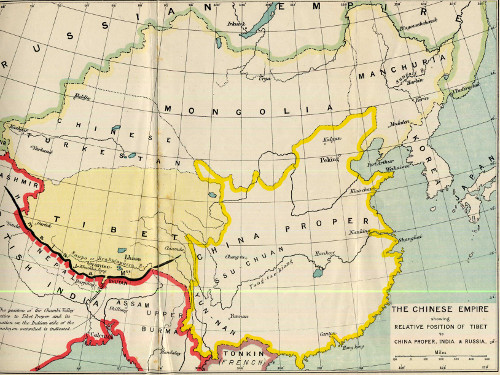
THE CHINESE EMPIRE showing RELATIVE POSITION OF TIBET to CHINA PROPER, INDIA & RUSSIA
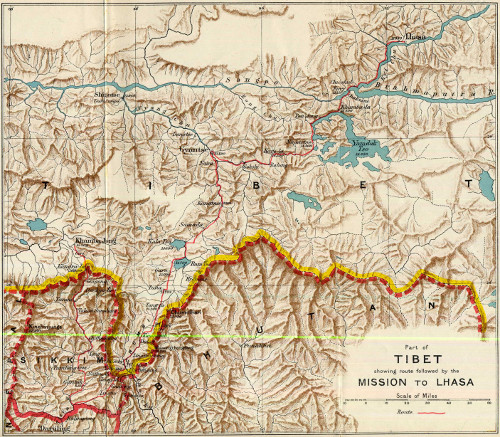
Part of TIBET showing route followed by MISSION TO LHASA
BILLING AND SONS, LTD., PRINTERS, GUILDFORD
Transcriber’s Note
Errors which are readily attributed to printer’s lapses have been corrected, as noted below. Spelling has been retained, except where the printer seems most likely to be at fault.
p. 48 evacu[a]ted Added.
p. 74 the interest of Russia[ ]in Tibet Added.
p. 187 awaked by shots and loud [booing] booming?
p. 421 Either[ ]of these causes Added.
p. 431 the Franco[-]German War. Added.
almos[t] Added.