Volume 1 — APPENDIX. VOL. I.
Reading edition
THERMOMETRICAL OBSERVATIONS.
Temperature of Merida, according to observations taken by the cura Don Eusebio Villamil, for one year, beginning on the 1st of September, 1841, and ending on the 31st of August, 1842. The observations were taken with a Fahrenheit thermometer at six in the morning, midday, and six in the evening. The thermometer stood in the shade, in an apartment well ventilated.
SEPTEMBER, 1842. OCTOBER
Days. Morn. Noon. Even. Days. Morn. Noon. Even.
1, 80° 84° 84° 1, 83° 86° 85°
2, 80° 84° 83° 2, 83° 86° 85°
3, 80° 84° 83° 3, 83° 85° 83°
4, 80° 84° 82° 4, 81° 84° 82°
5, 80° 84° 83° 5, 81° 84° 83°
6, 81° 85° 84° 6, 81° 84° 82°
7, 81° 84° 82° 7, 81° 84° 82°
8, 81° 86° 85° 8, 81° 84° 82°
9, 81° 85° 84° 9, 80° 84° 82°
10, 82° 85° 85° 10, 80° 84° 83°
11, 83° 85° 84° 11, 80° 85° 84°
12, 82° 85° 84° 12, 82° 85° 84°
13, 82° 85° 85° 13, 80° 84° 84°
14, 82° 86° 85° 14, 80° 84° 84°
15, 82° 86° 85° 15, 81° 84° 84°
16, 83° 86° 85° 16, 81° 84° 83°
17, 83° 85° 84° 17, 80° 83° 83°
18, 83° 85° 84° 18, 81° 83° 83°
19, 83° 85° 84° 19, 81° 84° 84°
20, 84° 86° 85° 20, 82° 83° 81°
21, 84° 86° 86° 21, 80° 81° 80°
22, 84° 86° 84° 22, 78° 80° 78°
23, 84° 86° 86° 23, 76° 78° 78°
24, 84° 85° 83° 24, 76° 78° 78°
25, 80° 84° 83° 25, 76° 76° 76°
26, 80° 85° 83° 26, 74° 76° 76°
27, 81° 85° 83° 27, 74° 78° 78°
28, 82° 85° 84° 28, 76° 80° 79°
29, 82° 86° 86° 29, 77° 81° 80°
30, 83° 86° 85° 30, 78° 81° 81°
31, 81° 82° 82°
NOVEMBER DECEMBER.
Days. Morn. Noon. Even. Days. Morn. Noon. Even.
1, 82° 83° 82° 1, 72° 74° 74°
2, 80° 82° 81° 2, 73° 77° 77°
3, 78° 80° 80° 3, 73° 79° 79°
4, 80° 77° 77° 4, 78° 79° 79°
5, 77° 78° 78° 5, 75° 76° 75°
6, 74° 77° 76° 6, 72° 74° 74°
7, 74° 76° 76° 7, 72° 74° 74°
8, 75° 78° 78° 8, 71° 74° 74°
9, 75° 78° 78° 9, 70° 74° 74°
10, 74° 79° 79° 10, 74° 78° 78°
11, 76° 79° 79° 11, 76° 78° 78°
12, 77° 80° 80° 12, 74° 77° 77°
13, 77° 80° 80° 13, 74° 78° 77°
14, 80° 80° 80° 14, 73° 78° 78°
15, 78° 79° 79° 15, 75° 79° 79°
16, 74° 78° 78° 16, 76° 78° 77°
17, 74° 78° 78° 17, 75° 75° 75°
18, 72° 77° 77° 18, 71° 74° 74°
19, 73° 79° 79° 19, 65° 73° 75°
20, 75° 79° 79° 20, 68° 74° 74°
21, 78° 82° 82° 21, 70° 76° 76°
22, 80° 83° 82° 22, 72° 88° 78°
23, 80° 84° 83° 23, 74° 78° 78°
24, 79° 82° 82° 24, 76° 77° 77°
25, 80° 83° 83° 25, 75° 77° 76°
26, 79° 82° 80° 26, 75° 78° 77°
27, 79° 78° 78° 27, 74° 79° 78°
28, 78° 76° 75° 28, 76° 79° 78°
29, 73° 73° 74° 29, 76° 78° 78°
30, 73° 74° 74° 30, 76° 77° 76°
31, 76° 78° 78°
JANUARY, 1842. FEBRUARY.
Days. Morn. Noon. Even. Days. Morn. Noon. Even.
1, 75° 78° 77° 1, 75° 78° 78°
2, 75° 77° 77° 2, 74° 80° 80°
3, 76° 76° 76° 3, 76° 81° 81°
4, 74° 78° 77° 4, 76° 80° 79°
5, 74° 78° 78° 5, 77° 80° 79°
6, 74° 78° 78° 6, 76° 80° 80°
7, 74° 78° 78° 7, 76° 80° 80°
8, 74° 78° 77° 8, 76° 74° 74°
9, 74° 77° 76° 9, 73° 74° 74°
10, 74° 77° 76° 10, 71° 76° 76°
11, 73° 78° 77° 11, 74° 79° 78°
12, 74° 78° 77° 12, 74° 80° 79°
13, 74° 77° 76° 13, 76° 80° 79°
14, 73° 78° 77° 14, 77° 80° 79°
15, 74° 77° 76° 15, 77° 80° 80°
16, 74° 76° 76° 16, 78° 76° 76°
17, 73° 76° 75° 17, 72° 76° 76°
18, 73° 76° 75° 18, 75° 79° 79°
19, 70° 76° 76° 19, 76° 79° 78°
20, 73° 76° 76° 20, 77° 80° 80°
21, 72° 72° 72° 21, 78° 76° 75°
22, 70° 72° 72° 22, 73° 74° 74°
23, 68° 72° 72° 23, 70° 74° 72°
24, 68° 73° 72° 24, 69° 78° 76°
25, 69° 74° 74° 25, 71° 77° 77°
26, 72° 78° 77° 26, 74° 78° 78°
27, 73° 76° 76° 27, 76° 81° 81°
28, 73° 76° 77° 28, 77° 81° 81°
29, 74° 78° 78°
30, 74° 79° 79°
31, 74° 80° 80°
MARCH. APRIL.
Days. Morn. Noon. Even. Days. Morn. Noon. Even.
1, 78° 82° 82° 1, 78° 83° 80°
2, 78° 83° 82° 2, 76° 80° 82°
3, 78° 83° 82° 3, 77° 83° 82°
4, 78° 83° 82° 4, 78° 84° 84°
5, 78° 84° 84° 5, 78° 84° 84°
6, 78° 84° 84° 6, 79° 86° 84°
7, 78° 85° 84° 7, 79° 84° 84°
8, 78° 84° 82° 8, 79° 84° 84°
9, 77° 82° 84° 9, 81° 85° 84°
10, 76° 84° 84° 10, 77° 84° 83°
11, 78° 84° 84° 11, 79° 85° 84°
12, 78° 84° 83° 12, 78° 85° 83°
13, 76° 84° 83° 13, 78° 84° 83°
14, 79° 84° 81° 14, 77° 84° 83°
15, 78° 84° 81° 15, 79° 84° 83°
16, 78° 81° 80° 16, 80° 85° 84°
17, 77° 82° 80° 17, 81° 84° 84°
18, 76° 83° 82° 18, 80° 84° 84°
19, 76° 81° 81° 19, 79° 83° 82°
20, 76° 81° 80° 20, 78° 84° 82°
21, 75° 80° 80° 21, 78° 84° 83°
22, 76° 81° 80° 22, 79° 83° 82°
23, 76° 82° 81° 23, 77° 83° 82°
24, 76° 82° 81° 24, 78° 84° 84°
25, 76° 82° 81° 25, 80° 85° 85°
26, 76° 84° 80° 26, 81° 86° 85°
27, 76° 80° 75° 27, 84° 83° 82°
28, 76° 82° 80° 28, 80° 83° 82°
29, 76° 82° 82° 29, 78° 84° 84°
30, 78° 83° 82° 30, 78° 83° 83°
31, 78° 83° 82°
MAY. JUNE.
Days. Morn. Noon. Even. Days. Morn. Noon. Even.
1, 79° 84° 84° 1, 79° 84° 84°
2, 81° 86° 86° 2, 80° 86° 85°
3, 82° 87° 86° 3, 81° 86° 86°
4, 83° 86° 83° 4, 82° 86° 85°
5, 82° 84° 84° 5, 83° 86° 86°
6, 80° 82° 82° 6, 84° 87° 87°
7, 79° 81° 80° 7, 82° 86° 85°
8, 78° 81° 80° 8, 83° 87° 87°
9, 78° 81° 81° 9, 87° 86° 85°
10, 76° 83° 81° 10, 83° 86° 83°
11, 78° 84° 82° 11, 81° 86° 85°
12, 78° 84° 83° 12, 82° 86° 85°
13, 80° 85° 83° 13, 84° 86° 86°
14, 80° 85° 83° 14, 84° 87° 86°
15, 79° 85° 84° 15, 85° 88° 88°
16, 79° 84° 84° 16, 85° 88° 84°
17, 79° 85° 85° 17, 84° 87° 86°
18, 79° 86° 86° 18, 84° 88° 88°
19, 80° 86° 86° 19, 84° 88° 88°
20, 81° 86° 85° 20, 84° 88° 87°
21, 82° 86° 85° 21, 84° 88° 87°
22, 82° 86° 85° 22, 83° 88° 88°
23, 82° 86° 86° 23, 82° 88° 86°
24, 81° 86° 86° 24, 82° 89° 86°
25, 82° 86° 85° 25, 83° 88° 86°
26, 82° 84° 82° 26, 82° 88° 86°
27, 82° 83° 81° 27, 82° 88° 86°
28, 80° 84° 80° 28, 82° 88° 85°
29, 80° 83° 80° 29, 82° 86° 85°
30, 80° 83° 81° 30, 82° 88° 85°
31, 80° 84° 83°
JULY. AUGUST.
Days. Morn. Noon. Even. Days. Morn. Noon. Even.
1, 83° 86° 84° 1, 83° 88° 86°
2, 83° 86° 84° 2, 82° 87° 86°
3, 82° 86° 84° 3, 84° 87° 86°
4, 82° 86° 85° 4, 84° 87° 86°
5, 82° 86° 83° 5, 83° 87° 86°
6, 81° 86° 86° 6, 82° 86° 85°
7, 82° 88° 86° 7, 82° 86° 86°
8, 82° 86° 85° 8, 82° 87° 86°
9, 81° 86° 85° 9, 83° 88° 86°
10, 81° 84° 82° 10, 83° 88° 87°
11, 80° 82° 81° 11, 84° 88° 82°
12, 78° 82° 82° 12, 82° 86° 86°
13, 80° 84° 83° 13, 83° 86° 86°
14, 79° 86° 85° 14, 82° 87° 85°
15, 82° 87° 85° 15, 83° 86° 83°
16, 82° 86° 86° 16, 82° 86° 83°
17, 82° 86° 86° 17, 81° 85° 84°
18, 81° 85° 83° 18, 81° 86° 85°
19, 81° 85° 83° 19, 80° 86° 84°
20, 81° 85° 82° 20, 82° 86° 86°
21, 80° 85° 82° 21, 82° 86° 86°
22, 80° 85° 82° 22, 82° 86° 84°
23, 80° 85° 82° 23, 81° 86° 86°
24, 81° 86° 85° 24, 82° 86° 86°
25, 82° 87° 85° 25, 83° 87° 86°
26, 81° 86° 84° 26, 84° 87° 86°
27, 82° 87° 86° 27, 82° 87° 86°
28, 83° 87° 86° 28, 80° 85° 85°
29, 83° 86° 86° 29, 80° 86° 86°
30, 83° 88° 86° 30, 81° 86° 86°
31, 83° 87° 86° 31, 82° 86° 86°
TABLE OF STATISTICS OF YUCATAN.
Districts. Principal Places Parishes Villages annexed Distance from the Capital—Leagues Population PRODUCTIONS.
Capital Mérida 4 5 37,801 Horned cattle horses, mules, tallow, jerked beef, leather, salt, gypsum, hemp, raw and manufactured, straw hats, guitars, and extract of logwood.
Campeachy City of Campeachy 2 " 36 19,600 Salt, logwood, rice, sugar, and marble of good quality.
Lerma Village of Lerma 3 8 37 10,567 Logwood, timber, rice, and fish oil.
Valladolid City of Valladolid 11 17 36 63,164 Cotton, sugar, starch, gum copal, tobacco, cochineal, saffron, vanilla, cotton fabrics, yarns, &c., wax, honey, castor oil, horned cattle, hogs, and skins.
Coast City of Izamal 16 27 15 78,846 Horned cattle, horses, mules, tallow, jerked beef, castor oil, hides, wax, honey, timber, indigo, hemp, raw and manufactured, straw cigars, barilla, and salt.
The Upper Highlands City of Tekax 9 7 25 60,776 Horned cattle, horses, mules, hogs, sheep, skins, sugar, molasses, timber, rice, tobacco, in the leaf and manufactured, spirits, arrow-root, straw hats, cotton lace, ochre, flints, and grindstones.
The Lower Highlands Village of Teabo 8 5 17 42,188 Horned cattle, horses, mules, hogs, sheep, skins, tallow, dried beef, hemp, raw and manufactured, and cotton lace.
The Upper Royal Road Town of Jequelchakan 6 11 26 54,447 Horned cattle, horses, mules, skins, tallow, dried beef, logwood, tobacco, sugar, and rum.
The Lower Royal Road Village of Maxcanú 5 7 14 41,726 Horned cattle, horses, mules, oil of palma Cristi, tobacco, hemp, and fine straw hats.
The Upper "Beneficios" Village of Ichmul 7 15 39 66,680 Sugar, molasses, rum, tobacco of good quality, rice, laces, pepper, gum copal, sarsaparilla, hats, hammocks, ebony, barilla, gypsum, and skins.
The Lower "Beneficios" Village of Sotuta 6 16 22 49,443 Horned cattle, horses, mules, hogs, skins, tallow, and dried beef.
Tizimin Village of Tizimin 7 18 41 37,168 Tortoise-shell, skins, timber, logwood, India-rubber, incense, tobacco, achiote (a substitute for saffron, and a very rich dye), starch from the yuca, cotton, wax, honey, molasses, sugar, rum, castor oil, salt, amber, vanilla, hogs, cochineal.
Island of Cármen Town of Cármen 2 1 80 4,364 Logwood.
Seiba-playa Village of Seiba-playa 3 6 42 8,183 Timber, rice, logwood, and salt.
Bacalar Town of Bacalar 2 " 88 3,986 Logwood, valuable timber, sugar of inferior quality, tobacco of the best description, rum, a fine species of hemp, known under the name of pita, resin, India-rubber, gum copal, pimento, sarsaparilla, vanilla, and gypsum.
Total 15 91 143 578,939
POPULATION OF YUCATAN.
Statement showing the number of inhabitants in the five departments into which the state is divided, distinguishing the sexes; taken from the census made by order of the government on the 8th of April, 1841.
Departments Men. Women. Total.
Merida 48,606 58,663 107,269
Izamal 32,915 37,933 70,848
Tekax 58,127 64,697 122,824
Valladolid 45,353 46,926 92,279
Campeachy 39,017 40,639 79,656
472,876
NOTE.—"This census is probably not very exact, because, having continually the fear of new contributions, and detesting military service, every one reduces as far as possible the number of his family in the lists prepared for the census. It appears to me that the total population of Yucatan may be fixed at 525,000 souls."—P. De R.
"The best information I have been enabled to obtain goes to show that the population of the state cannot fall short of 600,000 souls."—J. B. Jr.
SYSTEM ADOPTED BY THE ANCIENT BUILDERS OF YUCATAN IN COVERING THEIR ROOMS WITH STONE ROOFS.
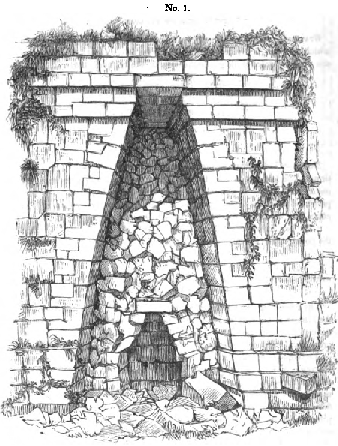
The engraving No. 1 represents the arch referred to in the description of the Monjas at Uxmal; and as the stones are not quite horizontal, but stand nearly at right angles to the line of the arch, it shows how near an approach was made to the real principle on which the arch is constructed.
Engraving 51: Triangular Arch
Throughout every part of Central America, Chiapas, and Yucatan, the same method is to be traced with slight modifications. The stones forming the side walls are made to overlap each other until the walls almost meet above, and then the narrow ceilings are covered with a layer of flat stones. In every case the stones were laid in horizontal layers, the principle of constructing arches, as understood by us, being unknown to the aboriginal builders. This readily accounts for the extreme narrowness of all their rooms, the widest not exceeding twenty feet, and the width more frequently being only from six to ten feet. In a few cases the covering stone is wanting, and the two sides meet so as to form a sharp angle. At Palenque the builders did not cut the edges of the stones, so as to form an even surface, their practice differing in this respect from that adopted in Yucatan, where in every instance the sides of the arch are made perfectly straight, or have a slight curve, with the inner surfaces smooth.
It may now be interesting to inquire if any similarity exists between the American method and those observed among the nations of antiquity in Europe and Asia. A true arch is formed of a series of wedge-like stones or of bricks, supporting each other, and all bound firmly together by the pressure of the centre one upon them, which latter is therefore distinguished by the name of keystone.
It would seem that the arch, as thus defined, and as used by the Romans, was not known to the Greeks in the early periods of their history, otherwise a language so copious as theirs, and of such ready application, would not have wanted a name properly Greek by which to distinguish it. The use of both arches and vaults appears, however, to have existed in Greece previous to the Roman conquest, though not to have been in general practice. And the former made use of a contrivance, even before the Trojan war, by which they were enabled to gain all the advantages of our archway in making corridors or hollow galleries, and which, in appearance, resembled the pointed arch, such as is now termed Gothic. This was effected by cutting away the superincumbent stones at an angle of about 45° with the horizon.
Of the different forms and curves of arches now in use, the only one adopted by the Romans was the semicircle; and the use of this constitutes one leading distinction between Greek and Roman architecture, for by its application the Romans were enabled to execute works of far bolder construction than those of the Greeks: to erect bridges and aquæducts, and the most durable and massive structures of brick. On the antiquity of the arch among the Egyptians, Mr. Wilkinson has the following remarks: "There is reason to believe that some of the chambers in the pavilion of Remeses III., at Medeenet Haboo, were arched with stone, since the devices on the upper part of their walls show that the fallen roofs had this form. At Saggara, a stone arch still exists of the time of the second Psamaticus, and, consequently, erected six hundred years before our era; nor can any one, who sees the style of its construction, for one moment doubt that the Egyptians had been long accustomed to the erection of stone vaults. It is highly probable that the small quantity of wood in Egypt, and the consequent expense of this kind of roofing, led to the invention of the arch. It was evidently used in their tombs as early as the commencement of the eighteenth dynasty, or about the year 1540 B.C.; and, judging from some of the drawings at Beni Hassan, it seems to have been known in the time of the first Osirtasen, whom I suppose to have been contemporary with Joseph."—Manners and Customs of the Anc. Egyptians, vol. ii., p. 116, 117, 1st series.
The entrance to the great Pyramid at Gizeh is somewhat similar in form to the arches found in Yucatan; it consists of two immense granite stones of immense size, meeting in a point and forming a sharp angle.
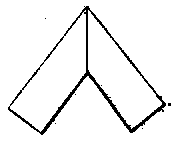
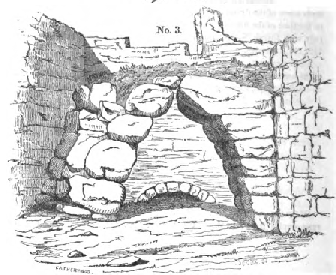
Of the accompanying plates, No. 2 represents the arches in the walls of Tiryns, copied from Sir W. Gell's Argolis; No. 3, an arch (called Cyclopean) at Arpino, in the Neapolitan Territory; No. 4, the most common form of arch used by the ancient American builders. A striking resemblance will doubtless be observed, indeed, they may almost be considered identical; and it may be added, that at Medeenet Haboo, which forms a part of the ancient Egyptian Thebes, a similar contrivance was observed by Mr. Catherwood. From this it will appear that the true principles of the arch were not understood by the ancient Egyptians, Greeks, or Etruscans, or by the American builders. It might be supposed that a coincidence of this strongly-marked character would go far to establish an ancient connexion between all these people; but, without denying that such may have been the case, the probabilities are greatly the other way.
Engraving 52: Gothic Arch
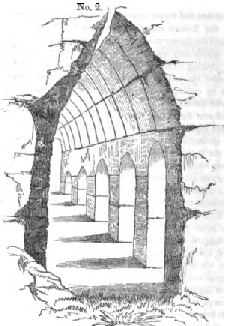
Engraving 53: Cyclopean Arch
This most simple mode of covering over a void space with stone, when single blocks of sufficient size could not be employed, would suggest itself to the most barbarous as well as to the most refined people. Indeed, in a mound lately opened in the Ohio Valley, two circular chambers were discovered, and are still preserved, the walls being made of logs, and the roofs formed by overlapping stones rising to a point, on precisely the same plan as the Treasury of Atreus at Mycenæ, and the chamber at Orchomenus, built by Minyas, king of Bœotia. No inference as to common origin or international communication can with safety be drawn from such coincidences, or from any supposed coincidence between the pyramidal structures of this Continent and those of Egypt, for no agreement exists, except that both are called pyramids.
Engraving 54: Arch used by the ancient American Builders
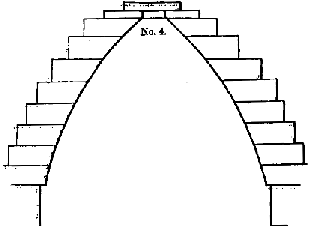
In the Egyptian Pyramids the sides are of equal lengths, and, with one exception (Saccara), composed of straight lines, which is not the case with any pyramid of the American Continent. The sides are never equal, are frequently composed of curves and straight lines, and in no instance form a sharp apex.
VESTIGIA PHALLICÆ RELIGIONIS PROUT QUIBUSDAM MONUMENTIS AMERICANIS INDICANTUR.—(Vid. tom. i., pag. 181.)
Haec monumenta ex undecim Phallis constant, omnibus plus minusve fractis, undique dispersis, atque solo semiobrutis, duoram circiter vel trium pedum mensuram habentibus. Non ea nosmetipsi reperimus neque illis hanc Phallicam naturam attribuimus; nobis autem, has regiones ante pererrantibus, hæc eadem monumenta Indi ostenderunt, quodam nomine appellantes lingua ipsorum eandem vim habente, ac supra dedimus. Quibus auditis, hæc Phallicæ religionis, his etiam in terris, vestigia putanda esse tunc primum judicavimus. Monumenta attamen de quibus huc usque locuti sumus, non, ut bene sciunt eruditi, libidinem denotant, sed potius, quod memoria dignissimum, nostra etiam continente vis genitalis cultum, omnibus pæne antiquis Europæ Asiæque nationibus communem, per symbola nota olim viguisse. Quam autem cognationem hic Phalloram cultus his populis cum Americæ aboriginibus indicare videatur, non nostrum est, qui visa tantum vel audita litteris mandamus, his paginis exponere.
ANCIENT CHRONOLOGY OF YUCATAN; OR, A TRUE EXPOSITION OF THE METHOD USED BY THE INDIANS FOR COMPUTING TIME.—Translated from the Manuscript of Dan Juan Pio Perez, Gefe Politico of Peto, Yucatan.
1°. Origin of the Period of 13 Days (triadecateridas).
The inhabitants of this peninsula, which, at the time of the arrival of the Spaniards, was called Mayapan, and by its first inhabitants or settlers Chacnouitan, divided time by calculating it almost in the same manner as their ancestors the Tulteques, differing only in the particular arrangement of their great ages (siglos).
The period of 13 days, resulting from their first chronological combinations, afterward became their sacred number, to which, introducing it ingeniously in their reckonings, they made all those divisions subordinate which they devised to adjust their calendar to the solar course; so that the days, years, and ages were counted by periods of thirteen numbers.
It is very probable that the Indians, before they had corrected their computation, used the lunations (neomenias) to regulate the annual course of the sun, counting (señalando) 26 days for each lunation; which is a little more or less than the time during which the moon is seen above the horizon in each of its revolutions; dividing this period into two of 13 days, which served them as weeks, giving to the first the first 13 days during which the new moon is seen till it is full; and to the second, the other thirteen, during which the moon is decreasing until it cannot be seen by the naked eye.
In the lapse of time, and by constant observations, they obtained a better knowledge of the solar course, perceiving that the 26 days, or two periods of 13 days, did not give a complete lunation, and that the year could not be regulated exactly by lunations, inasmuch as the solar revolutions do not coincide with those of the moon, except at long intervals. Adding this knowledge to more correct principles and data, they finally constructed their calendar in accordance with the course of the principal luminary, preserving always their periods of 13 days, not in order to make them agree with the apparent course of the moon, but to use them as weeks, and for their chronological divisions.
2°. The Weeks.
It must not be supposed that the weeks of the ancient Indians were similar to ours, that is to say, that they were the revolution of a period of days, each having a particular name: they were only the revolution or successive repetition of thirteen numbers applied in arithmetical progression to the twenty days of the month. The year being composed of 28 weeks and one additional day or number, the course of the years, on account of that excess, followed the arithmetical progression of the thirteen weekly numbers; so that if a year commenced with the number 1, the next would commence with number 2, and so on to the close of the 13 years, which formed an indiction, or week of years, as will be explained hereafter.
3°. The Month.
"Month" is called in the Yucateco language "U," which means also "the moon;" and this corroborates the presumption that the Indians went on from the computation of lunations to determine the course of the sun, calling the months "moons." But in some manuscripts, the name of Uinal in the singular and Uinalob in the plural is given to the eighteen months which compose the year; applying this comprehensive term to the series, and to each one of the particular names assigned to the twenty days that composed the month.
The day was called Kin, "the sun;" and the particular names by which the 20 days composing the month were designated are stated in the following table, in which they are divided into sets of five, for the better understanding of the subsequent explanations.
1st. 2d. 3d. 4th.
Kan. Muluc. Gix (Hix) Ca-uac.
Chicchan. Oc. Men. Ajau (Ahau).
Quimí (Cimí). Chuen. Quib (Cib). Ymix.
Manik. Eb. Caban. Yk.
Lamat. Been. Edznab. Akbal.
As those names corresponded in number with the days of the month, it followed that, the name of the first day of the year being known, the names of the first days of all the successive months were equally known; and they were distinguished from each other only by adding the number of the week to which they respectively belonged. But the week consisting of thirteen days, the month necessarily consisted of a week and seven days; so that if the month began with the first number of a week, it ended with the seventh number of the week ensuing.
[In order to know the number of the week corresponding with the first day of each month respectively, it is necessary only to know the number of the week with which the year begins, and to add successively seven, but subtracting thirteen whenever the sum of this addition exceeds thirteen, which gives the following series for the first days of the eighteen months: 1, 8, 2 (15-13), 9, 3 (16-13), 10, 4, 11, 5, 12, 6, 13, 7, 1, 8, 2, 9, 3, supposing the first day of the year to be the first day of the week, and generally taking for the first number of the series the number of the week by which the year begins.]
4°. The Year.
To this day the Indians call the year Jaab or Haab, and, while heathens, they commenced it on the 16th of July. It is worthy of notice that their progenitors, having sought to make it begin from the precise day on which the sun returns to the zenith of this peninsula on his way to the southern regions, but being destitute of instruments for their astronomical observations, and guided only by the naked eye, erred only forty-eight hours in advance. That small difference proves that they endeavoured to determine, with the utmost attainable correctness, the day on which the luminary passed the most culminating point of our sphere, and that they were not ignorant of the use of the gnomon in the most tempestuous days of the rainy season.
They divided the year into 18 months, as follows:
1st, Pop, beginning on the 16th of July. 2d, Uóó, beginning on the 5th of August. 3d, Zip, beginning on the 25th of August. 4th, Zodz, beginning on the 14th of September. 5th, Zeec, beginning on the 4th of October. 6th, Xul, beginning on the 24th of October. 7th, Dze-yaxkin, beginning on the 13th of November, 8th, Mol, beginning on the 3d of December. 9th, Dchen, beginning on the 23d of December. 10th, Yaax, beginning on the 12th of January. 11th, Zac, beginning on the 1st of February. 12th, Quej, beginning on the 21st of February, 13th, Mac, beginning on the 13th of March. 14th, Kankin, beginning on the 2d of April. 15th, Moan, beginning on the 22d of April. 16th, Pax, beginning on the 12th of May. 17th, Kayab, beginning on the 1st of June. 18th, Cumku, beginning on the 21st of June.
As the 18 months of 20 days each contained but 360 days, and the common year consists of 365, five supplementary days were added at the end of each year, which made part of no month, and which, for that reason, they called "days without name," xona kaba kin (= Neg. Name. Days.). They called them also uayab or uayeb Jaab (= Year. ); which may be interpreted two different ways. The word uayab may be derived from uay, which means "bed" or "chamber," presuming that the Indians believed the year to rest during those days; or uayab may equally be derived from another signification of uay, viz., to be destroyed, wounded, corroded by the caustic juice of plants, or with ley and other strong liquids. And on this account the Indians feared those days, believing them to be unfortunate, and to carry danger of sudden deaths, plagues, and other misfortunes. For this reason these five days were assigned for the celebration of the feast of the god Mam, "grandfather." On the first day they carried him about, and feasted him with great magnificence; on the second they diminished the solemnity; on the third they brought him down from the altar and placed him in the middle of the temple; on the fourth they put him at the threshold or door; and on the fifth, or last day, the ceremony of taking leave (or dismissal) took place, that the new year might commence on the following day, which is the first of the month Pop, corresponding with the 16th of July, as appears by the preceding table. The description of the god Mam may be seen in Cogolludo.
The division of the year into 18 months of 20 days would have given only the sum of 360 days; and the first day of the year falling on Kan, the last would have fallen on Akbal, so as to begin again the next year with the same Kan, making all the years alike. But as, in order to complete the year, they added five days, the result was that the year which commenced in Kan ended in Lamat, the last of the first series of five days; the ensuing year commenced in Muluc, the first of the second series of five days; the third commenced in Gix, the first of the third series; and the fourth in Cauac (the first ending in Akbal), the last of the fourth series of five days; so that the fifth year again began with Kan. It has also been stated that the year consisted of 28 weeks of 13 days each, and of one additional day; so that, if the year commenced with the number one of the week, it ended with the same number, and the ensuing year began with number two; and so on through the thirteen numbers of the week, thus forming, with the four initial days, the week of years, or indiction, of which we shall speak hereafter.
The following is the order of the twenty days in each of the 18 months composing the years formed by the four initial days together with the intercalary or complementary days.
Year beginning with the day Kan. Year beginning with the day Muluc. Year of Gix. Year of Cauac.
Kan. Muluc. Gix. Cauac.
Chicchan. Oc. Men. Ajau.
Quimí. Chuen. Quib. Ymix.
Manik. Eb. Caban. Yk.
Lamat. Ben. Edznab. Akbal.
Muluc. Gix. Cauac. Kan.
Oc. Men. Ajau. Chicchan.
Chuen. Quib. Ymix. Quimí.
Eb. Caban. Yk. Manik.
Ben. Edznab. Akbal. Lamat.
Gix. Cauac. Kan. Muluc.
Men. Ajau. Chicchan. Oc.
Quib. Ymix. Quimí. Chuen.
Caban. Yk. Manik. Eb.
Edznab. Akbal. Lamat. Ben.
Cauac. Kan. Muluc. Gix.
Ajau. Chicchan. Oc. Men.
Ymix. Quimí. Chuen. Quib.
Yk. Manik. Eb. Caban.
Akbal. Lamat. Ben. Edznab.
Intercalary days. Intercalary days. Intercalary days. Intercalary days.
Kan. Muluc. Gix. Cauac.
Chicchan. Oc. Men. Ajau.
Quimí. Chuen. Quib. Ymix.
Manik. Eb. Caban. Yk.
Lamat. Ben. Edznab. Akbal.
5°. The Bissextile.
The connexion between the days or numbers of the week which designate the beginning of the year, and the four initial or first days of the series of five, is so intimate that it is very difficult to intercalate an additional day for the bissextile, without disturbing that correlative order of the initials which is constantly followed in the denomination of the years, and forms their indictions, or weeks. But as the bissextile is necessary to complete the solar course, and as I have not any certain knowledge of the manner in which the Indians effected that addition, I will exhibit the method adopted by the Mexicans, their computation being very analogous to that of Yucatan, which in its origin probably emanated from Mexico.
Veyta asserts, in ch. x. of his "Historia Antigua de Mexico," that the bissextile was made by adding at the end either of the 18 months or of the five supplementary days, a day which was marked with the same hieroglyphic as the one preceding, but with a different number of the week, viz., with the succeeding number. But in each way that numerical order by which the years follow each other till they form the week of years, is disturbed; since the fifth year would thus be designated by the number 6 instead of 5, and the regular order of the years 4 to 6 be thereby interrupted. These interruptions, recurring every fourth year, would render it impossible to preserve that continuous harmony (on which rests the whole system of the Indian computation) between the numbers of the week which designate the ending year and its successor, as shown in the uniform succession of the four initial days.
In order to prevent that inconvenience, it is necessary to suppose that the Indians, whether they intercalated the additional day at the end of the 18 months or after the five supplementary days, did not only give to it the same number and hieroglyphic as to the day immediately preceding, but also designated it by some peculiar sign or number, in order that it might not be confounded with any other.
In a treatise published by Akerman, the opinion is expressed that the Indians, at the end of their cycle of 52 years, added a week of days in lieu of the bissextile days which had been neglected. This method has not the defect of disturbing the numerical order of the years, but that of deranging the series of the four initial days, which, as has been stated, gives designation to the years. It will be seen by the table of indictions, that each cycle consists of four complete weeks of years, formed by series of each one of the four initial signs, each week of years commencing with number one and ending with number thirteen; consequently, if, at the end of each cycle, a week of days be added, the first day of the ensuing year would be the 14th in the series of the 20 days of the month (instead of being the 1st, 6th, 11th, or 16th), thus abandoning the regular series of the four initial days, and substituting others, changing them again at each new cycle.
6°. Katun, or Cycle.
The Indians made (painted) a small wheel, in which they placed the four hieroglyphics of the initial days, Kan in the east, Muluc in the north, Gix in the west, and Cauac in the south, to be counted in that order. Some suppose that when the fourth year was accomplished, and Kan was again in order, a Katun or lustre of four years, was completed; others, that three revolutions of the wheel, with its four signs, were reckoned, with one (sign) more, which made 13 years, and that this completed the Katun; others, again, that the four complete weeks of years, or indictions, constituted the Katun; and this is probable. Besides the small wheel aforesaid, they made another great wheel, which they also called buk xoc and in which they placed three revolutions of the four signs of the small wheel, making 12 signs; beginning to count by the first Kan, and continuing to reckon all until the fourth naming of the same Kan, which was included, thus making thirteen years, and forming one indiction, or week (of years); the second reckoning began with Muluc, ending in the same, which formed the next thirteen; and so on, till they came to Cauac, which formed a Katun.
7°. Of the Indiction and Cycle of 52 Years, or Katun.
As in the preceding explanations sufficient idea has been given of what constituted the indiction and the cycle of 52 years, called by the Indians Katun, the facts are briefly recapitulated here, that the reader may not be fatigued hereafter with new explanations.
1st. The name of indiction is given to each one of the four weeks of years composing the cycle of 52 years.
2d. The American week was formed by the course of 13 numbers, applied indiscriminately to the 20 days of the month.
3d. It has been explained, that as the year was formed of 26 weeks and one day, by this overplus the years succeeded each other, following the correlative order of their numbers up to 13, in order to form a week, or indiction; for if the year had been composed of exactly 28 weeks, the numbers of the new years would never have formed a correlative week, because they would have commenced with the number 1, and finished with 13; by the other method, one year begins with the first, and terminates in the same; the second year commences with the number 2 and also finishes with it; and so on successively, until the 13 are completed.
4d. It has also been explained that the Indians, seeing that 18 months of 20 days did not make up the sum of 365, in order to complete them added five days more; resulting from this, the 20 days were divided into four portions, and the first of each of these, being Kan, Muluc, Gix, and Cauac, became initials, forming in turn the beginning of the years by courses of four years, every fifth year commencing again with Kan. But as the weeks were composed of 13 numbers, there were in each week three revolutions of the four initials and one initial more, by this excess of one causing each initial to have its own week: thus the indiction, or week, which began with Kan concluded also with the same Kan; so that the next indiction might commence with Muluc, the second initial, and in its turn conclude with the same Muluc; and so on continually, until each one of the initials had formed its own indiction, or week, and given to it its name; the whole composing 52 years, which is the sum of the four weeks of 13 years each, as may be seen in the following table.
Order of the years in the cycle of 52, divided into four indictions, or weeks of years, and as the year 1841 happens to be the first of one of these cycles, it is taken as the starting-point.
1st indiction 2d indiction 3d indiction 4th indiction
1841 1. Kan. 1854 1. Muluc. 1867, 1. Gix. 1880, 1. Cauac.
1842, 2. Muluc. 1855, 2. Gix. 1868, 2. Cauac. 1881, 2. Kan.
&c. 3. Gix. &c. 3. Cauac. &c. 3. Kan. &c. 3. Muluc.
4. Cauac. 4. Kan. 4. Muluc. 4. Gix.
5. Kan. 5. Muluc. 5. Gix. 5. Cauac.
6. Muluc. 6. Gix. 6. Cauac. 6. Kan.
7. Gix. 7. Cauac. 7. Kan. 7. Muluc.
8. Cauac. 8. Kan. 8. Muluc. 8. Gix.
9. Kan. 9. Muluc. 9. Gix. 9. Cauac.
10. Muluc. 10. Gix. 10. Cauac. 10. Kan.
11. Gix. 11. Cauac. 11. Kan. 11. Muluc.
12. Cauac. 12. Kan. 12. Muluc. 12. Gix.
13. Kan. 13. Muluc. 13. Gix. 1892, 13. Cauac.
This period of 52 years was called by the Indians Katun, and at its conclusion great feasts were celebrated, and a monument was raised, on which a large stone was placed crosswise, as is signified by the word Kat-tun, for a memento and record of the cycles, or Katunes, that had elapsed. It should be observed, that until the completion of this period, the initial days of the years did not again fall upon the same numbers of the week; for which reason, by merely citing them, it was at once known what year of that cycle was arrived at; being aided in this by the wheel or table on which the years were engraved in hieroglyphics.
8°. Of the great Cycle of 312 Years, or Ajau Katunes.
Besides the cycle of 52 years, or Katun, there was another great cycle peculiar to the Yucatecos, who referred to its periods for dating their principal epochs and the most notable events of their history. It contained 13 periods of 24 years each, making together 312 years. Each period, or Ajau Katun, was divided into two parts; the first of 20 years, which was included in a square, and therefore called amaytun, lamayte, or lamaytun; and the other of four years, which formed, as it were, a pedestal for the first, and was called chek oc Katun, or lath oc Katun, which means "stool" or "pedestal." They considered those four years as intercalated; therefore believed them to be unfortunate, and called them u yail Jaab, as they did the five supplementary days of the year, to which they likened them.
From this separation of the first 20 years from the last four, arose the erroneous belief that the Ajaus consisted only of 20 years, an error into which almost all have fallen who have written on the subject; but if they had counted the years which compose a period, and noted the positive declarations of the manuscripts that the Ajaues consisted of 24 years divided as above stated, they would not have misled their readers on this point.
It is incontrovertible that those periods, epochs, or ages, took the name of Ajau Katun, because they began to be counted from the day Ajau, which was the second day of those years that began in Cauac; but as these days and numbers were taken from years which had run their course, the periods of 24 years could never have an arithmetical order, but succeeded each other according to the numbers 13, 11, 9, 7, 5, 3, 1, 12, 10, 8, 6, 4, 2. As the Indians established the number 13 as the first, it is probable that some remarkable event had happened in that year, because, when the Spaniards came to this peninsula, the Indians reckoned then the 8th as the 1st, that being the date at which their ancestors came to settle it; and an Indian writer proposed that they should abandon that order also, and begin counting from the 11th, solely because the conquest had happened in that. Now if the 13 Ajau Katun began on a second day of the year, it must be that year which began on 12 Cauac, and the 12th of the indiction. The 11 Ajau would commence in the year of 10 Cauac, which happens after a period of 24 years, and so on with the rest; taking notice that after that lapse of years we come to the respective number marked in the course of the Ajaues, which is placed first; proving that they consist of 24, and not, as some have believed, of 20 years.
Series of the years completed in two Ajau Katunes, having their beginning in the year of our Lord 1488, in which the 13th Ajau commences on the 2d day of the year 12 Cauac, being the 12th of the first indiction.
A.D. 13th Ajau. A.D. 13th Ajau. A.D. 11th Ajau. A.D. 11th Ajau.
1488. 12. Cauac. L. 1500. 11. Cauac. L 1512 10. Cauac L 1524 9. Cauac L
1489. 13. Kan. a. 1501. 12. Kan. a 1513 11. Kan a 1525 10. Kan a
1490. 1. Muluc. m. 1502. 13. Muluc. m 1514 12. Muluc m 1526 11. Muluc m
1491. 2. Gix. a. 1503. 1. Gix. a 1515 13. Gix a 1527 12. Gix a
1492. 3. Cauac. y. 1504. 2. Cauac. y 1516 1. Cauac y 1528 13. Cauac y
1493. 4. Kan. t. 1505. 3. Kan. t 1517 2. Kan t 1529 1. Kan t
1494. 5. Muluc. u. 1506. 4. Muluc. u 1518 3. Muluc u 1530 2. Muluc u
1495. 6. Gix. n. 1507. 5. Gix. n 1519 4. Gix n 1531 3. Gix n
1496. 7. Cauac. 1508. 6. Cauac. —— 1520 5. Cauac —— 1532 4. Cauac ——
1497. 8. Kan. 1509. 7. Kan. Laib 1521 6. Kan 1533 5. Kan Chak
1498. 9. Muluc. 1510. 8. Muluc. oc 1522 7. Muluc 1534 6. Muluc oc
1499. 10. Gix. 1511. 9. Gix. Katun. 1523 8. Gix 1535 7. Gix Katun.
The fundamental point of departure from which to adjust the Ajaus with the years of the Christian era, to count the periods or cycles which have elapsed, and to make the years quoted by the Indians in their histories agree with the same era, is the year of our Lord 1392, which, according to all sources of information, confirmed by the testimony of Don Cosme de Burgos, one of the conquerors, and a writer (but whose observations have been lost), was the year in which fell the 7 Cauac, giving in its second day the commencement of 8 Ajau; and from this, as from a root, all that preceded and have followed it are adjusted according to the table of them which has been given; and as this agrees with all the series that have been found, it is highly probable that it is the correct one.
"At the end of each Ajau Katun, or period o/ 24 years," says a manuscript, "great feasts were celebrated in honour of the god thereof, and a statue of the god was put up, with letters and inscriptions." It must be supposed that these were expressed by means of signs or hieroglyphics.
The use of this cycle was of very great advantage and importance, because when, for example, the 8th Ajau was referred to in their histories in describing some event which it was necessary to distinguish from others, the 8th Ajau was established as a distinct date, and it was understood that the 312 years had elapsed, which made up the whole Katun, in order to return to the same number; this was more clear, if the writer explained that a uudz Katun had elapsed, which is the sum total of the thirteen Katunes, or the great cycle. They had various modes of quoting the Ajaues, as by saying generally the beginning, middle, or end of such an Ajau, or by mentioning the years of the Katun which had elapsed, without stating the month or day of the year, or by specifying all the particulars of the epoch, the year, month, and day. Such is the passage in which is noticed the death of a certain, without doubt very notable, Ajpula. It is said that he died in the 6th year of 13 Ajau, when the first day of the year was 4 Kan at the east end of the wheel, in the day of 9 Ymix, 18th of the month Zip. This date being so circumstantial, we will trace it out, that it may serve as an example.
Looking at the series of years which belong to the 13 Ajau, and which we have given above, it will be seen that 12 Cauac falls in the year 1488, the second day of that year being, therefore, the beginning of the 13th Ajau; that the year 1493 is the sixth from the beginning of the said Ajau, and that its first day is designated as 4 Kan, which is the title of that year, "18th of the month Zip." As this month begins on the 25th of August, the 18th corresponds with the 11th of September. Let us see now whether this 18th day falls on 9 Ymix. The first month of that year commenced with 4 Kan, since 4 Kan designates that year (see the rule given in treating of the months). We find the numbers (of the week) annexed to the first days of the following months by successively adding 7 to each month, &c. (or, which is the same thing, by the rule buk xoc). The number of the 1st day of the 1st month being in this case 4, the number of the 1st day of the 2d month will be 4+7=11, and that of the 1st day of the 3d month, viz., of Zip, will be 11+7-13=5. That month begins, therefore, in that year, with 5 Kan, and the following days are,
Days of Days of the Week. Days of Days of the Week. Days of Days of the Week.
Aug. Zip. Sept. Zip. Sept. Zip.
25 1 5. Kan. 1 8 12. Chuen. 8 15 6. Edznab.
26 2 6. Chicchan. 2 9 13. Eb. 9 16 7. Cauac.
27 3 7. Quimí. 3 10 1. Ben. 10 17 8. Ajau.
28 4 8. Manik. 4 11 2. Gix. 11 18 9. Ymix.
29 5 9. Lamat. 5 12 3. Men.
30 6 10. Muluc. 6 13 4. Quin.
31 7 11. Oc. 7 14 5. Caban.
Thus the 11th of September was the 18th of Zip, which does fall on 9 Ymix, and accords with the date given in the MS. This date appears, therefore, to have been very correct.
Of the Origin of this Cycle.
The origin and use of this species of age, epoch, or cycle, and (the time) when it commenced, are not known. Neither the Mexican nor Toltecan authors, nor those who corrected the chronological system for the computation of time, ever used it, nor had their writers any knowledge of its existence. The few and incomplete manuscripts which exist in this peninsula make no mention of it; so that there is neither record nor even conjecture to guide us, unless there be something on the subject in the work written by Don Cristobal Antonio Xiu, son of the King of Mani, by order of the then government, which, according to the padre Cogolludo, existed in his time, and some allege to be even yet extant.
It appears only that the Chevalier Boturini had some knowledge, though imperfect, of that mode of reckoning time; inasmuch as Don Mariano Veytia, in the second chapter of his "Historia Antigua de Mexico," transcribes literally the explanation which Boturini gives at page 122 of the work which he published under the title of "Idea of a New History of North America," and says, "that the Mexican Indians, when they reckoned in their calendar the first sign of their indiction under number 1, as, for instance, Ce Tecpatl (1 Tecpatl), it was understood that it was (so placed) only one time in every four cycles, because they spoke then of the initial characters of each cycle; and thus, according to the contrivance of their painted wheels, Ce (1) Tecpatl was but once the commencement of the four cycles" [meaning—began a cycle but once in four cycles. But the fact is not so: both in the Mexican and the Yucatec calendar, every cycle of 52 years begins with the same initial character of the year]; "for which reason, any character of those initial signs placed in their history means that four Indian cycles of 52 years each have elapsed, which makes 208 years before they can again occur as initial, because, in this way, no account is taken of characters which are in the body of the four cycles; and though the same characters are found there, they have not the same value."
Veytia affirms that he did not find any similar explanation, or anything alluding to the system of Boturini, in any of the ancient monuments which he had collected or examined, or mentioned by any Indian historian, not even in order to designate the epochs of the most remarkable events. But I believe that, in answer to this remark of Veytia, it may be said that Boturini, as Veytia states elsewhere, had examined the calendars used in old times by the Indians of Oaxacac, Chiapas, and Soconusco, and these being similar to that of the Yucatecos, it is not unreasonable to suppose that they, like the Yucatecos, computed by cycles greater than the Mexicans employed; and that Boturini took from them the idea, though confused and incorrect, of our Ajaus, or great cycles. This incorrectness might arise either from his not understanding the mechanism of their mode of computing, owing to the defective explanation given by the Indians, or from the manuscripts which Boturini had before him being mutilated, or, finally, from the possible fact that the Indians in those provinces had a particular custom of counting by cycles of four indictions, or of 208 years, which, notwithstanding the difference observed in their calculation, and the number of years which it produces, have a great analogy with the Yucateco cycles of 312 years. The only thing for which Boturini may be censured, if the Mexicans had no knowledge of that cycle, and did not use it, was the ascribing of it to them as being in common use for the computation of the greater periods of time.
The great similarity between the names of the days in the calendar of Oajaca, Chiapas, and Soconusco, and those of the Yucatecos, has been mentioned, and appears clearly by comparing the latter with those of the said provinces, which Veytia has transcribed in his history, chap. xi., at the end.
Days of the Oajaquian Month. Days of the Yucateco Month.
1. Votan. 11. Ben. 1. Kan. 11. Hix or Gix.
2. Ghanan. 12. Hix. 2. Chicchan. 12. Men.
3. Abagh. 13. Tzinkin. 3. Quimí. 13. Quib.
4. Tox. 14. Chabin. 4. Manik. 14. Caban.
5. Moxic. 15. Chue or Chic. 5. Lamat. 15. Edznab.
6. Lambat. 16. Chinax. 6. Muluc. 16. Cauac.
7. Molo or Mulu. 17. Cahogh. 7. Oc. 17. Ajau.
8. Elah or Elab. 18. Aghual. 8. Chuen. 18. Ymix.
9. Batz. 19. Mox. 9. Eb. 19. Yk.
10. Enoh or Enob. 20. Ygh. 10. Ben. 20. Akbal.
Oajacan Ghanan, gh being pronounced as k, is the same with the Yucateco Kan or Kanan (yellow); Molo or Mulu, Muluc; Chue, Chuen; Aghual, Akbal ox Akual; Ygk, Yk; Lambat, Lamat; Ben and Hix, Be-en and Gix or Hix. These analogies, and the fact that some of the Yucateco names have no known signification, induce the belief that both calendars had a common origin, with only such alterations as the priests made on account of particular events or for other reasons; which alterations our Indians adopted, leaving the other signs unchanged, either because they were accustomed to them, or because their signification, now forgotten, was then known.
The Indians of Yucatan had yet another species of cycle; but as the method followed by them in using it cannot be found, nor any example by which an idea of its nature might be imagined, I shall only copy what is literally said of it in a manuscript, viz.: "There was another number, which they called Ua Katun, and which served them as a key to find the Katunes. According to the order of its march, it falls on the days of the Uayeb jaab, and revolves to the end of certain years: Katunes 13, 9, 5, 1, 10, 6, 2, 11, 7, 3, 12, 8, 4."
[N.B. Uayeb jaab is one of the names given to the five supplementary days of the year, and also to the last four years of the Ajau of 24 years.]
Series of Ajaues, from the beginning of the vulgar era to the present year, and those following until the end of the cycle. It is formed of three columns: the first containing the years of the Christian era; the second, the years of the indiction in which the Ajaues commenced, on their second day; and the third, the succession of these Ajaues. (The vulgar era began in the year 7 Kan, which was the 2d of 7 Ajau, that commenced the second day of the year of the indiction 6 Cauac).
Years of our Lord. Years of the Indiction. Ajaues that began in them. Years of our Lord. Years of the Indiction. Ajaues that began in them.
24 4. Cauac. 5. Ajau. 984 2. Cauac. 3. Ajau.
48 2. Cauac. 3. Ajau. 1008 13. Cauac. 1. Ajau.
72 13. Cauac. 1. Ajau. 1032 11. Cauac. 12. Ajau.
96 11. Cauac. 12. Ajau. 1056 9. Cauac. 10. Ajau.
120 9. Cauac. 10. Ajau. 1080 7. Cauac. 8. Ajau.
144 7. Cauac. 8. Ajau. 1104 5. Cauac. 6. Ajau.
168 5. Cauac. 6. Ajau. 1128 3. Cauac. 4. Ajau.
192 3. Cauac. 4. Ajau. 1152 1. Cauac. 2. Ajau.
216 1. Cauac. 2. Ajau. *1176 *12. Cauac. *13. Ajau.
*240 *12. Cauac. *13. Ajau. 1200 10. Cauac. 11. Ajau.
264 10. Cauac. 11. Ajau. 1224 8. Cauac. 9. Ajau.
288 8. Cauac. 9. Ajau. 1248 6. Cauac. 7. Ajau.
312 6. Cauac. 7. Ajau. 1272 4. Cauac. 5. Ajau.
336 4. Cauac. 5. Ajau. 1296 2. Cauac. 3. Ajau.
360 2. Cauac. 3. Ajau. 1320 13. Cauac. 1. Ajau.
384 13. Cauac. 1. Ajau. 1344 11. Cauac. 12. Ajau.
408 11. Cauac. 12. Ajau. 1368 9. Cauac. 10. Ajau.
432 9. Cauac. 10. Ajau. 1392 7. Cauac. 8. Ajau.
456 7. Cauac. 8. Ajau. 1416 5. Cauac. 6. Ajau.
480 5. Cauac. 6. Ajau. 1440 3. Cauac. 4. Ajau.
504 3. Cauac. 4. Ajau. 1464 1. Cauac. 2. Ajau.
528 1. Cauac. 2. Ajau. *1488 *12. Cauac. *13. Ajau.
*552 *12. Cauac. *13. Ajau. 1512 10. Cauac. 11. Ajau.
576 10. Cauac. 11. Ajau. 1536 8. Cauac. 9. Ajau.
600 8. Cauac. 9. Ajau. 1560 6. Cauac. 7. Ajau.
624 6. Cauac. 7. Ajau. 1584 4. Cauac. 5. Ajau.
648 4. Cauac. 5. Ajau. 1608 2. Cauac. 3. Ajau.
672 2. Cauac. 3. Ajau. 1632 13. Cauac. 1. Ajau.
696 13. Cauac. 1. Ajau. 1656 11. Cauac. 12. Ajau.
720 11. Cauac. 12. Ajau. 1680 9. Cauac. 10. Ajau.
744 9. Cauac. 10. Ajau. 1704 7. Cauac. 8. Ajau.
768 7. Cauac. 8. Ajau. 1728 5. Cauac. 6. Ajau.
792 5. Cauac. 6. Ajau. 1752 3. Cauac. 4. Ajau.
816 3. Cauac. 4. Ajau. 1776 1. Cauac. 2. Ajau.
840 1. Cauac. 2. Ajau. *1800 *12. Cauac. *13. Ajau.
*864 *12. Cauac. *13. Ajau. 1824 10. Cauac. 11. Ajau.
888 10. Cauac. 11. Ajau. 1848 8. Cauac. 9. Ajau.
912 8. Cauac. 9. Ajau. 1872 6. Cauac. 7. Ajau.
936 6. Cauac. 7. Ajau. 1896 4. Cauac. 5. Ajau.
960 4. Cauac. 5. Ajau.
From the preceding series it is manifest that from the birth of Christ until the beginning of this cycle, have elapsed 6 great cycles, one epoch, and 17 (years) of another; the first epoch of the first cycle requiring a year, as has been stated.
Additional Note at End of Don J. P. Perez's Essay.
Since this exposition was written, I have had an opportunity of seeing the work, above quoted, of Chevalier Boturini, in which, speaking of the Toltec Indians, he says:
After their peregrination through Asia, they reached the Continent (America), and penetrated to Hutchuetlapallan, the first city of New Spain, in which their wise men convened 130 and some years before the birth of Christ; and seeing that the civil did not agree with the astronomical year, and that the equinoctial days were altered, they determined to add in every four years one day, in order to recover the hours which were (annually) lost. And it is supposed that they effected it by counting one of the symbols of the last month of the year twice (as the Romans did with their bissextile days), without disturbing their order, because adding or taking away (a symbol) would destroy their perpetual system; and thus they made the commencement of the civil year to agree with the vernal equinox, which was the principal and governing part of the year.
He adds, that although the intercalated day had not a place in the order of the symbols of the days of the year, but was thrust in, as it were, like an interloper, still it gave a name (or character) to the bissextile year, having most solemn feasts reserved to it, which, even in the third age, were sanctioned by the emperor or king of those provinces; and they were held in honour of the god Xinteuctli, "lord of the year," with great preparation of viands and sumptuous dances, in which the lords alone danced and sang; and for this reason they were called "the songs and dances of the lords." In the same bissextile year was held the solemn ceremony of piercing the ears of the girls and young men, it being reserved for the high-priest to execute that function, assisted by godfathers and godmothers.
In the 27th paragraph of the observations he says, that there was in the third age another mode of intercalating, applied only to the ritual calendar, and that, in order not to disturb either the perpetual order of the fixed feasts, or of the sixteen movable feasts, which circulated among the symbols of the days of the year, by (or for the sake of) counting twice the symbol of the last month of the bissextile year, which caused them much anxiety on account of the displeasure of their gods, it was held better to reserve the 13 bissextile days for the end of the cycle of 52 years; which (days) are distinguished in their wheels or tables by thirteen ciphers, (painted) blue or of some other colour; and they belonged neither to any month nor any year, nor had they particular or individual symbols, like the other days. It was with them as if there were no such days, nor were they dedicated to any of their gods, on which account they were reputed "unfortunate." The whole of those 13 days was a time of penitence and fasting, for fear that the world should come to an end; nor did they eat any warm food, as the fire was extinguished through the whole land till the new cycle began, when the ceremony of the new fire was celebrated.
But as all these were matters relating only to rites and sacrifices (not to the true computation of time), this mode of intercalating had no application to the natural year, because it would have greatly deranged the solstices, equinoxes, and beginnings of the years; and the fact is abundantly proved by the circumstance that the days thus intercalated (at the end of the cycle) had none of the symbols belonging to the days of the year, and the ritual calendar accounted them bissextiles at the end of each cycle, in imitation, though by a different order, of the civil bissextiles, which (as being more accurate) were more proper for the regulation of public affairs.
AN ALMANAC, ADJUSTED ACCORDING TO THE CHRONOLOGICAL CALCULATION OF THE ANCIENT INDIANS OF YUCATAN, FOR THE YEARS 1841 AND 1842, BY DON JUAN PIO PEREZ.
Observations.—The notes or remarks utz, yutz kin, a lucky day, lob, u lob kin, an unlucky day, signify that the Indians had their days of good and of ill fortune, like some of the nations of ancient Europe; although it is easily perceived that the number of their days of ill fortune is excessive, still they are the same found by me in three ancient almanacs which I have examined, and found to agree very nearly. I have applied them to the number, not the name, of the day, because the announcements of rain, of planting, &c, must, in my opinion, belong to the fixed days of the month, and not to the names of particular days; as these each year are changed, and turn upon the four primaries, Kan, Muluc, Gix, and Cauac, chiefs of the year. In another place, however, I have seen it laid down as a rule that the days Chicchan, Cimí or Kimí, Oc, Men, Ahau, and Akbal, are the days of rest in the month; and this appears probable, as I see no reason why there should be so great an excess of days of ill fortune. In the almanacs cited above, this order was not observed, either from ignorance or excessive superstition.
Thus the days on which the burner takes his fire, kindles it, gives it free scope, and extinguishes it, are subject to the 3d, 4th, 10th, and 11th of the days Chicchan, Oc, Men, and Ahau; as they say, for example, that on the 3d Chicchan the burner takes his fire, on the 10th Chicchan he begins, the 4th Chicchan he gives it scope, and the 11th Chicchan he extinguishes it; the same may be said of Oc, Men, and Ahau; from which we see that these epochs are movable, as the days 3, 4, 10, and 11 do not always fall on the same days of the month, but only according to the combination of the weekly numbers with the days referred to.
It may be asked, who is this burner that takes his fire, kindles it, permits it to destroy, and extinguishes it? To this I cannot reply, as I have been unable to find an explanation of the mystery; perhaps the days specified might be days of sacrifice, or some other act of superstition.
1ST INDIAN MONTH, "POP," OF THE YEAR 1 KAN.
Pop. July.
1. Kan. 1 Hun Kan, utz licil u cutal, Pop (good, as the beginning of Pop). 16
2. Chicchan. 2 Ca Chicchan, utz u tial pakal (good for planting). 17
3. Quimí. 3 Ox Quimí, lob kin (an unlucky day). 18
4. Manik. 4 Can Manik, utz u tial pakal (good for planting). 19
5. Lamat. 5 Ho Lamat, utz kin (a good day). 20
6. Muluc. 6 Uac Muluc, utz kin (6 Muluc; a day). 21
7. Oc. 7 Uuc Oc, utz u tial ahguehob (good for hunting; for the settlers). 22
8. Chuen. 8 Uaxxac Chuen, yutz kin, kal ikal u chibal tok (good day; without wind). 23
9. Eb. 9 Bolon Eb, u lob kin ( 9 Eb; a bad day). 24
10. Been. 10 Lahun Been, yutz kin (10 Been; a good day). 25
11. Hix. 11 Buluc Hix, yutz kin (11 Hix; a good day). 26
12. Men. 12 Lahca Men, yutz kin (12 Men; a good day). 27
13. Quib. 13 Oxlahun Quib, u lob kin (13 Quib; an unlucky day). 28
1. Caban. 14 Hun Caban, u lob kin (1 Caban; an unlucky day). 29
2. Edznab. 15 Ca Edznab, yutz kin, licil u zihil ahmiatz yetel ahdzib hunob (good day; in which are born writers and wise men.) 30
3. Cauac. 16 Ox Cauac, yutz kin (a good day). (good for planting). 31
4. Ahau. 17 Can Ahau, yutz kin ti almehenob; yalcab u kak ahtoc (a good day for the nobles; the burner gives the fire scope). Aug. 1
5. Ymix. 18 Ho Ymix, u lob kin (a bad day). 2
6. Yk. 19 Uac Yk, u lob kin (an unlucky day). 3
7. Akbal. 20 Uac Akbal, yutz kin (a good day). 4
UO, 2D INDIAN MONTH.
Uo. August.
8. Kan. 1 Uaxxac Kan, u lob kin licil u cutal Uo (a bad day, as the root of Uo). 5
9. Chicchan. 2 Bolon Chicchan, u lob kin (an unlucky day). 6
10. Quimí. 3 Lahun Quimí, u lob kin (an unlucky day). 7
11. Manik. 4 Buluc Manik, u lob kin (an unlucky day). 8
12. Lamat. 5 Lahca Lamat, u lob kin (an unlucky day). 9
13. Muluc. 6 Oxlahun Muluc, u lob kin (an unlucky day). 10
UO, 2D INDIAN MONTH. (Continued).
Uo. August.
7 1, Oc, u lob kin, cimil hoppol kin (a bad day; death in the five following). 11
8 2, Chuen, u lob kin (an unlucky day). 12
9 , Eb, u lob kin, chetun cimil yani (a bad day; sudden deaths). 13
10 4, Been, u lob kin, u coc cimil (an unlucky day; sudden deaths). 14
11 5, Hix, u lob kin (an unfortunate day). 15
12 6, Men, u lob kin (an unfortunate day). 16
13 7, Quib, u lob kin (an unfortunate day). 17
14 8, Caban, u lob kin (an unfortunate day). 18
15 9, Edznab, u lob kin, cimil yani (a bad day; death is here). 19
16 10, Cauac, u lob kin (an unlucky day). 20
17 11, Ahau, lob, u tup kak ahtoc (bad; the burner puts out the fire). 21
18 12, Ymix, u lob kin (a unfortunate day). 22
19 13, Yk, u lob kin (an unfortunate day). 23
20 1, Akbal, au yutz kin (a lucky day). 24
ZIP, 3D INDIAN MONTH.
Zip. August.
1 2, Kan, yutz kin, licil u cutal Zip (a good day; the root of Zip). 25
2 3, Chicchan, lob, u cha kak ahtoc (bad; the burner takes the fire). 26
3 4, Quimí, yutz kin u kin takal u kab balam (a good day; one in which the hands are laid on the tiger). 27
4 5, Manik, u lob kin (an unlucky day) 28
5 6, Lamat, u lob kin (an unlucky day). 29
6 7, Muluc, u lob kin. 30
7 8, Oc, u lob kin. 31
8 9, Chuen, u lob kin. Sept. 1
9 10, Eb, u lob kin. 2
10 11, Ben, u lob kin. 3
11 12, Hix, utz kin (an good day). 4
12 13, Men, utz u zihil ahau (good; the king is born) 5
13 1, Quib, utz kin. 6
14 2, Caban, yutz kin. 7
15 3, Edznab, yutz kin. 8
16 4, Cauac, yutz kin. 9
17 5, Ahau, yutz kin. 10
18 6, Ymix, yutz kin, haahal telá (a good day; there is rain). 11
19 7, Yk, yutz kin, haahal telá (a good day; there is rain). 12
20 8, Akbal, yutz. 13
ZODZ, 4TH INDIAN MONTH.
Zodz. Sept.
1 9, Kan, utz u zian ku, u kin chac licil u cutal zoc (good; church day, of rain, &c.). 14
2 10, Chicchan, u lob kin, u hoppol u kak ahtoc (a bad day; the fire begins). 15
3 11, Quimí, u lob kin, u kin u nichco hun ahau, coh u nich (a bad day). 16
4 12, Manik, u lob kin (a bad day). 17
5 13, Lamat, yutz kin. 18
6 1, Muluc, yutz kin. 19
7 2, Oc, yutz kin. 20
8 3, Chuen, yutz kin. 21
9 4, Eb, u lob kin, licil u zihil ahau (bad; the king is born. 22
10 5, Ben, lob kin. 23
11 6, Hix, utz u tial Ahcabnalob licil u pakal cab good for the bee-hunters; in it the swarms are hived). 24
12 7, Men, utz. 25
13 8, Quib, yutz kin. 26
14 9, Caban, u yutz kin. 27
15 10, Edznab, u yutz kin. 28
16 11, Cauac, u yutz kin. 29
17 12, Ahau, lob u kukumtok chapahal yani (bad; the plume of infirmities). 30
18 13, Ymix, lob kin. Oct. 1
19 1, Yk, utz kin u zian chac (good; a day of rain). 2
20 2, Akbal, u lob kin. 3
ZEC, 5TH INDIAN MONTH.
Zec. October.
1 3, Kan, utz u zian chac licil u cutal zec (good; beginning of Zec; rain). 4
2 4, Chicchan, lob u yalcab u kak ahtoc (bad; the burner gives the fire scope). 5
3 5, Quimí, lob u lubul u koch mehen palalob; chapahal yani (bad; the tax on children falls due; there is sickness). 6
4 6, Manik, lob. 7
5 7, Lamat, u lob kin. 8
6 8, Muluc, u lob kin. 9
7 9, Oc, u yutz kin, zut ti kaax xinxinbal (good for walking, &c.) 10
8 10, Chuen, u lob kin. 11
9 11, Eb, u lob kin. 12
10 12, Been, u lob kin. 13
11 13, Hix, u lob kin. 14
12 1, Men, u lob kin. 15
13 2, Quib, u lob kin, kalal hub, cinil yani (an unlucky day; the snail retreats to his shell, or is sawn open; death is in the day). 16
14 3, Caban, yutz kin. 17
15 4, Edznab, lob, u hokol chacmitan tac metnal ti kin ti akab (bad; hunger is loosed from hell by day and night). 18
16 5, Cauac, u lob kin. 19
17 6, Ahau, u lob kin. 20
18 7, Ymix, u lob kin. 21
19 8, Yk, u lob kin. 22
20 9, Akbal, u lob kin. 23
XUL, 6TH INDIAN MONTH.
Xul. October.
1 10, Kan, lob, u zian chac licil u cutal Xul (bad; rain; beginning of Xul). 24
2 11, Chicchan, utz u tup kak ahtoc, u ca kin ha (good; second day of rain; the burner extinguishes the fire). 25
3 12, Quimí, lob kin. 26
4 13, Manik, u lob kin. 27
5 1, Lamat, utz u yalcab muyal (good; the clouds fly). 28
6 2, Muluc, lob u lubul u koch mehenob yetel akkinob licil u ppixichob (bad; day of watching; the tax of the sons and priests falls due). 29
7 3, Oc, lob u cha kak ahtoc (bad; the burner takes fire). 30
8 4, Chuen, lob kin. 31
9 5, Eb, u lob kin. Nov. 1
10 6, Been, u lob kin. 2
11 7, Hix, lob kin, u lubul u koch almehenob ppixich yani (bad; a day of watching; of taxes from the nobles). 3
12 8, Men, u lob kin. 4
13 9, Quib, u lob kin. 5
14 10, Caban, u lob kin. 6
15 11, Edznab, u lob kin. 7
16 12, Cauac, u lob kin, u mupptun cizin lae (a bad day, and of attacks from the devil). 8
17 13, Ahau, u lob kin. 9
18 1, Ymix, u lob kin. 10
19 2, Yk, u lob kin. 11
20 3, Akbal, u lob kin. 12
DZEYAXKIN, 7TH INDIAN MONTH.
Dzeyaxkin. Nov.
1 4, Kan, u lob kin, licil u cutal Teyaxkin (bad day; beginning of Dzeyaxkin). 13
2 5, Chicchan, u lob kin. 14
3 6, Quimí, u lob kin. 15
4 7, Manik, lob, utz u pec chaci u kin haí, u zut muyal nocoycaan chalbaku (bad; thunder, rain, clouds, &c.) 16
5 8, Lamat, u lob kin. 17
6 9, Muluc, lob u kaalal hub u yail kin, u chibal, hub yani (bad; the snail's horn is closed; a bad day on it, a snail will bite). 18
7 10, Oc, lob kin, u hoppol u kak ahtoc (bad; the burner begins). 19
8 11, Chuen, u lob kin. 20
9 12, Eb, u lob kin. 21
10 13, Been, u lob kin. 22
11 1, Hix, yutz kin. 23
12 2, Men, yutz kin. 24
13 3, Quib, u lob kin, yoc uah payambe (bad; beginning of bread). 25
14 4, Caban, u lob kin, ceel yani (bad; there are agues). 26
15 5, Edznab, u lob kin. 27
16 6, Cauac, u lob kin. 28
17 7, Ahau, u lob kin. 29
18 8, Ymix, u lob kin. 30
19 9, Yk, utz u hoppol haí (good; the rain begins). Dec. 1
20 10, Akbal, utz kin. 2
MOL, 8TH INDIAN MONTH.
Mol. Dec.
1 11, Kan, u lob kin, licil u cutal Mol (a bad day; beginning of Mol). 3
2 12, Chicchan, u lob kin. 4
3 13, Quimí, u lob kin. 5
4 1, Manik, utz. 6
5 2, Lamat, u lob kin. 7
6 3, Muluc, u lob kin. 8
7 4, Oc, yutz kin u yalcab u kak ahtoc (a good day; the burner gives scope to the fire). 9
8 5, Chuen, yutz kin. 10
9 6, Eb, u lob kin. 11
10 7, Been, yutz kin. 12
11 8, Hix, u lob kin. 13
12 9, Men, u lob kin. 14
13 10, Quib, yutz kin u kin noh uah (a day of abundance). 15
14 11, Caban, yutz kin. 16
15 12, Edznab, u lob kin, u Chaalba ku (a bad day for the church). 17
16 13, Cauac, yutz kin licil, u kokol u yik hub u kin ha (good; the horn sounds well; rain). 18
17 1, Ahau, u lob kin. 19
18 2, Ymix, u lob kin, u coi kinal ahau ku (bad; a day lessened by the King of the Temple, God). 20
19 3, Yk, u lob kin. 21
20 4, Akbal, u lob kin, u coi kinal ahau ku (an unlucky day; lessened by the King God, or King of the Temple). 22
CHEN, 9TH INDIAN MONTH.
Chen. Dec.
1 5, Kan, lob (utz) licil u cutal Chen (bad or good; beginning of Chen). 23
2 6, Chicchan, u lob kin (utz). 24
3 7, Quimí, yutz kin. 25
4 8, Manik, lob kin. 26
5 9, Lamat, u lob kin. 27
6 10, Muluc, u lob kin. 28
7 11, Oc, utz, u tup kak ahtoc (good; the burner puts out the fire). 29
8 12, Chuen, yutz kin. 30
9 13, Eb, yutz kin. 31
10 1, Been, yutz kin. 1842 Jan. 1
11 2, Hix, yutz kin. 2
12 3, Men, utz u cha kak ahtoc (good; the burner takes his fire). 3
13 4, Quib utz. 4
14 5, Caban, lob licil u cimil uinicob u xulti (bad; the end of man). 5
15 6, Edznab, u lob kin. 6
16 7, Cauac, utz kin, u tial kabnal (good for the bee-hunter). 7
17 8, Ahau, yutz kin. 8
18 9, Ymix, yutz kin. 9
19 10, Yk, yutz kin. 10
20 11, Akbal, yutz kin. 11
YAX, 10TH INDIAN MONTH.
Yax. January.
1 12, Kan, lob licil u cutal Yax (bad; beginning of Yax). 12
2 13, Chicchan, lob u kukumtok chapahal yani (an unfortunate day; plume of maladies). 13
3 1, Quimí, lob kin. 14
4 2, Manik, utz u xul kaxal haí (end of rains). 15
5 3, Lamat, u lob kin. 16
6 4, Muluc, utz u zian chaac (day of rain). 17
7 5, Oc, licil u kalal u koch mehen palal (the taxing of the children is ended). 18
8 6, Chuen, u lob kin. 19
9 7, Eb, yutz kin. 20
10 8, Been, yutz kin. 21
11 9, Hix, u lob kin. 22
12 10, Men, utz u hoppol u kak ahtoc, utz ti cucut, ti kaax u tial ahcehob (a good day; the fire of the burner begins; good for the body, for the for the forests, and the deer). 23
13 11, Quib, u lob kin. 24
14 12, Caban, u lob kin. 25
15 13, Edznab, u lob kin. 26
16 1, Cauac, u lob kin. 27
17 2, Ahau, u lob kin. 28
18 3, Ymix, u lob kin, u kin kal be hub (bad; the horn does not sound). 29
19 4, Yk, yutz kin. 30
20 5, Akbal, lob u kin, u hokol chacmitan choctal metnal chetun cimil yani (bad; hunger stalks abroad; death is here). 31
ZAC, 11TH INDIAN MONTH.
Zac. February.
1 6, Kan, lob licil u cutal Zac (bad; the commencement of Zac). 1
2 7, Chicchan, lob kin. 2
3 8, Quimí, u lob kin. 3
4 9, Manik, u lob kin. 4
5 10, Lamat, u lob kin. 5
6 11, Muluc, utz cu pec chaaci, há yani (good; thunder and rain). 6
7 12, Oc, yutz kin. 7
8 13, Chuen, u lob kin. 8
9 1, Eb, lob kin. 9
10 2, Been, yutz kin. 10
11 3, Hix, u lob kin. 11
12 4, Men, u lob kin, u yalcab a kak ahtoc, u lubul u koch ahkin ppixich (a bad day; the burner gives scope to the fire; taxation of the priests). 12
13 5, Quib, u lob kin chapahal chocuil. 13
14 6, Caban, u lob kin. 14
15 7, Edznab, u lob kin. 15
16 8, Cauac, u lob kin ti ppix ich. 16
17 9, Ahau, u lob kin, u lubul u koch al mehenob (bad; the days of the contribution of the nobles are completed). 17
18 10, Ymix, u lob kin. 18
19 11, Yk, u lob kin. 19
20 12, Akbal, u lob kin, u nup cizin telae (bad; insidious attacks of the arch-fiend). 20
QUEJ, 12TH INDIAN MONTH.
Quej. February.
1 13, Kan, u lob kin. 21
2 1, Chicchan, u lob kin. 22
3 2, Quimí, u lob kin u thalal u koch akulelob (day of lawyers). 23
4 3, Manik, yutz kin u thalal u koch ahaulil uincob (a day of service, or binding on the kings of men). 24
5 4, Lamat, u lob kin. 25
6 5, Muluc, u lob kin. 26
7 6, Oc, u lob kin. 27
8 7, Chuen, u lob kin. 28
9 8, Eb, yutz kin, u kin pec chaac (good; it thunders). Mar. 1
10 9, Been, u lob kin. 2
11 10, Hix, lob kin u kalaal hub. 3
12 11, Men, u lob kin, u tup kak ahtoc (bad; the burner puts out the fire). 4
13 12, Quib, u lob kin. 5
14 13, Caban, u lob kin. 6
15 1, Edznab, u lob kin, uchac u pec chaaci (bad it may thunder). 7
16 2, Cauac, u lob kin. 8
17 3, Ahau, u lob kin, u cha kak ahtoc (bad; the burner handles the fire). 9
18 4, Ymix, utz, yoc uil payambe, ti u kaxal ha: chikin chaac (good; abundance). 10
19 5, Yk, u lob kin, ceel xan u yoc uil (bad; agues; and day of plenty). 11
20 6, Akbal, lob chac ceeli (utz) (bad; fevers). 12
MAC, 13TH INDIAN MONTH.
Mac. March.
1 7, Kan, u lob kin, licil u cutal Mac (bad; beginning of Mac). 13
2 8, Chicchan, u lob kin. 14
3 9, Quimí, u lob kin. 15
4 10, Manik, utz, u hoppol haí (good; the beginning of Mac). 16
5 11, Lamat, yutz kin. 17
6 12, Muluc, yutz kin. 18
7 13, Oc, u lob kin. 19
8 1, Chuen, u lob kin. 20
9 2, Eb, yutz kin. 21
10 3, Been, u lob kin, licil u pec chikin chac (bad; westerly rains). 22
11 4, Hix, u lob kin. 23
12 5, Men, u lob kin. 24
13 6, Quib, u lob kin. 25
14 7, Caban, u lob kin. 26
15 8, Edznab, utz yoc uil (sign of abundance). 27
16 9, Cauac, utz kin. 28
17 10, Ahau, utz u hoppol u kak ahtoc, yoc uil (the burner lights his fire; harvest day). 29
18 11, Ymix, utz u yoc uil. 30
19 12, Yk, yutz kin. 31
20 13, Akbal, utz u chaalba ku (u zian ku) (church day). Apr. 1
KANKIN, 14TH INDIAN MONTH.
Kankin. April.
1 1, Kan, lob, licil u cutal Kankin (bad; the root of Kankin). 2
2 2, Chicchan, lob u hokol u yik hub, u kin ha (an unlucky day; day of rain; the horn sounds). 3
3 3, Quimí, yutz kin. 4
4 4, Manik, yutz kin. 5
5 5, Lamat, yutz kin. 6
6 6, Muluc, yutz kin. 7
7 7, Oc, yutz kin. 8
8 8, Chuen, utz, licil u lubul há hach kaam (heavy rains). 9
9 9, Eb, lob ca cha u kin haí (day of rain). 10
10 10, Been, u lob kin. 11
11 11, Hix, yutz kin. 12
12 12, Men, yutz kin. 13
13 13, Quib, yutz kin. 14
14 1, Caban, yutz kin. 15
15 2, Edznab, yutz kin. 16
16 3, Cauac, yutz kin. 17
17 4, Ahau, utz u yalcab u kak ahtoc (licil u zihil cabnal) (good; the bee-hunter is born; the burner gives scope to the fire). 18
18 5, Ymix, u lob kin. 19
19 6, Yk, u lob kin. 20
20 7, Akbal, u lob kin. 21
MOAN, 15TH INDIAN MONTH.
Moan. April.
1 8, Kan, lob licil u cutal Moan (bad; the root of Moan). 22
2 9, Chicchan, u lob kin. 23
3 10, Quimí, u lob kin. 24
4 11, Manik, u lob kin. 25
5 12, Lamat, u lob kin. 26
6 13, Muluc, yutz kin, chac ikal (good; a hurricane). 27
7 1, Oc, u lob kin. 28
8 2, Chuen, u lob kin, u nuptun cizin oxppel kin ca uchuc ppixich chabtan kini (bad; a day of temptation; three days of watching). 29
9 3, Eb, lob hun chabtan oxppel akab u ppixichlae, u cappel u kinil nuptun cizin ca ppixchnac uinic baix tu yoxppel kinil xan (bad; a day of temptation; three days of watching). 30
10 4, Been, yutz u kin u haí (rain). May 1
11 5, Hix, u lob kin. 2
12 6, Men, u lob kin. 3
13 7, Quib, u lob kin zutob ti kax (bad for travellers). 4
14 8, Caban, lob, u tabal u keban yahanlil cabob (an unlucky day; the sins of the king are proved). 5
15 9, Edznab, u lob kin. 6
16 10, Cauac, u lob kin ximxinbal ti kax (bad for those who walk). 7
17 11, Ahau, u tup kak ahtoc, lob pazal cehob (the burner puts out the fire). 8
18 12, Ymix, u lob kin ti kuku uincob (bad for the sacrificers). 9
19 13, Yk, utz ti yahanlil cabob (good for the queen bees). 10
20 1, Akbal, utz u kin haí (a good day of rain). 11
PAX, 16TH INDIAN MONTH.
Pax. May.
1 2, Kan, lob, ti batabob licil u cutal Pax (bad for the caciques; the beginning of Pax). 12
2 3, Chicchan, lob u cha kak ahtoc iktan yol uinici (bad; the burner puts out the fire). 13
3 4, Quimí, u lob kin, licil u ppixichob (bad; a day of watching). 14
4 5, Manik, u lob kin, cup ikal (bad; a great and suffocating heat). 15
5 6, Lamat, u lob kin. 16
6 7, Muluc, u lob kin. 17
7 8, Oc, yutz kin. 18
8 9, Chuen, yutz kin. 19
9 10, Eb, yutz kin u xocol yoc kin (the days of the sun are reckoned). 20
10 11, Been, u lob kin. 21
11 12, Hix, u lob kin. 22
12 13, Men, yutz kin. 23
13 1, Quib, u lob kin. 24
14 2, Caban, u lob kin. 25
15 3, Edznab, lob, u lubul haí tu kuch haabil Muluc u cappel yoc uil (bad; year of Muluc; second day of planting). 26
16 4, Cauac, yutz kin. 27
17 5, Ahau, yutz kin. 28
18 6, Ymix, yutz kin. 29
19 7, Yk, yutz kin, u hoppol haí (it rains). 30
20 8, Akbal, u lob kin. 31
KAYAB, 17TH INDIAN MONTH.
Kayab. June.
1 9, Kan, lob, licil u cutal kayab (bad; the beginning of Kayab). 1
2 10, Chicchan, lob, u hoppol u kak ahtoc (the burner begins). 2
3 11, Quimí, u lob kin. 3
4 12, Manik, u lob kin. 4
5 13, Lamat, u lob kin. 5
6 1, Muluc, yutz kin. 6
7 2, Oc, u lob kin. 7
8 3, Chuen, u lob kin. 8
9 4, Eb, yutz u kin no haí (heavy rains). 9
10 5, Been, u lob kin. 10
11 6, Hix, u lob kin. 11
12 7, Men, u lob kin. 12
13 8, Quib, u lob kin. 13
14 9, Caban, u lob kin. 14
15 10, Edznab, u lob kin thol caan chaac (bad; from all parts). 15
16 11, Cauac, u lob kin, mankin ha (daily rains). 16
17 12, Ahau, u lob kin. 17
18 13, Ymix, yutz kin. 18
19 1, Yk, yutz kin. 19
20 2, Akbal, yutz kin. 20
CUMKU, 18TH INDIAN MONTH.
Cumkú. June.
1 3, Kan, utz, licil u cutal Cumkú (good; beginning of Cumkú). 21
2 4, Chicchan, lob kin, yalcab u kak ahtoc (bad; the burner gives scope to the fire). 22
3 5, Quimí, u lob kin. 23
4 6, Manik, u lob kin. 24
5 7, Lamat, u lob kin. 25
6 8, Muluc, utz u zian ku (a day to attend the temple). 26
7 9, Oc, yutz kin. 27
8 10, Chuen, u lob kin. 28
9 11, Eb, u lob kin. 29
10 12, Been, yutz kin. 30
11 13, Hix, u lob kin. July 1
12 1, Men, u lob kin. 2
13 2, Quib, u lob kin. 3
14 3, Caban, utz u kin balam haabil. 4
15 4, Edznab, utz ppixichnebal ppolom (the traders watch). 5
16 5, Cauac, u lob kin. 6
17 6, Ahau, u lob kin. 7
18 7, Ymix, utz u payalte lae cac uinabal uli. 8
19 8, Yk, u lob kin. 9
20 9, Akbal, u lob kin. 10
"XMA KABA KIN,", OR INTERCALARY DAYS.
July.
1 10, Kan, yutz kin, u nay eb haab, xma kaba kin ca culac u chun haab poop (cradle of the year, &c.). 11
2 11, Chicchan, u lob kin, u tup kak ahtoc (the burner puts out the fire). 12
3 12, Quimí, u lob kin. 13
4 13, Manik, utz u tial sabal ziil (to make presents). 14
5 1, Lamat, yutz kin. 15
The next year would commence with 2 Muluc, the following one with 3 Hix, the fourth year with 4 Cauac, the fifth with 5 Kan; and so on continually, until the completion of the 13 numbers of the week of years, which commences with the day Kan; after which the weeks of Muluc, Hix, and Cauac follow, in such manner that, after the lapse of 52 years, the week of years again begins with 1 Kan, as in the preceding almanac. Respecting the bissextile, I have already manifested my opinion in the chronology of the Indians.
The translation of the names of the months and days is not as easy as it would appear, because some are not at present in use, and others, again, from the different meanings attached to them, and from the want of their true pronunciation, cannot be correctly understood; however, be this as it may, I shall endeavour to decipher them as nearly as possible, and according to the present state of the language, beginning with the months.
1. Pop, mat of cane. 2. Uo, frog. 3. Zip, a tree. 4. Zodz, a bat. 5. Zec, obsolete. 6. Xul, end or conclusion. 7. Dzeyaxkin; I know not its signification, although the meaning of yaxkin is summer. 8. Mol, to reunite. 9. Chen, a well. 10. Yax, first, or Yaax, green or blue, though, as the following month is Zac, white, I believe this should be Yaax. 11. Zac, white. 12. Quez, a deer. 13. Mac, a lid or cover. 14. Kankin, yellow sun, perhaps because in this month of April the atmosphere is charged with smoke; owing to the woods being cut down and burned, the light of the sun is darkened, and at 5 P.M. it appears red and throws but little light. 15. Moan, antiquated, and its signification forgotten. 16. Pax, any instrument of music. 17. Kayab, singing. 18. Cumkú, a thunder-clap, or noise like the report of a cannon, which is heard in the woods while the marshes are drying, or from some other cause. Uayebhaab, Xma kaba kin, which signifies bed, or chamber of the year, or days without name, were the appellations given to the intercalary days, as they appertained to no month to which a name was given.
Translation of the 20 Days.
1. Kan, string or yam of twisted hemp; it also means anything yellow, or fruit and timber proper for cutting. 2. Chicchan, obsolete; if it is Chichan, it signifies small or little. 3. Quimí, or Cimí, death or dead. 4. Manik, obsolete, but if the word may be divided, it would signify wind that passes; for Man is to pass, to buy, and ik is wind. 5. Lamat, obsolete, not understood. 6. Muluc, obsolete; although, should it be the primitive of mulucbal, it will signify reunion. 7. Oc, that which may be held in the palm of the hand. 8. Chuen, disused; some say it is equivalent to board. 9. Eb, ladder. 10. Been, obsolete. 11. Hix, not used, although, combined with others, it signifies roughness, as in Hixcay, rasp, Hihixci, rough. 12. Men, builder. 13. Quib, or Cib, wax or gum copal. 14. Caban, obsolete. 15. Edznab, obsolete. 16. Cauac, disused, although it appears to be the word cacau. 17. Ahau, king, or period of 24 years; the day in which this period commenced, and therefore they called it Ahau Katun. 18. Ymix, obsolete; although it appears to be the same as Yxim, corn or maize. 19. Yk, wind. 20. Akbal, word disused and unknown.
This is the signification given to those days.
Peto, 14th April, 1842.