William Le Queux (continued 4)
Reading edition
I drained my glass, flung my cigarette end into the empty grate, and left my friend with a rather abrupt farewell.
“You’ll let me know if you elicit anything further?” he urged.
“Of course,” I answered, although such was not my intention. Then I went forth walking out to the Hammersmith Road.
The noon was stifling—one of those hot, close, oven-cast days of the London summer—when I was shown into the drawing-room of Gloucester Square, and, after the lapse of a few minutes, my love came forward gladly to meet me.
“It’s awfully kind of you to call, Doctor,” she exclaimed, offering her thin little hand—that hand that on the previous night had been so stiff and cold. “Nora is out, but I expect her in again every moment. She’s gone to the Stores to order things to be sent up to Atworth.”
“And how do you feel?” I inquired, as she seated herself upon a low silken lounge-chair and stretched out her tiny foot, neat in its patent leather slipper with large steel buckle.
She looked cool and fresh in a gown of white muslin relieved with a dash of Nile-green silk at the throat and waist.
“Oh, I am so much better,” she declared. “Except for a slight headache, I feel no ill effects of last night’s extraordinary attack.”
I asked permission to feel her pulse, and found it beating with the regularity of a person in normal health.
As I held her white wrist, her deep clear eyes met mine. In her pure white clinging drapery, with her gold-brown hair making the half-darkened room bright, with her red lips parted in a tender and solemn smile, with something like a halo about her of youth and ardour, she was a vision so entrancing that, as I gazed at her, my heart grew heavy with an aching consciousness of her perfection. And yet she was actually my wife!
I stammered satisfaction that she had recovered so entirely from the strange seizure, and her eyes opened widely, as though in wonder at my inarticulate words.
“Yes,” she said, “the affair was most extraordinary. I cannot imagine what horrid mystery is concealed within that room.”
“Nor I,” I responded. “Has Doctor Hoefer been here yet?”
“Oh yes,” she laughed; “he came at nine o’clock, opened the room, entered, and was seized again, but only slightly. He used the same drug as last night, and quickly recovered. For about an hour he remained, and then left. He’s such a queer old fellow,” she added, with a laugh; “I don’t think he uttered a dozen words during the whole time.”
“No,” I said; “his habit is to give vent to those expressive grunts. When interested his mind seems always so actively centred upon the matter under investigation that to speak is an effort. But tell me,” I urged, glancing into those pure, honest eyes, “have you ever experienced before such a seizure as that last night?”
She turned rather pale, I thought: this direct question seemed not easy to answer.
“I was ill once,” she responded, with hesitation, yet with sweet, simple, girlish tenderness. “One day, some little time ago, I suddenly fell unconscious, and seemed to dream all sorts of absurd and grotesque things.”
Did she refer to the fateful day of our marriage?
“Were you quite unconscious on that occasion?” I asked quickly, “or were you aware, in a hazy manner, of what was going on around you, as you were last night?”
A wild hope sprang up in my heart. Was it possible that she would reveal to me her secret?
“I think,” she answered, “that my condition then was very similar to that of last night; I recollect quite well being unable to move my limbs or to lift a finger. Every muscle seemed paralysed, while, at the same time, I went as cold as ice, just as though I were frozen to death. Indeed, a horrible dread took possession of me lest my friends should allow me to be buried alive.”
“You were in a kind of cataleptic state,” I remarked. “Who were these friends?”
Her great eyes were lifted. They were full of depths unfathomable even to my intense love.
“I was practically unconscious, therefore I do not know who was present; I only heard voices.”
“Of whom?”
“Of men talking.”
“Could you not recognise them?”
“No,” she answered, in a low tone; “they were dream-voices, strange and weird—sounding afar off.”
“What did they say?”
“I cannot tell, only I recollect that I thought I was in church; I had a curious dream.”
Again she hesitated. Her voice had suddenly fallen so that I could scarcely make out the sound of the last word.
“What did you dream? The vagaries of the brain sometimes give us a clue to the nature of such seizures.”
“I dreamed that I was wedded,” she responded, in a low, unnatural voice.
The next instant she seemed to realise what she had said. With a start of terror she drew herself away from me.
“Wedded? To whom?”
“I do not know,” she replied, with a queer laugh. “Of course, it was a mere dream; I saw no one.”
“But you heard voices?”
“They were so distorted as to be indistinguishable,” she replied readily.
“Are you absolutely certain that the marriage was only a dream?” I asked, looking her straight in the face.
A flash of indignant surprise passed across her features, now pale as marble; her lips were slightly parted, her large full eyes were fixed upon me steadfastly, and her fingers pressed themselves into the palms of her hands.
“I don’t understand you, Doctor!” she said at length, after a pause of the most awkward duration. “Of course I am not married?”
“I regret if you take my words as an insinuation,” I said hastily.
“It was a kind of dream,” she declared. “Indeed, I think that I was in a sort of delirium and imagined it all, for when I recovered completely I found myself here, in my own room, with Nora at my side.”
“And where were you when you were taken ill?”
“In the house of a friend.”
“May I not know the name?” I inquired.
“It is a name with which you are not acquainted,” she assured me. “The house at which I was visiting was in Queen’s-gate Gardens.”
Queen’s-gate Gardens! Then she was telling the truth!
“And you have no knowledge of how you came to be back here in your cousin’s house?”
“None whatever. I tell you that I was entirely unconscious.”
“And you are certain that the symptoms on that day were the same as those which we all experienced last night? You felt frozen to death?”
“Yes,” she responded, lying back in her chair, sighing rather wearily and passing her hand across her aching brow.
There was a deep silence. We could hear the throbbing of each other’s heart. At last she looked up tremblingly, with an expression of undissembled pain, saying—
“The truth is, Doctor, it was an absolute mystery, just as were the events of last night—a mystery which is driving me to desperation.”
“It’s not the mystery that troubles you,” I said, in a low earnest voice, “but the recollection of that dream-marriage, is it not?”
“Exactly,” she faltered.
“You do not recollect the name announced by the clergyman, as that of your husband?” I inquired, eagerly.
“I heard it but once, and it was strange and unusual; the droning voice stumbled over it indistinctly, therefore I could not catch it.”
She was in ignorance that she was my bride. Her heart was beating rapidly, the lace on her bosom trembled as she slowly lifted her eyes to mine. Could she ever love me?
A thought of young Chetwode stung me to the quick. He was my rival, yet I was already her husband.
“I have been foolish to tell you all this,” she said presently, with a nervous laugh. “It was only a dream—a dream so vivid that I have sometimes thought it was actual truth.”
Her speech was the softest murmur, and the beautiful face, nearer to mine than it had been before, was looking at me with beseeching tenderness. Then her eyes dropped, a martyr pain passed over her face, her small hands sought each other as though they must hold something, the fingers clasped themselves, and her head drooped.
“I am glad you have told me,” I said. “The incident is certainly curious, judged in connexion with the unusual phenomena of last night.”
“Yes, but I ought not to have told you,” she said slowly. “Nora will be very angry.”
“Why?”
“Because she made me promise to tell absolutely no one,” she answered, with a faint sharpness in her voice. There were loss and woe in those words of hers.
“What motive had she in preserving your secret?” I asked, surprised. “Surely she is—”
My love interrupted me.
“No, do not let us discuss her motives or her actions; she is my friend. Let us not talk of the affair any more, I beg of you.”
She was pale as death, and it seemed as though a tremor ran through all her limbs.
“But am I not also your friend, Miss Wynd?” I asked in deep seriousness.
“I—I hope you are.”
Her voice was timid, troubled; but her sincere eyes again lifted themselves to mine.
“I assure you that I am,” I declared. “If you will but give me your permission I will continue, with Hoefer, to seek a solution of this puzzling problem.”
“It is so uncanny,” she said. “To me it surpasses belief.”
“I admit that. At present, to leave that room is to invite death. We must, therefore, make active researches to ascertain the truth. We must find your strange visitor in black.”
“Find her?” she gasped. “You could never do that.”
“Why not? She is not supernatural; she lives and is in hiding somewhere, that’s evident.”
“And you would find her, and seek from her the truth?”
“Certainly.”
She shut her lips tight and sat motionless, looking at me. Then at last she said, shuddering—
“No. Not that.”
“Then you know this woman—or at least you guess her identity,” I said in a low voice.
She gazed at me with parted lips.
“I have already told you that I do not know her,” was her firm response.
“Then what do you fear?” I demanded.
Again she was silent. Whatever potential complicity had lurked in her heart, my words brought her only immeasurable dismay.
“I dread such an action for your own sake,” she faltered.
“Then I will remain till your cousin comes, and ask her what it is.”
“Ask her?”
Chapter Twenty Two.
A Savant at Home.
“Why should I not ask your cousin?” I inquired earnestly. “I see by your manner that you are in sore need of a friend, and yet you will not allow me to act as such.”
“Not allow you!” she echoed. “You are my friend. Were it not for you I should have died last night.”
“Your recovery was due to Hoefer, not to myself,” I declared.
I longed to speak to her of her visit to Whitton and of her relations with the Major, but dare not. By so doing I should only expose myself as an eavesdropper and a spy. Therefore, I was held to silence.
My thoughts wandered back to that fateful night when I was called to the house with the grey front in Queen’s-gate Gardens. That house, she had told me, was the home of “a friend.” I remembered how, after our marriage, I had seen her lying there as one dead, and knew that she had fallen the victim of some foul and deep conspiracy. Who was that man who had called himself Wyndham Wynd? An associate of the Major’s, who was careful in the concealment of his identity. The manner in which the plot had been arranged was both amazing in its ingenuity and bewildering in its complications.
And lounging before me there in the low silken chair, her small mouth slightly parted, displaying an even set of pearly teeth, sat the victim—the woman who was unconsciously my wedded wife.
Her attitude towards me was plainly one of fear lest I should discover her secret. It was evident that she now regretted having told me of that strange, dreamlike scene which was photographed so indelibly upon her memory, that incident so vivid that she vaguely believed she had been actually wedded.
“So you are returning to Atworth again?” I asked, for want of something better to say.
“I believe that is Nora’s intention,” she responded quickly, with a slight sigh of relief at the change in our conversation.
“Have you many visitors there?”
“Oh, about fifteen—all rather jolly people. It’s such a charming place. Nora must ask you down there.”
“I should be delighted,” I said.
Now that I had money in my pocket, and was no longer compelled to toil for the bare necessities of life, I was eager to get away from the heat and dust of the London August. This suggestion of hers was to me doubly welcome too, for as a visitor at Atworth I should be always beside her. That she was in peril was evident, and my place was near her.
On the other hand, however, I distrusted her ladyship. She had, at the first moment of our meeting, shown herself to be artificial and an admirable actress. Indeed, had she not, for purposes known best to herself, endeavoured to start a flirtation with me? Her character everywhere was that of a smart woman—popular in society, and noted for the success of her various entertainments during the season; but women of her stamp never commended themselves to me. Doctors, truth to tell, see rather too much of the reverse of the medal—especially in social London.
“When did you return from Wiltshire?” I inquired, determined to clear up one point.
“The day before yesterday,” she responded.
“In the evening?”
“No, in the morning.”
Then her ladyship had lied to me, for she had said they had arrived in London on the morning of the day when the unknown woman in black had called. Beryl had told the truth, and her words were proved by the statement of Bob Raymond that he had seen her pass along Rowan Road.
Were they acquaintances? As I reflected upon that problem one fact alone stood out above all others. If I had been unknown to Wynd and that scoundrel Tattersett, how was it that they were enabled to give every detail regarding myself in their application for the marriage licence? How, indeed, did they know that I was acting as Bob’s locum tenens? Or how was the Tempter so well aware of my penury?
No. Now that my friend had betrayed himself, I felt convinced that he knew something of the extraordinary plot in which I had become so hopelessly involved.
“The day before yesterday,” I said, looking her straight in the face, “you came to Hammersmith to try to find me.”
She started quickly, but in an instant recovered herself.
“Yes,” she admitted. “I walked through Rowan Road, expecting to find your plate on one of the doors, but could not.”
“I have no plate,” I answered. “When I lived there I was assistant to my friend. Doctor Raymond.”
“Raymond!” she exclaimed. “Oh yes, I remember I saw his name; but I was looking for yours.”
“You wished to see me?”
“Yes; I was not well,” she faltered.
“But your cousin knew that I had lived with Raymond. Did you not ask her?”
“No,” she answered, “it never occurred to me to do so.”
Rather a lame response, I thought.
“But last night she found me quite easily. She called upon Doctor Raymond, who gave her my new address.” And, continuing, I told her of my temporary abode.
“I know,” she replied.
“Have you ever met my friend Raymond?” I inquired with an air of affected carelessness.
“Not to my knowledge,” she answered quite frankly.
“How long ago did Hoefer leave?” I asked.
“About an hour, I think. He has locked the door of the morning-room and taken the key with him,” she added, laughing.
She presented a pretty picture, indeed, in that half-darkened room, leaning back gracefully and smiling upon me.
“He announced no fresh discovery?”
“He spoke scarcely a dozen words.”
“But this mystery is a very disagreeable one for you who live here. I presume that you live with your cousin always?”
“Yes,” she responded. “After my father’s death, some years ago, I came here to live with her.”
So her father was dead! The Tempter was not, as I had all along suspected, her father.
I longed to take her in my arms and tell her the truth, that I was actually her husband and that I loved her. Yet, how could I? The mystery was so complicated, and so full of inscrutable points, that to make any such declaration must only fill her with fear of myself.
We chatted on while I feasted my eyes upon her wondrous beauty. Had she, I asked myself, ever seen young Chetwode since her return to London? Did she really love him, or was he merely the harmless but necessary admirer which every girl attracts towards herself as a sort of natural instinct? The thought of him caused a vivid recollection of that night in Whitton Park to arise within me.
Where was Tattersett—the man who had laughed at her when she had declared her intention of escaping him by suicide? Who was he? What was he?
It occurred to me, now that I had learned some potent facts from her own lips, that my next course should be to find this man and investigate his past. By doing so I might elucidate the problem.
Her ladyship, with a cry of welcome upon her lips, entered the room and sank, hot and fatigued, into a cosy armchair.
“London is simply unbearable!” she declared. “It’s ever so many degrees hotter than at Atworth, and in the Stores it is awfully stuffy. In the provision department butter, bacon, and things seem all melting away.”
“You’ll be glad to get back again to Wiltshire,” I laughed.
“Very. We shall go by the night-mail to-morrow,” she answered. “Why don’t you come up and visit us, Doctor? My husband would be charmed to meet you I’m sure.”
“That’s just what I’ve been saying, dear,” exclaimed Beryl. “Do persuade Doctor Colkirk to come.”
“I am sure you are both very kind,” I replied, “but at present I am in practice.”
“You can surely take a holiday,” urged Beryl. “Do come. We would try to make it pleasant for you.”
Her persuasion decided me, and, after some further pressing on the part of her ladyship, I accepted the invitation with secret satisfaction, promising to leave in the course of a week or ten days.
Then we fell to discussing the curious phenomena of the previous night, until, having again exhausted the subject, I rose to take my leave.
“Good-bye, Doctor Colkirk,” Beryl said, looking into my eyes as I held her small hand. “I hope we shall soon meet down in Wiltshire, and, when we do, let us forget all the mystery of yesterday.”
“I suppose you have given Hoefer permission to visit, the room when he wishes to pursue his investigations?” I said, turning to her ladyship.
“Of course. The house is entirely at his disposal. One does not care to have a death-trap in one’s own house.”
“He will do his best—of that I feel quite sure,” I said.
And then again promising to visit her soon, I shook her hand, bade them both adieu, and with a last look at the frail, graceful woman I loved, went out into the hot, dusty street.
In order to celebrate my sudden accession to wealth I lunched well at Simpson’s, and then took a hansom to old Hoefer’s dismal rooms in. Bloomsbury. To me, so gloomy and severe is that once-aristocratic district that, in my hospital days, I called it Gloomsbury.
Hoefer occupied a dingy flat in Museum Mansions, and, as I entered the small room which served him as laboratory, I was almost knocked back by the choking fumes of some acid with which he was experimenting. A dense blue smoke hung over everything, and through it loomed the German’s great fleshy face and gold-rimmed spectacles. He was in his shirt-sleeves, seated at a table, watching some liquid boiling in a big glass retort. Around his mouth and nose a damp towel was tied, and as I entered he motioned me back.
“Ach! don’t come in here, my tear Colkirk! I vill come to you. Ze air is not good just now. Wait for me there in my room.”
Heedless of his warning, however, I went forward to the table, coughing and choking the while. I took out my handkerchief, when suddenly he snatched it from me, and steeped it in some pale yellow solution. Then, when I placed it before my mouth, inhaling it, I experienced no further difficulty in respiration.
The nature of the experiment on which he was engaged I could not determine. From the retort he was condensing those suffocating fumes, drop by drop, now and then dipping pieces of white, prepared paper into the liquid thus obtained. I stood by watching in silence.
Once he placed a drop of that liquid upon a glass slide, dried it for crystallisation, and, placing it beneath the microscope, examined it carefully.
He grunted. And I knew he was not satisfied.
Then he added a few drops of some colourless liquid to that in the retort, and the solution at once assumed a pale green hue. He boiled it again for three minutes by his common, metal watch, then, having drained it off into a shallow glass bowl to cool, blew out his lamp, and I followed him back into his small, cosy, but rather stuffy little den.
“Well?” he inquired. “You have called at her ladyship’s—eh?”
“Yes,” I replied, stretching myself in one of his rickety chairs; “but you were there before me. What have you discovered?”
“Nothing.”
“But that experiment I have just witnessed? Has it no connexion with the mystery?”
“Yes, some slight connexion. It was, however, a failure,” he grunted, still speaking with his strong accent.
“You experienced the same sensation there to-day, I hear?” I said.
“H’m, yes; but not so strong.”
“And the same injection cured you?”
“Of course. That, however, tells us nothing. We cannot yet ascertain how it is caused.”
“Or find out who was that unknown woman in black,” I added.
“If we could discover her we might obtain the key to the situation,” he responded.
“I have been invited by her ladyship to visit them in Wiltshire,” I said suddenly, as I lit a cigarette, “and I have accepted. Have I done right, do you think?”
“You would have done far better to stay here in London,” grunted the old man. “If we mean to get at the bottom of this mystery we must work together.”
“How?”
“In this affair, my dear Colkirk,” he exclaimed, with a sudden burst of confidence, “there is much more than of what we are aware. There is some motive in getting rid of Miss Wynd secretly and surely. I feel certain that she knows who her mysterious visitor was, but dare not tell us.”
“I am going down to Atworth,” I said. “Perhaps I shall discover something.”
“Perhaps?” he sniffed dubiously. “But, depend upon it, the key to this problem lies in London. You haven’t yet told me who this Miss Wynd is.”
“A lady who, her father being dead, went to live with Sir Henry Pierrepoint-Lane and his wife.”
“Ach! then she has no home? I thought not.”
“Why? What made you think that?”
“I fancied so,” he said, continuing to puff at his great pipe. “I fancied, too, that she had a lover—a young lover—who is a lieutenant in a cavalry regiment.”
“How did you know?”
“Merely from my own observations. It was all plain last night.”
“How?”
But he grinned at me through his great ugly spectacles without replying. I knew that he was a marvellously acute observer.
“And your opinion of her ladyship?” I inquired, much interested.
“She, like her charming cousin, is concealing the truth,” he answered frankly. “Neither are to be trusted.”
“Not Beryl—I mean Miss Wynd?”
“No; for she knows who her visitor was, and will not tell us.”
Then he paused. In that moment I made a sudden resolve; I asked him whether he had read in the newspapers the account of the Whitton tragedy.
“I read every word of it,” he responded—“a most interesting affair. I was not well at the time, otherwise I dare say I might have gone down there.”
“Yes,” I said, “from our point of view it is intensely interesting, the more so because of one fact, namely, that her ladyship was among the visitors when the Colonel was so mysteriously assassinated.”
“At Whitton!” he exclaimed, bending forward. “Was she at Whitton?”
“Yes,” I answered.
“And her cousin, Miss Wynd?”
“Of that I am not quite sure. All I know is that she was there on the afternoon previous to the tragedy. Sir Henry’s wife is Mrs Chetwode’s bosom friend.”
The old fellow grunted, closed his eyes, and puffed contentedly at his pipe.
“In that case,” he observed at last, “her ladyship may know something about that affair. Is that your suspicion?”
“Well, yes; to tell the truth, that is my opinion.”
“And also mine,” he exclaimed. “I am glad you have told me this, for it throws considerable light upon my discovery.”
“Discovery?” I echoed. “What have you discovered?”
“The identity of the woman in black who visited Miss Wynd last night.”
“You’ve discovered her—already?” I cried. “Who was she?”
“A woman known as La Gioia,” responded the queer old fellow, puffing a cloud of rank smoke from his heavy lips.
“La Gioia?” I gasped, open-mouthed and rigid. “La Gioia! And you have found her?”
“Yes; I have found her.”
Chapter Twenty Three.
A Counter-Plot.
“I have no knowledge yet of who the woman is,” responded Hoefer, in answer to my question. “I only know that her name is La Gioia. But you are aware of her identity, it seems.”
“No; like yourself, I only know her name.”
He glanced at me rather curiously through his big spectacles, and I knew that he doubted my words. I pressed him to explain by what means he had made the discovery, but his answers were ambiguous. In brief, he believed that I knew more than I really did, and therefore declined to tell me anything. He was extremely eccentric, this queer old dabbler in the occult, and I well knew that, having once adopted a plan in the pursuit of an inquiry, no power on earth would induce him to deviate from it.
Fully an hour I remained in that atmosphere full of poisonous fumes, watching a further but futile analysis that he made, and afterwards took my leave of him.
I went back to Bayswater, wrote a letter of resignation to the doctor who had employed me, and then went forth again upon my round of visits. The practice was large and scattered, and several cases were critical ones, therefore it was not until nearly eight o’clock that I returned again, fagged and hungry, only to find the waiting-room filled with club patients and others.
The irregularity of meals is one of the chief discomforts of a busy doctor’s life. I snatched a few moments to swallow my soup, and then entered the surgery and sat there until past nine ere I could commence dinner.
Then, over my coffee and a pipe, I sat at ease, thinking over the many occurrences of the day. Truly it had been an eventful one—the turning-point of my life. I had telegraphed to my mother, telling her of my good fortune, and, in response, received her hearty congratulations. One of the chief gratifications which the thousand pounds had brought to me was the fact that, for a year or so, she would not feel the absolute pinch of poverty as she had done through so long past.
And I was invited to Atworth! I should there have an opportunity of being always at the side of the woman I loved so madly, and perhaps be enabled to penetrate the veil of mystery with which she was surrounded. I was suspicious of the baronet’s wife—suspicious because she had made her first call upon me under such curious circumstances. How did she know me? and for what reason had she sought my acquaintance?
She had endeavoured to flirt with me. Faugh! Her beauty, her smartness, and her clever woman’s wiles might have turned the heads of the majority of men. But I loved Beryl, and she was mine—mine!
Reader, I have taken you entirely into my confidence, and I am laying bare to you my secret. Need I tell you how maddening the enigma had now become, how near I always seemed to some solution and yet how far off the truth? Place yourself in my position for a single moment—adoring the woman who, although she was actually my wife, was yet ignorant of the fact; and I dare not tell her the truth lest she might hold me in suspicion as one of those who had conspired against her. So far from the problem being, solved, each day rendered it more intricate and more inscrutable, until the continual weight upon my mind drove me to despair. Hence my anxiety for the days to pass in order that I might journey down to Atworth.
At last, on a close, overcast afternoon in the middle of September, when the hot sun seemed unable to penetrate the heavy veil of London smoke and the air was suffocating, I left Paddington, and, in due course, found myself upon the platform of the wayside station of Corsham, close to the entrance to the Box tunnel, where Sir Henry and his wife awaited me. The former was a tall, smart-looking, elderly man with grey hair and a well-trimmed grey beard, who, on our introduction, greeted me most cordially, expressing a hope that I should have “a good time” with them. I liked him at once; his face was open and honest, and his hand-grip was sincere.
We mounted the smart dogcart, and, leaving my baggage to the servant, drove out into the high-road which ran over the hills, looming purple in the golden sunset haze, to Trowbridge. Five miles through that picturesque, romantic district—one of the fairest in England—skirting the Monk’s Park, crossing the old Roman Road between Bath and London, and having ascended the ridge of the steep known as Corsham Side, we descended again through the little old-fashioned village of Atworth by a road which brought us, at last, to the lodge of the Hall. Then, entering the drive, we drove up to the fine old Tudor mansion, low and comfortable looking, with its long façade almost overgrown with ivy. One of “the stately homes of England,” it stood commanding a view of the whole range of the Wiltshire hills, the trees and park now bathed in the violets of the afterglow.
From the great hall the guests came forth to meet us in old English welcome, and, as I descended, Beryl herself, fresh in a pink cotton blouse and short cycling skirt, was the first to take my hand.
“At last, Doctor Colkirk!” she cried. “We’re all awfully delighted to see you.”
Our eyes met, and I saw in hers a look of genuine welcome.
“You are very kind,” I answered. “The pleasure is, I assure you, quite mutual.”
Then my host introduced me to all the others.
The house, built in the form of a square, with a large courtyard in the centre, was much larger than it appeared from the exterior. The hall, filled as it was with curios and trophies of the chase—for the baronet was a keen sportsman, and his wife, too, was an excellent shot—formed a comfortable lounge. My host and hostess had travelled widely in India and the East, and most of the Atworth collection had been acquired during their visits to the Colonies. The room assigned to me was a bright pleasant one, clean, with old-fashioned chintzes, while from the deep window I could see across the lawn and the deep glen beyond, away over the winding Avon to the darkening hills.
At dinner I was placed next my hostess, with Beryl on my left. The latter wore a striking gown of turquoise blue, which, cut low at the neck, suited her admirably. Her wonderful gold-brown hair had evidently been arranged by a practised maid; but, as I turned to her, before she seated herself, I saw, at her throat, an object which caused me to start in surprise; suspended by a thin gold chain around her neck, a small ornament in diamonds, an exact replica of that curious little charm, shaped like a note of interrogation, which I had taken from her on the fateful day of our marriage, which I wore around my own neck at the moment. As I looked it sparkled and flashed with a thousand brilliant fires. Could that strange little device convey any hidden meaning? It was curious that, having lost one, she should wear another exactly similar.
We sat down together chatting merrily. The baronet’s wife was in black lace, her white throat and arms gleaming through the transparency, while her corsage was relieved by crimson carnations. Around the table, too, were several other striking dresses, for the majority of the guests were young, and the house-party was a decidedly smart one. The meal, too, was served with a stateliness which characterised everything in the household of the Pierrepoint-Lanes.
I watched my love carefully, and saw, by her slightly flushed cheeks, that my arrival gave her the utmost satisfaction.
It was in the drawing-room afterwards, when we were sitting together, that I inquired if she had entirely recovered.
“Oh, entirely,” she replied. “It was extraordinary, was it not? Do you know whether Doctor Hoefer has visited the house again?”
“I don’t know,” I responded. “He’s so very secret in all his doings. He will tell me nothing—save one thing.”
“One thing—what is that?”
“He has discovered the identity of your visitor in black.”
“He has?” she cried quickly. “Who was she?”
“A woman whom he called by a curious foreign name,” I said, watching Beryl’s face the while. “I think he said she was known amongst her intimates as La Gioia.”
The light died in an instant from her face.
“La Gioia!” she gasped. “And he knows her?”
“I presume that, as a result of his inquiries, he has made this discovery. His shrewdness is something marvellous; he has succeeded in many cases where the cleverest detectives have utterly failed.”
“But how can he have found her?” she went on, greatly agitated by my statement.
“I have no idea. I only tell you this just as he made the announcement to me—without any explanation.”
She was silent, her eyes downcast. The ornament at her throat caught the light and glittered. My words had utterly upset her.
“I must tell Nora,” she said briefly, at last.
“But I presume that you know this person called La Gioia?” I remarked.
“Know her?” she gasped, looking up at me quickly. “Know her? How should I know her?”
“Because she visited you as a messenger from the friend whose name you refused to tell me.”
“I did not know it was her?” she declared wildly. “I cannot think that it was actually that woman.”
“You have, then, a reason for wishing not to meet her?”
“I have never met her,” she declared in a hard voice. “I do not believe she was actually that woman?”
“I have merely told you Hoefer’s statement,” I answered. “I know nothing of who or what she is; the name sounds as though she were an actress.”
“Did he tell you anything else?” she demanded. “Not another word beyond what you have already said?”
“He only told me that he had discovered her identity.”
“He has not found out her motive in visiting me?” she cried quickly.
“Not yet—as far as I am aware.”
She breathed more freely. That she desired to preserve the secret of this woman, whom she feared, was plain, but for what reason it was impossible to guess. Indeed, from her attitude, it seemed very much as though she were actually aware that her visitor and La Gioia were one and the same person. I saw by the twitching of her lips that she was nervous, and knew that she now regretted allowing Hoefer to prosecute his inquiries into the curious phenomena.
As I sat there with her, feasting my eyes upon her peerless beauty, I thought it all over, and arrived at the conclusion that, to discover the truth, I must remain patient and watchful, and never for a single instant show “my hand.”
I was suspicious of the baronet’s wife, and regarded her rather as an enemy than as a friend. She had forced herself upon me with some ulterior motive, which, although not yet apparent, would, I felt confident, be some day revealed.
Fortunately, at that moment, a smart woman in a cream gown went to the piano and began to play the overture from Adams’ Poupée de Nuremburg, rendering silence imperative. And afterwards, at my suggestion, my wife and I strolled along to the billiard-room, where we joined a party playing pool. She handled her cue quite cleverly, for a woman, and was frequently applauded for her strokes.
Of the agitation caused by my words not a single trace now remained. She was as gay, merry, and reckless as the others; indeed, she struck me as the very soul of the whole party. There was a smartness about her, without that annoying air of mannishness, which has, alas! developed among girls nowadays, and all that she did was full of that graceful sweetness so typically English.
The billiard-room echoed with laughter, again and again, for the game proved an exciting one, and the men of the party were, of course, gallant to the ladies in their play. There was a careless freedom in it all that was most enjoyable. The baronet was altogether an excellent fellow, eager to amuse everybody. What, I wondered, would he say if he knew of the vagaries of his smart wife, namely, that instead of visiting her relatives, she had run up to London for some purpose unknown? One fact was plain to me before I had been an hour in his house: he allowed her absolute and complete liberty.
We chatted together, sipping our whiskies between our turns at the game, and I found him a true type of the courteous, easy-going English gentlemen. I cannot, even to-day, tell what had prejudiced me against his wife, but somehow I did not like her. My distrust was a vague, undefined one, and I could not account for it.
She was eager to entertain me, it was true, anxious for my comfort, merry, full of smart sayings, and altogether a clever and tactful hostess. Nevertheless, I could not get away from the distinct feeling that I had been invited there with some ulterior motive.
The thought was a curious one, and it troubled me, not only that evening, but far into the silent night, as I lay awake striving to form some theory, but ever in vain.
Of one thing alone I felt absolutely assured—I am quick to distinguish the smallest signs, and I had not failed to become impressed by the truth I had read in her eyes that night—she was not sincere, she was plotting against me. I knew it, and regretted that I had accepted her invitation.
Chapter Twenty Four.
Face to Face.
The days passed merrily until the end of September. There was never a dull moment, for Sir Henry’s wife was one of those born hostesses who always gauge accurately the tastes of her guests, and was constantly making arrangements for their pleasure.
All the young ladies—save one young widow—and several of the men had brought their cycles, and many were the enjoyable spins we had in the vicinity. The fashion of cycling nowadays relieves a hostess of much responsibility, for on fine days guests can always amuse themselves, providing that the roads are good. I obtained a very decent machine from Bath, and, at Beryl’s side, accompanied the others on excursions into Bath or Chippenham, or, on longer journeys, to Malmesbury, Stroud, and Trowbridge. In her well-cut cycling skirt, cotton blouse, and straw hat, her wealth of hair dressed tightly by her maid, and her narrow waist girdled by a belt of grey chamois leather, she looked smart and lithe awheel. As a rule there is not much poetry in the cycling skirt, for it is generally made in such a manner as to hang baggy at the sides, which become disturbed by every puff of wind, and give the wearer the greatest amount of unnecessary annoyance. The French culottes are practical, if not altogether in accordance with our British view of feminine dress, and that they impart to a woman a considerable chicness, when in the saddle, cannot be denied. Yet there is nothing more graceful, nor more becoming to a woman than the English cycling skirt when cut by an artist in that form.
Sometimes alone, but often accompanied by our hostess, Sir Henry, or some of the guests. Beryl and I explored all the roads in the vicinity. My love constituted herself my guide, showing me the Three Shire Stones (the spot where the counties of Gloucester, Somerset, and Wilts join), the old Abbey of Lacock, the ancient moat and ruins at Kington Langley, the Lord’s Barn at Frogwell, the Roman tumuli at Blue Vein, and other objects of interest in the neighbourhood.
After my hard, laborious life in London these bright hours—spent in the fresh air by day, and in dancing and other gaieties at night—were indeed a welcome change. But it was not of that I reflected; my every thought was of her.
A score of times, during the week that had passed since my arrival at Atworth, I had been on the point of declaring my love for her and relating to her all I knew. Yet I hesitated. By so doing I might arouse her indignation. I had spied upon her; I was endeavouring to learn her secret.
Thus, from day to day I lingered at her side, played tennis, walked in the park, danced after dinner, and played billiards in the hour before we parted for the night, with eyes only for her, thoughts only of her, my life was hers alone. Perhaps I neglected the other guests. I think I must have done. Yet, well aware how quickly gossip arises among a house-party, I was always careful to remain sufficiently distant towards her to avoid any suspicion of flirtation. With a woman’s natural instinct she sometimes exerted her coquetry over me when we were alone, and by that I felt assured she was by no means averse to my companionship.
Often I gave young Chetwode a passing thought. I hated the prig, and thanked the Fates that he was not there. Sometimes his name was mentioned by one or other of the guests, and always in a manner that showed how her engagement to him was accepted by all her friends. Thus any mention of him caused me a sharp twinge.
During those warm, clear August days, spent with my love, I became somehow less suspicious of her ladyship’s actions. Hers was a complex nature; but I could not fail to notice her extreme friendliness towards me, and more than once it struck me that she contrived to bring Beryl and myself together on every possible occasion. The motive puzzled me.
Little time, however, was afforded for rumination, save in the privacy of one’s room at night. The round of gaiety was unceasing, and as one guest left another arrived, so that we always had some fresh diversion and merriment. It was open house to all. We men were told that no formalities would be permitted. The tantalus was ever open, the glasses ready, the soda in the ice, and the cigars of various brands placed invitingly in the smoking-room. Hence, every one made himself thoroughly at home, and helped himself, at any hour, to whatever he pleased.
The phantasmagoria of life is very curious. Only a fortnight before I was a penniless medico, feeling pulses and examining tongues in order to earn a shilling or two to keep the wolf from the door, yet, within eight days, I had entered into the possession of a thousand pounds, and was, moreover, the guest of one of the smartest hostesses in England.
I had been at Atworth about a fortnight, and had written twice to Hoefer, but, as yet, had received no response. He was a sorry correspondent, I knew, for when he wrote it was a painful effort with a quill.
Bob Raymond had written me one of those flippant notes characteristic of him; but to this I had not replied, for I could not rid myself of the belief that he had somehow played me false.
One evening, while sitting in the hall with my hostess, in the quiet hour that precedes the dressing-bell, she, of her own accord, began to chat about the curious phenomena in Gloucester Square.
“I have told my husband nothing,” she said. “I do hope your friend will discover the cause before we return to town.”
“If he does not, then it would be best to keep the door locked,” I said. “At present the affair is still unexplained.”
“Fortunately Beryl is quite as well as ever—thanks to you and to him.”
“It was a happy thought of yours to call me,” I said. “Hoefer was the only man in London who could give her back her life, and, if ever the mystery is solved, it is he who will solve it.”
I noticed that she was unusually pale, whether on account of the heat, or from mental agitation, I could not determine. The day had been a blazing one—so hot, indeed, that no one had been out before tea. At that moment every one had gone forth except ourselves, and, as she sat in a cane rocking-chair, swinging herself lazily to and fro, she looked little more than a girl, her cream serge tennis-dress imparting to her quite a juvenile appearance.
“I hope you are not bored here, Doctor,” she said presently, after we had been talking for some time.
“Bored?” I laughed. “Why, one has not a moment in which to be bored. This is the first half-hour of repose I’ve had since I arrived here.”
She looked at me strangely, and, with a curious smile, said—
“Because you are always so taken up with Beryl.”
“With Beryl!” I echoed, starting quickly. “I really did not know that—” I hastened to protest.
“Ah, no,” she laughed, “To excuse yourself is useless. The truth is quite patent to me if not to the others.”
“The truth of what?” I inquired, with affected ignorance.
“The truth that you love her.”
I laughed aloud, scouting the idea. I did not intend to show my hand, for I was never certain of her tactics.
“My dear Doctor,” she said presently, “you may deny it, if you like, but I have my eyes open, and I know that in your heart you love her.”
“Then you know my feelings better than myself,” I responded, inwardly angry that I should have acted in such a manner as to cause her to notice my infatuation.
“One’s actions often betray one’s heart. Yours have done,” she replied. “But I would warn you that love with Beryl is a dangerous game.”
“Dangerous! I don’t understand you.”
“I mean that you must not love her. It is impossible.”
“Why impossible?”
“For one simple and very good reason,” she responded. Then, looking straight in my face, she added, “Could you, Doctor, keep a secret if I told you one?”
“I think I could. It would not be the first one I’ve kept.”
“Well, it is for the sake of your own happiness that I tell you this,” she said. “You will promise never to breathe a word to her if I tell you.”
“I promise, of course.”
She hesitated, with her dark eyes fixed upon mine. Then she said, in a low voice—
“Beryl is already married.”
“To whom?” I asked, so calmly that I think I surprised her.
“To whom I cannot tell you.”
“Why not? Surely it is no secret.”
“Yes, it is a secret. That is why I dare not tell you her husband’s name.”
“Is she actually the wife of young Chetwode?”
“Certainly not.”
“But she is engaged to him,” I observed.
“She is believed to be,” my hostess announced, “but such is not really the case.”
“And her husband? Where is he?”
It was strange that I should be asking such a question about my own whereabouts.
“In London, I think.”
“Then he is quite content that his wife should pose as the affianced bride of young Chetwode? Such an arrangement is certainly rather strange.”
“I know nothing of the whys and wherefores,” she replied. “I only know that she is already married, and I warn you not to lose your heart to her.”
“Well, what you have told me is curious, but I think—”
The remainder of the sentence died upon my lips, for at that moment Beryl burst gaily into the hall, dusty and flushed after cycling, exclaiming—
“We’ve had such an awfully jolly ride. But the others came along so slowly that Connie and I scorched home all the way from Monkton. How stifling it is to-night!” And she drew the pins from her hat, and, sinking into a chair, began fanning herself, while, at the same moment, her companion, Connie Knowles, a rather smart girl who was one of the party, also entered.
Hence our conversation was interrupted—a fact which for several reasons I much regretted. Yet from her words, it seemed plain that she did not know that I was actually her cousin’s husband. She knew Beryl’s secret, that she was married, but to whom she was unaware.
There is an old saying among the contadinelli of the Tuscan mountains, “Le donne dicono semure i vero; ma non lo dicono tutto intero.” Alas, that it is so true!
That same evening when, after dressing, I descended for dinner, I found Beryl in the study, scribbling a note which, having finished, she gave to the servant.
“Is he waiting?” she inquired.
“Yes, miss.”
“Then give it to him—with this;” and she handed the girl a shilling.
When, however, she noticed me standing in the doorway she seemed just a trifle confused. In this message I scented something suspicious; but, affecting to take no notice, walked at her side down the corridor into the hall to await the others. She wore a toilette that night which bore the cut of a first-class couturier. It was a handsome heliotrope gown with a collar of seed pearls. After dining we danced together, and, in so doing, I glanced down at her white, heaving chest, for her corsage was a trifle lower than others she had hitherto worn. I found that for which my eyes were searching—a tiny dark mark low down, and only just visible above the lace edging of the gown—the tattoo-mark which I had discovered on that fateful day, the mark of the three hearts entwined.
What, I wondered, did that indelible device denote?
That it had some significance was certain. I had been waltzing with her for perhaps five minutes, when suddenly I withdrew my hand from her waist, and halting, reeled and almost fell.
“Why, Doctor,” she cried, “what’s the matter? How pale you are?”
“Nothing,” I gasped, endeavouring to reassure her. “A little faintness, that is all. I’ll go out into the night.” And, unnoticed by the others, I staggered out upon the broad, gravelled terrace which ran the whole length of the house.
She had walked beside me in alarm, and, when we were alone, suggested that she should obtain assistance.
“No,” I said; “I shall be better in a moment.”
“How do you feel?” she inquired, greatly concerned.
“As though I had suddenly become frozen,” I answered. “It is the same sensation as when I entered that room at Gloucester Square.”
“Impossible!” she cried in alarm.
“Yes,” I said; “it is unaccountable—quite unaccountable.”
The circumstance was absolutely beyond credence. I stood there, for a few minutes, leaning upon her arm, which she offered me, and slowly the curious sensation died away, until a quarter of an hour afterwards I found myself quite as vigorous as I had been before. Neither of us, however, danced again, but lighting a cigar, I spent some time strolling with her up and down the terrace, enjoying the calm, warm, starlit night.
We discussed my mysterious seizure a good deal, but could arrive at no conclusion.
After some hesitation I broached the subject which was very near my heart.
“I have heard nothing of late of Chetwode,” I said. “Where is he?”
“I don’t know,” she responded. “His regiment has left Hounslow for York, you know.”
“And he is in York?”
“I suppose so.”
“Suppose! And yet you are to be his wife!” I exclaimed.
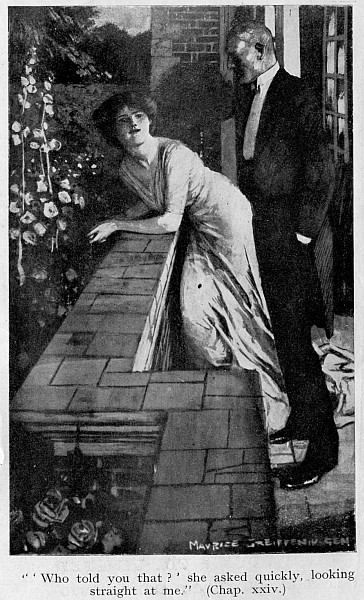
“Who told you that?” she asked quickly, halting and looking straight at me.
“Every one discusses it,” I answered. “They say he is to be your husband very shortly. What would he say, I wonder, if he knew that you and I frivol so much together?”
“What right has he to say anything regarding my actions? I am quite free.”
“Then he is not your lover?” I inquired in deep earnestness. “Tell me the truth.”
“Of course not. We have danced together and walked together, just as you and I have done; but as for love—why, the thing is absurd.”
“You do not love him?” I asked.
“Certainly not,” she laughed. Then she added, “I never love. That is why I am not like other women.”
“Every woman denies the tender passion,” I said, smiling.
“Well, I only tell you the truth,” she responded, with a slight sigh. “If every woman must love at one time in her life, there must of course be some exceptions. I am one of them.”
“Ah, you do yourself an injustice?” I declared. “Every woman has a heart.”
She was silent. Then, in a hard strained voice, she answered—
“True; but mine is like stone.”
“Why? What has hardened it?”
“Ah, no!” she cried quickly. “You are always, trying to learn my secret, but I can never tell you—never! Let us go in.” And, without another word, she passed through the French windows into the billiard-room, where the usual game of pool was in progress and the merry chatter was general.
Like that of her cousin, her nature was a complex one. The more I strove to understand her the more utterly hopeless the analysis became. I loved her—nay, in all the world there was but one woman for my eyes. Superb in beauty and in grace, she was incomparable—perfect.
That night, when the household was at rest, I still sat smoking in my room, puzzled over the curious recurrence of the sensation which seized all who entered the lethal chamber in London. The turret-clock over the stables had chimed half-past one, yet I felt in no mood to turn in. The writing of that hasty note by Beryl was an incident which I had forgotten, but which now came back to me. What if I could discover its nature? She had written it upon the blotting-pad in Sir Henry’s study, and the thought occurred to me that I might, perhaps, discover the impression there.
With that object I placed a box of matches in my pocket, switched off my light, and crept in the darkness noiselessly along the corridor. The carpeting was thick, and, being without slippers, I stole along without a sound past the door of Beryl’s room, and down the great oaken staircase into the hall.
I had crossed the latter, and had my hand upon the green baize door which kept out the draught of the corridors, and was about to open it, when of a sudden my quick ear caught a sound. In an instant I halted, straining my ears to listen. In the stillness of the night, and especially in the darkness, every sound becomes exaggerated and distorted. I stood there not daring to breathe.
Through the great high windows of the hall, filled with diamond panes like the windows of an ancient church, the faint starlight struggled so that the opposite side of the place was quite light. I glanced around at the shining armour standing weird in the half-light, with visors down and pikes in hand—a row of steel-clad warriors of the days gone by when Atworth was a stronghold. They looked a ghostly lot, and quite unnerved me.
But, as I listened, the suspicious sound again greeted my quick ear, and I heard in the door on the opposite side of the hall, straight before me, a key slowly turn. Even in that dead silence it made but little noise; the lock had evidently been well oiled.
Then cautiously the door gradually opened, and I was no longer alone. The dark figure of a woman advanced, treading so silently that she seemed to walk on air. She came straight towards the spot where I stood watching in the darkness, and I saw that she was dressed in black.
As she reached the centre of the hall the pale light fell upon her face, and, although uncertain, it was sufficient to reveal to me the truth; I was face to face with the woman who had been described by Beryl—the mysterious La Gioia!
Chapter Twenty Five.
The Woman in Black.
The encounter was unexpected and startling. I stood glaring at the dark figure, unable for the moment to move. The dark face, with its keen black eyes, fascinated me; there was a look of evil there. What business could bring her there, stealthily, like a thief?
She had halted in the centre of the hall, and seemed to be examining some object upon the Indian table, whereon tea was always served in the afternoon. The light was just sufficient to reveal that she held something small and white in her hand, but what it was I was unable to distinguish.
The “partial aboulia,” as we doctors term the lack of ability to perform intentional acts, which had seized me on discovering the intruder, quickly gave place to an endeavour to conceal myself; and this I accomplished by crouching down behind a large square pedestal whereon stood a giant palm. As I watched I saw her make a tour of the place, examining every object as though in search of something. Then, with deliberation, she passed through the door by which I had entered, and crept noiselessly up the stairs.
She was ascending to the room of the woman who feared her! I stole along after her. It was an adventurous piece of spying, for the slightest creak of the stairs would betray my presence, and oaken stairs creak horribly.
At last I gained the top, and, as I stood, watched her steal noiselessly along the corridor, past Beryl’s room, to my own room. She tried the door cautiously, opened it, and entered. As though in disappointment that I was not there she quickly came forth, stood in hesitation listening in the corridor, and then, creeping back, stopped before Beryl’s room. Evidently, she was well acquainted with the geography of the house, and knew who occupied the various chambers.
In the corridor it was much lighter than in the hall, and, as she came to a standstill before Beryl’s door, I was quite close to her, crouching on the dark stair, my head only on a level with the floor of the corridor. It was then I made a discovery which was somewhat puzzling: while her right hand was free, on the left she wore a black glove.
She bent at the door, peered into the keyhole, and, having listened in order to satisfy herself that Beryl was asleep, slowly turned the handle to try if it were locked.
Would she enter? I stood watching her actions with bated breath. That she was there with evil intent was absolutely certain.
The lock yielded, and, pushing open the door very slowly, she stole in on tiptoe, closing it after her.
What should I do? My love was in deadly peril—of that I felt certain. She had defied the Major, and the revenge of that all-powerful but unknown person, La Gioia, was upon her. She was alone—asleep, and at her mercy!
To dash in and seize her would be to alarm the house and, perhaps, compromise my loved one. Yet what could I do to save her? I had seen by the evil glint in her eyes that she was there with fell intent, and I knew by the cautious manner in which she moved, without hesitation or fear, that she was no amateur at such nocturnal visits. Indeed, she moved like a dark shadow, gliding without the slightest noise until one might almost have believed her to be some supernatural visitant.
It was my duty, however, to protect my love, no matter at what cost. I had come there for that purpose, having a distinct foreboding that some deadly peril surrounded her; therefore, now was my time to act, to meet that woman face to face and to demand an explanation.
Upon this decision I acted without further delay, for creeping as noiselessly as she had done, I reached the door and slowly turned the handle in order to burst in unexpectedly upon her. The handle turned, but the door would not open; she had locked it behind her.
I bent to the keyhole. All was dark within. There was no sound. The noise I had made by trying the door had, no doubt, alarmed her, and she was standing within preparing to make a sudden dash for liberty.
I drew myself up at the door prepared. Those moments were full of excitement. I held my breath, straining my ears to listen. There was no sound. The silence was like that of the grave.
My love was within that room, and her enemy was at her side!
Should I arouse the household? Again I hesitated, fearing lest I should compromise Beryl. Of a sudden, however, I recollected that in many houses the doors of the bedrooms frequently bear similar locks, and finding that the key had been removed by the intruder—possibly for the purpose of watching my movements from the inside—it occurred to me that I might try the key of my own room.
Yet if I left my post she might escape; she was evidently watching her opportunity.
Fully ten minutes passed, each second ticked out loudly by the long grandfather’s clock at the end of the corridor, until I could stand the tension no longer, and, receding slowly backwards, with my eyes still upon the door, ready for La Gioia’s dash for liberty, I reached my own room and secured the key.
Then, slipping back again, I placed the key swiftly in the lock, heedless of the noise it made, and turned it. The lock yielded, and a second later I stood within the room.
An involuntary cry of amazement escaped me, and I drew back. I dashed towards the bed, but it had not been slept in. The room, with its great mirror draped with silk, and its silver toilet-set catching the pale light, was empty! The window stood open, and, springing towards it, I saw to my dismay a rope-ladder reaching to the ground. Both La Gioia and my well-beloved had disappeared.
I looked out, but all was dark across the park. The night wind rustled in the trees, and a dog was howling dismally in the kennels. Could Beryl have been awaiting La Gioia, and have left in her company? The discovery utterly dismayed me.
I ran to my room, obtained a cap and boots, and, returning, passed through the open window, descending by the ladder to the terrace. Around the house I dashed like a madman, and down the drive towards the lodge-gates, halting suddenly now and then with my ear to the wind, eager to distinguish any sound of movement. I was utterly without clue to guide me as to the direction the fugitives had taken. Four or five roads and paths led from the house, in various directions, to Atworth village, to Corsham, and to Lacock, while one byway through the wood led out upon the old high-road to, Bath. The latter went straight into a dark copse at the rear of the house, and would afford ample concealment for any one wishing to get away unobserved. All the other roads cut across the park, and any one travelling along them would be visible for some distance. Therefore, I started down the byway in question, entering the wood and traversing it as noiselessly as I could, and emerged at last into the broad, white high-road which I knew so well, having cycled and driven over it dozens of times.
I calculated that the fugitives had about ten to twelve minutes’ start, and if they had really taken the road, I must be close upon them. The road ascended steadily all the way from the Wormwood Farm to Kingsdown, yet I slackened not my pace until I gained the crest of the hill. The moon had come out from behind the clouds, and the night was so light that any object upon that white open road could be seen for a long distance. Having gained the hilltop at the junction of the road to Wraxall, I stood and strained my eyes down both highways, but to my disappointment saw no one. Either I had passed them while they had hidden themselves in the wood, or I had mistaken the direction they had taken.
The presence in the house of that sinister woman in black, her mode of exit, and the startling fact that Beryl was missing, had, I think, unnerved me. As I stood reflecting I regretted that I had relied too much upon my own strategy, and had not aroused the household. In my constant efforts to preserve the secret of my well-beloved I had made a fatal mistake.
My mind had become confused by these constantly recurring mysteries. As a medical man I knew that all mental troubles involve diseases of the brain. The more complex troubles, such as my own at that moment, are still wrapped in obscurity. To the psychologist there are, of course, certain guiding principles through the maze of facts which constitute the science of the mind; but, after all, he knows practically nothing about the laws which govern the influence of mind over body. I had acted foolishly and impulsively. Both the women had fled.
I took the road down the hill to Wraxall, and thence, by a circular route by way of Ganbrook Farm and the old church at Atworth, back to the Hall. I hoped that they might take that road to Bath, but, although I walked for more than an hour, I met not a soul. A church clock chimed three as I came down the hill from Kingsdown, and it was already growing light ere I gained the terrace of the Hall again. I climbed back into Beryl’s room by the ladder still suspended there. Her absence was as yet undiscovered. Everything was just as I had left it an hour and a half before. I was undecided, at that moment, whether to alarm the household or to affect ignorance of the whole thing and await developments of the strange affair. Judged from all points the latter course seemed the best; therefore, still in indecision, I crept back to my room, and, entering there, closed the door.
I sank into a chair, exhausted after my walk, when a sudden pain shot through me from head to foot, causing me to utter an involuntary cry. The next instant the same sensation of being frozen crept over me, as it had done outside that room in Gloucester Square, and again on the previous night when dancing with my beloved. The same rigidity of my muscles, the same aphasia and amnesia, the same complex symptoms that I had before experienced, and so well remembered, were again upon me. My lower limbs seemed frozen and lifeless, my heart was beating so faintly that it seemed almost imperceptible, and my senses seemed so utterly dulled that I was unable either to cry out or to move.
If I had but a little of that curious liquid which Hoefer had injected! I blamed myself for not asking him to give me some in case of emergency. The unknown woman in black had left again behind her the curious unseen influence that so puzzled the greatest known medico-legist.
The sensation was much sharper, and of far longer duration, than that which had so suddenly fallen upon me when dancing. Reader, I can only describe it, even now, I sit recounting to you the curious story, as the icy touch of the grim Avenger. The hand of Death was actually upon me.
I think that the automatic processes of my brain must have ceased. Without entering into a long description, which the majority of the laity would not properly understand, it is but necessary to say that the lowest, or “third level” of the brain includes all the functions which the spinal cord and its upper termination, which we call the “medulla,” are able to perform alone—that is, without involving necessarily the activity of the nervous centres and brain areas which lie above them. The “third level” functions are those of life-sustaining processes generally—breathing, heart-beat and vaso-motor action—which secure the circulation of the blood. It was this portion of the brain, controlling the automatic processes, which had become paralysed. I needed, I knew, an artificial stimulation—some agent by which the physiological processes might be started again. What if they would not start again normally!
I sat in my chair, rigid as a corpse, unable to move or to utter a sound—cold, stiff, and as I well knew, resembling in every way a person lifeless. Slight consciousness remained to me, but, after a while, even that faded, and I knew not then what followed.
The period of blank unconsciousness appeared to me but a few minutes, but it must have been hours, for when I awoke the morning sun was high and was shining full in my face as I sat there. My limbs were cramped and my head was heavy, but there was no pain with my returning sensibility, as is generally the case after a period of insensibility. I rose with difficulty, and, staggering unevenly to the window, looked out. Upon the terrace two men were idly strolling as was the habit of those who came down early, awaiting the breakfast bell. I glanced at the timepiece and saw that it was about nine o’clock.
Had Beryl’s absence yet been discovered?
I glanced over to my bed, and then recollected that I had not undressed. Truly that night had been an eventful one. La Gioia had actually been in that room. In an instant, recollections of my midnight vigil and my chase crowded upon me. Surely, if that rope-ladder were still suspended from the window of the room occupied by my love, those two men strolling there must have noticed it!
I opened my own window and leaned out to look. No, it had been removed. My loved one’s absence had been discovered.
The breakfast bell rang and aroused me to a sense of responsibility. I knew of the secret visit of La Gioia, and it was my duty to reveal it so that the truth might be ascertained. Therefore, I shaved quickly, changed my clothes, and tossed about my bed so that the maids should not suspect my wakefulness.
There was merry chatter outside in the corridor as the guests descended, but, although I listened, I could hear no mention of Beryl’s disappearance. On completion of my toilet I opened my door and followed them down. Yet scarcely had I got to the head of the stairs when that same now-familiar sensation came upon me, like the touch of an icy hand. I gripped the old oaken banisters and stood cold and dumb. The same phenomena had occurred in my room as in that room of mystery at Gloucester Square. The thing utterly staggered belief.
Nevertheless, almost as swiftly as the hand of Death touched me was it withdrawn, and, walking somewhat unsteadily, I went down and along the corridor to the breakfast room.
The chatter was general before I entered, but there was a sudden silence as I opened the door.
“Why, Doctor Colkirk?” cried a voice, “this isn’t like you to be late. You’re an awful sluggard this morning!”
I glanced quickly across at the speaker and held my breath in amazement. It was Beryl! She was sitting there, in her usual place looking fresh in her pale blue cotton blouse, the merriest and happiest of the party.
What response I made I have no idea; I only know that I saluted my hostess mechanically and then walked to my chair like a man in a dream.
Chapter Twenty Six.
Husband and Wife.
Personally, I am one of those who pay no tribute of grateful admiration to those who have oppressed mankind with the dubious blessings of the penny post. Just as no household, which is adorned with the presence of pen-propelling young ladies, is ever without its due quantity of morning letters, so no breakfast table is quite complete if the post-bag has been drawn blank. The urn may hiss, eggs may be boiled to the precise degree of solidity, frizzling strips of “home-cured” may smile upon you from dish of silver, or golden marmalade may strive to allure you with the richness of its hue, but if the morning letters are not present the picture is incomplete. They are the crowning glory of the British breakfast table.
For a good many days my correspondents had happily left me in the lurch, but as I sank into my seat I saw upon my plate a single letter, and took it up mechanically. As a rule the handwriting of the envelope betrayed the writer, but this possessed the additional attraction of unfamiliar penmanship. It had been addressed to Rowan Road, and Bob had forwarded it.
The communication was upon paper of pale straw-colour, headed “Metropolitan Police, T. Division, Brentford,” and signed “J. Rowling, sub-divisional inspector.” There were only two or three lines, asking whether I could make it convenient to appoint an hour when he could call upon me, as he wished to consult me upon “a matter of extreme importance.” The matter referred to was, of course, the tragedy at Whitton. Truth to tell, I was sick at heart of all this ever-increasing maze of circumstances, and placed the letter in my pocket with a resolve to allow the affair to rest until I returned to London on the conclusion of my visit.
The receipt of it, however, had served one purpose admirably: it had given me an opportunity to recover my surprise at discovering Beryl sitting there opposite me, bright and vivacious, as though nothing unusual had occurred. The letter which I had seen her writing in the study on the previous evening had been, I now felt convinced, to make an appointment which she had kept.
But with whom?
I glanced at my hostess, who was busily arranging with those near her at table for a driving party to visit the Haywards at Dodington Park, and wondered whether she could be aware of the strange midnight visitant. I contrived to have a brief chat with her after breakfast was finished, but she appeared in entire ignorance of what had transpired during the night. I lit a cigarette, and as usual strolled around for a morning visit to the kennels with Sir Henry. On returning I saw my well-beloved seated beneath one of the great trees near the house, reading a novel. The morning was hot, but in the shade it was delightful. As I crossed the grass to her she raised her head, and then, smiling gladly, exclaimed—
“Why, I thought you’d gone to Dodington with the others, Doctor Colkirk?”
“No,” I answered, taking a chair near her; “I’m really very lazy this hot weather.”
How charming she looked in her fresh cotton gown and large flop-hat of Leghorn straw trimmed with poppies.
“And I prefer quiet and an interesting book to driving in this sun. I wonder they didn’t start about three, and come home in the sunset. But Nora’s always so wilful.”
Though as merry as was her wont, I detected a tired look in her eyes. Where had she been during the long night—and with whom? The silence was only disturbed by the hum of the insects about us and the songs of the birds above. The morning was a perfect one.
“I found it very oppressive last night,” I said, carefully approaching the subject upon which I wanted to talk to her. “I couldn’t sleep, so I came out here into the park.”
“Into the park?” she echoed quickly, and I saw by her look that she was apprehensive.
“Yes. It was a beautiful night—cool, refreshing, and starlit.”
“You were alone?”
I hesitated. Then, looking her straight in the face, answered—
“No, I was not. I had yourself as company.”
The colour in an instant left her cheeks.
“Me?” she gasped.
“Yes,” I replied, in a low, earnest voice. “You were also in the park last night.”
She was silent.
“I did not see you,” she faltered. Then, as though recovering her self-possession, she added, with some hauteur, “And even if I chose to walk here after every one had gone to rest, I really don’t think that you have any right to question my actions.”
“Forgive me,” I said quickly. “I do not question you in the least; I have no right to do so. You are certainly free to do as you please, save where you neglect your own interests or place yourself in peril—as you did last night.”
“In peril of what?” she demanded defiantly.
“In peril of falling a victim to the vengeance of an enemy.”
“I don’t understand you.”
“Then I will speak more frankly, Miss Wynd, in the hope that you will be equally frank with me,” I said, my eyes fixed upon her. “You were last night, or, rather, at an early hour this morning, with a person whom you have met on a previous occasion.”
“I admit that. It is, indeed, useless to deny it,” she answered.
“And yet, on the last occasion that you met, you nearly lost your life! Was it wise?”
“Nearly lost my life?” she echoed. “I do not follow you.”
“The woman in black who called at Gloucester Square on that evening not so many days ago. You surely remember her? Was it not after her departure that her unaccountable, evil influence remained?”
“Certainly. But what of her?”
“You were with her last night.”
“With her?” she gasped, surprised. “I certainly was not.”
“Do you deny having seen her?” I demanded.
“Most assuredly,” she responded promptly. “You certainly did not see us together.”
“And your companion was not a woman?”
“No; it was a man.”
“Who?”
“I have already told you that I object to any one interfering in my private affairs.”
“A lover?” I said, with some asperity perhaps. “You are entirely at liberty to think what you please. I only deny that I have set eyes upon my mysterious visitor since that evening in Gloucester Square.”
“Well, she was in the house last night,” I answered decisively. “She was in your room.”
“In my room?” gasped my well-beloved, in alarm. “Impossible?”
“I watched her enter there,” I replied; and then continuing, gave her an exact account of all that transpired—how she had first entered my room, and how the strange evil of her presence had so strangely affected me afterwards.
“It’s absolutely astounding,” she declared. “I was utterly ignorant of it all. Are you absolutely certain that it was the same woman?”
“The description given of her by yourself and your cousin’s servant is exact. She came here with some distinctly sinister purpose, that is quite evident.”
“But she must have entered by the servants’ quarters if she passed through the hall as you have described. She seemed to have been in search of us both.”
“No doubt,” I answered. “And if, as you say, you were absent from the room at the time, it is evident that she went straight out into the park in search of you. In that case she would have left the room before I tried the door, and would be ignorant of the fact that I had detected her presence in the house.”
“But what could she want with us?” she asked in a voice which told me that this unexpected revelation had unnerved her.
“Ah, that I cannot tell,” I responded. “She came here with an evil purpose, and fortunately we were both absent from our rooms.”
She knit her brows in thought. Possibly she was recalling some event during her midnight walk.
“And you say that you actually experienced in your own room, on returning there, an exactly similar sensation to that which we all felt at Gloucester Square?”
“Exactly.”
“Do you know,” she faltered, “I felt the same sensation in my own room this morning—very faintly, but still the same feeling of being chilled. What is your private opinion about it, Doctor?”
“My opinion is that there is a conspiracy afoot against both of us,” I responded very earnestly. “For some unaccountable reason we are marked down as victims—why, I cannot tell. You will forgive me for speaking plainly, but I believe that you alone hold the key to the mystery, that you alone know the motive of this vengeance—if vengeance it be—and if you were to tell me frankly of the past we might unite to vanquish our enemies.”
“What do you mean by the past?” she inquired, with just a touch of indignation.
“There are several questions I have put to you which you have refused to answer,” I replied. “The light which you could throw upon two or three points, now in obscurity, might lead me to a knowledge of the whole truth.”
She sighed, as though the burden of her thoughts oppressed her.
“I have told you all I can,” she answered.
“No; you have told me all you dare. Is not that a more truthful way of putting it?”
She nodded, but made no response.
“You have feared to tell me of the one fact concerning yourself which has, in my belief, the greatest bearing upon your perilous situation.”
“And what is that?”
“The fact that you are married!”
Her face blanched to the lips, her hands trembled and for a moment my words held her dumb.
“Who told you that?” she gasped, in a low voice.
“I knew it long ago,” I replied.
“Nora has betrayed my secret,” she observed in a hard voice.
“No,” I declared; “your cousin has told me nothing. I have known the fact for months past.”
“For months past! How?”
“You are not frank with me,” I replied; “therefore I may be at liberty to preserve what secrets I think best.”
“I—I do not deny it,” she faltered. Then, in a voice trembling with emotion, she added, “Ah, Doctor Colkirk, if you knew all that I have suffered you would quite understand my fear lest any one should discover my secret. I often wonder how it is that I have not taken my own life long, long ago.”
“No,” I said in deep sympathy, taking her hand. “Bear up against all these troubles. Let me assist you as your friend.”
“But you cannot,” she declared despairingly, tears welling in her eyes. “You can only assist me by keeping my secret. Will you promise me to do that?”
“Most certainly,” I replied. “But I want to do more. I want to penetrate the veil of mystery which seems to surround your marriage. I want—”
“You can never do that,” she interrupted quickly. “I have tried and tried, but have failed.”
“Why?”
“Because, strange though it may seem, I am entirely unaware of the identity of my husband. I have never seen him.”
I was silent. Should I reveal to her the truth? She could not believe me, if I did. What proof could I show her?
“And you do not know his name?”
“No; I do not even know his name,” she answered. “All I know is that by this marriage I am debarred for ever from all love and happiness. I have nothing to live for—nothing! Each day increases the mystery, and each day brings to me only bitterness and despair. Ah! how a woman may suffer and still live.”
“Have you no means by which to discover the identity of your unknown husband?” I inquired.
“None whatever,” she answered. “I know that I am married—beyond that, nothing.”
“And who else is in possession of this secret?” I inquired.
“Nora.”
“No one else?”
“No one—to my knowledge.”
“But you are, I understand, engaged to marry Cyril Chetwode,” I said, anxious to get the truth. “How can you marry him if you are really a wife?”
“Ah! that’s just it!” she cried. “I am the most miserable girl in all the world. Everything is so hazy, so enshrouded in mystery. I am married, and yet I have no husband.”
“But is it not perhaps best that, under the circumstances, you should be apart,” I said. “He may be old, or ugly, or a man you could never love.”
“I dread to think of it,” she said hoarsely. “Sometimes I wonder what he is really like, and who he really is.”
“And, at the same time, you love Cyril Chetwode?” I said, the words almost choking me.
I saw she loved that young ape, and my heart sank within me.
“We are very good friends,” she answered.
“But you love him? Why not admit it?” I said.
“And if I do—if I do, it is useless—all useless,” she murmured.
“Yes,” I observed, “it is useless. You are already married.”
“No!” she cried, holding up her tiny hand as though to stay my words. “Do not let us talk of it. I cannot bear to think. The truth hangs like a shadow over my life.”
“Does Chetwode know?” I inquired. “Is he aware that you can never be his?”
“He knows nothing. He loves me, and believes that one day we shall many. Indeed, now that he has succeeded to the estate, he sees no reason why our marriage should be delayed, and is pressing me for an answer.”
Her breast heaved and fell quickly beneath her starched blouse. I saw how agitated she was, and how, with difficulty, she was restraining her tears.
“What answer can you give him?”
“Ah!” she cried, “what answer, indeed. Was there ever woman before who knew not her husband, or who suffered as I am suffering?”
“Your case is absolutely unique,” I said. “Have you not endeavoured to solve the problem? Surely, from the official record of the marriage, it is possible to obtain your husband’s name? You have a wedding-ring, I suppose?” I said, my thoughts running back to that fateful moment when I had placed the golden bond of matrimony upon her hand.
“Yes,” she answered, and, placing her hand within her bodice, drew forth the ring suspended by a narrow blue ribbon; “it is here.”
I took it in my hand with a feeling of curiosity. How strange it was! That was the very ring which I had placed upon her finger when in desperation I had sold myself to the Tempter.
“Have you no idea whatever of the circumstances of your marriage? Do you know nothing?”
“Absolutely nothing—save that I am actually married.”
“The identity of the man who placed this ring upon your hand is an enigma?”
“Yes. I found it upon my finger; that is all that I am aware of. I changed my name, yet I am ignorant of what my new name really is.”
A sound of wheels approaching up the drive greeted our ears, but I still held the ring in the hollow of my hand.
“Shall I tell you the true name of your husband?” I said earnestly, looking straight into those deep, clear eyes.
“What?” she cried, starting in quick surprise; “you know it? Surely, that is impossible!”
“Yes,” I said in a low voice; “I know it.”
At that instant the ralli-car, which had evidently been to Corsham Station, dashed past us towards the house, interrupting our conversation and causing us both to raise our heads.
At the side of Barton, the coachman, there sat a stranger, who, as he passed, turned his head aside to glance at us. Our eyes met. In an instant I recognised him. It was none other than the man for whom I had been in active search through all these weeks—the Tempter!
Chapter Twenty Seven.
The Tempter.
The small-eyed man, to whom I had sold myself that fateful day, caught sight of Beryl, and, raising his grey felt hat in recognition, pulled up, and swung himself down from the trap. I glanced at my love and saw that her face was blanched to the lips. The meeting was, to her, evidently a most unexpected one.
Beneath the seat I saw a well-worn kit-bag, and a gun-case, which showed that he had come on a visit. Smartly dressed in light grey, he wore a button-hole of pink carnations, which gave him an air of gaiety and irresponsibility scarcely in keeping with his age.
“Ah, my dear Miss Wynd!” he cried, advancing to her with outstretched hand. “I’m so delighted to find you here. It is a long time since we met.”
“Yes,” she answered in a voice which trembled with suppressed excitement. “But I had no idea that you were coming down,” she added. “Nora told me nothing.”
“I too had no idea of visiting you, until the day before yesterday,” he said. “I’ve been abroad for nearly a year, and only arrived back in town three days ago, when I found Sir Henry’s, invitation, a month old, lying at my club. I wired to ask if I might still accept it, and here I am.”
He stood with his legs apart, his hat set rather jauntily upon his head, looking an entirely different person to that crabbed, strange old fellow who sat behind the bar of sunlight, with the banknotes in his claw-like fingers, every detail of that scene was as vivid in my memory as though it had occurred but yesterday. Again, I looked into his face. Yes, I had no doubt whatever that it was he.
“I—I am the first to bid you welcome to Atworth,” Beryl said. “Nora has gone over with some of the people to visit the Haywards, at Dodington. There’s a flower-show there.”
“I quite remember,” he exclaimed, “I went over there last year. Lady Dyrham drove us. Do you recollect?”
“Of course,” she laughed. “And how it rained too. My new frock was quite spoilt, and I had a bad cold for a fortnight afterwards. I’m not likely to easily forget that drive home.”
“Because of the spoilt frock?” he laughed, raising his small eyes to me.
“Yes, I suppose that’s what has impressed itself upon my memory. We women are never forgetful where clothes are concerned.”
“And who’s here? Anybody I know?” he inquired.
“Oh, there are the Pirries and the Tiremans, as usual, and, of course, Lady Dyrham,” she answered. Then, a moment later she added, “This is Doctor Colkirk—Mr Ashwicke. Let me introduce you, if you have not already met before.”
“We have not had that pleasure,” said the Tempter, turning to me and raising his hat.
He remained perfectly calm, betraying no sign whatever of recognition. In this I saw an intention on his part to deny all knowledge of our previous acquaintance.
His keen eyes glanced at me quickly, and, as though in that moment he gauged exactly my strength of character, he expressed his pleasure at our meeting, and hoped that we should all spend as pleasant a time as he had done last year.
“Here one has not an hour for leisure,” he laughed. “Sir Henry and his wife are really a wonderful pair as host and hostess. You’ve already found them so, I’ve no doubt.”
“Yes,” I responded mechanically, his marvellous self-control staggering me. “The house-party is a very jolly one.”
“I’ve been abroad,” he went on. “But I’m pleased to be at home again. There’s nothing like an English country house in summer. It is an ideal existence.”
“How long have you been away?” I inquired, anxious to ascertain his tactics.
“Nearly a year. After leaving here last summer, I spent a week in London and then left for Vienna. Afterwards I went south, spending greater part of the winter in Cairo, thence to Bombay, and returned for the late spring in Florence, and afterwards wandered about France, until three days ago I found myself again back in England.”
“And you did not return once during the whole year?” I asked, with affected carelessness.
His small eyes darted quickly to mine, as though in suspicion.
“No,” he responded promptly. “It is almost a year to-day since I was in England.”
Then, noticing Barton waiting with the trap, he ordered him to take the luggage to the house, while all three of us walked up the drive together.
A sudden change had passed over Beryl. She knew this man Ashwicke, her attitude towards him was that of fear. The looks they had exchanged at first meeting were sufficient to convince me that there was some hidden secret between them.
“Nora cannot be aware of your arrival,” Beryl said, as we walked together up the sunny drive to the house. “Otherwise she would either have told me, or she certainly would have remained at home to receive you.”
“Why should she?” he laughed lightly. “Surely we are old enough friends to put aside all ceremony. I’m a rolling stone, as you know, and I hate putting people out.”
“Yes,” she said; “you are a rolling stone, and no mistake. I don’t think any one travels further afield than you do. You seem to be always travelling.”
“I’ve only spent six months in England these last eight years,” he responded. “To me, England is only bearable in August or September. A little shooting, and I’m off again.”
“You only come back because you can’t get decent sport on the Continent?” I said, for want of other observation to make.
“Exactly,” he answered. ”‘La Chasse,’ as the French call it, is never a success across the Channel. Some rich Frenchman started a fox-hunt down at Montigny, in the Seine and Marne, not long ago, and part of the paraphernalia was an ambulance wagon flying the red-cross flag. A fact! I went to the first meet myself.”