Book 4 — The Worship Of The Babe.
Reading edition
"Rejoice, our Saviour He was born On Christmas day in the morning."
Old Carol.
TO HIS SAVIOUR, A CHILD; A PRESENT, BY A CHILD.
Go, pretty child, and bear this flower Unto thy little Saviour; And tell Him by that bud now blown, He is a Rose of Sharon known. When thou hast said so, stick it there Upon His bib or stomacher; And tell Him, for good handsel too, That thou hast brought a whistle new, Made of a clean, strait oaten reed To charm His cries at time of need. Tell Him for coral thou hast none, But if thou had'st He should have one; But poor thou art, and known to be Even as moneyless as He. Lastly, if thou can'st win a kiss From those mellifluous lips of His, Then never take a second on To spoil the first impression.
Robert Herrick.
HONOR TO THE KING.
Yet if his majesty our sovereign lord Should of his own accord Friendly himself invite, And say, "I'll be your guest to-morrow night," How should we stir ourselves, call and command All hands to work: "Let no man idle stand. Set me fine Spanish tables in the hall, See they be fitted all; Let there be room to eat, And order taken that there want no meat. See every sconce and candlestick made bright, That without tapers they may give a light. Look to the presence; are the carpets spread, The dais o'er the head, The cushions in the chairs, And all the candles lighted on the stairs? Perfume the chambers, and in any case Let each man give attendance in his place." Thus if the king were coming would we do, And 'twere good reason too; For 'tis a duteous thing To show all honor to an earthly king, And after all our travail and our cost, So he be pleased, to think no labor lost. But at the coming of the King of Heaven, All's set at six and seven: We wallow in our sin, Christ cannot find a chamber in the inn. We entertain Him always like a stranger, And, as at first, still lodge Him in the manger.
Christ Church, Oxford, MS.
NEW PRINCE, NEW POMP.
Behold a silly, tender Babe, In freezing winter night, In homely manger trembling lies; Alas! a piteous sight. The inns are full, no man will yield This little pilgrim bed; But forced He is with silly beasts In crib to shroud His head. Despise Him not for lying there, First what He is inquire; An orient pearl is often found In depth of dirty mire. Weigh not His crib, His wooden dish, Nor beast that by Him feed; Weigh not His mother's poor attire, Nor Joseph's simple weed. This stable is a prince's court, This crib His chair of state; The beasts are parcel of His pomp, The wooden dish His plate. The persons in that poor attire His royal liveries wear; The Prince himself is come from heaven, This pomp is praiséd there. With joy approach, O Christian wight! Do homage to thy King; And highly praise this humble pomp Which He from heaven doth bring.
Robert Southwell.
OF THE EPIPHANY.
Fair eastern star, that art ordained to run Before the sages, to the rising sun, Here cease thy course, and wonder that the cloud Of this poor stable can thy Maker shroud: Ye heavenly bodies glory to be bright, And are esteemed as ye are rich in light; But here on earth is taught a different way, Since under this low roof the Highest lay. Jerusalem erects her stately towers, Displays her windows and adorns her bowers; Yet there thou must not cast a trembling spark, Let Herod's palace still continue dark; Each school and synagogue thy force repels, There pride enthroned in misty error dwells; The temple, where the priests maintain their quire, Shall taste no beam of thy celestial fire, While this weak cottage all thy splendor takes: A joyful gate of every chink it makes. Here shines no golden roof, no ivory stair, No king exalted in a stately chair, Girt with attendants, or by heralds styled, But straw and hay enwrap a speechless child. Yet Sabæ's lords before this babe unfold Their treasures, offering incense, myrrh, and gold. The crib becomes an altar; therefore dies No ox nor sheep; for in their fodder lies The Prince of Peace, who, thankful for His bed, Destroys those rites in which their blood was shed: The quintessence of earth He takes, and fees, And precious gums distilled from weeping trees; Rich metals and sweet odors now declare The glorious blessings which His laws prepare, To clear us from the base and loathsome flood Of sense and make us fit for angel's food, Who lift to God for us the holy smoke Of fervent prayers with which we Him invoke, And try our actions in the searching fire By which the seraphims our lips inspire: No muddy dross pure minerals shall infect, We shall exhale our vapors up direct: No storm shall cross, nor glittering lights deface Perpetual sighs which seek a happy place.
Sir John Beaumont.
A HYMN FOR THE EPIPHANY.
SUNG AS BY THE THREE KINGS.
1 King. Bright Babe! whose awful beauties make The morn incur a sweet mistake; 2 King. For whom the officious heavens devise To disinherit the sun's rise; 3 King. Delicately to displace The day, and plant it fairer in Thy face; 1 King. O Thou born King of loves! 2 King. Of lights! 3 King. Of joys!
Chorus. Look up, sweet Babe, look up and see! For love of Thee, Thus far from home The East is come To seek herself in Thy sweet eyes.
1 King. We who strangely went astray, Lost in a bright Meridian night; 2 King. A darkness made of too much day; 3 King. Beckoned from far By Thy fair star, Lo, at last have found our way.
Chorus. To Thee, Thou Day of Night! Thou East of West! Lo, we at last have found the way To Thee, the world's great universal East, The general and indifferent day.
1 King. All-circling point! all-centring sphere! The world's one round eternal year: 2 King. Whose full and all-unwrinkled face Nor sinks nor swells with time or place; 3 King. But everywhere and every while Is one consistent solid smile, 1 King. Not vexed and tost, 2 King. 'Twixt spring and frost; 3 King. Nor by alternate shreds of light; Sordidly shifting hands with shades and night.
Chorus. O little All, in Thy embrace, The world lies warm and likes his place; Nor does his full globe fail to be Kissed on both his cheeks by Thee; Time is too narrow for Thy year, Nor makes the whole world Thy half-sphere.
Richard Crashaw.
A HYMN ON THE NATIVITY OF MY SAVIOUR.
I sing the birth was born to-night, The author both of life and light; The angels so did sound it. And like the ravished shepherds said, Who saw the light, and were afraid, Yet searched, and true they found it. The Son of God th' eternal king, That did us all salvation bring, And freed the soul from danger; He whom the whole world could not take, The Word, which heaven and earth did make, Was now laid in a manger. The Father's wisdom willed it so, The Son's obedience knew no No, Both wills were in one stature; And as that wisdom had decreed, The Word was now made flesh indeed, And took on Him our nature. What comfort by Him do we win, Who made himself the price of sin, To make us heirs of glory! To see this babe all innocence; A martyr born in our defence; Can man forget the story?
Ben Jonson.
AT CHRISTMAS.
All after pleasures as I rid one day, My horse and I both tried, body and mind, With full cry of affections quite astray, I took up in the next inn I could find. There, when I came, whom found I but my dear— My dearest Lord; expecting till the grief Of pleasures brought me to Him; ready there To be all passengers' most sweet relief? O Thou, whose glorious, yet contracted light, Wrapt in night's mantle, stole into a manger; Since my dark soul and brutish is Thy right, To man, of all beasts, be not Thou a stranger; Furnish and deck my soul, that Thou may'st have A better lodging than a rock or grave. The shepherds sing; and shall I silent be? My God, no hymn for Thee? My soul's a shepherd too; a flock it feeds Of thoughts and words and deeds; The pasture is Thy word, the stream Thy grace, Enriching every place. Shepherd and flock shall sing, and all my powers Outsing the daylight hours. Then we will chide the sun for letting night Take up his place and right: We sing one common Lord; wherefore He should Himself the candle hold. I will go searching till I find a sun Shall stay till we have done; A willing shiner, that shall shine as gladly As frost-nipt suns look sadly, Then we will sing and shine all our own day, And one another pay. His beams shall cheer my breast; and both so twine, Till ev'n his beams sing and my music shine.
George Herbert.
NEW HEAVEN, NEW WAR.
Come to your heaven, you heavenly quires! Earth hath the heaven of your desires; Remove your dwelling to your God, A stall is now His blest abode; Sith men their homage do deny, Come, angels, all their fault supply. This little Babe, so few days old, Is come to rifle Satan's fold; All hell doth at His presence quake, Though He himself for cold do shake; For in this weak, unarméd wise The gates of hell He will surprise. My soul, with Christ join thou in fight; Stick to the tents that He hath pight; Within His crib is surest ward, This little Babe will be thy guard; If thou wilt foil thy foes with joy, Then flit not from this heavenly Boy.
Robert Southwell.
FOR CHRISTMAS DAY.
Rejoice, rejoice, with heart and voice! In Christé's birth this day rejoice! From Virgin's womb this day did spring The precious seed that only savéd man; This day let man rejoice and sweetly sing, Since on this day salvation first began. This day did Christ man's soul from death remove, With glorious saints to dwell in heaven above. This day to man came pledge of perfect peace, This day to man came perfect unity, This day man's grief began for to surcease, This day did man receive a remedy For each offence and every deadly sin, With guilty heart that erst he wandered in. In Christé's flock let love be surely placed, From Christé's flock let concord hate expel, Of Christé's flock let love be so embraced As we in Christ and Christ in us may dwell; Christ is the author of all unity, From whence proceedeth all felicity. O sing unto this glittering, glorious king, O praise His name let every living thing; Let heart and voice, like bells of silver, ring The comfort that this day doth bring; Let lute, let shawm, with sound of sweet delight, The joy of Christé's birth this day recite.
Francis Kinwelmersh, A.D. 1576.
SUNG TO THE KING IN THE PRESENCE AT WHITEHALL.
Chor.—What sweeter music can we bring, Than a carol for to sing The birth of this our heavenly King? Awake the voice! awake the string! Heart, ear, and eye, and everything Awake! the while the active finger Runs divisions with the singer. From the flourish they come to the song. Dark and dull night, fly hence away, And give the honor to this day, That sees December turn'd to May. If we may ask the reason, say The why and wherefore all things here Seem like the spring-time of the year? Why does the chilling winter's morn Smile like a field beset with corn? Or smell like to a mead new-shorn, Thus on the sudden? Come and see The cause why things thus fragrant be: 'Tis He is born whose quickening birth Gives life and lustre public mirth To heaven and the under-earth. Chor.—We see Him come, and know Him ours, Who with His sunshine and His showers Turns all the patient ground to flowers. The darling of the world is come, And fit it is we find a room To welcome Him. The nobler part Of all the house here is the heart. Chor.—Which we will give Him; and bequeath This holly and this ivy wreath, To do Him honor, who's our King, And Lord of all this revelling.
Robert Herrick.
AND THEY LAID HIM IN A MANGER.
Happy crib, that wert alone To my God, bed, cradle, throne! Whilst thy glorious vileness I View with divine fancy's eye, Sordid filth seems all the cost, State, and splendor, crowns do boast. See heaven's sacred majesty Humbled beneath poverty; Swaddled up in homely rags On a bed of straw and flags! He whose hands the heavens displayed, And the world's foundation laid, From the world's almost exiled, Of all ornaments despoiled. Perfumes bathe Him not, new-born, Persian mantles not adorn; Nor do the rich roofs look bright With the jasper's orient light. Where, O royal Infant, be Th' ensigns of Thy majesty; Thy Sire's equalizing state; And Thy sceptre that rules fate? Where's Thy angel-guarded throne, Whence Thy laws Thou didst make known, Laws which heaven, earth, hell, obeyed? These, ah! these aside He laid; Would the emblem be—of pride By humility outvied?
Sir Edward Sherburne.
THE BURNING BABE.
As I in hoary winter's night stood shivering in the snow, Surprised I was with sudden heat which made my heart to glow; And lifting up a fearful eye to view what fire was near, A pretty babe all burning bright did in the air appear, Who, scorchéd with excessive heat, such floods of tears did shed, As though his floods should quench his flames which with his tears were fed. Alas! quoth he, but newly born in fiery heats I fry, Yet none approach to warm their hearts or feel my fire but I. My faultless breast the furnace is, the fuel wounding thorns: Love is the fire and sighs the smoke, the ashes shame and scorns: The fuel justice layeth on, and mercy blows the coals; The metal in this furnace wrought are men's defiléd souls; For which, as now on fire I am, to work them to their good, So will I melt into a bath to wash them in my blood. With that he vanish'd out of sight and swiftly shrunk away. And straight I calléd unto mind that it was Christmas Day.
Robert Southwell.
CHRIST'S NATIVITY.
Awake, glad heart! get up and sing! It is the birthday of thy King. Awake! awake! The sun doth shake Light from his locks, and, all the way Breathing perfumes, doth spice the day. Awake! awake! hark how th' wood rings, Winds whisper, and the busy springs A concert make! Awake! awake! Man is their high-priest, and should rise To offer up the sacrifice. I would I were some bird or star Fluttering in woods, or lifted far Above this inn, And road of sin! Then either star or bird should be Shining or singing still to Thee. I would I had in my best part Fit rooms for Thee! or that my heart Were so clean as Thy manger was! But I am all filth, and obscene; Yet, if Thou wilt, Thou canst make clean. Sweet Jesu! will then. Let no more This leper haunt and soil Thy door! Cure him, ease him, O release him! And let once more, by mystic birth, The Lord of life be born in earth.
Henry Vaughan.
AN ODE ON THE BIRTH OF OUR SAVIOUR.
In numbers, and but these few, I sing Thy birth, O Jesu! Thou pretty baby, born here With sup'rabundant scorn here: Who, for Thy princely port here, Hadst for Thy place Of birth a base Out-stable for Thy court here. Instead of neat enclosures Of interwoven osiers, Instead of fragrant posies Of daffodils and roses, Thy cradle, kingly stranger, As gospel tells, Was nothing else But here a homely manger. But we with silks not crewels, With sundry precious jewels, And lily work will dress Thee; And, as we dispossess Thee Of clouts, we'll make a chamber, Sweet babe, for Thee Of ivory And plaster'd round with amber. The Jews they did disdain Thee, But we will entertain Thee With glories to await here Upon Thy princely state here; And, more for love than pity, From year to year We'll make Thee here A free-born of our city.
Robert Herrick.
WHO CAN FORGET?
Who can forget—never to be forgot— The time, that all the world in slumber lies, When, like the stars, the singing angels shot To earth, and heaven awaked all his eyes To see another sun at midnight rise On earth? Was never sight of pareil fame For God before, man like himself did frame, But God himself now like a mortal man became. A child He was, and had not learnt to speak, That with His word the world before did make; His mother's arms Him bore, He was so weak, That with one hand the vaults of heaven could shake; See how small room my infant Lord doth take, Whom all the world is not enough to hold! Who of His years or of His age hath told? Never such age so young, never a child so old. And yet but newly He was infanted, And yet already He was sought to die; Yet scarcely born, already banished; Not able yet to go, and forced to fly: But scarcely fled away, when by and by The tyrant's sword with blood is all defiled, And Rachel, for her sons, with fury wild, Cries, "O thou cruel king, and O my sweetest Child!" Egypt His nurse became, where Nilus springs, Who, straight to entertain the rising sun, The hasty harvest in his bosom brings; But now for drought the fields were all undone, And now with waters all is overrun: So fast the Cynthian mountains pour'd their snow, When once they felt the sun so near them glow, That Nilus Egypt lost, and to a sea did grow. The angels carolled loud their song of peace; The cursed oracles were strucken dumb; To see their Shepherd the poor shepherds press; To see their King, the kingly sophies[S] come; And them to guide unto his Master's home, A star comes dancing up the orient, That springs for joy over the strawy tent, Where gold, to make their prince a crown, they all present.
Giles Fletcher.
FOOTNOTE:
THE CHILD JESUS.
A CORNISH CAROL.
Welcome that star in Judah's sky, That voice o'er Bethlehem's palmy glen! The lamp far sages hailed on high, The tones that thrilled the shepherd men: Glory to God in loftiest heaven! Thus angels smote the echoing chord; Glad tidings unto man forgiven, Peace from the presence of the Lord. The Shepherds sought that birth divine, The Wise Men traced their guided way; There, by strange light and mystic sign, The God they came to worship lay. A human Babe in beauty smiled, Where lowing oxen round Him trod: A maiden clasped her awful Child, Pure offspring of the breath of God. Those voices from on high are mute, The star the Wise Men saw is dim; But hope still guides the wanderer's foot, And faith renews the angel hymn: Glory to God in loftiest heaven! Touch with glad hand the ancient chord; Good tidings unto man forgiven, Peace from the presence of the Lord.
Robert Stephen Hawker.
LONG AGO.
In the bleak mid-winter Frosty wind made moan, Earth stood hard as iron, Water like a stone; Snow had fallen, snow on snow, Snow on snow, In the bleak mid-winter Long ago. Our God, heaven cannot hold Him, Nor earth sustain; Heaven and earth shall flee away When He comes to reign: In the bleak mid-winter A stable-place sufficed The Lord God Almighty, Jesus Christ. Enough for Him whom cherubim Worship night and day, A breastful of milk And a mangerful of hay; Enough for Him whom angels Fall down before, The ox and ass and camel Which adore. Angels and archangels May have gathered there, Cherubim and seraphim Thronged the air; But only His mother, In her maiden bliss, Worshipped the Beloved With a kiss. What can I give Him, Poor as I am? If I were a shepherd, I would bring a lamb; If I were a wise man, I would do my part: Yet what I can I give Him, Give my heart.
Christina G. Rossetti.
"What Can I Give Him?"
STAR OF BETHLEHEM.
When marshalled on the nightly plain The glitt'ring host bestud the sky, One star alone of all the train Can fix the sinner's wandering eye. Hark! hark! to God the chorus breaks From ev'ry host, from ev'ry gem; But one alone the Saviour speaks,— It is the Star of Bethlehem! Once on the raging seas I rode; The storm was loud, the night was dark; The ocean yawned, and rudely blew The wind that tossed my found'ring bark. Deep horror then my vitals froze; Death-struck, I ceased the tide to stem, When suddenly a star arose,— It was the Star of Bethlehem! It was my guide, my light, my all; It bade my dark forebodings cease; And through the storm and danger's thrall, It led me to the port of peace. Now safely moored, my perils o'er, I'll sing first in night's diadem, Forever and forever more,— The Star, the Star of Bethlehem!
Henry Kirke White.
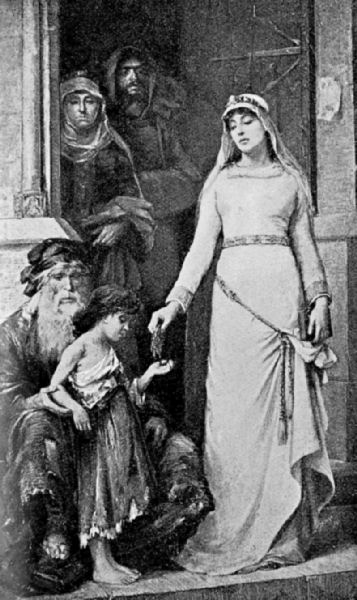
NO ROOM.
Foot-sore and weary, Mary tried Some rest to seek, but was denied. "There is no room," the blind ones cried. Meekly the Virgin turned away, No voice entreating her to stay; There was no room for God that day. No room for her, round whose tired feet Angels are bowed in transport sweet The mother of their God to greet. No room for Him in whose small hand The troubled sea and mighty land Lie cradled like a grain of sand; No room, O Babe Divine! for Thee That Christmas night; and even we Dare shut our hearts and turn the key. In vain Thy pleading baby cry Strikes our deaf souls; we pass Thee by, Unsheltered 'neath the wintry sky. No room for God! O Christ, that we Should bar our doors, nor ever see Our Saviour waiting patiently. Fling wide the doors! Dear Christ, turn back! The ashes on my hearth lie black— Of light and warmth a total lack. How can I bid Thee enter here Amid the desolation drear Of lukewarm love and craven fear? What bleaker shelter can there be Than my cold heart's tepidity— Chilled, wind-tossed, as the winter sea? Dear Lord, I shrink from Thy pure eye, No home to offer Thee have I; Yet in Thy mercy pass not by.
Agnes Repplier.
ON CHRISTMAS DAY.
Assist me, Muse divine! to Sing the Morn On which the Saviour of Mankind was born; But oh! what Numbers to the Theme can rise? Unless kind Angels aid me from the Skies! Methinks I see the tunefull Host descend, And with officious Joy the Scene attend! Hark, by their Hymns directed on the Road, The Gladsome Shepherds find the nascent God! And view the Infant conscious of his Birth, Smiling bespeak Salvation to the Earth! For when th' important Æra first drew near In which the great Messiah should appear; And to accomplish his redeeming Love; Beneath our Form should every Woe sustain, And by triumphant Suffering fix his Reign, Should for lost Man in Tortures yield his Breath Dying to save us from eternal Death! Oh mystick union!—salutary Grace! Incarnate God our Nature should embrace! That Deity should stoop to our Disguise! That man recover'd should regain the Skies! Dejected Adam! from thy grave ascend, And view the Serpent's Deadly Malice end, Adorning bless th' Almighty's boundless Grace That gave his son a Ransome for thy Race! Oh never let my Soul this Day forget, But pay in gratefull praise the annual Debt.
From a manuscript volume, written by George Washington.
THE HEAVENLY CHOIR.
What sudden blaze of song Spreads o'er th' expanse of heaven? In waves of light it thrills along, Th' angelic signal given— "Glory to God!" from yonder central fire Flows out the echoing lay beyond the starry quire; Like circles widening round Upon a clear blue river, Orb after orb, the wondrous sound Is echoed on forever; "Glory to God on high, on earth be peace, And love toward men of love—salvation and release." Yet stay, before thou dare To join that festal throng; Listen and mark what gentle air First stirred the tide of song; 'Tis not, "the Saviour born in David's home, To whom for power and health obedient worlds should come:" 'Tis not "the Christ the Lord:"— With fix'd adoring look The choir of angels caught the word, Nor yet their silence broke; But when they heard the sign, where Christ should be, In sudden light they shone and heavenly harmony. Wrapped in His swaddling-bands, And in His manger laid, The hope and glory of all lands Is come to the world's aid: No peaceful home upon His cradle smiled, Guests rudely went and came where slept the royal Child. But where Thou dwellest, Lord, No other thought should be; Once duly welcomed and adored, How should I part with Thee? Bethlehem must lose Thee soon, but Thou wilt grace The single heart to be Thy pure abiding-place. Thee, on the bosom laid Of a pure virgin mind, In quiet ever, and in shade, Shepherd and sage may find; They who have bow'd untaught to nature's sway, And they who follow truth along her star-paved way. The pastoral spirits first Approach Thee, Babe divine, For they in lowly thoughts are nursed, Meet for Thy lowly shrine: Sooner than they should miss where Thou dost dwell, Angels from heaven will stoop to guide them to Thy cell. Still, as the day comes round For Thee to be revealed, By wakeful shepherds Thou art found, Abiding in the field. All through the wintry heaven and chill night air, In music and in light Thou dawnest on their prayer. O faint not ye for fear— What though your wandering sheep, Reckless of what they see and hear, Lie lost in wilful sleep? High heaven in mercy to your sad annoy Still greets you with glad tidings of immortal joy. Think on th' eternal home The Saviour left for you; Think on the Lord most holy, come To dwell with hearts untrue: So shall ye tread untired His pastoral ways, And in the darkness sing your carol of high praise.
John Keble.