IN THE MORNING GLOW (continued 2)
Reading edition
"Bad dream, was it, little chap?" asked the Council, holding you close to his coat, all smoky of cigars, and patting your cheek.
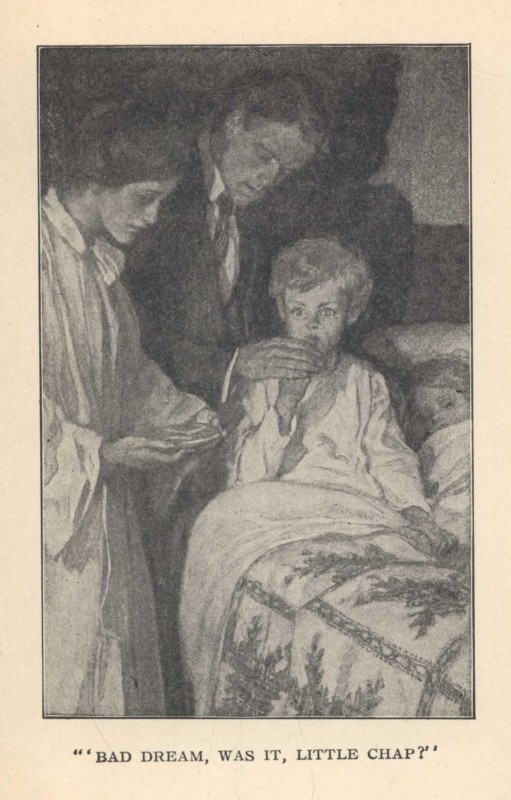
"BAD DREAM, WAS IT, LITTLE CHAP?"
"F-father, where did he go?"
"Who go, my boy?"
"Why, the burglar, Father."
"There wasn't any burglar, child."
"Why, yes, Father. I saw him. Right there. Coming through the window."
And it took Father and Mother and two oatmeal crackers and a drink of water to convince you that it was all a dream. So whether it was in frightening burglars away, or keeping the street-lamps burning, or smoking cigars, or soothing a little boy with a nightmare and a fevered head, the Council was a useful body, and always came just in time.
On week-day mornings Father had gone to work when you came down-stairs, but on Sunday mornings, when you awoke, a trifle earlier if anything—
"Father!"
Silence.
"Father!" a little louder.
Then a sleepy "Yes."
"We want to get up."
"It isn't time yet. You children go to sleep."
You waited. Then—
"Father, is it time yet?"
"No. You children lie still."
So you and Lizbeth, wide-awake, whispered together; and then, to while away the time while Father slept, you played Indian, which required two little yells from you to begin with (when the Indian You arrived in your war-paint) and two big yells from Lizbeth to end with (when the Paleface She was being scalped).
Then Father said it was "no use," and Mother took a hand. You were quiet after that, but it was yawny lying there with the sun so high. You listened. Not a sound came from Father and Mother's room. You rose cautiously, you and Lizbeth, in your little bare feet. You stole softly across the floor. The door was a crack open, so you peeked in, your face even with the knob and Lizbeth's just below. And then, at one and the same instant, you both said "Boo!" and grinned; and the harder you grinned the harder Father tried not to laugh, which was a sign that you could scramble into bed with him, you on one side and Lizbeth on the other, cuddling down close while Mother went to see about breakfast.
It was very strange, but while it had been so hard to drowse in your own bed, the moment you were in Father's you did not want to get up at all. Indeed, it was Father who wanted to get up first, and it was you who cried that it was not time.
Week-days were always best for most things, but for two reasons Sunday was the best day of all. One reason was Sunday dinner. The other was Father. On Sunday the dinner-table was always whitest with clean linen and brightest with silver and blue china and fullest of good things to eat, and sometimes Company came and brought their children with them. On Sunday, too, there was no store to keep, and Father could stay at home all day.
He came down to breakfast in slippers and a beautiful, wide jacket, which was brown to match the coffee he always took three cups of, and the cigar which he smoked afterwards in a big chair with his feet thrust out on a little one. While he smoked he would read the paper, and sometimes he would laugh and read it out loud to Mother; and sometimes he would say, "That's so," and lay down his paper and talk to Mother like the minister's sermon. And once he talked so loudly that he said "Damn." Mother looked at you, for you were listening, and sent you for her work-basket up-stairs. After that, when you talked loudest to Lizbeth or the Jones boy, you said "Damn," too, like Father, till Mother overheard you and explained that only fathers and grandfathers and bad little boys ever said such things. It wasn't a pretty word, she said, for nice little boys like you.
"But, Mother, if the bad little boys say it, why do the good fathers say it—hm?"
Mother explained that, too. Little boys should mind their mothers, she said.
It was easy enough not to say the word when you talked softly, but when you talked loudest it was hard to remember what Mother said. For when you talked softly, somehow, you always remembered Mother, and when you talked loudly it was Father you remembered best.
The sun rose high and warm. It was a long time after breakfast. Fragrance came from the kitchen to where you sat in the library, all dressed-up, looking at picture-books and waiting for dinner, and wondering if there would be pie. Father was all dressed-up, too, and while he read silently, you and Lizbeth felt his cheeks softly with your finger-tips. Where the prickers had been at breakfast-time it was as smooth as velvet now. Father's collar was as white as snow. In place of his jacket he wore his long, black Sunday coat, and in his shoes you could almost see your face.
"Father's beautifulest on Sunday," Lizbeth said.
"So am I," you said, proudly, looking down your blouse and trousers to the shine of your Sunday shoes.
"So are you, too," you added kindly to Lizbeth, who was all in white and curls.
Then you drew a little chair beside Father's and sat, quiet and very straight, with your legs crossed carelessly like his and an open book like his in your lap. And when Father changed his legs, you changed your legs, too. Lizbeth looked at you two awhile awesomely. Then she brought her little red chair and sat beside you with the Aladdin book on her lap, but she did not cross her legs. And so you sat there, all three, clean and dressed-up and beautiful, by the bay-window, while the sun lay warm and golden on the library rug, and sweeter and sweeter grew the kitchen smells.
Then dinner came, and the last of it was best because it was sweetest, and if Company were not there you cried:
"It's going to be pie to-day, isn't it, Mother?"
But Mother would only smile mysteriously while the roast was carried away. Then Lizbeth guessed.
"It's pudding," she said.
"No, pie," you cried again, "'cause yesterday was pudding."
"Now, Father, you guess," said Lizbeth.
"I guess?"
"Yes, Father."
And at that Father would knit his brows and put one finger to one side of his nose, so that he could think the harder, and by-and-by he would say:
"I know. I'll bet it's custard."
"Oh no, Father," you broke in, for you liked pie best, and even to admit the possibility of custard, aloud, might make it come true.
"Then it's lemon jelly with cream," said Father, trying another finger to his nose and pondering deeply.
"Oh, you only have one guess," cried you and Lizbeth together, and Father, cornered, stuck to the jelly and cream.
"Oh, dear," Lizbeth said, "I don't see what good it does to brush off the crumbs in the middle of dinner."
Silence fell upon the table, you and Lizbeth holding Father's outstretched hands. Your eyes were wide, the better to see. Your lips were parted, the better, doubtless, to hear. Only Mother was serene, for only Mother knew. And then through the stillness came the sound of rattling plates.
"Pie," you whispered.
"Pudding," whispered Lizbeth.
"Jelly," whispered Father, hoarsely.
The door swung open. You rose in your seats, you and Lizbeth and Father, craning your necks to see, and, seeing—
"Pie!" you cried, triumphantly.
"Ah!" said Father, lifting his pie-crust gayly with the tip of his fork.
"Apples," you said, peeping under your crust.
"Apples, my son? Apples? Why, no. Bless my soul! As I live, this is a robber's cave filled with sacks of gold."
"Oh, Father!" you cried, incredulous, not knowing how to take him yet; but you peeped again, and under your pie-crust it was like a cave, and the little slices of juicy apple lay there like sacks of gold.
"And see!" said Father, pointing with his fork, "there is the entrance to the cave, and when the policemen chased the robbers—pop! they went, right into their hole, like rabbits."
And sure enough, in the upper crusts were the little cuts through which the robbers popped. Your eyes widened.
"And oh, Father," you said, "the smoke can come out through the little holes when the robbers build their fire."
"Aha!" cried Father, fiercely. "I'm the policeman breaking into the cave while the robbers are away," and he took a bite.
"And I'm another policeman," you cried, catching the spirit of the thing and taking a bigger bite than Father's.
"And I'm a policeman's wife coming along, too," said Lizbeth, helping herself, so that Mother said:
"John, John, how am I ever going to teach these children table manners when—"
"But see, Mother, see!" Father explained, taking another bite, and ignoring Mother's eyes. "If we don't get the gold away the robbers will come back and—"
"Kill us!" you broke in.
"Yes, kill us, Mother!" shouted Father, balancing another sack of gold on the end of his fork. "Yes, yes, Mother, don't you see?"
"I see," said Mother, just between laugh and frown, and when the robbers came back around the coffee-pot hill, lo! there was no gold or cave awaiting them—only three plates scraped clean, and two jubilant policemen and a policeman's wife, full of gold.
And when Father was Father again, leaning on the back of Mother's chair, she said to him, "You're nothing but a great big boy," so that Father chuckled, his cheek against hers and his eyes shining. That was the way with Father. Six days he found quite long enough to be a man; so on Sunday he became a boy.
The gate clicked behind you, Father in the middle and you and Lizbeth holding each a hand, and keeping step with him when you could, running a little now and then to catch up again. Your steps were always longest on Sunday when you walked with Father, and even Lizbeth knew you then for a little man, and peeked around Father's legs to see you as you strode along. Father was proud of you, too, though he did not tell you. He just told other people when he thought you could not hear.
"Little pitchers have big ears," Mother would warn him then, but you heard quite plainly out of one ear, and it was small at that.
Everybody looked as you three went down the shady street together, and the nice young ladies gave you smiles and the nice old ladies gave you flowers, handing them out to you over their garden walls.
"Thank you. My name is Harry," you said.
"And I'm Lizbeth," said little sister. And as you passed on your stride grew longer and your voice sank bigger and deeper in your throat, like Father's.
But it wasn't the town you liked best to walk in with Father in the long, warm Sunday afternoons. It was the river-side, where the willows drooped over the running waters, and the grass was deepest and greenest and waved in the sun. On the meadow-bank at the water's silver edge you sat down together.
"Who can hear the most?" asked Father.
You listened.
"I hear the river running over the log," you said, softly.
"And the birds," whispered Lizbeth.
"And the wind in the willows," said Father.
"And the cow-bells tinkling way, way off," you added, breathlessly.
"Oh, and I hear the grass whispering," said Lizbeth.
"And oh, a bee," you cried.
"And something else," said Father.
You held your breath and listened. From the distant village the wind blew you faintly the sound of—
"Church-bells," cried you and Lizbeth together.
You fell to playing in the long grass. Lizbeth gathered daisies for Mother. You lay with your face just over the river-bank, humming a little song and gazing down into the mirror of the waters. You wondered how it would feel to be a little boy-fish, darting in and out among the river grasses.
By-and-by you went back to Father and sat beside him with your cheek against his arm.
"Father."
"Yes."
"What do you think when you don't say anything, but just look?"
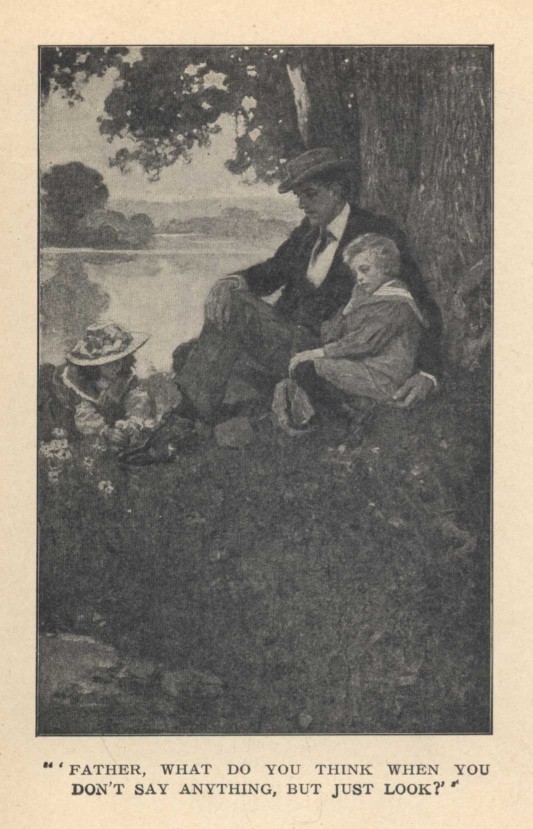
"'FATHER, WHAT DO YOU THINK WHEN YOU DON'T SAY ANYTHING, BUT JUST LOOK?'"
"When I just look?"
"Yes. Do you think what I do?"
"Well, what do you think?"
"Why, I think I'd like to be a big man like you and wear a long coat, and take my little boy and girl out walking. Did you think that, Father?"
"No. I was thinking how nice it would be just to be a little boy again like you and go out walking by the river with my father."
"Oh, Father, how funny! I wanted to be you and you wanted to be me. I guess people always want to be somebody else when they just look and don't say anything."
"What makes you think that, my boy?"
"Well, there's Grandmother. She sits by the window all day long and just looks and looks, and wishes she was an angel with Grandfather up in the sky."
"And Lizbeth?"
"Oh, Lizbeth wishes she was Mother."
"And how about Mother? Does she wish she were somebody else, do you think?"
"Oh no, Father, she doesn't, 'cause then she wouldn't have me and Lizbeth. Besides, she don't have time to just sit and look, Mother don't."
Your eyes were big and shining. Father just looked and looked a long time.
"And what do you think now, Father?"
"I was thinking of Mother waiting for you and Lizbeth and Father, and wondering why we don't come home."
And almost always after that, when you went out walking with Father, Sundays, Mother went with you. It seemed strange at first, but fine, to have her sit with you on the river-bank and just look and look and look, smiling but never saying a word; and though you asked her many times what she thought about as she sat there dreaming, she was never once caught wishing that she were anybody but her own self. She was happy, she told you; but while it was you she told, she would be looking at Father.
Oh, it was golden in the morning glow, when you were a little boy. But clouds skurried across the sky—black clouds, storm clouds—casting their chill and shadow for a while over all Our Yard, darkening Our House, so that a little boy playing on the hearth-rug left his toy soldier prostrate there to wander, wondering, from room to room.
"Mother, why doesn't Father play with us like he used to?"
"Mother, why do you sew and sew and sew all the time? Hm, Mother?"
All through the long evenings till bed-time came, and long afterwards, Father and Mother talked low together before the fire. The murmur of their voices downstairs was the last thing you heard before you fell asleep. It sounded like the brook in the meadow where the little green frogs lived, hopping through water-rings.
Of those secret conferences by the fire you could make nothing at all. Mother stopped you whenever you drew near.
"Run away, dear, and play."
You frowned and sidled off as far as the door, lingering wistfully.
"Father, the Jones boy made fun of me to-day. He called me Patchy-pants."
"Never mind what the Jones boy says," Mother broke in; but Father said, "He ought to have a new pair, Mother." You brightened at that.
"The Jones boy's got awful nice pants," you said; "all striped like a zebra."
Father smiled a little at that. Mother looked down at her sewing, saying never a word. That night you dreamed you had new pants, all spotted like a leopard, and you were proud, for every one knows that a leopard could whip a zebra, once he jumped upon his back.
Leaning on the garden fence, the Jones boy watched you as you sprinkled the geraniums with your little green watering-can.
"Where'd you get it?" he asked.
"Down at my father's store," you replied, loftily, for the Jones boy had no watering-can.
"Your father hasn't got a store any more."
"He has, too," you replied.
"He hasn't, either, 'cause my pa says he hasn't."
"I don't care what your pa says. My father has, too, got a store."
"He hasn't."
"He has."
"He hasn't, either."
"He has, teether."
"I say he hasn't."
"And I say he has," you screamed, and threw the watering-can straight at the Jones boy. It struck the fence and the water splashed all over him so that he retreated to the road. There in a rage he hurled stones at you.
"Your—father—hasn't—got—any— store—any—more—old—Patchy-pants— old—Patchy-pants—old—"
And then suddenly the Jones boy fled, and when you looked around there was Father standing behind you by the geraniums.
"Never mind what the Jones boy says," he told you, and he was not angry with you for throwing the watering-can. The little green spout of it was broken when you picked it up, but Father said he would buy you a new one.
"To-morrow, Father?"
"No, not to-morrow—some day."
You and Lizbeth, tumbling down-stairs to breakfast, found Father sitting before the fire.
"Father!" you cried, astonished, for it was not Sunday, and though you ran to him he did not hear you till you pounced upon him in his chair.
"Oh, Father," you said, joyfully, "are you going to stay home and play with us all day?"
"Fa-ther!" cried Lizbeth. "Will you play house with us?"
"Oh no, Father. Play store with us," you cried.
"Don't bother Father," Mother said, but Father just held you both in his arms and would not let you go.
"No—let them stay," he said, and Mother slipped away.
"Mother's got an awful cold," said Lizbeth. "Her eyes—"
"So has Father; only Father's cold is in his voice," you said.
You scarcely waited to eat your breakfast before you were back again to Father by the fire, telling him of the beautiful games just three could play. But while you were telling him the door-bell rang, and there were two men with books under their arms, come to see Father. They stayed with him all day long—you could hear them muttering in the library—and all day you looked wistfully at the closed door, lingering there lest Father should come out to play and find you gone.
He did not come out till dinner-time. After dinner he walked in the garden alone. He held a cigar in his clinched teeth.
"Why don't you smoke the cigar, Father?"
He did not hear you. He just walked up and down, up and down, with his eyes on the ground and his hands thrust hard into the pockets of his coat.
Mother watched him for a moment through the window. Then with her own hands she built a fire in the grate, for the night was chill. Before it she drew an easy-chair, and put Father's smoking-jacket on the back of it and set his slippers to warm against the fender. On a reading-table near by she laid the little blue china ash-tray you had given Father for Christmas, and beside it a box of matches ready for his hand. Then she called him in.
He came and sat there before the fire, saying nothing, but looking into the flames—looking, looking, till your mind ran back to a Sunday afternoon in summer by the river-side.
"I know what you are thinking, Father."
Slowly he turned his head to you, so that you knew he was listening though he did not speak.
"You're thinking how nice it would be, Father, if you were a little boy like me."
He made no answer. Mother came and sat on one of the arms of his chair, her cheek against his hair. Lizbeth undressed her dolls for the night, crooning a lullaby. One by one you dropped your marbles into their little box. Then you rose and sat like Mother on an arm of Father's chair. For a while you dreamed there, drowsy, in the glow.
"Mother," you said, softly.
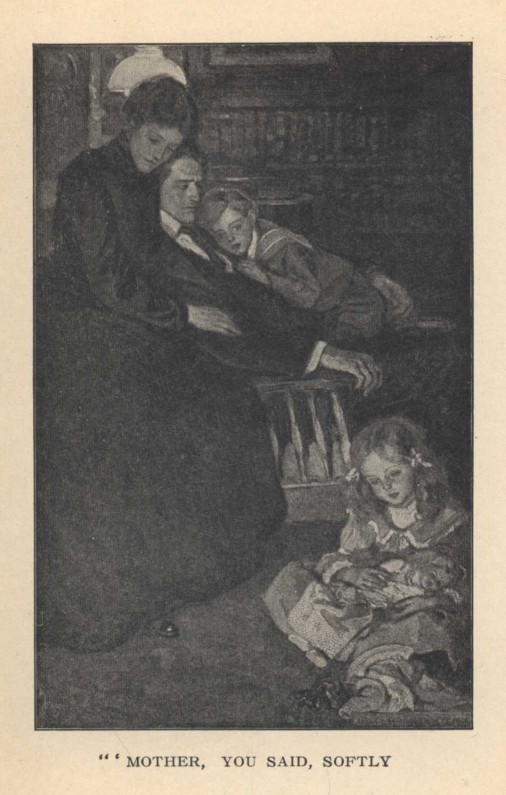
"'MOTHER, YOU SAID, SOFTLY'"
"Yes," she whispered back to you.
"Mother, isn't it fine?" you said.
"Fine, dearie?"
"Yes, Mother, everything ... 'specially—"
"Yes, sweetheart?"
"—'specially just having Father."
Father gave a little jump; seized you; crushed you in his arms, stars shining in his brimming eyes.
"Little chap—little chap," he cried, but could get no further, till by-and-by—
"Mother," he said—and his voice was clear and strong—"Mother, with a little chap like that and two girls like you and Lizbeth—"
His voice caught, but he shook it free again.
"—any man could begin—all over again—and win," he said.
Mother
," you said.
"And what's that?"
"B."
"And that?"
You sat on Mother's lap. The wolf-wind howled at the door, and you shuddered, cuddling down in Mother's arms and the glow. The wilder the wolf-wind howled, the softer was the lamp-light, the redder were the apples on the table, the warmer was the fire.
On your knees lay the picture-book with its sad, sad little tale. Mother read it to you—she had read it fifty times before—her face grave, her voice low and tragic, while you listened with bated breath:
"Who killed Cock Robin?
'I,' said the Sparrow,
'With my bow and arrow—
I killed Cock Robin.'"
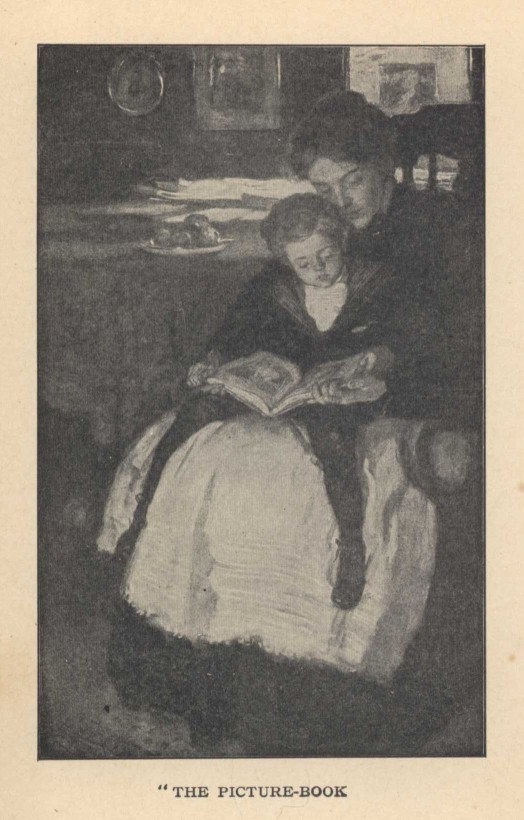
"THE PICTURE-BOOK"
It was the first murder you had ever heard about. You saw it all, the hideous spectacle—a beautiful, warm, red breast pierced by that fatal dart—a poor, soft little birdie, dead, by an assassin's hand. A lump rose in your throat. A tear rose in your eye—two tears, three tears. They rolled down your cheek. They dropped, hot and sad, on the fish with his little dish, on the owl with his spade and trowel, on the rook with his little book.
"P-poor Cock R-robin!"
"There, there, dear. Don't cry."
"But, M-mother—the Sparrow—he k-killed him."
Alas, yes! The Sparrow had killed him, for the book said so, but had you heard?
"N-no, w-what?"
The book, it seems, like other books, had told but half the story. Mother knew the other half. Cock Robin was murdered, murdered in cold blood, it was true, but—O merciful, death-winged arrow!—he had gone where the good birds go. And there—O joy!—he had met his robin wife and his little robin boy, who had gone before.
"And I expect they are all there now, dear," she told you, kissing your tear-stained cheek, "the happiest robins that ever were."
Dry and wide were your eyes. In the place where the good birds go, you saw Cock Robin. His eyes and his fat, red breast were bright again. He chirped. He sang. He hopped from bough to bough, with his robin wife and his little robin boy. For in the mending of little stories or the mending of little hearts, like the mending of little stockings, Mother was wonderful.
In those times there were knees to your stockings, knees with holes in them at the end of the day, with the soiled skin showing through.
"Just look!" Mother would cry. "Just look there! And I'd only just mended them."
"Well, you see, Mother, when you play Black Bear—"
"I see," she said, and before you went to bed you would be sitting on the edge of a tub, paddling your feet in the water.
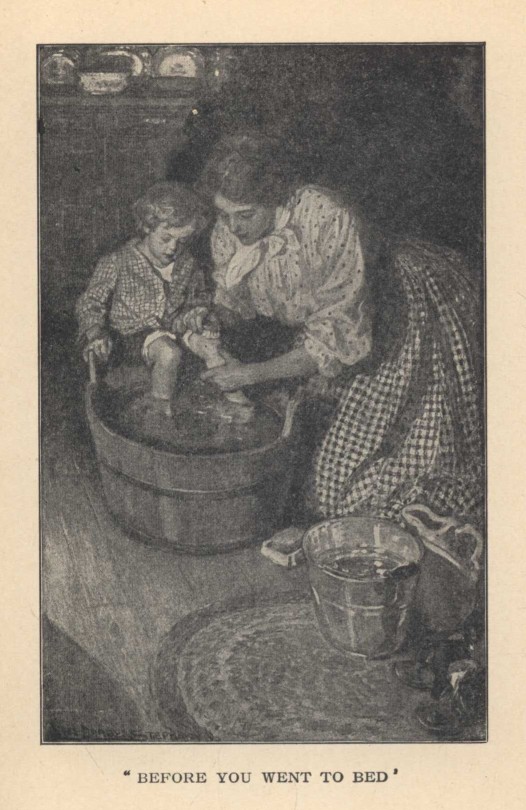
"BEFORE YOU WENT TO BED"
"You dirty boy," she would be saying, scrubbing at the scratched, black knees; but when you were shining again she would be saying—
"You darling!"
And though your stockings were whole in the clean of morning when you scampered out into the sun, in the dirt of night when you scampered back again—O skein, where is thy yarn? O darning-needle, where is thy victory?
Summer mornings, in the arbor-seat of the garden, Mother would be sewing, her lap brimming, her work-basket at her feet, the sun falling golden through the trellised green. In the nap of the afternoon, when even the birds drowsed and the winds slept, she would be sewing, ever sewing. And when night fell and the dishes were put away, she would be sewing still, in the lamp-light's yellow glow.
"Mother, why do you sew and sew?"
"To make my little boy blue sailor suits and my little girl white frocks, and to stop the holes."
"Do you like to sew, Mother?"
"I don't mind it."
"But doesn't it make you tired, Mother?"
"Oh, now and then."
"But I should think you'd rest sometimes, Mother."
"Should you, dear?"
"Yes, I would. Oh, I'd sew a little—just enough—and then I'd play."
"But Mother does sew just enough, and it takes all day, my dear. What do you say to that?"
You pondered.
"Well," you said, and stopped.
"Well?" she said, and laughed. Then you laughed, too.
"A mother," you told them afterwards, "is a person what takes care of you, and loves you, and sews and sews—just enough—all day."
Since mothers take care of little boys, they told you, little boys should take care of their mothers, too. So right in front of her you stood, bravely, your fists clinched, your lips trembling, your eyes flashing with rage and tears.
"You sha'n't touch my mother!"
But Mother's arms stole swiftly around you, pinning your own to your side.
"Father was only fooling, dear," she said, kneeling behind you and folding you to her breast. "See, he's laughing at us."
"Why, little chap," he said, "Father was only playing."
Mother wiped away your tears, smiling at them, but proudly. You looked doubtfully at Father, who held out his arms to you; then slowly you went to him, urged by Mother's hand.
"You must always take care of Mother like that," he said, "and never let any one hurt her, or bother her, when Father's away."
"Mother's little knight," she said, kissing your brow. And ever afterwards she was safe when you were near.
"Oh, that Mrs. Waddles. I wish she wouldn't bother me."
Under her breath Mother said it, but you heard, and you hated Mrs. Waddles with all your soul, and her day of reckoning came. Mother was in the garden and did not hear. You answered the knock yourself.
"Little darling, how—"
"You can't see my mother to-day," you said, stiffly.
"That's very strange," said Mrs. Waddles, with a forward step.
"No," you said, a little louder, throwing yourself into the breach and holding the door-knob with all your might. "No! You mustn't come in!"
"You impertinent little child!" cried Mrs. Waddles, threateningly, but you faced her down, raising your voice again:
"You can't see my mother any more," you repeated, firmly.
"And why not, I'd like to know?" demanded the old lady, swelling visibly. "Why not, I'd like to know?"
"'Cause I'm to take care of my mother when my father's away, and he said not to let anybody bother her that she don't want to see."
It was a long explanation and took all your breath.
"Oh, is that it?" cackled Mrs. Waddles, with withering scorn. "And how do you know that your mother doesn't want to see me—hey?"
"'Cause—she—said—so!"
You separated your words like the ABC book, that Mrs. Waddles might understand. It was a master-stroke. Gasping, her face on fire, gathering her skirts together with hands that trembled in their black silk mitts, Mrs. Waddles turned and swept away.
"I never!" she managed to utter as she slammed the gate.
You shut the door softly, the battle won, and went back to the garden.
"Well, that's over," you said, with a sigh, as Mother herself would have said it.
"What's over, dear?"
"Mrs. Waddles," you replied.
So you took care of Mother so well that she loved you more and more as the days of your knighthood passed; and she took care of you so well that your cheeks grew rosier and your eyes brighter and your legs stronger, and you loved her more and more with the days of her motherhood.
Even being sick was fine in those days, for she brought you little things in bowls with big spoons in them, and you ate till you wanted more—a sign that you would not die. And so you lay in the soft of the pillows, with the patchwork coverlet that Mother made with her own hands. There was the white silk triangle from her wedding-gown, and a blue one from a sash that was her Sunday best, long ago, when she was a little girl. There was a soft-gray piece from a dress of Grandmother's, and a bright-pink one that was once Lizbeth's, and a striped one, blue and yellow, that was once Father's necktie in the gay plumage of his youth.
As you lay there, sick and drowsy, the bridal triangle turned to snow, cold and white and pure, and you heard sleighbells and saw the Christmas cards with the little church in the corner, its steeple icy, but its windows warm and red with the Christmas glow. That was the white triangle. But the blue one, next, was sky, and when you saw it you thought of birds and stars and May; and if it so happened that your eyes turned to the gray piece that was Grandmother's, and the sky that was blue darkened and the rain fell, you had only to look at the pink piece that was Lizbeth's, or the blue and yellow that was Father's, to find the flowers and the sun again. Then the colors blended. Dandelions jingled, sleigh-bells and violets blossomed in the snow, and you slept—the sleep that makes little boys well.
The bees and the wind were humming in the cherry-trees, for it was May. You were all alone, you and Mother, in the garden, where the white petals were falling, silently, like snow-flakes, and the birds were singing in the morning glow.
Your feet scampered down the paths. Your curls bobbed among the budding shrubs and vines. You leaped. You laughed. You sang. In your wide eyes blue of the great sky, green of the grasses. On your flushed cheeks sunshine and breeze. In your beating heart childhood and spring—a childhood too big, a spring too wonderful, for the smallness of one little, brimming boy.
"Look, Mother! See me jump."
"My!" she said.
"And see me almost stand on my head."
"Wonderful!"
"I know what I'll be when I grow to be a man, Mother."
"What will you be?"
"A circus-rider."
"Gracious!" said she.
"On a big, white horse, Mother."
"Dear me!"
"And we'll jump 'way over the moon, Mother."
"The moon?"
"Yes, the moon. See!"
Then you jumped over the rake-handle. You were practising for the moon, you said.
"But maybe I won't be a circus-rider, Mother, after all."
"Maybe not," said she.
"Maybe I'll be President, like George Washington. Father said I could. Could I, Mother?"
"Yes—you might—some day."
"But the Jones boy couldn't, Mother."
"Why couldn't the Jones boy?"
"Because he swears and tells lies. I don't. And George Washington didn't, Mother. I guess I won't be a circus-rider, after all."
"Oh, I'm glad of that, dear."
"No, I guess I'll keep right on, Mother—as long as I've started—and just be President."
"Oh, that will be fine," said she. She was sewing in the arbor, her lap filled with linen, her work-basket at her feet.
"Mother."
"Yes."
"I think I'd like to sing a song now."
Straight and proper you stood in the little path, your heels together, your hands at your side, and so you sang to her the song of the little duck:
"'Quack, quack,' said the Duck,
'Quack, quack.'
'Quack, quack,' said—"
You stopped.
"Try it a little lower, dear."
"'Quack, quack,' said—"
"No, that's too low," you said. You tried again and started right that time and sang it through, the song of the little duck who
"'... wouldn't be a girl,
With only a curl,
I wouldn't be a girl, would you?'"
"Oh, it's beautiful," Mother said.
"Now it's your turn, Mother, to tell a story."
"A story?"
"Yes. About the violets."
"The violets?" she said, poising her needle, musingly. "The blue, blue violets—"
"As blue as the sky, Mother," you said, softly, for it is always in the hush of the garden that the stories grow.
"As blue as the sky," she said. "Ah, yes. Well, once there wasn't a violet in the whole world."
"Nor a single star," you said, awesomely, helping her. And as you sat there listening the world grew wider and wider—for when you are a little boy the world is always just as wide as your eyes.
"Not a violet or a single star in the whole world," Mother went on. "And what do you think? They just took little bits of the blue sky and sprinkled them all over the green world, and they were the first violets."
"And the stars, Mother?"
"Why, don't you see? The stars are the little holes they left in the blue sky, with the light of heaven shining through."
"Oh!" you said, softly. "Oh, Mother!"
And then, in the hush of the garden, you looked at her, and lo! her eyes were blue like the violets, and bright like the stars, for the light of heaven was shining through.
She was the most wonderful person in the whole world—who never did anything wrong, who knew everything, even who God was, watching, night and day, over little boys. Even the hairs of your head were numbered, she told you, and not a little bird died but He knew.
"And did He know when Cock Robin died, Mother?"
"Yes. He knew."
"And when I hurt my finger, Mother? Did He know then?"
"Yes, He knows everything."
"And was He sorry, Mother, when I hurt my finger?"
"Very sorry, dear."
"Then why did He let me hurt my finger—why?"
For a moment she did not speak.
"Dearie," she said at last, "I don't know. There are many things that nobody knows but God."
Hushed and wondering you sat in Mother's lap, for His eye was upon you. Somewhere up in the sky, above the clouds, you knew He was sitting, on a great, bright throne, with a gold crown upon His head and a sceptre in His hand—King of Kings and Lord of All. Down below Him on the green earth little birds were falling, little boys were hurting their fingers and crying in their Mothers' arms, and He saw them all, every one, little birds and little boys, but did not help them. You crept closer to Mother's bosom, flinging your arms about her neck.
"Don't let Him get me, Mother!"
"Why, darling, He loves you."
"Oh no, Mother—not like you do; not like you."
The bees and the wind were in the apple trees, for it was May. You were all alone, you and Mother, in the garden, where the white petals were falling, like snowflakes, silently. In the swing Grandfather built for you, you sat swaying, to and fro, in the shadows; and the shadows swayed, to and fro, in the gale; and to and fro your thoughts swayed in your dreaming.
The wind sang in the apple-boughs, the flowering branches filled and bent, and all about you were the tossing, shimmering grasses, and all above you birds singing and flitting in the sky. And so you swayed, to and fro, till you were a sailor, in a blue suit, sailing the blue sea.
The wind sang in the rigging. The white sails filled and bent. Your ship scudded through the tossing, shimmering foam. Gulls screamed and circled in the sky, ... and so you sailed and sailed with the sea-breeze in your curls...
The ship anchored.
The swing stopped.
You were only a little boy.
"Mother," you said, softly, for your voice was drowsy with your dream.
She did not hear you. She sat there in the arbor-seat, smiling at you, her hands idle, her sewing slipping from her knees. You did not know it then, but you do now—that to see the most beautiful woman in the whole world you must be her little boy.
There in her garden, in her lap, with her arms around you and her cheeks between your hands, you gazed, wondering, into the blue fondness of her eyes. You saw her lips, forever smiling at you, forever seeking your own. You heard her voice, sweet with love-words—
"My dearest."
"Yes."
"My darling."
"Yes."
"My own dear little boy."
And then her arms crushing you to her breast; and then her lips; and then her voice again—
"Once in this very garden, in this very seat, Mother sat dreaming of you."
"Of me, Mother?"
"Of you. Here in the garden, with that very bush there red with blossoms, and the birds singing in these very trees. She dreamed that you were a little baby—a little baby, warm and soft in her arms—and while the wind sang to the flowers Mother sang you a lullaby, and you stretched out your hands to her and smiled; and then—ah, darling!"
"But it was a dream, Mother."
"It was only a dream—yes—but it came true. It came true on a night in June—the First of June, it was—"
"My birthday, Mother!"
"Your birthday, dear."
"Oh, Mother," you said, breathlessly—"what a beautiful dream!"
THE END
* * * * * * * *
A FEW OF GROSSET & DUNLAP'S Great Books at Little Prices
NEW, CLEVER, ENTERTAINING.
GRET: The Story of a Pagan. By Beatrice Mantle. Illustrated by C. M. Relyea.
The wild free life of an Oregon lumber camp furnishes the setting for this strong original story. Gret is the daughter of the camp and is utterly content with the wild life—until love comes. A fine book, unmarred by convention.
OLD CHESTER TALES. By Margaret Deland. Illustrated by Howard Pyle.
A vivid yet delicate portrayal of characters in an old New England town.
Dr. Lavendar's fine, kindly wisdom is brought to bear upon the lives of all, permeating the whole volume like the pungent odor of pine, healthful and life giving. "Old Chester Tales" will surely be among the books that abide.
THE MEMOIRS OF A BABY. By Josephine Daskam. Illustrated by F. Y. Cory.
The dawning intelligence of the baby was grappled with by its great aunt, an elderly maiden, whose book knowledge of babies was something at which even the infant himself winked. A delicious bit of humor.
REBECCA MARY. By Annie Hamilton Donnell. Illustrated by Elizabeth Shippen Green.
The heart tragedies of this little girl with no one near to share them, are told with a delicate art, a keen appreciation of the needs of the childish heart and a humorous knowledge of the workings of the childish mind.
THE FLY ON THE WHEEL. By Katherine Cecil Thurston. Frontispiece by Harrison Fisher.
An Irish story of real power, perfect in development and showing a true conception of the spirited Hibernian character as displayed in the tragic as well as the tender phases of life.
THE MAN FROM BRODNEY'S. By George Barr McCutcheon. Illustrated by Harrison Fisher.
An island in the South Sea is the setting for this entertaining tale, and an all-conquering hero and a beautiful princess figure in a most complicated plot. One of Mr. McCutcheon's best books.
TOLD BY UNCLE REMUS. By Joel Chandler Harris. Illustrated by A. B. Frost, J. M. Conde and Frank Verbeck.
Again Uncle Remus enters the fields of childhood, and leads another little boy to that non-locatable land called "Brer Rabbit's Laughing Place," and again the quaint animals spring into active life and play their parts, for the edification of a small but appreciative audience.
THE CLIMBER. By E. F. Benson. With frontispiece.
An unsparing analysis of an ambitious woman's soul—a woman who believed that in social supremacy she would find happiness, and who finds instead the utter despair of one who has chosen the things that pass away.
LYNCH'S DAUGHTER. By Leonard Merrick. Illustrated by Geo. Brehm.
A story of to-day, telling how a rich girl acquires ideals of beautiful and simple living, and of men and love, quite apart from the teachings of her father, "Old Man Lynch" of Wall St. True to life, clever in treatment.
GROSSET & DUNLAP'S DRAMATIZED NOVELS
A Few that are Making Theatrical History
MARY JANE'S PA. By Norman Way. Illustrated with scenes from the play.
Delightful, irresponsible "Mary Jane's Pa" awakes one morning to find himself famous, and, genius being ill adapted to domestic joys, he wanders from home to work out his own unique destiny. One of the most humorous bits of recent fiction.
CHERUB DEVINE. By Sewell Ford.
"Cherub," a good hearted but not over refined young man is brought in touch with the aristocracy. Of sprightly wit, he is sometimes a merciless analyst, but he proves in the end that manhood counts for more than ancient lineage by winning the love of the fairest girl in the flock.
A WOMAN'S WAY. By Charles Somerville. Illustrated with scenes from the play.
A story in which a woman's wit and self-sacrificing love save her husband from the toils of an adventuress, and change an apparently tragic situation into one of delicious comedy.
THE CLIMAX. By George C. Jenks.
With ambition luring her on, a young choir soprano leaves the little village where she was born and the limited audience of St. Jude's to train for the opera in New York. She leaves love behind her and meets love more ardent but not more sincere in her new environment. How she works, how she studies, how she suffers, are vividly portrayed.
A FOOL THERE WAS. By Porter Emerson Browne. Illustrated by Edmund Magrath and W. W. Fawcett.
A relentless portrayal of the career of a man who comes under the influence of a beautiful but evil woman; how she lures him on and on, how he struggles, falls and rises, only to fall again into her net, make a story of unflinching realism.
THE SQUAW MAN. By Julie Opp Faversham and Edwin Milton Royle. Illustrated with scenes from the play.
A glowing story, rapid in action, bright in dialogue with a fine courageous hero and a beautiful English heroine.
THE GIRL IN WAITING. By Archibald Eyre. Illustrated with scenes from the play.
A droll little comedy of misunderstandings, told with a light touch, a venturesome spirit and an eye for human oddities.
THE SCARLET PIMPERNEL. By Baroness Orczy. Illustrated with scenes from the play.
A realistic story of the days of the French Revolution, abounding in dramatic incident, with a young English soldier of fortune, daring, mysterious as the hero.
TITLES SELECTED FROM GROSSET & DUNLAP'S LIST
REALISTIC, ENGAGING PICTURES OF LIFE
THE GARDEN OF FATE. By Roy Norton. Illustrated by Joseph Clement Coll.
The colorful romance of an American girl in Morocco, and of a beautiful garden, whose beauty and traditions of strange subtle happenings were closed to the world by a Sultan's seal.
THE MAN HIGHER UP. By Henry Russell Miller. Full page vignette illustrations by M. Leone Bracker.
The story of a tenement waif who rose by his own ingenuity to the office of mayor of his native city. His experiences while "climbing," make a most interesting example of the possibilities of human nature to rise above circumstances.
THE KEY TO YESTERDAY. By Charles Neville Buck. Illustrated by R. Schabelitz.
Robert Saxon, a prominent artist, has an accident, while in Paris, which obliterates his memory, and the only clue he has to his former life is a rusty key. What door in Paris will it unlock? He must know that before he woos the girl he loves.
THE DANGER TRAIL. By James Oliver Curwood. Illustrated by Charles Livingston Bull.
The danger trail is over the snow-smothered North. A young Chicago engineer, who is building a road through the Hudson Bay region, is involved in mystery, and is led into ambush by a young woman.
THE GAY LORD WARING. By Houghton Townley. Illustrated by Will Grefe.
A story of the smart hunting set in England. A gay young lord wins in love against his selfish and cowardly brother and apparently against fate itself.
BY INHERITANCE. By Octave Thanet. Illustrated by Thomas Fogarty. Elaborate wrapper in colors.
A wealthy New England spinster with the most elaborate plans for the education of the negro goes to visit her nephew in Arkansas, where she learns the needs of the colored race first hand and begins to lose her theories.
KATE DOUGLAS WIGGINS STORIES OF PURE DELIGHT
Full of originality and humor, kindliness and cheer
THE OLD PEABODY PEW. Large Octavo. Decorative text pages, printed in two colors. Illustrations by Alice Barber Stephens.
One of the prettiest romances that has ever come from this author's pen is made to bloom on Christmas Eve in the sweet freshness of an old New England meeting house.
PENELOPE'S PROGRESS. Attractive cover design in colors.
Scotland is the background for the merry doings of three very clever and original American girls. Their adventures in adjusting themselves to the Scot and his land are full of humor.
PENELOPE'S IRISH EXPERIENCES. Uniform in style with "Penelope's Progress."
The trio of clever girls who rambled over Scotland cross the border to the Emerald Isle, and again they sharpen their wits against new conditions, and revel in the land of laughter and wit.
REBECCA OF SUNNYBROOK FARM.
One of the most beautiful studies of childhood—Rebecca's artistic, unusual and quaintly charming qualities stand cut midst a circle of austere New Englanders. The stage version is making a phenomenal dramatic record.
NEW CHRONICLES OF REBECCA. With illustrations by F. C. Yohn.
Some more quaintly amusing chronicles that carry Rebecca through various stages to her eighteenth birthday.
ROSE O' THE RIVER. With illustrations by George Wright.
The simple story of Rose, a country girl and Stephen a sturdy young farmer. The girl's fancy for a city man interrupts their love and merges the story into an emotional strain where the reader follows the events with rapt attention.
GROSSET & DUNLAP, 526 WEST 26th ST., NEW YORK