Chapter XII · SOLDIERS SAVAGE AND CIVILIZED—LÉGIONNAIRES AND SPAHIS
Reading edition
ALGERIA is guarded by an army of 60,000 men. But they keep the peace only, for there is no warfare in Algeria or Tunisia to-day. In the days of the Roman legions less than half that number of men fought for and held all North Africa. France recognizes that the development of a new country depends more upon the military than all else. The Spahis, the Chasseurs d’Afrique, and the Légionnaires have won most of France’s battles in Algeria; and for this reason these great colonial corps are given a high place in the military establishment.
When they have fought they have fought well, and when they have died they have died gloriously. The last “little affair” was in 1903, when a hundred Spahis and horsemen of the Legion were attacked at El-Moungar, near the Moroccan frontier. They fought like lions until reinforcements arrived, and but thirty odd remained alive. Among the Légionnaires who died were a Spanish captain and a German lieutenant, for the Légion Étrangère demands nothing of any who would enlist in its ranks but his name and an affirmative to the question—“Will you fight?” The survivors of this engagement all received the Médaille Coloniale and the Saharan Clasp.
Now a more important move in the military game is being played across the frontier in Morocco itself, and 12,000 of Algeria’s native soldiery is cast for the chief rôle. The soldiers of the Foreign Legion are of all nationalities under the sun. Some of them are scoundrels, no doubt, or were until military discipline made them brace up, but others are as refined as the gentleman and officer of convention.
We met many Italians, Swiss, Germans, and Irishmen, and the Germans were not Alsatians, either, but real Platt-deutsch, from Bremen. In more than one instance they had been drummed out of their own regiment for some disgrace and enlisted anew in France’s Légion Étrangère that they might begin life over again. The real soldier of fortune exists nowhere in so large a proportion as in this corps.
Certain of the French troops in Africa are not usually the flower of the army, often they are disciplinaires sent out from home. At any rate when you see one of them robbing a poor peanut merchant who solicited him to buy dis nois poeur uné sous, you are quite ready to believe he needs disciplining. The Arab under such circumstances gives the tou-tou a tongue-lashing, which for invective could hardly be equalled: “Infamous belly of a snake,” “Canaille,” “Sale yondi, where is your politeness,” “Ouf, I’ll ram another handful down your camel throat and charge you nothing, either—salop de cochon!” The Arab is fast becoming Frenchified, as the above will indicate.
The next minute the seller of cacaoettes—which is a prettier name for peanuts than we have—turns to you calmly and says humbly: “Pardon, Sidi, will you buy some nuts?” And you buy them, ten sous worth, which is enough money in hand to keep him for twenty-four hours, just because he is so good an actor.
The sixty odd thousand regular soldiery in Algeria are virtually military police and civil engineers. The Arab-Berber population are no more likely to revolt, though they did it successfully enough in 1871, when France thought she had them subdued; and so, as a sort of police precaution, France keeps a very active army on the spot. If a nation possesses a vast territory, it must be policed somehow, and this is the French idea of doing it, for in the above number are counted the gendarmerie or national police.
One romantic character stands out plainly in the history of Algeria in these later years, and that is Yusuf, the name of the ideal native soldier who was a prodigious figure of the early nineteenth century. His personality was most strange. Bearer of an Arab name, he was the personification of a chivalrous military heroism consecrated to a country not his own; and France, contrary to her usual procedure, has seemingly neglected his fame and that of his descendants.
It was to Yusuf, in effect, that was due the security of the environs of Algiers from the conquest of 1833 to the extinction of the revolt of 1871. From the first landing of General Bourmont, the deliverer of Algeria, Yusuf was employed in every possible capacity; and the ancient slave of the Turkish ruler and the favourite of the Bey of Tunis became the symbol of law and progress. His sabre was henceforth to be used for Christianity, and not on behalf of paganism and rapine. Yusuf at the head of his Spahis is a noble and imposing figure of the African portrait gallery. He is almost invariably young, splendid of form and fastidious and luxurious in his dress; a superb romantic dream of the Orient, but adaptable and capable of absorbing European ideas.
Authors, artists, and princes have attempted to idealize Yusuf, but the task was futile. Louis-Philippe, Louis Bonaparte, Alexandre Dumas, Gautier, Horace Vernet, Delacroix, and Bugeaud have sung his praises afar; but he remains to-day the unspoiled, faithful servant of a government and faith as foreign to his own as the red Indian is to the Parisian.
Homage! Frenchmen and Algerians, and all others who know and love the land which smiles so bravely under the African sun, to Yusuf the warrior, the diplomat, and chien fidèle!
The Spahis, or native soldiery, made up from the Yusufs of all Algeria, are in great repute with their European officers, whatever the bureaucrats of the Boulevard Saint Germain may think. To the former he has:
“La main toujours ouverte, Le sabre toujours tiré, Une seule parole,”
and he is obedient to his superiors. This is a good formula upon which to mould a soldier.
The Spahis and Turcos of Algeria fought for France, too, on the mainland, in that unhappy and unnecessary “woman’s war” with Germany in 1871. The Germans protested against the employment of these “savages;” but the precept was England’s when she enlisted the red man against the North American colonist in 1776, and then, too, she hired Hessians for the job (who were Germans) and according to the traditionary tales concerning those mercenaries, they came about as near being “savages” as anything which ever walked on two feet.
The “Chanson du Spahi” is a classic in the land. It recounts in dulcet French phrase the whole life of one of these noble native soldiery enlisted in the ranks of the French army organization.
It is a veritable Odyssey, commencing with:—
“J’é’tais jeune, le cadet dans la tente de mon père. Le cadet de ses fils beaux comme des lions,”
and ending with:—
“Qui pleurera sur la tombe du soldat orphelin.”
The Spahi’s costume is fearfully and wonderfully made. It is gorgeous beyond that of

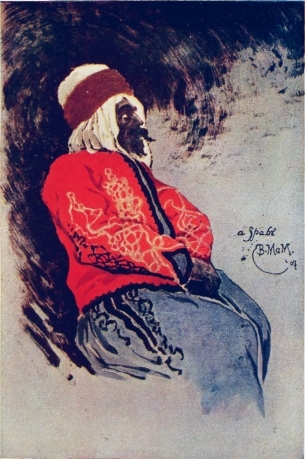
A Capitan of Spahi
any other soldiery; and yet it is most suitable for campaigning after the Spahi fashion. The waving burnous, the haïk, the broidered vest, the turban wound with camel’s-hair, red boots, and much gold braid make the Spahi dazzling to behold.
When it comes to the accoutrements of his horse the same thing is true. His saddle is a veritable seat, not a mere pad, and weighs ten times as much as a European saddle, his stirrups alone weighing as much. Instead of a single blanket, the Spahi trooper has a half a dozen variegated saddle-cloths, very spectacular, if not useful.
The barracks of the native soldiers in Algeria are bare, but with European fitments of iron bedsteads, etc. The religion of the Mussulman does not demand, nor indeed permit pictures or images of his God; and so, any substitute for the ikons of the Russian, and the crucifixes of the French soldier are absent.
In Algeria, besides the Spahis and the tirailleurs, each so picturesque whenever grouped with the North African landscape, there is a special field force of men from the south, pure Arab types, men of the desert, and scouts of the very first rank. All these military types are what is defined as native voluntary soldiery, the indigène not being subject to military conscription. Perhaps they are the better soldiers for this, since they adopt it voluntarily as a profession, but a discussion of the subject is not one of sufficient moment to take space here.
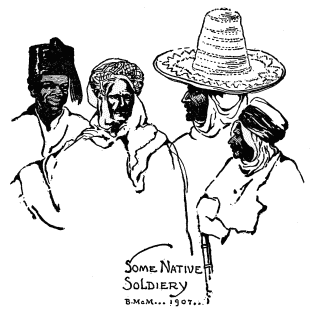
Each tribe of the south—whose civil administration, be it recalled, is in the hands of the native Sheik and the Cadi—is bound to furnish, at the need of the French government, whether for service within the limits of Algeria or out of it, a group of a certain proportionate size of able-bodied fighting men. These voluntary fighters of the open country, known as goums, are versed in many of the wiles of warfare of which the garrison-trained soldier is ignorant; and, upon a simple requisition, the chief of a tribe is bound to furnish his quota of these plainsmen. It is a duty owed to the French government for the protection and lawful status which it gives each individual tribe and its members; and this soldiery is not only voluntary, but serves, without salary, drawing only munitions of war and nourishment from the public war-chest, and furnishing even its own horses and guns.
The goum is a picturesque and original type of soldier. He rides a stocky Arabian horse, gaily caparisoned with a gaudy parti-coloured harness and saddle-cloth, and sits in a high-backed saddle, as if on a throne. His costume is fascinating, if crude, in the flowing lines of his burnous, his boots of bright red or yellow leather, and his great high-crowned straw hat, like no other form of head-gear on earth except the Mexican’s sombrero. He is proud of his occupation, and would rather fight than eat, at least one judges that this is the case in that he fights for France without pay.
The goums are a sort of savage soldiery, if you like to think of them as such, but they are not guerillas. Their efficacy in various little wars has been tried and tried again; and, recently, in Morocco, the first successful raids into the open country of the fanatical Moroccans were only made possible by the lances of a column of goums which only the day before had landed at Casablanca from the steamer from Oran. Regular soldiery has to get acclimated when fighting in a new and untried country, but the goum of the Sud-Algerien got down to business immediately in Morocco and gave the French a firm grasp on things, whilst the regular troops, also imported from the plains of Algeria, were getting used to the mountains, and the garrison troops of Tizi-Ouzou were trying to adapt themselves to the mode of life necessary for good health in a seaport town. The ways of most War Departments in moving troops about from one strategic point to another have ever been erratic, and that of the French is no exception. The goum of Algeria saved the day for France in Algeria, and perhaps by the time these lines are printed will
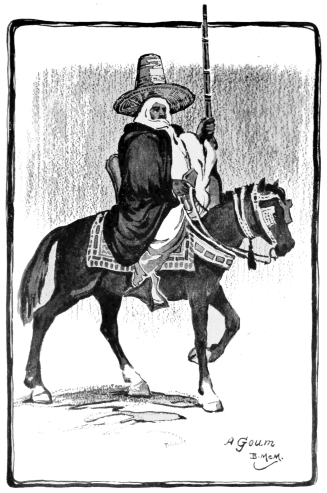
A Goum
have added another gem to the colonial diadem of France. If not so soon, why later on.
There is a current story in military circles in Algeria concerning the gift of an Arab chief to a French general commanding a division. It was not gold or jewels or goods of any kind, but a simple, secret admonition: “Never trust an Arab—not even me.” With variations this may be true enough, but the average traveller among these now loyal French citizens will have no cause to regret any little confidences he may commit to a friendly Arab or Berber; though, of the two, the latter being certainly the more faithful.
The railway, the telegraph, and the military have developed Algeria to what it is to-day. The Arab originally did not love the French, indeed he had no cause to, for they came and overran his country and put down abuses which he did not wish to have put down; but he has become philosophical, and has recognized that the iron horse forms a better means of transport than his mules and camels for the stuffs and goods of his trade and barter. He is commercial enough to want to do more business and make more money, so he tolerates the French; and, since his first experiences with the new order of things, he has prospered beyond his wildest dreams. That has civilized and subdued the Arab in French Africa. It would subdue any savage.
The fantasia is the classic diversion and showing-off pace of Algeria’s Spahi cavalry. No great function, local or otherwise, is complete without a fantasia, and here the Spahi is at his uncontrolled best. He rides dashingly around the field of the manœuvres, slashing with his sword at a leathern dummy of a man or a wooden ball on the top of a post, or with his stocky carbine shoots from the saddle, leaps hurdles, or throws his firearm high in the air and catches it again on its fall. All the time his charger is rushing about wildly and without method. The whole is a veritable military orgie of target-shooting, steeplechasing, marching and countermarching, and all with as picturesque a personnel and costuming as a circus.
It is mimic savage warfare uncontrolled, and far more real and warlike than the goose-step evolutions of European armies. The fantasia is a spontaneous, every-man-on-his-own sort of an affair. The smell of gunpowder is in the air, and no Wild West or Cossack horseman ever gave half so vivid an example of agility as does a Spahi or a goum on his African jour de fête.