XV THE EVE OF ST. JOHN
Reading edition
WHILE the caravan halted, all in consternation over the loss of Pilarica, that glad-hearted little maiden was, as ever, on the best of terms with life. To be sure, the nooning had not been quite as pleasant as usual. Though the morning route had led past fields softly golden with the early summer harvest, where reapers in wide hats were wielding shining sickles, the travellers had found themselves by midday on a parched upland, neither shade nor water to be had. After their frugal luncheon of bread and cheese, flavored with onions for the muleteers and with figs for the children, everybody but Pilarica had gone to sleep in such scanty shelter from the sun as the pack-mules afforded. Pilarica had loyally stayed by Don Quixote, who, though his sides were now well rounded out, cast hardly a larger scrap of shadow than the birds of prey hovering in the burning blue, so that the child, too hot to fall asleep, had taken her doll and strolled a little away from the train. Suddenly she saw stretched out at her feet a shabby cloak, propped up a trifle by dry stalks and broken bits of brush, the brown of the cloak so like the brown of the earth that it would hardly be noticed three yards off. Under this homely tent was—of all wonders!—a baby, a really truly baby wrapped in a little white kid-skin, a baby who blinked his black eyes and gurgled drowsily as Pilarica and her doll cuddled down beside him. And there they all three slept so soundly that the bustle attendant on getting the train under way did not rouse them, while Grandfather, supposing that Pilarica was riding with her uncle on Coronela or had been tossed up by one of the muleteers to a pack-throne, himself untied the rope that bound Don Quixote’s forelegs together and chirruped to the donkey to follow Carbonera.
When Pilarica, so exhausted by the heat that her siesta lasted twice as long as usual, finally awoke, a strange, wild-looking figure was squatted close by,—a figure so tanned from the mat of shaggy hair to the naked arms and legs that it looked as if it were only a queer shape of the sunburnt soil. Pilarica, fearlessly creeping out from under the cloak and sitting upright, saw at some distance beyond this unkempt watcher a flock of goats.
The goatherd was devouring a piece of black bread which he dipped, between bites, into a cow’s-horn half full of olive oil. He jumped back as the little girl appeared and stared at her with stupid, frightened eyes.
“Good-day, sir,” said Pilarica, who knew no reason why one should not be as polite to a goatherd as to a grandee.
Scared peasant though he was, he had Castilian manners.
“Will your Grace eat?” he stammered, offering his humble fare.
Pilarica declined with a courteous gesture of her little hand, now almost as brown as his own, and the customary Spanish phrase:
“May it do you good!”
He started again at the sound of her voice, but gulped down the rest of his bread, corked the cow’s-horn, thrust it into his rough leather wallet and then went to his flock, soon returning with warm milk in a bottle. Not daring, apparently, to reach across Pilarica, he pointed to the baby.
“Oh, may I!” exclaimed the little girl in ecstasy and, gathering that kid-skin bundle into her lap, she administered the milk as best she could, singing meanwhile, over and over, one of Grandfather’s lullabies:
“Recotín, recotón! The bells of Saint John! There’s a festival on! Recotín, recotín, recotón!”
The goatherd, to whom Pilarica’s sweet treble had an unearthly sound, crossed himself and backed still further away.
“What is the darling’s name?” she asked, too much engrossed in her new, delightful occupation to notice the peasant’s fright.
“THE CHILD OF HUNGER.”

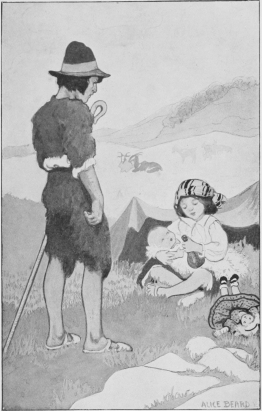
“The Child of Hunger,” replied the goatherd. He had a few words, at the best, and was, besides, more and more terrified in the presence of one whom he took to be a fairy. For he was but a simple-minded fellow, believing all the tales that he had heard from wandering shepherds on the windy waste or from old wives in rough-hewn chimney-corners. Whenever a lizard glided across his path, he saluted the little green creature with his best bow, for he believed that the lizard is itself so courteous that it will not go to sleep on a sunny wall without descending first to kiss the earth. When his eyes were hurting him, he would watch the swallows in their wheeling flight, for he believed that swallows know of a secret herb that cures sore eyes and that they pluck off its leaves to carry to their nestlings. He always trembled and crossed himself when he came upon even the prettiest little striped snake, for he believed that snakes never die, but when they see Death walking over the plain, looking for them, slip out of their skins and run away, growing into huge serpents with the years and becoming, in the centuries, scaly dragons that devour the flocks. This, he knew, was St. John’s Eve, when, as he had heard since childhood, from every fountain springs forth a fairy princess to spread her linen, white as snow and fine as cobwebs, out to dry in the dew. His young wife had perished of the fever a few weeks before and he could not leave their baby alone in the poor little hut of their brief happiness. So he had, while tending his flock, carried the child about with him, but the little one did not thrive. It would be better to give him to this gentle princess, who, perhaps, had come so far from her fountain to seek a playmate for that tiny fairy-baby with the golden hair and the bright blue eyes that never once winked as they looked out straight upon the western sun. What if the princess were waiting for a herd of elfin goats to bring that dainty creature milk? It would be as well for his honest Christian goats not to meet them. No harm could come to the child in the shining diamond grotto under the fountain, for the christening dews upon the little head would guard it from all evil. So the goatherd slyly picked up his coarse brown cloak and stealthily moved away with his flock, somewhat troubled in mind, for he thought Saint John might better have sent an angel than a fairy to their need, and missing so much the accustomed weight, lighter with every week, upon his arm, that he picked up a young kid and carried this for comfort.
Only the doll watched him as he went,—a high-minded doll that, as the afternoon wore by, showed no signs of jealousy, though Pilarica was utterly absorbed in her new plaything. The baby was almost as good as the doll, sleeping, or cooing, or kicking with its scrawny little legs. Once its wandering claw of a hand discovered an ear and did its best to pull that curious object off to put into the button mouth for proper investigation. It was this failure to detach its ear that finally roused the infant to wrath and it bleated as lustily as if it had been born the tenant of a kid-skin.
“Dear me!” sighed Pilarica, suddenly aware that she was weary and that a great red moon was climbing up over the edge of the world. “Where has the hairy man gone with his goats? Why didn’t he leave us some milk for supper? And when will somebody be coming for me?”
For Pilarica had the wisdom of experience. She knew that somebody always came for a little girl who was lost. For one moment a homesick thought fleeted back to her father and Big Brother and the rustling newspaper doll, and in the next she heard, not at all to her surprise, the trot-trot of Don Quixote’s hoofs and beheld that gallant ass, with Pedrillo running alongside, making over the plain toward the nooning place.
“Cry louder, Baby!” she admonished, with a little shake to which Baby instantly responded. It was really marvellous what a roar went forth upon the air, as if the kid had been transformed into a lion-cub. Clear and shrill above this remarkable accompaniment soared the ringing call of Pilarica. Don Quixote frisked his ears and tail and turned his course toward her of his own impulse; Pedrillo gave a shout of joy, and behind Pedrillo rose the halloo of Bastiano, and behind Bastiano clanged the great copper bell of Coronela.
There was a festival of greeting for Pilarica, but Baby Bunting, howling his worst, had a welcome only from Tia Marta. She gathered the brown bantling into her arms with a torrent of tender endearments and from that hour constituted herself his nurse and champion.
As the days went by, many and sharp were her quarrels with Don Manuel, who was determined that the foundling should be left at the first refuge that offered.
“Do you hope to carry this ugly tadpole on to Santiago?” he demanded at last. “Then let me tell you once for all that I will not receive it into my house. My house,” he added, not remembering to be consistent in the matter of Natural History, “is no nest for screech-owls.”
“Yah-ee!” protested the baby.
“Where’s Herod?” asked Hilario, winking at Tenorio and Bastiano, who mischievously repeated, one after the other:
“Where’s Herod?”
But Pedrillo picked up the child from Tia Marta’s tired shoulder and, dandling it skilfully, walked back and forth till the fretful cry was hushed.
They were enjoying a full midday meal at a village inn, for their lodging-place was so far on it could hardly be reached before late evening. Now that they were getting up into the hill country, where water was more plentiful and the heat not so intense, Don Manuel was pressing on at the full speed of the train in his desire that all, but especially the children, should be at Santiago for the feast of St. James. They were sitting at table in a long open room, at whose further end stood the mules and donkeys, their halters thrown over wall-pegs ingeniously made of ham-bones. Swallows flashed and called among the rafters. Pigeons with rainbow necks flew down to share the crumbs. A dog and two or three cats hunted about under the table for scraps. An enterprising hen, with a brood of fluffy chickens twit-twit-twittering behind her, bore in at the open door with the determined air of a militant suffragette and flew heavily across the room, lighting, to the children’s glee, right on Bastiano’s astonished head. The turkey and the pig, a gaunt black pig with stiff bristles, tried to join the party, but the dog, recalled to a sense of duty, promptly drove them out.
The muleteers were making merry over their favorite dish of big yellow peas boiled to a pap in olive oil, and flanked, on this occasion, by a platter of fried fish, but the children preferred an omelet tossed up in a twinkling out of the freshly laid eggs that they had helped the ventera find in the hay-scented stable. Meanwhile Grandfather was feasting them with riddles and with a treat of roasted chestnuts, singing as they munched:
“More than a score of neighbors who dwell Each in a satin hall, Like a little brown nun in a little brown cell, And never go out to call.”
And again:
“A jewel-case from her treasury The courteous forest gave to me As through brown leaves I trod; A chest as glossy as chest could be, A chest locked tight without a key; The carpenter was God.”
At this the ventera, a dumpling of a body with roguish round eyes, held a secret consultation with Grandfather and then stood laughing at Pilarica and Rafael while he puzzled them with an entirely new riddle:
“Oh, this will make your patience melt, The meaning is so shady; The lady has a soft brown belt, But the belt it has no lady.”
It was not until the doughnuts were spluttering in the olive oil that the children had the answer in their throats, and then it was on the way down instead of up. The carriers, even Don Manuel, came crowding about that tempting kettle, but Tia Marta, her thin face twitching, still sat on her three-legged stool at the table, crumbling her share of the loaf for the chickens and doves, and wishing she could give Roxa a shred of the fried fish. Pedrillo lingered near. Since her absorption in Juanito, as she called the child whom she had taken to her heart on St. John’s Eve, she seemed to have half forgotten her grudge against Pedrillo.
He came up to her now to show her that the baby slept.
“Angelito,” she murmured over it, touching the tiny cheek. “See, it is fatter already! I could make him well and strong, as I made the donkey. But what am I to be? A stranger in a strange land, a servant in another woman’s kitchen, with not even a cat of my own to mew to me. Never before have I been without a child to rear. There were my little sisters first, and then my blessed Catalina, and then her rosy Rodrigo—ah, that cruel Cuba!—and then those cherubs there that Doña Barbara will steal away from me. Blood is thicker than water, though it be water of tears. Ay de mi!”
“But eat, woman, eat,” gruffly implored Pedrillo. “You are giving away all your luncheon. Eat, and your trouble will be gone. Bread is relief for all kinds of grief.”
“Not for mine,” wailed the Andalusian. “Everyone knows his own sorrow, and God knows the sorrow of us all. Are the doors of Santiago so narrow that the gifts of Heaven may not enter in? Oh, this Don Manuel! This Galician with his soul shut in his account book! Growing richer every trip and grudging a few drops of milk as if he were a son of ruin with nothing left for God to rain on!”
“Patience, patience!” urged Pedrillo, his snub-nosed face so intent on Tia Marta that he inadvertently tilted Juanito wrong side up. “Did you never hear of the monk who, as he was telling his beads in his vineyard, suddenly held out his hand to see if it rained? Down flew a thrush and laid an egg on his palm. So the holy man waited, always with his arm outstretched, day after day, till five eggs had been laid, and then week after week, till they had all been hatched out and the fledglings had flown away. Then the mother-thrush, perching on the nearest fig tree, sang to the monk a song as sweet as an angel’s, so that he was well rewarded for his patience.”
“Bah! and how about the ache in his arm? But it is long since you have told me one of your foolish stories, Don Pedrillo.”
And Tia Marta, for the first time since Cordova, smiled on him.
“Ah!” murmured Pedrillo, hastily righting Juanito who was puckering for a roar. “Give the canary hempseed and you’ll see how it will sing.”
But at this critical moment Capitana, who had worked her halter free and whose softly jingling bells, as she ambled down the room, had not been noticed by the absorbed talkers, thrust her long head, with its most solemn expression, in between the two faces that had drawn so near together.