IV A Son of the Law
Reading edition
On an afternoon in the early days of the British occupancy of India, Blackmore-Sahib sat alone at the big desk in his study, in his hand a report which had just reached him from one of his districts. At his elbow the tea tray was untouched, although at this hour of the afternoon he was usually stretched out in a rattan chair in the living-room with the punkah swinging over him, the latest magazine, three months old at that, in his hand, and the tea tray already replaced on the small table beside his chair by the cigar service holding cigarettes all neatly rolled ready for his match. It was not because the report was urgent that he had forsaken his accustomed ease to prove it up; nor was it that he was particularly interested in the task, for apparently he was forcing himself to go over the lines of type and up and down the columns of figures. As his pencil reached the bottom of a column it would almost drop from his listless fingers until, with a start, he would begin upon the next row as if in great haste.
The bearer, entering the room noiselessly, saw the untouched tea tray standing just as he had left it a half hour before and looked anxiously at his master's face. But without disturbing his master he removed it and turned to the side table where stood the tobacco service. Not a cigarette was rolled! He clumsily attempted to prepare some but none of his efforts were really successful. However, he put several bulky ones in a saucer and placed them near his master's hand. Still in silence but with many backward glances at the man bending over the slowly-moving pencil, the boy left the room.
As the boy closed the door, the man dropped the pencil upon the desk, put his hand to his head for a second, and then arose. He walked to the door into the living-room and seemed to listen for an instant; then he went back to the desk.
The servant, evidently having heard his master's step, entered with fresh tea and toast.
"Is she better?"
As the boy set the tray down he replied hesitatingly, "No, Sahib, she is still groaning."
"You fool, don't you suppose I can hear that? She has groaned incessantly since last night."
"What can I do?" The man asked the question of himself as he turned half around towards the veranda door.
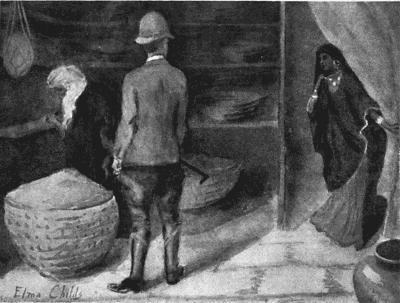
"IT WAS ONLY A GLIMPSE"
"Won't the Sahib have some tea?" suggested the boy timidly, for like every native-born this man feared his stalwart English master.
Blackmore-Sahib held out his hand without turning back from the door. "Yes, I will take a cup. Perhaps it will steady me a bit."
"Poor little Nona!" he sighed as he took the cup.
He gulped down the tea hurriedly and reached for a cigarette. But as his eyes fell on the clumsy ones in the saucer, they filled with tears and he walked quickly out upon the veranda without taking one.
Up and down he paced unheeding the streaks of sunshine which found their way in through the vines and fell upon his unprotected head.
"Poor Nona! Poor little girl!" he groaned. How skillfully she had always rolled his cigarettes, just to his taste! how daintily she had served his cup of tea! and how quietly she had sat every afternoon beside him, never disturbing his nap or reading! "Poor little Nona!" he sighed, for she might never sit beside him again. He could hear her groans now from the bedroom at the other side of the great living-room. Pitiable, heart-breaking little groans they were! He could not trust himself even to go to the door and look in upon her.
And yet he did not really love her. Nona had made Blackmore-Sahib's life very comfortable for the last ten years and he could not bear to think that she was suffering and probably would die. He did not want to lose his little Indian wife and her affectionate care for him, though of course she was his "wife" only according to the customs of many white men in dark lands. As he paced up and down he remembered how, when he had been sent by the government to this city in the heart of India away from every European association, he had rebelled until, seeing a pair of black eyes peeping from the doorway of a certain mud house, he had become very much interested in that section of the city although it belonged to a low caste of Hindus. He remembered how for several evenings he had taken his evening walk in that locality and furtively watched that house door in which he again saw framed for a second a beautiful Indian face and a slender, lithe Indian figure in a red sari. After a few more visits he had several conversations with the men of the neighbourhood and had learned that the man who lived in that house was, as they all were, of low caste and desperately poor. Finally he had met the man himself whom he heard loudly lamenting because he could not afford to marry off his beautiful daughters. "Why, a wedding costs many rupees nowadays!" he had heard him say.
So the sahib by a little courteous inquiry had learned that the man had three unmarried daughters. By further courteous and diplomatic conversation he had conveyed to the father the idea that if he, the sahib, could have his choice of the three girls he would pay a dowry for one of them. After several evenings of discussion and bargaining the old man slowly and cautiously had consented, but the matter of giving the sahib his choice had been a trifle difficult even among the low caste. But, finally, having bidden the sahib stand at the other corner of the street where he could see without being particularly noticeable, on the evening the bargain was sealed, the old man had called his daughters one at a time to the door of the house on some trifling pretext. It had been only a glimpse, but as the third girl disappeared from the doorway, Blackmore-Sahib had been satisfied. On the very next evening, having promised to pay a sufficient number of rupees to marry off both of the other daughters, the Englishman had had the satisfaction of seeing a little draped figure enter a covered ekka and be driven away towards his bungalow.
He could remember, even after ten years, how the ekka had driven up to his door and how he, having reached the door before her arrival, would not pay the promised money until the girl's veil had been lifted and he had seen for himself that no trickery had been played upon him and that this was the one of his choice. She had been very young, very timid, and very beautiful. He remembered that, cross, burly chap though he was, he had delighted to tease her out of her shyness and teach her the little ways by which she could make him happy and his bungalow a home. She had been an ignorant native girl, as the majority of Indian girls are, but she had soon learned to love him and she had always been beautiful to look upon.
They had not been married. That was not necessary in those days in the East. He had given her a good home and in doing that he had done his whole duty. Yet he had never mentioned her in his letters to England, for "they would not understand." Indeed, he had half expected until the last two years to go back to England and marry a fine girl whom he had known in boyhood. But when the time had drawn near he had decided to stay here as he was;—for what would become of Nona? He could not keep her, too, for even he did not think that way of living right. He sometimes longed for the green meadows and the hawthorne bush and the skylark, nevertheless he remained in India, for he could not take Nona and he could not leave her.
But now it seemed as if Nona were going to leave him. If she should die, he would be free to go to England to marry his childhood friend, for a recent letter from his brother had told him that Elizabeth was still unmarried and mistress of her own estate. But now, of a sudden, he did not want to go; he did not want to marry. Indeed, he did not want anything but to stay here with Nona. He wanted Nona! She must not die! He needed her.
"Sahib!" A soft voice arrested his step and Nona's ayah besought him: "Sahib, she is no better. May I get the memsahib? I think she can help her."
"What memsahib?" he asked, his voice gruff with emotion.
"The missionary memsahib, master. Please let me get her."
"A missionary! Would a missionary come to my house?" he asked in scorn.
Blackmore-Sahib had seen the missionary lady often, for she was one of the very few Europeans in the city, but he never had spoken to her. He knew missionary principles and he felt that he and Nona in her eyes were worse than the Hindus "in their blindness." He had always avoided a missionary's path; now he would not ask for help! Even if he should humble his pride and do so, he felt that no Christian would come to him, for were not he and Nona without the law?
"No, she would not come," he said emphatically.
"Yes, master, she will come. I know she will come. See how ill my mistress is! Hear her moans!" and the faithful ayah wrung her hands in grief. "Oh, let me go to get her."
"Is she a doctor?" he asked. "Does she give medicine?" he went on, trying to make the native woman understand.
"No, she is not a doctor, but she gives medicines," the woman replied enigmatically.
There was no doctor within reach. If this woman could help Nona, had he any right to let his pride keep him from at least asking for her help? Blackmore-Sahib reasoned it out slowly. Although he was sure that she would not come, he must do all that he could to help the sick woman and so he must ask the missionary to come.
"Go!" he said finally to the ayah and as she sped down the road he continued his pacing and his thoughts. His thoughts turned strangely, after the interruption, to his boyhood home and his boyhood days when even a lie, a wrong word, or an unkind deed had hurt him almost as much as his mother. But his mother had died when he was only a lad and after that had come school and then India and—Nona.
The change from the rigid morality of a well-trained boy living under the eye of a law-abiding people, to the moral thoughtlessness and neglect of a man far away from the reign of aught but the law of the conqueror among an inferior people; the change from the conventional obedience to the social customs of a Christian land, to the unconventional disregard of all Christian customs in a heathen land, had come so gradually that Blackmore-Sahib had never before realized how different he was in moral integrity from what he had been in that boyhood home and how different he must be in reality from what his mother had imagined that he would be in her fond dreams about the future. Had India by her enervating climate, by the ease with which she gratifies the sensual side of man's nature, and by the intellectual loneliness in which she makes her foreign rulers live—had India by these means warped his moral sense? Or had his good life in Christian England been a foolish fanaticism and was his life here the true living of a free soul?
Blackmore-Sahib was startled at the presence of such questionings in a mind which heretofore had accepted his conduct and life unquestioned. But at that moment there stole upon him the memory of a sweet white face, drawn with pain and the sound of a low but earnest voice saying, "My boy, I am going away—to leave you alone. Be strong and brave and good." These memories as they mingled in his mind and ears with the picture of a beautiful, dark face full of suffering into which he had looked that very morning and the sound of sharp moans still coming through the half-closed bungalow door, worked strange havoc within him.
Although his thoughts had carried him far, only a few moments had actually passed when, hearing quick steps beyond the compound wall, he came to a halt and saw an English woman hurry in at the gate, followed by the panting ayah.
"Good-afternoon, Mr. Blackmore," spoke a pleasant English voice. "I am not a physician, but I'll do the best I can."
Blackmore-Sahib followed clumsily, as a man does in a house of illness, after the energetic little figure that went straight to Nona's room. There the missionary spent much time examining her patient and it was with anxious eyes that she finally looked at the man as he sat near the door.
"It is a serious case. I have seen just one like it before," she said. "But since it is impossible to get a real physician I will do the best I can. Will you kindly send me a couple more servants and order several tubs of hot water got ready? Then, please, go away for a gallop and do not come back for several hours. I don't believe you know much about sickness and a good ride will brace you up, for you will have to watch with her to-night, I think." The last was said with a smile as she started quickly and quietly about her preparations.
At the end of two hours he met her at the bedroom door.
"She is more comfortable, but it will be a hard fight. I shall stay here to-night. I don't dare trust the case to any one else yet."
In the morning, when at five o'clock he was wakened from a fitful sleep by a rap at his door, the same voice said, "She is resting now. Will you come and watch her while I go home for a short time? I cannot leave her alone with the servants, for they are either too tired or too stupid to obey instructions this morning."
About seven she returned and all day long, sometimes by turns, sometimes together, they watched and waited, doing all they could to help Nature bring back peace to the poor suffering body.
About the middle of the morning he asked her how she had gained her medical skill. Then she told him of her life in India and how she had found that by helping the sick she could most easily reach the hearts of the people. She told of spending one furlough in a hospital at home for training. Seeing that the conversation did not annoy the patient and that it seemed to interest the man, she went on telling about her work and the joys and sorrows that she had experienced as a missionary. Not one word of preaching! She simply told of her life as if talking to an old friend. There was not a sign that she had recognized anything unusual in this household or seen anything to condemn. He began to wonder if she knew and yet he felt that she did know. She talked about England and the home she had hoped to go to the next year; but no one had been found to take her place and she could not go until there was some one to work for her people. He was surprised at the light in her eyes when she said: "I'll not leave them without some one to care for them even if I have to put off my home-going all my life."
She talked of Christ so freely and of her own religious beliefs so naturally that he felt that her speech grew out of her life and he did not resent the personal religious element in her conversation which he had always avoided and resented in others.
But while she was talking in low tones or listening to him as he, in turn, told of his home in England, she kept a keen eye on her patient. About eight o'clock at night a change came. The moaning stopped; the restless brown hands grew still; the breath came regularly; and Nona slept a quiet, restful sleep. The memsahib, on her knees beside the bed, looked up at the big, burly, white man standing on the other side of the narrow couch. "She will get well," she said simply. "And now—now"—she stammered with difficulty, "you will marry her, won't you?"
As the astonished man gazed into her wistful, earnest face a slow resolve grew in his own. The coming of this strong, wholesome woman into his life, the revival of the memories of his boyhood, the face of his mother, never entirely forgotten, and now clear and vivid before his very eyes, and, more even than all these, the dawning consciousness of the Presence in which his life had been lived and was now being judged cleared away all his ethical confusion, revealed to him the evil of his past life and begat in him a great desire for cleansing and a high purpose to make amends for the past.
And so when the missionary memsahib said to him, "You will marry her, won't you?" his astonishment slowly gave way to a sense of high moral purpose. After a silence which revealed the struggle within, he replied in a firm voice, "I will! and may God bless you."
With these words the man dropped upon his knees on the other side of the bed and his head rested for a moment on the pillow very close to the beautiful brown face there. Then, without asking permission, the missionary prayed a simple prayer of thanksgiving for the life of the woman and a request for a blessing upon her English brother and herself that they might shape their lives after the character of Christ and live according to Christian laws.
Then the missionary slipped quietly out of the room, for the danger was over and the servants could take as good care of their mistress as could she. But she promised the anxious ayah as she went away that she would come in from time to time for a few days to see that all went well.
Two weeks from that day an Englishman stood with a Hindu woman by his side in a missionary's parlour and there a quiet wedding ceremony was performed. To the bride it meant nothing, but to the bridegroom it meant an entire change in his life and heart.
Several years later an English gentleman bore unflinchingly the embarrassment—and worse—of introducing an Indian wife to his English family at home. Tenderly he sheltered her from all annoyances and apparently with pride he took her from place to place in the homeland. Only one person, a missionary from India, home on a long-delayed furlough, guessed that the journey was one prolonged torture to the man who, from a high sense of duty to a woman who could not even comprehend it, was making her all amends in his power for a wrong which, also, she did not comprehend.
"I don't understand why he married a native," one of the Englishman's relatives remarked to a friend. "Otherwise he is a perfect Christian gentleman and an honour to the family."
The missionary, who chanced to overhear the remark, in her mind erased the "otherwise."