Volume 1 — CHAPTER XI. (continued 2)
Reading edition
The mountaineers appeared disposed to try conclusions at once. We were fatigued with the march of 13 miles; the hot sun and weight of burdens had weakened the physical powers of the men. Some of the best, however, were picked out and sent to meet the mountaineers, while we stood and watched to weigh the temper of our opponents. Four of the scouts were foremost. An equal number of the mountaineers, not a whit loth for the encounter, bounded gallantly to meet them. They intuitively felt that the courage of our four men was not of the highest order. They approached to within 100 yards of them, and prepared their bows against the rifles. Our men delivered their fire harmlessly, and then backed; the mountaineers advanced, with fingers on their bow-strings. Our four men fled, while a hundred voices from our camp, looking down upon the scene, execrated them. This was a bad beginning for our side; the natives accepted it as a favourable omen to them, and yelled triumphantly. To check this glow, our riflemen sought cover, and seriously annoyed the natives. Some at the extremity of the hill of Nzera-Kum did execution among the mountaineers on the slope of the range opposite, at 400 yards distance; others crept down into the valley towards the river, and obtained a 1887. Dec. 8. Undussuma. triumph for us; others, again, working round the base of Nzera-Kum, effected a diversion in our favour. Saat Tato, our hunter, carried away a cow from her owners, and we thus obtained a taste of beef after eleven months' abstinence. As night fell, natives and strangers sought their respective quarters, both anticipating a busy day on the morrow.
Before turning in for the night, I resumed my reading of the Bible as usual. I had already read the book through from beginning to end once, and was now at Deuteronomy for the second reading, and I came unto the verse wherein Moses exhorts Joshua in those fine lines, "Be strong and of a good courage; fear not, nor be afraid of them: for the Lord thy God, He it is that doth go with thee; He will not fail thee, nor forsake thee."
I continued my reading, and at the end of the chapter closed the book, and from Moses my mind travelled at once to Mazamboni. Was it great fatigue, incipient ague, or an admonitory symptom of ailment, or a shade of spiteful feeling against our cowardly four, and a vague sense of distrust that at some critical time my loons would fly? We certainly were in the presence of people very different from the forest natives. In open our men had not been tested as they were to-day, and what my officers and self had seen of them was not encouraging. At any rate, my mind was occupied with a keener sense of the danger incurred by us in adventuring with such a small force of cowardly porters to confront the tribes of the grass land than I remember it on any previous occasion. It seemed to me now that I had a more thorough grasp of what might be expected. Whether it followed a larger visual view of land and population, or that I was impressed by the volume of human voices, whose uproar yet seemed to sound in my ears, I know not. But a voice appeared to say, "Be strong and of a good courage: fear not, nor be afraid of them." I could almost have sworn I heard the voice. I began to argue with it. Why do you adjure me to abandon the Mission? I cannot run if I would. To 1887. Dec. 8. Undussuma. retreat would be far more fatal than advance; therefore your encouragement is unnecessary. It replied, nevertheless, "Be strong and of a good courage. Advance, and be confident, for I will give this people and this land unto thee. I will not fail thee nor forsake thee; fear not, nor be dismayed."
Still—all this in strict confidence—before I slept I may add that though I certainly never felt fitter for a fight, it struck me, that both sides were remarkably foolish, and about to engage in what I conceived to be an unnecessary contest. We did not know even the name of the land or of the people, and they were equally ignorant of our name and of our purpose and motives. I sketched out my plans for the morrow, adjured the sentries to keep strict watch, and in sleep became soon oblivious of this Mazamboni—lord of the mountains and plains.
December 9th was a halt. In the morning we completed our thorn-bush fence, distributed cartridges, and examined rifles. By 9 o'clock the chill of early day retired before the warmth of a hot sun, and shortly after the natives mustered in imposing numbers. War-horns, with the weird notes heard in Usoga and Uganda in 1875, sounded the gathering, and over twenty drums boomed from each mountain top. There were shouts and cries flying in currents from mountain to valley, and back again, for we were quite surrounded. About 11 a.m. some few natives descended close enough for one Fetteh, a man of Unyoro, to distinguish what was said, and he exchanged a hot abuse with them, until there was quite a wordy war. Hearing that one of our people understood the language, I directed the wrathful tongues in the interests of peace, and a more amicable language resulted.
"We on our side," was said, "only fight in defence. You assail us while quietly passing through the land. Would it not be better to talk to each other, and try to understand one another first, and then, if we cannot agree, fight."
"True, those are wise words," a man replied. "Tell 1887. Dec. 9. Undussuma. us who you are. Where you are from, and where you are going."
"We are of Zanzibar, from the sea, and our chief is a white man. We are bound for the Nyanza of Unyoro."
"If you have a white man with you, let us see him, and we shall believe you."
Lieutenant Stairs promptly stepped out of the zeriba and was introduced by Fetteh.
"Now you tell us who you are," said Fetteh. "What land is this? Who is your chief? And how far is the Nyanza?"
"This land is Undussuma, the chief is Mazamboni. We are Wazamboni. The Ruweru (Nyanza) is reached in two days. It will take you five days. It lies east. There is only one road, and you cannot miss it."
This began the exchange of friendly intercourse. Strangerhood was broken. We then learned that there were two chiefs in Undussuma, one of whom would not be averse to peace, and exchange of friendly gifts, if it were agreeable to us. We gladly assented, and several hours were passed without a hostile cry being heard, or a shot fired, except at the river, the natives on whose shores were obstinate, and declined listening to anything but war proposals.
In the afternoon a message came from Mazamboni saying he would like to see the pattern and quality of our monies. We sent two yards of scarlet uniform cloth, and a dozen brass rods, and a promise was given that early next morning the chief himself would appear and go through the ceremony of brotherhood with me.
The next day we were refreshed after an undisturbed night, and fondly indulged in anticipations that in a few hours, perhaps, our camp would be filled with friendly natives. We had been requested not to depart until a return gift should arrive from Mazamboni. We accordingly had resolved on another day's halt. The morning was still raw and cold, for we were 4,235 feet above the sea. A mist covered the tall mountain tops, and a slight drizzle had set in, which excused our friends from a too early appearance; but at the third hour the mist 1887. Dec. 10. Undussuma. cleared away, and the outline of the entire range was clear against a pale blue sky. Lieutenant Stairs, Mr. Jephson, and myself, were out at the extreme west end of the spur enjoying the splendid view, admiring the scenery, and wondering when such a beautiful land would become the homesteads of civilized settlers. Stairs thought that it resembled New Zealand, and said that he would not mind possessing a ranche here. He actually went so far as to locate it, and pointed out the most desirable spot. "On that little hill I would build my house"—"Shebang" he called it. I wonder if that is a New Zealand term for a villa—"There I would herd my cattle; my sheep could browse on the mountain slope behind, and——"
But meantime the natives had appeared on the crests of the mountain in lengthy columns, converging towards a common centre—a butt end of a truncated hill—a thousand yards in an air line from where we stood, and a voice like that of a mob orator, clear and harmonious, broke on our ear. It proceeded from a man who, with a few companions, had descended to about 300 feet above the valley. He was ten minutes speaking, and Fetteh had been brought to listen and translate. Fetteh said that he commanded peace in the name of the king; but strange to say, no sooner had the man concluded his speech than loud, responsive yells rose from the valley in a hideous and savage clamour, and then from every mountain top, and from the slopes there was a re-echo of the savage outburst.
We surmised that such forceful yelling could not signal a peace, but rather war; and in order to make sure, sent Fetteh down into the valley below the speaker to ask him. The replies from the natives left us no room to doubt. The two sounds—Kanwana, "peace," and Kurwana, "war," were so similar that they had occasioned Fetteh's error.
"We do not want your friendship," they cried. "We are coming down to you shortly to drive you out of your camp with our herdsmen's staffs." And a treacherous fellow, who had crawled under cover of low 1887. Dec. 10. Undussuma. bush, came near causing us a severe loss—our interpreter especially having an exceedingly narrow escape. Fetteh picked up the arrows and brought them to us, and delivered his news.
There was then no alternative but to inflict an exemplary lesson upon them; and we prepared to carry it out without losing a moment of time, and with the utmost vigour, unless checked by proffers of amity.
The companies were mustered, and fifty rifles were led out by Lieutenant Stairs towards those obstinate and fierce fellows on the other side of the Ituri branch. A party of thirty rifles were sent under Mr. Jephson to skirmish up the slopes to the left; and twenty picked men were sent with Uledi to make a demonstration to the right. Rashid was ordered with ten men to the top of Nzera-Kum to guard against surprise from that quarter. Jephson and Uledi would be marching to their positions unobserved by the mountaineers, because the crowns of the forehills would obstruct the view, and would approach to them within 200 yards without being seen, while Lieutenant Stairs' company, being further out in the valley, would absorb their attention.
In a few minutes Stairs' company was hotly engaged. The natives received our men with cool determination for a few minutes, and shot their arrows in literal showers; but the Lieutenant, perceiving that their coolness rose from the knowledge that there was a considerable stream intervening between them and his company, cheered his men to charge across the river. His men obeyed him, and as they ascended the opposite bank opened a withering fire which in a few seconds broke up the nest of refractory and turbulent fellows who had cried out so loudly for war. The village was taken with a rush and the banana plantations scoured. The natives broke out into the open on a run, and fled far northward. Lieutenant Stairs then collected his men, set fire to the village, and proceeded to the assault of other settlements, rattling volleys from the company announcing the resistance they met.
Meanwhile, Uledi's party of chosen men had discovered 1887. Dec. 10. Undussuma. a path leading up the mountain along a spur, and after ascending 500 feet, led his men up into view on the right flank of the mob observing and cheering their countrymen in the valley. The Winchesters were worked most handsomely. At the same time Mr. Jephson's party came out of the left ravine, and together they had such a disastrous effect on the nerves of the natives that they fled furiously up the slopes, Uledi and his men chasing them.
Mr. Jephson, after seeing them in full flight, faced eastward, and pushed on for two miles, clearing every inhabitant out. By 1 P.M. all our men were in camp, with only one man slightly wounded. Every man had behaved wonderfully well; even the four cowards, who had been marked men, had distinguished themselves.
At 2 p.m., the natives in the valley having returned, each party was despatched once again. Stairs led his men across the Ituri branch, and followed the running fugitives far northward, then veered sharply round to join Jephson, who had continued his way eastward. Uledi's scouts were sent up to the very summit of the mountain range; but on observing the immense number of homesteads that dotted it, he prudently halted.
Until the afternoon the contest continued; the natives were constantly on the run, charging or retreating. By evening not one was in sight, and the silence around our camp was significant of the day's doings. The inhabitants were on the mountains or far removed eastward and northward. In the valley around us there was not a hut left standing to be a cover during the night. The lesson, we felt, was not completed. We should have to return by that route. In the natural course of things, if we met many tribes of the quality of this, we should lose many men, and if we left them in the least doubt of our ability to protect ourselves, we should have to repeat our day's work. It was, therefore, far more merciful to finish the affair thoroughly before leaving a tribe in unwhipped insolence in our rear. 1887. Dec. 10. Undussuma. The natives must have entertained an idea that we could not fight outside our bush fence, which accounts for their tall talk of driving us out with sticks, and that they were safe on the mountains. We were compelled to root out the idea that they could harm us in any way.
A cow neglected by her owner was burnt in one of the villages close by, and furnished us with a second limited ration of roast beef.
On the 11th it rained again during the early morning, which kept us indoors until 10 A.M. Some natives having then come out to demonstrate their hostility on the mountains, Stairs, Jephson and Uledi led their men up the mountain slopes in three separate small columns to the attack, and made a successful tour among their stronghold. A small flock of goats was captured, and distributed to the men, and our experiences of this day satisfied the natives that they had nothing to gain by fighting.
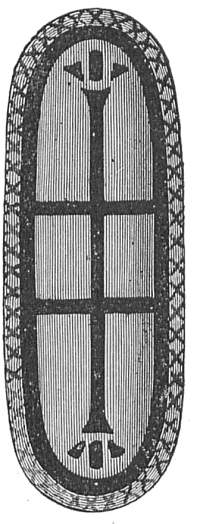
SHIELD OF THE EDGE OF THE PLAINS.
At one time it appeared as day would end with reconciliation, for a native stood on a high hill above our position after all had reached camp, and announced that he had been sent by Mazamboni to say that he received our gifts, but that he had been prevented from visiting us according to promise by the clamour of his young men, who insisted on fighting. But now, as many of them had been killed, he was ready to pay tribute, and be a true friend in future.
We replied that we were agreeable to peace and friendship with them, but as they had mocked us, kept our peace presents, and then scornfully called us women, they must purchase peace with cattle or goats, and if they held up grass in their hands they could approach without fear.
It should be mentioned that when the warriors descended the mountain slopes for the fight, every little 1887. Dec. 11. Undussuma. squad of men was accompanied by a large hound, of somewhat slender build, but courageous, and prompt to attack.
The arms of the Wazamboni consisted of long bows five and a half feet long, and arrows twenty-eight inches long, besides a long sharp spear. Their shields were long and narrow generally, but there were many of the true Uganda type. The arrows were cruelly barbed, and the spear was similar to that of Karagwé, Uhha, Urundi, and Ihangiro.
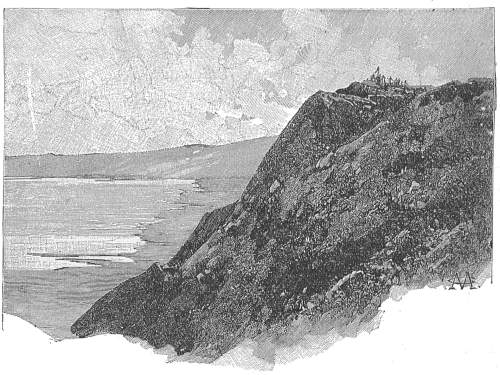
VIEW OF THE SOUTH END OF ALBERT NYANZA. (See page 306.)