Part II PRISON LAND (continued 2)
Reading edition
As we went on board we gave up our bills of health, after which we were not permitted to land again under penalty of forfeiting the passage and being disinfected again. Our luggage now bore yellow labels bearing the legend, “colis désinfecté,” signed by the medical inspector. These were passed on to the ships by Kanakas, who freely went and came, and passed things to and from the ship without hindrance. As Kanakas are generally supposed to be much better carriers of the plague than white people, our own examination and squirting seemed a trifle superfluous.
The steamer was the St. Antoine, which may be described as the Campania of the Service des Côtes. Until I made passages on one of her sister-ships—to be hereafter anathematised—I didn’t know how bad a French colonial passenger-boat could be. Afterwards I looked back to her with profound regret and a certain amount of respect; wherefore I will not say all that I thought of her during the eleven hours that she took to struggle over the sixty-odd miles from Noumea to Bourail.
There is no landing-place at the port of Bourail, save for boats, so, after the usual medical inspection was over and I had made myself known to the doctor, I went ashore in his boat. The Commandant was waiting on the shore with his carriage. I presented my credentials, and then came the usual consommations, which, being literally interpreted, is French for mixed drinks, after which we drove off to the town of Bourail, eight kilometres away. As we were driving down the tree-arched road I noticed half a dozen horsewomen seated astride à la Mexicaine, with gaily coloured skirts flowing behind.
“Ah,” I said, “do your ladies here ride South American fashion?”
“My dear sir,” he replied, “those are not ladies. They are daughters of convicts, born here in Bourail, and reared under the care of our paternal government! But that is all stopped now, later on you will see why.”
“Yes,” I said, “I have heard that you have given up trying to make good colonists out of convict stock.”
“Yes,” he replied; “and none too soon, as you will see.”
From which remark I saw that I had to do with a sensible man, so I straightway began to win his good graces by telling him stories of distant lands, for he was more of a Fleming than a Frenchman, and was therefore able to rise to the conception that there are other countries in the world besides France.
I found Bourail a pretty little township, consisting of one street and a square, in the midst of which stood the church, and by dinner-time I found myself installed in a little hotel which was far cleaner and more comfortable than anything I had seen in Noumea, except the club. When I said good-night to the Commandant, he replied:
“Good-night, and sleep well. You needn’t trouble to lock your door. We are all criminals here, but there is no crime.”
Which I subsequently found to be perfectly true.
Everything in New Caledonia begins between five and half-past, unless you happen to be starting by a steamer, and then it’s earlier. My visit to Bourail happened to coincide with a governmental inspection, and early coffee was ordered for five o’clock. That meant that one had to get tubbed, shaved, and dressed, and find one’s boots a little before five. Bar the Black Death, I disliked New Caledonia mostly on account of its early hours. No civilised persons, with the exception of milkmen and criminals under sentence of death, ought to be obliged to get up before nine.
Still, there was only one bath in the place, and I wanted to be first at it, so I left my blind up, and the sun awoke me.
I got out of bed and went on to the balcony, and well was I rewarded even for getting up at such an unrighteous hour. The night before it had been cloudy and misty, but now I discovered with my first glance from the verandah that I had wandered into something very like a paradise.
I saw that Bourail stood on the slope of a range of hills, and looked out over a fertile valley which was dominated by a much higher range to the north-east. The sun wasn’t quite up, and neither were the officers of the Commission, so I went for my bath. There were no mosquitos in Bourail just then, and I had enjoyed for once the luxury of an undisturbed sleep. The water, coming from the hills, was delightfully cool, and I came back feeling, as they say between New York and San Francisco, real good.
The Commission, for some reason or other, did not get up before breakfast-time (11.30), and so we got a good start of them. The Commandant had the carriage round by six o’clock, and, after the usual consommations, we got away. It was a lovely morning, the only one of the sort I saw in Bourail, for the next day the clouds gathered and the heavens opened, and down came the floods and made everything but wading and swimming impossible; but this was a day of sheer delight and great interest.
We drove over the scene of a great experiment which, I fear, is destined to fail badly. The province of Bourail is the most fertile in all Caledonia, wherefore in the year 1869 it was chosen by the paternal French Government as the Arcadia of the Redeemed Criminal. The Arcadia is undoubtedly there, the existence of the redeemed criminal struck me as a little doubtful.
As soon as we got under way I reverted to the young ladies we had seen on horseback the evening before.
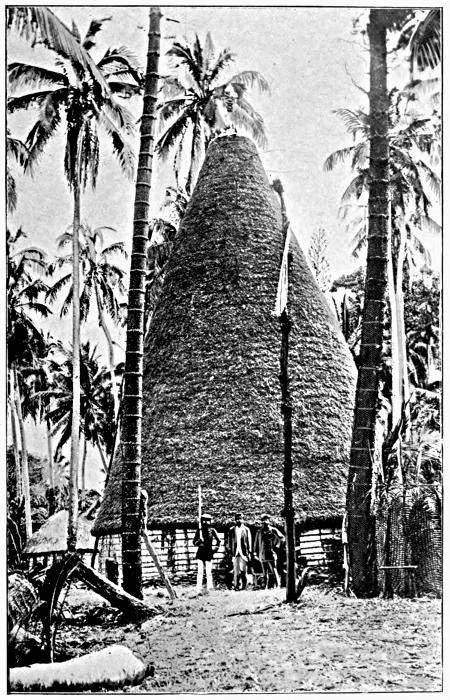
A Native Temple, New Caledonia.
“You shall see the houses of their parents,” said the Commandant; “and afterwards you will see the school where the younger ones are being educated. For example,” he went on, pointing down the street we were just crossing, “all those shops and little stores are kept by people who have been convicts, and most of them are doing a thriving trade. Yonder,” he said, waving his hand to the right, “is the convicts’ general store, the Syndicat de Bourail. It was founded by a convict, the staff are convicts, and the customers must be convicts. It is what you would call in English a Convict Co-operative Store. It is managed by scoundrels of all kinds, assassins, thieves, forgers, and others. I have to examine the books every three months, and there is never a centime wrong. That is more than most of the great establishments in Sydney could say, is it not?”
I made a non-committal reply, and said:
“Set a thief to catch a thief, or watch him.”
“Exactly! There is no other business concern in Caledonia which is managed with such absolute honesty as this is. I should be sorry for the man who tried to cheat the management.”
I knew enough of Caledonian society by this time to see that it would not be good manners to press the question any further. Afterwards I had an interview with the manager of the syndicate, an estimable and excellently conducted forger, who had gained his rémission and was doing exceedingly well for himself and his wife, who, I believe, had blinded somebody with vitriol, and was suspected of dropping her child into the Seine.
He presented me with a prospectus of the company, which showed that it had started with a government loan of a few hundred francs, and now had a reserve fund of nearly forty thousand francs. He was a patient, quiet-spoken, hard-working man who never let a centime go wrong, and increased his personal profits by selling liquors at the back door.
Our route lay across the broad valley which is watered by the River Nera. On either side the ground rose gently into little hillocks better described by the French word collines and on each of these, usually surrounded by a grove of young palms and a dozen acres or so of vineyards, orchards, manioc, plantain, or maize, stood a low, broad-verandahed house, the residence of the redeemed criminal.
I could well have imagined myself driving through a thriving little colony of freemen in some pleasant tropical island upon which the curse of crime had never descended, and I said so to the Commandant.
“Yes,” he said, “it looks so, doesn’t it? Now, you see that house up there to the left, with the pretty garden in front. The man who owns that concession was a hopeless scoundrel in France. He finished up by murdering his wife after he had lived for years on the wages of her shame. Of course, the jury found extenuating circumstances. He was transported for life, behaved himself excellently, and in about seven years became a concessionnaire.
“He married a woman who had poisoned her husband. They have lived quite happily together, and bring up their children most respectably.”
I was too busy thinking to reply, and he went on, pointing to the right:
“Then, again, up there to the right—that pretty house on the hill surrounded by palms. The man who owns that was once a cashier at the Bank of France. He was a ‘faussaire de première classe,’ and he swindled the bank out of three millions of francs before they found him out. He was sent here for twenty years. After eight he was given a concession and his wife and family voluntarily came out to him. You see, nothing was possible for the wife and children of a convict forger in Paris. Here they live happily on their little estate. No one can throw stones at them, and when they die the estate will belong to their children.”
“That certainly seems an improvement on our own system,” I said, remembering the piteous stories I had heard of the wives and families of English convicts, ruined through no fault of their own, and with nothing to hope for save the return of a felon husband and father into a world where it was almost impossible for him to live honestly.
“Yes,” he said; “I think so. Now, as we turn the corner you will see the house of one of our most successful colonists. There,” he said, as the wagonette swung round into a delightful little valley, “that house on the hillside, with the white fence round it, and the other buildings to the side. The owner of that place was a thief, a forger, and an assassin in Paris. He stole some bonds, and forged the coupons. He gave some of the money to his mistress, and found her giving it to some one else, so he stabbed her, and was sent here for life.
“He got his concession, and married a woman who had been sent out for infanticide, as most of them are here. If not that, it is generally poison. Well, now he is a respectable colonist and a prosperous farmer. He has about forty acres of ground well cultivated, as you see. He has thirty head of cattle and a dozen horses, mares, and foals, to say nothing of his cocks and hens and pigs. He supplies nearly the whole of the district with milk, butter, and eggs, and makes a profit of several thousand francs a year. I wish they were all like that!” he concluded, with a little sigh which meant a good deal.
“I wish we could do something like that with our hard cases,” I replied, “instead of turning them out into the streets to commit more crimes and beget more criminals. We know that crime is a contagious as well as an hereditary disease, and we not only allow it to spread, but we even encourage it as if we liked it.”
“It is a pity,” he said sympathetically, “for you have plenty of islands where you might have colonies like this. You do not need to punish them. Remove them, as you would remove a cancer or a tumour, and see that they do not come back. That is all. Society would be better, and so would they.”
I could not but agree with this since every turn of the road brought us to fresh proofs of the present success of the system, and then I asked again:
“But how do these people get their first start? One can’t begin farming like this without capital.”
“Oh no,” he said, “the Government does that. For the first few years, according to the industry and ability of the settler, these people cost us about forty pounds a year each, about what you told me it costs you to keep a criminal in prison. We give them materials for building their houses, tools, and agricultural implements, six months’ provisions, and seed for their first harvest. After that they are left to themselves.
“If they cannot make their farm pay within five years or so they lose everything; the children are sent to the convent, and the husband and wife must hire themselves out as servants either to other settlers or to free people. If they do succeed the land becomes absolutely theirs in ten years. If they have children they can leave it to them, or, if they prefer, they can sell it.
“Some, for instance, have got their rehabilitation, their pardon, and restoration of civil rights. They have sold their farms and stock and gone back to France to live comfortably. Their children are, of course, free, though the parents may not leave the colony without rehabilitation. After breakfast I will take you down the street of Bourail, and introduce you to some who have done well in trade, and to-morrow or next day you can see what we do with the children.”
VI SOME HUMAN DOCUMENTS
Society in Bourail, although in one sense fairly homogeneous, is from another point of view distinctly mixed. Here, for example, are a few personal items which I picked up during our stroll down the main and one street of the village.
First we turned into a little saddler’s shop, the owner of which once boasted the privilege of making the harness for Victor Emmanuel’s horses. Unfortunately his exuberant abilities were not content even with such distinction as this, and so he deviated into coining, with the result of hard labour for life. After a few years his good conduct gained him a remission of his sentence, and in due course he became a concessionnaire. His wife, who joined him after his release, is one of the aristocrats of this stratum of Bourailian society.
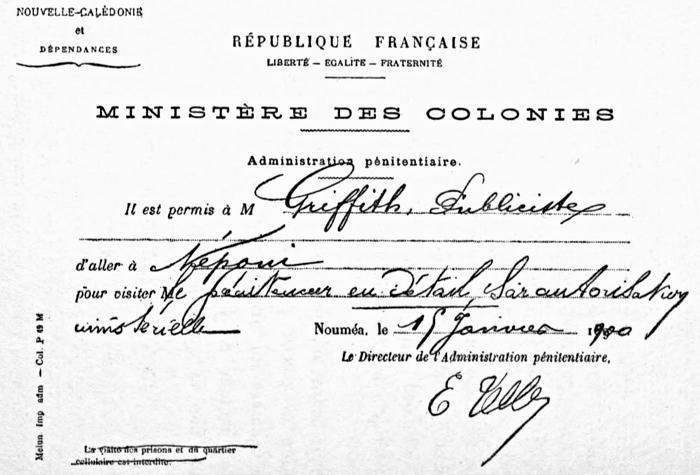
Permit to visit a Prison or Penitentiary Camp en détail. This is the ordinary form; but the Author is the only Englishman for whom the words in the left-hand corner were crossed out.
There is quite a little romance connected with this estimable family. When Madame came out she brought her two daughters with her. Now the elder of these had been engaged to a young man employed at the Ministry of Colonies, and he entered the colonial service by accepting a clerkship at Noumea. The result was naturally a meeting, and the fulfilment of the proverb which says that an old coal is easily rekindled. The engagement broken off by the conviction was renewed, and the wedding followed in due course. The second daughter married a prosperous concessionnaire, and the ex-coiner, well established, and making plenty of properly minted money, has the satisfaction of seeing the second generation of his blood growing up in peace and plenty about him. Imagine such a story as this being true of an English coiner!
A little further on, on the left hand side, is a little lending library, and cabinet de lecture. This is kept by a very grave and dignified-looking man, clean-shaven, and keen-featured, and with the manners of a French Chesterfield. “That man’s a lawyer,” I said to the Commandant, as we left the library. “What is he doing here?”
“You are right. At least, he was a lawyer once, doing well, and married to a very nice woman; but he chose to make himself a widower, and that’s why he’s here. The old story, you know.”
Next door was a barber’s shop kept by a most gentle-handed housebreaker. He calls himself a “capillary artist,” shaves the officials and gendarmerie, cuts the hair of the concessionnaires, and sells perfumes and soaps to their wives and daughters. He also is doing well.
A few doors away from him a liberé has an establishment which in a way represents the art and literature of Bourail. He began with ten years for forgery and embezzlement. Now he takes photographs and edits, and, I believe, also writes the Bourail Indépendent. As a newspaper for ex-convicts and their keepers, the title struck me as somewhat humorous.
Nearly all branches of trade were represented in that little street. But these may be taken as fairly representative samples of the life-history of those who run them. First, crime at home; then transportation and punishment; and then the effort to redeem, made in perfect good faith by the Government, and, so far as these particular camps and settlements are concerned, with distinct success in the present.
Unhappily, however, the Government is finding out already that free and bond colonists will not mix. They will not even live side by side, wherefore either the whole system of concessions must be given up, or the idea of colonising one of the richest islands in the world with French peasants, artisans, and tradesmen must be abandoned.
Later on in the afternoon we visited the Convent, which is now simply a girls’-school under the charge of the Sisters of St. Joseph de Cluny. A few years ago this convent was perhaps the most extraordinary matrimonial agency that ever existed on the face of the earth. In those days it was officially styled, “House of Correction for Females.” The sisters had charge of between seventy and eighty female convicts, to some of whom I shall be able to introduce you later on in the Isle of Pines, and from among these the bachelor or widower convict, who had obtained his provisional release and a concession, was entitled to choose a bride to be his helpmeet on his new start in life. The method of courtship was not exactly what we are accustomed to consider as the fruition of love’s young or even middle-aged dream.
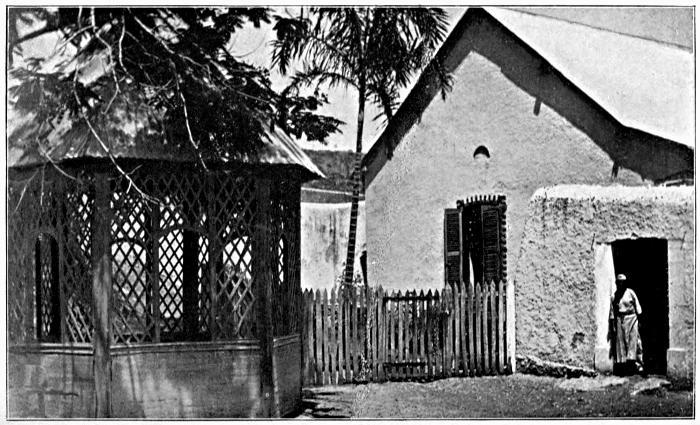
The Kiosk in which the Convict Courtships were conducted at Bourail.
After Mass on a particular Sunday the prospective bridegroom was introduced to a selection of marriageable ladies, young and otherwise. Of beauty there was not much, nor did it count for much. What the convict-cultivator wanted, as a rule, was someone who could help him to till his fields, look after live-stock, and get in his harvests.
When he had made his first selection the lady was asked if she was agreeable to make his further acquaintance. As a rule, she consented, because marriage meant release from durance vile. After that came the queerest courtship imaginable.
About fifty feet away from the postern door at the side of the Convent there still stands a little octagonal kiosk of open trellis-work, which is completely overlooked by the window of the Mother Superior’s room. Here each Sunday afternoon the pair met to get acquainted with each other and discuss prospects.
Meanwhile the Mother Superior sat at her window, too far away to be able to hear the soft nothings which might or might not pass between the lovers, but near enough to see that both behaved themselves. Along a path, which cuts the only approach to the kiosk, a surveillant marched, revolver on hip and eye on the kiosk ready to respond to any warning signal from the Mother Superior.
As a rule three Sundays sufficed to bring matters to a happy consummation. The high contracting parties declared themselves satisfied with each other, and the wedding day was fixed, not by themselves, but by arrangement between those who had charge of them.
Sometimes as many as a dozen couples would be turned off together at the mairie, and then in the little church at the top of the market-place touching homilies would be delivered by the good old curé on the obvious subject of repentance and reform. A sort of general wedding feast was arranged at the expense of the paternal Government, and then the wedded assassins, forgers, coiners, poisoners, and child-murderers went to the homes in which their new life was to begin.
This is perhaps the most daring experiment in criminology that has ever been made. The Administration claimed success for it on the ground that none of the children of such marriages have ever been convicted of an offence against the law. Nevertheless, the Government have most wisely put a stop to this revolting parody on the most sacred of human institutions, and now wife-murderers may no longer marry poisoners or infanticides with full liberty to reproduce their species and have them educated by the State, to afterwards take their place as free citizens of the colony.
The next day we drove out to the College of the Marist Brothers. It is really a sort of agricultural school, in which from seventy to eighty sons of convict parents are taught the rudiments of learning and religion and the elements of agriculture.
During a conversation with the Brother Superior I stumbled upon a very curious and entirely French contradiction. I had noticed that families in New Caledonia were, as a rule, much larger than in France, and I asked if these were all the boys belonging to the concessionnaires of Bourail.
“Oh no!” he replied; “but, then, you see, we have no power to compel their attendance here. We can only persuade the parents to let them come.”
“But,” I said, “I understood that primary education was compulsory here as it is in France.”
“For the children of free people, yes,” he replied regretfully, and with a very soft touch of sarcasm, “but for these, no. The Administration has too much regard for the sanctity of parental authority.”
When the boys were lined up before us in the playground I saw about seventy-six separate and distinct reasons for the abolition of convict marriages. On every face and form were stamped the unmistakable brands of criminality, imbecility, moral crookedness, and general degeneration, not all on each one, but there were none without some.
Later on I started them racing and wrestling, scrambling and tree-climbing for pennies. They behaved just like monkeys with a dash of tiger in them, and I came away more convinced than ever that crime is a hereditary disease which can finally be cured only by the perpetual celibacy of the criminal. Yet in Bourail it is held for a good thing and an example of official wisdom that the children of convicts and of freemen shall sit side by side in the schools and play together in the playgrounds.
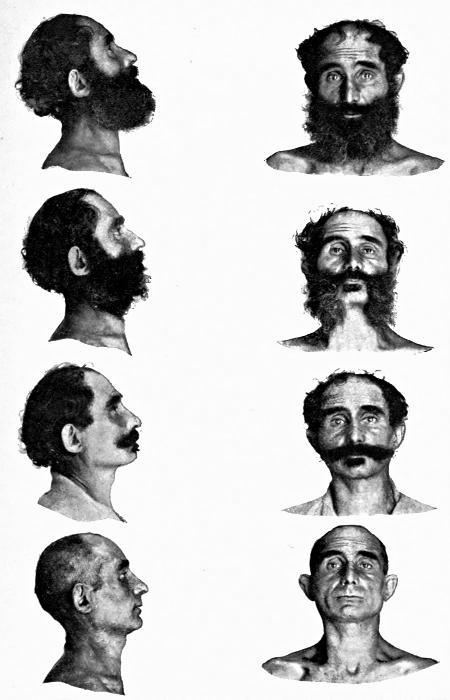
Berezowski, the Polish Anarchist who attempted to murder Napoleon III. and the Tsar Alexander II. in the Champs Elysées. All Criminals in New Caledonia are photographed in every possible hirsute disguise; and finally cropped and clean shaven.
By permission of C. Arthur Pearson, Ltd.
On our way home I was introduced to one of the most picturesque and interesting characters that I met in the colony. We pulled up at the top of a hill. On the right hand stood a rude cabin of mud and wattles thatched with palm-leaves, and out of this came to greet us a strange, half-savage figure, long-haired, long-bearded, hairy almost as a monkey on arms and legs and breast, but still with mild and intelligent features, and rather soft brown eyes, in which I soon found the shifting light of insanity.
Acting on a hint the Commandant had already given me, I got out and shook hands with this ragged, shaggy creature, who looked much more like a man who had been marooned for years on a far-away Pacific Island, than an inhabitant of this trim, orderly Penal Settlement. I introduced myself as a messenger from the Queen of England, who had come out for the purpose of presenting her compliments and inquiring after his health.
This was the Pole Berezowski, who more than thirty years ago fired a couple of shots into the carriage in which Napoleon III. and Alexander II. were driving up the Champs Elysées. He is perfectly harmless and well-behaved; quite contented, too, living on his little patch and in a world of dreams, believing that every foreigner who comes to Bourail is a messenger from some of the crowned heads of Europe, who has crossed the world to inquire after his welfare. Through me he sent a most courteous message to the Queen, which I did not have the honour of delivering.
That night the storm-clouds came over the mountains in good earnest, and I was forced to abandon my intention of returning to Noumea by road, since the said road would in a few hours be for the most part a collection of torrents, practically impassible, to say nothing of the possibility of a cyclone. There was nothing more to be seen or done, so I accepted the Commandant’s offer to drive me back to the port.
On the way he told me an interesting fact and an anecdote, both of which throw considerable light upon the convict’s opinion of the settlement of Bourail.
The fact was this: There are in New Caledonia a class of convicts who would be hard to find anywhere else. These are voluntary convicts, and they are all women. A woman commits a crime in France and suffers imprisonment for it. On her release she finds herself, as in England, a social outcast, with no means of gaining a decent living. Instead of continuing a career of crime, as is usually the case here, some of these women will lay their case before the Correctional Tribunal, and petition to be transported to New Caledonia, where they will find themselves in a society which has no right to point the finger of scorn at them.
As a rule the petition is granted, plus a free passage, unless the woman has friends who can pay. Generally the experiment turns out a success. The woman gets into service or a business, or perhaps marries a liberé or concessionnaire, and so wins her way back not only to respectability as it goes in Caledonia, but sometimes to comfort and the possession of property which she can leave to her children.
As a matter of fact, the proprietress of the little hotel at the port was one of these women. She had come out with a few hundred francs that her friends had subscribed. She now owns the hotel, which does an excellent business, a freehold estate of thirty or forty acres, and she employs fifteen Kanakas, half a dozen convicts, and a Chinaman—who is her husband, and works harder than any of them.
The anecdote hinged somewhat closely on the fact, and was itself a fact.
There is a weekly market at Bourail, to which the convict farmers bring their produce and such cows, horses, calves, etc., as they have to sell. Every two or three years their industry is stimulated and rewarded by the holding of an agricultural exhibition, and, as a rule, the Governor goes over to distribute the prizes. One of these exhibitions had been held, I regret to say, a short time before my arrival, and the Governor who has the work of colonisation very seriously at heart, made speeches both appropriate and affecting to the various winners as they came to receive their prizes.
At length a hoary old scoundrel, who had developed into a most successful stock-breeder, and had become quite a man of means, came up to receive his prizes from his Excellency’s hands. M. Feuillet, as usual, made a very nice little speech, congratulating him on the change in his fortunes, which, by the help of a paternal government, had transformed him from a common thief and vagabond to an honest and prosperous owner of property.
So well did his words go home that there were tears in the eyes of the reformed reprobate when he had finished, but there were many lips in the audience trying hard not to smile when he replied:
“Ah, oui, mon Gouverneur! if I had only known what good chances an unfortunate man has here I would have been here ten years before.”
What his Excellency really thought on the subject is not recorded.
The hotel was crowded that night for the steamer was to sail for Noumea, as usual, at five o’clock in the morning; but as Madame was busy she was kind enough to give up her own chamber to me; and so I slept comfortably to the accompaniment of a perfect bombardment of water on the corrugated iron roof. Others spread themselves on tables and floors as best they could, and paid for accommodation all the same.
By four o’clock one of those magical tropic changes had occurred, and when I turned out the moon was dropping over the hills to the westward, and Aurora was hanging like a huge white diamond in a cloudless eastern sky. The air was sweetly fresh and cool. There were no mosquitos, and altogether it was a good thing to be alive, for the time being at least.
Soon after the little convict camp at the port woke up. We had our early coffee, with a dash of something to keep the cold out, and I made an early breakfast on tinned beef and bread—convict rations—and both very good for a hungry man. Then came the news that the steamboat La France had tied up at another port to the northward on account of the storm, and would not put in an appearance until night, which made a day and another night to wait, as the coast navigation is only possible in daylight.
I naturally said things about getting up at four o’clock for nothing more than a day’s compulsory loafing, but I got through the day somehow with the aid of some fishing and yarning with the surveillants and the convicts, one of whom, a very intelligent Arab, told me, with quiet pride, the story of his escape from New Caledonia twelve years before.
He had got to Australia in an open boat, with a pair of oars, the branch of a tree for a mast and a shirt for a sail. He made his way to Europe, roamed the Mediterranean as a sailor for nine years, and then, at Marseilles, he had made friends with a man who turned out to be a mouchard. This animal, after worming his secret out of him under pledge of eternal friendship, earned promotion by giving him away, and so here he was for life.
He seemed perfectly content, but when I asked him what he would do with that friend if he had him in the bush for a few minutes, I was answered by a gleam of white teeth, a flash of black eyes, and a shake of the head, which, taken together, were a good deal more eloquent than words.
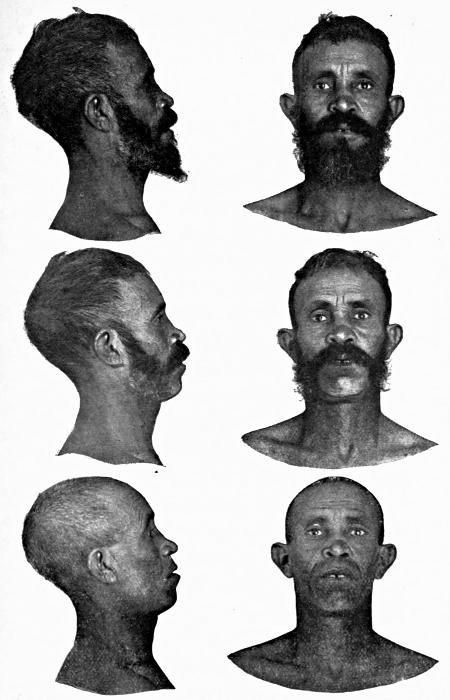
One of the Lowest Types of Criminal Faces. An illustration of the ease with which it is possible to disguise the chin, typical of moral weakness, and the wild-beast mouth, which nearly all Criminals have, by means of moustache and beard.
By permission of C. Arthur Pearson, Ltd.
La France turned up that afternoon, so did the Commission of Inspection from Bourail with several other passengers. I was told that we should be crowded, but until I got on board in the dawn of the next morning I never knew how crowded a steamer could be.
I had travelled by many crafts under sail and steam from a south sea island canoe to an Atlantic greyhound, but never had the Fates shipped me on board such a craft as La France. She was an English-built cargo boat, about a hundred and thirty feet long, with engines which had developed sixty horse-power over twenty years ago. She had three cabins on each side of the dog-kennel that was called the saloon.
If she had been allowed to leave an English port at all she would have been licensed to carry about eight passengers aft and twenty on deck. On this passage she had twelve first-class, about fifteen second, and between fifty and sixty on deck, including twenty convicts and relégués on the forecastle, and a dozen hard cases in chains on the forehatch.
She also carried a menagerie of pigs, goats, sheep, poultry, geese, and ducks, which wandered at their own will over the deck-cargo which was piled up to the tops of her bulwarks. Her quarter-deck contained about twenty square feet, mostly encumbered by luggage. The second-class passengers had to dine here somehow. The first-class dined in the saloon in relays.
The food was just what a Frenchman would eat on a Caledonian coast-boat. It was cooked under indescribable conditions which you couldn’t help seeing; but for all that the miserable meals were studiously divided into courses just as they might have been in the best restaurant in Paris.
Everything was dirty and everything smelt. In fact the whole ship stank so from stem to stern that even the keenest nose could not have distinguished between the smell of fried fish and toasted cheese. The pervading odours were too strong. Moreover, nearly every passenger was sick in the most reckless and inconsiderate fashion; so when it came to the midday meal I got the maître d’hôtel, as they called the greasy youth who acted as chief steward, to give me a bottle of wine, a little tin of tongue, and some fairly clean biscuits, and with these I went for’rard on to the forecastle and dined among the convicts.
The forecastle was high out of the water, and got all the breeze, and the convicts were clean because they had to be. I shared my meal and bread and wine with two or three of them. Then we had a smoke and a yarn, after which I lay down among them and went to sleep, and so La France and her unhappy company struggled and perspired through the long, hot day back into plague-stricken Noumea. When I left La France I cursed her from stem to stern, and truck to kelson. If language could have sunk a ship she would have gone down there and then at her moorings; but my anathemas came back upon my own head, for the untoward Fates afterwards doomed me to make three more passages in her.
To get clean and eat a decent dinner at the Cercle was something of a recompense even for an all-day passage in La France. But it is not a very cheerful place to come back to, for the shadow of the Black Death was growing deeper and deeper over the town. The plague was worse than ever. The microbe had eluded the sentries and got under or over the iron barriers, and was striking down whites and blacks indiscriminately, wherefore I concluded that Noumea was a very good place to get out of, and, as I thought, made my arrangements for doing so as quickly as possible.
VII THE PLACE OF EXILES
My next expedition was to include the forest camps to the south-west of the island, and a visit to the Isle of Pines, an ocean paradise of which I had read much in the days of my youth; wherefore I looked forward with some anticipation to seeing it with the eyes of flesh. There would be no steamer for three or four days, so the next day I took a trip over to the Peninsula of Ducos, to the northward of the bay.
The glory of Ducos as a penal settlement is past. There are now only a few “politicals,” and traitors, and convicts condemned a perpétuité; that is to say, prisoners for life, with no hope of remission or release. A considerable proportion of them are in hospital, dragging out the remainder of their hopeless days, waiting until this or the other disease gives them final release.
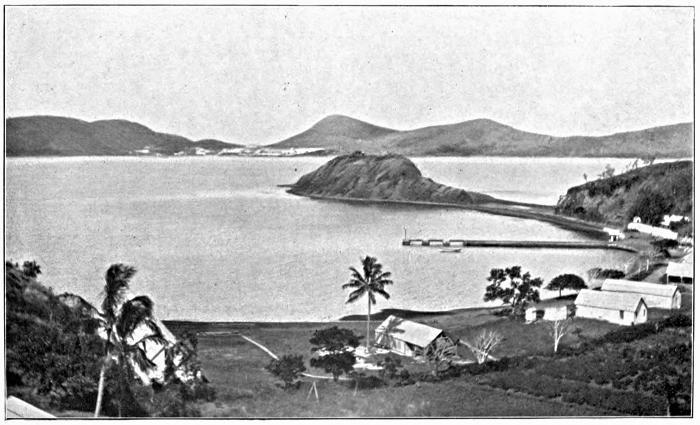
The Peninsula of Ducos. In the background is Ile Nou with the Central Criminal Depôt.
On another part of the peninsula, in a semi-circular valley, hemmed in by precipitous hills, there is a piteously forlorn colony, that of the liberés collectifs; that is to say, convicts who have been released from prison, but are compelled to live in one place under supervision. They are mostly men whose health has broken down under the work of the bagne, or who have been released on account of old age.
They live in wretched little cabins on the allotments, which it is their business to keep in some sort of cultivation. They have the poor privileges of growing beards and moustaches if they like, and of wearing blue dungaree instead of grey, and of earning a few pence a week by selling their produce to the Administration.
This is not much, but they are extremely proud of it, and hold themselves much higher than the common forçat. They do not consider themselves prisoners, but only “in the service of the Administration.” I have seldom, if ever, seen a more forlorn and hopeless collection of human beings in all my wanderings.
There was, however, a time when Ducos was one of the busiest and most important of the New Caledonian Settlements, for it was here that the most notorious and most dangerous of the communards were imprisoned after their suppression in 1872. Here lived Louise Michel, the high-priestess of anarchy, devoting herself to the care of the sick and the sorrowing with a self-sacrifice which rivalled even that of the Sisters of Mercy, and here, too, Henri Rochefort lived in a tiny stone house in the midst of what was once a garden, and the delight of his days of exile.
Louise Michel’s house has disappeared in the course of improvements. Rochefort’s house is a roofless ruin in the midst of a jungle which takes a good deal of getting through. It was from here that he made his escape with Pain and Humbert and two other communards in an English cutter, which may or may not have been in the harbour for that particular purpose.
One night they did not turn up to muster, but it was explained that Rochefort and Humbert had gone fishing, and the others were away on a tour “with permission.” As they did not return during the night search-parties were sent out for them. Meanwhile, they had kept a rendezvous at midnight with the cutter’s boat and got aboard.
The next day was a dead calm; and, as the cutter lay helpless at her anchor, the fugitives concealed themselves about her cargo as best they could. The hue and cry was out all over the coast, but the searchers looked everywhere but just the one place where they were. If the next day had been calm they must have been caught, for the authorities had decided on a thorough search of every vessel in the harbour. Happily for them a breeze sprang up towards the next morning, and the cutter slipped quietly out. Once beyond the outward reef the fugitives were in neutral water, and, being political prisoners, they could not be brought back.
By daylight the truth was discovered, but pursuit was impossible. The cutter had got too long a start for any sailing vessel to overtake her in the light wind, and the only steamer which the administration then possessed had gone away to Bourail to fetch back the Governor’s wife. If it had been in the harbour that morning, at least one picturesque career might have been very different. MacMahon was President at the time, and of all men on earth he had the most deadly fear of Rochefort, so he took a blind revenge for his escape by ordering the Governor to expel every one who was even suspected of assisting in the escape.
The story was told to me by one who suffered through this edict quite innocently, and to his utter ruin. He was then one of the most prosperous men in Noumea. He owned an hotel and several stores, and had mail and road-making contracts with the government. Unhappily, one of his stores was on the Peninsula of Ducos, and the man who managed it was reputed to be very friendly with Rochefort.
This was enough. He was ordered to clear out to Australia in two months. It was in vain that he offered himself for trial on the definite charge of assisting a prisoner to escape. The Governor and every one else sympathised deeply with him, but they dare not even be just, and out he had to go. He is now canteen-keeper on the Isle of Pines, selling groceries and drink to the officials and relégués at prices fixed by the government. He told me this story one night at dinner at his own table.
The general amnesty of 1880 released Louise Michel and the rest of those who had survived the terrible revolt of 1871 from Ducos and the Isle of Pines.
There are, however, two other celebrities left on Ducos. One of them is a tall, erect, grizzled Arab, every inch a chieftain, even in his prison garb. This is Abu-Mezrag-Mokrani, one of the leaders of the Kabyle insurrection of 1871, a man who once had fifteen thousand desert horsemen at his beck and call. Now he rules a little encampment in one of the valleys of the peninsula, containing forty or fifty of his old companions-in-arms, deported with him after the insurrection was put down.
When the Kanaka rebellion broke out in New Caledonia in 1878, Abu-Mezrag volunteered to lead his men against the rebels in the service of France. The offer was accepted and the old warriors of the desert acquitted themselves excellently among the tree-clad mountains of “La Nouvelle.” When the rebellion was over a petition for their pardon was sent to the home government, but the remnant of them are still cultivating their little patches of ground on Ducos.
The other surviving celebrity is known in Caledonia as the Caledonian Dreyfus, and this is his story:
In 1888 Louis Chatelain was a sous-officier of the line stationed in Paris. He was dapper, good-looking, and a delightful talker. He engaged the affections of a lady whose ideas as to expenditure were far too expansive to be gratified out of the pay of a sous-officier. Poor Chatelain got into debt, mortgaged or sold everything that he had, and still the lady was unsatisfied. Finally, after certain recriminations, and when he had given her everything but his honour, she suggested a means by which he could make a fortune with very little trouble. She had, it appears, made the acquaintance of a gentleman who knew some one connected with a foreign army, who would give twenty thousand francs for one of the then new-pattern Lebel rifles.
He entered into correspondence with the foreign gentleman, addressing him—c/o the —— Embassy, Paris. His letters were stopped, opened, photographed, and sent on. So were the replies. Then the negotiations were suddenly broken off, Chatelain was summoned before the military tribunal and confronted with the pièces de conviction. He confessed openly, posing as a martyr to la grande passion—and his sentence was deportation for life.
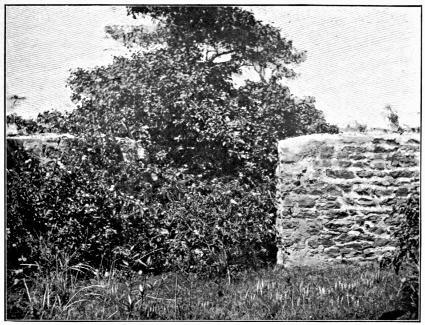
The remains of Henri Rochefort’s House.
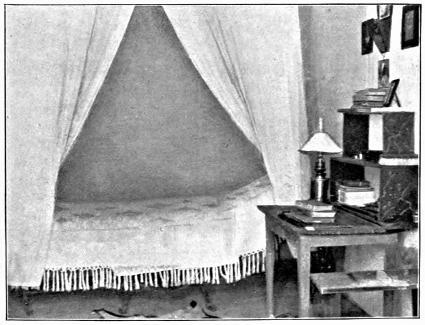
The Bedroom of Louis Chatelain, “The Caledonian Dreyfus” in Ducos. The photographs on the wall and the one on the table are those of the woman who ruined him.
When I went into his little sleeping-room at Ducos, I found on a little table beside his mosquito-curtained bed, a photograph of a very good-looking young woman. On the wall above the table there were two others of the same enchantress, the evil genius of his life. The moment he fell she deserted him. Unlike many another Frenchwoman, who has done so for lover or husband, she did not follow him across the world to Caledonia, and yet every night and morning of his life Louis Chatelain kneels down in front of that table as he might before an altar, and says his prayers with his eyes on those photographs.
VIII A PARADISE OF KNAVES
For the next three or four days after my visit to the Peninsula of Ducos there was nothing definite to be learnt about means of transit. In fact there was nothing certain except the plague—always that Spectre which seemed to stand at the end of every pathway. It was really getting quite monotonous, and I was beginning to wonder whether I should ever get out of Noumea at all.
Then I began making inquiries as to an over-land journey through the interior. No, that was impossible, save at great risk and expense. The Spectre had jumped the mountains. Huge armies of rats had appeared in the bush, just as though some Pied Piper of Hamelin had enticed them away from the towns into the mountains, and they were spreading the plague in all directions among the Kanakas.
It is a curious fact that rats, who of all animals are the most susceptible to the plague, will migrate from a plague-stricken town just as they will try to escape from a sinking ship.
Convicts and Kanakas were dying in unknown numbers. Camps were being closed, and the rains were coming on. There was nothing to be seen or done worth seeing or doing, so I had to content myself with wandering about Noumea and the neighbourhood, taking photographs, making acquaintances with convicts and liberés and getting stories out of them, wondering the while, as every one else was doing, what the Spectre was going to do next.
As far as I was concerned, he did me the unkindest turn that he could have done, save one. He infected the only two decent boats on the Coast Service, and so left me the choice between voyaging to the Isle of Pines in La France or stopping where I was.
I had to get to the island somehow, so I chose La France, and at five o’clock one morning, after being duly inspected and squirted, I once more boarded the detestable little hooker.
I thought my first passage in her was bad enough, but it was nothing to this. She was swarming with passengers, bond and free, black, white, and yellow, from end to end. She was loaded literally down to the deck, and she smelt, if possible, even stronger than she did before. The worst of this was that before we got to the Isle of Pines we had to get outside the reef and into the open water.
I have seen too much of seafaring to be easily frightened on salt water, but I candidly admit that I was frightened then. In fact, when we got outside and she began to feel the swell, I took out my swimming-jacket and put it on, though, of course this was a pretty forlorn hope, as the water was swarming with sharks and the shortest swim would have been a couple of miles. Still, one always likes to take the last chance.
Happily, she was English-built, and high in the bows, so she took nothing but spray over. Two or three green seas would have swamped her to a certainty, but they didn’t come, and so in time we got there.
On board I renewed the acquaintance of the Commandant of Ile Nou, who was taking his wife and family to the Isle of Pines, which is to Caledonia as the Riviera is to Europe. At midday we stopped at Prony, the headquarters of the forest camps which I was to visit later on my return; and we lunched in the saloon with six inches of water on the floor. That was the first time I ever saw a steamer baled out with buckets. Still, they managed to get the water under somehow. There didn’t appear to be a pump on board.
When we passed the reef, and started on the sixty-mile run through the open sea, some began to say their prayers and some said other things, but in the end we worried through, and just as the evening star was growing golden in the west we anchored in the lovely little Bay of Kuto.
Never before had I heard the anchor chain rumble through the hawse-hole with greater thankfulness than I did then, and, judging by the limp and bedraggled look of every one, bond and free, who went ashore, I don’t think I was alone in hoping that I had seen the last of La France—which I hadn’t.
My friend the Commandant introduced me to his confrère of the Isle of Pines. He was not particularly sympathetic. I believe I was the only Englishman who had ever come to the island with authority to inspect his domains, and he didn’t take very kindly to the idea. Still, ruler and all as he was in his own land, the long arm of the Minister of Colonies reached even to the Isle of Pines, and, although he did not even offer me the usual courtesy of a glass of wine, he handed the credentials back to me, and said:
“Très bien, monsieur! If you will come and see me at nine o’clock to-morrow morning we will make arrangements. You will, I think, find accommodation at the canteen.”
With that I took my leave, and went out into the darkness to find the canteen and some one to carry my luggage there. I found a surveillant, who found a relégué, and he shouldered my bag and found the canteen, the only semblance of an hotel on the island.
There, quite unknowingly, I stumbled upon excellent friends. The canteen-keeper was the man whose story I told in the last chapter. I was a stranger from a very strange land. Their resources are very limited; for communications with the grand terre were few and far between, and yet the twenty days that I was compelled to stop on the Isle of Pines, proved after all to be the pleasantest time that I had spent in New Caledonia.
But there was one exception, happily only a transient experience, yet bad enough in its way. If the plague was not on board La France it ought to have been, for never did a fitter nursery of microbes get afloat, and when I got into the wretched little bedroom, which was all they could fix up for me that night, I honestly believed that the little wriggling devil had got into the white corpuscles of my blood.
I had all the symptoms with which the conversation of the doctors at the Cercle in Noumea had made me only too familiar—headache, stomachache, nausea, dizziness, aching under the armpits and in the groins.
Of course, I was about as frightened as an ordinary person could very well be, a great deal more so in fact than I had been a few years before when I first experienced the sensation of being shot at. It may have been the fright or the fact, but the glands were swelling.
Then I caught myself repeating fragments of “Abide with me,” mixed up with Kipling’s “Song of the Banjo”; and when a lucid interval came I decided that the case was serious.
I had three things with me which no traveller in the outlands of the world should be without—quinine, chlorodyne, and sulpholine lotion. I took a big dose of quinine, and then one of chlorodyne. I should be afraid to say how big they were. Then I soaked four handkerchiefs in the lotion, put them where they were wanted, and laid down to speculate as to what would happen if the microbe had really caught me?
I had an appointment with the Commandant at nine o’clock the next morning. His house was more than a mile away. What would happen if I couldn’t walk in the morning?
I should have to explain matters, if I were still sane, to the people at the canteen. I had just come from Noumea, the very centre of the plague. The inference would be instant. The military doctor in charge of the hospital would be sent for, and he would say la Peste. I should be taken to the hospital, where, a day or two after, I saw a man suspected of the plague die of blood-poisoning, and once there—quien sabe?
Thinking this and many other incongruously mixed-up things, I went to sleep. Probably it was only a matter of a few minutes altogether. Nine hours after I woke and thought I was in heaven. The pains and the deadly fear were gone. I pulled my watch out from under my pillow. It was ten minutes to seven. The light was filtering in through the closely shut persiennes. The waves on the silver-sanded beach within a few yards of my bedroom were saying as plainly and seductively as waves ever said:
“Come and have a dip, and wash all that plague nonsense out of your head.”
So I got up, opened the window, put on my deck-shoes, and walked down to the beach.
I could walk! Out of hell I had come back to earth. A few hours before I had really believed that the next dawn would be shadowed by the presence of the Black Death. Now I looked up at the sapphire sky, and threw my hands above my head to make sure that the pains in the armpits were gone. Then I stepped out to the full length of my stride along the smooth, hard coral sand, to see if the groins were right.
Having reached a decent distance from the canteen I rolled into the cool, bright, blue water, and for half an hour I splashed around—not daring to go much beyond my depth, because those same blue waters are often cut by the black triangle of a shark’s dorsal fin—thinking how good a thing it was to live instead of dying, especially in such a paradise as this.
When I paid my official visit after breakfast, I found M. le Commandant in a more friendly mood. We exchanged cigarettes and compliments, and then we had a stroll round the little settlement of Kuto.
Kuto is most exquisitely situated on a promontory between two delicious, white-shored, palm-fringed bays, broken with fantastic, tree-crowned rocks. Long ago it was the home of the “politicals” and those soldiers of the Commune who had not been thought dangerous enough to be put in batches against a wall and shot. In those days Kuto, so they told me, might have been taken for a tiny suburb of Paris. It had a theatre, and a couple of newspapers, one serious and one humorous. There were social functions and many gaieties in the intervals of road-making and barrack-building.
But nowadays all this is changed. The deportés have gone back to France, and the relégués have come in their place, which is the same thing as saying that over this lovely scrap of earth there has descended the moral night of incurable crime and hopeless despair. Kuto is now a silent place of prisons, barracks, and workshops, inhabited by a few soldiers and officials and many blue-clad figures with clean-shaven faces, mostly repulsive to look upon and all stamped with the seal of stolid despair.
In order that you may understand what manner of people these were it is necessary to explain the meaning of the French legal term relégation, since there is nothing at all corresponding to it in the English system.
In France, as in all countries, there are criminals of many kinds and ranks, and of these the French relégués are the lowest and meanest. I have said before that in the criminal society of New Caledonia the assassins, forgers, embezzlers, and what we should call swell-mobsmen form the aristocracy. The relégués are the lowest class. They are the gutter-snipes of crime; the hard cases; the human refuse beyond all hope of social salvation; mental and moral derelicts, of no use to themselves or anybody else.
We have thousands of them in this country, but we don’t deal as wisely or as humanely with them as the French do. Our judges and magistrates send them to prison again and again, well knowing that they will only come out to commit more crimes and be sent again to prison, becoming in the intervals of liberty the wives and husbands and parents of other criminals.
This is one of the social problems which they deal with better in France. There is no nonsense there about a criminal “having paid his debt to society” when he has served his sentence, and being, therefore, free to go and commit more crimes. When a man or woman has committed a certain number of crimes of the minor sort, or has been convicted of hopeless immorality or alcoholism—in other words, when there is reason to believe that he or she is absolutely unfit to possess the rights of citizenship—such person may be, in the last resort, sentenced as in England, say, to twelve or eighteen months’ hard labour as punishment for that particular crime.
Now in an English police-court the habitual criminal might possibly thank the magistrate and go away to “do it on his head,” but in France he may hear the fatal words:
“At the expiration of your sentence you will be placed in relégation.”
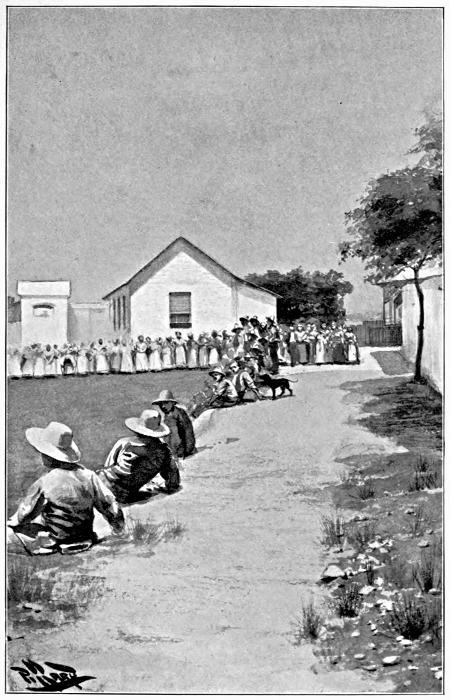
The “Market” in the Convent, Isle of Pines. The Female Réliqués are drawn up before one of the Prison Buildings. In the foreground are the Kanakas waiting to sell their fruit and vegetables.
Drawn by Harold Piffard from a photograph.
Of this the meaning is: “You have proved yourself unfit to live in the society of your fellow-citizens. Punishment is no warning to you. You will neither reform yourself nor be reformed; therefore Society has done with you: you are banished! You will be fed and clothed and attended when you are sick. You will have work found for you, and you will be paid for it. But if you won’t work there will be the prison and the cell for you. Now go, and make the best of it.”
The banishment is practically for life. There are circumstances under which a relégué can win his release, but there are two things that he can never do: he can never gain a concession and marry and settle down on his own property; and he can never gain restoration of the full rights of citizenship—both of which, as I have shown, the forçat can do.
As we drove out through the big gate in the wall which had been built across the neck of the peninsula to keep revolting Kanakas out, I remarked what a pity it was that such a lovely land should be nothing better than the habitation of scoundrels, to which the Commandant replied that the island served the purposes of the Administration very well, and if the relégués were not there it would have to be given over to the Kanakas, for free colonists would not come.
I thought—but, of course, I didn’t say—what British colonists would have made of such a paradise—fertile, well-watered, and blest with an absolutely perfect climate.
The first thing I noticed in the Isle of Pines was the excellence and extent of the roads. They are broad, level, and beautifully kept, and, tiny as the island is, there are many more miles of them than there are in all New Caledonia. They were mostly made by the deported communards, who also built the solid stone prisons, barracks, hospitals, chapels, and official residences which seemed to me to be ample for about twice the present white population of the island, which is under two thousand, bond and free.
I found very little difference between the treatment of the relégués and the best class of convicts, save that they were rather better fed, and lived in open camps. They slept in hammocks in common dormitories, and were permitted to have any little luxuries that they could buy with their earnings. There were no plank-beds or chains to be seen in the camps. In fact, they might just have been ordinary industrial settlements, save for the blue cotton livery, the bandless straw hats, and the hang-dog, hopeless faces which looked out under the brims.
But before our first drive was half over we passed a big quadrangle of high, white walls, and over the little black door in front was the word “Prison” in big black letters.
“That’s for the hard cases, I suppose?” I said to the Commandant as we passed.
“Yes,” he said; “we will visit it another day, and you shall see. This is worse than Ile Nou, you know. There they have the aristocrats. Here we have the canaille, the sweepings of the streets. Any one of these animals here would cut your throat for a few francs if he dare.”
Then I told him what the Commandant of Bourail had said about locking doors.
He laughed, and said:
“Parfaitement, but you had better lock your door here, and if you have a revolver put it under your pillow.”
The advice was well-meant but somewhat superfluous. The faces I had seen were quite enough. I soon found that my friend was somewhat of a cynic and a humorist in his way, for when I asked him what was the greatest punishment he could inflict on a recalcitrant relégué, he said:
“Make him work. Look at that gang of men yonder,” he went on, pointing to the hillside, which a long row of blue-clad figures was breaking up with picks and spades. “Every stroke of the pick is a punishment to those men. They are wretches whose only idea of life is to get through it without working. They have been thieves and swindlers, beggars and souteneurs—everything that is useless and vile. There is nothing they have not done to save themselves from working. Now, you see, we make them work.”
“And if they won’t?”
“Eh bien! They have stomachs—and soup and fish and meat and coffee and a drink of wine now and then, with a cigarette or a pipe, are better than bread and water, and the open air in a country like this is better than the black cell or the quartier disciplinaire, which you will see later on.”
“In other words,” I said, “you have gone back to the good old law: If a man will not work, neither shall he eat. Well, I must admit that you deal more sensibly with your hopeless vagabonds than we do with ours.”
“Bien possible,” he said, with some justification, “you will see that at least we make some use of them, more than they would in Paris or London, I think. For instance, this is our farm.”
As he said this we pulled up opposite to a rustic arch, over which were the words Ferme Uro.
We went down through a flowery avenue to a pretty verandahed house almost buried in greenery and flowers—the home of the Farm Superintendent. He came out and greeted his territorial lord, and then we went over the farm.
It was as perfect a specimen of what the French call petit culture as could be imagined. It was, in fact, rather a collection of exquisitely kept vegetable gardens than a farm. Every patch was irrigated by water from the low hills which run across the centre of the island. Every kind of vegetable, tropical and temperate, was under cultivation, and outside the gardens there were broad fields of maize and grass pasture.
In one of the fields I saw a long line of women hoeing the ridges for corn, and at one end of the line stood a white-clad surveillant, revolver on hip. For the fiftieth time my English prejudices were shocked when I learnt that these were a detachment of the female relégués; and I wondered what would be thought at home if the lady-guests at Aylesbury were turned out to work in the fields under the charge of a male warder. Here it was quite a matter of course.
“Wait till you have made the acquaintance of the ladies,” laughed the Commandant, in reply to a rather injudicious question, “and you will see that they want some watching.”
IX USE FOR THE USELESS
From the farm of Uro, after a drink of delicious milk, which, for some reason or other, took me back instantly to far-away England, we went on a few miles along the road to the ateliers, or workshops, where all kinds of industries, from boot-making to waggon-building, were being carried on in a somewhat leisurely style, and under what seemed to me very slight supervision.
“This is a hard school for them to learn and us to teach in,” said the Commandant. “The forçats generally know a trade and are accustomed to work, if they have not been gentlemen; but these have been brought up to hate the name of work. Yet you see we have made something of them. Everything that is used on the island is made here. In fact, we make something which will be used a long way from here.”
I saw this later on during our visit to the prison, which was too similar to the others to need any description. About a score of the occupants of a big shed within the walls were busy plaiting a long, reedy grass which others, squatted about the yard, were stripping and preparing for them. They had to get through so much a day or their rations were docked. The unhappy wastrels didn’t seem to like the regime at all, but they worked, if only for their stomachs’ sake.
When we left the prison we went to a long shed, where the plaits were being worked up into matting—miles of it there appeared to be—and when I asked what it was all for, I learnt that it was destined to be trodden by the millions of careless feet which would saunter through the halls and corridors of the Paris Exhibition.
This was the contribution of this far-away spot to the great show. Of course, those who were making it knew what it was for. Perhaps their thoughts—if they had any by this time, beyond their daily meat and drink, or any dreams of delight, beyond the little luxuries that their hard-earned pence could buy them at the canteen—were travelling even as they stitched back to the elysium of crime and idleness which they would never see again. From what I saw and heard I doubt not that many a bitter thought was woven in with the miles of matting which afterwards covered the exhibition floors.
The next day we went to make the acquaintance of the lady reléguées, who are accommodated in the Convent, as it is called, under the charge of a Mother Superior and six Sisters of St. Joseph, among whom I was a little surprised to find one who, learning that I was English, came and greeted me in a deliciously delicate Irish brogue. She was an Irish lady who had taken the vows in a French Convent, and had voluntarily exiled herself to this far-away foreign land to spend the rest of her days in a prison. Still, she and her French sisters appeared to be most cheerfully contented with their lot.
They had, however, one little trace of feminine vanity left. They sorely wanted their photographs taken, and my Irish compatriot wanted it most of all. It was against the rules not only of the Administration, but of their order, wherefore the photographs which I did take of the convent and its occupants did not turn out successes.
There were one hundred and seventy-six female reléguées in the Convent just then, mostly healthy, hearty-looking women of all ages, from twenty to sixty. Their faces were, if anything, more repulsive than the men’s. They had committed almost every possible crime, but most of them were there for infanticide. I was the first man—not an official—that they had seen, perhaps, for a good many years, for there are few visitors to the Isles of Pines, and fewer still to the jealously guarded Convent.
A little before dinner that evening I was sitting under the trees in front of the canteen jotting down some notes when I heard a voice, with a suspicion of tears in it, asking whether “monsieur would speak for a minute with an unfortunate woman.”
I turned round, and saw the gaunt figure and unlovely face of Marie, the reléguée housemaid of the canteen. Here was another human document, I thought, so I told her to go on.
She was in great trouble, she told me, and as I was a friend of the Government and of the Administration I could help her if I would. She had been released from the Convent to take service at the canteen, but though she was comfortable, and had a good master and mistress, her heart was pining for the society of her husband, who was working in enforced celibacy in far-away Bourail. They had been parted for a trifle, and she was sure that if “Milor” interceded for her with the Director she would be restored to his longing arms.
When she had finished, I said:
“And what was your husband sent out here for?”
“Il a éventré un homme,” she murmured.
“And what are you here for?” I continued.
“J’ai tué mon enfant,” she murmured again as softly as before.
I did not think the reunion desirable, and so the petition was not presented. Nevertheless, it would have probably been a very difficult matter to have convinced that woman that she hadn’t a perfect right to rejoin her husband, raise a family, and become with him a landed proprietor. I learnt afterwards that she had been relegated to the Isle of Pines for theft aggravated by assault with a hatchet.
Somehow the food that she handed round the table at the canteen that night didn’t taste quite as nice as usual, in spite of the conversation of Madame Blaise and her two charming daughters, the elder of whom, though she had never been farther into the world than Noumea, might, as far as grace of speech and action went, have just come out from Paris.
In the course of the next few days I wandered, sometimes in the Commandant’s carriage and sometimes afoot, all over the island, and ascended its only mountain, the Pic ’Nga, on the top of which there are the foundations of an old fort and look-out tower, dating back, so they say, to the old days of the pirates of the southern seas. From here you can see every bay and inlet round the coast, and a very lovely picture the verdant island made, fringed by its circlet of reefs and coral islets, with their emerald lagoons and white breakers, and the deep blue of the open ocean beyond.
Another day I went through the native reserve, and visited the settlement of the Marist Brothers, a most delightful little nook where the good brothers lead a contented existence, teaching their bronze scholars the beauties of the Catholic Faith, and the beneficence of the good French Government, which graciously permits them to live in a part of their own country, and sell their produce to the officials and such of their prisoners as have money à prix fixe.
After this I visited the coffee plantation—the only actually profitable industry in which prisoners are employed in New Caledonia—the hospitals and the disciplinary camps, which I found practically the same as those which I had already seen on the mainland.
The hospital was, however, an even more delightful abode of disease and crime than the one on Ile Nou. It stands well up the hillside behind the Convent, and the view from its terraces is one of the most beautiful I have ever seen. With the exception of the man who died of blood-poisoning under suspicion of the plague, the principal disease seemed general decay and old age. In fact, out of a criminal population of over twelve hundred, there were only thirty patients, for which reason the Isle of Pines, with its perfect climate, reminded me of Mark Twain’s Californian health resort, which was so healthy that the inhabitants had to go somewhere else to die.
Later on I saw a much more mournful place than the hospital. This was the Camp des Impotents.
I don’t think I ever saw a more miserable, forlorn-looking collection of human beings than I found here. They were not suffering from any specific disease, or else, of course, they would have been in the hospital. They are just mental and physical derelicts, harmless imbeciles, cripples incapable of work, and men dying quietly of old age.
Of course, the camp was exquisitely situated, and their lot struck me as being, after all, not a very bad ending to a useless, hopeless life—to dream away the last years under that lovely sun, breathing that delicious air, and waiting quietly for the end without anxiety or care.
The poor wretches looked at me somewhat as they might have looked at a visitor from some other world. They had ceased to be criminals or prisoners. They had no more crime left in them, and they would not have escaped if they could, so in their case discipline was relaxed and I spent a few francs in buying some of the rude carvings and a few walking-sticks which they had made out of lianes, the only work with which they whiled away the long sunny hours. It was worth twenty times the money to see their feeble, almost pitiful, delight as they looked at the little silver coins in their brown, shrivelled hands, and I really think that some at least of the blessings which followed me out of the camp were sincere. But when I said this to the Commandant he only smiled, and said:
“Perhaps! But no doubt they would like a visitor from England every day.”
A few days after I had finished my round of visits to the prison camps I had the privilege of assisting at a session of the Disciplinary Commission, a court whose function it is to hear complaints, grant redresses and privileges, try offences against the penal regulations, and inflict punishment. The Commandant is President, ex officio, and he is assisted by an officer of the Administration, who is a sort of civil magistrate and the Conductor of Works. These functionaries sit at a curved desk on a platform, and here, for the first time, I took my seat on a judicial bench.
There was a space of about twelve feet between the end of the platform and the railing which divided off the rest of the hall. Here the Principal Surveillant sat at one desk, and opposite to him on the other side of the room the Greffier or Clerk of the Court.
The court being a French one, precedence was, of course, given to the ladies. They were brought in one by one through a side door between the railings and the platform. The triviality of their complaints testified eloquently to the narrowness of the little lives they led.
One woman accused another of stealing her needle and thread so as to get her into trouble. Another wanted three halfpence of her savings, which she said the Mother Superior was unjustly keeping from her. A third wanted to know why she hadn’t had a letter from a friend of hers in service in Noumea, and was gravely informed that the plague had seriously interrupted communications and the letter would probably arrive as soon as possible. Another had rheumatism, and wanted to be taken off the field-work; besides, she was getting too old, she was nearly seventy—and her request was promptly granted.
Then a few were accused of little acts of idleness or insubordination or wastefulness. These were either fined a penny or so, according to the magnitude of the offence, or dismissed with a caution.
It must not, however, be imagined from this that the ladies of the relégation at the Isle of Pines are exactly models of female deportment, for, as the Commandant told me afterwards, they once revolted, and before help could be got they had caught two surveillants, stripped them stark naked, and made them run the gauntlet of the Convent between two rows of beautiful palms, after which they douched them well in a muddy duck-pond. They were proceeding to treat the good sisters in the same way when rescue arrived from Kuto and the other camps.
The male prisoners were a terribly hard-looking lot. They were brought up in twos and threes—plaintiff, defendant, and witnesses—and they accused each other of every sort of crime, from stealing a bit of bread to attempted murder.
The English axiom about dog eating dog does not hold good among relégués. They will steal from each other just as cheerfully as they will from anybody else, and will descend to any little meanness to spite each other. Most of the offences were of the pettiest and meanest kind, such as stealing each other’s clothes, or food, or tools and selling them for a penny or so to some one else who had lost his.
Others were up for being out of bounds after hours, and I noticed that these nearly all said they’d been fishing, which was not inappropriate.
During the proceedings I was very much struck by the appearance of an Arab in the grey uniform of the quartier disciplinaire. He was a tall, well-built, handsome fellow of about thirty, with a frank, open expression and an ever-smiling mouth which continually showed a magnificent set of teeth. There was a wonderful difference between him and his fellow-scoundrels, but I learned afterwards that he was the biggest scoundrel of the whole lot.
Two or three hundred years ago he would probably have commanded a fleet of Corsairs, and made his name a terror from one end of the Mediterranean to the other. Now, thanks to changed environment, he was only a deserter and a common thief who could not even keep his hands off the property of his fellow-thieves.
The procedure of the Court was quite different to anything we have in England. The prisoners were all, as I say, brought up and examined individually with accusers and witnesses. Then they were taken away what time the Court deliberated and fixed the sentence. Then the whole lot were brought in and ranged up along the two sides of the room. The greffier called out the names, and each man stepped forward, heard his sentence, and was marched out. The Arab took his fifteen days’ prison with an even jauntier smile than usual.
While this was going on I had been making a study in criminal physiognomy, and I came to the conclusion that if forty criminals were taken at random from English prisons, dressed exactly as these forty French criminals were, and mixed up with them, it would be absolutely impossible to tell which were French and which were English. There is no nationality in crime. Criminals belong to a distinct branch of the human family, and the family likeness among them is unmistakable.
As we were driving back that morning the Commandant invited me to a picnic which he was giving in honour of the Commandant of Ile Nou and myself. Naturally I accepted, and, being on the subject of pleasure excursions, I said:
“Of course you must have some delightful yachting and fishing about these lovely bays. I have been wondering why I haven’t seen any sailing craft about.”
“That is forbidden,” he said. “No one may own even a rowing boat without the licence of the Administration in Noumea, and even then he would have to give guarantees for its safety. You see these fellows would think nothing of stealing a boat and trying to escape in it, and the owner of the boat would be responsible for any escapes. Twenty-five of the politicals once managed to make a big canoe and got away in it, but they were all drowned or eaten by the sharks. Now all boats, even the Kanakas’ canoes, have to be kept locked and chained and guarded from sunset to sunrise.”
This, then, was why these smooth, sunlit waters were sailless and deserted—another effect of the curse of Crime on Paradise.
The picnic was a great success, and the Commandant proved a most excellent host. There were four wagonette loads of us, with a fair sprinkling of pretty girls, among whom, of course, were my host’s daughters. Everybody seemed to have forgotten for the time that I was an Englishman, and so I passed a very jolly day.
We camped in a big white stone building which had once been a gendarmerie barracks, standing in a delightful valley near to the entrance of a magnificent limestone cavern. We lunched sumptuously under the verandah, and I think I prattled French more volubly than I had ever done before. Then we went and shot pigeons, quite half as big again as the English variety, and splendid eating. The woods of the Isle of Pines swarmed with them and other feathered game whose names I don’t remember.
Of course, we wound up with a dance, and this was the queerest dance I had ever seen. Our drivers and attendants were, of course, all relégués, and so were the musicians. One ingenious scoundrel led the orchestra with a fiddle that he had made himself, even to the strings and the bow. It had an excellent tone, and he played it very well. I wanted to buy it, but he loved it and wouldn’t sell.
I must say that I pitied these musicians not a little as I watched them standing in a corner looking with hungry eyes upon the Forbidden and the Unattainable as it floated about the room in dainty light draperies with the arms of other men about its waist—for the relégué is not like the forçat. He has no hope of marriage, even with the meanest of his kind. His sentence includes, and very wisely too, perpetual celibacy.
All the same, I tried to picture to myself a picnic, say, at Dartmoor, with a company of English men and maidens dancing in one of the prison halls to music made by a convict band!
When the feast was over every bottle, full and empty, every knife, fork, spoon, plate, cup, and dish was counted over. The remnants were given away, but everything else was packed under the official eye. If the slightest trifle had been overlooked it would have been immediately stolen. This is one of the peculiarities of picnicing in Prisonland.
A few days afterwards my pleasant exile came to an end. The ungainly form of La France waddled into the bay, bringing news of the outside world. The principal items were to the effect that the plague was increasing merrily in Noumea, and that the victorious Boers were driving the British into the sea.
We had quite a sad little supper that night at the canteen, for I was rapidly becoming quite one of the family. Still this was the turning-point in my thirty-thousand-mile journey. At daybreak the snub nose of La France would point toward home, and so when I had said good-bye for the third or fourth time I pulled out across the bay which lay like a sheet of shimmering silver under the glorious tropic moon, and boarded the wretched little hooker for the last time with feelings something akin to thankfulness.
When many days afterwards, I got back to Noumea the Director asked me what I thought of the Isle of Pines.
“If you want my candid opinion,” I said, “I think it is an earthly paradise which you have used as a dust-heap to shoot your rubbish on. If the French Government would give me a hundred years’ lease of it, with power to do as I liked as long as I didn’t break the law, I would find capital enough in England and Australia to make it the Monte Carlo of the South Pacific. I’d have everything there that there is at Monte Carlo, and a couple of fast boats to bring the people over from Sydney in two days. I’d have all the wealth and fashion of Australia and a good many people from Europe there every year. In fact, your paradise should pay you a million francs a year and me twenty millions.”
“Ah!” he said, after a few moments of silence. “That is just like you English. That is enterprise. Here we only have government.”
X A LAND OF WOOD AND IRON
New Caledonia is essentially a land of contrasts, both in scenery and climate, and when I had left the sunny hills and plains and the silver-sanded, palm-fringed bays of the Isle of Pines some fifty miles behind me, I found myself in a region of enormous forests, clothing the slopes of rugged mountains running sheer down to the sea from the clouds which rarely broke above them.
There were no white beaches here, only boulder-strewn shores, which were literally, as well as in the metaphorical sense, iron-bound. Not only the rocks and the boulders, but the very sands of the shore themselves were of iron, sometimes pure, but, as a rule, containing from eighty-five to ninety per cent. of the metal.
This was Prony, the chief of a cluster of convict camps scattered about what is literally a land of wood and iron. The wood is used, the iron is not. Millions of tons of it are lying round the shores of one of the finest and safest natural harbours in the world. A thousand miles away are the coal-fields of New South Wales. Since it pays to ship copper and iron from Spain and even South America to Swansea, one would think it would pay to ship this to Newcastle. However, there it lies, waiting, I suppose for some one to make fortunes out of it, and the energies of the eight hundred or one thousand relégués are devoted to hewing timber in the forests, bringing it down to the shore, and floating it in big barges to Prony, where there is a finely equipped saw and planing mill.
The dressed timber is, of course, the property of the Administration, and is used for building wharves and jetties. A good deal of it is sold to the public for building purposes. Some day, too, there is going to be a real railway in Caledonia, and then the forest camps of the Baie du Sud will furnish the sleepers, signal-posts, and platforms.
Meanwhile Prony has a railway all to itself, of which I shall here give some account.
I was fortunate in making two very pleasant acquaintances in this out-of-the-way corner of the world. One was the Commandant, who was quite the most intelligent and broad-minded man of his class that I met in Caledonia, and the other was the Doctor of the port. He was, of course, a military Doctor, and held the rank of lieutenant in the army. His official title was “Le Médecin Major!” He had seen a good deal of the world, and had visited the United States on a French warship, and from him I heard the first words of English that I had heard for nearly three weeks. The dear little Doctor was proud of his English, and he had a right to be. Although it was not very extensive, it was distinctly select. One day the Commandant referred somewhat slightingly to it as “son peu d’Anglais”; but perhaps that was because he couldn’t speak a single word himself. At any rate, he never tried to.
At Prony, too, I renewed my acquaintance with the microbe. In fact, the Doctor was there because of him. One day a coast steamer had brought some tons of flour for the station, which depended entirely for its food on Noumea and Australia. The sacks were stacked under cover in the Commissariat Department. The little daughter of the Chief Surveillant got playing about among these sacks. Some infected rats had been doing the same a short time before, and so she got the plague.
The Doctor was telegraphed for to Noumea, and he came and saved her, and, thanks to his skill and precautions, that was the only case in Prony, although we actually had the infection in the midst of us, and for the fifteen days that I was tied up there we ate bread made from that flour!
I often had to pass the sacks, but I did so at a respectful distance. One morning, however, I had a bit of a fright. There had been a deluge of rain all night, and, when I woke, I found a dead and very wet mouse on my bedroom floor.
What if it had come from those sacks?
I drenched it with corrosive sublimate, and pitched it carefully out of doors with a stick. Then I poured petroleum over it and burnt it and the stick, and there the incident closed.
It always struck me as somewhat of a miracle that rats did not find those sacks out and spread the plague broadcast among us. It would have been a terrible thing in that isolated camp, cut off from all communication with the world except the telegraph. Perhaps there were no rats. At any rate, I never saw any, and felt duly thankful.
There are no roads about Prony, only footpaths, and not many of these, so we paid our visits to the camps in steam launches. When it was fine it was very pleasant work cruising about the picturesque bays, discoursing the while on crime, criminals, and colonisation with the intelligent Commandant, or swopping Anglo-French jokes and stories with the Doctor, who had a very pretty wit of his own.
The Commandant was a firm believer in relegation and transportation generally, but like every one else, he looked down upon the liberé and the relégué. According to him a forçat was worth two liberés, and a liberé was worth a relégué and a half, if not more. Nevertheless, during my stay at Prony I saw a squad of relégués working about as hard as I have ever seen men work. This was on the railway aforesaid.
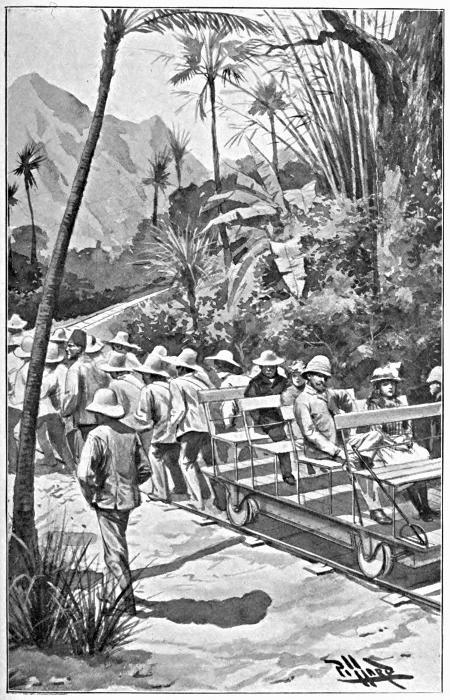
The Convict Railway at Prony.
Drawn by Harold Piffard from a photograph.
We started one morning, as usual, about five o’clock, and steamed across two or three bays to the Camp du Nord. In all the other camps the timber is got down from the hills to the sea by means of wood-paved slides, which are quite as much a feature of this part of Caledonia as the ice-slides are in Norway, but the Camp du Nord rises to the dignity of a railway on which that morning I did the most curious bit of railroading I have ever done.
When we had inspected the camp at the terminus and, for the Commandant’s sake, I had duly admired the landing-stage, the trim buildings, and the gardens in which the flowers and vegetables were struggling for existence in the burning iron soil, the State car was brought out for us.
It was a platform on wheels, with four sloping seats facing backwards. I could see the line twining away up through the forest, but there was no engine.
Presently it, or, rather, they, materialised at the summons of the Chief Surveillant. Fifteen blue-clad figures, each with a halter and hook-rope over his shoulder, came out of one of the dormitories. There was a long chain shackled to the front of the car. At an order the human beasts of draught passed the halters over their heads and hooked on to the chain, seven on each side and one ahead.
Then the Commandant invited the company to mount. There were seven of us. The Commandant had brought his two little girls, and there were four besides: the Chief Surveillant, who weighed fifteen stone if he weighed a pound, the Chief Forester, who weighed a good twelve stone, and the Doctor and myself, who were comparatively light weights.
I had often seen convicts harnessed to carts in England, and, of course, I had ridden many miles in rickshaws in the East, but this was the first time I had ever travelled in a car drawn by human beings who did it because they had to, and who would have had their food docked if they had refused to do it, and I confess that I didn’t exactly like it. Still, I took my place, and the strange journey began.
At first it didn’t seem very bad, for the line was almost level, but when we got into the hills the collar-work began, and our human cattle had to bend their necks and their backs to it.
The line wound up through cuttings and over bridges at what seemed to me an ever-increasing gradient. It was a damp, muggy, tropical morning. It was not exactly raining, but the moisture soaked you to the bones for all that, and the leaves and branches of the vast virgin forest on either hand shone and dripped as the moisture condensed on them.
We perspired sitting still and making no more exertion than was necessary for breathing, so you can imagine how those poor wretches tugging at the chains sweated—and, great heavens, how they stank!—though the most fastidious, under the circumstances, could hardly blame them for this.
For very shame’s sake I got off and walked whenever there was an excuse. It made breathing pleasanter. So did the Doctor, who was a botanist and found us Venus’ Fly-Traps and other weird vegetable monsters. The Forester also got off now and then, not from motives of mercy, but to point out varieties of timber to the Commandant. The Chief Surveillant sat tight, probably on account of his weight, until I wanted to put him into one of the halters.
But what, though I hardly like to say so, disgusted me most was the absolute callousness, as it seemed to me, of the two little girls. Perhaps the worst of it was that it was absolutely innocent. They had been born and bred in Prisonland, and I don’t suppose they really saw any difference between that sweating, straining, panting team of human cattle and a team of mules or donkeys.
At last, to my own infinite relief, the journey was over. What it must have been like to our team I can only guess from the fact that in a distance of a little over four miles they had dragged us up one thousand five hundred feet! It took an hour and three-quarters to do it. They were dismissed when we got to the top and allowed to have a drink—of water.
The Doctor took us back. He understood the brake, and in consideration for the young ladies he kept the speed moderate. We got back in twelve minutes and a half. He said he had done it in six; but I wasn’t with him then, and didn’t want to be.
Although forestry is, of course, the same all the world over, and, therefore, not the sort of thing to describe here in detail, there were two other camps that I visited which had interesting peculiarities of their own. One of these was the Camp of Bonne Anse, a pretty little spot whence a very steep and stony path led over a little range to a promontory called Cap Ndoua, which is the telegraph station for the Isle of Pines. I don’t know whether there are any other telegraphic stations which have neither cables nor wires and make no use of electricity, but this and the one on the Isle of Pines were the only ones I have ever seen.