Act 5 — ACT V.
Reading edition
Scene 1. Page 358.
Isab. ... but let your reason serve To make the truth appear, where it seems hid; And hide the false, seems true.
The apparent difficulty in the last line proceeds from its elliptical construction; yet the meaning is sufficiently obvious. Isabella requests of the Duke to exert his reason to discover truth where it seems hid, and to suppress falsehood where it has the semblance of truth. Hide is, doubtless, a licentious word, but was used for the reason suggested by Mr. Malone.
Scene 1. Page 375.
Lucio. Show your sheep-biting face, and be hang'd an hour.
There would have been little reason for dissenting from Mr. Henley's ingenious note, in which he supposes that this expression refers to the pillory, but for the subsequent remark by Lucio, "this may prove worse than hanging." It seems therefore more probable that "hang'd an hour" alludes to the time usually allotted for torturing the miserable object of the barbarous punishment by suspension, which is justly execrated by Randle Holme as "a dog's death," and always excites in the spectator a strange mixture of ludicrous and shocking sensations. It dishonours the living more than it degrades the criminal. The Turkish bowstring were much less offensive to the feelings of humanity: but the more solemn and decorous infliction of death, (if inflicted it must be,) would, as in military cases, be the stroke of the bullet, provided such a measure could be adopted without offending the soldier's honour. The pre-eminent mercy of the English law disdains to augment the horrors of premature dissolution by personal pain and torture; its object is to prevent or diminish the commission of the crime. On this principle, one could wish that, on the close of the usual necessary and consolatory preparation for death, some mode of stupefying the offender were adopted; that no sensation of torture on his part might be felt, nor any other on that of the spectator, than a satisfaction that the sentence of the law had been fulfilled. For this digression no apology can be necessary. As to Mr. Daines Barrington's supposition, that "the criminal was suspended in the air by the collistrigium or stretch-neck," a very little reflection will suffice to show that it is founded in error. Such a process would in half an hour's time most effectually prevent a repetition of the ceremony. The collistrigium was so called from the stretching out or projection of the neck through a hole made in the pillory for that purpose, or through an iron collar or carcan that was sometimes attached to the pillar itself. No punishment has been inflicted in so many different ways as that of the pillory; and therefore the following varieties of it have been thought worth exhibiting.
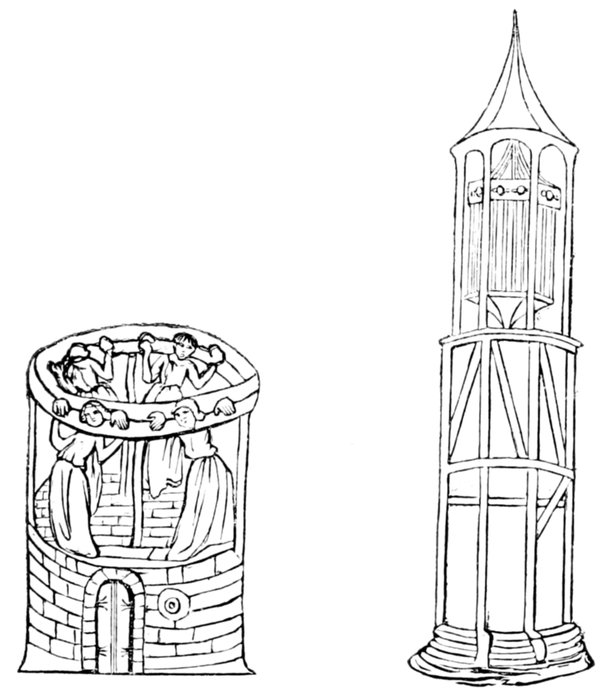
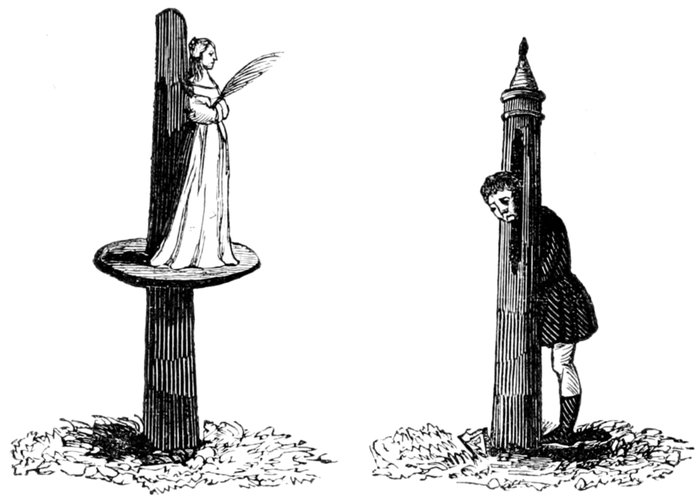
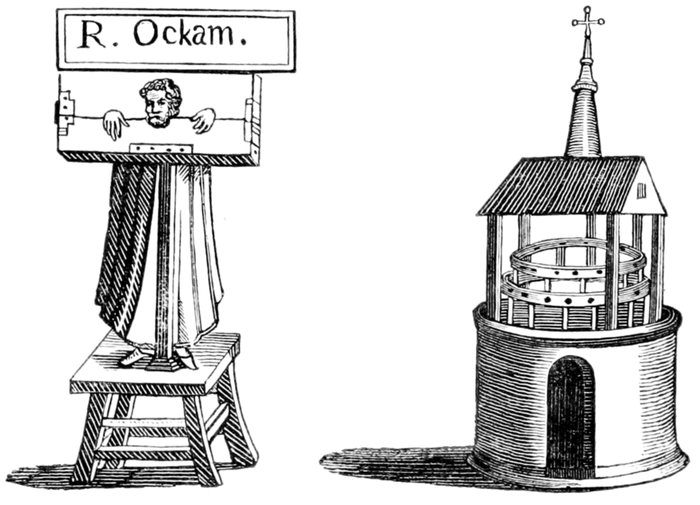
The first is from a manuscript of the Chronicle of Saint Denis, in the British Museum, Bibl. Reg. 16. G. vi. It was written in the thirteenth century. The second occurs in a manuscript of Froissart, preserved in the same collection. The third is copied from a print in Comenius's Orbis pictus, and furnishes a specimen of the carcan, the woman being confined to the pillar by an iron ring or collar. The fourth is from a table of the standard of ancient weights and measures in the exchequer, and shows the mode of punishing a forestaller or regrator in the time of Henry the Seventh. The fifth exhibits Robert Ockam in the pillory for perjury. The fact happened in the reign of Henry the Eighth, but the cut is copied from Fox's Martyrs, published long afterwards. The sixth and last figure represents an ancient pillory that formerly stood in the market-place of the village of Paulmy in Touraine. It is copied from a view of the castle of Paulmy in Belleforest's Cosmographie universelle, 1575, folio. Not long since there was remaining in the Section des halles at Paris an old hexangular building of stone, with open Gothic windows, through which appeared an iron circle or carcan, with holes for placing the hands and necks of several persons at the same time, in like manner as in the first and last figures. There is an engraving of it in Millin's Antiquités nationales, tom. iii. no. 34.
Scene 1. Page 378.
Duke. Being criminal in double violation Of sacred chastity, and of promise-breach.
Mr. Malone thinks double refers to Angelo's conduct to Mariana and Isabel; but surely, however inaccurate the expression, it alludes to Angelo's double misconduct to Isabella, in having attempted her chastity, and violated his promise with respect to her brother. Thus in Promos and Cassandra:
"Thou wycked man, might it not thee suffice By worse than force to spoyle her chastitie, But heaping sinne on sinne against thy othe, Hast cruelly her brother done to death."
In Cinthio Giraldi's novel, it is "Vous avez commis deux crimes fort grans, l'un d'avoir diffamé cette jeune femme, par telle tromperie que l'on peut dire que vous l'avez forcée: l'autre d'avoir fait mourir son frere contre la foy à elle donnée." Transl. by Chappuys, 1584.
Scene 1. Page 385.
Duke. Thy slanders I forgive; and therewithal Remit thy other forfeits: Take him to prison.
Mr. Steevens has refined too much in supposing this word to mean carnal offences. It is simply penalties. The Duke remits all Lucio's offences except the injury done to the woman, and he is ordered to remain in prison until he marry her. Forfeit was also used in the French sense of the word, crime, transgression.
THE CLOWN.
The clown in this play officiates as the tapster of a brothel; whence it has been concluded that he is not a domestic fool, nor ought to appear in the dress of that character. A little consideration will serve to show that the opinion is erroneous, that this clown is altogether a domestic fool, and that he should be habited accordingly. In Act II. Scene 1, Escalus calls him a tedious fool, and Iniquity, a name for one of the old stage buffoons. He tells him that he will have him whipt, a punishment that was very often inflicted on fools. In Timon of Athens we have a strumpet's fool, and a similar character is mentioned in the first speech in Antony and Cleopatra. But if any one should still entertain a doubt on the subject, he may receive the most complete satisfaction by an attentive examination of ancient prints, many of which will furnish instances of the common use of the domestic fool in brothels. In Twelfth Night, Act IV. Scene 1, Sebastian mistakes the clown for such a character as that before us, and calls him a foolish Greek, a term that is very happily explained by Dr. Warburton, whose note both communicates and receives support on the present occasion.
ON THE STORY AND CONSTRUCTION OF MEASURE FOR MEASURE.
Three sources whence the plot of this play might have been extracted, have already been mentioned, viz. Whetstone's Heptameron, 1582, 4to; his Promos and Cassandra, 1578, 4to; and novel 5, decad. 8, in Cinthio Giraldi. It is probable that the general outline of the story is founded on fact, as it is related, with some variety of circumstance, by several writers, and appears to have been very popular. It has therefore been thought worth while to point out the following works in which it occurs.
In Lipsii Monita et exempla politica, Antverp. 1613, 4to, cap. viii. Charles the bold duke of Burgundy causes one of his noblemen to be put to death for offending in the manner that Angelo would have done; but he is first compelled to marry the lady. This story has been copied from Lipsius into Wanley's Wonders of the little world, book iii. ch. 29, edit. 1678, folio; and from Wanley into that favourite little chap book, Burton's Unparalleled varieties, p. 42. See likewise The spectator, No. 491. This event was made the subject of a French play by Antoine Maréchal, called Le jugement équitable de Charles le hardy, 1646, 4to. Here the offender is called Rodolph governor of Maestrick, and by theatrical licence turns out to be the duke's own son. Another similar story of Charles's upright judgment may be found in the third volume of Goulart's Thrésor d'histoires admirables, 1628, 8vo, p. 373.
Much about the time when the above events are supposed to have happened, Olivier le Dain, for his wickedness surnamed the Devil, originally the barber, and afterwards the favourite of Louis XI., is said to have committed a similar offence, for which he was deservedly hanged. See Godefroy's edition of the Memoirs of Philip de Comines, Brussels, 1723, 8vo, tom. v. p. 55.
At the end of Belleforest's translation of Bandello's novels, there are three additional of his own invention. The first of these relates to a captain, who, having seduced the wife of one of his soldiers under a promise to save the life of her husband, exhibited him soon afterwards through the window of his apartment suspended on a gibbet. His commander, the marshal de Brissac, after compelling him to marry the widow, adjudges him to death. The striking similitude of a part of this story to what Mr. Hume has related of colonel Kirke, will present itself to every reader, and perhaps induce some to think with Mr. Ritson, (however they will differ in his mode of expressing the sentiment,) that Mr. Hume's narration is "an impudent and barefaced lie." See The quip modest, p. 30. A defence also of Kirke may be seen in the Monthly magazine, vol. ii. p. 544. Yet though we may be inclined to adopt this side of the question, it will only serve to diminish, in a single instance, the atrocities of that sanguinary monster.
In Lupton's Siuqila. Too good to be true, 1580, 4to, there is a long story of a woman, who, her husband having slain his adversary in a duel, goes to the judge for the purpose of prevailing on him to remit the sentence of the law. He obtains of her, in the first place, a large sum of money, and afterwards the reluctant prostitution of her person, under a solemn promise to save her husband. The rest, as in Belleforest's novel.
In vol. i. of Goulart's Thrésor d'histoires admirables, above cited, there are two stories on this subject. The first, in p. 300, is of a citizen of Como in Italy, who in 1547 was detained prisoner by a Spanish captain on a charge of murder. The wife pleads for him as before, and obtains a promise of favour on the same terms. The husband recommends her compliance, after which the Spaniard beheads him. Complaint is made to the Duke of Ferrara, who compels the captain to marry the widow, and then orders him to be hanged. The other, in p. 304, is of a provost named La Vouste, whose conduct resembles that of the other villain's, with this addition; he says to the woman, "I promised to restore your husband; I have not kept him, here he is." No punishment is inflicted on this fellow.
The last example to be mentioned on this occasion occurs in Cooke's Vindication of the professors and profession of the law, 1646, 4to, p. 61. During the wars between Charles the Fifth and Francis the First, one Raynucio had been imprisoned at Milan for betraying a fort to the French. His wife petitions the governor Don Garcias in his favour, who refuses to listen but on dishonourable terms, which are indignantly rejected. The husband, like Claudio in Measure for measure, at first commends the magnanimity of his wife, and submits to his sentence; but when the time for his execution approaches, his courage fails him, and he prevails on his wife to acquiesce in the governor's demands. A sum of ten thousand crowns is likewise extorted from the unhappy woman, and she receives in return the dead body of her husband. The Duke of Ferrara, Hercules of Este, who was general for the Emperor, is informed of the circumstance. He first persuades the governor to marry the lady, and then orders him to be beheaded.
Towards the conclusion of this play Dr. Johnson has observed, that "every reader feels some indignation when he finds Angelo spared." This remark is rigorously just, and calculated to satisfy those moralists who would have preferred the catastrophe in some of the preceding stories. But in the construction of a play theatrical effect was to be attended to; on which ground alone the poet may be defended. The other charge against him in Dr. Johnson's note is doubtless unfounded, and even laboriously strained. Shakspeare has been likewise hastily censured by a female writer of great ingenuity, for almost every supposed deviation from the plot of Cinthio's novel, and even for adhering to it in sparing Angelo.[9] It might however be contended, that, if our author really used this novel,[10] he has, with some exceptions, exerted a considerable degree of skill and contrivance in his alterations; and that he has consequently furnished a rich and diversified repast for his readers, instead of serving up the simple story in the shape of such a tragedy as might have suited a Greek audience, but certainly would not have pleased an English one in his time. In the novel, the sister, when she solicits mercy for her brother's murderer and her own seducer, (in the play Angelo is neither but in intention,) justly urges that excess of justice becomes cruelty. He therefore who would refuse mercy to Angelo for an intentional offence, has no right to censure him for severity to Claudio who had committed a real one. In the novel, the sister is actually seduced, and her brother murdered; and yet she pleads for the offender. In the play, though Isabella believes her brother to be dead, she reconciles herself to the sad event, inasmuch as she knows that he suffered by course of law, as well as by the cruelty of Angelo, from whose iniquity she herself has happily escaped. She is stimulated to solicit this man's life, from the suggestion and situation of her friend the innocent Mariana, who would have felt more distress from the death of Angelo, than the other parties discontent from his acquittal. The female critic has likewise observed that "Measure for measure ought not to be the title, since justice is not the virtue it inculcates." But surely, if Angelo had died, it would have been outmeasuring measure; as it is, the administration of justice is duly balanced, and both he and Claudio are equally punished in imagination. The Duke too, who knew all the circumstances, deserves credit for some ingenuity in his arrangements to protect the innocent, and, if not rigidly to punish the guilty, at least to save a sinner. Nor will any one contend that Angelo has escaped punishment: the agonizing state of uncertainty in which he long remained after the mock sentence, the bitter reproof of his colleague, and the still severer language of the Duke, will, it is to be hoped, conduce to satisfy every feeling and humane spectator of this fine play, that the poet has done enough to content even the rigorous moralist, and to exemplify, in his own divine words, that "earthly power doth then seem likest heaven's, when mercy seasons justice."