Part 3 — CHAPTER III. GOLDEN AGE OF ROMAN LITERATURE.
Reading edition
(B.C. 80-14 A.D.)
Divisions and Ornaments.—The Golden Age, which now engages our attention, is naturally divided into two distinct periods, bearing the names of Cicero, the greatest of Roman writers, and Augustus, the founder of the empire and patron of letters.
In the Ciceronian Period (80-43 B.C.), a stormy era of conspiracy as well as conquest—marked by Catiline’s formidable attempt to destroy the commonwealth, by the civil war of Cæsar and Pompey, and the murder of these renowned leaders—political eloquence and history monopolized the attention of the master minds of Rome. As a consequence, Latin prose matured early in the golden age; while poetry boasted of no ornaments until, at the close of the Ciceronian Period, Lucretius penned his philosophical poem “On the Nature of Things,” and Catullus produced his erotic odes and elegies.
In the Augustan Period (B.C. 42-14 A.D.), the greatest of Roman poets, Virgil and Horace, lived and wrote, prose playing a secondary part. Tibullus and Propertius put forth their sweet elegies, and Ovid his amatory pieces. Even the pages of Livy’s history are aglow with poetical coloring. But the blossom was as transient as it was beautiful, and expanded only to die.
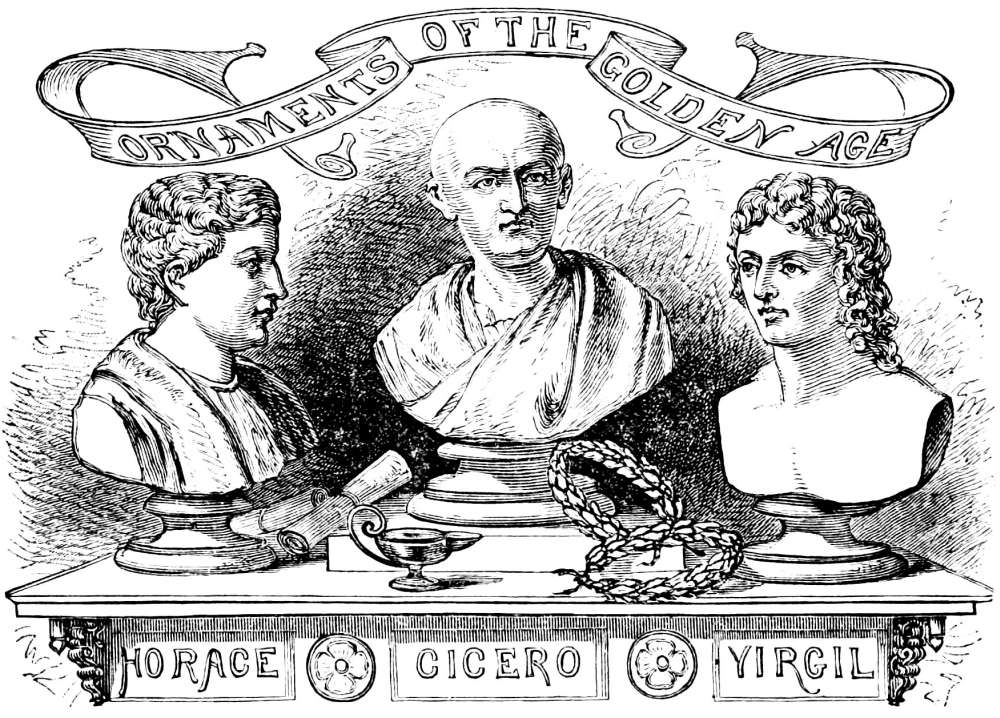
ORNAMENTS OF THE GOLDEN AGE HORACE CICERO VIRGIL
PROSE WRITERS OF THE CICERONIAN PERIOD.
Marcus Tullius Cicero (106-43 B.C.) was born at Arpi’num, a Latian town south-east of Rome. As his family (of equestrian rank) had never distinguished itself, he is known as a novus homo (new man). Detecting unusual talent in the boy, his father resolved to develop it by a thorough education, which he himself superintended at Rome. The most accomplished teachers were secured, the Greek poet Ar’chias among the number, and the youth was thoroughly grounded in grammar, rhetoric, and Grecian literature. This early training Cicero sedulously supplemented with a course on Roman law under Scævola, avoiding the whirl of dissipation that surrounded him, and even relinquishing social pleasure for the labors of his closet or to study in the forum the style of the first public speakers. “Who can blame me,” he asked in his oration for Archias, “if while others are gazing at festal shows and idle ceremonies, exploring new pleasures, engaged in midnight revels, in the distraction of gaming, the madness of intemperance, I dedicate my time to learning and the Muses?”
At twenty-five Cicero made his début; and within two years he rose to the highest rank at the Roman bar by ably pleading the cause of one Roscius against a friend of the terrible Sulla. Successful in this case, to escape the vengeance of the dictator as well as to recruit his failing health, Cicero went abroad. At Athens he pursued the study of philosophy with Pompo’nius Atticus, the companion of his boyhood and ever after his warmest friend. In the schools of Asia Minor, as well as at Rhodes, then a great literary centre, he studied under distinguished teachers, storing his memory with valuable knowledge at the same time that he made himself proficient in the rhetorical art. The death of Sulla having removed all danger, at the age of thirty he went back to Italy, thoroughly restored by his travels, and fired with the noble ambition of making himself the Demosthenes of Rome. Step by step he approached the realization of his hopes, and when, in the prosecution of Verres, the rapacious governor of Sicily, he triumphed over Hortensius (70 B.C.), his end was practically achieved.
Cicero served his country in many capacities, but in none more effectively than as consul; since, while holding this office (63-62 B.C.), he saved the republic from a dangerous conspiracy, headed by the profligate Catiline. The consul’s tact and courage were sorely tried, but prevailed. Four crushing orations laid bare the plans of the traitor and drove him from the city, to fall in a desperate battle with the Roman legions, while a grateful nation greeted the vigilant Cicero as “the Father of his Country.”
But the Roman people were fickle, and at the instigation of an enemy banished Cicero from the city he had saved, 58 B.C. The next year, however, the decree was revoked, and he returned. When the civil war between Cæsar and Pompey was imminent, Cicero’s indecision told powerfully against him.[43] At last he joined Pompey, who, provoked at his vacillation, exclaimed: “I wish that Cicero would go over to the other side; perhaps he would then be afraid of us.” The battle of Pharsalia (48 B.C.) overthrew the hopes of the party whose cause he had espoused, and Cicero, returning to Italy, accepted the rule and friendship of Cæsar, and settled down to a literary life.
Shortly after, a plot is laid against the dictator; the fatal Ides (15th) of March (44 B.C.) arrive; the assassins do their bloody work in the senate-house; and Brutus, flourishing his traitorous dagger, cries to Cicero: “Rejoice, O Father of our Country, for Rome is free!”
But it was grief, not joy, that the dagger of Brutus brought to the Republic; another Pompey and another Cæsar arose to contend for the mastery of the world. Marc Antony aspired to the dead dictator’s place; but Cicero, now the foremost statesman in Rome, regarding him as the enemy of liberty, upheld the cause of the people and of Octavius, Cæsar’s young nephew. Into the struggle that ensued, he entered with all the spirit of his youth, thundering against Antony his grand “Philippics,” in the second of which are concentrated all his powers of invective, passion, and eloquence. It is Cicero’s mightiest effort.
FROM THE SECOND PHILIPPIC.
“When, therefore, this fellow (Antony) had begun to wallow in the treasures of that great man, he began to exult like a buffoon in a play, who has lately been a beggar and has become suddenly rich.[44] But, as some poet or other says,
‘Ill-gotten gains come quickly to an end.’
It is an incredible thing, and almost a miracle, how he in a few, not months, but days, squandered all that vast wealth. There was an immense quantity of wine, an excessive abundance of very valuable plate, much precious apparel, great quantities of splendid furniture, and other magnificent things in many places, such as one was likely to see belonging to a man who was not indeed luxurious, but who was very wealthy. Of all this in a few days there was nothing left. What Charybdis was ever so voracious? Charybdis, do I say? Charybdis, if she existed at all, was only one animal. The ocean, I swear most solemnly, appears hardly capable of having swallowed up such numbers of things so widely scattered, and distributed in such different places, with such rapidity.
Nothing was shut up, nothing sealed up, no list was made of anything. Whole storehouses were abandoned to the most worthless of men. Actors seized on this, actresses on that; the house was crowded with gamblers, and full of drunken men; people were drinking all day, and that too in many places; there were added to all this expense (for this fellow was not invariably fortunate) heavy gambling losses. You might see, in the cellars of the slaves, couches covered with the most richly embroidered counterpanes of Cneius Pompey. Wonder not, then, that all these things were so soon consumed. Such profligacy as that could have devoured, not only the patrimony of one individual, however ample it might have been, but whole cities and kingdoms.
And then his houses and gardens! O the cruel audacity! Did you dare to enter into that house? Did you dare to cross that most sacred threshold? and to show your most profligate countenance to the household gods who protect that abode? A house which for a long time no one could behold, no one could pass by, without tears! Are you not ashamed to dwell so long in that house—one in which, stupid and ignorant as you are, still you can see nothing which is not painful to you?
When you behold those beaks of ships in the vestibule, and those warlike trophies, do you fancy that you are entering into a house which belongs to you? It is impossible. Although you are devoid of all sense and all feeling, still you are acquainted with yourself, and with your trophies, and with your friends. Nor do I believe that you, either waking or sleeping, can ever act with quiet sense.
It is impossible but that, were you ever so drunk and frantic, as in truth you are, when the recollection of the appearance of that illustrious man comes across you, you should be roused from sleep by your fears, and often stirred up to madness if awake. I pity even the walls and the roof.”—Yonge.
The patriot paid for his stanch defence of freedom with his life. Octavius and Antony, becoming reconciled, formed with Lepidus the Second Triumvirate, or board of three, to govern the Roman world; and Cicero knew that the sun of liberty had set. The triumvirs agreed upon a general proscription of their enemies. A reign of terror deluged Italy with blood, but the noblest of those who fell was Cicero.
Antony demanded his life, and Octavius covered himself with infamy by yielding it. The orator met his fate near his villa at Formiæ; timid throughout his life, in the last scene he exhibited manly fortitude. He is said to have been calmly reading the “Medea” of Euripides in his litter when Antony’s myrmidons overtook him; a desperado who owed him many favors, while even his brutal companions covered their eyes, struck the fatal blow. The head and hands of the murdered orator were cut off and sent to Antony, whose inhuman wife, as she fondled the ghastly head in her lap, maliciously thrust her bodkin into the tongue that had denounced her husband.—True as it was, it ill became the time-serving Octavius to say, when afterward wielding the sceptre of the world as Augustus Cæsar, “Cicero was a good citizen, who really loved his country.”
Cicero’s Works.—Cicero was emphatically a many-sided man, and filled a wide space in Roman literature. Though he excelled chiefly in oratory, he has left us, besides fifty-nine orations, a number of philosophical treatises, essays, and many letters to his friend Atticus, his brother, and other correspondents. While deeply absorbed in public duties, he found opportunities, without neglecting these, to pursue the study of philosophy, having in view not only his own relaxation, but also the moral advancement of his countrymen. His works on this subject, some of which, for the sake of interest and variety, he wrote in the form of dialogues, present a valuable survey of the Greek systems. They assert his belief in the existence of one Supreme Creator and the immortality of the soul. (See Mayor’s “A Sketch of Ancient Philosophy.”)
Cicero’s chief philosophical writings are “the Tusculan Disputations,” imaginary discussions of various practical questions at the author’s Tusculan villa,—the scorn of death, the endurance of suffering, etc.; “the Offices,” a moral essay; treatises “On Friendship” and “On Old Age,” justly considered as among the most charming productions of their class in any literature; political dissertations “On the Republic” and “On Laws;” and a theological disquisition “On the Nature of the Gods.”
THE END OF LIFE. [From Cicero’s Treatise on Old Age.]
“An old man, indeed, has nothing to hope for; yet he is in so much the happier state than a young one; since he has already attained what the other is only hoping for. The one is wishing to live long, the other has lived long. And yet, good gods! what is there in man’s life that can be called long? To my mind, nothing whatever seems of long duration, in which there is any end. For when that arrives, then the time which is past has flowed away; that only remains which you have secured by virtue and right conduct. Hours indeed depart from us, and days, and months, and years; nor does past time ever return, nor can it be discovered what is to follow.
Whatever time is assigned to each to live, with that he ought to be content: for neither need the drama be performed entire by the actor, in order to give satisfaction, provided he be approved in whatever act he may be; nor need the wise man live till the plaudite.[45] The short period of life is long enough for living well and honorably; and if you should advance farther, you need no more grieve than farmers do, when the loveliness of spring-time hath passed, that summer and autumn have come. For spring represents the time of youth, and gives promise of the future fruits; the remaining seasons are intended for plucking and gathering those fruits. Now the harvest of old age, as I have often said, is the recollection and abundance of blessings previously secured.
In truth, everything that happens agreeably to nature is to be reckoned among blessings. What, however, is so agreeable to nature as for an old man to die? which even is the lot of the young, though nature opposes and resists. And thus it is that young men seem to me to die, just as when the violence of flame is extinguished by a flood of water; whereas old men die, as the exhausted fire goes out, spontaneously, without the exertion of any force. And as fruits when they are green are plucked by force from the trees, but when ripe and mellow drop off, so violence takes away their lives from youths, maturity from old men; a state which to me indeed is so delightful that, the nearer I approach to death, I seem as it were to be getting sight of land, and at length, after a long voyage, to be just coming into harbor.”—Edmonds.
Cicero also wrote a treatise “On Glory,” now lost. It was once in the possession of Petrarch, who commends it in the most flattering terms. The Italian poet was induced to lend it to his aged preceptor; but the latter, driven by poverty, secretly put the work in pawn and died without making known its whereabouts. It never saw the light afterward; although it is supposed to have been destroyed two centuries later by a plagiarist, who had helped himself to some of its fine periods.
As a letter-writer, Cicero excels all others. It was the custom of his countrymen to bestow as great pains on private correspondence as on works intended for publication; and his epistles, eight hundred of which survive, are simple, elegant, and glow with wit, though some of them were written so fast as to be almost illegible. (Consult Jeans’s “Life and Letters of Cicero; Church’s “Roman Life in the Days of Cicero.”)
Our author also turned his hand to history and poetry, but with indifferent success. His works were extremely popular among his contemporaries, some of them selling by the thousand.
Cicero’s Style.—Cicero has always been commended for the cadence of his periods. The art of framing harmonious balanced sentences was his special study, and the Latin language, which he perfected in beauty and richness, was well adapted to his purpose. His style is often exuberant, for he cultivated the flowers of rhetoric. Character he sketched with a powerful pen, and his speeches are enlivened with abundant illustrations drawn from the wonderful storehouse of his memory. Too often, however, vanity crops out, to mar the effect.
Quintilian declared that as an orator Cicero combined “the force of Demosthenes, the copiousness of Plato, and the elegance of Isocrates.” Through all his works flows a current of mingled majesty and sweetness. Merivale aptly styles him “the most consummate specimen of the Roman character under the influence of Hellenic culture.”
CICERO ON PROVIDENCE. [From the Treatise on the Nature of the Gods.]
“There are and have been philosophers who have given it as their opinion that the gods exercise no superintending care whatever over human affairs. Now, if the opinion of these men be true, what becomes of piety? what of public worship? what of religion itself? For all these marks of homage are to be rendered in a pure and holy spirit unto the majesty of the gods, only in case they are observed by these same, and in case any favor has been bestowed by the immortal gods on the race of men. If, however, the gods are neither able nor willing to assist us; if they take no care whatever of us; if they mark not what we do; if there is nothing that can come from them and exercise an influence on the lives of men,—what reason is there why we are to pay any adoration, render any honors, offer any prayers, to the immortal gods?
Piety, just as much as the other virtues, cannot exist in outward show and empty feignings; while along with piety, both public worship and religion itself must of necessity be done away with. Remove these, and a great disturbance and total confusion of life ensue. Nay, indeed, I do not know whether, if piety toward the gods be removed, good faith also, and every social tie that binds together the human race, and justice too, that most excellent of all virtues, would not be removed along with it.”—Charles Anthon.
Varro (116-28 B.C.).—The great central sun of the Republican Era was Cicero, compared with whom the brightest of his contemporaries seem but as lesser luminaries whose light is swallowed up in his. Of these, Marcus Terentius Varro was perhaps the greatest. Years of incessant application, which a boyhood passed among the Sabine mountains at Reate (re’ă-te) had prepared him to endure, won for Varro the proud title “Most Learned of the Romans.”
During the civil war, Varro sided with Pompey. After the triumph of Cæsar, he retired from public life to his favorite studies, the victor magnanimously recognizing his merit by placing him in charge of the public library at Rome. The material results of his literary labors enabled him to live like a prince, and we find him the proprietor of three sumptuous country-seats, one of which was celebrated for its costly marble aviary of three thousand song-birds—Varro’s pets.
All this wealth did not escape the notice of the rapacious triumvirs after the assassination of Cæsar. The name of Varro, then more than seventy, was placed on the proscription list; his property was confiscated; and Antony sacked his beautiful villa at Casi’num, committing his invaluable library to the flames. The old man owed his life to friends, who concealed him from his implacable foe till the order for his murder was countermanded. Augustus afterward restored his fortune, but Varro always keenly missed the society of his books. At the advanced age of eighty, he composed, in dialogue form, an admirable work “On Husbandry,” written in a brisk and entertaining style.
The genius of Varro was remarkably versatile; as over six hundred different books on various subjects, in both prose and verse, abundantly testify. In fertility he surpassed all other Romans; and we can but wonder, with St. Augustine, how he found time to write so much. His most creditable work was his “Antiquities Divine and Human,” a lost treasure, of which the present age, with its profound interest in the religions of the past, severely feels the want.
Varro also prepared a treatise “On the Latin Language,” edited a popular encyclopædia of the liberal arts, and wrote on history. Throughout his works he appears as a pure patriot, a defender of ancient simplicity and virtue. His satires on effeminacy and affectation are caustic; no one can help enjoying his humorous etchings of the spruce dandy, the dainty epicure, and the finical poet who gargles his throat before reciting his pieces. In every kind of writing that he attempted (and there was little he did not attempt) he is worthy of respect: the familiar line from Dr. Johnson’s epitaph on our own Goldsmith, would apply with equal force to Varro—“He touched nothing that he did not adorn.”
Little survives of Varro’s writings beyond the treatise on agriculture, and a part of that on the Latin language.
Julius Cæsar.—July 12th, 100 B.C., was the birthday of Caius Julius Cæsar, by some believed to be, as Shakespeare styled him, “the foremost man of all this world.” The period at which he lived was a critical one in history. Roman virtue had depreciated, justice was bought and sold, luxury had sapped the vigor of the nation, and vice ran riot. Only one-man power, and that wielded by a clear head and powerful arm, could save the state. The times demanded a statesman who would not shrink from taking upon himself all needful responsibilities; and in Julius Cæsar that statesman was forthcoming.
Cæsar’s whole career evinces ambition, courage, and determination. Sulla himself he feared not to defy, when ordered to divorce his wife for political reasons; and he was adroit enough to escape the vengeance of the ruthless dictator who saw in “the loose-girt boy” many Mariuses. Leaving Rome for the East, he acquitted himself with signal ability, though only twenty-two, in a campaign against Mytilene; and when captured by pirates on the high seas, he paid them an extortionate ransom, but promptly turned the tables on them by overhauling their vessel with a small fleet, and nailing them to crosses on the coast of Asia Minor.
At Rhodes he studied oratory and rhetoric. On his return to Rome he gave evidence of his powers in the forum, and was hailed as second in eloquence to Cicero only. His readiness to protect the poor and the oppressed, together with his insinuating manners, made Cæsar the idol of the people, who bestowed upon him various offices and finally raised him to the consulship. At the expiration of his term, he was intrusted with the government of the two Gauls; and the military skill he displayed in this position, during nine years of active service (58-50 B.C.), proved him to be one of the world’s great captains. Overpowering many fierce tribes, he carried the terror of the Roman eagles into the forests of Germany and even across the Channel. A million human beings are computed to have been sacrificed in his Gallic campaigns.
Jealous of these brilliant successes, and recognizing in Cæsar a dangerous opponent of his schemes for political aggrandizement, Pompey prevailed on the senate to demand the resignation of his victorious rival. This brought matters to a crisis. Cæsar with his legions crossed the Rubicon, which separated Cisalpine Gaul from Italy (49 B.C.), and was soon in Rome, whence Pompey and his friends had fled. The battle of Pharsalia the next year decided the question in favor of Cæsar; Pompey’s party was overthrown in Africa and Spain, and the Roman world remained the prize of the conqueror.
Not long, however, did he enjoy it. Fearing his ambition, or pretending to do so, a number of “liberators” conspired against his life. On the 15th of March, 44 B.C., he fell pierced by their daggers at the foot of Pompey’s statue, as that last cry, wrung from his heart by the ingratitude of a trusted friend, resounded through the senate-house,—“Thou, too, Brutus, my son!”
We can hardly see how, amid the excitements of such a career, Cæsar found any time to devote to literary pursuits; yet his name is hardly less eminent in letters than for statesmanship and military genius. He seems to have had the rare ability of “employing at the same time his ears to listen, his eyes to read, his hand to write, and his voice to dictate.” While crossing the Alps, on one occasion, he wrote a grammatical treatise of no little merit.
The greatest of Cæsar’s works are his “Commentaries” on the Gallic and the Civil War—the former in seven books, to which an eighth was added at the author’s request by his fellow-soldier Hirtius. In “the Gallic War,” Cæsar not only recounts his successes and feats of engineering skill, but also entertains us with pleasing descriptions of the countries he visited and the tribes he encountered. He always aims at justifying himself, and so plausibly defended his course in “the Civil War” as to carry conviction even to the prejudiced. (See Froude’s “Cæsar;” Trollope’s “Cæsar.”)
In Cæsar’s style, conciseness goes hand in hand with simplicity and perspicuity. Dispensing with ornament, he uses every word to the best advantage—and this despite the fact that he wrote with amazing rapidity. Though, perhaps, he lacks vivacity and energy, there is no purer Latin than his. We subjoin some interesting paragraphs from the Commentaries on the Gallic War, relating to the customs of
THE ANCIENT GAULS AND GERMANS.
“The whole nation of Gauls is extremely addicted to superstition; whence, in threatening distempers and the imminent dangers of war, they make no scruple to sacrifice men, or engage themselves by vow to such sacrifices. In these they make use of the ministry of the Druids: for it is a prevalent opinion among them that nothing but the life of man can atone for the life of man, insomuch that they have established even public sacrifices of this kind. Some prepare huge colossuses of osier twigs, into which they put men alive, and setting fire to them, those within expire amid the flames. They prefer for victims such as have been convicted of theft, robbery, or other crimes, believing them the most acceptable to the gods; but, when criminals are wanting, the innocent are often made to suffer.
Mercury is the chief deity with them; of him they have many images, account him the inventor of all arts, their guide and conductor in their journeys, and the patron of merchandise and gain. Next to him are Apollo and Mars, Jupiter and Minerva. Their notions in regard to these are pretty much the same as those of other nations. Apollo is their god of physic, Minerva of works and manufactures; Jove holds the empire of heaven, and Mars presides in war. To this last, when they resolve on a battle, they commonly devote the spoil. If they prove victorious, they offer up all the cattle taken, and set apart the rest of the plunder in a place appointed for that purpose; it is common in many provinces to see these monuments of offerings piled up in consecrated places. Nay, it rarely happens that any one shows so great a disregard of religion as either to conceal the plunder or pillage the public oblations; and the severest punishments are inflicted on such offenders.
The Gauls fancy themselves to be descended from the god Pluto; which, it seems, is an established tradition among the Druids. For this reason they compute the time by nights, not by days; and, in the observance of birthdays, new moons, and the beginning of the year, always commence the celebration from the preceding night. In one custom they differ from almost all other nations, that they never suffer their children to come openly into their presence until they are old enough to bear arms; for the appearance of a son in public with his father before he has reached the age of manhood is accounted dishonorable.
Whatever fortune the woman brings, the husband is obliged to equal it out of his own estate. This whole sum, with its annual product, is left untouched, and falls always to the share of the survivor. The men have power of life and death over their wives and children; and, when any father of a family of illustrious rank dies, his relations assemble, and, on the least ground of suspicion, put even his wives to the torture like slaves. If they are found guilty, iron and fire are employed to torment and destroy them. Their funerals are magnificent and sumptuous, according to their quality. Everything that was dear to the deceased, even animals, are thrown into the pile; and, formerly, such of their slaves and clients as they loved most sacrificed themselves at the funeral of their lord.
The Germans differ widely in their manners from the Gauls; for neither have they Druids to preside in religious affairs, nor do they trouble themselves about sacrifices. They acknowledge no gods but those that they can see, and by whose power they are apparently benefited: the sun, the moon, fire. Of others they know nothing, not even by report. Their whole life is addicted to hunting and war; and from their infancy they are inured to fatigue and hardships. Agriculture is little regarded among them, as they live mostly on milk, cheese, and the flesh of animals. Nor has any man lands of his own, or distinguished by fixed boundaries. The magistrates and those in authority portion out yearly to every canton and family such a quantity of land, and in what part of the country they think proper; and the year following remove them to some other spot.
Many reasons are assigned for this practice; lest, seduced by habit and continuance, they should learn to prefer pillage to war; lest a desire of enlarging their possessions should gain ground, and prompt the stronger to expel the weaker; lest they should become curious in their buildings, in order to guard against the extremes of heat and cold; lest avarice should get footing among them, whence spring factions and discords; in fine, to preserve contentment and equanimity among the people, when they find their possessions nothing inferior to those of the most powerful.
It is accounted honorable for states to have the country all around them lie waste and depopulated; for they think it an argument of valor to expel their neighbors, and suffer none to settle near them; at the same time that they are themselves also the safer, as having nothing to apprehend from sudden incursions. When a state is engaged in war, either offensive or defensive, they make choice of magistrates to preside in it, whom they arm with the power of life and death. In time of peace there are no public magistrates; but the chiefs of the several provinces and clans administer justice, and decide differences within their respective limits. Robbery has nothing infamous in it when committed without the territories of the state to which they belong; they even pretend that it serves to exercise their youth, and prevent the growth of sloth. The laws of hospitality are held inviolable among them. All that fly to them for refuge, on whatever account, are sure of protection and defence.”—Duncan.
Sallust (86-34 B.C.).—Another historian, whose name is as familiar as Cæsar’s to classical students, is Caius Sallustius Crispus, popularly known as Sallust. From his native town Amiternum, in the country of the Sabines, he came to Rome, ambitious of public honors, and gradually worked his way up to a seat in the senate. Alleged immorality, however, caused his expulsion from that body, and not until he had rendered important service to Cæsar in the civil war did he recover his good standing. Cæsar made him governor of the rich province of Numidia (46 B.C.), which Sallust pretty thoroughly plundered during his one year of office, returning to Rome with fabulous riches. It was fortunate for him that, when a Numidian commission arrived to prosecute him for extortion, his powerful patron interposed to save him from punishment.
On the assassination of Cæsar, Sallust retired from public life and devoted part of his ill-gotten gains to the erection of a splendid mansion on one of the seven hills. It was surrounded by lovely pleasure-grounds, adorned with baths, statues, and other magnificent works of art, prominent among which, on exquisitely chiselled columns, rose a temple, paved in mosaic, and set off with Grecian marbles. “The Gardens of Sallust” were preferred by many of the Roman emperors to the imperial palace itself.
Here or at his Tiburtine villa, our author, thoroughly convinced of the vanity of political honors, and filled with remorse for his youthful indiscretions, spent the last nine years of his life in the compilation of historical works which give us a high opinion of his abilities. His first effort was “the Conspiracy of Catiline,” the facts of which were vividly impressed upon his memory, since, when a student at Rome, he was a witness of its thrilling scenes. “The Jugurthine War,” which followed, treats of the struggle which the Roman people carried on with Jugurtha, king of Numidia. This unscrupulous prince had made his way to an undivided throne over the murdered bodies of his two cousins, allies of the Romans, securing impunity for a time by buying up the senate. Having, however, caused the assassination of another kinsman in the very streets of Rome, whither he had been summoned, on the pledge of the public faith, to expose those who had taken his bribes, he was ordered to quit Italy. It was on leaving the capital that Jugurtha, looking back, uttered those words so significant of the prevalent corruption: “O venal city and destined soon to perish, if you can but find a purchaser!”
A Roman army followed him into Africa; but little was effected until the consul Metellus assumed the command, and, proof against Numidian gold, prosecuted the war in earnest. After five years’ continuance, it was successfully terminated by Marius. Sallust’s history ends with the betrayal of Jugurtha to the Romans, and the triumph of the consul Marius, “on whom the hopes of the state were then placed.” Plutarch adds that, after figuring in the procession, Jugurtha was set upon by the people, who tore the rings from his ears and even stripped him of his clothes; then he was pushed into a damp dungeon to starve, shuddering as he cried to the bystanders with a maniacal laugh, “How cold is this bath of yours!”
Another work of Sallust was a History of Rome from 78 to 66 B.C., fragments of which remain.
Sallust’s Style, modelled after that of Thucydides, is sententious, energetic, and an improvement on the original in clearness. Condensation without obscurity is its crowning excellence; and its finish, though too plainly showing marks of labor, is always attractive.
The forte of Sallust lay in delineating character; his portraits of Catiline and Jugurtha are as vivid as if the men themselves stood before us. Especially striking are his pictures of remorse. Catiline, who murdered his own son to induce an infamous beauty to become his wife, “at peace with neither gods nor men, finds no comfort either waking or sleeping; his complexion is pale, his eyes haggard, his walk sometimes quick and sometimes slow, and distraction is apparent in every look.” Jugurtha, red with the blood of many victims, “fears his subjects and his enemies alike, is ever on the watch, starts from his sleep to seize his arms, and is so agitated by terror as to appear under the influence of madness.”
Sallust also affects the moralist, and throughout his works is as loud in the praises of virtue as in his life he was careless of her interests. From “the Jugurthine War” we take an interesting account of the
CAPTURE OF A NUMIDIAN FORT.
“Not far from the river Mulucha, which separated the kingdoms of Jugurtha and Bocchus, there stood, in the midst of a plain, a small fort, on a rock of considerable breadth, and of prodigious height, naturally as steep on every side as art or labor could render it; it had no access, except at one place, and that was by means of a narrow path. As the king’s treasure was deposited in this place, Marius exerted his utmost efforts to reduce it; and succeeded, more by accident than by prudent management.
The castle was abundantly provided with men, arms, provisions, and a spring of water; its situation rendered it impossible to make use of mounds and turrets, and the machinery usually employed in a siege; the path to it was very narrow, with a precipice on each side. The moving galleries were pushed forward with infinite hazard, and to no purpose; for, when they advanced toward the garrison, they were either destroyed by fire or crushed by prodigious stones. The soldiers could neither maintain their footing nor make use of their batteries without exposing themselves to continual danger. The most adventurous were either slain or wounded, and the rest were greatly discouraged.
Marius, having thus spent many toilsome days, now hesitated whether he should abandon his enterprise, which had proved unsuccessful, or wait the interposition of fortune, which had so frequently befriended him. While these reflections day and night occupied his mind, a Ligurian, a common soldier of the auxiliary cohorts, who had gone out of the camp in search of water, happened to observe, not far from the opposite side of the castle, some periwinkles creeping among the rocks; gathering one, then another, and still climbing to procure more, he was led insensibly almost to the top of the mountain, where, perceiving all was quiet in that quarter, the natural desire of viewing unknown objects prompted him to proceed.
It chanced that an oak-tree, of considerable magnitude, here grew out of the side of the rock, and, bending its trunk downward near the root, then taking a turn, mounted upward, as is natural to trees in such situations.
By the help of this, the Ligurian, laying hold of the branches of the tree or of the prominences of the rock, was at length enabled to survey the whole plan of the castle, without being disturbed by the Numidians, who were all engaged on that side on which the attack had been made. Having carefully examined whatever he thought would be useful to him in the execution of his design, he returned the same way; not hastily, as he went up, but pausing at every step, and observing everything with the utmost care.
On his return to the camp, he hastened to Marius, informed him of what he had done, pressed him to make an attempt on the castle on that side where he himself had mounted, and promised that he would lead the way, and be the first to face the danger. Marius despatched some of those who attended him, accompanied by the Ligurian, to examine the spot; and, although their reports varied as to the facility or the difficulty of the undertaking, the consul, encouraged by the hope of success, determined to make the attempt. He accordingly selected, from among the trumpeters and cornet-blowers of the line, five of the most active and enterprising men, together with four centurions to support them, and, putting the whole under the command of the Ligurian, he ordered them to be in readiness to set out on the following day.
At the time appointed the party left the camp, having previously taken such measures as were necessary for the expedition. The centurions, according to the instructions which they had received from their guide, had changed their arms and dress, and marched with their heads and feet bare, that they might have the freer prospect, and climb with more facility. Their swords and bucklers were slung across their shoulders; the latter, of the Numidian kind, and covered with hides, as well for the sake of lightness, as that all noise might be avoided if they struck against the rock.
The Ligurian, leading the way, fixed cords about the stones, and such roots of trees as appeared proper for the purpose, to assist the soldiers in climbing; stretching his hand, from time to time, to such as were discouraged at so rugged a march. When the ascent was more steep than ordinary, he would send them up before him unarmed, and then follow himself with their arms. Wherever it appeared more dangerous to climb, he went foremost; and, by ascending and descending several times, encouraged the rest to follow him, and retired to make way for them. At length, after much tedious labor, they gained the castle, which was quite deserted on that side, the Numidians being all employed in the opposite quarter.
When Marius was informed of the success of the Ligurian, although he had kept the garrison employed the whole day by a continued attack, he now, encouraging the soldiers, sallied from under the moving galleries, and, drawing up his men in the form of a shell, rushed forward to the castle; while the slingers and archers poured their volleys from a distance, and the engines incessantly played on the besieged. The Numidians, who had often before broken to pieces and even burned the Roman galleries, did not now defend themselves within their battlements, but passed whole days and nights without their walls; they railed at the efforts of the Romans, upbraided Marius with madness, and in the height of their exultation threatened to make our men slaves of Jugurtha.
While both sides were warmly engaged in this vigorous struggle for glory and empire on the one hand, and life and liberty on the other, the trumpets on a sudden sounded in the enemy’s rear. The women and children, who had come out to see the engagement, first fled in dismay; after them, such as were nearest the walls; and at last the whole, armed and unarmed, fairly gave way. The Romans now pressed onward with greater vigor, overthrowing the enemy, and wounding most of them; then, advancing over the heaps of slain, they flew to the walls, all thirsting for glory, and each striving to be foremost, without regard to plunder. Thus did accidental success justify the rashness of Marius, while his imprudence contributed to heighten his glory.”
Cornelius Nepos (74-24 B.C.), though inferior to the writers just treated, deserves mention for his “Lives of Eminent Commanders,” his only extant work. These sketches, especially the biography of Pomponius Atticus, are clearly written and furnish valuable information respecting the times to which they relate; but Nepos was not an accurate compiler, and dependence cannot always be placed on his statements. As a specimen of his style, we quote from his “Lives”.
THE CHARACTER OF ALCIBIADES.
“Nature seems to have tried in him what she could do. For it is agreed upon among all who have written about him, that nobody was more extraordinary than he, either in vices or in virtues; being born in a very great city, of a great family, much the handsomest man of his time, fit for all things, and abounding in judgment for the management of affairs. For he was a very great commander, both by sea and land; so eloquent that he mightily prevailed in speaking; and such was the plausibility of his elocution and language that in haranguing nobody was able to stand before him.
The same man, when occasion required, was laborious, hardy, generous, splendid no less in his equipage than his diet, affable, fawning, very cunningly serving the times. The same, when he had unbent himself, and there was no reason why he should take upon him any labor of thought, was found to be luxurious, dissolute, and intemperate, in so much that all wondered that in the same man there should be so much unlikeness to himself, and natures so different.”—John Clarke.
POETS OF THE CICERONIAN PERIOD.
Lucretius (95-55 B.C.).—Meanwhile Italy produced two poets of high rank, Lucretius and Catullus. Of Lucretius we have little trustworthy information. A native of Italy, he appears, in accordance with the common practice, to have studied philosophy at Athens, where he became the classmate of Memmius. From his poetry, we may infer his indifference to all things transient, alike to social pleasures and the stormy sea of politics that surged around him; his life was probably one of deep thought, tinged with sadness. In dignity he was a true Roman; in sympathy for his kind, a true man. With nature he must have held frequent converse, for Homer alone of ancient writers excels him in description. His life ended with suicide.
The only work of Lucretius was what Macaulay styles “the finest didactic poem in any language,” “On the Nature of Things.” It was dedicated to his school-friend Memmius, at whose suggestion it is said to have been written. The old story that, having been crazed by a love-philter administered through the jealousy of his wife, the poet composed this work during the temporary returns of reason, is now discredited as a fabrication of later times.
The poem is divided into six books, and embodies the dogmas of Epicurus, which Lucretius vivified with the spirit of poetry and beautified with its most attractive drapery. Pleasure, the chief end of existence, is to be sought by banishing care and distressing thoughts. God created not; but eternal atoms, variously and ceaselessly active, constitute all existing things. The soul dies with the body; it behooves us, therefore, to make the most of the little time allotted us, by dividing it between moderate enjoyment and philosophical contemplation. (See Masson’s “The Atomic Theory of Lucretius.”)
Lucretius also accounted for the origin of the universe, whose government by a Divine Being he scouted; for that of plants, men, and animals, teaching the survival of the fittest; for that of language and the arts. To elevate his readers above degrading superstitions and the cowardly fear of death is his primary aim; and “the constant presence of this practical purpose imparts to his words that peculiar tone of impassioned earnestness to which there is no parallel in ancient literature.” In one of many passages on the subject, he thus speaks of
THE DREAD OF DEATH.
“Were then the Nature of Created Things To rise abrupt, and thus repining man Address:—’O mortal! whence these useless fears? This weak, superfluous sorrow? why the approach Dread’st thou of death? For if the time elapsed Have smiled propitious, and not all its gifts, As if adventured in a leaky vase, Been idly wasted, profitless, and vain— Why quitt’st thou not, thou fool! the feast of life Filled, and with mind all panting for repose? But if thyself have squandered every boon, And of the past grown weary—why demand More days to kill, more blessings to pervert, Nor rather headlong hasten to thine end?’ Were Nature thus to address us, could we fail To feel the justice of her keen rebuke? So true the picture, the advice so sage! But to the wretch who moans the approach of death With grief unmeasured, louder might she raise Her voice severe:—’Vile coward! dry thine eyes— Hence with thy snivelling sorrows, and depart!’ Should he, moreo’er, have passed man’s mid-day hour— ‘What! thou lament, already who hast reaped An ample harvest? By desiring thus The past once more, the present thou abhorr’st, And life flies on imperfect, unenjoyed, And death untimely meets thee, ere thy soul, Cloyed with the banquet, is prepared to rise. Leave, then, to others bliss thy years should shun; Come, cheerful leave it, since still leave thou must.’ Justly, I deem, might Nature thus reprove: For, through creation, old to young resigns, And this from that matures; nor aught descends To the dread gulfs, the fancied shades of hell. The mass material must survive entire To feed succeeding ages, which, in turn, Like thee shall flourish, and like thee shall die; Nor more the present ruins than the past. Thus things from things ascend; and life exists To none a freehold, but a use to all. Reflect, moreo’er, how less than naught to us Weighs the long portion of eternal time Fled ere our birth: so, too, the future weighs When death dissolves us. What of horror, then, Dwells there in death? what gloomy, what austere? Can there be elsewhere slumber half so sound?” John Mason Good.
Lucretius reasons plausibly, but on some points, it is too evident, unsatisfactorily even to himself. His work contains much that is worthy of praise, but this only makes its atheistical tendencies more dangerous. It was left unfinished at the poet’s death, to be revised and edited by other hands.
The style of Lucretius is not uniformly harmonious; some of his verses lack polish, and he inclines to antique forms. Yet it is dignified, luminous, and animated; glows with all the poet’s enthusiasm, and is marked by tenderness and pathos. The pictures drawn are so real as to awaken the emotions that would be experienced on beholding the originals. Schlegel gives Lucretius high praise: “As a painter and worshipper of nature, he is the first of all the poets of antiquity.”
In the extract given below, the touching description of the cow searching for her calf that has been offered in sacrifice, will show how he dignifies commonplace subjects:—
VARIETY IN NATURE.
“Thus Nature varies; man, and brutal beast, And herbage gay, and silver fishes mute, And all the tribes of heaven, o’er many a sea, Through many a grove that wing, or urge their song Near many a bank of fountain, lake, or rill, Search where thou wilt, each differs in his kind, In form, in figure differs. Hence alone Knows the fond mother her appropriate young, The appropriate young their mother, ’mid the brutes, As clear discerned as man’s sublimer race. Thus oft before the sacred shrine, perfumed With breathing frankincense, the affrighted calf Pours o’er the altar, from his breast profound, The purple flood of life. But wandering wild O’er the green sward, the dam, bereft of hope, Beats with her cloven hoof the indented dale, Each spot exploring, if, perchance, she still May trace her idol; through the umbrageous grove, With well-known voice, she moans; and oft reseeks, Urged by a mother’s love, the accustomed stall. Nor shade for her, nor dew-distended glebe, Nor stream soft gliding down its banks abrupt, Yields aught of solace; nor the carking care Averts, that preys within; nor the gay young Of others soothe her o’er the joyous green: So deep she longs, so lingers for her own. Thus equal known, thus longed for, seek, in turn, The tender heifer, tremulous of voice, And the gay bleating lamb, their horned dams, Lured by the milky fount that nurtures life.”
Catullus (87-54 B.C.).—Verona in Cisalpine Gaul gave birth to Catullus, the first great Roman lyrist. It was no doubt to avail himself of the superior advantages Rome offered, that while still in the greenness of his youth he exchanged his provincial quarters for the capital. Here we catch occasional glimpses of him—moving among the élite as the equal of men like Nepos, Hortensius, and Cicero; or as the reckless sensualist throwing himself at the feet of some dissolute siren.
Upon the notorious “Lesbia,” who stole, our poet sung,
“The charms most rare of every fair To frame a perfect whole,”
Catullus wasted alike his love and the finest lyrics of which the Latin boasts. The coquettish beauty at first gloried in her conquest of Rome’s most popular poet, and appears for a time to have been true. Then she grew cold, and cast him off for new admirers. But Catullus, though outraged by her fickleness, could not overcome his unworthy passion:—
“I curse her every hour sincerely, Yet hang me—but I love her dearly.”
At last, however, he renounced his faithless mistress, bidding her adieu in an ode which closes with one of his most beautiful similes:—
“Nor give that love a thought which I So nursed for thee in days gone by, Now by thy guile slain in an hour, E’en as some little wilding flower, That on the meadow’s border blushed, Is by the passing ploughshare crushed.”
Catullus spent his hours of relaxation at his villa in the suburbs of the Latian town of Ti’bur, or at his favorite Sirmio on a lovely lake in northern Italy, the subject of one of his most graceful odes. Toward the close of his life, in the hope of refilling a purse which his extravagance had depleted, he went to Bithynia in Asia Minor as a staff-officer of the prætor Memmius, to whom Lucretius inscribed his poem. But in consequence of the selfishness of his superior, Catullus came back with wallet still lighter. Of two friends who went to Spain on a similar errand, he archly inquired:—
“And have you netted—worse than worst— A good deal less than you disbursed; Like me, who following about My prætor, was—in fact—cleaned out?”
The death of a brother to whom he was devotedly attached plunged Catullus in grief; and now with nothing to live for, sated with worldly pleasure, in which he found the vanity of vanities, he longed for the fate that soon overtook him.
The Style of Catullus, called by the ancients “the Accomplished,” is lively, graceful, and vigorous; he writes in the language of nature, and excels in suiting his words to the sentiments expressed. The musical measures of the Greeks, adapted by him to his native tongue, lent intensity to his words, and there were “lutes in his very lines.” From the Greek writers, particularly Sappho and Callimachus of Alexandria, he borrowed largely. One of his odes to Lesbia is evidently an imitation of Sappho’s celebrated love-song quoted on p. 169:—
TO LESBIA.
“The equal of a God he seems to me, Surpassing wealth doth his blessed lot appear, Who, sitting often opposite to thee, May gaze and hear. The radiance of thy smile from me hath reft, From miserable me, all sense away, For when I look on Lesbia naught is left That Love can say. My tongue is dumb, while through each trembling limb The thin flame mounts, till self-wrought murmurs rise To fill mine ears, and night grown doubly dim Veils o’er mine eyes.”—C. N. Gregory.
His book of poems, 116 in number, was dedicated to Cornelius Nepos. Their subjects are as various as the metres in which they are written, for they reflect the passing emotions of the poet, now lighted with gayety, now clouded with sorrow, anon ablaze with love.
Among the other pieces of Catullus must be mentioned his cutting satires, in which even Cæsar was not spared; his exquisite epithalamia, or marriage-hymns; and the “Atys,” a weird poem remarkable for its metrical effects. Our poet’s lyric powers may be further judged of by the following
ELEGY ON LESBIA’S SPARROW.
“Loves and Graces, mourn with me, Mourn, fair youths, where’er ye be! Dead my Lesbia’s sparrow is, Sparrow, that was all her bliss, Than her very eyes more dear; For he made her dainty cheer, Knew her well, as any maid Knows her mother, never strayed From her lap, but still would go Hopping round her to and fro, And to her, and her alone, Chirrup’d with such pretty tone. Now he treads that gloomy track, Whence none ever may come back. Out upon you, and your power, Which all fairest things devour, Orcus’ gloomy shades, that e’er Ye should take my bird so fair! Oh! poor bird! Oh! dismal shades! Yours the blame is, that my maid’s Eyes, dear eyes! are swoll’n and red, Weeping for her darling dead.” Theodore Martin.
POETRY OF THE AUGUSTAN AGE.
As prose reached its highest development in the last years of the Republic, so many causes contributed to perfect Latin verse in the reign of the first Roman emperor, Augustus. Secured upon the throne by his triumph at Actium (31 B.C.), Augustus pursued a conciliatory course, with a view to winning the love of his subjects, and he was eminently successful. All classes, tired of civil war and its attendant proscriptions and massacres, hailed with delight the return of peace; and under the patronage of the emperor, seconded by his minister Mæcenas, poetry revived.
Augustus was as fortunate in finding at Rome a number of youthful poets, many of them in humble circumstances and of provincial origin, as in the possession of a minister who could appreciate and foster their talents. Mæcenas knew the value of genius too well to let it die of neglect; and his name, as the patron of art and letters, has passed into a proverb. His luxurious gardens were the haunt of poets and savants, and round his sumptuous table sat an inspired circle who poured their grateful tributes into the ears of their master and his.
Thus the munificence of Augustus and Mæcenas, themselves both critics and writers, combined with the political quiet that gave leisure for literary pursuits, to make their period the golden age of poetry. Prose, on the other hand, declined. Political eloquence was powerless in the face of despotism; while the veracious historian must needs tread a dangerous path, or seal his lips.
The poets of the Augustan era were deficient, as a rule, in that creative genius which characterized the age of Pericles in Greece, their works being rather the fruits of art and industry. A long and careful training, in which Greek studies played a prominent part, prepared them for their high profession; Horace tells us that at the age of twenty-three he was still “seeking the truth among the groves of Academus.” Works on various subjects could now be consulted in the public libraries of Rome; and Alexandrian models helped to mould the literary taste of the day. (Compare Sellar’s “Roman Poets of the Augustan Age.”)
Virgil.—In the little village of Andes near Mantua, on the 15th of October, B.C. 70, Rome’s greatest poet, Virgil (Publius Virgilius Maro), first saw the light. His boyhood was spent on the banks of the winding Mincio in a quiet round of rural pursuits; his father, as owner of a small farm, being among those whom the poet subsequently pictured as the happiest of men.
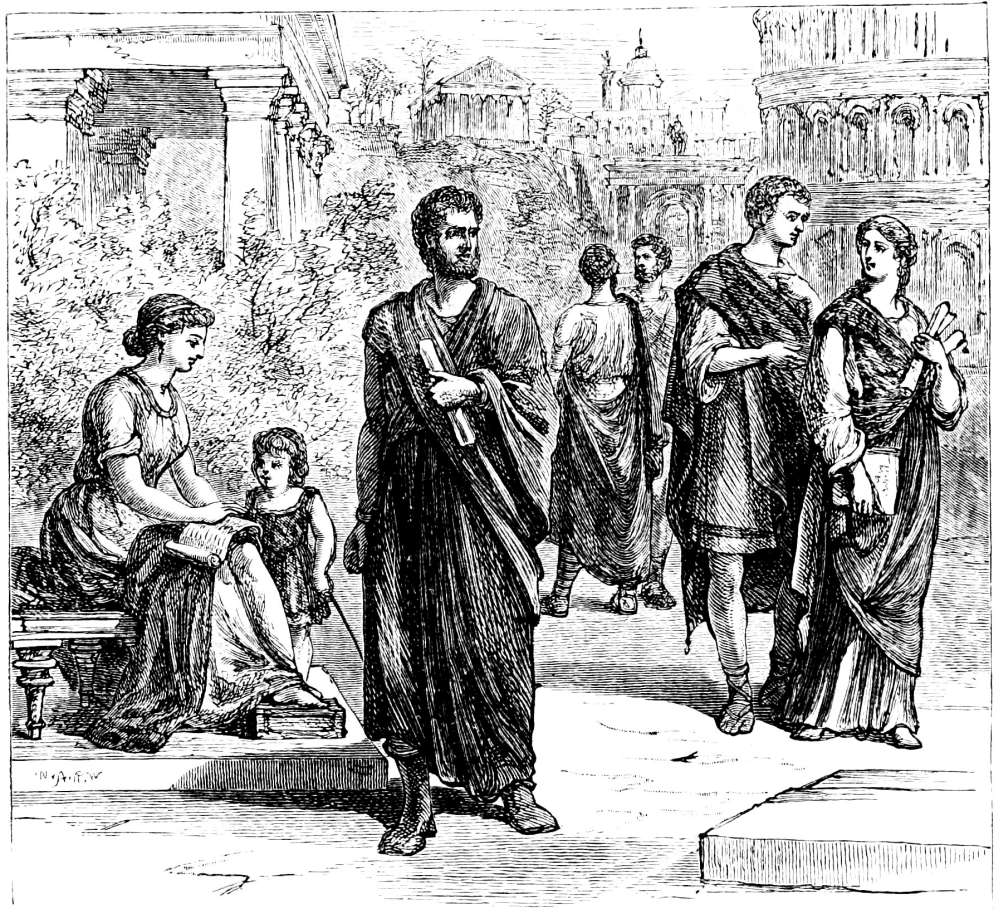
Romans of the Augustan Age (Becker’s “Gallus.”)
Alive to the importance of education, Virgil’s parents set aside a portion of their slender means to provide for his instruction; and when he reached the age of twelve, his father entered him in a school at Cremona. In his seventeenth year he went to Rome, and there prosecuted the higher studies, familiarizing himself with the Greek poets, and spending his leisure in the composition of lyric pieces. Having completed his education, Virgil returned to his native place, where, amid the natural attractions that surrounded him, he conceived the idea of rivalling Theocritus in bucolic poetry, and in 42 B.C. began his Eclogues.
After the victory of the Triumvirs in the civil war, the lands about Cremona and Mantua were divided among the soldiers who had served against Brutus, and the estate of Virgil, neutral though he had been, was taken from him. On the poet’s application to Octavius, however, it was restored, and in one of his Eclogues he gave utterance to his sincere gratitude. Shortly after, Virgil was ejected again, and this time narrowly escaped with his life by swimming the Mincio. Nor does he appear to have ever been reinstated. Octavius, however, loaded him with favors; and a house in Rome near the palace of his friend Mæcenas, with a lovely villa in the suburbs of Naples, where the climate agreed better with his delicate constitution than the damp air of the north, reconciled him to the loss of his boyhood’s home.
The Eclogues, published about 37 B.C., established Virgil’s reputation as a pastoral poet, and gained him no mean place among the literary and political celebrities that crowded the house of Mæcenas. It was by the advice of this statesman that the poet undertook the most finished and original of all his productions,—the Georgics,—a work which, though only about 2200 lines in length, occupied him for seven years.
Having declared in this poem that “he would wed Cæsar’s glories to an epic strain,” Virgil was held to his promise by the emperor, at whose solicitation he gave the rest of his life (eleven years) to the composition of the Æneid. In this great epic, like the Odyssey a sequel to the Iliad, the origin of Rome is traced back to ancient Troy, and the genealogy of Augustus to her greatest surviving hero, “the pious Æneas.” Death stopped the poet’s pen when three years’ labor was yet necessary, in his estimation, to perfect his work.
It appears that in the year 19 B.C. Virgil undertook a tour through Greece and Asia Minor, to acquaint himself with the geography of the countries described in the Æneid; but meeting Augustus at Athens, he changed his plans and started with the emperor for Rome. On the way he was seized with a mortal illness, and only lived to reach the harbor of Brundisium in southern Italy. On his death-bed, Virgil besought his friends to bring him the manuscript of his epic, that he might consign it to the flames; but they wisely saved a masterpiece which the modesty of its author would have condemned to oblivion.
Virgil was interred at Naples. A simple vault, overgrown with ivy and wild myrtle, still marks his grave. On a marble slab set in the rock opposite is the inscription which Dryden has thus rendered:—
“I sung flocks, tillage, heroes: Mantua gave Me life; Brundisium, death; Naples, a grave.”
Virgil has been described as a tall, dark-complexioned man, careless of his dress, and with awkward country airs. His life was that of a student; and despite the fact that he was a martyr to dyspepsia and pulmonary disease, he did not allow his delicate health to interfere with his literary labors. Of gentle, unassuming manners, he would fly from the admiring crowds that followed him in the streets; and none would have inferred from his appearance or conversation that he was a great poet. He was more than a great poet—he was a pure, unselfish, honest man, uncontaminated by the prevailing vices. Not the least among his virtues was filial piety. His countrymen felt how great and noble he was, when they rose in the theatre and paid him equal honor with the emperor himself.
Had he lived, it was Virgil’s purpose, after completing the Æneid, to study philosophy, the love of which he had imbibed in early life from the verses of Lucretius. The investigation of truth was his highest aim; and there are reasons for believing that he had in mind the preparation of a grand philosophical poem that might have cast into the shade the stately treatise “On the Nature of Things.”
Such liberality had Virgil experienced from his friends that he left a fortune of $400,000, to be divided, as he never married, among his brother, Augustus, Mæcenas, and others of his associates.
The Eclogues.—Virgil was the first Roman writer to cultivate pastoral poetry, and his Eclogues (selections), or more properly Bucolics (shepherd poems), are mostly dialogues, in imitation of the idyls of Theocritus. Various subjects are charmingly discussed by imaginary shepherds, in whom one sometimes recognizes the poet and his friends.
The least understood of Virgil’s Eclogues is the one entitled “Pollio,” from the name of the consul to whom it is addressed. It was written B.C. 40, and predicts the coming of a wondrous Child, whose birth would usher in a golden age of peace and happiness. Some have seen in this child an unconscious allusion to the Babe of Bethlehem, whose advent the Sibylline oracles are believed to have foretold. Perhaps Virgil had heard of the Hebrew prophecies indirectly through the Alexandrian Greeks, and recast them in Latin verse; perhaps it was but a Roman infant—Pollio’s child—whose birth he sung in an exaggerated strain. However this may be, we may remember that the heathen as well as the Jewish world at this time expected a great reformer, who should restore the innocence and bliss of by-gone ages.
EXTRACT FROM THE POLLIO.
“Comes the Last Age, of which the Sibyl sung— A new-born cycle of the rolling years; Justice returns to earth, the rule returns Of good King Saturn; lo! from the high heavens Comes a new seed of men. Lucina chaste, Speed the fair infant’s birth, with whom shall end Our age of iron, and the golden prime Of earth return; thine own Apollo’s reign In him begins anew. This glorious age Inaugurates, O Pollio, with thee; Thy consulship shall date the happy months; Under thine auspices the Child shall purge Our guilt-stains out, and free the land from dread. He with the gods and heroes like the gods Shall hold familiar converse, and shall rule With his great father’s spirit the peaceful world. For thee, O Child! the earth untilled shall pour Her early gifts, the winding ivy’s wreath, Smiling acanthus, and all flowers that blow. The ground beneath shall cradle thee in blooms, The venomed snake shall die, the poisonous herb Perish from out thy path. So, when the years shall seal thy manhood’s strength, The busy merchant shall forsake the seas— Barter there shall not need; the soil shall bear For all men’s use all products of all climes. The glebe shall need no harrow, nor the vine The searching knife, the oxen bear no yoke; The wool no longer shall be schooled to lie, Dyed in false hues; but, coloring as he feeds, The ram himself in the rich pasture-lands Shall wear a fleece now purple and now gold, And the lambs grow in scarlet. So the Fates, Who know not change, have bid their spindles run, And weave for this blest age the web of doom.” W. L. Collins.
The Georgics.—Having shown his powers in the Eclogues, Virgil was not unwilling to put them to a further proof, when Mæcenas suggested a work on husbandry, which should dignify that ancient art and revive a love for the simple pursuits of the fathers of the Republic.
Taking Hesiod’s “Works and Days” as his model, he added the artistic Georgics (agricultural poem) to the works of Cato and Varro on rural life. No less elevated in tone than theirs, it possesses an additional attraction in its dress of verse, glows with the author’s love of nature, and displays his ardent zeal to check the national decay. Virgil labored upon the Georgics for seven years, it being his habit to rise betimes and dictate in the early morning verses which he spent the rest of the day in polishing and condensing.
The Georgics is a didactic poem, and as such, with the work of Lucretius, represents the only department in which the Romans excelled both the Greeks and all modern nations. The first of its four books is devoted to tillage; it gives directions for ploughing (early and often, was Virgil’s motto), sowing, and fertilizing, and explains the signs of the weather. We learn from it that the pests of the modern farmer were not unknown to the old Roman husbandman:—
“With ponderous roller smooth the level floor, And bind with chalky cement o’er and o’er; Lest springing weeds expose thy want of art, And worn in many a chink the surface part: There builds the field-mouse underneath the ground, And loads her little barn with plunder crowned; There works the mole along her dark abode, There in its hollow lurks the lonely toad, There wastes the weevil with insatiate rage, There the wise ant that dreads the wants of age.”
Arboriculture is treated minutely in the second book, the vine receiving the principal share of attention. Here we have the most beautiful of those digressions which lend an enchanting variety to the style of the Georgics—the poet’s glowing eulogy of his native land.
PRAISES OF ITALY.
“Yet nor the Median groves, nor rivers, rolled, Ganges, and Hermus, o’er their beds of gold, Nor Ind, nor Bactra, nor the blissful land Where incense spreads o’er rich Panchaia’s sand, Nor all that fancy paints in fabled lays, O native Italy! transcend thy praise. Though here no bulls beneath the enchanted yoke With fiery nostril o’er the furrow smoke, No hydra teeth embattled harvest yield, Spear and bright helmet bristling o’er the field; Yet golden corn each laughing valley fills, The vintage reddens on a thousand hills, Luxuriant olives spread from shore to shore, And flocks unnumbered range the pastures o’er. Hence the proud war-horse rushes on the foe, Clitumnus! hence thy herds, more white than snow, And stately bull, that, of gigantic size, Supreme of victims, on the altar lies, Bathed in thy sacred stream oft led the train When Rome in pomp of triumph deck’d the fane. Here Spring perpetual leads the laughing Hours, And Winter wears a wreath of summer flowers: The o’erloaded branch twice fills with fruits the year, And twice the teeming flocks their offspring rear. Yet here no lion breeds, no tiger strays, No tempting aconite the touch betrays, No monstrous snake the uncoiling volume trails, Or gathers orb on orb his iron scales. But many a peopled city towers around, And many a rocky cliff with castle crowned, And many an antique wall whose hoary brow O’ershades the flood that guards its base below. All hail, Saturnian earth! hail, loved of fame, Land, rich in fruits and men of mighty name! For thee I dare the sacred founts explore, For thee, the rules of ancient art restore, Themes once to glory raised again rehearse, And pour through Roman towns the Ascræan verse.” Sotheby.
The raising of cattle and the management of bees form the subjects of the remaining books of the Georgics.
The Æneid narrates in epic verse the adventures of Æneas, the legendary ancestor of the Romans. Virgil sums up his plot in the opening lines:—
“Arms and the man I sing, who first, By Fate of Ilian realm amerced, To fair Italia onward bore, And landed on Lavinium’s shore:— Long tossing earth and ocean o’er, By violence of heaven, to sate Fell Juno’s unforgetting hate: Much labored too in battle-field, Striving his city’s walls to build, And give his Gods a home. Thence come the hardy Latin brood, The ancient sires of Alba’s blood, And lofty-rampired Rome.”
Æneas, the son of Venus by the Trojan shepherd Anchi’ses, escaped from burning Troy with his aged father, little son, and household gods. He lay concealed for a time in the mountains; and, when the victorious Greeks had all withdrawn, took ship with the remnant of his people to found a new Troy in the west. After seven years of hardships and mistakes, the Trojans embark from Sicily for “the Hesperian shore.”
Here the Æneid takes up the story. In the first book we see the Trojan fleet driven by a tempest, sent at Juno’s solicitation, on the opposite coast of Africa, near the rising walls of Carthage. Dido, its queen, whom the murder of her husband Sichæus by her unnatural brother had driven from Tyre, receives the strangers hospitably, and by the strategy of Venus conceives a passionate love for Æneas. At her request the Trojan prince tells the pathetic story—the fall of his native city through the wiles of the Greeks, and his subsequent trials.
Æneas returns Dido’s love, but only at last to betray his confiding hostess, and fly with his vessels under cover of the night, in obedience to a warning from Mercury, the messenger of Jove. Too “pious” to disregard the heavenly command, he left Dido to end her sorrow on the funeral pyre.
After a temporary sojourn in Sicily, where he celebrates funeral games to his father’s memory, Æneas at length reaches Cumæ in Italy, and at once seeks the Sibyl. She informs him that his trials are not over, and takes him to the lower world that he may hold an interview with his father Anchises. There he descries among other shades the injured Dido, to whom he endeavors to excuse his conduct.
“’Mid these among the branching treen Sad Dido moved, the Tyrian queen, Her death-wound ghastly yet and green. Soon as Æneas caught the view And through the mist her semblance knew, Like one who spies, or thinks he spies, Through flickering clouds the new moon rise, The tear-drop from his eyelids broke, And thus in tenderest tones he spoke. ‘Ah Dido! rightly then I read The news that told me you were dead, Slain by your own rash hand! Myself the cause of your despair! Now by the blessed stars I swear, By heaven, by all that dead men keep In reverence here ’mid darkness deep, Against my will, ill-fated fair, I parted from your land.’” Conington.
But Dido averts her eyes “that neither smiled nor wept,” and moves away in silence to join Sichæus, who “gives her love for love.”
Æneas learns from the lips of Anchises the future of his race, and beholds the shadowy forms of kings, generals, and statesmen that are to shed glory on the Roman name. “Augustus Cæsar, god by birth,” figures, as we should expect, the proudest of the throng. At last he espies the great Marcellus, “the Sword of Rome,” glittering in the spoils of the Punic War; and by his side
“A youth full-armed, by none excelled In beauty’s manly grace.”
In answer to the inquiry of Æneas, Anchises tells his son that this youth is “our own Marcellus,” and eulogizes his virtues. Thus Virgil immortalized the name of a Roman prince of great promise, son of Octavia, the emperor’s sister, whose premature death had filled the Roman world with sorrow. When, at the request of Augustus, the poet read this portion of his epic before the royal family, all were moved to tears, and the bereaved mother fainted. She afterward showed her appreciation of Virgil’s genius by presenting him about $400 for each of the twenty-seven lines. The passage is well worth repeating here:—
VIRGIL’S TRIBUTE TO MARCELLUS.
“Seek not to know (the ghost replied with tears) The sorrows of thy sons in future years. This youth (the blissful vision of a day) Shall just be shown on earth, then snatched away. The gods too high had raised the Roman state, Were but their gifts as permanent as great. What groans of men shall fill the Martian field! How fierce a blaze his flaming pile shall yield! What funeral pomp shall floating Tiber see, When rising from his bed, he views the sad solemnity! No youth shall equal hopes of glory give, No youth afford so great a cause to grieve. The Trojan honor, and the Roman boast, Admired when living, and adored when lost! Mirror of ancient faith in early youth! Undaunted worth, inviolable truth! No foe, unpunished, in the fighting field Shall dare thee, foot to foot, with sword and shield! Much less in arms oppose thy matchless force, When thy sharp spurs shall urge thy foaming horse. Ah! couldst thou break through Fate’s severe decree, A new Marcellus shall arise in thee! Full canisters of fragrant lilies bring, Mixed with the purple roses of the spring: Let me with funeral flowers his body strow; This gift which parents to their children owe, This unavailing gift, at least I may bestow!”—Dryden.
From Cumæ the Trojan chief sails to Latium, the land of his destiny, and there he receives from King Lati’nus the promise of his daughter Lavinia’s hand. But this provokes a war with Turnus, a neighboring prince, to whom Lavinia had been secretly plighted by the queen-mother. Not until he had subdued Turnus and his Latin allies did Æneas make Lavinia his own and rule as king of Latium. The poem ends with the fall of Turnus in a duel between the rival chiefs. To finish the story, Alba Longa was built by Æneas’ son Iulus, from whose royal line in later ages sprung Romulus, founder of Rome, the Julian family, and their great hero Julius Caesar.
The passion of Dido, as portrayed in the fourth book of the Æneid, is the most masterly piece of Virgil’s handiwork. We present below the closing scenes that sealed her sad fate.
THE DEATH OF DIDO.
“Now, rising from Tithonus’ bed, The Dawn on earth her freshness shed: The queen from off her turret height Perceives the first dim streak of light, The fleet careering on its way, And void and sailless shore and bay; She smites her breast, all snowy fair, And rends her golden length of hair: ‘Great Jove! and shall he go?’ she cries, ‘And leave our realm a wanderer’s mock? Quick, snatch your arms and chase the prize, And drag the vessels from the dock! Fetch flames, bring darts, ply oars!—yet why? What words are these, or where am I? Why rave I thus? Those impious deeds— Poor Dido! how your torn heart bleeds. Too late! it should have bled that day When at his feet your sceptre lay. Lo here, the chief of stainless word, Who takes his household gods on board, Whose shoulders safe from sword and fire Conveyed his venerable sire! Oh! had I rent him limb from limb And cast him o’er the waves to swim, His friends, his own Ascanius killed, And with the child the father filled! Yet danger in the strife had been:— Who prates of danger here? A death-devoted, desperate queen, What foe had I to fear? No, I had sown the flame broadcast, Had fired the fleet from keel to mast, Slain son and sire, stamped out the race, And thrown at length with steadfast face Myself upon the bier. If needs must be that wretch abhorred Attain the port and float to land, If such the fate of heaven’s high lord, And so the moveless pillars stand; Scourged by a savage enemy, An exile from his son’s embrace, So let him sue for aid, and see His people slain before his face; Nor when to humbling peace at length He stoops, be his or life or land, But let him fall in manhood’s strength And welter tombless on the sand. Such malison to heaven I pour, A last libation with my gore. And, Tyrians, you through time to come His seed with deathless hatred chase: Be that your gift to Dido’s tomb: No love, no league ’twixt race and race. Rise from my ashes, scourge of crime, Born to pursue the Dardan horde To-day, to-morrow, through all time, Oft as our hands can wield the sword: Fight shore with shore, fight sea with sea, Fight all that are or e’er shall be!’ She ceased, and with her heart debates How best to leave the life she hates. Then to Sichæus’ nurse she cried (For hers erewhile at Tyre had died):— ‘Good nurse, my sister Anna bring: O’er face and body bid her fling Pure drops from lustral bough: So sprinkled come, and at her side The victims lead: you too provide A fillet for your brow. A sacrifice to Stygian Jove I here perform, to ease my love, And give to flame the fatal bed Which pillowed once the Trojan’s head.’ Thus she: the aged dame gives heed, And, feebly hurrying, mends her speed. Then, maddening over crime, the queen, With bloodshot eyes, and sanguine streaks Fresh painted on her quivering cheeks, And wanning o’er with death foreseen, Through inner portals wildly fares, Scales the high pile with swift ascent, Takes up the Dardan sword and bares, Sad gift, for different uses meant. She eyed the robes with wistful look, And, pausing, thought awhile and wept; Then pressed her to the couch, and spoke Her last good-night or ere she slept. ‘Sweet relics of a time of love, When fate and heaven were kind, Receive my life-blood and remove These torments of the mind. My life is lived, and I have played The part that Fortune gave, And now I pass, a queenly shade, Majestic to the grave. A glorious city I have built, Have seen my walls ascend, Chastised for blood of husband spilt A brother, yet no friend. Blest lot! yet lacked one blessing more, That Troy had never touched my shore.’ Then as she kissed the darling bed, ‘To die! and unrevenged!’ she said, ‘Yet let me die: thus, thus I go Exulting to the shades below. Let the false Dardan feel the blaze That burns me pouring on his gaze, And bear along, to cheer his way, The funeral presage of to-day.’ Thus as she speaks, the attendant train Behold her writhing as in pain, Her hands with slaughter sprinkled o’er, And the fell weapon spouting gore. Loud clamors thrill the lofty halls: Fame shakes the town, confounds, appalls: Each house resounds with women’s cries. And funeral wails assault the skies: E’en as one day should war o’erthrow Proud Carthage or her parent Tyre, And fire-flood stream with furious glow O’er roof, and battlement, and spire.” Conington.
Virgil’s epic was the pride of his countrymen, who, with a pardonable national vanity, pronounced it superior to Homer’s. Tenderness, grace, elegance, rhythmical perfection, brilliance of description, it certainly possesses; yet, with all its beauties, it is not faultless. We miss the wonderful imagination that plays through every page of the Iliad; indeed, Homer furnished the originals of many of its most striking figures. Nor did Virgil disdain levying on Latin authors also. Whatever recommended itself to him in the poetry of others, he borrowed for his own. And yet he must not be regarded as a plagiarist; doubtless it was his intention to enshrine in a national epic literary monuments of all the great minds of his country.
Æneas, his hero, too often appears as the boaster or the heartless hypocrite, rather than as the ideal of greatness and piety it was designed to draw. The author himself seems to have felt the inferiority of his epic to the Iliad, and hence his wish to destroy it. We are told that it was first written in prose; and then the artist, having a clear conception of the whole, threw different portions into verse as the spirit moved him. (See Nettleship’s “Introduction to the Study of the Æneid.”)
Horace (65-8 B.C.).—The great lyric poet of Rome was Horace (Quintus Horatius Flaccus), a freedman’s son, of Venusia on the roaring Au’fidus. That he might enjoy the best educational advantages, his father took him to Rome at the early age of twelve. Here he was placed in charge of a famous schoolmaster, called by his pupils “the Flogger;” under whose rod the country lad made the acquaintance of Ennius and Homer. To the watchful care and liberality of his parent, who remained to guard him from the temptations of the metropolis, he gratefully acknowledged that he owed everything.
Horace was at Athens, finishing his course, when Cæsar fell beneath the daggers of the conspirators. With a number of hot-headed fellow-students he promptly espoused the cause of Brutus the Liberator, and served in the civil war as military tribune. But Horace’s courage could not stand the touch of cold steel; he ignominiously fled from the field of Philippi, and his estate was confiscated as a reward for his patriotism. Poverty now compelled him to take a clerkship at Rome; and to add to his slender income he began writing verses. This brought him into notice, and in 38 B.C. he had the honor of an introduction to the social circle that gathered round Mæcenas. His little farm, fifteen miles from Tibur, the ruins of which are still pointed out to tourists, was the gift of his munificent patron.
This “Sabine farm” was at once Horace’s joy and pride. Between Rome and Tibur, therefore, he made frequent journeys, and the simple country-folk, won by his affability, hailed with delight the occasions when, tired of city excitements, he sought relaxation among them. Beset by the throng of gossips and favor-seekers who haunted his footsteps as the friend of Mæcenas, Horace in his Sixth Satire breaks out into enthusiastic praises of his rural home, with its simple fare and freedom from annoyances:—
“This fortune’s favorite son (’tis cried) Is ever by Mæcenas’ side, Companion wheresoe’er he goes, In rural sports or festal shows. Should any rumor, without head Or tail, about the streets be spread, Whoever meets me gravely nods, And says, ‘As you approach the gods, It is no mystery to you; What do the Dacians mean to do?’ ‘Indeed I know not.’—’How you joke, And love to sneer at simple folk.’ ‘Then, pr’ythee, where are Cæsar’s bands Allotted their long-promised lands?’ Although I swear I know no more Of that than what was asked before, They stand amazed, and think me then The most reserved of mortal men. Bewildered thus amidst a maze, I lose the sunshine of my days, And often wish: Oh! when again Shall I behold the rural plain? And when with books of sages deep Sequestered ease and gentle sleep, In sweet oblivion, blissful balm! The busy cares of life becalm. Oh! when shall Pythagoric beans With wholesome juice enrich my veins? And bacon, ham, and savory pottage, Be served within my simple cottage? O nights that furnish such a feast As even gods themselves might taste!” Francis.
The loss of his friend Virgil cast a shadow over Horace’s latter years. His own death was sudden. A short month before, Mæcenas had breathed his last; and thus the promise of the poet not to survive his patron was almost literally fulfilled. In an ode to Mæcenas, Horace had sung,
“Should you, alas! be snatched away, Wherefore, ah! wherefore should I stay, My value lost, no longer whole, And but possessing half my soul? One day (believe the sacred oath) Shall lead the funeral pomp of both; With thee to Pluto’s dark abode, With thee I’ll tread the dreary road.”
The remains of the poet were laid by the side of his friend; and thus, devoted to each other in life, they slept together in the grave. (Read Milman’s “Life of Horace.”)
Horace, in his youth, was a free liver, a voluptuary; such, indeed, were the men of his day, Virgil alone excepted. Time, however, corrected his tastes, and at the close of his life we find him playing the part of the moralist. If there is much to condemn in his character, there is also much to admire,—his even temper, contented disposition, and independent spirit. Quick to resent an affront, he was as ready to forgive an injury. His friends found him ever a genial, frank, warm-hearted companion.
As to his personal appearance, we may judge from his own accounts that he was gray in advance of his years, short, corpulent, and withal blear-eyed. This last defect furnished Augustus with a ready joke, when he had Horace on one side and the asthmatic Virgil on the other: “I sit between sighs and tears,” he used to say.
Works of Horace.—The earliest poetical efforts of Horace were Satires, which, though written in hexameter verse, he called prose-poems. Holding up to contempt the follies of fashionable society, fortune-hunting, extravagance, avarice, etc., they pleased the Romans and rapidly grew in popularity. But Horace merely derides, he does not chastise, the vices of his day, evidently deeming ridicule a more effective weapon than denunciation.
In his Epodes, Horace aimed his blows at individuals with something like the force of Archilochus. But personal satire was not the author’s forte, and his Epodes are hardly equal to his other productions.
It is to his Odes, in the lyric metres of Alcæus and Sappho, whose poetry he not only loved, but recast after his own ideas in his native tongue, that Horace owes his renown. Always brief and to the point, clear and elegant in their condensation, graceful, spicy, true to nature, these poems have been read with pleasure for nineteen centuries. They deal with a great variety of subjects—the grand as well as the commonplace; and, whatever the theme, their author is equally admirable. He paints pictures of moral beauty and sublimity with singular impressiveness. Nowhere in the classics is a nobler character sketched than that drawn by Horace of a man firm in the cause of justice (Book III., 3). Byron presents it in an English dress:—
“The man of firm and noble soul No factious clamors can control; No threat’ning tyrant’s darkling brow Can swerve him from his just intent: Gales the warring waves which plough By Auster on the billows spent, To curb the Adriatic main, Would awe his fixed, determined mind in vain. Ay, and the red right arm of Jove, Hurtling his lightnings from above, With all his terrors then unfurled, He would unmoved, unawed behold: The flames of an expiring world Again in crashing chaos rolled, In vast promiscuous ruin hurled, Might light his glorious funeral pile: Still dauntless, ’mid the wreck of earth he’d smile.”
Horace began writing his odes at the age of thirty-five, and was seven years in completing the first three books; they were issued 23 B.C. That he designed them to include all his lyric productions is evident from the following ode, with which the third book closes:—
“And now ’tis done: more durable than brass My monument shall be, and raise its head O’er royal pyramids: it shall not dread Corroding rain or angry Boreas, Nor the long lapse of immemorial time. I shall not wholly die: large residue Shall ’scape the queen of funerals. Ever new My after-fame shall grow, while pontiffs climb With silent maids the Capitolian height. ‘Born,’ men will say, ‘where Aufidus is loud, Where Daunus, scant of streams, beneath him bowed The rustic tribes, from dimness he waxed bright, First of his race to wed the Æolian lay To notes of Italy.’ Put glory on, My own Melpomene, by genius won, And crown me of thy grace with Delphic bay.” Conington.
The odes of the fourth book were written at the request of Augustus, who commissioned the favorite poet to celebrate the victories of his step-sons over a German tribe. After publishing the original three books, Horace wrote his Epistles, the most finished of all his works. They bear the ripe fruits of his experience, and are full of wise reflections which do credit to his knowledge of men and manners. Sprightliness and wit constitute their charm. Their subjects are various, several of them being literary criticisms; the longest, called “the Art of Poetry,” possesses the greatest value.
The works of Horace have maintained their popularity in all ages; his sententious sayings have become aphorisms; and to-day he is a greater favorite with scholars than ever. Few classical poets have been so fortunate in their translators.
ODE TO MÆCENAS.
“Strong doors, wakeful watch-dogs, securely had barred Danaë in her tower of brass, If Venus and Jove had not laughed at such guard And the shower of gold caused to pass. Through an army of guards will bright gold make its way; It will pierce through the thickest of walls; More power it has and may strike more dismay Than the lightning from heaven that falls. Through lucre the house of the Argive seer[46] fell: Philip forced cities’ gates with his gold; The power of rivals with bribes he could quell: We know, too, how fleets have been sold. The increase of wealth ever brings with it care And hungry ambition for more; Thus, Mæcenas, O knight with whom none can compare! Great fortune I ever forswore. The more that a man to himself shall deny, The more he shall have from the gods; Poor, I seek for the home of contentment, and fly With joy from the wealthy abodes. With my stream of pure water, few acres of wood, And secure that my harvest will pay, A pleasure I have more substantial than could Be to him that o’er Afric holds sway. Though for me never works the Calabrian bee, Though for me is no Formian wine, Though no sheep in the pastures of Gaul feed for me. Yet poverty never is mine. Much must that man want ever who much shall demand; What he gains whets the covetous vice; Happy he to whom God with a niggardly hand Has granted what yet will suffice.”—Yardley.
TO PYRRHA.
“What scented stripling, Pyrrha, wooes thee now In pleasant cavern, all with roses fair? For whom those yellow tresses bindest thou With simple care? Full oft shall he thine altered faith bewail, His altered gods; and his unwonted gaze Shall watch the waters darken to the gale In wild amaze, Who now believing gloats on golden charms; Who hopes thee ever kind and ever void; Nor, hapless! knows the changeful wind’s alarms, Nor thee, untried. For me, let Neptune’s temple wall declare How, safe escaped, in votive offering My dripping garments own, suspended there, Him Ocean-king.” Gladstone.
Varius (74-14 B.C.).—Older than Horace or Virgil in the Augustan galaxy was Varius, the friend who introduced them both to Mæcenas. An epic on the death of Cæsar, highly esteemed by his countrymen,—and a tragedy entitled “Thyestes,” classed with the finest Greek dramas,—have won for Varius an enviable fame.
Both are lost; but we still have the benefit of the poet’s labors as the editor of Virgil’s Æneid.
Albius Tibullus (59-19 B.C.), another poet of the Augustan age, perfected the erotic elegy which Catullus had introduced from Greece. The meagre accounts that remain of his life inform us that he was a knight, and lost his estates near Rome for political reasons, after the overthrow of Pompey. These he partially recovered, it is supposed through the influence of Messa’la, a noble of the old school, whose praises he never tired of sounding. As aide-de-camp, he accompanied Messala in his expedition against the rebellious Aquitanians, and doubtless figured in the triumph decreed his victorious friend by the emperor.
A peaceful life, however, was more in accordance with his tastes. The hills and dales, the corn-fields, vineyards, and meadows, possessed greater charms for him than the favor of Augustus, who vainly sought to attract Tibullus to his court. Hence we find the poet generally living at his country-seat, amid rural enjoyments.
The elegies of Tibullus preserve the names of two Roman beauties—“Delia,” the early mistress of his heart, and “Nem’esis,” her successor. Delia, “with her queenly charms and golden locks,” first brought him to her feet, and he wooed her in his most finished strains. But, like Catullus, he soon found occasion to lament his fair one’s inconstancy. Delia jilted him for a richer lover, and Tibullus transferred his affections to the imperious Nemesis.
The style of Tibullus is sweet and polished. A pensive, almost melancholy tone pervades his verses. In the following plaintive elegy, the injured but forgiving poet recalls to his false one how tenderly he nursed her through a critical sickness, picturing his dream of happiness with her installed as the mistress of his rural home, and his rude awakening:—
ELEGY TO DELIA.
“Oh! I was harsh to say that I could part From thee; but, Delia, I am bold no more! Driven like a top, which boys with ready art Keep spinning round upon a level floor. Burn, lash me, love, if ever after this By me one cruel, blustering word is said; Yet spare, I pray thee by our stolen bliss, By mighty Venus and thy comely head. When thou didst lie, by fell disease o’erpowered, I rescued thee, by prayers, from death’s domain; Pure sulphur’s cleansing fumes I round thee showered, While an enchantress sung a magic strain. Yes—and another now enjoys the prize, And reaps the fruit of all my vows for thee: Foolish, I dreamed of life ’neath golden skies, Wert thou but saved—not such great heaven’s decree. I said—I’ll till my fields, she’ll guard my store When crops are threshed in autumn’s burning heat; She’ll keep my grapes in baskets brimming o’er, And my rich must expressed by nimble feet. She’ll count my flock; some home-born slave of mine Will prattle in my darling’s lap and play: To rural god ripe clusters for the vine, Sheaves for my crops, cates for my fold, she’ll pay. Slaves—all shall own her undisputed rule; Myself a cipher—how the thought would please! Here will Messala come, for whom she’ll pull The sweetest apples from the choicest trees; And, honoring one so great, for him prepare And serve the banquet with her own white hands. Fond dream! which now the east and south winds bear Away to far Armenia’s spicy lands.” Cranstoun.
Propertius.—With the name of Tibullus is often linked that of Propertius, who was born about 50 B.C. at Assisium, among the Umbrian mountains. In this lovely spot he was prepared for the study of the law, which he afterward adopted as his profession at Rome. But Propertius found this calling distasteful; relinquishing it, accordingly, for the pursuits of literature, he aspired to be a Roman Callimachus, and grounded himself in the principles of Alexandrian verse. But too much study made him artificial, and his numerous mythological allusions and digressions encumber rather than embellish. He lacks the sweetness, simplicity, and tenderness, of Tibullus.