The technique of Ancient Manuscripts[15].
Reading edition
The technique of Ancient Manuscripts[15].
Parchment and vellum. Erasures.
Parchment and vellum.Parchment. With regard to the preparation of parchment and other kinds of skin for writing on (Pergamena and Membrana) there is little to be said. The skins of many different animals have been used for this purpose both in classical and mediaeval times, especially skins of calves, sheep, goats and pigs. Unlike manuscripts on papyrus, parchment or vellum[16] manuscripts were usually covered with writing on both sides, since the ink does not show through from one side to the other, as it is liable to do on the more absorbent and spongy papyrus paper. Erasures.For this reason complete or partial erasures were much easier to execute on vellum than on papyrus. The writing was first sponged so as to remove the surface ink, and the traces that still remained were got rid of by rubbing the surface of the vellum with pumice stone. In some cases the manuscript was erased from the whole of a vellum codex or roll, and the cleaned surface then used to receive fresh writing.
Palimpsests.
Palimpsests.Palimpsests; manuscripts of this class, on twice-used vellum, were called palimpsests (παλίμψηστος); see Cic. Fam. vii. 18. Several important texts, such as the legal work of Gaius, have been recovered by laboriously deciphering the not wholly obliterated writing on these palimpsests. During the early mediaeval period, when classical learning was little valued, many a dull treatise of the schoolmen or other theological work of small interest was written over the obliterated text of some much earlier and more valuable classical author.
Papyrus MSS.
Papyrus MSS.In some cases it appears that papyrus manuscripts were made into palimpsests, but probably not very often, as it would be difficult to erase the ink on a roll of papyrus without seriously injuring the surface of the paper.
Moreover as papyrus manuscripts were only written on one side of the paper, the back was free to receive new writing without any necessity to rub out the original text. The recently discovered treatise by Aristotle on the Political Constitution of Athens has some monetary accounts written on the back of the papyrus by some unphilosophical man of business not many years later than the date of the original treatise.
Papyrus paper.
Papyrus paper.Papyrus paper. The ancient methods employed in the preparation of papyrus paper (charta) can be clearly made out by the evidence of existing examples aided by the minute but not wholly accurate description given by Pliny, Hist. Nat. XIII. 71 to 83.
Papyrus plant.
Papyrus plant.The papyrus plant, the Cyperus Papyrus of Linnaeus, (Greek βύβλος) is a very tall, handsome variety of reed which grows in marshes and shallows along the sides of streams of water. The plant has at the top a very graceful tufted bunch of foliage; its stem averages from three to four inches in diameter, and the total height of the plant is from ten to twelve feet.
It grows in many places in Syria, in the Euphrates valley and in Nubia. In Egypt itself it is now extinct, but it was abundant there in ancient times, especially in the Delta of the Nile.
The only spot in Europe where the papyrus plant grows in a wild state is near Syracuse in the little river Anapus, where it was probably introduced by the Arab conquerors in the eighth or ninth century A.D.
It grows here in great abundance and sometimes nearly blocks up the stream so that a boat can scarcely get along.
The stem of the papyrus consists of a soft, white, spongy or cellular pith surrounded by a thin, smooth, green rind. Papyrus paper (βιβλία or χάρτης) was wholly made from the cellular pith. The method of manufacture was as follows.
Process of manufacture.
Process of manufacture.The long stem of the plant was first cut up into convenient pieces of a foot or more in length; the pith in each piece was then very carefully and evenly cut with a sharp knife into thin slices. These slices were then laid side by side, their edges touching but not overlapping, on the smooth surface of a wooden table which was slightly inclined to let the superfluous sap run off, as it was squeezed out of the slices of pith by gentle blows from a smooth wooden mallet. When by repeated beating the layer of pith had been hammered down to a thinner substance, and a great deal of the sap had drained off, some fine paste made of wheat-flour was carefully brushed over the whole surface of the pith. A second layer of slices of pith, previously prepared by beating, was then laid crosswise on the first layer made adhesive by the paste, so that the slices in the second layer were at right angles to those of the first. The beating process was then repeated, the workmen being careful to get rid of all lumps or inequalities, and the beating was continued till the various slices of pith in the two layers were thoroughly united and amalgamated together.
Use of many layers. Sizes of papyrus.
Use of many layers.For the best sort of papyrus these processes were repeated a third and sometimes even a fourth time, the separate slices in each layer being cut much thinner than in the coarser sorts of paper which consisted of two layers only. The next process was to dry and press the paper; after which its surface was carefully smoothed and polished with an ivory burnisher[17]; its rough edges were trimmed, and it was then ready to be made up into sheets or rolls. There was nothing in the method of manufacture to limit strictly the size of the papyrus sheets (σελίδες, paginae) either in breadth or length; Sizes of papyrus.the workmen could lay side by side as many slices of the pith as he liked, and slices of great length might have been cut out of the long stem of the papyrus. Practically, however, it was found convenient to make the paper in rather small sheets; twelve to sixteen inches are the usual widths of papyrus manuscripts.
Union of the sheets. Long rolls.
Union of the sheets.The reason of this obviously was that it would have been impossible to cut slices of great length to the requisite thinness and evenness of substance, and so papyrus manuscripts are always made up of a large number of separate sheets carefully pasted together. This was very skilfully done by workmen who (in Pliny's time) were called glutinatores; cf. Cic. Att. IV. 4. The two adjacent edges of the sheets, which were to be joined together by lapping, were thinned down by careful rubbing to about half their original substance. The two laps were then brushed over with paste, accurately applied together, and the union was then completed by beating with the wooden mallet. When the pasted joint was dry it was rubbed and polished with the ivory burnisher till scarcely any mark of the joining remained. Long rolls.In this way long rolls were formed, often fifty feet or more in length; as a rule, however, excessive length for a single roll was inconvenient. Pliny mentions 20 sheets as being an ordinary limit. Thus, for example, in such works as Homer's Iliad or Virgil's Aeneid, each book would form a separate volumen or roll (Greek κύλινδρος or τόμος).
The invention of papyrus paper dates from an early period in the history of Egypt. Examples still exist which are as early as 2300 B.C., and its manufacture was probably known long before that.
Papyrus used in Greece.
Papyrus used in Greece.In later times Egyptian papyrus was an important article of export into many countries. An Attic inscription of the year 407 B.C. tells us what the cost of paper then was in Athens; two sheets (χάρται δύο) cost two drachmae and four obols, equal in modern value to about four shillings; see C. I. A. I. 324. The χάρται in this case probably mean, not a single page, but several sheets pasted together to form a roll.
Papyrus made in Rome. Old MSS. on papyrus.
Papyrus made in Rome.In Pliny's time paper was made not only in Egypt but also in Rome and at other places in Italy[18]. The best kind was formerly called Hieratica, because it was used in Egypt for sacred hieroglyphic writing only. In later times this finest quality, in Rome at least, was called Augusta, and the second quality Liviana, from Livia the wife of Augustus. A coarse variety used for wrapping up parcels and the like was called "shop-paper," emporetica. Pliny also tells us that paper was manufactured of many different breadths, varying from about four to eighteen inches. The commonest width was about twelve inches; see Pliny, Hist. Nat. XIII. 71 to 83. Old MSS. on papyrus.In the last of these paragraphs Pliny mentions examples of old papyrus manuscripts existing in his time, such as manuscripts in the handwriting of Tiberius and Gaius Gracchus, which were nearly two centuries old. Manuscripts written by Cicero, Augustus and Virgil are, he says, still frequently to be seen.
With regard to the antiquity of paper Pliny's views are far from correct. He thinks paper was first made in Egypt in the time of Alexander the Great (Hist. Nat. XIII. 79), whereas, as is mentioned above, papyrus paper of fine quality was certainly made in Egypt nearly 2000 years before the time of Alexander, and probably much earlier.
Paper of fine quality.
Paper of fine quality.The best kinds of papyrus paper are close in texture, with a smooth surface, very pleasant to write upon with a reed pen, and adapted to receive miniature paintings of great refinement and delicacy of touch. To prevent the ink spreading or soaking into the paper, it was as a final process sometimes soaked in size made of fish-bones or gum and water, exactly as modern linen paper is sized. The colour of the papyrus is a pale brown, very pleasant to the eye, and excellent as a background to the painted decorations.
Fibrous texture.
Fibrous texture.When it was first made, papyrus paper must have been extremely durable and tough owing to its compound structure with two or more fibrous layers placed cross-wise. The parallel fibrous lines of the pith are very visible on the surface of papyrus paper; and these regular lines served as a guide to the scribe when writing, so that when papyrus was used it was not necessary to cover the page with ruled lines to keep the writing even, as had to be done when the manuscript was on vellum.
In a papyrus manuscript the pages of writing are set side by side, across the roll, with a small margin between each page or column.
Greek examples of papyrus rolls.
Greek examples of papyrus rolls.A small terra-cotta statuette[19] of about the fifth or fourth century B.C. found at Salamis in Cyprus in 1890, shows a Greek scribe writing on a long papyrus roll placed on a low table before which he is sitting.
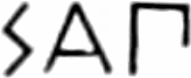
Among Greek vase paintings of the same date a not uncommon subject is the poetess Sappho reading from a papyrus roll. A fourth century vase with this subject in the Central Museum in Athens shows Sappho holding a manuscript on which the following words are inscribed (supplying missing letters and correcting blunders)
ΘΕΟΙ ΗΕΡΙΩΝ ΕΠΕΩΝ ΕΡΧΟΜΑΙ ΑΓΓΕΛΟΣ ΝΕΩΝ ΥΜΝΩΝ.
By the figure of Sappho is inscribed the beginning of her name, in letters of archaistic form.
Sappho reading.
Sappho reading.A very similar design occurs on a beautiful gem in the British Museum (B.M. Cat. of gems, No. 556), which appears to date from the latter part of the fifth century B.C. A very graceful female figure, probably meant for Sappho, is represented seated on a chair with high curved back. She is reading from a manuscript roll which she holds by the two rolled up ends, holding one in each hand.
This method of holding a papyrus manuscript is shown very clearly on a vase in the British Museum on which the same motive is painted. The lady (Sappho) holds the two rolled up portions of the manuscript, stretching tight the intermediate portion on which is the column of writing which she is reading.
Umbilicus or roller.
Umbilicus or roller.As the reader progressed the paper was unrolled from the roll held in the right hand, and the part just read was rolled up in the left-hand roll. These Greek representations do not usually show any stick or roller for the manuscript to be rolled round; but in Roman times a wooden or ivory roller (ὄμφαλος, umbilicus) was used as the core of the roll; and the end of the long strip of papyrus by the last page or column of text was pasted on to it. The ends of the umbilicus were often fitted with a round knob or boss, which was decorated with gilding or colour. The edges of the papyrus roll were smoothed with pumice-stone (pumice mundus), and the whole manuscript was often provided with a vellum case, which was stained a bright colour, red, purple or yellow. Tibullus (El. III. i. 9) alludes to these ornamental methods,
Lutea sed niveum involvat membrana libellum. Pumex et canas tondeat ante comas; Atque inter geminas pingantur cornua frontes.
The frontes are the edges of the roll, and the cornua are the projecting portions of the two wooden rollers.
Inscribed titles.
Inscribed titles.The title of the manuscript was written on a ticket or slip of vellum, which hung down from the closed roll like the pendant seal of a mediaeval document. Thus when a number of manuscripts were piled on the shelf of an armarium the pendants hanging down from the ends of the rolls indicated plainly what the books were, without the necessity of pulling them from their place.
Small numbers of rolls, especially manuscripts which had to be carried about, were often kept in round drum-like boxes (capsae or scrinia), with loop handles to carry them by.
Coloured inks.
Coloured inks.Much of the beauty of an ancient manuscript depended on the use of red or purple ink for headings, indices and marginal glosses. As Pliny says (Hist. Nat. XXXIII. 122) minium in voluminum quoque scriptura usurpatur.
The use of purple ink for the index is mentioned by Martial in his epigram Ad librum suum (III. 2) where he sums up the various methods of decoration which in his time were applied to manuscripts,
Cedro nunc licet ambules perunctus, Et frontis gemino decens honore Pictis luxurieris umbilicis; Et te purpura delicata velet, Et cocco rubeat superbus index.
Use of oil.
Use of oil.The oil of cedar wood, mentioned in the first of these lines, was smeared over the back of papyrus manuscripts to preserve them from book-worms.
The act of unrolling a manuscript to read it was called explicare, and when the reader had come to the end it was opus explicitum. In mediaeval times from the false analogy of the word (hic) incipit, a verb explicit was invented, and was often written at the end of codices to show that the manuscript was complete to the end, though, strictly speaking the word is only applicable to a roll.
Mediaeval use of papyrus.
Mediaeval use of papyrus.The use of papyrus paper for manuscripts to some extent continued till mediaeval times. Papyrus manuscripts of the sixth and seventh century A.D. are not uncommon, and, long after vellum had superseded papyrus paper for the writing of books, short documents, such as letters, Papal deeds and the like, were still frequently written on papyrus. Papal Briefs on papyrus still exist which were written as late as the eleventh century.
Black ink. Carbon ink.
Black ink.The black ink which was used for classical manuscripts was of the kind now known as "Indian" or more correctly "Chinese ink," which cannot be kept in a fluid state, but has to be rubbed up with water from day to day as it is required. One of the menial offices which Aeschines when a boy had to perform in his father's school was "rubbing the ink," τὸ μέλαν τρίβων; see Demos. De Corona, p. 313. Carbon ink.This kind of ink (μέλαν or μελάνιον, atramentum librarium) simply consists of finely divided particles of carbon, mixed with gum or with size made by boiling down shreds of parchment. It was obtained by burning a resinous substance and collecting the soot on a cold flat surface, from which it could afterwards be scraped off. The soot had then to be very finely ground, mixed with a gummy medium and then moulded into shape and dried. The process is described by Pliny, Hist. Nat. XXXV. 41; and better still by Vitruvius, VII. 10.
Black pigment.
Black pigment.A variety of this carbon pigment used for pictures on stucco by wall-painters was called atramentum tectorium, modern "lamp-black"; the only difference between this and writing ink was in the kind of glutinous medium used with it. Careful scribes probably prepared their own ink, as the writers of mediaeval manuscripts usually did. The common commercial black ink of about 300 A.D. was sold at a very cheap rate, as is recorded in an inscription containing part of Diocletian's famous edict which was found at Megalopolis and published by Mr Loring (Jour. Hell. Stud. Vol. XI., 1890, p. 318, line 46). Under the heading "Pens and ink," Περὶ καλάμων καὶ μελανίου, the price of ink, μελάνιον, is fixed at 12 small copper coins the pound.
Very great skill is required to prepare carbon ink of the finest quality. Though it is now largely manufactured in Europe, none but the Chinese can make ink of the best sort.
In some places sepia ink from the cuttle-fish was used in ancient times; see Persius, Sat. III. 12; and cf. Pliny, Hist. Nat. XI. 8, and XXXII. 141.
Red inks.
Red inks.The red ink used for ancient manuscripts was of three different kinds, namely red lead, vermilion or sulphuret of mercury, and red ochre. The ancient names for these red pigments were used very indiscriminately, μίλτος, minium, cinnabaris and rubrica. In some cases μίλτος certainly means the costly vermilion; and again the word is also used both for red lead and for the much cheaper red ochre. The latter appears to be always meant by the name μίλτος Σινώπις; see Choisy, Inscrip. Lebadeia, p. 197. The Latin words minium and rubrica are used in the same vague way; see Vitruv. VII. 9; and Pliny, Hist. Nat. XXXV. 31 to 35.
In mediaeval manuscripts red ink (rubrica) was largely used not only for headings and glosses, but also in Service books for the ritual directions, which have hence taken the name of rubrics.
Purple ink.
Purple ink.The purple ink (coccus), which Martial mentions in the passage quoted above at page 27, was made from the kermes beetle, which lives on the ilex trees of Greece and Asia Minor. This was one of the most important of the ancient dyes for woven stuffs and it was also used as a pigment by painters; see below, page 246.
Double inkstands.
Double inkstands.The inkstands of ancient scribes were commonly made double, to hold both black and red ink. Many examples of these from Egypt and elsewhere still exist, and they are shown in many of the Pompeian wall-paintings. They usually are in the form of two bronze cylinders linked together, each with a lid which is attached by a little chain. Other inkstands are single, little round boxes of bronze, in shape like a large pill-box. Another method, specially common in ancient Egypt, was for the scribe to carry about his ink, both black and red, in a solid form; he then rubbed up with water just as much as he needed at the time. The box and palette mentioned below was made for this use of solid inks, except that the whole thing, handle and all, is made out of one piece of metal.
Reed pens.
Reed pens.The pens used by ancient writers of manuscripts were mainly some variety of reed (κάλαμος, calamus or canna), cut diagonally to a point like a modern quill pen. Great numbers of reed pens have been found in Egyptian tombs and also in Pompeii; they exactly resemble those still used in Egypt and in Oriental countries generally.
Metal pens.
Metal pens.Metal pens were also used by Greek and Roman scribes. Examples both in silver and bronze have been found in Greece and in Italy, shaped very much like a modern steel pen[20].
Scribes' palettes.
Scribes' palettes.In some cases manuscripts were written with a fine brush instead of a pen, especially the hieroglyphic manuscripts of ancient Egypt. Many combined scribes' palettes and brush cases have been found in Egyptian tombs. These are long slips of wood, partly hollowed to hold the brushes, and with two cup-like sinkings at one end for the writer to rub up his cakes of black and red ink.
In Egyptian manuscripts red ink is used much more copiously than either in Greek or Latin manuscripts. Very often the scribe writes his columns alternately in black and red for the sake of the decorative appearance of the page.
Pen-cases.
Pen-cases.Egyptian pen-cases in the form of a bronze tube about ¾ inch in diameter and 10 inches long with a tightly fitting cap have frequently been found. The British Museum possesses good examples of these, and of the other writing implements here described.
Reed pens.
Reed pens.The above-mentioned passage in the Edict of Diocletian (see page 28) gives the prices of reed pens (καλαμοι) of various qualities. The difference is very great between the best and the inferior kinds of pens; the best quality appears to have been made from the long single joint of a reed.
There is no evidence that quill pens were used in classical times, but it is difficult to believe that so natural an expedient never occurred to any ancient scribe, especially when the use of vellum for manuscripts came in; for papyrus paper the softer reed pen would be more convenient than a quill, and indeed for all the earlier sort of Greek and Latin writing in large uncial characters. It is only for the smaller cursive writing that a quill would be as suitable as a reed pen.
The inscription mentioned at p. 24 as giving the cost of paper in Athens in 407 B.C. is part of a record of the expenses of building the Erechtheum. It also mentions the purchase for 4 drachmae of 4 wooden writing-tablets,
χάρται ἐωνήθησαν δύο, ἐς ἃς τὰ ἀντίγραφα ἐνεγράψαμεν

Σανίδες τέτταρες