Front matter (continued 2)
Reading edition
At 3.45 A.M. I served the rum to the boys before "going over." It was certainly a very dangerous job, as my batman and I had to crawl from one shell hole to another to give each man his allowance. When a star shell would go up I would be exposed but would try to screen myself flat to the ground. I never wanted to appear so small in my life and I thought all the time that I must have been as huge as an elephant. I did not want to be "napooed" whilst acting as rum server, and if I had to "go west" I wanted to go fighting at the head of my men.
However, I served all out in safety and then crawled back to my shell hole. I looked at my watch and saw that it was exactly 4.00 A.M. The artillery on both sides was now less active. Dawn was just breaking; a slight mist appeared. The men had their bayonets fixed and were all ready and anxious for the signal to "go over." At 4.19 A.M. a heavy barrage was laid on our front line and rear trenches. We knew then that the Huns had anticipated our attack, and had by some means found out our "Zero Hour." We were not able to move forward until the "Zero Hour."
Exactly at 4.20 our artillery opened up, and as the shells passed over our heads to the German front line they gave us a great deal of satisfaction. At the same time mines that were previously laid beneath the German trenches were exploded and great big cones of flames shot up into the air. These pillars of fire appeared to be about twenty feet at the base and forty feet high. I would think in my estimation there would be about one hundred of these pillars of flame all along the German front support lines. We were now "over the top" and were advancing in two waves in extended order. The third wave was still in the front line trench and would remain there until our barrage lifted, when we would advance to our first objective. Then the third wave would come out.
When within 50 yards of our barrage I signalled to the men to take all possible cover, which they quickly did by getting into the shell holes. As I looked to my right I saw Lieutenant L—— at the head of what was left of his platoon. He was leading them into their position. Blood was flowing from his face and running down all over his tunic, but he was bravely carrying on. Just as he was about to slide into a shell hole with another man, who I presume was his batman, a shell landed close to them. As the dust and smoke cleared away I noticed on the ground their two dead bodies. Each one had answered his country's call. My friend's presentiment had come true!
Matters were now very exciting. The bursting of shrapnel and the crumps of large shells were exploding around us. Every man knew that his life depended upon his keeping cool. We were impatiently waiting for the barrage to lift, as we were expecting to encounter the Germans out in the open as soon as that happened.
The German is a good fighter as long as he can rub shoulders with his comrades. But when he gets to close quarters and is opposed to our men with the bayonet he seems to wilt. Our boys have no difficulty in putting him out of business then. I had a Russian in my platoon whose boast was that he personally accounted for one dozen Germans and he had notched his rifle, much against orders, twelve times. His ambition was to get another dozen in this fight. He was in the next shell hole to mine and was eagerly watching for me to give the signal to advance. When I did give it, he went along, and I had little doubt, from the look on his face, that he would get another dozen.
I had lost quite a number of men, my platoon was very much diminished, and the platoon sergeant had been killed. As our barrage lifted we advanced and made a dash into the German front line trench, to find nothing there except the mangled German bodies. We ran along the trenches, but could not find anything. By this time our moppers-up were in the trenches, so we left them to look after the dugouts and immediately clambered out and made for the German second line.
On the second line we encountered a number of Saxons. They all appeared to be terrified and put up a very feeble resistance. I afterwards learned through a prisoner that these Saxons were sent out in front to resist our advance, and that the Prussian Guards had threatened to shoot them from the rear if they showed any hesitation in going forward. They were made to act as a buffer between us and the Guards. They seemed to be quite young and boyish looking, and did not appear to have any heart for the fight.
During this time we were very much annoyed by the Hun aeroplanes which were dropping bombs and firing their machine guns upon us from above. I was glad to see two German aeroplanes brought down, for our aviators were getting busy and there were numerous battles in the air. It was not long until our boys had the air supremacy, and we were left in peace from that quarter.
As we advanced with our barrage, a German barrage of machine gun bullets played around us as well as their shells. We got into Cité St. Laurent and followed a German trench for some distance, then out again until we reached what I took to be the church, now in ruins.
We now got into a former German communication trench, called "commotion trench" for obvious reasons. There was certainly some commotion here. We had to fight our way up this trench, dodging German stick bombs and rifle grenades, walking over dead German bodies, until we reached our objective, a trench called Nun's Alley. At a certain point I established my Lewis gun section so that they could fire up a certain sector of a trench running at right angles to Nun's Alley, which was originally part of the Hun's strong line of resistance.
The battalion was so much reduced in strength that what was left of the whole battalion was required to hold the front line.
At noon the Germans retreated, but all day long their artillery as well as our own was busy. A great deal of counter battery work was going on. Shells were likewise being dropped along the sector of the German trenches we had captured from them. At dusk as we were "standing to" the Germans sent up a great number of coloured rockets, and suddenly our outpost men who had been stationed in shell holes came in with the news that the Prussian Guards were advancing in close formation on a counterattack against us. Our S.O.S. was sent up and quickly answered by our artillery. Just before their barrage opened up, we quickly jumped out of Nun's Alley trench and got into shell holes.
With the assistance from our artillery, and every machine gun and rifle playing upon the advancing hordes of Prussians in close formation, we mowed them down ruthlessly. What was left of them turned and fled.
Until the night of the 18th we held the line, and during this time we had four counter-attacks in one day. Our ration parties could not be sent out, nor could we get our rations for two days. Our iron rations were eaten by special permission from the commanding officer, and it was only on the night of the relief that we were able to obtain more food.
I noticed the Germans had built some very good and deep dugouts in Nun's Alley, but as we were liable to counterattack at any time, I did not examine them.
I was glad for the few men I had left of my platoon when the relief took place, about 1.30 the morning of the 19th. They were all keyed up to the highest pitch and keeping up on their nerves alone. They had had no sleep while they were in the attack, so after giving all information about the enemy to the platoon commander of the relief, we got on our way back to rest billets.
We did not delay and were soon marching away from the danger zone. The nervous strain began to wear off the men, although they were dropping from lack of sleep and fatigue. First one man and then another would drop out. When we were about 800 yards from our rest billets I heard a loud "hurrah! hurrah!" It came from the officers and men whose turn it had been to remain out of the line. They had come to meet us and brought along with them the Brigade Bagpipers, who immediately began to strike up "The Campbells Are Coming" and "The Cock of the North." It was wonderful, the effect this music had on the boys, who immediately began to brace up and marched in very briskly. Our efforts and success were appreciated, and it was not long until we all had a good meal that had been specially prepared for us. And after eating the same, we were soon in bed.
In the morning I heard one of the men making inquiries about my batman. I had missed him early in the fight but had been expecting him to turn up at any time. To my consternation I was informed by a man from another company that he had seen my batman's dead body in a shell hole. I regretted this news very much, as he had been like a friend to me. He had completed two years of medicine but like a great many more he had answered his country's call and gave his life for the cause.
The casualties of our battalion were four officers killed and six wounded and 260 men killed and wounded. It was a very hard fought battle but we gained and held all our objectives, inflicting terrible casualties on the Huns.
During the month of May one of our brigades made an attack on Fresnoy-en-Gohelle. It was what we call a little brigade show.
Fresnoy was three miles from Vimy station. At daylight early on May the sixth, the brigade went "over the top." The German barbed wire had all been cut by our artillery, so the Germans, anticipating the attack, met our brigade with a whole German division. This did not stop our brigade from advancing and closing with the enemy. In the little village of Fresnoy, though greatly outnumbered, they fought with the Huns for a whole day and night.
All the troops on both sides were wearing their gas helmets, and it was really a hand-to-hand struggle. Each one tried to tear the gas helmet from his opponent. A gas helmet pulled off a man meant his death, as the fumes were very thick. I later on spoke to an officer who participated in this fight and he told me of some of his experiences.
His eyesight had been rather bad previously. When he started to walk over No Man's Land, in his haste to put on his small box respirator, he lost his glasses and could not see very far in front of him. He led his men more by sense of direction than by sense of eyesight, as he could not see through his goggles without his glasses. He therefore had to go blindly along until he fell down in a shell hole, where he remained until the fumes had been dispelled. When he tried to crawl out of the shell hole German snipers in front of him made desperate attempts to pot him. However, he was fortunate enough to be allowed to remain until nearly dark, when he was located and brought back to safety. Our brigade suffered rather heavily in this attack, but we had the pleasure of inflicting a greater amount of casualties on the Germans than they had on us.
One of the most sanguinary encounters that I was ever in happened during the latter part of April. My company was doing duty in brigade support line which was a captured trench we had taken from the Germans. It was now being used by us as an observation trench. It ran along the slope of the ridge, and from it we could see the smoke coming out of the chimneys of the coal mines at Lens, about four and a quarter miles away. A splendid view of the ground occupied by the Hun could be had, as his trenches lay in front of us. One day about 4.30 P.M. we received information that the Germans were assembling in a certain sunken road with the view of making a counterattack. Our artillery had been given instructions to concentrate their fire at 5.30 P.M. upon this road. Excitement ran high in our trench and we were all anxious to be at the Huns again. Everyone that could was looking through periscopes and some peered over the top of the parapet as we eagerly waited for our artillery to commence.
At 5:30 P.M., much to our surprise, our artillery did not open up. We suspected that the Germans had by some means found out that we knew they were assembling for this counterattack and that they therefore gave up the idea.
That even at dusk we prepared to advance, but during our stay in the observation trench we had five casualties in our company. We were to occupy a lately evacuated German trench which was directly in front of our firing line. The battalions on our right and left flank also had to move up. At 10.00 P.M. we left the observation trench and were met by guides from the battalion which was then holding the sector of the front line trench that we had to pass to get to the recently evacuated German trench, now to become our front line. With my guide I led my platoon in single file for a distance of 50 yards past the firing line. All at once the Germans commenced to bombard us with gas shells. We immediately put on our gas helmets and advanced through these poisonous fumes. When we were within 200 yards of our objective the Huns put up what we call a box barrage. They had evidently been warned of our advance.
A box barrage is shell fire directed along the rear and both flanks. It hemmed us in, although the flanking fire did not harm our company, as it was too far away from us, still the fire from the rear was gradually creeping up to us, and it was a very anxious and trying time for our nerves as it came gradually towards us. I shouted out to form line in extended order and we made a rush for our objective, which we had named "Winnipeg trench." We managed to get into it in the nick of time, as the creeping barrage was almost on top of us.
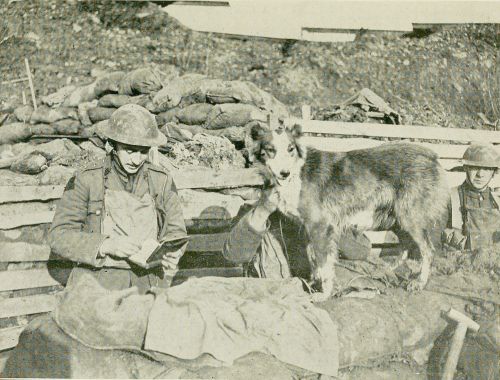
A Dog Used to Carry Messages in the Trenches These dogs are fed only by their own keepers and must not be petted by the "Tommies," so that they will carry messages only to their masters
We had lost about sixty men of the company during this advance, so we had sent up our S.O.S. signals. The artillery answered immediately by commencing to play a drum fire, or intense bombardment, upon the German artillery and trenches. It was not long before we had silenced their guns, as we must have sent over ten shells to the one of the Huns'. During this period my stretcher bearer had been kept very busy, and I had to send for additional stretcher bearers so that I could have the casualties attended to. My casualty report showed eight men killed, two missing, fifteen wounded.
I left the trenches. One officer and seven men were granted ten days' rest, I being the lucky officer. We left the trenches at midnight and went to Sains-en-Gohelle. I arrived here and found busses all ready to transport the men to the Railhead. We were conveyed to the Railhead and then entrained, detraining at Boulogne. From there we marched to Ambleteuse, a distance of ten kilometres.
Here were gathered together, I should judge, about 10,000 troops—all under canvas. Imperials, Canadians, Australians, New Zealanders and Maoris were in the camp.
There were several Y.M.C.A. marquees and during our short and pleasant rest we were entertained by some of the most celebrated actors and actresses from England who had come over to offer their services free. It was very much appreciated by us and we thanked the Y.M.C.A. for their cordiality in giving us such a pleasant time.
Ten days passed all too quickly and we entrained at Wimereau, a short distance from Ambleteuse, amidst the cheers and waving of handkerchiefs by the girls of the W.A.A.C. (Women's Army Auxiliary Corps). There are over ten battalions of these girls in France, all doing their bit at the bases.
We left Wimereau at 1.30 in the afternoon. Every car in the train was packed to full capacity. Sometimes we were travelling at the rate of about thirty miles per hour, then we would slow down to five, depending upon the grade.
We arrived at Hasebrouck about 4.30 in the afternoon. We heard the reports of exploding shells and bombs as we approached the station, and as we looked out of the windows of the train we could see the French inhabitants fleeing out of the city. The Germans were shelling and bombing the town. I could see fires here and there in the neighbourhood. Our train slowly pulled into the station and stopped. Every window was occupied by the officers and men who were anxiously looking out at the fires and the damage that had been done by the German shells and bombs.
A friend of mine whom I had met at the rest camp was in the next compartment to mine. He remarked to me that he did not mind the shelling so much if the civilian population were out of danger, and added that in his opinion he thought that we were quite safe. Suddenly a shell struck a tree not more than thirty yards away from us and a splinter glanced off and struck the railway train. I heard then the old familiar cry of "stretcher bearer," "stretcher bearer on the double," and an R.A.M.C. Sergeant came running over to our car. As I jumped out of my compartment, I went into the other one. There to my horror my friend was lying unconscious. Blood was flowing freely from all parts of his body, and as I helped to place him on the stretcher he passed away to the Great Beyond. In another car five N.C.O.'s were wounded from fragments of the same shell, so I could shake hands with myself on being fortunate to escape without injury.
CHAPTER VI
TRENCH ROUTINE
The war establishment of an infantry battalion is about 1,046 men divided into four companies. There are four platoons to a company, and four sections to a platoon.
The platoon is the smallest unit in the field. It is often said that this is a platoon or junior officers' war, and I believe this is quite true. I must mention something about the organisation of this compact little unit.
As previously stated, a platoon consists of four sections. Taking for example an average strength of 49 O.R. (other ranks), a suitable organisation would be as follows:
Platoon Headquarters: 1 Officer 1 Platoon Sergeant 1 Officer's Batman 1 Stretcher Bearer 1 Cook No. 1 Section 1 N.C.O. 9 Riflemen 3 Snipers 1 Scout No. 2 Section 1 N.C.O. 6 Rifle Grenadiers 3 Carriers No. 3 Section 1 N.C.O. 2 Scouts 8 Lewis Gunners No. 4 Section 1 N.C.O. 10 Bombers
Sometimes each section may wear a different coloured cloth armlet, so that you can tell at a glance what section a man belongs to. The platoon commander has at all times to look out for his men's comfort first—is own comfort and safety being a second consideration.
EQUIPMENT OF AN INFANTRY SOLDIER WHEN GOING "OVER THE TOP"
1 Steel Helmet which seems to him to weigh a ton when he is marching out of reach of shell fire, but when under shell fire, he thinks it is as light as a feather and he wishes it were much heavier and bigger.
1 Iron Rations. A small, white bag containing 3 hardtack biscuits, a tin of bully beef, sometimes a tin of mixed tea and sugar.
1 Small Box Respirator or gas mask, at the alert position. This is lying flat on his chest.
1 P.H. or Smoke Helmet. This is a spare gas helmet, which is out of use, but is perfectly effective, and may be used if the small box respirator is damaged.
1 Haversack. This is fastened on the back of the man. D-shaped buckles are provided on the Webb equipment to allow for this.
1 Rubber Sheet. Fastened on the outside of the haversack.
220 Rounds of Small Arm Ammunition.
2 Mills Bombs per man. Ten bombs to bombers and rifle grenadiers. The latter have grenade cups, and copper rods about 12 inches long which are screwed into the base of the Mills bomb and are fired from a rifle.
1 Ground Flare and Matches.
1 First Field Dressing.
2 Identification Discs.
1 Mess Tin.
2 Water Bottles, filled with water.
1 Jerkin.
1 Entrenching Tool and Handle.
1 Wire Cutter. Usually the riflemen have wire cutters attached to their rifle. There are about seven men supplied with wire cutters in a platoon.
1 Rifle and Bayonet.
Besides the above, during the cold and rainy weather each man takes a turn to carry the jar of rum, extra rations and bombs. Tommy is pretty well loaded down by the time he has all his equipment on him. Sometimes he may have to carry two extra bandoliers of cartridges.
There are four battalions to an infantry brigade and, like the company system, one of these four battalions in its turn is out for rest and training behind the lines. During this time the other battalions are taking their turn in the trenches.
The battalions may be in the trenches for ten days. No fixed time is allotted as we have found out by experience that the Germans somehow or other learn the night and time of our relief and they then open up their artillery upon us. Consequently when we go into the trenches, we never know how long we are going to remain there. We might make a tour of say ten days, three days in the support line, two days in the front, two days in the reserve, then back again for another three days in the front line. It all depends upon brigade headquarters staff, who order operations for relief before the battalion takes over the trenches from another unit. The relief takes place under cover of darkness.
The battalion that is relieving the one that is in the trenches is met by guides from the battalion to be relieved at a rendezvous point. There is one guide for each platoon. He conducts them separately and in single file to the part of the line that they have to occupy. Platoons are widely separated if going over open ground. As the incoming platoons enter the trench, they line up directly in the rear of the men who are to be relieved, who are "standing to" on the fire step with all their equipment on. On the command "stand down" the relief takes the place of the outgoing party.
It is usual to have one officer per company accompanied by some N.C.O.'s. One day before the relief takes place the actual conditions and situation must be ascertained. If the communication trenches are good this is often done in daylight. The trench stores are taken over by an officer who checks them up, but does not sign a receipt until the relief actually takes place.
All information of value such as the name of the opposing force, whether they are Prussians, Saxons or Bavarians, the whereabouts of their machine guns and if there was much activity shown on the part of the enemy, description of their S.O.S. signal, if known, is passed on to the relieving force.
If the enemy trenches are close to ours we may run a little narrow sap extending from our fire trench in the direction of the enemy. Great pains are taken to conceal this sap. The excavated earth is placed in sand bags and carried some distance away. At the end of this sap, which may be 3 × 4 feet, we make a cutting sufficiently large to accommodate two men. As a rule the men in this sap, or listening post, as it is commonly called, are connected with the sentry in the fire trench by a long, strong cord. Signals are pre-arranged to give silent warning of any movements on the part of the enemy.
The duties of these men are very exacting and great caution must be observed. They must listen for any underground mining or hammering on the faucet of gas drums. Consequently this is very important work and a great deal depends upon the coolness and intelligence of the men in the listening post. As the work is very nerve racking, reliefs usually take place every hour. A platoon officer may accompany such relief.
The platoon officers on duty have to make up several reports such as: weather report, showing strength and direction of the wind, and situation report, stating particulars of what may have been seen of the enemy, the number of shells fired in our direction, also any results noted from the firing of the German rocket signals. There is also a casualty report showing the number of casualties during the day. Another report is made out for the shortage of equipment, ammunition, bombs, etc.
TRENCH ORDERS
1. Duties—(a) One officer per company and one N.C.O. per platoon will always be on duty.
(b) By night the officer and N.C.O. on duty will frequently patrol the trench line, to see that the sentries are alert and to inquire whether they have any information to report about the enemy.
(c) The N.C.O. coming on duty will go around and post new sentries with the N.C.O. coming off duty.
(d) The length of each tour of duty will depend on the number of officers and N.C.O.'s available in the company. Normally, each tour should be, by night 2 hours, by day 4 hours, day commencing at morning "stand to" and night commencing at evening "stand to." In inclement weather it may be advisable to reduce the tour to 1 hour.
(e) N.C.O.'s after posting sentries will report "All correct" or otherwise to the officer on duty.
(f) The officer on duty will be responsible for sending in the reports required by battalion headquarters, unless there is anything unusual to report, when this duty will be performed by the company commander.
(g) Men will be warned for duty by the platoon N.C.O. on duty. This will be done at evening "stand to."
(h) On being detailed for duty, a man will be informed at which hours he will come on duty.
(i) When possible to do so, notice boards will be placed in each platoon's trench, on which will be pinned, daily, all orders regarding working parties, and a list of the men in the platoon, giving the time at which they will come on sentry and other duty.
(j) Except under special circumstances, such, for instance, as a sentry being killed or wounded, no sentry will be relieved by another man unless the relief is properly carried out in the presence of a N.C.O.
2. Sentries—By Night—(a) Sentries will be posted every 2 hours, except under bad weather conditions, when the length of the tour of sentry may be reduced.
(b) From evening "stand to" till morning "stand to" one sentry to every three or four bays in the fire trench will be posted. If wiring or digging parties are out in front, or listening posts are numerous, this number may be reduced.
(c) The next relief will remain within reach of the sentry.
(d) Every sentry is to be regularly posted by a N.C.O., who will explain to him his duties and the front to be watched, and ascertain that the sentry and his relief are aware of the position of the section and platoon commanders, the sentries on either side, and whether there are any patrols or working parties out in front. Should there be salients in the line, the sentry will be carefully instructed, so as to avoid any possibility of him firing toward his own trenches.
(e) By night or in places which have the reputation of being dangerous, i.e., where enemy are suspected of mining, advanced posts, etc., no man should ever be posted alone. There should be either a double sentry post, or the next relief should rest within kicking distance of the sentry.
By Day—(f) The number of sentries required depends on the proximity of the enemy's trench line and whether a good view to the front can be obtained, normally one to every four bays is sufficient.
(g) Every sentry will be provided with a periscope.
(h) Well protected "look out" posts for sentries will be built along the front trench line.
(i) Sending Out of Patrols—Patrols will never be sent out without definite orders as to what is required of them. Patrols will go via a listening post (if such exist). All listening posts will be warned of the strength of the patrol and the approximate hour of departure and return. Word will be passed quietly along the line of sentries that a patrol is out in front.
(j) As little challenging as possible will be done by sentries, and then only in a low tone of voice.
The battalion quartermaster, who usually holds the honorary rank of captain, has charge of all rations and equipment for his battalion. He is assisted in this duty by the battalion quartermaster sergeant, who in turn very often goes to battalion advance headquarters with the rations. During the daytime at battalion rear headquarters or horse lines the quartermaster supervises the distribution of the allotted quantity of rations that is required for each company. All company quartermaster sergeants being present, they in their turn see that their company's amount of rations is safely delivered to the transport officer. The transport officer at night has his small ammunition carts or transports take the rations as near to the support line as is possible, the company quartermaster sergeants going with him. From that point ration parties from the respective companies meet the company quartermaster sergeant, who sees to the proper delivery of the ration. In addition the party may have the mail, ammunition, or any shortages of equipment that may be required, after which each quartermaster sergeant reports to his company headquarters for orders.
In the trenches we often have papers only two or three days old, and the news from them is literally devoured. As this is the only means by which we can find out how the war is going on, all newspapers and periodicals are looked on with great favour in the trenches.
My sergeant reported to me when we were in the front line trench that Private Johnston had swollen feet. I went over to a shallow dugout where I found Johnston with his boots off. One foot in particular was very much swollen and blue. It had been raining hard since we were in the trenches. As we would stand down off the fire step, we would be in mud almost up to our knees. Trench knees were very prevalent at the early stages of the war. At present it is almost a crime for a man to allow himself to get it. Trench feet are caused by the extreme cold due to dampness; and not only dampness and cold, but to the inaction of the feet brought about by the heavy claying nature of the ground and the weight of the water surrounding the man's boots and legs. It was found that a warm layer of air between the foot and the outer covering was absolutely necessary if trench feet were to be avoided. An oiled silk stocking has been recommended to be placed next to the skin and looser boots and loosened puttees are considered necessary when in the trenches. At present we have long rubber boots that the boys wear when they occupy the trenches. They are considered trench stores and remain there.
A batman is chosen by an officer to act as his orderly; his duties are many, and wherever the officer goes while in the trenches his batman accompanies him. The higher the rank of the officer the easier the work for the batman and the less the risk, although there are exceptional occasions when a commanding officer takes as much risk as the junior Lieutenant under him. When a platoon officer leads his platoon "over the top" his batman goes with him; he therefore takes the same risk as the other men in the platoon, but he has several privileges that the private has not, such as: after he has attended to the requirements of his officer when out of the line he may spend the balance of his time as he deems fit, he is exempt from sentry and fatigue duties, and as a rule he has a good standing with the boys.
Whilst in the trenches, we receive reports giving us information regarding the movements on the part of the enemy, and also describing the number of shells that the enemy has fired at us and the number that we have fired in return. We also receive a communique that gives us information as to what has happened on the various sectors of the line, and also the result of any battles or raids that we have been participating in. By this we learn how we have been progressing along the whole of the frontage we have fought along.
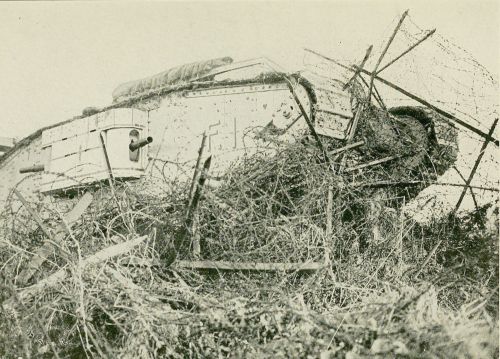
A Tank in Action
The splendid attack on April 9th gave us possession of the entire Vimy Ridge with the exception of its extreme northwest point. This the Germans held on to stubbornly and were not finally ejected until April 11th. Southward the British passed on down the backward slope of the ridge and seized Farbus and its woods. On April 12th, our army being fairly established on the ridge Sir Douglas Haig pressed home the attack upon Lens. On that day and the following day, despite bad weather, the advance was steadily continued. The villages behind the ridge, Vimy, Givenchy, Angres, Bailleul, Willerval, were taken one after the other and our lines began to close in upon Lens from the northwest. One factor which contributed to our success was undoubtedly the co-operation of the tanks which accompanied the advance. The first appearance of the tanks caused great excitement amongst us, as it also caused consternation and dismay amongst the Germans.
The tank is a factor of the great war and is emblematic of Britain's purpose, slow but relentlessly sure. It lumbers out over the waste of No Man's Land toward the German line, mowing down the enemy with its deadly machine guns and is undeterred by the rifle or machine gun fire of the enemy. It goes crashing on to and over the enemy trenches, going down one side of the shell or mine craters, and up the other, trampling down the strongest of barbed wire entanglements, trees, etc.
As this monster goes on, few Germans are brave enough to face an advancing force. In our advance on Lens the artillery preparation was so perfect that the wire barriers were everywhere swept aside. The German high command made a desperate attempt to divert our advance on Lens by a heavy counterattack along the Cambrai-Bapaume Road, which was delivered by about four divisions. We repulsed it, taking 300 prisoners and inflicting a casualty of some 10,000 of which 1500 were killed; our success was largely due to the artillery.
All officers and men look forward to the delivery of the mail. In the early stages of the war, it was a very common practice for both officers and men that had no lady relatives to write to the "Agony or Personal Column" of one of the London daily papers, asking for some lady to correspond with them. The ads would read, "Lonely Officer, or Lonely Soldier, would like to correspond with some Young Lady for period of War." Invariably a nom de plume and designation of battalion were used, and the result was that a large number of letters were received.
I remember a young officer who put an ad in the paper, and for some days there was no result. The officers all began to tease him and I think he regretted having informed us what he had done. However, one day the mail corporal brought three full mail bags all for the "Lonely Officer." Things began to look lively. He was now in a dilemma. Could he read and answer them all before he would have to go in to the front line? It seemed a stupendous task. He had a few volunteers to help him to read his correspondence, but no one was willing to answer it. For three weeks afterwards there were no letters, then one day Brigade Headquarters post office sent word that there was a transport car coming along with Lieutenant K.'s mail. The car was completely loaded down with his correspondence, so they wished to know what he wanted done with the balance. It was not long afterwards that correspondence from the Agony Column ceased.
The censoring of the mail is sometimes very amusing. Yet it has its pathetic side. I censored a letter from a boy to his mother. He had run away from home, and enlisted under an assumed name. He just had begun to realise that if he was killed in action, his mother would never know, so it was a very penitent son that sent a very loving letter to his mother at home. The war brings out all that is best in the "boys," though some of them are sad rogues as they vow eternal love to many girls at the same time. No harm is meant, I am sure, it is probably to break the monotony of the life in the trenches. Some of the letters have quite a number of crosses on them, like this xxxxxxx, denoting kisses, and probably stuck away in one corner we will see one small x with "For the Censor," marked above it.
The reason why all letters in France are censored is to prevent any information of military importance reaching the enemy.
While out at rest our battalion received orders from brigade headquarters to prepare a small raiding party with the object of putting out of action a German machine gun that had given the troops that were then holding the line considerable trouble.
Aerial photographs and map location of the small sector of the German line where the machine gun emplacement was located had been sent us. I was detailed to take charge of the party and was given instructions to destroy this machine gun emplacement and if possible to bring back some prisoners for purpose of information.
I selected ten men including one sergeant and one corporal and for three days we practiced for this raid by going over the tapes and also making use of some previously dug trenches, so that every man would know exactly what part he would take when the actual raid would be pulled off.
These men were equipped just as they would be when the actual raid would take place, four men were armed with rifles and bayonets, the others were armed with bombs and knobkerries and in addition all had their wire cutters.
It is usual for us and also the enemy to have a narrow zig-zag passageway through the barbed wire entanglements to afford us an exit for a party going out into No Man's Land. Our battalion scout officer the night previous to the raid had been out doing special reconnaissance along the sector of the German line that we had to raid, and while he was crawling along the edge of their barbed-wire he had discovered the opening. This very valuable information I had received from him.
The second night we were in the front line trenches I received orders that I was to make the raid that night.
I gave the sergeant the necessary instructions to have the men prepared and ready to leave our line at one A.M. Part of the instructions were that the men were to have their faces blackened and a small white chalk mark on the front of their steel helmets. On the back of each man was a small piece of bright tin about two inches in diameter, fastened on their tunic.
Notices had been sent to the units on our flanks that a raiding party was going out at one A.M.
Two hours' time was allowed us to accomplish this. I took my compass bearings and at one A.M. led the boys in single file through our barbed-wire entanglements into No Man's Land.
The German barbed-wire entanglements were about two hundred and fifty yards away from us. I headed right for where I estimated the opening in the German wire entanglements would be.
As the German flares went up we would try to get into shell holes if possible before they burst. We were not very conspicuous as long as they were bursting ahead of us. The great danger of being observed was when the flares burst behind us.
Our progress over No Man's Land was very slow. Not a word was spoken. I signalled back as pre-arranged to my boys by throwing small clods of earth to the man in rear who passed back the signals to those behind him.
In a previous counterattack the Huns had lost this part of No Man's Land. The result was that quite a number of German dead lay on this particular sector unburied. This was due to the continual artillery activity on both sides.
As we reached the middle of No Man's Land, I raised my head carefully above the lip of a shell hole while a German white flare was up. To my consternation I saw what was evidently a German battle patrol coming crouching through their barbed-wire. I counted in all twenty-five men.
Things looked ominous for my party, as they outnumbered us over two to one. I had no desire to go back, without accomplishing my mission. Neither did I wish to engage my men in personal conflict with such odds against them. So I sent my scout with a message to the officer who was on duty in our sector of the line and informed him what I had observed. At the same time I asked him to pass the word along to open up a machine gun fire at a point that would get the approaching Hun battle patrol.
It was with mixed feelings of pleasure that I heard our Lewis guns open fire in the required direction, and I had the satisfaction of seeing the approaching Huns beat a hasty retreat, leaving a number of dead and wounded behind them. We waited for what seemed to be hours, in reality it was only fifteen minutes, and then we crawled carefully forward towards the German barbed-wire entanglements. The Huns in their somewhat hasty retreat had forgotten to haul in their white tape line and this was the means that guided us through their barbed-wire. As soon as I got almost through the barbed-wire, I immediately jumped up, my boys doing likewise, and made a rush for the German trench.
Here I discovered a German sentry in the act of loading a pistol to send up a flare. He was so taken by surprise and fear that he immediately held up his hands, mumbling "Kamerad." We at once gagged him. As previously arranged my party divided in two, one-half going to the right under my command and the other to the left in charge of the sergeant. We had no time to lose as their trench mortars might open up at any moment.
I surprised a machine-gun crew and quickly put them out of business with a few Mills bombs. On the left my sergeant surprised and captured two prisoners. We then quickly got out of the trench, pushing our prisoners ahead of us as we crawled back over No Man's Land. By this time the Germans had discovered the result of our raid and began at once to send up their white flares with great rapidity. In addition their "flying-pigs," "fish-tails," "rum-jars" and "Minenwerfers" made things very lively for us in No Man's Land. Our prisoners were just as keen to reach our trenches safely as we were. However, we had to remain out on our stomachs in No Man's Land until the white flares had ceased to go up with such rapidity. It seemed a lifetime for me since I had left our trenches, and I began to wonder if I would ever get back to them again. As I heard some of my men moan, I knew that they had been hit, but I knew that our stretcher bearers would soon be out to give them their required attention once we got safely back to our line.
We slowly wormed our way back, and it was very sweet music to my ears to be challenged by our own sentry as we approached the trench. I made myself known, and very soon we were all in and gave the necessary information for stretcher bearers to be sent out. Our casualties were one killed and two slightly wounded.
The information gained from the prisoners was of great importance.
CHAPTER VII
BEHIND THE LINES
All front line infantry units in France are, like gypsies, moving all the time. It is seldom we are out at rest at the same place twice inside of six months. Rests are named according to the units that are out of the trenches for that time. Battalion rests may be for seven or ten days; brigade rest may be as long as two weeks; division rest may last one month.
We call the time we are out of the line rest, but in reality we have a strict period of training to undergo. At the same time there is a great deal of amusement, without the danger attached to it that we have when in the trenches.
The boys may start P.T. and B.F. (Physical Training and Bayonet Fighting) for one hour. Then squad and company drill until noon or, if an attack is to take place in the near future, they may be practicing for the same by going over the tapes. In the afternoon they may be given lectures, rifle practice, bombing, or Lewis gun drill. This may continue until about 4:00 P.M., and then they are dismissed for the balance of the day.
The Y.M.C.A. usually has moving picture theatres nearby for the benefit of the troops in that vicinity. Football, baseball and boxing also play a prominent part in keeping the men fit. In the evening there may be a good concert given by the Y.M.C.A., probably winding up by a church service. Thus the spiritual welfare of the boys is looked after. Spare moments are spent writing letters.
During one of our rests at the little village called Villers-au-Bois, the Town Major, who was a captain in one of the Imperial battalions, after he had his staff get our officers and men the necessary accommodation, informed us that the Middlesex battalion had been in these billets a short time after the First Expeditionary Force had landed in France.
When the First British Expeditionary Force landed in France, some famous regiments came over with it. Among these were the Middlesex regiment and the famous Scotch regiment, "The Black Watch." As the Black Watch marched through the small French village, the following dialogue took place between two old Frenchmen who saw them approaching. The elder of the two turned to his companion and said in the patois of the region: "Then it is true that Angleterre has no men! So she is sending out the womans to fight!" The other Frenchman replied: "No, no—they are not womans—for they have got moustaches." "Sacré, Sacré," replied his friend, "I have it! This is the famous Middlesex regiment."
During our rest at this small village, we had Canadian corps sports, which were organised by the Y.M.C.A. The 1st, 2nd, 3rd, 4th and 5th divisions had all their representatives. The latter division had only a few units in the field, but it seemed to pull down the most honours. This division has since been broken up and used to reinforce the other four. Major-General Currie and his staff were present, as were all the Canadian troops that were out of the line and not on duty. Our sports consisted of running, short and long distance, baseball, and football, the usual athletic performances. It was here that I saw Tom Longboat, the famous Indian runner, compete, but he was beaten for first place in a five-mile race by another Indian.
About six o'clock the same evening I noticed our observation balloons were up. These balloons were about four miles behind our trenches and three miles or so apart. They were taking advantage of the very clear weather for observation purposes along the German lines and back areas.
It may not be out of place to describe an observation balloon. This is a captive balloon fastened sometimes to a motor truck by long stout ropes, and may be hauled along the road, if the Germans commence to shell them with their explosive shells. The balloon is composed of one elongated ballonette, inflated with hydrogen or some other kind of light gas. A second internal ballonette is inflated with air, which is required in order to maintain the shape of the balloon. By means of the keel at the end, the balloon is oriented to the wind. On a clear day the observation balloon rises to a height of 200 to 400 yards and remains up for several hours, being occasionally pulled down to relieve the observation officer who takes his position in the nacelle or basket beneath the balloon. From there he reports enemy movements by telephone to headquarters.
I was watching an aeroplane flying very high in our direction and, as our anti-aircraft shells were bursting beneath it, the little white puffs of smoke of the shells' burst indicated to us that the aeroplane was a Hun machine. Nothing seemed to daunt the aviator and as he hovered over the observation balloon on my right I heard his machine gun firing. A few bombs were dropped and the balloon took fire.
The observation officer in the meantime had jumped out of his basket. He began to fall through space until his parachute opened. Then we witnessed a thrilling race as the burning balloon and the officer in his parachute began to descend to the ground, pursued by the Hun aviator who was using his machine gun on the unfortunate observation officer. Luckily the observation officer got safely to the ground.
The next target of this daring Hun aviator was the observation balloon in front of where we were standing. The observation officer immediately jumped out of his basket and got safely down to the ground. The Hun aviator, however, destroyed this balloon and then retired back to his lines, evidently having used up all of his bombs. He came back an hour later and destroyed a third balloon, but this time his daring was nipped in the bud as he was brought down by one of our anti-aircraft shells somewhere near one of our rear support lines. One of his hands had been shattered so that he was unable to manipulate his levers. The boys had no sooner taken him prisoner and got him clear of his machine than the German artillery opened up and with a shell blew his aeroplane to pieces. It must be understood that our aeroplanes cannot be everywhere at the same time. They had evidently gone on a mission to some other locality and the Huns had probably been aware of this fact. Hence the audacity of this aviator.
Later the same evening I was walking along the Villers-au-Bois and Carency Road when I heard the drone of an aeroplane behind me. I turned round and saw an aeroplane flying very fast and low. I was at that time in the centre of the road. On both sides were tents occupied by the men of an artillery battery who were also out at rest. Suddenly I heard three loud reports and knew at once the Hun was dropping bombs. As I imprudently glanced up in the air I could see the aviator leaning over the side of his plane and the Maltese Cross on the wings, as he turned his machine gun upon the tents around me. The observation officer was firing what we called a "chaser" bullet. These bullets at dusk or night show a reddish streak as they travel through the air, giving the aviator an idea of the direction of his fire. There is usually one chaser bullet to every five cartridges. However, this aviator was soon brought down by our anti-aircraft picket, which was waiting for him. As he was flying low they had no trouble in bringing his machine down.
In the early part of July I arrived at a little place called Bully-Grenay. This town had a population of about 2,000 and was almost four miles from Lens. We had to be very careful how we approached it as we were within easy shelling distance from the Germans as well as easily observable by them. This town had not suffered very much from shell fire. One of our Majors, whose turn it was to remain out of the line, had been sent with an advance party to see about our billets. I was left behind in charge of the rear party with instructions to have all billets cleaned up that we had occupied so that the next battalion that came in would find them all right.
Later on, when I reached this town, I saw the Major surrounded by a crowd of women. I approached to see what was the matter and then saw one woman gesticulating and shaking her fist at the Major. He, poor fellow, could not understand the reason of this unnecessary excitement.
After saluting, I asked him what was the matter. He informed me that the Town Major had given him the names of the various civilians who could accommodate officers and men, and as this lady's name was on the list he had asked her to clean up her room for an officer. She had resented this very much, as she thought her rooms were extra clean. The Major's poor French had evidently been misunderstood. I spoke to the lady in French and tried to smooth matters over. She kept a little store which was named "Le Pauvre Diable" or "Poor Devil."
After I had bought a few postcards Madame told me that I could have the room. She also informed me that the Germans often shelled the railway station which was not more than 150 yards away from her store.
That same afternoon we were informed that our battalion was coming out of the line. As it is customary for us to buy extra rations for the boys when they come out of the trenches and as I was secretary of the canteen, the Colonel authorised me to have something good ready for the tired and weary men when they would arrive at about 3:00 A.M. in the morning. A sufficient number of names had not been given of the civilians who had accommodation for officers. Therefore, the battalion being short of one billet for an officer, I volunteered to give up my billet to this officer when he should come out of the line. I therefore told my hostess I would be obliged to leave, saying that Lieutenant S—— would take over my room. Madame would not hear of this, insisting upon my accepting her room. So she and her daughter slept downstairs. Later on, when the battalion arrived in the small hours of the morning, and after each officer had seen that his men had received a good meal and all been accommodated properly in their billets, they in turn had something to eat, afterwards going to bed.
There was very little to do the next day, but we had three men wounded as they were in the street near the railway station. The Huns were aiming at this station in the expectation of probably hitting some French coal and ammunition trains as they came into it. The following night as I lay awake in bed I could hear a whistling noise as the German shells passed over our house. I judged they were going in the direction of Les Brébis, about half a mile beyond Bully-Grenay.
Suddenly, when everything was quiet, I heard a loud explosion. A crump had struck the railway station. Madame from downstairs shouted to the other officer and me that there was no danger as the Germans were only firing at the usual target, the railway station.
On July 10th, as we were out on our training ground practising for an attack, we observed some German aeroplanes. But our anti-aircraft pickets had also observed them and soon drove them away.
In the afternoon as we marched back to the billets, I noticed that during our absence several batteries of artillery had come into this little town and were then busy firing at the Boche line. When I returned to my billet that evening Madame told me that one of the guns that had been firing was situated in the rear of her house. This appeared to frighten her very much.
About 2:00 A.M. in the morning we were all awakened by a very loud explosion. All the window panes were blown out and the glass of the small conservatory was smashed to atoms. Madame, in a very excited tone of voice, shouted to us to come downstairs at once, not forgetting to bring our gas helmets. We went outside to see about our men's safety, then returned. After dressing very hastily we descended the stairs and were led by Madame and her daughter to the cellar which was rather shallow, not more than ten feet deep and about ten feet wide. There were some provisions stored in the cellar and in the corner a small stove and a coal bin, a few chairs and a bed.
In the course of conversation Madame informed us that her husband and another daughter had been prisoners in the hands of the Germans since 1914. At the time they had been taken prisoners they had been on a visit to Lille. They were returning to Bully-Grenay when they were cut off by the Germans. She had not received any news and did not know whether they were alive or dead at that time. There are many families in France in this predicament, and the torture of these poor people is quite pitiful.
The shelling ceased about daybreak and I was glad to get out of the cellar, as it really afforded very little protection. If a shell had struck the house one was liable to be killed by the falling masonry. Lieutenant S—— and myself went over to the billets that our men were in and found them all safe, after which we returned to our own billet.
The inhabitants of little villages and towns near the firing line all take risks of this kind. Many of them are killed, but they seem to cling to their homes whilst they have a possible chance to do so. The children when they go to school carry gas masks, which they use when required, as they never know when the Germans will send over gas shells.
CHAPTER VIII
THE "BULL RING"
Near a certain town "somewhere in France" there is a large training ground that is called the "bull ring." Here men from the Imperial, Canadian, Australian and Newfoundland Forces are trained and instructed in the various branches of the service.
The "bull ring" is about two miles square and is divided into sections. Each section is allotted for the purpose of training a large number of men in special branches of the service such as bayonet fighting, physical training, bombing, trench warfare, musketry, wiring, machine gunnery, topography, military engineering and the use of the gas mask.
The training for the gas masks is very simple. Each man is trained to adjust his mask in a few seconds. After that he is tested, with the gas mask on, by going through a small hut that is filled up with lachrymatory gas about four times the strength of any gas that the Huns would be likely to send over.
During the summer of 1917 the camp contained about 80,000 men of the first British Army. In the morning each depot battalion would send its men to the "bull ring" for training. They would usually arrive about 8:30 A.M. and would work up till noon. Then would break off to fall in again probably about two. After that, an hour and a half was devoted to lectures, etc. They would be marched back again about 3:30 P.M. to their respective headquarters.
The training camp was admirably arranged, as it brought in close contact the soldiers of the Commonwealth and the Dominions with those of the Motherland.
Discipline plays a very important part in the training of the soldier. Great care is taken to teach the men to salute properly. The officers in turn must return the soldier's salute in the prescribed manner. Each officer salutes his senior. A well disciplined battalion is easily recognised by the smart manner in which the members salute.
The men must be shaved every morning, shoes shined and buttons polished. Everything about them must be spick and span. They must also appear in full fighting order. Standing steady in the ranks must be strictly adhered to and all movements in drill must be done with snap and precision. The small box respirators and P.H. helmets (gas helmets) are often used during the P.T. and B.F. (physical training and bayonet fighting). We also march on the training ground wearing small box respirators and P.H. helmets alternately. This accustoms the men to the use of the gas helmet.
Boxing plays a prominent part in the training of our soldiers, and is a great help in the bayonet fighting, as it teaches the men the quickness of eye and movement, which is as essential for a good boxer as it is for a good bayonet fighter.
One of the many games that is a source of amusement and very popular with the boys is known by the name of "McGrady." It is very simple but it affords the boys a great deal of pleasure. The instructor forms the men in a circle around him, each man being armed with his rifle and bayonet with scabbard on. He then explains to them this very simple game which gets their interest and also causes them to concentrate their minds. The instructor will then say, "McGrady says, 'Do this'" and he then makes a point with the bayonet, all his class doing the same.
If, however, he says, "McGrady says, 'Do that,'" he will probably make a short point and no one must move. If any man has made a short point he must come out in the centre, take the instructor's place and try to catch someone else off his guard. It is just the difference in the words "This" and "That," and all depends upon the cleverness of the instructor in being able to tell the tale to divert the men's minds and be able to catch them off their guard.
Many of the soldiers who were undergoing training here had been wounded and, after being passed as physically fit for the front again, were trained with men who had never been up the line.
In some cases they were given instruction by an instructor who had never been in the front line. Now when a soldier is wounded his name appears on the casualty list. He is allowed to put on his left sleeve a narrow gold stripe for each time he has been wounded, and the Tommy is very sensitive about taking instructions from anyone who has not these stripes. One incident that was brought to my notice will show how sensitive Tommy is as to whom he has instructing him.
A certain sergeant, who had been gassed at Ypres, had also been fighting in various other battles but, luckily for him, he had never been wounded. Therefore, he could not wear the stripe. He was giving instruction to the class on gas drill. Nearly all the class were wearing a gold stripe for wounds received.
I was in the lecture room when the sergeant commenced his lecture, but subsequently I was called away for a few minutes. Upon my return I discovered that the lecture was practically at a standstill. All the Tommies had turned their backs on the sergeant and would not listen to him. They thought he had never been up the line and they resented very much taking instruction from one who, in their opinion, had had a bomb-proof job. I asked the sergeant what was the matter, and he told me that he thought his class was under the impression that he had not been up the line. I therefore allowed him, before proceeding with the lecture, to relate some of his experiences at the front. After that he had no further trouble with that class.
After a certain length of time training at the "bull ring," the men are drafted and ordered to go up the line to reinforce battalions at the front. I was given charge of a draft of 200 men. The men selected were duly warned to fall in on the following morn at 7.00 A.M. at their respective parade grounds. They were all delighted and, as most of them had never heard a shot fired, they were anxious and keen to go up the line. By 7:30 the next morning I had inspected the men carefully. Afterwards they were inspected by the adjutant and the colonel. Each man, I may say, had his full fighting kit on.
After a brief speech by the Colonel we marched to the railway station. As we approached the station the French soldiers, who were guarding the German prisoners that were working on the railway tracks, sprang to attention and shouted, "Bon Voyage, Bon Voyage." When I arrived at the station the railway transport officer met me and pointed out the cars that we were to occupy. There was a canteen at the station run by some English ladies, who were serving the men with cakes and dainty slices of bread and butter and tea or cocoa. The ladies were all very refined and were not paid for their services. They seemed to take a great deal of pleasure in making the soldiers happy and contented.
As we would proceed along the railway and approach a nearby town the little French children would shout out, "Bon Voyage, Bon Voyage, Bully Beef, Bully Beef, Biscuit, Biscuit."
Our boys would throw them out the rations, which would be picked up quickly by the poor French children. Upon arrival at the railhead each man would turn in all the extra food he had not eaten and would then be marched to the depot to be assigned to billets for the night. In the morning the various drafts would be sorted out and sent to reinforce their fighting units.
Here is an incident that occurred whilst I was in charge of a party at the "bull ring." A sergeant was giving a lecture on musketry to a class. He began in this strain: "The rifle is a soldier's best friend on active service." After that he described the length of the rifle, the length of the barrel, the muzzle velocity, the calibre of the ammunition used, the width of the lands, the depth of the grooves, and the mechanism of the bolt. He began to describe the care of arms. To emphasize his point, he repeated: "The rifle is the soldier's best friend and I want you to treat it as such. Treat it as you would treat your wife. Rub it well over with an oily rag." This caused a decided grin on the faces of the married men in the ranks.
We take great pains to train our men in machine gunnery. A barrage of machine guns on any part of the line is always dangerous to the enemy and is advantageous to us. Usually a barrage may be laid at distances from a thousand to five hundred yards. The cone of fire is very deadly, but when it gets as near as five hundred yards the trajectory, being flat or low, is then dangerous to us if we stand up, so that we have to be very careful how we work under it.
No soldiers in the world are fit to cope with the British soldier in bayonet fighting. Their training is intensive, and a man must be physically fit in every respect to be good at this element of warfare. A good boxer is usually a good bayonet fighter, and I notice that in the U.S. National Army there is great attention being paid to boxing as a means of making the men proficient at this game.
I remember an amusing incident which took place in the "bull ring." We had our bags suspended from horizontal bars by strong cords. These cords had a thin piece of twine tied between each bag. The bayonet fighters were placed in a trench, and at the word "Go," they had to run a distance of about fifty yards, jump over another trench, and make a lunge with a bayonet at the bag. One man, who did not notice this twine which was between the bags, made his lunge, then ran between the bags and did not stoop. The twine caught him right on the point of the nose, taking all the skin off it, and throwing him back into the trench. He could not realise how he had been thrown there, and it was only after he had been assisted out of the trench and was led up to the bags that he believed he had not been assaulted by some of his fellow soldiers. He said afterwards he never noticed the string between the bags.
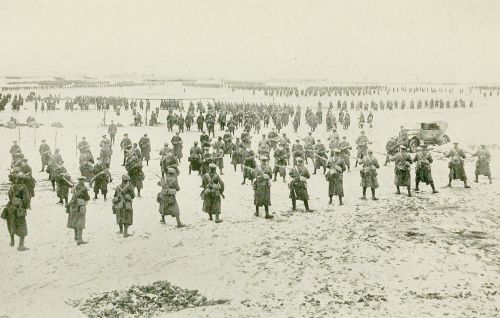
Bayonet Exercise at a Training Ground Somewhere in France
Particular attention is given to all musketry instruction. This subject is always interesting to lecture on. I was giving a lecture one day on what we call the use of combined sights, which is only used when a platoon or company fires at a range of a thousand yards or over and they are not sure of the exact range. For instance, if I wanted the men to fire at a given target, I would give a fire order as under:—
No. 1 and 2. Platoons at 1050.
No. 3 and 4. Platoons at 1150. Five rounds rapid fire.
I do not use the term yards, because it is understood that 1050 means 1050 yards and 1150 means 1150 yards. We would thus have a range of a hundred yards between each platoon's fire, so we would be almost sure to get the enemy in the intervening range.
I was taking my class in instruction and asked each man in his turn to give "Fire Order." I was rather surprised when I heard a voice describe very minutely the target, but giving the range as follows:—
No. 1 and 2. Platoons at half past ten.
No. 3 and 4. Platoons at half past eleven. Five rounds rapid fire.
I looked round at my pupil and asked him if he meant No. 1 and 2 to fire at half past ten, and numbers 3 and 4 at half past eleven. He said, "Yes, sir. You gave your fire order 10:50 and 11:50." I then had to explain to him that my order meant yards, not time, and that his time scheme would give the enemy time to retreat to Berlin before firing commenced.
Physical training or, as it is called in the army, P.T., is the first thing that a soldier has to undergo to make him fit for the arduous life of a soldier.
One of the soldiers who was at the "bull ring" was a rather stout block of a man. His comrades called him "Shorty." He weighed over 200 pounds and his flesh was very soft, and when at P.T. I heard him groan many a time when he had to get down on his hands and feet, stretch himself full length without allowing his chest to touch the ground, and then raise himself up and down on his hands. Poor "Shorty" must have been in physical torture, but we had to reduce him in flesh, and he was game. When he had to lie flat on his back, and raise his feet into the air, keeping his hands on the ground without moving the body, it was very trying. It looked simple and it is simple, but when a man weighs over 200 pounds, raising the feet from the thighs upwards and keeping the other portion of the body level on the ground is no sinecure. However, "Shorty" stuck to it. Then we had races one day for money prizes. Someone asked "Shorty" to enter the race. He said, "Yes, all right, I will, if I can get the limit in your handicap." This was assented to, and "Shorty" entered.
When the time for the race arrived, he came out on the track in his canvas slippers and a pair of old khaki overalls. Everyone laughed at the idea of "Shorty's" running in this race. Certainly his appearance was against him as a sprint runner. I asked him how he fancied his chances were in his heat, and he said, "Fine, sir, I can win easy." I believed him, although others laughed uproariously.
When the heat was ready to be run, just as they were getting on their marks, "Shorty" shouted out, "You fellows behind can get a good view of me as I break the tape." "Rats, Rats," his fellow competitors shouted, "get on your mark."
When they were all on their marks, the starter told them to get set. "Shorty" got down in a very professional manner. He had made two small toe holes in the ground, and with his body bent to the ground he was all ready when the pistol went off. "Shorty" was away like a shot out of a gun.
Run! Why he seemed to fly for a short distance! All at once he slowed down and placed his hand to his side, but all the same he painfully got home first. Then he collapsed. The other runners were all curious and could not understand how he had beaten them, but he laid it down to the physical training, expressing grave doubts as to whether he would be fit for the final. The final heat came along, and "Shorty" turned out in his overalls. Somehow or other he had managed to dig up a pair of running pumps and he sprinted around on them quite lively. Eventually all the competitors got on their marks, but just before the starter got them away "Shorty" shouted out, "Halloa, you fellows in the rear, have you any news to send to your friends? Because if you have I would like to carry it along for you."
This time there was a growl from the other finalists, who told him that he would see their dust. After a lot of badinage they all got set, and the pistol cracked. "Shorty" came home an easy winner, looking around at the other competitors. He could have given a start to any one of them and beaten them badly.
Later on we found out he was an old time champion sprinter.
In the training for "bombing" many people think that baseball players are the best men for this kind of work. This is not so. The man who has been used to bowling at cricket is the better man. Bombs are thrown in what we would call a lobbing or overhead throw. I have seen many baseballers throw the bombs in the same manner in which they would throw the baseball, and have in a few instances seen their shoulders dislocated in throwing. The cricketer on the other hand had the natural and easiest manner of throwing the ball. Great attention should be paid to bombing.
Every soldier should have the rudiments of learning in this branch of the service, as it is essential that all soldiers should learn to read a map and be able to draw a sketch of any trench or sector of the line which they may occupy.
I remember examining some sketches that had been made by men who had been given an outpost scheme in which they had to place what we call our sentry groups, picquets, etc. One sketch that was submitted to me showed a tree here and there on the sketch, but nowhere could I see anything that looked like a road or even like an outpost. I had the sketcher brought to me and asked him where his outpost was. His reply was rather staggering. He said, "Isn't it true, sir, that outposts must keep under cover, so that no one can observe them." I said, "Yes, certainly, that is true, but still I cannot see your outposts." He said, "No, sir, it is under cover, I did not put it on the paper as I did not want it to be observed."
CHAPTER IX
THE RED CROSS AND THE Y.M.C.A.
What is the Red Cross?
It is the world's international ideal of mercy. It knows no bounds of racial, religious or political separation. Wherever and whenever war, pestilence, storm, flood or disaster has wrought suffering, want or distress, there it has gone and brought relief, with the ready hands of unselfish aid.
Who first organised relief for those wounded, sick, or neglected on the field of battle? The Knights Hospitallers first had the idea, which had its birth in the Hospital of St. John at Jerusalem. Although driven out of the Holy Land by the Moslems, this institution re-established itself at Malta and is still in existence.
What nation first organised such relief? Great Britain, during the Crimean war, sent Florence Nightingale in 1854 to the hospitals of Scutari. When Miss Nightingale with thirty-eight other nurses reached Scutari she found pest houses, rather than hospitals, with open sewers beneath the buildings. Contagious cases were taken in by the thousands. So successful was Miss Nightingale in bringing order out of chaos that she is recognised to-day as one of the greatest individual organisers of war relief.
Who first conceived such service on an international basis?
Henri Dunant, a Swiss physician on the battlefield of Solferino, Italy, in 1859 organised a group of volunteers to help administer to the wounded. At that time great confusion and consequent inefficiency prevailed because of the multiplicity of relief flags. As a result of these experiences and under the inspiration of the work of Florence Nightingale, Doctor Dunant formulated the first proposals for an international organisation to care for the sick and wounded in time of war. He suggested two years later to the Geneva Society of Public Utilities a single and uniform hospital flag for all nations. In 1864 an international conference of 14 nations was held in Geneva, Switzerland. The outcome of this was the treaty of Geneva, known as the Red Cross Treaty.
What in brief does the Red Cross Treaty provide?
That hospital formations and their personnel should be treated as neutrals. That each nation signing the treaty should have an association of volunteers to assist and supplement the medical services of its army. But the emblem of service coming to all nations should be a cross of red on a field of white. This emblem, which is the Swiss flag with the colours reversed, was adopted in recognition of the fact that Dr. Dunant was Swiss and that the Red Cross was founded at Geneva.
What is the Red Cross doing in France for the soldiers?
There are two distinct phases of Red Cross relief work for soldiers on duty. The operating of rolling canteens and the maintaining of stationary canteens back of the fighting line is one. It is a most daring yet essential work, this of operating rolling canteens. Often a soldier leaves the trench utterly exhausted. The rolling canteen goes right down to the communicating trenches, where the soldiers passing in and out receive their quarts of steaming bouillon or coffee in winter, and cold drinks in summer.
At junction points on the French railroads troops going on leave from the battle front often have to spend hours waiting for trains. Since there are probably not more than half a dozen important junctions and an average of 20,000 men pass each one per day, only a small fraction of them could be accommodated. Formerly thousands had to sleep in the open, often in the rain. These men come from the fighting zone tired, hungry and infected. It is for such emergency that the stationary canteen is conducted. At the canteen the men can obtain at cost price substantial hot meals that have been prepared by the ladies. They can have hot baths and get their clothes cleaned and sterilised, so that they take the train refreshed in body and spirit. As the number of soldiers in France grows, the canteen will necessarily become a greater factor and will be most potent in maintaining the morale of our army.
If you can't go to war, you can pay to alleviate the sufferings of those who are fighting. I want you to take an imaginary journey over the battle front with me.
We are now in the midst of the most fierce fighting of this great war. Think of the worst earthquakes and floods that would shock you at home, multiply the horror of your impressions a hundredfold, and you will come near to the horrors of the Marne. Multiply this a thousandfold and you have the ferocity of the battles of the Ancre and Somme. At the present time we are in the midst of the great big battle of the war.
Think of the devastation by fire in France, where villages and woods and pasture lands are completely wiped out of existence. Not a house, church or tree is left standing where once there were thousands of families living in a condition as prosperous and happy as anywhere in the world. Think of the ruins by floods and shell fire in Flanders, and think of the stench of thousands of carcases, human and animal, poisoning the atmosphere for miles around for those who must stay in the trenches. Then turn your mind to some great engagement and try to realise long trenches of men, writhing in torture from poisonous gas or liquid fire, of soldiers smashed and disfigured by shell wounds, their lacerations as indescribable as their heroism is undaunted. If you think of these things, you will not refuse to pay your contributions to the Red Cross. For the Red Cross relieves this suffering.
Now leave the trenches, and retire behind the firing line with me. Here we are on roads that are lined with men on stretchers—some dead, scores mortally wounded, hundreds and hundreds of casualties in all states of collapse. The middle of the roadway is filled with dozens of ambulances after every action. There is perhaps a mile's length of hospital trains waiting in the siding to convey the wounded to base hospitals.
And all this purgatory of pain is dependent for relief upon the skill of our doctors, the tenderness of our nurses, the efficiency of our equipment; all of which means is dependent upon the generosity of the public.
May I not take it for granted that, just as the fighting manhood of the United States is soon to be with us in the trenches, so you of the Red Cross who have done so much for us in the past are now eager to be mobilised in the Allied Army of Mercy. I assume that your organisation is coming with us in increased numbers, and with increased equipment, if necessary to the mountains above and around Salonika, to the Plains of Egypt, to East Africa, to the waterless waste of Mesopotamia, to France, Flanders, and Italy.
I have left untouched all the work of caring for the homeless and starving population now being daily released from the bondage of over three years' servitude. It is, of course, for your great hearted public to decide whether and when and how they can best intervene in this area of human desolation. I can, however, specify in detail a few of the objects in which your money can usefully be spent. We have base hospitals running into hundreds in France and England, advance base hospitals and special hospitals for convalescents, for cripples, or the blind, for face cases and homes for the permanently disabled. We have hospital ships on the English Channel, in the Mediterranean, on the Adriatic and on the Tigris. We have hospital trains in England, France and Egypt; hundreds of motor ambulances in all our theatres of war, with repair cars and other necessary equipment. There are thousands of doctors, nurses, orderlies, etc., to be clothed and fed. There are canteens of Red Cross men, rest homes for nurses, worn out by hard work and ceaseless activity. We provide, of course, hospital clothing, drugs, dressings all in enormous quantities for equipment and reserve. These reserves are for ever being replenished at an ever rising price and cost.
When a man is wounded the Red Cross is immediately with him.
The stretcher bearer takes him from the front line trenches to the regimental aid post, where the battalion or medical officer is stationed. The next step leads to the advanced dressing station. Sometimes during a battle this may be the Y.M.C.A. hut. At the advanced dressing station he passes out of the hands of his regiment into the care of the R.A.M.C. (Royal Army Medical Corps). Here he may stay in a farm house, barn or a bomb-proof structure.
From here he will be taken by an ambulance a few miles away to a field ambulance station. This station may be in huts or tents, and is probably receiving wounded from four or five dressing stations. After that the wounded man goes to the casualty clearing station and finally, if the case is bad enough, to the base hospital. When he is fit to move again, he will be placed on board ship and brought over to a hospital in England. As he slowly recovers he is taken out for pleasant drives, and everything is done to make his time in the hospital pass quickly. The attention given by the Red Cross nurses is simply splendid and it is no wonder that the boys often sing the song, "I don't want to get well."
A kind old lady was visiting one of the hospitals in England. She was shown through a ward, where a number of wounded soldiers were lying in bed. Being of an inquisitive turn of mind, she asked one of the soldiers how he felt. His reply to her was, "I am not so bad, Lydy." She then asked him if he had accounted for many Germans, and his reply was: "I dunno, I did my best."
She then went to the next cot and asked the soldier in it the same questions. His reply to her first question was: "I feel damn rotten." This did not appear to shock the old lady, as she had previously heard of some of this kind of soldierly language. However, she was not deterred, and asked him how many Germans that he had accounted for. His reply was very startling. "When I was in my first attack, I was very savage, and all at once my pal, Bill, shouts out, 'Shike your bynet (bayonet), Tom! Shike your bynet, Tom! You have got five of the Bleeders on.'"
The old lady left the hospital highly delighted with the prowess of the cockney soldier.
The Y.M.C.A. is doing wonderful work for the boys at the front. It not only looks after the spiritual, moral and physical welfare of the boys, but it also provides amusements and sports, moving pictures and good concerts in which the fair sex are represented by a few of the boys dressed up in very attractive and lady-like costumes. The reason boys are substituted for the part of girls is due to the fact that no ladies are allowed to come within the danger zone. However, we try to fool ourselves into believing that these imitations are the real thing, and at a distance they certainly look it. But your illusion is quickly dispelled on a closer examination of their hands and feet, which are too large and muscular for pretty young girls.
The Y.M.C.A. officials give good advice to the "boys" at all times. Here they are supplied with pen, ink and note paper to write home. In one particular Y.M.C.A. that I visited I noticed an inscription which read as follows: "Write home to Mother to-day. She is anxiously awaiting your letter."
The officials of the Y.M.C.A. have not always what we call a "bomb-proof job"; that is to say, one that is immune from shell fire. In the town of Bully-Grenay, a distance of four and one half miles from Lens, the Y.M. C.A. officials occupy a house in which they have a club for officers. A short distance from it they have two large camouflaged tents for the boys. The Boche very often shells this town, and the inhabitants who still persist in remaining there, together with the Y.M.C.A. staff, are in constant danger. One day a shell exploded in the garden of the Y.M.C.A. Officers' Club. It broke every window in the building near by, and a large piece of the shell is hung over their counter as a memento of the occasion.
It was in this town Captain Campbell, our quartermaster, and his batman were killed by a German H.E. shell (high explosive). Captain Campbell was quietly eating his dinner in a room of his billet, quite close to the Y.M.C.A.
There is a town called Lievin about two miles from Lens, which, previous to the war, had a population of over twenty-two thousand inhabitants. It was taken by the Germans who held it until the month of April, 1917. We recaptured it from them at that time. Nothing remains of Lievin at the present time but a few bare walls here and there to show that a town existed at one time. In the middle of one of the streets we had a support trench. In the basement of a large building, close to a corner which we called "Whizz Bang Corner," on account of the number of shells that the Huns fired in this locality, was the entrance to the Y.M.C.A. hut.
This particular Y.M.C.A. had been used as a regimental aid post for the wounded. We had several batteries of our artillery in Lievin, so it is needless to say that strafing was going on continually between them and the enemy.
Under the circumstances you will see that it is unjust to think that the Y.M.C.A. secretaries hold down "bomb-proof jobs."
CHAPTER X
SOME TRENCH SONGS
When the singing soldiers of the First British Expeditionary Force marched to the slaughter at Mons in the fall of 1914 singing "Tipperary," they established a precedent which the troops from all parts of the British Empire have maintained. The Canadians were quick to learn the value of songs to fighting men, and some of the many they have given voice to in Flanders are here set down. Most of the parodies were acquired from that redoubtable soldier, Tommy Atkins. Some of them are the invention of Canadian soldier-minstrels.
When the first Canadian division landed in France they marched to Armentières singing, to the tune of "Marching Through Georgia":
"Hurrah, hurrah, we'll get you, Kaiser Bill; Hurrah, hurrah, your cup of joy we'll spill; The day that you have toasted will be hell let loose when we All go marching through Germany."
Moving west from Fleurbaix to Ypres they sang to the air of "Good-Bye, My Bluebell," as they marched:—
"Good-bye, old Germany, farewell to you, You'll have no Kaiser when the war is through. You'll have no army, no shot and shell, Good-bye, old Germany—and go to——"
There they switched—to please the padre—and chorused gleefully:—
"You're in the army now, You're in the army now, You son of a gun, you'll never be done, You're in the army now."
What happened to the first Canadian division at Ypres during the two weeks following the first gas attack made by the Germans (April 15-22) is an old, and glorious story in the annals of Canadian bravery. The Highland brigade went into the blood-drenched salient to the lilt of:—
"Sing a song of bonny Scotland."
They sang little during the slaughter-pregnant, fight-full days and nights which followed; but at the first halt following their departure from that section of the line (May 5-15), one brave heart sang:—
(Air—Sing Me to Sleep.) "Far, far from Ypres, I want to be, Where German snipers cannot get me; Think of me crouching, where the shells shriek, Praying for sergeant to sing me to sleep."
During the fierce fighting at Festubert, towards the end of that month, they had learned the trench classic:—
(Sung mock seriously.) "I want to go home, I want to go home, The bullets they rattle, the cannon they roar, I don't want to go up any more. Take me over the seas, Where the Alleman' cannot get me, Oh, my, I don't want to die, I want to go Home."
About that time they realised that there was little good in the jam issued to the troops in the field, so they joined in with the soldiers of the Imperial Army when those cheery fellows sang:—
"Tickler's Jam, Tickler's Jam, How I love old Tickler's Jam; Sent from England in one pound pots, Packed it is in ten ton lots; Every night when I'm asleep, I'm dreaming that I am Forcing my way through the Dardanelles, With a pot of Tickler's Jam."