A Call to Umbrellas. “We must have bloody noses, and cracked crowns, and pass them current, too.”
Reading edition
In 1837 people did not do things by halves. De mortuis nil nisi bonum doubled its meaning from the fervour of the abuse and obloquy cast upon the subject of it during life. William IV. found even his Queen—to whom, by the way, though she was jostled on the edge of accession by Mrs. Jordan and others, he seems to have been devoted—satirized, lampooned, vilified, by press and tongues alike. No sooner is he himself dead than his demise becomes “mournful intelligence,” “melancholy event,” “affecting news,” “distressing circumstance of the death of our beloved monarch.”
Out of the chaos left behind him steps a girlish figure, not unlike, in her bare feet and streaming hair, to some picture of early Italy, a Stella Matutina.
Her head and hands are touched with the holy Chrism; Melbourne redeems the sword of state with a hundred shillings; two archbishops and some peers lift the tiny figure into the throne; no champion throws the glove; the acclamations of thousands proclaim her crowned, peers and peeresses put on their coronets; trumpets blare above the boom of cannon; the heads of a nation are bowed in the silence of prayer; “Stand firm and hold fast,” adjures His Grace; the old do homage and become her liege men of life and limb and of earthly worship, and of faith and truth which they will bear unto her, to live and die against all manner of folk. All the romance of the Middle Ages seems crowded round that small figure in St. Edward’s chair, and Stella Matutina becomes Queen Regnant.
When she opened her first Parliament the Repeal Cry and disturbed Canada were vexing elements in discussion; but the young sovereign placed her trust “upon the love and affection of my people;” and that trust, as we see, was not misplaced.
The Far West was long in hearing of her accession. “There was a deep slumberous calm all around, as if Nature had not yet awoke from her night’s rest; then the atmosphere began to kindle with gradual light; it grew brighter and brighter; towards the east the sky and water intermingled in radiance and flowed and glowed together in a bath of fire. Against it rose the black hull of a large vessel, with masts and spars rising against the sky. One man stood in the bows, with an immense oar which he slowly pulled, walking backwards and forwards; but vain seemed all his toil with the heavy black craft, for it was much against both wind and current and it lay like a black log and moved not. We rowed up to the side and hailed him, ‘What news?’ What news indeed, to these people weeks away from civilization, newspapers and letters. ‘William Fourth was dead, and Queen Victoria reigned in his stead.’”
“Canada will never cost English ministers another thought or care if they will but leave her entirely alone, to govern herself as she thinks fit.” Then came the division of opinion as to what was fit, to be followed later by the opinions of Lords Durham and Sydenham upon the dominant party, to be in the meantime fought for by all. Some held it wisdom to say that a despotic government was the best safeguard of the poorer classes. A certain gentleman aired this idea in Canada, saying a governor and council was the only thing for that country. His Canadian listener looked at him fixedly for a moment, asking again if that were really his opinion,—“Then, sir, I pity your intellects.”
There was an ominous smoke from the fire in Canadian hearts over this question of class prejudices. Those were the days when a barrister would not shake hands with a solicitor, nor would a “dissenting” minister be allowed within the pale of society. Governor Maitland had been particularly hard upon this latter so-called shady lot of people. A store-keeping militia officer refused a challenge because the second who brought it was a saddler. The honourable profession of teaching was looked at so askance that to become a teacher was an avowal of poverty and hopelessness. Yet joined to this Old World nonsense, transplanted to a world so new that the crops sprung out of untilled ground, was the fact that many of the noblesse, indigenous as the burdock and thistle, drew their rent rolls from the village stores, and with the rearing of the head of what was called “the hydra-headed democracy,” Froissart’s fear was shared “that all gentility was about to perish.”
Under these circumstances military life naturally gave scope for much originality in uniform, accoutrement, and deportment. At one drill three or four hundred men were marshalled, or rather scattered in a picturesque fashion hither and thither. A few well-mounted ones, dressed as lancers, in uniforms which were anything but uniform, flourished back and forth over the greensward to the great peril of spectators, they and their horses equally wild, disorderly, spirited and undisciplined. Occasionally a carving or butcher knife lashed to the end of a fishing pole did good duty for lance,—not a whit more astounding in appearance and use than the concert of marrow-bones and cleavers which some years before had nearly frightened the Duchess of York to death on her arrival in England.
But the lancers were perfection compared with the infantry. Here there was no attempt at uniformity of dress, appearance or movement; a few had coats, others jackets; a greater number had neither coats nor jackets, but appeared in shirt-sleeves, white or checked, clean or dirty, in edifying variety. Some wore hats, some caps; some had their own shaggy heads of hair. Some had fire-locks, some had old swords suspended in belts or stuck in waistbands; but the greater number shouldered sticks. An occasional umbrella was to be seen, but umbrellas were too precious to allow of liberties; some said, “But for these vile guns I myself would have been a soldier;” some were willing to enlist for gardin’, but not for shootin’. The word of command was thus given:—“Gentlemen with the umbrellas, take ground to the right; gentlemen with the walking-sticks, take ground to the left.” They ran after each other, elbowed and kicked, stooped, chattered; and if the commanding officer turned his back for a moment, very easily sat down. One officer made himself hoarse shouting out orders which no one thought of obeying with the exception of two or three men in front. But the lancers flourished their lances, galloped, and capered, curvetted (and tripped) to the admiration of all. The captain of the lancers was the proprietor of the village store, and shortly after the military display might have been seen, plumed helmet in hand, vaulting over his counter to serve one customer a pennyworth of tobacco and another a yard of check. The parade day ended in a riot, in which the colonel was knocked down and one or two others seriously, if not fatally, injured. “Most elegantly drunk,” “superbly corned,” the gallant lancers, for want of an enemy, fought with one another. One invention of ’37 was a fuddleometer, an instrument designed to warn a man when he had taken his innermost utmost. But it does not seem to have been adopted at the War Office. Be that as it may, “these were the men who were out in ’37, and they did good work too.”
A glance at the method of preparation at times employed by their enemies shows a uniformity in style. One captain, in calling his company together, enumerating “You gentlemen with the guns, ramrods, horsewhips, walking-canes and umbrellas, and them that hasn’t any,” could not get his men together, because at the time most of them happened to be engaged either as players in, or spectators of, a most interesting game of fives. The captain consulted his hand-book of instructions to see what was proper to do in such circumstances, and exhorted them persuasively and politely:
“Now, gentlemen, I am going to carry you through the revolutions of the manual exercise, and I hope, gentlemen, you will have a little patience. I’ll be as short as possible; and I hope, gentlemen, if I should be going wrong, one of you gentlemen will be good enough to put me right again, for I mean all for the best. Take aim! Ram down cartridge—no, no, fire—I remember now, firing comes next after taking aim; but with your permission, gentlemen, I’ll read the words of command.”
“Oh, yes, read it, Captain, read it, that will save time.”
“’Tention, the whole then. Please to observe, gentlemen, that at the word ‘fire,’ you must fire, that is if any of your guns are loaded; and all you gentlemen fellow-soldiers, who’s armed with nothing but sticks and riding switches and cornstalks, needn’t go through the firings, but stand as you are and keep yourselves to yourselves.... Handle cartridge! Pretty well, considering you done it wrong end foremost.... Draw rammer! Those who have no rammers to their guns need not draw.... Handsomely done, and all together too, except that a few of you were a little too soon and some a little too late.... Charge bagonet!”
(Some of the men) “That can’t be right, Captain. How can we charge bagonets without our guns?”
“I don’t know as to that, but I know I’m right, for here it is printed, if I know how to read—it’s as plain as the nose on your—faith, I’m wrong! I’ve turned over two leaves at once. I beg your pardon, gentlemen,—we’ll not stay out long, and we’ll have something to drink as soon as we’ve done. Come, boys, get off the stumps.... Advance arms! Very well done; turn stocks of your guns in front, gentlemen, and that will bring the barrels behind; and hold them straight up and down please.... Very well done, gentlemen, you have improved vastly. What a thing it is to see men under good discipline. Now, gentlemen, we come to the revolutions—but Lord, men, how did you get into such a higglety-pigglety?”
The fact was, the sun had come round and roasted the right wing of the veterans, and, as they were poorly provided with umbrellas, they found it convenient to follow the shade. In a vain attempt to go to war under the shadow of their own muskets, and huddling round to the left, they had changed their crescent to a pair of pothooks. The men objected to the captain’s demand for further “revolutions,” as they had already been on the ground for three-quarters of an hour, and they reminded him frequently of his promise to be as quick as he could. He might fine them if he chose, but they were thirsty and they would not go without a drink to please any captain. The dispute waxed hotter, until he settled it by sending for some grog, and the fifteen guns, ten ramrods, twelve gun-locks, three rifle-pouches and twenty-two horse-whips, walking-canes and umbrellas, fortified themselves for further exertions. The result of the next order or two was doubly groggy.
“’Tention to the whole. To the left, no—that is the left—I mean the right—left wheel—march.” He was strictly obeyed, some wheeling to the right, others left, and some both ways.
“Halt—let’s try again! I could not just tell my right hand from my left—long as I have served, I find something new to learn every day—now gentlemen, do that motion once more.” By the help of a non-commissioned officer in front of each platoon they succeeded in wheeling this time with some regularity.
“’Tention the whole—by divisions—to the right, wheel—march!”
They did wheel and they did march, and it seemed as if Bedlam had broken loose; every man took the command:
“Not so fast on the right!”
“Haul down those umbrellas!”
“Faster on the left—keep back in the middle!”
“Don’t crowd so!”
“I’ve lost my shoe!” And by this time confusion was so many times confounded that the narrative had to cease perforce.
There is a Sherlock Holmes-like story told of a deserter from the British army who tried to enlist in Buffalo. His good manner and address were noticeable, and he was supposed to be no common recruit. A surgeon who suspected him suddenly called out “Attention!” and as the man’s hands dropped by his side he stood confessed a soldier.
At Fort Brady, with its whitewashed palisades and little mushroom towers, was a castle, unrivalled in modern architecture. On the greensward in front were drilled an awkward squad of matchless awkwardness, in that way the superiors of any Canadians whom they might propose to attack. On occasion one would give his front file a punch in the small of the back to speed his movements, another would aim a kick for the same purpose; each had a humour to knock his neighbour indifferently well. The sentinels, in flannel jackets, were lounging up and down, looking like ploughboys ready to shoot sparrows, quite in keeping with their surroundings. But on the Canadian side there were not even these vivid demonstrations of power. Enthusiasm, however, made up for many shortcomings.
In all the newspapers of the two provinces such productions as that shown in reduced fac-simile on the opposite page might be seen; age has robbed the original, now lying before us, of a few words, but the lettering and alignment are unaltered.
The chronicler has it that Brockville’s corps began with twenty-three inoffensive and respectable men of small merchandise, who essayed to hearten themselves and terrify the French by adopting the name Invincibles. This amused Kingston, and a corps was accordingly turned out from there, called the Unconquerables, in order not to be behind “the paltry little village down the river,” and in a bogus notice from one “Captain Focus, commanding,” there was an N.B.: “No Unconquerable permitted to attend muster without his shoes well blacked and his breeches well mended.”
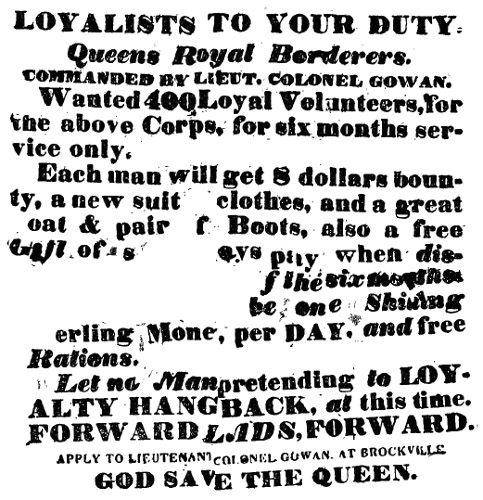
One colonel issued instructions that above all things solid form must be preserved,—should a man fall, close and cover the vacancy. An Irishman with a bass voice and sepulchral delivery gravely asked, “And would your honour have us step on a did man?”
The word “halt” had little power to make some militia corps stationary; it rather accelerated their speed. “Halt—halt—halt!” cried a perspiring officer as he chased his men, and as near explosion point as his own gun; “if you don’t halt I’ll walk you five miles!” The threat prevailed, and they halted. But they were peremptory enough when individually they had to give the same order. Both sides, loyalist and patriot, saw an enemy in every bush and were always ready for a spy. Excitement was running high in a Yonge Street village one day, when a lad, young Jakeway, hearing an unusual noise in the street, walked out to see what it was. One of a number of armed men before the village inn called to him to halt, taking him for a spy. But the lad turned away and did not hear. The man, upon no further provocation, raised his gun to shoot, but another, less ardent, knocked the weapon up and contented himself with Jakeway’s arrest. The leader recognized him as an inoffensive onlooker, and dismissed him with an apology. No one was to pass certain outposts out of Kingston without passport, the parole and countersign. The Montreal mail with four horses dashed to the bridge at Kingston Mills as the militia sentry’s halt rang out. But the coachman, as fit as himself, paid no heed; so the sentry’s bayonet pierced the breast of one of the leaders. Complaint was made to the Postmaster-General, but the sentry was promoted and Government would afford no redress. It knew a good man. That same night brought commanding officer and men, clothed and armed, to parade. By lantern light they were made load and told “the time was come.” On the principle of first fire, then enquire, a man in the front rank—of course an Irishman—discharged his musket in his officer’s face. “Be jabers,” said he, when asked for explanation and congratulated on the harmlessness of his aim, “Colonel, I wuz that full of fight I cuddn’t help it.”
But at the grand inspection in and about Kingston, which took place chiefly before St. George’s church, with the same hearty bluff Englishman, Colonel Bonnycastle, in command, the troops, six hundred and fifty in number, newly clothed and equipped, made a handsome showing, and considering their rawness performed their evolutions creditably and without damage to themselves or him.
“Are these British soldiers?” asked an onlooker who was shrewdly guessed to be a military spy from the other side.
“Oh, no, not at all, only the Frontenac militia.”
“Then if they are militia,” returned the American, “all I can say is they must be regular militia.”
Old Peninsula officers, remnants of Brock’s army, veterans from everywhere British, helped from Quebec to Sarnia to leaven this mass of raw colonial fighting material, and they developed it into something very ugly to tackle.
But even veterans want substantial recompense for service, and in ’37 Sir Francis received a strong appeal from one of them: “May it please your Honor and Glory, for iver more, Amen.
“I, —— ——, formly belonging to the 49th Regt of Foot was sent to this country in 1817 by his Majesty George the Forth to git land for myself and boys; but my boys was to small, but Plase your Honor now the Can work, so I hope your honor wold be so good to a low them Land, because the are Intitle to it by Lord Bathus. I was spaking to His Lord Ship in his one office in Downing Street, London, and he tould me to beshure I wold Git land for my boys. Plase your Honor, I was spaking to Lord Almor before he went home about the land for my boys, and he sed to beshure I was Intitle to it. Lord Almor was Captain in the one Regt that is the Old 49th Regt foot. Plase your honor I hope you will doe a old Solder Justis. God bless you and your family.
“Your most humble Sarvint “—— ——
“N.B. Plase your Honor I hope you will excuse my Vulgar way of writing to you, but these is hard times Governor so I hope you will send me an answer.”
Not one of them was too far off to hear the despatchmen as they rode along the half-made roads, with bugles blowing the call to arms. Spear in boot, sword clanking by his side, the despatchman was an impressive figure which still lives in the memory of some of those who in their youth answered to his call. No one disputed his word; at his behest the farmer had to go, and the farmer’s horses had to be harnessed to furnish transport for recruits. “Four of us were out, ’cause why, we had to. Two of us were stacking cornstalks, one was at the creek with the horses, and I was mending the fence. It was a beautiful day, and the air was clear enough to hear anything, let alone that bugle. The tooting was followed by the appearance of a lot of men, and we were ordered to fall in. It took me only a minute to run into the house for some things; none of us had a gun, and on the way we cut ourselves cudgels. There was not any volunteering about it, for it was a regular press. I was the youngest, and mother she did cry like sixty.”
Everywhere the rigours of barrack life, drill, and life generally were lightened by practical jokes and bogus challenges. John Strachan, junior, once gravely challenged a cow, gave her one more chance to answer, and then, in defence of his country, took her life. What is more, he had to pay for her.
In Quebec the volunteer days of ’37-38 were festive times. With population that followed a thin line of river border and condensed at the two cities, and with superior means of equipment and drill, the period of formation was not so lengthy as in Upper Canada. Lieutenant-Colonel the Honourable James Hope was chosen by Lord Gosford as commander of the volunteer force. In December, ’37, the garrison at Quebec was reduced to one company of Royal Artillery. No greater compliment could be paid Major Sewell, late of the 49th, Brock’s own—with his regiment in uniforms of “blue coat and buff breeches, white blanket coat and green facings, blue cap and light band”—than to put him in charge of that important post. He had some veterans among them, Henry Lemesurier, a captain minus his right arm, which had been carried away by a round-shot at the battle of Salamanca when bearing the colours of his regiment—the 74th—for one. The militia force in the beginning of the year was incomplete and inefficient, looking formidable with its list of every officer from colonel to corporal, but with many, officers and men alike, who had never handled a musket. But they were to get used to the smell of powder. “Lord love your honour, the smell of gunpowder, did you say? Divil a bit do we care for it—it’s the balls we do be moindin’.” And well he might say so, for not even H. M. Regular Rocket troop was to be entirely trusted. At St. Eustache, under the impression that rockets like wine improve with age, one, a relic of the Peninsula, was fired. It was a mellow old fellow, slow in making up its mind. Instead of rising it fell, failed to clear the unaccustomed snake fence which lay in the track, broke off its tail and sent its huge head whirling and whizzing, twirling and sizzling, over a ploughed field, with Head-quarter staff, Rocket troop and all before it in mad flight to escape. It seized upon one volunteer to play particular pranks with, and chased him round and round the field, until, exhausted, he fell between the furrows, and the rocket, balked of its prey, went out with a final bang. Convinced that his enemy was defunct the man got somehow to his feet, and never drew breath—so the story goes—until Montreal was reached.
The first paid corps raised at Quebec was named the Porkeaters, a regiment some six hundred strong, able-bodied, resolute fellows, mostly Irish labourers, mechanics and tradesmen, who did no discredit to their supposed diet. These bacon-fed knaves began by looking the awkward squad; but drill by the non-coms, of the regulars, aided by strict discipline, soon made them perform their evolutions with the regularity and precision of their instructors. It is easy to fancy this regiment going into action under Colonel Rasher, with the wholesome advice, Salvum Larder, floating to the breeze in the hands of Ensign Flitch—“Charge, Sausage, charge; On, Bacons, on,” the last words of some local Marmion.
A fine cavalry corps, well-mounted, muscular fellows, under Major Burnet, did good work; yet temperate withal, not like Strange’s troop in Kingston. The latter had been in semi-activity since ’34—that is to say, they were drilled on foot, with sticks for sabres. The consequence was that when they were furnished with arms and mounted on steeds of many sizes, difficulties ensued. Calm Sergeant Nobbs, sword in hand, all his neighbours equally hard at work mastering horse and weapon, unfortunately drew the curb at an inopportune moment as he was demonstrating his mode of parrying. Up came the horse’s head, and off went its ears.
Also at Quebec were the Queen’s Pets, composed of seafaring men, under Captain Rayside, a veteran naval officer, in long blue pea-jackets, blue breeches, round fur caps with long ears, and red woollen cravats—evidently the young Queen was supposed to be fond of novelty—their arms, horse pistols, broad cutlasses and carronade. Companies 1, 2, 3, 4, 5 and 7 in this regiment had blue loose coats with red collars, blue breeches, and high fur caps with long ears; the Highland company had Rob Roy tartan trews, Scotch bonnets and dark frock coats.
The Fauch-a-Ballaughs were gayer still, in white blanket coat, red sash, green buttons, green facings and green seams, high cap with green top falling over—an old hat and the humour of forty fancies pricked int’ it for a feather—and blue breeches with a red stripe.
One corps had a euphonious and suggestive Dahomean title from corporations gained in forty years of piping peace and good dinners. They were chiefly Lower Town merchants, veterans in business if not in war, who soon brought their cognomens under the discipline of black leather belts, cartouche box and twenty rounds of ball cartridge; good Brown Besses rested on the shelves provided by a kindly Mother Nature; and with much puffing and blowing, their eyes fronted and righted until a permanent cast was threatened.
All corps dined much, whether they were to fight or not. Military dinners were frequent, and always went off with great éclat, the local excitement lending “go” to them all. Even in that time of ferment there were, as there had been since the Conquest, sensible men, French and English, of the better classes who had made the fact of a common enemy—the American assault of Quebec—a ground for a common patriotism. History has handed down a glowing account of one St. Andrew’s dinner given in ’37, in Quebec, and Mr. Archibald Campbell’s lines, sung by himself in a clear and mellow voice, are worth reproduction as indicative of the Scottish spirit:
“Men of Scotia’s blood or land, No longer let us idly stand Our ‘origin’ which traitors brand As ‘foreign’ here. By gallant hearts those rights were gained, By gallant hearts shall be maintained, E’en tho’ our dearest blood be drained Those rights to keep. On the crest of Abram’s heights, Victorious in a thousand fights, The Scottish broadsword won our rights, Wi’ fatal sweep. Then when the Gaul shall ask again Who called us here across the Main, Each Scot shall answer, bold and plain, ‘Wolfe sent me here.’ Be men like those the hero brought, With their best blood the land was bought, And, fighting as your fathers fought, Keep it or die.”
There were men then in Quebec whose denunciations of British rule were given with a vim not exceeded by Papineau himself, who were destined, fermentation over, to be like the wine kept for the end of the feast. It so happened that Sir E. P. Taché, aide-de-camp to the Queen in after years, was then Patriote—to be spelled in capitals and rolled with the reverberation of the Parisian R. He was subjected to an unexpected domiciliary visit, as a cannon was supposed to be hidden under his winter supply of provisions. The searchers were rewarded by a pair of duelling pistols, then a part of every gentleman’s outfit, and a veritable Mons Meg, six inches long, which belonged to a small boy of the same number of years.
As history counts, it was not long before Etienne Taché, in the fold and one of our Queen’s knights good and true, declared “the last gun fired for British supremacy in America would be fired by a French-Canadian.”
From survivors, and from a few printed memorials, one finds that what was known as Training Day seems to have been a great farce in Upper Canada. The 4th of June, King George’s birthday, was its date. Descriptions of it take one back to the Duke of Brunswick’s lament over his army—that if it had been generaled by shoemakers and tailors it could not have been worse, for the Duke’s general marched with his division like cabbages and turnips in defile. Here there was no likeness to anything so formal; the army manœuvres partook of the wild luxuriance of native growths. If twelve were the hour for muster on the common at Fort George, it was sure to be after one before the arduous work of falling in began. “The men answered to their names, as the rolls of the various companies were called, with a readiness and distinctness of tone which showed that, in spite of the weather, they were wide-awake,” says the chronicle. Once they became more active a scene ensued which could not fail to gladden the eyes of the onlookers. In time, either slow or quick, the men did not seem to be guided by any rule of book, but exemplified home-made tactics, presenting lines for which mathematicians have yet furnished no name, putting out flanking parties at either end, and as nearly squaring a circle and circling a square as possible. “Though many jokes were passed, fewer sods were thrown than usual.” Even later than ’37, once men had been out and had come home veterans their services were in demand by officers newly appointed. As in the days of the good Duke of York, ignorance was an officer’s perquisite; then some intelligent sergeant whispered the word of command which his officer was ashamed to know; here, the poor officer was willing, but perhaps had a sergeant as ignorant as himself. However, he was not too haughty to search for some private to help him. “Say, they tell me you were out,” said one of these officers to a private; “I suppose you know something of military training. Now, I am a captain and don’t know anything, and I believe I’ll appoint you my sergeant.” The scene of initiation was by the Little Thames, on what was later to be a Court House site, thenceforward to be known as Stratford. The captain wore the battered remains of a tall silk hat, a black tailed coat, white linen trousers about six inches too short, and hose a world too wide for his shrunk shanks. The hastily-made sergeant, Tom Stoney, a blue-eyed young Irishman with a spice of fun but kind at heart, armed his superior officer with his own cavalry sword, and taking him into his small saddler-shop made himself military tailor as well. The captain never would have rested without spurs had he known that the late King on his first appearance in military uniform, although unmounted, wore a pair of gold ones that reached halfway up his legs like a gamecock. Stoney drew down the white pantaloons as far and as tight as possible, sewed on buttons, and cut and sewed two leather straps to aid in keeping the captain together. The men were got into line; the captain meekly took his place among them. “Right face!” cried the sergeant, and off flew a button, up went the trouser-leg to the knee—“pursued my humour, not pursuing his”—rejoicing in regained freedom, relented and came down again. Clump-clamp went the leather strap with every step. The sergeant’s commands came quicker than ever, the captain perspired, and toiling behind his men removed his silk hat to wipe his streaming face. Then he ventured his first “command”: “I think we have had enough drill; we’ll march down to the distillery, boys, if you like.” And they did.
In the Talbot District, Training Day since 1812 had been kept up with constancy. In spite of that, the inhabitants were somewhat unprepared when ’37 came. But the gathering of the Loyalists, however isolated they were from one another, was willing and surprisingly quick. Old officers of the army sought for and gathered up volunteers; they had neither drum nor fife, but there was a ready response from willing hearts, and from hands equally willing, however uncouth and unused to arms. The most embarrassing hindrances, sometimes, to everything like organization and drill and obedience to orders were those same old soldiers when, as was generally the case, they knew more than their officers. They stood in the ranks, and at the same time found fault with every word of command, so that they demoralized that which they had brought together. No set of volunteers was more difficult to handle than the old soldiers who had settled in Adelaide. Captain Pegley, although himself a retired regular officer, found them almost unmanageable when mixed with the more docile farmers and farmers’ sons. After much adjuration he at length broke out into exclamations which, on the whole, suited his mixed audience better than set military phrase. “Haw, man! gee, man!” cried he, a startling contrast to the studied politeness of some of the subs, who, with nothing whatever of the drill-sergeant tone, whenever the openings in the ranks were too wide, would say, “Won’t you be kind enough to step nearer this way; now, you men, be good enough to keep your places.” The sharpest order delivered by these subs was, “Halt! and let the others come up, can’t you!” Wheeling into line disclosed a line looking like the snake fence surrounding the stubble field which contained the wheel.
Marching in quick time with one bagpipe and a fiddle, or with a single drum and fife, was not antidote enough to the stubble as they passed the gallant Lieutenant-Colonel in blue frock coat, white trousers shoved up from his boots, a round hat above his fat face, seated in unostentatious dignity on his venerable white mare, whose sides were blown out with grass and her neck adorned with a rope halter. “Now, men, won’t you fall in,” he would pathetically inquire, while they showed every disposition to fall out. For, instead of the drum boy, in the centre of the parade-ground was a keg containing that liquid which in Lower Canada, when carried in a seal-skin covered bottle, was known as Lac dulce, or sometimes as old man’s milk. Then would Captain Rappelje command to drink the Sovereign’s health, which was done con amore; trials of strength, boxing and wrestling, would follow, when “Abe would knock Jehial as straight as a loon’s foot.”
What would men not do to keep these kegs full. Once Colonel Bostwick and Captain Neville were temporarily absent at the same time, while certain points on the river were guarded against surprise; the rebels were hourly expected, but failed to appear. Advantage was taken of the officers’ absence to cross at one of these points, to replenish the canteen. The boat, showing lights, returned before the expected time. Those on the pier bethought them of a Yankee boast to come across and eat the small village before breakfast. They prepared to fire into the boat, but changed their minds, and rushed to where their Captain and a companion were soundly sleeping. The pile of discarded clothing by the couch had been rather mixed, and the Captain measured six foot odd; his companion’s valour was contained in few inches.
“Come, come quick, quick, the rebels are upon us!” brought them to their feet, the big Captain thrusting himself as far as he could, and farther than the garments bargained for, into the unmentionables of the smaller man. They refused to cover below the calf; he tried to withdraw, they were obdurate, and in an agony of thought the enemy’s knock was heard. The small man had meanwhile decamped with a train at either heel. The Captain seized a jacket which matched the rest of his suit; in desperation he took the quilt, and in toga arrayed, like “that hook-nosed fellow of Rome,” reached the wharf in time to receive the whiskey kegs, where he delivered a lecture on breach of discipline and ordered the men to the guard-house. This Captain was a formidable figure out of his quilt, in his own red uniform with white facings and girt with a sword whose hilt of ivory and brass was further decorated with two beavers conventionalized beyond even the requirements of modern art. The sash, of double twisted silk, strange to say had been the property of John Rolph, who, during his life in Middlesex, had made his home in Captain Neville’s house—a queer foregathering, for we all know the one, and the latter was after the pattern of the U. E. Loyalist definition in 1777:
“By Tory now is understood A man who seeks his country’s good.”
Captain Neville and Colonel Mahlon Burwell had a friendly rivalry as to who would furnish the country to which they were both so devoted with the most warlike sons. Leonidas, Blucher, Hannibal, Napoleon and Brock, did they call their unprotesting infants, until a mother rose to the assertion of her prerogative when Wolfe was suggested for one of her babies. The most warlike of this cream of heroism weighed but two pounds when he came into the world, and was put in his father’s carpet slipper to be weighed. Great, then, was the consternation when at the outbreak the following regimental order was issued, embracing fathers and sons:
“You are hereby ordered and required to warn all the men from sixteen to sixty, within limits of the late Captain David Rappelje’s company, to meet at St. Thomas, 13th inst., on Wednesday, with arms and ammunition, of whom I will take command.” The same village walls held another order from Sir Francis Bond Head. The result was more men brought together than ever before in the history of the settlement. The Mansion House was the great rallying point, and here, after the Scotch fashion, business was discussed, the suspected ones talked over by the extra loyal, and toasts and maledictions drunk according to the politics of the thirsty. That part of the country was one of the most disaffected sections, and neighbour looked upon neighbour with suspicion.
Some time before this, roused out of his retirement by the tales of agitation which he heard, Colonel Talbot attended the only political meeting of his Canadian life. On St. George’s Day of the year when Sir John Colborne, one of his nearest friends, took such a conspicuous part in the provincial elections, a large party of his people went out to meet the Colonel on the way from his Canadian Malahide castle. They found him on the top of Drake’s Hill, from which a beautiful view was afforded of the pleasant valley they were ready to defend. He entered the town, surrounded by waving flags bearing “The Hon. Thomas Talbot, Founder of the Talbot Settlement,” and other descriptive legends. The venerable figure of the eccentric lord of the manor, Executive Councillor, friend and fellow-officer of Wellington, stood there surveying his flock, the majority cheering him to the echo; but knots here and there bestowed unfavourable glances on them and him. His address was full of wit and sage advice. Some of the veterans, clad like himself in home-spun, who had toiled under his eye and by his aid had emerged from poverty to wealth, stood, with hands in their capacious pockets, looking up at him as if they “could fairly swallow his words.” When he referred to the pains he had taken to preserve loyalty among them, “That’s true, Colonel,” came as involuntary response. “But,” said he, “in spite of all my efforts, some black sheep have got into the flock—aye, and they have got the r-r-rot-t-t, too!”
His well-known aversion to altercation or controversy resulted in his being the only speaker. A loyal address was dictated by him extolling the blessings of government as then enjoyed and resting the blame of disaffection on the religious teaching of a certain lot of immigrants who had come to the Talbot Settlement in time to enjoy its prosperity, and then, not having the devotion bred by being first-comers, found it easy to pick flaws. The year ’37 brought to them a mysterious individual mounted on a cream-coloured horse which ambled him along the lanes and roads of Yarmouth. Like the clock peddler, the stranger wore deep green glasses in his spectacles. After his labours of disseminating dissension were over he managed to make his escape, but the cream-coloured nag figured as an officer’s charger on the Loyalist side—according to his late owner’s opinion, much after the manner of the unmounted Glengarries whose humour it was to steal at a moment’s rest—“convey, the wise it call”—but from the opposite point of view was pressed into government service. It was an animal of no prejudices, for with its rider it was always in the van.
Of those whose looks burned as they listened to the Colonel, and who would not subscribe to the address, some were yet to stand upon the drop to die for treason—a dignified name with which Colonel Talbot, in common with Drew, Prince and others, would have had little patience. These disaffected were chiefly influenced by an Englishman, George Lawton, who, like a good many of the demagogues of that day, had been a factious pate elsewhere. Concerned in the Bristol Riots, he was well up in the catch-words which thrilled the crowds there, and he used his strong mind and nimble tongue upon Canadian complications. He had to escape, somehow, from the consequences of his acts at home; so a sham illness and a sham death, a stuffed coffin and a funeral, and a voyage of the supposed deceased brought George Lawton to the Talbot District to sow those “seed-grains” of revolutionary doctrine which were to make him a second time an outcast. One of the first persons he met in this country was a chief mourner who had followed his coffin to the grave.
As early as ’33, Colonel Talbot writes to a friend: “My rebels endeavoured to hold a meeting at St. Thomas on the 17th, Dr. Franklin’s birthday as I am informed, but in which they were frustrated by my Royal Guards, who routed the rascals at all points and drove them out of the village like sheep, numbers with broken heads leaving their hats behind them—the glorious work of old Colonel Hickory. In short, it was a most splendid victory. Mr. Fraser, the Wesleyan minister, behaved admirably on the occasion, and I scarcely think they will venture to call another meeting in St. Thomas. Their object was to form a political union, the articles of which were to elect the Legislative Council and magistrates.”
At all periods of the Rebellion Talbot’s District provided much “sympathy.” Several men from Port Stanley set out to join the sympathisers who were making ready at Detroit. Their small vessel was provided with boiler and machinery, and they made fair headway until off a spot near the Lake Road, when the rudder gave way. In a frenzy of conscience the boat made for her own shore and stuck in the sand-bank. Just at that point there happened to be a small company of dragoons, who, when they saw the boat coming towards them, with armed men in it, divided into two parties and galloped off in opposite directions. The officer of the company, in two minds to go both ways at once, solved his difficulty by popping under an upturned canoe. The would-be saviours of their country in the rebel boat got clear of the sand-bank and made off, upon which the dragoons galloped back to look after their captain. After a careful search, for he was very coy, they found him under his canoe canopy, not a bad makeshift where umbrellas were not procurable.
There was scarcely a locality which did not give evidence that the rebel spirit had a lodgment not far off. But also in each there were martial spirits eager and willing to lead or be one of loyalist troops. Some of them tell their own stories so well that it would be a pity to garble or curtail them. One man describes how he gave up his professional work, as the winter and the Rebellion were coming on together. “... The political horizon at that time looked rather squally. The Rads. were holding frequent meetings in different parts of the country, at which loud and long speeches were made to the ignorant and wicked, until it broke out in a general rising among the disaffected portion—which was the largest portion of the County of York. In Simcoe the Rads. were fully half the population; but they did not turn out for fear of the other half, among whom were many fiery Orangemen. And to this Order I attribute the safety of our country, although many loyal men, not Orangemen, turned out in behalf of the Government. Without these men we should have failed, as, before troops could arrive from England, the Yankees would have flooded the country.
“The Home District appeared to be the stronghold of the disaffected in Upper Canada. On the 4th of December, as I was going towards Queensville, I met five or six men with rifles, whom I knew to be fond of hunting deer. We talked about hunting and I went on my way, when I met sixty or seventy more, straggling along, some with guns, some with swords, and others unarmed. They had several waggons with them, which appeared loaded, but were covered up. I began to suspect their object, but could get no satisfaction to my questions. Then I met a young fellow whom I followed into his father’s house, and saw his father give him a pair of boots and some money. That convinced me. I then turned back and followed the party, when I met a man who told me my suspicions were correct, and that they were going to take Toronto. I advised him to go home, but he said he dare not; so then I told him he had better go to the States. He said he would, and I afterwards learned that he took my advice. On my way south I went into the tavern on Tory Hill, and asked the landlady if she understood the movement, to which she replied that they were going to take Toronto, and she had known it for several days. Her husband and several others had gone there three days before, and I may say here that when I went to the city I found him there as a volunteer—either that or go to prison. I next saw Mr. Samuel Sweasey, and asked him if he understood the movement. ‘Yes, they are going to take Toronto, rob the Bank, hang the Governor, and when they come back they will hang you,’ When I asked him where his sons were, he said he had sent them to the woods to get rid of them, as the rebels were after them.” Between this narrator and his friends the news was soon pretty well spread in the neighbourhood of the Landing, Bond Head, Bradford and Newmarket as to what he had seen and heard. “Farther on I met several men, too great cowards to turn out with the rebels, but mean enough to give me great abuse on account of my principles.” He and various other officers met at Newmarket, and agreed to do all possible to raise quickly what force they could in their respective neighbourhoods, the narrator being assisted by one of his sons, who was a sergeant. “Two men had been sent from Newmarket to inform the Governor that there were a number up here he could depend on. These men were taken prisoners by Mackenzie’s party.... We felt much the want of arms. Orders were given to search for and seize all the arms that could be found; but we had poor success, as most of them were in the hands of the rebels and the rest were hidden away to prevent our getting them. About the 9th we heard that John Powell had shot Anderson,” followed by the rest of the doings after Montgomery’s. News reached the men of the north slowly, and for many reasons their march to the assistance of the city was delayed. “At McLeod’s inn, on Yonge Street, a most cowardly affair occurred. Some twenty-five or thirty of the Scotch and a few others, on hearing that a body of men under Lount was stationed in the Ridges, whom we might have to fight, turned tail and went home. Their minister did all he could to dissuade them; but home they would go. When he found persuasion useless, he mounted his horse and called for volunteers. A few fell in with him, and he and they were with us when we took up our march for the city.
“A certain officer had assumed the command, and was mounted on a horse that had been taken from a Lloydtown man as he was trying to get home after Montgomery’s. When we got down as far as Willis’s farm, at the entrance to the Ridges, a halt was called and a council held, and, as it was yet feared by some that there was a strong force of rebels in the Ridges, it was decided that a few of us, about eight, and mounted, should form an advance guard to reconnoitre. A man from the Landing had gone into Willis’s and got a gun, which when the colonel saw he called to the man to let him have. The other objected, whereupon the colonel went up to him and, in the presence of us all, wrenched it out of his hands. We were then ordered, the disarmed man one of us, to advance, which we did. The eight of us had two guns, three swords, one club, and this little party went through the Ridges while the colonel and his reserve waited for about half an hour. Hearing nothing from us in the shape of a skirmish they ventured through. When we got to Bond’s Lake I got a pitchfork for the man from whom the colonel had taken the gun.” At Thornhill they learned that the rebels were completely dispersed, and many were for returning home; but it was decided to continue the march and tender their services to the Government. “By this time we mustered pretty strong, as several had joined us during the night and morning, many of whom I presume would have joined the other party had they been able to reach the city and make a stand there. We had now some twenty-five or thirty prisoners that we had picked up as we came. These we tied and placed in two strings, somewhat in the form of Ʌ.” Arrived in the city the volunteers were inspected by the Governor, and thanked by him in Her Majesty’s name for the tender of their services. “When they came opposite to where I was sitting on my horse, Colonel Carthew said, ‘A more loyal man does not live,’ and upon this the Governor bowed twice and passed on.” Some ten or twelve of them did not accept their billet upon the people, but went to a tavern and paid their own way. “I was officer of the guard on the night that Peter Matthews was brought into the Parliament House (used as head-quarters and prison) a prisoner. On the next night I went with Mr. Robinson, Dr. King and Sheriff Jarvis to the hospital, where Edgar Stiles, Kavanagh, and Latra were lying, to take their depositions.” On the next night he was sent “with a strong party to Sharon, where we captured some thirty or forty and sent them to Toronto. For three or four days I was at Newmarket attending to the guards, as we had a number of prisoners in the Baptist meeting-house.... I was ordered to where Collingwood now stands to look for Lount, who was said to be there at a lonely house of one John Brasier. When we had got as far as Bradford a man was sent after us with a report that Lount had been taken somewhere below Toronto. When I went to Newmarket again I found that in my absence several gentlemen who had been nowhere at the first had come in, had got commissions and my men.... After this, some eighteen or twenty of us about the Landing and Sharon joined and formed a company for our mutual defence, armed with muskets. For a while we met for drill weekly, then monthly, and soon not at all.”
Lloydtown, although the seat of disaffection, had its loyalists, too; but as they were in the face of such odds they had to temper the exhibition of their loyalty with discretion. One of themselves says that when the call came for their aid they made a prompt response, but took the precaution to leave the village in small parties.
But loyalty was a term on a sliding scale, and a Scotchman whose vote was Reform was every whit as loyal as his Tory acquaintance who “suspicioned” him.
“Loyal? Of course I was loyal, as every one in our neighbourhood was; but most of us were true Reformers nevertheless, and not ashamed of the name, in spite of Mackenzie’s goings-on. I refused to volunteer in ’38 when the draftings began again, because all trouble in Upper Canada was over, and I could not see that I was called upon to give up important home duties; and besides that, the officers had nothing to do, and thought it would be a fine thing to get a company up and have the recompense for keeping it together. The captain only succeeded in getting a few volunteers, not twenty, and the thing was to be completed by ballot. That was a regular farce, and the ignorance of some of those who drew was ridiculous. A Scotchman, holding his slip in his hand, showed it exultantly to a friend, who did not begrudge him his luck, saying, ‘O-o-aye, ah’ve drawed a prize.’ But I met an Irishman, soon after, who had been sharper than the Scotchman, pretending that he knew the peculiar twist of a paper that was intended not to be ‘drawed.’ The Irishman was rejoicing in his own exemption, and wickedly gloating over his brother who was not up to the twisted paper trick and had ‘drawed.’ One man, now our most prominent citizen, and certainly one of the oldest, refused either to draw or volunteer, for reasons the same as mine; he had fought in ’37 on the loyalist side, and now in ’38 a warrant was out for him on the score of disloyalty! They tried to arrest him, thinking he would submit quietly, but he fought the thing on every point, and these so-called loyalists found they had no legal ground to stand on. They dare not press the matter, so my friend was let alone.”
“Our captain was a regular autocrat in manner and appearance, and he spoke with a thick, fast utterance of a kind better imagined than written, when he was excited. Two others, who happened to be where we were stationed, also had an impediment in their speech, and none of them were remarkable for smooth temper. X. was sitting in the tavern one day when Z. entered to get something which was lying on the back of X.’s chair. Z. stutteringly apologized for disturbing him. X. was annoyed at being mocked, and stutteringly told him he would stand no such insult. Z. wondered why it was an insult to claim his belongings on the chair, and was equally angry at being stuttered at in response to his polite speech. Stutters were bandied until mutual anger, recrimination and exasperation led to a mutual invitation to the open and an appeal to the captain’s sympathy, which was stutteringly refused, while he advised them not to be ‘such-ch f-f-fools.’”
“In the beginning of the winter of ’37-38, MacNab, president of our railroad, came with some of the directors into our office. He stood before the fire, with his coat-tails turned up, and seemed to have made up his mind to rival Cromwell, if not to surpass him. ‘Boys, the Rebellion has burst out and the railway has burst up. Make out your arrears of accounts due, get them verified and certified by the chief engineer and keep them safe—some day you may get the money. In the meantime we have none for you, and the banks are burst all over the country, and if we had any to give you you could not pass it. We have no further use for your services, unless you choose to enlist in the volunteer corps. In that case I can promise you lots of work at twenty-five cents a day without board, except by foraging on the enemy. I give you quarter of an hour to get your accounts verified, and then go. I want to lock up the office and put the key in my pocket by that time.’
“I don’t know what the other fellows did with themselves, but I got my $130 odd verified, and it will be just sixty years next December since that money started ‘coming’ to me. I joined the Guelph Light Infantry, under Captain Poore, and that afternoon we marched over awful roads to Ancaster. When we got there we made camp-fires along the street, and lay down in our blankets on the frozen ground. The object of our expedition was to annihilate Duncombe.
“At about two in the morning we were kicked till we woke up, when we were summoned to partake of the banquet the Government provided of pork and bread. For the ensuing two weeks of our expedition we looked back in raptures at that meal, for we got hardly another bite except an occasional one stolen from the farmers. Once I got one hot potato from the table while the people were at breakfast; the other fellows took the rest, and it was all done in a moment. We got an occasional frozen potato or turnip, but the farmers, who were nearly all rebels there, generally left their houses empty. Lane, the commissary, was all the time a three-days’ journey behind us.
“When we reached Brantford we were quartered in the Methodist Church, three hundred of us, a coloured company from Toronto part of the three hundred. Many queer things happened there, including a burlesque sermon from the pulpit by a darkey, and the attempt to take up a collection after it for commissariat purposes. I was sentry that night over the so-called stores, and as I was leaving the church a kettle of boiling fat was brought in. I had not time to wait, so I dipped my india-rubber cup in and took a drink. I scalded my thumb and finger, burnt my mouth and tongue, melted my cup, and then had two hours in which to quietly meditate on the result of drinking red-hot fat in a hurry. As I was leaving the church a strip of red flannel was handed me to sew on my fur cap; none of us had uniforms, and the flannel was our distinguishing mark from the enemy. While on sentry a woman crossed the road and asked me if I had seen her husband; I said I had seen no one, and asked her to sew the flannel on my cap. It appeared I was keeping sentry over her husband’s bake-shop, which had been taken for commissary purposes, and she kept me bareheaded in a snowstorm for an hour waiting for that cap. That was our first snow, and before that all our teaming had been by waggons. While bareheaded the commissary came along to get into his store; I challenged him, and he said he had not got the watchword. I would not let him pass; so he forced his way against my bayonet. That made him go off vowing vengeance. Soon Colonel MacNab and Colonel Mills and the commissary came up. I guessed what they came for, and challenged them. MacNab was in the middle. To ‘Advance, friend, and give the countersign,’ he said, ‘Don’t you know me?’ I said I knew no one on duty. He then came up and whispered ‘Quebec,’ and I let him pass. That ended the attempt to catch me tripping while on duty. When the woman brought me my cap I said I was not going to thank her for sewing it, because she sympathised with the rebellion. Suddenly I heard musket shots, and it appeared the rebels were marching in to take Brantford without knowing we were there waiting for them. A doctor in advance of their army had been taken prisoner at the bridge; but he lied to MacNab, and said he was on his way to see a sick person. This seemed probable, and he was let go, when he rode back to warn the rebels. A shot was sent after him, and that started the alarm I heard. All our companies were mustered in line in a great snowstorm, and furnished with thirty-six rounds of ball cartridge; then we began quick march to catch the enemy, who retreated when the doctor reached them. We caught up to them at Beemersville, when they took position and fired a volley; we charged, and they subsided; so we ate their breakfast. During the day several hundred Indians drew up in line in an orchard and took us for rebels; we took them for the same. We were in line to receive them, and pails of whiskey were dealt along. The others took it, but I refused, although the sergeant who dealt it out said it would give me Dutch courage. I said I wanted only English courage. Officers met each other half way with flags of truce for a parley. It turned out we were all of the same side, so they brought their painted faces to within ten feet opposite; but we couldn’t speak Indian and they couldn’t speak English, so we were not very communicative. When there was to be no fighting I wanted my whiskey, but the sergeant would not give it.
“I went into the tavern to capture a prisoner almost in my hand. He had fired two rifles at me, and then he ran to the tavern; my musket was not loaded, so I could not return fire, but I threw it at him. I got him fast in the tavern, almost transfixing him with my bayonet before I could divert it; as it was, his long whiskers were pinned into the wall, and to withdraw the steel I had to plant my foot against his waistband. But when our men came pouring in several tried to kill him, so I stood before him and we fenced with bayonets, I against three or four. They desisted when I told them that the first blood spilt would be theirs or mine, and I sent for a sergeant to come and take the man. But when they went out I had to stand between my prisoner and the crowd.
“We slept three deep in straw that night. I came in late, found a place, and used another man for a pillow; soon a comrade came in and woke me up by sitting on my head while he pulled off his boots. I shook him off three or four times, but he remonstrated with me for being inconsiderate, as my head was the highest thing in the room and the best for his purpose. He was so persistent, and I so sleepy, that I agreed to let him stay if he would promise to get off when he got rid of his boots. He promised, and I went to sleep; and I suppose he must have done as he said, for I did not find him on my head in the morning.
“Near what was then Sodom-and-Gomorrah we came on seven haystacks in a row by the fence line; the cavalry had tied their horses to the fence and divided the stacks among them; then the teams came up, and the stacks were melted more thoroughly than the snow. My legs were stiff from walking, and a pock-marked Irishman’s hands were stiff from driving; so we exchanged musket and whip, and I had a day’s relief while driving for him. The snow had grown so deep that a team took the lead, breaking the way for the men, who would pass by in full procession, while the teamster drew to one side to rest his horses. Before we left Norwich three or four hundred men gave themselves up as prisoners, heartily sick of what they had supposed was patriotism. When we got to Ingersoll and asked for food they said there that everything had been bought up that was not poisonous; the grocery man had nothing to offer me but soft soap, and he recommended that in strong terms. I declined the inference.
“Our barracks there were in the blacksmith’s shop, without a floor, and built over the creek on the only street in the place. I took my bayonet out of the sheath and knocked at the kitchen door of the best looking house I could see. A lady answered, and I asked her if there was a gentleman in the house that I could talk to. She said no, her husband was with the officers. I said I came to buy a loaf of bread. She could spare me none, as she was going to give a dinner to the officers that evening, and at any rate she did not sell bread, that was not her business. I told her I was sorry there was no man in the house that I could talk to, but as there was not I must tell to her that I had been all over the village trying to buy food, and as I had not been able to get any I had taken this bayonet out with a view to fighting for some if I could not buy it; that I was soldiering to drive the rebels out, and that we had no commissariat; that that sort of thing was hard for me and the rest of the men, when officers could have banquets given them after being too ignorant to organize a commissariat. I told her a great many things, and apologized for having to talk to her so, and that I was sorry there was no man to talk to. She ended by giving me nearly a whole loaf, the price for which she said was a York sixpence. I put a York shilling down on the table and took my loaf to the barracks, where I cut it in as many pieces as there happened to be men in. As soon as I had put a piece in my mouth I found myself reeling and getting blind. They led me out and I fell into the creek, with my head under water; they picked me out again, but my appetite was all gone, and I gave away my bit of bread. I wandered about, and after awhile heard that the Orangemen were having a feast. I and several others went to the same house, and we were all in the seventh heaven of happiness; good food, and served by a handsome hostess and two beautiful daughters. After eating, we joined the Orangemen in the next room, and we spent several hours drinking grog and singing. That was our tenth day out, and that supper was my third meal. Generally our meals consisted in sucking a corner of a blanket; we kept our mouths moist that way, and averted faintness and reeling.
“When going to Hamilton teams were pressed from the farmers, and we were carried seven men and a driver in each. When we got to the mountain the angle and state of the road sent the first sleigh over the precipice, and ours, the second, hung over at right angles; but we managed by hugging the bank and shifting our weight. I looked over and saw the first sleigh on a ledge about one hundred feet below, and as the men were not visible I suppose they were buried in the snow.
“When sitting in the tavern that day I found in my pocket a small apple I had bought near Paris. I took a bite of it and that brought the saliva into my mouth, when, naturally, I fainted as I sat.
“As we marched into Hamilton we had to pass by my door, so I marched out of the ranks and into it. Of my three meals in two weeks, only one was at the expense of the Government.”
“When I was going from Hamilton to Windsor I had to take to sleighing at Chatham, and as we drove down the river, hugging the shore, many large fields of ice floated down the open. We passed three men on one cake, another on a second, and later a fifth, all dead and frozen Yankees, sympathisers. At Windsor I stopped with Mr. Baby, whose house windows were riddled with bullets, and I saw vacant lots broken up and dotted with graves. As an encouragement for me, on my way to Detroit, I was told that the Yankees had threatened to hang the first six Canadians they could catch, to the lamp posts, in return for Colonel Prince’s shooting. When I got my pass from a lieutenant to enable me to cross the river he told me the same thing. I got over and was trying to get my boxes examined by two men who called themselves custom house officers, when I found I had to go off, for peace’ sake, with three others, to report. I guessed what it was about, and made up my mind. They took me to a low tavern filled with unwashed men, and I was left sitting with one of my three while the other two reported on me to an officer. Was I in the ‘war’? Yes. Which side, the patriotic? Yes. Where? Under General Duncombe. How did he make out? Beaten horribly. My questioner had been at Navy Island, and said ‘the British had sent over a —— rocket, which they all looked at while it zigzagged round until it fell plump on the island, where it fizzed away so long that they went to see what was the matter with it, and while they were looking the —— thing burst, and —— if it didn’t kill eight; they didn’t feel any curiosity to examine any of the rest that came.’ I treated this fellow to a drink, unrectified and tasting like sulphuric acid. I didn’t drink mine, so he did. Then I was conducted to the officers’ room, about eighteen gentlemanly looking fellows, apparently American officers, who were deputed to conduct the campaign, so as to give better prospects of success in the conquering and annexing of Canada. They tried to catch me tripping, but I lied manfully; I had no scruples about treating such gentry so. I knew all about what I had seen, and all I had to do was to reverse the position. But my stay in Detroit was short, and I soon returned to work in Canada.
“In our scrimmage with the enemy our captain of cavalry fired his pistol at a rebel, but his horse inopportunely pranced and the bullet ran along the animal’s neck and out at his forehead. He fell, stunned, crushing the captain pretty badly, one of whose hands was permanently injured. He told the story to some one, and that person said, ‘Don’t tell that story again; say the rebels shot your horse, and claim a pension.’ He took his friend’s advice, but I don’t know about the pension. At a review afterwards I saw the same captain on the same horse, and I told the story to the man I was with; we then went up to the captain, and asked him how he got his hand hurt, and he replied that the rebels had shot his horse!
“After our campaign I found I could drink thirteen cups of tea at a meal for several successive meals; but I could not sleep in a bed, or in fact stay long in the house at night at all.” This narrator gives some most unflattering opinions of Colonel MacNab in his generalship in the Duncombe campaign, and many tales of the commissariat department alone seem to bear out his statements from a private’s point of view. He is contemptuous and satirical in describing the methods employed in the Little Scotland affair, “but considering we were about 30 to 1 it did not much matter.”
Another gives a summary of the few casualties at Little Scotland, and, as a death dealer, thinks sauerkraut almost equal to bullets: “A private from Hamilton nearly perished after eating a quart of raw frozen sauerkraut. I was detailed to bring in some prisoners, a cold trip in the snow, and I was fired at from behind an elevation in the road in front of us. We found two of the prisoners covered up in an oat bin in a tannery. Our luggage-train had such a hard time that in one place we had to build a bridge and hold it down with hand-spikes while the train went over. We had no rest and little to eat; no salt at all, and our rations only frozen bread. We would gnaw at it a while and then lay it aside to rest our jaws; but we had to be careful that the hero of the sauerkraut would not make away with it, as he had a hungry maw and a canvas bag. At night we slept in the open, and we wrapped ourselves in Indian blankets—to find them frozen round us. But a fire made of fence rails thawed us and our bread and blankets.”
Occasionally there were volunteers who were not made of the stuff which could be comfortable in a frozen blanket or willing to face a foe. An American, engaged in shipping lumber to Buffalo, with no love for Canadians, had boards added in every possible way about his vessel and covered with all available lanterns and candles. This display sent terror, as he expected, to the hearts of the raw recruits. When ordered to hold themselves in readiness for the advancing foe, one of them approached the captain and declared he was not going, as he had “only listed to stan’ guard.”