PART II (continued 3)
Reading edition
The technicalities of steel and iron come easily off his tongue; they are his native speech, in which he expresses himself most intimately. All his life he has been concerned with machines. He is the inventor of the Brennan steerable torpedo, whose adoption by the Admiralty made him rich and rendered possible the long years of study and experiment that went to the making of the mono-rail car. He has a touch of the rich man's complacency; it does not go ill with his kindly good humor and his single-hearted pride in his life work.
It is characteristic, I think, of his honesty of purpose and of the genius that is his driving force that hitherto he has concerned himself with scientific invention somewhat to the exclusion of the commercial aspects of his contrivance. He has had help in money and men from the British Government, which likewise placed the torpedo factory at his disposal; and the governments of India and—of all places—Kashmir have granted him subsidies. Railroad men from all parts of the world have seen his model; but he has not been ardent in the hunt for customers. Perhaps that will not be necessary; the mono-rail car should be its own salesman; but, in the meantime, it is not amiss that a great inventor should stand aloof from commerce.
But, for all the cheerful matter-of-factness of the man, he, too, has seen visions. There are times when he talks of the future as he hopes it will be, as he means it to be, when "transportation is civilization." Men are to travel then on a single rail, in great cars like halls, two hundred feet long, thirty to forty feet wide, whirling across continents at two hundred miles an hour—from New York to San Francisco between dawn and dawn.
Travel will no longer be uncomfortable. These cars, equipped like a hotel, will sweep along with the motion of an ice-yacht. They will not jolt over uneven places, or strain to mount the track at curves; in each one, the weariless gyroscopes will govern an unchanging equilibrium. Trustful Kashmir will advance from its remoteness to a place accessible from anywhere. Streetcar lines will no longer be a perplexity to paving authorities and anathema to other traffic; a single rail will be flush with the ground, out of the way of hoofs and tires. Automobiles will run on two wheels like a bicycle. It is to be a mono-rail world, soothed and assured by the drone of gyroscopes. By that time the patient ingenuity of inventors and engineers will have found the means to run the gyroscopes at a greater speed than is now possible, thus rendering it feasible to use a smaller wheel. It is a dream based on good, solid reasoning, backed by a great inventor's careful calculations; H.G. Wells has given a picture of it in the last of his stories of the future.
Practical railroad men have given to the mono-rail car a sufficiently warm welcome. They have been impressed chiefly by its suitability to the conditions of transportation in the great new countries, as, for instance, on that line of railway that is creeping north from the Zambesi to open up the copper deposits of northwestern Rhodesia, and on through Central Africa to its terminus at Cairo. Just such land as this helped to inspire Brennan. He was a boy when he first saw the endless plains of Australia, and out of that experience grew his first speculations about the future of railway travel. Such lands make positive and clear demands, if ever they are to be exploited for their full value to humanity. They need railways quickly laid and cheaply constructed; lines not too exacting in point of curves and gradients; and, finally, fast travel. It is not difficult to see how valuable the mono-rail would have been in such an emergency as the last Sudan War, when the army dragged a line of railway with it down toward Omdurman. Petrol-driven cars to replace the expensive steam locomotives, easy rapid transit instead of the laborious crawl through the stifling desert heat—a complete railway installation, swiftly and cheaply called into being, instead of a costly and cumbersome makeshift.
The car went back to her garage, or engine-shed, or stable, or whatever the railway man of the future shall decide to call it. Struts were pulled into position to hold her up, the motors were switched off, and the gyroscopes were left to run themselves down in forty-eight hours or so. When the mono-rail comes into general use, explained Brennan, there will be docks for the cars, with low brick walls built to slide under the platforms and take their weight.
While his guests assembled in a store-shed to drink champagne and eat sandwiches, he produced a big flat book, sumptuously bound, and told us how his patents were being infringed on in Germany. On that same day there was an exhibition of a mono-rail car on the Brennan principle taking place at the Zoölogical Gardens in Berlin; the book was its catalogue. It was full of imaginative pictures of trains fifty years hence, and thereto was appended sanguine letter-press. While there sounded in our ears the hum of the gyroscopes from the car housed in the rear, I translated one paragraph for him. It was to the effect that one Brennan, an Englishman, had conducted experiments with gyroscopes ten years ago, but the matter had gone no further.
"There, now," said Brennan.
(Everybody's Magazine)
A NEW POLITICAL WEDGE
The Way St. Louis Women Drove a Nine-Hour Day into the Law
BY INIS H. WEED
It was the evening before the state primaries—a sweltering first of August night in the tenement district of St. Louis, where the factory people eat their suppers and have their beds. Men in shirt-sleeves and women with babies sat on the steps for a breath of air, and the streets were a noisy welter of children.
Two of the most enthusiastic girls in the Women's Trade Union League stopped before the group silhouetted in the gaslight at No. 32 and handed the men in the group this card:
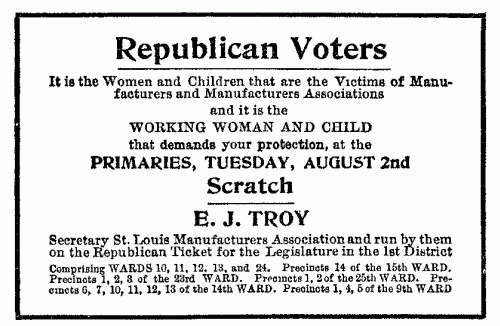
"So yez would be afther havin' me scratch Misther Troy?" Mike Ryan ran his fingers through his stubby crop with a puzzled air. "Oi'm always fur plazin' the loidies, but Misther Troy, he's a frind o' mine. Shure, he shmokes a grand cigar, an' he shakes yer hand that hearty."
So Mike belonged to the long, long glad-hand line. Well, personal arguments were necessary in his case then. That was the way the girls sized up Mike Ryan.
"But this ticket has something to do with your oldest girl."
"With Briddie?"
"It sure does, Mr. Ryan. Didn't I hear your wife tellin' what with the hard times an' all, you'd be puttin' Briddie in the mill this winter as soon as ever she's turned fourteen? Wouldn't you rather they worked her nine hours a day instead o' ten—such a soft little kid with such a lot o' growin' to do? There's a lot of us goin' to fight for a Nine-Hour Bill for the women and children this winter, an' do you think a manufacturers' representative, like Troy, is goin' to help us? Look at his record! See how he's fought the employees' interests in the legislature! That's a part of his job! He won't vote for no Nine-Hour Bill!"
And the two girls went on to the next tenement.
They were only two of the hundreds of Trade Union girls who were "doing" the First Electoral District (about one-third of St. Louis) on the eve of the primaries. They were thorough. They had the whole district organized on the block system, and they went over each block house by house.
A new move, is it not, this carefully organized effort of factory women to secure justice through the ballot-box?
How have St. Louis women attained this clear vision that their industrial future is bound up in politics? It is a three years' story. Let us go back a little.
St. Louis is essentially a conservative city. First, it was an old French town; then a Southern town; then a German tradesman's town. With such strata superimposed one above the other, it could hardly be other than conservative. In addition, St. Louis was crippled in the war between the states. She lost her market. This made her slow.
In the 'eighties, this old French-Southern-German city began to recover from the ruin of her Southern trade. Little by little she took heart, for the great Southwest was being settled. There was a new field in which to build up trade. To-day St. Louis is the great wholesale and jobbing depot, the manufacturing city for that vast stretch of territory known as the Southwest.
Since 1890, great fortunes have been amassed—most of them, indeed, in the past ten years. There has been a rapid growth of industry. The old Southern city has become a soft-coal factory center. A pall of smoke hangs over the center of the city where the factories roar and pound. In the midst of this gloom the workfolk are creating rivers of beer, carloads of shoes and woodenware, millions of garments and bags, and the thousand and one things necessary to fill the orders of hundreds of traveling salesmen in the Southwest territory—and in the South, too, for St. Louis is winning back some of her old-time trade.
And the toil of their lifting hands and flying fingers has wrought a golden age for the men who control the capital and the tools. The men who manage have been shaking hands in their clubs for the past decade and congratulating themselves and each other over their drinks. "Yes, St. Louis is a grand old business town. Solid! No mushroom real-estate booms, you know, but a big, steady growth. New plants starting every month and the old ones growing. Then, when we get our deep waterway, that's going to be another big shove toward prosperity.
"Nice town to live in, too! Look at our handsome houses and clubs and public buildings. Never was anything like our World's Fair in the history of men—never! Look at our parks, too. When we get 'em linked together with speedways, where'll you find anything prettier?" Thus the money-makers in this heavy German town.
But what about the employees—the clerks and the factory workers? Have they been "in" on this "big shove toward prosperity?" Have they found it a "nice" town to live in?
No, to each count. For the people at the bottom of the ladder—for the people who tend machines, dig ditches, and stand behind the notion counter—St. Louis is a smoky town, where people have gray lungs instead of pink; a town where franchise grabbing and an antiquated system of taxation have their consequence of more than New York city rents. A town whose slums, says Lee Frankel, are the worst in the country. A town where wages are low (in some occupations twenty-five per cent lower than in New York City); where employment is irregular, the speeding-up tremendous, the number of women entering industry steadily increasing, and where the influx of immigrant labor is pulling down the wage scale and the standard of living.
The average wage of the shoe-workers in the East is $550 per year. In St. Louis it is $440 if work is steady—and rents are higher than in New York City.
It must be remembered that this sum is an average, and that thousands of shoe-workers earn, less than $440, for full-time work. The same is true of thousands engaged in other kinds of manufacture and in department stores.
Somehow the town looks different from the two ends of the ladder.
The government of Missouri and St. Louis has been about as little adapted to the needs of the industrial worker as it well could be. Men have been concerned not so much with social justice as with government protection for money-making schemes.
Business opportunity has depended much on pliable state and municipal laws. How the interests fought to keep them pliable; how St. Louis and Missouri became a world scandal in this steady growth to riches, we all know.
We know, too, the period of political reform. People thought the killing trouble in Missouri lay largely with the governmental machinery; and the optimists' faith in a state primary law, in the initiative and referendum as panacea, was white and shining. They did not see that the underlying problem is industrial.
After the reform wave had spent itself, the crooked people who had kept out of jail crept from their holes and went back to their old job of beating the game. The only essential difference is that their methods to-day are less raw and crude. They play a more gentlemanly game; but the people are still robbed of their rights.
Thus it came to pass that when the cheerful optimist went to the cupboard to get his poor dog a bone, why, lo! the cupboard was bare.
Meantime the dog has taken up the struggle for social justice on his own account, not singly but in groups and packs. As yet, although a deal of snuffing, running to and fro, barking, yelping, and fighting has been done, little has been accomplished; for one reason, because labor has lacked great organizers in St. Louis.
It has remained for the working women of St. Louis to make the industrial idea effective and to reach out with united single purpose to bend the political bow for their protection.
The Women's Trade Union League, whose real general is Cynthelia Isgrig Knefler, the most dynamic woman in St. Louis, received its first impetus only three years ago in the idealism of a brilliant young Irish girl, Hannah Hennessy, who died at Thanksgiving, 1910, a victim of exhausting work in a garment shop and of her own tireless efforts to organize the working girls of her city.
Hannah Hennessy was sent by the Garment Workers' Union to the National Labor Convention of 1907 at Norfolk, Virginia.
There she glimpsed for the first time the inevitable great world march of women following industry as machinery takes it out of the home and into the shop—saw these women, blind, unorganized, helpless to cope with the conditions offered by organized capital. The vision fired this Irish girl to a pitch of enthusiasm peculiar to the Celtic temperament. Back she came to St. Louis with the spirit of the Crusaders, her vision "the eight-hour day, the living wage to guard the home."
For the first time she saw the broken physical future of women who label three thousand five hundred bottles of beer an hour, and accept their cuts and gashes from the bursting bottles as inevitable; of women who put eyelets on a hundred cases of shoes a day, twenty-four pairs to the case; of women who must weave one thousand yards of hemp cloth a day to hold their job in a mill where the possible speed of woman and machine is so nicely calculated that the speediest person in the factory can weave only twelve hundred and sixty yards a day; where the lint from this hemp fills the air and is so injurious to eyes and throat that the company furnishes medical attendance free.
To undertake the huge task of organizing these thousands of St. Louis women would require not only vision but time and energy. Hannah's return meant being engulfed in the vast roar made by rows of throbbing, whirring machines, into one of which she sewed her vitality at dizzy speed ten hours a day. Vision she had, but training, time, energy—no!
It was at this point that she met Cynthelia Isgrig Knefler, a leisure-class young woman, who had been gripped by a sense of the unevenness of the human struggle. Cynthelia Knefler was groping her way through the maze of settlement activities to an appreciation of their relative futility in the face of long hours, low wages, and unsanitary shops.
Then the idealism of these two young women, born on the one hand of hard experience, on the other of a gentle existence, fused, and burned with a white light whose power is beginning to touch the lives of the women who toil and spin for the great Southwest.
Both women possessed fire and eloquence. Hannah's special contribution was first-hand experience; Mrs. Knefler's the knowledge of economic conditions necessary to an understanding of our complicated labor problems. Wise, sane, conservative, Mrs. Knefler not only helped Hannah to organize branch after branch of the Women's Trade Union League in the different industries, but set out at once to train strong, intelligent leaders. She stimulated them to a critical study of labor laws with the evolution of industry for background.
Night after night for two years Mrs. Knefler and Hannah were out organizing groups of girls. Mrs. Knefler's friends finally stopped remonstrating with her. Hannah, utterly self-forgetful despite ten hours a day in the mills, hurled herself into the new work. Evening after evening her mother protested anxiously, but Hannah, heedless of her own interest, would eat her supper and hurry across the city to help groups of new girls—American, Russian, Roumanian—a confused mass, to find themselves and pull together.
One June morning in 1910 the papers announced that the Manufacturers' Association and the Business Men's League had decided on E.J. Troy as their candidate to the State Legislature for the First District. His candidacy was also backed by the Republican machine. The papers went on to say that E.J. Troy was one of "our ablest and most popular fellow townsmen," that he had grown up in his district, had a host of friends, and might be expected to carry the primaries by a big majority.
That evening at the weekly dinner of the officers of the Women's Trade Union League at the Settlement, Mrs. Knefler hurried in: "Girls, have you seen the morning papers? Do you know that we've got E.J. Troy to contend with again?"
At the same moment in dashed Hannah Hennessy by another door, calling out, "Girls, they're goin' to put Troy on the carpet again!"
To both speeches came half a dozen excited replies that that's just what they were talking about!
Over the potatoes and meat and bread-pudding the situation was discussed in detail.
"Yes, 'twas him, all right, that thought up most of those tricky moves when we was tryin' to get our Nine-Hour Bill before," reflected a wiry, quick-motioned girl during a second's pause.
"Don't it just make you boil," began another, "when you think how he riled 'em up at every four corners in Missouri! He had every old country storekeeper standin' on end about that Nine-Hour Bill. He had 'em puttin' on their specs and callin' to mother to come and listen to this information the manufacturers had sent him:—how the labor unions was tryin' to get a Nine-Hour Bill for women passed; how it would keep their youngest girl, Bessie, from helping in the store when the farmers drove in of a Saturday night; and how it was a blow at American freedom."
"E.J. Troy's got to be squenched at the primaries," said a third, quietly and decisively.
"But how?" asked a more timid officer.
Bing! Mrs. Knefler got into action. There never was a woman for whom a difficult situation offered a more bracing tonic quality. The business meeting that followed fairly bristled with plans.
The girls' first move was to go before the Central Labor Body and ask them to indorse their objections to E.J. Troy. Definite action beyond indorsement the girls did not ask or expect. This much they got.
One day a little later, when Mrs. Knefler's campaign was beginning to take form, a representative of E.J. Troy called Mrs. Knefler on the telephone. The voice was bland, smooth, and very friendly. Wouldn't she—that is—ah—er—wouldn't her organization confer with Mr. E.J. Troy? He felt sure they would come to a pleasant and mutually helpful understanding.
Mrs. Knefler explained to the mouthpiece (take it either way) that it would be quite useless; that the stand of the League was taken on Mr. Troy's previous record and on the "interests" he represented; that while they had nothing against him in his private capacity, as a public servant they must oppose him. All this in Mrs. Knefler's suavest fashion. She feels intensely, but she never loses her self-possession. That's why she is such a formidable antagonist.
It was the last week in June—they had just a month before the primaries in which to rouse public opinion. The newspapers must help, of course.
Mrs. Knefler went to the editors. They were polite, they admitted the justice of her stand, but they were evasive. Mrs. Knefler opened her paper the next morning after she had made the rounds, to find not a single word about the danger to the working woman's interests.
What could the papers do? Weren't they in the hands of the "big cinch," as a certain combination of business men in St. Louis is known? Naturally they refused to print a line. You never step on your own toe, do you, or hit yourself in the face—if you can help it?
One must admit that things looked bad for the League. How were girls who raced at machines all day, who had neither money nor the voice of the press, to rouse this sluggish, corrupt city to the menace of sending to the legislature men like E.J. Troy, pledged body and soul to the manufacturers? How could they waken the public to woman's bitter necessity for shorter hours? The case looked hopeless, but Mrs. Knefler merely set her teeth, and got busy—decidedly busy.
She planned a campaign that no other St. Louis woman in her class would have had the courage to tackle. Mrs. Knefler is a member of the club that is the St. Louis clubwomen's "holy of holies." They have a club-house that just drips art, and they steep themselves in self-culture. As a group their consciousness of the city's industrial problems is still nebulous. The high light in which Mrs. Knefler's work must inevitably stand out is intensified by this background of self-culture women, with a few—only a few—rash daughters shivering around preparatory to taking their first cold plunge in the suffrage pool.
In such an atmosphere Cynthelia Knefler planned and carried out the biggest, the most modern and strategic campaign for the working woman ever waged outside a suffrage state. It was done simply because her heart was filled with the need of the thousands of helpless, unorganized girls for protection from the greed of organized capital.
There are moments when love gives vision and raises us head and shoulders above our group. So it was with Cynthelia Knefler, brought up in this conservative city, educated in a prunes-and-prisms girls' school, steeped in the Southern idea that no "lady" would ever let her picture or her opinions get into the newspapers, and that making public speeches was quite unthinkable!
The press was silent, but at least Mrs. Knefler could speak to the labor unions. She and two other women appealed to every labor union in St. Louis with a speech against E.J. Troy. They fought him—not as a man, but as a representative of the "big interests." Mrs. Knefler made seventy-six speeches in that one month before the primaries. That meant hurrying from hall to hall on hot summer nights and making two speeches, and sometimes three and four, while her friends were wearing white muslin and sitting on the gallery, to get the cool of the evening.
Mrs. Knefler's mind was working like a trip-hammer that month; seeking ways and means for rousing the busy, unthinking, conglomerate mass of people to the real issue. Money in the League was scarce. There are no rich members. But out of their wages and out of raffles and entertainments the League had a small reserve. Part of this they used to print sixty thousand cards. So that when you went in to get a shave your glance was caught, as the barber turned your head, by this red ticket" "Scratch E.J. Troy." When you stopped in for a loaf of bread, a red ticket behind the glass of the case advised you to "Scratch E.J. Troy." When you went in for a drink, there leaped into sight dozens of little red tickets: "Scratch E.J. Troy."
There are always some men, though, who are moved only by the big, noisy things of life. Only Schneider's band sounds like music to them; only "Twenty Buckets of Blood, or Dead Man's Gulch" appeals to them as literature; and the only speaker is the man who rips out Old Glory and defies forked lightning. In a political campaign the little red ticket is lost on that kind of man. Mrs. Knefler understood this. So one hot July day huge posters in high, wood-block letters screamed from billboards and the walls of saloons and barber shops and labor halls: "Union men and friends, Scratch E.J. Troy."
All this printing and bill-posting was expensive for working girls. They came back at the Central Labor body again. "Your sympathy is great, but your funds are better," they said.
"You've tackled too big a job," the Labor leaders told the girls, with a benevolent air. "He's the candy around this town—E.J. Troy is. It would take a mint of money to beat E.J. Troy."
However, the Central body instructed the legislative committee of five to give the girls every help, and they did good service. But the Central Body didn't instruct the Committee to go down very far into the treasury.
July was wearing on. The League hurled itself upon the press once more. Surely after so much speech-making and bill-posting the editors would accord them some recognition merely as news. Silence—absolute silence in the next day's papers, and the next.
How did they accomplish the next move? That is one of the secrets. Their money was gone, the silence of the press had crushed them with an overwhelming sense of helplessness, but nevertheless they turned the trick. They reached the upper and middle class readers of the South Side District, Troy's district, which the papers were determined to keep as much in ignorance as possible. All one night, silent, swift-moving men whipped the paste across the billboards of that section and slapped on huge posters, so that when Papa Smith and young Mr. Jones and Banker Green came out of their comfortable houses next morning on their way to business, they neglected their papers to find out why they should "scratch E.J. Troy."
The day of the primaries was almost come. Now to reach the dull fellows who hadn't seen the cards and the huge posters, who use their eyes only to avoid obstacles. One night, as the factory whistles blew the signal of dismissal, the men in the lines of operators who filed out of shop and mills found themselves mechanically taking and examining this ticket handed them by League girls, who had gone off their job a bit early and had their wages docked in order to work for the larger good.
The Committee of the Central Body was now openly active in their behalf. Men as well as women were passing out the tickets.
Then came the eve of the election. Busy pairs of girls who had already done ten hours' work were going over E.J. Troy's district, with its sections of rich and poor and well-to-do. Throbbing feet that had carried the body's weight ten hot, fatiguing hours hurried up and down the blocks, climbed flight after flight of stairs, and stood at door after door.
"Say, kid, ain't it the limit that a woman can't vote on her own business?" said one girl too another after they had finished the one hundred and forty-fifth family and tried to explain their stake in the election to a bigoted "head of the house."
On the morning of the primaries Mrs. Schurz, as she took the coffee off the stove, remonstrated with her oldest daughter, Minna. "Vat, Minna, you ain't goin' to stay out of de mill today and lose your pay?
"Yes, I be, Mutter," retorted Minna, with a tightening of the lips and a light in her eyre. "I'm goin' to the polls to hand out cards to the voters. I'm goin'. I don't care if I lose my job even."
"Oh, Minna, dat is bad, and me wid four kinder to eat de food. Where is de fleisch and de brot widout your wages?" Mrs. Schurz's heavy face wore the anxious despondence so common to the mothers of the poor.
The girl hesitated, then tightened her lips once more. "I've got to take the risk, Mutter. It'll come out right—it's got to. Do you want the rest of the children workin' ten hours a day too? Look at me! I ain't got no looks any more. I'm too dead tired to go out of a Saturday night. I can't give nobody a good time any more. I guess there won't be no weddin' bells for mine—ever. But the kids"—pointing to the inside bedroom, where the younger girls were still asleep—"the kids is a-goin' to keep their looks."
So at six o'clock Minna joined the relays of working girls who—many of them, like Minna, at personal risk and sacrifice—handed out cards all day to each man who entered. Thus the men were reminded at the last moment of the working woman's stake in the election. "Scratch E.J. Troy" was before their eyes as they crossed their tickets.
Every moment of the day there were alert girls to make this final quiet appeal for justice. They were serious, dignified. There was no jeering, no mirth on the part of the men at the novelty of this campaign—nothing to make any woman self-conscious.
The girls were quiet enough outwardly, but the inner drama was keyed high. Had all their speech-making, placarding, bill-posting and the canvassing of factories, blocks, and primaries—had all their little savings, their risk and personal sacrifice accomplished anything? That was what the girls asked themselves. The thermometer of their hope rose and fell with the rumors of the day. The fathers of the Central Labor Body patted them on the head benevolently and tried to ease their fall, if they were to fall, by saying that anyway it would be something to make Troy run third on his ticket.
Seven o'clock, and the girls were leaving the primaries in twos and threes, tired but excitedly discussing the situation. Between hope and despondency the comment varied on the streets, at the supper-tables, and in the eager, waiting groups of girls on tenement steps and stairs.
At last came the authentic returns. E.J. Troy ran 3,338 votes behind his ticket. With a silent press and practically no money, the working women had defeated one of the most popular men in St. Louis.
A man pledged to the interests of labor legislation won his place. That made the outlook better for the Women's Nine-Hour Bill, and thousands of working girls tumbled into bed, tired, but with new hope.
Every newspaper in St. Louis failed to comment on the victory. The slaves who sit at the editorial desk said they couldn't—they weren't "let." So the most hopeful feature in St. Louis politics has never been commented on by the American press.
As for Hannah Hennessy—she had been too ill to share in the active work of the campaign, but her influence was everywhere—a vital force, a continual inspiration.
Week by week her cheeks grew thinner, her cough more rasping. But after the campaign against Troy was over, she turned with the same intensity of interest to the National Convention of the American Federation of Labor which was to meet there in November. For a year she had been making plans, eager to make this convention a landmark in the history of women's labor. But in November she was in bed by the little grate fire in the family sitting-room. And when convention week came with its meetings a scant three blocks from her home, she could be there in spirit only; she waited restlessly for the girls to slip in after the daily sessions and live them over again for her.
On Thanksgiving Day, between the exhausting strain of high-tension work and the zeal of the young reformer, her beautiful life and brilliant fire were burned out. The committee for the prevention of tuberculosis added her case to their statistics, and the League girls bore her into the lighted church.
In the winter of 1910-11 the leaders of all the labor and social forces of St. Louis, all the organizations for various forms of uplift, united under an able secretary and began their custom of lunching together once a week to discuss the pending social legislation. They played a good game. First, there was the educational effect of their previous legislative campaign to build on. Then there was all the economy and impetus gained from consolidation. They knew the rules of the game better, too. Their plans were more carefully laid and executed.
With a more wary and sophisticated eye on the Manufacturers' Association and a finger in the buttonhole of every legislator, the socially awake of St. Louis have secured more humane child labor legislation, and the Nine-Hour Day for women and children with no exception in favor of shop-keepers.
Knowing the sickening fate of industrial legislation in certain other states when tried before judges whose social vision is fifty years behind the times, the winners of this new bill began to wait tensely enough for its testing. So far, however, the Women's Nine-Hour law has not been contested. It has also been exceptionally well enforced, considering that there are only four factory inspectors for all the myriad shops and mills of this manufacturing city of the Southwest, and only seven factory inspectors for the whole state of Missouri.
Meanwhile St. Louis's new political wedge, the Women's Trade Union League, continues to be a perfectly good political wedge. When there is legislation wanted, all kinds of organizations invariably call upon this league of the working women, whose purpose is a wider social justice.
St. Louis is another American city where the working women are discovering that they can do things if they only think so.
(The Delineator)
Illustrated by two pen-and-ink sketches made by a staff artist.
THE JOB LADY
Gives the Young Wage-Earner a Fair Working Chance
BY MARY E. TITZEL
The Jones School, the oldest public school building in Chicago, is at Harrison Street and Plymouth Court. When it was new, it was surrounded by "brown-stone fronts," and boys and girls who to-day are among the city's most influential citizens learned their A-B-C's within its walls. Now, the office-buildings and printing-houses and cheap hotels and burlesque shows that mark the noisy, grimy district south of the "loop" crowd in upon it; and only an occasional shabby brown-stone front survives in the neighborhood as a tenement house. But in the Jones School, the process of making influential citizens is still going on. For there the "Job Lady" has her office, her sanctum.
Job Lady is a generic term that includes Miss Anne Davis, director of the Bureau of Vocational Supervision, and her four assistants. The Bureau—which is the newest department of Chicago's school system—is really an employment agency, but one that is different from any other employment agency in the United States. It is concerned solely with a much-neglected class of wage-earners—children from fourteen to sixteen years of age; and its chief purpose is, not to find positions for its "patrons," but to keep them in school.
It was founded as a result of the discovery that there were not nearly enough jobs in Chicago to go around among the twelve or fifteen thousand children under sixteen years of age who left school each year to go to work; also that, though a statute of the State required a child either to work or to go to school, there were about twenty-three thousand youngsters in the city who were doing neither. The law had made no provision for keeping track of the children once they had left school. No one knew what had become of them. So Miss Davis, acting as special investigator for the School of Civics and Philanthropy and the Chicago Women's Club, set to work to find out.
She discovered—and she can show you statistics to prove it—that "bummin'" around, looking aimlessly for work, brought many a boy and girl, unable to withstand the temptations of the street, into the Juvenile Court. And she found, as other statistics bear witness, that the fate of the children who found jobs was scarcely better than that of their idle brothers and sisters. Undirected, they took the first positions that offered, with the result that most of them were engaged in "blind-alley" occupations, unskilled industries that offered little, if any, chance for advancement and that gave no training for the future. The pay was poor; it averaged two dollars a week. Working conditions were frequently unhealthful. Moral influences of shop and factory and office were often bad. For the most part, the industries that employed children were seasonal; and many boys and girls were forced into long periods of inactivity between positions. This state of affairs, combined with a natural tendency to vary the monotony of life by shifting, on the slightest pretext, from one job to another, was making of many children that bane of modern industry, the "casual" laborer.
The Bureau—started informally in the course of initial investigations and kept alive through the grace of the Women's Club, until the Board of Education was ready to adopt it—has been able to do much in amelioration of the lot of the fourteen-to-sixteen-year-old worker. But no statistics it can produce are as telling as the sight of the Bureau in operation. Sit with your eyes and ears open, in a corner of the office in the Jones School and you will make the acquaintance of one of the humanest employment agencies in the world; also you will learn more about such grave subjects as the needs of our educational system and the underlying causes of poverty than you can learn out of fat treatises in a year.
"Why do you want to leave school?" That is the first question the Job Lady asks of each new applicant who comes to the Bureau for work. Perhaps the child has heard that question before; for in those schools from which the greatest numbers of children go out at the age of fourteen, Miss Davis and her assistants hold office hours and interview each boy or girl who shows signs of restlessness. They give informal talks to the pupils of the sixth and seventh grades about the opportunities open to boys and girls under sixteen; they discuss the special training offered by the schools and show the advisability of remaining in school as long as possible; they try to find an opportunity of talking over the future with each member of the graduating class.
But even when the way has been paved for it, the question, "Why do you want to leave school?" brings to light the most trivial of reasons. In very few cases is it economic necessity that drives a child to work.
"I ain't int'rusted," explained one boy to Miss Davis. "I jest sits."
The Job Lady is often able to convince even the sitters that school is, after all, the best place for boys and girls under sixteen. She persuaded between twenty-five and thirty per cent. of the children that applied at the Bureau last year to return to school. Sometimes all she had to do was to give the child a plain statement of the facts in the case—of the poor work and poor pay and lack of opportunity in the industries open to the fourteen-year-old worker. Often she found it necessary only to explain what the school had to offer. One boy was sent to Miss Davis by a teacher who had advised him to go to work, although he had just completed the seventh grade, because he had "too much energy" for school! He was a bright boy—one capable of making something of himself, if the two important, formative years that must pass before he was sixteen were not wasted; so he was transferred from his school to one where vocational work was part of the curriculum—where he could find an outlet for his superfluous energy in working with his hands. Now he is doing high-school work creditably; and he has stopped talking about leaving school.
But it isn't always the whim of the child that prompts him to cut short his education. Sometimes he is driven into the industrial world by the ignorance or greed of his parents. Miss Davis tells of one little girl who was sacrificed to the great god Labor because the four dollars she brought home weekly helped to pay the instalments on a piano, and of a boy who was taken from eighth grade just before graduation because his father had bought some property and needed a little extra money. Frequently boys and girls are put to work because of the impression that schools have nothing of practical value to offer.
Still, even the most miserly and most stubborn and most ignorant of parents can sometimes be made to see the wisdom of keeping a child in school until he is sixteen. They are won to the Job Lady's point of view by a statement of the increased opportunity open to the child who is sixteen. Or they are brought to see that the schools are for all children, and that work, on the contrary, is very bad for some children.
But often all the Job Lady's efforts fail. The child is incurably sick of school, the parent remains obdurate. Or, perhaps, there is a very real need of what little the son or daughter can earn. Often some one can be found who will donate books, or a scholarship ranging from car-fare to a few dollars a week. Over four hundred dollars is being given out in scholarships each month, and every scholarship shows good returns. But often no scholarship is forthcoming; and there is nothing for the Job Lady to do but find a position for the small applicant.
Then begins the often difficult process of fitting the child to some available job. The process starts, really, with fitting the job to the child, and that is as it should be. The Job Lady always tries to place the boys and girls that come to her office where there will be some chance for them to learn something. But jobs with a "future" are few for the fourteen-year-old worker. The trades will not receive apprentices under the age of sixteen; business houses and the higher-grade factories won't bother with youngsters, because they are too unreliable; as one man put it, with unconscious irony, too "childish." So the Job Lady must be content to send the boys out as office and errand boys or to find employment for the girls in binderies and novelty shops. But she investigates every position before a child is sent to fill it; and if it is found to be not up to standard in wages or working conditions, it is crossed off the Bureau's list.
The Job Lady has established a minimum wage of four dollars a week. No children go out from the Bureau to work for less than that sum, excepting those who are placed in the part-time schools of some printing establishments, or in dressmaking shops, where they will be learning a useful trade. This informal minimum-wage law results in a raising of the standard of payment in a shop.
In such manner, the Bureau makes over many a job to fit the worker. But the fitting process works both ways. The Job Lady knows that it is discouraging, often demoralizing, for a child to be turned away, just because he is not the "right person" for a place. So she tries to make sure that he is the right person. That she succeeds very often, the employers who have learned to rely on the Bureau will testify.
"If you haven't a boy for me now," one man said to Miss Davis, "I'll wait until you get one. It will save time in the end, for you always send just the boy I want."
The secret of finding the right boy lies, first of all, in discovering what he wants to do; and, next, in judging whether or not he can do it. Very often, he has not the least idea of what he wants to do. He has learned many things in school, but little or nothing of the industrial world in which he must live. To many boys and girls, especially to those from the poorest families, an "office job" is the acme of desire. It means to them, pitifully enough, a respectability they have never been quite able to encompass. As a result, perhaps, of our slow-changing educational ideals, they scorn the trades.
Into the trades, however, Miss Davis finds it possible to steer many a boy who is obviously unfitted for the career of lawyer, bank clerk, or, vaguely, "business man." And she is able to place others in the coveted office jobs, with their time-honored requirement: "only the neat, honest, intelligent boy need apply."
Often, given the honesty and intelligence, she must manufacture a child to fit the description. Sometimes all that is necessary is a hint about soap and water and a clean collar. Sometimes the big cupboard in her office must yield up a half-worn suit or a pair of shoes that some luckier boy has outgrown. Occasionally, hers is the delicate task of suggesting to a prematurely sophisticated little girl that some employers have an unreasonable prejudice against rouge and earrings; or that even the poorest people can wash their underwear. Manners frequently come in for attention.
When the boys or girls are placed, the Bureau, unlike most employment agencies, does not wash its hands of them. Its work has only begun. Each child is asked to report concerning his progress from time to time; and if he does not show up, a vocational supervisor keeps track of him by visits to home or office, or by letters, written quarterly. The Job Lady is able to observe by this method, whether or not the work is suitable for the child, or whether it offers him the best available chance; and she is often able to check the habit of "shifting" in its incipient stages. She is continually arbitrating and making adjustments, always ready to listen to childish woes and to allay them when she can.
Not long ago, I went to a conference on Vocational Guidance. There I heard, from the mouths of various men, what hope the work being done by the Bureau held for the future. One showed how it had infused new blood into the veins of an anemic educational system, how it was making the schools a more efficient preparation for life—the life of factory and shop and office—than they ever had been before.
Another man pointed out that the Bureau, through the schools, would strike at one of the deep roots of poverty—incompetency. More people are poor for lack of proper equipment to earn a living and proper direction in choosing a vocation, he said, than for any other one reason.
A third man saw in the Vocational Bureau a means of keeping a control over employing interests. "You treat our children well, and you pay them well," the schools of the future, he declared, would be able to say to the employer, as the Bureau was already saying, "or we won't permit our children to work for you." A fourth had a vision of what the Bureau and the new education it heralded could do toward educating the men and women of the future to a knowledge of their rights as workers.
And then there came a man with a plea. "All of these things," he said, "the Bureau can accomplish—must accomplish. But let us not forget, in our pursuance of great ends, that it is the essential humanness of the Bureau that has made it what it is."
Here was the final, immeasurable measure of its success. It counts, of course, that the Job Lady helps along big causes, drives at the roots of big ills; but, somehow it counts more that an anxious-faced youngster I saw at the Bureau should have brought his woes to her. His employer had given him a problem to solve—and he couldn't do it. He was afraid he'd lose his job. He had never been to the Bureau before, but "a boy you got a job for said you'd help me out," he explained—and he was sent off happy, the problem solved.
It counts too, that Tillie, who had once found work through the Bureau, but was now keeping house for her father, should turn to the Bureau for aid. Her father had been sick and couldn't afford to buy her anything new to wear. "My dress is so clumsy," she wrote, "that the boys laugh at me when I go out in the street." She was confident that the Job Lady would help her—and her confidence was not misplaced. It counts that the Jameses and Henrys and Johns and Marys and Sadies come, brimming over with joy, to tell the Job Lady of a "raise" or of a bit of approbation from an employer. All the funny, grateful, pathetic letters that pour in count unspeakably!
To hundreds of boys and girls and parents the Job Lady has proved a friend. There has been no nonsense about the matter. She has not sentimentalized over her work; she has not made it smack of charity. Indeed, there is no charity about it. The boys and girls and parents who come to the Job Lady are, for the most part, just average boys and girls and parents, as little paupers as millionaires. They are the people who are generally lost sight of in a democracy, where one must usually be well-to-do enough to, buy assistance, or poor enough to accept it as alms, if he is to have any aid at all in solving the problems of life.
It is a great thing for the schools, through the Bureau, to give to these average men and women and children practical aid in adjusting their lives to the conditions under which they live and work, and to do it with a sympathy and an understanding—a humanness that warms the soul.
(Kansas City Star)
Two illustrations with the captions:
1. "Tom Sawyer and Becky Thatcher," an Illustration in the "Adventures of Tom Sawyer" (Harpers), which met the Author's Approval.
2. Mrs. Laura Frazer, the Original "Becky Thatcher," Pouring Tea at Mark Twain's Boyhood Home in Hannibal, Mo., on the Anniversary of the Author's Birth.
MARK TWAIN'S FIRST SWEETHEART, BECKY THATCHER, TELLS OF THEIR CHILDHOOD COURTSHIP
To Mrs. Laura Frazer of Hannibal, Mo., Mark Twain's immortal "Adventures of Tom Sawyer" is a rosary, and the book's plot is the cord of fiction on which beads of truth are strung. In the sunset of her life she tells them over, and if here and there among the roseate chaplet is a bead gray in coloring, time has softened the hues of all so they blend exquisitely. This bead recalls a happy afternoon on the broad Mississippi with the boys and girls of seventy years ago; the next brings up a picture of a schoolroom where a score of little heads bob over their books and slates, and a third visualizes a wonderful picnic excursion to the woods with a feast of fried chicken and pie and cake.
For Mrs. Frazer is the original of Becky Thatcher, the childhood sweetheart of Tom Sawyer, and the original of Tom Sawyer, of course, was Mark Twain himself.
"Yes, I was the Becky Thatcher of Mr. Clemens's book," Mrs. Frazer said the other day, as she sat in the big second floor front parlor of the old time mansion in Hannibal, which is now the Home for the Friendless. Mrs. Frazer is the matron of the home.
"Of course I suspected it when I first read the 'Adventures of Tom Sawyer,'" she went on. "There were so many incidents which I recalled as happening to Sam Clemens and myself that I felt he had drawn a picture of his memory of me in the character of Judge Thatcher's little daughter. But I never confided my belief to anyone. I felt that it would be a presumption to take the honor to myself.
"There were other women who had no such scruples—some of them right here in Hannibal—and they attempted to gain a little reflected notoriety by asserting that they were the prototypes of the character. When Albert Bigelow Paine, Mr. Clemens's biographer, gathered the material for his life of the author, he found no fewer than twenty-five women, in Missouri and elsewhere, each of whom declared she was Becky Thatcher, but he settled the controversy for all time on Mr. Clemens's authority when the biography was published. In it you will find that Becky Thatcher was Laura Hawkins, which was my maiden name.
"We were boy and girl sweethearts, Sam Clemens and I," Mrs. Frazer said with a gentle little laugh.
She is elderly, of course, since it was seventy years ago that her friendship with Mark Twain began, and her hair is gray. But her heart is young, and she finds in her work of mothering the twenty-five boys and girls in her charge the secret of defying age. On this particular afternoon she wore black and white striped silk, the effect of which was a soft gray to match her hair, and her placid face was lighted with smiles of reminiscence.
"Children are wholly unartificial, you know," she explained. "They do not learn to conceal their feelings until they begin to grow up. The courtship of childhood, therefore, is a matter of preference and of comradeship. I liked Sam better than the other boys, and he liked me better than the other girls, and that was all there was to it."
If you had seen this lady of Old Missouri as she told of her childhood romance you would have recalled instinctively Mark Twain's description:
A lovely little blue eyed creature with yellow hair plaited into two long tails, white summer frock and embroidered pantalettes. * * * He worshipped this new angel with furtive eye until he saw that she had discovered him; then he pretended he did not know she was present, and began to "show off" in all sorts of absurd boyish ways, in order to win her admiration.
And you would have found it easy to conceive that this refined, gentle countenance once was apple cheeked and rosy, that the serene gray eyes once sparkled as blue as the Father of Waters on a sunny day and that the frosted hair was as golden as the sunshine.
"I must have been 6 or 7 years old when we moved to Hannibal," Mrs. Frazer said. "My father had owned a big mill and a store and a plantation worked by many negro slaves further inland, but he found the task of managing all too heavy for him, and so he bought a home in Hannibal and was preparing to move to it when he died. My mother left the mill and the plantation in the hands of my grown brothers—I was one of ten children, by the way—and came to Hannibal. Our house stood at the corner of Hill and Main streets, and just a few doors west, on Hill Street, lived the Clemens family.
"I think I must have liked Sam Clemens the very first time I saw him. He was different from the other boys. I didn't know then, of course, what it was that made him different, but afterward, when my knowledge of the world and its people grew, I realized that it was his natural refinement. He played hookey from school, he cared nothing at all for his books and he was guilty of all sorts of mischievous pranks, just as Tom Sawyer is in the book, but I never heard a coarse word from him in all our childhood acquaintance.
"Hannibal was a little town which hugged the steamboat landing in those days. If you will go down through the old part of the city now you will find it much as it was when I was a child, for the quaint old weatherbeaten buildings still stand, proving how thoroughly the pioneers did their work. We went to school, we had picnics, we explored the big cave—they call it the Mark Twain Cave now, you know."
"Were you lost in the cave, as Tom Sawyer and Becky Thatcher were?" Mrs. Frazer was asked.
"No; that is a part of the fiction of the book," she answered. "As a matter of fact, some older persons always went with us. Usually my older sister and Sam Clemens's older sister, who were great friends, were along to see that we didn't get lost among the winding passages where our candles lighted up the great stalagmites and stalactites, and where water was dripping from the stone roof overhead, just as Mr. Clemens has described it."
And then she proceeded to divorce the memory of Mark Twain from "the little red schoolhouse" forever.
"In those days we had only private schools," Mrs. Frazer said. "If there were public schools I never heard of them. The first school I went to was taught by Mr. Cross, who had canvassed the town and obtained perhaps twenty-five private pupils at a stated price for the tuition of each. I do not know how much Mr. Cross charged, but when I was older I remember that a young woman teacher opened a school after getting twenty-five pupils at $25 each for the year's tuition. I shall never forget that Mr. Cross did not belie his name, however, or that Sam Clemens wrote a bit of doggerel about him."
She quoted it this way:
Cross by name and Cross by nature, Cross hopped out of an Irish potato.
"The schoolhouse was a 2-story frame building with a gallery across the entire front," she resumed. "After a year together in that school Sam and I went to the school taught by Mrs. Horr. It was then he used to write notes to me and bring apples to school and put them on my desk. And once, as a punishment for some prank, he had to sit with the girls and occupied a vacant seat by me. He didn't seem to mind the penalty at all," Mrs. Frazer added with another laugh, "so I don't know whether it was effective as a punishment or not.
"We hadn't reached the dancing age then, but we went to many 'play parties' together and romped through 'Going to Jerusalem,' 'King William was King George's Son' and 'Green Grow the Rushes—O.'
"Judge Clemens, Sam's father, died and left the family in straitened circumstances, and Sam's schooling ended there. He began work in the printing office to help out, and when he was 17 or 18 he left Hannibal to go to work in St. Louis. He never returned to live, but he visited here often in the years that followed."
Mrs. Frazer's own story formed the next chapter of her narrative. A young physician, Doctor Frazer of Madisonville, which was a little inland village in Ralls County, adjoining, came often to Hannibal and courted pretty Laura Hawkins. When she was 20 they were married and went to live in the new house Doctor Frazer had built for his bride at Madisonville. There they reared two sons until they required better school facilities, when they went to Rensselaer, also in Ralls County, but nearer Hannibal. They lived in Rensselaer until Doctor Frazer's death, when the mother and younger son moved to the General Canby farm. This son's marriage led to Mrs. Frazer's return to Hannibal twenty-two years ago. She was offered the position of matron at the Home for the Friendless, and for twenty-two years she has managed it. The boys and girls who have gone out from it in nearly every case have become useful men and women as a result of her guidance at the critical period of their life, for the girls remain in the home until they are 14 and the boys until they are 12. The old mansion which houses the score or more of children always there is to be abandoned in the spring for a new and modern building, a gift from a wealthy citizen to the private charity which has conducted the institution so long without aid from city, county or state.
It was given to Mrs. Frazer and Mark Twain to renew their youthful friendship after a lapse of half a century. In 1908 Mrs. Frazer made a trip East, accepting an invitation to visit Albert Bigelow Paine at Redding, Conn. Mr. Paine had visited Hannibal two years before in a search for material for his biography of Mark Twain and had made Mrs. Frazer's acquaintance then. He mentioned the approaching visit to the great humorist and Mark Twain promptly sat down and wrote Mrs. Frazer that she must be a guest also at Stormfield, his Redding estate. So it came about that the one-time little Laura Hawkins found herself lifting the knocker at the beautiful country home of Mark Twain in the Connecticut hills.
"The door was opened by Clara Clemens, Mr. Clemens's daughter," Mrs. Frazer said, "and she threw her arms about me and cried:
'I know you, for I've seen your picture, and father has told me about you. You are Becky Thatcher, and I'm happy to see you.'
"And that," Mrs. Frazer said, "was the first time I really knew I was the original of the character, although I had suspected it for thirty years. Clara Clemens, you know, even then was a famous contralto, and Ossip Gabrilowitsch, whose wife she is now, was 'waiting' on her at the time.
"It was a wonderful visit," she went on. "Mr. Clemens took me over Stormfield. It must have been a tract of three hundred acres. We went through the fields, which were not fields at all, since they were not cultivated, and across a rustic bridge over a little rushing brook which boiled and bubbled among the rocks in the bed of a great ravine, and we sat down under a rustic arbor and talked of the old days in Hannibal when he was a little boy and I a little girl, before he went out into the world to win fame and before I lived my own happy married life. Mr. Clemens had that rare faculty of loyalty to his friends which made the lapse of fifty years merely an interim. It was as if the half century had rolled away and we were there looking on the boy and girl we had been.
"Mr. Clemens had won worldwide fame; he had been a welcome guest in the palaces of Old World rulers and lionized in the great cities of his own country. He had been made a Doctor of Literature by the University of Oxford, the highest honor of the greatest university in the world, and yet there at Stormfield to me he seemed to be Sam Clemens of old Hannibal, rather than the foremost man in the American world of letters.
"That, I believe, is my most treasured memory of Sam Clemens," Mrs. Frazer ended. "I love to think of him as the curly-headed, rollicking, clean minded little boy I played with as a child, but I like better still to think of him as he was in his last days, when all that fame and fortune had showered on him did not, even momentarily, make him waver in his loyalty to the friends of his youth."
In Hannibal stands the quaint little 2-story house flush with the sidewalk which Samuel Langhorne Clemens's father built in 1844, after he had moved to the old river town from Florida, Mo., where the great story teller was born. Restored, it houses many reminders of the author and is maintained as a memorial to Mark Twain. There, November 30, the eighty-second anniversary of the birth of Clemens, the people of Hannibal and persons from many cities widely scattered over America will go to pay tribute to his memory.
And there they will see Becky Thatcher in the flesh, silkengowned, gray-haired and grown old, but Becky Thatcher just the same, seated in a chair which once was Mark Twain's and pouring tea at a table on which the author once wrote. And if the aroma of the cup she hands out to each visitor doesn't waft before his mind a vision of a curly-headed boy and a little girl with golden long-tails at play on the wharf of old Hannibal while the ancient packets ply up and down the rolling blue Mississippi, there is nothing whatever in the white magic of association.
(Milwaukee Journal)
FOUR MEN OF HUMBLE BIRTH HOLD WORLD DESTINY IN THEIR HANDS
BY WILLIAM G. SHEPHERD
WASHINGTON—Out of a dingy law office in Virginia, out of a cobbler's shop in Wales, out of a village doctor's office in France and from a farm on the island of Sicily came the four men who, in the grand old palace at Versailles, will soon put the quietus on the divine right of kings.
In 1856, three days after Christmas, a boy named Thomas was born in the plain home of a Presbyterian parson in Staunton, Va. When this boy was 4 years old, there was born in Palermo, on the island of Sicily, 4,000 miles away, a black-eyed Sicilian boy. Into the town of Palermo, on that July day, came Garibaldi, in triumph, and the farmer-folk parents of the boy, in honor of the occasion, named their son Victor, after the new Italian king, whom Garibaldi had helped to seat.
Three years later still, when Thomas was playing the games of 7-year-old boys down in Virginia, and when Victor, at 3, spent most of his time romping on the little farm in Sicily, there was born in the heart of the foggy, grimy town of Manchester, in England, a boy named David. His home was the ugliest of the homes of all the three. It was of red brick, two stories high, with small windows, facing a busy stone sidewalk. Its rooms were small and little adorned, and not much hope of greatness could ever have sprung from that dingy place.
There was one other boy to make up the quartet. His name was George. He was a young medical student in Paris twenty-two years old when David was born in England. He thought all governments ought to be republics, and, by the time he was 25, he came over to the United States to study the American republic, and, if possible, to make a living over here as a doctor. He had been born in a little village in France, in a doctor's household.
While George was in New York, almost starving for lack of patients, and later, while he taught French in a girls' school in Stamford, Conn., little Thomas, down in Virginia, at the age of 10 years, had buckled down to his studies, with the hope of being a lawyer; Victor, at 6, was studying in a school in far-away Palermo, and David, at 3, fatherless by this time, was getting ready for life in the home of his uncle, a village shoemaker, in a little town of Wales. The only city-born boy of the four, he was taken by fate, when his father died, to the simplicity of village life and saved, perhaps, from the sidewalks.
The years whirled on. George married an American girl and went back to France, to write and teach and doctor. Thomas went to a university to study law. David, seven years younger, spent his evenings and spare time in his uncle's shoe shop or in the village blacksmith shop, listening to his elders talk over the affairs of the world.
Victor, with law as his vision, crossed the famous old straits of Messina from his island home and went to Naples to study in the law school there.
In the '80s things began to happen. Down in Virginia, Thomas was admitted to the bar. In old Wales, David, who, by this time, had learned to speak English, was admitted to practice law in 1884, and, in 1885, the black-eyed, hot-blooded Sicilian Victor received the documents that entitled him to practice at the Italian bar.
George, in France, by this time had dropped medicine. Bolshevism had arisen there in the form of the Commune, and he had fought it so desperately that he had been sentenced to death. He hated kings, and he also hated the autocracy of the mob. He fled from Paris.
Soon they will sit at a peace table together, the first peace table in all human history from which divine-right kings are barred. The future and the welfare of the world lie in their four pairs of hands. Their full names are: Georges Clemenceau, premier of France; David Lloyd George, prime minister of England; Victor Emanuel Orlando, premier of Italy, and Thomas Woodrow Wilson, president of the United States.
(Saturday Evening Post)
Three half-tone reproductions of wash-drawings by a staff artist.
THE CONFESSIONS OF A COLLEGE PROFESSOR'S WIFE
A college professor—as may be proved by any number of novels and plays—is a quaint, pedantic person, with spectacles and a beard, but without any passions—except for books. He takes delight in large fat words, but is utterly indifferent to such things as clothes and women—except the dowdy one he married when too young to know better.... It is always so interesting to see ourselves as authors see us.
Even more entertaining to us, however, is the shockingly inconsistent attitude toward academic life maintained by practical people who know all about real life—meaning the making and spending of money.
One evening soon after I became a college professor's wife I enjoyed the inestimable privilege of sitting next to one of America's safest and sanest business men at a dinner party given in his honor by one of the trustees of the university.
When he began to inform me, with that interesting air of originality which often accompanies the platitudes of our best citizens, that college professors were "mere visionary idealists—all academic theories; no practical knowledge of the world"—and so on, as usual—I made bold to interrupt:
"Why, in the name of common sense, then, do you send your own sons to them to be prepared for it! Is such a policy safe? Is it sane? Is it practical?" And I am afraid I laughed in the great man's face.
He only blinked and said "Humph!" in a thoroughly businesslike manner; but throughout the rest of the evening he viewed me askance, as though I had become a dangerous theorist too—by marriage. So I turned my back on him and wondered why such a large and brilliant dinner was given for such a dull and uninteresting Philistine!
This shows, by the way, how young and ignorant I was. The mystery was explained next day, when it was intimated to me that I had made what is sometimes called, even in refined college circles, a break. Young professors' wives were not expected to trifle with visitors of such eminent solvency; but I had frequently heard the materialistic tendencies of the age condemned in public, and had not been warned in private that we were all supposed to do our best to work this materialist for a million, with which to keep up the fight against materialism.
In the cloistered seclusion of our universities, dedicated to high ideals, more deference is shown to the masters of high finance than to the masters of other arts—let me add not because Mammon is worshiped, but because he is needed for building cloisters.
The search for truth would be far more congenial than the search for wealth; but, so long as our old-fashioned institutions remain, like old-fashioned females, dependent for their very existence on the bounty of personal favor, devious methods must be employed for coaxing and wheedling money out of those who control it—and therefore the truth.
I was a slender bride and had a fresh, becoming trousseau. He was a heavy-jowled banker and had many millions. I was supposed to ply what feminine arts I could command for the highly moral purpose of obtaining his dollars, to be used in destroying his ideals.
Well, that was the first and last time I was ever so employed. Despite the conscientious flattery of the others he gruntingly refused to give a penny. And—who knows—perhaps I was in part responsible for the loss of a million! A dreadful preface to my career as a college professor's wife.
However, before pursuing my personal confessions, I must not overlook the most common and comic characteristic of the college professor we all know and love in fiction. I refer to his picturesque absent-mindedness. I had almost forgotten that; possibly I have become absent-minded by marriage too! Is not the dear old fellow always absent-minded on the stage? Invariably and most deliriously! Just how he manages to remain on the Faculty when absent-minded is never explained on the program; and it often perplexes us who are behind the scenes.
I tell my husband that, in our case, I, as the dowdy and devoted wife, am supposed to interrupt his dreams—they always have dreams—remove his untidy dressing gown—they always wear dressing gowns—and dispatch him to the classroom with a kiss and a coat; but how about that great and growing proportion of his colleagues who, for reasons to be stated, are wifeless and presumably helpless?
Being only a woman, I cannot explain how bachelors retain their positions; but I shall venture to assert that no business in the world—not even the army and navy—is conducted on a more ruthless and inexorable schedule than the business of teaching.
My two brothers drift into their office at any time between nine and ten in the morning and yet control a fairly successful commercial enterprise; whereas, if my husband arrived at his eight-o'clock classroom only one minute late there would be no class there to teach. For it is an unwritten law among our engaging young friends the undergraduates that when the "prof" is not on hand before the bell stops ringing they can "cut"—thus avoiding what they were sent to college for and achieving one of the pleasantest triumphs of a university course.
My confessions! Dear me! What have I, a college professor's wife, to confess? At least three things:
1—That I love my husband so well that I wish I had never married him.
2—That I have been such a good wife that he does not know he ought never to have had one.
3—That if I had to do it all over again I would do the same thing all over again! This is indeed a confession, though whether it be of weakness of will or strength of faith you may decide if you read the rest.
The first time I saw the man who became my husband was at the Casino in Newport. And what was a poor professor doing at Newport? He was not a professor—he was a prince; a proud prince of the most royal realm of sport. Carl, as some of you might recall if that were his real name, had been the intercollegiate tennis champion a few years before, and now, with the kings of the court, had come to try his luck in the annual national tournament. He lasted until the finals this time and then was put out. That was as high as he ever got in the game.
Alas for the romance of love at first sight! He paid not the slightest attention to me, though he sat beside me for ten minutes; for, despite his defeat, he was as enthusiastically absorbed in the runner-up and the dashing defender of the title as—well, as the splendid sportsman I have since found him to be in disappointments far more grim.
As for me, I fear I hardly noticed him either, except to remark that he was very good-looking; for this was my first visit to Newport—the last too—and the pageantry of wealth and fashion was bewilderingly interesting to me. I was quite young then. I am older now. But such unintellectual exhibitions might, I fancy, still interest me—a shocking confession for a college professor's wife!
I did not see Carl again for two years, and then it was in another kind of pageant, amid pomp and circumstance of such a different sort; and, instead of white flannel trousers, he now wore a black silk gown. It had large flowing sleeves and a hood of loud colors hanging down behind; and he was blandly marching along in the academic procession at the inaugural ceremonies of the new president of the university.
I wonder why it is that when the stronger sex wishes to appear particularly dignified and impressive, as on the bench or in the pulpit, it likes to don female attire! No matter whether suffragists or antis—they all do it. Now some of these paraders seemed as embarrassed by their skirts as the weaker sex would be without them; but the way Carl wore his new honors and his new doctor's hood attracted my attention and held it. He seemed quite aware of the ridiculous aspect of an awkward squad of pedagogues paraded like chorus girls before an audience invited to watch the display; but, also, he actually enjoyed the comedy of it—and that is a distinction when you are an actor in the comedy! His quietly derisive strut altogether fascinated me. "Hurrah! Aren't we fine!" he seemed to say.
As the long, self-conscious procession passed where I sat, smiling and unnoticed, he suddenly looked up. His veiled twinkle happened to meet my gaze. It passed over me, instantly returned and rested on ray eyes for almost a second. Such a wonderful second for little me!... Not a gleam of recollection. He had quite forgotten that our names had once been pronounced to each other; but in that flashing instant he recognized, as I did, that we two knew each other better than anyone else in the whole assemblage.
The nicest smile in the world said as plainly as words, and all for me alone: "Hurrah! You see it too!" Then, with that deliciously derisive strut, he passed on, while something within me said: "There he is!—at last! He is the one for you!" And I glowed and was glad.
Carl informed me afterward that he had a similar sensation, and that all through the long platitudinous exercises my face was a great solace to him.
"Whenever they became particularly tiresome," he said, "I looked at you—and bore up."
I was not unaware that he was observing me; nor was I surprised when, at the end of the exhausting ordeal, he broke through the crowd—with oh, such dear impetuosity!—and asked my uncle to present him, while I, trembling at his approach, looked in the other direction, for I felt the crimson in my cheeks—I who had been out three seasons! Then I turned and raised my eyes to his, and he, too, colored deeply as he took my hand.
We saw no comedy in what followed.
There was plenty of comedy, only we were too romantic to see it. At the time it seemed entirely tragic to me that my people, though of the sort classified as cultured and refined, deploring the materialistic tendency of the age, violently objected to my caring for this wonderful being, who brilliantly embodied all they admired in baccalaureate sermons and extolled in Sunday-school.
It was not despite but because of that very thing that they opposed the match! If only he had not so ably curbed his materialistic tendencies they would have been delighted with this well-bred young man, for his was an even older family than ours, meaning one having money long enough to breed contempt for making it. Instead of a fortune, however, merely a tradition of noblesse oblige had come down to him, like an unwieldy heirloom. He had waved aside a promising opening in his cousin's bond-house on leaving college and invested five important years, as well as his small patrimony, in hard work at the leading universities abroad in order to secure a thorough working capital for the worst-paid profession in the world.
"If there were only some future in the teaching business!" as one of my elder brothers said; "but I've looked into the proposition. Why, even a full professor seldom gets more than four thousand—in most cases less. And it will be years before your young man is a full professor."
"I can wait," I said.
"But a girl like you could never stand that kind of life. You aren't fitted for it. You weren't brought up to be a poor man's wife."
"Plenty of tune to learn while waiting," I returned gayly enough, but heartsick at the thought of the long wait.
Carl, however, quite agreed with my brothers and wanted impetuously to start afresh in pursuit of the career in Wall Street he had forsworn, willing and eager—the darling!—to throw away ambition, change his inherited tastes, abandon his cultivated talents, and forget the five years he had "squandered in riotous learning," as he put it!
However, I was not willing—for his sake. He would regret it later. They always do. Besides, like Carl, I had certain unuttered ideals about serving the world in those days. We still have. Only now we better understand the world. Make no mistake about this. Men are just as noble as they used to be. Plenty of them are willing to sacrifice themselves—but not us. That is why so few of the sort most needed go in for teaching and preaching in these so-called materialistic days.
What was the actual, material result of my lover's having taken seriously the advice ladled out to him by college presidents and other evil companions of his innocent youth, who had besought him not to seek material gain?
At the time we found each other he was twenty-seven years of age and had just begun his career—an instructor in the economics department, with a thousand-dollar salary. That is not why he was called an economist; but can you blame my brothers for doing their best to break the engagement?... I do not—now. It was not their fault if Carl actually practiced what they merely preached. Should Carl be blamed? No; for he seriously intended never to marry at all—until he met me. Should I be blamed? Possibly; but I did my best to break the engagement too—and incidentally both our hearts—by going abroad and staying abroad until Carl—bless him!—came over after me.
I am not blaming anybody. I am merely telling why so few men in university work, or, for that matter, in most of the professions nowadays, can support wives until after the natural mating time is past. By that time their true mates have usually wed other men—men who can support them—not the men they really love, but the men they tell themselves they love! For, if marriage is woman's only true career, it is hardly true to one's family or oneself not to follow it before it is too late—especially when denied training for any other—even though she may be equally lacking in practical training for the only career open to her.
This sounds like a confession of personal failure due to the typical unpreparedness for marriage of the modern American girl. I do not think anyone could call our marriage a personal failure, though socially it may be. During the long period of our engagement I became almost as well prepared for my lifework as Carl was for his. Instead of just waiting in sweet, sighing idleness I took courses in domestic science, studied dietetics, mastered double-entry and learned to sew. I also began reading up on economics. The latter amused the family, for they thought the higher education of women quite unwomanly and had refused to let me go to college.
It amused Carl too, until I convinced him that I was really interested in the subject, not just in him; then he began sending me boxes of books instead of boxes of candy, which made the family laugh and call me strong-minded. I did not care what they called me. I was too busy making up for the time and money wasted on my disadvantageous advantages, which may have made me more attractive to men, but had not fitted me to be the wife of any man, rich or poor.
All that my accomplishments and those of my sisters actually accomplished, as I see it now, was to kill my dear father; for, though he made a large income as a lawyer, he had an even larger family and died a poor man, like so many prominent members of the bar.
I shall not dwell on the ordeal of a long engagement. It is often made to sound romantic in fiction, but in realistic life such an unnatural relationship is a refined atrocity—often an injurious one—except to pseudo-human beings so unreal and unromantic that they should never be married or engaged at all. I nearly died; and as for Carl—well, unrequited affection may be good for some men, but requited affection in such circumstances cannot be good for any man—if you grant that marriage is!
A high-strung, ambitious fellow like Carl needed no incentive to make him work hard or to keep him out of mischief, any more than he needed a prize to make him do his best at tennis or keep him from cheating in the score. What an ignoble view of these matters most good people accept! In point of fact he had been able to do more work and to play better tennis before receiving this long handicap—in short, would have been in a position to marry sooner if he had not been engaged to marry! This may sound strange, but that is merely because the truth is so seldom told about anything that concerns the most important relationship in life.
Nevertheless, despite what he was pleased to call his inspiration, he won his assistant professorship at an earlier age than the average, and we were married on fifteen hundred a year.
Oh, what a happy year! I am bound to say the family were very nice about it. Everyone was nice about it. And when we came back from our wedding journey the other professors' wives overwhelmed me with kindness and with calls—and with teas and dinners and receptions in our honor. Carl had been a very popular bachelor and his friends were pleased to treat me quite as if I were worthy of him. This was generous, but disquieting. I was afraid they would soon see through me and pity poor Carl.
I had supposed, like most outsiders, that the women of a university town would be dreadfully intellectual and modern—and I was rather in awe of them at first, being aware of my own magnificent limitations; but, for the most part, these charming new friends of mine, especially the wealthier members of the set I was thrown with, seemed guilelessly ignorant in respect of the interesting period of civilization in which they happened to live—almost as ignorant as I was and as most "nice people" are everywhere.
Books sufficiently old, art sufficiently classic, views sufficiently venerable to be respectable—these interested them, as did foreign travel and modern languages; but ideas that were modern could not be nice because they were new, though they might be nice in time—after they became stale. College culture, I soon discovered, does not care about what is happening to the world, but what used to happen to it.
"You see, my dear," Carl explained, with that quiet, casual manner so puzzling to pious devotees of "cultureine"—and even to me at first, though I adored and soon adopted it! "—universities don't lead thought—they follow it. In Europe institutions of learning may be—indeed, they frequently are—hotbeds of radicalism; in America our colleges are merely featherbeds for conservatism to die in respectably." Then he added: "But what could you expect? You see, we are still intellectually nouveaux over here, and therefore self-consciously correct and imitative, like the nouveaux riches. So long as you have a broad a you need never worry about a narrow mind."
As for the men, I had pictured the privilege of sitting at their feet and learning many interesting things about the universe. Perhaps they were too tired to have their feet encumbered by ignorant young women; for when I ventured to ask questions about their subject their answer was—not always—but in so many cases a solemn owllike "yes-and-no" that I soon learned my place. They did not expect or want a woman to know anything and preferred light banter and persiflage. I like that, too, when it is well done; but I was accustomed to men who did it better.
I preferred the society of their wives. I do not expect any member of the complacent sex to believe this statement—unless I add that the men did not fancy my society, which would not be strictly true; but, even if not so intellectual as I had feared, the women of our town were far more charming than I had hoped, and when you cannot have both cleverness and kindness the latter makes a more agreeable atmosphere for a permanent home. I still consider them the loveliest women in the world.
In short my only regret about being married was that we had wasted so much of the glory of youth apart. Youth is the time for love, but not for marriage! Some of our friends among the instructors marry on a thousand a year, even in these days of the high cost of living; and I should have been so willing to live as certain of them do—renting lodgings from a respectable artisan's wife and doing my own cooking on her stove after she had done hers.
Carl gave me no encouragement, however! Perhaps it was just as well; for when first engaged I did not know how to cook, though I was a good dancer and could play Liszt's Polonaise in E flat with but few mistakes.
As it turned out we began our wedded life quite luxuriously. We had a whole house to ourselves—and sometimes even a maid! In those days there were no flats in our town and certain small but shrewd local capitalists had built rows of tiny frame dwellings which they leased to assistant professors, assistant plumbers, and other respectable people of the same financial status, at rates which enabled them—the owners, not the tenants—to support charity and religion.
They were all alike—I refer to the houses now, not to all landlords necessarily—with a steep stoop in front and a drying yard for Monday mornings in the rear, the kind you see on the factory edges of great cities—except that ours were cleaner and were occupied by nicer people.
One of our next-door neighbors was a rising young butcher with his bride and the house on the other side of us was occupied by a postman, his progeny, and the piercing notes of his whistle—presumably a cast-off one—on which all of his numerous children, irrespective of sex or age, were ambitiously learning their father's calling, as was made clear through the thin dividing wall, which supplied visual privacy but did not prevent our knowing when they took their baths or in what terms they objected to doing so. It became a matter of interesting speculation to us what Willie would say the next Saturday night; and if we had quarreled they, in turn, could have—and would have—told what it was all about.
"Not every economist," Carl remarked whimsically, "can learn at first hand how the proletariat lives."
I, too, was learning at first hand much about my own profession. My original research in domestic science was sound in theory, but I soon discovered that my dietetic program was too expensive in practice. Instead of good cuts of beef I had to select second or third quality from the rising young butcher, who, by the way, has since risen to the dignity of a touring car. Instead of poultry we had pork, for this was before pork also rose.
My courses in bookkeeping, however, proved quite practical; and I may say that I was a good purchasing agent and general manager from the beginning of our partnership, instead of becoming one later through bitter experience, like so many young wives brought up to be ladies, not general houseworkers.
Frequently I had a maid, commonly called along our row the "gurrul"—and quite frequently I had none; for we could afford only young beginners, who, as soon as I had trained them well, left me for other mistresses who could afford to pay them well.
"Oh, we should not accuse the poor creatures of ingratitude," I told Carl one day. "Not every economist can learn at first hand the law of supply and demand."
If, however, as my fashionable aunt in town remarked, we were picturesquely impecunious—which, to that soft lady, probably meant that, we had to worry along without motor cars—we were just as desperately happy as we were poor; for we had each other at least. Every other deprivation seemed comparatively easy or amusing.
Nor were we the only ones who had each other—and therefore poverty. Scholarship meant sacrifice, but all agreed that it was the ideal life.
To be sure, some members of the Faculty—or their wives—had independent means and could better afford the ideal life. They were considered noble for choosing it. Some of the alumni who attended the great games and the graduating exercises were enormously wealthy, and gave the interest of their incomes—sometimes a whole handful of bonds at a time—to the support of the ideal life.
Was there any law compelling them to give their money to their Alma Mater? No—just as there was none compelling men like Carl to give their lives and sacrifice their wives. These men of wealth made even greater sacrifices. They could have kept in comfort a dozen wives apiece—modest ones—on what they voluntarily preferred to turn over to the dear old college. Professors, being impractical and visionary, cannot always see these things in their true proportions.
We, moreover, in return for our interest in education, did we not shamelessly accept monthly checks from the university treasurer's office? It was quite materialistic in us. Whereas these disinterested donors, instead of receiving checks, gave them, which is more blessed. And were they not checks of a denomination far larger than those we selfishly cashed for ourselves? Invariably. Therefore our princely benefactors were regarded not only as nobler but as the Nobility.
Indeed, the social stratification of my new home, where the excellent principles of high thinking and plain living were highly recommended for all who could not reverse the precept, struck me, a neophyte, as for all the world like that of a cathedral town in England, except that these visiting patrons of religion and learning were treated with a reverence and respect found only in America. Surely it must have amused them, had they not been so used to it; for they were quite the simplest, kindest, sweetest overrich people I had ever met in my own country—and they often took pains to tell us broad-mindedly that there were better things than money. Their tactful attempts to hide their awful affluence were quite appealing—occasionally rather comic. Like similarly conscious efforts to cover evident indigence, it was so palpable and so unnecessary.