FLOATING BUGS AND THEIR CONSTRUCTION
Reading edition
A style of fishing becoming more popular each year is that of Fly Rod fishing with Floating Bugs. These Bugs represents the large moth, butterfly, etc., and are constructed of a large variety of materials. Some have cork bodies. Some have Balsa Wood bodies. Others all hair bodies. Bodies covered with chenille, and other materials. One of the easiest to make and I believe one of the most successful styles, is entirely constructed from the body hair of the deer, reindeer, or caribou. All of these hairs are rather coarse and hollow consequently are very buoyant, and when properly made into a copy of the living insect, they have a soft, lifelike body that appears very natural when taken by a fish. These soft bodied Bugs are not so apt to be ejected before the Angler has time to set the hook, as are those with hard bodies.
{50}
Bass Bugs tied by the author (actual size)
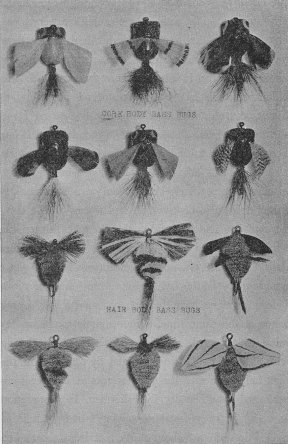
Although the object of this book is to teach the Angler how to tie his own flies a few words in regards to the writer's personal experiences in using these Bugs might not be amiss at this time. Floating Bugs are mostly tied on large size hooks and generally used for {51} bass. However, I have had a great deal of luck and many pleasant experiences with them tied as small as a #14 Model Perfect hook, and used with a 4x Leader. The small sizes will take many large trout, and are readily accepted by all pan fish. When fishing in still waiters with the Floating Bugs, whether it be for bass, pickerel, trout or pan fish I use a light leader, treated so that it will sink. I cast to a likely looking spot, beside an old stump along lily pads, or to an opening in the lily pads themselves. I let the Bug hit the water with quite a splash, as a living moth of the same size would, and there I let it lie, absolutely motionless, as though stunned by the blow. By all means do not be impatient, let the Bug lie perfectly still for two or three minutes, and then simply move the tip of your rod just enough to cause the Bug to quiver on the surface. Again let it lie perfectly still for a minute or two; usually about the second time the Bug is made to quiver you can expect a strike, and when a big bass comes after one of these Bugs, he comes full of action. When fishing fast water, I fish them exactly as I would a dry fly, upstream or up and across the current. My personal choice for color is the natural brownish grey body hair from either the deer, reindeer, or caribou. Wings, tail and body all the same natural color. I tie this pattern from size 2/0 Model perfect hook down to size 14, and us {52} the larger sizes for bass and pickerel, and the smaller sizes for trout and pan fish. I remember one very pleasant experience that happened in northern Maine three years ago. There is a small, deep, spring fed lake of about ten acres in area, completely surrounded by wilderness; this lake had been stocked with, Rainbow Trout and closed to all fishing for five years. I was fortunate in being there about two months after it had been opened to fishing and was invited to try my luck, after first being advised that although some very nice catches were regularly being taken on a Streamer Fly fished deep, also on live bait and worms with a spinner, no one had even been able to take fish on the surface. I arrived at this lake about one hour before dark, and it was one of those evenings when the water was actually boiling with rising trout. In fact never before or since have I seen so many fish breaking water at the same time. I immediately made up my mind to take fish on the surface. I began fishing with a small spider, and changed fly after fly for the next half hour with the same results as had been experienced by other dry fly fishermen. In desperation and with darkness fast approaching I tied on a size 4 Grey Bug and cast about thirty feet from shore. The Bug hit the water with quite a splash and didn't even as much as put down one fish, and several continued to {53} rise from within a few inches to a few feet from where the Bug landed. I waited a couple of minutes and gave the Bug a little twitch, nothing happened, again I twitched and again nothing happened. I began to believe I was stumped when again the Bug was moved ever so slightly for the fifth time, and remember this was at least seven minutes after it first hit the water. A fish struck. In a few minutes I landed a 2 1/4 pound Rainbow. Before darkness had brought the day to a close I had landed three more beautiful Rainbows averaging 2 pounds each. I had never since had the opportunity to fish in this beautiful little lake. Some day I hope to return, and again try, and I believe succeed in taking these beautiful Rainbow Trout on the conventional dry fly. However, this one little experience proved conclusively to me the absolute necessity of patience in fishing Floating Bugs.
FLOATING BUGS: THEIR CONSTRUCTION (SEE DIAGRAM 9)
First let us begin by making the most simple; that is, one that has the Body, Wings, and Tail, all of the same material and color. Follow the illustrations carefully and even your first attempt will be a masterpiece.
{54}
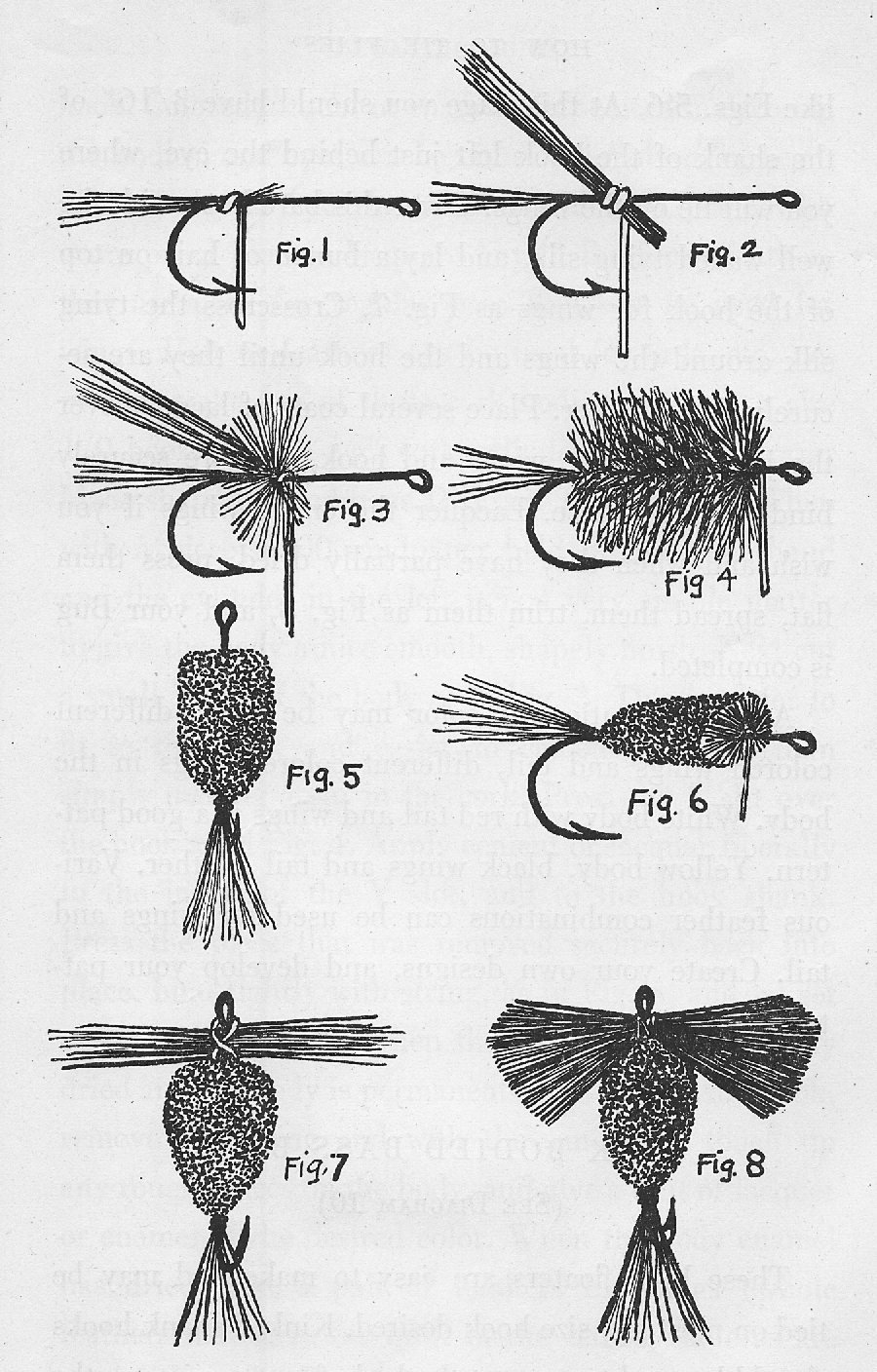
Although I use well waxed 00 tying silk, you will find that regular sewing silk size A will work best on your first attempt. First wax your thread thoroughly and take a few turns around the shank of the hook and tie in a small bunch of hairs for the tail, as in Diagram 9, Fig. 1, page (55). We will assume that we are using regular deer hair cut from the hide. Next clip a small bunch of hairs, about the size of a match, close to the hide. You will notice there is some fuzz mixed with the hair at the base close to the skin, pick out the fuzz and place the butts of the hairs under the hook as in Fig. 2, Take a couple of loose turns with the tying silk, hold the tips of the hair with the thumb and finger of the left hand, and pull the tying silk down tight. You will notice that the hairs spin around the hook and the butt ends will stand out pretty much at right angles to the hook, as in Fig. 3. Cut off the tip end of the hairs on the dotted line, press the hairs back tightly, apply a drop of water-proof lacquer to the base of the hairs and the hook, and repeat the same process of tying on a small bunch of hair, each time pressing it back tightly. Remember this is important, because the hair must be as close together as possible to make a firm, smooth, buoyant body.
{55}
Diagram 9
{56}
When you have built the body up until it looks something like Fig. 4, remove it from the vise and with a sharp pair of scissors trim and shape it until it looks like Figs. 5 and 6. At this stage you should have 3/16" of the shank of the hook left just behind the eye, where you will tie on the wings. Cover this bare hook with the well waxed tying silk, and lay a bunch of hair on top of the hook for wings as Fig. 7. Crisscross the tying silk around the wings and the hook until they are securely tied together. Place several coats of lacquer over he junction of the wings and hook, to more securely bind them in place. Lacquer the entire wings if you wish and when they have partially dried, press them flat, spread them, trim them as Fig. 8, and your Bug is completed.
Any combination of color may be used, different colored wings and tail, different colored rings in the body. White body with red tail and wings is a good pattern. Yellow body, black wings and tail another. Various feather combinations can be used for wings and tall. Create your own designs, and develop your patterns.
{57}
CORK BODIED BASS BUGS (SEE DIAGRAM 10)
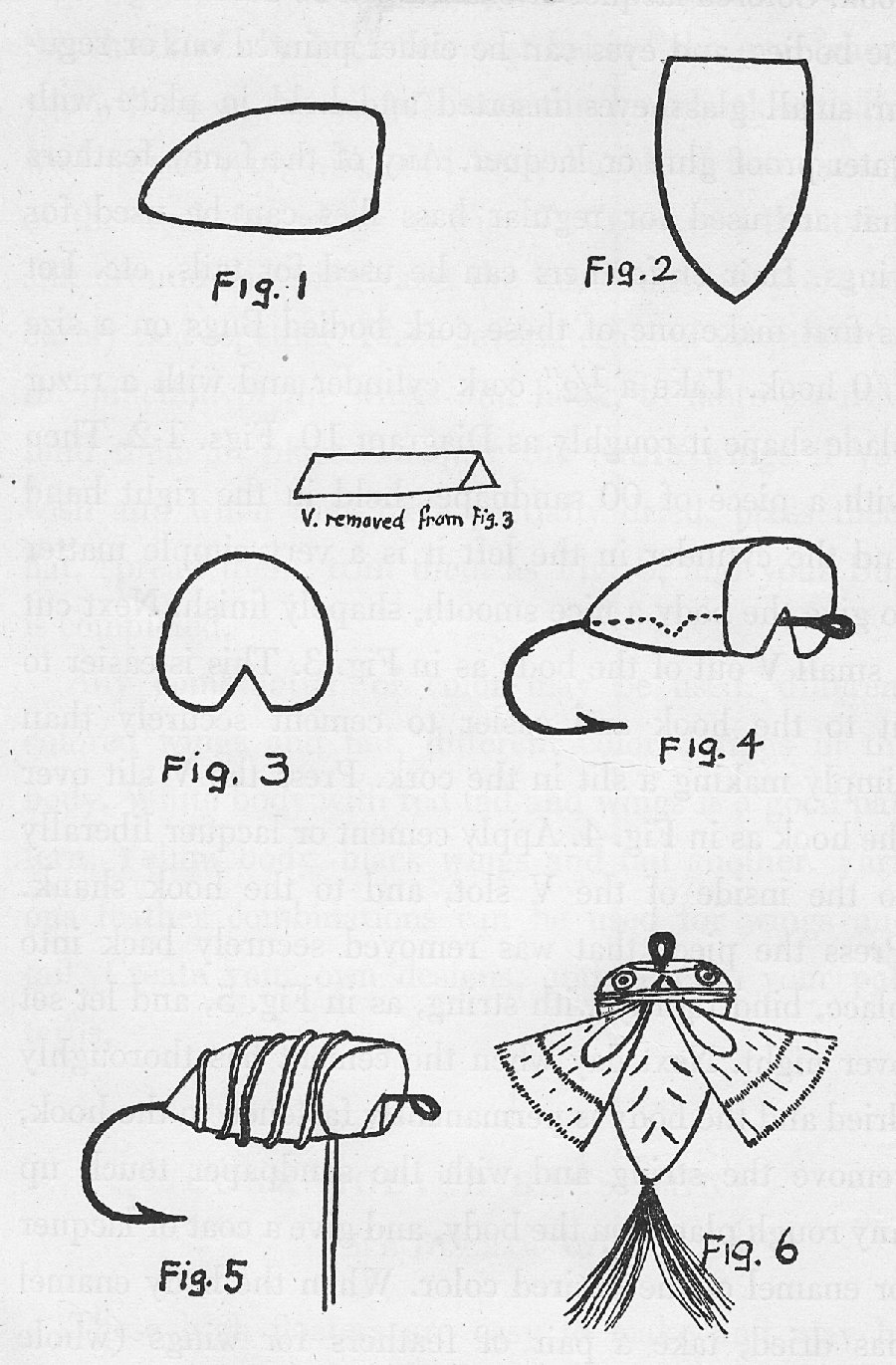
These high floaters are easy to make and may be tied on most any size hook desired. Kinked shank hooks should be used to prevent the body from turning on the hook. Colored lacquer or enamel can be used to decorate the bodies, and eyes can be either painted on, or regular small glass eyes inserted and held in place with water-proof glue or lacquer. Any of the fancy feathers that are used for regular bass flies can be used for wings. Hair or feathers can be used for tails, etc. Let us first make one of these cork bodied Bugs on a size 1/0 hook. Take a 1/2" cork cylinder and with a razor blade shape it roughly as Diagram 10, Figs. 1 and 2. Then with a piece of 00 sandpaper held in the right hand and the cylinder in the left it is a very simple matter to give the body a nice smooth, shapely finish. Next cut a small V out of the body as in Fig. 3. This is easier to fit to the hook and easier to cement securely than simply making a slit in the cork. Press the V slit over the hook as in Fig. 4. Apply cement or lacquer liberally to the inside of the V slot, and to the hook shank. Press the piece that was removed securely back into place, bind tightly with string, as in Fig. 5, and let set over night. Next day when the cement has thoroughly dried and the body is permanently fastened to the hook, remove the string and with the sandpaper touch up any rough places on the body, and give a coat of lacquer or enamel of the desired color.
{58}
Diagram 10
{59}
When the body enamel has dried, take a pair of feathers for wings (whole feathers that have the quill in the centre, same as are used for regular bass fly wings are best), and with the tying silk bind these fast to the top side of the shoulders as in Fig. 6. Tie on a tail close to the body, paint on the eyes, paint any other color or designs you wish on the body, and the Bug is completed.
{60}
Diagram 11
{61}
ANGLER'S KNOTS
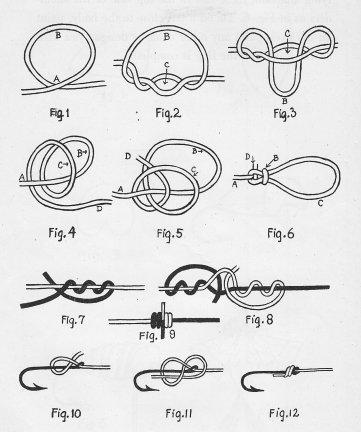
Figs. 1, 2 and 3 in Diagram 11, page (60) show a very convenient way to tie a dropper loop in the leader; roll the gut between thumb and finger at (A) Fig. 1, next invert loop (B) through (C) Figs. 2 and 3.
Figs. 4, 5, and 6 make the best knot for or a loop in the end of a leader, gut snells etc. Pull loop (C) through loop (B) Figs. 5 and 6.
Figs. 7, 8, and 9 are about the easiest and most secure knots for making leaders, the ends are in the centre of the finished knot and can be clipped close.
Figs. 10, 11, and 12, the figure eight knot, is the best for tying flies to the leader, it won't slip, and the pull is in line with the hook shank.
{62}
MY FAVORITE FLIES
Quite frequently I am asked which fly I like the best, or which particular patterns I would choose should I carry only a few flies with me on a trip. That is rather a difficult question to answer. The season, the type of fishing and location must be taken into consideration.
There must be some reason for so many hundreds of patterns. I hardly believe that any half dozen patterns can be used with constant success throughout the season, even in one particular locality. There are times, when fish are feeding, that they will take anything; again one may change fly after fly without success, when finally a fly will be tried that will take fish on every cast. Suppose that particular fly wasn't included in the chosen few, the answer is obvious.
However, I will endeavor to choose six patterns each of the various styles, and to give my reasons for their choice, but here I assure you there will always be many more patterns in my fly box for further trial, after I have exhausted my favorite six.
Beginning with dry flies, my first choice would be {63} a Quill Gordon, on a size 16 hook. This fly closely represents the numerous duns that are on or about the water, to some extent, during the entire season. I have little faith in color in the dry fly, except light or dark shades. I do believe that the size and shape have a great deal more to do with the success of a dry fly than color. I have proven to my own satisfaction that a Quill Gordon sparsely dressed as it should be, but tied with a black hackle and yellow mallard wings, is just as successful as the customary dressing.
My second choice would be the Red Ant. Although this fly belongs to the order Hymenoptera, it can be used when many of the Diptera order are on the water, such as Cowdung, Blue bottle, Bee, etc. This family all have flat wings and make an entirely different appearance than the aforementioned Quill Gordon. I tie the Red Ant on a size 14 hook. I build the body first of red silk floss, shape it like the body of an ant, give it a couple of coats of clear lacquer and let it dry hard and shiny. This body will reflect light, much as the natural insect. I then tie on two hackle tips for wings. Have them about as long as the hook, spread them so they are at about a 30 degree angle from the body and very flat. I then use a brown saddle hackle with fibers about 3/4" long for legs. I put on only two or three turns of the hackle, and then clip off all of the top and bottom hackles, leaving only about six fibers sticking {64} straight out on each side. This fly will float very close to the water, and because of its sparse dressing, slightly heavy body because of the lacquer, it is not a good floater. It also has the disadvantage of being hard to see. However, it is still my second choice, and properly dressed, and fished with a very fine leader, will take many nice fish.
My third choice is the Fan Wing Royal Coachman. This fly was never supposed to represent any particular family but I believe it is taken by fish for the Lepidoptera, large-winged moths and butterflies. It seems to be very successful when these are about in the evening.
My fourth choice is the Furnace Spider. This fly I tie on a size 16 short shank hook, by winding only about three turns of a furnace saddle hackle, with fibers about three fourths of an inch long. Tied in this manner, without any body or tail, the fly will alight on the water with the hook down, and looked at from beneath, against the light, only the little black spot will be noticeable. This I believe represents some of the order Coleoptera (beetles) and also the small black gnat (Empidae). I know if no other ways to tie the Black Gnat small enough to represent the natural insect, and even on the very smallest hook, the artificial is usually many times larger than the natural. The small black centre of the furnace saddle hackle tied in this manner seems to represent the size of the natural very {65} closely. This fly is a very good floater and an excellent fly when trout are feeding on those small insects.
My fifth choice is the Grannon. This fly is of the order of Trihoptera, and has different shaped wings than any of those previously mentioned, the wings being quite full and roof shaped. It is on the water a good part of the season, and can be used when other flies with this shape wing are about, such as the alder fly, cinnamon fly, etc.
My next and sixth choice of dry fly would be the Brown Palmer, made on a size 12 long shank hook with a full body of peacock herl, and palmer hackle, wound not too full. This I believe is taken by the trout for many of the caterpillars.
My personal choice of these six patterns should now appear quite obvious, should it be necessary for me to limit myself to such a small selection. I have selected one each of the six most prominent orders, and should any one of the hundreds of families of these orders be in prominence on the water, I would at least have the correct size or color.
My choice of the standard pattern wet flies, Feather Streamers, Bucktail Streamers, and nymphs would be a little more difficult. I am a firm believer that color plays a very important part in the dressing of wet flies, as well as size and style. I offer my personal choice of these styles because of the consistency with which they {66} have taken fish for me during many years of fishing all parts of the country.
I do not hesitate to say that I have taken more trout, of all kinds, on a brown hackle with peacock herl body, than any of the other common wet fly patterns. This is probably because I have used it more. I do believe that in the north, and especially for brook trout, a fly with a little red in it is more productive. Therefore, for northern fishing I would select Royal Coachman, Parmachene Belle, and Montreal. Other favorite flies that are good most anywhere in North America are Grizzly King, Queen O'Waters; Cahill, and Grey Hackle.
Feather Streamers and Hair Streamers are being more extensively used each year. Many authorities are of firm conviction that these flies unquestionably represent small minnows, upon which the fish are in the habit of feeding. This may be true, but I have seen many rubber, metal and composition minnows, that were exact replicas of the naturals, both as to color and size, and they would not take fish as would the Feather or Hair Streamers, fished in the same waters at the same time.
Most of my experience with Feather Streamers and also Hair Streamers has been for Landlocked Salmon and Rainbow Trout, in big waters. So I will list these according to the way they have produced for me. The {67} Black Ghost on a #4 long shank hook has been my most successful Feather Streamer. Probably because its white streamers are easily seen by the fish. It will most always raise fish, even if not the proper fly to make them strike. The Grey Ghost is another, and one of the most popular streamers in the North for Landlocked Salmon. This fly, as well as the Supervisor, Spencer Bay Special and numerous other flies of this style, were originally designed by their creators to represent the smelt, a favorite food of the salmon. These flies vary so in their color combinations that I wonder what the fish do take them for. However, I do know that a Grey Ghost will work when a Supervisor will not, and vice versa. One is grey and the other is blue. When fishing in lakes with a Feather Streamer for trout I have consistently had most luck with a creation of my own, Gregg's Demon. This fly was never tied to represent anything, but I have taken many nice fish on it, and have seen little fellows hardly as long as the fly itself chase it, and try their best to bite it in two. There is just something about it that has "fish appeal."
A Brown Bucktail with a silver body on a #6 3x long shank hook rates number one in Bucktail streamers. Another excellent fly that has been a favorite for years, is a Yellow and Red Bucktail, with a silver body, the red only a narrow streak through the centre. This fly has recently been named "Mickey Finn." A red and {68} white, with silver or gold body is a real good pattern where there are brook trout, and tied on a large hook is very good for bass.
I use one with all white bucktail and silver body, the same as I do a Black Ghost, for locating fish. I find they will most always show their presence, one way or another when a white fly is cast near them.
An all yellow with black streak in the centre same as the "Mickey Finn" is another very good combination. This is an excellent pickerel and bass fly. In fact, most any of these Feather Streamers and Bucktail Streamers tied on larger hooks, and used with or without a spinner, are excellent lures for both bass and pickerel.
Nymphs: I have explained elsewhere my liking these lures, and can say little more except that I always carry the following color combinations in various sizes. All tied according to styles illustrated in the diagrams. Cream Belly with Dark Back; Yellow Belly with Black Ribs and Dark Back; Green Belly with Dark Back; Grey Belly and Gold Ribs with Dark Back; Brown Belly and Gold Ribs with Black Back; Orange Belly and Black Ribs with Dark Back.
{69}
STANDARD DRESSINGS OF 334 FLIES
ALPHABETICALLY ARANGED
[Transcriber's Note: Some of the names are not in strict alphabetical order.]
NAME TAG TAIL RIBS BODY HACKLE WINGS
Abbey Orange&black Gold Red Floss Brown Grey Mottled (mallard)
Adams Gold Golden tippet Grey Wool Brown and grizzly Grey Mottled (mallard)
Alexandra Peacock herl Silver Black Peacock sward and jungle cock
Alder Peacock herl Black Dark speckled Turkey or Groused
Apple Green Brown Green Silk Brown Dark Grey
Ash Dun Grey Silver Grey Grey Lt. Starling
August Dun Redish Yellow Lt. Brown Floss Redish Brown Hen Pheasant
Autumn Dun Black Yellow Black Grey Teal Breast
Babcock Black and Yellow Gold Cardinal Red Black Black and Yellow
Barrington Grey Speckled Peacock Herl Brown Grey Speckled
Beauty Silver Black Badger Spotted Golden
Beaverkill Gold Grey Speckled White Floss Brown tied palmer Grey
Bee Gold Black&Yellow chenille Brown Brown
Belgrade Peacock herl Scarlet and white Yellow Claret tied palmer Red, white and jungle cock
Blue Rooster Tan mottled wood duck Condor Quill Blue Andalusian Tan mottled wood duck
Blue Bi-visible Blue floss Blue tied palmer
Black Bi-visible Black floss Black, tied palmer
Blue Winged Olive Brown Green Golden Brown Blue dun hackle tips
{70}
NAME TAG TAIL RIBS BODY HACKLE WINGS
Blue Professor Gold Scarlet Gold Blue floss Ginger Grey speckled
Black Nymph Brown mottled Black herl Partridge
Brown Nymph Brown mottled Brown herl Partridge
Br. Bi-Visible Silver or none Brown Brown
Brown Spider Brown Brown
Black Spider Black Black
Brown Dun Brown Brown Brown Starling
Black Midge Black Black
Black Prince Silver Scarlet Silver Black floss Black Black
Blue Dun Pale blue hackle Pale blue fur Pale blue dun Blue grey
Blue Bottle White silk Black or Gold Steel blue silk or dk. blue chenille
Black Gnat Gold Black Chenille Black Grey
Black Hackle Gold Black Chenille Black
Blue Upright Pale blue hackle Pale blue fur Pale blue dun Blue Grey
Brown Hackle Gold Golden tippet Peacock herl Brown
Brown Palmer Gold Golden tippet Peacock herl Brown tied palmer
Brown Hen Red Silk Peacock herl Brown Brown mottled
Blue Quill Blue dun hackle Quill Blue Dun Blue Grey
Black and Silver Golden tippet Silver Black Black
Black and Claret Golden tippet Silver Claret Wool Black Black
Black June Silver Peacock herl Black Dark Grey
Black Moose Green and Yellow Green Black tied palmer Guinea
Black Quill Black Quill Black Dark Grey
Black Ant Black chenille Black Silk Black Slate
{71}
NAME TAG TAIL RIBS BODY HACKLE WINGS
Blue and Black Golden tippet Black Black
Blue Jay Gold Scarlet Gold Red Red Blue Jay
Blue Quill Blue Dun Quill Blue Dun Grey
Bonnie View Gold Grey Gold Olive Brown Brown Grey
Boots Black Gold Speckled Gold Red Wool Black Black
Bandreth Gold Scarlet Gold Yellow Scarlet and yellow Grey speckled
Brown Adder Red Black&Br. mottled Brown silk Brown, tied palmer Black and brown mottled
Brown Sedge Gold Gold Brown Silk Brown Brown
Bustard and Black Silver Golden tippet Silver Black Wool Black
Bustard and Orange Gold Golden tippet Gold Orange Wool Orange
Butcher Scarlet Silver Black Blue black
Caddis Gold Grey Gold Brown Silk Brownish Red Grey
Cahill, Dark Gold Tan Mottled Grey Wool or Fur Brown Tan mottled wood duck
Cahill, Light Gold Tan Mottled Buff Wool Ginger Tan Mottled
Cahill Quill Tan Mottled Quill Grey Tan Mottled
Canada Gold Claret Gold Bright Red Brown Mottled Turkey
Carpenter Rusty red wool Red Hen Pheasant
Cardinal Gold Red Gold Red Wool Light red Red
Claret Gnat Claret Wool Claret Dark Grey
Cinnamon Golden tippet Gold Lemon&Black Wool Brown Cinnamon
Coachman Gold Golden tippet Peacock Herl Brown White
Coachman Leadwing Gold Golden tippet Peacock Herl Brown Dark Grey
Cock-y-bondhu Gold Gold Peacock Herl Furnace
Col. Fuller Black and yellow Yellow silk Scarlet Yellow Yellow and scarlet
{72}
NAME TAG TAIL RIBS BODY HACKLE WINGS
Cow Dung Dirty orange herl or yel. green wool Brown Grey
Critchley Fancey Gold Yellow Gold Yellow Yellow and grey Grizzly and scarlet
Cupsuptic Golden tippet Silver Red Silk Floss Brown Yellow
Dark Sedge Gold Wire Dk. Green Wool Blood Red
Dark Stone Yellow Silk Grey Wool Grey Dark Grey
Dr. Breck Grey Speckled Silver Scarlet White and Scarlet
Dorset Furnace Green Wool Furnace Teal
Downlooker Brown Floss Brown, tied palmer Brown and black mottled turkey
Deer Fly Black Bright Green White White
Dusty Miller Grey speckled Gold Wire Grey wool mohair Grey Dirty Grey Turkey
Dark Miller Br. Hackle Brown Silk Scarlet Yellow and black
Emerald Gold Gold Lt. Green t. Brown Brown Mottled
Evening Dun Lt. Blue Buff Wool Lt. Blue Starling
Epting Grey speckled Red, orange,&yel. chenille Black Grey Speckled
Female Beaverkill Yellow chenille Grey speckled Grey silk or wool Brown Dark Grey
Female Grannon Green Brown Floss Partridge Brown mottled partridge
Fem. March Br. Yellow Silk Dk. brown floss Brown mottled turkey or grouse
Ferguson Scarlet yel. and herl Mottled turkey tail, yellow and red
Fern Fly Orange Floss Lt. Red Dark Starling
Feted Green Green Green Green Green
{73}
NAME TAG TAIL RIBS BODY HACKLE WINGS
Fiery Brown gold Golden tippet Gold Redish brown mohair or wool R. I. Red Bronze
Flights Fancy Ginger Gold Pale Yel. Floss Ginger Lt. grey
Francis Fly Red Silk Peacock Herl Grizzly Dun
Furnace Dun Gold Furnace Br.&orange wool Furnace Dark Starling
Furnace Hackle Peacock Herl Furnace
Gen. Hooker Yellow Green Floss Brown Mottled grey and brown
Great Dun Brown hairs Gold Gold Brown Floss Brown Dark Grey
Grey Bi-Visible Silver or none Grizzly
Green Nymph Green Gold Green Wool Green
Grey Spider Grey Grizzly
Gld. Midge Gold Pale Green Dun
Great Dun Gold Brown Hairs Gold Brown Silk Brown Dark Grey
Ginger Palmer Silver Silver Yellow or ginger floss Ginger, tied palmer
Ginger Quill Ginger Quill Ginger Lt. Grey
Golden Dun Gold Grey Speckled Gold Gold or orange Red Lt. Grey
Golden Dun Midge Gold Grey Hairs Gold Pale Green Wool Light Grey Lt. Grey
Gold Spinner Gold Eyed Grey Speckled Gold Red Dark Grey
Gold Eyed Gauze Wing Blue Dun Pale yel. and green silk Blue Dun Blue dun hackle tips
Gold Monkey Yellow Silk Floss Grey Speckled Dark Grey
Gold Ribbed Hare's Ear Gold Dark Hairs Gold Rabbit's Fur Grey
{74}
NAME TAG TAIL RIBS BODY HACKLE WINGS
Gold Stork Grey speckled Gold Brown Grey speckled
Golden Eyed Gauze Wing Pale Grey Pale Grey Pale Green
Good Evening Gold Orange Gold Scarlet Brown Dark blue with white tip
Gordon Gold Brown speckled Gold Yellow Grey Brown speckled wood duck
Govenor Peacock Herl Brown Brown mottled turkey
Gov. Alford Scarlet Green Herl Brown Black and Brown
Grannon Brown fur or wool Brown or grizzly Dark Partridge
Gravelbed Dark Grey Black Woodcock
Grey Drake Grey Speckled Black White Floss Grey Grey speckled
Grey Hackle peacock Peacock Herl Grizzly
Grey Hackle Gold Golden tippet Red wool or silk Grizzly
Grey Hackle yellow Gold Golden tippet Yellow wool or silk Grizzly
Grey Marlow Gold Gold Red Wool Grey Grey
Grey Miller Grey Wool Grey Grey
Great Dun Brown and Grey Maroon Purple and Red Floss Grey or Black Grey or Black
Great Red spinner Black and white Gold Red Floss Brown Slate Grey
Grey Bodied Ashy Golden tippet Brown, black, or green herl or wool Grey
Green Drake Brown pheasant Brown Floss Raffia or lemon silk Partridge&ginger Yellowish Olive
Green Insect Green Herl Green
{75}
NAME TAG TAIL RIBS BODY HACKLE WINGS
Greenwell's Glory Yellow Gold Olive or Yellow Furnace Mottled woodcock
Grizzly King Gold Scarlet Gold Dark Green Grizzly Grey Speckled
Grouse&Black Gold Golden tippet Gold Black Fur Black Grouse
Grouse&Claret Gold Golden tippet Gold Claret mohair or wool Claret Grouse
Grouse&Green Gold Golden tippet Gold Green Wool Ginger Grouse
Grouse&Orange Gold Golden tippet Gold Orange Wool Orange Grouse
Grouse&Peacock Gold Golden tippet Gold Peacock Herl Dark Red Grouse
Grouse&Purple Gold Golden tippet Gold Purple Wool Purple Grouse
Grouse Spider Orange Floss Grouse Grouse
Half Stone Yellow Honey Dun Woodcock
Hazel-Fly Green Herl Furnace
Hemsworth Gold&herl Golden tippet
Hammond's Adopted Gold Gold Lt. Brown Ginger Mottled woodcock
Hare's Ear Yellow Silk Rabbit's fur Yel. or None Grey
Harlequin Orange and lt. blue wool Black Grey
Hawthorn Black hackle Black ostrich herl Black Lt. Grey
Hen. Guinea Gold Scarlet Gold Red wool Red Guinea Fowl
Henshall Peacock Herl Peacock Herl Lt. Grey Grey Speckled
Hod Gold Gold Pea-Green Dark Ginger Hen Pheasant
Hofland Fancy Brown Red (dark) Brown Brown and Yellow
Hoskins Golden tippet Lemon Blue Dun Woodcock
House Fly Dun Condor Quill Black Dark Starling
Howell Gold Scarlet Gold Peacock Herl Claret White tip turkey tail
Ibis and White Gold Red&White Gold Red floss Rd/&White Red and White
{76}
NAME TAG TAIL RIBS BODY HACKLE WINGS
Imbrie Gold Golden tippet Gold White Lt. Red Dark Starling
Indian Yellow Ginger Yellow Lt. Brown Ginger Goose
Iron Blue Dun Yellow Blue Dun Bluish Black
Iron Blue Quill Blue Dun Quill Blue Dun lt. Blue Dun Hkl. Tip
Iron Blue Nymph Honey Dun Honey Dun
July Dun Dun Yellow Dark Dun Starling
Joe Killer Barred woodduck Silver Short red bucktail Yel.&white peacock swd.&jungle cock
Jenni Lavender or blue Gold Yellow floss Scarlet Lavender or lt. blue
Jock Scott Black silk Yellow&Scarlet White floss Yellow floss Grouse&Guinea Yel.&grey speckled scarlet&jungle cock
Jennie Spinner Orange and brown Cream hackle White horse hair Silver Blue Silver blue hackle tips or none
Jungle Cock Scarlet Gold or white Blue grey fur Claret or blk. Dark brown and jungle cock
Katy-did Black Hairs Gold Wire Green floss Green Green
King O'Waters Gold Grey Speckled Gold Red floss Brown Grey Speckled
Kingdon Gold Green floss White floss Dark Woodcock
King Fisher Silver Lt. Blue Kingfisher
Kitson Gold Black Hairs Gold Yellow Claret Yellow with black cheeks
La Branche Gold Grey Gold Blue Grey Fur Blue Dun Grey
Lady Doctor Gold and red wool Two yellow hackle Yellow Wool Yel. tied palm. Polar bear and Black hair and jungle cock
Lady Beaverkill Yellow chenille Grey Speckled Grey (dark) Brown Dark Grey
{77}
NAME TAG TAIL RIBS BODY HACKLE WINGS
Lake Edward Golden Crest Gold Claret Wool Claret Pea Green
Lake George White and scarlet Gold Scarlet floss White White&Scarlet
Lake Green Green Silk Canary yellow Ginger Teal Breast
Laramie Scarlet Silver Scarlet floss Dark Blue Grey Mottled
Lt. Stone Grey Yellow Silk Grey Black and jungle
Little Marryat Brown Lt. grey or herl Brown Dark grey
Ld. Baltimore Black Silk Orange Silk Black Black and jungle
Lowery Peacock Herl Brown Lt. Brown
Lt. Montreal Gold Grey Mottled Gold Scarlet Claret Grey Speckled
Lt. March Br. Partridge hackle Olive&Br. fur Partridge Lt. mottled partridge
Magpie Black Hairs Black Black Black with whit tip
Mallard&Amber Gold Golden tippet Gold Amber floss Lt. Red Brown mallard breast
Mallard&Claret Gold Golden tippet Gold Claret wool Lt. Red Brown mallard breast
Mallard&Green Gold Golden tippet Gold Green Wool Lt. Red Brown mallard breast
Mallard&Red Gold Golden tippet Gold Red wool Lt. Red Brown mallard breast
March Brown Grouse Yellow Silk Br. or Grey fur Grouse Dark Brown mottled turkey or grouse
March Br. Ginger Ginger Brown fur Ginger Dark Brown mottled turkey or grouse
March Br. Nymph Partridge Gold Yellow wool Partridge
Markam Scarlet and white Yellow Scarlet Dark Brown with white tips
Marlow Buzz Gold Peacock Herl Furnace
Marston's Fancy Brown Fur Brown Dark Grey
Massasaga Gold Ibis Gold Green floss Canary Yellow Canary Yellow
Maxwell Blue Lt. Blue Silver Grey Lt. Blue
McGinty Grey speckled and scarlet Black and Yel. chenille Brown Brown with white tip
{78}
NAME TAG TAIL RIBS BODY HACKLE WINGS
Mealy Moth Silver Lt. Grey Wool White White
Mershon Silver Black Hairs Silver Black Black Dark blue with whit tip
Merson White Black Hairs White Black Dark blue
Mole Brown Hairs Gold Dk. brown floss Brown tied palmer Brown mottled mallard
Montreal Gold Scarlet Gold Claret floss Claret Brown mottled turkey tail or grouse
Montreal Claret Gold Claret Gold Claret floss Claret Brown mottled turkey tail or grouse
Montreal Silver Scarlet Silver Claret Brown mottled turkey tail or grouse
Montreal Yellow Gold Scarlet Gold Yellow floss Claret Brown mottled turkey tail or grouse
Morison Black Black Claret Black Black
Mowry Black Hairs Black Black Black with white tip
Needle Brown Orange Dark Brown
Neversink Black Pale buff wool Yellow Teal breast
New Page Gold Gold speckled Yellow floss Brown Mottled brown and red
Olive Dun Gold Olive Dun Gold or none Olive Wool Olive Dun Lt. blue grey or olive dun hackle tips
Olive Quill Olive Quill Olive Olive
Orange&Bk. Gold Golden tippet> Gold Orange Wool Black
Orange Dun Orange Wool Dk. Brown Lt. Brown
Olive Nymph Olive Mot. Br. wool Olive
Orange Miller Gold Orange floss White White
Orange Sedge Gold Orange floss Brown tied palmer Red, Brown
Oriole Yellow Gold Black floss Black Yellow
{79}
NAME TAG TAIL RIBS BODY HACKLE WINGS
Oak Black Orange floss Brown Dark grey and Lt. Brown mottled
Pale Blue Dun Pale Blue Pale Blue Fur Pale Blue Pale blue hackle tips or none
Pale Buff Pale Buff Pale Buff Wool Pale Buff Pale Buff
Pale Eve. Dun Br. silk or none Lemon floss Lt. blue grey or grizzly Lt. Blue Grey
Pale Sulphur Pale Yel. Hairs Pale Yellow Pale Yellow Pale Yellow
Orange Tag
Pale Watery Yellow Olive Wool Pale Yellow Grey
Pale Watery Quill Yellow Quill Pale Yellow Grey
Pale Yellow Yellow Yellow Pale Yellow
Parmachene Beau Peacock herl Scarlet and white Gold Yellow floss or mohair Scarlet and white Scarlet, White jungle cock
Parmachene Belle Peacock herl Scarlet and white Gold Yellow floss or mohair Scarlet and White Scarlet&white
Parson Golden tippet Silver wire Silver Black Bronze
Peter Ross Golden tippet Bright Yel. Ginger
Pheasant Gold Yellow floss Ginger Bronze
Pheasant, Gold Golden tippet Gold Wire Gold Pheasant Pheasant, Wing
Pheasant, Silver Golden tippet Silver Wire Silver Pheasant Pheasant, Wing
Pheasant&Yel. Golden tippet Gold Yellow floss Pheasant Pheasant, Wing
Pink Lady Gold Pheasant Gold Pink floss Brown Grey Speckled
Pink Wickhams Brown Pink floss Brown tied palmer Grey Speckled
Polka Gold Scarlet Gold Scarlet floss Scarlet Guinea
Poor Mans Fly Ginger Brown Wool Ginger Grey Speckled
{80}
NAME TAG TAIL RIBS BODY HACKLE WINGS
Portland Grey Speckled Gold Red floss Red Teal breast
Preston's Fancy Brown Hairs Gold Brown Grey with white spot
Priest Red Ibis Silver Silver Badger
Prime Gnat Brown> Brown Dark Grey
Professor Gold Scarlet Gold Yellow floss Brown Grey Speckled
Quaker Silver Grey Wool Grey Grey Speckled
Queen O'Waters Gold Orange floss Br. Palmer Grey Speckled
Quill Gordon Tan speckled Gold Wire or none Quill Blue Dun Tan speckled wood duck
Raven Golden tippet Black chenille Black Black Crow
Red Ant Herl Red floss Brown Dark Grey
Red Fox Speckled Teal Redish Brown or wool
Red Quill Dark Red Red Quill Dark Red Med. Starling
Red Ibis Scarlet Gold Scarlet floss Scarlet Scarlet
Red Spinner Gold Brown Hairs Gold Red Brown Dark Grey
Red Tag Red Silk Red Peacock Herl Brown
Rd. Body Ashy Red Wool Brown Palmer
Ross McKenney Gold Barred wood duck Gold Brown Wool White and red bucktail and jungle cock
Royal Coachman Gold Golden tippet Peacock herl with scarlet red band Hackle Brown White
Rube Wood Red Grey Speckled White Chenille Lt. Brown Grey Speckled
Ruben Wood Tan speckled White Chenille Lt. Brown Tan speckled
Saltoun Ginger Silver Black floss Black Lt. Starling
Sand-Fly Lt. Ginger Copper Brown Lt. Ginger Yellowish Brown
Sassy Cat Scarlet Peacock Herl Yellow Yellow, scarlet cheeks
{81}
NAME TAG TAIL RIBS BODY HACKLE WINGS
Seth Green Yellow Green floss Grey speckled
Seth Green Claret Yellow Green floss Claret Grey speckled
Turkey Yellow Green floss Brown Brown mottled
Shad Fly Green Peacock Herl Brown mottled
Shoemaker Tan speckled Pink&Grey Brown Mottled Woodcock
Silver Doctor Yel. blue green and red Silver Blue&Guinea Brown, red, blue, green and yellow
Silver Horns Copper floss Grouse
Silver Sedge Silver Brown Palmer Brown
Silver Stock Grey Speckled Silver Brown Teal breast
Soldier Palmer Gold Red Wool Brown Palmer
Spent Gnat Brown Peacock herl Wt. Floss or Quill Blue Hkl. tips
Sedge, light Pale Buff wool Ginger Hen pheasant
Sniper&Yel. Pale Yel. floss Snipe
Stebbins Grey Speckled Peacock Herl Grouse Dark Starling
Stone Grey Yellow Grey Wool Grey Grey
Sunset Green chenille Yellow chenille Yellow White
Swiftwater Grey Speckled Peacock herl Brown White
Teal&Black Golden tippet Black wool Black Teal breast
Teal&Orange Gold Golden tippet Gold Orange wool Olive Teal breast
Teal&Gold Golden tippet Gold Dk. Brown Teal breast
Teal&Red Gold Golden tippet Gold Red wool Olive Teal breast
Teal&Silver Golden tippet Silver Badger Teal breast
Teal&Yellow Silver Golden tippet Silver Yellow wool Ginger Teal breast
{82}
NAME TAG TAIL RIBS BODY HACKLE WINGS
Tippet&Black Silver Golden tippet Silver Black wool Black Golden tippet
Tippet&Red Silver Golden tippet Silver Red wool Dk. Brown Golden tippet
Tippet&Silver Silver Golden tippet Silver Silver Badger Golden tippet
Tootle Bug Blue Scarlet Orange&Yel. Br. palmer Brown Mottled
Tups Indispensable Honey Dun Yellow Honey Dun
Turkey Brown Red Brown Brown Brown
Turkey Professor Gold Red Yellow floss Brown Brown mottled
Van Patten Scarlet Gold White Brown Grey speckled
Varient, Gold Gold Blue Dun Starling
Water Cricket Black Orange Black
Watson's Fancy Gold Golden tippet Gold Red&Blk. wool Black Black hackle tips
Welshman's Button Peacock Herl Furnace Landrail
Western Bee Yellow&Black chenille Brown Dark Grey
Whirling Blue Dun Gold Ginger Blue Grey Fur Ginger Blue Grey
White Hackle Silver White floss White
White Miller Silver White floss White White
White Moth Silver White Chenille White White
Wickham's Fancy Brown hairs Gold Br. palmer Grey
Wickham Pink Red Red&Gold Lt. Reddish Landrail
Widow White Purple Floss Black Black
Willow Yellow Green Brown Dark Grey
Wilkson Orange Orange Teal breast
Witch Gold Gold Red Ibis Gold Grey Wool Badger
Whitechurch Dun Grey Speckled Yellow floss Ginger Lt. Grey
White Wickhams Brown Hairs White floss White, palmer Grey
{83}
NAME TAG TAIL RIBS BODY HACKLE WINGS
Woodcock&Gold Golden tippet Silver Gold Gingerr Mottled Woodcock
Woodcock&Grn. Golden tippet Silver Green wool Green Mottled Woodcock
woodcock&Red Golden tippet Silver Red wool Reddish brown Mottled Woodcock
Woodcock&Yellow Golden tippet Silver Yellow wool Woodcock Mottled Woodcock
Worm Fly Peacock Herl Ginger
Yel. Bi-visible Yellow wool Yel. and white palmer
Yel. Coachman Peacock Herl Brown Yellow
Yel. Dun Yel. wool Honey Dun Lt. Starling
Yel. Hackle Gold Yellow floss Yellow
Yel. Professor Gold Scarlet Gold Yellow floss Brown Yellow Speckled
Yel. May Yel. Speckled Gold or black Yellow floss Yellow Yellow Speckled
Yel. Miller Gold Yel.&Herl White White
Yel. Spider Yellow Yellow Yel. (long)
Yel. Sally Yellow Gold Yellow Yellow Yellow
Zulu Gold Red Peacock Herl Black
The Barnes Sports Library
This library of practical sports books covers fundamentals, techniques, coaching and playing hints and equipment for each sport. Leading coaches and players have been selected to write these books, so each volume is authoritative and based upon actual experience. Photographs or drawings, or both, illustrate techniques, equipment and play.
ARCHERY LACROSSE
by Reichart&Keasey by Tad Stanwick
BAIT CASTING LAWN GAMES
by Gilmer Robinson by John R. Tunis
BASEBALL PHYSICAL CONDITIONING
by Daniel E. Jessee by Stafford&Duncan
BASKETBALL RIDING
by Charles C. Murphy by J.J. Boniface
BASKETBALL FOR GIRLS RIFLE MARKSMANSHIP
by Meissner&Meyers by Lt. Wm. L. Stephens
BASKETBALL OFFICIATING ROPING
by Dave Tobey by Bernard S. Mason
BETTER BADMINTON SIX-MAN FOOTBALL
by Jackson&Swan by Ray O. Duncan
BICYCLING SKATING
by Ruth and Raymond Benedict by Putman&Parkinson
BOWLING FOR ALL SKIING
by Falcaro&Goodman Benedict by Walter Prager
BOXING SOCCER AND SPEEDBALL FOR GIRLS
by Edwin L. Haislet by Florence L. Hupprich
FENCING SOFTBALL
by Joseph Vince by Arthur T Noren
FIELD HOCKEY FOR GIRLS SOFTBALL FOR GIRLS
by Josephine T. Lees by Viola Mitchell
FLY CASTING SWIMMING
by Gilmer Robinson by R. J. H. Kiphuth
FOOTBALL TABLE TENNIS
by W. Glenn Killinger by Jay Purves
GOLF TENNIS
by Patty Berg by Helen Jacobs
HANDBALL TOUCH FOOTBALL
by Bernath E. Phillips by John V. Grombach
HOW TO TIE FLIES TRACK AND FIELD
by E. C. Gregg by Ray M. Conger
ICE HOCKEY VOLLEY BALL
by Edward Jeremiah by Robert Laveaga
Clair Bee's Basketball Library
THE SCIENCE OF COACHING MAN-TO-MAN DEFENSE AND ATTACK
ZONE DEFENSE AND ATTACK DRILLS AND FUNDAMENTALS