THE MANAGEMENT OF THE SKIS (continued 3)
Reading edition
This jump is made with the feet level, and the skis close together and parallel, in just the same way as a jump used for starting on the side of a hill or as a substitute for the kick-turn. Pay the same attention to the points of getting the weight well on the toes before making the spring, and of then crouching low and jumping with a free, swinging action, not a timid, jerky one, and be sure to press the knees together.
The skis should remain about parallel with the surface of the snow throughout the jump; if the jump is used for making an uphill turn, the points of the skis must be well lifted, if for a downhill one, their heels.
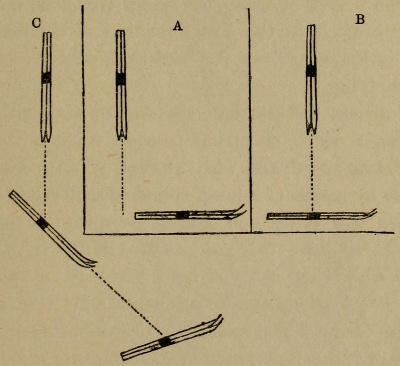
Fig. 42.
You will find it far easier to keep your balance on landing, if you remember not to jump to one side of your course (Fig. 42, a), but to come to the ground with your feet as nearly as possible on your original line of progress—though, of course, pointing across it, instead of along it, and, according to the speed at which you were running, more or less ahead of the place where you took off (Fig. 42, b).
The secret of using the jump round successfully lies, not in the actual making of the jump, but in knowing the safest and most effective way of applying it.
Suppose, for instance, you are running either across a slope or straight down it, at a very moderate speed, and wish to stop, you can easily do so by means of a jump round towards the hill, which will bring you almost or quite at right angles to your original course (Plates XLVII. and XLVIII.). As you land you will naturally have to lean inwards to compensate for the outward throw. The amount of inward lean necessary varies with the speed at which you are running before the jump. When the speed is at all high the inclination at which you would be safe from an outward fall is so great that on landing after the jump, if you were to make one, the skis would almost certainly skid, and you would fall inwards; while, if the skis did happen to hold, your legs would not have enough strength to withstand the shock, but would collapse under you.
When running at all fast, therefore, it is impossible to stop with one jump. You must first jump a little way round, so that you face less directly downhill, and check your pace; you can then jump again and stop yourself (Fig. 42, c).
In the same way, if you wish to jump round instead of making a downhill turn, you must either make your tacks at a gradient which will keep down your speed sufficiently to allow you to make the complete turn in one jump, or you must check your pace before making the downhill jump by turning slightly uphill with a preliminary jump. This is exactly equivalent to checking the pace by making a slight uphill swing before making a downhill one.
The higher the speed, the slighter the change of direction that one can safely make in one jump, and at a very high speed it would, for this reason, be impossible to stop even in two jumps. There is nothing to prevent a runner from stopping or making a downhill turn at the highest possible speed by means of a series of jumps, but a turn so made covers so much ground that it is practically useless. This does not much matter, however, for the kind of snow which makes jumping round necessary is not such as to tempt one to run very fast.
SKATING
It is possible on a gentle slope, if the snow is shallow, to use the skis like skates, striking out with each alternately.
This needs little explanation. You have merely, while running straight downhill, to lift one ski—say, the right—and put it down again pointing outwards from the other at a widish angle, their heels being close together.
The moment the right ski touches the snow, give a vigorous push backwards and to the left with the left ski, at the same time throwing the weight of the body well forwards and to the right over the right foot. While sliding on the right ski, bring the left forward and hold it close to the other, but clear of the snow. You are then ready to make a fresh stroke by putting down the left ski and pushing with the right.
A series of such movements leaves a track as in Fig. 43, a.
You will find it difficult at first to throw the weight sufficiently forward and outward at each stroke, especially if, instead of putting down the ski on which you are about to slide exactly level with the other, as you should do (Fig. 43, b), you put it farther forward (c). This difficulty will cause each stroke to become shorter and shorter until it is impossible to continue the movement.
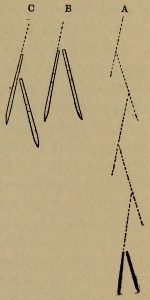
Fig. 43.
In practising, hold the ski which is off the snow parallel with and close to the other one until you are ready to make the next stroke, and slide on each foot at least far enough to make sure that your balance is perfectly steady on it.
It has already been explained how, by striking out to one side only, one can change one’s direction—for, of course, the action of stepping round is precisely the same as that of skating—and how one can in this way steer or stop oneself in breakable crust.
Skating, moreover, is one of the best possible exercises for the balance, for it teaches one to run steadily on one foot without the support of the other, and on this account alone you should by no means omit to learn it.
It is generally supposed that by skating down a gentle slope it is possible to increase the speed, but I think this is very doubtful.
A skating track is a zigzag one, and is therefore not such a short way over a given distance as a direct slide. Then, again, although each stroke tends to increase the speed, it must be remembered that the whole weight of the runner rests on one ski, causing it to sink deeper and travel slower, and also that the skis are travelling slightly across the slope instead of straight down it, which reduces the speed still more. Besides this, the stroke itself is not directly in the line of motion, since it is impossible to place one ski at right angles with the other one.
A better way of increasing the speed downhill is probably to lunge directly downhill with each foot alternately, keeping the skis close together—an exactly similar action to that of moving on level ground. Pushing with the sticks will, of course, make you go faster still.