PART V.
Reading edition
Take two small pieces of brass wire about an inch long, and turn up the ends of each into a hook. Now get a minute piece of ebonite of the same length, and, putting one hook on one side and one on the other, bind the whole together with silk. If you cannot get ebonite easily you can use a small piece of sealing-wax in the same way; by heating the wires you can sink them into the wax and so make a neater join. Now the wires must not touch each other anywhere, but must be completely separated by the ebonite or sealing-wax. The double wire from the battery and press is now fastened, one wire to the press hook on one side, and one wire to that on the other side of the sealing-wax or ebonite. Wind silk over the whole to cover the joins, and a neat double hook is the result. The picture (Fig. 6) gives the method of making the hook, and it also gives a great deal more, which I now proceed to explain.
Supposing we can rig up a small beam of wood from which to suspend the drum, we can make matters more mysterious still. Let the double wire, being hidden by some means or other all along its course, be conducted on to the end of the beam. It can then be trained along the top of it until it comes to the point from which the drum is to hang. Here there must be a hole drilled, large enough to admit the hook rather tightly. Pull the double wire through and fasten the two wires to the hooks as before described.
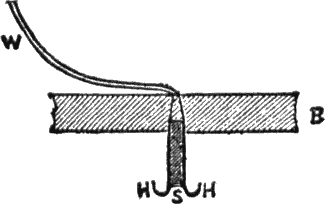
Fig. 6.—Hook From Which to Suspend the Magic Drum.
W, Double wire from battery and “press.” B, Beam of wood from which drum is suspended. H H, Brass hooks at side. S, Ebonite or sealing-wax between the hooks. The beam is, of course, shown in section.
Now you can pull back the wire and fix the hook firmly in the hole, hiding the double wire at the top of the beam (of course if it is high up no one will be able to see over the top of the beam, so you will be quite safe); the hook being thus fixed will not attract any one’s notice, and look quite unsuspicious. The chief glory of the double hook thus constructed is, of course, that you can remove the drum whenever you choose, for examination, and whenever you hang it up you have only to hitch one eye over one side of the hook and the other over the other side, and the drum will work. People who are not up in the matter cannot conceive how the electricity can get to the drum, when it is simply hung by an (apparently) ordinary cord and ordinary eyes to what looks like an ordinary hook attached to a beam in a plain and straightforward manner.
You are now possessed of an electric trumpet and an electric drum, which you can put one at one end of the room and the other at the other. By running double wires from battery and press to the trumpet, and another double wire from battery and press to the drum, you can arrange matters so that when you put one press down the trumpet works, and when the other press is put down the drum works. If you want to work both together you must either have a very powerful battery (say 6 or 7 cells, No. 2 Lechlanche) or two batteries, one for trumpet and one for drum. If you want to use one battery for both you can make either work (at different times) from the same battery and presses, wherever they may be, by having a two-way switch in a dark corner of the wire.
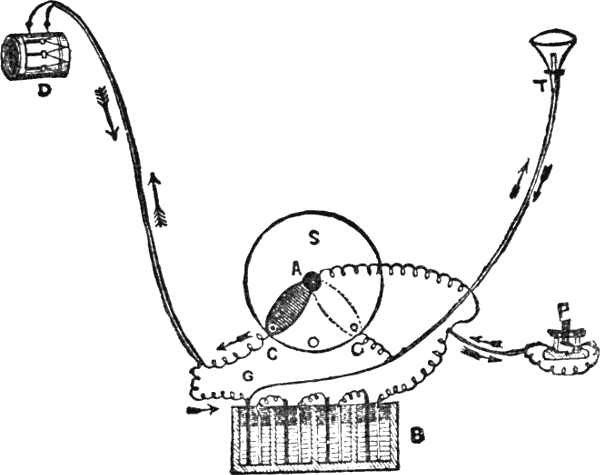
Fig. 7.—Method of Joining Switch Drum and Trumpet to Press and Battery.
S, Switch. B, Battery. P, Press. D, Drum. T, Trumpet. The arrows show the course of the current when the switch is at A C and A G respectively.
It is very confusing business setting up the wires so as to produce the right effect, which is to change the current from drum to trumpet and vice versa in a moment by merely altering the handle of the switch. Readers who are not accustomed to the work will find it most intricate, and as I have done it myself several times, they may as well have the benefit of my trouble. I therefore give an illustration of how to connect up the wires (Fig. 7), and hope it will make matters clear to them. An explanation of the picture is necessary.
Suppose first of all that the switch is at A C, then the current will travel from the right-hand end of the battery, B, up one wire of the double conductor to the press, P, as shown by the lower arrow, through the press and along the wire, as shown by the top arrow, to the middle of the switch, A, down the arm of the switch to C, up one wire of the double conductor to the drum, and down by the other wire to the other end of the battery.
Now let the handle of the switch be moved to the other terminal, as shown by the dotted lines. The current will now go from the right-hand end of the battery to press and center of switch as before, it then goes down the arm of the switch up to the trumpet by the wire on the left side, and down to the other end of the battery by the wire on the right side, as shown by the arrows. Therefore when the arm of the switch is at A C the press will work the drum; when it is at A G the press will work the trumpet.
Suppose we have no press, but instead of it we have only one wire going straight from the right-hand end of the battery to the middle of the switch. Now let two incandescent lamps be substituted for the trumpet and drum. When the arm of the switch is at A C the current goes straight up from the right-hand pole of the battery to the center of the switch, along the arm, up to the lamp on the left-hand side, and down to the other pole of the battery. Now, suppose the arm of the switch is moved to A G, the current will go up as before to the center of the switch, down by the arm, up the wire to the lamp on the right-hand side, and back to the battery by the other wire. In the first case, therefore, the lamp at D lights up, in the second case the lamp at T lights up. The wires from C to D and G to T may be as long as you please, you can therefore control the lamps when they are far apart or in different parts of the house. When the arm of the switch is central neither lamp lights up, or, if you are fitting up the trumpet and drum, the press will not work either when the switch is in this position. This is an advantage, as when people get too inquisitive you can turn off the current, and then whatever they do they will not make the trumpet or drum work till you turn it on again, which you can do when you want them to work for you!
The construction of the switch is so simple that it is hardly necessary to explain the method of joining the wires, but I may say that one is to be joined to the bottom of the brass pillar in the center which supports the brass arm. The others are joined to the right and left terminals, generally by brass screws under the base, but sometimes by screw terminals at the upper surface; this depends on the make of switch which is purchased.
Ingenious readers can easily make a switch for themselves; it only requires a brass arm attached at one end to a central figure, and long enough to touch two screws, or pieces of brass, fixed to the base on opposite sides of it, when turned in their direction. The end of the arm not supported by the brass pillar is provided with a small wooden handle to turn it by.
The switch should be arranged to occupy some dark corner in which you can turn on drum or trumpet to work from the “presses” at will without any one seeing you alter it.
I will only add one thing in conclusion, and that is, that you can have the double wire from the battery and center of switch to the press at the end as long as you like, and it can turn about behind furniture or under the carpet as much as you like, and it will still work instantly from the end press.
Now, by scraping the wire clean at any intermediate point, or as many points as you like, and arranging a simple spring contact fastened to the wires without breaking them so that they can be made to touch when required and spring apart directly the touch is removed (this is easily done with two springs consisting of two strips of sheet brass, one fastened to one wire and one to the other, separated by a piece of wood except at the end when pressed together), you can make the trumpet squeak or the drum roll at any part of the room you like. The springs can be hidden under the carpet so as to be absolutely undiscernible except to the initiated. The best places are under furniture with rather long legs; the foot of the operator can then be placed on the springs, and so make them meet and the trumpet or drum sound without the least chance of detection. The wires not being broken in fixing the springs as described, those springs which are closer to the battery, in no way interfere with those which are further off, as, when these are used, the current simply runs round those that intervene between them and the battery, without being in any way hindered in its course, and the press at the end of the double wire will, therefore, work just as if no intermediate springs existed.