HOW TO AMUSE.
Reading edition
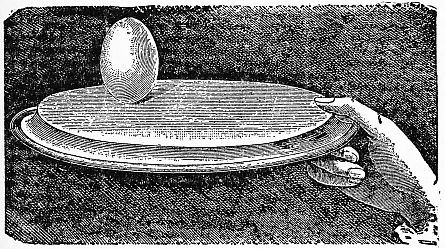
The Dancing Egg.
Place the egg (which should be hard-boiled, not raw) upon the under-side of a smooth tray, and move the tray round and round horizontally, gradually increasing in speed. The egg, resting in the middle of the tray, is carried round and round by the movement, and gradually begins to revolve on its own axis, faster and faster, till at last it is seen to rise on end, and spin away exactly as a top would do.
In all experiments involving egg-balancing, you will find it a material aid to success to keep the egg upright in the saucepan while it is being boiled. The air-chamber will, in such case, be kept central with the longer axis of the egg, which will in consequence be much more easily balanced.
To set the egg spinning as above described demands a considerable amount of practice, not to mention some strength, and, still more, address. For the benefit of those who may prefer to succeed at the first attempt, I will indicate a simpler plan of proceeding:—
Place the tray on the table, letting it project so far over the edge as to be readily and rapidly grasped by the hand. Place the egg in the middle, and with the thumb of the left and the first finger of the right hand placed at opposite ends, set it vigorously spinning. It will immediately rise on end, still spinning. Quickly seize the tray, and you will then have nothing to do but to keep the egg still rotating, which is a very easy matter. This is done by moving the tray in horizontal circles, but in the reverse direction to that in which the egg revolves.
The Old Family Coach.
Miss Annie and Clara and the Little Dog decided to take a ride in the Family Coach, so, whip in hand, the fat Coachman shut the Door, mounted the box, the Little Dog barked, when they entered the Family Coach, and almost fell among the Wheels. Miss Clara and Annie scolded the Coachman for being so careless in starting the Family Coach too soon, and putting the Little Dog in danger of falling among the Wheels. Finally the Coachman cracked his whip and the Family Coach started in good shape, the Little Dog barking furiously. Everything went well with the Family Coach for a few miles, till the Coachman spied a pretty girl on the road. He kept looking after her and did not see that he was putting the Family Coach and horses in danger, when crash! went the Family Coach. Miss Clara and Miss Annie screamed, the Little Dog barked; the Coachman shouted, the Wheels went in different directions, and the Axle, the Whiffle Tree and all the parts of the Family Coach were left in a heap in the road, in care of the Coachman, while Miss Clara, Miss Annie and the Little Dog went home on foot. Such were the adventures of the Family Coach.
Assemble the company, and give to each one of the names that are capitalized in the first paragraph, four being Wheels, two Axles, one the Whiffle Tree and one the Door, the names of the ladies to two, and select the tallest person in the room for the Little Dog. After all the names of all the parts are given, some one stands in the middle of the floor and reads the Adventures of the Family Coach.
Each time the Family Coach is mentioned every one in the room should rise, turn around three times, and sit down again. When the wheels are mentioned, four persons bearing the names of Wheels also rise, turn around three times, and sit down. The Little Dog barks, the Coachman shouts, the two ladies bow when their names (Miss Clara and Miss Annie), are called. There is great fun when the Little Dog is called on repeatedly to rise, turn, and sit down again. When the Horses are mentioned four persons also rise, turn around, etc., and so until disaster overtakes the Coach. This game causes much merriment, and general good feeling.
The Game of Quotations.
All the members of the company being seated, each is provided with pencil and paper. Some one gives a quotation, while the other players write the speaker’s name upon their papers, and opposite it the name of the author from whom they believe he has quoted. After each in turn has given a quotation, the papers are collected and re-distributed, care being taken that no one shall receive his own. Then each repeats the quotation originally given, this time adding the name of the author; the other players correcting meanwhile the papers held by them. The person who has given the largest number of authors correctly wins a prize. For example, the first player rises and says:
Colors seen by candle-light Do not look the same by day.
The next says:
Handsome is that handsome does.
And so on until all have given quotations. When the papers are exchanged, No. 1, again rising says:
Colors seen by candle-light Do not look the same by day. Mrs. Browning.
No. 2:
Handsome is that handsome does. Goldsmith.
And so on through the list. If any player has substituted some other name for Browning or Goldsmith, or has failed to write the name of any author, it must be marked as incorrect. One player then collects and compares all the papers and announces the winner of the contest.
Crambo.
Each member of the party is provided with paper and pencil, also with two small cards or slips of paper, upon one of which is to be written a question and on the other a single word. The questions and words are collected separately and re-distributed, whereupon each player must answer in rhyme the question he has drawn, introducing into the rhyme the word on the other card. The time is limited to five minutes, and when this has expired, each reads aloud the result of his labors, first giving the question and word received. To make the game more interesting it is sometimes required that the word received shall be made a rhyming word. Here is an example: A writes for his question “Where is the end of the rainbow?” and for his single word “goose.” In the allotted time he writes the following:
You ask where the end of the rainbow is found; Just answer yourself if you can, sir. For “anser” in Latin in English means “goose,” And I’m not such a goose as to answer.
Pictured Quotations.
At the top of a half sheet of paper (each player having one), a picture is rudely drawn illustrating some quotation. When all the drawings are finished each player passes his paper to his right-hand neighbor, who writes his interpretation of the picture at the bottom of the paper, turning the paper over to conceal the writing and passing it on to the next player. When each has written on all the papers and they have returned to their owners, they are unfolded and their contents read aloud, the correct quotation being given last. As an instance, A draws a casement window through which is seen a face gazing at a cluster of stars. The paper is passed to No. 1, and he writes as his interpretation:
In the prison cell I sit, thinking mother dear of you.
No. 2 writes:
Mabel, little Mabel, with her face against the pane.
None guess correctly, so A explains that it illustrates this couplet from Tennyson’s “Locksley Hall:”
Many a night from yonder ivied casement ere I went to rest, Have I looked on great Orion sloping slowly toward the West.
Cross Questions.
The company is divided into two equal parts, and blank cards and pencils are distributed. One side writes questions on any subject desired, while the other prepares in like manner a set of hap-hazard answers. The question cards are then collected and distributed to the players on the other side, while their answers are divided among the questioners. The leader holding a question then reads it aloud, the first player on the other side reading the answer he holds. Some of the answers are highly amusing.
The Game of Rhymes.
A variation of the former game. The game is begun by a young lady or gentleman speaking a single line, to which the next nearest on the left must respond with another line to rhyme with the first. The next player gives a new line, of the same length, and the fourth supplies a rhyme in turn, and so on. The game is provocative of any amount of fun and nonsense. A sample may be given.
1st Player.—I think I see a brindle cow.
2d Player.—It’s nothing but your dad’s bow wow.
3d Player.—He is chasing our black Tommy cat.
4th Player.—Poor puss had best get out of that, etc.
Any amount of nonsense may be indulged in a game of this sort, within proper limits. Clever players can easily give the game a most interesting turn and provoke rhymes that are original and witty. Thus, a subject once started, every phase of it may be touched upon before the round closes.
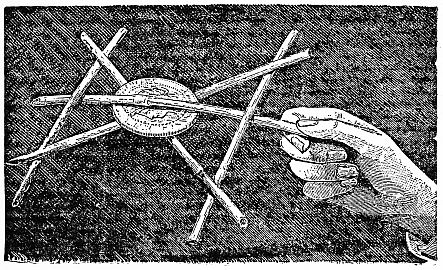
The Five-Straw Puzzle.
You are supplied with five straws of equal length (about three and a half inches), and you are required to lift all five, holding only the tip of one of them. A glance will show you the arrangement of the five little straws and the coin in their centre, which is, as will be seen, as simple as possible—when you know it. The use of the coin is an optional addition. It wedges all tight, and prevents the straws slipping when once put together; but it is by no means indispensable.
French Rhymes.
Each member of the company writes upon a slip of paper two words that rhyme. These are collected by one player and read aloud, and as they are read everybody writes them down upon new papers. Five or ten minutes being allowed, each player must write a poem introducing all the rhyming words in their original pairs. At the expiration of the given time the lines are read aloud. Suppose the words given are “man and than,” “drops and copse,” “went and intent,” etc., these are easily framed into something like this:
Once on a time a brooklet drops, With splash and dash, through a shady copse; One day there chanced to pass a man, Who, deeming water better than Cider, down by the brooklet went, To dip some up was his intent.
Of course the result is nonsense, but it is pleasant nonsense, and may be kept up indefinitely, to the entertainment of the participants.
Where’s Your Letter Going?
All being seated, two of the company are chosen, one for postmaster, the other for carrier. The Postmaster gives the name of some city to each person, writing the names down upon paper as they are given. The carrier, blindfolded, stands in the middle of the room and the postman calls: “I have a letter to go from Philadelphia to St. Louis.”
As the names are mentioned, the persons representing these cities change places, the carrier at the same time trying to catch one of them. If he succeeds, and can, while blindfolded, give the name of the captured player, the latter becomes carrier in turn. When the postman says: “I have letters to go all over the world,” everybody rises and changes places, and if in the confusion the carrier captures a seat, the player who remains standing becomes carrier in turn.
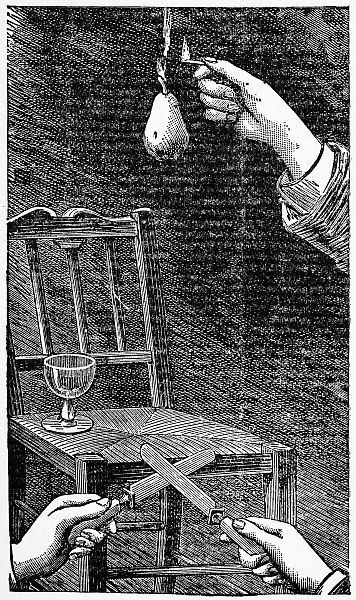
The Divided Pear.
Problem: To find the position in which a knife must be held that a pear, suspended high up near to the ceiling, shall, on the severing of the thread to which it is attached, so fall as to cut itself in half upon the blade. There is no necessity for line or plummet; we need only dip the suspended pear in a glass of water, which we forthwith remove. The water drips from it; we note the exact spot on floor or table where the drops fall, and make a private mark on such spot.
This is done privately beforehand, so that the company, on their arrival, find the pear suspended in readiness for the feat, and know nothing of the tell-tale “drop.”
At the proper moment you hold the knife, edge upward, immediately over the point which you have marked, while some one applies a lighted match to the thread. If you have duly followed our instructions, the pear, in falling, should cut itself in half upon the blade.
For the experiment as above described one knife only is used; but it may also be performed with two knives, as shown in our illustration.
The Game of Bouquet.
Each player composes in turn a bouquet of three different flowers, that he names aloud to the person conducting the play. The leader then writes the names of the flowers, and after them the names of three persons in the room. He then demands of the player who has composed the bouquet, what he intends doing with the flowers, and upon their proposed disposition being declared, the names of the three persons they represent are read aloud.
Example.
Leader.—“Miss A, choose three flowers.”
Miss A.—“A rose, an aster and a pansy.”
L.—“I have written them. Now what will you do with the rose?”
A.—“I will throw it out of the window.”
L.—“And the aster?”
A.—“I will put it in a vase.”
L.—“And the pansy?”
A.—“I will always keep it near me.”
L.—“Very well. You have thrown Mr. A out of the window, put Mr. B in a vase and expressed a desire to keep Mr. C always near you.”
The All-Around Story Game.
This is a very entertaining game and productive of general merriment, if conducted at all cleverly by the players. One person in the room begins to relate a story, and after telling enough to interest his hearers and arouse their curiosity, suddenly breaking off, throws a knotted handkerchief at some other member of the party, calling upon him to continue the narrative. This is kept up as long as possible, the more absurd and improbable the plot of the story the better. If any one fails to respond upon receiving the handkerchief, he or she must pay a forfeit.
Tongue-Twisters.
The amusing game of tongue-twisters is played thus: The leader gives out a sentence (one of the following), and each repeats it in turn, any player who gets tangled up in the pronunciation, having to pay forfeit.
A haddock! a haddock! a black-spotted haddock, a black spot on the black back of the black-spotted haddock.
She sells sea shells.
She stood at the door of Mr. Smith’s fish-sauce shop, welcoming him in.
The sea ceaseth and it sufficeth us.
Six thick thistle sticks.
The flesh of freshly fried flying fish.
A growing gleam glowing green.
I saw Esau kissing Kate, the fact is we all three saw; I saw Esau, he saw me, and she saw I saw Esau.
Swan swam over the sea; swim, swan, swim; swan swam back again; well swum, swan.
You snuff shop snuff, I snuff box snuff.
The bleak breeze blighted the bright broom blossoms.
High roller, low roller, rower.
Oliver Oglethorp ogled an owl and oyster. Did Oliver Oglethorp ogle an owl and oyster? If Oliver Oglethorp ogled an owl and oyster, where are the owl and oyster Oliver Oglethorp ogled?
Hobbs meets Snobbs and Nobbs; Hobbs bobs to Snobbs and Nobbs; Hobbs nobs with Snobbs and robs Nobbs’ fob. “That is,” says Nobbs, “the worse for Hobbs’ jobs,” and Snobbs sobs.
Susan shines shoes and socks; socks and shoes shine Susan. She ceaseth shining shoes and socks, for shoes and socks shock Susan.
Robert Rowley rolled a round roll round; a round roll Robert Rowley rolled round. Where rolled the round roll Robert Rowley rolled round?
Strict, strong Stephen Stringer snared slickly six sickly, silky snakes.
To Balance a Pencil on its Point.
Dig the blade of a half open penknife into a pencil, a little above the point, and to open or close the blade, little by little, till you find that the balance is obtained. The combination of pencil and penknife thus placing itself in equilibrio is an illustration of a familiar law of mechanics; the centre of gravity of the combination falls below the point of support (the finger, edge of the table, or the like), and thus stable equilibrium is obtained.
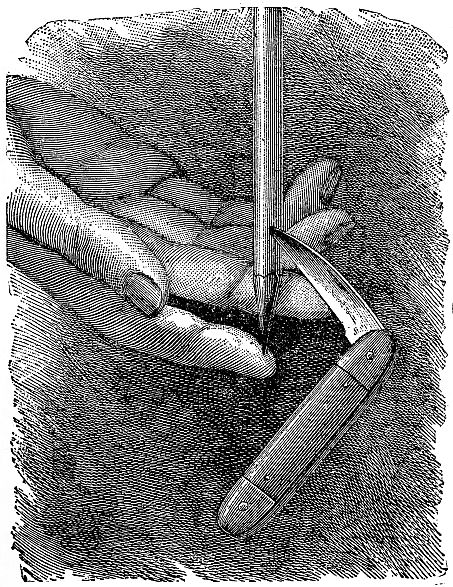
By varying the degree of opening of the penknife, you impart corresponding degrees of inclination to the pencil. When the centre of gravity of the two combined falls in the same line as the axis of the pencil, the latter will assume a perpendicular position.
My Grandfather’s Trunk.
A great game for young folks of a winter evening. The company being seated in a circle, somebody begins by saying, for instance:
No. 1. “I pack my grandfather’s trunk with a pair of spectacles.”
No. 2. “I pack my grandfather’s trunk with a pair of spectacles and a silk hat.”
No. 3. “I pack my grandfather’s trunk with a pair of spectacles, a silk hat and a dime novel.” And so on, each person repeating all the articles already mentioned, beside adding a new one.
If any one fails to repeat the list correctly, he drops out of the game, which is continued until the contents of the trunk are unanimously declared too numerous to remember.
How, When and Where.
One member of the company leaving the room, a word admitting of more than one interpretation is chosen by the others. On his return, he asks each in succession, “How do you like it?” The player questioned being required to give an appropriate answer. He then inquires in similar manner, “When do you like it?” and if the answer to that question still give him no clue, proceeds to ask, “Where do you like it?”
When he at last discovers the word, the person whose answer has furnished him with the most information, must in turn leave the room and become the questioner.
We will suppose the word chosen to be “rain,” which can also be taken as “reign” or “rein.”
The question “How do you like it?” receives the answers “tight,” “heavy,” “short,” “warm,” etc.
The question “When do you like it?” “In summer,” “When I am driving,” “In the nineteenth century,” etc.
“Where do you like it?” “In England,” “On a horse,” “In the sky,” etc.
“I Love My Love.”
A pretty game and a prime favorite with country lads and lasses. The leader commences by saying, “I love my love with an ‘A’ because she is Angelic, because her name is Araminta and because she lives in Atlanta. I will give her an Amethyst, feed her upon Almonds and make her a bouquet of Anemones.” The next player, taking the letter “B,” loves his love in the same set of phrases, only because she is Bewitching, her name is Belinda, etc. The next takes “C,” and so on through the alphabet, omitting the letter X.
Any one failing to supply the required words promptly gives a forfeit.
To Drive a Needle Through a Cent.
To drive a needle through a cent, particularly if the needle be a fine one, seems at first sight an impossibility. It is, however, a very easy matter, if you set about it in the right way. Thrust the needle through a cork, allowing the point to project slightly, and then, with a pair of cutting-pliers, nip off all that remains exposed at the opposite end. Place cork and cent as shown in our illustration, or simply let the coin rest on a piece of soft wood, and hammer away vigorously on the top of the cork.
The needle, being steel, is harder than the bronze of the coin, and the cork preventing it from bending to either side, it may be driven through the cent, or any other coin of like substance, with perfect ease.
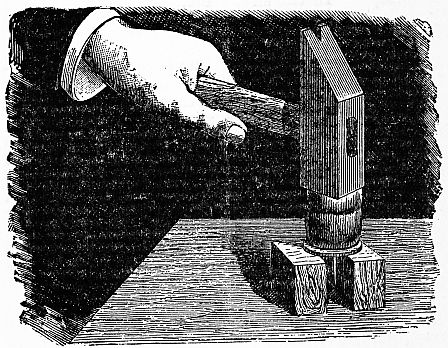
The cork should be kept in position with the left hand, while receiving the blows of the hammer.
Proverbs.
This game requires the players to be alert and on the watch for the words that give the clue to the solution. One player (A) having gone from the room, a proverb is selected by the others, of which each person takes a separate word, in order. The absent player then being recalled, proceeds to question the others singly, each introducing in his answer the word of the proverb he has previously received. Suppose the proverb selected to be “Nothing venture nothing have,” the game would proceed thus:
A. “Is the proverb a long one?”
1st Player. “Nothing should be too long for you to guess.”
A. “Have you ever played this game before?”
2d P. “Really I cannot venture to say.”
A. “Are you fond of parlor games?”
3d P. “Nothing pleases me more.”
A. “Are you enjoying yourself this evening?”
4th P. “I have enjoyed myself thus far.”
If A has not by this time guessed the proverb, he continues his questions until enlightened, when the player whose answer has given him the most information goes from the room.
Rather a noisy way of playing the same game is to have all the players at a given signal shout their words in unison, leaving the listener to distinguish in the uproar some word that shall give him a clue to the proverb. The shouting is repeated as often as desired until he is successful.
In either modification of the game the player whose answer or word leads the questioner to discovery becomes the one to go from the room.
Tossing The Rings.
Fasten securely a stick two feet long and an inch or more in diameter to the centre of a block of wood or piece of board, so that the block forms a substantial base for the stick, which should be slightly tapered at its upper end. Make out of wire six hoops or rings, three of them nine inches in diameter, two of them seven inches, and one five inches. They should be heavy enough to toss easily, perhaps half an inch in thickness. Wind these with cloth torn into strips, fastening the ends with needle and thread. Use three colors of the cloth, the rings of each size being the same color. Red, white and blue make a pretty combination, using red for the largest size, white for the next, and blue for the one small one. Now set the standard at some distance from the players, and the game begins. One player takes all the rings and tosses them one at a time over the upright stick. For each of the large rings which he succeeds in getting upon the standard, he counts ten; for each of the next size, fifteen; and for the smallest one, twenty-five. Any number agreed upon may be called a game, and the player first obtaining that number of counts wins. After one player has thrown all the rings, another player takes them, tossing them in the same way. Any number of players may take part in the game. When once around, the first one tosses again, and so on until the game is out. For small children, five or six feet is far enough to toss the rings, but larger ones may increase the distance.
Magic Figures.
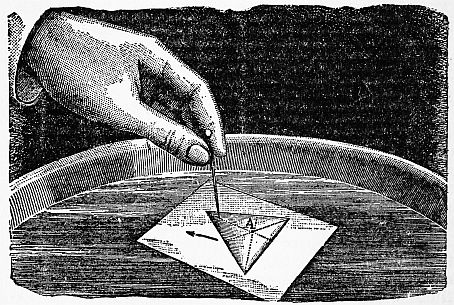
Upon a little square of ordinary writing-paper, sketch some geometrical figure—square, rectangle, triangle, polygon, etc.—using for that purpose a pencil whose tip has been moistened with water. Float the paper, with the design upward, on the water in a basin, and fill up with water the figure you have traced. With a little care you may do this without difficulty, for the lines of moisture which form the outlines of your figure (a triangle, we will suppose) will prevent the liquid overpassing the limits thereby defined. The water thus enclosed will rise in a little heap. Now take a pin, and placing the point at any spot you please within the triangle, in such manner that the point dips into the water but does not touch the paper itself, you will see the paper begin to move horizontally in a straight line until the geometric centre of the triangle places itself exactly under the point of the pin. You can readily determine beforehand this central point, which we will call A, and holding the pin as shown in the engraving, you will find that the paper travels in the direction shown by the arrow, till A comes just under the point of the pin, when it will stop of its own accord. Repeat the experiment with a square or a rectangle, and you will find that the spot which is beneath the pin-point, when the paper comes to a standstill, is precisely the point of intersection of the two diagonals.
The Force of the Breath.
When you blow into a paper bag in order to swell it out, afterward bursting it with a blow to produce the familiar “bang,” have you ever stopped to ask yourself what was the precise force of your breath? You know that such force can be measured by the instrument known as the spirometer, which you occasionally see at a railway station or a country fair. But a simple paper bag may be made to answer the purpose of the spirometer, as I propose to explain.
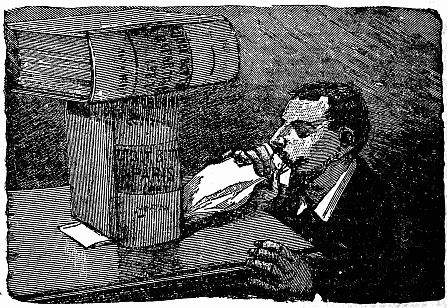
The bag must be rather long and narrow, airtight, and of thin, tough paper. A bullock’s bladder will answer the purpose still better. A tube should be inserted in the neck, through which to blow. Lay it flat, near the edge of a table, with the mouth turned toward yourself; place various weights upon it, increasing by degrees, and you will be surprised at the weight that your breath will thus lift. To upset a couple of big dictionaries, placed one upon the other, will be mere child’s play, as you will find on putting the matter to the test.
Hunt the Ring.
All the players stand in a circle holding a long cord, which forms an endless band upon which a ring has been slipped before it was joined at the ends. This ring is passed rapidly from one player to another—always on the cord and concealed by the hand—while somebody in the centre endeavors to seize the hands of the person who holds it, who when actually caught takes his place within the circle.
If the circle is very large two rings may be slipped upon the cord, and two players placed in the centre together.
A small key may be used instead of a ring, while still another variation is to have the concealed object a small whistle with a ring attached. When this is adopted an amusing phase of the game is to secretly attach a string to the whistle and fasten this to the back of the player in the centre by means of a bent pin at the other end of the string. Then while feigning to pass the whistle from hand to hand, it is occasionally seized and blown upon by some one in the ring, toward whom the victim is at that moment turning his back, causing that individual to be greatly puzzled.
Shadow Buff.
A sheet being stretched across one end of the room, one of the players is seated upon a low stool facing it and with his eyes fixed upon it. The only light in the room must be a lamp placed upon a table in the centre of the room. Between this lamp and the person on the stool, the players pass in succession, their shadows being thrown upon the sheet in strong relief. The victim of the moment endeavors to identify the other players by their respective shadows, and if he succeeds the detected party must take his place.
It is allowable to make detection as difficult as possible by means of any available disguise that does not conceal the whole person, any grimacing, contortion of form, etc.
Magic Music.
A beautiful game, which amuses even the mere spectator as much as it does the actual players. One of the company sits at the piano while another leaves the room. The rest of the party then hide some article previously agreed upon and recall the absent player. At his entrance the pianist begins playing some lively air very softly; keeping up a sort of musical commentary upon his search, playing louder as he approaches the goal, and softer when he wanders away from it. In this way he is guided to at last discover the object of his search.
Going to Jerusalem.
This is another piano game, but does not require so much skill as the former. One person goes to the piano, while the others arrange in a line as many chairs, less one, as there are players; the chairs alternately facing opposite directions. Then as the pianist begins to play, the others commence marching around the line of chairs, keeping time to the music. When this suddenly ceases, everybody tries to sit down, but as there is one less chair than players, somebody is left standing and must remain out of the game. Then another chair is removed and the march continued, until the chairs decrease to one and the players to two.
Whoever of these succeeds in seating himself as the music stops, has won the game.
Bean-Bags.
A game of skill, the equivalent of parlor quoits. It is played with bean-bags and a board three feet long and two feet wide, elevated at one end by another board to an angle of thirty degrees, and having some six inches from the top an opening about five inches square. Station this board at one end of a long room and divide the company equally. Eight bean-bags are all that are required.
The leader of one side begins. Standing at a suitable distance from the board, he endeavors to throw the bags, one at a time, through the square opening. Every bag that reaches the goal counts ten, every one that lodges upon the board five, and every one that falls to the ground outside of the board a loss of ten.
Suppose A to have put two bags through the opening (twenty), and two upon the board (ten),—that is a gain of thirty—but the other four bags falling to the ground makes a loss of forty, so his real score is a loss of ten.
B puts four through the opening (forty), three upon the board (fifteen), and one upon the ground (ten), which gives him a gain of forty-five.
The sides play alternately, and after three rounds for each, the scores, which have been carefully kept by one member of the party, are balanced, and the side having the greatest gain declared winners.
A prize may be given for the highest individual score.
Throwing the Handkerchief.
A very old and still quite popular game. The company being seated around the room in a circle, some one stationed in the centre throws an unfolded handkerchief to one of the seated players. Whoever receives it must instantly throw it to some one else, and so on, while the person in the centre endeavors to catch the handkerchief in its passage from one player to another. If he catches it, as it touches somebody, that person must take his place in the centre. If it is caught in the air the player whose hands it last left enters the circle.
The handkerchief must not be knotted or twisted, but thrown loosely.
Blind-Man’s Buff.
A player is led blindfolded into the middle of the room, taken by the shoulders, and turned around three times, after which he must catch somebody to replace him. As he is being turned, the others say:
“How many horses have you in your father’s stable?”
“Three; black, white and gray.”
“Turn about, and turn about, and catch whom you may.”
This game belongs to many countries, and is known by many different names. It is “Blind Cow” in Germany; “Blind Goat” in Sweden; “Blind Mouse” in South Germany and Servia; “Blind Hen” in Spain; “Blind Fly,” or “Blind Cat,” in Italy. To the English name, “Blind-man’s Buff,” correspond the Polish “Blind Old Man,” and the Norwegian “Blind Thief.”
A familiar variation makes this a ring-game. The blindfolded person stands in the centre, with a staff, while the ring circles about him. When he strikes the floor three times, the ring must pause. The person in whose direction he points must grasp the staff, and utter some sound, disguising the voice as much as possible. The first must then guess the name from the sound. This form of the game is called “Peg in the Ring.”
A Queer Candlestick.
Take a short piece of candle, and into its lower end thrust, by way of ballast, a nail. You should choose a nail of such a size that the candle-end shall be all but immersed, the water just rising to its upper edge, though not so high as to overflow the top and wet the wick. Now, light the candle, and you may safely make a wager that, in spite of the apparently unfavorable circumstances in which it is placed, it will burn completely to the end.
This may, at first sight, appear a rash assertion, but after a little reflection, you will see how the arrangement works. The candle, of course, grows shorter as it burns, and it seems therefore as if the water must overflow the top and reach the wick; but on the other hand, it grows proportionately lighter, and therefore rides higher in the water.
Further, the external surface of the candle, kept cool by the surrounding liquid, melts much more slowly than it would in the open air, so that the flame hollows out for itself a sort of little well, as represented in the right-hand corner of our illustration.
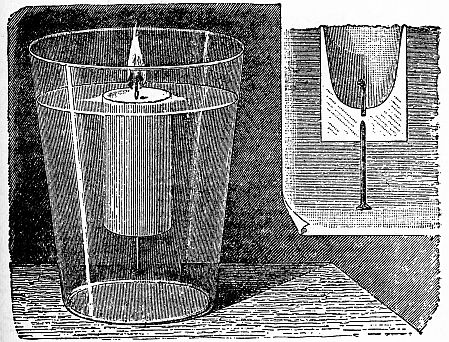
This hollowing process further lightens the candle, and the wick will, as you have stated, burn to the very end.
To Weigh a Letter with a Broomstick.
For the purpose of weighing light objects as, for instance, a letter, a very delicate balance is required; and as such we recommend to our readers our new broomstick letter-weighing machine. Cut off the end of an ordinary broom-handle, to a length of about ten inches, and plunge it into a tall glass jar full of water—first, however, weighting it at bottom in such manner that about seven inches of its length shall be under water. Attach to the upper end, by means of a tack, an ordinary visiting card. This will form the tray or scale of the apparatus—and behold your weighing-machine, complete. All that remains to be done is to graduate it. Place on the scale a one-ounce weight, note how far the stick sinks, and mark thereon, with a very black pencil, the point where it meets the surface of the water.
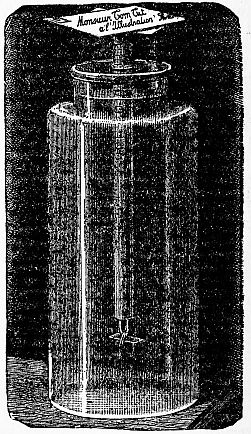
The apparatus being so far graduated, take off the weight, and lay on the card, in its stead, the letter you desire to weigh. If the pencil mark remains above the surface of the water, your letter weighs less than an ounce, and two cents will pay the postage; if, on the contrary, the mark sinks below the surface, your letter is over-weight, and you must pay accordingly.
The Tailless Donkey.
An amusing game at which any size of party may play and enjoy it for hours. Cut a large figure of a donkey, minus a tail, from dark paper or cloth, and pin it upon a sheet stretched tightly across a door-way. Each player is given a piece of paper, which would fit the donkey for a tail, if applied. On each tail is written the name of the person holding it. When all is ready, the players are blindfolded in turn—placed facing the donkey a few steps back in the room—then turned around rapidly two or three times and told to advance with the tail held at arm’s length, and with a pin previously inserted in the end, attach it to the figure of the donkey wherever they first touch it. When the whole curtain is adorned with tails—(not to mention all the furniture, family portraits, etc., in the vicinity)—and there are no more to pin on, the person who has succeeded in fastening the appendage the nearest to its natural dwelling place, receives a prize, and the player who has given the most eccentric position to the tail entrusted to his care, receives the “booby” prize, generally some gift of a nature to cause a good-humored laugh.
Boston.
This is a variation of “Blind Man’s Buff,” which is described elsewhere. Seat the company round the room and give each a number. Blindfold one person and station him in the centre of the room, twirling him around several times so that he may successfully “lose his bearings.” He must then call any two numbers included in the number of players, and the two people representing them must at once rise and change places, while the “blind man” endeavors to seize one of them. If he succeeds in doing this he must, while still blindfolded, identify the captive, who then in turn enters the circle.
More than two numbers may be called at once, and when the “blind man” calls out “Boston!” and everybody changes places, he may, by slipping into a vacant seat during the confusion, find a substitute in the person left standing when all the chairs are occupied.
What is Your Age?
It is always a delicate thing to inquire a lady’s age, but the question in this game will offend nobody. There must be at least two people in the secret, and one of them leaves the room. Somebody in the company tells his age to the others, and the absent player is recalled. Everybody is at liberty to question him, but he only pays attention to the one player he knows holds the secret of the game, and from the first letters of the words introducing the remarks of this person he takes his cue—the first ten letters of the alphabet standing for the ten figures, 1, 2, 3, 4, 5, 6, 7, 8, 9, 0.
A goes from the room and B asks for somebody’s age. C volunteers, “I am twenty-five.” A being then recalled, there is a universal demand from the company for the required age, and a great deal of doubt expressed as to his ability to guess it. During the general confusion, B hastily says: “Be sure before you speak,” and then again: “Enough thinking. Tell us now.” Whereupon, A, guided by the first letter, “b,” of the first remark, and the “e” of the second, which he knows represents the digits “two” and “five” respectively, quickly says “twenty-five.”
What, Sir? Me, Sir?
One player says to another:
“Mr. Brown, I saw you on Broadway.”
Whereupon Mr. Brown says:
“What, sir? Me, sir?”
The other replies:
“Yes, sir; you, sir.”
“Oh! no, sir, not I, sir.”
“Who then, sir?”
“Mr. Smith, sir.”
Mr. Smith immediately replies:
“What, sir? Me, sir?”
And so on till each is mentioned in turn. Those who miss must pay a forfeit. At the end of the game all the forfeits are redeemed.
Horse.
The players are seated around the room. One person pretends to whisper to each of the others in turn the name of a different animal. After naming them all, he must call out the name of some one animal, and the person having that name must run out at the door. Having given the whole company the name of horse, he calls horse whereupon they all make a simultaneous rush for the door. A narrow door should be chosen, if possible.
Rooster.
This is a short game, reaching a quick conclusion and exciting a hearty laugh. Tell everybody in the room that you will give to each in a whisper, the name of some animal, whose peculiar cry they are to imitate in concert at a given signal. To all but one person the simple charge to “keep perfectly silent” is given. Upon that one is bestowed the name of “Rooster.” Then saying, “All be ready when I say three!” Count “one, two, three,” when a lusty crow from the victim of the joke, and a laugh from the others, tell him that the general amusement has been at his expense.
Consequences.
The players are each provided with a slip of paper and a pencil. Each must write the name of some gentleman (who is known to the party), turn down the end of the paper on which the name is written, and pass the paper to the next neighbor. All must then write the name of some lady (also known), then change the papers again and write “where they met,” “what he said,” “what she said,” “what the world said,” and “the consequences,” always passing the papers on. When all are written, each player must then read his paper.
Mr. Jones..........
And Miss Smith.....
Met on a roof........
He said, “I trust you are not afraid.”
She said, “Not while you are here.”
World said, “It’s a match.”
Consequences, “He sailed for Africa next morning,” etc.
Mesmerizing.
This may be made very amusing, although no actual mesmerism is attempted. A member of the party announces that he has been declared to possess a vast amount of mesmeric power; not enough to gain absolute control over a person, but sufficient to at least prevent him from rising from a chair alone. His challenge being accepted by some one, he seats his victim in a low chair and himself in a higher one close at hand. Then, solemnly demanding a complete relaxation of will power and a sober countenance on the part of the subject, he begins making passes with his hands, stroking the forehead of the person beside him, and otherwise imitating a genuine mesmerist. After a short time he quietly says:
“Now see if you can get up alone!”
Of course, the subject rises to his feet at once, but so does the mesmerist, thus proving to the former that having risen simultaneously with himself, he has surely failed to rise alone.
Guessing Eyes and Noses.
A sheet is fastened up between two doors. Holes are cut in it, and some of the party go behind the sheet and stand with their eyes at the holes, while the others must guess to whom the eyes belong. Failing to guess correctly they must give a forfeit.
Beast, Bird or Fish.
The players sit round in a circle, and one player, who is “it,” points to some one, and says either “beast,” “bird,” or “fish.” He then counts ten as quickly as possible. The person pointed to must name some “beast,” “bird,” or “fish” (whichever he was asked) before ten is reached. If he fails, he must give a forfeit.
Truth.
The players pile up their hands, choose a number, and draw out in turn, and the person who draws his or her hand from the pile at the number selected has to answer truly any questions put by the rest.
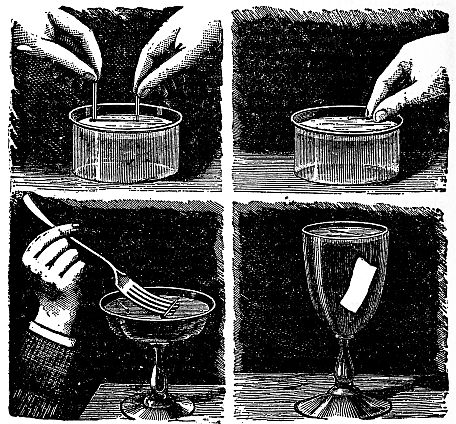
Needles and Pins Made to Float.
Take an ordinary pin, thoroughly dry. This is an object which water can moisten, but less easily than glass. If, by some means or other, you can manage to lay it on the water without wetting it, you will see the water take a convex shape on either side of the pin, and this latter, displacing a proportionate body of water, will float on the surface, just as a lucifer match would do. The same experiment may be performed with a needle, and it must not be supposed that a very fine needle or pin alone is suitable.
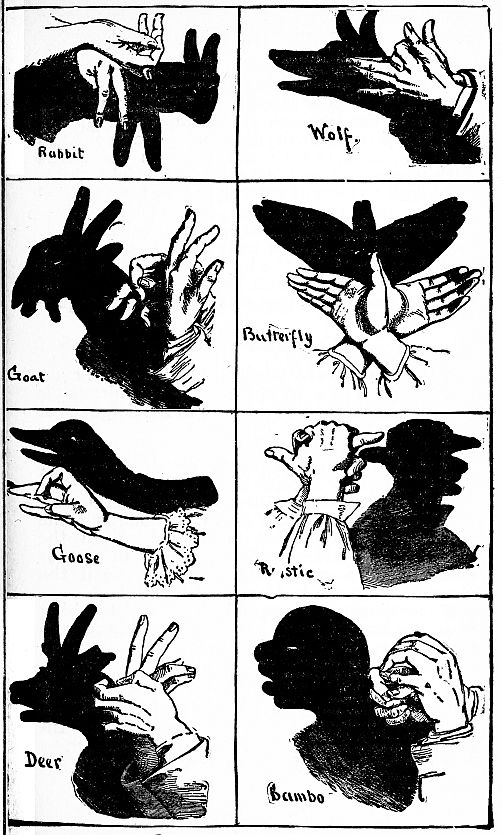
Shadows on the wall.
Hit or Miss.
Great amusement is excited by this game when played in the presence of a company of guests. Spread a sheet upon the floor and place two chairs upon it. Seat two of the party in the chairs within reach of each other and blindfold them. Give each a saucer of cracker or bread crumbs and a spoon, then request them to feed each other. The frantic efforts of each victim to reach his fellow sufferer’s mouth is truly absurd—the crumbs finding lodgment in the hair, ears and neck much oftener than the mouth. Sometimes bibs are fastened around the necks of the victims for protection.
Going Shopping.
A lively game of “talk and touch.” The company is seated in a circle, and one who understands the game commences by saying to his neighbor at the right:
“I have been shopping.”
“What did you buy?” is the required response.
“A dress,” “a book,” “some flowers,” “a pencil”—whatever the first speaker wishes, provided always that he can, in pronouncing the word, touch the object mentioned. Then the second player addresses his neighbor in similar manner, and so on around the circle until the secret of the game is discovered by all.
Whoever mentions an object without touching it, or names one that has already been given, pays a forfeit.
The Three Matches.
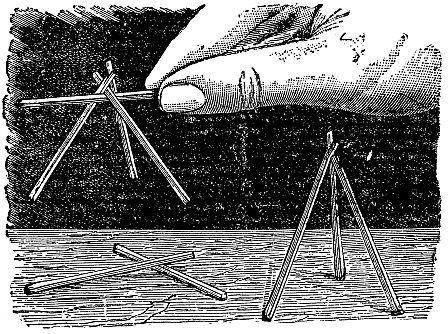
With your penknife slit one end of a match, and trim that of another into a wedge shape. Insert this latter into the split end of the former, so that the two shall form an acute angle. Place them on the table, the angle upward, and prop them up by leaning another match against them, the whole forming a tripod, as shown in the figure. Now hand a fourth match to one of the company, and request him to lift with it the other three from the table. Such is the problem to be resolved. All that you have to do is to insert the fourth match just inside the point of the tripod, between the two conjoined and the single match; and with it to press the two joined matches lightly outward till the third falls with its upper end on the one you hold. You lower this till the end of the single match passes within the angle formed by the juncture of the two first. If you then raise the match you hold in your hand, the three others will ride astride upon it, the single match on the one side, the two joined matches on the other. The table used should have a cloth on it, that the lower ends of the matches may not slip. Some little delicacy of handling is needful to make the single match fall just in the right position, but this once achieved, the three thus slightly supported might be carried a mile without any fear of dropping them.
To Spin a Cent Upon a Needle Point.
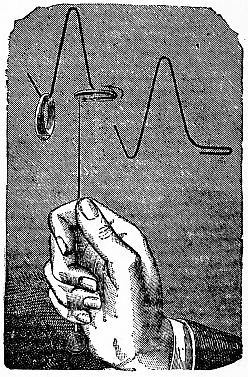
Bend a hair-pin as shown in our illustration. Place a cent horizontally on the right-hand hook, which should be narrow enough to clip it closely, and hang upon the left-hand hook a tolerably heavy finger-ring (or two, if one is found insufficient). Place the free edge of the coin on some upright point (that of a lady’s bonnet-pin, for example), and you will find that the combination can be made to balance itself. Furthermore, by gently blowing upon the ring, you can set the apparatus revolving rapidly, without any disturbance to its equilibrium.
If you spin the cent upon a very sharp steel needle, you will find that the needle will at length work its way completely through the coin. You may therefore, if you please, propound your puzzle in this rather striking form—How to bore a hole through a cent by merely blowing upon it.
Counting Apple-seeds.
This rhyme, formerly used in England, remains unchanged, except the omission of the last three lines. Apples were an essential part of every entertainment in the country. The apple, having been properly named for a person, with a pressure of the finger, was divided, to decide the fate of the person concerned according to its number of seeds.
One, I love, Two, I love, Three, I love, I say, Four, I love with all my heart, And five, I cast away; Six, he loves, Seven, she loves, Eight, they both love; Nine, he comes, Ten, he tarries, Eleven, he courts, Twelve, he marries; Thirteen, wishes, Fourteen, kisses, All the rest little witches.
Spin the Plate.
A tin pie-plate is set spinning in the middle of the floor; someone is called from the party, who must catch the plate before it stops, or pay a forfeit.
Lighting the Candle.
This feat is a very amusing one and is performed as follows: Two persons kneel on the ground, facing each other. Each holds in his left hand a candle in a candlestick, at the same time grasping his right foot in his right hand. This position compels him to balance himself on his left knee. One of the candles is lighted; the other is not. The holders are required to light the unlighted candle from the lighted one. The conditions are simple enough, but one would hardly believe how often the performers will roll over on the floor before they succeed in lighting the candle. It will be found desirable to spread a newspaper on the floor between the combatants. Many spots of candle-grease will thus be intercepted, and the peace of mind of the lady of the house proportionately spared.
A Problem in Gymnastics.
Place a low stool on the floor, close against the wall, and yourself facing the wall, with your feet distant from it just double the width of the stool. Stoop down and grasp the stool with one hand on either side, and rest your head against the wall. Now lift the stool from the floor, and slowly raise yourself to the erect position—or rather, endeavor to do so. It is better to try the experiment for the first time on a well-carpeted floor. On polished oak or parqueterie you would probably have a bad fall. We have here a curious effect of the displacement of the centre of gravity of the body, which renders it almost impossible to stand upright without first replacing the stool on the ground, and resting the hand upon it to get the needful support.
Redeeming Forfeits.
The girl who is to name the penalty by which the forfeit must be redeemed lays her face on the lap of another who sits on a chair, while a third, standing behind, holds the article over her head and asks:
“Here is a forfeit, a very fine forfeit; what shall be done to redeem it?”
“Is it fine or superfine?” (i. e., does it belong to a gentleman or to a lady.)
The sentence is then declared.
Another formula, used in the Middle and Southern States, is: “Heavy, heavy, what hangs over you?”
The German usage is nearly the same, the question being: “Judge, what is your sentence, what shall he do whose pledge I have in my hand?” Any proper penalty may be named.
The Game of Location.
Sides are chosen and the opposing parties stand in separate lines as for a spelling match. No. 1 of one side mentions the name of some city or town in any part of the globe, and No. 1 of the other side must locate it before his opponent has finished counting ten or twenty, as may be agreed. He then, in turn, names a city which No. 2 on the other side must locate. If anyone fails to give the correct location before the expiration of the ten counts, a member from the side he represents is chosen by the other.
The Game of Clumps.
Sides are chosen, and a representative from each side goes from the room. After choosing the object to be guessed, they return, each going to his opponent’s side, where he is asked questions to be answered by “yes” or “no,” concerning the object selected. The side which first guesses correctly has the privilege of choosing a member from the opposing side. Then the successful guesser of one party and the player who has been most nearly successful on the other go from the room and choose a new subject. The two parties must be separated by some distance and the questioning carried on in a low voice, so that nothing said by one side can be heard by the other. An illustration:
For instance, the object chosen is the thumb on the right hand of the Washington Monument.
Question. “Does it belong to the animal kingdom?”
Answer. “No.”
Q. “To the mineral kingdom?”
A. “Yes.”
Q. “Is it in existence now?”
A. “Yes.”
Q. “Is it in this country?”
A. “Yes,” and so on until a successful termination of the guessing is reached.
Ant and Cricket.
One of the company being appointed to represent the Cricket, seats himself in the midst of the other players, who are the Ants, and writes upon a piece of paper the name of a certain grain, whatever kind he pleases. He then addresses the first Ant: “My dear neighbor, I am very hungry, and have come to you for aid. What will you give me?” “A grain of rice, a kernel of corn, a worm,” etc., replies the Ant, as he sees fit. The Cricket asks each in turn, and if one of them announces as his gift the word already written upon the paper, the Cricket declares himself satisfied and changes places with the Ant.
If the desired word is not spoken, however, the same cricket keeps his place, scorning each article of food as it is suggested to him. In either case the form of the question changes, and the supplicant says: “My hunger is appeased and now I wish to dance. What dance do you advise?” He therefore writes the name of a dance upon his paper and the Ants advise in turn—“A polka, a fandango, a minuet,” etc. The third Cricket declares himself unable to dance without music, and requests that a suitable instrument be recommended. “A lyre, a kazoo, a mandolin,” etc., say the Ants.
The fourth Cricket, tired of dancing, wishes to rest, and asks upon what he shall take his repose. “A rose-leaf, the moss, the heart of a lily,” are all suggested, but unless the name he has previously written upon his paper is mentioned, he expresses himself dissatisfied.
The fifth and last Cricket confesses fear lest while sleeping he shall be devoured by a bird, but requests advice concerning the choice of a destroyer. “A lark, a turtle-dove, a pigeon,” are thereupon mentioned by the Ants.
By carefully selecting the most uncommon names for replies, the same Cricket may be kept through the entire set of questions. If the word written upon his paper, however, is mentioned in any case, he must show it to the unfortunate Ant, to whom he surrenders his place.
Gussing Characters.
One of the party leaves the room while the others decide upon some character, real or fictitious. The absentee is then recalled, and each in turn asks him a question referring to the character he has been elected to represent. When he guesses his identity the player whose question has thrown the most light upon the subject has to go from the room.
For example: A goes from the room and the company decides that he shall represent King Henry VIII. When he enters, No. 1 asks: “Which one of your wives did you love best?” No. 2 says: “Do you approve of a man’s marrying his deceased brother’s wife?” No. 3 adds: “Were you very sorry your brother died?” etc., while A, after guessing various names, is led by some question to guess correctly, and the fortunate questioner is consequently sent from the room to have a new character assigned him in turn.
The Magic Candle Extinguisher.
Cut out of thin cardboard a couple of little figures, and insert in the mouth of each, fixing it, say, with sealing-wax, a piece of quill (a portion of a toothpick, for instance), through which he or she appears to be blowing. Fill each tube with sand, but leave a minute space empty at the end remote from the figure. In the cavity of the one place a few grains of gunpowder, and in the other a tiny morsel of phosphorus. The figures being thus privately prepared beforehand, you call for a lighted candle, and announce that the one figure will blow it out and the other relight it.
The moment the tube with the powder is brought near the candle, the powder will ignite, and will produce an explosion of infinitesimal proportions, but large enough to blow out the candle and cause a jet of smoke in the direction of the second figure, which you hold in the opposite hand. The heat of the smoke will cause the phosphorus to ignite, and if you hold the tube which contains it pretty close to the wick, the candle will again be lighted.
This is an experiment which should not be attempted by unskilled hands. Both gunpowder and phosphorus require to be handled with great care, but it might be possible to make, out of thin paper, little cartridges containing a minute portion of each substance, to be introduced into the tubes as occasion required. Unless the reader has some practical knowledge of laboratory work, he should not attempt this experiment.
The Broken Mirror.
The painters have given the last finishing touches to the room they have been redecorating, but before leaving they cannot resist the temptation of a joke on whoever is sent to see that all is in order. Imagine the horror of the servant-girl when she sees a great crack, perhaps half a dozen, right across the big drawing-room mirror. Meanwhile, behind her back the workmen are smiling over her discomfiture. After having sufficiently chuckled over the success of their innocent joke they offer to repair the damage, and, not to keep their victim longer in suspense, one of them takes a wet cloth and passes it over the supposed crack in the glass. Lo, a miracle! The cracks disappear under the mere touch of the damp duster, and the glass is whole again. She can hardly believe her own eyes. And yet there is no witchcraft about the matter. If you are inclined to play a similar trick, you have only to trace, with a small piece of soap, on the mirror which is to appear broken, a few fine lines in imitation of cracks. Their reflection in the glass will give them depth, and make them seem as though they extended through the thickness of the glass, while a rub with a wet flannel will make all right again.
A Parlor Zoetrope.
We have here the game of the “little horses,” so popular at Continental watering-places, brought in a simplified and innocent form within reach of everybody. Glue round the inside of the rim of a circular dish of white porcelain, a number of little cardboard figures of animals; or simply sketch thereon, with ink, similar figures or numerals, equidistant from one another. Place the dish thus furnished, in an ordinary dish of somewhat larger size, and having its centre slightly elevated—a not uncommon pattern. You will only have to give a slight impulse with the hand to the smaller plate to set it spinning within the other. Should the larger dish not be raised in the centre, you have only to pour into it a little water, enough to make the inner dish just float, and it will then revolve with great freedom, the water practically destroying all friction.
You can repeat the same figure, but with, say, the arms in different positions, so that, when the plate is set spinning, you may have depicted, in due order, the successive positions of a man raising and lowering his arms. Thus, for example, if the first figure has his arms hanging down close by his sides, the next will have them a little further from the body; the third will have them extended horizontally; the next following a little higher; and, finally, the last will have them raised above his head. Now peep, with one eye only, through a little hole made with a pin in a visiting-card or playing-card, and gaze at any given point of the circle described by the figures. When the dish is set in motion, you apparently see one figure only, but such figure seems to move like a living being, its arms appearing to take in succession the various positions which are really those of the separate figures. You may amuse yourself by thus arranging several series of such figures, their positions varied in proper succession, thus reproducing, at merely nominal expense, the scientific toy known as the Zoetrope or Praxinoscope.
A Wonderful Pin.
Take a piece of cord elastic, and through it thrust a pin bent by twisting the ends of the elastic, held vertically between the thumb and finger of each hand, and then drawing the hands apart, so as to stretch the cord, you can communicate to this latter a movement so rapid that the revolutions of the pin shall produce the shape of a glass cup. The illusion will be the more complete if the pin is itself brilliantly illuminated, while having a dark background behind it, the operator should be in a darkened room, and a single ray of sunlight from without, should fall through a hole in the shutters, upon the pin. With a little skill in manipulation one can produce, using pins bent in different ways, the semblance of the most diverse objects—say, a cheese-dish, and aquarium, a bouquet-holder, or a goblet.
Should the form of the pin tend, by reason of centrifugal force, to make it assume a horizontal position, this can be cured by securing one end of it, by means of fine white silk, to the elastic. This will usually be invisible when the pin is made to revolve as above described, and, in any case, will not affect the appearance of the figure.
Shadows on the Wall.
The exhibitor, as well as the cardboard figures, is placed behind the spectators, a position which has many advantages. Place on the table a lighted candle, and in front of it, at two or three feet distance, attach to the wall a sheet of white paper to form your “screen.” Between the light and the screen interpose some opaque body, for example, an atlas or other large book.
But under such conditions how are we to cast the shadows on the screen? Simply by the use of a mirror, placed at the side of the table. The reflection of the mirror will appear on the wall as a luminous space, oval or oblong as the case may be, and if you have placed it at the proper angle with reference to the screen, and move your cardboard shapes about cleverly between the candle and the mirror, you will forthwith see little fantastic figures projected in shadow on the screen, while the uninitiated spectator is wholly at a loss to discover how you produce them.
The Rotation of the Globe.
When you next chance to eat an egg for breakfast, do not fail to try the following experiment. It is one which always succeeds, and is productive of much amusement to the company.
Moisten slightly with water the rim of your plate, and in the centre paint with the yolk of the egg a sun with golden rays. By the aid of this simple apparatus you will be in a position to illustrate, so clearly that a child can comprehend it, the double movement of the earth, which revolves simultaneously round the sun and on its own axis.
All that you have to do is to place the empty half-shell of your egg on the rim of the plate, and keeping this latter duly sloped, by a slight movement of the wrist as may be needful, you will see the egg-shell begin to revolve rapidly on its own axis, at the same time traveling round the plate. It is hardly necessary to remark that the egg-shell will not travel uphill, and the plate must therefore be gradually shifted round, as well as sloped, so that the shell may always have an inch or two of descending plane before it.
The slight cohesion caused by the water which moistens the plate counteracts the centrifugal force, and so prevents the egg-shell falling off the edge of the plate.
Through the Water Dry.
Into a basin full of water, throw a coin, or ring, or other suitable object, and announce that you will take it out of the basin without wetting your hand. All that is needed to effect this is to dust the surface of the water with some form of powder having no cohesion with water, and which, consequently, water does not moisten. Powdered lycopodium, to be procured of any chemist, has this property.
Having sprinkled a little of this powder on the surface of the liquid, plunge your hand boldly to the bottom, pick up the ring, and show the company that your hand is as dry as it was before the operation. This comes of the fact that the lycopodium has formed over your hand a regular glove, to which the liquid cannot adhere any more than it can to the plumage of the ducks, which we see plunge and plunge again, and still come up dry as ever, by reason of the oily matter secreted by their feathers.
Those who may care to carry the experiment further may try it with hot water, increasing the temperature at each attempt, when they will find that it is possible, with the aid of the lycopodium, to lift an article out of a kettle of all but boiling water. The sensation of heat is not destroyed, but it causes no injury to the tissues—in other words, no scald.
Hanging Without a Cord.
Soak a thread in strong salt and water; dry thoroughly, and repeat this two or three times. This must be done privately beforehand. When you bring forward the thread thus prepared, the spectators have no reason to suppose that it is other than the ordinary article.
Use this thread to suspend a ring, choosing as light a one as possible. Set fire to the thread, which will burn from end to end, but the spectators will be surprised to see that the ring does not fall, being supported by the ash resulting from the combustion. In reality, the fibrous particles of the thread have been destroyed, but there remains a tiny filament of salt, strong enough, if there is no draught in the room, to support the weight of the ring.
This experiment may be varied in this manner:
Attach four pieces of thread to the four corners of a little piece of muslin, so as to form a miniature hammock. Soak the whole in salt water; then dry it, and repeat the operation three or four times. When the threads and the muslin are thoroughly saturated with salt and perfectly dry, place a blown egg in the little hammock, suspended as shown in the figure. Set fire to the hammock, which will burn freely enough, as also the fine threads, but if the experiment has been properly carried out, the egg will remain suspended, to the astonishment of all who behold it.
The Magic Scorpion.
Place on the surface of the water in a glass or basin a number of small pieces of camphor of various sizes, together representing the form of some animal, say a scorpion. After a little while the scorpion will begin to stir in the water; you will see him move his claws, as though trying to swim, and curl his tail convulsively, as if in pain.
This amusing experiment is easy to perform, and costs practically nothing, for camphor is to be found in every household; but in spite of its simplicity we may deduce from it, as you will see, several interesting observations.
1. Our scorpion floats on the water, but lies almost entirely below the surface. This proves to us that the specific gravity of camphor is nearly, but not quite, equal to that of water.
2. The animal does not dissolve. Camphor is therefore insoluble in water.
3. The different fragments of which our scorpion consists do not separate, but remain one against the other as we originally placed them. This is because they are held together by the force known as cohesion.
4. Lastly, the eccentric movements we have mentioned depend on a well-ascertained but mysterious property of camphor, viz., that when placed on the surface of the water, it moves spontaneously. It is a well-known fact that a morsel of camphor placed in a glass of water will, after a few moments, begin to move either with a sidelong or rotary movement; such movement being due, according to some authorities, to the recoil produced by an escape of liberated gases; according to others, to a mysterious force inherent in the surface of liquids, and known as superficial tension.
Amusing the Children.
A clever way to amuse a party of children is to invite them to a peanut party. Tiny cards of invitation are sent out, on each of which two half peanut shells are fastened. A large quantity of the nuts are hidden about the house, and when the young folks arrive they are told to hunt them. They who find the most and least of them receive prizes.
Another is a soap bubble party. The invitations for this should have a pen and ink sketch of a pipe and bubble. Provide plenty of clay pipes, with the name of a guest written on each, and make the soapsuds with the addition of glycerine to make the bubbles strong and tough. For the prizes for the most successful bubble blower, a fancy pipe is suitable. It can be made by gilding the handle and outside of the bowl of a clay pipe and painting the inside of the bowl in water colors. A bow of baby ribbon to match the paint improves it. For the booby prize a little pipe can be made from a match and half an acorn shell.
A penny party furnishes amusement for an evening. With the invitations is sent a request for each guest to bring a penny, not for an admission fee, but for use. For each guest there are provided two cards and a pencil; one card is blank; the other has a list of the things to be found on a penny. The list is numbered, and each person is expected to name as many as he can, prizes being awarded for the best and poorest list. Find—1. Top of hill. 2. Place of worship. 3. An animal. 4. A fruit. 5. A common fruit. 6. Links between absent friends. 7. Union of youth and old age. 8. A vegetable. 9. Flowers. 10. What we fight for. 11. A metal. 12. A messenger. 13. A weapon of defence. 14. A weapon of warfare. 15. A body of water. 16. A beverage. 17. What young ladies want. 18. The most popular State. 19. What men work for. 20. Sign of royalty. 21. A jolly dog. The answers are—1. Brow. 2. Temple. 3. Hare (hair). 4. Date. 5. Apple. 6. Letters. 7. 1894 (the date of the penny). 8. Ear. 9. Tulips (two lips). 10. Liberty. 11. Copper. 12. One sent (cent). 13. Shield. 14. Arrow. 15. Sea (c). 16. Tea (t). 17. Beau (bow). 18. United States (matrimony). 19. Money. 20. Crown. 21. A merry cur (America). Usually a half hour is allowed for filling out the blank cards, and after that some time for correcting the lists and awarding prizes.
It is often hard to find games for evening amusements that will amuse all. Some are so noisy that the sensitive cannot enjoy them, but the following will instruct as well as amuse: One is to transpose the misplaced letters of words, usually the name of a city. To prepare for the game make a large quantity of small cards from pasteboards, about an inch and a half square. Paste a large letter on each one, cut from a newspaper or advertisement, having several for each letter of the alphabet. Give to each the letters necessary to spell a word and let him study it out. Thus the letters ilisyantp can be made to spell Ypsilanti, or stoonb Boston.
Another game which is quite entertaining is called a pronunciation match. Any number can play. One is elected as leader. At first he will call out a letter, as a, and each person must think quickly while he counts five, and be ready to tell the name of a city in the State agreed upon before the contest begins. For instance, the leader, while he counts five, points to one of the company who must give the name of a city beginning with the letter A, B or C, as the leader may announce. When one answer has been given, he quickly counts again, and points to another person until some one fails to respond, when he is declared leader and also pays a forfeit. It is very amusing and teaches people to think quickly and keep their wits about them.