Part 3 — STARS
Reading edition
How to Find the Time by the Stars
Fig. 1 shows the stars around the northern pole of the heavens (Pole Star), and the Pointers of the Great Bear, which direct us to the Pole Star.
Fig. 1.
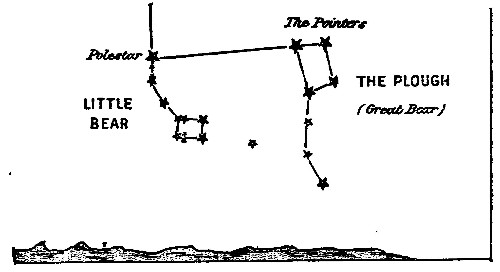
Since all stars appear to rise in the East and set in the West (which is really due to our earth turning round under them), the Pointers revolve once around the Pole Star in the opposite direction to the hands of a clock, once in twenty-four hours, or they swing through a quarter of a circle once in six hours; it is thus a simple matter after a little practice to judge what part of the imaginary circle they will pass through in an hour or less.
Assuming that all the stars rise four minutes earlier each night, and that the Pointers of the Plough are vertically above the Pole at midnight at the end of February, we may calculate the position of the Pointers for any hour of the night.
The First Twenty Stars in Order of Brightness
Date of rising at 9 P.M. in the East.
1. Sirius, the Dog-starDec. 4
2. (Canopus, of the Ship)
3. (Alpha, of the Centaur)
4. Vega, of the LyreApril 1
5. Capella, of the CharioteerAug. 21
6. Arcturus, of the HerdsmanFeb. 20
7. Rigel, of OrionNov. 4
8. Procyon, the Little Dog-starNov. 27
9. (Achernar, of Eridanus)
10. (Beta, of the Centaur)
11. Altair, of the EagleMay 26
12. Betelgeux, of Orion's right shoulderOct. 30
13. (Alpha, of the Southern Cross)
14. Aldebaran, of the Bull's right eyeOct. 2
15. Pollux, of the TwinsNov. 4
16. Spica, of the VirginMar. 1
17. Antares, of the ScorpionMay 9
18. Fomalhaut, of the Southern FishAug. 27
19. Deneb, of the SwanApr. 22
20. Regulus, of the LionJan. 1
Orion
Then there is another set of stars representing a man wearing a sword and a belt, named "Orion." It is easily recognized by the three stars in line, which are the belt, and three smaller stars in another line, close by, which are the sword. Then two stars to right and left below the sword are his feet, while two more above the belt are his shoulders, and a group of three small stars between them make his head.
Now the great point about Orion is that by him you can always tell which way the North or Pole Star lies, and which way the South, as you can see him whether you are in the South or the North part of the world. The Great Bear can be seen only when you are in the North, and the Southern Cross when you are in the South.
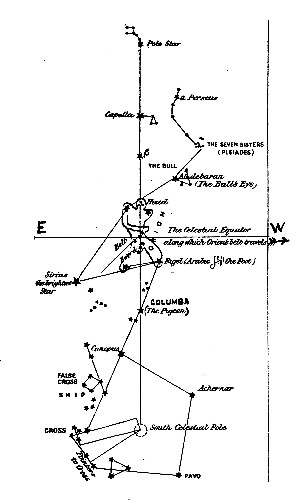
If you draw a line by holding up your staff against the sky, from the center star of Orion's belt through the center of his head, and carry that line on through two big stars till it comes to a third, that third one is the North or Pole Star.
Then if you draw a line the other way, beginning again with the center star of the belt, and passing through the center star of the sword, your line goes through another group of stars shaped like the letter L. And if you go about as far again past L, you come to the South Pole, which unfortunately is not marked by any star. Roughly Orion's sword, the three small stars, points North and South.
East and West. Orion sets due west, and rises due east, so that, if you can catch him rising or setting, you know where the points of the compass are. Constellations, such as Orion, or the Bull, rise in the east, four minutes earlier each succeeding night—that is about half an hour earlier every Saturday.
Read The Song of the Fifty Stars by Arthur A. Carey, and try to find each star on a chart and then in the Heavens.
The Song of the Fifty Stars
Alpherat, Caph, and Algenib—three leading stars— Move in front of all the host, Turning from East to West, Over the rounded dome; And, near the head of the line, the Star of the North, Polaris, turns his round and marks the hub of the wheel. From Alpherat, North and East, Andromeda shoots, Like a branch, with Mirach and Almach; while, far in the South, Achernar shines, a beacon-light, at the "End of the River." From Almach pass to Algol, of the changing face, Called by the Arabs the Demon— The Medusa of the Greeks. But, not so fast! lest we forget the little changing star Whose place is West of Algol, farther South— Mira, "the Wonderful," in Cetus or the Whale. Algol leads to Mirfach, the brightest star of Perseus, Who saved the captive Andromeda, daughter of Cepheus, "the Monarch," And royal Cassiopeia. Then comes, surrounded by her sisters, gentle Alcyone, The peaceful, daughter of the King who rules the tempestuous winds; And, running in pursuit of these—the happy Pleiades— Aldebaran, "the Follower," shines from the eye of the Bull. Next comes Capella—the Mother Goat—watching her three Kids; Her yellow light the color of our Sun. Capella and Rigel move in line, and afterwards comes Nath, Who marks the horn of the butting Bull. Orion, the Hunter, on the Equator—the Giant of the Arabs— Shines glorious North and South; Bellatrix his left shoulder; Mintaka marks his belt. After Mintaka comes Betelgeux, right shoulder of Orion; While, between them in order, though farther North, Is Zeta of Taurus, the Bull, who marks the other horn. The next is Menkalinan, the shoulder of the Charioteer; And, two degrees to the Eastward, the Circle of the Solstice passes by. While, far down in the South, Canopus gleams from the stern of Argo, the Ship. Sirius, Star of the Greater Dog, brightest of all in the heavens, Is followed by Castor, one of the Twins. While Procyon—"Dog-in-advance"—the bright "forerunner" of Sirius, Is followed by Pollux, the greater of the Twins. Next Regulus comes in the Lion's heart, Denebola, the tip of his tail; While, between them in order, Merak and Dubhe, the pointers, Point to their aim in the North. Two brilliant stars in the Southern Cross are Alpha and Beta Crucis, The former a glorious double Sun, with a third star in attendance; To see them ourselves we must travel far, But we know that the glory is great in the South, Although from us it is hidden. Next, in the hand of the Virgin, the pointed Ear of Wheat— Spica of the Romans— Not far from the Autumn Equinox. Now, back to the North we go, and look for Mizar and Alcor— The Indian Squaw with the little papoose on her back, And the tip of the tail of the Greater Bear Where Benetnasch commands. Now, again to the South, where the forefeet of the Centaur Are marked by Beta and Alpha;—the former is known as Hadar—"the Ground";— The latter sun is nearest to ours And famous as Serk-t, toward whom the ancient Egyptians Turned their temples in homage— And, between them in order, the great and distant Arcturus Shines out warm in the North. Pulcherrima—most beautiful—must be sought by those who love her; For she is modest and shy in the presence of the Great One. Nearby is Gemma, the Bud, In the beautiful Northern Crown. Near the point where the "roof-tree" crosses the Zodiac Ring Is a warm, red star in Scorpio. This is Antares; while, in the North, Etanin marks the Dragon's head. Mu Sagitarii—closer still to the Solstice and Ecliptic— Marks the northern part of the heavenly Archer's bow. On summer evenings, high above our heads, Vega shines with cool and brilliant light; While, to the South and East, is Altair of the Eagle. Nearby is the Northern Cross, or Cygnus, Whom we call "the Swan," With Deneb Adige marking her outspread tail. The nose of Pegasus, the soaring horse, Shines out in the star Enif, or Epsilon of Pegasus—a triple star— While Fomalhaut gleams in the South, Guarding the Fish's Mouth. Now Scheat and Markab, hand in hand, watch for the stragglers— Bringing up the rear of all the Fifty Stars that have passed by.
The Sun Clock
When you have been able to find the North Star it will be very easy to set up a sun-dial. This device is not so valuable now as standard time is universally used. If you know the difference between "sun time" and standard time, the sun-dial can be referred to with a fair amount of accuracy and many people regard it as a curiosity.
Select a place where the sun shines all day and the ground is level. Set up a post or stake perpendicular and firm. At night go and "sight" a straight stick at the North Star and fasten it securely. This stick will now be parallel to the axis of the earth and its shadow will fall at the same line on any given hour no matter what season of the year it may be. At noon by the sun the shadows of the slanting stick and the upright one will coincide. This gives you the "sun noon" and the time by a standard watch or clock will tell you what correction to apply to your dial to convert its time into standard. Having once established the noon, or "no hour" mark the I, II, III, IV, V, and VI with stakes. Then calculate the correct sun time of VI A.M. by your standard watch and stake out the morning hours. Halves and even quarters can be marked between if you wish.
A flower dial can be made by having your upright post a pretty tall one, say ten or even twenty feet, and planting rows of flowers like spokes of a wheel along the hour lines. It may be possible even to select such as are likely to open at or near the indicated hour. The entire semicircle of pegs will also make a pretty finish with tall ornamental foliage plants or shrubs.
Practice
Make a sun-dial on the ground, mark the hours with stones or sticks, and see if it shows the time every day.
Among the Stars
Scouts must be able to find their way by night, but unless they practise it they are very apt to lose themselves. At night distances seem much greater, and land-marks are hard to see.
When patrolling in dark places, keep closer together, and in the dark or in the woods or caves keep in touch with each other by catching hold of the end of the next Scout's staff.
The staff is also useful for feeling the way.
Winter Evenings.—Cut out a quantity of little stars from stamp edging. Take an old umbrella, open, and stick the stars inside it, in the patterns of the chief constellations, then hold it overhead, and turn it once round for twenty-four hours, making the stars rise in the east.
The sun and the moon appear almost the same size as a rule. When we are a little nearer the sun, in winter, he looks a trifle larger than the moon.
To study the constellations, go out when the stars are bright, armed with a star map and a bicycle lamp to read it by, and spread a rug on the ground to lie on, or have a deck-chair, or hammock. Watch for meteors in August and November.
Let each girl try to draw a sketch map of a given constellation, from memory.