REVIEW OF A POPULAR PUBLICATION. IN THE SEARCHING STYLE.
Reading edition
The Bank Note. Oblong Octavo. London, 1850. The Governor and Company of the Bank of England. Price, from Five to One Thousand Pounds.
The object of this popular but expensive pocket companion, is not wholly dissimilar from that of its clever and cheaper contemporary “Notes and Queries.” As the latter is a “medium of intercommunication for literary men,” so the former is a medium of intercommunication for commercial men; and surely there is no work with which so many queries are constantly connected as the Bank Note. Nothing in existence is so assiduously inquired for; nothing in nature so perseveringly sought.
This is not to be wondered at; for in whatever light we view it, to whatever test we bring it, whether we read it backwards or forwards, from left to right, or from right to left; or whether we make it a transparency to prove its substantial genuineness and worth, who can deny that the Bank Note is a most valuable work?—a publication, in short, without which no gentleman’s pocket can be complete?
Few can rise from a critical examination of the literary contents of this narrow sheet, without being forcibly struck with the power, combined with the exquisite fineness of the writing. It strikes conviction at once. It dispels all doubts, and relieves all objections. There is a pithy terseness in the construction of the sentences; a downright, direct, straightforward, coming to the point, which would be wisely imitated in much of the contemporaneous literature that constantly obtains currency (though not as much). Here we have no circumlocution, no discursive pedantry, no smell of the lamp; the figures, though wholly derived from the East (being Arabic numerals), are distinct and full of purpose; and if the writing abounds in flourishes, which it does, these are not rhetorical, but boldly graphic: struck with a nervous decision of style, which, instead of obscuring the text and meaning, convinces the reader that he who traced them when promising to pay the sum of five, ten, twenty, thirty, forty, fifty, one hundred, or a thousand pounds, means honestly and instantly to keep his word: that he will pay it to bearer on demand, without one moment’s hesitation.
Strictly adapted for utility, yet the dulcet is not wholly overlooked; for, besides figures and flourishes, the graces of art are shed over this much-prized publication. The figure of Britannia is no slavish reproduction of any particular school whatever. She sits upon her scroll of state utterly inimitable and alone. She is hung up in one corner of the page, the sole representative of the P. R. F. P., or pre-reissue-of-the-fourpenny-piece, school. Neither, if judged by the golden rule of our greatest bard, is the work wholly deficient in another charm. As we have just explained, its words are few: brevity is the soul of wit. And we fearlessly put it to the keenest appreciator of good things, whether a Bank Note (say for a hundred) is not the best joke conceivable—except, indeed, a Bank Note for a thousand.
A critical analysis of a work of this importance cannot be complete without going deeply into the subject. Reviewing is, alas, too often mere surface-work; for seldom do we find the critic going below the superficies, 427or extending his scrutiny beyond the letter-press. We shall, however, set a bright example of profundity, and having discharged our duty to the face of the Bank Note, shall proceed to penetrate below it: having analysed the print, we shall now speak of the paper.
The late Mr. Cobbett, to express his idea of the intrinsic worthlessness of these sheets, in comparison with the prices at which they pass current, was wont to designate Bank Notes as “Rags.” It may, indeed, be said of them that, “Rags they were, and to tinder they return;” for they are born of shreds of linen, and, ten years after death, are converted in bonfires into the finest of known tinder. It may be considered a curious fact by those who wear shirts, and a painful, because hopeless one, by those who make them, that the refuse or cuttings of linen forms, with a slight admixture of cotton, the pabulum or pulp of Bank Note Paper. Machinery has made no inroads on this branch of paper-making. The pulp is kept so well mixed in a large vat, that the fibrous material presents the appearance of a huge cauldron of milk. Into this the paper-maker dips his mould, which is a fine wire sieve, having round its edge, a slight mahogany frame, called the “Deckel,” which confines the pulp to the dimensions of the mould. This dip is quite a feat of dexterity, for on it depends the thickness and evenness of the sheet of paper. The water-mark, or, more properly, the wire-mark, is obtained by twisting wires to the desired form or design, and stitching them on the face of the mould; therefore the design is above the level face of the mould, by the thickness of the wires it is composed of. Hence, the pulp in settling down on the mould, must of necessity be thinner on the wire design than on other parts of the sheet. When the water has run off through the sieve-like face of the mould, the new-born sheet of paper is transferred to a blanket; this operation is called “couching,” and is effected by pressing the mould gently but firmly on the blanket, when the spongy sheet clings to the cloth. Sizing is a subsequent process, and, when dry, the water-mark is plainly discernible, being, of course, transparent where the substance is thinnest. The paper is then made up into reams of five hundred sheets each, ready for press. The water-mark in the notes of the Bank of England is secured to that Establishment by a special Act of Parliament. Indeed, imitation of anything whatever connected with a Bank Note is an extremely hazardous feat.
A scrupulous examination of this curious piece of paper, implants a thorough conviction that it is a very superior article—in short, unique. There is nothing like it in the world of sheets. Tested by the touch, it gives out a crisp, crackling, sharp, sound—a note essentially its own—a music which resounds from no other quires. To the eye it shows a colour belonging neither to blue-wove nor yellow-wove, nor to cream-laid, but a white, like no other white, either in paper and pulp. The rough fringiness of three of its edges are called the “deckled” edges, being the natural boundary of the pulp when first moulded; the fourth is left smooth by the knife, which eventually cuts the two notes in twain. It is so thin that, when printed, there is much difficulty in making erasures; yet it is so strong that a “water-leaf” (a leaf before the application of size) will support thirty-six pounds; and, with the addition of one grain of size, half a hundred weight, without tearing; yet the quantity of fibre of which it consists, is no more than eighteen grains and a half.
The process of engraving the Bank Note is peculiar. Its general design is remarkably plain—steel plates are used, and are engraved in a manner somewhat analogous to that employed in the Mint for the production of the coin, except that heavy pressure is used instead of a blow. The form of the Note is divided into four or five sections, each engraved on steel dies which are hardened. Steel rollers, or mills, are obtained from these dies, and each portion of the Note is impressed on a steel plate to be printed from by the mills until the whole form is complete.
By means of a very ingenious machine, the engraving on the plates when worn by long printing is repaired by the same mills, and thus perfect identity of form is permanently secured. The merits of this system are due to the late Mr. Oldham, and the many improvements introduced not only into this, but into the printing department, are the work of his son and successor, Mr. Thomas Oldham, the present chief engraver to the Bank of England. The plate—always with a pair of notes upon it—is now ready for the press; for it contains all the literary part of the work, except the date, the number, and the cashier’s signature.
We must now review the manner of printing. Before passing through the press, all paper must be damped that it may readily absorb ink; and Bank Note paper is not exempt from this law; but the process by which it is complied with is an ingenious exception to the ordinary modes. The sheets are put into an iron chamber which is exhausted of air; water is then admitted, and forces itself through every pore at the rate of thirty thousand sheets, or double notes, per minute!
In a long gallery that looks like a chamber of the Inquisition with self-acting racks, stands a row of plate-printing presses worked by steam. Every time a sheet passes through them they emit a soft “click” like a ship’s capstan creaking in a whisper. By this sound they announce to all whom it may concern that they have printed two Bank Notes. They are tell-tales, and keep no secrets; for, not content with stating the fact aloud, each press moves, by means of a chain, an index of numerals at the end of the room; so that the chief of the department can see at any hour of the day 428how many each press has printed. To take an impression of a note plate “on the sly,” is therefore impossible. By a clever invention of Mr. Oldham the impression returns to the printer when made, instead of remaining on the opposite side of the press, after it has passed through the rollers, as of old. The plates are heated, for inking, over steam boxes instead of charcoal fires.
When a ream, consisting of five hundred sheets or one thousand notes, have been printed, they are placed in a tray which is inserted in a sort of shelf-trap that shuts up with a spring. No after-abstraction can, therefore, take place. One such repository is over the index appertaining to each press, and at the end of the day it can at once be seen whether the number of sheets corresponds with the numerals of the tell-tale. Any sort of mistake can thus be readily detected. The average number of “promises to pay” printed per diem is thirty thousand.
As we cannot allow the dot over an i, or the cross of a t to escape the focus of our critical microscope, we now proceed to apply it to the Bank Ink. Like the liquid of Messrs. Day and Martin, this inestimable composition, with half the usual labour, produces the most brilliant jet-black, fully equal to the highest Japan varnish, and is warranted to keep in any climate. It is made from the charred husks of Rhenish grapes after their juice has been expressed and bottled for exportation to the dinner-tables of half the world. When mixed with pure linseed oil, carefully prepared by boiling and burning, the vinous refuse produces a species of blacks so tenacious that they obstinately refuse to be emancipated from the paper when once enslaved to it by the press. It is so intensely nigritious that, compared with it, all other blacks are musty browns; and pale beside it. If the word of a printer’s devil may be taken, it is many degrees darker than the streams of Erebus. Can deeper praise be awarded?
The note is, when plate-printed, two processes distant from negotiable; the first being the numbering and dating—and here we must point out the grand distinction which exists between the publication which we have the satisfaction of stating, now lies before us (but it is only a “Five”) and ordinary prints. When the types for this miscellany, for instance, are once set up, every copy struck off from them by the press is precisely similar. On the contrary, of those emitted from the Bank presses no two are alike. They differ either in date, in number, or in denomination. This difference constitutes a grand system of check, extending over every stage of every Bank Note’s career—a system which records its completion and issue, tracks it through its public adventures, recognises it when it returns to the Bank, from among hundreds of thousands of companions, and finally enables the proper officers to pounce upon it, in case of inquiry, at any official half hour for ten years after it has returned in fulfilment of its “promise to pay,” To promise an explanation of what must appear so complicated a plan, may seem to the reader like a threat of prolixity. But he may read on in security; the system is as simple as the alphabet.
Understand then, that the dates of Bank Notes are arbitrary, and bear no reference to the day of issue. At the beginning of the official year (February) the Directors settle what dates each of the eleven denominations of Bank Notes shall bear during the ensuing twelve months, taking care to apportion to each sort of note a separate date. The table of dates is then handed to the proper officer, who prints accordingly. The five-pound Note which now rejoices our eyes is, for example, dated February the 2nd, 1850; we therefore know that there is no genuine note in existence, for any other sum, which bears that date; and if a note for ten, twenty, fifty, hundred, &c., having “2nd Feb., 1850,” upon it were to be offered to us or to a Bank Clerk, we or he would, without a shadow of further evidence, impound it as a forgery.
Now, as to the numbering:—It is a rule that of every date and denomination, one hundred thousand Notes—no more and no less—shall be completed and issued at one time. We know, therefore, that our solitary five is one of a hundred thousand other fives, each bearing a different number—from 1[2] to 100,000—but all dated 2nd Feb., 1850. The numbers are printed on each Note by means of a letter-press, the types of which change with each pull of the press. For the first Note, the press is set at “00001,” and when that is printed, the “1,” by the mere act of impression, retires to make room for “2,” which impresses itself on the next Note, and so on up to “100,000.” The system has been applied to the stamping of railway tickets. The date, being required for the whole series, is of course immovable. After this has been done, the autograph of a cashier is only requisite to render the Note worth the value inscribed on it, in gold.
While the printers are at work, manufacturing each series of Notes, the account-book makers are getting-up a series of ledgers so exactly to correspond, that the books of themselves, without the stroke of a pen, are a record of the existence of the Note. The book in which the birth of our own especial and particular “Five” is registered, is legibly inscribed,
“Fives, Feb. 2, 1850.”
When you open a page, you find it to consist of a series of horizontal and perpendicular lines, like the pattern of a pair of shepherd’s plaid inexpressibles, variegated with columns of numerals; these figures running on regularly from No. 1, on the top of the first page, to No. 100,000 at the bottom of the last. It 429must therefore be obvious to the meanest capacity that the mere existence of that book, with its arbitrary date and series of numbers, corresponding to the like series of Notes, is a sufficient record of the existence and issue of the latter. The return of each Note after its public travels, is recorded in the square opposite to its number. Each page of the book contains two hundred squares and numbers; consequently, whatever number a Note may bear, the Clerk who has to register its safe return from a long round of public circulation, knows at once on which page of the book to pounce for its own proper and particular square. In that he inserts the date of its return—not at full length, but in cypher. “S” in red ink means 1850, and the months are indicated by one of the letters of the word Ambidextrous, with the date in numerals. Our only, and therefore favourite, five is numbered 31177. Should it chance to finish its travels in the Accountant’s Office on the 6th of August next, it will be narrowly inspected (for fear of forgery) and defaced—a Clerk will then turn at once to the book lettered “Fives, Feb. 2,” and so exactly will he know which page to open, and where the square numbered 31177 is situated, that he could point to it blindfold. He will write in it “6 t,” which means 6th August; that being the eighth month in the year, and “t” the eighth letter in the chosen word.
The intermediate history of a Bank Note is soon told. Nineteen-twentieths are issued to Bankers or known houses of business. If Glynn’s, or Smith’s, or any other banking firm, require a hundred ten-pound Notes, the Clerk who issues them makes a memorandum showing the number of the Notes so issued, and the name of the party to whom they have been handed—an easy process, because Notes being new,[3] are always given out in regular series, and the first and last Note that makes the sum required need only be recorded. Most Bankers make similar memoranda when notes pass out of their hands; and the public, as each Note circulates among them, frequently sign the name of the last holder. When an unknown person presents a Note for gold at the Bank of England, he is required to write his name and address on it, and if the sum be very large, it is not paid without inquiry. By these expedients, a stolen, lost, or forged note can often be traced from hand to hand up to its advent.
The average periods which each denomination of London Notes remain in circulation has been calculated, and is shown by the following
Account of the Number of Days a Bank Note issued in London remains in Circulation:—
£5 72·7 days
10 77·0 „
20 57·4 „
30 18·9 „
40 13·7 „
50 38·8 „
100 29·4 „
200 12·7 „
300 10·6 „
500 11·8 „
1000 11·1 „
The exceptions to these averages are few, and, therefore, remarkable. The time during which some Notes remain unpresented are reckoned by the century. On the 27th of September, 1845, a fifty pound Note was presented bearing date 20th January, 1743. Another for ten pounds, issued on the 19th November, 1762, was not paid till the 20th April, 1843. There is a legend extant, of the eccentric possessor of a thousand pound Note, who kept it framed and glazed for a series of years, preferring to feast his eyes on it, to putting the amount it represented out at interest. It was converted into gold, however, without a day’s loss of time by his heirs, on his demise. Stolen and lost Notes are generally long absentees. The former usually make their appearance soon after some great horse-race, or other sporting event, altered or disguised so as to deceive Bankers, to whom the Bank of England furnishes a list of the numbers and dates of stolen Notes. In a Chapter on Forgery, which we are preparing, the reader will see some singular facts on this point.
Mr. Francis, in his “History of the Bank of England,” tells a curious story about a bank post bill, which was detained during thirty years from presentation and payment. It happened in the year 1740:—“One of the Directors, a very rich man, had occasion for 30,000l., which he was to pay as the price of an estate be had just bought; to facilitate the matter, he carried the sum with him to the Bank and obtained for it a Bank bill. On his return home, he was suddenly called out upon particular business; he threw the Note carelessly on the chimney, but when he came back a few minutes afterwards to lock it up, it was not to be found. No one had entered the room; he could not therefore suspect any person. At last, after much ineffectual search, he was persuaded that it had fallen from the chimney into the fire. The Director went to acquaint his colleagues with the misfortune that had happened to him; and as he was known to be a perfectly honourable man he was readily believed. It was only about four-and-twenty hours from the time that he had deposited his money; they thought, therefore, that it would be hard to refuse his request for a second bill. He received it upon giving an obligation to restore the first bill, if it should ever be found, or to pay the money himself, if it should be presented by any stranger. About thirty years afterwards (the Director having been long dead, and his heirs in possession of his fortune), an unknown person presented the lost bill at the Bank, and demanded payment. It was in vain that they mentioned to this person the transaction by which that bill was annulled; he would not listen to it; he maintained that it had come to him from abroad, and insisted upon immediate payment. The Note was payable to bearer; and the thirty thousand pounds were paid him. The heirs of the Director would not listen to any demands 430of restitution; and the Bank was obliged to sustain the loss. It was discovered afterwards that an architect having purchased the Director’s house, had taken it down, in order to build another upon the same spot, had found the Note in a crevice of the chimney, and made his discovery an engine for robbing the Bank.”
Carelessness, equal to that recorded above, is not at all uncommon, and gives the Bank enormous profit, against which the loss of a mere thirty thousand pound is but a trifle. Bank Notes have been known to light pipes, to wrap up snuff, to be used as curl-papers; and British tars, mad with rum and prize-money, have not unfrequently, in time of war, made sandwiches of them, and eaten them between bread-and-butter. In the forty years between the years 1792 and 1812 there were out-standing Notes (presumed to have been lost or destroyed) amounting to one million, three hundred and thirty odd thousand pounds; every shilling of which was clear profit to the Bank.
The superannuation, death, and burial of a Bank of England Note is a story soon told. The returned Notes, or promises performed, are kept in “The Library” for ten years, and then burnt in an iron cage in one of the Bank yards.
A few words on the history and general appearance of the Bank of England Note will conclude our criticism.
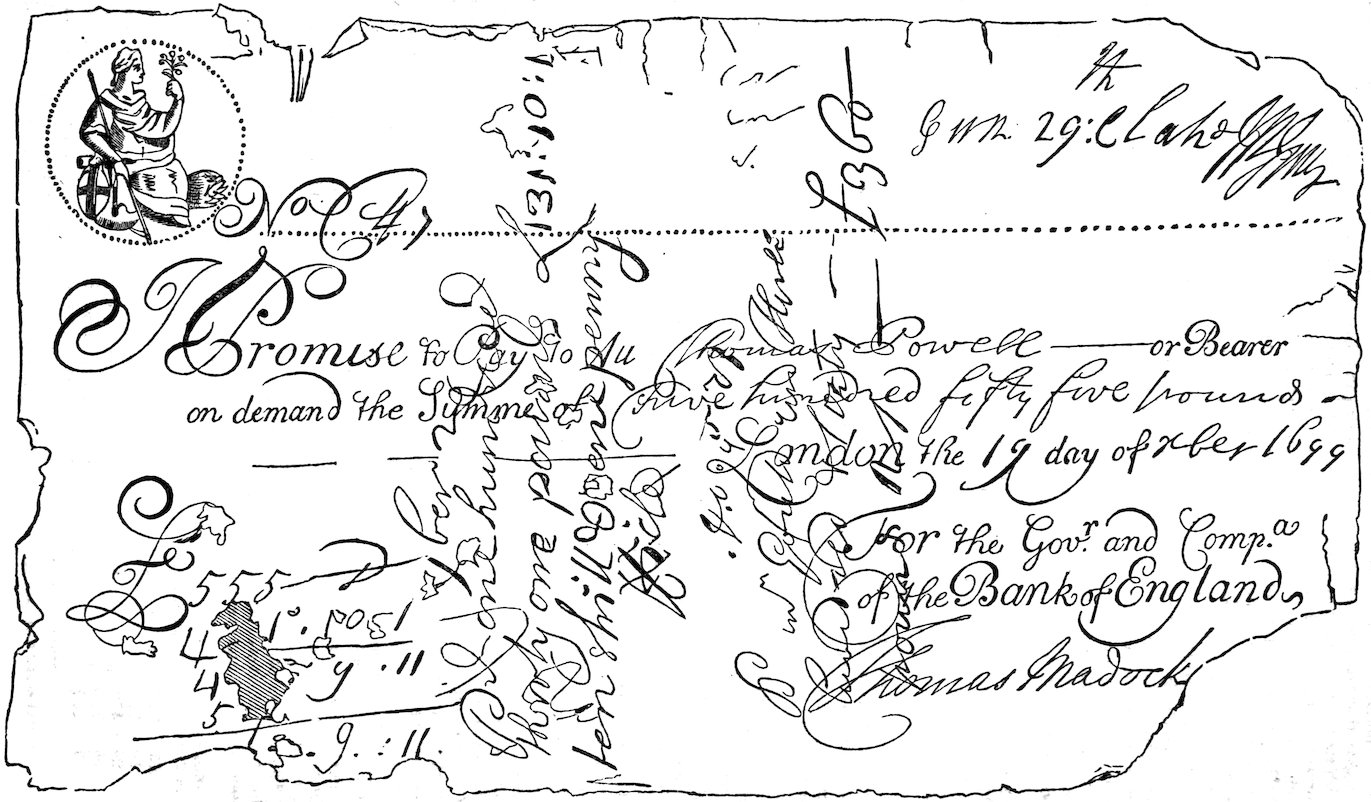
The strong principle to insure the detection of forgery is uniformity; hence, from the very first Note issued by the Bank, to that, the merits of which we are now discussing, the same general design has been preserved,—only that the execution has been from time to time improved; except, we are bound to add, that of the signatures, some of which are still as illegible as ever. Originally, Notes were granted more in the form of Bank post-bills,—that is, not nominally to a member of the establishment, but really to the party applying for them, and for any sum he might require. If it suited his convenience, he presented his Note several times, drawing such lesser sums as he might require; precisely as if it were a letter of credit, after the manner of the Sailor mentioned in the latest edition of Joe Miller. Jack, somehow or other, got possession of a fifty pound Note; the sum was so dazzlingly enormous that he had not the heart, on presenting it for payment, to demand the whole sum at once, for fear of breaking the Bank. So, leaning confidentially over the counter, he whispered to the cashier, that he wouldn’t be hard upon ’em. He knew times were bad,—so, as it was all the same to him, he would take five sovereigns now, and the rest at so much a week. In like manner, the fac-simile on the opposite page, while it presents a specimen of one of the earliest Bank Notes in existence, shows that the holder took the amount as Jack proposed;—by instalments. It was granted to Mr. Thomas 431Powell, on the 19th of December, 1699, for five hundred and fifty-five pounds. His first draft was one hundred and thirty-one pounds, ten shillings, and one penny; the second “in gould,” three hundred and sixty; the third, sixty-three pounds, nine shillings, and elevenpence, when the note was retained by the Bank as having been fully honoured.
With this curious specimen of the ancient Bank of England Note, we take leave of the modern ones—only, however, for a short time. In a week or two, we shall change the topic (as we have previously intimated) to one closely bearing upon it. Circumstances, however, demand that we should change the subject of it at a much earlier date.