SCIENCE IN THE HOUSEHOLD By Mrs. W. N. SHAW
Reading edition
The slow development of the demand for the training of girls of the middle and upper classes in the details of household management has been to a great extent due to the common observation that persons of imperfect education are frequently proficient in the domestic arts, and to the assumption that good housekeeping consists entirely in the efficient exercise of those arts.
The fact that in the early Victorian period girls living much at home learned, almost insensibly, from their mothers the routine of daily duties in the house, has made elder women look askance on the lectures dealing with domestic economy which appear to them so needless, and has led them to foster the superstition that woman qua woman should be equal to any demand that may be made upon her as organiser of her own household.
That the housekeeping of to-day is more complex than that of half a century ago is incredible to the older woman who remembers the baking and brewing, and divers other matters, that demanded the attention of the notable housewives of the forties and fifties of the nineteenth century. That the horizon of women’s lives has widened, and that other interests than those appertaining to their immediate circle claim their attention, is not acceptable to all; it is however the claims of these outside interests that have awakened in the more thoughtful the desire so to order their households that they may in some degree free themselves from petty cares, and be able to help in the amelioration of the lives of less fortunate persons; or to pursue other branches of knowledge in which they have learned to take a keen intellectual pleasure.
It is a paradox that one of the difficulties with which the modern mistress has to contend is the fact that her house is “replete with every modern convenience.” Every labour-saving contrivance, every mechanical convenience, calls for vigilance to ensure its proper use, and for knowledge as to the ways in which it may fail, and of the method of readjustment if it should happen to do so. No apparatus which is not thoroughly understood by the mistress will be well used by the servants, and servants will rarely if ever exercise any knowledge they possess to prevent the expense of calling in a workman. If the mistress of a house can use such ordinary tools as a hammer, a screwdriver, a gluepot, and a soldering-iron, a great deal of expense may be saved in small repairs; on the other hand, ignorant meddling with scientific apparatus may be worse than useless. There can be no doubt that a course of instruction in natural philosophy, combined with work in a well-equipped laboratory and workshop, should find a place in the curriculum of every girls’ school, whether elementary or secondary, as this training lays the surest foundation for a superstructure of experimental domestic science. The argument against including the application of the physical sciences to domestic methods in the ordinary educational course of every girl, namely, that she may not be called upon to keep a house of her own, cannot be sustained; there are no circumstances in which knowledge of the laws which govern the health and well-being of human beings can be useless. We all live in houses, either our own or other people’s, and we are all liable to disease and discomfort caused by the faulty construction of the house or the unhealthy practices of the inmates.
THE AIM AND METHODS OF MODERN EDUCATION
The aim of education is to enable a person to act wisely in every emergency of life whatever his particular calling may be, but it is hardly possible to act wisely without some knowledge of the relation between cause and effect. This is true whether we are engaged in the practical affairs of life, in the pursuit of knowledge, or in the effort to extend knowledge by research. It is sometimes argued that a woman of trained intellect can easily acquire the art of housekeeping, and this is no doubt the case if we limit the art to the choice and supervision of competent domestics, but there can be no doubt that there are many women of trained intellect who not only suffer themselves but entail suffering on others from inability to discern good housekeeping, in our sense of the word, from bad. It must be remembered that courses of education should be framed for the training of unmethodical and unpractical minds, which may and often do accompany the highest forms of intellect, as well as for those of a naturally orderly and practical bent.
We all consciously or unconsciously make use of the facts of science: we do not send eggs by parcel post merely placed in a box, we do not even send one egg in a box that exactly fits it, we are careful to surround each egg with soft paper or some other elastic material in sufficient quantity to distribute the effects of the blows that we know the box will be subjected to in the post, so that the eggs may not be broken; if we place a tray of china on a table, we are careful that it should not project beyond the table so as to fall when we let it go; we do not pour hot water into cut-glass tumblers, and we do not mix effervescing drinks in wine-glasses. We should call a person ignorant who was unaware of the probable results of doing the things enumerated above; but if the accidents following want of knowledge were always so simple, ignorance would not be a matter of much importance, and we might be willing to let our girls learn by experience. Unfortunately, the neglect of a scientific law has led in the past, and may lead in the future, to much more serious, even fatal results, and Solomon has applied a not very complimentary epithet to those who have wisdom forced upon them by involuntary experience. It is to the publication of statistics which show the alarming spread of such diseases as consumption and the terrible waste of infant life, that we owe the awakening of the public mind to the need for systematic training in science and scientific method.
THE VALUE OF A SCIENTIFIC TRAINING
Scientific method seeks to establish relations between isolated facts or phenomena, and the relation generally takes the form of cause and effect; so that persons with a scientific training are accustomed to examine the grounds for considering this relation of cause and effect in circumstances which are selected with a view to exhibiting the reality of the relation. From that training it becomes possible for them, when confronted with circumstances presenting some difficulty, to form a better opinion as to what is the cause of the difficulty than they could if they were confronted with the same difficulty without the previous training. Any attentive observer of human nature will be struck by the fact that every person is accustomed to refer every event to some cause; if it is an illness, the occasion for contracting the illness is defined; if it is any unforeseen event in the domestic economy, a reason is nearly always forthcoming; the question which the housewife is called upon to decide is whether the reason offered is a real and sufficient one. Meteorologists tell a familiar story of an Indian nabob who found that there was a deposit of moisture on the outside of his tumbler of brandy and water, and tasting it with his finger, remarked it was very curious that the water came through the glass but the brandy did not. Plenty of reasons offered for domestic incidents have no better ground of fact than the nabob’s opinion that the water came through the glass.
A good deal of the comfort of a modern house turns upon a right judgment as regards cause and effect, and therefore some preparation which will fit the housewife to appreciate the rights and wrongs of domestic reasoning is an indispensable qualification for success. It is not always possible for the most profound student to offer offhand the true explanation of various facts of domestic life, but it is possible to approach the consideration of these questions with some hope of deciding whether the explanation offered is a true or a fictitious one. The ability for this is largely a question of habit of mind or training; and for our purpose the training must include those departments of knowledge, the laws of which find daily expression in the manifold experiences of domestic life. The ultimate foundation for these laws is to be found in the study of Physics, which deals with those changes in the state of matter which stop short of the alteration of its composition; of Chemistry, which deals with changes involving an alteration of the composition of the substances under consideration; and of Physiology, which is the identification of the processes which take place in living animals and plants and their relation to the laws of physics and chemistry. Without a knowledge of the fundamental principles of these sciences and of the methods by which those principles are established, it is not to be expected that any person can deal adequately with the common experiences of life.
It is true that experience, if it is sufficiently extensive and prolonged, may lead to the formulation of a set of practical rules that will carry a housewife through the ordinary household round without discredit, but the question which we have to put to ourselves is whether, by organising and directing the experience, success may not be made certain and more instructive. In these days domestic life is more complicated than it used to be; at the same time experience is in a sense more restricted. Many of the instructive processes, practical experience in which conveyed valuable if unconscious scientific training, are now conducted on a large scale, and are outside the range of domestic duties, and the housewife has to supply, by special training in scientific principles, the judgment that in days gone by was acquired as a matter of habit.
It is impossible in the short space of a single article to set out the details of a systematic course of training sufficient to fit the housewife to use her judgment wisely in circumstances which require a knowledge of the principles of the fundamental physical sciences. The most that we can attempt is to give a few examples which illustrate the application of the principles of physics and chemistry. Our purpose in doing so is to suggest illustrations which appeal to every householder, and may create a desire for fuller knowledge rather than to supply a course of instruction. What we aim at is not to provide the equipment of scientific training, but to show that the scientific habit of mind will find opportunities for useful employment in many of the most ordinary affairs of life. The problems that present themselves in the course of experience are sometimes difficult and intricate; patience and careful observation as well as knowledge are required for their solution. Sometimes this solution is beyond the immediate resources of those concerned, and it is a part of scientific training to recognise when this is the case, so that effort and money may not be wasted in endeavours which are foredoomed to failure. We may cite a case in point where an extra bell was desired in a system of electric bells in a flat at a time when electric installations in private houses were somewhat rare, and workmen with any knowledge beyond that necessary for carrying out instructions were not easily found. To the confusion of the tenant, the introduction of this extra bell caused all the bells in the flat to strike work. A mathematical lecturer living in the same building was consulted, and opined that the battery of two somewhat small-looking cells was insufficient, so he obtained and added a larger cell, but the bells were obdurate and did not resume work. A lady with knowledge of physics examined the installations and discovered that the wire connections as altered were entirely wrong and did not connect the bells to the battery. A plan of the correct connections was shown to the workman, who a few days later reported that now all the bells rang at once, and he had had to disconnect the battery! He produced a sketch of the connections he had made, and on his error being pointed out he was able to rectify it, and the bells answered to touch without the use of the extra cell. Generally speaking, a failure on the part of electric bells is corrected by filling up the cells which compose the battery with water, an operation which any one may undertake.
It is not safe, however, for an inexperienced person to interfere with electric light fittings further than to remove a worn-out lamp and place a new one in the socket, and even this operation may be attended with disaster. A young friend of ours who was taking part in some private theatricals obtained the loan of a row of electric footlights. It did not occur to any one concerned to ask the voltage of the lamps or of the current to which they were to be applied. When the footlights were turned up they blazed for a brief period, and then every light in the house went out! Electrical science for the housewife has been resolved into a knowledge of electric terms and of a few practical rules useful and interesting in themselves, but not immediately suitable for our purpose of showing how scientific study may aid the housewife in her daily routine.
PHYSICAL SCIENCE IN THE HOUSEHOLD
We may for this purpose examine some of the laws of common physical and chemical phenomena, neglect of which has resulted in much needless discomfort in daily life, and even more serious consequences. For instance, the laws of expansion of gases and liquids with heat, and their subsequent behaviour, are phenomena that are often imperfectly realised. There is probably no person who is unacquainted with the law of gravitation, but there are many persons who accept literally the statements that smoke rises and that balloons ascend. A clear understanding of what actually takes place when gases and material masses appear to move in opposition to the law of gravitation is essential to any scheme for warming and ventilating the house.
A very simple experiment will serve to reconcile the apparent contradiction of the universal law by the observed fact. Suppose we have two fluids, oil and water, of which oil is, bulk for bulk, lighter than water. If the oil be poured into a glass beaker, it will be seen to rest at the bottom of the beaker; if water be now poured into the same beaker the water will go to the bottom of the beaker and will displace the oil and lift it up so that the oil will float on the water; the oil may be lifted to any height we please if sufficient water be poured in to lift it to that height. If a single drop of oil be introduced into the water by means of a pipette and be liberated at the bottom of the beaker the water will close in under it, and lift it up to the surface. In both cases the oil “rises” through the water. Oil, however, has no tendency to “rise” by itself, and in this case it lay motionless until it was lifted by the heavier fluid. We may use colloquial language when describing phenomena if we bear in mind what is really taking place.
A balloon “rising” through the air is exactly analogous to the drop of oil in the water. The balloon is, bulk for bulk, lighter than air; the air therefore closes in under it and lifts it just as the water lifted the bubble of oil.
EFFECTS OF CHANGES OF TEMPERATURE ON AIR
Let us apply this to air. Air when warmed expands, and therefore warm air is, bulk for bulk, lighter than cold air. Warm air behaves in the presence of cold air as the balloon: it is displaced and lifted by the cold air, the result being an ascending stream of warm air, which is called a convection current.
The movement of ascending smoke is essentially the same as that of the warmed air. Smoke is warm air made visible by the particles of soot with which it is laden. The particles of soot would fall to the ground except that they are carried upwards in the stream of warm air. Dr. W. N. Shaw has called attention to the importance of these phenomena in his book on “Air Currents and the Laws of Ventilation,” in the Cambridge Series of Physical Text-books. He there says: “The dominant physical law in the ventilated space is the law of convection. It is at once the condition of success and the cause of most failures. Without convection, ventilation would be impossible; in consequence of convection, nearly all schemes of ventilation fail.
“The law of convection is the law according to which warmed air rises and cooled air sinks in the surrounding air. Its applications are truly ubiquitous. Every surface, e.g. a warm wall, or a person warmer than the air in the immediate neighbourhood, causes an upward current; every surface colder than the air in contact with it causes a downward current.
“Ventilation would be much easier if warmed air or cooled air could be carried along at any height required; but the law of convection is inexorable: warmed air naturally finds the ceiling, cooled air the floor.”
It is true that the ventilation of a house is generally considered to be the business of the builder and architect, yet there are many unpleasant phenomena that come under the observation of the housewife which are due to this law of convection, and it will be useful to consider a few of them.
Let us take first the universal annoyance to housewives caused by the sight of dirt on the ceiling. That all air is full of dust is seen when a stream of sunlight crosses a room; the particles of dust are then clearly perceived moving rapidly in all directions in the air. These dust particles, when air is at rest, constantly fall to the ground under the action of gravity, and are deposited on shelves and ledges, from which they have to be removed daily by the housemaid. When air is warmed and ascends it carries the dust particles with it, and these particles striking against any cold surface with which they come into contact stick to it. This is the cause of the necessity for the periodical sweeping of chimneys. The walls of the chimney are colder than the smoke that comes into contact with them, and the particles of soot in the smoke striking against them are deposited on them. In the house the effect of the bombardment of surfaces by dust-laden streams of air is seen most conspicuously over burning gas-lights. Burning gas does not itself produce all the dirt which is found on the ceiling above it, but it causes upward streams of hot air, which carry up the dust and deposit it on the ceiling. The practice of suspending a shade over the gas-light does not lessen the amount of dust and smoke in the air, but the shade serves to spread out the air over a larger surface, and thus to render the dirt on the ceiling less apparent. That the shade itself remains clean is due to the fact that it gets hot. A heated surface promotes the activity of the motion of the air-particles in its neighbourhood, and by this local activity the dust is repelled, so that a surface remains clean or becomes coated according as it is more or less hot than the invading current. The validity of this explanation may be tested by holding a cold spoon over a lighted candle when it will be seen that the spoon becomes blackened; if a hot spoon be substituted for the cold one it will remain clean.
In order that the hot, vitiated air of a room may escape easily, it has been in many cases the custom to place an exit opening for it in the chimney over the room fireplace. The wall in the neighbourhood of this ventilator invariably becomes black; but as this wall is warm it is not probable that dust is deposited on it by the outgoing air, the explanation given by the housewife that the smoke from the chimney gets through the ventilator into the room is probably correct, though these ventilators are supplied with mica flaps which should swing open when air from the room strikes against them, and close when the air from the chimney does so.
When a house is heated by hot-water pipes and radiators, the walls over these pipes are another source of trouble (Fig. 1). A good deal of scientific ingenuity is required if the walls are to be kept clean.
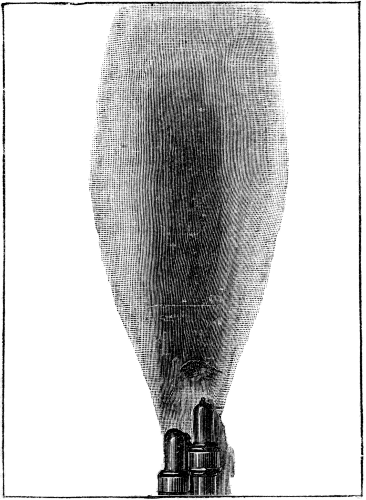
Fig. 1.
That some ceilings appear striped with broad light and dark lines is due to inequalities in the temperature of the ceiling. The light stripes are under the joists, which prevent to some extent the escape of heat from the ceiling, and the dark correspond to the unprotected parts of the ceiling. The dust rising from the room is slightly repelled by the currents from the warmer parts of the ceiling, and sticks more readily to the colder parts.
Let us take for our second example the apparently trivial matter of smells in the house. Smells may be of various kinds from various causes. The best judge of the kind, and therefore of the cause, is the nose. Suppose the smell to be the common one in houses of all classes—the smell of cookery! The smell of cookery in the house is generally a winter phenomenon. The air in an inhabited house is always in a state of motion, induced by the inequalities of temperature caused by the inhabitants themselves, and to a greater extent by the fires, of which there will certainly be one in the kitchen. We must remember that cold air will get into the house through all available openings, to take the place of the air which supplies the fires. The most obvious available openings in an ordinary dwelling-house are the casual ones of the open chimneys of unused grates, and the loosely fitting doors and windows. In cold weather fires are lighted in the sitting-room grates; these fires when lighted should warm the air in the chimneys above them and cause an upward draught in the chimney. Sometimes however the chimney will be found to be occupied by a current of air coming down to feed fires in other rooms, and so long as this goes on the smoke from the newly lighted fire comes into the room. The down-draught can be stopped by opening a window to supply sufficient cold air to counteract it, otherwise we have to adopt special devices to make the smoke go up the chimney in the first instance. Sometimes a newspaper is burnt in the grate to give the necessary amount of warm air, but this is a dangerous practice by which the chimney may be set on fire. Sometimes air is supplied by the bellows. A newspaper is often held in front of the grate so as to close the opening above the fire and cause the cold air to pass through the fire, thus promoting combustion and the supply of hot air in the chimney. In any case, the warm air of the fire is carried up the chimney by the cold air of the room, and this cold air is drawn from the casual openings already referred to. It has been demonstrated by laboratory experiments that the amount of draught in any chimney depends on the height of the chimney and the fire in its grate.
Smells are conveyed about a house by the flow of air to feed the fires, and they nearly always find their way from all parts of the house to the ground-floor sitting-rooms when the doors are left open and the fires are burning. On their way they pass through passages and are therefore nearly ubiquitous. The air of any room in the house is in communication with that of every other room, and it is only by the nature of the smell that we can tell its probable source. There are people who like when they open the bedroom door in the morning to know that coffee and bacon await them downstairs, or on coming into the house from a cold winter’s walk to meet a “delicious smell of Irish stew.” To other people all smell of cookery is abhorrent, and they feel a sense of irritation that their guests should on entering the house be regaled with the odour of the preparation of food. To many mistresses the only remedy that suggests itself is a message to the cook, who is powerless in the matter and returns an answer that she is sorry, but that she doesn’t know why there should be a smell of cooking upstairs as there is none in the kitchen. A visit to the kitchen will generally confirm the cook’s statement as to that particular spot, but a considerable smell will be encountered on the kitchen stairs. We may inquire into the cause of this. The usual equipment of the kitchen includes a closed range, supplemented in many cases by a gas stove. The kitchen fire draws a plentiful supply of air from casual openings, and this air for the most part passes with the smoke up such flues as are open. The oven is provided with a ventilator, which carries off the odour of baked or roasted meats. The odour in the hot air over the closed range has no escape except into the kitchen—the cook says that ever so slight an opening in the top of the range will prevent the oven from heating. This odour-laden air therefore comes directly into the kitchen, and being hot is directed to the ceiling, thus escaping the cook who is in the draught of the fresh air supply. Travelling along the ceiling the hot air passes through the opening at the top of the door and mingles with the fresh air on its way upstairs. The same thing happens when the gas stove is in use. The only remedy is to provide some exit for the hot air of the kitchen which will be more easily accessible than that by way of the door, for the hot air will travel by the easiest path. A considerable knowledge of science is required to achieve this object.
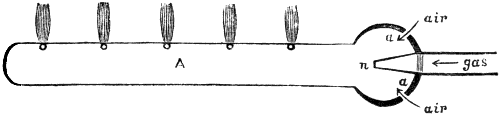
Fig. 2.
Closely allied with the smell of cookery is the smell of the gas stove. Many persons consider that the use of a gas stove either in the kitchen or in a bedroom is inseparable from the peculiar odour of partially consumed gas. It may therefore be useful to consider how the gas supplied to stoves and incandescent lights differs from that of an open gas fire or that of an ordinary burner. Gas stoves and incandescent lights get their supply of gas through what are known as Bunsen burners, so called after the German chemist whose invention they are. In an ordinary burner the gas mixes with atmospheric air at the opening at which it burns; the supply of air obtained in this way is insufficient for complete combustion until the outer layers are reached; the interior part of the flame is bright and smoky. In the Bunsen burner the gas issues from the main through a nozzle which opens inside a bulb. The bulb is perforated to allow of the ingress of atmospheric air; the gas and air mix in the tube which is a prolongation of the bulb, and the mixture is lighted at the top of the tube. Fig. 2 shows a representation of the Bunsen burner as applied to a gas stove. In this the gas escapes from the main at the nozzle n, into a bulb of which the tube A is a prolongation, air is admitted to the bulb at the openings a a, and the mixed gas and air is burnt at the openings in the tube A. The amount of air supplied is regulated by the size of the openings a a and the holes where the gas is lighted. The gas thus supplied with air is completely consumed where combustion begins, and a clear, blue, non-luminous flame is the result. If the holes through which the mixture of gas and air issues are partially closed by rust or by accretions from the “boiling over” of saucepans it is evident that, the gas supply being unchanged, less air can be drawn through them; consequently the gas will not be entirely consumed, and acetylene (C2H2, one of the products of partially consumed coal gas) will pass into the atmosphere and will give rise to the peculiar odour associated with gas stoves. This product of partially consumed gas is very poisonous, and all gas stoves should be furnished with chimneys to carry off the fumes to the open air. The phenomenon known as “burning back,” that is, the ignition of the gas at the nozzle in the bulb, is caused by the pressure of gas being too small for the supply of air. The gas should at once be turned out and relighted till it burns at the proper places. The simple remedy for smell from a gas stove is the cleansing of its burners, unless indeed the kettle is too close to the holes from which the gas issues for complete combustion to be possible.
There is another winter phenomenon which is very disagreeable—the presence of fog in the house; and the perplexed housewife asks, Where does the fog get in when all outside doors and windows are closed? We have already pointed out that the sitting-room fires must have air, and that that air will be drawn from casual openings. Among these openings are the chimneys of fireless grates; the greater part of the fog in the house comes down these chimneys. On a foggy day it is wise to close the chimneys of fireless grates and provide some other opening for the supply of air; but all air from the outside is full of fog. The problem of how to let in air and keep out fog suggests the question, What is fog? Fog consists of material particles (dust or smoke) on which vapour has condensed; if these particles can be removed the air will be clear. The problem for the housewife is how to free a sufficient quantity of air from these particles.
A smell of gas in any part of the house may be very dangerous if no one on the premises has any scientific knowledge, for it may be premised that the escape of gas is not where the smell is first perceived. Gas being lighter than air is carried upwards, and the smell is at first above the place of escape; it may even be in a room over where the gas is escaping. The only safe detector of the source of mischief is the nose; the mixture of coal gas and atmospheric air is explosive, and no light must be struck. The upper sash of the window should be pulled down to allow the gas to escape, and if the accident is at night time must be allowed before searching for the source of escape further than can be done by feeling the taps in the dark or following the scent by the nose.
Further illustration of the effect of convection currents in the air of a dwelling-house are needless, but the student may profitably spend time and thought in considering how fresh air may be introduced into a room without causing cold air to lie on the floor or hot, vitiated air to cling to the ceiling. It is the old problem (with a difference) of teaching a grandmother to suck an egg. He may also interest himself in seeking answers to the questions (1) What action is expected to take place when a poker is placed against the bars of a grate to make the fire draw? and (2) Does the sun put the fire out, and if so how? In connection with the expansion of air with heat he may consider the popular fallacy that an inverted empty pot in a pie keeps in the juice.
EFFECT OF CHANGES OF TEMPERATURE ON WATER
Accidents have occurred in houses owing to ignorance of the full effects of heating or cooling water from its ordinary temperature. Water at any ordinary temperature expands when subjected to the action of heat; it contracts on cooling till it reaches a temperature seven degrees above the freezing point; from this temperature it expands until it becomes a solid mass of ice. At still lower temperatures ice contracts.
Let us consider first the effect of heating water. If water at the ordinary temperature be poured into a vessel which is placed on a fire or other source of heat the water at the bottom of the vessel will be warmed and will expand; it will therefore be lighter, bulk for bulk, than the water nearer the top of the vessel. The cold water will therefore descend, and the warm water will rise. All ordinary water contains air; presently the air in the water will become visible as small bubbles which rise to the surface of the water and escape noiselessly into the atmosphere. As more heat is applied some of the water in the bottom of the vessel will be formed into steam, and bubbles of steam will expand and rise into the cooler water above and collapse there with a rattling noise which is characteristic of the state known as simmering. These bubbles of steam rising and bursting aid the convection currents in stirring and mixing the water so that it presently becomes of even temperature throughout. When this occurs the bubbles of steam rise to the surface and burst explosively into the atmosphere, throwing the water violently about; the water is then boiling. It is an important point to remember in cookery that boiling water will not become any hotter with the application of more heat, but it will “boil away;” that is, it will be completely converted into steam. The steam resulting from any volume of water occupies a space 1700 times that of the water from which it is produced, but what concerns the housewife most seriously is that the change of water into steam is accompanied with the evolution of tremendous mechanical force that will burst any vessel in which the water is enclosed. It is the fact of this tremendous exercise of mechanical force that has led to serious accidents when hot-water bottles have been put into the oven to keep warm. It has been assumed by some people that if the hot-water bottle be not completely filled, that if what they consider to be sufficient room is left for the expansion of the water, no harm can result from putting the bottle into the oven, but no arrangement can make such a course safe.
The bursting of the kitchen boiler is an accident resulting from disregard of the phenomena of heated water. It sometimes happens that the hot-water supply of the various taps in the house fails. If the boiler supplying the water is a hand-fed one some one whose duty it was to fill it has neglected that duty. An empty boiler with a removable lid will do no harm, but it is not advisable to leave it empty, as the heat of the fire will destroy the iron of which it is made. No attempt, however, should be made to fill the boiler while it is hot, as the result of pouring cold water into it will be the sudden and violent conversion of the water into steam, and the person pouring in the water will assuredly be scalded. If the boiler be one that is filled automatically, one of two things has probably occurred: either the pipes are blocked by fur—that is to say by sediment from the boiled water—or the supply-pipe is frozen. In neither case is it safe to light the fire. If the pipes are blocked by fur steam will be formed in the boiler and it will burst; if the supply-pipe is frozen the heat may thaw the ice, and the inrush of cold water will at any rate crack the boiler.
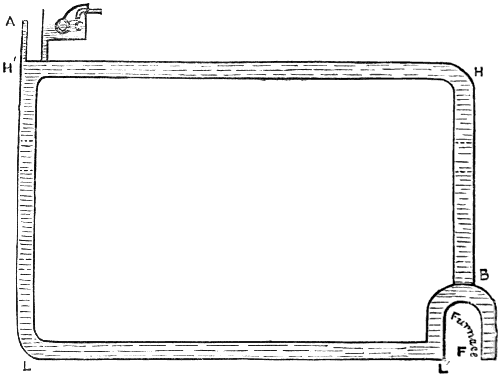
Fig. 3.
When water expands with heating convection currents are formed in it, and the hot water rises to any height we please if cold water be available to take its place. This law of convection is applied to maintain a circulation of hot water in pipes used for warming a house. The general arrangement of such a system is shown in Fig. 3. The furnace heats a boiler in the basement or on the lowest storey of the house; HB and HL’ are parallel vertical pipes connected with a horizontal pipe H’H at the top of the house; C is a small cold-water cistern which is furnished with a ball-tap to maintain the supply of cold water to the pipe H’L if any water is drawn off at any part of the circuit. The short pipe A acts as a valve for the escape of air from the pipes. The pipes H’L, H’H, and HB are filled with water. When the fire is lighted in the furnace, hot water is driven up the pipe HB by cold water descending through H’L, and this circulation goes on so long as a difference of temperature is maintained in the pipes; that is, so long as the fire is burning. Any number of coils of pipes may be introduced into the circuit between the boiler and the top of the pipe HB. In filling the pipes with water allowance is made in these coils for the expansion of the water with heat and for the air which we have seen escapes from heated water, and a tap is fixed in each coil for letting out any air that may have lodged in it. If free air remains in the pipes the circulation of the water will be hindered and the boiler may become dangerously overheated. It is therefore necessary when the heating apparatus is in use to examine these taps and see that water and not air escapes from them.
The installation of a heating apparatus in middle-class houses is fairly common, and where one is not found many persons use gas or oil stoves in the passages in the winter, for it is now realised that it is not possible to heat rooms by means of open fires without creating cold draughts in them from the cold passages into which they open. And, moreover, the constant change of temperature encountered in passing from one warm room to another through cold passages is not only disagreeable, but is not found to be conducive to health.
Let us turn to the cooling of water. Water expands about one-eleventh of its volume on becoming ice. This change of state, like that of change into steam, is accompanied by the evolution of tremendous mechanical force. If water freezes in pipes it bursts the pipes, and on a thaw taking place the pipes are found to leak. The appropriate remedy for this state of things is to protect the pipes from cold or to empty them when a frost is apprehended. In all properly built houses there is a tap by means of which the water supply can be cut off from the house, thus allowing the pipes to be emptied on a frosty night. The custom of leaving the taps dripping is effective, because the pipe is generally liable to freeze at some particular point where it is in immediate contact with the cold air, probably in the unclosed chink where the pipe passes through the wall; keeping the water moving in the pipe prevents any part of it getting cold enough to freeze, but the practice should not be resorted to, as it wastes water.
RADIANT HEAT
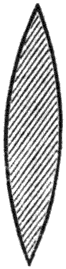
Fig. 4.—Section of a Convex lens.
It is pleasant on a dry, still day in winter, when the ground is covered with crisp snow or glistens with hard frost, to feel the warmth of the sun’s rays, and it is becoming quite a fashion for people of leisure to spend the winter months at the pleasure resorts amid the snow-laden mountains of Switzerland. It is a matter of some interest to inquire how it happens that the sun’s rays are warm when the thermometer tells us that the temperature of the air is below freezing-point. There is an old and pretty experiment in which a burning glass is made of ice; it is not a difficult thing to do. If the scale-pan of an ordinary balance be made hot and be pressed against a slice of ice (the concave side of the scale-pan towards the ice), first on one side of the slice and then on the other, the ice can be formed into a convex lens (Fig. 4). If now this lens be placed in the path of a sunbeam and the light be brought to a focus, that is, to a bright spot on a piece of paper, the paper will be heated and will take fire while the lens through which the heat passes remains ice. From this we may surmise that the heat of the sun does not affect the medium through which it passes.
Clerk Maxwell suggested yet another experiment in illustration of this law. By means of an ice lens he collected the sunlight to a focus in the middle of a basin of clear water, and observed that no effect was discernible in the water. He then directed the focus (the spot of light) on to a mote in the water. The mote became hot, the water was agitated, convection currents were formed, and the mote was carried up in them. This showed that rays of light from the sun do not affect the substances through which they can pass, and that they heat bodies through which they do not pass. It has been demonstrated by laboratory experiments that all hot bodies emit rays of heat, whether we see the rays or not. When we see the rays the bodies are said to be red or white-hot. The process by which heat passes from one body to another without warming the intervening medium is called radiation. Radiation takes place only through transparent bodies. Rays of heat, like rays of light, pass through transparent bodies; whereas they are absorbed by, that is they make hot, opaque bodies. Heat rays travel in straight lines and are reflected from polished surfaces; their intensity varies inversely as the square of the distance of the object on which they fall from their source. The heat of an ordinary fire is radiant heat; when we sit round the fire we act as opaque bodies and absorb the heat, and are what we call scorched if the fire is very bright. If we move away from the fire, still letting the same firelight shine on us, we are not scorched; this is because the heating power of the rays varies inversely as the distance from their source, therefore if we move away double the distance we receive one quarter of the heat that we received before we moved. If we draw our chairs to one side we are not scorched, because the rays of heat do not travel round a corner.
CONDUCTION OF HEAT
We have seen that the ice-lens was not affected by the passage of heat through it. If we now take hold of the lens we shall experience a feeling of cold, and the lens will begin to melt. Heat has passed from our hand into the ice. The process by which heat passes from one body to another in contact with it is called conduction. The fundamental law of conduction is, that heat always passes from a warm body to a cold one. Clerk Maxwell illustrated this law in a series of very simple experiments. He placed a silver teaspoon in a cup of hot tea, and noted that the handle became warm gradually from the hot tea; the heat passed from the bowl of the spoon in the tea to successive parts of the handle until the whole spoon was hot. His second experiment was to put two cold spoons, one of silver and one of German silver, into the tea, when he found that the same phenomenon took place, but that the silver spoon became hot much more quickly than did the German silver one. He then put three spoons into the tea, made respectively of silver, of German silver, and of bone. In the result, he found that when the other two were hot, the bone spoon hardly showed any sign of heat at the end of its handle.
The conclusion to be drawn from these experiments is that heat passes at different rates through different substances. Substances through which heat passes quickly are called good conductors of heat. The law of the conductivity of heat is that in a homogeneous body the flow is continuous, and is from the region of high temperature to the region of low temperature, and that it continues until the body is of uniform temperature throughout. The law is the same for bodies of different materials when in contact one with another.
The conduction of heat is in operation in every department of domestic life. People live in houses and are clothed to protect them from the vicissitudes of the weather, including the cold of winter and the heat of summer; use is made of the phenomenon in warming the house and in the preparation of food.
In selecting materials for various purposes, account has to be taken of their conductivities, for in some cases it is desirable that the transfer of heat should take place slowly, and in others that it should take place quickly. It might be thought that the conductivity of a substance could be estimated by touch, but a little reflection will show that this cannot be the case. The flow of heat between two bodies depends upon the difference of temperature between them, and if there should be no difference of temperature between them at the moment of touch there will be no flow of heat, though both are bodies of greater or less conductivity. Let us take, for example of the uncertainty of estimation by touch, a well-known experiment. Suppose we have a basin of hot water and a basin of cold water, and place a hand in each for a few moments; suppose we withdraw the hands and plunge them into a basin of tepid water, we shall find that the tepid water feels cold to the hand that was in the hot water and warm to the hand that was in the cold water.
Luckily, it has been found possible in the laboratory to refer substances to a common standard and to assign numerical values to them in order of their conductivities, so that substances can be compared and a selection made for any desired purpose. Pure silver has the highest conductivity; other useful materials take the following order: copper, zinc, lead, iron, steel, marble, glass, brick, slate, wood, fur, cotton, flannel, water, air. Fur and wool no doubt owe much of their warmth to the fact that they consist of fibres which enclose a good deal of air, but as a matter of fact the warmth of loosely woven woollen and knitted articles in general is often overrated; they are very warm as under garments or in calm weather, but in windy weather the air in them is rapidly changed and the cold seems to blow through them. If for any purpose we select a material from its place in a table of comparative conductivities, and use it without reference to the law of conduction of heat, we shall probably be disappointed with the result. We know that cotton burns easily; if we stretch a cotton handkerchief over the back of a gold watch and place a red-hot cinder from the fire on the handkerchief on the watch, the handkerchief will not be burnt.
Many interesting problems present themselves when a house has to be built or rented. There is often opportunity for some choice of material in walls or roof, and some peculiarities to be considered. Are the top rooms of a thatched cottage warmer or colder than the top rooms of a house covered with slates? Is a wooden or an iron building warmer? What difference does it make if the iron building is lined with wood? If the iron walls were twice as thick, what would be the effect inside the room? Would the walls of such a building be always dry inside? It sometimes happens that the end wall of a row of houses is covered with slates to preserve it from the effects of storms of wind and rain; will that inside wall be always dry?
But the housewife is probably more interested in those articles in use in the house which it is her business to provide. Shall the stoves be of slate or iron? In olden days warming-pans were made of copper. What change in the manner of use justifies making them of earthenware or India-rubber? The slow transmission of heat through thick woollen materials has been applied to the construction of Norwegian cooking-stoves (Fig. 5). These stoves consist of a wooden box, lined with well-padded felt. The cooking vessels are of metal; the food when at boiling point is placed in these vessels and the lids put on, a thick padded felt is placed on the vessels and entirely fills the wooden lid of the box which is then closed; the heat is preserved so that the cooking is continued without further attention. Would it be possible to use the Norwegian stove as a refrigerator? Would it keep an ice pudding cold without any alteration? In connection with this we may ask why freezing machines have the inner vessel in which the freezing takes place of zinc, and the outer vessel which contains the ice and salt of wood? What would be the effect of interchanging the materials?
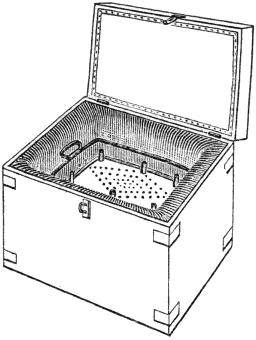
Fig. 5.
It is possible that the excellence of some continental cookery is due to the extensive use on the continent of earthenware cooking utensils through which heat passes very slowly. The growing fashion of using enamelled cooking vessels must have some effect on the food cooked in them as heat certainly passes quickly through them. Reference has been made to them simply to demonstrate the universality of the application of physical laws, and we may now return to the house and its arrangement for the comfort of the inmates.
METHODS OF DOMESTIC HEATING
The two methods of warming a house are by radiation and conduction. We may surmise that in any case both methods will be in use, but the one will predominate; for instance, in heating by an open fire radiation will predominate, and in heating by stoves and radiators conduction will predominate. In planning a house a decision must be made between the two. This decision being made there is the further consideration of where the source of heat shall be placed. In the case of an open fireplace shall it be in an end wall, in a corner, in an outside wall, and so on, the object being to make the greatest possible use of the heat that passes up the chimney and of that which radiates into the room. The same consideration must be paid to the situation of the closed stove; where will it pass heat by conduction to the greatest volume of air, and where can its radiant heat be utilised?
In a room heated by a stove there is frequently a vessel of water placed by or on the top of the stove. If we ask what is the purpose of this water we shall be told that the stove dries the air in the room. Now, it is impossible that the heat of the stove should remove any moisture from the air; we must therefore seek an answer to the question, What is dry air? The sensation of the dryness or moisture of the air does not depend only upon the amount of vapour in the air but upon the ratio of the amount present to the amount that the air is able to hold at the given temperature. The warmer the air is the more vapour it can hold, hence when the air is warmed the percentage of water present to the possible amount in it is lowered; that is its humidity, which is the percentage amount, is lowered, and we feel it to be dry. The question may arise why we should feel this when the room is heated by a stove and not when it is heated by an open fire? It may be that in a room with an open fire we are warmed by radiation and give out heat to the surrounding air which is constantly changed by convection currents, so that the air we breathe is colder than we ourselves; and that in a room warmed by a stove we receive heat from the air and are constantly breathing air that is warmer than we ourselves. But it is more than probable that the custom of providing a source of moisture to the air persists from the suggestion of a single person in seeking to relieve the disagreeable feeling attending the breathing of air laden with the poisonous products of half-consumed gas, and that it has no real scientific foundation.
How to estimate temperatures.—Whatever method is adopted for warming a room, the housewife may be assured that the resulting temperature will not be pleasing to every member of the family. One will find it too warm, and another will at the same time find it too cold, and this not from any wilful captiousness but from the cause that we have already alluded to, that the feelings are a very uncertain test of temperature. It is therefore advisable to keep the air of the room as far as possible at a standard temperature. To do this it will be necessary to have a thermometer in the room, and to know what its readings indicate. When the thermometer registers 32° Fahr. or less, water will freeze in the room, and the vessels in which it is kept will burst; it is therefore wise, when it is anticipated that the temperature will fall below 32° Fahr., to empty the ewers and bottles that may be in the room. From 32° Fahr. to 40° Fahr. the room will be very cold, up to and including 58° Fahr. it will be too cold to be pleasant; the standard temperature may be taken as between 62° and 64° Fahr.
It may appear a simple matter to hang up a thermometer and read it, but a little thought will show that it is not so easy as it seems. If, for instance, the thermometer is placed in front of the fire at a distance, say of four feet from it, what will its reading indicate? Will it be the temperature of the air of the room or the temperature of the fire, or if neither, what will it be? Suppose we have two identical thermometers, and hang them on adjacent walls, one of which is an outside wall, which of the two readings shall we take as that of the temperature of the room? It is not an easy matter to decide. In a sick-room, where one person’s comfort only has to be considered the doctor will order the thermometer to be hung at the bed-head, but we cannot adopt this plan in a general sitting-room.
CHEMICAL SCIENCE IN THE HOUSEHOLD
In our endeavour to establish the claims of the science of chemistry to a prominent place in the educational equipment of women, all reference to those most interesting and important chemical phenomena that accompany the exercise of the physiological functions will be omitted; as also those which are most immediately concerned with the preparation of food. Attention will be confined to some of the common occurrences of daily life, the methods of dealing with which are typical of the method adopted in considering more important and abstruse problems.
Perhaps one of the most disappointing experiences of the novice in housekeeping is the rapidity with which everything assumes a shabby aspect. Bright paint grows dull, dull paint wears away, curtains and fabrics fade, and very soon mistress and maids alike feel that the house no longer repays the trouble incurred in the spring-cleaning that it must still undergo. This spring-cleaning, the primary object of which is the preservation of the beauty and substance of the house and its appointments, is in the result the cause of much of their deterioration.
Cleaning consists in removing dirt by means that are partly physical and partly chemical; for instance, the removal of dust by sweeping, shaking, or brushing is a physical operation, and the removal of dirt and grease by dissolving them in soapy water involves their change by a chemical process. If the surfaces or materials to be cleaned include a substance on which the cleansing agent can operate the agent will not confine its work to the removal of the dirt only; in washing coloured fabrics we know how often the colour comes out with the dirt. Knowledge therefore, not only of the composition and properties of cleansing agents, but also of the surfaces and materials to which they are to be applied, is essential, and we should find that it is not always the powder or paste which makes the greatest show of cleanliness in the shortest time, with least expenditure of labour, that is the most to be desired.
The use of alkalies.—The most common cleansing agents are hot water, soap, and soda. Hot water is itself a detergent; that is, it has the power of dissolving dirt. It does not, however, dissolve grease, and all household dirt is more or less greasy, hence we cannot do our cleansing with water only, and we are accustomed to add to it soap or soda.
It is not easy or even possible to discuss the chemical properties of substances without the use of chemical terms. Substances are classified for chemical purposes in groups, every member of which exhibits the same chemical property, and we shall require to distinguish between the group called acids and the group called alkalies. It will be sufficient for our purpose just now to know that acids have a sour taste and that alkalies counteract acids. From this definition lemon-juice will easily be recognised as an acid. If we add soda to lemon-juice there will be a brisk effervescence and the lemon-juice will no longer be sour, hence soda is an alkali. Alkalies have another well-known chemical property—they dissolve grease and oil and enable them to mix with water. If we have some hot water in a tumbler and pour oil into it the oil will float on the water, and if we stir the two together the oil will break into globules but will still float on the water; we cannot mix them together. If we dissolve some soda in hot water and pour in oil we shall find on stirring that the mixture becomes milky or soapy in appearance and the oil and water are no longer discernible as different fluids. Moreover, on standing the oil will not again separate from the water; it has been emulsified. Oils themselves have the chemical power of dissolving resins. Resins are hard, bright vegetable gums which will come under our notice when we consider the composition of varnishes.
All hard soaps are made from soda, grease, and resin; the cheaper soaps contain free soda, the dearer ones contain an excess of fat. Yellow scrubbing soap contains about eight per cent. of free soda. Both soap and soda can be dissolved in water, and are so dissolved for cleaning purposes. Knowing the constituents of our cleansing agents, we can consider their action on paint and varnish. Paint contains white-lead, linseed-oil, and colouring matter. It is not very hard when dry and can be easily scratched with the nail. Varnish is made from linseed-oil, resin, and turpentine. When dry it should be very hard and bright.
The whole of the painted woodwork of the house is subjected to spring-cleaning whatever its appearance with regard to dirt may be. The operator throws into a pailful of hot water a “handful” of soda, soaks a scrubbing-brush in the mixture, rubs it well with soap, and uses it to brush the somewhat soft paint or harder varnish. The soda and soap, aided by the heat, soften the paint and the brush removes a quantity equal to about a coat of paint. The effect is certainly pleasing for the time being, but there will be no difficulty in understanding that the process can only be repeated until the paint and varnish grow shabby or disappear.
It is not wise for the inexpert housewife to trust to unscientific friends for advice as to the best materials to use when cleaning paint. A foreman painter once gave, as a recipe for this purpose, an instruction to add a tablespoonful of “salts of tartar” to three-quarters of a pailful of water. The result was a very rapid and complete removal of dirt from the paint, but the housewife, being dissatisfied with the rather dull appearance of the white varnish, stroked it with her finger and found that it was covered with a fine white powder. The maid’s assurance that this was all right and only needed to be removed by dusting did not satisfy her, and she began to wonder what chemical action was to be expected from “salts of tartar.” A first search for information revealed that salts of tartar was an old name for “potassium carbonate,” but the housewife knew no chemistry and had never heard of potassium carbonate, so this information was useless to her. She had, however, had some scientific training and was not satisfied to rest in ignorance. A search in a book on elementary chemistry disclosed the further truth that the commercial name for “potassium carbonate” is pearlash! She then remembered that being desirous at one time to remove the paint from some oak carving said to be two hundred years’ old, she had successfully used a solution of pearlash painted on with a brush. The paint when dry from the application had been scraped off in long, tough ribbons. Of course the mixture had been very much stronger than that prescribed by the painter, but the effect had been very much more apparent.
Acids and alkalies are to some extent responsible for the fading of fabrics in the wash when these fabrics owe their colour to vegetable dyes. Acids turn vegetable blues red, alkalies turn vegetable blues green and vegetable yellows brown. It is easy to illustrate this action of acids and alkalies on vegetable colours. A blue liquid can be obtained by boiling a red cabbage in water. If we take two portions of this water and add any acid, say lemon-juice, to one portion we shall obtain a red liquid; if we add any alkali, say soda, to the other portion we shall obtain a green liquid. If we go a step further and add lemon-juice to the green liquid and soda to the red liquid we may approach very nearly to our original blue liquid. These experiments suggest a remedy for the change of colour in fabrics on washing with soda, but the dyes most commonly used are not vegetable dyes, and the fading of the fabrics is due to chemical changes, into which we have no space to enter.
Strong acids and alkalies act as caustics; that is they destroy fabrics. Continued washing in strong soda and water not only tends to destroy, but also spoils the appearance of all kinds of wearing apparel and household linen. White silk and wool at once become yellow on being washed with soap that contains free soda, and linen is affected in the same way though not to the same extent.
The widely advertised pastes and liquids for cleaning metal-work, particularly brass, often contain acids or alkalies that are injurious to metals. If after cleaning there should be a green deposit on brass or copper it will be wise to inquire into the composition of such deposit, and to discontinue the use of that paste or liquid. When brass pans are used for boiling fruit for jams, it is usual to rub them inside with a slice of lemon before putting in the fruit. A careful housewife will consider the reason for this custom. We remember once seeing a copper pan, that had been provided for the preparation of oatmeal porridge, with a band about an inch wide of green crystals on the inside. Inquiry elicited that the cook had thought it a convenient pan in which to prepare the fish (salt haddock) for breakfast. Ignorance of the chemical action of salt and acids on metals may lead to very serious results. The common name for the green deposit on brass and copper is verdigris, and most people know that verdigris is a poisonous compound; the difficulty is that, not knowing its chemical composition, they do not recognise verdigris when they see it. The cook thought that the complaint made had reference only to the misuse of the pan, and said that it was quite easy to clean the green deposit off!
THE CHEMISTRY OF THE BODY
It is to the science of chemistry that we owe our knowledge of the composition of the various foodstuffs from which dietaries are selected, as well as of the several parts of the human body which relies for its sustenance on those dietaries. But the adjustment of dietaries to the work they have to do is a more complex problem than those we have hitherto considered. We learn from the science of physiology that the human body is a laboratory in which certain juices are secreted for the digestion of foods, and that in this laboratory foods must be reduced to the consistency necessary for their passage through animal membranes; for it is by passage through membranes that the nutritive parts of food find their way into the general circulation of the blood which carries them to all parts of the system. Very few foodstuffs are available for use in their natural state, and the majority of them are prepared for consumption in the first place by more or less elaborate processes included in the art of cookery. When thus prepared they should be in a fit state to undergo in the body the physical changes comprised in mastication, and the chemical changes associated with the process of digestion.
It might be surmised by the thoughtful parent that as the child’s body lacks some of the external features of the adult body, such as hair and teeth, so there might, and probably would, be corresponding lapses in the internal economy, and that therefore the food prepared for the adult would be, even in the smallest quantity, unsuited to the child. Physiologists tell us that this is so, and in particular that the secretions which in adult life are called saliva and pancreatic juice and which have the function of preparing starch for digestion, are at this time scanty in amount and deficient in chemical action. But these secretions are essential for the digestion of starchy foods, and chemists tell us that starch abounds in the vegetable kingdom from which most of the food of children is derived. It is therefore a matter of some importance that every person in charge of an infant should have that amount of knowledge of chemical reactions which is requisite to enable them to detect whether a food does or does not contain starch. A child fed entirely on starchy foods suffers from malnutrition of so serious a character that death may, and often does, ensue. Even if other suitable food, such as modified milk, be given, the internal economy of the child will be seriously disturbed.
The names by which patent foods are advertised are very often misleading to unscientific persons, and invalids have suffered much from the mistaken idea that jellies and meat extracts are foods. Meat extracts have their use, but any invalid fed on extract of beef only would die sooner than one left with no food at all. The reason for this can be learned from the knowledge of the constituents of beef extracts and the part they play in the human organism.
CONCLUSION
If we have seemed to lay stress on the value of a knowledge of the sciences of physics and chemistry to the exclusion of the mention of others, our justification of the fact is that space is limited, and that we believe that physics and chemistry underlie all the other sciences and are of paramount importance to students of all other subjects. In the sciences of biology, physiology, botany, geology, &c., little advance can be made without a knowledge of the fundamental laws of nature. The physical laws control movement, and the chemical laws control growth, whether of animate or inanimate nature. Physical and chemical phenomena are concerned in the upheaval of rocks and mountains which govern the contour of the continents of the world. These contours influence climates and peoples; as the contours change the people change. The dwellers in the mountain regions differ in character from the dwellers in valleys and plains; the inhabitants of cold districts differ from the inhabitants of warm districts; but it is people who make history, and historians cannot afford to pass by natural environments and natural laws.
If a foundation of the fundamental sciences be laid at school the student can subsequently build upon it the special science that is suited to his career. It matters little what the calling in life of any person may be; if he aim at success in that calling he must acquaint himself with the laws by which he has his being, and by which he must perforce be guided in all his actions as well as in his intercourse with his fellow-men.
The many avenues now open to women for public work entail on them the responsibility of fitting themselves for that work. They as much as, if not more than, the housewife need to study the sciences which treat of the safeguarding of human life. As councillors dealing with sanitary and building laws, as inspectors of workrooms, of institutions, and of the conditions of child-life, they owe it to themselves and to the community they serve not to undertake those duties without adequate knowledge. Adequate knowledge must be taken to mean scientific knowledge of those matters of which, by offering themselves for such appointments, they assume an expert knowledge. It is an irony that scientific training should be willingly and even eagerly acquired when it is a question of qualifying for a salaried post for work among strangers, and that a mother should be content to bring to bear on the well-being and lives of her own circle unscientific and amateur experience.
We have only been able to touch the skirt of a great subject, but our end will have been achieved if we have succeeded in pointing the way for a fuller realisation of the aims of earnest men and women for the saving of child-life and the mitigation of disease, and if we have shown how great that subject is—how much too great for anything but the most superficial treatment in a single article.