PROTECTION OF FOOD AND OTHER STORES FROM RATS AND MICE.
Reading edition
Past attempts to exterminate rats and mice have failed, not so much because of lack of effective means as because of the neglect of necessary precautions and the absence of concerted endeavors. We have rendered our work abortive by continuing to provide subsistence and hiding places for the animals. If these advantages are denied, persistent and general use of the usual methods of destruction will prove far more successful.
RAT-PROOF BUILDING.
First in importance, as a measure of rat repression, is the exclusion of the animals from places where they find food and safe retreats for rearing their young.
The best way to keep rats from buildings, whether in city or in country, is to use cement in construction. As the advantages of this material are coming to be generally understood, its use is rapidly extending to all kinds of buildings. The processes of mixing and laying this material require little skill or special knowledge, and workmen of ordinary intelligence can successfully follow the plain directions contained in handbooks of cement construction.[5]
Many modern public buildings are so constructed that rats can find no lodgment in the walls or foundations, and yet in a few years, through negligence, such buildings often become infested with the pests. Sometimes drain pipes are left uncovered for hours at a time. Often outer doors, especially those opening on alleys, are left ajar. A common mistake is failure to screen basement windows which must be opened for ventilation. However the intruders are admitted, when once inside they intrench themselves behind furniture or stores, and are difficult to dislodge. The addition of inner doors to vestibules is an important precaution against rats. The lower edge of outer doors to public buildings, especially markets, should be reinforced with light metal plates to prevent the animals from gnawing through. Any opening left around water, steam, or gas pipes, where they go through walls, should be closed carefully with concrete to the full depth of the wall.
Dwellings.—In constructing dwelling houses the additional cost of making the foundations rat-proof is slight compared with the advantages. The cellar walls should have concrete footings, and the walls themselves should be laid in cement mortar. The cellar floor should be of medium rather than lean concrete. Even old cellars may be made rat-proof at comparatively small expense. Rat holes may be permanently closed with a mixture of cement, sand, and broken glass, or sharp bits of crockery or stone.
On a foundation like the one described above, the walls of a wooden dwelling also may be made rat-proof. The space between the sheathing and lath, to the height of about a foot, should be filled with concrete. Rats can not then gain access to the walls, and can enter the dwelling only through doors or windows. Screening all basement and cellar windows with wire netting is a most necessary precaution.
Old buildings in cities.—Aside from old dwellings, the chief refuges for rats in cities are sewers, wharves, stables, and outbuildings. Modern sewers are used by the animals merely as highways and not as abodes, but old-fashioned brick sewers often afford nesting crannies.
Fig. 2.—Rat-proofing a frame dwelling by concrete side wall (United States Public Health Service, New Orleans, La., 1914).
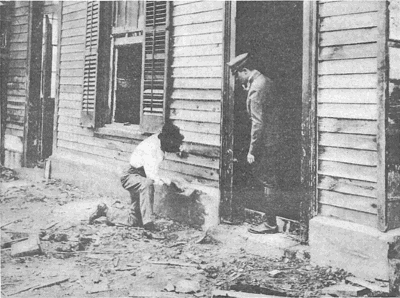
Wharves, stables, and outbuildings in cities should be so built as to exclude rats. Cement is the chief means to this end. Old tumble-down buildings and wharves should not be tolerated in any city. (See fig. 2.)
In both city and country, wooden floors of sidewalks, areas, and porches are commonly laid upon timbers resting on the ground. Under such floors rats have a safe retreat from nearly all enemies. The conditions can be remedied in towns by municipal action requiring that these floors be replaced by others made of cement. Areas or walks made of brick are often undermined by rats and may become as objectionable as those of wood. Wooden floors of porches should always be well above the ground.
Farm buildings.—Granaries, corncribs, and poultry houses may be made rat-proof by a liberal use of cement in the foundations and floors; or the floors may be of wood resting upon concrete. Objection has been urged against concrete floors for horses, cattle, and poultry, because the material is too good a conductor of heat, and the health of the animals suffers from contact with these floors. In poultry houses, dry soil or sand may be used as a covering for the cement floor, and in stables a wooden floor resting on concrete is just as satisfactory so far as the exclusion of rats is concerned.
The common practice of setting corncribs on posts with inverted pans at the top often fails to exclude rats, because the posts are not high enough to place the lower cracks of the structure beyond reach of the animals. As rats are excellent jumpers, the posts should be tall enough to prevent the animals from obtaining a foothold at any place within 3 feet of the ground. A crib built in this way, however, is not very satisfactory.
For a rat-proof crib a well-drained site should be chosen. The outer walls, laid in cement, should be sunk about 20 inches into the ground. The space within the walls should be grouted thoroughly with cement and broken stone and finished with rich concrete for a floor. Upon this the structure may be built. Even the walls of the crib may be of concrete. Corn will not mold in contact with them, provided there is good ventilation and the roof is water-tight.
However, there are cheaper ways of excluding rats from either new or old corncribs. Rats, mice, and sparrows may be kept out effectually by the use of either an inner or an outer covering of galvanized-wire netting of half-inch mesh and heavy enough to resist the teeth of the rats. The netting in common use in screening cellar windows is suitable for covering or lining cribs. As rats can climb the netting, the entire structure must be screened, or, if sparrows are not to be excluded, the wire netting may be carried up about 3 feet from the ground, and above this a belt of sheet metal about a foot in width may be tacked to the outside of the building.
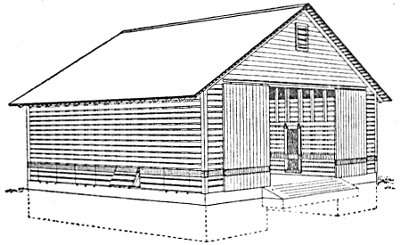
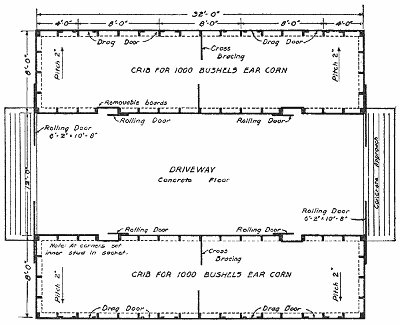
Complete working drawings for the practical rat-proof corncrib shown in figures 3 and 4 may be obtained from the Office of Public Roads and Rural Engineering of the department.
Buildings for storing foodstuffs.—Whenever possible, stores of food for man or beast should be placed only in buildings of rat-proof construction, guarded against rodents by having all windows near the ground and all other possible means of entrance screened with netting made of No. 18 or No. 20 wire and of ¼-inch mesh. Entrance doors should fit closely, should have the lower edges protected by wide strips of metal, and should have springs attached, to insure that they shall not be left open. Before being used for housing stores, the building should be inspected as to the manner in which water, steam, or gas pipes go through the walls, and any openings found around such pipes should be closed with concrete.
Fig. 3.—Perspective of rat-proof corncrib, showing concrete foundation by dotted lines; also belt of metal.
If rat-proof buildings are not available, it is possible, by the use of concrete in basements and the other precautions just mentioned, to make an ordinary building practically safe for food storage.
When it is necessary to erect temporary wooden structures to hold forage, grain, or food supplies for army camps, the floors of such buildings should not be in contact with the ground, but elevated, the sills having a foot or more of clear space below them. Smooth posts rising 2 or 3 feet above the ground may be used for foundations, and the floor itself may be protected below by wire netting or sheet metal at all places where rats could gain a foothold. Care should be taken to have the floors as tight as possible, for it is chiefly scattered grain and fragments of food about a camp that attract rats.
Rat-proofing by elevation.—The United States Public Health Service reports that in its campaigns against bubonic plague in San Francisco (1907) and New Orleans (1914) many plague rats were found under the floors of wooden houses resting on the ground. These buildings were made rat-proof by elevation, and no case of either human or rodent plague occurred in any house after the change. Placing them on smooth posts 18 inches above the ground, with the space beneath the floor entirely open, left no hiding place for rats.
This plan is adapted to small dwellings throughout the South, and to small summer homes, temporary structures, and small farm buildings everywhere. Wherever rats might obtain a foothold on the top of the post they may be prevented from gnawing the adjacent wood by tacking metal plates or pieces of wire netting to floor or sill.
KEEPING FOOD FROM RATS AND MICE.
The effect of an abundance of food on the breeding of rodents should be kept in mind. Well-fed rats mature quickly, breed often, and have large litters. Poorly fed rats, on the contrary, reproduce less frequently and have smaller litters. In addition, scarcity of food makes measures for destroying the animals far more effective.
Merchandise in stores.—In all parts of the country there is a serious economic drain in the destruction by rats and mice of merchandise held for sale by dealers. Not only foodstuffs and forage, but textiles, clothing, and leather goods are often ruined. This loss is due mainly to the faulty buildings in which the stores are kept. Often it would be a measure of economy to tear down the old structures and replace them by new ones. However, even the old buildings may often be repaired so as to make them practically rat-proof; and foodstuffs, as flour, seeds, and meats, may always be protected in wire cages at slight expense. The public should be protected from insanitary stores by a system of rigid inspection.
Fig. 4.—Floor plan of rat-proof corncrib shown in figure 3.
Household supplies.—Similar care should be exercised in the home to protect household supplies from mice and rats. Little progress in ridding the premises of these animals can be made so long as they have access to supplies of food. Cellars, kitchens, and pantries often furnish subsistence not only to rats that inhabit the dwelling, but to many that come from outside. Food supplies may always be kept from rats and mice if placed in inexpensive rat-proof containers covered with wire netting. Sometimes all that is needed to prevent serious waste is the application of concrete to holes in the basement wall or the slight repair of a defective part of the building.
Produce in transit.—Much loss of fruits, vegetables, and other produce occurs in transit by rail and on ships. Most of the damage is done at wharves and in railway stations, but there is also considerable in ships' holds, especially to perishable produce brought from warm latitudes. Much of this may be prevented by the use of rat-proof cages at the docks, by the careful fumigation of seagoing vessels at the end of each voyage, and by the frequent fumigation of vessels in coastwise trade; but still more by replacing old and decrepit wharves and station platforms with modern ones built of concrete.
Where cargoes are being loaded or unloaded at wharves or depots, food liable to attack by rats may be temporarily safeguarded by being placed in rat-proof cages, or pounds, constructed of wire netting. Wooden boxes containing reserve food held in depots for a considerable time or intended for shipment by sea may be made rat-proof by light coverings of metal along the angles. This plan has long been in use to protect naval stores on ships and in warehouses. It is based on the fact that rats do not gnaw the plane surfaces of hard materials, but attack doors, furniture, and boxes at the angles only.
Packing houses.—Packing houses and abattoirs are often sources from which rats secure subsistence, especially where meats are prepared for market in old buildings. In old-style cooling rooms with double walls of wood and sawdust insulation, always a source of annoyance because of rat infestation, the utmost vigilance is required to prevent serious loss of meat products. On the other hand, packing houses with modern construction and sanitary devices have no trouble from rats or mice.
Garbage and waste.—Since much of the food of rats consists of garbage and other waste materials, it is not enough to bar the animals from markets, granaries, warehouses, and private food stores. Garbage and offal of all kinds must be so disposed of that rats can not obtain them.
In cities and towns an efficient system of garbage collection and disposal should be established by ordinances. Waste from markets, hotels, cafés and households should be collected in covered metal receptacles and frequently emptied. Garbage should never be dumped in or near towns, but should be utilized or promptly destroyed by fire.
Rats find abundant food in country slaughterhouses; reform in the management of these is badly needed. Such places are centers of rat propagation. It is a common practice to leave offal of slaughtered animals to be eaten by rats and swine, and this is the chief means of perpetuating trichinæ in pork. The law should require that offal be promptly cremated or otherwise disposed of. Country slaughterhouses should be as cleanly and as constantly inspected as abattoirs.
Another important source of rat food is found in remnants of lunches left by employees in factories, stores, and public buildings. This food, which alone is sufficient to attract and sustain a small army of rats, is commonly left in waste baskets or other open receptacles. Strictly enforced rules requiring all remnants of food to be deposited in covered metal vessels would make trapping far more effective.
Military training camps, unless subjected to rigid discipline in the matter of disposal of garbage and waste, soon become centers of rat infestation. Waste from camps, deposited in covered metal cans and collected daily, should be removed far from the camp itself and either burned or utilized in approved modern ways.