Volume 2 — SIR WALTER SCOTT. (continued 2)
Reading edition
Such is the exterior of Abbotsford. The interior is far more interesting. The porch, copied from that of the old palace of Linlithgow, is finely groined, and there are stags' horns nailed up in it. When the door opens, you find yourselves in the entrance-hall, which is, in fact, a complete museum of antiquities and other matters. It is, as described in Lockhart's Life of Scott, wainscoted with old wainscot from the kirk of Dumfermline, and the pulpit of John Knox is cut in two, and placed as chiffonniers between the windows. The whole walls are covered with suits of armor and arms, horns of moose deer, the head of a musk bull, etc. At your left hand, and close to the door, are two cuirasses, some standards, eagles, etc., collected at Waterloo. At the opposite end of the room are two full suits of armor, one Italian, and one English of the time of Henry V., the latter holding in its hands a stupendous two-handed sword, I suppose six feet long, and said to have been found on Bosworth field. Opposite to the door is the fireplace of freestone, imitated from an arch in the cloister at Melrose, with a peculiarly graceful spandrel. In it stands the iron grate of Archbishop Sharpe, who was murdered by the Covenanters; and before it stands a most massive Roman camp kettle. On the roof, at the center of the pointed arches, runs a row of escutcheons of Scott's family, two or three at one end being empty, the poet not being able to trace the maternal lineage so high as the paternal. These were painted accordingly in nubibus, with the motto, Nox alta velat. Round the door at one end are emblazoned the shields of his most intimate friends, as Erskine, Moritt, Rose, etc., and all round the cornice ran the emblazoned shields of the old chieftains of the Border, with this motto, in old English letters:—"These be the Coat Armouries of the Clannis and Chief Men of name who keepit the Marchys of Scotland in the aulde tyme of the King. Trewe weare they in their tyme, and in their defence, God them defend it."
The chairs are from Scone Palace. On the wall hangs the chain shirt of Cromwell; and on a table at the window where visitors sign their names, lies the huge, tawny lion skin, sent by Thomas Pringle from South Africa.
A passage leading from the entrance-hall to the breakfast-room has a fine groined ceiling, copied from Melrose, and the open space at the end, two small full-length paintings of Miss Scott, and Miss Anne Scott.
In the breakfast-room where Scott often used to read, there is a table, constructed something like a pyramid, which turns round. On each side of this he laid books of reference, and turned the table as he wanted one or the other. Here is also a small oak table, at which he breakfasted. His daughter Anne used generally to join him at it; but if she did not come, he made breakfast himself, and went to work again without waiting. In this room—a charming little room, with the most cheerful views up the valley—there is such a collection of books as might serve for casual reading, or to refresh the mind when weary of writing, poetry and general literature: beside a fine oil painting over the fireplace of the Wolf's craig, in Lammermoor, i.e., Fast Castle, by Thomson, and numbers of sweet water-color pictures. Also a bust of Mackenzie, the Man of Feeling, in a niche.
Then there is the library, a noble room, with a fine cedar ceiling, with beautiful compartments, and most lovely carved pendants, where you see bunches of grapes, human figures, leaves, etc. It is copied from Rosslyn or Melrose. There are three busts in this room: the first, one of Sir Walter, by Chantrey; one of Wordsworth; and in the great bay window, on a table, a cast of that of Shakspeare, from Stratford. There is a full-length painting of the poet's son, the present Sir Walter, in his hussar uniform, with his horse. The work-table in the space of the bay window, and the fine carved ceiling in this part of the room, as well as the brass hanging lamp brought from Herculaneum, are particularly worthy of notice. There is a pair of most splendidly carved box-wood chairs, brought from Italy, and once belonging to some cardinal. The other chairs are of ebony, presented by George IV. There is a tall silver urn, standing on a porphyry table, filled with bones from the Piræus, and inscribed as the gift of Lord Byron. The books in this room, many of which are secured from hurt by wire-work doors, are said to amount to twenty thousand. Many, of course, are very valuable, having been collected with great care by Scott, for the purpose of enabling him to write his different works. Then, there is a large collection of both printed and MS. matter, relative to the rebellions of '15 and '45; and others connected with magic and demonology. Altogether the books, many of which are presentation copies, from authors, not only of this but various other countries, make a goodly show, and the room is a noble one.
In the drawing-room, the wood also is of cedar; and here hangs the large painting by Raeburn, containing the full-length portrait of Sir Walter, as he sits under a wall, and of his two dogs. This, one often sees engraved. It is said to be most like him, and is certainly very like Chantrey's bust when you examine them together. There is a portrait of Lady Scott, too. Oh! such a round-faced little blackamoor of a woman! One instantly asks—where was Sir Walter's taste? Where was the judgment which guided him in describing Di Vernon, Flora MacIvor, or Rebecca? "But," said the housekeeper, "she was a very brilliant little woman;" and this is also said by those who knew her. How greatly, then, must the artist have sinned against her! The portrait of Miss Anne Scott is lovely, and you see a strong likeness to her father. Scott's mother is a very good, amiable, motherly-looking woman, in an old-fashioned lady's cap. Beside these articles, there is a table of verd antique, presented by Lord Byron. This is placed between the front windows, and bears a vase of what resembles purple glass, a transparent marble, inlaid beautifully with gold. There is also a black ebony cabinet, which was presented by George IV. with the chairs now in the library.
The armory is a most remarkable room; it is the collection of the author of Waverley; and to enumerate all the articles which are here assembled, would require a volume. Take a few particulars. The old wooden lock of the Tolbooth of Selkirk; Queen Mary's offering-box, a small iron ark or coffer, with a circular lid, found in Holyrood-house. Then Hofer's rifle—a short, stout gun, given him by Sir Humphry Davy, or rather by Hofer's widow to Sir Humphry for Sir Walter. The housekeeper said, that Sir Humphry had done some service for the widow of Hofer, and in her gratitude she offered him this precious relic, which he accepted for Sir Walter, and delighted the poor woman with the certainty that it would be preserved to posterity in such a place as Abbotsford. There is an old white hat, worn by the burgesses of Stowe when installed. Rob Roy's purse and his gun; a very long one, with the initials R. M. C., Robert Macgregor Campbell, round the touch-hole. A rich sword in a silver sheath, presented to Sir Walter by the people of Edinburgh, for the pains he took when George IV. was there. The sword of Charles I., afterward belonging to the Marquis of Montrose. A collection of claymores, and of the swords of German executioners, of the very kind still used in that semi-barbarous, though soi-disant philosophical country; a country of private trials without juries, of torture in prison, and of the bloodiest mode of execution possible. There the criminal, if not—as was a poor tailor of Köningsberg, in 1841—broken on the wheel inch by inch for killing a bishop, is seated in a chair on the platform, with his head against a post, and the executioner strikes off his head. The head falls, the blood spouts like fountains from the struggling trunk, and falls in a crimson shower all over the figure—a horrible spectacle!
On the blades of one of these swords is an inscription, thus translated by Scott himself:
"Dust, when I strike, to dust; from sleepless grave, Sweet Jesu, stoop a sin-stained soul to save."
The hunting-bottle of James I.; the thumbikins with which the Covenanters were tortured; the iron crown of the martyr Wishart; Bonaparte's pistols, found in his carriage at Waterloo; the pistols of Claverhouse, all of steel, according to the fashion of that time, and inlaid with silver. Two great keys of the Tolbooth of Edinburgh, found after the doors were burned by the mob who seized and hanged Captain Porteus; and innumerable other objects of the like kind.
In the dining-room, the most curious thing is the painting of the head of Mary Queen of Scots, immediately after decapitation. Of this, it is said, Sir Walter took great pains to establish the authenticity. It is by Amias Cawood, and, to my fancy, strange as it may seem, gives a better notion of the beauty of Mary than any of her living portraits. But the hair is still black, not gray, or rather white, as stated by the historians. There are a considerable number of good portraits in this room. A fine one of Nell Gwynn, also much handsomer than we generally see her; it is a fellow to the one in Glammis Castle. An equestrian portrait of Lord Essex, the parliament general. Thomson, the poet, who must likewise have been handsome, if like this. John Dryden. Oliver Cromwell, when young. The Duke of Monmouth. The marriage of Scott of Harden, to muckle-mouthed Meg, who is making the widest mouth possible, with a very arch expression, as much as to say, "As you will be obliged to have me, I will, for this once, have the pleasure of giving you a fright." Charles XII. of Sweden. Walter Raleigh, in a broad hat, very different to any other portrait I have seen of him—more common looking. Small full-lengths of Henrietta, queen of Charles I., and of Ann Hyde, queen of James II. Prior and Gay, by Jervas. Hogarth, by himself. Old Beardie, Scott's great-grandfather. Lucy Walters, first mistress of Charles II., and mother of the Duke of Monmouth; with the Duchess of Buccleugh, Monmouth's wife.
Lastly, and on our way back to the entrance-hall, we enter the writing-room of Sir Walter, which is surrounded by book-shelves, and a gallery, by which Scott not only could get at his books, but by which he could get to and from his bedroom, and so be at work when his visitors thought him in bed. He had only to lock his door, and he was safe. Here are his easy leathern chair and desk, at which he used to work, and, in a little closet, is the last suit that he ever wore—a bottle-green coat, plaid waistcoat, of small pattern, gray plaid trowsers, and white hat. Near these hang his walking-stick, and his boots and walking-shoes. Here are, also, his tools, with which he used to prune his trees in the plantations, and his yeoman-cavalry accouterments. On the chimney-piece stands a German light-machine, where he used to get a light, and light his own fire. There is a chair made of the wood of the house at Robroyston, in which William Wallace was betrayed; having a brass plate in the back, stating that it is from this house, where "Wallace was done to death by Traitors." The writing-room is connected with the library, and this little closet had a door issuing into the garden; so that Scott had all his books at immediate command, and could not only work early and late, without any body's knowledge, but, at will, slip away to wood and field, if he pleased, unobserved. In his writing-room, there is a full-length portrait of Rob Roy, and a head of Claverhouse. The writing-room is the only sitting-room facing the south. It ranges with the entrance-hall, and between them lies a little sort of armory, where stand two figures, one presenting a specimen of chain armor, and the other, one of wadded armor—that is, silk stuffed with cotton.
Here, then, is a tolerable account of the interior of Abbotsford. I perceive that Mr. Lockhart, in his recent People's Edition of his Life of Scott, has given an account said to have been furnished by Scott himself to an annual. If it were correct at the time it was written, there must have been a general rearrangement of paintings and other articles. Mr. Lockhart says, he suspects its inaccuracy; but what makes me doubt that Scott drew up the account is, that some of the most ornamental ceilings, which can not have been changed, are stated to be of dark oak, whereas they are of pencil cedar.
I again walked up the mile-long plantation, running along the hillside from the house up the valley, and found it again merely a walk through a plantation—nothing more. It is true that, as you get a good way up, you arrive at some high ground, and can look out up the valley toward Selkirk, and get some views of the Tweed, coming down between its moorland hills, which are very sweet. But the fault of Abbotsford is, that it is not laid out to the advantage that it might be. The ground in front of the house, highly capable of being laid out in beautiful lawn and shrubbery, is cut up with trees that shut out the noblest feature of the scene—the river. One side of the house is elbowed up with square brick garden walls, which ought to be at a distance, and concealed; the other with an unsightly laundry-yard, with its posts and lines. Just down before the house, where the sweet and rich verdure of lawn should be, is set the farmyard; and then comes the long, monotonous wood. This, in some degree, might be altered, and probably sometime will. At present, the fault of the whole estate is stiffness and formality. The plantations of fir have, necessarily, a stiff, formal look; but this, too, will mend with time. They are now felling out the fir timber; and then what is called the hard-wood, that is, the deciduous trees, will in course of time, present a softer and more agreeable look.
I ranged all through these plantations, from the house to the foot of the Eildon hills, down by the Rhymer's glen and Huntly burn. It is amazing what a large stretch of poor land Sir Walter had got together. It is not particularly romantic, except for the fine background of the Eildon hills; but Sir Walter saw the scene with the eyes of poetic tradition. He saw things which had been done there, and sung of; and all was beautiful to him: and in time, when the trees are better grown, and have a more varied aspect, and the plantations are more broken up, it will be beautiful. The views from the higher grounds are so now. Down at the house the trees have so grown and closed up the prospects, that you can scarcely get a single glimpse of the river; but when you ascend the woods, and come to an opening on the hills, you see up and down the valley, far and wide. Near a mount in the plantations, on which an old carved stone is reared, and held upright by iron stays, probably marking the scene of some border skirmish, there are seats of turf, from which you have fine views. You see below Abbotsford, where the Gala water comes sweeping into the Tweed, and where Galashiels lies smoking beyond, all compact, like a busy little town as it is. And in another direction, the towers and town of Melrose are discerned at the foot of the bare but airy Eildon hills; and, still farther, the black summit of the Cowdenknowes.
Something beyond this spot, after issuing out of the first mass of plantations, and ascending a narrow lane, I came to a farmhouse. I asked a boy in the yard what the farm was called; and a thrill went through me when he answered—Kaeside. It was the farm of William Laidlaw, the steward and the friend of Sir Walter. We have seen how, in his earlier, joyous days, Sir Walter fell in with Laidlaw, Hogg, and Leyden. The expeditions into Ettrick and Yarrow, in quest of old border ballads, brought Scott into contact with the two former. He found, not only poetry, but actual living poets, among the shepherds and sheep-farmers of the hills. I know nothing more beautiful than the relation of these circumstances in Lockhart's Life of Scott. In Chambers's Edinburgh Journal of July and August, 1845, there is also a very interesting account of Laidlaw, and especially of the coming of Scott and Leyden to Blackhouse farm, in Yarrow, Laidlaw's farm, and of their strolling over all the classic ground of the neighborhood; to St. Mary's Loch, to the thorn of Whitehope, Dryhope Tower, the former abode of "the Flower of Yarrow," Yarrow Church, and the Seven Stones, which mark the graves of the Seven Brothers, slain in "The Douglas Tragedy." How Laidlaw produced the famous ballad of "Auld Maitland," and how Leyden walked about in the highest excitement while Scott read it aloud. Then follows the equally interesting account of the visit of Scott and Laidlaw to Hogg, in Ettrick. These were golden days. Laidlaw and Hogg were relatives, and old friends. Hogg had been shepherd at Blackhouse, with Laidlaw's father. The young men had grown poets, from the inspiration of the scenes they lived among, and their mutual conversation. Then comes the great minstrel of the time, seeking up the scattered and unedited treasures of antiquity, and finds these rustic poets of the hills, and they become friends for life. It is a romance. Laidlaw was of an old and famous, but decayed family. The line had been cursed by a maternal ancestress, and they believed that the curse took effect: they all became lawless men. But Laidlaw went to live at Abbotsford, as the factor or steward of Scott; and in him Scott found one of the most faithful, intelligent, and sympathizing friends, ready either to plant his trees or write down his novels at his dictation, when his evil days came upon him. In our daydreams we imagine such things as these. We lay out estates, and settle on them our friends and faithful adherents, and make about us a paradise of affection, truth, and intellect; but it was the fortune of Scott to do this actually. Here, at his little farm of Kaeside, lived Laidlaw, and after Scott's death went to superintend estates in Rosshire; and his health at length giving way, he retired to the farm of his brother, a sheep-farmer of Contin; and there, in as beautiful scenery as Scotland or almost any country has to show, the true poet of nature, this true-hearted man, breathed his last on the 18th of May, 1845.
Those who wander through the woods of Abbotsford, and find their senses regaled by the rich odor of sweet-brier and woodbines, with shrubs oftener found in gardens, as I did with some degree of surprise, will read with interest the following direction of Scott to Laidlaw, in which he explains the mystery:—"George must stick in a few wild roses, honeysuckles, and sweet-briers, in suitable places, so as to produce the luxuriance we see in the woods which nature plants herself. We injure the effect of our plantings, so far as beauty is concerned, very much by neglecting underwood." In the woods of Abbotsford the memory of Laidlaw will be often recalled by the sight and odor of these fragrant plants.
Descending into a valley beyond Kaeside, I came to the forester's lodge, on the edge of a little solitary loch. Was this cottage formerly the abode of another worthy—Tom Purdie, whom Scott has, on his grave-stone in Melrose abbey-yard, styled "Wood-forester of Abbotsford?"—a double epithet which may be accounted for by foresters being often nowadays keepers of forests where there is no wood, as in Ettrick, etc. Whether this was Tom Purdie's abode or not, however, I found it inhabited by a very obliging and intelligent fellow, as porter there. The little loch here I understood him to be called Abbotsford Loch, in contradiction to Cauldshiels Loch, which is still further up the hills. This Cauldshiels Loch was a favorite resort of Scott's at first. It had its traditions, and he had a boat upon it; but finding that it did not belong to his estate, as he supposed, by one of his purchases, he would never go upon it again, though requested to use it at his pleasure by the proprietor. By the direction of the forester, I now steered my way onward from wood to wood, toward the Eildon hills, in quest of the glen of Thomas the Rhymer. The evening was now drawing on, and there was a deep solitude and solemnity over the dark pine woods through which I passed. The trees which Scott had planted were now in active process of being thinned out, and piles of them lay here and there by the cart tracks through the woods, and heaps of the peeled bark of the larch for sale. I thought with what pleasure would Scott have now surveyed these operations, and the beginning of the marketable profit of the woods of his own planting. But that day was passed. I went on over fields embosomed in the black forest, where the grazing herds gazed wildly at me, as if a stranger were not often seen there; crossed the deep glen, where the little stream roared on, lost in the thick growth of now lofty trees; and then passed onward down the Rhymer's glen to Huntly burn: every step bearing fresh evidence of the vanished romance of Abbotsford. How long was it since Miss Edgeworth sat by the little water-fall in the Rhymer's glen, and gave her name to the stone on which she was seated? The house at Huntly burn, which Scott had purchased to locate his old friend Sir Adam Fergusson near him, was now the house of the wood-factor; and piles of timber, and sawn boards on all sides, marked its present use. Lockhart was gone from the lovely cottage just by at Chiefswood. And Scott himself, after his glory and his troubles, slept soundly at Dryburgh. The darkness that had now closed thickly on my way, seemed to my excited imagination to have fallen on the world. What a day of broad hearts and broad intellects was that which had just passed! How the spirit of power, and of creative beauty, had been poured abroad among men, and especially in our own country, as with a measureless opening of the divine hand; and how rapidly and extensively had then the favored ministers of this intellectual diffusion been withdrawn from the darkened earth! Scott, and almost all his family who had rejoiced with him—Abbotsford was an empty abode—the very woods had yielded up their faithful spirits—Laidlaw and Purdie were in the earth—Hogg, the shepherd-poet, had disappeared from the hills. And of the great lights from England, how many were put out!—Crabbe, Southey, Coleridge, Byron, Shelley, Keats, Campbell, Mrs. Hemans, Miss Landon, Hood, and Lamb, many of them bidding farewell to earth amid clouds and melancholy, intense as was the contrasting brightness of their noonday fame. "Sic transit gloria mundi." The thought passed through me—but a second followed it, saying, "Not so—they only by whom the glory is created travel onward in the track of their eternal destiny.
'Won is the glory, and the grief is past.'"
The next morning I took my way to Dryburgh, the closing scene of the present paper. Dryburgh Abbey lies on the Tweed, about four miles from Melrose. You turn off—when you have left the Eildon hills on your right, and have seen on your left, in the course of the river, the Cowdenknowes, Bemerside, and other classic spots—down a steep and woody lane, and suddenly come out at a wide bend of the river, where, on your side, the gravel brought down by the floods spreads a considerable strand, and the lofty banks all round on the other are finely wooded. Few are the rivers which can show more beautiful scenery in their course than the Tweed. But what strikes you strangely are the ruins of a chain bridge, which some time ago was carried away by the wind. There stand aloft the tall white frames of wood to which the bridge was attached at each end, like great skeletons; and the two main chains stretch across, and fragments of others dangle in the air—iron rags of ruin. It has a most desolate and singular look. This, I suppose, was put up by the late whimsical Earl of Buchan, to whom Dryburgh belonged, as now, to his nephew. At the opposite end of the bridge peeps out of the trees the top of a little temple. It is a temple of the Muses, where the nine sisters are represented consecrating Thomson the poet. Aloft, at some distance in a wood, you descry a gigantic figure of stone; and this, on inquiry, you find to be William Wallace, who, I believe, was never here, any more than Thomson. It was intended for Burns, but as the block was got out of the quarry on the opposite side of the river, close to where you land from the ferry-boat, the fantastic old fellow took it into his head that, as it was so large a block, it should be Wallace.
As you ascend a lane from the ferry to go to the abbey, you find a few cottages, and a great gate, built in the style of an old castle gateway, with round stone pillars with lantern summits, and the cross displayed on each—a sort of poor parody on the gateway at Abbotsford. This castle gateway is the entrance, however, to no castle, but to a large orchard, and over the gate is inscribed—"Hoc Pomarium sua manus satum Parentibus suis optimis sac: D. S. Buchaniæ Comes." That is, "This orchard, sown by his own hands, the Earl of Buchan dedicates to his best of parents." The whole is worthy of the man. If there be any sense in it, the orchard was sown by this silly old lord, not the trees; and these were merely sown by him, and not planted. And why dedicate an orchard to his deceased parents? Were they so excessively fond of apples? Why not satisfy himself with some rational monument? But then he must have been rational himself; and it must be recollected that this was the man who, when Scott was once very ill, forced himself into the house in order to get at the invalid, and arrange with him, in his last moments, the honors of a great heraldic funeral procession; the same man that Scott afterward congratulated himself was dead first, lest he should have made some foolish extravagance of the sort over his remains.
But, to return to the orchard gateway—it is droll enough, immediately under the pious and tender inscription to his parents, in Latin, to see standing this sentence, in plain English—"Man-traps and spring-guns placed in this orchard." Quere? Are they, too, dedicated to his best of parents, or only to his poor brethren of mankind?
Dryburgh is a sweet old monastic seclusion. Here, lying deep below the surrounding country, the river sweeps on between high, rocky banks, overhung with that fine growth of trees which no river presents in more beauty, abundance, and luxuriance. A hush prevails over the spot, which tells you that some ancient sanctity is there. You feel that there is some hidden glory of religious art and piety somewhere about, though you do not see it. As you advance, it is up a lane overhung with old ashes. There are primitive-looking cottages, also overshadowed by great trees. There are crofts, with thick, tall hedges, and cattle lying in them with a sybaritic luxury of indolence. You are still, as you proceed, surrounded by an ocean of foliage, and ancient stems; and a dream-like feeling of past ages seems to pervade not only the air, but the ground. I do not know how it is, but I think it must be by a mesmeric influence that the monks and the holy dreamers of old have left on the spots which they inhabited their peculiar character. You could not construct such a place now, taking the most favorable materials for it. Take a low, sequestered spot, full of old timber and cottages, and old gray walls; and employ all the art that you could, to give it a monastic character—it would be in vain. You would feel it at once; the mind would not admit it to be genuine. No, the old monastic spots are full of the old monastic spirit. The very ground, and the rich old turf, are saturated with it. Dig up the soil, it has a monastery look. It is fat, and black, and crumbling. The trees are actual monks themselves. They stand and dream of the Middle Ages. With the present age and doings they have no feelings, no sympathies. They keep a perpetual vigil, and the sound of anthems has entered into their very substance. They are solemn piles of the condensed silence of ages, of cloistered musings; and the very whisperings of their leaves seem to be muttered aves and ora pro nobises.
This feeling lies all over Dryburgh like a living trance; and the arrangements of these odd Buchans for admitting you to the tomb of Scott, enable you to see the most of it. You perceive a guide-post, and this tells you to go on to the house where the keys are kept. You descend a long lane amid these old trees and crofts, and arrive at a gate and lodge, which seem the entrance to some gentleman's grounds. Here probably you see too a gentleman's carriage waiting, and present yourself to go in. But you are told that, though this is the place, you must not enter there. You must go on still farther to the house where the keys are kept. At length, you find yourself at the bottom of another stretch of lane, and here you stop, for the simple reason that you can go no farther—you have arrived at the bank of the river. Necessarily then looking about you, you see on one side a gate in a tall wall, which looks into an orchard, and on the other a cottage in a garden. On this cottage there is a board, bearing this long-sought-after inscription—"The abbey keys kept here." You knock, and ask if you can see the abbey; and a very careless "Yes," assures you that you can. The people appointed to show the ruins and Scott's grave, are become notorious for their lumpish, uncivil behavior. It would seem as if the owner of the place had ordered them to make it as unpleasant to visitors as possible; a thing very impolitic in them, for they are making a fortune by it. Indeed, Scott is the grand benefactor of all the neighborhood, Dryburgh, Melrose, and Abbotsford. At Abbotsford and Melrose they are civil, at Dryburgh the very reverse. They seem as though they would make you feel that it was a favor to be admitted to the grounds of Lord Buchan; and you are pointed away at the gate of exit with a manner which seems to say, "There!—begone!"
The woman of the cottage was already showing a party; and her sister, just as sulky, ungracious a sort of body as you could meet with, was my guide. The gate in the wall was thrown open, and she said, "You must go across the grass there." I saw a track across the grass, and obediently pursued it; but it was some time before I could see any thing but a very large orchard of young trees, and I began to suppose this another Pomarium dedicated by old Lord Buchan to his parents, and to wish him and his Pomaria under the care of a certain old gentleman; but, anon!—the ruins of the abbey began to tower magnificently above the trees, and I forgot the planter of orchards and his gracious guides. The ruins are certainly very fine, and finely relieved by the tall, rich trees, which have sprung up in and around them. The interior of the church is now greensward, and two rows of cedars grow where formerly stood the pillars of the aisles. The cloisters and south transept are more entire, and display much fine workmanship. There is a window aloft, I think in the south transept, peculiarly lovely. It is formed of, I believe, five stars cut in stone, so that the open center within them forms a rose. The light seen through this window gives it a beautiful effect. There is the old chapter-house also entire, with an earthen floor, and a circle drawn in the center, where the bodies of the founder and his lady are said to lie. But even here the old lord has been with his absurdities; and at one end, by the window, stands a fantastic statue of Locke, reading in an open book, and pointing to his own forehead with his finger. The damp of the place has blackened and mildewed this figure, and it is to be hoped will speedily eat it quite up. What has Locke to do in the chapter-house of a set of ancient friars?
The grave of Scott, for a tomb he has not yet got, is a beautiful fragment of the ruined pile, the lady aisle. The square from one pillar of the aisle to the next, which in many churches, as in Melrose, formed a confessional, forms here a burial-place. It is that of the Scotts of Haliburton, from whom Scott descended; and that was probably one reason why he chose this place, though its monastic beauty and associations were, no doubt, the main causes. The fragment consists of two arches' length, and the adjoining one is the family burial-place of the Erskines. The whole, with its tier of small Norman sectional arches above, forms, in fact, a glorious tomb, much resembling one of the chapel tombs in Winchester; and the trees about it are dispersed by nature and art so as to give it the utmost picturesque effect. It is a mausoleum well befitting the author of the Lay of the Last Minstrel; and, though many wonder that he should have chosen to be interred in another man's ground and property, yet, independent of all such considerations, we must say, that it would be difficult to select a spot more in keeping with Scott's character, genius, and feelings. But that which surprises every one, is the neglect in which the grave itself remains. After thirteen years it is still a mere dusty and slovenly heap of earth. His mother lies on his right hand, that is, in front of him, and his wife on his left. His mother has a stone laid on her grave, but neither Scott nor his wife has any thing but the earth which covers them; and lying under the arched ruin, nature herself is not allowed, as she otherwise would, to fling over the poet the verdant mantle with which she shrouds the grave of the lowliest of her children. The contrast is the stranger now, that so splendid a monument is raised to his honor in Edinburgh; and that both Glasgow and Selkirk have their statue-crowned column to the author of Waverley. The answer to inquiries is, that his son has been out of the country; but a plain slab, bearing the name, and the date of his death, would confer a neatness and an air of respectful attention on the spot, which would accord far more gratefully with the feelings of its thousands and tens of thousands of visitors than its present condition.
As this goes to press, I hear that at length a stone is preparing for Sir Walter's grave.
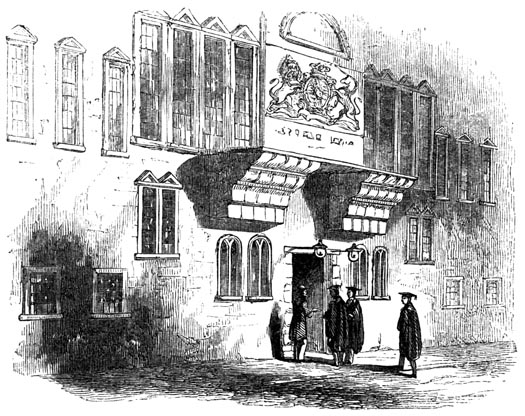
Gateway of Glasgow College