RHEA C. SCOTT
Reading edition
INSTRUCTOR IN HOME DEMONSTRATION WORK AT GEORGE PEABODY COLLEGE FOR TEACHERS. NASHVILLE, TENN.; FORMERLY ASSISTANT STATE DEMONSTRATION AGENT IN LOUISIANA.
ILLUSTRATED BY MRS. R. E. GAMBLE
SECOND EDITION, REVISED.
PHILADELPHIA AND LONDON J. B. LIPPINCOTT COMPANY
COPYRIGHT, 1917, BY J. B. LIPPINCOTT COMPANY COPYRIGHT, 1918, BY J. B. LIPPINCOTT COMPANY
Electrotyped and Printed by J. B. Lippincott Company At the Washington Square Press, Philadelphia, U. S. A.
TO THE WOMEN AND GIRLS OF THE FARM, LOVERS OF THE FIELDS, AND FRIENDS OF THE FLOWERS, WHOSE HEARTS HEAR THE CALL AND WHOSE HANDS SEEK THE SKILL TO MAKE THE RURAL HOME A PLACE OF LIGHT, OF HEALTH, OF BEAUTY, THIS LITTLE VOLUME IS AFFECTIONATELY DEDICATED
PREFACE
The point of view from which this manual was written is indicated in the introduction.
The aims are to increase efficiency in the farm home and to satisfy the growing demand for useful information in the country schools.
This is done by giving suggestions and directions for practical work to be done in the home and at school.
Throughout the country to-day many rural schools are expressing a desire to add to their present school curricula courses which are practical. The ideal kept in mind during the preparation of this manual has been to supply that need and at the same time to make it possible for any woman to use the book in her own home.
The limitations in the size have caused many omissions. It is the intention of the author to enlarge upon this material as the demand increases. Ideas and suggestions from other States have been dominant throughout, thus carrying out the true demonstration point of view.
The Author.
January, 1917.
ACKNOWLEDGMENTS
Acknowledgment and thanks are gratefully given to the following persons for suggestions, use of material, and corrections:
Miss Ola Powell, United States Department of Agriculture, Washington, D. C., for making this little volume possible by inspirational suggestions furnished throughout the preparation of the manual and especially for the use of her two models of jelly strainers and illustrations on cheese making.
Mr. O. B. Martin, United States Department of Agriculture, Washington, D. C., for his most valuable suggestions and sympathetic interest during the entire preparation of the material.
The United States Department of Agriculture, Washington, D. C., for photographs of roller tray wagon, water works system, and ideas obtained from circular letter prepared by Miss Mary E. Creswell and Miss Ola Powell, of the States Relations Service, Office of Extension Work in the South.
Mr. Harry M. Lamon, Poultry Division of the Bureau of Animal Industry, United States Department of Agriculture, Washington, D. C., for illustrations of poultry house, dry mash hopper and chicken coop, and the use of information in Farmers’ Bulletin, No. 574.
Mr. B. H. Rawl, Chief of the Dairy Division, Bureau of Animal Industry; United States Department of Agriculture, Washington, D. C., and Mr. J. H. McClain and other specialists in the Dairy Division for assistance in taking the pictures and for criticisms and corrections of the material.
Mr. N. E. D. Talcott, State Agent in Poultry Club Work in Virginia, for the use of his dry mash hopper and oat-sprouting rack.
Dr. John W. Wayland, State Normal School, Harrisonburg, Va., for his appropriate dedication.
Miss Elizabeth C. Cleveland, Head of the English Department, State Normal School, Harrisonburg, Va., for reading and correcting manuscript.
Mrs. K. C. Blythe, Leesburg, Va., for permission to use a dish drainer.
Mr. C. E. Hanson, A. & M. College, College Station, Texas, for his interest and helpful suggestions.
Miss Emma Chandler, State Agent in Home Demonstration Work, Stillwater, Okla., for the use of iceless refrigerator No. 2 and directions for making same.
Mr. Thos. H. Fullan, Alabama Polytechnic Institute, Auburn, Ala., for the use of his milking stool and suggestions for making the shower bath.
Mrs. Helen Brown Wolcott, State Agent in Home Demonstration Work, Lexington, Ky., for ideas for making the dish rack.
To “The Country Gentleman” for illustrations of cheese making.
Also others who have contributed to this volume.
CONTENTS
PAGE
Introduction 13-14
CHAPTER I
Kitchen Conveniences 15
Vegetable Paring Table, Wall Cabinet for the Kitchen, Ironing Board, Jelly Strainer, No. 1 and No. 2, Dish Drainer, Dish Rack, Coal Box, Wood Box, Fireless Cooker, Home-made Cook Stove Drier.
CHAPTER II
Dining Room Conveniences 43
Roller Tray Wagon, Sideboard, Screen.
CHAPTER III
Porch Equipment 51
Iceless Refrigerator, No. 1 and No. 2, Umbrella Stand, Blacking Box, Towel Roller, Porch Swing.
CHAPTER IV
Miscellaneous Equipment 67
Dustless Mop, Folding Canning Table, Fly Trap, Garbage Barrel, Scrubbing Chariot, Sewing Screen, Shower Bath, Practical Waterworks System.
CHAPTER V
Poultry Devices 84
Poultry House, Nests, Egg Tester, Dry Mash Hopper, No. 1 and No. 2, Rack for Oat-Sprouting Trays, Dust Boxes, Drinking Vessel, Chicken Brooder.
CHAPTER VI
Dairy Devices 99
Butter-making, Butter Worker, Milking Stool, Cheese-making Equipment.
APPENDIX
Fundamentals in Woodworking, Suggested List of Tools, List of Publications for Supplementary Reading.
Index 117
ILLUSTRATIONS
Page
Convenient Arrangement for Kitchen Devices Frontispiece
An Exhibit of Home-made Labor Saving Devices 14
Home-made Driers Ready for Use 36
Assembled Material for Building a Fireless Cooker 40
Roller Tray Wagon, Including Compartment for China and a Drawer for Silver and Linen 44
Iceless Refrigerator 54
Sewing Screen 78
A Portable Poultry House, Showing the Exterior and Interior 84
Churning Operations 104
Drawing the Curd 108
Pressing the Curd 108
Moulding the Cheese 109
Necessary Equipment Used in Cheese-making 109
INTRODUCTION
By President Julian A. Burruss State Normal School for Women, Harrisonburg, Va.
No phase of modern social development has received more attention in recent years than that of our rural population. Advances have been striking along all lines of country life. It would, however, be too much to say that the interests of women and their work in the home have received the attention properly due them. Frequently farmers of the highest type will equip their farms with the latest and best implements and machinery for their work and yet will fail to provide their homes with equipment equally as essential and desirable for the work of the women members of their households. Women’s organizations and the agents of the Home Demonstration Work, together with other agencies, have done much to direct attention along this very important line and in many communities labor-saving devices of a most ingenious character have been developed.
What is good for one busy housewife is not too good for another, and it is a good rule to push a good thing along for the benefit of others. With this in view the author has gathered together numerous inventions of home-made devices of a labor-saving and efficiency-increasing kind, and describes them in this little volume so that all to whom it may come may have the opportunity to make such contrivances, or modifications of them, for their own use. In doing this, the author has not merely had in her mind her own State, but has sought to recognize the viewpoints of women in as many other States as possible.
The author is peculiarly fitted for the task she has set herself. As Assistant State Agent for Home Demonstration Work in Virginia, under the direction of the United States Department of Agriculture, and as supervisor and community worker for a number of years in various rural districts before assuming the duties of her present position, she has had abundant facilities for becoming familiar with the conditions prevailing in country homes. Having maintained sympathetic relationships with country women for many years, she knows their problems and their needs, and she is also familiar with the sources from which help may be drawn.
There can be no real improvement in social life in the country unless there is leisure time to be devoted to uplifting, cultural, and recreational purposes. The only way in which this may be obtained is by means of labor-saving and time-saving appliances. The articles here described are intensely practical and may be readily made in any home at a nominal cost. To make two blades of grass grow where one formerly grew is certainly a very valuable achievement; but to save muscles and nerves, and to give time and energy for mental and social and spiritual development, is far more valuable and desirable. If the information given in this book serves to lighten the burden and shorten the daily drudgery of a single housewife, its publication will be justified; and it should find a cordial reception in a multitude of homes.
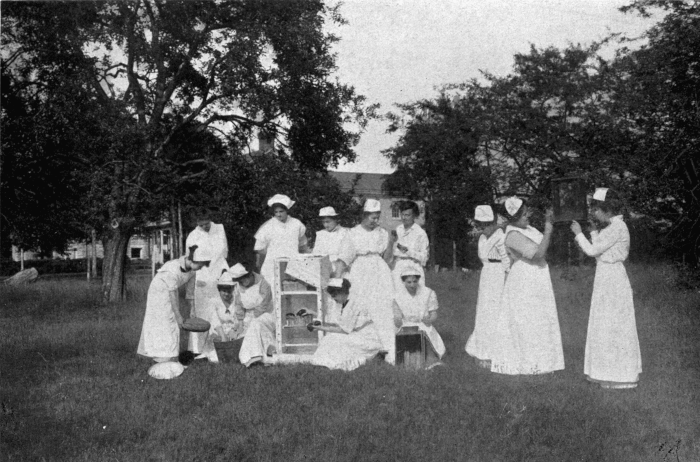
AN EXHIBIT OF HOME-MADE LABOR SAVING DEVICES BY THE CANNING CLUB AT THE STATE NORMAL SCHOOL, HARRISONBURG, VA.
HOME LABOR SAVING DEVICES