DESCRIPTION OF THE PRINTS, Etc.
Reading edition


With talents equally honourable to himself, his country, and the age in which he lived, Hogarth did not leave his widow possessed of much more than arose from the sale of his prints. But during the twenty-five years which she survived him, she had the higher and more exalted gratification of finding that his reputation increased, and his fame acquired stability by time.
In the year 1780, the late Horace Lord Orford published his Anecdotes, in which he has introduced Hogarth's catalogue and character. The volume printed at Strawberry Hill, he (with the preceding part of the work) presented to Mrs. Hogarth. The books were accompanied with the following handsome apology for his strictures on the genius of her husband:[81]—
To Mrs. Hogarth.
"Berkeley Square, October 4, 1780.
"Mr. Walpole begs Mrs. Hogarth's acceptance of the volume that accompanies this letter, and hopes she will be content with his endeavours to do justice to the genius of Mr. Hogarth. If there are some passages less agreeable to her than the rest, Mr. Walpole will regard her disapprobation only as marks of the goodness of her heart, and proofs of her affection to her husband's memory; but she will, he is sure, be so candid as to allow for the duty an historian owes to the public and himself, which obliges him to say what he thinks, and which when he obeys, his praise is corroborated by his censure. The first page of his Preface will more fully make his apology;[82] and his just admiration of Mr. Hogarth, Mr. W. flatters himself, will, notwithstanding his impartiality, still rank him in Mrs. Hogarth's mind as one of her husband's most zealous and sincere friends."
In nine years after the receipt of this letter, Mrs. Hogarth died, bequeathing her property to her relation, Mrs. Mary Lewis of Chiswick, by whose kindness and friendship I am in possession of the manuscripts which form the basis of the foregoing sheets, the following most singular and curious print of "Enthusiasm Delineated," etc. etc. etc.
ENTHUSIASM DELINEATED,
CONTRASTED WITH THE PRINT ENTITLED
A MEDLEY;
TO WHICH HOGARTH AFTERWARDS ALTERED THE PLATE.[83]
"Idolatry is not only an accounting and worshipping that for God which is not God, but it is also a worshipping the true God in a way unsuitable to His nature, and particularly by the mediation of images and corporeal resemblances."—South.
Such was the opinion of Dr. South, and such the opinion of Hogarth, when he designed this very extraordinary print, the intention of which is to give "a lineal representation of the strange effects resulting from literal and low conceptions of sacred beings, as also of the idolatrous tendency of pictures in churches, and prints in religious books," etc. To exemplify this, he has parodied the productions of several eminent masters, whose works, having been generally painted under the direction of cardinals, popes, etc., are chiefly on religious subjects; and by the artists absurdly attempting to represent what are not properly objects of sight, that which they intended to be sublime is rendered in the highest degree ridiculous. To burlesque the idolatrous symbols with which they have peopled their canvas, place the popish doctrine of transubstantiation[84] in its true point of view, unmask hypocrisy, and check the progress of those enthusiastic delusions which Bishop Lavington properly terms "Religion run Mad,"[85] are the author's leading objects.
To effect these purposes, he has delineated what we may fairly denominate a powerful preacher, who from his countenance, and what is hinted at in the scale of vociferation at his left hand, seems treating his congregation with a bull roar. He may be considered as either a Methodistical Papist or a Popish Methodist, for his shaven crown intimates that he is a Jesuit; and the harlequin's jacket underneath his gown denotes the versatility of his religious professions. This Proteus of the pulpit poises a puppet in each hand; that in the left represents the devil grasping a gridiron; in his right he holds the triple figure with the triangular emblem, by which Raphael and some other painters have profanely presumed to personify the Deity.[86]
Exemplifying sacred mysteries by these absurd theorems is surely open to the severest satire; and to heighten his ridicule, the artist has, by adding three legs to the triangle, rendered it a complete trivet, and given to his jesuitical and theatrical declaimer (who, as his text intimates, "speaks as a fool") a pointed antithesis,—"If you do not believe in this trivet, you shall broil on that gridiron." Dangling on pegs around the pulpit, and to be exhibited as there shall be occasion, are six other puppets, copied from the absurd misrepresentations which some of the old masters have made of Adam and Eve, Peter and Paul, Moses and Aaron. Adam and Eve are a little caricatured, but evidently intended to hint at the dry designs of Albert Durer. Adam, though naked, has the air of a first-rate coxcomb. Eve, encircled with a zone of fig leaves, has neither grace in her step nor dignity in her gesture. Peter, displaying his ponderous key, and pulling off Paul's black periwig, is copied from Rembrandt, and to him referred in Hogarth's inscription. Paul, with a beard of Hudibrastic cut and dye, being low of stature, is elevated by high-heeled shoes, and armed with two swords: that in his hand, massy as the weapon wielded by John a Gaunt; the other, which, like the dagger of Hudibras, might serve as its page, tucked to his side.
Moses and Aaron, one bearing the tables and the other an incense pot, are retreating to the other side. The Jewish lawgiver's having made many ordinances concerning food, may be hinted at by his being crowned with a porridge pot; the two feet may serve for horns. The bells on the hem of Aaron's garments are sufficiently obvious, and, as saith Master Thomas Goodwin, in his Civil and Ecclesiastical Rites—"By the bells are typed the sound of his doctrine."
The nobleman in a pew beneath, unquestionably refers to some known character; but for whom it is meant I am unable to determine. He may either be a peer who was at that time very constant in his attendance at the Tabernacle, or a wolf who has found his way into the fold, and is prowling among the lambs of the flock. His face presents the index of a mind in which hypocrisy is united with another passion, and is in an eminent degree characteristic. The holy fervour[87] of the female, who, seduced by the tender touches of an earthly lover, lets her celestial model fall to the ground, is equally remarkable. A ragged figure[88] in the same pew, dropping his tears into a bottle, we know, by his rueful countenance, his handcuffs, and the letter T marked on his cheek, to be a repentant thief. A tattered and coal-black proselyte at the foot of the reading-desk, inspired with the epidemical enthusiasm of the place, is embracing the idolatrous image of her adoration, which in colour is similar to herself.
As sculptors and painters have thought fit to denominate a child's head, with duck wings, "Cherubin;"[89] Hogarth, to one of these infantine fancies, has whimsically enough added a pair of duck's feet. The well-fed figure in the desk may perhaps be meant as an overcharged portrait of Whitfield. The fainting female in the corner of the print was intended for Mrs. Douglas of the Piazza, who, after a most licentious life, became a rigid devotee, and was Sam. Foote's original for Mother Cole. The Jew, with an insect between his nails, has a fine air of head. On the book open before him is a print of "Abraham offering up Isaac."[90]
The figures in the background it is not necessary to enumerate: they are sighing, weeping, groaning! The four most obtrusive convey a severe satire on transubstantiation. A Turk looking through the window, is evidently laughing at their absurdities, and thanking Mahomet that he has been early initiated in the Koran. A dog, with "Whitfield" on his collar, seated upon a hassock, and howling in concert with the preacher, is admirably designed.
The figure of a pigeon impressed on the Methodist's brain, is intended to intimate that if the Holy Spirit gets into the head instead of the heart, it will create that confusion of intellect described in the mental thermometer which rises out of it, and which is crowned by a dove on the point of a triangle.
Thus did this great artist express his "First Thought," but afterwards erased, or essentially altered every figure except two, and on the same piece of copper: we find his variations so multifarious as to render it nearly a new print, which he entitled
CREDULITY, SUPERSTITION, AND FANATICISM.
A MEDLEY.
The preacher and the devil, except in a few shadows added to a handkerchief, are left as in the first state, and these are the only figures that are so left; from them and the background it is positively ascertained that the first and second engravings are on the same copperplate. Raphael's strange symbol of the Deity the artist has struck out, and in the place of it inserted a witch upon a broomstick; instead of the puppets representing Adam and Eve, Peter and Paul, Moses and Aaron, we have Mrs. Veale's ghost, Julius Cæsar's apparition, and the shade of Sir George Villiers.
The nobleman, and lady dropping her deified image in the pew beneath the pulpit, are discarded, and a pair of vulgar and uninteresting characters put in their room. The handcuffed felon is obliterated, and his place supplied by two figures, one weeping, the other asleep. The ragged woman hugging a model is altered to the boy of Bilson; and on the hassock, where was the howling dog, is a shoeblack's basket, with Whitfield's Journal placed upon King James's Demonology. The characters of cherubin and seraph are changed; and though the duck's wings are left, the legs are lopped off. In the place of the corpulent and consequential clerk, the artist has inserted a meagre and moon-eyed monster, with wings that either grow out of his shoulders, or appertain to a foul fiend planted behind him and acting as his prompter. Mother Douglas is beaten out of the copper, and in her room Hogarth has introduced Mrs. Tofts and her rabbits, one of the popular impositions of his own day. The smelling-bottle applied to recover Mrs. Douglas from fainting, is with Mrs. Tofts very properly changed to a dram glass. The Jew is altered, and altered for the worse: the print of "Abraham and Isaac," in a book before him, is obliterated, and a knife inscribed "bloody," and laid upon an altar, supplies its place. In the characters of the common people of the congregation there are several variations; the models which some of them held in their arms are totally changed. The pigeon in the Methodist's brain is discarded; in the place of the inscription in the top division of the thermometer he has inserted the Cock Lane ghost; and instead of the glory, which in the "First Thought" crowned the whole, we have the Tedworth Drummer, a tale which, had it not given the subject for Addison's comedy, would have been long since forgotten. On the scale of vociferation and the chandelier, the names of W—d and Romaine are only to be found in the present state of the plate; in the scale of the thermometer there are numerous alterations. In "The Medley," the artist has made an addition, and placed Wesley's Sermons and Glanville's book On Witches as supporters to the Methodist's brain. To do this, and introduce the rabbits on the foreground, he has brought his work so near the bottom of his plate as not to leave room for a title, which, with the quotation from St. John, "Believe not every spirit," etc., is, in the present state of the plate, engraven on another piece of copper.
Many little variations besides those I have noted will appear by a comparison of the two designs; one is worthy of particular attention. In the print of "Enthusiasm Delineated," the inscriptions on the thermometer, etc., are evidently from the burin of Hogarth; in the print of "The Medley," every inscription, even those which in each impression contain the same words, are the work of a writing engraver, from which I am inclined to believe, that in the first state the artist never trusted the plate out of his own hands.
With respect to the comparative merit of the two prints, I think of the "First Thought" what Mr. Walpole in his Anecdotes asserts of the "Second," that "for useful and deep satire, it is the most sublime of all his works." It forms one great whole; and the skill with which he has appropriated the absurd symbols of painters, and combined the idolatrous emblems of Popery with the mummery of modern enthusiasts, presents a trait of his genius hitherto unknown; displays the powers of his mind on subjects new to his pencil, and shows an extent of information and depth of thought that is not to be found in any of his other works.
In "The Medley" the artist has changed his ground, attacked follies of another description, and in the place of Enthusiasm introduced Credulity, Superstition, and Fanaticism. In his management of them he has shown much genius, and by his transition from one object to another, and the many metamorphoses of his characters, displayed a power of assimilating, aptness of appropriating, and versatility of pencil hardly to be paralleled, and proved that his invention was inexhaustible. With all this, it must be acknowledged that some of the local credulities which he has there depicted were of so temporary and trifling a nature, that even now they are hardly recollected by any other circumstances than having been introduced in this print.
Ten or twelve figures engraved on the background are not in the "First Thought:" two of them, viz. a crazed convert terrified by a lay preacher, are admirably descriptive; but as to the residue of this half-price audience, met together to be miserable, they add to the number without much increasing the force, destroy the pyramid, and hurt the general effect;—if they are intended to stand on the floor, they are too high; if on benches, too low. The effect of this print is further injured by the alteration of the clerk. In the first state, his ample breadth of face and black periwig render him a leading character, and give him the rank of principal figure. The thin-visaged, hungry harpy in "The Medley" has no importance, neither is there any principal figure in that print. A little cherub Mercury, crowned with a postilion's cap, and bearing in his mouth a letter directed to St. Moneytrap, is an afterthought, and only to be found in the second impression.
If I am asked what were the artist's inducements for making so many alterations, I can account for it in no other way than by supposing some friend suggested that the satire would be mistaken, and that there might be those who would suppose his arrows were aimed at religion, though every shaft is pointed at the preposterous masquerade habit in which it has been frequently disguised.
Considering the time that must have been employed in beating out the old figures, the trouble of polishing the copper, etc., it seems rather extraordinary that he should not have wholly discarded his plate of the "First Thought," and taken another piece of copper for the second. It is probable that the alterations were made by degrees, and before the author was fully satisfied with his design, became much more numerous than he had at first intended.[91]
TASTE IN HIGH LIFE
IN THE YEAR 1742.
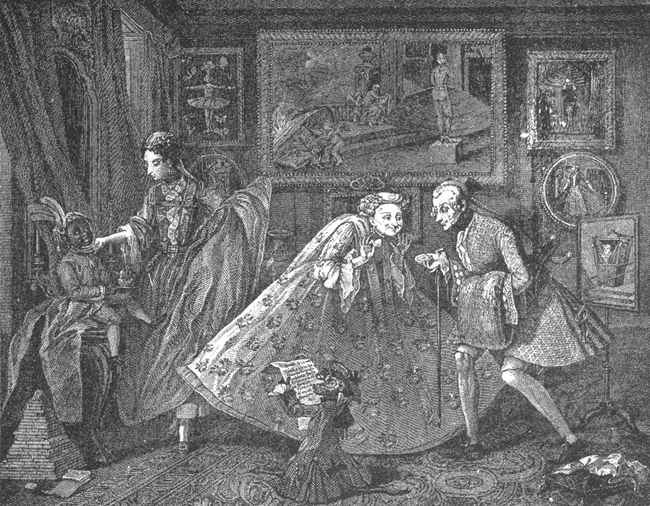
TASTE IN HIGH LIFE.
The picture from which this print was copied, Hogarth painted by the order of Miss Edwards, a woman of large fortune, who, having been laughed at for some singularities in her manners, requested the artist to recriminate on her opponents, and paid him sixty guineas for his production.
It is professedly intended to ridicule the reigning fashions of high life in the year 1742. To do this the painter has brought into one group an old beau and an old lady of the Chesterfield school, a fashionable young lady, a little black boy, and a full-dressed monkey. The old lady, with a most affected air, poises between her finger and thumb a small tea-cup, with the beauties of which she appears to be highly enamoured.
The gentleman, gazing with vacant wonder at that and the companion saucer which he holds in his hand, joins in admiration of its astonishing beauties!
"Each varied colour of the brightest hue, The green, the red, the yellow, and the blue, In every part their dazzled eyes behold, Here streak'd with silver—there enrich'd with gold."
This gentleman is said to be intended for Lord Portmore, in the habit he first appeared at Court on his return from France. The cane dangling from his wrist, large muff, long queue, black stock, feathered chapeau, and shoes, give him the air of
"An old and finish'd fop, All cork at heel, and feather all at top."
The old lady's habit, formed of stiff brocade, gives her the appearance of a squat pyramid, with a grotesque head at the top of it. The young one is fondling a little black boy, who on his part is playing with a petite pagoda. This miniature Othello has been said to be intended for the late Ignatius Sancho, whose talents and virtues were an honour to his colour. At the time the picture was painted he would have been rather older than the figure; but as he was then honoured by the partiality and protection of a noble family, the painter might possibly mean to delineate what his figure had been a few years before.
The little monkey, with a magnifying glass, bag-wig, solitaire, laced hat, and ruffles, is eagerly inspecting a bill of fare, with the following articles pour dinner: cocks' combs, ducks' tongues, rabbits' ears, fricasey of snails, grande d'œuts beurre.[92]
In the centre of the room is a capacious china jar; in one corner a tremendous pyramid composed of packs of cards; and on the floor, close to them, a bill inscribed, "Lady Basto Dr to John Pip, for cards—£300."
The room is ornamented with several pictures; the principal represents the Medicean Venus on a pedestal, in stays and high-heeled shoes, and holding before her a hoop petticoat somewhat larger than a fig-leaf; a Cupid paring down a fat lady to a thin proportion, and another Cupid blowing up a fire to burn a hoop petticoat, muff, bag, and queue wig, etc. On the dexter side is another picture representing Monsieur Desnoyer, operatically habited, dancing in a grand ballet, and surrounded by butterflies, etc., inscribed "Insects," and evidently of the same genus with this deity of dance. On the sinister is a drawing, denominated "Exotics," consisting of queue and bag-wigs, muffs, solitaires, petticoats, French-heeled shoes, and other fantastic fripperies.
Beneath this is a lady in a pyramidical habit walking the park; and, as the companion picture, we have a blind man walking the streets.
The fire-screen is adorned with a drawing of a lady in a sedan chair—
"To conceive how she looks, you must call to your mind The lady you've seen in a lobster confin'd, Or a pagod in some little corner enshrin'd."
As Hogarth made this design from the ideas of Miss Edwards, it has been said that he had no great partiality for his own performance, and that, as he never would consent to its being engraved, the drawing from which the print is copied was made by the connivance of one of her servants.[93] Be that as it may, his ridicule on the absurdities of fashion,—on the folly of collecting old china,—cookery,—card-playing, etc., is pointed, and highly wrought.
At the sale of Miss Edwards' effects at Kensington, the original picture was purchased by the father of Mr. Birch, surgeon, of Essex Street, Strand.
FARINELLI, CUZZONI, AND SENESINO,
IN THE CHARACTERS OF
PTOLEMY, CLEOPATRA, AND JULIUS CÆSAR.
"To banish nature and to vary art, To fix the ear but never reach the heart, To mangle sense and dress up meagre sound, While the same tasteless unison goes round; And still the point of excellence to place In execution, cadence, and grimace; To ravish with unnatural sounds the ear, While beaux applaud and belles with rapture hear,[94] The song we raise."
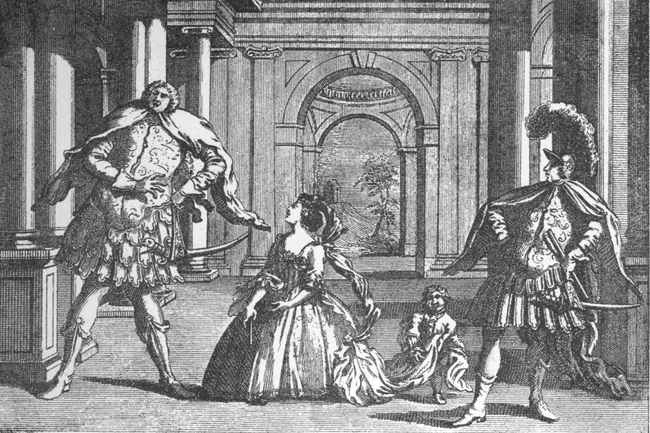
FARINELLI, CUZZONI, & SENESINO.
This dignified heroine and the two heroes—of a class—
"By their smooth chins and simple simper known,"
are here the representatives of "the majesty of Egypt, a morsel for a monarch," and "the foremost man of all this world;"[95] they were the three principal performers in Handel's opera of Ptolomeo, performed in the year 1728. There have been some suspicions of its not being Hogarth's design, and from the characters more than bordering on caricature, etc., I once inclined to that opinion; but from the general spirit of the satire, and the same figures being introduced in nearly the same attitudes in the first print Hogarth ever published (see p. 22), there is little doubt of its being his production.
The position (for it can hardly be called an attitude) in which the painter has placed Farinelli, is fully warranted by the writer of a pamphlet, entitled Reflections on Theatrical Expression in Tragedy, etc., published in 1755. These Reflections are admirably contrasted by the exaggerated compliment with which the author of the Divine Legation honours the divine Senesino. The two quotations follow:—
"I shall therefore, in my further remarks on this article, go back to the old Italian theatre, when Farinelli drew everybody to the Haymarket. What a pipe! what modulation! what ecstasy to the ear!—but, heavens! what clumsiness! what stupidity! what offence to the eye! Reader, if of the city, thou mayst probably have seen in the fields of Islington or Mile-End, or if thou art in the environs of St. James's, thou must have observed in the park, with what ease and agility a cow, heavy with calf, has rose up at the command of the milkwoman's foot. Thus from the mossy bank sprung up the divine Farinelli. Then with long strides, advancing a few paces, his left hand settled upon his hip in a beautiful bend, like that of an old-fashioned caudle-cup, his right hand remained immoveable across his manly breast till numbness called its partner to supply its place, when it relieved itself in the position of the other handle to the caudle-cup, etc."—Reflections, etc.
With respect to the other genius of Italian song, Mr. Nichols very justly observes that his dignity must have been wonderful, or the following passage in Dr. Warburton's Inquiry into the Causes of Prodigies and Miracles (printed in 1727) affords a most notorious example of the bathos:—
"Observe," says he (p. 60), "Sir Walter Raleigh's great manner of ending the first part of the History of the World: 'By this, which we have already set down, is seen the beginning and end of the three first monarchies of the world, whereof the founders and erectors thought that they never could have ended; that of Rome, which made the fourth, was also at this time almost at the highest. We have left it flourishing in the middle of the field, have rooted up or cut down all that kept it from the eyes and admiration of the world; but after some continuance it shall begin to lose the beauty it had, the storms of ambition shall beat the great boughs and branches one against another, her leaves shall fall off, her limbs wither, and a rabble of barbarous nations enter the field and cut her down.' What strength of colouring! what grace, what nobleness of expression! with what a majesty does he close his immortal labour! It puts one in mind of the so much admired exit of the late famed Italian singer!" (Senesino.[96]) What a climax!
A WOMAN SWEARING HER CHILD TO A GRAVE CITIZEN.
"Here Justice triumphs in his elbow chair, And makes his market of the trading fair; His office shelves with parish laws are grac'd, But spelling-books and guides between 'em plac'd.[97] Here pregnant madam screens the real sire, And falsely swears her bastard child for hire Upon a rich old leecher, who denies The fact, and vows the naughty hussif lies. His wife enrag'd, exclaims against her spouse, And swears she'll be reveng'd upon his brows; The jade, the justice, and churchward'ns agree, And force him to provide security."
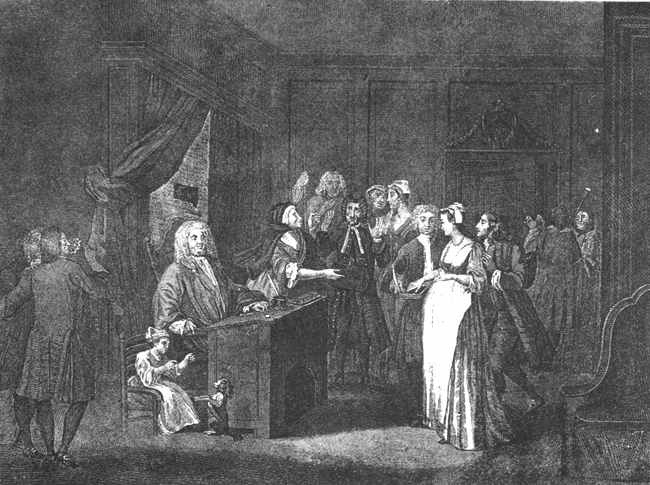
WOMAN SWEARING A CHILD.
These curious rhymes, engraven under the original print, in a degree describe the plot of the play, and the characters of the performers in this religious ceremony; for as such does Picart class a copy which he has introduced in the fourth volume of his work,[98] accompanied with the following explanation:—
"Many other customs might find a place here, and delight the readers by their comical singularity, but we dare not crowd in too great a number of those trifles, as not being properly religious ceremonies; which therefore, till approved of by the church, or by the governor of it, prescribed by ecclesiastical laws or formularies, we shall omit, except two or three of the most remarkable. The first is what the description here annexed calls the breeding woman's oath,—a custom not to be met with in other countries,—which is so fantastical, or rather unjust, that it would be a prejudice to the laws of England if we were to judge of their equity by that practice. Suppose any of these girls, which may be called amphibious (being neither wives nor virgins), is found to be with child. She does not, or will not, pretend to know the father of this child. In order to free herself from the trouble of maintaining it when born, she looks out for some rich man, upon whom she intends to father it. Generally they say she pitches upon some good citizen, though she does not know him, or maybe has never seen him. Then she goes before a Justice of the Peace, summons the pretended father to appear before him, and in his presence swears upon the Bible, which the clerk holds to her, that she owns and declares that such a one whom she has summoned to appear is the father of the child. How far the equivocal expressions and restrictions of that oath may excuse her from perjury, let a good casuist be the judge. However, the man thus named and sworn to by this formality of law is obliged to pay an arbitrary fine, and to agree upon a sum of money for the maintenance of the child."—Picart's Religious Ceremonies, p. 83.
The original picture from which this print was engraven was one of Hogarth's early productions, and is in the possession of the Rev. Mr. Whalley, at Ecton, Northamptonshire. In the disposition of the figures, etc., it has a more than accidental resemblance to a picture by Heemskirk, which was in the possession of Mr. Watson, surgeon, Rathbone Place, where all the male figures are monkeys; all the females, cats; and which in the year 1772 was engraved in mezzotinto by Dickinson, and entitled "The Village Magistrate."
A small copy from Hogarth's print is introduced as the headpiece to a tale printed in Banks' Works, vol. i. p. 248, entitled "The Substitute Father."
THE FOUNDLINGS.
"No mother's care Shielded our infant innocence with prayer; No father's guardian hand our youth maintain'd, Call'd forth our virtues, and from vice restrain'd; But strangers,—pitying strangers,—hear our cry, And with parental care each want supply."
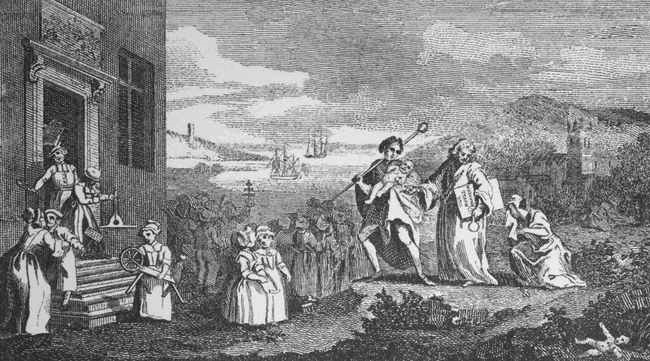
THE FOUNDLINGS.
The last print represented what Mr. Picart chose to call a religious ceremony,—in this we have a scene which may properly be so denominated; for surely rescuing deserted, unoffending, and helpless innocence from destruction, providing an asylum for childhood, initiating youth in habits of industry, and rendering those whose parents were unable to protect them useful members of society, is a religious as well as a political institution.
"Cold on Canadian hills or Minden's[99] plain, Perhaps the mother mourn'd her soldier slain, Bent o'er her babe, her eye dissolv'd in dew, The big drop mingling with the milk it drew; Gave the sad presage of his future years, The child of misery, baptiz'd in tears."
Hogarth, by presenting some of his works to the Foundling Hospital, was in fact an early benefactor to the charity. He made the annexed design for the use of this institution; it was engraved by F. Morellon la Cave, as the headpiece to a power of attorney from the trustees of the charity to those gentlemen who were appointed to receive subscriptions towards the building, etc.
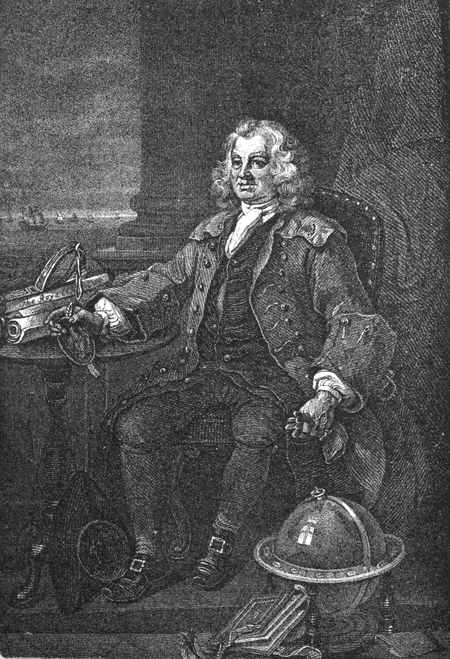
CAPTAIN THOMAS CORAM.
The artist has made his old friend Captain Coram a principal figure; and as this excellent and venerable man was in fact the founder of the charity, it is with great propriety he is introduced. Before him the beadle of the Hospital carries an infant, whose mother, having dropped a dagger with which she might have been momentarily tempted to destroy her child, kneels at his feet; while he, with that benevolence with which his countenance was so eminently marked, bids her be comforted, for her babe will be nursed and protected.
On the dexter side of the print is a new-born infant, left close to a stream of water, which runs under the arch of a bridge. Near a gate, on a little eminence in the pathway above, a woman leaves another child to the casual care of the next person who passes by. In the distance is a village with a church.
In the other corner are three boys coming out of a door with the king's arms over it; as emblems of their future employments, one of them poises a plummet, a second holds a trowel, and a third, whose mother is fondly pressing him to her bosom, has in his hand a card for combing wool. The next group, headed by a lad elevating a mathematical instrument, are in sailors' jacket and trousers; those on their right hand, one of whom has a rake, are in the uniform of the school.
The attributes of the three little girls in the foreground—a spinning-wheel, sampler, and broom—indicate female industry and ingenuity.
It must be admitted that the scene here represented is a painter's anticipation, for the charter was not granted until October 1739, and this design was made only three years afterwards; but the manner in which the charity has been since conducted has realized the scene.
FRONTISPIECE TO TERRÆ FILIUS.
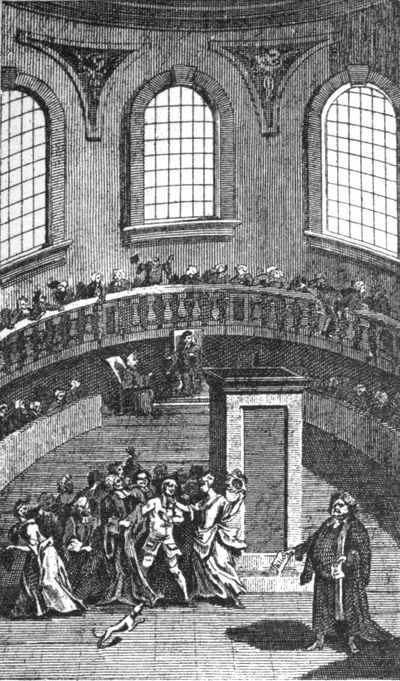
TERRÆ FILIUS.
The work to which this is a frontispiece was written by Nicholas Amhurst, author of the Craftsman, and published in the year 1726. The leading object of this writer is to satirize the Tory principles of the University of Oxford; but as the book does not abound in subjects for the pencil, Hogarth has selected a scene described in No. 33, published 8th May 1721, which contains "Advice to all gentlemen schoolboys, etc., who are designed for the University of Oxford." In the part which forms the subject for this print, the writer thus cautions them:—
"Have a particular regard how you speak of those gaudy things which flutter about Oxford in prodigious numbers in summer time, called 'Toasts;' take care how you reflect on their parentage, their condition, their virtue, or their beauty,—ever remembering that
'Hell has no fury like a woman scorn'd;'
especially when they have spiritual bravoes on their side, to revenge their cause on every audacious contemner of Venus and her altars.
"Not long ago a bitter lampoon was published on the most celebrated of these petticoat professors. As soon as it came out the town was in an uproar, and a very severe sentence was passed upon the author of this anonymous libel, to discover whom no pains were spared. All the disgusted ill-natured fellows in the University were, one after another, suspected upon this occasion. At last, I know not how, it was peremptorily fixed upon one, whether justly or not I cannot say; but the parties offended resolved to make an example of somebody for such an enormous crime, and one of them (more enraged than the rest) was heard to declare, 'that right or wrong, that impudent scoundrel (mentioning his name) should be expelled by G—; and that she had interest enough with the President and Senior Fellows of his College to get his business done.' Accordingly, within a year after this, he was (almost unanimously) expelled from his fellowship, in the presence of some of the persons injured, who came thither to see the execution.
'Felix quam faciunt aliena pericula cautum'
was the thesis pitched upon by the excluding doctors for the under-graduates to moralize upon, in a public exercise upon this occasion; and as it is a very wholesome maxim, I leave it, my little lads, to your serious meditation."
To the figures introduced in this print the original artist has given a spirit worthy of Callot; and the copy hereto annexed has been thought correct and animated.
THE SEPULCHRE.
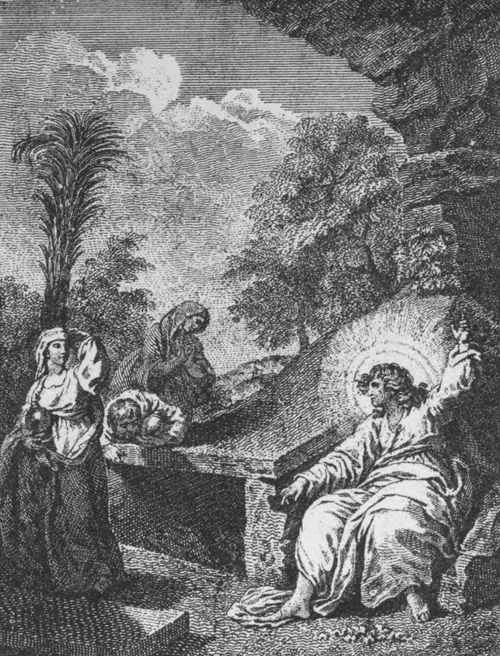
THE SEPULCHRE.
It has been frequently and truly remarked, that in either historical or serious subjects Hogarth did not excel; but to prove that even in this walk he was considerably above mediocrity, and that the reader may be enabled to judge for himself, I have selected the annexed print, which forms one compartment of the altar-piece to St. Mary Redcliffe's, Bristol, for the painting of which he received five hundred pounds.
The centre division, which is much the largest, represents the Ascension. The rays emanating from the ascending Deity, and beaming through the interstices of the surrounding clouds, are tenderly and brilliantly touched. In the foreground, St. Thomas on one knee, with his hands clasped together, is eagerly looking up with an expression of wonder and astonishment. On the other side is St. Peter, in a reclining posture. Near the centre, St. John, with a group made up of the other Apostles, attentively listening to the two men in white, who appeared on this occasion. The background is on one side closed with tremendous rocks; on the other, under the skirts of low-hung clouds in the distance, appears part of the magnificent city of Jerusalem, illuminated by a flash of lightning, which, darting from a darkened sky, casts a livid gloom over the whole.
The compartment on the right hand represents the rolling of the stone and sealing the sepulchre in the presence of the high priest; the exertion displayed in this is happily contrasted by the tenderness and elegant softness displayed in the companion picture here copied, where the Marys approach the empty sepulchre. The angel, speaking and pointing up to heaven with an expression which explains itself—to singular beauty, sweetness, and benevolence, unites great elevation of character, and the native dignity of a superior being.
The foregoing remarks, with some little variations, are extracted from an article in the Critical Review for June 1756, which, being written while the artist was living, were possibly seen and approved by himself.
The writer concludes by remarking, that the purchasing such a picture for their church does great honour to the opulent city for which it was painted, and is the likeliest means to raise a British School of Artists; though it would be a just subject of public regret if Mr. Hogarth should abandon a branch of painting in which he stands alone, unrivalled and inimitable, to pursue another in which so many have already excelled.
From the "Sealing the Sepulchre" and this print there are two large mezzotintos by J. Jenner. The centre compartment has not been engraved.
THE POLITICIAN.
A politician should (as I have read) Be furnished in the first place with a head!
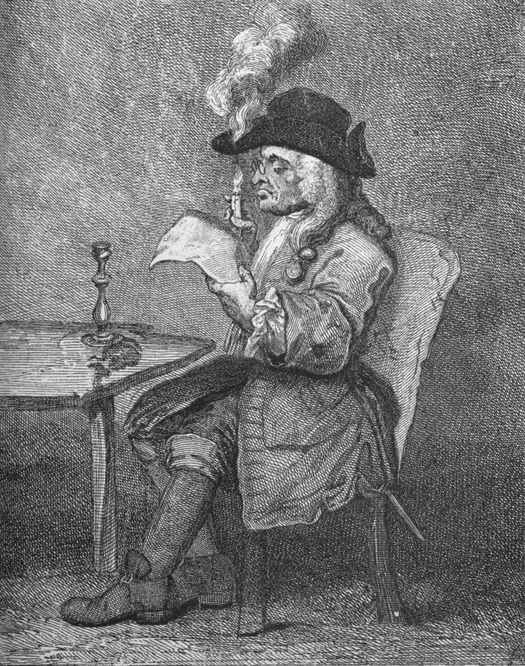
THE POLITICIAN.
One of our old writers gives it as his opinion, that "there are only two subjects which are worthy the study of a wise man, i.e. religion and politics." For the first, it does not come under inquiry in this print; but certain it is, that too sedulously studying the second has frequently involved its votaries in many most tedious and unprofitable disputes, and been the source of much evil to many well-meaning and honest men. Under this class comes the "Quidnunc" here portrayed; it is said to be intended for a Mr. Tibson, laceman in the Strand, who paid more attention to the affairs of Europe than to those of his own shop. He is represented in a style somewhat similar to that in which Schalcken painted William the Third,[100]—holding a candle in his right hand, and eagerly inspecting the Gazetteer of the day. Deeply interested in the intelligence it contains concerning the flames that rage on the Continent, he is totally insensible of domestic danger, and regardless of a flame which, ascending to his hat,
"Threatens destruction to his three-tail'd wig."
From the tie-wig, stockings, high-quartered shoes, and sword, I should suppose it was painted about the year 1730, when street robberies were so frequent in the metropolis that it was customary for men in trade to wear swords; not as now (1803), to preserve their religion and liberty from foreign invasion, but to defend their own pockets from domestic collectors.
The original sketch Hogarth presented to his friend Forrest; it was etched by Sherwin, and published 1775.
THE MATCHMAKER.
"Wanted immediately—A Husband." —Vide the daily papers.
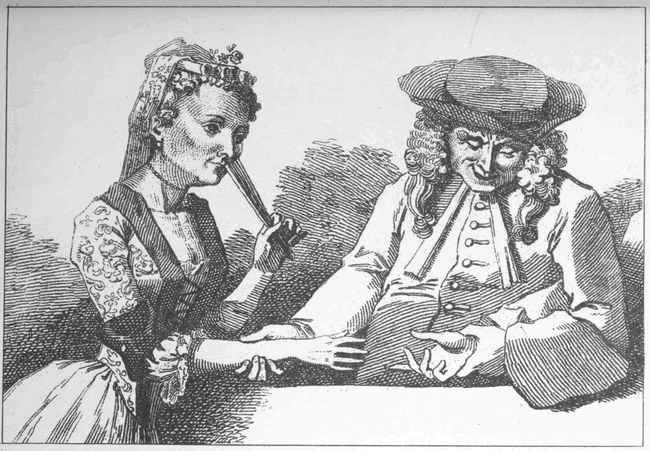
THE MATCH MAKER.
The two agreeable persons here introduced formed part of a group in an unfinished picture painted by Hogarth. They were some years since engraved on two copperplates; but as I thought that was placing still further apart the hands of those twain whom the holy service of matrimony was soon to unite, I have here brought them into one, and in this we are presented with the bride and that useful agent of Hymen, denominated a Matchmaker. We see nothing of the bridegroom but his hand and arm; from which, the countenance of the lady, and the character of the go-between, we may fairly infer he is young, and regret that the artist did not complete the trio, and place him as a contrast to the antiquated virgin with whom he is to be united. By the beauty spots on her face, she wishes to conceal the ravages of time; and from her laced lappets, cuffs, robings, and brocaded silk, we may suppose she is rich. As to the share which the venerable person who provides her with a husband is to have for his reward—it depends upon the bargain. I have been told that in this masquerade matrimony, the master of the ceremonies, or lord of the bedchamber (which the reader pleases), is paid by both the contracting parties.
Some of my readers may possibly imagine that the tribe of Matchmakers, like the race of wolves, is extinct in England; but this is so far from being the case, that there is now in the neighbourhood of Piccadilly a regular office,[101] where any gentleman or gentlewoman, first paying a stipulated sum for entrance money, may disclose their virtuous wishes, and be provided with partners for life,—or as long as they can agree.
THE MAN OF TASTE.
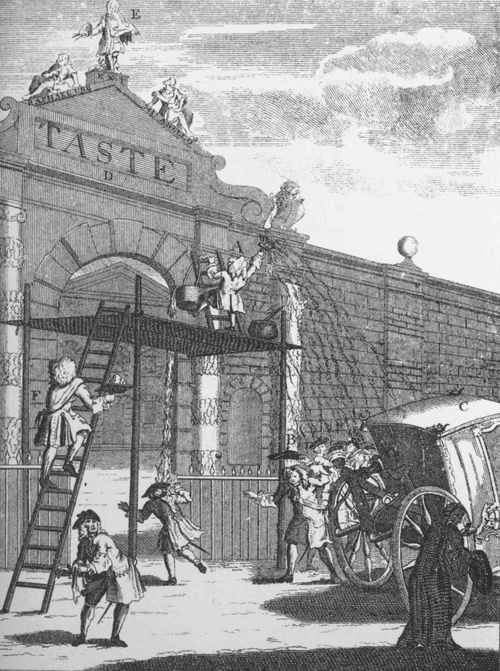
THE MAN OF TASTE.
The circumstance on which this print is built is thus described by Dr. Johnson:—
"Mr. Pope published in 1731 a poem called False Taste, in which he very particularly and severely criticises the house, the furniture, the gardens, and the entertainments of Timon, a man of great wealth and little taste. By Timon he was universally supposed, and by the Earl of Burlington, to whom the poem is addressed, was privately said, to mean the Duke of Chandos, a man perhaps too much delighted with pomp and show, but of a temper kind and beneficent, and who had consequently the voice of the public in his favour. A violent outcry was therefore raised against the ingratitude and treachery of Pope, who was said to have been indebted to the patronage of Chandos for a present of a thousand pounds, and who gained the opportunity of insulting him by the kindness of his invitation. The receipt of the thousand pounds Pope publicly denied; but from the reproach which the attack on a character so amiable brought upon him, he tried all means of escaping. The name of Cleland was employed in an apology[102] by which no man was satisfied; and he was at last reduced to shelter his temerity behind dissimulation, and endeavoured to make that disbelieved which he never had confidence openly to deny. He wrote an exculpatory letter to the Duke, which was answered with great magnanimity by a man who accepted his excuse without believing his professions. He said, that to have ridiculed his taste or his buildings had been an indifferent action in another man, but that in Pope, after the reciprocal kindness that had been exchanged between them, it had been less easily excused."—Johnson's Life of Pope.
Soon after the publication of the poem alluded to, Hogarth made this design, which presents a view of Burlington Gate. On the front, as a crooked compliment to the noble proprietor, he has inscribed the word "Taste;" and as a standing proof of the projector being entitled to the appellation, placed a statue of his grand favourite William Kent triumphantly brandishing his palette and pencils on the summit, with two reclining figures representing Raphael and Michael Angelo for his supporters.[103] Standing on a scaffold board beneath them, Mr. Pope, in the character of a plasterer, is whitewashing the front, and whirling his brush with a spirit that produces a shower of liquid pearl which dismays and defiles the passengers beneath; the principal of these, intended for the Duke of Chandos, holds his hat over his head to shelter himself in his retreat. The torrent is not confined to his Grace's person, but lavishly scattered over his carriage and attendants, among whom is a blackamoor in the way of being whitewashed. The clergyman, whom I believe intended for the duke's chaplain,[104] is escaping round the carriage.
An old military character, who as well as the chaplain is got out of the poet's vortex, is rubbing off the stains which he has previously contracted.
Climbing a ladder reared against the scaffold, we have Lord Burlington doing the office of a labourer, and arrayed in a tie-wig, with a pair of compasses[106] suspended to the riband of his order, and carrying to his little active workman a hand-hawk, on which is a portion of what I am told the bricklayers call "fine stuff," to mix up more whitening for beautifying the front of his own gate, and defiling the garments of every passenger. This, it must be acknowledged, our poetical plasterer performs with distinguished dexterity: he at the same time covers the corrosions in the front, dashes a plenteous shower on those that come near it, and so kicks the bottom of a pail which hangs to his short ladder, that a copious stream flows on the head of a gentleman beneath.
This double distribution of flattery and satire is amply exemplified in the Epistle to Lord Burlington; where the poet, by contrasting the feeble and imperfect efforts of those he abuses with the superior and superlative genius of the peer,[107] elevates the powers of his own patron, and sinks those of all his competitors.
The print from which this is copied was prefixed to a pamphlet, entitled A Miscellany of Taste, by Mr. Pope, etc., containing his epistles, with notes, etc. There are two other engravings from the same design, one larger and one smaller than the print annexed. In the former of these, Mr. Pope has a tie-wig on.[109]
HENRY FIELDING.
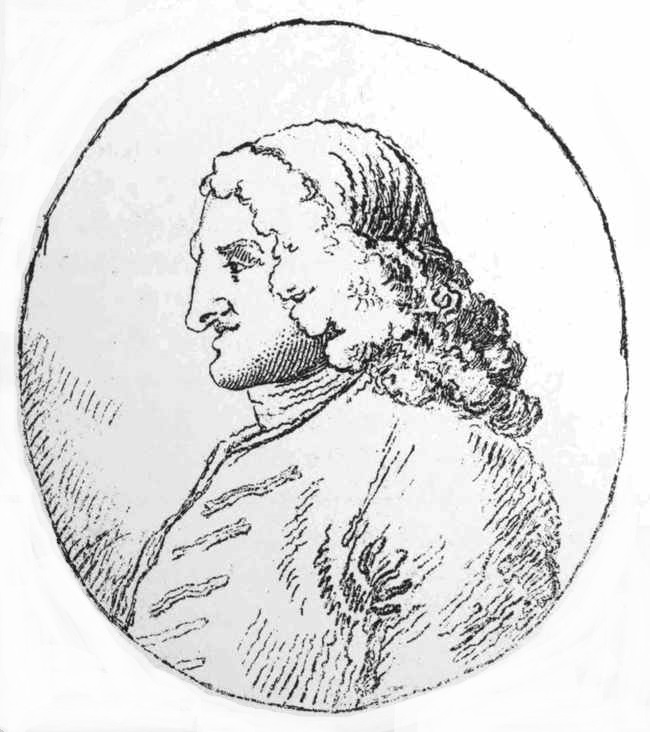
HENRY FIELDING.
This admirable writer was born at Sharpham Park, in Somersetshire, near Glastonbury, April 22, 1707. His father, Edmund Fielding, served in the wars under the Duke of Marlborough, and arrived at the rank of lieutenant-general at the latter end of George I. or beginning of George II. He was grandson to an Earl of Denbigh, and nearly related to the Duke of Kingston, and many other noble families. His mother was the daughter of Judge Gould, the grandfather of Sir Henry Gould, one of the Barons of the Exchequer.
Henry received the first rudiments of his education from the Rev. Mr. Oliver, to whom we may judge he was not under very considerable obligations, from the humorous and striking portrait given of him afterwards, under the name of Parson Trulliber, in Joseph Andrews. From Mr. Oliver's care he was removed to Eton school, where he had the advantage of being early known to many of the first people in the kingdom,—namely, Lord Lyttelton, Mr. Fox, Mr. Pitt, Sir Charles Hanbury Williams, and the late Mr. Winnington.
At this great seminary of education he gave distinguished proofs of strong and peculiar powers; and when he left the place, was said to be uncommonly versed in the Greek authors, and an early master of the Latin classics: for both which he retained a strong predilection in all the subsequent periods of his life. Thus accomplished, he went from Eton to Leyden, and there continued to show an eager thirst for knowledge, and to study the civilians with unwearied assiduity for two years; when, remittances failing, he was obliged to return to London, not then quite twenty years old.
The comedy called Don Quixote in England, was planned at Leyden, and completed on his return to London; where, from some cause or other, he was induced to bring it on the stage before it was properly wrought up, so that by this first essay he gained no dramatic reputation. Nor were his other productions for the playhouse much more popular; for though he wrote eight comedies and fifteen farces, they have not generally proved what are termed stock plays;[110] and yet from several of them, particularly Pasquin, succeeding and successful writers for the stage have borrowed some of their best speeches.
He died at Lisbon, to which place he went for the recovery of his health, in the year 1754, aged 47.
Of his talents, he has left memorials that will never die while the English nation retains a taste for genuine and Cervantic humour: his features posterity would have only known by description, had not his friend Hogarth, to whom he had often promised to sit, made this drawing; for, singular as it may seem, though this admirable writer lived on intimate terms with the best artists of the day, no portrait of him was ever painted.
Many strange stories have been told of the manner in which the drawing was made, such as, the hint being taken from a shade which a lady cut with scissors; of Mr. Garrick having put on a suit of his old friend's clothes, and making up his features and assuming his attitude for the painter to copy, etc. etc. These are trifling tales to please children, and echoed from one to another, because the multitude love the marvellous.
The simple fact is, that the painter of the "Distressed Poet," and the author of Tom Jones, having talents of a similar texture, lived in habits of strict intimacy; and Hogarth being told, after his friend's death, that a portrait was wanted as a frontispiece to his works, sketched this from memory.
The drawing was engraved by Mr. Basire, and is said, by those who knew the original, to be a faithful resemblance. This print is copied from a proof I had from Mrs. Lewis, and taken before the ornaments were inserted.[111]
SIMON LORD LOVAT.
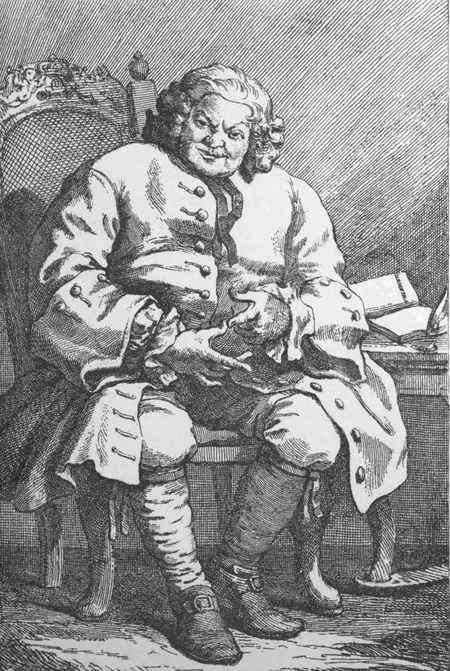
SIMON, LORD LOVAT.
Simon Lord Lovat was born in the year 1667; his father was the twenty-second person who had enjoyed the title of Lovat in lineal descent. His mother was Dame Sybilla Macleod, daughter of the Chief of the clan of the Macleods, so famous for its unalterable loyalty to its princes.
Buchanan relates a marvellous story of the family at the battle of Loch Lochlie, 1544. In this battle Lord Lovat, his four brothers, his three sons, and the whole clan of the Frazers, were cut to pieces; but if we are to believe this tale, the clan was afterwards restored by a kind of miracle. The passage is curious:—
"About this time, by the instigation, as it is thought, of the Earl of Huntly, a battle was fought in which almost the whole clan of the Frazers was exterminated. There was an old quarrel between the Frazers and the Macdonalds, which had been rendered illustrious by the many bloody engagements to which it had given birth. Huntly, in the meantime, was deeply irritated that the Frazers alone, among so many neighbouring clans, should reject his protection. He had just collected the neighbouring islanders, and made an incursion upon the estates of the Earl of Argyll; and while every other clan had exerted its whole force in his favour, there was scarcely an individual in the whole clan of Frazer that had not ranged himself under the enemy's standard. For this time, however, the feud was composed without an engagement; and the forces of each party having disbanded themselves, returned to the respective clans. The Macdonalds meantime, instructed by the Earl of Huntly, collected their whole force, and, having taken their enemy by surprise, engaged in a most obstinate battle. The unfortunate clan, overpowered by the greatest inequality of numbers, were killed to a man. Thus a family the most numerous, and who had often deserved well of the Scottish weal, had wholly perished, unless, as it seems just to believe, the Divine Providence had not interfered in their favour. Of the heads of the clan, eighty persons had left their wives pregnant at home, and each of them in her turn was delivered of a male child, who all attained safe to man's estate."—Buchanan, lib. xv. p. 532. Pity but they had been twins!
Thus much may suffice for the character of his progenitors; as to his own,[112] he wrote a narrative in French stating his conduct, connections, treatment at the Court of St. Germains, etc. These memoirs,[113] which are brought no further than the year 1715, were translated and printed several years ago; but, for some political or family reasons, not published until 1797. They contain many curious particulars of his life, much of which, both then and in every subsequent period, had great need of an apology. On his tergiversation in the rebellion of 1745, Sir William Young, one of the managers appointed for conducting the prosecution, makes the following observations:—"Your Lordships have already done national justice on some of the principal traitors who appeared in open arms against his Majesty by the ordinary course of law; but this noble Lord, who in the whole course of his life has boasted of his superior cunning in wickedness, and his ability to commit frequent treasons with impunity, vainly imagined that he might possibly be a traitor in private, and rebel only in his heart, by sending his son and his followers to join the Pretender, and remaining at home himself, to endeavour to deceive his Majesty's faithful subjects; hoping he might be rewarded for his son's services if successful, or his son alone be the sufferer for his offences if the undertaking failed. Diabolical cunning! Atrocious impiety!"—State Trials, vol. iv. p. 627.
These are hard and heavy accusations; but the fact is, that whoever becomes the biographical advocate of Lord Lovat will find it useful to adopt the plan recommended to the writer who wished to draw a fair character of that all-accomplished statesman, William Pulteney, Earl of Bath:
"Leave a blank here and there, in each page, To enrol the fair deeds of his youth! When you mention the acts of his age, Leave a blank for his honour and truth."
Notwithstanding all this, his conduct previous to execution was manly and spirited. When advised by his friends to throw himself at his Majesty's feet and petition for mercy, he absolutely refused, said that he was old and infirm, and his life not worth asking. When informed that an engine was to be made for his execution like that called "the Maiden," provided long since for state criminals in Scotland, he commended the contrivance, observing that, as his neck was short, the executioner would be puzzled to find it out with his axe; and if such a machine were used, it would get the name of "Lord Lovat's Maiden."[114]
When he was brought from Scotland to be tried in London, Hogarth having previously known him, went to meet him at St. Albans for the purpose of taking his portrait, and at the "White Hart" in that town found the hoary peer under the hands of his barber. The old nobleman rose to salute him (according to the Scotch and French fashion) with so much eagerness, that he left a large portion of the lather from his beard on the face of his old friend.
He is drawn in the attitude of enumerating by his fingers the rebel forces, "Such a general had so many men," etc.; and I am informed the portrait is in air, character, and feature, a most faithful resemblance of the original.
NINE PRINTS FOR DON QUIXOTE.
The first of these prints is copied from a plate in Jarvis' quarto translation of this inimitable work; it has neither painter nor engraver's name, but carries indisputable marks of the pencil and burin of Hogarth. The second is from an unfinished print in my possession, which I think by the same artist. The six which follow were designed for Lord Carteret's Spanish edition, published in the year 1738; but as they are etched in a bold and masterly style, I suppose the noble peer did not think they were pretty enough to embellish his volume, and therefore laid them aside for Vandergucht's engravings from Vanderbank's designs. Hogarth's six plates remaining in the hands of Mr. Tonson, his Lordship's publisher, were at his death bought by Mr. Dodsley, from whom they were purchased by Messrs. Boydell, in whose possession they now remain. While in Dodsley's hands, references to the chapters and corresponding pages in Jarvis' translation were engraved under each.
The last scene, representing "Sancho's Feast," is copied from an incomparable print engraved at an early period of Hogarth's life, and published by Overton and Hoole, price one shilling. The subject of this is exactly consonant to Hogarth's genius, and was probably selected by the artist to show how happily he could enter into the spirit of a writer whose turn of mind seems so congenial to his own. Had Cervantes been an Englishman, I think he would have contemplated our national follies through the same medium that they were seen by Hogarth, and probably selected similar scenes as subjects for his satire. He lived in an age and country where one gigantic folly
"In proud pre-eminence stalk'd through the land!"
He touched the phantom with his pen, and it vanished; but as folly is in some cases the parent of virtue, may not chivalry and romance, ridiculous as they are in the eye of reason, give birth to an ardour of spirit which aggrandizes and elevates a nation? To a sedate and saturnine people, a spice of absurdity may have its use, were it only to give motion to those virtues which without it might stagnate. Divested of that frenzy, which at the same time that it ruffles and impairs their reason, awakes and rouses their spirits, a whole nation, like a man-of-war becalmed, may be undulated by ineffectual motion, until they drop into a sort of mental stupor, unmarked by any other distinctions than those that arise from stately indolence, haughty solemnity, and supercilious dignity.
I will not presume to say that Spain is exactly in this situation; but if it were, other causes may have contributed to the change. If such are to be the consequences of a nation's becoming wise, a tincture of folly is rather to be desired than dreaded.
As to the hero of this admirable tale, the Knight of the Sorrowful Countenance, who has been the cause of more laughter than either the Knights of Arthur's Round Table, or any other knights ancient or modern, how can we sufficiently admire him! A paragon of patience and perseverance, unconquerable fortitude and proud honour, who in his lucid intervals reasoned like a philosopher, and was invariably actuated by the most exalted motives; deemed himself bound to defend the weak against the strong, chastise indolence, redress injuries, and free those who were in bonds! That this ardent, heroic, and dignified character, with motives so pure, an heart so excellent, and virtues that elevate, adorn, and irradiate human nature, should be led by an enthusiasm which fevered his imagination into absurdities that expose him to derision, and, like Samson, brought forth to make sport for the multitude, is mortifying to humanity; and I must confess, that with me, the laugh which the author's irresistible humour invariably excites is accompanied by a pitying sigh for the hero of this history, who is, after all, so superlatively happy in his ideal importance, that there is a degree of cruelty in destroying the illusion. The adage, "You think you are happy because you are wise; I think I am wise because I am happy," is not easily confuted.[115]
But this admirable romance carries me further than I intended. I was led into it by considering the comparative merit of Cervantes and Hogarth, in doing which, it is proper to observe that the motley follies of England (diametrically opposite to those of Spain) are changeable as an April day. Our English moralist (for surely he is worthy of the title) transferred them to his canvas or copper, and exposed them by pointed ridicule.
But his satiric histories had a higher and still more useful direction. They were calculated to encourage industry, and promote humanity in the lower orders of society, by exhibiting the baneful consequences of idleness and cruelty; and to check the ostentatious follies of those in a higher rank, by pointing out the happiness attendant on the practice of virtue, and the consequent misery of dissipation, sensuality, and vice.
I hope the warmest admirers of Cervantes will not be offended if I venture to assert that these were objects of more national and individual importance than was the extirpation of knight-errantry.
Both these great men may be considered as universal classics; for while Cervantes delights the learned and the illiterate in his own country, and is translated and eagerly read in France, Italy, Germany, and England, while the artists of all these nations emulate each other in delineating the scenes he has described, and every age and rank peruse Don Quixote with pleasure,—the fame of Hogarth is not bounded by the shores of Albion, but takes as wide a circuit through Europe, and his pictured stories are contemplated with admiration by men of every clime.[116]
Could their congenial spirits witness the tribute posterity pay to their talents, how would they be gratified! Large as is their portion of fame, they were little favoured by fortune. Hogarth, after a long life of persevering industry, died comparatively poor. As to the maimed hero of Spain, when the learned Don Gregorio Mayans y Siscar, at the request of Lord Carteret, collected materials for his life, he could neither learn where he was born nor where he died. Sevilla, Madrid, Esquivias, Toledo, Lucena, and Alcazor de San Juan, contended for the honour of his birth, whom living they had suffered to languish in a prison.
He was born in Alcala de Henares, in the year 1547, and died at Madrid, April 23, 1616, on the same nominal day with Shakspeare; so that Spain and England lost their two great luminaries at the same period, nor have succeeding centuries produced a successor worthy of ascending either of their vacant thrones.
From the similarity of their genius, it was reasonable to expect that Hogarth would excel in delineating the scenes described by Cervantes; and though our great painter of nature succeeded better in subjects drawn from the rich storehouse of his own mind than in those described by others, yet in the portraits of the knight, and knight companions, he has adhered very closely to their leading characteristics, which are thus depicted by Cervantes:—
"The age of our gentleman bordered upon fifty years; he was of a robust constitution, spare-bodied, of a meagre visage, and a very keen sportsman.
"Rozinanté was so long and lank, so thin and lean, so like one labouring with an incurable consumption, as did clearly show with what propriety his master so entitled him. Sancho Panza, or Canzas, was so called, because he had a great belly, a short stature, and thick legs."[117]
To attempt a description of the nine following prints in any other words than those of Cervantes, would be absurd and vain; to suppose that the greatest part of my readers had not perused Don Quixote, would be an insult on their taste. I will therefore take it for granted that the following scenes are in their recollection. The few that have not read this admirable romance have a pleasure to come; as an inducement to their embracing it, I will insert little more than a reference to the page in Shelton, whose quaint old English has perhaps more serious Cervantic humour than either Jarvis' or Smollett's modern translations. My edition is that of 1675.
PLATE I. THE FIRST SALLY IN QUEST OF ADVENTURES.
DON QUIXOTE PLATE I.
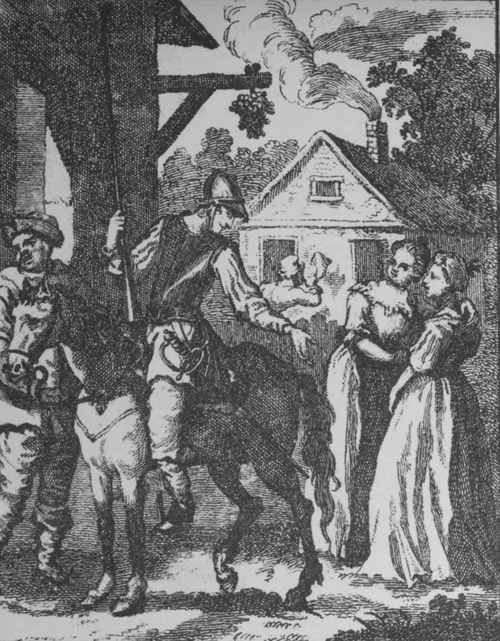
The original from which this plate is copied is in Jarvis' quarto translation, without either painter's or engraver's name; but the style of the etching, and air of the figures, indisputably determine the artist. It represents our heroic candidate for fame, before he had received the honour of knighthood, at the door of an inn, which he considered as a castle; the host holding his horse's bridle, and two young female travellers looking with astonishment at his figure. In the distance is a swineherd blowing his horn, which our adventurer mistakes for a trumpet sounded by a dwarf on the battlements, to announce his approaching the portico of the castle.—Vide Shelton, p. 3.
PLATE II. THE INNKEEPER.
DON QUIXOTE PLATE II.
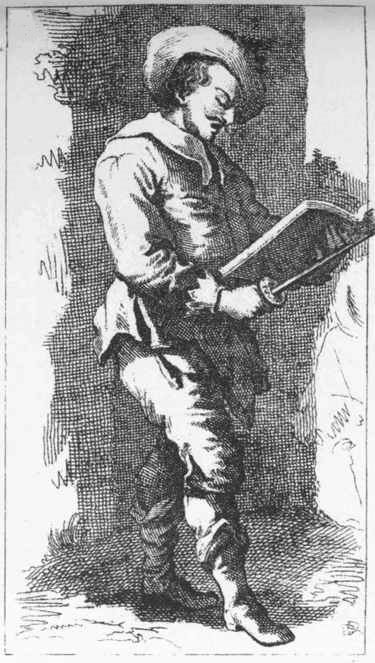
The original of this print is in my possession, and was designed to represent the innkeeper conferring the order of knighthood on Don Quixote, but for some cause, not now known, never finished. The artist probably intended that it should form a part of the series begun for Lord Carteret, but the other six being discarded, never completed his design; though a slight outline of the Don kneeling to receive his new honours is discernible in the corner of the print. Mine host, though a large man, is a less portly personage than the author describes. This print is not in any of the catalogues of Hogarth's works, but the style leaves little doubt of the artist.
In the plate from Vanderbank, in Jarvis' quarto, representing the whole scene, the innkeeper has a more than accidental resemblance to this figure.
PLATE III. THE FUNERAL OF CHRYSOSTOM.
DON QUIXOTE PLATE III.
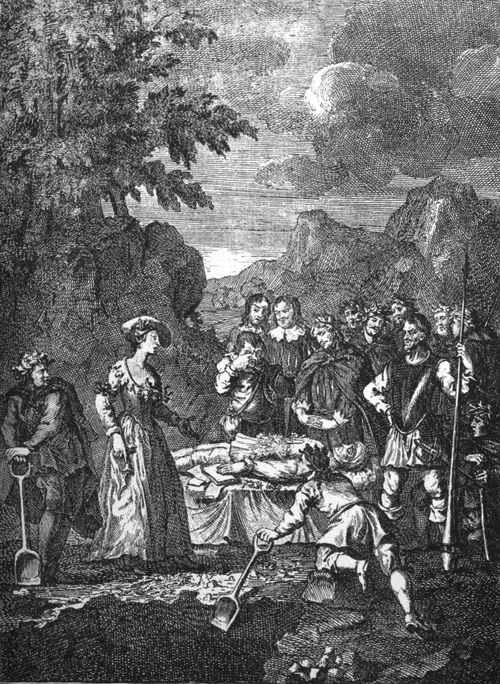
The stern attention which our Don gives to the Shepherdess Marcella, who is vindicating herself to those that surround the corpse, well expresses his determination to defend her cause, and protect her from insult. The shepherd in a similar attitude to the soldier in Vandyke's "Belisarius," and Sancho blubbering with his finger in his eye, are well-imagined; but the figure of Marcella is affected and stiff, and the shepherd on her right hand has more city pertness than rural simplicity.
Vanderbank has taken this scene for one of the prints in Jarvis' translation, and by placing Marcella where she ought to be, on the summit of the rock, rendered his design more picturesque than Hogarth's.—Vide Shelton, p. 10.
PLATE IV. THE INNKEEPER'S WIFE AND DAUGHTER ADMINISTERING CHIRURGICAL ASSISTANCE TO THE POOR KNIGHT OF LA MANCHA.
DON QUIXOTE PLATE IV.
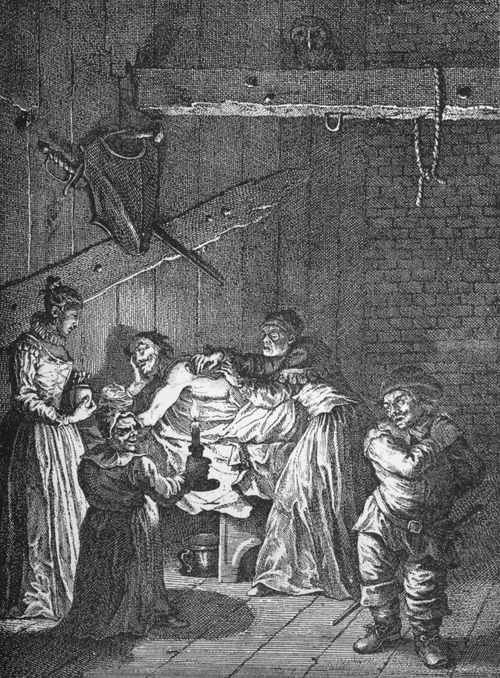
Don Quixote's adventure with the Yanguessian carriers having terminated in his being most bountifully beaten, he is here represented in the hay-loft of a very sorry inn, attended by the hostess and her daughter, Maritornes, and his faithful squire; the two former administering comfort to his sufferings, the third holding a candle; and the last, with a most rueful countenance, bewailing his own unfortunate participation in the buffetings of his lord and master.
The picture which Cervantes draws of Maritornes, Hogarth has well transferred to the copper. Thus is she portrayed:—
"From head to heel she was not seven palms[118] high, and burdened with shoulders that forced her to look down more than she wished. Added to this, she was broad-faced, flat-pated, saddle-nosed, blind of one eye, and could scarcely see out of the other."
The hostess could not have been better marked by the pencil of Teniers; the owl perched over her head should not be overlooked. That, as well as the rope hung to a beam, cracked walls, etc. etc., added to the miserable figure of the knight reclined on his hard pallet, display variety of wretchedness. I do not recollect to have seen a print in which the light is more judiciously distributed; in this and every other particular, I think it much superior to the same scene designed by Vanderbank in Jarvis' quarto translation.—Vide Shelton, p. 29.
PLATE V. DON QUIXOTE SEIZES THE BARBER'S BASIN FOR MAMBRINO'S HELMET.
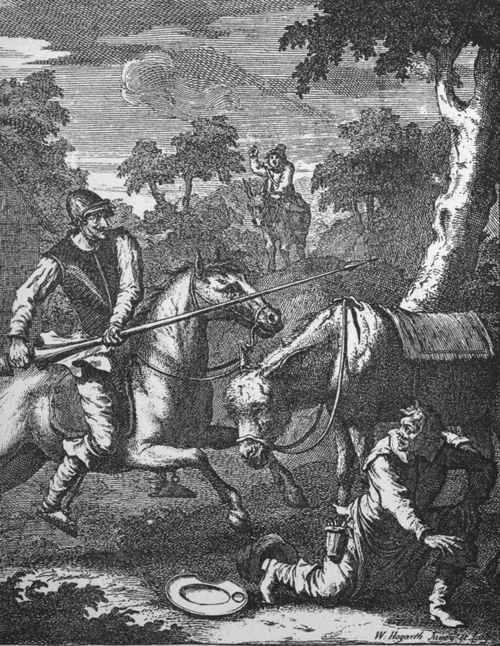
DON QUIXOTE PLATE V.
In this print the face and figure of the fierce knight is spirited; the terror and astonishment of the discomfited barber well expressed, and the triumphant shout of Sancho in the distance admirably characteristic. Notwithstanding this, I think that Vanderbank's design for Jarvis, where the squire is brought into the foreground, contemplating the glittering prize, is a better chosen point of time. To Sancho he has given a mixture of cunning and simplicity which I have seldom seen so happily displayed; and taken as a whole, it is perhaps a superior plate to Hogarth's.—Vide Shelton, p. 42.
PLATE VI. DON QUIXOTE RELEASES THE GALLEY SLAVES.
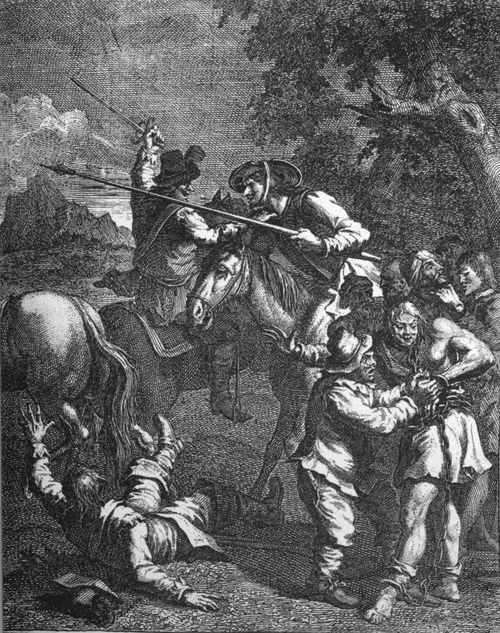
DON QUIXOTE PLATE VI.
The moment taken in this busy scene is when our valorous knight, after having unhorsed one of the guards, is engaged with the other; while Sancho, willing to bear his part in the adventure, helps to extricate Gines de Passamonte from his bonds.
In this, as in some other of Hogarth's designs, the artist not having taken the trouble of reversing his drawing, the figures are left-handed. The character of Sancho, and two or three of the slaves, is admirable.
I think the whole design much superior to Vanderbank's in Jarvis' translation, where the scene is chosen after the discomfiture of the Guards; for to two or three of the thieves Vanderbank has given the countenances of apostles. His whole print is tame, feeble, and spiritless.—Vide Shelton, p. 47.
PLATE VII. THE FIRST INTERVIEW OF THE VALOROUS KNIGHT OF LA MANCHA WITH THE UNFORTUNATE KNIGHT OF THE ROCK.
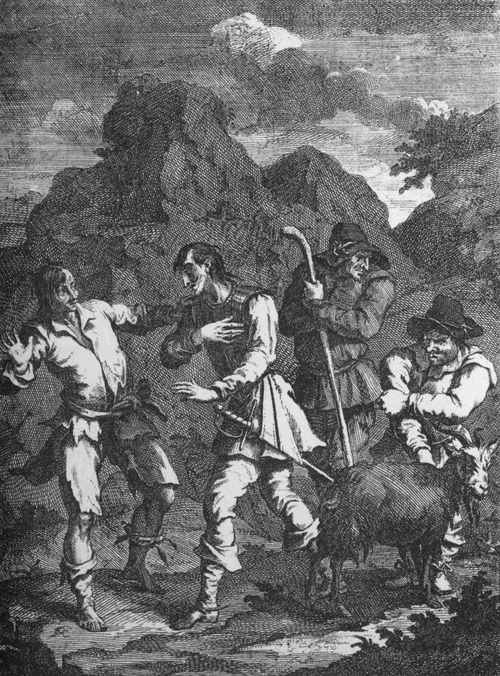
DON QUIXOTE PLATE VII.
This interview, which took place in the mountains of Sierra Morena, Cervantes thus describes:—
"Cardenio approached with a grave pace, and in a hoarse voice saluted them with great courtesy. Don Quixote returned his greeting with no less complaisance, and pressed him strongly in his arms, as if they had been long acquainted. The Knight of the Rock, after he had been thus embraced, retreated a few steps, and, laying his hand on the Don's shoulder, perused his face with such earnestness, as though he were desirous of recollecting if he had ever seen him before, and no less admired Don Quixote's strange figure than himself was admired by our heroic knight-errant."
This is the point of time which Hogarth has chosen; and the wild eye of Cardenio, the placid benevolence of Don Quixote, and the shrewdness of the goatherd, are well opposed. From the air, attitude, and action of Sancho, I should have imagined the period to be after he had been mauled by the madman, did not the two knights so strongly determine it to be before.
In Vanderbank's design of the same subject (vide Jarvis' quarto), the figure of Sancho is tolerable, but the Don is vapid and ill-drawn; and Cardenio's head, like that of Medusa, looks as if it were encircled with snakes.—Vide Shelton, p. 51.
PLATE VIII. THE CURATE AND BARBER DISGUISING THEMSELVES TO CONVEY DON QUIXOTE HOME.
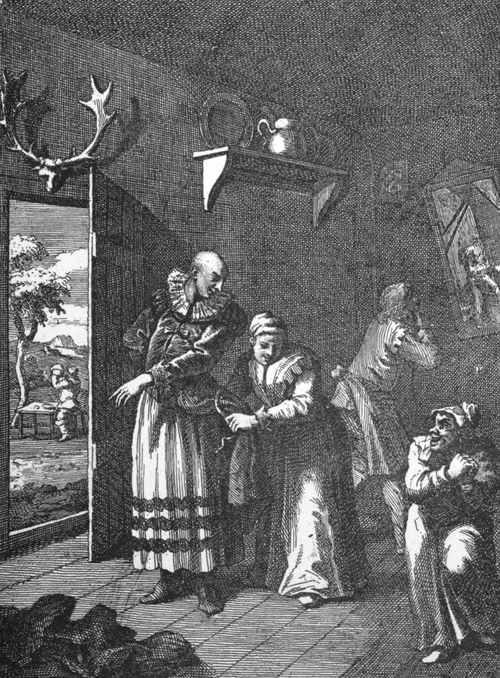
DON QUIXOTE PLATE VIII.
Don Quixote's old neighbours, the curate and barber, being desirous of checking his wandering disposition, are here disguising themselves for an interview, in which they hoped to bring him home, where they trusted he might again live as an old Christian ought to do. In pursuance of this plan, the barber procured an ample beard made from the tail of a pied ox; and the curate assumed the habit of a distressed virgin, and framed a tale of having been wronged by a naughty knight, to punish whom the Don was to be entreated to follow wherever this afflicted fair one should lead.
The dressing-room for this masquerade is the kitchen of an inn; out of the door, astride on a bench, inhaling copious draughts from a leathern bottle, Sancho gives some life to a little landscape in the distance.—Vide Shelton, p. 60.
PLATE IX. SANCHO'S FEAST.
"Sancho's dread doctor and his wand were there."
DON QUIXOTE PLATE IX.
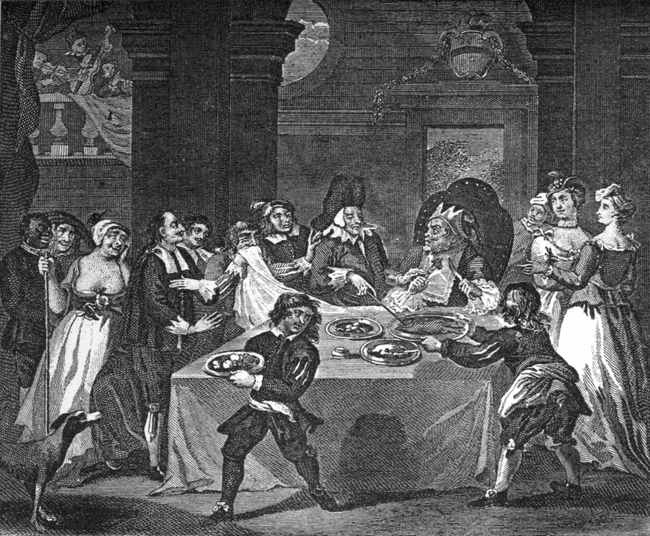
Though Don Quixote is the ostensible hero of this admirable history, I have sometimes thought that Sancho was the author's favourite character. He is here represented as Governor of Barataria, and seated in the spacious hall of a sumptuous palace, surrounded with all the pompous parade of high rank, and encircled by numerous attendants.[119] A band of musicians in an adjoining gallery strike up a symphony to gratify his ear, and a table is spread with every dainty to feast his eye and fret his soul; for however magnificent the appendages of this mock monarch, the instant he attempts to taste the solid comforts of government, the loaves and fishes evade his grasp, are touched by the black rod, and vanish!
"In plenty starving, tantaliz'd in state,"
he curses the gaudy unsubstantial pageant, vows vengeance on the Doctor, and swears that he will offer up both him and every physical impostor in the island as a sacrifice to his injured and insulted appetite.
Hogarth has here caught the true spirit of the author, and given to this scene the genuine humour of Cervantes. The rising choler of our Governor is admirably contrasted by the assumed gravity of Doctor Pedro Rezio. The starch and serious solemnity of a straight-haired student who officiates as chaplain, is well opposed by the broad grin of a curl-pated blackamoor. The suppressed laughter of a man who holds a napkin to his mouth forms a good antithesis to the open chuckle of a fat cook. Sancho's two pages bear a strong resemblance to the little punch-maker in the Election Feast, and though well conceived, might have had more variety; they present a front and back view of the same figure. To two females on the Viceroy's right hand there may be a similar objection.
The original print was designed and engraved at a very early period of Hogarth's life. As it was finished with more neatness than any of the eight which he afterwards etched for the same work, the copy is attempted in a similar style.
In the drawing, Sancho was originally portrayed with a full face; but Hogarth, judiciously thinking a profile would be preferable, fixed a bit of paper over his first thought, and altered it to the state in which it is here engraved.
The design that Vanderbank made from the same scene is cold and uninteresting; in another by Hayman, prefixed to Smollett's coarse translation, Sancho is fat enough for Falstaff, and the Doctor looks like a fellow dressed up to play the part of a conjuror in a puppet-show.—Vide Shelton, p. 221.
HEIDEGGER IN A RAGE.
HEIDEGGER IN A RAGE.
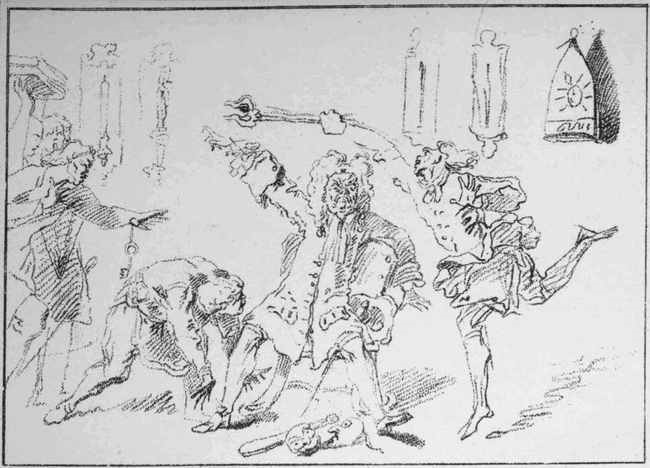
The spirited sketch from which this is copied has been thought the work of P. Mercier; but some of my subscribers thinking it bore a strong resemblance to Hogarth, I at their request submitted it to public opinion. It arose from the following circumstance:—
The late Duke of Montagu invited Heidegger to a tavern, where he was made drunk, and fell asleep; in that situation a mould of his face was taken, from which was made a mask; and the Duke provided a man of the same stature to appear in a similar dress, and wear it to personate Heidegger on the night of the next masquerade, when George the Second (who was apprised of the plot) was to be present. On his Majesty's entrance, Heidegger, as was usual, bade the music play "God save the King;" but no sooner was his back turned, than the impostor, assuming his voice and manner, ordered them to play "Charley over the Water." On this Heidegger raged, stamped, swore, and commanded "God save the King." The instant he retired, the impostor returned and ordered them to resume "Charley." The musicians thought their master drunk, but durst not disobey. The scene now became truly comic. Shame! shame! resounded from all parts of the theatre. Heidegger offered to discharge his band, when the impostor advanced and cried out in a plaintive tone, Sire, the whole fault lies with that devil in my likeness. This was too much: poor Heidegger turned round, grew pale, but could not speak. The Duke, seeing it take so serious a turn, ordered the fellow to unmask. Heidegger retired in great wrath, seated himself in an arm-chair, furiously commanded his attendants to extinguish the lights, and swore he would never again superintend the masquerade, unless the mask was defaced and the mould broken in his presence. For this purpose the man on his knee has a mallet stuck in his girdle.
THE LARGE MASQUERADE TICKET.
MASQUERADE TICKET.
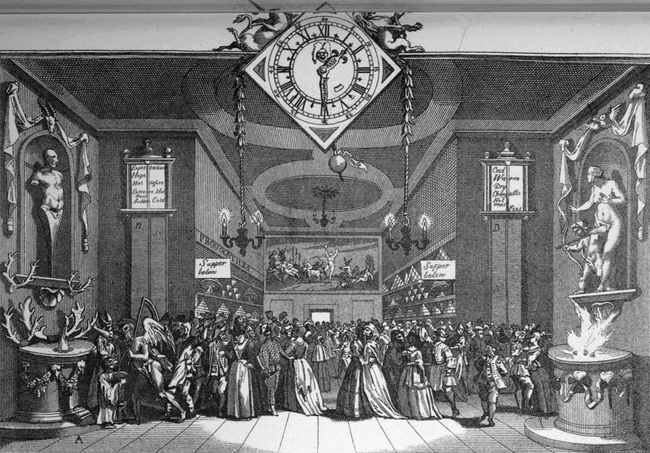
As the first print which Hogarth published on his own account, usually denominated "The Small Masquerade Ticket," represents a large company eagerly pressing to the door of a masquerade, we have here the interior of the room crowded with a countless multitude of grotesque characters, celebrating the orgies of the place, which, in the following references engraved under the original print, are thus described:—
"A, a sacrifice to Priapus. B, a pair of Lecherometors, showing ye company's inclinations as they approach 'em. Invented for the use of ladys and gentlemen by ye ingenious Mr. H——r" (Heidegger).
This titular divinity of the gardens being thus considered as the god of their idolatry, his Term is entitled to the first notice. The arched niche in which it is placed is terminated by a goat's head, ornamented with a pair of branching antlers, and decorated with festooned curtains. Beneath is an altar, the base of which is relieved with rams' heads and flowers; and three pair of stags' horns are fixed to the top.
As a companion to it, the united statues of a Venus and Cupid, both of them masked, are placed on the opposite side of the print. Cupid, who is a very well-drawn and spirited little figure, "has bent his bow to shoot at random," and Venus seems contemplating the rise and fall of the mercury in one of those instruments which the reference informs us is to show the inclinations of all that approach it. The niche in which these divinities are placed is not only decorated with curtains, but crowned with cooing doves. An altar beneath has on it three or four bleeding hearts, which, being close to the blaze, are in the way of being broiled. On the base are queue-wigs, bag-wigs, etc.
This may suffice for the presiding deities of the diversion; the head of their high priest, the renowned Heidegger, master of the mysteries and manager in chief, is placed on the front of a large dial, fixed lozenge-fashion at the top of the print, and I believe intended to vibrate with the pendulum, the ball of which hangs beneath, and is labelled "Nonsense." On the minute finger is written "Impertinence," and on the hour hand, "Wit:" which seems to intimate nonsense every second, impertinence every minute, and wit once an hour! The time is half-past one—the witching hour of night; 1727, the date of the year this print was published, is on the corners of the clock.
Recumbent on the upper line of this print, and resting against the sides of the dial, the artist has placed our British lion and unicorn renverse (such, I think, is the term in heraldry), lying on their backs, and each of them playing with its own tail; the lion sinister, and the unicorn dexter. The supporters of our regal arms being thus ludicrously introduced, may perhaps allude to the encouragement George the Second gave to Heidegger, who at that period might be said to
"Teach kings to fiddle, and make senates dance;"
and who, by thus kindly superintending the pleasures of our nobles, gained an income of £5000 a year, and, as he frequently boasted, laid out the whole in this country.
Beneath is a framed picture of a Bacchanalian scene; and on each side, shelves with pyramids of jellies, sweetmeats, etc., inscribed "Provocatives." On two labels placed before them is written, "Supper below."
A pair of instruments, somewhat similar to the mental thermometer in "The Medley," are fixed on each side: on that next to Venus and Cupid is written, "cool, warm, dry, changeable, hot, moist, fixt;" on the other, "expectation, hope, hot desire, extreme hot, moist, sudden cold."
The motley crew who make up the crowd it is not easy to describe, for every one present assumes a false character.
"Here tottering old age essays to prance With feeble feet, and joins th' imperfect dance; There, supercilious youth assumes the air And reverend mien which hoary sages wear. 'Tis thus, like Proteus, Folly joys to range, Her name to vary, and her shape to change."
Here are priests of all persuasions—Brahmins, friars, drones, monks, and monkeys not a few.
A figure of Time with his scythe, eagerly pressing towards the altar with rams' heads, is arrested in his course by a sort of slaughterman, with a mask, shaven crown, and short apron, who violently grasps his wing with one hand, and with the other lifts up a hatchet, which with fatal force he aims at his head. For sanctuary, this feeble figure lays hold of one of the horns of the altar, but is frustrated in his attempt to reach the steps by a bishop, who, with his sacrificing knife, coolly stabs him to the heart; while a monkey, in the habit of a chorister, holds a basin to catch the blood, the fumes from which he snuffs up with ineffable delight. This I apprehend to be a metaphorical view of a prelate killing Time at a masquerade.
Next to this group is a Mother Shipton, hooking on the arms of a clown; and near them a harlequin endeavouring to draw the attention of a graceful columbine from a turban'd Turk, who attempts to seduce her from her party-coloured gallant. A female, with the mask of a monkey's head, salutes a nun in a black veil; and while an old Capuchin, with the face of an ape, whispers soft things to a young girl, a fellow somewhat like Tiddy-doll draws up her head-dress to a point, like a fool's cap. A man in the right-hand corner, solicitous to give a glass of wine to one of the sisterhood, lifts up her veil for the purpose of her drinking it.[120]
ADDENDA.