Volume 1 — CHAPTER VII. MANASSEH’S CONTEMPORARIES
Reading edition
The Renaissance and the Reformation—John Sadler—Milton’s belief in the Return—Edmund Bunny—Isaac de La Peyrère—Leibnitz—Thomas Brightman—James Durham—The pamphlet “Doomes-Day”—Thomas Burnet—The pamphlet “The New Jerusalem”—Thomas Drake—Edward Nicholas, John Sadler, Hugh Peters, Henry Jesse, Isaac Vossius, Hugo Grotius, Rembrandt, Isaac da Fonseca Aboab, Dr. Ephraim Hezekiah Bueno, Dr. Abraham Zacuto Lusitano, H. H. R. Yahacob Sasportas, Haham Jacob Jehudah Aryeh de Leon [Templo]—Manasseh’s origin.
As a result of the impulse given to Letters generally by the Renaissance in the fifteenth century, and by the Reformation in the sixteenth century, the knowledge of the Hebrew language and literature spread rapidly in the literary world, and particularly in the first half of the seventeenth century. Hebrew was a favourite study with Puritan ministers, who dwelt much upon the Messianic hopes and promises of the Scriptures and Rabbinical works. A great stir was caused among Jews as well as Christians by Montezinos’ report and other rumours concerning the lost Ten Tribes. John Sadler (1615‒1674) (Appendix xii), Town Clerk of London, a friend of Cromwell, and probably also of Milton and Dury, stated that there was an old prophecy which fixed the time of the Restoration at the year 5408 = 1648 A.D. Puritans and Sectarians began to take the greatest interest in Jewish Messianic affairs just before King Charles I. (1600‒1649) was executed, for most of them were looking forward to some new reformed Commonwealth, some new communion of saints, some republic, some peaceful kingdom of Truth and Justice, and they connected the restoration of Israel scripturally with its advent. That was one reason why Sadler and Cromwell and others were favourably disposed towards the Jews and inclined to let them come back to England, for the idea prevailed that the Jews had first to be dispersed throughout the whole world before the Lord would return to set up His millennial Kingdom. Milton thought that the whole twelve tribes would return to Zion;¹ and similar sympathetic views are expressed in an anonymous romance published in London in 1648, entitled Nova Solyma (Appendix xiii), of which it has been claimed he was the author.
¹ Paradise | Regain’d. | A | Poem. | In iv. Books. | To which is added | Samson Agonistes. | The Author | John Milton. | London, | Printed by J. M. for John Starkey at the | Mitre in Fleet street, near Temple-Bar MDCLXXI (8º. 2 ll. + 111 + 101 + 1 l. ERRATA). “Licensed July 2, 1670.”
[Samson Agonistes was translated into Hebrew by Joseph Massel and published under the title of שמשון הגבור in Manchester, in 1890. (8º. 3 ll. + 107 pp. + 3 ll.)]
Joannis Miltoni Angli De Doctrina Christiani ... Cantabrigiæ,... M.DCCC.XXV. (4to. 6 ll. + 544 pp. + 1 l.)
Edmund Bunny (1540‒1619), a theological writer, devoted himself to the work of an itinerant preacher, visiting towns and villages. His doctrine was Calvinistic, but his warm attachment to the ideals of ancient Israel was a singular feature of his theological views.¹
¹ The | Scepter of | Ivdah: | Or, what maner of Government it | was, that unto the Common-wealth | or Church of Israel was | by the Law of God | appointed. | By Edm. Bunny. | ... Imprinted at London by N. Newton, | and A. Hatfield, for | Iohn Wright. | 1584. | (Sm. 8º. 4 ll. + 160 pp. + 31 ll. [B. M.]
The | Coronation of | Dauid: | Wherein out of that part of the | Historie of David, that sheweth how | he came to the Kingdome, wee have set | forth unto us what is like to be the end | of these troubles that daylie arise | for the Gospels sake. | By Edm. Bunny. | ... Imprinted at London by Thomas Orwin for | Thomas Gubbin and John Perin. | 1588. | (4to. 6 ll. + 108 pp. [B. M.])
Of The | Head-Corner-Stone: | by Builders still overmuch | omitted: ... By Edm. Bvnny, Batcheler | of Divinitie. | ... Printed by W. Iaggard, 1611. | (Sm. Folio. 11 ll. + 577 pp. [B. M.])
The distinguished French-Huguenot scholar Isaac de La Peyrère (1594‒1676) of Bordeaux, probably of marrano Jewish blood, author of many works, wrote and published anonymously Dv Rappel des Ivifs, M.DC.XLIII.¹ (Appendix xiv) which was intended to be part of a greater work on the same subject.² He demands in this book the restoration of Israel to the Holy Land in an unconverted state, in the belief that this restoration will lead to the final triumph of Christianity. He expects France to carry out this idea, and appeals in this sense to the Royal Dynasty in a somewhat strange homiletical manner.³ In 1644 he was appointed French Ambassador at Copenhagen. Being on intimate terms with the eminent scholars Isaac [Vos] Vossius (Appendix xv) (1618‒1689) and Hugo Grotius [Huig van Groot]⁴ (1583‒1645) he became acquainted with their mutual friend Manasseh and with Manasseh’s friends, Caspar [van Baerle] Barlaeus (1584‒1648), Simon Episcopius (1583‒1643), Gerard John [Vos] Vossius (1577‒1649),⁵ Johannes [van Meurs] Meursius (1579‒1639), David Blondel (1591‒1655), [Peter] Petrus [Serrurier] Serrarius (fl. 1650‒1700) and Paulus Felgenhauer (circa 1625), who all supported similar ideas.
¹ “... the curious will be rather surprised to learn that the Abbe [Henri] Grégoire (1750‒1831) and others have been under a mistake in asserting that Peyreyra’s Rappel des Juifs was printed during his life-time, upwards of 120 years: for this singular book, as it appears from the learned Jesuit, his friend, he could never obtain a license; but the fair copy, which he deposited in a public library, only appeared in print in Paris, after it became the pleasure of the head of the French government to assemble a Jewish Sanhedrin in May, 1806, for reasons that are obvious....”
(Gentleman’s Magazine, vol. lxxxii., November, 1812, p. 432.)
² p. 373: Advis av Lectevr. Ce petit Traittè n’est qu’vn Essay et un Extraict d’un plus grand Desseing que i’ay conceu; intitulé Synopsis doctrinæ Christianæ ad vsvm Ivdæorvm et Gentivm .
³ “Ie fonde cette Cõiecture sur ce que cette grãde Deliurance des Iuifs fut traittée & concluë dãs la ville Royale de Susan: Svsan, qui signifie Le Lys. Ville Royale de Susun qui est donc mesme chose que la ville Royale du Lys: and mesme chose ville Royale de France.”
This appeal recalls another of a similar kind addressed in 1672 by Baron G. W. von Leibnitz (1646‒1716) during his sojourn in Paris (1672‒1676) to Louis XIV. (1638‒1715) about the conquest of Egypt. “Epistola ad regem Franciæ de expeditione Egyptiaca.” This interesting appeal, which contains also some references to Jerusalem and Syria, was discovered in Hanover during the first occupation by the French and transmitted to the First Consul Bonaparte, who wrote from Namur on the 4th August, 1803: “Mortier m’envoie à l’instant même un manuscrit, en latin, de Leibnitz, adressé à Louis XIV., pour lui proposer la conquête de l’Egypte. Cet ouvrage est très-curieux.” M. de Hoffmann published this document in a pamphlet which appeared in French in 1840: “Mémoire de Leibnitz à Louis XIV. sur la conquête de l’Egypte.”
⁴ Swedish Ambassador in Paris, 1635‒1645.
⁵ William Laud, Bishop of London (1628‒1633), presented Gerard John Vossius to a canonry in Canterbury Cathedral in 1629. His son, Dionysius Vossius (1612‒1633), translated the Conciliador (Pentateuch), Francofurti 1632 [I. S.] of Manasseh Ben Israel into Latin. Francofurti, 1633 [I. S.] and Amsterdami, 1633 [I. S.].
The Rev. Thomas Draxe¹ (ob. 1618), a theologian of great knowledge and influence, demonstrated that “all the particular promises, such as the land of Canaan, a certain form of government ... were proper to the Jews...,” and “that we (Christians) must therefore acknowledge ourselves debtors unto the Jews, and deeply engaged unto them, we must be so far off from rendering or returning them evil for good....”²
¹ The History Of The Worthies Of England. Endeavoured by Thomas Fuller, D.D., London,... MDCLXII., pp. 125‒126.
² The Worlde’s Resvrrection, or The gener’all calling of the Iewes... By Thomas Draxe, Minister of the word of God ... At London ... Anno 1608. (4to. 6 ll. + 124 pp. [B. M.])
Thomas Brightman (1562‒1607), a Puritan Divine and Bible exegete, in his comment on:—
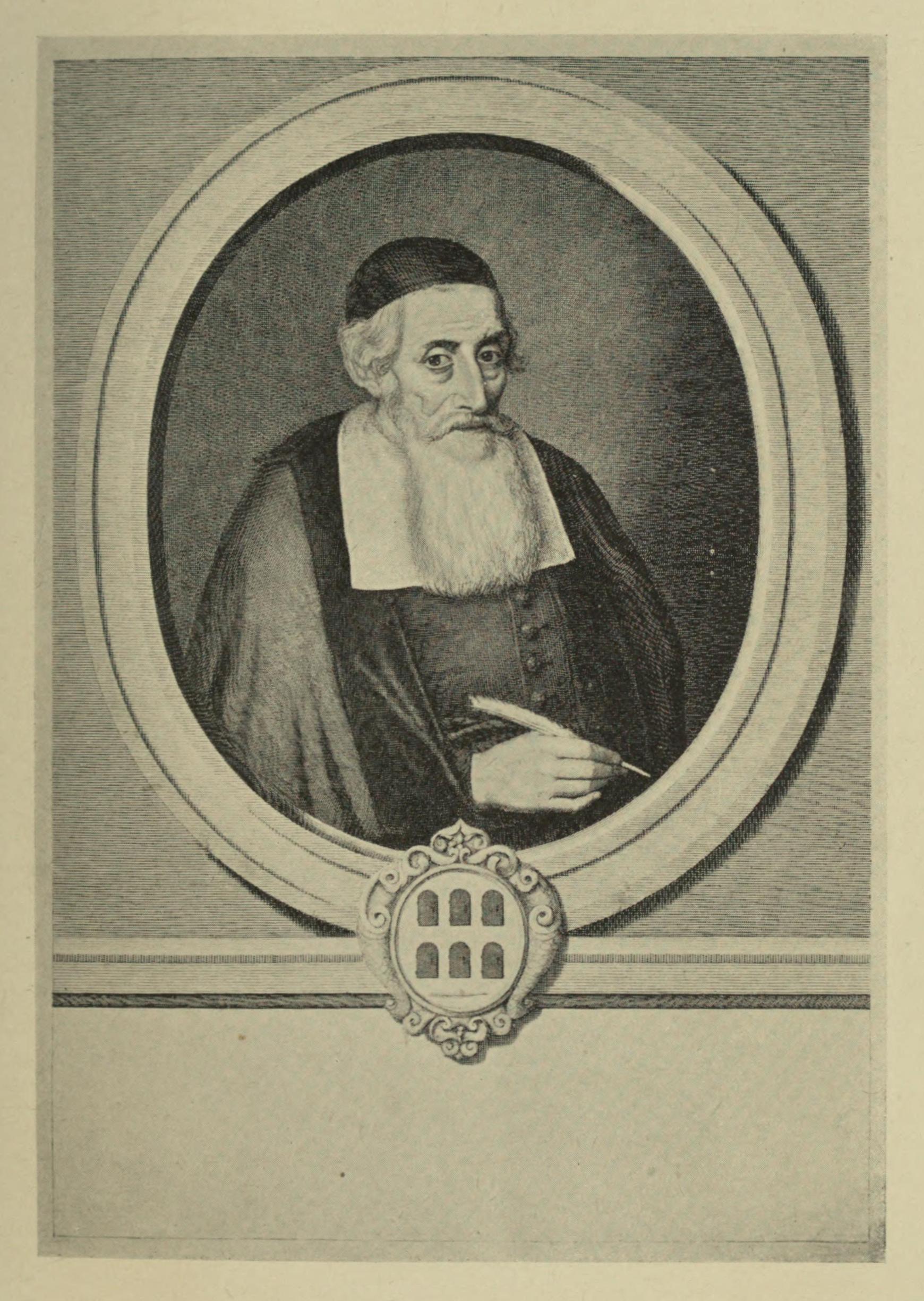
H. H. Reby Yahacob ♦Saportas
P. van Gunst, sculp.
From a line engraving (proof before all letters) lent by Israel Solomons
“And the sixth [angel] poured out his vial upon the great river Euphrates; and the water thereof dried up, that the way of the kings of the east might be prepared” (Revelation xvi. 12).
gives reasons why these “kings of the east” must mean the Jews, and then says: “What! Shall they return to Jerusalem again? There is nothing more certain: the prophets do everywhere confirm it.”¹
¹ A Revelation Of Mr. Brightman’s Revelation, Whereon Is shewed, how all that which Mr. Brightman, ... hath fore-told ... hath beene fulfilled, and is yet a fulfilling, ... whereby it is manifest, that Mr. Brightman was a true Prophet.... Printed in the yeare of fulfilling it. 1641. (4to. Eng. Front. + 1 l. + 37 pp. [B. M.]
The Rev. James Durham (1622‒1658) not only upholds, but gives solid reasons for his belief in the Restoration of the Jews.¹
¹ A Commentary Upon the Book of Revelation.... Delivered in several Lectures, by ... Mr. James Durham, Late Minister of the Gospel in Glasgow.... Edinburgh.... 1680.
Mr. Vavasor Powel (1617‒1660) expounds with abundant references to scriptural prophecy, the return and re-establishment of the Jews, attended with many miracles and peculiar circumstances.¹
¹ A New and Useful Concordance to the Holy Bible.... Also a Collection of those Scripture-Prophesies which relate to the Call of the Jews, and the Glory that shall be in the latter days.
Begun by the industrious Labours of Mr. Vavasor Powel, late deceased:... London,... 1671.
An anonymous writer relates:—
“... the Jewes ... are ... assembling ... from out of all countreys ... to regaine the holy land once more out of the hand of the Ottaman:”¹ (Appendix xvi).
¹ Doomes-Day:... The gathering together of the Jews ... for the conquering of the Holy Land.... London,... 1647.
Thomas Burnet (1635?‒1715), Master of the Charterhouse, a great scholar and celebrated author in English and Latin, writes:—
Deum nunquam deserturum esse finaliter populum suum Israeliticum.
Secundò, Nondum impleta esse promissa omnia Israelitis data.¹
¹ De Statu Mortuorum et Resurgentium Tractatus. Ajicitur Appendix de Futurà Judærum Restauratione.
Autore Thoma Burnetio, S. T. P. Editio Secunda. Londini:... M.DCC.XXXIII. (8º VIII. + 432 pp. [B. M.])
p. vi.: Editoris Præfatio.... Londini, ex Hospitio Lincolniensi, mense Oct. A.D. 1727: pp. 315‒432: “Appendix de Futura Judæorum Restauratione. Autore Thoma Burnetio, S. T. P.”
Another anonymous theologian published in 1674, A Paper, shewing that the great ... Restauration of all Israel and Judah will be fulfilled ... and that the New Jerusalem is most probably then to be set up (Appendix xvii).
Among the Christian friends of Manasseh, the following distinguished persons may be named: Edward Nicholas, the author of An Apology for the Honorable Nation of the Jews, 1648 (Appendix xviii); the above-mentioned John Sadler, who petitioned Richard Cromwell (1626‒1712) for a pension for Manasseh’s widow; Hugh Peters (1598‒1660), one of Oliver Cromwell’s army chaplains, and a strong advocate for the unrestricted admission of the Jews (Appendix xix), Isaac Vossius, the scholarly Protestant ecclesiastic, with whom he was in correspondence.¹ Vossius, at one time a member of the Court of Queen Christina of Sweden, was instrumental in bringing Manasseh to her notice.² Dr. Nathanael Homes (1599‒1678), the famous Puritan divine and author,³ and the great painter Rembrandt Harmenszoon van Ryn (1606(7)‒1669). The most notable of his Jewish friends were, Isaac da Fonseca Aboab (1605‒1693) (Appendix xx), Haham of the Sephardi community at Amsterdam, on whose initiative the Great Synagogue there was erected. Dr. Ephraim Hezekiah (ob. 1665) [de Dr. Joseph⁴ (ob. 1641)] Bueno (Bonus), author of several liturgical works⁵ and the subject of Rembrandt’s famous etching “The Jew Doctor”; Dr. Abraham Zacuto Lusitano (1580‒1642) (Appendix xxi), one of the most celebrated physicians of his age; Jacob Jehudah Aryeh de Leon [Templo] (1603‒1675), chiefly known as having designed models of the Tabernacle and Temple and was called “Templo” for that reason, which was assumed as a surname by his descendants. In anticipation of his visit to England, to exhibit the models before Charles II. (1630‒1685) and his Court, he published in Amsterdam a pamphlet in English describing them (Appendix xxii): and H. H. R. Yahacob Sasportas (1610‒1698), who accompanied Manasseh to England in 1655, was appointed in the month of Nisan, 1664, Haham of the Sephardi community in London. He was the author of one of the treatises in Sepher Pene Rabah edited by Manasseh Ben Israel ... Amsterdam 5388, and also wrote Sepher Ohel Ya’acob and Sepher Kizur Zizath Nobel Zebi, which were published together at Amsterdam 5497, against the adherents of Sabbatai Zebi (1626‒1676). His stay here was of short duration—not quite two years. He left the country to escape the plague which was then raging, and subsequently, in 1681, became the Ecclesiastical Head of the Sephardi Jews in Amsterdam. It is noteworthy that two of these friends of Manasseh, Aboab and Sasportas, were particularly interested in the Messianic hopes, though from different points of view. Aboab, a Cabbalist, whose religious poetry is remarkable for chaste diction and wealth of imagination, was supposed to be a secret Sabbatian, while Sasportas, sober-minded and a strict Talmudist, was strongly opposed to the mystical tendencies of pseudo-Messianism, and hoped for the restoration in the traditional way.
¹ Two of these letters have been published by Heer J. M. Hillesum, in his article “Menasseh Ben Israel,” in the Amsterdamsch Jaarboekje, 1899, pp. 27‒56.
² Manasseh in her honour published in Portuguese:—Oracion Panegirica a su Magestad la Reyna de Suedia. Amsterdam, 1642. 4to.
³ The Resurrection—Revealed Raised Above Doubts & Difficulties. In Ten Exercitations.... By Doctor Nathanael Homes.... London, Printed for the Author, A.D. 1661.
⁴ Wrote one of the “Aprovaciones” for “La primera parte del Conciliador enel Pentateucho, 1632.” “Del excelente Señor Doctor Joseph Bueno, Philosopho, y Medico preclaro.”: and also a Soneto which appears on the ninth introductory leaf of “Menasseh Ben Israel De La Resvrreccion De Los Mvertos, ... En Amsterdam, En casa, y à costa del Autor. Ano. 5396. de la criacion del mundo.” (12mo. 12 ll. + 187 pp. + 1 l. [I. S.]
⁵ At the joint expense of Ephraim Bueno and Jona Abrabanel (who both contributed Sonetos to De La Resvrreccion De Los Mvertos) the Sepher Pene Rabah [I. S.] was issued at Amsterdam in the year 5388. It was edited, re-arranged and printed by Manasseh Ben Israel. Jona (ob. 1667) Abrabanel was a poet, and son of Dr. Joseph (ob. 1620?) Abrabanel, a physician in Amsterdam, whose sister Rachel was the wife of Manasseh Ben Israel. Their father, Isaac Abrabanel, a scientist (ob. 1573), lived and died in Ferrara, Italy, and was on intimate terms with the famous marrano physician, Juan Rodrigo de Castel-Branco [Amatus Lusitanus] (1511‒1568). He was the son of Joseph Abrabanel (1471‒1552), a doctor of medicine, born at Lisbon and died at Ferrara, whose father, Don Isaac, was the illustrious Bible commentator and statesman.
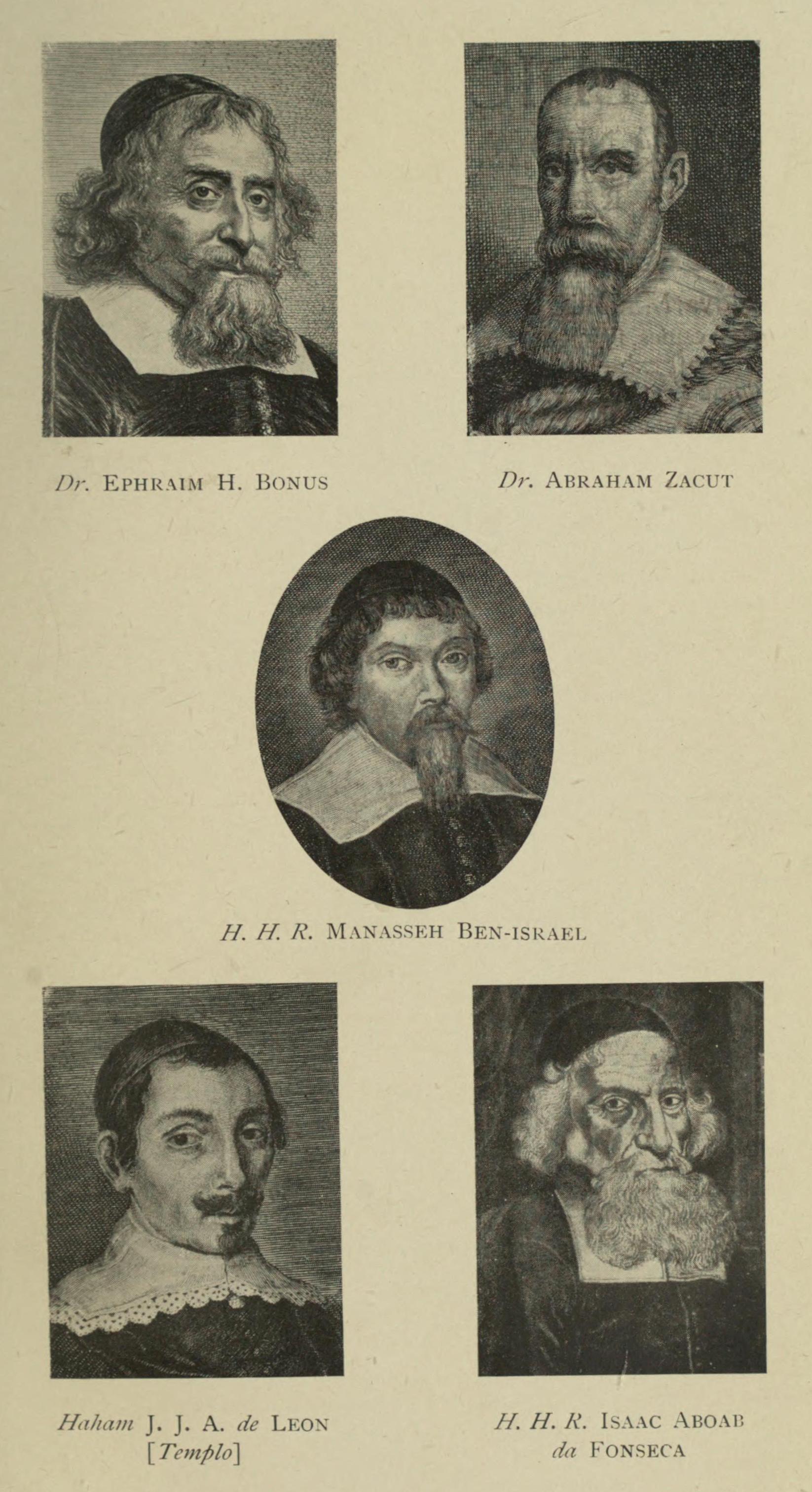
Dr. Ephraim H. Bonus Dr. Abraham Zacut
H. H. R. Manasseh Ben-israel
Haham J. J. A. de Leon [Templo] H. H. R. Isaac Aboab da Fonseca
From rare engravings lent by Israel Solomons
In 1603 Joseph Ben-Israel, the father of Manasseh, and his wife Rachel Soeiro, secretly left Lisbon. He had been a victim of the Inquisition, which deprived him of his wealth, and on three distinct occasions had been subjected to excruciating tortures, which undermined his health. They apparently fled to La Rochelle, France, for it was here that Manasseh was shortly afterwards born, in 1604, as is attested by his marriage certificate, deposited in the Archives of the City of Amsterdam (Puiboek, No. 669, fo. 95 verso, 15 Aug. 1623). Here he was also baptized, as it was not until his parents arrived at Amsterdam that they dared avow their faith in the God of Israel. In a holograph letter¹ of Manasseh to an unknown correspondent (suggested by Mr. E. N. Adler, the owner, to be Gerard John Vossius) he writes: “... and the Thesoro delos Dinim (Appendix xxiii) of our rites and ceremonies, the last in my Portuguese mother tongue, for I am a Lisbonian by patrimony....” He did not claim Lisbon as his own birthplace, but as that of his father. Most of his connections were with Spanish and Portuguese Jews, though he was opposed to any sort of separation, condemning it in his writings, and emphasizing the necessity of Jewish unity and brotherhood. It is noteworthy that a hundred and twenty-six years later, when the father of Jewish Rationalism, Moses Mendelssohn (1729‒1786), had to defend Judaism and the Jewish people, he found no better apology than Manasseh’s Vindiciae Judæorum (1656), which was translated into German, and for which he wrote the admirable Vorrede (Appendix xxiv).
¹ Amsterdam, ultimo de Janʳᵒ, 1648.
Magᵉᵒ y muy docto Sʳ
... y el Thesoro de los dinim de nuestros ritos y ceremonias, este en mi lengua materna lusitana, porq’ yo soy por patria Lixbonense.... Con esto me despide, hora vale amantissimo S.
El Haham Menasseh Ben Israel.
Jewish Quarterly Review, No. 63, p. 569, vol. xvi., April, 1904.—About Hebrew Manuscripts, by Elkan Nathan Adler ... London ... 1905, pp. 65‒77—The Jewish Historical Society of England Transactions ... Edinburgh and London. 1908 ... pp. 177‒183.