Chapter XIX · (continued 2)
Reading edition
In those four months I traveled over the greater part of Kansas, held two meetings every day, and the latter part of the time three meetings every day, making in all between two and three hundred speeches, averaging an hour in length; a fact that tends to show that women can endure talk and travel at least, as well as men; especially when we recollect how the Hon. Sidney Clark, then candidate for Congress, canvassed, in the beautiful autumn weather, a small portion of the State which I had traveled over amid the burning heat of July and August; he spoke once a day instead of twice; he rested on Sundays; he had no anxiety about the means of travel, his conveyance being furnished at hand; he was supported by a large constituency, and expected to be rewarded by office and honors; yet with all these advantages, he broke down in health and was obliged to give up a part of his appointments, and the Republican papers said: "It was not strange, as no human being could endure without loss of health such constant speaking, with such long and tedious journeys as Mr. Clark had undertaken."
It is deemed, in certain quarters, wicked heresy to complain of or criticise the Republican party, that has done so much in freeing the slaves and in bringing the country victoriously through the war of the rebellion; but if there is to be any truth in history we must set it down, to stand forever a lasting disgrace to the party that in 1867, in Kansas, its leaders selfishly and meanly defeated the woman suffrage amendment.
As the time for the election drew nigh, those political leaders who had been relied upon as friends of the cause were silent, others were active in their opposition. The Central Committee issued a circular for the purpose of preventing loyal Republicans from voting for woman suffrage; not content with this, the notorious I. S. Kalloch, and others of the same stripe, were sent out under the auspices of the Republican party to blackguard and abuse the advocates of woman's cause while professedly speaking upon "manhood suffrage." And Charles Langston, the negro orator, added his mite of bitter words to make the path a little harder for women, who had spent years in pleading the cause of the colored man.
And yet, with all the obstacles which the dominant party could throw in our way; without organization, without money, without political rewards to offer, without any of the means by which elections are usually carried, we gained one-third of all the votes cast! Surely it was a great triumph of principle; and had the leading Republicans, even one or two of them, stood boldly for the measure which they themselves had submitted, Kansas might have indeed been a "free State"; the first to enfranchise women; the advance guard in the great progressive movements of the time; and her leading politicians might have gone down in history as wise, far-seeing statesmen who loved principles better than office, and who gained the rewards of the world because they sought "first the kingdom of God and His righteousness." As it was, their favorite measure, "negro suffrage," was defeated for that time, and several of those who sold their birthright of truth and justice for a miserable mess of pottage in the shape of office and emoluments, lost even the poor reward for which they had trafficked.
As for us, the advocates of suffrage who labored there in that first woman's suffrage campaign, we have forgotten, in part, the bitterness of disappointment and defeat; we think no more of the long and wearisome journeys under the hot sun of southern Kansas; the anxiety and uncertainty; the nervous tremor when night has overtaken us wandering on the prairie, not knowing what terrible pitfalls might lie before; the mobs which sometimes made the little log school-house shake with their missiles; the taunts and jeers of the opposition; all this is passed, but the great principle of human rights which we advocated remains, commending itself more and more to the favor of all good men, confirmed by every year's experience, and destined at no distant day to find expression in law.
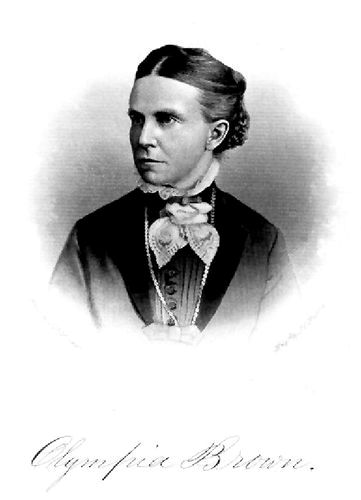
Olympia Brown.
Sincerely Yours,
The day before the election immense meetings were held in all the chief cities. In Leavenworth Mr. Train spoke for two hours in Laing's Hall, and then took the evening train for Atchison. Mrs. Stanton entered the hall just as he left, and made only a short speech, reserving herself for the evening, when, Daniel R. Anthony in the chair, she made her final appeal to the voters of the State. She was followed by several of the leading gentlemen in short speeches, fully indorsing both amendments. The Bulletin, in speaking of the meeting, said:
Laing's Hall was crowded to overflowing last evening to listen to a discourse from Mrs. Stanton, on the main issues pending in this State, and to be decided to-day. The speech of Mrs. Stanton was mainly in behalf of female suffrage. Speeches were also made by Col. J. C. Vaughan, Col. Jennison, Col. Moonlight, and Col. Anthony. The best of feeling prevailed throughout.
Susan B. Anthony spoke to an equally large audience in Atchison, and Olympia Brown to another in an adjoining town.
The morning of the election two spacious barouches containing the several members of the Hutchinson family—John, his son Henry and daughter Viola; with Mrs. Stanton, Miss Anthony, Mrs. Daniel R. and Mrs. J. Merritt Anthony, visited in succession the four polling booths in Leavenworth and addressed the voters in short, earnest speeches as to their duty as citizens. Mrs. Stanton made a special appeal to Irishmen, quoting to them the lofty sentiments of Edmund Burke on human liberty. She told them of visiting O'Connell in his own house, and attending one of his great repeal meetings, of his eloquent speech in the World's Anti-Slavery Convention, and his genial letters to Lucretia Mott, in favor of woman's right to vote. After three cheers for O'Connell, they shouted, "Go on, go on." The Hutchinsons then sang their stirring ballad, "The good time coming." The reception at each booth was respectful, and at the end of the speech or song there followed three hearty cheers for "woman suffrage."[89]
The Leavenworth Commercial of Nov. 14, 1867, had the following editorial:
A Contrast.—Miss Susan B. Anthony and Mrs. Elizabeth Cady Stanton left yesterday afternoon for St. Louis, from whence they go to Omaha, and from that place, in company with Geo. Francis Train, start on a general lecturing tour through the principal cities of the West and East. Their subject, of course, in all the places at which they will speak, will be, "Woman Suffrage"; and we believe they will speak with far more than ordinary encouragement. Kansas, the only State in which the subject was ever submitted—though under the most adverse of circumstances—has spoken in a manner which has rather nerved than dispirited these tried and faithful champions of their own sex.
The two propositions were submitted, in this State, under circumstances wholly dissimilar. While negro suffrage was specially championed and made the principal plank in the Republican party—made almost a test of membership and of loyalty to it and the government—female suffrage stood, not simply as an ignored proposition, but as one against which was arrayed all party organizations, whether Republican, Democratic or German. And yet, notwithstanding this ignoring of the question, notwithstanding the combined and active opposition of these powerful and controlling organizations, nearly as many votes were cast for female suffrage as for negro suffrage.
And if we go outside of our State, and take a look at the influences that were brought to bear upon our citizens, the result seems still more striking and remarkable. On the side of negro suffrage stood Congress, and its policy in the South; also all the leading radical journals in the country, and that branch of the pulpit to which radicals had been taught to look for political wisdom as well as orthodox religious sermons. The whole enginery of the radical party, and of that party's tactics, was brought to bear upon the State. Party pride, party prejudices, and religious beliefs were each and all fervidly appealed to on behalf of negro suffrage. But in respect to woman suffrage, matters were far different. Even those in the East, whose eminence and eloquence had served to throw broadcast the ideas that it was sought to give form and reality to in this State, as the final testing hour neared, gradually withdrew their aid and counsel; and in a manner sympathiless and emotionless as marble statuary, from their calm Eastern retreats watched the unequal contest. When Stephen A. Douglas said he "didn't care a d——n whether slavery was voted up or voted down in Kansas," he but expressed in a forcible and emphatic manner the feelings of many of the Eastern "friends" of woman suffrage in the recent campaign. We repeat then, when we consider the many obstacles thrown in the way of the advocates of this measure, of the indifference with which the masses look upon anything new in government, and their indisposition to change, that the degree of success of these advocates is not only remarkable, but one in which they have a just right to feel proud and triumphant.
And to these two ladies, to their indomitable wills and courage, to their eloquence and energies, is due much of the merit of the work performed in the State. We would not rob others of their glories, or their triumphs. Yet these two came to us as pioneers. Through the highways and byways of all the long years of their past lives we find the tracings of their deep earnestness and devotion to the principles which first found ways and means of development in Kansas. We find them giving utterance to these thoughts in the days of their first inception, and in words of burning eloquence closing the campaign which gave them over for decision and arbitrament to the great jury and final arbiter, the people. But in the recent election, as is well known, these ladies were not successful to the full extent of their wishes. They have the proud consciousness of knowing, however, that their work has been commensurate with the combined efforts of party organizations. Congressmen, Senators, presses, ministers, etc., and that the people of Kansas are not more averse to giving the franchise to woman than to the negro. With this evidence of the result of their efforts they can afford to wait, and, in the spirit of a Lowell, found their faith in the future, as when he says:—
But humanity sweeps onward! where to-day the martyr stands, On the morrow crouches Judas with the silver in his hands. Far in front the cross stands ready, and the crackling fragments burn, While the hooting mob of yesterday in silent awe return, To glean up the scattered ashes into history's golden urn.
And again—
Careless seems the great avenger; history's pages but record One death-struggle in the grapple 'twixt old systems and the Word. Truth forever on the scaffold, wrong forever on the throne; Yet that scaffold sways the future, and behind the dim unknown Standeth God in the darkness keeping watch above His own.
After speaking in all the chief cities from Leavenworth to New York,[90] Mrs. Stanton and Miss Susan B. Anthony turned their attention to the establishment in the city of New York of a woman suffrage paper, called The Revolution.[91] The funds for this enterprise were provided by two Democrats, David Melliss, the financial editor of the World, and George Francis Train. The editors were Parker Pillsbury and Elizabeth Cady Stanton; the owner and publisher, Susan B. Anthony. This affiliation with Mr. Train and other Democrats, together with the aggressive tone of The Revolution, called down on Miss Anthony and Mrs. Stanton severe criticism from some of their friends, while they received sincere praise from others. In reviewing the situation, they have had no reason to regret their course, feeling that their determination to push their cause, and accept help from whatever quarter it was proffered, aroused lukewarm friends to action, who, though hostile at first to the help of Democrats, soon came to appreciate the difficulty of carrying on a movement with the press, pulpit, politicians, and philanthropists all in the opposition.
Abolitionists were severe in their denunciations against these ladies, because, while belonging to anti-slavery associations, they affiliated with the bitter enemies of the negro and all his defamers. To which they replied: "So long as opposition to slavery is the only test for a free pass to your platform and membership of your association, and you do not shut out all persons opposed to woman suffrage, why should we not accept all in favor of woman suffrage to our platform and association, even though they be rabid pro-slavery Democrats? Your test of faithfulness is the negro, ours is the woman; the broadest platform, to which no party has as yet risen, is humanity." Reformers can be as bigoted and sectarian and as ready to malign each other, as the Church in its darkest periods has been to persecute its dissenters.
So utterly had the women been deserted in the Kansas campaign by those they had the strongest reason to look to for help, that at times all effort seemed hopeless. The editors of the New York Tribune and the Independent can never know how wistfully, from day to day, their papers were searched for some inspiring editorials on the woman's amendment, but naught was there; there were no words of hope and encouragement, no eloquent letters from an Eastern man that could be read to the people; all were silent. Yet these two papers, extensively taken all over Kansas, had they been as true to woman as to the negro, could have revolutionized the State. But with arms folded, Greeley, Curtis, Tilton, Beecher, Higginson, Phillips, Garrison, Frederick Douglass, all calmly watched the struggle from afar, and when defeat came to both propositions, no consoling words were offered for woman's loss, but the women who spoke in the campaign were reproached for having "killed negro suffrage."
We wondered then at the general indifference to that first opportunity of realizing what all those gentlemen had advocated so long; and, in looking back over the many intervening years, we still wonder at the stolid incapacity of all men to understand that woman feels the invidious distinctions of sex exactly as the black man does those of color, or the white man the more transient distinctions of wealth, family, position, place, and power; that she feels as keenly as man the injustice of disfranchisement. Of the old abolitionists who stood true to woman's cause in this crisis, Robert Purvis, Parker Pillsbury, and Rev. Samuel J. May were the only Eastern men. Through all the hot debates during the period of reconstruction, again and again, Mr. Purvis arose and declared, that he would rather his son should never be enfranchised, unless his daughter could be also, that, as she bore the double curse of sex and color, on every principle of justice she should first be protected. These were the only men who felt and understood as women themselves do the degradation of disfranchisement.
Twenty years ago, as now, the Gibraltar of our difficulties was the impossibility of making the best men feel that woman is aggravated by the endless petty distinctions because of sex, precisely as the most cultivated man, black or white, suffers the distinctions of color, wealth, or position. Take a man of superior endowments, once powerful and respected, who through unfortunate circumstances is impoverished and neglected; he sees small men, unscrupulous, hard, grinding men taking places of trust and influence, making palace homes for themselves and children, while his family in shabby attire are ostracised in the circle where by ancestry and intelligence they belong, made to feel on all occasions the impassable gulf that lies between riches and poverty. That man feels for himself and doubly for his children the humiliation. And yet with the ever-turning wheel of fortune such distinctions are transient; yours to-day, mine to-morrow. That glorious Scotch poet, Robert Burns, from the depths of his poverty and despair, might exclaim in an inspired moment on the divine heights where the human soul can sometimes mount:
"A man's a man for a' that."
But the wail through many of his sad lines shows that he had tasted the very dregs of the cup of poverty, and hated all distinctions based on wealth.
When a colored man of education and wealth like Robert Purvis, of Philadelphia, surrounded with a family of cultivated sons and daughters, was denied all social communion with his neighbors, equal freedom and opportunity for himself and children, in public amusements, churches, schools, and means of travel because of race, he felt the degradation of color. The poor white man might have said, If I were Robert Purvis, with a good bank account, and could live in my own house, ride in my own carriage, and have my children well fed and clothed, I should not care if we were all as black as the ace of spades. But he had never tried the humiliation of color, and could not understand its peculiar aggravations, as he did those of poverty. It is impossible for one class to appreciate the wrongs of another. The coarser forms of slavery all can see and deplore, but the subjections of the spirit, few either comprehend or appreciate. In our day women carrying heavy burdens on their shoulders while men walk by their side smoking their pipes, or women harnessed to plows and carts with cows and dogs while men drive, are sights which need no eloquent appeals to move American men to pity and indignation. But the subtle humiliations of women possessed of wealth, education, and genius, men on the same plane can not see or feel, and yet can any misery be more real than invidious distinctions on the ground of sex in the laws and constitution, in the political, religious, and moral position of those who in nature stand the peers of each other? And not only do such women suffer these ever-recurring indignities in daily life, but the literature of the world proclaims their inferiority and divinely decreed subjection in all history, sacred and profane, in science, philosophy, poetry, and song.
And here is the secret of the infinite sadness of women of genius; of their dissatisfaction with life, in exact proportion to their development. A woman who occupies the same realm of thought with man, who can explore with him the depths of science, comprehend the steps of progress through the long past and prophesy those of the momentous future, must ever be surprised and aggravated with his assumptions of headship and superiority, a superiority she never concedes, an authority she utterly repudiates. Words can not describe the indignation, the humiliation a proud woman feels for her sex in disfranchisement.
In a republic where all are declared equal an ostracised class of one half of the people, on the ground of a distinction founded in nature, is an anomalous position, as harassing to its victims as it is unjust, and as contradictory as it is unsafe to the fundamental principles of a free government. When we remember that out of this degraded political status, spring all the special wrongs that have blocked woman's success in the world of work, and degraded her labor everywhere to one half its value; closed to her the college doors and all opportunities for higher education, forbade her to practice in the professions, made her a cipher in the church, and her sex, her motherhood a curse in all religions; her subjection a text for bibles, a target for the priesthood; seeing all this, we wonder now as then at the indifference and injustice of our best men when the first opportunity offered in which the women of any State might have secured their enfranchisement.
It was not from ignorance of the unequal laws, and false public sentiment against woman, that our best men stood silent in this Kansas campaign; it was not from lack of chivalry that they thundered forth no protests, when they saw noble women, who had been foremost in every reform, hounded through the State by foul mouthed politicians; it was not from lack of money and power, of eloquence of pen and tongue, nor of an intellectual conviction that our cause was just, that they came not to the rescue, but because in their heart of hearts they did not grasp the imperative necessity of woman's demand for that protection which the ballot alone can give; they did not feel for her the degradation of disfranchisement.
The fact of their silence deeply grieved us, but the philosophy of their indifference we thoroughly comprehended for the first time and saw as never before, that only from woman's standpoint could the battle be successfully fought, and victory secured. "It is wonderful," says Swift, "with what patience some folks can endure the sufferings of others." Our liberal men counseled us to silence during the war, and we were silent on our own wrongs; they counseled us again to silence in Kansas and New York, lest we should defeat "negro suffrage," and threatened if we were not, we might fight the battle alone. We chose the latter, and were defeated. But standing alone we learned our power; we repudiated man's counsels forevermore; and solemnly vowed that there should never be another season of silence until woman had the same rights everywhere on this green earth, as man.
While we hold in loving reverence the names of such men as Charles Sumner, Horace Greeley, William Lloyd Garrison, Gerrit Smith, Wendell Phillips and Frederick Douglass, and would urge the rising generation of young men to emulate their virtues, we would warn the young women of the coming generation against man's advice as to their best interests, their highest development. We would point for them the moral of our experiences: that woman must lead the way to her own enfranchisement, and work out her own salvation with a hopeful courage and determination that knows no fear nor trembling. She must not put her trust in man in this transition period, since, while regarded as his subject, his inferior, his slave, their interests must be antagonistic.
But when at last woman stands on an even platform with man, his acknowledged equal everywhere, with the same freedom to express herself in the religion and government of the country, then, and not till then, can she safely take counsel with him in regard to her most sacred rights, privileges, and immunities; for not till then will he be able to legislate as wisely and generously for her as for himself.