Chapter X · (continued 2)
Reading edition
These demands, we think, must be admitted to be essentially wise and just. We make them in no spirit of selfish antagonism to the other sex, but under a deep conviction that they are prompted by an enlightened regard for the highest welfare of the race. Some one has justly said that God has so linked the human family together that any violence done at one end of the chain is felt throughout its length. The true interests of the sexes are not antagonistic, but harmonious. There can be no just conflict between their respective rights and duties. For the coming of the day when this great truth shall be universally received, we must work and pray as we have opportunity. When that day shall arrive, it will be clearly perceived that in the true Harmonic Order "woman and her brother are pillars in the same temple and priests of the same worship."
The Secretary, Sidney Peirce, read the following letter from
SARAH M. GRIMKÉ.
When an insect emerges with struggles from its chrysalis state, how feeble are all its movements, how its wings hang powerless until the genial air has dried and strengthened them, how patiently the insect tries again and again to spread them, and visit the flowers which bloom around, till at last it enjoys the recompense of its labors in the nectar and the fragrance of the garden.
This illustrates the present condition of Woman. She is just emerging from the darkness and ignorance by which she has been shrouded. She looks forth from her chrysalis and sees the natural and intellectual world lying around her clothed in radiant beauty, and inviting her to enter and possess this magnificent inheritance. How came I, she asks, to be excluded from all these precious privileges? I will arise and go to my Father and say, "Father, permit me to share the labors of my brethren and partake of the fruits which they enjoy." "Go, my daughter," is the paternal response. "Be unto man, in an infinitely higher sense than heretofore, a help-meet." How is woman fulfilling her divine mission? Is she looking on the benefits she is commissioned to bestow on the human race, or is she keeping her eye on her own interests and seeking her own elevation, with little of that expansive benevolence, that philosophical foresight which seeks the development of all?
Woman is now in the transition state, a glorious mission is before her, a glorious destiny awaits her. To fulfill that mission, to be worthy of that destiny, she must patiently wait and quietly hope, blessing those who scorn and deride her feeble and often unsuccessful efforts, to free herself from her entanglements. She must expect many failures in her attempts to emancipate herself from the thralldom of public opinion. Those who have long held the reins of power and the rank of superiority, naturally look with distrust on a movement which threatens to overturn long established customs and transform the baby and the toy into an intellectual being, desiring equal rights with themselves and asserting her claim to all the immunities they enjoy. Woman must be willing to see herself as she is, the slave of fashion, assuming all the Proteus forms she invents, without reference to health or convenience. She must remember how few of us give evidence of sufficient development to warrant our claims; and whilst we feel a divine impulse to proceed in achieving the enlargement of woman, whilst we hear a voice saying, "Ye have compassed this mountain long enough; speak to the people that they go forward," let us not be dismayed at the hindrances we shall encounter from those whom we are laboring to release from the swaddling bands of infancy, or the grave-clothes of superstition, time-honored opinion and crushing circumstances. We are now in a perilous and difficult position. We feel all the inconveniences of our past condition, all the disadvantages and uneasiness of the one we are constrained to occupy, and see in bold relief all the advantages which a change will yield us. But let us remember that our transition state, although replete with temptations and suffering, is necessary to our improvement; we need it to strengthen us and enable us to bear hardships as good soldiers of truth.
To regard any state of society as fixed, is to regard it as the ultimate good, as the best condition to which we can attain. But when man has progressed, when his morality and his religion have assumed a higher tone, it is impossible to perpetuate his childhood, or to give permanence to institutions and opinions whose days are numbered. When reform has truth for its basis and is instinct with the life of progression, no power can dress it in the habiliments of the grave, and bury it out of sight, either in the Potter's-field or under the magnificent mausoleum. There is nothing so precious to man as progress; he has defended it with his heart's best blood, and according to his development has aided it, although sometimes in his blindness he has scattered fire and sword, destruction and misery around, in endeavoring to force mankind to adopt the truths he thought essential to progress. "Woman has come on the stage," says Horace Mann, "6,000 years after man, to profit by his misdeeds and correct his errors." Until now, the world was not prepared to receive, in full measure, the hallowed influence which woman is designed to shed. Her holy mission is to bring peace on earth and good-will to man. She does not ask for irresponsible power; she has seen that from the earliest records of the human race the possession of such power is fraught with danger, that it has always made tyrants. She feels Divinity stirring within her, and its irrepressible aspirings can not, should not be controlled. Mankind have always rejected the means appointed by Infinite Wisdom to assist their upward flight. Let us then go calmly forward, alike regardless of the scorn and ridicule of the shallow, the grave denunciations of the bigot, or the weighty counsel of the narrow-minded and selfish, who would point out the exact position fitted for us to occupy, and with seeming condescension invite us to fill some posts of honor and profit, while they undertake to confine us within their bounds, leaving nothing to our good sense, intelligence, intuitive desires, and aspiring hopes. The truth is, "It is not in man that walketh to direct his steps." God alone is competent to do this, and in the present movement His power, wisdom, and will, are so conspicuous, that it will be well to set no bounds to His work, but let it have free course, expecting that contradictions and inconsistencies will mar it, but believing that those contradictions will cease, those inconsistencies disappear, and the perfected human being be developed.
If we adopt as our watchword the language of Margaret Fuller, we can not but overcome all obstacles, outlive all opposition: "Give me Truth. Cheat me by no illusion. Oh, the granting of this prayer is sometimes terrible; I walk over the burning plowshares and they sear my feet—yet nothing but Truth will do."
Sarah M. Grimké
Lucretia Mott addressed the Convention, briefly referring to the importance of the movement and expressing her gratification on seeing the response given to the call, by the great number of persons assembled. She saw before her not only a large delegation from the immediate vicinity, but a goodly number from other and distant States.
The movement for the enfranchisement of woman is indeed making rapid progress. Since the first Convention held at Seneca Falls, in 1848, where a few women assembled, and notwithstanding their ignorance of the parliamentary modes of conducting business, promulgated these principles, which took deep root, and are already producing important results. Other large Conventions have been held in different places, which have done much toward disseminating the great principles of equality between the sexes; and a spirit of earnest inquiry has been aroused. She referred to the fact that the agitation commenced in those States most distinguished for intellectual and moral culture, while we in Pennsylvania are ready to embrace their views on this subject; and trusted that the Convention now assembled, would be neither less interesting nor less efficient than those that have been already held.
Mrs. Clarina Howard Nichols, of Brattleboro, Vermont, spoke briefly on the absurdity of the popular idea of woman's sphere. She thought the sphere of sex could only be determined by capacity and moral obligation. She had once thought politics necessarily too degrading for woman, but she had changed her views. The science of government, it is said, is of divine origin; a participation in its administration can not then necessarily involve anything to deteriorate from the true dignity of woman. The world's interests have never yet been fully represented. The propriety of woman voting had been to her a stumbling-block; the idea was repelling. She was not yet allowed to vote, but she had ceased to consent to the arrangement which deprived her of that right, and therefore experienced a freedom of spirit which she had not known before. The idea that woman could not go to the ballot-box without a sacrifice of her delicacy was absurd. Women were allowed to vote in church matters unquestioned. They can hold railroad stock, bank stock, and stock of other corporations, where their influence is in proportion to the amount held.
But we are not called upon to maintain the position of the propriety or expediency of women voting. The question is, Shall they have the right so to do?—the propriety should be left to themselves. Woman can now travel alone securely, where formerly it was considered a risk. She can deposit her vote with men, with as much propriety as she can ride with them in railroad cars, on steamboats, etc. She came all the way from the Green Mountains without any male attendant; she traveled with members of Congress and delegates to the Baltimore Convention, and not a "bear" among them offered her the least indignity.
Ernestine L. Rose quoted the testimony of Horace Mann,[67] that our Legislatures were "bear gardens, our representatives too rude and rough for woman's association, hence the impropriety and indelicacy of her mingling in politics." But we are told it is woman's province to soothe the angry passions and calm the belligerent feelings of man, and if what Horace Mann says is true, where can we find a riper harvest awaiting us than in the halls of legislation!
Harriet K. Hunt then read an address upon the medical education of women; on concluding, she offered the following resolutions:
1st. Resolved, That the present position of medical organizations, precluding women from the same educational advantages with men, under pretext of delicacy, virtually acknowledges the impropriety of his being her medical attendant.
2d. Resolved, That we will do all in our power to sustain those women who, from a conviction of duty, enter the medical profession, in their efforts to overcome the evils that have accumulated in their path, and in attacking the strongholds of vice.
3d. Resolved, That the past actions and present indications of our medical schools should not affect us at all; and notwithstanding Geneva and Cleveland Medical Colleges closed their doors after graduating one woman each, and Harvard, through the false delicacy of the students, declared it inexpedient to receive one who had been in successful practice many years, we would still earnestly follow in peace and love where duty points, and leave the verdict to an enlightened public sentiment.
The address of Dr. Hunt called out a discussion on the importance of a thorough medical training for women in all departments of science belonging to that profession.
Mrs. Nichols spoke earnestly of the imperfect education of woman. With no knowledge of the laws of health, she has no means of obtaining the required information. Men hold the purse even when it is filled by the labor of both. They close the college doors, though we have helped to build and endow them. And at what a fearful cost of life and health are we thus wronged. Does it cost too much to educate the future mothers of this nation in the science of life? Who can estimate how much greater are the expenses incurred by our ignorant violation of the laws of health?
Frances Dana Gage, of Ohio, spoke of the high scholarship and very successful examinations of those women who had been admitted into the medical colleges, far surpassing the young men in their recitations and general intelligence. So long as the lives of children are conceded to be in the hands of their mothers, it is of vital consequence to the race that women be thoroughly educated for the medical profession.
Mrs. ROSE said: These are mighty questions. When our little ones are removed by death from our care and affection, we feel most keenly our ignorance, and long to know something of those immutable laws of life and health we have so long violated. Woman should at least know enough to be physician to herself and children, but she is denied the advantages granted to man for obtaining knowledge of these things more necessary if possible to her than to him.
The idea of a female doctor is ridiculed. But what is she worth as a nurse of the sick without a knowledge of the art of healing? Why am I in the prime of life in such feeble health? In my country, the laws of life are, comparatively speaking, kept in a nutshell. The girl must not exercise; it is not fashionable. She must not be seen in active life; it is not feminine. The boy may run, the girl must creep. It is to discuss all these grave inequalities that we have assembled here, and I trust the influence of this Convention may be felt in opening to woman all honest and honorable means of self-support and self-development, and in removing all the legal shackles that block her pathway through life.
Eva Pugh said: The degradation of one sex is the degradation of the other. This question is universal, affecting all alike. No fact is better established than that the character of the parent is inherited by the child. Can noble men be born of infirm women? Who are the mothers of great men? Women of mind, of thought, of independence; not women degraded by man's tyranny, laboring in prescribed limits, thinking other people's thoughts, and echoing their opinions. This question of woman's rights affects the whole human race. We know from sad experience that man can not rise while woman is degraded.
Mrs. Mott spoke of the great change in public sentiment within her recollection in regard to the so-called sphere of woman. Twenty years ago people wondered how a modest girl could attend lectures on Botany; but modest girls did attend them and other places frequented only by men, and the result was not a loss of delicacy, but a higher and nobler development; a true modesty.
Joseph A. Dugdale made a few remarks on the injustice of the laws by which happy households are often broken up on the death of the husband and father. He said there remained one way in which this great evil could be avoided even while the law remains unchanged, and that was by a will of the husband conveying the whole property of their joint industry and economy to the wife, in the event of his death. He urged this as the duty of every husband and father. He closed his remarks with the following extract from the will of Martin Luther, proving that other errors than those of the Church, were deemed by the great reformer of sufficient magnitude to awaken his earnest opposition:
MARTIN LUTHER'S WILL.
"This is all I am worth, and I give it all to my wife for the following reasons:
"1. Because she has always conducted herself toward me lovingly, worthily, and beautifully, like a pious, faithful, and noble wife; and by the rich blessings of God, she has borne and brought up five living children, who yet live, and God grant they may long live.
"2. Because she will take upon herself and pay the debts which I owe and may not be able to pay during my life, which, so far as I can estimate, may amount to about 450 florins, or perhaps a little more.
"3. But most of all, because I will not have her dependent on the children, but the children on her; that they may hold her in honor, and submit themselves to her as God has commanded. For I see well and observe, how the devil, by wicked and envious mouths, heats and excites children, even though they be pious, against this command; especially when the mothers are widows, and the sons get wives, and the daughters get husbands, and again socrus murum, nurus socrum. For I hold that the mother will be the best guardian for her own children, and will use what little property and goods she may have, not for their disadvantage and injury, but for their good and improvement, since they are her own flesh and blood, and she carried them under her heart.
"And if, after my death, she should find it necessary or desirable to marry again (for I can not pretend to set limits to the will or providence of God), yet I trust and herewith express my confidence that she will conduct herself toward our mutual children as becometh a mother, and will faithfully impart to them property, and do whatever else is right.
"And herewith I humbly pray my most gracious lord, his grace Duke John Frederick, elector of Saxony, graciously to guard and protect the above-named gifts and property.
"I also entreat all my good friends to be witnesses for my dear Catey, and help to defend her should any good-for-nothing mouth reprove and slander her, as if she had secretly some personal property of which she would defraud the poor children. For I testify there is no personal property except the plate and jewelry enumerated above.
"Finally, I beg, since in this will or testament I have not used legal forms or words (and thereto I have my reasons), that every one may let me be the person that I am in truth, namely, openly and known both in heaven and earth, and in hell, and let me have respect and authority enough so that I may be trusted and believed more than any lawyer. For so God the Father of all mercies hath entrusted to me, a poor, miserable, condemned sinner, the Gospel of His dear Son, and therein thus far I have behaved and conducted myself truly and faithfully, and it has made much progress in the world through me, and I am honored as a teacher of truth, notwithstanding the curse of the Pope and the wrath of emperors, kings, princes, priests, and all kinds of devils; much rather then let me be believed in this little matter, especially as here in my hand which is very well known; and I hope it may be enough, when it can be said and proved that this is the serious and deliberate desire of Dr. Martin Luther (who is God's lawyer and witness of His Gospel) to be proved by his own hand and seal, Sept. 16, 1542."
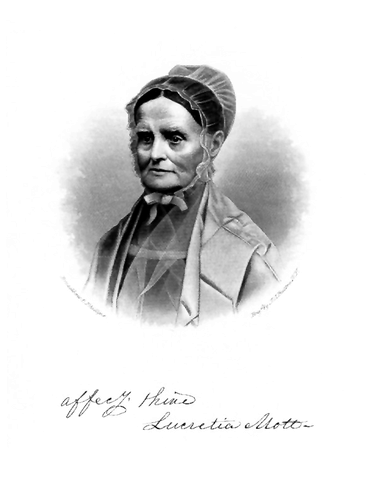
Lucretia Mott (see 8th resolution) thought it important that we should not disclaim the antagonism that woman's present position rendered it necessary she should assume. Too long had wrongs and oppressions existed without an acknowledged wrong-doer and oppressor. It was not until the slaveholder was told, "thou art the man," that a healthful agitation was brought about. Woman is told that the fault is in herself, in too willingly submitting to her inferior condition; but, like the slave, she is pressed down by laws in the making of which she has had no voice, and crushed by customs that have grown out of such laws. She can not rise, therefore, while thus trampled in the dust. The oppressor does not see himself in that light until the oppressed cry for deliverance.
In commenting on the will just read, she further said:
The extract from Luther's will which has been read, while it gives evidence of the appreciation of the services of his wife, to a certain extent, and manifests a generous disposition to reward her as a faithful wife, still only proves the degrading relation she bore to her husband. There is no recognition of her equal right to their joint earnings. While the wife is obliged to accept as a gift that which in justice belongs to her, however generous the boon, she is but an inferior dependent.
The law of our State and of New York, has within a few years been so amended that the wife has some control over a part of her property. Much yet remains to be done; and if woman "contend earnestly" for the right, man will co-operate with her in adjusting all her claims. We have only to look back a few years, to satisfy ourselves that the demands already made are met in a disposition to redress the grievances. When a delegation of women to the World's Anti-Slavery Convention in 1840, could find no favor in London, what were the reasons assigned for the exclusion? Not that the right of representation was not as much woman's as man's, but that "they would be ridiculed in the morning papers."
Daniel O'Connell felt the injustice done to those delegates, and in a letter on the subject to me, expressed his deep regret, that owing to business engagements, he was not able to attend the Convention and take part in the discussion.[68]
Dr. Bowring advocated the admission of the delegates at that time; and afterward in a letter to this country, said: "How often have I regretted that the woman's question, to me of singular interest, was launched with so little preparation, so little knowledge of the manner in which it had been entangled, by the fears of some and the follies of others! But, bear up! for the coming of those women will form an era in the future history of philanthropic daring. They made a deep, if not a wide impression; and have created apostles, if as yet they have not multitudes of followers. The experiment was well worth making. It honored America—it will instruct England. If in some matters of high civilization you are behind us, in this matter of courageous benevolence how far are you before us!"
Since that time women have fairly entered the field as students of medicine and as physicians, as editors and lecturers, engaged in schools of design, and in the taking of daguerres, as well as in some other works of art, and in holding Conventions in several of the States of our Union for the advocacy of our entire claims. A National Society has been formed; and the proceedings of these Conventions and Society meetings have been fairly reported, and have received favorable notices in many of the papers of this country, as well as in the Westminster Review in England.
Frances D. Gage said that allusion had been made in the address to the popular sentiment, that men are what their mothers made them. She repelled this sentiment as an indignity to her sex. What mother, she asked, ever taught her son to drink rum, gamble, swear, smoke, and chew tobacco? The truth was, that the boy was virtually taught to regard his mother as inferior, and that it was not manly to follow her instructions. When he left the hearth-stone he was beyond her reach. He found men, and those, too, in elevated stations, addicted to vulgar and vicious practices, and he was liable, in forgetfulness of all that his mother had taught him, to fall into such habits himself. Men allowed grog-shops to be set up on the street corners, and permitted gambling-houses to exist, to tempt the boy from the path of virtue; and when the mothers asked for the abatement of these evils, they were told to keep in their sphere. In the town where she resided (McConnellsville, Morgan Co., Ohio), the women sent a large petition to the court asking that grog-shops might not be licensed. The judge thereupon remarked that "woman's place was in the nursery and the parlor, and that when she interfered with public affairs, or set herself up as an instructor of the courts, she was out of her sphere." Thus men perpetuate institutions which undermine the influence of the mothers, and corrupt the morals of the sons. The boys were, therefore, in many cases, what men made them. True, there were some cases in which the mother, by superior power, shaped the destiny of her sons, in spite of adverse influences. Such cases were not the rule, but the exception. Mothers, generally, could not exert their full influence over their sons, unless they were permitted to stand by them as the equals of their fathers in all relations of life.
The following address, written by Ann Preston, and adopted as an exposition of the principles and purposes of the Convention, was impressively read by the author:
ANN PRESTON'S ADDRESS.
The question is repeatedly asked by those who have thought but little upon the subject of woman's position in society, "What does woman want more than she possesses already? Is she not beloved, honored, guarded, cherished? Wherein are her rights infringed, or her liberties curtailed?"
Glowing pictures have been drawn of the fitness of the present relations of society, and of the beauty of woman's dependence upon the protecting love of man, and frightful visions have been evoked of the confusion and perversion of nature which would occur if the doctrine of the equal rights of man and woman was once admitted.
The idea seems to prevail that movements for the elevation of woman arise, not from the legitimate wants of society, but from the vague restlessness of unquiet spirits; not from the serene dictates of wisdom, but from the headlong impulses of fanaticism.
We came not here to argue the question of the relative strength of intellect in man and woman; for the reform which we advocate depends not upon its settlement. We place not the interests of woman in antagonism to those of her brother, for
"The woman's cause is man's: They rise or sink together, Dwarfed or God-like, bond or free."
We maintain not that woman should lose any of that refinement and delicacy of spirit which, as a celestial halo, ever encircles the pure in heart. We contend not that she shall become noisy and dictatorial, and abjure the quiet graces of life. We claim not that she, any more than her brother, should engage in any vocation or appear in any situation to which her nature and abilities are not fitted. But we ask for her, as for man, equality before the law, and freedom to exercise all her powers and faculties under the direction of her own judgment and volition.
When a woman dies, leaving behind her a husband and children, no appraisers come into the desolated home to examine the effects; the father is the guardian of his offspring; the family relation is not invaded by law. But when a man dies the case is entirely different; in the hour of the widow's deep distress strangers come into the house to take an inventory of the effects, strangers are appointed to be the guardians of her children, and she, their natural care-taker, thenceforth has no legal direction of their interests; strangers decide upon the propriety of the sale of the property—earned, perhaps, by her own and her husband's mutual efforts—and her interest in the estate is coolly designated as the "widow's incumbrance!" In the extremity of her bereavement there is piled upon her, not only the dread of separation from her children, but that of being sent homeless from the spot where every object has been consecrated by her tenderest affections.
Nor is the practical working of this law better than its theory; all over the country there are widows who have been made doubly desolate by its provisions—widows separated from their children, who, if they had had the disposal of their own and their husbands' mutual property, might have retrieved their circumstances, and kept the household band together. We ask for such change in public sentiment as shall procure the repeal of this oppressive law.
We ask that woman shall have free access to vocations of profit and honor, the means of earning a livelihood and independence for herself! As a general rule, profitable employments are not considered open to woman, nor are her business capabilities encouraged and developed by systematic training. Gloomy must be the feelings of the father of a family of young daughters, when he is about to bid farewell to the world, if he is leaving them without the means of pecuniary support. Their brothers may go out into society and gain position and competency; but for them there is but little choice of employment, and, too often, they are left with repressed and crippled energies to pine and chafe under the bitter sense of poverty and dependence.
Their pursuits are to be determined, not by their inclination, judgment, and ability, as are those of man, but by the popular estimate of what is proper and becoming. In Turkey public delicacy is outraged if a woman appears unveiled beyond the walls of the harem; in America a sentiment no less arbitrary presumes to mark out for her the precise boundaries of womanly propriety; and she who ventures to step beyond them, must do it at the peril of encountering low sneers, coarse allusions, and the withering imputation of want of feminine delicacy.
Even for the same services woman generally receives less than man. The whole tendency of our customs, habits, and teaching, is to make her dependent—dependent in outward circumstances, dependent in spirit.
As a consequence of her fewer resources, marriage has been to her the great means of securing position in society. Thus it is that this relation—which should ever be a "holy sacrament," the unbiased and generous election of the free and self-sustained being—too often is degraded into a mean acceptance of a shelter from neglect and poverty! We ask that woman shall be trained to unfold her whole nature; to exercise all her powers and faculties.
It is said that the domestic circle is the peculiar province of woman; that "men are what mothers make them." But how can that woman who does not live for self-culture and self-development, who has herself no exalted objects in life, imbue her children with lofty aspirations, or train her sons to a free and glorious manhood? She best can fulfill the duties of wife and mother, who is fitted for other and varied usefulness.
The being who lives for one relation only can not possess the power and scope which are required for the highest excellence even in that one. If the whole body is left without exercise, one arm does not become strong; if the tree is stunted in its growth, one branch does not shoot into surpassing luxuriance.
That woman whose habits and mental training enable her to assist and sustain her husband in seasons of difficulty, and whose children rely on her as a wise counselor, commands a life-long reverence far deeper and dearer than can be secured by transient accomplishments, or the most refined and delicate imbecility! All women are not wives and mothers, but all have spirits needing development, powers that grow with their exercise.
Those who are best acquainted with the state of society know that there is, at this time, a vast amount of unhappiness among women for want of free outlets to their powers; that thousands are yearning for fuller development, and a wider field of usefulness. The same energies which in man find vent in the professions, and in the thousand forms of business and study, must find an ennobling channel in woman, else they will be frittered away in trifles, or turned into instruments to prey upon their possessor.
To follow the empty round of fashion, to retail gossip and scandal, to be an ornament in the parlor or a mere drudge in the kitchen, to live as an appendage to any human being, does not fill up nor satisfy the capacities of a soul awakened to a sense of its true wants, and the far-reaching and mighty interests which cluster around its existence.
We protest against the tyranny of that public sentiment which assigns any arbitrary sphere to woman. God has made the happiness and development of His creatures to depend upon the free exercise of their powers and faculties. Freedom is the law of beauty, written by His fingers upon the human mind, and the only condition upon which it can attain to its fall stature, and expand in its natural and beautiful proportions.
It is recognized, in reference to man, that his judgment, opportunities, and abilities are the proper measure of his sphere. "The tools to him who can use them." But the same principles are not trusted in their application to woman, lest, forsooth, she should lose her feminine characteristics, and, like the lost Pleiad, forsake her native sphere!
It seems to be forgotten that the laws of nature will not be suspended; that the human mind, when released from pressure, like water, must find its own level; that woman can not, if she would, cast away her nature and instincts; that it is only when we are left free to obey the inward attractions of our being that we fall into our natural places, and move in our God-appointed orbits.
We ask that none shall dare to come in between woman and her Maker, and with unhallowed hands attempt to plant their shallow posts and draw their flimsy cords around the Heaven-wide sphere of an immortal spirit! We maintain that God has not so failed in His adaptations as to give powers to be wasted, talents to be wrapped in a napkin; and that the possession of faculties and capabilities is the warrant of nature, the command of the All-Wise for their culture and exercise.
We believe that the woman who is obeying the convictions of her own soul, and whose ability is commensurate with her employment, is ever in her own true sphere; whether in her quiet home she is training her children to nobleness and virtue, or is standing as a physician by the bed of sickness and sorrow; whether, with Elizabeth Fry, she is preaching the gospel of glad tidings to the sad dwellers in prison, or like the Italian, Lauri Bassi, is filling a professor's chair and expounding philosophy to admiring and instructed listeners.
While we demand for woman a more complete physical, intellectual, and moral education, as the means of strengthening and beautifying her own nature, and of ennobling the whole race, we also ask for a more elevated standard of excellence and moral purity in man; and we maintain that if there is any place of resort or employment in society, which necessarily would sully the delicacy of woman's spirit, in that, man also must be contaminated and degraded. Woman indeed should wear about her, wherever she moves, the protecting investment of innocence and purity; but not less is it requisite that he, who is the companion of her life, should guard his spirit with the same sacred and beautiful covering.
We believe that woman, as an accountable being, can not innocently merge her individuality in that of her brother, or accept from him the limitations of her sphere. In all life's great extremities she also is thrown upon her inward resources, and stands alone. Man can not step in between her and the "accusing angel" of her own conscience; alone in the solitude of her spirit she must wrestle with her own sorrows; none can walk for her "the valley of the shadow of death!" When her brother shall be able to settle for her accountabilities, and "give to God a ransom for her soul," then, and not till then, may she rightly commit to him the direction of her powers and activities.
We ask, in fine, for the application of the fundamental principles of Christianity and republicanism to this, as to all other questions of vital importance; and appealing to all who desire the progression and happiness of the whole race, we ask them, as magnanimous men and true women, to examine this subject in the spirit of a generous and candid investigation.
Rush Plumly said: Although institutions which recognize all the rights of all classes of the people, and allow scope for the growth and activity of every faculty, must, in their very nature, increase in power and permanence; yet, compared with the duration of things, the oldest nations and the best founded governments have had but an ephemeral existence, appearing, maturing, and decaying with startling rapidity and endless succession.
No form has been exempt from this national mortality. Theocracies, oligarchies, monarchies, despotisms, republics, have arisen, flourished, and vanished into history or tradition. So inevitable does the successive ruin appear, that we have incorporated into our religious faith the idea that limitation, conflict, and decay, rather than expansion, permanence, and peace, are inherent in all human governments, and, in despair man postpones his hope of national, as well as of individual stability and happiness, to some future existence.
For results so certain and so universal among all people, in every age, there must be some profound and radical cause which religion and philosophy have not discovered, or for which they have proposed no remedy. It is not sufficient to say that these are consequences of human imperfection; that we know; but whence arises the imperfection? It does not satisfy us to assert that they proceed from the depravity of man; how came he depraved? Nor is it more consoling to declare that all human institutions must change and perish. Why must they? Human institutions, if founded upon eternal principles, become divine, and may be immortal; it is not the human, but the inhuman institutions which perish; not humanity, but inhumanity which fills the earth with strife and blood.
No! there is behind and below all these imaginary causes, a real cause for the degeneracy of the race. It may be traced to the long continued disregard of the laws of God in relation to woman, and the retribution is worked out physiologically upon the whole nature of man, reaching every tissue of his body and every faculty of his mind.
It is a law of God, well understood, that whenever and wherever any community forcibly depresses any class of its people below the general level, it not only injures and degrades that class, but is itself injured, degraded, and deranged in exact proportion to the wrong it perpetrates. Whenever we crowd any portion of our fellow-beings into an abyss of ignorance and servitude, we are drawn irresistibly, by their weight, to the brink of the same gulf.
If this be the inevitable result of the oppression of an individual, or a class, how much more forcibly must it apply when one-half the world, the "mothers of the living," are made subject to systematic deprivation of rights and tyrannous restriction in the exercise of high and noble faculties.
I do not propose to detail the disabilities under which woman suffers. They have been ably depicted by women in this meeting. But I wish to indicate the breadth and basis of this reform, for the consideration of those people who suppose it to be a fractional and transient movement.
Whatever suffering or degradation woman is subjected to, by the depression of the whole sex below the level of society, reacts with frightful force upon man; who is thus compelled to compensate for the cruel and mistaken policy, which, in all time, has denied to her equal opportunities of education and development, closed to her those avenues to profit and progress open to him, ignored her in the Church and State as feeble and inferior, rejected her counsels, and derided her authority in the creation of those institutions of society to which not only she, but her children are to be subject; although, if there be any induction more striking than another it is this, that a child, who is the offspring of the physical union of man and woman, can only be truly educated and nurtured by institutions springing from the unity of mental and moral elements in the father and mother.
This universal ignoring of the feminine element pervades not only the politics, but the religion of every country on earth. Men worship, as their supreme God, only an embodiment of the masculine element—"Power," whether in Jove or Jehovah; and ever in the Christian Trinity or Unity, the same masculine ideal is maintained. Jesus did, indeed, recognize the feminine element in His emphatic declaration that "God is Love," but His professed followers have "not so learned Him," for they not only declare God to be a triune masculinity, but they have driven woman from the pulpit, and would dispute with her the place at the cross and the sepulchre.
The religions of antiquity permitted woman to be a priestess at the expense of wifehood and maternity, but our Christian Protestantism denies to her the mission of minister, even with that penalty. It is true the Catholic Church does recognize women among its divinities, and it might be a curious and instructive inquiry, how far that Church owes its perpetuity, despite its gigantic crimes and crushing despotism, to the recognition of "Mary the mother of God." In its effort to perpetuate the servitude of woman, as in other attempts to defend oppression and falsehood, society has suborned the handmaids of progress, Religion and Science, to justify its wickedness; the one to prove inferiority from her organism, the other to add the weight of its anathema against any effort at equality.
But Nature vindicates herself against the first, by presenting De Staël, Margaret Fuller, and others; and to the cavilling bigot it may be said that whoever declared that "man is the head of the woman," if he designed to justify the present interpretation of that expression, has forfeited all claim to the apostleship of a religion whose highest merit it is to equalize the people by elevating the oppressed. But Paul taught no such doctrine.
The result of all this circumscription of woman has been to enfeeble and misdirect her faculties, to weaken the influence of her nature upon society and especially upon her offspring. Driven from the thousand avenues to wealth and position open to man, denied access to the best institutions of learning, permitted to acquire only superficial accomplishments, she is ushered into society at an age when her brothers are preparing to enter colleges and halls of learning from which she is excluded, and thus undeveloped and comparatively helpless, her instincts vitiated and no freedom for her affinities, she is turned adrift to encounter obstacles for which she is unprepared, and in the severe conflict to barter her honor for subsistence; or if she escape that horrible contingency, to exchange her beauty or her services for a matrimonial establishment, and thus prepare to perpetuate human degeneracy.
There are many exceptions to this statement, but the statement is the rule. From these unequal and discordant relations, and the feeble and restricted influence of the mother, spring generations of children who are born constitutionally defective in the feminine qualities of gentleness, purity, and love; and the utter rejection of that element in the societary arrangements under which they grow to manhood, aggravates their inherited tendencies, until whole nations of warriors founding governments of blood have filled the earth, and war and rapine have not only become the occupation and the pastime of man, but have grown into his religion and become incarnate in the Deities he worships.
It is thus that the seeds of violence and vice are sown with the germs of the generations, and they spring to a frightful harvest in each succeeding growth of the race. Millions of human beings issue into life, pre-ordained—not in the theological, but in the physiological sense—to violence and crime, and they go forth to make their calling and election sure. From these the world recruits its armies, renews its tyrants, refills its slave-pens and its brothels, populates its prisons, alms-houses, and asylums. It is in vain to hope for other results while woman, upon whom, as "mother of the living," depends the progress of man, is denied any other than a limited and indirect influence in the fabric of society.
We may abolish slavery, remove intemperance, banish war and licentiousness, but they will have frightful reproduction in the elemental discord of our natures; for that which is "in us will be revealed." Man indicates his condition by the institutions he creates; they are the issues of the life he lives at the time, the outward sign of his inward state.
To improve that inward condition, and arrest at their origin these causes of human degeneracy, is the object of this reform. It proposes, as before stated, not only to cure, but to prevent the diseases of the body politic; to place man and woman in such natural and true relations of equal and mutual development, and to so sanctify marriage that from their union under the highest auspices, a regenerate humanity shall not only cease to be violent and vicious, but shall outgrow the dispositions to violence and vice.
We know that this is a work for whole generations, but as we believe it to be radical and effectual, it should be at once begun. We think the first great step is to clear away the rubbish of ages from the pathway of woman, to abolish the onerous restrictions which environ her in every direction, to open to her the temples of religion, the halls of science and of art, and the marts of commerce, affording her the same opportunity for education and occupation now enjoyed by man; no longer, by corrupt public sentiment and partial legislation, to limit her to a few and poorly paid pursuits to obtain subsistence and thus increase her dependence upon the charity of man, nor to deny her admission to any institution of learning, whose richly endowed professorships and vast advantages she by her labor has contributed to create, only to see them monopolized by man. I know that in answer to this it is urged that she has organic limits intellectually which deny to her such attainments. It is sufficient to reply, that under all the disabilities to which she is subject, her sex has produced De Staël and Margaret Fuller.
Letters were read from Mary Mott, of Auburn, De Kalb County, Indiana; Paulina Wright Davis, Dr. Elizabeth Blackwell, William and Mary Johnson, and a series of resolutions passed.[69] Oliver Johnson took an active part in the discussions, and at the close of the Convention, moved a resolution of thanks to the friends who had come from a distance, and contributed so much to the success of the meeting. The Convention then adjourned sine die.
In 1849, Richard H. Dana, of Boston, well known as a man of rare literary culture, delivered a lecture on womanhood throughout the country. He ridiculed the new demand of American women for civil and political rights, and for a larger sphere of action, and eulogized Shakespeare's women, especially Desdemona, Ophelia, and Juliet, and recommended them to his dissatisfied countrywomen as models of innocence, tenderness, and confiding love in man, for their study and imitation.
He gave this lecture in Philadelphia, and Lucretia Mott was in the audience. At the close she asked an introduction, and told him that while she had been much interested in his lecture, and profited by the information it contained, she could not respond to his idea of woman's true character and destiny. "I am very sorry," he replied quickly, at the first word of criticism, and rushed out of the house, leaving Mrs. Mott, who had hoped to modify his views, somewhat transfixed with surprise. In describing the scene to some friends afterward, she remarked that she had never been treated with more rudeness by one supposed to understand the rules of etiquette that should always govern the behavior of a gentleman.
Soon after this, she delivered the following discourse in the Assembly buildings in Philadelphia. After giving the Bible view of woman's position as an equal,
Lucretia Mott said: I have not come here with a view of answering any particular parts of the lecture alluded to, in order to point out the fallacy of its reasoning. The speaker, however, did not profess to offer anything like argument on that occasion, but rather a sentiment. I have no prepared address to deliver to you, being unaccustomed to speak in that way; but I felt a wish to offer some views for your consideration, though in a desultory manner, which may lead to such reflection and discussion as will present the subject in a true light.
Why should not woman seek to be a reformer? If she is to shrink from being such an iconoclast as shall "break the image of man's lower worship," as so long held up to view; if she is to fear to exercise her reason, and her noblest powers, lest she should be thought to "attempt to act the man," and not "acknowledge his supremacy"; if she is to be satisfied with the narrow sphere assigned her by man, nor aspire to a higher, lest she should transcend the bounds of female delicacy; truly it is a mournful prospect for woman. We would admit all the difference, that our great and beneficent Creator has made, in the relation of man and woman, nor would we seek to disturb this relation; but we deny that the present position of woman is her true sphere of usefulness; nor will she attain to this sphere, until the disabilities and disadvantages, religious, civil, and social, which impede her progress, are removed out of her way. These restrictions have enervated her mind and paralyzed her powers. While man assumes that the present is the original state designed for woman, that the existing "differences are not arbitrary nor the result of accident," but grounded in nature; she will not make the necessary effort to obtain her just rights, lest it should subject her to the kind of scorn and contemptuous manner in which she has been spoken of.
So far from her "ambition leading her to attempt to act the man," she needs all the encouragement she can receive, by the removal of obstacles from her path, in order that she may become the "true woman." As it is desirable that man should act a manly and generous part, not "mannish," so let woman be urged to exercise a dignified and womanly bearing, not womanish. Let her cultivate all the graces and proper accomplishments of her sex, but let not these degenerate into a kind of effeminacy, in which she is satisfied to be the mere plaything or toy of society, content with her outward adornings, and the flattery and fulsome adulation too often addressed to her.
Did Elizabeth Fry lose any of her feminine qualities by the public walk into which she was called? Having performed the duties of a mother to a large family, feeling that she owed a labor of love to the poor prisoner, she was empowered by Him who sent her forth, to go to kings and crowned heads of the earth, and ask audience of these, and it was granted her. Did she lose the delicacy of woman by her acts? No. Her retiring modesty was characteristic of her to the latest period of her life. It was my privilege to enjoy her society some years ago, and I found all that belonged to the feminine in woman—to true nobility, in a refined and purified moral nature. Is Dorothea Dix throwing off her womanly nature and appearance in the course she is pursuing? In finding duties abroad, has any "refined man felt that something of beauty has gone forth from her"? To use the contemptuous word applied in the lecture alluded to, is she becoming "mannish"? Is she compromising her womanly dignity in going forth to seek to better the condition of the insane and afflicted? Is not a beautiful mind and a retiring modesty still conspicuous in her?
Indeed, I would ask, if this modesty is not attractive also, when manifested in the other sex? It was strikingly marked in Horace Mann, when presiding over the late National Educational Convention in this city. The retiring modesty of William Ellery Channing was beautiful, as well as of many others who have filled elevated stations in society. These virtues, differing as they may in degree in man and woman, are of the same nature, and call forth our admiration wherever manifested.
The noble courage of Grace Darling is justly honored for risking her own life on the coast of England, during the raging storm, in order to rescue the poor, suffering, shipwrecked mariner.
Woman was not wanting in courage in the early ages. In war and bloodshed this trait was often displayed. Grecian and Roman history have lauded and honored her in this character. English history records her courageous women too, for unhappily we have little but the records of war handed down to us. The courage of Joan of Arc was made the subject of a popular lecture not long ago by one of our intelligent citizens. But more noble, moral daring is marking the female character at the present time, and better worthy of imitation. As these characteristics come to be appreciated in man too, his warlike acts with all the miseries and horrors of the battle-ground will sink into their merited oblivion, or be remembered only to be condemned. The heroism displayed in the tented field must yield to the moral and Christian heroism which is shadowed in the signs of our times.
The lecturer regarded the announcement of woman's achievements, and the offering of appropriate praise through the press, as a gross innovation upon the obscurity of female life—he complained that the exhibition of attainments of girls in schools was now equal to that of boys, and the newspapers announce that "Miss Brown received the first prize for English grammar," etc. If he objected to so much excitement of emulation in schools, it would be well; for the most enlightened teachers discountenance these appeals to love of approbation and self-esteem. But while prizes continue to be awarded, can any good reason be given why the name of the girl should not be published as well as that of the boy? He spoke with scorn, that "we hear of Mrs. President so and so; and committees and secretaries of the same sex." But if women can conduct their own business, by means of presidents and secretaries of their own sex, can he tell us why they should not? They will never make much progress in any moral movement while they depend upon men to act for them. Do we shrink from reading the announcement that Mrs. Somerville is made an honorary member of a scientific association? That Miss Herschel has made some discoveries, and is prepared to take her equal part in science? Or that Miss Mitchell, of Nantucket, has lately discovered a planet, long looked for? I can not conceive why "honor to whom honor is due" should not be rendered to woman as well as man; nor will it necessarily exalt her, or foster feminine pride. This propensity is found alike in male and female, and it should not be ministered to improperly in either sex.
In treating upon the affections, the lecturer held out the idea that as manifested in the sexes they were opposite if not somewhat antagonistic, and required a union as in chemistry to form a perfect whole. The simile appeared to me far from a correct illustration of the true union. Minds that can assimilate, spirits that are congenial, attract one another. It is the union of similar, not of opposite affections, which is necessary for the perfection of the marriage bond. There seemed a want of proper delicacy in his representing man as being bold in the demonstration of the pure affection of love. In persons of refinement, true love seeks concealment in man as well as in woman. I will not enlarge upon the subject, although it formed so great a part of his lecture. The contrast drawn seemed a fallacy, as has much, very much, that has been presented in the sickly sentimental strains of the poet from age to age.
The question is often asked, "What does woman want, more than she enjoys? What is she seeking to obtain? Of what rights is she deprived? What privileges are withheld from her?" I answer, she asks nothing as favor, but as right; she wants to be acknowledged a moral, responsible being. She is seeking not to be governed by laws in the making of which she has no voice. She is deprived of almost every right in civil society, and is a cipher in the nation, except in the right of presenting a petition. In religious society her disabilities have greatly retarded her progress. Her exclusion from the pulpit or ministry, her duties marked out for her by her equal brother man, subject to creeds, rules, and disciplines made for her by him, is unworthy her true dignity.
In marriage there is assumed superiority on the part of the husband, and admitted inferiority with a promise of obedience on the part of the wife. This subject calls loudly for examination in order that the wrong may be redressed. Customs suited to darker ages in Eastern countries are not binding upon enlightened society. The solemn covenant of marriage may be entered into without these lordly assumptions and humiliating concessions and promises.
There are large Christian denominations who do not recognize such degrading relations of husband and wife. They ask no aid from magistrate or clergyman to legalize or sanctify this union. But acknowledging themselves in the presence of the Highest and invoking His assistance, they come under reciprocal obligations of fidelity and affection, before suitable witnesses. Experience and observation go to prove that there may be as much harmony, to say the least, in such a union, and as great purity and permanence of affection, as can exist where the common ceremony is observed.
The distinctive relations of husband and wife, of father and mother of a family, are sacredly preserved, without the assumption of authority on the one part, or the promise of obedience on the other. There is nothing in such a marriage degrading to woman. She does not compromise her dignity or self-respect; but enters married life upon equal ground, by the side of her husband. By proper education, she understands her duties, physical, intellectual, and moral; and fulfilling these, she is a helpmeet in the true sense of the word.
I tread upon delicate ground in alluding to the institutions of religious Associations; but the subject is of so much importance that all which relates to the position of woman should be examined apart from the undue veneration which ancient usage receives.
"Such dupes are men to custom, and so prone To reverence what is ancient, and can plead A course of long observance for its use, That even servitude, the worst of ills, Because delivered down from sire to son, Is kept and guarded as a sacred thing."
So with woman. She has so long been subject to the disabilities and restrictions with which her progress has been embarrassed, that she has become enervated, her mind to some extent paralyzed; and like those still more degraded by personal bondage, she hugs her chains. Liberty is often presented in its true light, but it is liberty for man. I would not go so far, either as regards the abject slave or woman; for in both cases they may be so degraded by the crushing influences around them, that they may not be sensible of the blessings of freedom. Liberty is not less a blessing, because oppression has so long darkened the mind that it can not appreciate it. I would, therefore, urge that woman be placed in such a situation in society, by the recognition of her rights, and have such opportunities for growth and development, as shall raise her from this low, enervated, and paralyzed condition, to a full appreciation of the blessing of entire freedom of mind.
It is with reluctance that I make the demand for the political rights of women, because this claim is so distasteful to the age. Woman shrinks, in the present state of society, from taking any interest in politics. The events of the French Revolution, and the claim for woman's rights, are held up to her as a warning. Let us not look at the excesses of women alone, at that period; but remember that the age was marked with extravagances and wickedness in men as well as women. Political life abounds with these excesses and with shameful outrage. Who knows but that if woman acted her part in governmental affairs, there might be an entire change in the turmoil of political life? It becomes man to speak modestly of his ability to act without her. If woman's judgment were exercised, why might she not aid in making the laws by which she is governed? Lord Brougham remarked that the works of Harriet Martineau upon Political Economy were not excelled by those of any political writer of the present time. The first few chapters of her "Society in America," her views of a Republic, and of government generally, furnish evidence of woman's capacity to embrace subjects of universal interest.
Far be it from me to encourage women to vote, or to take an active part in politics in the present state of our government. Her right to the elective franchise, however, is the same, and should be yielded to her, whether she exercise that right or not. Would that man, too, would have no participation in a government recognizing the life-taking principle; retaliation and the sword. It is unworthy a Christian nation. But when in the diffusion of light and intelligence a Convention shall be called to make regulations for self-government on Christian principles, I can see no good reason why women should not participate in such an assemblage, taking part equally with man.
Professor Walker, of Cincinnati, in his "Introduction to American Law," says: "With regard to political rights, females form a positive exception to the general doctrine of equality. They have no part or lot in the formation or administration of government. They cannot vote or hold office. We require them to contribute their share in the way of taxes to the support of government, but allow them no voice in its direction. We hold them amenable to the laws when made, but allow them no share in making them. This language applied to males would be the exact definition of political slavery; applied to females custom does not teach us so to regard it." Woman, however, is beginning so to regard it.
He further says: "The law of husband and wife, as you gather it from the books, is a disgrace to any civilized nation. The theory of the law degrades the wife almost to the level of slaves. When a woman marries, we call her condition coverture, and speak of her as a femme covert. The old writers call the husband baron, and sometimes in plain English, lord.... The merging of her name in that of her husband is emblematic of the fate of all her legal rights. The torch of Hymen serves but to light the pile on which these rights are offered up. The legal theory is, that marriage makes the husband and wife one person, and that person is the husband. On this subject, reform is loudly called for. There is no foundation in reason or expediency for the absolute and slavish subjection of the wife to the husband, which forms the foundation of the present legal relations. Were woman, in point of fact, the abject thing which the law in theory considers her to be when married, she would not be worthy the companionship of man."
I would ask if such a code of laws does not require change? If such a condition of the wife in society does not claim redress? On no good ground can reform be delayed. Blackstone says: "The very being and legal existence of woman is suspended during marriage; incorporated or consolidated into that of her husband under whose protection and cover she performs everything." Hurlbut, in his Essay upon Human Rights, says: "The laws touching the rights of women are at variance with the laws of the Creator. Rights are human rights, and pertain to human beings without distinction of sex. Laws should not be made for man or for woman, but for mankind. Man was not born to command, nor woman to obey.... The law of France, Spain, and Holland, and one of our own States, Louisiana, recognizes the wife's right to property, more than the common law of England.... The laws depriving woman of the right of property are handed down to us from dark and feudal times, and are not consistent with the wiser, better, purer spirit of the age. The wife is a mere pensioner on the bounty of her husband. Her lost rights are appropriated to himself. But justice and benevolence are abroad in our land awakening the spirit of inquiry and innovation; and the Gothic fabric of the British law will fall before it, save where it is based upon the foundation of truth and justice."
May these statements lead you to reflect upon this subject, that you may know what woman's condition is in society, what her restrictions are, and seek to remove them. In how many cases in our country the husband and wife begin life together, and by equal industry and united effort accumulate to themselves a comfortable home. In the event of the death of the wife the household remains undisturbed, his farm or his workshop is not broken up or in any way molested. But when the husband dies he either gives his wife a portion of their joint accumulation, or the law apportions to her a share; the homestead is broken up, and she is dispossessed of that which she earned equally with him; for what she lacked in physical strength she made up in constancy of labor and toil, day and evening. The sons then coming into possession of the property, as has been the custom until of later time, speak of having to keep their mother, when she in reality is aiding to keep them. Where is the justice of this state of things? The change in the law of this State and of New York in relation to the property of the wife, goes to a limited extent toward the redress of these wrongs which are far more extensive and involve much more than I have time this evening to point out.
On no good ground can the legal existence of the wife be suspended during marriage, and her property surrendered to her husband. In the intelligent ranks of society the wife may not in point of fact be so degraded as the law would degrade her; because public sentiment is above the law. Still, while the law stands, she is liable to the disabilities which it imposes. Among the ignorant classes of society, woman is made to bear heavy burdens, and is degraded almost to the level of the slave. There are many instances now in our city, where the wife suffers much from the power of the husband to claim all that she can earn with her own hands. In my intercourse with the poorer class of people, I have known cases of extreme cruelty from the hard earnings of the wife being thus robbed by the husband, and no redress at law.
An article in one of the daily papers lately presented the condition of needle-women in England. There might be a presentation of this class in our own country which would make the heart bleed. Public attention should be turned to this subject in order that avenues of more profitable employment may be opened to women. There are many kinds of business which women, equally with men, may follow with respectability and success. Their talents and energies should be called forth, and their powers brought into the highest exercise. The efforts of women in France are sometimes pointed to in ridicule and sarcasm, but depend upon it, the opening of profitable employment to women in that country is doing much for the enfranchisement of the sex. In England and America it is not an uncommon thing for a wife to take up the business of her deceased husband and carry it on with success.
Our respected British Consul stated to me a circumstance which occurred some years ago, of an editor of a political paper having died in England; it was proposed to his wife, an able writer, to take the editorial chair. She accepted. The patronage of the paper was greatly increased, and she a short time since retired from her labors with a handsome fortune. In that country, however, the opportunities are by no means general for woman's elevation.
In visiting the public school in London a few years since, I noticed that the boys were employed in linear drawing, and instructed upon the black-board in the higher branches of arithmetic and mathematics; while the girls, after a short exercise in the mere elements of arithmetic, were seated during the bright hours of the morning, stitching wristbands. I asked why there should be this difference made; why the girls too should not have the black-board? The answer was, that they would not probably fill any station in society requiring such knowledge.
The demand for a more extended education will not cease until girls and boys have equal instruction in all the departments of useful knowledge. We have as yet no high-school in this State. The normal school may be a preparation for such an establishment. In the late convention for general education, it was cheering to hear the testimony borne to woman's capabilities for head teachers of the public schools. A resolution there offered for equal salaries to male and female teachers when equally qualified, as practiced in Louisiana. I regret to say, was checked in its passage by Bishop Potter; by him who has done so much for the encouragement of education, and who gave his countenance and influence to that Convention. Still, the fact of such a resolution being offered, augurs a time coming for woman which she may well hail. At the last examination of the public schools in this city, one of the alumni delivered an address on Woman, not as is too common in eulogistic strains, but directing the attention to the injustice done to woman in her position in society in a variety of ways, the unequal wages she receives for her constant toil, etc., presenting facts calculated to arouse attention to the subject.
Women's property has been taxed equally with that of men's to sustain colleges endowed by the States; but they have not been permitted to enter those high seminaries of learning. Within a few years, however, some colleges have been instituted where young women are admitted upon nearly equal terms with young men; and numbers are availing themselves of their long denied rights. This is among the signs of the times, indicative of an advance for women. The book of knowledge is not opened to her in vain. Already is she aiming to occupy important posts of honor and profit in our country. We have three females editors in our State, and some in other States of the Union. Numbers are entering the medical profession; one received a diploma last year; others are preparing for a like result.
Let woman then go on, not asking favors, but claiming as right, the removal of all hindrances to her elevation in the scale of being; let her receive encouragement for the proper cultivation of all her powers, so that she may enter profitably into the active business of life; employing her own hands in ministering to her necessities, strengthening her physical being by proper exercise and observance of the laws of health. Let her not be ambitious to display a fair hand and to promenade the fashionable streets of our city, but rather, coveting earnestly the best gifts, let her strive to occupy such walks in society as will befit her true dignity in all the relations of life. No fear that she will then transcend the proper limits of female delicacy. True modesty will be as fully preserved in acting out those important vocations, as in the nursery or at the fireside ministering to man's self-indulgence. Then in the marriage union, the independence of the husband and wife will be equal, their dependence mutual, and their obligations reciprocal.
In conclusion, let me say, with Nathaniel P. Willis: "Credit not the old-fashioned absurdity that woman's is a secondary lot, ministering to the necessities of her lord and master! It is a higher destiny I would award you. If your immortality is as complete, and your gift of mind as capable as ours of increase and elevation, I would put no wisdom of mine against God's evident allotment. I would charge you to water the undying bud, and give it healthy culture, and open its beauty to the sun; and then you may hope that when your life is bound up with another, you will go on equally and in a fellowship that shall pervade every earthly interest."
NATIONAL CONVENTION IN PHILADELPHIA.
October 18, 1854, the Fifth National Convention was held in Sansom Street Hall, where a large audience, chiefly of ladies, assembled at an early hour.
At half-past ten o'clock Lucretia Mott made her appearance on the platform, accompanied by several ladies and gentlemen, notably Lucy Stone in Bloomer costume. She was the observed of all observers; the neatness of her attire, and the grace with which she wore it, did much to commend it to public approval. The press remarked that the officers of the Convention were all without bonnets, and that many ladies in the audience had their knitting-work. "A casual visitor," says The Bulletin, "would have been impressed with the number and character of this assembly, both among the actors and spectators. Every variety of age, sex, race, color, and costume were here represented. Bloomers were side by side with the mouse-colored gowns and white shawls of the wealthy Quaker dames, and genteelly dressed ladies of the latest Paris fashion."
The house was crowded, and on the steps ascending the platform were seated William Lloyd Garrison and James Mott, side by side with men of the darkest hue. The colored people scattered through the audience seemed quite at their ease, and were evidently received on grounds of perfect equality, which was the subject of much comment by outsiders.
Mrs. Frances D. Gage, President of the last Convention at Cleveland, called the assembly to order, and read
THE CALL.
In accordance with a vote passed at the adjournment of the Woman's Rights Convention held in Cleveland, Ohio, in October, 1853, the Fifth National Convention will be held in Philadelphia, October 18th, to continue three days. The subjects for consideration will be the Equal Right of Woman to all the advantages of education, literary, scientific, artistic; to full equality in all business avocations, industrial, commercial, professional; briefly, all the rights that belong to her as a citizen.
This wide range of subjects for discussion can not fail to awaken the attention of all classes; hence we invite all persons irrespective of sex or color to take part in the deliberations of the Convention, and thus contribute to the progress of truth and the redemption of humanity.
On behalf of the Central Committee,
Paulina Wright Davis, President. Antoinette L. Brown, Secretary.
The following officers were chosen for the Convention:
President.—Ernestine L. Rose, of New York.
Vice-Presidents.—Lucretia Mott, Philadelphia; Frances D. Gage, Missouri; Thomas Wentworth Higginson, Massachusetts; Martha C. Wright, New York; Thomas Garrett, Delaware; Hannah Tracy Cutler, Illinois; Robert Purvis; Pennsylvania; John O. Wattles, Indiana; Marenda B. Randall, Vermont; George Sunter, Canada.
Secretaries.—Joseph A. Dugdale, Abby Kimber, Hannah M. Darlington.
Business Committee.—Lucy Stone, William Lloyd Garrison, Myra Townsend, Mary P. Wilson, Sarah Pugh, Lydia Mott, Mary Grew.
Finance Committee.—Susan B. Anthony, James Mott, Ruth Dugdale, Rebecca Plumbly.
Mrs. Rose, on taking the chair, said:
There is one argument which in my estimation is the argument of arguments, why woman should have her rights; not on account of expediency, not on account of policy, though these too show the reasons why she should have her rights; but we claim—I for one claim, and I presume all our friends claim—our rights on the broad ground of human rights; and I for one again will say, I promise not how we shall use them. I will no more promise how we shall use our rights than man has promised before he obtained them, how he would use them. We all know that rights are often abused; and above all things have human rights in this country been abused, from the very fact that they have been withheld from half of the community.
By human rights we mean natural rights, and upon that ground we claim our rights, and upon that ground they have already been conceded by the Declaration of Independence, in that first great and immutable truth which is proclaimed in that instrument, "that all men are created equal," and that therefore all are entitled to "certain inalienable rights, among which are life, liberty, and the pursuit of happiness." Our claims are based upon that great and immutable truth, the rights of all humanity. For is woman not included in that phrase, "all men are created free and equal"? Is she not included in that expression? Tell us, ye men of the nation, ay, ye wise law-makers and law-breakers of the nation, whether woman is not included in that great Declaration of Independence? And if she is, what right has man to deprive her of her natural and inalienable rights? It is natural, it is inherent, it is inborn, it is a thing of which no one can justly deprive her. Upon that just and eternal basis do we found our claims for our rights; political, civil, legal, social, religious, and every other.
But, at the outset, we claim our equal political rights with man, not only from that portion of the Declaration of Independence, but from another, equally well-established principle in this country, that "taxation and representation are inseparable." Woman, everybody knows, is taxed; and if she is taxed, she ought to be represented.
I will simply here throw out a statement of these principles upon which our claims are based; and I trust each separate resolution will be taken up by this Convention, fully canvassed and commented upon, so as to show it not only an abstract right, but a right which can be wisely made practical.
Again, it is acknowledged in this country, and it is eternally true, that "all the just powers of government are derived from the consent of the governed." If so, then, as woman is a subject of government, she ought to have a voice in enacting the laws. If her property is taxed to maintain government, she ought to have a voice in forming that government. If she has to pay taxes to maintain government, she ought to have a voice in saying how those taxes shall be applied.
On these grounds we make our claims, on natural, humane, eternal, and well-recognized laws and principles of this republic. On these grounds we ask man to meet us, and meet us in the spirit of inquiry, in the spirit of candor and honesty, as rational human beings ought to meet each other, face to face, and adduce arguments, if they can, to convince us that we are not included in that great Declaration of Independence; that although it is a right principle that taxation and representation are inseparable, yet woman ought to be taxed, and ought not to be represented; and that although it is an acknowledged principle that all just power of government is derived from the consent of the governed, yet woman should be governed without her consent. Let them meet us fairly and openly; let them meet us like rational men, men who appreciate their own freedom, and we will hear them. If they can convince us that we are wrong, we will give up our claims; but if we can convince them that we are right in claiming our rights, as they are in claiming theirs, then we expect them in a spirit of candor and honesty to acknowledge it.
Joseph Dugdale read several letters, which, as usual, seemed to be something of a bore to the audience. When he finished, Lucretia Mott suggested that if there were any more lengthy epistles to be read, it would be well for the secretaries to look them over, and omit all that in their wisdom might not be worth reading.
Lucy Stone, from the Business Committee, read a series of resolutions,[70] and as some one from the audience called, "Louder!" she remarked that if ladies would keep their bonnets tied down over their ears, they must not ask others to find lungs of sufficient power to penetrate the heavy pasteboard and millinery over them. She spoke briefly on the resolutions, and the steadily increasing interest in the subject of woman's rights.
Hannah Tracy Cutler gave a report of Illinois, Frances Dana Gage of Missouri, and Susan B. Anthony of New York.
Thomas Wentworth Higginson, of Massachusetts, said he had a matter of business to present. Mrs. Paulina Wright Davis being too ill to attend the Convention, Mr. Higginson read a letter from her sister, Mary K. Spaulding, suggesting the establishment of a newspaper in the city of New York as "the national organ" of the Woman's Rights movement. He doubted the wisdom of such a step, and after setting forth the expense of a central organ and the great danger of its creating a schism, he offered the following resolutions:
Resolved, That in the opinion of this Convention it is not expedient, at present, to establish a newspaper as The National Organ of the Woman's Rights Movement.
Resolved, That it is expedient to appoint a Committee who shall provide for the preparation and publication, in widely circulated journals, facts and arguments relating to the cause.
Mrs. Mott approved of the resolutions, and said they had arrived at a similar conclusion in the Syracuse Convention; she fully concurred in the views of Mr. Higginson.
William Lloyd Garrison replied, that if organization for any good cause be right, it was right for this. Every reform movement needs an organ of its own. And this cause needs a paper of the most radical character; that shall make no compromises with popular prejudices; far above the paralyzing influences of Church and State.
Mrs. Mott said she did not oppose organization, but was in favor of individual freedom and responsibility. The Liberator, Mr. Garrison's paper, has done far more good than The Anti-Slavery Standard, the organ of the Anti-Slavery movement.
Mr. Garrison said The Liberator was not simply an anti-slavery paper, but an advocate of general reform.
Remarks were made on this point by Elizabeth Paxton, Susan H. Cox, George P. Davis, and George Sunter, of Canada.
Lucy Stone advocated the resolutions; her experience in the anti-slavery cause had taught her a lesson of wisdom for this movement. We are rich in principle and enthusiasm, but not in silver and gold, and therefore should avoid taking on our shoulders a national organ. Widely circulated journals are now open to us, in which we can express our opinions with freedom and without expense. There is nothing so strong as individual purpose and freedom to carry it out. The papers established by Mrs. Davis and Mrs. Bloomer are good, and she hoped the friends would give generously to their support.
The resolutions were unanimously adopted, and Elizabeth Cady Stanton, of New York; Paulina Wright Davis, of Rhode Island; Thomas Wentworth Higginson and Lucy Stone, of Massachusetts; and Oliver Johnson, of New York, were appointed as the Committee to superintend the work.
Lucy Stone said she had a new item of business to propose. She knew that those who came to these Conventions went away feeling stronger and better. She held in her hand a pamphlet containing five tracts; one from Wendell Phillips, one from Theodore Parker, one from The Westminster Review, by Mrs. John Stuart Mill, one from Mr. Higginson, and last, but not least, one from Mrs. C. I. H. Nichols, which should be distributed. They were able papers, and all interested in the movement should exert themselves to circulate them. The people only wanted light.
Another mode of disseminating the principles was by stories illustrating the wrongs of women under the present laws. The right of a woman to what she earns; to the custody of her person; to the guardianship of her children, and all of her other rights, should be illustrated in fiction. Prizes should be offered for the best stories upon these subjects. She pledged herself to raise $500 for the purpose. She pointed to "Uncle Tom's Cabin" to show what fiction could accomplish, and trusted that action would be taken upon the subject before the Convention adjourned.
Mr. Garrisonarose to say "ditto to Lucy Stone." In regard to "Uncle Tom's Cabin," it was known that Mrs. Stowe was induced to write it from a request of Dr. Bailey, of The National Era, to write a story for his paper. And he thought that such an offer might now call forth something to aid the cause of woman. He praised the tracts to which Miss Stone alluded.
The President appointed Wendell Phillips, Elizabeth Cady Stanton, and Mary Channing Higginson, the Committee on prize tracts.[71]
Mrs. Tracy Cutler read an invitation from the Female Medical College for the members of the Convention to visit that institution and attend its lectures, and took the opportunity to compliment Philadelphia as being the first city, not only in the United States, but in the world, to establish a Medical College for Women.
Dr. Ann Preston gave an interesting report of The Woman's Medical College; of all the persecutions women had encountered in securing a medical education and entering that profession. She noted the signs of a growing liberality with satisfaction.
The Rev. Henry Grew, of Philadelphia, then appeared upon the platform, and said he was sorry to differ from the general tone of the speakers present, but he felt it to be his duty to give his views on the questions under consideration. His opinions as to woman's rights and duties were based on the Scriptures. He quoted numerous texts to show that it was clearly the will of God that man should be superior in power and authority to woman; and asserted that no lesson is more plainly and frequently taught in the Bible, than woman's subjection.
Mrs. Cutler replied at length, and skillfully turned every text he had quoted directly against the reverend gentleman, to the great amusement of the audience. She showed that man and woman were a simultaneous creation, with equal power and glory on their heads, and that dominion over the fowl of the air, the fish of the sea, and every creeping thing on the earth was given to them, and not to man alone. The time has come for woman to read and interpret Scripture for herself; too long have we learned God's will from the lips of man and closed our eyes on the great book of nature, and the safer teaching of our own souls. It is a pity that those who would recommend the Bible as the revealed will of the all-wise and benevolent Creator, should uniformly quote it on the side of tyranny and oppression. I think we owe it to our religion and ourselves to wrest it from such hands, and proclaim the beautiful spirit breathed through all its commands and precepts, instead of dwelling so much on isolated texts that have no application to our day and generation.
Mrs. Mott said: It is not Christianity, but priestcraft that has subjected woman as we find her. The Church and State have been united, and it is well for us to see it so. We have had to bear the denunciations of these reverend (irreverend) clergymen, as in New York, of late. But if we look to their authority to see how they expound the text, quite likely we shall find a new reading. Why, when John Chambers returned to Philadelphia from the World's Temperance Convention at New York, he gave notice that he would give an address, and state the rights of woman as defined by the Bible. Great allowance has been made by some of the speakers in this Convention, on account of his ignorance, and certainly this was charitable. But I heard this discourse. I heard him bring up what is called the Apostolic prohibition, and the old Eastern idea of the subjection of wives; but he kept out of view some of the best ideas in the Scriptures.
Blame is often attached to the position in which woman is found. I blame her not so much as I pity her. So circumscribed have been her limits that she does not realize the misery of her condition. Such dupes are men to custom that even servitude, the worst of ills, comes to be thought a good, till down from sire to son it is kept and guarded as a sacred thing. Woman's existence is maintained by sufferance. The veneration of man has been misdirected, the pulpit has been prostituted, the Bible has been ill-used. It has been turned over and over as in every reform. The temperance people have had to feel its supposed denunciations. Then the anti-slavery, and now this reform has met, and still continues to meet, passage after passage of the Bible, never intended to be so used. Instead of taking the truths of the Bible in corroboration of the right, the practice has been, to turn over its pages to find example and authority for the wrong, for the existing abuses of society. For the usage of drinking wine, the example of the sensualist Solomon, is always appealed to. In reference to our reform, even admitting that Paul did mean preach, when he used that term, he did not say that the recommendation of that time was to be applicable to the churches of all after-time. We have been so long pinning our faith on other people's sleeves that we ought to begin examining these things daily ourselves, to see whether they are so; and we should find on comparing text with text, that a very different construction might be put upon them. Some of our early Quakers not seeing how far they were to be carried, became Greek and Hebrew scholars, and they found that the text would bear other translations as well as other constructions. All Bible commentators agree that the Church of Corinth, when the apostle wrote, was in a state of great confusion. They fell into discussion and controversy; and in order to quiet this state of things and bring the Church to greater propriety, the command was given out that women should keep silence, and it was not permitted them to speak, except by asking questions at home. In the same epistle to the same Church, Paul gave express directions how women shall prophesy, which he defines to be preaching, "speaking to men," for "exhortation and comfort." He recognized them in prophesying and praying. The word translated servant, is applied to a man in one part of the Scripture, and in another it is translated minister. Now that same word you will find might be applied to Phebe, a deaconess. That text was quoted in the sermon of John Chambers, and he interlarded it with a good many of his ideas, that women should not be goers abroad, and read among other things "that their wives were to be teachers." But properly translated would be "deaconesses."
It is not so Apostolic to make the wife subject to the husband as many have supposed. It has been done by law and public opinion since that time. There has been a great deal said about sending missionaries over to the East to convert women who are immolating themselves on the funeral pile of their husbands. I know this may be a very good work, but I would ask you to look at it. How many women are there now immolated upon the shrine of superstition and priestcraft, in our very midst, in the assumption that man only has a right to the pulpit, and that if a woman enters it she disobeys God; making woman believe in the misdirection of her vocation, and that it is of divine authority that she should be thus bound. Believe it not, my sisters. In this same epistle the word "prophesying" should be "preaching"—"preaching godliness," etc. On the occasion of the first miracle which it is said Christ wrought, a woman went before Him and said, "Whatsoever he biddeth you do, that do." The woman of Samaria said, "Come and see the man who told me all the things that ever I did."
These things are worthy of note. I do not want to dwell too much upon Scripture authority. We too often bind ourselves by authorities rather than by the truth. We are infidel to truth in seeking examples to overthrow it. The very first act of note that is mentioned when the disciples and apostles went forth after Jesus was removed from them, was the bringing up of an ancient prophecy to prove that they were right in the position they assumed on that occasion, when men and women were gathered together on the holy day of Pentecost, when every man heard and saw those wonderful works which are recorded. Then Peter stood forth—some one has said that Peter made a great mistake in quoting the prophet Joel—but he stated that "the time is come, this day is fulfilled the prophecy, when it is said, I will pour out my spirit upon all flesh, and your sons and your daughters shall prophesy," etc.—the language of the Bible is beautiful in its repetition—"upon my servants and my handmaidens I will pour out my spirit and they shall prophesy." Now can anything be clearer than that?
Rev. Henry Grew again quoted Scripture in reply to Mrs. Mott, and said the coming of Christ into the world did not restore man and woman to the original condition of our first parents. If the position assumed by the women be true, then must the Divine Word from Genesis to Revelation be set aside as untrue, that woman may be relieved from the, perhaps, unfortunate limitations that hold her back in this age of progress.