Book 1 — HISTORY OF THE WARS: BOOK I (continued 3)
H. B. (Henry Bronson) Dewing translation
Now the emperor and his court were deliberating as to whether it would be better for them if they remained or if they took to flight in the ships. And many opinions were expressed favouring either course. And the Empress Theodora also spoke to the following effect: "As to the belief that a woman ought not to be daring among men or to assert herself boldly among those who are holding back from fear, I consider that the present crisis most certainly does not permit us to discuss whether the matter should be regarded in this or in some other way. For in the case of those whose interests have come into the greatest danger nothing else seems best except to settle the issue immediately before them in the best possible way. My opinion then is that the present time, above all others, is inopportune for flight, even though it bring safety. For while it is impossible for a man who has seen the light not also to die, for one who has been an emperor it is unendurable to be a fugitive. May I never be separated from this purple, and may I not live that day on which those who meet me shall not address me as mistress. If, now, it is your wish to save yourself, O Emperor, there is no difficulty. For we have much money, and there is the sea, here the boats. However consider whether it will not come about after you have been saved that you would gladly exchange that safety for death. For as for myself, I approve a certain ancient saying that royalty is a good burial-shroud." When the queen had spoken thus, all were filled with boldness, and, turning their thoughts towards resistance, they began to consider how they might be able to defend themselves if any hostile force should come against them. Now the soldiers as a body, including those who were stationed about the emperor's court, were neither well disposed to the emperor nor willing openly to take an active part in fighting, but were waiting for what the future would bring forth. All the hopes of the emperor were centred upon Belisarius and Mundus, of whom the former, Belisarius, had recently returned from the Persian war bringing with him a following which was both powerful and imposing, and in particular he had a great number of spearmen and guards who had received their training in battles and the perils of warfare. Mundus had been appointed general of the Illyrians, and by mere chance had happened to come under summons to Byzantium on some necessary errand, bringing with him Erulian barbarians.
When Hypatius reached the hippodrome, he went up immediately to where the emperor is accustomed to take his place and seated himself on the royal throne from which the emperor was always accustomed to view the equestrian and athletic contests. And from the palace Mundus went out through the gate which, from the circling descent, has been given the name of the Snail. Belisarius meanwhile began at first to go straight up toward Hypatius himself and the royal throne, and when he came to the adjoining structure where there has been a guard of soldiers from of old, he cried out to the soldiers commanding them to open the door for him as quickly as possible, in order that he might go against the tyrant. But since the soldiers had decided to support neither side, until one of them should be manifestly victorious, they pretended not to hear at all and thus put him off. So Belisarius returned to the emperor and declared that the day was lost for them, for the soldiers who guarded the palace were rebelling against him. The emperor therefore commanded him to go to the so-called Bronze Gate and the propylaea there. So Belisarius, with difficulty and not without danger and great exertion, made his way over ground covered by ruins and half-burned buildings, and ascended to the stadium. And when he had reached the Blue Colonnade which is on the right of the emperor's throne, he purposed to go against Hypatius himself first; but since there was a small door there which had been closed and was guarded by the soldiers of Hypatius who were inside, he feared lest while he was struggling in the narrow space the populace should fall upon him, and after destroying both himself and all his followers, should proceed with less trouble and difficulty against the emperor. Concluding, therefore, that he must go against the populace who had taken their stand in the hippodrome—a vast multitude crowding each other in great disorder—he drew his sword from its sheath and, commanding the others to do likewise, with a shout he advanced upon them at a run. But the populace, who were standing in a mass and not in order, at the sight of armoured soldiers who had a great reputation for bravery and experience in war, and seeing that they struck out with their swords unsparingly, beat a hasty retreat. Then a great outcry arose, as was natural, and Mundus, who was standing not far away, was eager to join in the fight,—for he was a daring and energetic fellow—but he was at a loss as to what he should do under the circumstances; when, however, he observed that Belisarius was in the struggle, he straightway made a sally into the hippodrome through the entrance which they call the Gate of Death. Then indeed from both sides the partisans of Hypatius were assailed with might and main and destroyed. When the rout had become complete and there had already been great slaughter of the populace, Boraedes and Justus, nephews of the Emperor Justinian, without anyone daring to lift a hand against them, dragged Hypatius down from the throne, and, leading him in, handed him over together with Pompeius to the emperor. And there perished among the populace on that day more than thirty thousand. But the emperor commanded the two prisoners to be kept in severe confinement. Then, while Pompeius was weeping and uttering pitiable words (for the man was wholly inexperienced in such misfortunes), Hypatius reproached him at length and said that those who were about to die unjustly should not lament. For in the beginning they had been forced by the people against their will, and afterwards they had come to the hippodrome with no thought of harming the emperor. And the soldiers killed both of them on the following day and threw their bodies into the sea. The emperor confiscated all their property for the public treasury, and also that of all the other members of the senate who had sided with them. Later, however, he restored to the children of Hypatius and Pompeius and to all others the titles which they had formerly held, and as much of their property as he had not happened to bestow upon his friends. This was the end of the insurrection in Byzantium.
XXV
Tribunianus and John were thus deprived of office, but at a later time they were both restored to the same positions. And Tribunianus lived on in office many years and died of disease, suffering no further harm from anyone. For he was a smooth fellow and agreeable in every way and well able by the excellence of his education to throw into the shade his affliction of avarice. But John was oppressive and severe alike with all men, inflicting blows upon those whom he met and plundering without respect absolutely all their money; consequently in the tenth year of his office he rightly and justly atoned for his lawless conduct in the following manner.
The Empress Theodora hated him above all others. And while he gave offence to the woman by the wrongs he committed, he was not of a mind to win her by flattery or by kindness in any way, but he openly set himself in opposition to her and kept slandering her to the emperor, neither blushing before her high station nor feeling shame because of the extraordinary love which the emperor felt for her. When the queen perceived what was being done, she purposed to slay the man, but in no way could she do this, since the Emperor Justinian set great store by him. And when John learned of the purpose of the queen regarding him, he was greatly terrified. And whenever he went into his chamber to sleep, he expected every night that some one of the barbarians would fall upon him to slay him; and he kept peeping out of the room and looking about the entrances and remained sleepless, although he had attached to himself many thousands of spearmen and guards, a thing which had been granted to no prefect before that time. But at daybreak, forgetting all his fears of things divine and human, he would become again a plague to all the Romans both in public and in private. And he conversed commonly with sorcerers, and constantly listened to profane oracles which portended for him the imperial office, so that he was plainly walking on air and lifted up by his hopes of the royal power. But in his rascality and the lawlessness of his conduct there was no moderation or abatement. And there was in him absolutely no regard for God, and even when he went to a sanctuary to pray and to pass the night, he did not do at all as the Christians are wont to do, but he clothed himself in a coarse garment appropriate to a priest of the old faith which they are now accustomed to call Hellenic, and throughout that whole night mumbled out some unholy words which he had practised, praying that the mind of the emperor might be still more under his control, and that he himself might be free from harm at the hands of all men.
At this time Belisarius, after subjugating Italy, came to Byzantium at the summons of the emperor with his wife Antonina, in order to march against the Persians[32]. And while in the eyes of all others he was an honoured and distinguished person, as was natural, John alone was hostile to him and worked actively against him, for no other reason than that he drew the hatred of all to himself, while Belisarius enjoyed an unequalled popularity. And it was on him that the hope of the Romans centred as he marched once more against the Persians, leaving his wife in Byzantium. Now Antonina, the wife of Belisarius, (for she was the most capable person in the world to contrive the impossible,) purposing to do a favour to the empress, devised the following plan. John had a daughter, Euphemia, who had a great reputation for discretion, but a very young woman and for this reason very susceptible; this girl was exceedingly loved by her father, for she was his only child. By treating this young woman kindly for several days Antonina succeeded most completely in winning her friendship, and she did not refuse to share her secrets with her. And on one occasion when she was present alone with her in her room she pretended to lament the fate which was upon her, saying that although Belisarius had made the Roman empire broader by a goodly measure than it had been before, and though he had brought two captive kings and so great an amount of wealth to Byzantium, he found Justinian ungrateful; and in other respects she slandered the government as not just. Now Euphemia was overjoyed by these words, for she too was hostile to the present administration by reason of her fear of the empress, and she said: "And yet, dearest friend, it is you and Belisarius who are to blame for this, seeing that, though you have opportunity, you are not willing to use your power." And Antonina replied quickly: "It is because we are not able, my daughter, to undertake revolutions in camp, unless some of those here at home join with us in the task. Now if your father were willing, we should most easily organize this project and accomplish whatever God wills." When Euphemia heard this, she promised eagerly that the suggestion would be carried out, and departing from there she immediately brought the matter before her father. And he was pleased by the message (for he inferred that this undertaking offered him a way to the fulfilment of his prophecies and to the royal power), and straightway without any hesitation he assented, and bade his child arrange that on the following day he himself should come to confer with Antonina and give pledges. When Antonina learned the mind of John, she wished to lead him as far as possible astray from the understanding of the truth, so she said that for the present it was inadvisable that he should meet her, for fear lest some suspicion should arise strong enough to prevent proceedings; but she was intending straightway to depart for the East to join Belisarius. When, therefore, she had quit Byzantium and had reached the suburb (the one called Rufinianae which was the private possession of Belisarius), there John should come as if to salute her and to escort her forth on the journey, and they should confer regarding matters of state and give and receive their pledges. In saying this she seemed to John to speak well, and a certain day was appointed to carry out the plan. And the empress, hearing the whole account from Antonina, expressed approval of what she had planned, and by her exhortations raised her enthusiasm to a much higher pitch still.
When the appointed day was at hand, Antonina bade the empress farewell and departed from the city, and she went to Rufinianae, as if to begin on the following day her journey to the East; hither too came John at night in order to carry out the plan which had been agreed upon. Meanwhile the empress denounced to her husband the things which were being done by John to secure the tyranny, and she sent Narses, the eunuch, and Marcellus, the commander of the palace guards to Rufinianae with numerous soldiers, in order that they might investigate what was going on, and, if they found John setting about a revolution, that they might kill the man forthwith and return. So these departed for this task. But they say that the emperor got information of what was being done and sent one of John's friends to him forbidding him on any condition to meet Antonina secretly. But John (since it was fated that he should fare ill), disregarding the emperor's warning, about midnight met Antonina, close by a certain wall behind which she had stationed Narses and Marcellus with their men that they might hear what was said. There, while John with unguarded tongue was assenting to the plans for the attack and binding himself with the most dread oaths, Narses and Marcellus suddenly set upon him. But in the natural confusion which resulted the body-guards of John (for they stood close by) came immediately to his side. And one of them smote Marcellus with his sword, not knowing who he was, and thus John was enabled to escape with them, and reached the city with all speed. And if he had had the courage to go straightway before the emperor, I believe that he would have suffered no harm at his hand; but as it was, he fled for refuge to the sanctuary, and gave the empress opportunity to work her will against him at her pleasure.
May, 541 Thus, then, from being prefect he became a private citizen, and rising from that sanctuary he was conveyed to another, which is situated in the suburb of the city of Cyzicus called by the Cyzicenes Artace. There he donned the garb of a priest, much against his will, not a bishop's gown however, but that of a presbyter, as they are called. But he was quite unwilling to perform the office of a priest lest at some time it should be a hindrance to his entering again into office; for he was by no means ready to relinquish his hopes. All his property was immediately confiscated to the public treasury, but a large proportion of this the emperor remitted to him, for he was still inclined to spare him. There it was possible for John to live, disregarding all dangers and enjoying great wealth, both that which he himself had concealed and that which by the decision of the emperor remained with him, and to indulge in luxury at his pleasure, and, if he had reasoned wisely, to consider his present lot a happy one. For this reason all the Romans were exceedingly vexed with the man, because, forsooth, after proving himself the basest of all demons, contrary to his deserts he was leading a life happier than before. But God, I think, did not suffer John's retribution to end thus, but prepared for him a greater punishment. And it fell out thus.
There was in Cyzicus a certain bishop named Eusebius, a man harsh to all who came in his way, and no less so than John; this man the Cyzicenes denounced to the emperor and summoned to justice. And since they accomplished nothing inasmuch as Eusebius circumvented them by his great power, certain youths agreed together and killed him in the market-place of Cyzicus. Now it happened that John had become especially hostile to Eusebius, and hence the suspicion of the plot fell upon him. Accordingly men were sent from the senate to investigate this act of pollution. And these men first confined John in a prison, and then this man who had been such a powerful prefect, and had been inscribed among the patricians and had mounted the seat of the consuls, than which nothing seems greater, at least in the Roman state, they made to stand naked like any robber or footpad, and thrashing him with many blows upon his back, compelled him to tell his past life. And while John had not been clearly convicted as guilty of the murder of Eusebius, it seemed that God's justice was exacting from him the penalties of the world. Thereafter they stripped him of all his goods and put him naked on board a ship, being wrapped in a single cloak, and that a very rough one purchased for some few obols; and wherever the ship anchored, those who had him in charge commanded him to ask from those he met bread or obols. Thus begging everywhere along the way he was conveyed to the city of Antinous in Aegypt. And this is now the third year during which they have been guarding him there in confinement. As for John himself, although he has fallen into such troubles, he has not relinquished his hope of royal power, but he made up his mind to denounce certain Alexandrians as owing money to the public treasury. Thus then John the Cappadocian ten years afterward was overtaken by this punishment for his political career.
XXVI
At that time the Emperor again designated Belisarius General of the East, and, sending him to Libya, gained over the country, as will be told later on in my narrative. When this information came to Chosroes and the Persians, they were mightily vexed, and they already repented having made peace with the Romans, because they perceived that their power was extending greatly. And Chosroes sent envoys to Byzantium, and said that he rejoiced with the Emperor Justinian, and he asked with a laugh to receive his share of the spoils from Libya, on the ground that the emperor would never have been able to conquer in the war with the Vandals if the Persians had not been at peace with him. So then Justinian made a present of money to Chosroes, and not long afterwards dismissed the envoys.
In the city of Daras the following event took place. There was a certain John there serving in a detachment of infantry; this man, in conspiracy with some few of the soldiers, but not all, took possession of the city, essaying to make himself tyrant. Then he established himself in a palace as if in a citadel, and was strengthening his tyranny every day. And if it had not happened that the Persians were continuing to keep peace with the Romans, irreparable harm would have come from this affair to the Romans. But as it was, this was prevented by the agreement which had already been reached, as I have said. On the fourth day of the tyranny some soldiers conspired together, and by the advice of Mamas, the priest of the city, and Anastasius, one of the notable citizens, they went up to the palace at high noon, each man hiding a small sword under his garment. And first at the door of the courtyard they found some few of the body-guards, whom they slew immediately. Then they entered the men's apartment and laid hold upon the tyrant; but some say that the soldiers were not the first to do this, but that while they were still hesitating in the courtyard and trembling at the danger, a certain sausage-vendor who was with them rushed in with his cleaver and meeting John smote him unexpectedly. But the blow which had been dealt him was not a fatal one, this account goes on to say, and he fled with a great outcry and suddenly fell among these very soldiers. Thus they laid hands upon the man and immediately set fire to the palace and burned it, in order that there might be left no hope from there for those making revolutions; and John they led away to the prison and bound. And one of them, fearing lest the soldiers, upon learning that the tyrant survived, might again make trouble for the city, killed John, and in this way stopped the confusion. Such, then, was the progress of events touching this tyranny.
FOOTNOTES:
[1]
Cf. Iliad xi. 385 τοξότα, λωβητήρ, κέραι άγλαέ, παρθενοπîπα, the only place where τοξότης occurs in Homer.
[2]
Cf. Iliad v. 192.
[3]
Cf. Iliad viii. 267; xi. 371.
[4]
Cf. Iliad iv. 113.
[5]
Cf. Iliad iv. 123.
[6]
Cf. Iliad xi. 390.
[7]
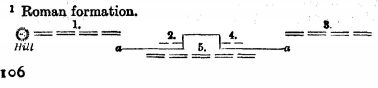
The trench crossed the plain in an approximately straight line. The army of the Ephthalitae were drawn up behind it, facing the advancing Persians, while a few of them went out beyond the trench to draw the attack of the Persians.
[8]
Cf. Thuc. ii. 76, 4.
[9]
Cf. Book VII. xxvi. 4.
[10]
Cf. Thuc. i. 128.
[11]
A division of no fixed number.
[12]
Cf. Book I. ii. 15.
[13]
Modern Erzeroum.
[14]
i.e. "by force."
[15]
Cf. Book VIII. xiii. 15.
[16]
Cf. Iliad xxiv. 348; Odyssey x. 279.
[17]
Lebanon.
[18]
Roman formation.
a—a, trench.
1.: Bouzes and Pharas.
2.: Sunicas and Aigan.
3.: John, Cyril, Marcellus, Germanus, and Dorotheus.
4.: Simmas and Ascan.
5.: Belisarius and Hermogenes.
[19]
Cf. Book I. x. 2.
[20]
Cf. Book I. xii. 21.
[21]
Cf. Book I. xiii. 2.
[22]
"Euphratesia"; cf. section 2.
[23]
Title meaning a patrician. See Index.
[24]
Ch. xiv. 28-54.
[25]
The coast described here is that of Arabia.
[26]
Rather the "Arabian Gulf."
[27]
Cf. ch. xv. 31.
[28]
In Latin serica, as coming from the Chinese (Seres).
[29]
Cf. chap. xvi. 7.
[30]
Cf. Book II. xvii.
[31]
i.e. "Conquer."
[32]
Book VI. xxx. 30.