Book 24 — APPENDIX.
Reading edition
APPENDIX.
No. I.
JUSTIFICATORY PIECES.
Lord William Bentinck to sir E. Pellew.
At sea, June 18th, 1813.
Sir,
Y. E. has seen the information I have received of a projected attack upon Sicily by Murat, in conjunction with the Toulon fleet. It seems necessary that the French fleet should leave Toulon, should reach the coast of Naples, embark the men and land them in Sicily, or cover their passage from Calabria or the Bay of Naples, if the intention be, as in the last instance, to transport them to Sicily in the tonnage and small craft of the country.—The most important question is, whether this can be effected by the enemy.—I have no difficulty in saying on my part, that in the present disposition of the Neapolitan army in Sicily, and in the non-existence of any national force, and the imperfect composition of the British force, if half the number intended for this expedition should land in Sicily the island would be conquered.
(Signed) W. Bentinck.
Sir E. Pellew to lord W. Bentinck.
H. M. S. Caledonia, June 19th, 1813.
My lord,
I feel it my duty to state to your lordship that in my judgment the Toulon fleet may evade mine without difficulty under a strong N. W. wind to carry them through the passage of the Hieres islands, without the possibility of my interrupting them, and that they may have from twelve to twenty-four hours’ start of me in chasing them. When blown off the coast, my look-out ships would certainly bring me such information as would enable me to follow them immediately to the Bay of Naples. Your lordship is most competent to judge whether in the interval of their arrival and my pursuit, the French admiral would be able to embark Murat’s army artillery and stores, and land them on the coast of Sicily before I came up with them.—The facility of communication by telegraph along the whole coast of Toulon would certainly apprize Murat of their sailing at a very short notice, but for my own part, I should entertain very sanguine hopes of overtaking them either in the Bay of Naples or on the coast of Sicily before they could make good their landing.
Lord Wm. Bentinck to lord Wellington.
At sea, June 20th, 1813.
My lord,
By the perusal of the accompanying despatch to lord Castlereagh, your lordship will perceive that Murat has opened a negociation with us, the object of which is friendship with us and hostility to Buonaparte. You will observe in one of the conversations with Murat’s agent, that he informed me that Buonaparte had ordered Murat to hold twenty thousand men in readiness for the invasion of Sicily in conjunction with the Toulon fleet. I enclose the copy of a letter I have in consequence addressed to Sir E. Pellew, together with his answer, upon the practicability of the Toulon fleet sailing without the knowledge of the blockading fleet. Your lordship will have received my letter of the 21st of May enclosing a copy of my dispatch to Lord Bathurst, relative to the discontent of the Neapolitan troops in Sicily and the consequent state of weakness if not of danger resulting from it to that island. I stated also that this circumstance had induced me to detain in Sicily the two battalions which had been withdrawn from Spain.
Lord Wellington to lord William Bentinck.
Huarte, July 1st, 1813.
My lord,
In answer to your lordship’s despatch, I have to observe, that I conceive that the island of Sicily is at present in no danger whatever.
No. II.
Letter from general Nugent to lord William Bentinck.
Vienna, January 24th, 1812.
My dear lord William,
I hope you have received the letter I wrote to you shortly after my arrival here by a person sent for that purpose. Soon after his departure the affair of La Tour happened, as King mentions in his letter. It required some time before I could judge of the result it would have and the manner it would be considered by the emperor and the government here, and then to settle again the manner of sending officers down to the Mediterranean, for some of those then destined to be sent were implicated. All these circumstances caused the delay of the present which otherwise you would have had much sooner. Another cause of the delay was that I wanted to inform you of the answer which would be given by this house to the speculations that I was commissioned by the prince-regent to propose relative to the arch-duke. There was no decisive answer given, and the only manner of forming an opinion upon that subject was by observing and getting information of their true intentions. I am now firmly convinced that these are such as we could wish, and that it is only fear of being committed that prevents them to speak in a more positive manner. Their whole conduct proves this, more particularly in La Tour’s affair which has produced no change whatsoever nor led to any discovery of views or connexions. There is even now less difficulty than ever for officers going to the Mediterranean. They get passports from government here without its inquiring or seeming to know the real object. As it can do nothing else but connive, to which this conduct answers, I think a more explicit declaration is not even requisite and I am convinced that when the thing is once done they will gladly agree. This is likewise King’s and Hardenberg’s and Johnson’s opinion upon the subject, and as such they desire me to express it to you, and to observe that the situation of things here makes the forwarding of the measures you may think expedient in the Mediterranean and the Adriatic the more desirable.
They are here extremely satisfied with the conduct of government in England, and by the accounts we have the latter is much pleased with the conduct of this country, particularly relative to the affairs of Prussia. These are however not decided yet. But whatever the consequence may be and whatever this country may do for the present, I am convinced that your measures will ultimately contribute much to the result. I am happy to perceive by the last information from England that every thing seems to have been settled there by you. The recruiting business of major Burke is going on rapidly. As it was not begun at the time of my departure I can only attribute it to your presence. The letters contain likewise that government is come to the most favorable resolutions relative to the arch-duke, and I hope the formation of the troops will soon be effectuated. The dispositions of the Adriatic coasts and the Tyrol are as good as can be, but all depends upon establishing a basis and without that all partial exertions would be useless or destructive. At the same time that some regiments would be formed, I think it would be very expedient, to form at the same place a Dalmatian or a Croat regiment, particularly as in the present state of things it will be much easier even than the other. The men could be easily recruited in Bosnia, and sent from Durazzo to the place you should appoint. The bearer will give you every information upon the subject, and at all events, I should propose to you to send him immediately back to Durazzo, and, should you adopt the above, to give him the necessary orders and the commission for recruiting and sending the men to the place of formation. No person can be better qualified than he is. He knows the languages, the country, and the character of the people, and understands every thing that relates to commercial affairs. As to the place of formation, I think I already proposed Cephalonia to you. Lissa or one of the nearer islands would give too much jealousy in the beginning in those parts, until our capital increases so as to undertake an important enterprise, at all events it is important to form a noyau of the three nations; it is then that we may hope to be joined by the whole of Dalmatia and Croatia after a short time. Major and other officers will shortly proceed to the Mediterranean. They will be directed to Messina where I request you will send orders for them. It would be very useful and saving to provide means for transporting them to that place from Durazzo, and if possible to establish a more frequent and regular intercourse between you and the latter. Johnson who soon sets off from here will in the meantime establish a communication across Bosnia to Durazzo. His presence in those parts will be productive of many good effects. You will find that he is an able active and zealous man and will certainly be very useful in forwarding your views. I can answer for his being worthy of your full confidence, should you adopt the proposition relative to the recruiting it would be necessary to put at his disposal the requisite funds.
You will judge by the account the bearer of this will give you whether cloth &c. can be had at a cheaper rate from this country or where you are, and he will bring back your directions for this object. Allow me to observe that it would be highly useful to have clothes for a considerable number of men prepared beforehand. Many important reasons have prevented me hitherto from proceeding to the Mediterranean as speedily as I wished. I hope however not to be detained much longer and soon to have removed every obstacle. I think to set off from here in the beginning of March, and request you will be so kind as to provide with the return of the bearer to Durazzo the means of my passage from thence, where I shall come with a feigned name. I hope he will be back there by the time of my arrival. I shall endeavour to hasten my journey as I have important information in every respect. By that time we shall know the decision relative to the north. King has informed you of the reasons which made an alteration necessary in regard to Frozzi’s journey. Part of your object is in fact fulfilled already, and there are agents in Italy &c. As to the other and principal part relative to connections in the army, and the gaining an exact knowledge of it and of the government in Italy, with other circumstances, I expect soon to have a person of sufficient consequence and ability to execute your instructions, and he will go to Milan &c. as soon as it can be done with safety. His permanent residence in that country seems to be necessary, that he may be able to accomplish fully the object, and as the sum you have assigned for this purpose is sufficient for a considerable time, you can determine whether he is to remain there permanently or not. Frozzi will bring you an exact account of what has been arranged relative to this business, and will himself be a very proper person for communications between you and Italy or this country. He will for that purpose go back to Italy, the obstacle that opposed it hitherto being now no more. I cannot but repeat the importance of giving all possible extent to the arch-duke’s establishment, and particularly the raising of as much troops as possible, for all will depend upon having the means of landing. We are then sure of augmenting very speedily, and finding the greatest assistance. The place for beginning cannot be determined on exactly, but there is much to be expected in Dalmatia and Croatia where we could be joined by the inhabitants and troops. The lower part would be best adapted in case we begin with a small force. I shall send and bring officers particularly acquainted with the country and provide every other assistance such as plans &c. and I think it would be expedient to prevent for the present any enterprize in that country that would alarm them. Since I began my letter a courier has arrived from Paris.
The contingent of the Rhenish confederacy have got orders to be ready for marching. Reinforcements are sending from France to the north and every preparation is making for war. Buonaparte told to Swartzenburg that he would begin in April and all circumstances seem to agree with this. On the other side Russia is very slow in making peace with Turkey. He entirely neglects Prussia, and for this reason it is to be feared that the latter will place his capital with Buonaparte notwithstanding that this cabinet is endeavouring to prevent it. I should be then very much afraid for the conduct of this house well inclined as the emperor is. Proposals were made by France but no resolution has been taken until it is known how things turn out. The worst is that Romanzow is still in credit with Alexander, which prevents all confidence in other houses and makes Russia adopt half measures. This sketch of the situation will give you some idea of the wavering and uncertain state people are in. There is no calculation to be made as to the conduct of government, nor must we be surprised at any thing they may do. On the other side our speculations are not built upon them, but upon the disposition of the people; and whatever may happen I am convinced that this is a good foundation if the measures are taken and the means prepared. A principal object of mine in these parts has been to prepare the measures for the case that it comes here to the very worst. The most important thing is the augmenting in every possible manner the force at your disposition. The accounts we have to-day of your return and the powers I hope you have give me the best hopes of your overcoming every difficulty. I must yet observe that as Johnson’s proceedings are entirely subordinate to, and make a part of your plans and operations in general, and that he cannot of course depend upon King, you will be so good as to give him decisive instructions to that purpose, and assign him the means and powers for acting in consequence. I shall combine with him in my passage through Bosnia every thing in the hopes that you will approve of this.
Letter from Mr. King to lord William Bentinck.
Vienna, January 24th, 1812.
My lord,
I have the honour to acknowledge the receipt of your lordship’s letter of the 25th of August, which was delivered to me towards the latter end of October by captain Frizzi whom I should immediately have furnished with the means of proceeding to Italy for the purpose of carrying your lordship’s instructions into effect, had it not appeared to me that the measures which I had taken on my arrival here had already in a great degree anticipated your lordship’s intentions. As a confirmation of this, I beg leave to transmit for your lordship’s perusal the reports (marked A) of three messengers whom I sent to the north of Italy for the purpose of ascertaining the state of the public mind, particularly in the ci-devant Venetian territories and adjacent districts. These reports confirm in a very satisfactory manner the assurances, which I have received through various other channels, that the inhabitants of those countries are ready and determined to avail themselves of the first opportunity to shake off a yoke which is become insupportable. I have also the honour to transmit to your lordship the copy of a letter from count Montgelas, the minister of foreign affairs in Bavaria, to the commissary-general at Nimpten, from which it appears that the Bavarian government is not altogether ignorant of the intentions of the Swiss and Tyroleze, but I am happy to have it in my power to inform your lordship that the persons who seem to have excited the suspicions of the Bavarian government do not enjoy the confidence of our friends in Switzerland, and have not been made acquainted with their intentions; it is nevertheless indispensably necessary that we should act with the greatest possible caution in the employment of emissaries, lest the French and Bavarian governments should take the alarm and adopt measures which would defeat our projects or at least occasion a premature explosion. On these grounds (having previously consulted with general N. to whom captain Frizzi was particularly addressed and who entirely coincides in my opinion) I think it eligible to send this officer back to Sicily and I trust that in so doing I shall meet with your lordship’s approbation. I beg leave to observe that the only service captain Frizzi could render in Italy at the present moment would be to ascertain the number and distribution of the French forces in this country, but as these undergo continual changes I think it will be sufficient to despatch a confidential agent to your lordship with the latest intelligence from Italy, at a period when the northern war and consequent occupation of the French troops will enable your lordship to derive advantage from such intelligence.
The general opinion is that hostilities will commence between France and Russia in the month of April at which period the preparations of the French government will be completed, and there is little reason to hope that the Russians will avail themselves of the interval, either to annihilate the army of the duchy of Warsaw or to advance to the assistance of the king of Prussia, who will in all probability ally himself with France notwithstanding his former declarations to the contrary. The latest intelligence from Berlin states that count St. Marsan had presented the ultimatum of his government, which demands an unconditional surrender of all the Prussian fortresses, and insists on the military force and resources of Prussia being placed at the disposal of French generals. It is positively asserted that the king is inclined to submit to these humiliating proposals, but nothing has been as yet definitively concluded. I am sorry to inform your lordship that the aspect of affairs in this country is highly discouraging; the injudicial financial measures which count Wallis has thought proper to adopt have rendered it impossible for government to place the army on a respectable footing, and have considerably increased the discontent of the people, who however still retain their characteristic aversion to the French. The government is determined to maintain a strict neutrality during the approaching crisis if possible.
In my former letter I mentioned to your lordship my intention of establishing a person at Durazzo in order to forward messengers &c. &c. and to transmit to me occasionally intelligence of the state of things in the Adriatic. But having received of late repeated assurances of the increasing discontent of the inhabitants of those parts of the coast who have the misfortune to be under the dominion of the French, and of their willingness to make every effort to shake off the yoke, and being aware how important it is at the present moment not to neglect an object of this nature I have desired Mr. Johnson to proceed thither in order to form connections in Albania, Dalmatia, and to avail himself in every possible manner of the spirit of discontent which has so decidedly manifested itself. Mr. Johnson who has been employed on the continent for some years past as an agent of government, and who has given proofs of his zeal and abilities, will repair to Durazzo, or according to circumstances to some other town in the neighbourhood of the Adriatic and will there reside as agent of the British government. He will communicate his arrival to your lordship with as little delay as possible.
By the following piece of information which I have derived from an authentic source your lordship will perceive that the French and Swedish governments are far from being on friendly terms. An alliance has been proposed by the former to the latter and instantaneously rejected. The terms of the alliance were as follows, viz. 1st, a body of 30,000 Swedes to be placed at the disposal of France. 2nd, 3000 seamen to be furnished to the French marine, and 3rd, a regiment of Swedes to be raised for the service of France as was the case before the French revolution. I transmit this letter to your lordship by captain Steinberg and ensign Ferandi, two officers who have served creditably in the Austrian army. The former has connections and local knowledge in his native country which may become particularly useful. I fear it will not be in my power to send 50 subaltern officers to Sicily as your lordship desired. I shall however occasionally despatch some intelligent officers who will I think be extremely useful in the formation of new corps.
No. III.
Extracts from the correspondence of sir Henry Wellesley, sir Charles Stuart, and Mr. Vaughan.
Mr. Vaughan to sir Charles Stuart.
Cadiz, August 3d, 1813.
“The Spanish troops in Catalonia and elsewhere are starving, and the government are feeding them with proclamations to intendants. Since I have known Spain I have never known the seat of government in a worse state. There is a strong feeling against the English and a miserable jacobin party which is violent beyond measure.”
Ditto to Ditto.
Chichana, Nov. 2d, 1813.
“Never was any thing so disgraceful in the annals of the world as the conduct of all the Spanish authorities on the occasion of the sickness breaking out. It is believed that no persons have the sickness twice, and as almost every family in Cadiz has passed the epidemic of the fever the interested merchants would not allow it to be said that the epidemic existed, they have continued to issue clear bills of health to vessels leaving the port in the height of the mortality and did all they could to intimidate the government and Cortez into remaining amongst them.”
Sir Henry Wellesley to lord Wellington.
Sept. 13th, 1813.
“A curious scene has been passing here lately. The permanent deputation[13] having been appointed the Cortez closed their session on the 14th. There had been for some days reports of the prevalence of the yellow fever which had excited alarm. On the 16th in the evening, I received an official note from the ministers of state apprizing me of the intention of the government to proceed to Madrid on the following day, but without assigning any reason for so sudden a resolution. At night I went to the regency, thinking this was an occasion when it would be right to offer them some pecuniary assistance. I found Agar and Ciscar together, the cardinal being ill of the gout. They told me that the prevalence of the disorder was the sole cause of their determination to leave Cadiz; and Ciscar particularly dwelt upon the necessity of removing, saying he had seen the fatal effects of delay at Carthagena. They then told me that there was disturbance in the town, in consequence of which they determined on summoning the extraordinary Cortez. I went from the regency to the Cortez. A motion was made for summoning the ministers to account for the proceedings of the regency. Never was I witness to so disgraceful a scene of lying and prevarication. The ministers insisted that it was not the intention of the regency to leave Cadiz until the Cortez had been consulted, although I had in my pocket the official note announcing their intention to do so, and had been told by Ciscar that the extraordinary Cortez was assembled for no other reason than because there were disturbances in the town.”
Ditto to Ditto.
Cadiz, Dec. 10th, 1813.
“The party for placing the princess at the head of the Spanish regency is gaining strength, and I should not be surprised if that measure were to be adopted soon after our arrival at Madrid, unless a peace and the return of Ferdinand should put an end to all such projects.”
Mr. Stuart to lord Wellington.
June 11th, 1813.
“The repugnance of the Admiralty to adopt the measures suggested by your lordship at the commencement of the American war for the protection of the coast, has been followed by events which have fully justified your opinion. Fifteen merchantmen have been taken off Oporto in a fortnight and a valuable Portuguese homeward-bound merchant ship was captured three days ago close to the bar of Lisbon.”
No. IV.
Extract from a manuscript memoir by captain Norton, thirty-fourth regiment.
COMBAT OF MAYA.
The thirty-ninth regiment, commanded by the hon. col. O’Callaghan, then immediately engaged with the French and after a severe contest also retired, the fiftieth was next in succession and they also after a gallant stand retired, making way for the ninety-second which met the advancing French column first with its right wing drawn up in line, and after a most destructive fire and heavy loss on both sides the remnant of the right wing retired, leaving a line of killed and wounded that appeared to have no interval; the French column advanced up to this line and then halted, the killed and wounded of the ninety-second forming a sort of rampart, the left wing then opened its fire on the column, and as I was but a little to the right of the ninety-second I could not help reflecting painfully how many of the wounded of their right wing must have unavoidably suffered from the fire of their comrades. The left wing after doing good service and sustaining a loss equal to the first line retired.
COMBAT OF RONCESVALLES.
Extracts from general Cole’s and marshal Soult’s Official Reports, MSS.
General Cole to lord Wellington.
Heights in front of Pampeluna, July 27th, 1813.
——“The enemy having in the course of the night turned those posts, were now perceived moving in very considerable force along the ridge leading to the Puerto de Mendichurri. I therefore proceeded in that direction and found that their advance had nearly reached the road leading from Roncesvalles pass to Los Alduides, from which it is separated by a small wooded valley. Owing to the difficulty of the communications the head of major-general Ross’s brigade could not arrive there sooner; the major-general however, with great decision, attacked them with the Brunswick company and three companies of the twentieth, all he had time to form; these actually closed with the enemy and bayonetted several in the ranks. They were however forced to yield to superior numbers, and to retire across the valley, the enemy attempted to follow them but were repulsed with loss, the remainder of the brigade having come up.”
Marshal Soult to the Minister of War.
“Linzoin, 26 Juiller, 1813.
“Leurs pertes ont également été considérables, soit à l’attaque du Lindouz par le général Reille ou le 20me regiment a été presque détruit à la suite d’une charge à la bayonnette executée par un bataillon du 6me leger, division Foy, soit à l’attaque d’Altobiscar par le général Clauzel.”
Extract from the correspondence of the duke of Dalmatia with the Minister of War.
Ascain, 12 Août, 1813.
“Dés a présent V. E. voit la situation de l’armée, elle connait ses forces, celles de l’ennemi, et elle se fait sans doute une idée de ses projets, et d’avance elle peut apprécier ce qu’il est en notre pouvoir de faire; je ne charge point le tableau, je dis ma pensée sans détour, et j’avoue que si l’ennemi emploie tous ses moyens, ainsi que probablement il le fera, ceux que nous pourrons en ce moment lui opposer etant de beaucoup inferieurs, nous ne pourrons pas empêcher qu’ils ne fasse beaucoup de mal. Mon devoir est de le dire à V. E. quoique je tienne une autre language aux troupes et au pays, et que d’ailleurs je ne néglige aucun moyen pour remplir de mon mieux la tache qui m’est imposée.”
No. V.
Extracted from the Imperial Muster-Rolls.
Report of the movements of the army of Arragon during the first fifteen days of September, 1813.
“Le 12eme toute l’armée d’Aragon se reunit a Molino del Rey; partie de celle de Catalonia et la garrison de Barcelonne se placent a droite a Ollessa et Martorel, pour partir tous ensemble a 8 heures du soir et se porter le droite par San Sadurni, le rest par le grande route d’Ordal sur Villa Franca, ou l’armée Anglaise etait rasemble. General Harispe rencontré a onze heures du soir un fort advant garde au Col d’Ordal dans les anciens ratranchemens. Un combat de plus vif s’engagea sous les ordres du general de l’avant garde Mesclop. Le 7eme et 44eme regns. montrerent une haute valeur, ainsi qu’une partie d’116eme. Les positions sont prise et reprise, et nous restent enfin, couvert des morts et de blesses Anglais. Dans la pursuite le 4eme houssards se saissirent des 4 pieces de cannon Anglais, &c. avec trois ou quatre cents prisoniers, presque tous de la 27eme regn. Anglais. Le droit, ayant rencontrer des obstacles et quelques troupes ennemis a combattre dans les passages, est retarde dans sa marche, et n’arriva pas avec le jour au rendezvouz entre L’Ongat et Grenada. Un battalion de 117eme venant à gauche, par Bejas sur Avionet, rejoint l’armée en position, avec des prisoniers.
“Le marechal Suchet directé une movement de cavalrie et de l’artillerie qui tenaient la tête pour donner le tems à l’infanterie d’entrer en ligne. Les Anglais etaient en battaile sur trois lignes en avant de Villa Franca, ils commencerent aussitot leur retraite en bon ordre. On les poursuiverent et on les harcelerent, la cavalrie fit plusieurs charges assez vive. Ils opposerent de la resistance, essuyerent des pertes, surtout en cavalrie, precipiterent leur marche, brulerent un pont et s’eloignerent vers Arbos et Vendrils, laissant plus que 150 hommes pris et beaucoup des morts et des blesses, surtout des houssards de Brunswick. Nôtre avant garde va ce soir à Vendrils et plusieurs certaines de deserteurs sont ramassé.”
No. VI.
No. 1.—Extract from the official state of the allied army, commanded by lieutenant-general sir John Murray, at the Col de Balaguer, 17th June, 1813. Exclusive of officers, sergeants, and drummers.
Present fit for duty. Sick. Command. Horses. Mules. Total men.
British and German cavalry 739 12 6 733 ” 757
British Portuguese and Sicilian artillery 783 8 199 362 604 990
British engineers and staff corps 78 5 36 ” ” 119
British and German infantry 7,226 830 637 ” ” 8,693
Whittingham’s infantry 4,370 503 316 ” ” 5,189
Sicilian infantry 985 121 272 ” ” 1,378
General Total 14,181 1,479 1,466 1,095 604 17,126
No. 2.—Extract from the original weekly state of the Anglo-Sicilian force, commanded by lieutenant-general sir William Clinton. Head-quarters, Taragona, 25th September, 1813. Exclusive of officers, sergeants, and drummers.
Present fit for duty. Sick. Command. Horses. Mules. Total men.
Cavalry 663 61 215 875 40 939
Artillery, engineers, and staff corps 997 67 58 507 896 1,122
Infantry 9,124 1,390 1,019 115 429 11,533
General Total 10,784 1,518 1,292 1,497 1,465 13,594
No. 3.—Extract from the original state of the Mallorquina division (Whittingham’s.) Taragona, 15th of December, 1813.
Under arms. Sick. Command. Horses. Mules. Total men.
Infantry 4,014 400 627 110 21 5,041
No. 4.—Extract from the original state of the first army commanded by the camp-marshal, Don Francisco Copons et Navia. Head-quarters, Vich, 1st of August, 1813.
Under arms. Sick. Command. Horses. Mules. Total men.
Infantry disposable 10,219 1,535 2,207 586 ” 13,961
In Cardona 1,182 115 398 ” ” 1,695
Seo d’Urgel 984 172 144 ” ” 1,300
Artillery, &c. 877 7 59 6 ” 1,070
Grand total 13,262 1,829 2,808 592 ” 18,026
No. 5.—Extract from the original state of the second army commanded by the camp-marshal, Don Francisco Xavier Elio. Vinaros, 19th September, 1833.
Present under arms. Sick. Command. Total of men. Horses.
Total of all arms 26,835 3,181 7,454 37,470 4,073
Note.—This state includes Villa Campa’s, Sarzfield’s, Duran’s, the Empecinado’s, and Roche’s divisions, besides the troops immediately under Elio himself.
No. VII.
No. 1.—Force of the Anglo-Portuguese army under the marquis of Wellington’s command. Extracted from the original morning state for the 24th of July, 1813.
Officers, Total.
Sergeants, &c. Rank and file. Men. Horses.
British and German cavalry } 916 5,894 6,750 5,834
Present under arms }
Ditto infantry 4,665 29,926 34,581 ”
Portuguese cavalry 251 1,241 1,492 1,178
Ditto infantry 2,594 20,565 23,459 ”
Grand Total, exclusive of } 8,726 57,566 66,282 7,012 {Infantry
sick and absent on command } {and cavalry.
The artillerymen, &c. were about 4,000.
No. 2.—Anglo-Portuguese force. Extracted from the original morning state, 15th of October, 1813.
Officers,
Sergeants,&c. Rank and file. Total.
British and German cavalry and infantry 5,859 37,250 43,109
Portuguese ditto 4,253 21,274 25,527
Grand Total, exclusive of sick, } 10,112 58,524 68,636
absent on command. &c. &c. }
The artillerymen and drivers about 4,000
Total 72,636
No. 3.—Anglo-Portuguese force, from the original morning state, 9th November, 1813.
Officers,
Sergeants,&c. Rank and file. Total.
British and German cavalry and infantry 5,356 39,687 45,043
Portuguese ditto 2,990 22,237 25,227
Grand Total, exclusive of sick, } 8,346 61,924 70,270
absent on command. &c. }
The artillerymen &c. &c. about 4,000
Total 74,270
No. 4.—Sir Rowland Hill’s force at the battle of St. Pierre. Extracted from the original morning state, 13th December, 1813.
Officers,
Sergeants, &c. Rank and file. Total.
Second division {British 802 5,371 6,173
{Portuguese 277 2,331 2,608
Lecor’s Portuguese division 507 4,163 4,670
Total under arms, exclusive of artillerymen 1,586 11,865 13,451
No. 5.—Anglo-Portuguese force. Extracted from the original morning state, 13th February, 1814.
Officers,
Sergeants, &c. Rank and file. Total. Cavalry.
British and German cavalry 1,093 7,315 8,408} 9,898
Portuguese cavalry 280 1,210 1,490}
Infantry.
British and German infantry 4,853 29,714 34,567} 56,306
Portuguese infantry 2,828 18,911 21,739}
General Total, present under arms 66,204
Artillerymen, &c. about 4,000
No. 6.—Anglo-Portuguese force. Extracted from the original morning state, 10th of April, 1814.
Officers,
Sergeants, &c. Rank and file. Total.
British and German cavalry 1,159 7,640 8,799} 9,987
Portuguese cavalry 230 958 1,188}
British and German infantry 4,946 29,999 34,945} 54,550
Portuguese infantry 2,622 16,983 19,605}
General Total, present under arms 64,537
The artillerymen, &c. about 4,000
No. 7.—Actual strength of the infantry divisions engaged in the battle of Toulouse. Extracted from the original morning state, 10th April, 1814.
Officers, Rank
Infantry, present under arms. Sergeants, &c. and file. Total.
Second division, British 715 4,123} 6,940
Ditto Portuguese 235 1,867} Grand Total
Third division, British 529 2,741 } 4,679 infantry,
Ditto Portuguese 226 1,183 } officers and
Fourth division, British 531 3,028} 5,383 soldiers,
Ditto Portuguese 239 1,585} present
Sixth division, British 558 3,233 } 5,681 under arms.
Ditto Portuguese 246 1,644 }
Light division, British 378 2,469} 4,318 30,963
Ditto Portuguese 231 1,240}
Lecor’s Portuguese division 455 3,507 3,962
——— ————
4,343 26,620
——— ————
Note.—There is no separate state for the cavalry on the 10th of April, but on the 15th of May, 1814, they stood as follows.
Officers, Rank
Cavalry, present under arms. Sergeants, &c. and file.
Bock’s brigade of Germans 112 694 Total cavalry,
Ponsonby’s brigade of British 188 1,921 present
Fane’s brigade of British 240 1,506 under arms.
Vivian’s brigade of British 128 960
Lord Edw. Somerset’s brigade of British 214 1,691 6,954
—— ———
882 6,072
—— ———
Total of Anglo-Portuguese cavalry and infantry, present under arms 37,917
Add the Spaniards under Freyre and Morillo, together said to be 14,000
———
51,917
Artillerymen, &c. 1,500
———
General Total 53,417
———
Note.—My authority for the number of guns employed during this campaign are copies of the returns given to me by sir Alexander Dickson who commanded that arm. The number of artillerymen is not borne on the morning states, but in the original weekly state of the 15th of May, 1814, I find the artillerymen, engineers, drivers, and waggon-train, amounted to four thousand eight hundred and twenty-one, with five thousand and thirty horses and mules. This may be taken as the average strength during the campaign, but more than half were with sir John Hope and some with lord Dalhousie. Wherefore, the number at the battle of Toulouse could not have exceeded fifteen hundred, making a total of all ranks and arms of fifty-three thousand combatants.
No. VIII.
No. 1.—General state of the French armies under Soult and Suchet. Extracted from the Imperial Muster-rolls, July 1813. The armies of the north centre and south being by an imperial decree reorganised in one body, taking the title of the army of Spain.
Present under arms. Detached. Hosp- Total.
Men. Horses. Men. Horses. itals Men. Horses.
Army of Spain 97,983 12,676 2,110 392 14,074 114,167 13,028
Arragon 32,362 4,919 3,621 551 3,201 39,184 5,470
Catalonia 25,910 1,869 168 ” 1,379 27,457 1,744
General Total 156,255 19,464 5,899 943 18,654 180,808 20,242
No. 2.—15th of September, 1813.
Total.
Men. Horses. Men. Horses. Men. Men. Horses.
Army of Spain 81,351 11,159 4,004 1,438 22,488 107,843 11,272
Arragon 32,476 4,447 2,721 320 3,616 38,813 6,305
Catalonia 24,026 1,670 120 ” 2,137 26,283 2,497
General Total 137,853 17,276 6,845 1,758 28,241 172,939 20,074
Note.—The garrison of San Sebastian though captive is borne on this state.
This is the last general state of the French army in my possession but the two following notes were inserted in the Imperial Rolls.
“Army of Spain, 16th November, 1813.— 102 battalions. 74 squadrons, without garrisons.
74,152 men present under arms. 100,212 effectives. 17,206 horses.
18,230 Hospital. }
8,555 Troop horses. }
1,809 Officers’ horses. }
5,384 Horses of draft. }
“Army of Spain, 1st December.— 93 battalions. 74 squadrons. 17,989 horses.”
No. 3.—Detailed state of the army of Spain, July 1813, when Soult took the command.
Effective and
Right wing.—Lieutenant-general Reille. non-effective.
Men. Horses. Men. Total.
First division, Foy, 9 battalions 5,922 189 } Present under arms, { 6,784 }
Seventh ditto, Maucune, 7 ditto 4,186 110 } 17,235 450 { 5,676 } 21,366
Ninth ditto, La Martiniere, 11 ditto 7,127 151 } men. horses. { 8,906 }
Centre.—Drouet, Count D’Erlon.
Second division, D’Armagnac, 8 batt. 6,961 116 } { 8,580 }
Third ditto, Abbé, 9 ditto 8,030 285 } 20,957 624 { 8,723 } 23,935
Sixth ditto, Daricau, 8 ditto 5,966 223 } men. horses. { 6,627 }
Left wing.—Lieut.-general Clauzel.
Fourth division, Conroux, 9 battalions 7,056 150 } { 7,477 }
Fifth ditto, Vandermaesen, 7 ditto 4,181 141 } 17,218 432 { 5,201 } 20,265
Eighth ditto, Taupin, 10 ditto 5,981 141 } men. horses. { 7,587 }
Reserve, General Villatte.
French 14,959 2,091 17,929
Foreign 4 battalions of the Rhine, strength not given.
4 ditto Italians, general St. Pol, ditto.
4 ditto Spaniards, general Casabianca, ditto.
Cavalry, Pierre Soult.
Effective and
Men. Horses. non-effective.
22 squadrons 4,723 4,416} Present under arms. { 5,098 } 7,621
Ditto Trielhard 2,358 2,275} 7,081 6,691 { 2,523 }
men. horses.
Total according to the organization, but } 77,450 91,086
exclusive of the foreign battalions }
Men under arms.
Troops not in the organization 14,938 16,946
Generals {Garrison of St. Sebastian, 1st July } 2,731 3,086
Rey {forming part of this number
Cassan.— Ditto of Pampeluna, 1st July 2,951 3,121
Lameth.—Ditto of Santona, 1st May 1,465 1,674
Second reserve, not in the above 5,595 6,105
Effective and non-effective.
Men. Horses. Men. Horses.
General Total 97,983 12,676. Present under arms. 114,167 13,028
No. 4.—Detailed state of the army of Spain, 16th of September, 1813.
Effective and
Men. non-effective.
{ Foy 5,002 } present }
Right wing { Maucune 4,166 } 14,875 under arms. }
{ Menne 5,707 } } Men.
}
{ D’Armagnac 4,353 } }
Centre. { Abbé 5,903 } 15,098 ditto } 45,752
{ Maranzin 4,842 } }
}
{ Conroux 4,736 } }
Left wing. { Roguet 5,982 } 15,789 ditto }
{ Taupin 5,071 } }
Reserve. Villatte 8,256 }
Provisional troops of the } } The Italian brigade, }
right wing, destined } 2,168 } about 2,000 } 10,424
to reinforce the } } ordered to Milan. }
garrison of Bayonne } }
Total.
Men. Horses. Men.
Cavalry.— Pierre Soult 4,456 4,617 }
Ditto Trielhard 2,368 2,583 } 8,325
Gensd’armes { mounted 291 247 }
{ dismounted 1,210 ” }
Parc 895 885 } 1,399
Engineers 504 127 }
{ Pampeluna 3,805 191 }
{ San Sebastian 2,366 prisoners of war. }
{ Santona 1,633 }
Garrisons. { Bayonne 4,631 137 } 15,164
{ St. Jean Pied de Port 1,786 }
{ Navarens 842 }
{ Castle of Lourdes 107 }
———
81,064
Deduct garrison of San Sebastian 2,366
———
Total, present under arms 78,698
———
No. IX.
Orders for the several divisions of the allied army for the attack of the enemy’s fortified position in front of Toulouse for to-morrow, 1st April, 1814. Published in the United Service Journal, October 1838.
(Extract.)
“St. Jory, 9th April, 1814.
“The front attack of the third division is to extend from the river Garonne to the great road which leads from the village of La Lande to Toulouse (the road from Montauban) inclusive of that road.
“The light division will be immediately on the left of the third division, and it will extend its front of attack from the great road above-mentioned until it connects its left flank with the right of the Spanish troops.
“The operations of these two divisions are meant, however, more as diversions than as real attacks; it not being expected that they will be able to force any of the passes of the canal which covers Toulouse. The line of the canal is to be threatened chiefly at the bridges and at the locks or any other points where the form of the ground, or other circumstances most favour the advance of the troops. A considerable part both of the third and of the light divisions must be kept in reserve.”
Note.—The analysis of the allied army on the 10th of April, given in Appendix VII. Sections 6 and 7, has been very carefully made and faithfully set down; but as the real number of the allies has lately become a point of dispute between French and English writers, I here give the Morning State of the whole army, accurately printed from the original document delivered by the adjutant-general to lord Wellington on the morning of the 10th of April, 1814. The reader will thus be enabled, with the help of my text, to trace each division in its course and ascertain its true numbers.
No. X.
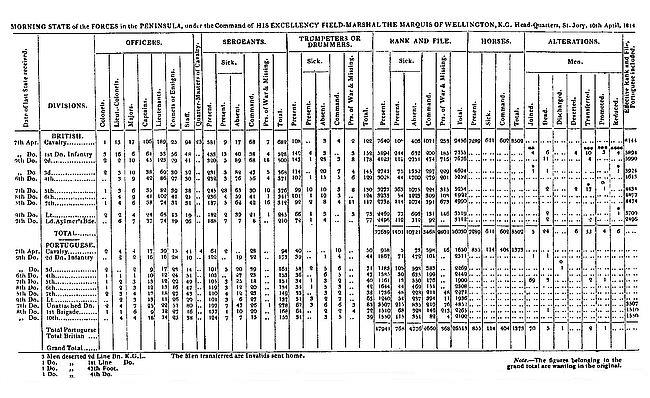
click here for larger image.
MORNING STATE of the FORCES in the PENINSULA, under the Command of HIS EXCELLENCY FIELD-MARSHAL THE MARQUIS OF WELLINGTON, K.G. Head-Quarters, St. Jory, 10th April, 1814.
KEY: AA = Colonels. KEY: BA = Quarter-Masters of Cavalry.
AB = Lieut.-Colonels. BB = Present.
AC = Majors. BC = Present.
AD = Captains. BD = Absent.
AE = Lieutenants. BE = Command.
AF = Cornets or Ensigns. BF = Prs. of War & Missing.
AG = Staff. BG = Total.
Date of DIVISIONS. OFFICERS SERGEANTS.
last State Sick.
received. AA AB AC AD AE AF AG BA BB BC BD BE BF BG
BRITISH.
7th Apr. Cavalry 1 13 17 106 189 25 94 25 581 9 17 68 7 682
” Do. 1st Dn. Infantry 3 16 6 64 53 56 48 .. 433 13 40 38 4 528
9th Do. 2d 2 2 10 45 123 29 41 .. 320 5 89 68 18 500
” Do. 3d 2 3 10 38 69 30 32 .. 231 3 82 47 5 368
6th Do. 4th .. 3 9 42 86 27 30 .. 232 3 76 56 4 371
7th Do. 5th 1 3 6 35 82 39 38 .. 245 28 63 30 10 376
8th Do. 6th .. 4 9 41 102 41 25 .. 236 4 59 41 1 341
5th Do. 7th 1 4 6 38 74 31 31 .. 187 5 62 42 16 312
9th Do. Lt. 2 2 4 24 68 13 19 .. 182 2 39 21 1 245
7th Do. Ld.Aylmer’s Bde. .. 6 7 37 74 19 26 .. 188 7 7 8 .. 210
TOTAL
--------
PORTUGUESE.
7th Apr. Cavalry 2 4 4 17 39 15 41 4 64 2 .. 28 .. 94
9th Do. 2d Dn. Infantry .. 2 2 16 16 28 10 .. 122 .. 19 32 .. 173
” Do. 3d 2 .. 2 9 17 23 14 .. 101 5 20 39 .. 165
6th Do. 4th 1 1 1 10 12 24 51 .. 103 .. 27 23 .. 153
7th Do. 5th 1 2 3 13 12 22 49 .. 105 3 25 18 .. 151
8th Do. 6th 1 2 3 12 13 16 47 .. 119 3 12 20 .. 154
5th Do. 7th 2 3 4 17 18 27 43 .. 110 4 12 23 .. 149
9th Do. Lt. .. 2 3 13 11 26 29 .. 101 3 6 27 .. 137
7th Do. Unattached Dn. 2 4 7 25 22 51 80 .. 197 7 47 26 1 278
8th Do. 1st Brigade 1 1 6 9 12 27 16 .. 137 1 10 20 .. 168
” Do. 10th .. 4 4 18 14 23 38 .. 124 7 7 15 .. 153
Total Portuguese
Total British
Grand Total
KEY: CA = Present. KEY: DA = Present.
CB = Present. DB = Present.
CC = Absent. DC = Absent.
CD = Command. DD = Command.
CE = Prs. of War & Missing. DE = Prs. of War & Missing.
CF = Total. DF = Total.
DIVISIONS. TRUMPETERS OR DRUMMERS. RANK AND FILE
Sick. Sick.
CA CB CC CD CE CF DA DB DC DD DE DF
BRITISH.
Cavalry 108 .. 8 4 2 122 7640 106 406 1071 233 9456
1st Dn. Infantry 142 4 3 .. 3 152 5894 244 632 200 185 7155
2d 143 1 23 3 8 178 4123 112 2251 474 716 7676
3d 114 .. 20 7 4 145 2741 75 1352 297 229 4694
4th 102 1 15 5 6 129 3028 44 1700 279 201 5252
5th 99 10 10 3 8 130 3277 363 1075 224 315 5254
6th 101 1 19 3 .. 124 3233 54 1223 309 103 4922
7th 92 2 8 4 11 117 2738 114 1074 391 673 4990
Lt. 66 1 3 .. 3 73 2469 77 696 131 146 3519
Ld.Aylmer’s Bde. 72 1 4 .. .. 77 2496 212 312 92 .. 3112
TOTAL 37639 1401 10721 3468 2801 56030
-------
PORTUGUESE.
Cavalry 40 .. .. 10 .. 50 958 5 73 598 16 1650
2d Dn. Infantry 39 .. 1 4 .. 44 1867 71 472 101 .. 2511
3d 58 2 5 6 .. 71 1183 105 598 383 .. 2269
4th 36 .. 6 5 .. 47 1585 30 635 199 .. 2449
5th 34 1 3 2 .. 40 1161 13 550 176 .. 1900
6th 33 1 5 3 .. 42 1644 44 469 151 .. 2308
7th 33 .. 3 2 .. 38 1736 48 228 211 48 2271
Lt. 51 3 2 7 .. 63 1240 54 237 394 11 1936
Unattached Dn. 67 3 6 6 3 85 3507 215 835 219 76 4852
1st Brigade 64 .. 2 2 4 72 1510 68 328 146 213 2265
10th 31 .. 3 5 .. 39 1550 115 351 82 4 2102
Total Portuguese 17941 768 4776 2660 368 26513
Total British
Grand Total
KEY: EA = Present. KEY: FA = Joined.
EB = Sick. FB = Dead.
EC = Command. FC = Discharged.
ED = Total. FD = Deserted.
FE = Transferred
FF = Promoted.
FG = Reduced.
FH = Effective Rank and File,
Portuguese included.
DIVISIONS. HORSES. ALTERATIONS.
Men.
EA EB EC ED FA FB FC FD FE FF FG FH
BRITISH.
Cavalry 7289 611 602 8502 .. .. .. .. .. .. .. 8144
{b} {c} {c} {d}
1st Dn. Infantry .. .. .. .. .. .. .. .. 4 6 .. 4 10 3 4 5894
2d .. .. .. .. .. .. .. .. .. 11 .. .. 4 .. .. 5990
{a} {a}
3d .. .. .. .. .. .. .. .. 1 1 .. .. .. .. 1 3924
4th .. .. .. .. .. .. .. .. .. .. .. .. .. .. .. 4613
{a} {e}
5th .. .. .. .. .. .. .. .. .. 2 .. 2 17 1 .. 4438
6th .. .. .. .. .. .. .. .. .. .. .. .. .. .. .. 4877
7th .. .. .. .. .. .. .. .. .. .. .. .. .. .. .. 4474
{a}
Lt. .. .. .. .. .. .. .. .. .. 2 .. .. .. .. 1 3709
Ld.Aylmer’s Bde. .. .. .. .. .. .. .. .. .. 2 .. .. 2 .. .. 2496
TOTAL 7289 611 602 8502 5 24 .. 6 33 4 6 ..
-------
PORTUGUESE.
Cavalry 855 114 404 1373 .. .. .. .. .. .. .. ..
2d Dn. Infantry .. .. .. .. .. .. .. .. 1 1 .. .. .. .. .. ..
{e} .. .. .. .. ..
3d .. .. .. .. .. .. .. .. .. .. 1 .. .. .. .. ..
4th .. .. .. .. .. .. .. .. .. .. .. .. .. .. .. ..
5th .. .. .. .. .. .. .. .. 69 3 .. .. 2 1 .. ..
6th .. .. .. .. .. .. .. .. .. .. .. .. .. .. .. ..
7th .. .. .. .. .. .. .. .. .. .. .. .. .. .. .. ..
Lt. .. .. .. .. .. .. .. .. .. .. .. .. .. .. .. ..
Unattached Dn. .. .. .. .. .. .. .. .. .. .. .. .. .. .. .. 3507
1st Brigade .. .. .. .. .. .. .. .. .. 1 .. .. .. .. .. 1510
10th .. .. .. .. .. .. .. .. .. .. .. .. .. .. .. 1550
-------
Total Portuguese 855 114 404 1373 70 5 1 .. 2 1 .. ..
Total British
Grand Total
3 Men deserted 2d Line Bn. K.G.L.
1 Do. ” 1st Line Do.
1 Do. ” 47th Foot.
1 Do. ” 4th Do.
The Men transferred are Invalids sent home.
_Note._—The figures belonging to the grand total are wanting in the original.